
ヘレロ蜂起
Herero uprising
German garrison of Windhoek, besieged by the Herero, 1904
☆ヘ
レロ・ナマ戦争[4]とは、ドイツ領南西アフリカ(現在のナミビア)の先住民、主にヘレロ族とナマ族が、ドイツ帝国に対して行った一連の相互に関連した反
植民地武装闘争の総称である。この紛争は1904年から1908年にかけて発生し[5]、ヘレロ族の反乱や第二次ナマ族の反乱などが含まれる。
| The Herero and Nama
War[4] is the collective term for a series of interlinked,
anti-colonial armed struggles by native peoples in German South West
Africa (present-day Namibia), mainly the Herero and Nama people,
against the German Empire. The overall conflict took place between 1904
and 1908,[5] and included the Herero uprising and the Second Nama
Rebellion. |
ヘレロ・ナマ戦争[4]とは、ドイツ領南西アフリカ(現在のナミビア)
の先住民、主にヘレロ族とナマ族が、ドイツ帝国に対して行った一連の相互に関連した反植民地武装闘争の総称である。この紛争は1904年から1908年に
かけて発生し[5]、ヘレロ族の反乱や第二次ナマ族の反乱などが含まれる。 |
| Names The 1904–1908 conflict has received numerous different names, with Herero and Nama War being a popular choice,[4] including the variant war against the Ovaherero and Nama.[6] The alternatives Namibian-German War or Namibian War had gained popularity by the 2020s, emphasizing the anti-colonial and inter-ethnic character of the conflict.[5] As part of the debate on Namibian genocide reparations, the Scientific Services of the German Bundestag [de] released a 2016 paper where the overall conflict was dubbed Rebellion by the Ethnic Groups of the Herero and Nama in German Southwest Africa; this naming was strongly criticized by historian Harald Kleinschmidt who regarded it as "discriminatory" and based on German colonial literature.[7][a] Instead of giving the entire war one name, however, researchers have often focused on individual sections or phases of the fighting and given those individual names. As such, the 1904–1908 conflict has been subdivided into the Herero uprising (1904–1907),[10] alternatively known as Herero Revolt,[11] Revolt of the Hereros,[12] Herero War,[11] or the Ovaherero-German War;[13] and the Second Nama Rebellion (1904–1908)[10] or Nama-German War.[5] |
名称 1904年から1908年にかけての紛争には数多くの異なる名称が付けられており、「ヘレロ・ナマ戦争」が一般的な呼称となっている[4]。これには、 「オヴァヘレロおよびナマに対する戦争」という表現も含まれる[6]。2020年代には、「ナミビア・ドイツ戦争」や「ナミビア戦争」といった呼称が広ま り、この紛争の反植民地主義的かつ民族間の対立という性格が強調されるようになった。[5] ナミビアのジェノサイド賠償をめぐる議論の一環として、ドイツ連邦議会の科学調査局[de]は2016年に報告書を発表し、この紛争全体を「ドイツ南西ア フリカにおけるヘレロ族およびナマ族による反乱」と称した。この呼称は、歴史家のハラルド・クラインシュミットから、「差別的」であり、ドイツの植民地時 代の文献に基づいているとして強く批判された。[7][a] しかし、戦争全体に一つの名称を与える代わりに、研究者たちはしばしば戦闘の個々の部分や段階に焦点を当て、それらに個別の名称を付けてきた。そのため、 1904年から1908年にかけての紛争は、ヘレロの蜂起(1904年–1907年)[10](別名:ヘレロの反乱[11]、ヘレロ族の反乱、 [12] ヘレロ戦争[11]、あるいはオヴァヘレロ・ドイツ戦争[13]と呼ばれることもある。また、第2次ナマ反乱(1904年–1908年)[10]、あるい はナマ・ドイツ戦争[5]とも呼ばれる。 |
| Background Pre-colonial South-West Africa Before colonization, the most populous groups in Namibia were the Herero in the central and southern regions, the Nama in the south, and the Ovambo in the north.[10] The Ovambo were agriculturists as their lands had access to the waterways of the Etosha Pan,[14] whereas the other native peoples were mainly semi-nomadic cattle-raisers.[10] By the 19th century, the Herero were transitioning into a form of "nomadic feudalism", with a greater division of wealth and a political-religious elite which included the chiefs of the around 20 oruzo (paternal derivation groups).[15] The Namibian Nama were traditionally split into eight clans since the 18th century, namely the Red Nation, Fransman Nama, Swartbooi Nama, Groot Doden, Veldschoendragers, Keetmanshoop Nama, Bondelswarts, and Topnaars.[16] In the early 19th century, the Oorlam Nama also migrated into Namibia, adding five more clans, namely the Witboois, Amraal, Bereseba, Bethanie, and the Afrikaners. The Oorlam clans were partially descended from European settlers in South Africa.[17] Both the Herero and Nama adapted some aspects of warfare from the South African Boers, including horse-mounted guerrilla warfare.[10] The Oorlam Nama were particularly acquainted with European ways due to having lived around Boer settlements before their migration to Namibia.[17] In contrast, the Ovambo discouraged most contacts with European explorers and traders due to their strong focus on their inherited warrior traditions.[14] Smaller ethnic groups included the San, Damara, and Basters.[18] The San were largely hunters and gatherers and weaker than the other native peoples.[19] The Damaras were largely "serfs" or slaves of Herero and Nama, while the free Damaras existed as hunters and gatherers in the local mountains. The Basters were descended from "legally recognized and religiously consecrated unions" of Dutch men and Nama women; they were proud of their European heritage and spoke Dutch.[20] From 1830, the later Namibia became engulfed in warfare between the different ethnic groups and clans due to influx of migrants from other regions, the spread of European firearms by trade, and scarcity of resources due to droughts.[21] A major conflict erupted when Herero intruded into traditional Nama lands on the search for new pastures in 1830, whereupon the Nama rallied under the leadership of Jonker Afrikaner to push them back. The resulting fighting intermittently lasted until 1858, with Jonker Afrikaner temporarily dominating much of Namibia,[22] while the Herero suffered such heavy losses that European Christian missionaries prematurely claimed that the "Herero race has so far as we know ceased to exist".[23] Under the pressure of Christian missionaries and many Nama –who had grown wary of his power– Jonker Afrikaner was forced into signing the peace treaty of Hoachanas in 1858. As part of this treaty, the Herero acknowledged the Nama as overlords.[24] After Jonker Afrikaner died in 1861, his Nama coalition fell apart. As Swedish trader Charles Andersson had also sold large numbers of guns to the Herero, the latter exploited the Nama's weakness by launching a new conflict which became known as the "Herero War of Freedom". At the time, local white residents began petitioning both the Cape Colony and North German Confederation to intervene to bring the Nama-Herero conflicts to an end, but these requests were ignored. Regardless, historian Jon Bridgman argued that these petitions set "a dangerous precedent" for things to come. The war ultimately concluded with the treaty of Okahandja in 1870, with the Herero regaining their independence.[25] From 1870, Herero chief Samuel Maharero became the predominant figure in Namibia, being called upon to mediate in disputes by Herero, Nama, and Europeans alike. However, Maharero regarded his position as tenuous and continued to view the Nama as potential enemies; he thus requested the Cape Colony to send a commissioner to secure the peace and, by extension, his own position. As a result of Maharero's closeness to commissioner William Coates Palgrave, the Nama were ultimately unwilling to submit to the Palgrave Commission.[26] The peace process collapsed in 1880, when a new war broke out over a border incident and Palgrave withdrew from the region. The renewed conflict was economically ruinous to local European traders.[27] |
背景 植民地化以前の南西アフリカ 植民地化以前、ナミビアで最も人口の多かった民族集団は、中部および南部地域のヘレロ族、南部のナマ族、そして北部のオバンボ族であった。[10] オバンボ族は、その土地がエトーシャ・パンの水路に面していたため農業を営んでいた[14]が、他の先住民族は主に半遊牧的な牧畜民であった。[10] 19世紀までに、ヘレロ族は富の分配がより進み、約20のオルゾ(父系集団)の長らを含む政治・宗教的エリート層を擁する、一種の「遊牧封建制」へと移行 しつつあった。[15] ナミビアのナマ族は、18世紀以来、伝統的に8つの氏族に分かれていた。すなわち、レッド・ネイション、フランスマン・ナマ、スワートボイ・ナマ、グルー ト・ドーデン、フェルトショエンドラガース、キートマンズフープ・ナマ、ボンデルスワーツ、トプナールである。[16] 19世紀初頭には、オールラム・ナマ族もナミビアへ移住し、ウィットブイス、アムラール、ベレセバ、ベタニー、アフリカーナーズの5つの氏族が加わった。 オールラム氏族は、一部が南アフリカのヨーロッパ人入植者の子孫であった。[17] ヘレロ族とナマ族の両者は、騎馬ゲリラ戦を含む、南アフリカのボーア人からの戦術の一部を取り入れた。[10] オールラム・ナマ族は、ナミビアへの移住前にボーア人の入植地周辺で生活していたため、特にヨーロッパの習慣に精通していた。[17] 対照的に、オバンボ族は、受け継がれてきた戦士としての伝統を強く重視していたため、ヨーロッパの探検家や商人との接触をほとんど避けていた。[14] 小規模な民族集団には、サン族、ダマラ族、バスター族が含まれていた。[18] サン族は主に狩猟採集民であり、他の先住民族に比べて勢力が弱かった。[19] ダマラ族の多くはヘレロ族やナマ族の「農奴」あるいは奴隷であったが、自由な身分のダマラ族は地元の山岳地帯で狩猟採集民として暮らしていた。バスター族 は、オランダ人男性とナマ族女性の「法的に認められ、宗教的に祝福された結合」から生まれた子孫であり、彼らは自らのヨーロッパの血統を誇り、オランダ語 を話していた。[20] 1830年以降、後のナミビアとなる地域は、他地域からの移住者の流入、交易によるヨーロッパ製火器の普及、そして干ばつによる資源の不足により、異なる 民族集団や氏族間の戦争に巻き込まれていった。[21] 1830年、ヘレロ族が新たな牧草地を求めてナマ族の伝統的な領土に侵入したことで大規模な紛争が勃発し、これに対しナマ族はヨンカー・アフリカーナーの 指導の下で結集し、ヘレロ族を撃退した。その結果生じた戦闘は1858年まで断続的に続き、ヨンカー・アフリカーナーが一時的にナミビアの大部分を支配す るに至った[22]一方、ヘレロ族は甚大な被害を被り、ヨーロッパのキリスト教宣教師たちは時期尚早ながら「我々の知る限り、ヘレロ族はもはや存在しなく なった」と主張した。[23] キリスト教宣教師や、彼の権力に警戒感を抱くようになった多くのナマ族からの圧力により、ヨンカー・アフリカーナーは1858年にホアチャナス和平条約へ の調印を余儀なくされた。この条約の一環として、ヘレロ族はナマ族を宗主として認めた。[24] 1861年にヨンカー・アフリカーナーが死去すると、彼のナマ連合は崩壊した。スウェーデンの商人チャールズ・アンデションもヘレロ族に大量の銃を販売し ていたため、ヘレロ族はナマ族の弱体化に乗じて新たな紛争を開始し、これは「ヘレロ自由戦争」として知られるようになった。当時、現地の白人居住者たち は、ナマ族とヘレロ族の紛争を終結させるため、ケープ植民地と北ドイツ連邦の両方に介入を求める請願を始めたが、これらの要請は無視された。それにもかか わらず、歴史家のジョン・ブリッジマンは、これらの請願が後の事態にとって「危険な前例」を築いたと論じている。この戦争は最終的に1870年のオカハン ジャ条約で終結し、ヘレロ族は独立を取り戻した。[25] 1870年以降、ヘレロ族の首長サミュエル・マハレロはナミビアにおける主導的な存在となり、ヘレロ族、ナマ族、そしてヨーロッパ人からも紛争の調停を求 められた。しかし、マハレロは自身の立場が不安定であると考え、ナマ族を潜在的な敵と見なし続けた。そのため、彼は平和を確保し、ひいては自身の地位を固 めるために、ケープ植民地に委員の派遣を要請した。マハレロがウィリアム・コーツ・パルグレイブ委員と親密な関係にあった結果、ナマ族は最終的にパルグレ イブ委員会への服従を拒んだ。[26] 1880年、国境紛争をきっかけに新たな戦争が勃発し、パルグレイブが同地域から撤退したことで、和平プロセスは崩壊した。再燃した紛争は、現地のヨー ロッパ人商人にとって経済的に壊滅的な打撃となった。[27] |
| German colonization In the early 1880s, the German statesman Otto von Bismarck, reversing his previous rejection of colonial acquisitions, decided on a policy of imperial expansion. In 1882 Bismarck gave permission to Adolf Lüderitz to obtain lands which Germany would bring within its "protection", under the conditions that a port was established within the territories taken and that there was "clear title" to the land. Lüderitz bought the title to Angra Pequena (later renamed Lüderitz Bay) from Joseph Fredericks, a chief of the Oorlam people, in exchange for 200 rifles, 2,500 German marks, and some lead toy soldiers, and established a port there. Clarification of Germany's title among the European powers took some time, as the British demurred in response to a German request to clarify the boundaries of their title, however in April 1884 Bismarck instructed the German consul in declare "Lüderitzland" (as Lüderitz's holding in South-West Africa had become known) as under the "protection" of the German Reich. Lüderitz steadily spread Germany's influence throughout the South-West African territory until by 1885 only one tribe within it – the Witboois – had not concluded some kind of arrangement with Germany.[28]  Theodor Leutwein toasting Hendrik Witbooi in 1896 The continued resistance of the Witboois, led by Hendrik Witbooi, culminated in an armed conflict in 1893, as the Germans opted to violently force them into submission. This campaign, also known as the "First Nama Rebellion", demonstrated the Nama's effective use of guerrilla warfare and dragged on until 1904. It was concluded when the new German governor, Theodor Leutwein, managed to corner the Witboois in the Naukluft Mountains where they agreed to surrender. The German-Witbooi treaty allowed the Witbooi Nama to remain under arms as German allies and auxiliaries.[29] Over the next years, Leutwein launched disarmament and punitive operations to subjugate native groups, including the Mbandjeru and Khaua Nama, the Zwartboois, the Grootfontein "mixed-bloods", and some Nama Afrikaners.[30] Whilst Rhenish missionaries, traders, and other Europeans had been present in the territory since the 1830s, it was only with the advent of Germany's claim to South-West Africa that German settlement of the territory began in earnest. By 1903 there were roughly 4,682 European settlers in the protectorate of whom nearly 3,000 were Germans, most of them in the towns of Lüderitz, Swakopmund, and Windhoek. The advent of large-scale German settlement also brought about changes in the treatment of the native Herero and Nama peoples by Europeans, with native people facing increased legal discrimination and expropriation of land for the use of European settlers.[31] The large majority of these settlers were men, as just 700 white women lived in the colony before the rebellion. This caused many male settlers to take native concubines, often forcefully, or just rape local women.[32] The impact of the German colonization was uneven, with the Herero territories being heavily affected,[33] whereas the Ovambo "remained essentially unconquered".[10] The fort Namutoni effectively marked the northern border of German control, beyond which the Ovambo remained largely self-governing.[34] Traditional Herero society and political-religious systems disintegrated during the German rule. The new commercial pressures encouraged many Herero to sell their cattle, forcing large numbers to become cattle ranchers who worked for Germans or richer Herero.[35] Samuel Maharero was officially appointed Herero paramount chief by the Germans, though this position had not existed before colonization and Maharero could not fulfill the religious duties of the chiefdom due to being Christian.[35] There existed no measures for Maharero, let alone other chiefs, to enforce their decision across the entire Herero people; at best, chiefs like Maharero acted as primus inter pares. Regardless of any formal appointments, the power of all Herero chiefs largely depended on their wealth and had to be shared with all other cattle owners. Furthermore, the Herero were subdivided into nine large tribes by 1903. The Okahandja Herero under Maharero's personal leadership were the largest tribe, bordered to the west by the Omaruru Herero of Chief Manasse and the Otijimbingwe Herero under Chief Zacharias. Around Mount Waterberg lived Chief Kambazeni's tribe, while the east was split into smaller tribes under Chiefs Nikodemus, Tjetjo, Mambo, Ombondju, and Kakimena.[36] |
ドイツによる植民地化 1880年代初頭、ドイツの政治家オットー・フォン・ビスマルクは、それまで植民地獲得に反対していた姿勢を翻し、帝国拡張政策を決定した。1882年、 ビスマルクはアドルフ・リュデリッツに対し、獲得した領土内に港湾を建設すること、およびその土地に対する「明確な所有権」を有することを条件として、ド イツが「保護」下に置く土地を取得することを許可した。リューデリッツは、オオラム族の首長ヨゼフ・フレデリックスから、200丁のライフル、2,500 ドイツマルク、および鉛製のおもちゃの兵隊数体を代償として、アングラ・ペケナ(後にリューデリッツ湾と改名)の所有権を購入し、そこに港を建設した。ド イツの権利範囲を欧州列強の間で明確にするには時間を要した。ドイツが権利範囲の境界を明確にするよう求めたのに対し、イギリスが難色を示したためであ る。しかし1884年4月、ビスマルクはドイツ領事に対し、「リューデリッツランド」(南西アフリカにおけるリューデリッツの保有地として知られるように なった)をドイツ帝国の「保護」下にあると宣言するよう指示した。リューデリッツは南西アフリカ全域にドイツの影響力を着実に広め、1885年までには、 その領土内の部族のうちウィトボイ族のみが、ドイツとの何らかの取り決めを結んでいなかった。[28] 1896年、ヘンドリック・ウィットブイに乾杯するテオドール・ロイトヴァイン ヘンドリック・ウィットブイ率いるウィットブイ族の抵抗は続き、ドイツ側が武力による服従を強いることを選択したため、1893年に武力衝突へと発展し た。「第一次ナマ族反乱」としても知られるこの戦役は、ナマ族によるゲリラ戦術の効果的な運用を示すものであり、1904年まで長期化した。この戦役は、 新任のドイツ総督テオドール・ロイトヴァインがナウクルフト山脈でウィトボイ族を包囲し、彼らが降伏に同意したことで終結した。ドイツとウィットボイ族の 条約により、ウィットボイ・ナマ族はドイツの同盟者および補助部隊として武装を維持することが認められた。[29] その後数年間、ロイトヴァインは、ムバンジェルー・ナマ族やカウア・ナマ族、ズワルトボイ族、グルートフォンテインの「混血」たち、そして一部のナマ・ア フリカーナーを含む先住民集団を服従させるため、武装解除および懲罰作戦を展開した。[30] 1830年代からライン地方出身の宣教師や商人、その他のヨーロッパ人がこの地域に滞在していたが、ドイツによる南西アフリカの領有権主張が始まって初め て、この地域へのドイツ人入植が本格的に始まった。1903年までに、この保護領にはおよそ4,682人のヨーロッパ人入植者がおり、そのうち3,000 人近くがドイツ人で、その大半はリューデリッツ、スワコプムント、ウィントフックの各町に居住していた。大規模なドイツ人入植の到来は、ヨーロッパ人によ る先住民ヘレロ族やナマ族への扱いにも変化をもたらし、先住民は法的差別を強められ、ヨーロッパ人入植者のために土地を収用される事態に直面した。 [31] 反乱前の植民地には白人女性がわずか700人しか居住していなかったため、入植者の大多数は男性であった。このため、多くの男性入植者が先住民の女性を、 しばしば強制的に妾にしたり、あるいは単に地元の女性を強姦したりする事態が生じた。[32] ドイツ植民地化の影響は地域によって異なり、ヘレロ族の領土は深刻な影響を受けた[33]一方、オバンボ族は「本質的に征服されなかった」ままであった [10]。ナムトニ砦は事実上、ドイツ支配の北の境界線となり、その北側ではオバンボ族が概ね自治を維持していた[34]。 ドイツ統治下において、ヘレロの伝統社会および政治・宗教的体制は崩壊した。新たな商業的圧力により、多くのヘレロ人が家畜を売却するよう促され、その結 果、大勢のヘレロ人がドイツ人や裕福なヘレロ人のために働く牧畜業者となることを余儀なくされた。[35] サミュエル・マハレロはドイツ人によって正式にヘレロの最高首長に任命されたが、この地位は植民地化以前には存在せず、またマハレロはキリスト教徒であっ たため、首長としての宗教的義務を果たすことはできなかった。[35] マハレロをはじめとする首長たちが、ヘレロ族全体に対して自らの決定を強制する手段は存在しなかった。せいぜい、マハレロのような首長は「同輩中の第一人 者(primus inter pares)」として振る舞うに過ぎなかった。いかなる正式な任命があろうとも、すべてのヘレロ族首長の権力は主にその富に依存しており、他のすべての牛 の所有者と共有されなければならなかった。さらに、1903年までにヘレロ族は9つの大きな部族に細分化されていた。マハレロの直接的な指導下にあったオ カハンジャ・ヘレロ族は最大の部族であり、西側にはマナッセ首長のオマルル・ヘレロ族、ザカリアス首長のオティジンブウェ・ヘレロ族が隣接していた。 ウォーターバーグ山周辺にはカンバゼニ首長の部族が居住し、東側はニコデムス、チェチョ、マンボ、オンボンジュ、カキメナ各首長の下にある小規模な部族に 分かれていた。[36] |
| Prelude Herero grievances  Samuel Maharero, Herero paramount chief The Herero's key grievance and the structural condition which led to the outbreak of the war was the existence of an unfair judicial system. If a white person was killed, multiple Africans would be executed as punishment. In contrast, settlers could kill natives with effective impunity because African lives were deemed worthless, so the judicial system would find a way to exonerate or issue a minimal punishment.[37] The result was widespread murder and rape against Africans by settlers, which weakened the colonial administration's monopoly on violence and overall authority. The victims were powerless to get redress for these crimes because police and soldiers were among the perpetrators.[38] African witnesses were generally deemed to be unreliable by German courts,[33] often contributing to the courts exonerating settlers accused of wrongdoings.[33] Several settlers abused the lopsided judicial system, becoming serial violators.[33][39] On the other side, Germans who opposed the abuses were ostracized by settlers and even sanctioned by the courts as well as colonial authorities.[33] German employers were legally allowed to beat, whip, and flog indigenous employees.[40][33] Even chiefs were subject to corporal punishments. According to historian Horst Drechsler, most "Germans described the Africans as baboons and treated them accordingly".[33][b] Many settlers regarded the native Africans as either potential cheap labor or obstacles to be eliminated.[39] The influence of the struggle over land in regards to the Herero uprising remains disputed among researchers. Some studies have emphasized struggle over land as the central cause of the uprising, but the colonist population was not quickly increasing in 1903 and other research has shown that the land question was not urgent.[42][c] In the period before the rebellion, Leutwein had begun to implement a strategy to concentrate indigenous people on reserves.[43] The creation of the reserves, alongside a statute limiting contracts in July 1903, were supposed to at least partially remedy abuses against the Herero. Instead, the reserves openly showcased how little land the Herero still held, while the statute led traders to further pressure natives to repay debts. These measures thus led to even greater grievances among the Herero.[44] The building of the Otavi railway resulted in further seizure of land in the southern territories of the Herero, and the railway's financier –the Otavigesellschaft– openly demanded that the Herero cede not just land for a further expansion of the line itself but also all water rights and a 20 kilometres (12 mi) stretch along the tracks. Leutwein negotiated with Samuel Maharero over these demands until the chief partially yielded. Maharero agreed to relinquish land for the railway's tracks free of charge, but no additional territory.[45] The Herero were aware that the expansion of the railway might lead to an influx of more settlers into their areas.[33] In general, the settler population as well as German authorities ignored the provisions of the protection treaty with the Herero, with Leutwein noting that the majority of the local whites were even ignorant of the treaty's existence. The Herero complained that the Germans were violating their customs and breaking the treaty; realizing that the old promises were ignored, many Herero also no longer felt bound by the agreement by 1904.[33] |
序章 ヘレロ族の不満 サミュエル・マハレロ、ヘレロ族の最高首長 ヘレロ族の主な不満であり、戦争勃発につながった構造的な要因は、不公正な司法制度の存在であった。白人が殺害された場合、その報復として複数のアフリカ 人が処刑されることになっていた。対照的に、入植者は事実上免責された状態で先住民を殺害することができた。アフリカ人の命は無価値と見なされていたた め、司法制度は入植者を無罪とするか、あるいは最小限の刑罰しか科さないよう仕向けたのである。[37] その結果、入植者によるアフリカ人への殺害や強姦が蔓延し、植民地行政の暴力独占と全体的な権威が弱体化した。警察や兵士が加害者の中に含まれていたた め、被害者たちはこれらの犯罪に対する救済を求める力がなかった。[38] アフリカ人の証言は、ドイツの裁判所によって概して信頼できないものと見なされ[33]、それがしばしば、不正行為で告発された入植者の無罪判決につな がった。[33] 何人かの入植者は、この不均衡な司法制度を悪用し、常習的な加害者となった。[33][39] 一方、こうした虐待に反対したドイツ人は、入植者から排斥され、さらには裁判所や植民地当局からも制裁を受けた。[33] ドイツ人の雇用主は、先住民の従業員を殴打し、鞭打ち、むち打ちにすることを法的に許されていた。[40][33] 首長でさえ体罰の対象となった。歴史家ホルスト・ドレクスラーによれば、ほとんどの「ドイツ人はアフリカ人をヒヒと呼び、それに応じて扱った」という。 [33][b] 多くの入植者は、先住民のアフリカ人を、潜在的な安価な労働力か、排除すべき障害のいずれかとして見なしていた。[39] ヘレロ族の反乱における土地をめぐる争いの影響については、研究者の間で依然として議論が分かれている。一部の研究では、土地をめぐる争いを反乱の中心的 な原因として強調しているが、1903年当時、入植者人口は急速に増加しておらず、他の研究では土地問題が緊急性を帯びていなかったことが示されている。 [42][c] 反乱前の時期、ロイトヴァインは先住民を保留地に集約する戦略の実施に着手していた。[43] 保留地の設置と、1903年7月の契約を制限する法令の制定は、ヘレロ族に対する虐待を少なくとも部分的に是正するはずであった。しかし実際には、保留地 の設置はヘレロ族が依然として所有する土地がいかに少ないかを露呈する結果となり、一方で法令は商人たちに先住民に対し債務返済をさらに強要するよう促す こととなった。したがって、これらの措置はヘレロ族の間でさらに大きな不満を招くこととなった。[44] オタビ鉄道の建設は、ヘレロ族の南部領土におけるさらなる土地の接収をもたらした。また、鉄道の資金提供者であるオタビゲゼルシャフトは、線路のさらなる 延伸のための土地だけでなく、すべての水利権および線路沿いの20キロメートル(12マイル)の区域についても、ヘレロ族に譲渡するよう公然と要求した。 ロイトヴァインは、首長サミュエル・マハレロが部分的に譲歩するまで、これらの要求について交渉を続けた。マハレロは、鉄道線路のための土地を無償で譲渡 することに同意したが、それ以上の領土の譲渡には応じなかった。[45] ヘレロ族は、鉄道の拡張が自分たちの地域への入植者のさらなる流入につながる可能性があることを認識していた。[33] 概して、入植者層もドイツ当局も、ヘレロ族との保護条約の条項を無視しており、ロイトヴァインは、現地の白人の大多数が条約の存在すら知らないと指摘して いる。ヘレロ族は、ドイツ人が彼らの慣習を侵害し、条約を破っていると訴えた。かつての約束が無視されていることを悟り、1904年までに多くのヘレロ族 もまた、もはやその合意に拘束されるものとは感じていなかった。[33] |
| Start of the Bondelswarts
uprising In 1903, a rebellion by the Bondelswarts, a Nama clan, erupted in the southeastern Namibia.[46] The Bondelswarts had generally cooperated with colonial authorities, as they deemed the rival Witbooi clan a greater threat than the Germans. Tensions greatly increased when local German authorities ordered the Bondelswarts to register their guns in preparation of a disarmament drive, but they refused to comply.[47] Amid local disputes, Lieutenant Walter Jobst, Warmbad district chief, shot the Bondelswarts chief Christian and was then killed by the chief's followers.[47][46][d] Governor Leutwein responded by gradually sending the majority of the colony's Schutztruppe garrison to punish the Bondelswarts.[46][48] A short and fierce war erupted.[49] The Bondelswarts engaged in hit-and-run attacks and began cooperating with bands of robbers in the Karras Hills, with the Germans unable to inflict a defeat on them. On 25 December 1903, Captain Franke's Second Field Company was also sent from Omaruru to the far south of the colony to quell the Bondelswarts' rebellion.[48] Eventually, Leutwein personally ventured south to take command of the campaign.[48] This left the north stripped of troops[50]—there were only 770 German soldiers in the entire colony.[51] At this point, several local clans still offered support to the Germans; for instance, Hendrik Witbooi's clan fought alongside the Schutztruppe against the Bondelswarts.[52] The Bondelswarts were still fighting by early 1904, ensuring that most of the German colonial troops were not present in central Namibia when the Herero uprising broke out.[49][48] |
ボンデルスワーツ族の反乱の始まり 1903年、ナミビア南東部で、ナマ族の一派であるボンデルスワーツ族による反乱が勃発した。[46] ボンデルスワーツ族は、ライバルであるウィトボイ族をドイツ人よりも大きな脅威と見なしていたため、概して植民地当局と協力していた。しかし、地元のドイ ツ当局が武装解除運動の準備としてボンデルスワーツ族に銃の登録を命じたところ、彼らはこれに従うことを拒否し、緊張は著しく高まった。[47] こうした地域紛争のさなか、ヴァルムバート地区長であるヴァルター・ヨブスト中尉がボンデルスワーツ族の首長クリスチャンを射殺し、その後、首長の追随者 たちによって殺害された。[47][46][d] これに対し、ロイトヴァイン総督は、ボンデルスワート族を懲罰するため、植民地のシュッツトルッペ駐屯部隊の大部分を段階的に派遣した。[46][48] 短期間ながら激しい戦争が勃発した。[49] ボンデルスワート族は奇襲攻撃を仕掛け、カラース・ヒルズの盗賊団と協力し始めたが、ドイツ軍は彼らに決定的な打撃を与えることができなかった。1903 年12月25日、ボンデルスワルト族の反乱を鎮圧するため、オマルルからフランケ大尉率いる第2野戦中隊も植民地の最南端へ派遣された。[48] 最終的に、ロイトヴァインは自ら南下し、作戦の指揮を執った。[48] これにより北部は兵力を失った[50]――植民地全体でドイツ兵はわずか770名しかいなかった。[51] この時点でも、いくつかの現地の氏族は依然としてドイツ軍を支援していた。例えば、ヘンドリック・ウィットボイの氏族は、ボンデルスワート族に対して シュッツトルッペと共に戦った。[52] ボンデルスワート族は1904年初頭になってもなお戦闘を続けており、その結果、ヘレロ族の反乱が勃発した際、ナミビア中部にはドイツ植民地軍の大部分が 不在となっていた。[49][48] |
| Rebellion Herero plans 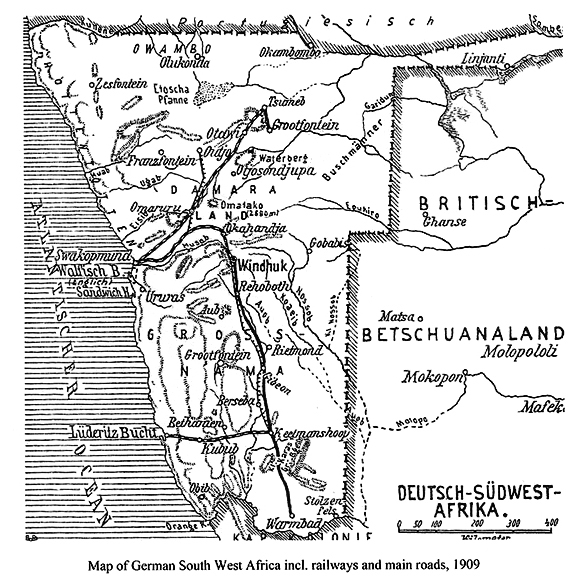 German South West Africa in 1904 In response to their grievances, several Herero leaders including Samuel Maharero began to plan an anti-German uprising.[13][e] The first planning may have taken place at a series of meetings by Herero headmen at Okahandja in April and May of 1903.[53] The Herero uprising was an act of desperation to retake their land, cattle, and political independence; as well as exact revenge.[40][54] Matthias Häussler writes that the war was limited in means but not ends; the Herero wanted the permanent end of German colonization.[55] Similarly, Bridgman described the revolt as being aimed at the removal of the Germans from South West Africa or at least the Herero lands.[53] To which extent the natives believed that a victory over the Germans would be possible is debated among historians. Bridgeman argued that younger Herero and Nama deemed it possible to push the Germans out of Namibia, and pressured their potentially more "defeatist" chiefs to take action.[56] Maharero attempted to forge a wider coalition within Namibia. He secretly contacted the Ovambo in the north, encouraging them to ally with the Herero.[52] The Herero planned to strike at German outposts, garrisons and the transportation and communication system, seeking to cripple the colonial military control in their territories. Even more important to the insurgents was the removal of all German settlers from their lands. The Herero reasoned that the German colonial government existed to the settlers' benefit, so the latter's removal might also trigger an exodus of the colonial forces from the region. The settlers were also targeted because they mainly lived on isolated, indefensible farms with considerable wealth in cattle.[53] At the same time, Maharero sought to avoid massacres of the settlers by the Herero and worked toward preventing an "orgy of wanton killing" upon the uprising's start. According to Bridgeman, Maharero's calls for restraint were partially motivated by moral concerns, including his Christian faith, but also political calculations: By not engaging in unrestricted violence, he could present the Herero as "civilized" and potential allies to other regional people and powers, including the British.[57] To this end, Maharero also ordered his followers to not attack British citizens, Boers, Nama, Basters, and Berg Darama, thereby seeking to avoid the enmity of these peoples and allowing for the possibility of allying with them in the future.[58] The removal of most German troops from their lands due to the Bondelswarts rebellion provided the Herero with a favorable strategic situation, contributing to the rebel leaders triggering their rising in January 1904.[49][48] Furthermore, the absence of the governor and most security forces encouraged violent settlers and Schutztruppe soldiers to increase their abuses of the Herero. Some settlers hoped to provoke violence by the natives, believing that a reaction by the natives could be used to justify further repression. Rumors began to circulate, alleging that Leutwein and some of his troops had been killed by the Bondelswarts or had been interned by the British after crossing the border. Maharero later claimed that settlers and some Schutztruppe officers spread these rumors, as Leutwein was still a trusted figure for the Herero whom more radical Germans viewed as being too lenient toward the natives. The governor's alleged removal further encouraged open resistance.[59] Despite signs of increased Herero unrest in the days leading up to the uprising's planned start, few Germans suspected anything more substantial than a "minor disturbance". Gustav Duft, the German civilian official left in charge in the Herero territories during Leutwein's absence, did grow alarmed, and traveled to Okahandja on 11 January. Duft intended to talk to the Herero chiefs encamped in the area, hoping to deescalate.[60] |
反乱 ヘレロ族の計画 1904年のドイツ領南西アフリカ 不満を背景に、サミュエル・マハレロをはじめとする数名のヘレロ族指導者たちは、反ドイツ蜂起の計画を開始した。[13][e] 最初の計画は、1903年4月から5月にかけてオカハンジャで行われた一連のヘレロ族長会議において策定された可能性がある。[53] ヘレロ族の蜂起は、土地、家畜、そして政治的独立を取り戻すための絶望的な行動であり、同時に復讐を果たすものでもあった。[40][54] マティアス・ヘウスラーは、この戦争は手段こそ限定的であったが、目的は限定的ではなかったと記している。ヘレロ族はドイツの植民地支配の恒久的な終結を 望んでいたのである。[55] 同様に、ブリッジマンもこの反乱を、南西アフリカ、あるいは少なくともヘレロ族の土地からドイツ人を追放することを目的としたものと記述している。 [53] 先住民がドイツに対する勝利をどの程度可能だと信じていたかについては、歴史家の間で議論が分かれている。ブリッジマンは、若いヘレロ族やナマ族がドイツ 人をナミビアから追い出すことは可能だと考えており、より「敗北主義的」な傾向のある首長たちに行動を起こすよう圧力をかけたと論じている。[56] マハレロは、ナミビア国内でより広範な連合を築こうとした。彼は北部のオバンボ族に密かに接触し、ヘレロ族と同盟を結ぶよう促した。[52] ヘレロ族は、ドイツの前哨基地、駐屯地、および交通・通信網を攻撃し、自領内における植民地軍の支配機能を麻痺させることを計画した。反乱軍にとってさら に重要だったのは、自領からすべてのドイツ人入植者を追放することだった。ヘレロ族は、ドイツ植民地政府が入植者の利益のために存在していると判断してお り、入植者を追放すれば、植民地軍もこの地域から撤退するきっかけになるかもしれないと考えた。入植者が標的とされたのは、彼らが主に孤立した防御不可能 な農場に居住し、多量の家畜を所有していたためでもあった。[53] 同時に、マハレロはヘレロによる入植者の虐殺を避けようとし、蜂起開始時の「無差別殺戮の乱痴気騒ぎ」を防ぐよう努めた。ブリッジマンによれば、マハレロ の自制を求める呼びかけは、彼のキリスト教信仰を含む道徳的配慮に部分的に動機づけられていたが、政治的計算もあった。無制限な暴力に走らないことで、彼 はヘレロ族を「文明化された」存在として、また英国を含む地域の他民族や列強にとっての潜在的な同盟者として提示することができた。[57] この目的のため、マハレロはまた、追随者に対し、英国人、ボーア人、ナマ族、バスター族、ベルク・ダラマ族を攻撃しないよう命じ、それによってこれらの民 族との敵対関係を避け、将来的に彼らと同盟を結ぶ可能性を残そうとした。[58] ボンデルスワーツの反乱により、ドイツ軍の大半が彼らの領地から撤退したことは、ヘレロ族にとって有利な戦略的状況をもたらし、1904年1月に反乱指導 者たちが蜂起を起こす一因となった。[49][48] さらに、総督および治安部隊の大半が不在であったため、暴力的な入植者やシュッツトルッペの兵士たちは、ヘレロ族に対する虐待をエスカレートさせるように なった。一部の入植者は、先住民による反応をさらなる弾圧の正当化に利用できると考え、先住民による暴力を引き起こそうと望んでいた。ロイトヴァインと彼 の部隊の一部がボンデルスワート族に殺害された、あるいは国境を越えた後にイギリス軍に抑留されたという噂が流れ始めた。マハレロは後に、ロイトヴァイン はヘレロ族にとって依然として信頼される人物であり、より過激なドイツ人からは先住民に対して寛大すぎると見なされていたため、入植者や一部のシュッツト ルッペ将校がこれらの噂を流したのだと主張した。総督の解任説は、公然とした抵抗をさらに助長した。[59] 蜂起の開始予定日までの数日間、ヘレロ族の動揺が高まっている兆候が見られたにもかかわらず、「些細な騒動」以上の事態を疑うドイツ人はほとんどいなかっ た。ロイトヴァイン不在中にヘレロ領の統治を任されていたドイツ人民間官吏グスタフ・ドゥフトは、事態を憂慮し、1月11日にオカハンジャへと向かった。 ドゥフトは、事態の沈静化を望み、その地域に野営していたヘレロ族の首長たちと話し合うつもりであった。[60] |
| Early Herero rebellion The Herero clans seized the opportunity to rebel on 12 January 1904.[40][60] They mobilized about 8,000 warriors, many armed with guns but others possessing only spears.[61][f] The uprising caught the colonists by surprise[63] and saw a stunning success at first: farms and businesses were plundered, and 123[40] 150,[64] or as many as 160 Germans were killed.[51] Most of those killed were farmers and traders; German soldiers were only one-tenth of the dead. The rebels generally spared women, children, missionaries, and white people who were not German.[63][51][g] Individual attacks were planned to take advantage of deception and surprise, and the Herero seized weapons and supplies.[63] The Herero killed men, took anything useful, razed buildings, and attempted to destroy everything else, in an attempt to destroy colonists' economic existence and force them to depart Namibia forever.[55] The occurrence of mutilation, particularly castration, was in revenge for the sexual violence that had previously been visited on Herero women.[65] For the most part, the Herero warriors displayed considerable military discipline and restraint.[66] Over the course of the uprising's first ten days, nearly all German farms in Herero territories were destroyed; most farmers survived, albeit without any possessions, and fled to the colonial capital Windhoek.[60] In contrast to the effective attacks on the settlers' farms, the Herero did not launch large-scale attacks on the German outposts and towns despite Maharero's commands to do so.[67] Blockaded places included Windhoek, Omaruru, Otjimbingwe, Okahandja, Gobabis, and Outjo.[60] In course of the uprising's first week, there were a few raids, but only "two or three minor outposts" were seriously threatened. No assaults were mounted against major forts or the poorly defended Windhoek. When facing organized defenses, the Herero warriors largely limited themselves to blockades and the destruction of railroad lines as well as telegraph lines. Historians have debated the reasons for the rebels' passivity in this regard; Bridgman reasoned that the Herero were culturally averse toward combat in towns and fortresses, while the German fortifications also served as genuine force-multipliers which remained very difficult for the natives to capture even under favorable conditions.[67] Samuel Maharero was also diplomatically active after the uprising's start. He sent letters to Kaptein Hermanus van Wyk of the Rehoboth Basters as well as Hendrik Witbooi, requesting their support.[52][68] In his letter to Witbooi, Maharero expressed his desire for an inter-ethnic alliance, famously exclaiming Let us die fighting![69][70] Yet van Wyk and Witbooi initially refused to join any rebellion, and van Wyk turned the letters over to the Germans. Maharero may had hoped that the Nama and Basters could tie down the Germans in the south, but this came not to pass.[52] In the north, the Ovambo acually launched attacks on German posts during the first days of the Herero revolt, but these failed.[67] Afterward, the Ovambo largely did not involve themselves in the escalating conflict.[71] |
ヘレロ族の初期の反乱 ヘレロ族の各部族は、1904年1月12日に反乱を起こす好機を捉えた。[40][60] 彼らは約8,000人の戦士を動員したが、その多くは銃で武装していたものの、槍しか持たない者もいた。[61][f] この蜂起は入植者たちを不意打ちにし[63]、当初は驚異的な成功を収めた。農場や商店が略奪され、123人[40]、150人[64]、あるいは最大で 160人のドイツ人が殺害された[51]。殺害された者の大半は農民や商人であり、ドイツ兵は死者のわずか10分の1に過ぎなかった。反乱軍は概して、女 性、子供、宣教師、そしてドイツ人以外の白人を手加減した。[63][51][g] 個々の攻撃は欺瞞と奇襲を活かすよう計画され、ヘレロ族は武器や物資を奪い取った。[63] ヘレロ族は男性を殺害し、有用なものはすべて奪い、建物を焼き払い、その他すべてを破壊しようと試みた。これは入植者の経済的基盤を破壊し、彼らをナミビ アから永久に追い出すことを目的としたものである。[55] 切断、特に去勢が行われたのは、以前にヘレロ族の女性たちが受けた性的暴力への報復であった。[65] 概して、ヘレロ族の戦士たちはかなりの軍事的規律と自制心を示した。[66] 蜂起の最初の10日間で、ヘレロ族の領土内にあるドイツ人農場のほぼすべてが破壊された。農民の多くは、所有物をすべて失ったものの生き延び、植民地首都 のウィントフックへ逃れた。[60] 入植者の農場に対する効果的な攻撃とは対照的に、ヘレロ族はマハレロの命令があったにもかかわらず、ドイツの前哨基地や町への大規模な攻撃は行わなかっ た。[67] 包囲された場所には、ウィントフック、オマルル、オチンビンゲ、オカハンジャ、ゴバビス、アウトジョが含まれていた。[60] 蜂起の最初の1週間の間に、いくつかの襲撃はあったものの、深刻な脅威にさらされたのは「2、3の小さな前哨基地」に過ぎなかった。主要な要塞や、防衛体 制が脆弱なウィントフックに対する攻撃は行われなかった。組織的な防衛体制に直面した場合、ヘレロ族の戦士たちは、主に包囲や鉄道線路、電信線の破壊に留 めた。歴史家たちは、この点における反乱軍の消極的な姿勢の理由について議論してきた。ブリッジマンは、ヘレロ族が文化的に町や要塞での戦闘を嫌っていた こと、またドイツ軍の要塞が真の戦力増強装置として機能しており、有利な状況下であっても先住民がこれを攻略することは極めて困難であったことを理由とし て挙げている。[67] サミュエル・マハレロも、蜂起開始後は外交活動に積極的に取り組んだ。彼はレホボスのバスター族のカプテン、ヘルマヌス・ファン・ヴィークやヘンドリッ ク・ウィットボイに書簡を送り、支援を要請した。[52] [68] ウィトボイへの書簡の中で、マハレロは民族間の同盟を望む意向を表明し、「戦って死のう!」という有名な叫びを上げた。[69][70] しかし、ファン・ヴィークとウィトボイは当初、いかなる反乱への参加も拒否し、ファン・ヴィークはそれらの書簡をドイツ軍に引き渡した。マハレロは、ナマ 族とバスター族が南部でドイツ軍を足止めしてくれることを期待していたのかもしれないが、それは実現しなかった。[52] 北部では、オバンボ族がヘレロ族の反乱開始当初、実際にドイツ軍の駐屯地への攻撃を仕掛けたが、これらは失敗に終わった。[67] その後、オバンボ族は激化する紛争にほとんど関与しなかった。[71] |
| German reaction German garrison of Windhoek, besieged by the Herero, 1904 The Germans were largely surprised by the uprising.[72] At the time, there were about 766 regular German soldiers on duty in the colony, supported by 120 Baster scouts and more than 120 Witbooi scouts. These were reinforced by 764 reservists and 400 untrained settler volunteers. Overall, there were about 2,000 pro-colonial troops available.[1] Aside of the settlers who directly supported the colonial military, many settlers also armed themselves for self-defense, and even women reportedly began to carry guns.[73] Though outnumbered, the colonial forces were better armed and organized than the native insurgents.[74] Upon learning of the Herero's actions, Leutwein hastily initiated negotiations with the Bondelswarts and concluded a peace which provided for the clan's disarmament but was otherwise not favourable to the Germans; this allowed him to move his troops back north.[13] When the colonial authorities called upon the Nama clans to provide auxiliaries in accordance with the old treaties, they obliged; about 100 Nama joined the anti-Herero operations, including several Witboois.[52] The Basters also sided with the Germans and remained loyal to the colonial authorities throughout the entire conflict.[75] Among the German settler community, claims of native atrocities quickly circulated despite the great restraint displayed by the Herero rebels.[76] Exaggerated and fabricated atrocity propaganda[77] portraying Herero as animal-like sadists spread widely[78] with newspapers such as the Kolonialblatt and Deutsch-Südwestafrikanische Zeitung [de] playing a significant role in inciting violence.[79][76] News of the revolt reached the German mainland on 14 January; after initial shock, demands for vengeance were quickly voiced by German officials.[76] German Chancellor Bernhard von Bülow addressed the Reichstag on 18 January, claiming that the rebellion had erupted "without apparent cause", declaring his intention to send an Imperial German Navy regiment as quick response force, and requesting a credit to pay for the deployment of 500 troops, six machine guns, and six artillery pieces during the next month.[80] On 19 January, director of the Colonial Department Oscar Wilhelm Stübel provided more detailed information to the Reichstag, further admitting that the revolt could be motivated by a desire for independence by the Herero. Social Democratic Party leader August Bebel criticized the government's claims, arguing that the revolt had been evidently caused by the abuses committed by settlers and traders in South West Africa. Bebel called for a proper investigation of the revolt's origin.[81] Troops were sent from Germany to re-establish order but only dispersed the rebels, led by Chief Maharero. The Herero led a guerrilla campaign, conducting fast hit-and-run operations then melting back into the terrain they knew well, preventing the Germans from gaining an advantage with their modern artillery and machineguns. Leutwein sent desperate messages to Maharero in hopes of negotiating an end to the war. The Hereros, however, were emboldened by their success and had come to believe that, "the Germans were too cowardly to fight in the open," and rejected Leutwein's offers of peace. One missionary wrote, "One hears nothing but (Herero) talk of 'cleaning up,' 'executing,' 'shooting down to the last man,' 'no pardon,' etc."[82] Soon after the rebellion began, German Emperor Wilhelm II replaced Leutwein with the notorious General Lothar von Trotha.[83] Some German authorities also began more serious efforts to investigate the rebellion's causes. The Reichstag demanded an official inquiry in March 1904, and this demand was reluctantly backed by Stübel. Chancellor Bülow forwarded the demand to Wilhelm II who promptly postponed any investigation indefinitely.[84] In general, German imperialists showcased little genuine interest in the circumstances of the rebellion, instead viewing it as a good pretext to seize more control as well as territory in South West Africa.[72] The uprising was broadly blamed on Herero "blood-thirstiness", "racial strife", the traders' practices,[84] and Leutwein's allegedly too-lenient governing style.[85] British influence was also used as a scapegoat,[86] with Leutwein quickly joining those who claimed that British individuals had incited the Herero to rebel, seeking to deflect blame from himself.[85] The ensuing anti-British campaign—including the arrest of British citizens in South West Africa—petered out once no evidence could be found.[86] German missionaries were also blamed by officials and the pro-colonial press, alleging that the missionaries were somehow abetting the insurgents. Missionaries responded with an anonymous letter in the newspaper Der Reichsbote, clarifying that the rebellion was rooted in the mistreatment of Herero by settlers and officials. This further incited imperialists and colonial officials; the "shadow-boxing" between the missionaries and their critics in the press ultimately availed to little.[87] |
ドイツ側の反応 1904年、ヘレロ族に包囲されたヴィンデフックのドイツ軍駐屯地 ドイツ軍はこの反乱に大きく不意を突かれた。[72] 当時、植民地には約766名のドイツ正規兵が駐留しており、120名のバスター族の斥候と120名以上のウィトボイ族の斥候が支援していた。これらに加 え、764名の予備役兵と400名の訓練を受けていない入植者志願兵が投入された。全体として、約2,000名の親植民地派部隊が動員可能であった。 [1] 植民地軍を直接支援した入植者以外にも、多くの入植者が自衛のために武装し、女性でさえ銃を携行し始めたと伝えられている。[73] 数では劣っていたものの、植民地軍は先住民の反乱軍よりも装備が充実しており、組織化も進んでいた。[74] ヘレロ族の行動を知ると、ロイトヴァインは急いでボンデルスワルト族との交渉を開始し、同氏族の武装解除を条件とする和平を締結したが、それ以外の点では ドイツ側に有利な内容ではなかった。これにより、彼は部隊を北へ撤退させることができた。[13] 植民地当局が旧条約に基づきナマ族の氏族に対し補助兵の提供を求めたところ、彼らはこれに応じた。約100人のナマ族が反ヘレロ作戦に参加し、その中には 数人のウィトブイ族も含まれていた。[52] バスター族もドイツ側に味方し、紛争全体を通じて植民地当局への忠誠を貫いた。[75] ドイツ人入植者社会の間では、ヘレロ族の反乱軍が極めて自制を保っていたにもかかわらず、先住民による残虐行為の主張が急速に広まった。[76] ヘレロ族を動物のようなサディストとして描く、誇張され捏造された残虐行為のプロパガンダ[77]が広く拡散し[78]、『コロニアルブラット』や『ドイ チュ・ズュートヴェストアフリカーニシェ・ツァイトゥング』[de]といった新聞が、暴力を煽る上で重要な役割を果たした。[79] [76] 反乱の報は1月14日にドイツ本土に届いた。当初の衝撃が収まると、ドイツ当局者からはすぐに報復を求める声が上がった。[76] 1月18日、ベルンハルト・フォン・ビューロードイツ首相は帝国議会で演説し、反乱は「明白な原因もなく」勃発したと主張した。また、迅速な対応部隊とし てドイツ帝国海軍連隊を派遣する意向を表明し、翌月中に兵士500名、機関銃6挺、大砲6門を配備するための予算を要求した。[80] 1月19日、植民地局長のオスカー・ヴィルヘルム・シュテューベルは帝国議会に対し、より詳細な情報を提供し、この反乱はヘレロ族の独立への願望に起因す る可能性があるとさらに認めた。社会民主党党首のアウグスト・ベーベルは政府の主張を批判し、この反乱は明らかに南西アフリカの入植者や商人による虐待に よって引き起こされたものだと論じた。ベーベルは反乱の起源について適切な調査を行うよう求めた。[81] 秩序を回復するためドイツから軍隊が派遣されたが、マハレロ首長率いる反乱軍を一時的に追い散らすにとどまった。ヘレロ族はゲリラ戦を展開し、素早い奇襲 攻撃を行った後、熟知した地形に溶け込むことで、近代的な大砲や機関銃を擁するドイツ軍が優位に立つことを阻止した。ロイトヴァインは戦争終結に向けた交 渉を望み、マハレロに必死のメッセージを送った。しかし、ヘレロ族はその成功に勇気づけられ、「ドイツ人は野戦を戦うにはあまりにも臆病だ」と信じるよう になり、ロイトヴァインの和平提案を拒否した。ある宣教師は、「(ヘレロ族の)口にするのは『一掃する』、『処刑する』、『最後の一人まで撃ち殺す』、 『容赦しない』といった言葉ばかりだ」と記している。[82] 反乱が始まって間もなく、ドイツ皇帝ヴィルヘルム2世は、ルートヴァインに代わって、悪名高いロタール・フォン・トロタ将軍を任命した。[83] 一部のドイツ当局も、反乱の原因を調査するためのより本格的な取り組みを開始した。1904年3月、帝国議会は公式調査を要求し、この要求はシュテューベ ルによってしぶしぶ支持された。ビュロー首相はこの要求をヴィルヘルム2世に伝えたが、皇帝は直ちに調査を無期限に延期した。[84] 概して、ドイツの帝国主義者たちは反乱の背景に対して真摯な関心をほとんど示さず、むしろこれを南西アフリカにおける支配権と領土のさらなる掌握に向けた 好都合な口実と見なしていた。[72] この反乱は、概してヘレロ族の「血に飢えた性向」、「人種間の争い」、商人たちの商慣行[84]、そしてロイトヴァインの統治スタイルが寛大すぎたこと [85]に原因があるとして非難された。英国の影響力もスケープゴートとして利用され[86]、ロイトヴァインは、自身への非難をそらすべく、英国人がヘ レロ族を反乱に駆り立てたとする主張にすぐに同調した。[85] 南西アフリカにおける英国人の逮捕を含む、これに続く反英キャンペーンは、証拠が見つからなかったため、次第に下火となった。[86] ドイツ人宣教師たちも、当局や親植民地派の報道機関から非難され、宣教師たちが何らかの形で反乱勢力を助長しているとの疑いがかけられた。宣教師たちは新 聞『Der Reichsbote』に匿名の手紙を寄稿してこれに応じ、反乱の根源は入植者や当局によるヘレロ族への虐待にあると明らかにした。これは帝国主義者や植 民地当局をさらに激昂させたが、新聞上で繰り広げられた宣教師と批判者たちの「空論の応酬」は、結局のところほとんど実を結ばなかった。[87] |
| Fall Further information: Herero and Nama genocide  "Condition of Herero on surrender after having been driven into the desert" A conclusive battle was fought on 11 August 1904, at the Battle of Waterberg in the Waterberg Mountains. Chief Maharero believed his six to one advantage over the Germans would allow him to win in a final showdown. The Germans had time to bring forward their artillery and heavy weapons. Both sides took heavy losses, but the Herero were scattered and defeated.[88] Trotha's troops defeated 3,000–5,000 Herero combatants at the Battle of Waterberg but were unable to encircle and annihilate the retreating survivors.[89]: 605 The pursuing German forces prevented groups of Herero from breaking from the main body of the fleeing force and pushed them further into the desert. As exhausted Herero fell to the ground, unable to go on, German soldiers killed men, women, and children.[90]: 22 It took the Germans until 1908 to re-establish authority over the territory. By that time tens of thousands of Africans (estimates range from 34,000 to 110,000) had been either killed[91][92][93][94][95][96] or died of thirst while fleeing. 65,000 of 80,000 Hereros and at least 10,000 of 20,000 Nama died as a result of the conflict.[97] |
秋 詳細情報:ヘレロ族とナマ族の虐殺 「砂漠へと追い詰められた後の、降伏したヘレロ族の状況」 1904年8月11日、ウォーターバーグ山脈におけるウォーターバーグの戦いで、決戦が繰り広げられた。マハレロ首長は、ドイツ軍に対して6対1という数 的優位を活かせば、最終決戦で勝利できると信じていた。ドイツ軍には、砲兵隊や重火器を前線に展開する時間的余裕があった。双方とも甚大な損害を被った が、ヘレロ族は散り散りになり、敗北した。[88] トロタの部隊はウォーターバーグの戦いで3,000~5,000人のヘレロ族戦闘員を撃破したが、撤退する生存者を包囲して殲滅することはできなかった。 [89]: 605 追撃するドイツ軍は、逃走する主力部隊から離脱しようとするヘレロ族のグループを阻止し、彼らをさらに砂漠の奥へと追い込んだ。疲れ果てたヘレロ族が地面 に倒れ、もはや歩けなくなると、ドイツ兵は男女や子供までも殺害した。[90]: 22 ドイツ軍がこの地域に対する支配権を再確立するには、1908年までを要した。その時点で、数万人のアフリカ人(推定数は3万4000人から11万人)が 殺害されたか[91] [92][93][94][95][96] あるいは逃走中に渇きで命を落とした。8万人のヘレロ族のうち6万5千人、2万人のナマ族のうち少なくとも1万人が、この紛争の結果として死亡した。 [97] |
| Aftermath As a result of their loyalty during the conflict, the Basters were rewarded by the German government by being permitted to retain their lands and way of life until World War I.[20] In 1915, during World War I, South African forces occupied it in the so-called South West Africa Campaign, and SW Africa officially became a mandate of South Africa in 1920.[98] On 16 August 2004, 100 years after the war, the German government officially apologised for the atrocities.[99] "We Germans accept our historic and moral responsibility and the guilt incurred by Germans at that time," said Heidemarie Wieczorek-Zeul, Germany's development aid minister. In addition, she admitted that the massacres were equivalent to genocide.[100] Not until 2015 did the German government admit that the massacres were equivalent to genocide and again apologised in 2016.[contradictory] The Herero are suing the German government in a class action lawsuit.[101] In 2021, Germany announced that they would repay Namibia €1.1 billion.[102] Some notable fighters in Herero Wars are revered as the national heroes of Namibia.[103] |
戦後の展開 紛争中の忠誠心に対し、バスター族はドイツ政府から報いを受け、第一次世界大戦までその土地と生活様式を維持することを認められた。[20] 1915年、第一次世界大戦中、南アフリカ軍は「南西アフリカ戦役」において同地を占領し、1920年に南西アフリカは正式に南アフリカの委任統治領となった。[98] 戦争から100年後の2004年8月16日、ドイツ政府はこれらの残虐行為について公式に謝罪した。[99] ドイツの開発援助大臣ハイデマリー・ヴィーツォレック=ツォイルは、「我々ドイツ人は、歴史的・道義的責任、および当時のドイツ人が負った罪を受け入れ る」と述べた。さらに彼女は、これらの虐殺がジェノサイドに相当することを認めた。[100] ドイツ政府が虐殺がジェノサイドに相当することを認めたのは2015年になってからであり、2016年に改めて謝罪した。[矛盾] ヘレロ族はドイツ政府を相手取り、集団訴訟を起こしている。[101] 2021年、ドイツはナミビアに対し11億ユーロを支払うことを発表した。[102] ヘレロ戦争における著名な戦士の一部は、ナミビアの国民的英雄として崇敬されている。[103] |
| In literature The Herero Wars and the massacres are both depicted in a chapter of the 1963 novel V. by Thomas Pynchon. The tragic story of the Herero and Nama Genocide also appears in Pynchon's 1973 novel Gravity's Rainbow. The heavy toll of the Herero and Nama genocide on individual lives and the fabric of Herero culture is seen in the 2013 historical novel Mama Namibia by Mari Serebrov.[104] The war and the massacres are both significantly featured in The Glamour of Prospecting,[105] a contemporary account by Frederick Cornell of his attempts to prospect for diamonds in the region. In the book, he describes his first-hand accounts of witnessing the concentration camp on Shark Island amongst other aspects of the conflict. |
文学において ヘレロ戦争と虐殺は、トーマス・ピンチョンの1963年の小説『V.』の一章で描かれている。ヘレロ族とナマ族の虐殺という悲劇的な物語は、ピンチョンの1973年の小説『重力 rainbow』にも登場する。 ヘレロ族とナマ族のジェノサイドが個人の命やヘレロ文化の基盤に与えた甚大な被害は、マリ・セレブロフによる2013年の歴史小説『ママ・ナミビア』にも描かれている。[104] この戦争と虐殺は、フレデリック・コーネルによる同地域でのダイヤモンド探鉱の試みを描いた当時の記録『The Glamour of Prospecting』[105]でも大きく取り上げられている。同書の中で、彼は紛争の諸側面の中でも特に、シャーク島にある強制収容所を目撃した自 身の体験について記している。 |
| Herero and Nama genocide National heroes of Namibia |
ヘレロ族とナマ族の虐殺 ナミビアの国民的英雄 |
| Notes a. According to Kleinschmidt, the conflict's description as "rebellion" characterized it as "seemingly illegitimate" struggle,[8] while the use of the term "ethnic groups" in the paper was "denying statehood, sovereignty and subjecthood under international law" to the Herero and Nama.[9] b. Racist and contemptuous attitudes toward the native population of Namibia was widespread in German society, both among settlers as well as in Germany itself.[41] For instance, the sexual relationships between native women and German settlers –including rape– were mainly criticized from a racialist viewpoint and regarded as "Verkafferung [de]", a form of going native.[32] c. Conversely, historian Horst Drechsler argued that the claim about the land question being marginal to the Herero uprising originated in pro-settler circles. For instance, a May 1904 motion by the Berlin branch of the Deutsche Kolonialgesellschaft declared that "the allegation now being circulated in Germany that the Herero have staged their rebellion because their livelihood is in jeopardy is false".[33] Similarly, Karl Dove categorically denied the importance of land grievances to the revolt.[33] d. According to Bridgeman, Jobst had entered the Bondelswarts camp to enforce the gun registration, resulting in a shootout and the death of Chief Willem Christian.[47] According to Kössler, Jobst violently intervened in a dispute over a supposedly stolen goat and murdered Chief Jan Abram Christiaan during this dispute.[46] e. The Germans initially believed that Samuel Maharero's nephew Assa Riarua had masterminded the revolt, based on the faulty assumption that the Maharero could only have been "forced" into an open anti-German resistance by others.[53] f. The extent to which the Herero had access to guns is disputed. Leutwein claimed that just half of the Herero rebels were armed with guns, but the editors of the German official history disagreed and estimated a much higher number.[62] According to Bridgman, the exact number of guns was less important than the rebels' lack of ammunition.[61] g. Only three German women and seven Boer men were killed.[64] |
注 a. クラインシュミットによれば、この紛争を「反乱」と表現することは、それを「一見して正当性を欠く」闘争として位置づけるものであった[8]。また、本論 文における「民族集団」という用語の使用は、ヘレロ族およびナマ族に対し、「国家性、主権、および国際法上の被支配者としての地位」を否定するものであっ た。[9] b. ナミビアの先住民に対する人種差別的かつ軽蔑的な態度は、入植者間だけでなくドイツ本国においても、ドイツ社会に広く蔓延していた。[41] 例えば、先住民の女性とドイツ人入植者との間の性的関係(強姦を含む)は、主に人種主義的な観点から批判され、「ヴェルカッフェルング (Verkafferung)」、すなわち現地化の一形態と見なされていた。[32] c. 逆に、歴史家のホルスト・ドレクスラーは、土地問題がヘレロ族の反乱において二次的な要因であったという主張は、入植者支持派のサークルに由来すると論じ た。例えば、1904年5月にドイツ植民地協会(Deutsche Kolonialgesellschaft)のベルリン支部が提出した動議では、「ヘレロ族が生活基盤の危機に瀕しているために反乱を起こしたという、現 在ドイツ国内で流布している主張は虚偽である」と宣言された。[33] 同様に、カール・ドーヴェもまた、反乱における土地問題の重要性を断固として否定した。[33] d. ブリッジマンによれば、ヨブストは銃の登録を強制するためにボンデルスワーツのキャンプに侵入し、その結果、銃撃戦が発生してウィレム・クリスチャン首長 が死亡した。[47] ケスラーによれば、ヨブストは盗まれたとされるヤギをめぐる争いに暴力的に介入し、その争いの最中にヤン・アブラム・クリスティアン首長を殺害した。 [46] e. ドイツ側は当初、サミュエル・マハレロの甥であるアッサ・リアルアが反乱の首謀者であると信じていた。これは、マハレロが他者によって「強制」されて初めて公然と反ドイツの抵抗運動に踏み切れたはずだという誤った前提に基づいていた。[53] f. ヘレロ族がどの程度銃を入手できていたかについては議論がある。ロイトヴァインは、ヘレロ族の反乱軍のわずか半数しか銃で武装していなかったと主張した が、ドイツの公式史編纂者たちはこれに異議を唱え、はるかに多い数と推定した。[62] ブリッジマンによれば、銃の正確な数は、反乱軍が弾薬を欠いていたという事実よりも重要ではなかった。[61] g. 死亡したのはドイツ人女性3名とボーア人男性7名のみであった。[64] |
| References 01. Bridgman 1981, p. 66. Bridgman 1981, p. 87. Bridgman 1981, p. 164. Dedering 2024, p. 121. Kössler 2024, p. 51. Kleinschmidt 2024, p. 301. Kleinschmidt 2024, pp. 303–305. Kleinschmidt 2024, pp. 304, 306. Kleinschmidt 2024, p. 304. de Quesada 2013, p. 11. Bridgman 1981, p. 2. Bridgman 1981, p. 6. Kössler 2024, p. 53. Bridgman 1981, p. 14. Bridgman 1981, pp. 17–18. Bridgman 1981, p. 23. Bridgman 1981, p. 24. Bridgman 1981, pp. 23, 25. Bridgman 1981, pp. 23–24. Bridgman 1981, p. 25. Bridgman 1981, pp. 31–33. Bridgman 1981, pp. 33–35. Bridgman 1981, p. 34. Bridgman 1981, p. 36. Bridgman 1981, p. 37. Bridgman 1981, pp. 36–37. Bridgman 1981, pp. 37–. Bridgman 1981, pp. 36–41. de Quesada 2013, pp. 11–12. de Quesada 2013, p. 12. Curson, Peter (2012). Border Conflicts in a German African Colony: Jakob Morengo and the Untold Tragedy of Edward Presgrave. Arena books. pp. 34–36. ISBN 978-1906791964. Retrieved 11 October 2019. Bridgman 1981, pp. 60–61. Drechsler 1980, p. 133. Bridgman 1981, pp. 14, 16. Bridgman 1981, p. 19. Bridgman 1981, pp. 19–20. Häussler 2021, pp. 259–260. Häussler 2021, pp. 45–46. Bridgman 1981, p. 60. Faber-Jonker 2023, p. 642. Bridgman 1981, pp. 62–63. Häussler 2021, p. 51. Adhikari 2022, p. 124. Drechsler 1980, p. 132. Drechsler 1980, pp. 132–133. Kössler 2024, pp. 51–52. Bridgman 1981, pp. 63–64. Bridgman 1981, p. 64. Kössler 2024, pp. 52–53. Häussler 2021, p. 46. Adhikari 2022, p. 128. Kössler 2024, p. 54. Bridgman 1981, p. 69. Bridgman 1981, p. 63. Häussler 2021, p. 56. Bridgman 1981, p. 62. Bridgman 1981, pp. 70–71. Bridgman 1981, p. 70. Bridgman 1981, pp. 64–65. Bridgman 1981, p. 73. Bridgman 1981, pp. 67–68. Bridgman 1981, p. 67. Häussler 2021, p. 53. Bridgman 1981, pp. 73–74. Häussler 2021, p. 58. Bridgman 1981, pp. 68, 71. Bridgman 1981, p. 71. Bridgman 1981, pp. 71–72. Bridgman 1981, p. 72. Gewald, Jan-Bart, Herero Heroes: A Socio-political History of the Herero of Namibia, 1890-1923, London: James Curry Ltd (1999), ISBN 0852557493, p. 156 Bridgman 1981, p. 16. Drechsler 1980, p. 138. Häussler 2021, pp. 58–59. Bridgman 1981, pp. 66–67. Bridgman 1981, pp. 25, 72. Bridgman 1981, p. 74. Häussler 2021, pp. 50–51. Adhikari 2022, p. 129. Häussler 2021, p. 63. Bridgman 1981, pp. 74–75. Bridgman 1981, p. 75. Gaudi 2017, p. 80-81. Biographies of Namibian personalities by Klaus Dierks Drechsler 1980, pp. 137–138. Drechsler 1980, pp. 141–142. Drechsler 1980, pp. 139–140. Drechsler 1980, pp. 140–141. Gaudi 2017, Ch. 7: Hereroland. Clark, Christopher (2006). Iron Kingdom: The Rise and Downfall of Prussia 1600–1947. Cambridge: Belknap Press of Harvard. pp. 776. ISBN 978-0-674-02385-7. Totten, Samuel; Parsons, William S. (2009). Century of Genocide, Critical Essays and Eyewitness Accounts. New York: Routledge Falmer. p. 15. ISBN 978-0-415-99085-1. Jeremy Sarkin-Hughes (2008) Colonial Genocide and Reparations Claims in the 21st Century: The Socio-Legal Context of Claims under International Law by the Herero against Germany for Genocide in Namibia, 1904-1908, p. 142, Praeger Security International, Westport, Conn. ISBN 978-0-31336-256-9 A. Dirk Moses (2008) Empire, Colony, Genocide: Conquest, Occupation and Subaltern Resistance in World History, p. 296, Berghahn Books, NY ISBN 978-1-84545-452-4 Dominik J. Schaller (2008) From Conquest to Genocide: Colonial Rule in German Southwest Africa and German East Africa, p. 296, Berghahn Books, NY ISBN 1-8454-5452-9 Sara L. Friedrichsmeyer, Sara Lennox, and Susanne M. Zantop (1998) The Imperialist Imagination: German Colonialism and Its Legacy, p. 87, University of Michigan Press ISBN 978-0-47209-682-4 Walter Nuhn (1989) Sturm über Südwest. Der Hereroaufstand von 1904, Bernard & Graefe-Verlag, Koblenz ISBN 3-7637-5852-6. Marie-Aude Baronian, Stephan Besser, Yolande Jansen (2007) Diaspora and Memory: Figures of Displacement in Contemporary Literature, Arts and Politics, p. 33, Rodopi ISBN 978-1-42948-147-2 Herero und Nama verklagen Deutschland wegen Kolonialverbrechen 06.01.2017, FOCUS Magazine "Namibia | South African History Online". sahistory.org.za. Retrieved 11 November 2019. Onishi, Norimitsu (29 December 2016). "Germany Grapples With Its African Genocide". The New York Times. "German minister says sorry for genocide in Namibia" (15 August 2004) The Guardian Christoph Schult und Christoph Titz (6 January 2017). "Herero und Nama verklagen Deutschland" Der Spiegel Oltermann, Philip (28 May 2021). "Germany agrees to pay Namibia €1.1bn over historical Herero-Nama genocide". The Guardian. Nujoma, Sam (26 August 2002). "Heroes' Acre Namibia Opening Ceremony – inaugural speech". via namibia-1on1.com. Serebrov, Mari (2013) Mama Namibia. Windhoek, Namibia: Wordweaver Publishing House 105. Frederick Carruthers Cornell (1920). The Glamour of Prospecting: Wanderings of a South African Prospector in Search of Copper, Gold, Emeralds, and Diamonds. London, England: London, T.F. Unwin Ltd. |
参考文献 01. Bridgman 1981, p. 66. Bridgman 1981, p. 87. Bridgman 1981, p. 164. Dedering 2024, p. 121. Kössler 2024, p. 51. Kleinschmidt 2024, p. 301. Kleinschmidt 2024, pp. 303–305. Kleinschmidt 2024, pp. 304, 306. Kleinschmidt 2024, p. 304. de Quesada 2013, p. 11. ブリッジマン 1981, p. 2. ブリッジマン 1981, p. 6. ケスラー 2024, p. 53. ブリッジマン 1981, p. 14. ブリッジマン 1981, pp. 17–18. ブリッジマン 1981, p. 23. Bridgman 1981, p. 24. Bridgman 1981, pp. 23, 25. Bridgman 1981, pp. 23–24. Bridgman 1981, p. 25. Bridgman 1981, pp. 31–33. Bridgman 1981, pp. 33–35. Bridgman 1981, p. 34. Bridgman 1981, p. 36. Bridgman 1981, p. 37. Bridgman 1981, pp. 36–37. Bridgman 1981, pp. 37–. Bridgman 1981, pp. 36–41. de Quesada 2013, pp. 11–12. de Quesada 2013, p. 12. Curson, Peter (2012). Border Conflicts in a German African Colony: Jakob Morengo and the Untold Tragedy of Edward Presgrave. Arena books. pp. 34–36. ISBN 978-1906791964. 2019年10月11日閲覧。 Bridgman 1981, pp. 60–61. Drechsler 1980, p. 133. Bridgman 1981, pp. 14, 16. ブリッジマン 1981, p. 19. ブリッジマン 1981, pp. 19–20. ヘウスラー 2021, pp. 259–260. ヘウスラー 2021, pp. 45–46. ブリッジマン 1981, p. 60. Faber-Jonker 2023, p. 642. Bridgman 1981, pp. 62–63. Häussler 2021, p. 51. Adhikari 2022, p. 124. Drechsler 1980, p. 132. Drechsler 1980, pp. 132–133. Kössler 2024, pp. 51–52. Bridgman 1981, pp. 63–64. Bridgman 1981, p. 64. Kössler 2024, pp. 52–53. Häussler 2021, p. 46. Adhikari 2022, p. 128. Kössler 2024, p. 54. Bridgman 1981, p. 69. Bridgman 1981, p. 63. Häussler 2021, p. 56. Bridgman 1981, p. 62. Bridgman 1981, pp. 70–71. Bridgman 1981, p. 70. Bridgman 1981, pp. 64–65. Bridgman 1981, p. 73. Bridgman 1981, pp. 67–68. Bridgman 1981, p. 67. Häussler 2021, p. 53. Bridgman 1981, pp. 73–74. Häussler 2021, p. 58. Bridgman 1981, pp. 68, 71. Bridgman 1981, p. 71. Bridgman 1981, pp. 71–72. Bridgman 1981, p. 72. Gewald, Jan-Bart, Herero Heroes: A Socio-political History of the Herero of Namibia, 1890-1923, London: James Curry Ltd (1999), ISBN 0852557493, p. 156 Bridgman 1981, p. 16. Drechsler 1980, p. 138. Häussler 2021, pp. 58–59. Bridgman 1981, pp. 66–67. Bridgman 1981, pp. 25, 72. Bridgman 1981, p. 74. Häussler 2021, pp. 50–51. Adhikari 2022, p. 129. Häussler 2021, p. 63. Bridgman 1981, pp. 74–75. Bridgman 1981, p. 75. Gaudi 2017, p. 80-81. クラウス・ディルクス著『ナミビアの著名人伝記』 Drechsler 1980, pp. 137–138. Drechsler 1980, pp. 141–142. Drechsler 1980, pp. 139–140. Drechsler 1980, pp. 140–141. Gaudi 2017, 第7章:ヘレロランド。 Clark, Christopher (2006). 『鉄の王国:プロイセンの興亡 1600–1947』. ケンブリッジ:ハーバード大学出版局ベルナップ・プレス. pp. 776. ISBN 978-0-674-02385-7. トッテン、サミュエル;パーソンズ、ウィリアム・S. (2009). 『ジェノサイドの世紀:批評エッセイと目撃証言』. ニューヨーク:ラウトリッジ・ファルマー. p. 15. ISBN 978-0-415-99085-1. ジェレミー・サーキン=ヒューズ (2008) 『21世紀における植民地時代のジェノサイドと賠償請求:1904年から1908年にかけてナミビアで発生したジェノサイドをめぐり、ヘレロ族がドイツに 対して国際法に基づき提起した請求の社会法的文脈』、p. 142、プレガー・セキュリティ・インターナショナル、コネチカット州ウェストポート。ISBN 978-0-31336-256-9 A. ダーク・モーゼス (2008) 『帝国、植民地、ジェノサイド:世界史における征服、占領、そして被支配者の抵抗』, p. 296, バーグハーン・ブックス, NY ISBN 978-1-84545-452-4 ドミニク・J・シャラー(2008)『征服からジェノサイドへ:ドイツ南西アフリカおよびドイツ東アフリカにおける植民地支配』、296頁、Berghahn Books、NY ISBN 1-8454-5452-9 サラ・L・フリードリヒスマイヤー、サラ・レノックス、スザンヌ・M・ザントップ(1998)『帝国主義的想像力:ドイツ植民地主義とその遺産』、p. 87、ミシガン大学出版局 ISBN 978-0-47209-682-4 ヴァルター・ヌーン(1989)『南西部の嵐。1904年のヘレロ族の反乱』、 Bernard & Graefe-Verlag, Koblenz ISBN 3-7637-5852-6. マリー=オード・バロニアン、ステファン・ベッサー、ヨランド・ヤンセン (2007) 『ディアスポラと記憶:現代文学、芸術、政治における追放の図像』、p. 33、Rodopi ISBN 978-1-42948-147-2 ヘレロ族とナマ族、植民地時代の犯罪をめぐりドイツを提訴 2017年1月6日、FOCUS Magazine 「ナミビア | South African History Online」。sahistory.org.za。2019年11月11日閲覧。 大西則光(2016年12月29日)。「ドイツ、アフリカでのジェノサイドと向き合う」。ニューヨーク・タイムズ。 「ドイツ大臣、ナミビアでのジェノサイドについて謝罪」(2004年8月15日)ガーディアン クリストフ・シュルト、クリストフ・ティッツ(2017年1月6日)。「ヘレロ族とナマ族、ドイツを提訴」シュピーゲル フィリップ・オルターマン(2021年5月28日)。「ドイツ、歴史的なヘレロ・ナマ族ジェノサイドをめぐりナミビアに11億ユーロの支払いに合意」。ガーディアン。 ヌジョマ、サム(2002年8月26日)。「ヒーローズ・エーカー・ナミビア開会式 – 開会の辞」。namibia-1on1.com経由。 セレブロフ、マリ(2013)『ママ・ナミビア』。ナミビア、ウィントフック:ワードウィーバー・パブリッシング・ハウス 105. フレデリック・カルーサーズ・コーネル(1920)。『探鉱の魅力:銅、金、エメラルド、ダイヤモンドを求めて彷徨う南アフリカの探鉱者』。イギリス、ロンドン:T.F. アンウィン社。 |
| Bibliography Adhikari, Mohamed (2022). Destroying to Replace: Settler Genocides of Indigenous Peoples. Hackett Publishing. ISBN 978-1-64792-055-5. Alnæs, Kirsten (1989). "Living with the past: The Songs of the Herero in Botswana". Africa: Journal of the International African Institute. 59 (3). Cambridge University Press: 267–299. doi:10.2307/1160229. JSTOR 1160229. S2CID 143939978. Bridgman, Jon (1981). The Revolt of the Hereros. University of California Press. ISBN 978-0-520-04113-4. de Quesada, Alejandro (2013). Imperial German Colonial and Overseas Troops 1885–1918. Osprey Publishing. ISBN 978-1780961644. Dedering, Tilman (2024). "The Herero and Nama War in German South-West Africa (1904-1907) in newspaper reports". In Andreas Eckl; Matthias Häussler; Martha Akawa-Shikufa (eds.). An Unresolved Issue: Genocide in Colonial Namibia (PDF). Windhoek: Friedrich-Ebert-Stiftung. pp. 121–136. ISBN 978-99945-56-38-0. Drechsler, Horst (1980). "Let Us Die Fighting": The Struggle of the Herero and Nama against German Imperialism (1884–1915). Zed Press. ISBN 0905762479. Faber-Jonker, Leonor (2023). "'Rivers of Blood and Rivers of Money': The Herero and Nama Genocides in German Southwest Africa, 1904–1908". The Cambridge World History of Genocide. Cambridge University Press. ISBN 978-1-108-76548-0. Gaudi, Robert (2017). African Kaiser: General Paul Von Lettow-Vorbeck and the Great War in Africa, 1914–1918. Caliber. ISBN 978-1-84904-867-5. Retrieved 1 June 2021 – via Google Books. Gann, Lewis H.; Duignan, Peter (1977). The Rulers of German Africa, 1884-1914. Stanford University Press. ISBN 978-0804709385. Häussler, Matthias (2021). The Herero Genocide: War, Emotion, and Extreme Violence in Colonial Namibia. Berghahn Books. ISBN 978-1-80073-024-3. Kleinschmidt, Harald (2024). "The Scientific Re-Presentation of Colonialist Propaganda. An analysis of the legal opinion by the Scientific Services of the Deutscher Bundestag relating to Namibian compensation claims". In Andreas Eckl; Matthias Häussler; Martha Akawa-Shikufa (eds.). An Unresolved Issue: Genocide in Colonial Namibia (PDF). Windhoek: Friedrich-Ebert-Stiftung. pp. 301–330. ISBN 978-99945-56-38-0. Kössler, Reinhart (2024). "The Nama-German War – an integral part of a complex trajectory of large-scale violence". In Andreas Eckl; Matthias Häussler; Martha Akawa-Shikufa (eds.). An Unresolved Issue: Genocide in Colonial Namibia (PDF). Windhoek: Friedrich-Ebert-Stiftung. pp. 51–68. ISBN 978-99945-56-38-0. Lindner, Ulrike (2011). Koloniale Begegnungen: Deutschland und Großbritannien als Imperialmächte in Afrika 1880-1914 (in German). Campus Verlag. ISBN 978-3593394855. Morlang, Thomas (2008). Askari und Fitafita. "Farbige" Söldner in den deutschen Kolonien (in German). Ch. Links Verlag. ISBN 978-3861534761. Zollmann, Jakob (2010). Koloniale Herrschaft und ihre Grenzen: Die Kolonialpolizei in Deutsch-Südwestafrika 1894 - 1915 (in German). Vandenhoeck & Ruprecht. ISBN 978-3525370186. |
参考文献 Adhikari, Mohamed (2022). 『破壊して置き換える:先住民に対する入植者によるジェノサイド』. Hackett Publishing. ISBN 978-1-64792-055-5. Alnæs, Kirsten (1989). 「過去と生きる:ボツワナのヘレロ族の歌」. 『アフリカ:国際アフリカ研究所誌』59巻3号。ケンブリッジ大学出版局:267–299頁。doi:10.2307/1160229。JSTOR 1160229。S2CID 143939978。 ブリッジマン、ジョン(1981)。『ヘレロ族の反乱』. カリフォルニア大学出版局. ISBN 978-0-520-04113-4. デ・ケサダ, アレハンドロ (2013). 『ドイツ帝国植民地・海外軍 1885–1918』. オスプレイ・パブリッシング. ISBN 978-1780961644. デデリング、ティルマン(2024年)。「新聞報道に見るドイツ領南西アフリカにおけるヘレロ・ナマ戦争(1904-1907年)」。アンドレアス・エッ クル、マティアス・ヘウスラー、マーサ・アカワ=シクファ(編)『未解決の問題:植民地時代のナミビアにおけるジェノサイド』(PDF)。ウィントフッ ク:フリードリヒ・エーベルト財団。pp. 121–136. ISBN 978-99945-56-38-0. ドレクスラー, ホルスト (1980). 『戦って死せん』:ドイツ帝国主義に対するヘレロ族とナマ族の闘争 (1884–1915). ゼッド・プレス. ISBN 0905762479. ファーバー=ヨンカー、レオノール(2023年)。「『血の川と金の川』:ドイツ南西アフリカにおけるヘレロ族とナマ族のジェノサイド、 1904–1908年」。『ケンブリッジ世界ジェノサイド史』。ケンブリッジ大学出版局。ISBN 978-1-108-76548-0。 ガウディ、ロバート(2017年)。『アフリカのカイザー:ポール・フォン・レットウ=フォルベック将軍とアフリカにおける第一次世界大戦、 1914–1918年』。キャリバー。ISBN 978-1-84904-867-5。2021年6月1日取得 – Googleブックス経由。 ガン、ルイス・H.;デュイグナン、ピーター(1977年)。『ドイツ領アフリカの支配者たち、1884-1914年』. スタンフォード大学出版局. ISBN 978-0804709385. ヘウスラー、マティアス (2021). 『ヘレロ族のジェノサイド:植民地時代のナミビアにおける戦争、感情、そして極度の暴力』. ベルクハーン・ブックス. ISBN 978-1-80073-024-3. クラインシュミット、ハラルド(2024年)。「植民地主義的プロパガンダの科学的再提示。ナミビアの賠償請求に関するドイツ連邦議会科学局の法的見解の 分析」。アンドレアス・エックル、マティアス・ヘウスラー、マーサ・アカワ=シクファ(編)。『未解決の問題:植民地時代のナミビアにおけるジェノサイ ド』(PDF)。ウィントフック:フリードリヒ・エーベルト財団。pp. 301–330. ISBN 978-99945-56-38-0. ケスラー、ラインハルト(2024)。「ナマ・ドイツ戦争――大規模な暴力の複雑な軌跡における不可欠な一部」。アンドレアス・エックル、マティアス・ヘ ウスラー、マーサ・アカワ=シクファ(編)『未解決の問題:植民地時代のナミビアにおけるジェノサイド』(PDF)。ウィントフック:フリードリヒ・エー ベルト財団。51–68頁。ISBN 978-99945-56-38-0。 リンドナー、ウルリケ(2011)。『植民地時代の出会い:アフリカにおける帝国主義大国としてのドイツとイギリス 1880-1914』(ドイツ語)。キャンパス・ヴェルラフ。ISBN 978-3593394855。 モーラング、トーマス(2008)。『アスカリとフィタフィタ。ドイツ植民地における「有色人種」傭兵』(ドイツ語)。C.リンクス・ヴェルラフ。ISBN 978-3861534761. ツォルマン、ヤコブ(2010年)。『植民地支配とその限界:ドイツ領南西アフリカにおける植民地警察 1894年 - 1915年』(ドイツ語)。ヴァンデンホック・アンド・ルプレヒト。ISBN 978-3525370186。 |
| Further reading Bühler, Andreas H. (2003). Der Namaaufstand gegen die deutsche Kolonialherrschaft in Namibia von 1904-1913 (in German). Iko-Verlag Berlin. ISBN 978-3889396761. |
参考文献 ビュラー、アンドレアス・H. (2003). 『1904年から1913年にかけてのナミビアにおけるドイツ植民地支配に対するナマ族の反乱』(ドイツ語)。イコ・ヴェルラフ、ベルリン。ISBN 978-3889396761。 |
| https://en.wikipedia.org/wiki/Herero_uprising |
リ ンク
文 献
そ の他の情報
CC
Copyleft,
CC, Mitzub'ixi Quq Chi'j, 1996-2099
