

台湾の歴史
History of Taiwan
☆台湾島の歴史[history of the island of Taiwan]は、
人類の居住を示す最古の証拠が確認される数万年前にまで遡る。[1][2]
紀元前3000年頃に農業を基盤とする文化が突如として現れたことは、現在の台湾先住民族の祖先が到着したことを反映していると見られている。[3]
元朝(1271年~1368年)の頃には中国からの人々が徐々に台湾と接触するようになり、17世紀初頭には漢民族が定住し始めた。16世紀にポルトガル
の探検家がこの島を発見し、「フォルモサ」と名付けたことで、台湾は西洋に知られるようになった。1624年から1662年にかけて、島の南部は現在の台
南市安平にあるゼーランディアを拠点とするオランダ人によって植民地化された。一方、スペイン人は北部に前哨基地を築いたが、1642年に基隆のスペイン
要塞がオランダ軍に占領されるまで続いた。これらのヨーロッパ人による入植に続き、福建省や広東省からの閩南人および客家人の移民が流入した。
1662年、鄭成功はオランダ軍を破り、島に拠点を築いた。彼の子孫は1683年に清朝に敗れ、台湾における彼らの領土は清朝に併合された。2世紀以上に
わたる清朝の統治下で、中国本土からの違法な海峡横断移住や台湾先住民の領土への侵食により、台湾の人口は200万人以上増加し、漢民族が多数派となっ
た。中国からの入植が拡大し続けた結果、清の支配地域は最終的に西部平原全域と北東部まで及んだ。この過程は、台湾への入植が積極的に奨励された清統治の
末期に加速した。清は1895年の日清戦争に敗北した後、台湾と澎湖を日本に割譲した。台湾は産業の成長を遂げ、米や砂糖を輸出する生産性の高い日本の植
民地となった。日中戦争中は中国侵攻の拠点となり、第二次世界大戦中は東南アジアおよび太平洋への侵攻の拠点となった。
1945年、第二次世界大戦の終結後、国民党(KMT)率いる中華民国(ROC)の国民政府が台湾の支配権を掌握した。主権の移譲を含む、台湾に対するそ
の支配の合法性と性質については議論がある。[4][5]
1949年、中国内戦で中国本土の支配権を失った後、国民党(KMT)率いる中華民国政府は台湾へ撤退し、そこで蒋介石は戒厳令を布告した。国民党は、
1980年代の民主化改革が行われるまでの40年間、台湾(金門島、烏丘島、馬祖諸島を含む)を一党独裁国家として統治した。1996年には、史上初の直
接大統領選挙が実施された。戦後、台湾は「台湾の奇跡」として知られる急速な工業化と経済成長を遂げ、「アジアの四小龍」の一つとなった。
| The
history of the island of Taiwan dates back tens of thousands of
years
to the earliest known evidence of human habitation.[1][2] The sudden
appearance of a culture based on agriculture around 3000 BC is believed
to reflect the arrival of the ancestors of today's Taiwanese indigenous
peoples.[3] People from China gradually came into contact with Taiwan
by the time of the Yuan dynasty (1271–1368) and Han Chinese people
started settling there by the early 17th century. The island became
known by the West when Portuguese explorers discovered it in the 16th
century and named it Formosa. Between 1624 and 1662, the south of the
island was colonized by the Dutch headquartered in Zeelandia in
present-day Anping, Tainan whilst the Spanish built an outpost in the
north, which lasted until 1642 when the Spanish fortress in Keelung was
seized by the Dutch. These European settlements were followed by an
influx of Hoklo and Hakka immigrants from Fujian and Guangdong. In 1662, Koxinga defeated the Dutch and established a base of operations on the island. His descendants were defeated by the Qing dynasty in 1683 and their territory in Taiwan was annexed by the Qing dynasty. Over two centuries of Qing rule, Taiwan's population increased by over two million and became majority Han Chinese due to illegal cross-strait migrations from mainland China and encroachment on Taiwanese indigenous territory. Due to the continued expansion of Chinese settlements, Qing-governed territory eventually encompassed the entire western plains and the northeast. This process accelerated in the later stages of Qing rule when settler colonization of Taiwan was actively encouraged. The Qing ceded Taiwan and Penghu to Japan after losing the First Sino-Japanese War in 1895. Taiwan experienced industrial growth and became a productive rice- and sugar-exporting Japanese colony. During the Second Sino-Japanese War it served as a base for invasions of China, and later Southeast Asia and the Pacific during World War II. In 1945, following the end of hostilities in World War II, the nationalist government of the Republic of China (ROC), led by the Kuomintang (KMT), took control of Taiwan. The legality and nature of its control of Taiwan, including transfer of sovereignty, is debated.[4][5] In 1949, after losing control of mainland China in the Chinese Civil War, the ROC government under the KMT withdrew to Taiwan where Chiang Kai-shek declared martial law. The KMT ruled Taiwan (along with the islands of Kinmen, Wuqiu and the Matsu) as a single-party state for forty years until democratic reforms in the 1980s. The first-ever direct presidential election was held in 1996. During the post-war period, Taiwan experienced rapid industrialization and economic growth known as the "Taiwan Miracle", and was one of the "Four Asian Tigers". |
台湾島の歴史[history of the island of Taiwan]は、人類の居住を示す最古の証拠が確認される数万年前にま
で遡る。[1][2]
紀元前3000年頃に農業を基盤とする文化が突如として現れたことは、現在の台湾先住民族の祖先が到着したことを反映していると見られている。[3]
元朝(1271年~1368年)の頃には中国からの人々が徐々に台湾と接触するようになり、17世紀初頭には漢民族が定住し始めた。16世紀にポルトガル
の探検家がこの島を発見し、「フォルモサ」と名付けたことで、台湾は西洋に知られるようになった。1624年から1662年にかけて、島の南部は現在の台
南市安平にあるゼーランディアを拠点とするオランダ人によって植民地化された。一方、スペイン人は北部に前哨基地を築いたが、1642年に基隆のスペイン
要塞がオランダ軍に占領されるまで続いた。これらのヨーロッパ人による入植に続き、福建省や広東省からの閩南人および客家人の移民が流入した。 1662年、鄭成功はオランダ軍を破り、島に拠点を築いた。彼の子孫は1683年に清朝に敗れ、台湾における彼らの領土は清朝に併合された。2世紀以上に わたる清朝の統治下で、中国本土からの違法な海峡横断移住や台湾先住民の領土への侵食により、台湾の人口は200万人以上増加し、漢民族が多数派となっ た。中国からの入植が拡大し続けた結果、清の支配地域は最終的に西部平原全域と北東部まで及んだ。この過程は、台湾への入植が積極的に奨励された清統治の 末期に加速した。清は1895年の日清戦争に敗北した後、台湾と澎湖を日本に割譲した。台湾は産業の成長を遂げ、米や砂糖を輸出する生産性の高い日本の植 民地となった。日中戦争中は中国侵攻の拠点となり、第二次世界大戦中は東南アジアおよび太平洋への侵攻の拠点となった。 1945年、第二次世界大戦の終結後、国民党(KMT)率いる中華民国(ROC)の国民政府が台湾の支配権を掌握した。主権の移譲を含む、台湾に対するそ の支配の合法性と性質については議論がある。[4][5] 1949年、中国内戦で中国本土の支配権を失った後、国民党(KMT)率いる中華民国政府は台湾へ撤退し、そこで蒋介石は戒厳令を布告した。国民党は、 1980年代の民主化改革が行われるまでの40年間、台湾(金門島、烏丘島、馬祖諸島を含む)を一党独裁国家として統治した。1996年には、史上初の直 接大統領選挙が実施された。戦後、台湾は「台湾の奇跡」として知られる急速な工業化と経済成長を遂げ、「アジアの四小龍」の一つとなった。 |
| Prehistory Main article: Prehistory of Taiwan See also: Austronesian peoples History of Taiwan is located in TaiwanLiang IslandLiang  Taiwan, with early sites, and the 130 km-wide (81 mi) Taiwan Strait In the Late Pleistocene, sea levels were about 140 metres (460 ft) lower than at present, exposing the floor of the shallow Taiwan Strait as a land bridge.[6] A concentration of vertebrate fossils has been found in the channel between the Penghu Islands and Taiwan, including a partial jawbone designated Penghu 1, apparently belonging to a previously unknown species of genus Homo, dated 450,000 to 190,000 years ago.[7] The oldest evidence of modern human presence on Taiwan consists of fragments and a tooth found at Chouqu and Gangzilin, in Zuojhen District, estimated to be between 20,000 and 30,000 years old.[2][8] The oldest artefacts are chipped-pebble tools of the Paleolithic Changbin culture found in Changbin, Taitung, dated 15,000 to 5,000 years ago. The same culture is found at sites at Eluanbi on the southern tip of Taiwan, persisting until 5,000 years ago.[1][9] Analysis of spores and pollen grains in sediment of Sun Moon Lake suggests that traces of slash-and-burn agriculture started in the area 11,000 years ago, and ended 4,200 years ago, when abundant remains of rice cultivation were found.[10] At the beginning of the Holocene 10,000 years ago, sea levels rose, forming the Taiwan Strait and cutting off the island from the Asian mainland.[6] In 2011, the ~8,000-year-old Liangdao Man skeleton was found on Liang Island.[11][12] The only Paleolithic burial that has been found on Taiwan was in Chenggong in the southeast, dating from about 4000 BC.[13] Around 3,000 BC, the Neolithic Dapenkeng culture abruptly appeared and quickly spread around the coast. Their sites are characterised by corded-ware pottery, polished stone adzes and slate points. The inhabitants cultivated rice and millet, but were also heavily reliant on marine shells and fish. Most scholars believe this culture is not derived from the Changbin culture, but was brought across the Strait by the ancestors of today's Taiwanese aborigines, speaking early Austronesian languages.[3][14] Some of these people later migrated from Taiwan to the islands of Southeast Asia and throughout the Pacific and Indian Oceans. Malayo-Polynesian languages are now spoken across a huge area, but form only one branch of the Austronesian family, the rest of whose branches are found only on Taiwan.[15][16][17][18] Trade links with the Philippine archipelago continued from the early 2nd millennium BC, including the use of jade from eastern Taiwan.[19] The Dapenkeng culture was succeeded by a variety of cultures throughout the island, including the Tahu and Yingpu. Iron appeared in such cultures as the Niaosung Culture.[20] The earliest metal artifacts were trade goods, but by around 400 AD wrought iron was being produced locally using bloomeries, a technology possibly introduced from the Philippines.[21] |
先史時代 主な記事:台湾の先史時代 関連項目:オーストロネシア系民族 台湾の歴史は、台湾・梁島・梁 台湾には初期の遺跡があり、幅130km(81マイル)の台湾海峡 がある。後期更新世には、海面は現在より約140メートル(460フィート)低く、浅い台湾海峡の海底が陸橋として露出していた。[6] 澎湖諸島と台湾の間の海峡では、脊椎動物の化石が集中して発見されており、その中には「澎湖1号」と名付けられた顎骨の一部が含まれている。これは、これ まで知られていなかったヒト属の種に属するものとみられ、年代は45万年前から19万年前と推定される。[7] 台湾における現代人の最古の痕跡は、左鎮区の周丘および崗子林で発見された破片と歯であり、その年代は2万年から3万年前と推定されている。[2] [8] 最古の遺物は、台東県長濱で発見された旧石器時代・長濱文化の打製石器であり、その年代は1万5000年から5000年前と推定される。同文化は台湾南端 の鵝鑾壁の遺跡でも確認されており、5000年前まで存続していた。[1][9] 日月潭の堆積物に含まれる胞子や花粉の分析によると、この地域では1万1000年前に焼畑農業の痕跡が見られ始め、4200年前に稲作の豊富な遺物が発見 された時点で終了したことが示唆されている。[10] 1万年前の完新世の初め、海面上昇により台湾海峡が形成され、島はアジア大陸から切り離された。[6] 2011年、梁島で約8,000年前の梁島人(リャンダオマン)の骨格が発見された。[11][12] 台湾で発見された唯一の旧石器時代の埋葬遺跡は、南東部の成功にあり、紀元前4000年頃のものとされる。[13] 紀元前3000年頃、新石器時代の大坪坑文化が突如として現れ、沿岸部に急速に広がった。その遺跡は、縄文土器、磨製石斧、スレート製の石器を特徴として いる。住民は米やキビを栽培していたが、貝類や魚にも大きく依存していた。多くの学者は、この文化が長濱文化から派生したものではなく、初期のオーストロ ネシア語を話した現在の台湾先住民の祖先によって海峡を越えて持ち込まれたものだと考えている。[3][14] これらの人々の一部は、後に台湾から東南アジアの島々や、太平洋・インド洋全域へと移住した。マレー・ポリネシア語族は現在広大な地域で話されているが、 オーストロネシア語族の一つの分枝に過ぎず、その残りの分枝は台湾にのみ見られる。[15][16][17][18] フィリピン諸島との交易関係は紀元前2千年紀初頭から続き、台湾東部のヒスイが用いられたこともあった。[19] 大坪坑文化の後、島全域でタフ文化や英埔文化など、様々な文化が発展した。鉄は鳥松文化などの文化において登場した。[20] 最古の金属製品は交易品であったが、西暦400年頃には、おそらくフィリピンから導入された技術であるブロメリーを用いて、現地で錬鉄が生産されるように なっていた。[21] |
| Chinese contact and settlement Main article: Early Chinese contact with Taiwan Early records of possible visits  Penghu next to Taiwan Early Chinese histories refer to visits to eastern islands that some historians identify with Taiwan. Troops of the Three Kingdoms state of Eastern Wu are recorded visiting an island known as Yizhou in the spring of 230.[22] Some scholars have identified this island as Taiwan while others do not.[23] The Book of Sui relates that Emperor Yang of the Sui dynasty sent three expeditions to a place called "Liuqiu" early in the 7th century.[24] The Liuqiu described by the Book of Sui produced little iron, had no writing system, taxation, or penal code, and was ruled by a king. The natives used stone blades and practiced slash-and-burn agriculture.[22] Later the name Liuqiu (whose characters are read in Japanese as "Ryukyu") referred to the island chain to the northeast of Taiwan, but some scholars believe it may have referred to Taiwan in the Sui period.[25] Chinese fishermen had settled on the Penghu Islands near Taiwan by 1171. Although Penghu is not part of Taiwan island, it is currently governed as part of Taiwan Area by the Republic of China. In 1171, "Bisheye" bandits, a Taiwanese people related to the Bisaya of the Visayas, landed on Penghu and plundered fields planted by Chinese migrants.[26] The Song dynasty sent soldiers after them, and from that time on Song patrols regularly visited Penghu in the spring and summer. A local official, Wang Dayou, stationed troops there to prevent depredations from the Bisheye.[27][28][29] |
中国との接触と入植 本記事:台湾と中国の初期の接触 訪問の可能性を示す初期の記録 台湾の隣にある澎湖 中国の初期の歴史書には、一部の歴史家が台湾と同一視する東方の島々への訪問について言及されている。三国時代の東呉の軍隊が、230年の春に「夷州」と 呼ばれる島を訪れたことが記録されている。[22] 一部の学者はこの島を台湾であると特定しているが、そうでないとする学者もいる。[23] 『隋書』によれば、隋の煬帝は7世紀初頭に「琉球」と呼ばれる地へ3度の遠征を行った。[24] 『隋書』に記述される琉球は鉄の生産が少なく、文字体系も税制も刑法もなく、王によって統治されていた。先住民は石器を使用し、焼畑農業を行っていた。 [22] 後に「琉球」(日本語では「リュウキュウ」と読む)という名称は台湾の北東にある島々を指すようになったが、一部の学者は、隋時代には台湾を指していた可 能性があると見ている。[25] 1171年までに、中国の漁民たちが台湾近郊の澎湖諸島に定住していた。澎湖は台湾島の一部ではないが、現在は中華民国によって台湾地区の一部として統治 されている。1171年、ビサヤ諸島のビサヤ族と関係のある台湾人である「ビシェイェ」の盗賊団が澎湖に上陸し、中国からの移住者たちが耕していた畑を略 奪した。[26] 宋朝は彼らを追って兵を派遣し、それ以降、宋の巡視船は春と夏に定期的に澎湖を訪れるようになった。地方官の王大有は、比謝耶族による略奪を防ぐため、そ こに兵を駐屯させた。[27][28][29] |
Yuan dynasty Original geographic distributions of Taiwanese aboriginal peoples During the Mongol-led Yuan dynasty (1271–1368), Han Chinese people started visiting Taiwan.[30] The first Yuan emperor, Kublai Khan, sent officials to the Ryukyu Kingdom in 1292 to demand its loyalty, but the officials ended up in Taiwan and mistook it for Ryukyu. After three soldiers were killed, the delegation immediately retreated.[31] Another expedition was sent in 1297. Wang Dayuan visited Taiwan in 1349 and provided the first detailed written description of Taiwan. He mentioned the presence of Chuhou pottery from modern Lishui, suggesting that Chinese merchants had already visited the island.[32] Wang described Taiwan as the first overseas kingdom or country「海外諸國,蓋由此始」“Overseas countries start from here”. [33] He found no Chinese settlers there but many on Penghu.[34] He called different regions of Taiwan Liuqiu and Pisheye. Liuqiu was a vast land of huge trees and mountains named Cuilu, Zhongman, Futou, and Dazhi. A mountain could be seen from Penghu. He climbed the mountain and could see the coasts. Wang described a rich land with fertile fields that was hotter than Penghu and had people whose customs differed from Penghu. They did not have boats and oars but only rafts. The men and women bound their hair and wore colored garments. They obtained salt from boiled sea water and liquor from fermented sugarcane juice. There were barbarian lords and chiefs that were respected by the people and they had a bone-and-flesh relationship between father and son. They practiced cannibalism against their enemies. The land's products included gold, beans, millet, sulphur, beeswax, deer hide, leopards, and moose. They accepted pearls, agates, gold, beads, dishware, and pottery as items of trade.[35] Pisheye was located to the east. It had extensive mountains and plains but the people did not engage in much agriculture or produce any products. The weather was hotter than Liuqiu. Its people wore their hair in tufts, tattooed their bodies with black juice, and wrapped red silk and yellow cloth around their heads. Pisheye had no chief. Its people hid in wild mountains and solitary valleys. They practiced raiding and plundering by boat. Kidnapping and slave trading were common.[36] |
元朝 台湾先住民族の本来の分布 モンゴル族が率いた元朝(1271年~1368年)の時代、漢民族が台湾を訪れるようになった。[30] 元朝の初代皇帝クビライ・ハンは1292年、琉球王国に臣従を要求するため使者を派遣したが、使者たちは誤って台湾に上陸し、それを琉球と勘違いしてし まった。兵士3名が殺害された後、使節団は直ちに撤退した。[31] 1297年には別の遠征隊が派遣された。1349年、王大元が台湾を訪れ、台湾に関する最初の詳細な記述を残した。彼は現在の麗水(リシュイ)産の「楚 侯」陶器の存在に言及しており、これはすでに中国商人が島を訪れていたことを示唆している。[32] 王大元は台湾を「海外諸国、蓋由此始」すなわち「海外諸国はここから始まる」と表現した。[33] 彼は台湾には中国人の入植者を見かけなかったが、澎湖には多くいた。[34] 彼は台湾の異なる地域を琉球と皮社耶と呼んだ。琉球は広大な土地で、巨大な樹木と、翠穀、中満、福頭、大芝と名付けられた山々があった。澎湖からはある山 が見えた。彼はその山に登り、海岸を見渡すことができた。王は、肥沃な田畑を持つ豊かな土地について記述している。そこは澎湖よりも暑く、人々の風俗も澎 湖とは異なっていた。彼らは船や櫂を持たず、筏(いかだ)しか使わなかった。男女は髪を束ね、色鮮やかな衣服を着ていた。彼らは海水を煮詰めて塩を取り、 サトウキビの汁を発酵させて酒を作っていた。そこには、民衆から尊敬される異民族の領主や首長がおり、父と子の間には血肉を分かち合うような絆があった。 彼らは敵に対して人肉食を行っていた。その土地の産物には、金、豆、粟、硫黄、蜜蝋、鹿の皮、ヒョウ、ヘラジカが含まれていた。彼らは真珠、瑪瑙、金、 ビーズ、食器、陶器を交易品として受け入れていた。[35] ピシェイは東に位置していた。広大な山地と平原があったが、人々は農業をほとんど行わず、産物も生み出さなかった。気候は琉球より暑かった。その人々は髪 を束ね、黒い汁で体に刺青を入れ、頭に赤い絹と黄色い布を巻いていた。ピシェイには首長がいなかった。その人々は荒れた山や人里離れた谷間に身を潜めてい た。彼らは船を使って襲撃や略奪を行っていた。誘拐や奴隷貿易が横行していた。[36] |
Ming dynasty Statue of Chen Di in Lianjiang County By the early 16th century, increasing numbers of Chinese fishermen, traders and pirates were visiting the southwestern part of the island. Some merchants from Fujian were familiar enough with the indigenous peoples of Taiwan to speak Formosan languages.[30] The people of Fujian sailed closer to Taiwan in the mid-16th century to trade with Japan while evading Ming authorities. Chinese who traded in Southeast Asia also began taking an East Sea Compass Course (dongyang zhenlu) that passed southwestern and southern Taiwan. Some of them traded with the Taiwanese aborigines. Taiwan was referred to as Xiaodong dao ("little eastern island") and Dahui guo ("the country of Dahui"), a corruption of Tayouan, a tribe that lived on an islet near modern Tainan from which the name "Taiwan" is derived. By the late 16th century, Chinese from Fujian were settling in southwestern Taiwan. In 1593, Ming officials started issuing licenses for Chinese junks to trade in northern Taiwan, acknowledging already existing illegal trade.[37] Initially Chinese merchants arrived in northern Taiwan and sold iron and textiles to the aboriginal peoples in return for coal, sulfur, gold, and venison. Later the southwest became the primary destination for its mullet fish. Some fishing junks camped on Taiwan's shores and many began trading with the indigenous people for deer products. The southwestern Taiwanese trade was of minor importance until after 1567 when it was used as a location outside of Ming control to circumvent the ban on Sino-Japanese trade, particularly to access Japanese silver. The Chinese bought deerskins from the aborigines and sold them to the Japanese for a large profit.[38] Chen Di visited Taiwan in 1603 on an expedition against the Wokou pirates led by Ming general Shen Yourong.[39][40] The pirates were defeated and they met a native chieftain who presented them with gifts.[41] Chen recorded these events in an account of Taiwan known as Dongfanji (An Account of the Eastern Barbarians) and described the natives of Taiwan and their lifestyle.[42] Chen Di's book also indicates a substantial number of Chinese settlers who were living together with the indigenous people on Taiwan.[43] Later, General Shen returned again and commanded a force to Keelung, driving off a Tokugawa shogunate expedition to seize the island.[44] When a Portuguese ship sailed past southwestern Taiwan in 1596, several of its crew members who had been shipwrecked there in 1582 noticed that the land had become cultivated, presumably by settlers from Fujian.[45] When the Dutch arrived in 1623, they found about 1,500 Chinese visitors and residents. A small minority brought Chinese plants with them and grew crops such as apples, oranges, bananas, watermelons.[46] Some estimates of the Chinese population put it at 2,000 over two villages, one of which would become Tainan. There was also a significant population of Chinese living in an aboriginal village where the villagers spoke a creole language incorporating many Chinese words.[30][38] |
明王朝 連江県の陳帝像 16世紀初頭までに、台湾島の南西部を訪れる中国人漁師、商人、海賊の数は増加していた。福建省出身の商人の中には、台湾の先住民と親しく接し、台湾の言 語を話せる者もいた。[30] 16世紀半ば、福建の人々は明の当局の目を逃れつつ日本と交易を行うため、台湾のより近くまで船を走らせた。東南アジアで交易を行っていた中国人たちもま た、台湾の南西部および南部を通過する「東洋鎮路(dongyang zhenlu)」という航路を取り始めた。その一部は台湾の先住民と交易を行った。台湾は「小東島(シャオドンダオ)」や「大渤国(ダーホイグオ)」と呼 ばれていた。後者は、現在の台南近郊の小島に住んでいた部族「大渤(タイユアン)」の名が転じたもので、「台湾」という名称の由来となっている。16世紀 後半には、福建出身の中国人が台湾南西部に定住し始めた。1593年、明の役人は、すでに存在していた違法な交易を容認し、台湾北部での交易を行う中国船 への許可証の発行を開始した。[37] 当初、中国商人たちは台湾北部に到着し、先住民に鉄や織物を売り、その見返りとして石炭、硫黄、金、鹿肉を受け取っていた。その後、台湾南西部はボラ漁の 主要な目的地となった。一部の漁船は台湾の海岸に停泊し、多くの船が先住民と鹿の産物を取引し始めた。台湾南西部の貿易は、1567年以降、明の支配外に ある場所として日中貿易禁止令を回避し、特に日本の銀を入手するために利用されるようになるまでは、さほど重要ではなかった。中国人は先住民から鹿の皮を 買い取り、それを日本人に売り、多額の利益を得ていた。[38] 陳迪は1603年、明の将軍・沈友容が率いる倭寇討伐遠征の一環として台湾を訪れた。[39][40] 倭寇は撃破され、彼らは贈り物を捧げた先住民の首長と面会した。[41] 陳迪はこれらの出来事を『東蛮記』として記録し、台湾の先住民とその生活様式について記述した。[42] 陳迪の著書には、台湾の先住民と共に暮らしていた多数の中国人入植者の存在も記されている。[43] その後、沈友容将軍は再び台湾に赴き、基隆に軍を率いて進軍し、島を占領しようとした徳川幕府の遠征軍を撃退した。[44] 1596年にポルトガル船が台湾南西部沖を通過した際、1582年に同地で難破した乗組員数名は、おそらく福建省からの入植者によって、その土地が開墾さ れていることに気づいた。[45] 1623年にオランダ人が到着した際、彼らは約1,500人の中国人訪問者や居住者を発見した。ごく少数の者が中国産の植物を持ち込み、リンゴ、オレン ジ、バナナ、スイカなどの作物を栽培していた。[46] 中国人の人口については、2つの村に計2,000人いたという推計もある。そのうちの一つが後の台南となる。また、先住民の村にもかなりの数の中国人が居 住しており、その村人たちは多くの中国語の単語を取り入れたクレオール語を話していた。[30][38] |
Dutch and Spanish colonies
(1624–1662) Taiwan in the 17th century, showing Dutch (magenta) and Spanish (green) possessions, and the Kingdom of Middag (orange) Contact and establishment Main article: Dutch Formosa  Chinese depiction of Chikan (Fort Provintia), 1752 The name Formosa (福爾摩沙) dates from 1542, when Portuguese sailors noted it on their maps as Ilha Formosa (Portuguese for "beautiful island"). In 1582, the survivors of a Portuguese shipwreck spent 45 days battling malaria and aborigines before returning to Macau.[47][38] The Dutch East India Company (VOC) came to the area in search of an Asian trade and military base. Defeated by the Portuguese at the Battle of Macau in 1622, they attempted to occupy Penghu, but were driven off by the Ming authorities in 1624. They then built Fort Zeelandia on the islet of Tayowan off the southwest coast. On the adjacent mainland, they built a smaller brick fort, Fort Provintia.[48] Piracy The Europeans worked with and also fought against Chinese pirates. The pirate Li Dan mediated between Ming Chinese forces and the Dutch at Penghu, leading to the Dutch relocating to Taiwan. At this time it became common for Chinese pirates in the Taiwan strait to sell protection guarantees (racketeering). In one case fishermen paid 10 percent of their catch to the Li Dan's son for a document guaranteeing their safety. On discovering this, the VOC also entered the protection business; this was one of the first taxes levied on the colony. In July 1626, the Council of Formosa ordered all Chinese individuals living or trading in Taiwan to obtain a license to "distinguish the pirates from the traders and workers". This residence permit eventually became a head tax and major source of income for the Dutch.[49] Zheng Zhilong supplanted Li Dan as the region's most influential pirate in 1625. Like Li Dan before him, he worked with the Dutch, even at times pillaging under the Dutch flag. At his peak, he commandeered a fleet of tens of thousands of men, according to Fujianese officials. Recognizing his large fleet of superior European-style ships, the Chinese asked the Dutch for help against Zheng. Company officials were told that if they refused their help, their main Chinese trading partner, Xu Xinsu, would no longer be permitted to trade with the company but would instead "be destroyed along with his entire family." The Dutch agreed, but acted too late, and Zheng sacked the city of Xiamen. Now considering Zheng too powerful to fight against, in 1628 Chinese authorities awarded him with an official title and imperial rank to appease him. Zheng became the "Patrolling Admiral" responsible for clearing the coast of pirates, and eliminated his competitors.[49] In the summer of 1633, a Dutch fleet and the pirate Liu Xiang carried out a successful sneak attack, destroying Zheng's fleet.[49] On 22 October 1633, Zheng forces lured the Dutch fleet and their pirate allies into an ambush and defeated them.[50][51] The Dutch reconciled with Zheng and he arranged for more Chinese trade in Taiwan. In 1637, Liu was defeated by Zheng.[49] |
オランダとスペインの植民地(1624年~1662年) 17世紀の台湾。オランダ(マゼンタ)とスペイン(緑)の領地、およびミッダグ王国(オレンジ)を示している 接触と植民地化 本記事:オランダ領フォルモサ 1752年の中国によるチカン(プロビンティア砦)の描写 「フォルモサ(福爾摩沙)」という名称は1542年に遡る。当時、ポルトガル人船員が地図上に「イルハ・フォルモサ」(ポルトガル語で「美しい島」の意) と記したのである。1582年、難破したポルトガル船の生存者たちは、マラリアや先住民との戦いに45日間を費やした後、マカオへ帰還した。[47] [38] オランダ東インド会社(VOC)は、アジアにおける貿易および軍事拠点を求めてこの地域にやって来た。1622年のマカオの戦いでポルトガル軍に敗れた 後、澎湖の占領を試みたが、1624年に明の当局によって追い払われた。その後、彼らは南西海岸沖の泰原島にゼーランディア砦を建設した。隣接する本土に は、より小規模な煉瓦造りの要塞、プロビンティア砦を築いた。[48] 海賊 ヨーロッパ人は中国の海賊と協力し、また対立もした。海賊の李丹は澎湖において明の中国軍とオランダ人の間を取り持ち、その結果、オランダ人は台湾へ移住 することになった。この頃、台湾海峡の中国海賊が保護保証を売りさばく(恐喝)ことが一般的になった。ある事例では、漁師たちが安全を保証する文書と引き 換えに、漁獲高の10パーセントを李丹の息子に支払っていた。これを発見したVOCもまた、保護ビジネスに参入した。これは植民地に課された最初の税の一 つであった。1626年7月、フォルモサ評議会は、台湾に居住または交易を行うすべての中国人に、「海賊と商人および労働者を区別する」ための許可証の取 得を命じた。この居住許可証は、やがて人頭税となり、オランダ人にとって主要な収入源となった。[49] 1625年、鄭芝龍は李丹に代わって、この地域で最も影響力のある海賊となった。彼もまた、かつての李丹と同様にオランダ人と協力し、時にはオランダの旗 の下で略奪を行うことさえあった。福建省の役人によれば、全盛期には数万人の兵を率いる艦隊を指揮していたという。その大規模な欧州式艦隊の威力を認めた 中国側は、鄭対抗のためオランダに支援を求めた。オランダ東インド会社の幹部たちは、もし支援を拒否すれば、中国における主要な貿易相手である徐新粟が同 社との取引を禁じられ、代わりに「その一家ごと滅ぼされる」と通告された。オランダ側は同意したが、対応が遅すぎたため、鄭はアモイを略奪した。鄭成功の 勢力が強大すぎて対抗できないと判断した中国当局は、1628年、彼をなだめるために官職と帝王級の位を授けた。鄭成功は海賊を駆逐する任務を担う「巡海 提督」となり、競合相手を排除した。[49] 1633年の夏、オランダ艦隊と海賊の劉祥が奇襲攻撃を成功させ、鄭成功の艦隊を壊滅させた。[49] 1633年10月22日、鄭の軍勢はオランダ艦隊とその同盟海賊を待ち伏せに誘い込み、撃破した。[50][51] オランダ側は鄭と和解し、鄭は台湾における中国との貿易拡大を手配した。1637年、劉は鄭に敗北した。[49] |
| Japanese trade The Japanese had been trading for Chinese products in Taiwan since before the Dutch arrived in 1624. In 1593, Toyotomi Hideyoshi attempted but failed at compelling Taiwan into a tributary relationship as the island lacked a unified government.[52]: 60 In 1609, the Tokugawa shogunate sent an exploratory mission to the island.[53] In 1609 and 1615, Tokugawa Ieyasu sent expeditions to attack Penghu and Taiwan. General Shen of Wuyu was sent to Keelung against the Japanese invaders and sunk one of their ships, forcing them to retreat.[54] In 1616, Murayama Tōan sent 13 vessels to conquer Taiwan. The fleet was dispersed by a typhoon.[55][56] In 1625, Batavia ordered the governor of Taiwan to prevent the Japanese from trading because they paid more for silk. The Dutch also restricted Japanese trade with the Ming dynasty.[49] The loss of Japanese trade made trade in Taiwan far less profitable. After 1635, the shogun forbade Japanese from going abroad and eliminated the Japanese threat to the company. The VOC expanded into previous Japanese markets in Southeast Asia.[49] |
日本の貿易 日本人は、1624年にオランダ人が到着する以前から、台湾で中国製品を取引していた。1593年、豊臣秀吉は台湾を属国化しようと試みたが、島に統一さ れた政府が存在しなかったため失敗に終わった。[52]: 60 1609年、徳川幕府は台湾へ偵察使節団を派遣した。[53] 1609年と1615年、徳川家康は澎湖と台湾を攻撃するための遠征隊を派遣した。武義の沈将軍は、日本軍の侵略者に対抗するため基隆に派遣され、敵艦1 隻を沈め、日本軍を撤退させた。[54] 1616年、村山東庵は台湾を征服するため13隻の船団を派遣した。この船団は台風によって散り散りになった。[55][56] 1625年、バタビアは台湾総督に対し、日本人が絹に対してより高い価格を支払うことを理由に、日本との交易を阻止するよう命じた。オランダはまた、明王 朝との日本の貿易も制限した。[49] 日本の貿易が失われたことで、台湾での貿易の収益性は大幅に低下した。1635年以降、将軍は日本人の海外渡航を禁じ、東インド会社に対する日本の脅威を 排除した。VOCは東南アジアにおいて、かつて日本が支配していた市場へと進出していった。[49] |
| Spanish Formosa Main article: Spanish Formosa In 1626, the Spanish Empire, viewing the Dutch presence on Taiwan as a threat to their colony in the Philippines, established a settlement at Santísima Trinidad on the northeast coast (modern Keelung), building Fort San Salvador. They also built Fort Santo Domingo in the northwest (modern Tamsui) in 1629 but abandoned it by 1638 due to conflicts with the local population. The small colony was plagued by disease, faced hostile locals, and received little support from Manila, who viewed the fortresses as a drain on their resources.[57] In August 1641, the Dutch and their native allies tried to take the Spanish fortresses manned by a small Spanish-Kampanpagan-Cagayano force but abandoned the attempt when the commander realised they had insufficient cannon to mount a successful siege.[58] In August 1642, a second Dutch invasion with a larger and better equipped force succeeded in capturing the forts.[59][60] The Spanish as well as Filipinos plus Hispanic-Americans, who had manned the fortresses, dispersed to live with the natives or retreated to the Philippines.[61] |
スペイン統治下のフォルモサ 本記事:スペイン統治下のフォルモサ 1626年、スペイン帝国は台湾におけるオランダの存在をフィリピン植民地への脅威とみなして、北東海岸のサンティシマ・トリニダード(現在の基隆)に居 留地を設立し、サン・サルバドル要塞を建設した。また1629年には北西(現在の淡水)にサント・ドミンゴ要塞を建設したが、現地住民との対立により 1638年までに放棄された。この小さな植民地は疫病に悩まされ、敵対的な現地住民に直面し、要塞を資源の浪費と見なしていたマニラからの支援もほとんど 得られなかった。[57] 1641年8月、オランダ人とその先住民の同盟軍は、少数のスペイン人・カンパンパガン人・カガヤノ人で守られていたスペインの要塞を攻略しようとした が、指揮官が包囲戦を成功させるには大砲が不足していると悟り、試みを断念した。[58] 1642年8月、より大規模で装備の整ったオランダ軍による2度目の侵攻が成功し、要塞は占領された。[59][60] 要塞を守備していたスペイン人、フィリピン人、およびヒスパニック系アメリカ人は、先住民と共に暮らすために散り散りになったか、フィリピン本島へ撤退し た。[61] |
| Dutch colonization The villages around Fort Zeelandia Bird's eye view of Fort Zeelandia in Dutch Formosa in the 17th-century See also: Dutch pacification campaign on Formosa According to Salvador Diaz, a pirate informant who worked in the protection racket business with ties to the Portuguese, initially there were only 320 Dutch soldiers and they were "short, miserable, and very dirty."[49] Conditions were probably not as bad as described by Diaz. Dutch records state that there were 450 soldiers in 1626.[49] Dutch ships wrecked at Liuqiu in 1624 and 1631; their crews were killed by the inhabitants.[62] In 1633, an expedition consisting of 250 Dutch soldiers, 40 Chinese pirates, and 250 Taiwanese natives were sent against Liuqiu Island but met with little success.[63] The Dutch allied with Sinkan, a small village that provided them with firewood, venison and fish.[64] In 1625, they bought land from the Sinkanders and built the town of Sakam for Dutch and Chinese merchants.[65] Initially the other villages maintained peace with the Dutch. In 1625, the Dutch attacked 170 Chinese pirates in Wankan but were driven off. Encouraged by the Dutch failure, Mattau warriors raided Sinkan. The Dutch returned and drove off the pirates. The people of Sinkan then attacked Mattau and Baccluan, and sought protection from Japan. In 1629, Pieter Nuyts visited Sinkan with 60 musketeers. After Nuyts left, the musketeers were killed in an ambush by Mattau and Soulang warriors.[49] On 23 November 1629, an expedition set out and burned most of Baccluan, killing many of its people, who the Dutch believed harbored proponents of the previous massacre. Baccluan, Mattau, and Soulang people continued to harass company employees until late 1633 when Mattau and Soulang went to war with each other.[49] In 1635, 475 soldiers from Batavia arrived in Taiwan.[66] By this point even Sinkan was on bad terms with the Dutch. Soldiers were sent into the village and arrested those who plotted rebellion. In the winter of 1635 the Dutch defeated Mattau and Baccluan. In 1636, a large expedition was sent against Liuqiu Island. The Dutch and their allies chased about 300 inhabitants into caves, sealed the entrances, and killed them with poisonous fumes. The native population of 1100 was removed from the island.[67] They were enslaved with the men sent to Batavia while the women and children became servants and wives for the Dutch officers. The Dutch planned to depopulate the outlying islands.[68] The villages of Taccariang, Soulang, and Tevorang were also pacified.[49] In 1642, the Dutch massacred the people of Liuqiu island again.[69] The Dutch estimated in 1650 that there were around 50,000 natives in the western plains region;[70] the Dutch Formosa ruled around "315 tribal villages with a total population of around 68,600, estimated 40–50% of the entire indigenes of the island".[71] The Dutch tried to convince the natives to give up hunting and adopt sedentary farming but their efforts were unsuccessful.[72] The VOC administered the island and its predominantly aboriginal population until 1662. They set up a tax system and schools to teach romanized script of Formosan languages and evangelize Christianity.[73][67] They tried to teach the native children the Dutch language but the effort was abandoned after failing to produce good results.[74] The native Taiwanese religion was primarily animist. Practices like mandatory abortion, marital infidelity, nakedness, and non-observation of the Christian Sabbath were considered sinful. The Bible was translated into the native languages. This was the first entrance of Christianity into Taiwan.[71] The Dutch levied a tax on all imports and exports. A tax was also levied on every non-Dutch person above the age of six. This poll tax was highly unpopular and caused the major insurrections in 1640 and 1652. A tax was imposed on hunting through licenses for pit-traps and snaring.[75][76] Although its control was mainly limited to the western plain of the island, the Dutch systems were adopted by succeeding occupiers.[77] The Dutch originally sought to use their castle Zeelandia at Tayowan as a trading base between Japan and China, but soon realized the potential of the huge deer populations that roamed Taiwan's western regions.[70] |
オランダによる植民地化 ゼーランディア砦周辺の村々 17世紀のオランダ領フォルモサにおけるゼーランディア砦の鳥瞰図 関連項目:フォルモサにおけるオランダの平定作戦 ポルトガルとつながりがあり、恐喝ビジネスに関与していた海賊の情報提供者サルバドール・ディアスによれば、当初オランダ兵はわずか320名で、彼らは 「背が低く、みすぼらしく、ひどく汚れていた」という。[49] 状況は、おそらくディアスが描写したほど悪くはなかっただろう。オランダの記録によれば、1626年には450名の兵士がいたとされる。[49] 1624年と1631年に琉球でオランダ船が難破し、乗組員は住民によって殺害された。[62] 1633年、オランダ兵250名、中国海賊40名、台湾先住民250名からなる遠征隊が琉球島へ派遣されたが、ほとんど成果を上げられなかった。[63] オランダ人は、薪や鹿肉、魚を供給してくれた小さな村シンカンと同盟を結んだ。[64] 1625年、彼らはシンカンの住民から土地を購入し、オランダ人と中国人の商人のためにサカムという町を建設した。[65] 当初、他の村々はオランダ人と平和を保っていた。1625年、オランダ人はワンカンで170人の中国海賊を攻撃したが、撃退された。オランダ軍の失敗に勇 気づけられたマタウの戦士たちは、シンカンを襲撃した。オランダ軍は再び現れ、海賊たちを撃退した。その後、シンカンの住民はマタウとバクルアンを攻撃 し、日本への保護を求めた。1629年、ピーター・ヌイツは60人のマスケット銃兵を率いてシンカンを訪れた。ヌイツが去った後、マスケット銃兵たちはマ タウとソウランの戦士たちによる待ち伏せ攻撃で殺害された。[49] 1629年11月23日、遠征隊が出動し、バクルアンの大部分を焼き払い、多くの住民を殺害した。オランダ人は、彼らが以前の虐殺の首謀者を匿っていると 信じていたのだ。バクルアン、マタウ、ソウランの人々は、1633年後半にマタウとソウランが互いに戦争を始めるまで、オランダ東インド会社の職員への嫌 がらせを続けた。[49] 1635年、バタビアから475名の兵士が台湾に到着した。[66] この時点で、シンカンでさえオランダと不和になっていた。兵士たちが村に送り込まれ、反乱を企てた者たちを逮捕した。1635年の冬、オランダ軍はマタウ 族とバクルアン族を撃破した。1636年、琉球島に対して大規模な遠征隊が派遣された。オランダ軍とその同盟軍は約300人の住民を洞窟に追い詰め、入り 口を封鎖し、有毒ガスで殺害した。1100人の先住民は島から追放された。[67] 彼らは奴隷とされ、男性はバタビアへ送られ、女性と子供たちはオランダ人将校の使用人や妻となった。オランダ人は周辺諸島から住民を排除する計画を立て た。[68] タッカリアン、ソウラン、テヴォランの各村も平定された。[49] 1642年、オランダ人は再び琉球島の住民を虐殺した。[69] オランダ人は1650年、西部平原地域に約5万人の先住民が居住していると推定した。[70] オランダ統治下のフォルモサは、「315の部族集落を支配し、総人口は約6万8600人で、島の先住民全体の40~50%を占めると推定された」。 [71] オランダ人は先住民に対し、狩猟を捨て定住農業を採用するよう説得を試みたが、その努力は実を結ばなかった。[72] VOCは1662年まで、この島とその大部分を占める先住民を統治した。彼らは税制を設け、台湾諸語のローマ字表記を教え、キリスト教を布教するための学 校を設立した。[73] [67] 彼らは先住民の子供たちにオランダ語を教えようとしたが、成果が上がらなかったため、この試みは断念された。[74] 台湾先住民の宗教は主にアニミズムであった。強制中絶、不倫、裸体、キリスト教の安息日を守らないといった行為は、罪深いものと見なされた。聖書は先住民 の言語に翻訳された。これが台湾へのキリスト教の最初の導入であった。[71] オランダ人はすべての輸出入に税を課した。また、6歳以上のオランダ人以外の者全員にも税が課された。この人頭税は極めて不評であり、1640年と 1652年の大規模な反乱を引き起こした。穴罠やわなによる狩猟には、許可証を通じて税金が課された。[75][76] その管理は主に島の西部平原に限定されていたものの、オランダの制度はその後継の占領者たちにも採用された。[77] オランダ人は当初、台湾のゼーランディア城を日本と中国間の交易拠点として利用しようとしたが、すぐに台湾西部地域を徘徊する膨大な数の鹿の潜在的な価値 に気づいた。[70] |
| Chinese settlers Map of Taiwan with the western coast pointed downwards, c. 1640  Depiction of a Chinese man, woman, and soldier, by Georg Franz Müller (1646–1723) The VOC encouraged Chinese migration to Taiwan and provided a military and administrative structure for Chinese immigration. It advertised to the Chinese a number of economic benefits and even paid them to move to Taiwan. Thousands of Chinese, mostly young single men, became rice and sugar planters.[78][30] In 1625, the company started advertising Provintia as a site of settlement. The next year the town caught fire and both the Chinese and company personnel left. In 1629, the natives of Mattau and Soulang attacked Sakam and chased away the inhabitants of Provintia. In 1632, the company encouraged the Chinese to plant sugarcane in Sakam.[30] In the spring of 1635, 300 Chinese laborers arrived. The Chinese initially cultivated rice but lost interest in the crop by 1639 due to lack of access to water. This was addressed in the early 1640s and rice production resumed. Various industries sprung up and in the 1640s the Dutch began to tax them, causing some discontent.[30] After 1648, nearly all company revenue came from the Chinese.[79] The Chinese were allowed to own property in a limited area. The Dutch attempted to prevent the Chinese from mingling with the natives.[30] The natives traded meat and hides for salt, iron, and clothing from Chinese traders. In 1634 the Dutch ordered the Chinese to sell deerskins to only the company. By 1636, Chinese hunters were entering previously native lands cleared by the Dutch. Commercial hunters replaced the natives and by 1638 the future of the deer population was in question. Restrictions on hunting were implemented.[80] In 1636, Favorolang, the largest aboriginal village north of Mattau, killed three Chinese and wounded several others. From August to November, Favrolangers appeared near Fort Zeelandia and captured a Chinese fishing vessel. The next year the Dutch and their native allies defeated Favorolang. The expedition was paid for by the Chinese populace. When peace negotiations failed, the Dutch blamed a group of Chinese at Favorolang. The Favorolangers continued their attacks until 1638. In 1640 an incident involving the capture of a Favorolang leader and the ensuing death of three Dutch hunters near Favorolang resulted in the banning of Chinese hunters from Favorolang territory. The Dutch blamed the Chinese and orders were given to restrict Chinese residency and travel. No Chinese vessel was allowed around Taiwan unless it carried a license. An expedition was ordered to chase away the Chinese from the land and to subjugate the natives to the north. In November 1642, an expedition set out northward, killing 19 natives and 11 Chinese. A policy banning any Chinese from living north of Mattau was implemented. Later the Chinese were allowed to conduct trade in Favorolang with a permit. The Favorolangers were told to capture any Chinese who did not possess a permit.[80] In the late 1630s, Batavia started pressuring the authority in Taiwan to increase revenues. The Dutch started collecting voluntary donations from the Chinese. In addition to a 10 percent tax on numerous products and real estate sales, they also implemented a residency-permit tax. Chinese settlers began protesting the residency tax, that the Dutch harassed them for pay.[81] The Dutch thought the Chinese were exploiting the natives by selling at high prices.[81] The sale of rights to trade with aborigines was not just a way to raise profits but to keep track of the Chinese and prevent them from mingling with the natives.[81] On 8 September 1652, a Chinese farmer, Guo Huaiyi, and an army of peasants attacked Sakam. Most of the Dutch were able to find refuge but others were captured and executed. Over the next two days, natives and Dutch killed around 500 Chinese. On 11 September, four or five thousand Chinese rebels clashed with the company soldiers and their native allies. The rebels fled; some 4,000 Chinese were killed.[81] The rebellion and its ensuing massacre destroyed the rural labor force. Although the crops survived almost unscathed, there was a below average harvest for 1653. However thousands of Chinese migrated to Taiwan due to war on the mainland and a modest recovery of agriculture occurred. Anti-Chinese measures increased. Natives were reminded to watch the Chinese and not to engage with them. However, in terms of military preparations, little was done.[79] In May 1654, Fort Zeelandia was afflicted by locusts, a plague, and an earthquake.[82] |
中国人入植者 台湾の地図(西海岸が下向き)。1640年頃 中国人男性、女性、兵士の描写。ゲオルク・フランツ・ミュラー(1646–1723)作 オランダ東インド会社(VOC)は、台湾への中国人移住を奨励し、中国人移民のための軍事的・行政的な体制を整えた。同社は中国人に対し、数多くの経済的 利益を宣伝し、台湾への移住に対して報酬さえ支払った。数千人の中国人(その大半は若い独身男性)が、米や砂糖の栽培者となった。[78][30] 1625年、同社はプロヴィンティアを移住地として宣伝し始めた。翌年、町で火災が発生し、中国人と会社の職員の両方が立ち去った。1629年、マタウと ソウランの先住民がサカムを襲撃し、プロヴィンティアの住民を追い払った。1632年、会社は中国人に対し、サカムでのサトウキビ栽培を奨励した。 [30] 1635年の春、300人の中国人労働者が到着した。中国人は当初、稲作を行っていたが、水不足のため1639年までにその作物への関心を失った。この問 題は1640年代初頭に解決され、稲作が再開された。様々な産業が興り、1640年代にはオランダ人がこれらに課税し始め、一部で不満が生じた。[30] 1648年以降、会社の収入のほぼすべてが中国人からもたらされるようになった。[79] 中国人は限定された区域内での土地所有を許可されていた。オランダ人は、中国人が先住民と交わるのを防ごうとした。[30] 先住民は、中国の商人から塩、鉄、衣類と引き換えに肉や皮を取引していた。1634年、オランダ人は中国人に対し、鹿の皮を東インド会社だけに販売するよ う命じた。1636年までに、中国の猟師たちは、オランダ人によって開墾されたかつての先住民の土地に侵入するようになった。商業猟師が先住民に取って代 わり、1638年までに鹿の個体数の将来が危ぶまれるようになった。狩猟に対する規制が実施された。[80] 1636年、マタウの北に位置する最大の先住民集落ファヴォロランは、中国人3名を殺害し、数名を負傷させた。8月から11月にかけて、ファヴォロランの 住民たちはゼーランディア砦付近に現れ、中国人の漁船を捕獲した。翌年、オランダ人とその先住民の同盟軍はファヴォロランを撃破した。この遠征の費用は中 国人住民が負担した。和平交渉が決裂すると、オランダ側はファヴォロランの中国人集団を非難した。ファヴォロラン族の攻撃は1638年まで続いた。 1640年、ファヴォロランの指導者が捕らえられ、その直後にファヴォロラン近郊でオランダ人猟師3名が死亡した事件を受け、ファヴォロラン領内への中国 人猟師の立ち入りが禁止された。オランダ側は中国人を非難し、中国人の居住と移動を制限する命令が出された。許可証を持たない中国船は台湾周辺への航行を 一切禁じられた。中国人をその地から追い出し、北部の先住民を服従させるための遠征が命じられた。1642年11月、遠征隊が北へ向けて出発し、先住民 19人と中国人11人を殺害した。マタウの北側に中国人が居住することを禁じる政策が実施された。その後、中国人は許可証があればファボロランで貿易を行 うことが許された。ファボロランの人々には、許可証を持たない中国人を捕らえるよう命じられた。[80] 1630年代後半、バタビアは台湾当局に対し、歳入増を迫り始めた。オランダ人は中国人から自発的な寄付の徴収を開始した。数多くの製品や不動産売買に対 する10パーセントの税に加え、居住許可税も導入した。中国人入植者たちは、オランダ人が金銭を搾り取るために彼らを嫌がらせているとして、居住税に抗議 し始めた。[81] オランダ人は、中国人が高値で商品を売りつけ、先住民を搾取していると考えていた。[81] 先住民との交易権の販売は、単に利益を上げる手段であるだけでなく、中国人を見張って先住民との交わりを防ぐためでもあった。[81] 1652年9月8日、中国人農民の郭懐義と農民軍がサカムを襲撃した。オランダ人の大半は避難できたが、捕らえられた者たちは処刑された。 その後2日間で、先住民とオランダ人は約500人の中国人を殺害した。9月11日、4,000人から5,000人の中国人反乱軍が、東インド会社の兵士と その先住民の同盟軍と衝突した。反乱軍は敗走し、約4,000人の中国人が殺害された。[81] この反乱とそれに続く虐殺により、農村の労働力が壊滅した。作物はほとんど無傷で残ったものの、1653年の収穫量は平均を下回った。しかし、本土での戦 争を避けて数千人の中国人が台湾へ移住したため、農業は緩やかに回復した。反中国的な措置は強化された。先住民に対し、中国人を監視し、彼らと関わらない よう注意が促された。しかし、軍事的な準備に関しては、ほとんど何も行われなかった。[79] 1654年5月、ゼーランディア砦はイナゴの被害、疫病、そして地震に見舞われた。[82] |
End of Dutch rule Mid-17th century portrait of Koxinga (Guoxingye or "Kok seng ia" in southern Fujianese), "Lord of the Imperial Surname" Zheng Chenggong, known in Dutch sources as Koxinga, was the son of famed pirate Zheng Zhilong and his Japanese wife Tagawa Matsu. He studied at the Imperial Academy in Nanjing. When Beijing fell in 1644 to rebels, Chenggong and his followers declared their loyalty to the Ming dynasty and he was bestowed the title Guoxingye (Lord of the Imperial surname). Chenggong continued the resistance against the Qing from Xiamen. In 1650 he planned a major offensive from Guangdong. The Qing deployed a large army to the area and Chenggong decided to ferry his army along the coast but a storm hindered his movements. The Qing launched a surprise attack on Xiamen, forcing him to return to protect it. From 1656 to 1658 he planned to take Nanjing. Chenggong encircled Nanjing on 24 August 1659. Qing reinforcements arrived and broke Chenggong's army, forcing them to retreat to Xiamen. In 1660 the Qing embarked on a coastal evacuation policy to starve Chenggong of his source of livelihood.[82] Some of the rebels during the Guo Huaiyi rebellion had expected aid from Chenggong and some company officials believed that the rebellion had been incited by him.[82] In the spring of 1655 no silk junks arrived in Taiwan. Some company officials suspected that this was a plan by Chenggong to harm them. In 1655, the governor of Taiwan received a letter from Chenggong referring to the Chinese in Taiwan as his subjects. He commanded them to stop trading with the Spanish. Chenggong directly addressed the Chinese leaders in Taiwan rather than Dutch authorities, stating that he would withhold his junks from trading in Taiwan if the Dutch would not guarantee their safety. Chenggong had increased foreign trade by sending junks to various regions and Batavia was wary of this competition. Batavia sent a small fleet to Southeast Asian ports to intercept Chenggong's junks. One junk was captured but another junk managed to escape.[82] The Taiwanese trade slowed and for several months in late 1655 and early 1656 not a single Chinese vessel arrived in Tayouan. Even low-cost goods grew scarce and the value of aboriginal products fell. The system of selling Chinese merchants the right to trade in aboriginal villages fell apart. On 9 July 1656, a junk flying Chenggong's flag arrived at Fort Zeelandia. Chenggong wrote that he was angry with the Dutch but since Chinese people lived in Taiwan, he would allow them to trade on the Chinese coast for 100 days so long as only Taiwanese products were sold. Chinese merchants began leaving. Chenggong confiscated a Chinese junk from Tayouan trading pepper in Xiamen, causing Chinese merchants to abort their trade voyages. Chinese merchants refused to buy the company's foreign wares and even sold their own foreign wares, causing prices to collapse.[82] Chinese merchants in aboriginal villages ran out of goods to trade for aboriginal products. Chinese farmers also suffered due to the exodus of Chinese. By the end of 1656, Chinese farmers were asking for relief from debts and many could barely find food for themselves.[82]  Siege of Fort Zeelandia Chenggong retreated from his stronghold in Amoy (Xiamen city) and attacked the Dutch colony in Taiwan in the hope of establishing a strategic base to marshal his troops to retake his base at Amoy. On 23 March 1661, Zheng's fleet set sail from Kinmen with a fleet carrying around 25,000 soldiers and sailors. The fleet arrived at Tayouan on 2 April. Zheng's forces routed 240 Dutch soldiers at Baxemboy Island in the Bay of Taiwan and landed at the bay of Luermen.[83][84] Three Dutch ships attacked the Chinese junks and destroyed several until their main warship exploded. The remaining ships were unable to keep Zheng from controlling the waters around Taiwan.[85][86] On 4 April, Fort Provintia surrendered to Zheng's forces. Following a nine-month siege, Chenggong captured the Dutch fortress Zeelandia and established a base in Taiwan.[87] The Dutch held out at Keelung until 1668 when they withdrew from Taiwan completely.[88][89][90] |
オランダ統治の終焉 17世紀中頃の鄭成功(国姓爺、または福建南部方言で「コック・セン・イア」)の肖像画 オランダの資料でコックスィンガとして知られる鄭成功は、有名な海賊・鄭芝龍とその日本人妻・田川松の息子である。彼は南京の国子監で学んだ。1644年 に北京が反乱軍に陥落すると、鄭成功とその配下は明王朝への忠誠を宣言し、彼は「国姓爺」の称号を授けられた。鄭成功はアモイから清に対する抵抗を続け た。1650年、彼は広東から大規模な攻勢を計画した。清はこの地域に大軍を派遣したため、鄭成功は沿岸沿いに軍を移動させることを決めたが、嵐が彼の動 きを阻んだ。清はアモイに奇襲攻撃を仕掛け、彼はアモイを守るために戻らざるを得なくなった。1656年から1658年にかけて、彼は南京攻略を計画し た。1659年8月24日、鄭成功は南京を包囲した。清の増援が到着し、鄭成功の軍を撃破したため、彼らはアモイへ撤退せざるを得なかった。1660年、 清は鄭成功の生計の糧を断つため、沿岸部の住民を避難させる政策に着手した。[82] 郭懐義の乱の際、反乱軍の一部は鄭成功からの援助を期待しており、東インド会社の役人の中には、この反乱が鄭成功によって扇動されたと信じる者もいた。 [82] 1655年の春、台湾には絹を積んだジャンク船が1隻も到着しなかった。オランダ東インド会社の役人の中には、これが鄭成功による彼らを害する計画ではな いかと疑う者もいた。1655年、台湾総督は鄭成功から書簡を受け取り、その中で鄭成功は台湾の中国人を自分の臣民と呼んでいた。彼は彼らに対し、スペイ ン人との交易を停止するよう命じた。鄭成功はオランダ当局ではなく、台湾の華人指導者たちに直接呼びかけ、オランダ側が安全を保証しない限り、台湾での交 易のためにジャンク船を差し控えると述べた。鄭成功は各地にジャンク船を派遣して対外貿易を拡大しており、バタビアはこの競争を警戒していた。バタビアは 鄭成功のジャンク船を阻止するため、東南アジアの港へ小規模な艦隊を派遣した。1隻のジャンク船は拿捕されたが、もう1隻は逃れることに成功した。 [82] 台湾との貿易は減速し、1655年末から1656年初頭にかけて数ヶ月間、台湾には中国船が1隻も到着しなかった。安価な品物さえも不足し、先住民の産品 の価値は下落した。中国商人に先住民の村での交易権を販売する制度は崩壊した。1656年7月9日、鄭成功の旗を掲げたジャンク船がゼーランディア砦に到 着した。鄭成功は、オランダ人に対して怒りを抱いていると記したが、台湾には中国人が住んでいるため、台湾産品のみを販売するという条件の下、100日間 は中国沿岸での貿易を許可するとした。中国商人たちは去り始めた。鄭成功は、アモイで胡椒を取引していた台湾発の中国ジャンク船を没収し、これにより中国 商人たちは貿易航海を中止せざるを得なくなった。中国商人たちは会社の輸入品を買うことを拒み、自らの輸入品さえ売り払ったため、価格は暴落した。 [82] 先住民の村にいた中国商人たちは、先住民の産物と交換する品物を尽きさせてしまった。中国人の流出により、中国人の農民たちも苦境に立たされた。1656 年の終わり頃には、中国人の農民たちは借金の免除を求め、多くは自分たちの食糧さえまともに確保できなくなっていた。[82] ゼーランディア砦の包囲戦 鄭成功はアモイ(厦門市)の拠点から撤退し、台湾のオランダ植民地を攻撃した。これは、アモイの拠点を奪還するために軍を動員する戦略的拠点を確立するこ とを狙ったものである。1661年3月23日、鄭の艦隊は金門から出航し、約2万5000人の兵士と水兵を乗せた艦隊を率いた。艦隊は4月2日に台湾に到 着した。鄭軍は台湾湾のバクセンボイ島でオランダ兵240名を撃破し、ルエルメン湾に上陸した。[83][84] オランダ艦3隻が中国船を攻撃し、主力戦艦が爆発するまで数隻を撃沈した。残りの艦船では、鄭が台湾周辺海域を制圧するのを阻止することはできなかった。 [85] [86] 4月4日、プロビンティア砦は鄭軍に降伏した。9ヶ月に及ぶ包囲戦の末、鄭成功はオランダの要塞ゼーランディアを攻略し、台湾に拠点を確立した。[87] オランダ軍は基隆で抵抗を続けたが、1668年に台湾から完全に撤退した。[88][89][90] |
Kingdom of Tungning (1662–1683) Territory controlled by Koxinga, founder of the Kingdom of Tungning Main article: Kingdom of Tungning Conquest Koxinga renamed Zeelandia to Anping and Provintia to Chikan.[91] On 29 May 1662, Chikan was renamed to "Ming Eastern Capital" (Dongdu Mingjing). Later "Eastern Capital" (Dongdu) was renamed Dongning (Wades Giles: Tungning), which means "Eastern Pacification,"[92] by Zheng Jing, Koxinga's son. One prefecture and two counties (Tianxing and Wannian) were established in Taiwan.[91] Koxinga died on 23 June 1662. Chinese nationalists in the 20th century invoked Koxinga for his patriotism and political loyalty against Qing and Western influence.[93][94][95][96] |
東寧王国(1662年–1683年) 東寧王国の建国者、鄭成功が支配した領土 本記事:東寧王国 征服 鄭成功はゼーランディアを安平に、プロビンティアを基安と改名した。[91] 1662年5月29日、基安は「明東都」(東都明京)と改称された。その後、「東都」は鄭経(コシンガの息子)によって「東寧」(ウェード・ギルズ式:ト ンニン)と改称された。これは「東方の平定」を意味する。[92] 台湾には1つの府と2つの県(天興県と万年県)が設置された。[91] 鄭成功は1662年6月23日に死去した。20世紀の中国国民党は、清朝や西洋の影響に対する鄭成功の愛国心と政治的忠誠心を称えた。[93][94][95][96] |
Retreat to Taiwan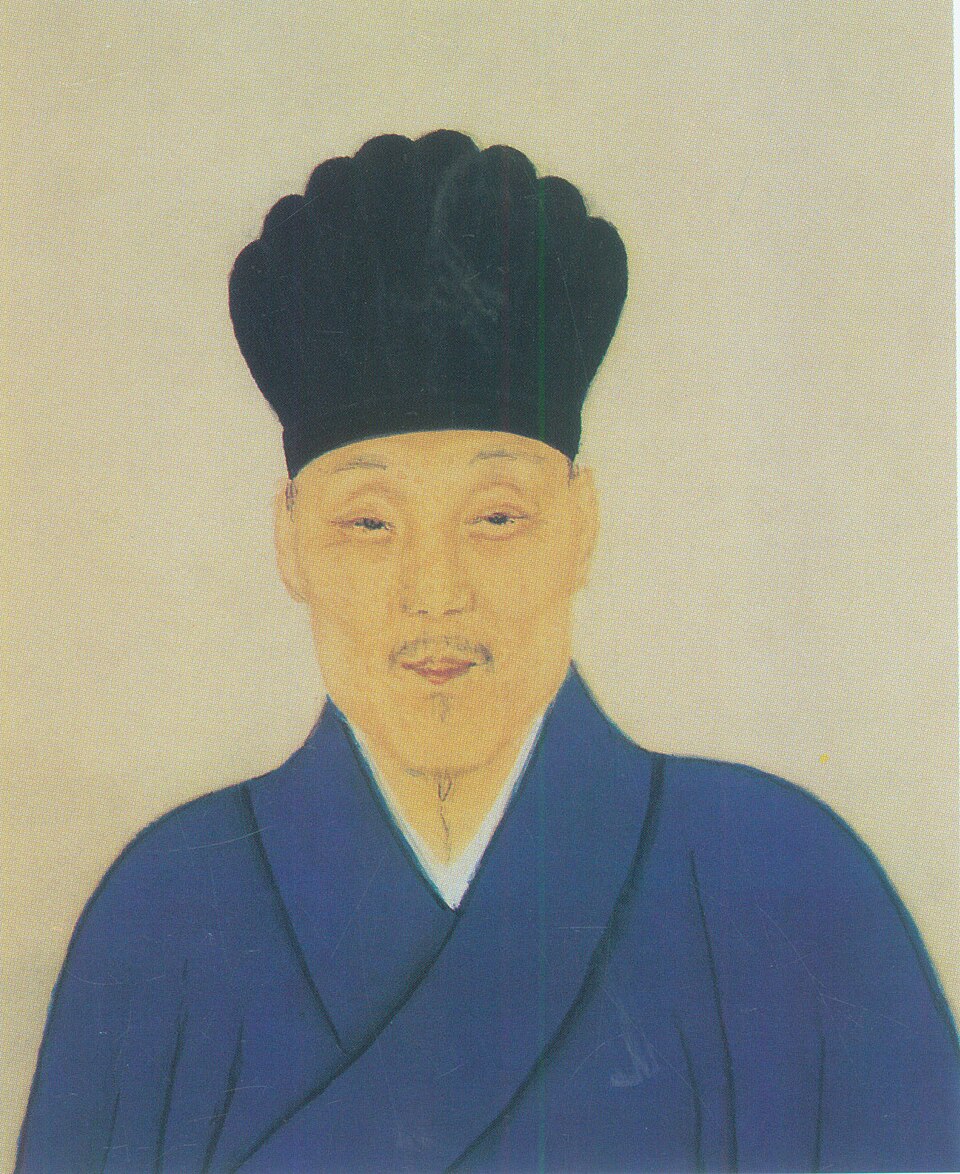 Portrait of Zheng Jing (1642–1681), possibly 17th c. Zheng Jing's succession was contested by Zheng Miao, Zheng Chenggong's fifth son. Zheng Jing arrived in Taiwan in December 1662 and defeated his enemies. The infighting caused some followers to defect to the Qing. By 1663, some 3,985 officials and officers, 40,962 soldiers, 64,230 civilians, and 900 ships in Fujian had defected from Zheng territory.[97] To combat population decline, Zheng Jing promoted migration to Taiwan. Between 1665 and 1669 a large number of Fujianese moved to Taiwan. Some 9,000 Chinese were brought to Taiwan by Zheng Jing.[98] The Qing dynasty enacted a sea-ban to starve out the Zheng forces. In 1663, the writer Xia Lin testified that the Zhengs were short on supplies and the people suffered tremendous hardship.[99] The Dutch attacked Zheng ships in Xiamen but failed to take the town. The Dutch assisted the Qing in combat against the Zheng fleet in October 1663, resulting in the capture of Zheng bases in Xiamen and Kinmen. The remaining Zheng forces fled southward and completely evacuated from the mainland coast in the spring of 1664.[100] Qing-Dutch forces attempted to invade Taiwan twice in December 1664 and again in 1666 but were impacted by adverse weather. The Dutch continued to attack Zheng ships occasionally but were unable to take back the island.[101][102] 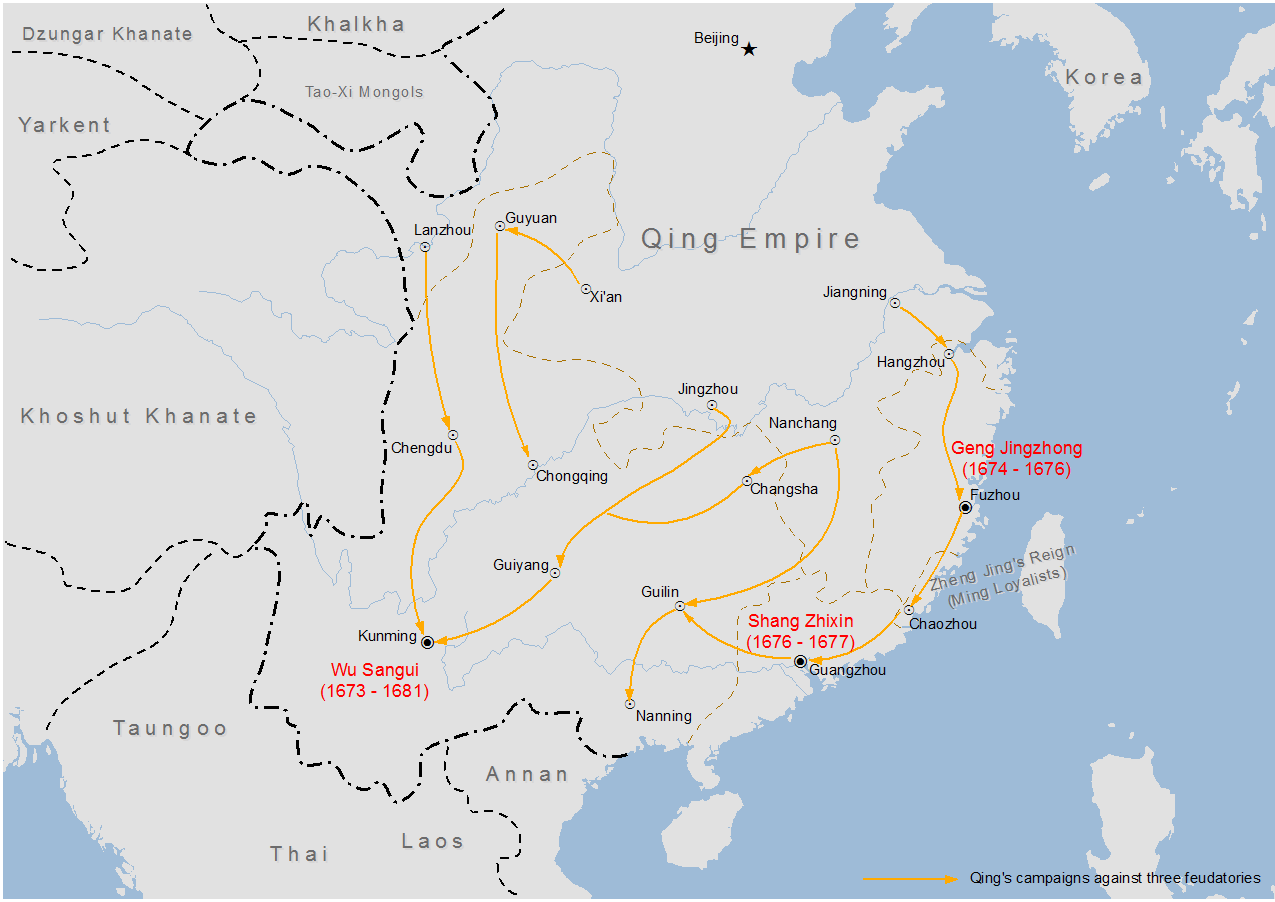 Map showing the Revolt of the Three Feudatories (1673–1681) After Zheng Jing was ejected from the mainland, the Qing tried to settle the conflict through negotiation.[103] In 1669 the Qing offered Zheng significant autonomy in Taiwan if they shaved their heads in the Manchu style. Zheng Jing declined and insisted on a relationship with the Qing similar to Korea.[104] In 1670 and 1673, Zheng forces seized vessels on their way to the mainland. In 1671, Zheng forces raided the coast of Zhejiang and Fujian. In 1674, Zheng Jing joined the Revolt of the Three Feudatories and recaptured Xiamen. He imported war material and made an alliance with Geng Jingzhong in Fujian. They fell afoul of each other not long afterward. Zheng captured Quanzhou and Zhangzhou in 1674. After Geng and other rebels surrendered to the Qing in 1676 and 1677, the tide turned against the Zheng forces. Quanzhou was lost to the Qing on 12 March 1677 and then Zhangzhou and Haicheng on 5 April. Zheng forces counterattacked and retook Haicheng in August. Zheng naval forces blockaded Quanzhou and tried to retake the city in August 1678 but they were forced to retreat when Qing reinforcements arrived. Zheng forces suffered heavy casualties in a battle in January 1679.[105] On 20 March 1680, the Qing fleet led by Wan Zhengse defeated Zheng naval forces near Quanzhou. Many Zheng commanders and soldiers defected to the Qing. Xiamen was abandoned. On 10 April, Zheng Jing's war on the mainland came to a close.[106] Zheng Jing died in early 1681.[107] |
台湾への撤退 鄭経(1642–1681)の肖像画、おそらく17世紀のもの 鄭経の継承をめぐっては、鄭成功の五男である鄭淵が異議を唱えた。鄭経は1662年12月に台湾に到着し、敵を打ち破った。この内紛により、一部の配下が 清に寝返った。1663年までに、福建省の役人や将校約3,985人、兵士40,962人、民間人64,230人、船900隻が鄭氏の領地から離反した。 [97] 人口減少に対処するため、鄭経は台湾への移住を奨励した。1665年から1669年の間に、多数の福建人が台湾に移住した。鄭経によって約9,000人の 中国人が台湾へ移送された。[98] 清朝は鄭軍を飢えさせるため、海上禁運令を発令した。1663年、文人の夏林は、鄭軍が物資不足に陥り、民衆が甚大な苦難に直面していると証言している。 [99] オランダ人はアモイで鄭軍の船を攻撃したが、同地の占領には失敗した。1663年10月、オランダは清を支援して鄭軍艦隊と交戦し、その結果、アモイと金 門の鄭軍拠点を占領した。残存する鄭軍は南へ逃走し、1664年の春には中国本土沿岸から完全に撤退した。[100] 清・オランダ連合軍は1664年12月と1666年の2度にわたり台湾侵攻を試みたが、悪天候の影響を受けた。オランダは時折鄭軍の船を攻撃し続けたが、 島を奪還することはできなかった。[101][102] 三藩の乱(1673年–1681年)を示す地図 鄭経が本土から追放された後、清は交渉を通じて紛争の解決を図った。[103] 1669年、清は鄭氏に対し、満州式の剃髪を行うならば台湾において相当な自治権を与えると提案した。鄭経はこれを拒否し、朝鮮と同様の清との関係を主張 した。[104] 1670年と1673年、鄭軍は本土へ向かう船舶を拿捕した。1671年、鄭軍は浙江省と福建省の沿岸部を襲撃した。1674年、鄭経は三藩の乱に加わ り、アモイを奪還した。彼は軍需物資を輸入し、福建の耿景忠と同盟を結んだ。しかし、ほどなくして両者の関係は決裂した。鄭軍は1674年に泉州と漳州を 占領した。1676年と1677年に耿景中ら反乱勢力が清に降伏すると、情勢は鄭軍に不利に転じた。1677年3月12日に泉州が清に奪われ、続いて4月 5日には漳州と海城も失われた。鄭軍は反撃し、8月に海城を奪還した。鄭軍の水軍は泉州を封鎖し、1678年8月に同市の奪還を試みたが、清軍の増援が到 着したため撤退を余儀なくされた。鄭軍は1679年1月の戦闘で多大な損害を被った。[105] 1680年3月20日、万正碩率いる清軍艦隊が泉州近海で鄭軍の水軍を撃破した。多くの鄭軍の将校や兵士が清に寝返った。アモイは放棄された。4月10 日、鄭経による本土での戦いは終結した。[106] 鄭経は1681年初頭に死去した。[107] |
| Sinicization Zheng Jing never relinquished the trappings of a Ming government,[108] enabling him to draw support from Ming loyalists. In Taiwan, the Six Ministries were established, however oversight of all affairs was given to military leaders. Zheng's family and officers remained at the top of the administration.[109] They enacted programs of agricultural and infrastructural development. By 1666, grain harvests were more than capable of sustaining the population.[110] Zheng also advised commoners to improve their dwellings and for temples dedicated to the Buddha and local Fujianese deities to be constructed. An Imperial Academy and Confucian Shrine were established in 1665 and 1666 while regular civil service examinations were implemented.[92] Zheng dispatched teachers to aboriginal tribes to provide them with supplies and teach them more advanced farming techniques.[111] Schools were set up to teach the aboriginal people the Chinese language and those who refused were punished.[112][111] The expansion of Chinese settlements often came at the expense of aboriginal tribes, causing rebellions over the course of Zheng rule. In one campaign, several hundred Shalu tribes people in modern Taichung were killed.[111][113] The Chinese population in Taiwan more than doubled under Zheng rule.[114] Zheng disbanded the troops and turned them into military colonies.[115] By the start of 1684, a year after the end of Zheng rule, areas under cultivation in Taiwan had tripled in size since the end of the Dutch era in 1660.[113] Zheng merchant fleets continued to operate between Japan and Southeast Asian countries, reaping profits as a center of trade. They extracted a tax from traders for safe passage through the Taiwan Strait. Zheng Taiwan held a monopoly on certain commodities such as deer skin and sugarcane, which sold at a high price in Japan.[116] Zheng Taiwan achieved greater economic diversification than the profit-driven Dutch colony and cultivated more types of grain, vegetables, fruits, and seafood. By the end of Zheng rule in 1683, the government was extracting over 30% more annual income in silver than under the Dutch in 1655. Sugar exports exceeded Dutch figures in 1658 while deerskin output remained the same.[117] |
中国化 鄭経は明朝政府の形式を一度も放棄しなかった[108]ため、明朝忠臣からの支持を得ることができた。台湾では六部が設置されたが、すべての事務の監督権 は軍人指導者に委ねられた。鄭家の親族や将校たちは、依然として行政のトップに留まっていた[109]。彼らは農業およびインフラ整備の政策を推進した。 1666年までに、穀物の収穫量は人口を養うのに十分な水準に達していた[110]。鄭はまた、庶民に対して住居の改善を勧め、仏や福建の地方神を祀る寺 院の建設を指示した。1665年と1666年には帝国学院と孔子廟が設立され、定期的な科挙試験が実施された[92]。 鄭成功は先住民の部族に教師を派遣し、物資を供給するとともに、より高度な農法を教えた。[111] 先住民に中国語を教えるための学校が設けられ、これを拒否した者は処罰された。[112][111] 中国人の入植地の拡大はしばしば先住民の犠牲を伴い、鄭成功の統治期間中に反乱を引き起こした。ある遠征では、現在の台中に住む数百人の沙鹿族が殺害され た。[111][113] 鄭氏統治下で、台湾の中国人人口は2倍以上に増加した。[114] 鄭氏は軍隊を解散させ、それらを軍事植民地へと転換した。[115] 鄭氏統治の終結から1年後の1684年初頭までに、台湾の耕作地は1660年のオランダ統治時代終了時と比較して3倍の規模に拡大していた。[113] 鄭氏商船団は日本と東南アジア諸国間を航行し続け、貿易の中心地として利益を上げていた。彼らは台湾海峡の安全な航行に対し、商人から税金を徴収した。鄭 氏統治下の台湾は、日本で高値で取引された鹿革やサトウキビなどの特定商品について独占権を持っていた。[116] 鄭氏統治下の台湾は、利益追求型のオランダ植民地よりも経済の多角化が進んでおり、より多くの種類の穀物、野菜、果物、海産物を栽培していた。1683年 の鄭氏統治の終焉までに、政府が徴収する銀による年間収入は、1655年のオランダ統治下よりも30%以上増加していた。砂糖の輸出量は1658年にオラ ンダの記録を上回ったが、鹿皮の生産量は同水準にとどまった。[117] |
Shi Lang Shi Lang (1621–1696) in an 18th-century painting Shi Lang led the Qing conquest of Zheng Taiwan. He was originally a military leader working under Zheng Zhilong, the father of Zheng Chenggong. He had a falling out with Chenggong. After escaping imprisonment by Chenggong, Shi Lang defected to the Qing dynasty and participated in a successful assault on a Zheng stronghold. In 1658, Shi was made Deputy Commander of Tongan and continued to participate in campaigns against Zheng forces. Shi relayed information about Zheng internal conflict between Chenggong and his son to Beijing.[118] The Qing established a naval force in Fujian in 1662 and appointed Shi Lang as the commander. Shi advocated for more aggressive action against the Zhengs. On 15 May 1663, Shi attacked the Zheng fleet and succeeded in killing and capturing Zheng forces. From 18 to 20 November, the Dutch fought sea battles against Zheng forces while Shi took Xiamen. In 1664, Shi assembled a fleet of 240 ships, and in conjunction with 16,500 troops, chased remaining Zheng forces south. They failed to dislodge the last Zheng stronghold. After the defection of Zheng commander Zhou Quanbin, Zheng Jing pulled out from the remaining mainland stronghold in the spring of 1664.[119] |
施琅 18世紀の絵画に描かれた施琅(1621年–1696年) 施琅は、清による鄭台島の征服を指揮した。彼はもともと、鄭成功の父である鄭芝龍の下で働く軍人であった。その後、鄭成功と対立した。鄭成功による投獄か ら脱出した後、施琅は清朝に寝返り、鄭軍の要塞への攻撃に参加して成功を収めた。1658年、施琅は東安副将に任命され、引き続き鄭軍に対する戦役に参加 した。施琅は、鄭成功とその息子との間の鄭家内部の対立に関する情報を北京に伝えた。[118] 清は1662年に福建省に海軍を設立し、石朗を指揮官に任命した。石朗は鄭氏に対するより積極的な行動を主張した。1663年5月15日、石朗は鄭氏の艦 隊を攻撃し、鄭氏軍の殺害と捕獲に成功した。11月18日から20日にかけて、オランダ軍が鄭氏軍と海戦を繰り広げる中、石朗はアモイを占領した。 1664年、施琅は240隻の艦隊を編成し、1万6500人の陸軍と連携して、残存する鄭軍を南へと追撃した。しかし、鄭軍の最後の拠点を陥落させること はできなかった。鄭軍の指揮官・周全彬が寝返った後、鄭経は1664年の春、残っていた本土の拠点を撤退した。[119] |
End of Zheng rule Zheng Keshuang Main article: Battle of Penghu Shi Lang was instructed to arrange a peace mission to Taiwan but he did not believe Zheng Jing would accept the terms. He warned that if the Zhengs built up their strength, they would pose a serious danger. Shi detailed his plans to invade Taiwan; he argued that securing Taiwan would render garrisons unnecessary and reduce the defense spending.[120] In 1681, Li Guangdi recommended Shi Lang to be the coordinator of the invasion force. Shi was reappointed as naval chief of Fujian on 10 September 1681.[121] Shi's plan was to take Penghu first. The Governor-general Yao Qisheng disagreed and proposed a two pronged attack on Tamsui and Penghu at the same time. Shi thought the proposal was unrealistic and requested to be put in total control over the entire invasion force. Kangxi denied the request.[122] In Taiwan, Zheng Jing's death resulted in a coup. Zheng Keshuang murdered his brother Zheng Kezang. Political turmoil, heavy taxes, an epidemic in the north, a large fire that caused the destruction of more than a thousand houses, and suspicion of collusion with the Qing caused more Zheng followers to defect to the Qing. Zheng's deputy Commander Liu Bingzhong surrendered with his ships and men from Penghu.[123] Orders from the Kangxi Emperor to invade Taiwan reached Yao Qisheng and Shi Lang on 6 June 1682. The invasion fleet met with unfavorable winds and was forced to turn back. Conflict between Yao and Shi led to Yao's removal in November.[124] On 18 November 1682, Shi Lang was authorized to assume the role of supreme commander and Yao was relegated to logistics. Two attempts to sail to Penghu in February 1683 failed due to a shift in winds.[125] Shi's fleet of 238 ships and over 21,000 men set sail on 8 July 1683.The next day, Shi's fleet approached small islands to the northwest of Penghu. The Qing forces were met by 200 Zheng ships. Following an exchange of gunfire, the Qing were forced to retreat with Zheng forces in pursuit. The Qing vanguard led by Lan Li provided cover fire for a withdrawal. The Zheng side also suffered heavy losses, making Liu reluctant to pursue the disarrayed Qing forces.[126] On 11 July, Shi regrouped his squadrons and requested reinforcements at Bazhao. On 16 July, reinforcements arrived. Shi divided the main striking force into eight squadrons of seven ships with himself leading from the middle. Two flotillas of 50 small ships sailed in different directions as a diversion. The remaining vessels served as rear reinforcements.[127] The battle took place in the bay of Magong. The Zheng garrison fired at the Qing ships and then set sail from the harbor with about 100 ships to meet the Qing forces. Shi concentrated fire on one big enemy ship at a time until all of Zheng's battle ships were sunk by the end of 17 July. Approximately 12,000 Zheng forces perished. Liu escaped to Taiwan while the garrison commanders surrendered. The Qing captured Penghu on 18 July.[128] Shi Lang arrived in Taiwan on 5 October 1683 to supervise the surrender, which went smoothly. Zheng Keshuang and other leaders shaved their head in the Manchu style. The use of the Ming calendar in Taiwan was ended.[129] |
鄭氏政権の終焉 鄭克彡 本記事:澎湖の戦い 施朗は台湾への和平使節団を派遣するよう命じられたが、鄭経が条件を受け入れるとは考えていなかった。彼は、鄭氏が勢力を拡大すれば重大な脅威となるだろ うと警告した。施琅は台湾侵攻の計画を詳述し、台湾を確保すれば駐屯部隊が不要となり、防衛費を削減できると主張した。[120] 1681年、李光迪は施琅を侵攻軍の総指揮官に推挙した。施琅は1681年9月10日、福建海軍総督に再任された。[121] 施琅の計画は、まず澎湖を攻略するというものだった。総督の姚啓生はこれに反対し、淡水と澎湖への同時二正面攻撃を提案した。施朗はこの提案を非現実的だ と考え、侵攻軍全体の全権を委ねるよう要請した。康煕帝はこの要請を却下した。[122] 台湾では、鄭経の死をきっかけにクーデターが発生した。鄭可双は兄の鄭可蔵を殺害した。政情不安、重税、北部での疫病、千戸以上の家屋を焼失させた大火 災、そして清との結託の疑いにより、さらに多くの鄭氏派が清に寝返った。鄭氏の副司令官である劉炳忠は、澎湖から船と兵を率いて降伏した。[123] 1682年6月6日、台湾侵攻の命令が康熙帝から姚啓生と施琅に下った。侵攻艦隊は逆風に見舞われ、引き返すことを余儀なくされた。姚と施の対立により、 11月に姚は更迭された。[124] 1682年11月18日、施琅が総司令官に任命され、姚は後方支援に回された。1683年2月、澎湖へ向かう2度の試みは、風向きの変化により失敗した。 [125] 238隻の船と2万1000人以上の兵を擁する施琅の艦隊は、1683年7月8日に出航した。翌日、施琅の艦隊は澎湖の北西にある小島に接近した。清軍は 鄭軍200隻と遭遇した。砲撃戦の後、清軍は鄭軍に追われ撤退を余儀なくされた。蘭里率いる清軍先鋒隊が、撤退のための援護射撃を行った。鄭軍側も甚大な 損害を被ったため、劉は混乱した清軍を追撃することに消極的だった。[126] 7月11日、施は艦隊を再編し、八釗にて増援を要請した。7月16日、増援が到着した。施は主力攻撃部隊を7隻ずつの8個分隊に分け、自ら中央で指揮を 執った。50隻の小船からなる2つの分艦隊が、陽動として別の方向へ出航した。残りの船は後方支援として待機した。[127] 戦闘は馬公湾で繰り広げられた。鄭軍の守備隊は清の船に砲撃を加えた後、約100隻の船で港を出航し、清軍を迎え撃った。施琅は敵の大型船1隻ずつに集中 砲火を浴びせ、7月17日の終わりまでに鄭軍の戦艦をすべて沈めた。鄭軍は約1万2000名が戦死した。劉は台湾へ逃亡し、守備隊の指揮官たちは降伏し た。清軍は7月18日に澎湖を占領した。[128] 施琅は1683年10月5日に台湾に到着し、降伏の監督にあたったが、これは順調に進んだ。鄭克彡ら指導者たちは満州式の剃髪を行った。台湾における明暦 の使用は終了した。[129] |
| Citations 01. Jiao (2007), pp. 89–90. Olsen & Miller-Antonio (1992). Jiao (2007), pp. 91–94. "Foreign Relations of the United States". US Dept. of State. January 6, 1951. Retrieved 2022-01-07. The Cairo declaration manifested our intention. It did not itself constitute a cession of territory. "UK Parliament". Hansard. Feb 7, 1955. Retrieved 2022-01-07. The position in law is that an armistice or the cessation of fighting does not affect sovereignty. Chang (1989). Chang, Chun-Hsiang; Kaifu, Yousuke; Takai, Masanaru; Kono, Reiko T.; Grün, Rainer; Matsu'ura, Shuji; Kinsley, Les; Lin, Liang-Kong (2015). "The first archaic Homo from Taiwan". Nature Communications. 6 (6037): 6037. Bibcode:2015NatCo...6.6037C. doi:10.1038/ncomms7037. PMC 4316746. PMID 25625212. Zuozhen Man Deprecated link archived 2012-07-15 at archive.today, Encyclopedia of Taiwan. Changbin Culture Archived 2014-05-03 at the Wayback Machine, Encyclopedia of Taiwan. 10. 李壬癸 [ Li, Paul Jen-kuei ] (Jan 2011). 1. 台灣土著民族的來源 [1. Origins of Taiwan Aborigines]. 台灣南島民族的族群與遷徙 [The Ethnic Groups and Dispersal of the Austronesian in Taiwan] (Revised ed.). Taipei: 前衛出版社 [Avanguard Publishing House]. pp. 46, 48. ISBN 978-957-801-660-6. 根據張光直(1969)...9,000BC起...大量種植稻米的遺跡 [Chang, Kwang-chih (1969): ...traces of slash-and-burn agriculture since 9,000BC... remains of rice cultivation] Ko, Albert Min-Shan; Chen, Chung-Yu; Fu, Qiaomei; Delfin, Frederick; Li, Mingkun; Chiu, Hung-Lin; Stoneking, Mark; Ko, Ying-Chin (2014). "Early Austronesians: into and out of Taiwan". The American Journal of Human Genetics. 94 (3): 426–436. doi:10.1016/j.ajhg.2014.02.003. PMC 3951936. PMID 24607387. The Liangdao Man skeletal remains were discovered on the Liang Island of the Matsu archipelago in December 2011 and transported to the Matsu Folklore Museum. Matsu is located on the Min River estuary, 24 km from Fujian and 180 km northwest of Taiwan Soares, Pedro A.; Trejaut, Jean A.; Rito, Teresa; Cavadas, Bruno; Hill, Catherine; Eng, Ken Khong; Mormina, Maru; Brandão, Andreia; Fraser, Ross M.; Wang, Tse-Yi; Loo, Jun-Hun; Snell, Christopher; Ko, Tsang-Ming; Amorim, António; Pala, Maria; Macaulay, Vincent; Bulbeck, David; Wilson, James F.; Gusmão, Leonor; Pereira, Luísa; Oppenheimer, Stephen; Lin, Marie; Richards, Martin B. (2016). "Resolving the ancestry of Austronesian-speaking populations". Human Genetics. 135 (3): 309–326. doi:10.1007/s00439-015-1620-z. PMC 4757630. PMID 26781090. Matsumura, Hirofumi; Xie, Guangmao; Nguyen, Lan Cuong; Hanihara, Tsunehiko; Li, Zhen; Nguyen6, Khanh Trung Kien; Ho, Xuan Tinh; Nguyen, Thi Nga; Huang, Shih‑Chiang; Hung, Hsiao‑chun (2021). "Female craniometrics support the 'two‑layer model' of human dispersal in Eastern Eurasia". Scientific Reports. 11 (20830): 20830. Bibcode:2021NatSR..1120830M. doi:10.1038/s41598-021-00295-6. PMC 8531373. PMID 34675295. pp. 5–9. Tapenkeng Site, Encyclopedia of Taiwan. Blust (1999). Diamond (2000). Hill et al. (2007). Bird, Hope & Taylor (2004). Bellwood, Hung & Iizuka (2011), pp. 35–37, 41. 20. Jiao (2007), pp. 94–103. Tsang (2000). Knapp 1980, p. 5. http://www.strongwindpress.com/pdfs/HKFax/No_HK2013-41.pdf Archived 2015-09-28 at the Wayback Machine title夷洲问题再辨析 (PDF). [2015-09-27]. (原始內容 (PDF)存檔於2015-09-28)}. Xiong (2012), p. 201. Tanaka Fumio 田中史生 (2008). "Kodai no Amami Okinawa shotō to kokusai shakai" 古代の奄美・沖縄諸島と国際社会. In Ikeda Yoshifumi (ed.). Kodai chūsei no kyōkai ryōiki 古代中世の境界領域. pp. 49–70. Isorena 2004. Liu 2012, pp. 170–171. Hsu 1980, p. 6. Wills 2007, p. 86. 30. Andrade 2008f. Lai, Fu-shun (October 26, 2015). "A factual review of Taiwan's history". Taipei Times. Retrieved April 24, 2024. Knapp 1980, p. 7–8. Rubinstein 1999, p. 86. Wong 2017, p. 82. Thompson 1964, p. 168–169. Thompson 1964, p. 169–170. Andrade 2008d. Andrade 2008a. Jenco, Leigh K. (2020). "Chen Di's Record of Formosa (1603) and an Alternative Chinese Imaginary of Otherness". The Historical Journal. 64: 17–42. doi:10.1017/S0018246X1900061X. S2CID 225283565. 40. "閩海贈言". National Central Library (in Chinese). pp. 21–29. Retrieved 16 July 2023. Thompson 1964, p. 178. Thompson 1964, p. 170–171. Wong 2017, p. 83. Wong 2017, p. 84: "Tokugawa Ieyasu rekindled Hideyoshi's ambition of securing Taiwan for commercial interest. He sent expedition to attack Penghu and Taiwan at least twice, first in 1609 and then in 1615. In response to Japanese challenge, General Shen again led an expeditionary forces to Jilong, sank one of the Japanese battleships, and forced the Japanese to retreat" Knapp 1980, p. 10. Andrade, Tonio (2007). How Taiwan Became Chinese (Project Gutenberg ed.). Columbia University Press. p. 116. ISBN 978-0-23112855-1. Borao Mateo (2002), pp. 2–9. Wills (2006), pp. 88–89. Andrade 2008b. 50. Wong 2017, p. 50. Onnekink 2019, p. 79. Wachman, Alan M. (2007-08-01). Why Taiwan?: Geostrategic Rationales for China's Territorial Integrity. Stanford University Press. doi:10.1515/9781503626379. ISBN 978-1-5036-2637-9. OCLC 1294424907. Wills (2006). Wong 2017, p. 84. Huang (2005), Chapter 3. Smits, Gregory (2007). "Recent Trends in Scholarship on the History of Ryukyu's Relations with China and Japan" (PDF). In Ölschleger, Hans Dieter (ed.). Theories and Methods in Japanese Studies: Current State and Future Developments (Papers in Honor of Josef Kreiner). Göttingen: Bonn University Press via V&R Unipress. pp. 215–228. ISBN 978-3-89971-355-8. Archived from the original (PDF) on 2012-03-02. Retrieved 2012-04-04. Wills (2006), p. 91. Andrade 2008e. Borao Mateo (2002), pp. 329–333. 60. Blusse & Everts (2000), pp. 300–309. Mawson, Stephanie J. (August 2016). "Convicts or Conquistadores ? Spanish Soldiers in the Seventeenth-Century Pacific". Past & Present (232): 87–125. doi:10.1093/pastj/gtw008. ISSN 0031-2746. Blussé 2000, p. 144–145. Blussé 2000. van Veen (2003), p. 142. Shepherd (1993), p. 37. van Veen (2003), p. 149. Blusse & Everts (2000). Everts (2000), pp. 151–155. Lee, Yuchung. "荷西時期總論 (Dutch and Spanish period of Taiwan)". Council for Cultural Affairs. Archived from the original on December 3, 2013. Retrieved September 29, 2012. 70. Shepherd (1993). Tai (2007), p. 246. Shepherd (1993), p. 366. Campbell (1915). Everts (2000), p. 151. Roy (2003), p. 16. Huang, C 2011, 'Taiwan under the Dutch' in A new history of Taiwan, The Central News Agency, Taipei, p. 71. Shepherd (1993), pp. 1–29. Keliher (2003), p. 32. Andrade 2008i. 80. Andrade 2008g. Andrade 2008h. Andrade 2008j. Clodfelter (2017), p. 63. Campbell (1903), p. 544. Andrade 2011a, p. 138. Campbell (1903), p. 482. Clements (2004), pp. 188–201. Blussé, Leonard (1 January 1989). "Pioneers or cattle for the slaughterhouse? A rejoinder to A.R.T. Kemasang". Bijdragen tot de Taal-, Land- en Volkenkunde. 145 (2): 357. doi:10.1163/22134379-90003260. S2CID 57527820. Andrade 2016, p. 207. 90. Hang, Xing (2016). Conflict and Commerce in Maritime East Asia: The Zheng Family and the Shaping of the Modern World, c.1620–1720. Cambridge University Press. p. 154. ISBN 978-1316453841. Wong 2017, p. 105–106. Hang 2010, p. 209. Spence (1999), pp. 51–57. Clements (2004), p. 215. Wong 2017, p. 106–107. Lian, Heng (1920). 臺灣通史 [The General History of Taiwan] (in Chinese). OCLC 123362609. Wong 2017, p. 110. Wong 2017, p. 106. Wong 2017, p. 109. 100. Wong 2017, p. 111–113. Wong 2017, p. 113–114. Wong 2017, p. 138. Wong 2017, p. 138–139. Wong 2017, p. 139–140. Wong 2017, p. 118–122. Wong 2017, p. 124–125. Wong 2017, p. 157. Hang 2010, p. 208. Hang 2010, p. 196. 110. Wong 2017, p. 115. Hang 2010, p. 210. Wills 2015, p. 99. Hang 2015, p. 160. Hang 2010, p. 195–196. Hang 2010, p. 211. Wong 2017, p. 116. Hang 2015, p. 160–161. Wong 2017, p. 147–148. Wong 2017, p. 148–150. 120. Wong 2017, p. 152. Wong 2017, p. 155–159. Wong 2017, p. 160–161. Wong 2017, p. 166–167. Wong 2017, p. 162–163. Wong 2017, p. 165–166. Wong 2017, p. 168–169. Wong 2017, p. 169–170. Wong 2017, p. 170–171. 129. Wong 2017, p. 181–182. |
参考文献 01. Jiao (2007), pp. 89–90. Olsen & Miller-Antonio (1992). Jiao (2007), pp. 91–94. 「米国の対外関係」。米国務省。1951年1月6日。2022年1月7日閲覧。カイロ宣言は我々の意図を表明したものである。それ自体が領土 の割譲を構成するものではない。 「英国議会」。ハンスヤード。1955年2月7日。2022年1月7日閲覧。法的な立場としては、休戦や戦闘の停止は主権に影響を及ぼさない。 Chang (1989)。 Chang, Chun-Hsiang; Kaifu, Yousuke; Takai, Masanaru; Kono, Reiko T.; Grün, Rainer; Matsu'ura, Shuji; Kinsley, Les; Lin, Liang-Kong (2015). 「The first archaic Homo from Taiwan」. Nature Communications. 6 (6037): 6037. Bibcode:2015NatCo...6.6037C. doi:10.1038/ncomms7037. PMC 4316746. PMID 25625212. 左鎮人 リンク切れ(2012年7月15日 archive.todayにアーカイブ)、台湾百科事典。 長濱文化 2014年5月3日ウェイバックマシンにてアーカイブ、台湾百科事典。 10. 李壬癸 [ Li, Paul Jen-kuei ] (2011年1月)。1. 台湾先住民族の起源 [1. Origins of Taiwan Aborigines]。台湾の南島系民族の集団と移動 [The Ethnic Groups and Dispersal of the Austronesian in Taiwan](改訂版)。台北:前衛出版社 [Avanguard Publishing House]。pp. 46, 48。ISBN 978-957-801-660-6。張光直(1969)によると... 紀元前9,000年から...稲作が盛んに行われた遺跡 [Chang, Kwang-chih (1969): ...紀元前9,000年以降の焼畑農業の痕跡...稲作の遺跡] Ko, Albert Min-Shan; Chen, Chung-Yu; Fu, Qiaomei; Delfin, Frederick; Li, Mingkun; Chiu, Hung-Lin; ストーンキング、マーク;コ、インチン (2014). 「初期オーストロネシア人:台湾への流入と流出」. 『アメリカ人類遺伝学雑誌』. 94 (3): 426–436. doi:10.1016/j.ajhg.2014.02.003. PMC 3951936. PMID 24607387。梁島人の骨格遺骸は、2011年12月に馬祖諸島の梁島で発見され、馬祖民俗博物館へ搬送された。馬祖は閩江河口に位置し、福建省から 24km、台湾の北西180kmにある ソアレス、ペドロ・A.;トレジョ、ジャン・A.;リト、テレサ;カヴァダス、ブルーノ;ヒル、キャサリン;エン、ケン・コン;モルミナ、マ ル;ブランダオ、アンドレイア;フレイザー、ロス・M.;ワン、ツェー・イー;ルー、ジュン・フン;スネル、クリストファー;コ、ツァン・ミン;アモリ ム、アントニオ; パラ、マリア;マコーレー、ヴィンセント;ブルベック、デビッド;ウィルソン、ジェームズ・F.;グスマオ、レオノール;ペレイラ、ルイーザ;オッペンハ イマー、スティーブン;リン、マリー;リチャーズ、マーティン・B. (2016). 「オーストロネシア語話者集団の祖先解明」. Human Genetics. 135 (3): 309–326. doi:10.1007/s00439-015-1620-z. PMC 4757630. PMID 26781090. 松村 弘文; 謝 広茂; グエン・ラン・クオン; 埴原 恒彦; 李 振; グエン6、カン・チュン・キエン;ホー、スアン・ティン;グエン、ティ・ガ;ファン、シー・チャン;フン、シャオ・チュン (2021). 「女性の頭蓋計測データは、東ユーラシアにおける人類拡散の『二層モデル』を支持する」. Scientific Reports. 11 (20830): 20830. Bibcode:2021NatSR..1120830M. doi:10.1038/s41598-021-00295-6. PMC 8531373. PMID 34675295. pp. 5–9. タペンケン遺跡、『台湾百科事典』。 Blust (1999)。 Diamond (2000)。 Hill et al. (2007)。 Bird, Hope & Taylor (2004)。 Bellwood, Hung & Iizuka (2011), pp. 35–37, 41。 20. Jiao (2007), pp. 94–103。 Tsang (2000)。 Knapp 1980, p. 5。 http://www.strongwindpress.com/pdfs/HKFax/No_HK2013-41.pdf 2015-09-28 ウェイバックマシンにアーカイブされたタイトル『夷洲問題再辨析』 (PDF)。[2015-09-27]. (オリジナル (PDF) 2015-09-28 時点のアーカイブ)}. Xiong (2012), p. 201. 田中史生 (2008). 「古代の奄美・沖縄諸島と国際社会」. 池田義文(編)『古代中世の境界領域』所収. pp. 49–70. Isorena 2004. Liu 2012, pp. 170–171. Hsu 1980, p. 6. Wills 2007, p. 86. 30. Andrade 2008f. Lai, Fu-shun (2015年10月26日). 「台湾の歴史に関する事実に基づく検証」。『台北タイムズ』。2024年4月24日閲覧。 Knapp 1980, p. 7–8. Rubinstein 1999, p. 86. Wong 2017, p. 82. Thompson 1964, p. 168–169. トンプソン 1964, p. 169–170. アンドラーデ 2008d. アンドラーデ 2008a. ジェンコ、リー・K. (2020). 「陳迪の『福摩沙記』(1603)と、他者性に関するもう一つの中国の想像」. 『ヒストリカル・ジャーナル』. 64: 17–42. doi:10.1017/S0018246X1900061X. S2CID 225283565. 40. 「閩海贈言」。国立中央図書館(中国語)。pp. 21–29。2023年7月16日閲覧。 トンプソン 1964, p. 178。 Thompson 1964, p. 170–171. Wong 2017, p. 83. Wong 2017, p. 84: 「徳川家康は、商業的利益のために台湾を確保するという秀吉の野心を再燃させた。彼は澎湖と台湾を攻撃するため、少なくとも2回、遠征軍を派遣した。最初 は1609年、次に1615年である。日本の挑戦に対し、沈将軍は再び遠征軍を率いて基隆に向かい、日本の戦艦1隻を沈め、日本軍を撤退させた」 Knapp 1980, p. 10. アンドラーデ、トニオ(2007)。『台湾はいかにして中国の一部となったか』(プロジェクト・グーテンベルク版)。コロンビア大学出版局。p. 116。ISBN 978-0-23112855-1。 ボラオ・マテオ(2002)、pp. 2–9。 ウィルズ(2006)、pp. 88–89。 アンドラーデ 2008b. 50. ウォン 2017, p. 50. オネキンク 2019, p. 79. ワックマン, アラン・M. (2007-08-01). 『なぜ台湾か?:中国の領土保全をめぐる地政学的根拠』. スタンフォード大学出版局. doi:10.1515/9781503626379. ISBN 978-1-5036-2637-9. OCLC 1294424907. ウィルズ (2006)。 ウォン 2017, p. 84。 ファン (2005), 第3章。 スミッツ、グレゴリー(2007年)。「琉球と中国・日本との関係史に関する学術研究の最近の動向」(PDF)。オルシュレーガー、ハンス・ディーター (編)『日本研究における理論と方法:現状と今後の展開(ヨーゼフ・クライナー記念論文集)』所収。ゲッティンゲン:ボン大学出版局(V&R Unipress経由)。pp. 215–228。ISBN 978-3-89971-355-8。2012年3月2日にオリジナル(PDF)からアーカイブされた。2012年4月4日に閲覧。 ウィルズ(2006年)、91頁。 アンドラーデ 2008e。 ボラオ・マテオ (2002), pp. 329–333. 60. ブルッセ & エバーツ (2000), pp. 300–309. モーソン, ステファニー・J. (2016年8月). 「囚人か、征服者か? 17世紀太平洋におけるスペイン兵士たち」. 『Past & Present』 (232): 87–125. doi:10.1093/pastj/gtw008. ISSN 0031-2746. ブルッセ 2000, p. 144–145. ブルッセ 2000. ファン・ヴィーン (2003), p. 142. Shepherd (1993), p. 37. van Veen (2003), p. 149. Blusse & Everts (2000). Everts (2000), pp. 151–155. Lee, Yuchung. 「荷西時期総論 (台湾のオランダ・スペイン統治期)」。文化部。2013年12月3日にオリジナルからアーカイブされた。2012年9月29日に取得。 70. シェパード(1993)。 タイ(2007)、246頁。 シェパード(1993)、366頁。 キャンベル(1915)。 エバーツ (2000), p. 151. ロイ (2003), p. 16. 黄, C 2011, 「オランダ統治下の台湾」『台湾新史』中央通信社、台北、p. 71. シェパード (1993), pp. 1–29. ケリハー(2003年)、32頁。 アンドラーデ 2008i。 80. アンドラーデ 2008g。 アンドラーデ 2008h。 アンドラーデ 2008j。 クロドフェルター(2017年)、63頁。 キャンベル(1903年)、544頁。 アンドラーデ 2011a, p. 138. キャンベル (1903), p. 482. クレメンツ (2004), pp. 188–201. ルネ・ブルッセ (1989年1月1日). 「開拓者か、それとも屠殺場行きか? A.R.T. ケマサンへの反論」. 『Bijdragen tot de Taal-, Land- en Volkenkunde』145 (2): 357. doi:10.1163/22134379-90003260. S2CID 57527820. アンドラーデ 2016, p. 207. 90. ハン・シン (2016). 『東アジア海域における紛争と商業:鄭家と近代世界の形成、1620年頃–1720年』. ケンブリッジ大学出版局. p. 154. ISBN 978-1316453841. Wong 2017, p. 105–106. Hang 2010, p. 209. Spence (1999), pp. 51–57. Clements (2004), p. 215. Wong 2017, p. 106–107. Lian, Heng (1920). 『台湾通史』 (中国語). OCLC 123362609. Wong 2017, p. 110. Wong 2017, p. 106. Wong 2017, p. 109. 100. Wong 2017, p. 111–113. Wong 2017, p. 113–114. Wong 2017, p. 138. Wong 2017, p. 138–139. Wong 2017, p. 139–140. Wong 2017, p. 118–122. Wong 2017, p. 124–125. Wong 2017, p. 157. Hang 2010, p. 208. Hang 2010, p. 196. 110. Wong 2017, p. 115. Hang 2010, p. 210. Wills 2015, p. 99. Hang 2015, p. 160. Hang 2010, p. 195–196. Hang 2010, p. 211. Wong 2017, p. 116. Hang 2015, p. 160–161. Wong 2017, p. 147–148. Wong 2017, p. 148–150. 120. Wong 2017, p. 152. Wong 2017, p. 155–159. Wong 2017, p. 160–161. Wong 2017, p. 166–167. Wong 2017, p. 162–163. Wong 2017, p. 165–166. Wong 2017, p. 168–169. Wong 2017, p. 169–170. Wong 2017, p. 170–171. 129. Wong 2017, p. 181–182. |
| https://en.wikipedia.org/wiki/History_of_Taiwan |
☆ 清朝(1683年~1895年)以降、日本統治開始まで
| Qing dynasty
(1683–1895) Main article: Taiwan under Qing rule  The Qing Empire in 1820, with provinces in yellow, military governorates and protectorates in light yellow, tributary states in orange. Annexation See also: Taiwan Prefecture Shi Lang remained in Taiwan for 98 days before returning to Fujian on 29 December 1683. In Fujian, some officials from the central government advocated for transporting all of Taiwan's inhabitants to the mainland and abandoning the island.[130] One argued that defending Taiwan was impossible and increasing defense expenditures was unfavorable.[130] Shi opposed abandoning Taiwan, arguing that this would leave it open to other enemies. He assured that defending Taiwan would only take 10,000 men and reduce garrison forces on the coast. Shi convinced all the attendees at the Fujian conference, with the exception of Subai, that it was in their best interests to annex Taiwan.[131] On 6 March 1684, Kangxi accepted Shi's proposal to set up permanent military establishments in Penghu and Taiwan and authorized the establishment of Taiwan Prefecture, divided into three counties, as a prefecture of Fujian Province.[132][133]  Painting of Taiwan, Kangxi period, 1684–1722 Taiwan administration The Qing initially forbade mainlanders from moving to Taiwan and sent most of the people back to the mainland, after which the official population of Taiwan was only 50,000. Manpower shortage compelled local officials to solicit migrants from the mainland despite restrictions. Sometimes even warships transported civilians to Taiwan.[134] By 1711, illegal migrants amounted to tens of thousands yearly.[135] Individuals such as Lin Qianguang, a native of Fujian Province, entered Taiwan. He held office in Taiwan from 1687 to 1691 but lived in Taiwan for several years beforehand. He wrote one of the first accounts of aboriginal life in Taiwan in 1685.[136] The first recorded regulation on the permit system was made in 1712 but it probably existed as early as 1684. Its purpose was to reduce population pressure on Taiwan. The government believed that Taiwan was unable to support a larger population before leading to conflict. Regulations banned migrants from bringing their families. To prevent undesirables from entering Taiwan, the government recommended only allowing those who had property or relatives in Taiwan to enter Taiwan. A regulation to this effect was implemented in 1730.[137] Over the 18th century, regulations on migration remained largely consistent. Early regulations focused on the character of permit receivers while later regulations reiterated measures such as patrolling and punishment. The only changes were to the status of families.[137] Families were barred from entering Taiwan to ensure that migrants would return to their families. The overwhelmingly male migrants had few prospects and thus married locally, resulting in the idiom "has Tangshan[a] father, no Tangshan mother" (Chinese: 有唐山公,無唐山媽; Pe̍h-ōe-jī: Ū Tn̂g-soaⁿ kong, bô Tn̂g-soaⁿ má).[138][139] Marrying aboriginal women was prohibited in 1737 on the grounds that it interfered in aboriginal life and was used as a means to claim aboriginal land.[140][141] Migrant families were allowed to enter Taiwan legally for a period between 1732 and 1740. In 1739, opposition to family migrations claimed that vagrants and undesirables were taking advantage of the system. Families were barred again from 1740 to 1746. In 1760, family crossings to Taiwan became legal again for a short period. Starting in 1771, Qing restrictions on cross-strait migration relaxed as they realized that the policies were unenforceable. Even during periods of legal migration, more individuals chose to hire illegal ferry service than to deal with official procedures. After lifting restrictions on family crossings in 1760, only 277 people requested permits after a year, the majority of them being government employees. In comparison, within a ten-month period in 1758–1759, nearly 60,000 people were arrested for illegal crossings. In 1790, an office was set up to manage civilian travel between Taiwan and the mainland, and the Qing government ceased to actively interfere in cross-strait migration.[135][142][141] In 1875, all restrictions on entering Taiwan were repealed.[135] |
清王朝(1683年–1895年) 本記事:清朝統治下の台湾 1820年の清帝国。黄色は省、薄黄色は軍管区および保護領、オレンジ色は属国を示す。 併合 関連項目:台湾府 施琅は台湾に98日間滞在した後、1683年12月29日に福建省へ戻った。福建では、中央政府の一部官吏が、台湾の住民全員を本土へ移住させ、島を放棄することを主張した。[130] ある者は、台湾の防衛は不可能であり、防衛費の増大は好ましくないとした。[130] 施琅は、台湾を放棄すれば他の敵に狙われることになるとしてこれに反対した。彼は、台湾の防衛には1万人の兵力で十分であり、沿岸の駐屯部隊を削減できる と断言した。石は、蘇白を除く福建会議の出席者全員に対し、台湾を併合することが彼らの最善の利益になると説得した。[131] 1684年3月6日、康煕帝は澎湖と台湾に恒久的な軍事拠点を設置するという石の提案を受け入れ、3つの県に分かれた台湾府を福建省の下に置くことを認可 した。[132] [133] 台湾の絵画、康熙時代(1684年–1722年) 台湾の行政 清朝は当初、本土からの台湾移住を禁じ、移住者の大半を本土へ送り返した。その結果、台湾の公式人口はわずか5万人となった。人手不足のため、地方官吏は 制限にもかかわらず、本土からの移住者を募らざるを得なかった。時には軍艦でさえ民間人を台湾へ運んだ。[134] 1711年までには、不法移民は年間数万人に達していた。[135] 福建省出身の林強光のような人物が台湾に入ってきた。彼は1687年から1691年まで台湾で官職に就いたが、その数年前から台湾に住んでいた。彼は 1685年に、台湾の先住民の生活に関する最初の記録の一つを著した。[136] 許可制度に関する最初の記録された規制は1712年に制定されたが、おそらく1684年にはすでに存在していた。その目的は、台湾への人口圧力を軽減する ことにあった。政府は、台湾がそれ以上の人口を支えられなくなれば紛争が生じると考えていた。規制により、移住者が家族を連れてくることは禁止された。望 ましくない人物の台湾への流入を防ぐため、政府は台湾に財産や親族を持つ者のみを台湾への入国を許可するよう推奨した。この趣旨の規制は1730年に施行 された。[137] 18世紀を通じて、移住に関する規制は概ね一貫していた。初期の規制は許可証受領者の素性に焦点を当てていたが、後の規制では巡回や処罰といった措置が繰 り返し強調された。唯一の変化は家族の地位に関するものであった。[137] 移住者が家族のもとへ戻ることを確実にするため、家族の台湾への入島は禁じられていた。圧倒的に男性が多かった移住者たちは将来の見通しが立たず、現地で 結婚することになった。その結果、「唐山(台湾)の父はいても、唐山の母はいない」(中国語:有唐山公,無唐山媽;ペーオージー:Ū Tn̂g-soaⁿ kong, bô Tn̂g-soaⁿ má)という慣用句が生まれた。[138][139] 1737年には、先住民の生活に干渉し、先住民の土地を奪う手段として利用されるという理由で、先住民女性との結婚が禁止された。[140][141] 1732年から1740年にかけて、移民家族は合法的に台湾に入ることが許された。1739年、家族単位の移住に反対する声は、浮浪者や好ましくない者た ちが制度を悪用していると主張した。1740年から1746年にかけて、家族単位の移住は再び禁止された。1760年、台湾への家族単位の渡航は短期間な がら再び合法化された。1771年以降、清朝は政策が実行不可能であると悟り、海峡横断移住に対する規制を緩和した。合法的な移住が認められていた時期で さえ、公式の手続きをこなすよりも、違法な渡し船を利用する者の方が多かった。1760年に家族単位での渡航制限が解除された後、1年経っても許可を申請 したのはわずか277人で、その大半は政府職員であった。これに対し、1758年から1759年にかけての10ヶ月間で、違法な渡航により逮捕された者は 6万人近くに上った。1790年、台湾と本土間の民間人の往来を管理する機関が設置され、清政府は海峡横断の移住に積極的に干渉することをやめた。 [135][142][141] 1875年、台湾への入国に関するすべての制限が撤廃された。[135] |
Settler expansion (1684–1795) Section of a painting depicting daily life of the Taokas people, 1684–1722  Section of Kangxi period painting of Taiwan, 1684–1722  Administrative units of Taiwan under the Qing dynasty in 1685[143]  Administrative units of Taiwan under the Qing dynasty in 1734[144] From 1661 to 1796, the Qing restricted expansion of territory in Taiwan. Taiwan was garrisoned with 8,000 soldiers at key ports and civil administration was kept to a minimum. Three prefectures nominally covered the entire western plains but effective administration covered a smaller area. A permit was required for settlers to go beyond the mid-point of the western plains. In 1715, the governor-general of Fujian-Zhejiang recommended land reclamation in Taiwan but the Kangxi Emperor was worried that this would cause instability and conflicts.[145] Under the reign of the Yongzheng Emperor (r. 1722–1735), the Qing extended control over the entire western plains to better control settlers and maintain security. This was not an active colonization policy but a reflection of continued illegal crossings and land reclamation. After the Zhu Yigui uprising in 1721, Lan Dingyuan, an advisor to Lan Tingzhen, who led forces against the rebellion, advocated for land reclamation to strengthen government control over Chinese settlers and to incorporate aboriginals under their administration.[146] Under the reign of the Qianlong Emperor (r. 1735–1796), the administrative structure of Taiwan remained largely unchanged. After the Lin Shuangwen rebellion in 1786, Qianlong agreed that leaving fertile lands to unproductive aborigines only attracted illegal settlers.[147] The Qing did little to administer the aborigines and rarely tried to impose control over them. Aborigines were classified into two categories: acculturated aborigines (shufan) and non-acculturated aborigines (shengfan). To the Qing, shufan were aborigines who paid taxes and had adopted Han Chinese culture. When the Qing annexed Taiwan, there were 46 aboriginal villages under government control, likely inherited from the Zheng regime. In the Yongzheng period, 108 aboriginal villages submitted as a result of enticement from the regional commander, Lin Liang. Shengfan who paid taxes but did not practice Han Chinese culture were called guihua shengfan (submitted non-acculturated aborigines).[148] The Qianlong administration forbade enticing aborigines to submit due to fear of conflict. In the early Qianlong period, there were 299 named aboriginal villages. Records show 93 shufan villages and 61 guihua shengfan villages. The number of shufan villages remained stable throughout the Qianlong period. Two aboriginal affairs sub-prefects were appointed to manage aboriginal affairs in 1766. One in charge of the north and the other in charge of the south. Boundaries were built to keep the mountain aborigines out of settlement areas. The policy of marking settler boundaries and segregating them from aboriginal territories became official policy in 1722. Fifty-four stelae were used to mark crucial points along the boundary. Settlers were forbidden from crossing into aboriginal territory but settler encroachment continued, and the boundaries were rebuilt in 1750, 1760, 1784, and 1790. Settlers were forbidden from marrying aborigines as marriage was one way to obtain land.[142] 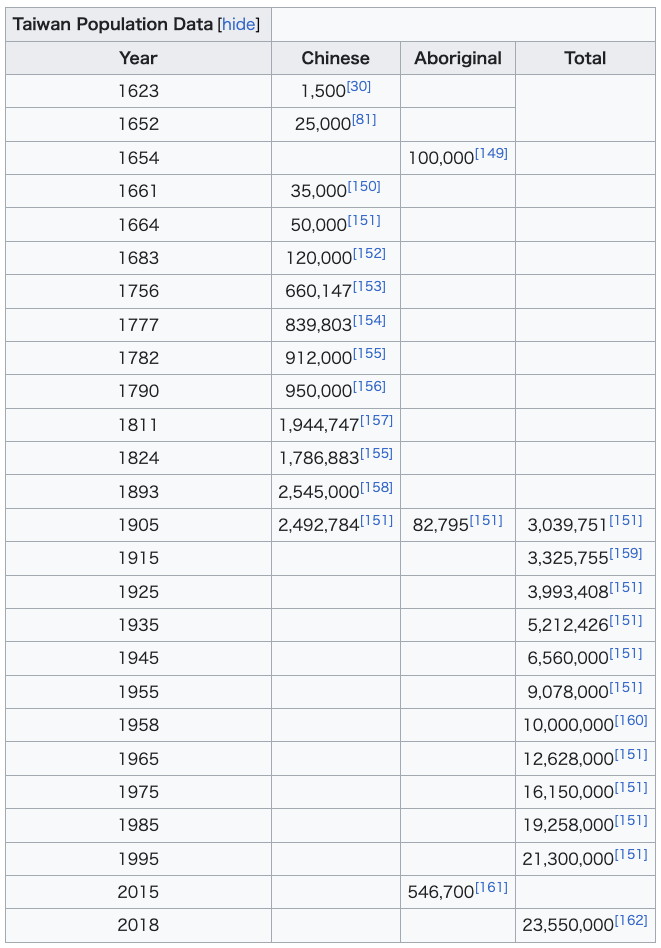 Taiwan Population Data  Painting of Taiwan (note the architectural difference between indigenous and Chinese inhabited areas), Kangxi period, 1684–1722 |
入植者の拡大(1684年~1795年) タオカ族の日常生活を描いた絵画の一部、1684年~1722年 康熙時代の台湾を描いた絵画の一部、1684年~1722年 1685年の清朝統治下の台湾の行政区画[143] 1734年の清朝統治下の台湾の行政区画[144] 1661年から1796年にかけて、清朝は台湾における領土の拡大を制限した。台湾では主要な港に8,000人の兵士が駐屯し、民政は最小限に抑えられて いた。名目上は3つの県が西部平原全域を管轄していたが、実効的な行政範囲はそれより狭かった。入植者が西部平原の中間地点を越えて移動するには許可が必 要だった。1715年、福建・浙江総督は台湾での開墾を提言したが、康熙帝はこれが不安定さや紛争を招くことを懸念した。[145] 雍正帝(在位1722–1735年)の治世下、清朝は入植者をより効果的に統制し、治安を維持するため、西部平原全域への支配を拡大した。これは積極的な 植民地化政策ではなく、違法な越境や開墾が継続していたことを反映したものであった。1721年の朱一桂の乱の後、反乱鎮圧の指揮を執った蘭廷貞の参謀で あった蘭定元は、漢人入植者に対する政府の統制を強化し、原住民をその行政下に組み入れるために、開墾を提唱した。[146] 乾隆帝(在位 1735–1796)の治世下、台湾の行政構造は概ね変わらなかった。1786年の林双文の乱後、乾隆帝は、肥沃な土地を生産性の低い原住民に任せておく ことは、不法入植者を招くだけだと認めた。[147] 清朝は原住民の統治にほとんど手を付けず、彼らに対する支配を強めようとはめったにしなかった。原住民は、漢化された原住民(熟番)と漢化されていない原 住民(生番)の2つのカテゴリーに分類された。清朝にとって、熟番とは税を納め、漢文化を取り入れた原住民を指した。清朝が台湾を併合した際、政府の管理 下にあった原住民の村は46あり、これはおそらく鄭氏政権から引き継がれたものだった。雍正年間には、地方司令官の林良による勧誘の結果、108の原住民 の村が帰順した。税金を納めるものの漢文化を実践しなかった生番は、帰化生番(帰化非同化原住民)と呼ばれた。[148] 乾隆政権は、紛争を恐れて原住民を誘致して帰化させることを禁じた。乾隆初期には、299の名称のある原住民村落が存在した。記録によれば、93の「帰化 生番」村と61の「帰化生番」村が存在した。帰化生番村の数は乾隆時代を通じて安定していた。1766年、原住民事務を管理するため、2人の原住民事務副 知事が任命された。1人は北部を、もう1人は南部を担当した。山岳原住民が開拓地に入らないよう、境界線が設けられた。入植者の境界線を明示し、先住民の 領土から隔離する政策は、1722年に公式な政策となった。境界線上の重要な地点には54基の石碑が設置された。入植者は先住民の領土への立ち入りを禁じ られていたが、入植者による境界線の侵犯は続き、1750年、1760年、1784年、1790年に境界線が再整備された。結婚は土地を取得する手段の一 つであったため、入植者が先住民と結婚することは禁じられていた。[142] 台湾の人口データ 台湾の絵(先住民居住地域と中国系住民居住地域の建築様式の違いに注目)、康熙時代(1684–1722) |
| Administrative expansion
(1796–1874) Qing quarantine policies were maintained in the early 19th century but attitudes towards aboriginal territory shifted. Local officials repeatedly advocated for colonization, especially in the cases of Gamalan and Shuishalian in modern Yilan County in northeastern Taiwan. The Kavalan people had started paying taxes as early as the Kangxi period (r. 1661–1722), but they were non-acculturated aborigines.[163] In 1787, a Chinese settler named Wu Sha tried to colonize Gamalan but was defeated. The next year, the Taiwan prefect, Yang Tingli, was convinced to support Wu Sha. Yang recommended colonization of Gamalan to the Fujian governor but the governor refused. In 1797, a new Tamsui sub-prefect supported Wu in his colonization efforts despite the ban. Wu's successors were unable to register their land on government registers. Local officials could not officially recognize it.[164] In 1806 the pirate fleet of Cai Qian was within the vicinity of Gamalan. Taiwan Prefect Yang argued that abandoning Gamalan would cause trouble on the frontier. Later another pirate band tried to occupy Gamalan. Yang recommended establishing administration and land surveys in Gamalan. In 1809, the emperor ordered for Gamalan to be incorporated. An imperial decree for the formal incorporation of Gamalan was issued and a Gamalan sub-prefect was appointed.[165] Unlike Gamalan, debates on Shuishalian (upstream areas of the Zhuoshui River and Wu River) resulted in its continued status as a forbidden area. Six aboriginal villages occupied the flat and fertile basin area of Shuishalian. The aboriginals had submitted as early as 1693 but they remained non-acculturated. In 1814, some settlers obtained reclamation permits through fabricating land lease requests. In 1816, government troops evicted the settlers.[166] Multiple officials recommended opening up Shuishalian between 1823 and 1848, but these recommendations were ignored.[167] The subject of land reclamation continued to be a topic of discussion and the Tamsui subprefecture gazetteer in 1871 openly called for colonization.[168] |
行政の拡大(1796年~1874年) 19世紀初頭、清朝の検疫政策は維持されたが、先住民の領土に対する態度は変化した。地方官吏たちは、特に台湾北東部の現在の宜蘭県に位置するガマラン族 やシュイシャリアン族の事例において、繰り返し入植を提唱した。カバラン族は康熙年間(在位1661–1722)にはすでに税を納め始めていたが、彼らは 同化していない先住民であった。[163] 1787年、呉舎という名の漢人入植者がガマランへの入植を試みたが、失敗に終わった。翌年、台湾府の楊廷利は呉舎を支援するよう説得された。楊は福建総 督にガマランの開拓を勧めたが、総督はこれを拒否した。1797年、新たな淡水副知事は、禁止令にもかかわらず、呉の開拓活動を支持した。呉の後継者たち は、政府の土地台帳に土地を登録することができなかった。地方官吏はそれを公式に認めることができなかった。[164] 1806年、蔡謙の海賊船団がガマランの近海に現れた。台湾府の楊知事は、ガマランを放棄すれば辺境に混乱を招くと主張した。その後、別の海賊団がガマラ ンを占領しようとした。楊はガマランにおける行政の確立と土地調査を推奨した。1809年、皇帝はガマランの編入を命じた。ガマランの正式な編入に関する 勅令が発布され、ガマランの副知事が任命された。[165] ガマランとは異なり、シュイシャリアン(卓水川および武川の上流地域)をめぐる議論の結果、同地域は引き続き禁域としての地位を維持することとなった。6 つの原住民集落が、シュイシャリアンの平坦で肥沃な盆地地域を占拠していた。原住民は早くも1693年に服従していたが、依然として同化されていなかっ た。1814年、一部の入植者が土地賃貸の申請書を偽造して開墾許可を取得した。1816年、政府軍は入植者を追放した。[166] 1823年から1848年にかけて、複数の役人が水沙里の開拓を推奨したが、これらの提言は無視された。[167] 土地開拓の問題は引き続き議論の的となり、1871年の淡水県誌は公然と入植を呼びかけた。[168] |
Expansion in reaction to crises
(1875–1895) Administrative units of Taiwan under the Qing dynasty by 1894[169] In 1874, Japan invaded southern Taiwan in what is known as the Mudan Incident (Japanese invasion of Taiwan (1874)). For six months Japanese soldiers occupied southern Taiwan until the Qing paid an indemnity in return for their withdrawal.[170] The imperial commissioner for Taiwan, Shen Baozhen, recommended subjugating the aborigines and populating their territory with Chinese settlers to prevent Japanese encroachment. The administration of Taiwan was expanded and campaigns against the aborigines were launched. Starting in 1874, mountain roads were built and aborigines were brought into formal submission. In 1875, the ban on entering Taiwan was lifted.[171] In 1877, 21 guidelines on subjugating aborigines and opening the mountains were issued. Agencies for recruiting settlers were established. Efforts to promote settlement in Taiwan petered out soon after.[172] The Sino-French War broke on in 1883 and the French occupied Keelung in northern Taiwan in 1884. The French army withdrew in 1885. Efforts to colonize aboriginal territory were renewed under Liu Mingchuan, the Taiwan defense commissioner. In 1887, Taiwan became its own province. During Liu's tenure, Taiwan's capital was shifted to modern Taichung. Taipei was built up as a temporary capital and then became the permanent capital in 1893. Liu's efforts to increase revenues were mixed due to foreign pressure to reduce levies. A cadastral reform survey was undertaken from June 1886 to January 1890 that met with opposition in the south. The receipts from the land tax reform fell short of expectations.[173]  Map of Asia showing the "Chinese Empire" (1892) Electric lighting, modern weaponry, a railway, cable and telegraph lines, a local steamship service, and industrial machinery were introduced to Taiwan. A telegraph line from Tainan to Tamsui was constructed in 1886–88 and a railway connecting Keelung, Taipei, and Hsinchu was built. These efforts met with mixed results. The telegraph line only functioned in bursts of a week due to a difficult overland connection and the railway required an overhaul, serviced small rolling stock, and carried little freight.[174] Taiwan attracted few laborers and few settlers went to Taiwan due to the aborigines and harsh climate. Governor Liu was criticized for the high cost and little gain of colonization activities. Liu resigned in 1891 and the colonization efforts ceased.[175] A Taiwan Pacification and Reclamation Head Office was established. By 1887, roughly 90,000 aborigines had formally submitted to Qing rule. This number increased to 148,479 aborigines over the following years. However the cost of getting them to submit was exorbitant. The Qing offered them materials and paid village chiefs monthly allowances. Not all the aborigines were under effective control and land reclamation in eastern Taiwan occurred at a slow pace.[175] From 1884 to 1891, Liu launched more than 40 military campaigns against the aborigines with 17,500 soldiers. A third of the invasion force was killed or disabled in the conflict.[174] By the end of the Qing period, the western plains were developed farmland areas with about 2.5 million Chinese inhabitants. The mountainous areas were still largely autonomous and aboriginal land loss occurred at a relatively slow pace.[176][158] However, by the last years of Qing rule, most of the plains aborigines had been acculturated to Han culture, around 20–30% could speak their mother tongues, and they gradually lost their land ownership and rent collection rights.[177] |
危機への対応としての拡大(1875年~1895年) 1894年時点の清朝支配下の台湾の行政区画[169] 1874年、日本は「牡丹事件」(1874年の台湾侵攻)として知られる事件で台湾南部を侵攻した。日本軍は6ヶ月間にわたり台湾南部を占領し、清朝が賠償金を支払うことで撤退した。[170] 台湾総督の沈宝璋は、日本の侵攻を防ぐため、原住民を服従させ、その領土に中国からの入植者を移住させることを提言した。台湾の行政は拡大され、原住民に 対する征伐が開始された。1874年以降、山道が建設され、原住民は正式に服従させられた。1875年、台湾への入島禁止令が解除された。[171] 1877年には、原住民の平定と山間部の開拓に関する21項目の指針が公布された。入植者を募集する機関が設立された。台湾への入植を促進する取り組み は、その後まもなく下火になった。[172] 1883年に清仏戦争が勃発し、1884年にフランス軍は台湾北部の基隆を占領した。フランス軍は1885年に撤退した。台湾防務委員の劉銘伝の下で、先 住民の領土への入植努力が再開された。1887年、台湾は独立した省となった。劉銘伝の在任中、台湾の首都は現在の台中に移された。台北は暫定的な首都と して整備され、1893年に恒久的な首都となった。劉明川による歳入増大の取り組みは、課税軽減を求める外国からの圧力により、成果はまちまちであった。 1886年6月から1890年1月にかけて地籍改革調査が実施されたが、南部ではこれに反対の声が上がった。土地税改革による歳入は期待を下回った。 [173] 「中華帝国」を示すアジア地図(1892年) 台湾には、電灯、近代兵器、鉄道、ケーブルおよび電信線、地元の蒸気船サービス、そして産業用機械が導入された。1886年から88年にかけて台南から淡 水への電信線が敷設され、基隆、台北、新竹を結ぶ鉄道が建設された。これらの取り組みは、成果がまちまちであった。陸路の接続が困難だったため、電信線は 1週間程度しか機能せず、鉄道は全面的な改修を必要とし、小型の車両しか運用できず、貨物輸送量も少なかった。[174] 台湾には労働者がほとんど集まらず、原住民や過酷な気候のため移住者も少なかった。劉総督は、植民地化活動にかかる費用が高額であるにもかかわらず成果が 乏しいとして批判された。劉は1891年に辞任し、植民地化の取り組みは中止された。[175] 台湾平定開墾総署が設立された。1887年までに、およそ9万人の原住民が正式に清の支配下に服した。この数はその後数年間で14万8,479人に増加し た。しかし、彼らを服従させるための費用は法外なものであった。清朝は彼らに物資を提供し、村長には月々の手当を支給した。すべての原住民が実効支配下に あったわけではなく、台湾東部における開墾は緩やかなペースで進んだ。[175] 1884年から1891年にかけて、劉は1万7500人の兵を率いて原住民に対して40回以上の軍事作戦を展開した。侵攻部隊の3分の1が戦闘で戦死また は負傷した。[174] 清朝末期までに、西部の平野部は約250万人の漢民族が居住する開発された農地となっていた。山岳地帯は依然として大部分が自治を保っており、先住民の土 地喪失は比較的緩やかなペースで進んだ。[176][158] しかし、清朝末期に至る頃には、平原部の先住民の大部分は漢文化に同化しており、母語を話せる者は20~30%程度にとどまり、彼らは徐々に土地所有権や 地代徴収権を失っていった。[177] |
Rebellions Depiction of Qing ships crossing the ocean to suppress the Lin Shuangwen rebellion, 1787–1788  Conquest of Douliumen (Zhuluo)  The Capture of Lin Shuangwen In 1723, aborigines along the central coastal plain rebelled. Troops from southern Taiwan were sent to put down this revolt, but in their absence, Han settlers in Fengshan County rose up in revolt.[178] By 1732, five different ethnic groups were in revolt but the rebellion was defeated by the end of the year.[178] During the Qianlong period (1735–1796), the 93 shufan acculturated aborigine villages never rebelled and over 200 non-acculturated aboriginal villages submitted.[179] During the 200 years of Qing rule in Taiwan, the plains aborigines rarely rebelled against the government and the mountain aborigines were left to their own devices until the last 20 years of Qing rule. Most rebellions were caused by Han settlers.[180] In 1720, there was an upset in Taiwan due to increased taxation. They gathered around Zhu Yigui and supported him in an anti-Qing rebellion.[181][182] Hakka leader Lin Junying from the south also joined the rebellion. In March 1720, Zhu and Lin attacked Taiwan County. In less than two weeks, the rebels had defeated Qing forces across Taiwan. The Hakka troops left Zhu to follow Lin north. The Qing sent a fleet under the command of Shi Shibian; the rebellion was defeated and Zhu was executed.[181] In 1786, members of the Tiandihui society were arrested for failing to make tax payments. The Tiandihui broke into the jail and rescued their members. When Qing troops were sent to arrest Lin Shuangwen, the leader of the Tiandihui led his forces to defeat the Qing troops.[183] Many of the rebel army's troops came from new arrivals from mainland China who could not find land.[182] Lin attacked Changhua County, killing 2,000 civilians. In early 1787, 50,000 Qing troops under Li Shiyao were sent to put down the rebellion. Lin tried to enlist the support of the Hakka people but they sent their troops to support the Qing.[183] Despite the Tiandihui's ostensibly anti-Qing stance, its members were generally anti-government and were not motivated by ethnic or national interest, resulting in social discord.[182] In 1788, 10,000 Qing troops led by Fuk'anggan and Hailanqa were sent to Taiwan and defeated the rebellion; Lin was executed.[184][183] |
反乱 林双文の反乱を鎮圧するため海を渡る清の船を描いた図、1787年~1788年 ドゥリウメン(朱羅)の征服 林双文の捕縛 1723年、中部沿岸平野の原住民が反乱を起こした。台湾南部の軍隊がこの反乱を鎮圧するために派遣されたが、その不在中に、鳳山県の漢人入植者たちが反 乱を起こした。[178] 1732年までに5つの異なる民族集団が反乱を起こしたが、その年の終わりまでに鎮圧された。[178] 乾隆年間(1735–1796)には、93の「修番」化された原住民集落は一度も反乱を起こさず、200以上の非修番化された原住民集落が服従した。 [179] 清朝による台湾統治の200年間、平地部の原住民が政府に対して反乱を起こすことは稀であり、山地部の原住民は清朝統治の最後の20年間まで放任されてい た。反乱の大部分は漢人入植者によって引き起こされた。[180] 1720年、台湾では増税をきっかけに動乱が起きた。彼らは朱一桂の周りに集まり、反清の反乱を支持した。[181][182] 南部の客家指導者である林俊英もこの反乱に加わった。1720年3月、朱と林は台湾県を攻撃した。2週間も経たないうちに、反乱軍は台湾全土で清軍を撃破 した。客家軍は朱を離れて林に従い北上した。清朝は石士弁指揮下の艦隊を派遣し、反乱は鎮圧され、朱は処刑された。[181] 1786年、天地会の会員たちが税金の未納を理由に逮捕された。天地会は牢屋に突入し、仲間を救出した。清軍が天地会の指導者である林双文を逮捕するため に派遣されると、林は部隊を率いて清軍を撃破した。[183] 反乱軍の兵士の多くは、土地を得ることができなかった中国本土からの新参者であった。[182] 林は彰化県を攻撃し、2,000人の民間人を殺害した。1787年初頭、李世耀率いる5万の清軍が反乱鎮圧のために派遣された。林双文は客家人の支持を得 ようとしたが、彼らは清を支援するために兵を送った。[183] 天地会の表向きの反清姿勢にもかかわらず、その構成員は概して反政府的であり、民族的・国家的利益に動機づけられたものではなかったため、社会的不和を招 いた。[182] 1788年、福康冈と海蘭卡率いる1万人の清軍が台湾に派遣され、反乱を鎮圧した。林は処刑された。[184][183] |
 Depiction of the shufan Makatao people, Qing dynasty painting, Qianlong period (1735–1796)  Hoanya people  Siraya people  Papora people  Babuza people  Taokas people |
シュファン・マカタオ族の描写、清代絵画、乾隆年間(1735–1796) ホアンヤ族 シラヤ族 パポラ族 バブザ族 タオカス族 |
Invasions Departure of a Ryukyuan ship bearing tribute to Beijing, 1831  Japanese painting of the expedition forces attacking the Mudan tribe, 1874  Evacuation of Keelung by the French forces, image created 1887 By 1831, the East India Company decided it no longer wanted to trade with the Chinese on their terms and planned more aggressive measures. Given the strategic and commercial value of Taiwan, there were British suggestions in 1840 and 1841 to seize the island. William Huttman wrote to Lord Palmerston pointing out "China's benign rule over Taiwan and the strategic and commercial importance of the island."[185] He suggested that Taiwan could be occupied with only a warship and less than 1,500 troops, and the English would be able to spread Christianity among the natives as well as develop trade.[186] In 1841, during the First Opium War, the British tried to scale the heights around the harbor of Keelung three times but failed.[187] The British transport ship Nerbudda became shipwrecked near Keelung Harbour due to a typhoon. In October 1841, HMS Nimrod sailed to Keelung to search for the Nerbudda survivors, but after Captain Joseph Pearse found out that they were sent south for imprisonment, he ordered the bombardment of the harbour and destroyed 27 sets of cannon before returning to Hong Kong. The brig Ann also shipwrecked in March 1842. The commanders of Taiwan, Dahonga and Yao Ying, filed a disingenuous report to the emperor, claiming to have defended against an attack from the Keelung fort. Most of the survivors—over 130 from the Nerbudda and 54 from the Ann—were executed in Tainan in August 1842. The false report was later discovered and the officials in Taiwan punished.[185] On 12 March 1867, the American barque Rover shipwrecked offshore off of southern Taiwan. The captain, his wife, and some men escaped. The Koaluts (Guizaijiao) tribe of the Paiwan people captured and killed them. Two rescue attempts failed.[188][189] Le Gendre, the US Consul, demanded that the Qing send troops to help him negotiate with the aborigines. On 10 September, Garrison Commander Liu Mingcheng led 500 Qing troops to southern Taiwan with Le Gendre. The aboriginal chief, Tanketok (Toketok), explained that a long time ago the white men came and almost exterminated the Koaluts tribe and their ancestors passed down their desire for revenge. They agreed that the mountain aborigines would help the castaways.[190] It was later discovered that Tanketok did not have absolute control over the tribes. Le Gendre castigated China as a semi-civilized power for not seizing the territory of a "wild race".[191] In December 1871, a Ryukyuan vessel shipwrecked on the southeastern tip of Taiwan and 54 sailors were killed by aborigines.[192] The shipwreck and murder of the sailors came to be known as the Mudan incident, although it did not take place in Mudan (J. Botan), but at Kuskus (Gaoshifo).[193] The Ryukyu Kingdom did not ask Japanese officials for help regarding the shipwreck. Instead its king, Shō Tai, sent a reward to Chinese officials in Fuzhou for the return of the 12 survivors. The Mudan incident did not immediately cause any concern in Japan; it was not until April 1874 that it became an international concern.[194] The Imperial Japanese Army started urging the government to invade Taiwan in 1872 with the Mudan incident as casus belli. The king of Ryukyu was dethroned by Japan and preparations for an invasion of Taiwan were undertaken in the same year.[195] On 17 May 1874, Saigō Jūdō led the main force, 3,600 strong, aboard four warships.[196] They invaded indigenous territory in southern Taiwan. On 3 June, they burnt all the villages that had been occupied. On 1 July, the new leader of the Mudan tribe and the chief of Kuskus surrendered.[197] The Japanese settled in and established large camps with no intention of withdrawing, but in August and September 600 soldiers fell ill. The death toll rose to 561. Negotiations with Qing China began on 10 September. The Western Powers pressured China not to cause bloodshed with Japan as it would negatively impact the coastal trade. The resulting Peking Agreement was signed on 30 October. Japan gained the recognition of Ryukyu as its vassal and an indemnity payment of 500,000 taels. Japanese troops withdrew from Taiwan on 3 December.[198] During the Sino-French War, the French invaded Taiwan during the Keelung Campaign in 1884. On 5 August 1884, Sébastien Lespès bombarded Keelung's harbor and destroyed the gun placements. The next day, the French attempted to take Keelung but failed to defeat the larger Chinese force led by Liu Mingchuan and were forced to withdraw. On 1 October, Amédée Courbet landed with 2,250 French forces and defeated a smaller Chinese force, capturing Keelung. French efforts to capture Tamsui failed. The French shelled Tamsui, destroying not only the forts but also foreign buildings. Some 800 French troops landed on Shalin beach near Tamsui but they were repelled by Chinese forces.[199] The French imposed a blockade Taiwan from 23 October 1884 until April 1885 but the execution was not completely effective.[200] French ships around mainland China's coast attacked any junk they could find and captured its occupants to be shipped to Keelung for constructing defensive works. However, for every junk the French captured, another five junks arrived with supplies at Takau and Anping. The immediate effect of the blockade was a sharp in decline of legal trade and income.[201] In late January 1885, Chinese forces suffered a serious defeat around Keelung. Although the French captured Keelung they were unable to move beyond its perimeters. In March the French tried to take Tamsui again and failed. At sea, the French bombarded Penghu on 28 March.[202] Penghu surrendered on 31 March but many of the French soon grew ill and 1,100 soldiers and later 600 more were debilitated.[203] An agreement was reached on 15 April 1885 and an end to hostilities was announced. The French evacuation from Keelung was completed on 21 June 1885 and Penghu remained under Chinese control.[204] End of Qing rule As part of the settlement for losing the Sino-Japanese War, the Qing empire ceded the islands of Taiwan and Penghu to Japan on April 17, 1895, according to the terms of the Treaty of Shimonoseki. The loss of Taiwan would become a rallying point for the Chinese nationalist movement in the years that followed.[205] |
侵略 1831年、北京へ貢ぎ物を運ぶ琉球船の出航 1874年、牡丹族を攻撃する遠征軍を描いた日本画 1887年に制作された、フランス軍による基隆からの撤退の様子 1831年までに、東インド会社はもはや中国の条件に従って貿易を行うことを望まず、より積極的な措置を計画した。台湾の戦略的・商業的価値を考慮し、 1840年と1841年には同島を占領すべきだという英国側の提案があった。ウィリアム・ハットマンはパーマストン卿に宛てた書簡で、「台湾に対する中国 の温和な統治、および同島の戦略的・商業的重要性」を指摘した。[185] 彼は、軍艦1隻と1,500名未満の兵力で台湾を占領できるとし、英国は現地住民へのキリスト教の布教や貿易の発展も可能になると提案した。[186] 1841年、第一次アヘン戦争の最中、英国軍は基隆港周辺の高地への登攀を3度試みたが失敗した。[187] 英国の輸送船「ナーブッダ」号は台風により基隆港付近で座礁した。1841年10月、HMSニムロッド号はナーブッダ号の生存者を捜索するため基隆へ向 かったが、ジョセフ・ピアース艦長が生存者たちが南へ送られ投獄されたことを知ると、港への砲撃を命じ、27門の大砲を破壊してから香港へ戻った。 1842年3月には、ブリッグ船「アン」も座礁した。台湾の指揮官である大洪嘉と姚英は、基隆要塞からの攻撃を防いだと偽って、皇帝に不実な報告を提出し た。「ナーブッダ」号の生存者130名余りと「アン」号の生存者54名の大部分は、1842年8月に台南で処刑された。この虚偽の報告は後に発覚し、台湾 の役人たちは処罰された。[185] 1867年3月12日、アメリカのバーク船「ローバー」号が台湾南部の沖合で座礁した。船長、その妻、および数名の乗組員は脱出したが、パイワン族のコア ルツ(グイザイジャオ)族に捕らえられ、殺害された。2度の救出作戦は失敗に終わった。[188][189] 米国領事のル・ジェンドルは、清朝に対し、先住民との交渉を支援するため軍隊を派遣するよう要求した。9月10日、駐屯地司令官の劉明成は、ル・ジェンド ルと共に500名の清軍を率いて台湾南部へ向かった。先住民の首長タンケトク(トケトク)は、昔、白人がやって来てコアルツ族をほぼ全滅させ、その祖先が 復讐の念を代々受け継いできたと説明した。彼らは、山岳部の先住民が遭難者を助けることで合意した。[190] 後に、タンケトクが部族に対して絶対的な支配力を持っていなかったことが判明した。ル・ジャンドルは、「野蛮な民族」の領土を掌握しなかったとして、中国 を半文明国であると非難した。[191] 1871年12月、琉球の船が台湾南東端で難破し、54名の船員が原住民によって殺害された。[192] この難破と船員殺害は「牡丹事件」として知られるようになったが、実際には牡丹(日:牡丹)ではなく、クスクス(高石甫)で発生したものである。 [193] 琉球王国はこの難破事故に関して日本当局に援助を求めなかった。その代わりに、尚泰王は12人の生存者の引き渡しに対し、福州の中国当局に報奨金を送っ た。牡丹事件は当初、日本において直ちに懸念を引き起こすことはなかった。国際的な関心事となったのは、1874年4月になってからである。[194] 日本陸軍は1872年、牡丹事件を開戦の口実として、政府に対し台湾侵攻を強く働きかけ始めた。琉球王は日本によって廃位され、同年、台湾侵攻の準備が着 手された。[195] 1874年5月17日、西郷十郎は4隻の軍艦に乗船し、3,600名の主力部隊を率いた。[196] 彼らは台湾南部の先住民の領土に侵攻した。6月3日、占領した村々をすべて焼き払った。7月1日、木丹族の新首長とクスクス族の長が降伏した。[197] 日本軍は撤退する意思もなく、大規模な野営地を築いて駐留したが、8月から9月にかけて600名の兵士が病に倒れた。死者数は561名に達した。清朝との 交渉は9月10日に始まった。列強諸国は、沿岸貿易に悪影響を及ぼすとして、中国に対し日本との流血の争いを避けるよう圧力をかけた。その結果、10月 30日に北京協定が調印された。日本は琉球を属国として承認させ、50万両の賠償金を獲得した。日本軍は12月3日に台湾から撤退した。[198] 清仏戦争中、フランスは1884年の基隆作戦において台湾に侵攻した。1884年8月5日、セバスチャン・レスペスは基隆港を砲撃し、砲台を破壊した。翌 日、フランス軍は基隆の占領を試みたが、劉明川率いる数で勝る中国軍を打ち破ることができず、撤退を余儀なくされた。10月1日、アメデ・クールベが 2,250名のフランス軍を率いて上陸し、数で劣る中国軍を撃破して基隆を占領した。淡水占領の試みは失敗に終わった。フランス軍は淡水を砲撃し、要塞だ けでなく外国人居住区の建物も破壊した。約800名のフランス軍が淡水近くの沙林浜に上陸したが、中国軍によって撃退された。[199] フランスは1884年10月23日から1885年4月まで台湾を封鎖したが、その実施は完全には効果的ではなかった。[200] 中国本土沿岸を巡回するフランス艦船は、見つかるジャンク船をすべて攻撃し、その乗組員を捕らえて基隆へ連行し、防御施設の建設に従事させた。しかし、フ ランスが1隻のジャンク船を捕獲するたびに、高頭や安平には物資を積んだ別の5隻のジャンク船が到着した。封鎖の直接的な影響として、合法的な貿易と収入 が急激に減少した。[201] 1885年1月下旬、中国軍は基隆周辺で深刻な敗北を喫した。フランス軍は基隆を占領したものの、その周辺地域へ進軍することはできなかった。3月、フラ ンス軍は再び淡水(タムスイ)の占領を試みたが失敗した。海上では、フランス軍が3月28日に澎湖(ポンフー)を砲撃した。[202] 澎湖は3月31日に降伏したが、多くのフランス兵がすぐに病に倒れ、1,100名の兵士、その後さらに600名が衰弱した。[203] 1885年4月15日に合意が成立し、戦闘の終結が宣言された。フランス軍の基隆からの撤退は1885年6月21日に完了し、澎湖は中国の支配下にとど まった。[204] 清朝支配の終焉 日清戦争での敗戦に伴う講和の一環として、清帝国は下関条約の条項に基づき、1895年4月17日に台湾および澎湖諸島を日本に割譲した。台湾の喪失は、その後の数年間、中国の民族主義運動の結束の象徴となることとなった。[205] |
| 130-205 130. Wong 2017, p. 187. Wong 2017, pp. 187–188. Wong 2017, p. 189–190. Twitchett 2002, p. 146. Wong 2017, p. 193. Wong 2017, p. 194. Thompson 1964, p. 178–179. Ye 2019, p. 51. "Entry #60161". 臺灣閩南語常用詞辭典 [Dictionary of Frequently-Used Taiwan Minnan]. (in Chinese and Hokkien). Ministry of Education, R.O.C. 2011. Tai, Pao-tsun (2007). The Concise History of Taiwan (Chinese-English bilingual ed.). Nantou City: Taiwan Historica. p. 52. ISBN 9789860109504. 140. Ye 2019, p. 54. Shepherd 1993, p. 150–154. Ye 2019, p. 50–55. "清代臺灣行政區劃沿革". "清代臺灣行政區劃沿革". Ye 2019, p. 46–47. Ye 2019, p. 47–49. Ye 2019, p. 49. Ye 2019, p. 49–50. Ye 2019, p. 21. 150. Ye 2019, p. 27. Rubinstein 1999, p. 10. Ye 2019, p. 29. Shepherd 1993, p. 155. Shepherd 1993, p. 156. Rubinstein 1999, p. 136. Ye 2019, p. 34. Ye 2019, p. 57. Rubinstein 1999, p. 177. Shepherd 1993, p. 161. 160. Rubinstein 1999, p. 331. Ye 2019, p. 13. Li 2019, p. 5. Ye 2019, p. 55–56. Ye 2019, p. 56. Ye 2019, p. 56–57. Ye 2019, p. 58. Ye 2019, p. 59–60. 170. Ye 2019, p. 60–61. "清代臺灣行政區劃沿革". Ye 2019, p. 61–62. Ye 2019, p. 62. Ye 2019, p. 63–64. Rubinstein 1999, p. 187–190. Rubinstein 1999, p. 191. Ye 2019, p. 65. Ye 2019, p. 1, 10, 174. Ye 2019, pp. 174–175, 166. Twitchett 2002, p. 228. Ye 2019, p. 91. 180. Ye 2019, p. 106. Li 2019, p. 82–83. "Taiwan in Time: Rebels of heaven and earth - Taipei Times". 17 April 2016. Standaert 2022, p. 225. Li 2019, p. 83. Shih-Shan Henry Tsai (2009). Maritime Taiwan: Historical Encounters with the East and the West. Routledge. pp. 66–67. ISBN 978-1-317-46517-1. Leonard H. D. Gordon (2007). Confrontation Over Taiwan: Nineteenth-Century China and the Powers. Lexington Books. p. 32. ISBN 978-0-7391-1869-6. Elliott 2002, p. 197. Barclay 2018, p. 56. Wong 2022, p. 119. 190. Wong 2022, p. 119–120. Wong 2022, p. 121–122. Barclay 2018, p. 50. Barclay 2018, p. 52. Barclay 2018, p. 53–54. Wong 2022, p. 124–126. Wong 2022, p. 132. Wong 2022, p. 137–138. Wong 2022, p. 141–143. Gordon 2007, p. 142–145. 200. Gordon 2007, p. 146–49. Gordon 2007, p. 149–151, 154. Gordon 2007, p. 149–151. Gordon 2007, p. 161–162. Gordon 2007, p. 162. 205. Zhang (1998), p. 514. |
130-205130. Wong 2017, p. 187. Wong 2017, pp. 187–188. Wong 2017, p. 189–190. Twitchett 2002, p. 146. Wong 2017, p. 193. Wong 2017, p. 194. Thompson 1964, p. 178–179. Ye 2019, p. 51. 「項目 #60161」。『台湾閩南語常用詞辞典』。(中国語および福建語)。中華民国教育部 2011. 戴宝存 (2007). 『台湾簡史』(中国語・英語併記版)。南投市:台湾史学会。p. 52. ISBN 9789860109504. 140. Ye 2019, p. 54. Shepherd 1993, p. 150–154. Ye 2019, p. 50–55. 「清代台湾行政区画沿革」。 「清代台湾行政区画沿革」。 Ye 2019, p. 46–47. Ye 2019, p. 47–49. Ye 2019, p. 49. Ye 2019, p. 49–50. Ye 2019, p. 21. 150. Ye 2019, p. 27. Rubinstein 1999, p. 10. Ye 2019, p. 29. Shepherd 1993, p. 155. Shepherd 1993, p. 156. Rubinstein 1999, p. 136. Ye 2019, p. 34. Ye 2019, p. 57. ルビンスタイン 1999, p. 177. シェパード 1993, p. 161. 160. ルビンスタイン 1999, p. 331. イェ 2019, p. 13. リ 2019, p. 5. イェ 2019, p. 55–56. Ye 2019, p. 56. Ye 2019, p. 56–57. Ye 2019, p. 58. Ye 2019, p. 59–60. 170. Ye 2019, p. 60–61. 「清代台湾行政区画沿革」。 Ye 2019, p. 61–62. Ye 2019, p. 62. Ye 2019, p. 63–64. Rubinstein 1999, p. 187–190. Rubinstein 1999, p. 191. Ye 2019, p. 65. Ye 2019, p. 1, 10, 174. Ye 2019, pp. 174–175, 166. Twitchett 2002, p. 228. Ye 2019, p. 91. 180. Ye 2019, p. 106. Li 2019, p. 82–83. 「Taiwan in Time: Rebels of heaven and earth - Taipei Times」。2016年4月17日。 Standaert 2022, p. 225. Li 2019, p. 83. ツァイ・シーシャン・ヘンリー (2009). 『Maritime Taiwan: Historical Encounters with the East and the West』. Routledge. pp. 66–67. ISBN 978-1-317-46517-1. レナード・H・D・ゴードン (2007). 『Confrontation Over Taiwan: Nineteenth-Century China and the Powers』. Lexington Books. p. 32. ISBN 978-0-7391-1869-6. エリオット 2002, p. 197. バークレー 2018, p. 56. ウォン 2022, p. 119. 190. ウォン 2022, p. 119–120. ウォン 2022, p. 121–122. バークレー 2018, p. 50. バークレー 2018, p. 52. バークレー 2018, p. 53–54. ウォン 2022, p. 124–126. Wong 2022, p. 132. Wong 2022, p. 137–138. Wong 2022, p. 141–143. Gordon 2007, p. 142–145. 200. Gordon 2007, p. 146–49. Gordon 2007, p. 149–151, 154. Gordon 2007, p. 149–151. Gordon 2007, p. 161–162. Gordon 2007, p. 162. 205. Zhang (1998), p. 514. |
| https://en.wikipedia.org/wiki/History_of_Taiwan |
☆ 大日本帝国統治時代——Empire of Japan (1895–1945)
| Empire of Japan
(1895–1945) Main article: Taiwan under Japanese rule See also: Political divisions of Taiwan (1895–1945) and List of Governors-General of Taiwan  A map of the Empire of Japan including Taiwan ("barbarian land" in red) in 1895  1901 map with red line marking approximate boundary separating territory under actual Japanese administration from "Savage District" The acquisition of Taiwan by Japan was the result of Prime Minister Itō Hirobumi's "southern strategy" adopted during the First Sino-Japanese War in 1894–95. Itō and Mutsu Munemitsu, the minister of foreign affairs, stipulated that Penghu and Taiwan must be ceded to Japan. These conditions were met during the signing of the Treaty of Shimonoseki on 17 April 1895. Taiwan and Penghu were transferred to Japan on 2 June.[206][207] The period of Japanese rule in Taiwan has been divided into three periods under according to policies: military suppression (1895–1915), dōka (同化): assimilation (1915–37), and kōminka (皇民化): Japanization (1937–45). A separate policy for aborigines was implemented.[208][209] The matter of assimilation, dōka (同化), was tied to the admonition "impartiality and equal favor" (isshi dōjin) for all imperial subjects under the Emperor of Japan. Conceptually this colonial ideal conveyed the idea that metropolitan Japanese (naichijin) imparted their superior culture to the subordinate islanders (hontōjin), who would share the common benefits.[210] |
大日本帝国(1895年–1945年) 本記事:日本統治下の台湾 関連項目:台湾の行政区画(1895年–1945年)および台湾総督の一覧 1895年の台湾(赤色で示された「蛮地」)を含む大日本帝国の地図 1901年の地図。赤線は、日本の実効支配下にある地域と「野蛮地区」とを分けるおおよその境界線を示している 日本による台湾の獲得は、1894年から95年にかけての日清戦争中に伊藤博文首相が採用した「南進政策」の結果であった。伊藤と外務大臣の陸奥宗光は、 澎湖と台湾を日本に割譲することを条件とした。これらの条件は、1895年4月17日の下関条約調印時に満たされた。台湾と澎湖は6月2日に日本に引き渡 された。[206][207] 台湾における日本の統治期間は、政策に基づき、軍事鎮圧期(1895年~1915年)、同化期(1915年~1937年)、皇民化期(1937年 ~1945年)の3つに区分されている。先住民に対しては、別途の政策が実施された。[208][209] 同化(どうか)の問題は、日本天皇の下にあるすべての帝国臣民に対する「一視同仁」という教訓と結びついていた。概念的には、この植民地主義的理想は、本 土の日本人(内地人)が、従属的な島民(本島人)に優れた文化を授け、それによって共通の利益を分かち合うという考えを表していた。[210] |
| Armed resistance Main articles: Japanese invasion of Taiwan (1895) and Taiwanese resistance to Japanese colonialism  The Imperial Guard Defeats the Enemy in Hard Fighting at Keelung on the Island of Taiwan, 1895 The colonial authorities encountered violent opposition in Taiwan. Five months of sustained warfare occurred after the 1895 invasion and partisan attacks continued until 1902. For the first two years the colonial authority relied mainly on military force. On 20 May, Qing officials were ordered to leave their posts. General mayhem and destruction ensued in the following months.[211] Japanese forces landed on the coast of Keelung on 29 May. After the fall of Taipei on 7 June, local militia and partisan bands continued the resistance. In the south, a small Black Flag force led by Liu Yongfu delayed Japanese landings. Taiwanese gentry approach Britain and then France in a failed attempt to gain protectorate status for Taiwan,[212]: 66 after which Governor Tang Jingsong attempted to carry out anti-Japanese resistance efforts as the Republic of Formosa.[211] The Green Standard Army and Yue soldiers from Guangxi took to looting and pillaging. Taipei's gentry elite sent Koo Hsien-jung to Keelung to invite the advancing Japanese forces to proceed to Taipei and restore order.[213] The Republic, established on 25 May, disappeared 12 days later when its leaders left for the mainland.[211] Liu Yongfu formed a temporary government in Tainan before escaping as Japanese forces closed in.[214] Between 200,000 and 300,000 people fled Taiwan in 1895.[215][216] Chinese residents in Taiwan were given the option of selling their property and leaving by May 1897, or become Japanese citizens. From 1895 to 1897, an estimated 6,400 people sold their property and left Taiwan.[217][218] Armed resistance by Hakka villagers broke out in the south. A series of attacks led by "local bandits" or "rebels" lasted throughout the next seven years. After 1897, uprisings by Chinese nationalists were commonplace. Luo Fuxing [zh], a member of the Tongmenghui, was arrested and executed along with 200 others in 1913.[219] In June 1896, 6,000 Taiwanese were slaughtered in the Yunlin Massacre. From 1898 to 1902, some 12,000 "bandit-rebels" were killed in addition to the 6,000–14,000 killed in the initial resistance war of 1895.[214][220] Major armed resistance was largely crushed by 1902 but minor rebellions started occurring again in 1907, such as the Beipu uprising by Hakka and Saisiyat people in 1907, Luo Fuxing in 1913 and the Tapani Incident of 1915.[221][222] The Beipu uprising occurred on 14 November 1907 when a group of Hakka insurgents killed 57 Japanese officers and members of their family. In response, 100 Hakka men and boys were killed in the village of Neidaping.[223] Luo Fuxing was an overseas Taiwanese Hakka involved with the Tongmenghui. He planned a rebellion against the Japanese with 500 fighters, resulting in the execution of more than 1,000 Taiwanese by Japanese police. Luo was killed on 3 March 1914.[220][224] In 1915, Yu Qingfang organized a religious group that defied Japanese authority. In the Tapani incident, 1,413 members of Yu's group were captured. Yu and 200 of his followers were executed.[225] After the Tapani rebels were defeated, Andō Teibi ordered a massacre. Military police in Tapani and Jiasian lured out anti-Japanese militants with a pardon. They were told to line up in a field, dig holes, and were then executed by firearm. According to oral tradition, some 5,000–6,000 people died in this incident.[226][227] |
武力抵抗 主な記事:日本による台湾侵攻(1895年)および日本植民地支配に対する台湾人の抵抗 1895年、台湾島基隆での激戦において、帝国衛兵が敵を撃破 植民地当局は台湾で激しい抵抗に直面した。1895年の侵攻後、5ヶ月にわたる継続的な戦闘が発生し、ゲリラ攻撃は1902年まで続いた。最初の2年間、 植民地当局は主に軍事力に依存していた。5月20日、清朝官吏は職を離れるよう命じられた。その後数ヶ月にわたり、大混乱と破壊が続いた。[211] 日本軍は5月29日、基隆の海岸に上陸した。6月7日に台北が陥落した後も、地元の民兵やゲリラ部隊は抵抗を続けた。南部では、劉永福率いる小規模な黒旗 軍が日本軍の上陸を遅らせた。台湾の士紳たちは、台湾の保護国化を図るため英国、次いでフランスに接触したが失敗に終わった[212]: 66 。その 後、総督の唐景松は「福爾摩沙共和国」として抗日抵抗運動を展開しようとした。[211] 広西からの緑旗軍と越軍は略奪と暴行に走った。台北の士紳層は、進軍する日本軍に対し台北へ進み秩序を回復するよう要請するため、顧賢瓊を基隆へ派遣し た。[213] 5月25日に樹立された共和国は、指導者たちが本土へ去った12日後に消滅した。[211] 劉永福は台南で臨時政府を樹立したが、日本軍の包囲が迫る中、逃亡した。[214] 1895年には20万から30万人が台湾から逃れた。[215][216] 台湾在住の中国人には、1897年5月までに財産を売却して去るか、日本国籍を取得するかの選択肢が与えられた。1895年から1897年にかけて、推定 6,400人が財産を売却して台湾を去った。[217][218] 南部では客家(ハッカ)の村人による武装抵抗が勃発した。「地元の山賊」や「反乱軍」が主導する一連の攻撃は、その後7年間にわたって続いた。1897年 以降、中国民族主義者による蜂起は日常茶飯事となった。同盟会のメンバーであった羅福星[zh]は、1913年に他の200名と共に逮捕され、処刑され た。[219] 1896年6月、雲林大虐殺で6,000人の台湾人が虐殺された。1898年から1902年にかけて、1895年の初期抵抗戦争で殺害された 6,000~14,000人に加え、約12,000人の「山賊・反乱者」が殺害された。[214] [220] 大規模な武力抵抗は1902年までにほぼ鎮圧されたが、1907年には再び小規模な反乱が発生し始めた。例えば、1907年の客家とサイシヤット族による 北埔の乱、1913年の羅福星の乱、1915年のタパニ事件などである。[221] [222] 北埔の乱は1907年11月14日に発生し、客家系の反乱者グループが日本人将校57名とその家族を殺害した。これに対し、内大坪の村で100人の客家系 男性と少年が殺害された。[223] 羅福星は、同盟会に関与していた台湾出身の客家系海外華人であった。彼は500人の戦闘員を率いて日本に対する反乱を計画したが、その結果、1,000人 以上の台湾人が日本警察によって処刑された。羅福星は1914年3月3日に殺害された。[220][224] 1915年、余清芳は日本の権威に反抗する宗教団体を結成した。タパニ事件では、余のグループのメンバー1,413人が捕らえられた。余と200人の追随 者が処刑された。[225] タパニの反乱軍が敗北した後、安藤貞比は虐殺を命じた。タパニとジャシアンの憲兵は、恩赦を餌に反日活動家たちを誘い出した。彼らは野原に整列し、穴を掘 るよう命じられ、その後銃殺された。口伝によれば、この事件で約5,000~6,000人が死亡した。[226][227] |
Non-violent resistance The original flag of the Taiwanese People's Party, 2 January 1929 – 6 October 1929 Nonviolent means of resistance such as the Taiwanese Cultural Association (TCA), founded by Chiang Wei-shui in 1921, continued after most violent means were exhausted. Chiang joined the "Chinese United Alliance" founded by Sun Yat-sen. He saw Taiwanese people as Japanese nationals of Han Chinese ethnicity and wished to position the TCA as an intermediary between China and Japan. The TCA also aimed to establish independence for Taiwan.[228] Statements of self determination were possible at the time due to the relatively progressive era of Taishō Democracy. "Taiwan is Taiwan people's Taiwan" became a common position for all anti-Japanese groups. In December 1920, Lin Hsien-tang and 178 Taiwanese residents filed a petition seeking self-determination. It was rejected.[229] The TCA had over 1,000 members of various backgrounds from across Taiwan except in indigenous areas. The TCA promoted vernacular Chinese language. In 1923 the TCA co-founded Taiwan People's News [ja; zh] which was published in Tokyo and then shipped to Taiwan. It was subjected to censorship and seven or eight issues were banned. Chiang and others applied to set up a parliament for Taiwan that was deemed illegal. In 1923, 99 Alliance members were arrested and 18 were tried in court.[230] Thirteen were convicted. Chiang was imprisoned more than ten times.[231] The TCA split in 1927 to form the New TCA and the Taiwanese People's Party, which both Chiang and Lin left for. The New TCA later became a subsidiary of the Taiwanese Communist Party and the only organization advocating Taiwanese independence. The TPP brought forth issues such as Japanese opium trafficking, the inhumane treatment of the Seediq people, and revealed the colonial authority's use of poisonous gas. In February 1931, the TPP was terminated. Chiang died on 23 August.[232]  Japanese painting of Taiwan, 1928 |
非暴力抵抗 台湾人民党の初代党旗、1929年1月2日 – 1929年10月6日 1921年に蒋維瑾によって設立された台湾文化協会(TCA)のような非暴力的な抵抗手段は、暴力的な手段のほとんどが尽きた後も続けられた。蒋は孫文が 設立した「中華同盟」に加わった。彼は台湾人を漢民族の日本人国民と見なし、台湾文化協会を中国と日本の仲介役として位置づけたいと考えていた。台湾文化 協会はまた、台湾の独立を確立することも目指していた。[228] 当時、比較的進歩的な「大正民主」の時代であったため、自決に関する声明を出すことが可能であった。「台湾は台湾人の台湾である」という主張は、すべての 反日団体に共通する立場となった。1920年12月、林憲堂と178人の台湾在住者が、自決を求める請願書を提出した。これは却下された。[229] 台湾中国協会(TCA)には、先住民地域を除く台湾全土から、様々な背景を持つ1,000人以上の会員がいた。TCAは中国語の普及を推進した。1923 年、台湾同盟は『台湾人民新聞』[ja; zh]を共同創刊した。同紙は東京で発行され、台湾へ送られていた。検閲の対象となり、7、8号が発行禁止となった。蒋等が台湾の議会設置を申請したが、 これは違法と見なされた。1923年、同盟員99名が逮捕され、18名が裁判にかけられた。[230] うち13名が有罪判決を受けた。蒋は10回以上投獄された。[231] 1927年、台湾同盟は分裂し、新台湾同盟と台湾人民党が結成された。蒋と林は共に新台湾同盟に移った。新台湾同盟は後に台湾共産党の傘下となり、台湾独 立を主張する唯一の組織となった。台湾人民党は、日本のアヘン密輸やセデック族への非人道的な扱いといった問題を提起し、植民地当局による毒ガスの使用を 暴露した。1931年2月、台湾人民党は解散した。蒋は8月23日に死去した。[232] 台湾を描いた日本画、1928年 |
| Assimilation movement In 1914, Itagaki Taisuke briefly led a Taiwan assimilation movement as a response to appeals from influential Taiwanese spokesmen. In December 1914, Itagaki formally inaugurated the Taiwan Dōkakai, an assimilation society. Within a week, over 3,000 Taiwanese and 45 Japanese residents joined the society. After Itagaki left later that month, leaders of the society were arrested and its Taiwanese members detained or harassed. In January 1915, the Taiwan Dōkakai was disbanded.[233] Japanese colonial policy sought to strictly segregate the Japanese and Taiwanese population until 1922.[234] Taiwanese students who moved to Japan for their studies were able to associate more freely with Japanese and took to Japanese ways more readily than their island counterparts. However full assimilation was rare.[235] An attempt to fully Japanize the Taiwanese people was made during the kōminka period (1937–45). The reasoning was that only as fully assimilated subjects could Taiwan's inhabitants fully commit to Japan's war and national aspirations.[236] The kōminka movement was generally unsuccessful and few Taiwanese became "true Japanese" due to the short time period and large population. In terms of acculturation under controlled circumstances, it can be considered relatively effective.[237] |
同化運動 1914年、板垣退助は、台湾の有力な代弁者たちからの要請に応え、一時的に台湾同化運動を主導した。1914年12月、板垣は同化団体である「台湾同化 会」を正式に発足させた。1週間も経たないうちに、3,000人以上の台湾人と45人の日本人居住者が同会に加入した。その月の後半に板垣が去った後、同 会の指導者たちは逮捕され、台湾人会員は拘束されたり嫌がらせを受けたりした。1915年1月、台湾同化会は解散した。[233] 日本の植民地政策は、1922年まで日本人と台湾人の人口を厳格に分離することを目指していた。[234] 留学のために日本へ渡った台湾人学生は、島に残った同胞よりも自由に日本人と交流し、日本の習慣にもより容易に馴染んだ。しかし、完全な同化は稀であっ た。[235] 台湾人を完全に日本化しようとする試みは、公民化期(1937–45年)に行われた 。その理屈は、台湾の住民が完全に同化された臣民となって初めて、日本の戦争や国家的志向に全面的に献身できるというものだった。[236] 公民化運動は概して失敗に終わり、期間が短く人口が多かったため、「真の日本人」となった台湾人はほとんどいなかった。管理された状況下での文化同化とい う点では、比較的効果的だったと言える。[237] |
Education Taichung Middle School in 1919 A system of elementary common schools taught Japanese language and culture, Classical Chinese, Confucian ethics, and practical subjects like science.[238] The emphasis was on Japanese language and ethics while Classical Chinese was included to mollify upper-class Taiwanese parents.[239] These schools served a small percentage of the Taiwanese population and Japanese children attended their own primary schools. Post-elementary education was rare for Taiwanese people and a portion of the population continued to enroll in Qing-style private schools due to limited access to government educational institutions. Most boys attended Chinese schools while a smaller portion trained at religious schools. Elementary education was offered to those Taiwanese who could afford it.[238] The gentry was urged to promote the "new learning" and those invested in the Chinese education style were resentful of the proposal. Younger Taiwanese started participating in community affairs in the 1910s. Many were concerned about obtaining modern educational facilities and the discrimination they faced in obtaining spots at the few government schools. Local leaders in Taichung campaigned for the inauguration of the Taichū Middle School but faced opposition from Japanese officials.[240] In 1922, an integrated school system was introduced opening common and primary schools to both Taiwanese and Japanese based on Japanese language proficiency.[241] Few Taiwanese children could speak fluent Japanese and only the children of wealthy Taiwanese families with close ties to Japanese settlers were allowed to study alongside Japanese children.[242] The number of Taiwanese at formerly Japanese-only elementary schools was limited to 10 percent.[239] Some Taiwanese sought secondary education and opportunities in Japan and Manchukuo.[239] In 1943, primary education became compulsory, and by the next year nearly three out of four children were enrolled in primary school.[243] By 1922, around 2,000 Taiwanese students were enrolled in metropolitan Japan, increasing to 7,000 by 1942.[235] |
教育 1919年の台中中学校 初等普通学校制度では、日本語と日本文化、漢文、儒教の倫理、そして理科などの実用科目が教えられた。[238] 重点は日本語と倫理に置かれていたが、台湾の上流階級の保護者をなだめるために漢文もカリキュラムに含まれていた。[239] これらの学校に通うのは台湾の人口のごく一部に過ぎず、日本人の子供たちは独自の小学校に通っていた。台湾人にとって初等教育以降の進学は稀であり、政府 の教育機関へのアクセスが限られていたため、人口の一部は清朝式の私塾に通い続けた。男子の多くは漢学塾に通い、少数派は宗教学校で学んだ。初等教育は、 経済的に余裕のある台湾人にのみ提供された。[238] 士紳階級には「新学」の推進が促されたが、中国式の教育に傾倒していた者たちはこの提案に反発した。1910年代に入ると、若い台湾人たちが地域社会活動 に参加し始めた。多くは近代的な教育施設の整備や、数少ない官立学校への入学枠を巡って直面する差別について懸念を抱いていた。台中の地元指導者たちは台 中中学校の開設を求めて運動を展開したが、日本側当局からの反対に直面した。[240] 1922年、日本語能力に基づき台湾人と日本人の双方に普通学校および小学校を開放する統合学校制度が導入された。[241] 流暢な日本語を話せる台湾人の子供はほとんどおらず、日本人入植者と密接な関係を持つ裕福な台湾人家庭の子供たちだけが、日本人の子供たちと共に学ぶこと を許された。[242] かつて日本人専用だった小学校における台湾人の定員は10パーセントに制限された。[239] 一部の台湾人は、日本や満州国で中等教育を受けたり、機会を求めたりした。[239] 1943年、初等教育が義務化され、翌年には児童の4人に3人近くが小学校に通うようになった。[243] 1922年までに、日本本土には約2,000人の台湾人学生が在籍しており、1942年までに7,000人に増加した。[235] |
Japanization Kagi Shrine, one of many Shinto shrines built in Taiwan. After full-scale war with China in 1937, the "kōminka" imperial Japanization project was implemented to ensure the Taiwanese would remain subjects of the Japanese Emperor rather than support a Chinese victory. The goal was to make sure the Taiwanese people did not develop a sense of national identity.[244] Although the stated goal was to assimilate the Taiwanese, in practice the process segregated the Japanese into their discrete areas, despite co-opting Taiwanese leaders.[245] The organization was responsible for increasing war propaganda, donation drives, and regimenting Taiwanese life.[246] As part of the policies, Chinese language in newspapers and education were removed.[236] China and Taiwan's history were erased from the curriculum.[244] Chinese language use was discouraged. However even some members of model "national language" families from well-educated Taiwanese households failed to learn Japanese to a conversational level. A name-changing campaign was launched in 1940 to replace Chinese names with Japanese ones. Seven percent of the Taiwanese had done so by the end of the war.[236] Characteristics of Taiwanese culture considered "un-Japanese" or undesirable were banned or discouraged. The Taiwanese were encouraged to pray at Shinto shrines. Some officials removed religious idols and artifacts from native places of worship.[247] |
日本化 台湾に数多く建てられた神社のひとつ、加吉神社。 1937年に中国との本格的な戦争が始まると、台湾人が中国の勝利を支持するのではなく、日本天皇の臣民であり続けることを確実にするため、「公民化」と いう日本化政策が実施された。その目的は、台湾の人々が民族意識を抱かないようにすることだった。[244] 表向きの目的は台湾人の同化であったが、実際には台湾の指導者を取り込む一方で、日本人を隔離された地域に追いやる結果となった。[245] この組織は、戦争プロパガンダの強化、寄付活動の推進、そして台湾人の生活の統制を担っていた。[246] 政策の一環として、新聞や教育から中国語が排除された。[236] 中国と台湾の歴史はカリキュラムから抹消された。[244] 中国語の使用は抑制された。しかし、教育水準の高い台湾人家庭の「国語」模範家庭の成員でさえ、日常会話レベルの日本語を習得できなかった者もいた。 1940年には、中国名を日本名に改める改名運動が開始された。終戦までに、台湾人の7%がこれに応じた。[236] 「非日本的」あるいは望ましくないと見なされた台湾文化の特徴は、禁止または抑制された。台湾人には神社の参拝が奨励された。一部の役人は、地元の礼拝所 から宗教的な偶像や遺物を撤去した。[247] |
Aboriginal policies Photo from Savages of Formosa, a 1926 government report on tribal life in Taiwan  Severed heads of Seediq rebels Japan continued the Qing classification of aborigines. Acculturated aborigines lost their aboriginal status. Han Chinese and shufan were both treated as Taiwanese by the Japanese. Below them were the semi-acculturated and non-acculturated "barbarians" outside normal administrative units and Japanese law.[248] According to the Sōtokufu (Office of the Governor-General), mountain aborigines were animals under international law.[249] The Sōtokufu declared all unreclaimed and forest land in Taiwan as government property, forbidding any new use of forest land.[250] The Japanese authority denied aboriginal rights to their property and land. Han and acculturated aborigines were forbidden from any contractual relationships with aborigines.[251] The aborigines could not enjoy property ownership and acculturated aborigines lost their rent holder rights under the new property laws.[249][252] Initially the Japanese spent most of their time fighting Chinese insurgents and the government took on a more conciliatory approach towards aborigines. In 1903, the government implemented harsher policies. It expanded guard lines to restrict the aborigines' living space. Sakuma Samata launched a five-year plan for aboriginal management, attacking aborigines and using landmines and electrified fences to force them into submission.[253] A small portion of land was set aside for aboriginal use. From 1919 to 1934, aborigines were relocated to out of the way areas. A small compensation for land use was initially given out but discontinued later on. In 1928, each aborigine was allotted three hectares of reserve land. Some of the allotted land was taken away and it was discovered that the aboriginal population was bigger than the estimated 80,000. The allotted land was reduced but they were not adhered to anyways. In 1930, the government relocated aborigines to the foothills. They were given less than half the originally promised land, or one-eighth of their ancestral lands.[254][255] Aboriginal resistance lasted until the early 1930s.[221] By 1903, indigenous rebellions had resulted in the deaths of 1,900 Japanese.[256] In 1911, an army invaded Taiwan's mountainous areas and by 1915, many aboriginal villages had been destroyed. The Atayal and Bunun resisted the hardest.[257] The last major aboriginal rebellion, the Musha (Wushe) Uprising occurred on 27 October 1930 when the Seediq people launched the last headhunting party. Seediq warriors led by Mona Rudao attacked police stations and the Musha Public School. Approximately 350 students, 134 Japanese, and 2 Han Chinese were killed. The armed conflict ended in December when the Seediq leaders committed suicide.[258][259] According to a 1933-year book, wounded people in the war against the aboriginals numbered around 4,160, with 4,422 civilians dead and 2,660 military personnel killed.[260] After the Musha Incident, the government took a more conciliatory stance towards the aborigines.[253] |
原住民政策 1926年の台湾の部族生活に関する政府報告書『台湾の野蛮人』からの写真 セデック族の反乱者の首 日本は清朝による原住民の分類を引き継いだ。同化された原住民は原住民としての地位を失った。漢民族とシュファンは、いずれも日本人によって台湾人として 扱われた。その下には、通常の行政単位や日本の法の適用外にある、半同化および非同化の「野蛮人」がいた。[248] 総督府によれば、山地原住民は国際法上、動物に等しい存在であった。[249] 総督府は台湾の未開墾地および森林地帯をすべて国有地と宣言し、森林地の新たな利用を一切禁じた。[250] 日本当局は、先住民の財産および土地に対する権利を否定した。漢民族および同化済みの先住民は、先住民とのいかなる契約関係も禁じられた。[251] 先住民は財産所有権を享受できず、同化済みの先住民は新しい財産法の下で小作権を失った。[249][252] 当初、日本軍は中国系反乱軍との戦闘に多くの時間を費やしており、政府は原住民に対してより融和的な姿勢をとっていた。1903年、政府はより厳しい政策 を実施した。原住民の居住空間を制限するため、警戒線を拡大した。佐久間三俣は原住民管理のための5カ年計画を開始し、原住民を攻撃するとともに、地雷や 電気柵を用いて彼らを服従させようとした。[253] 先住民用にわずかな土地が確保された。1919年から1934年にかけて、先住民は人里離れた地域へ移住させられた。当初は土地使用に対するわずかな補償 金が支給されたが、後に打ち切られた。1928年、先住民一人あたり3ヘクタールの保留地が割り当てられた。割り当てられた土地の一部は取り上げられ、先 住民の人口が推定の8万人よりも多いことが判明した。割り当てられた土地は削減されたが、いずれにせよその規定は守られなかった。1930年、政府は先住 民を山麓地帯へ移住させた。彼らに与えられた土地は当初約束されたものの半分以下、すなわち先祖代々の土地の8分の1に過ぎなかった。[254] [255] 先住民の抵抗は1930年代初頭まで続いた。[221] 1903年までに、先住民の反乱により1,900人の日本人が死亡した。[256] 1911年、軍隊が台湾の山岳地帯に侵攻し、1915年までに多くの先住民の村が破壊された。アタヤル族とブヌン族の抵抗が最も激しかった。[257] 最後の大規模な先住民反乱である武舎(ウシェ)の乱は、1930年10月27日、セデック族が最後の首狩り隊を組織した際に発生した。モナ・ルダオ率いる セディク族の戦士たちは、警察署や武舎公学校を襲撃した。約350人の生徒、134人の日本人、2人の漢民族が殺害された。この武力衝突は、12月にセ ディク族の指導者たちが自決したことで終結した。[258][259] 1933年の書籍によると、原住民との戦争による負傷者は約4,160人に上り、民間人4,422人と軍人2,660人が死亡した。[260] 武舎事件後、政府は原住民に対してより融和的な姿勢をとるようになった。[253] |
| Japanese colonists Japanese commoners started arriving in Taiwan in April 1896.[261] Japanese migrants were encouraged to move to Taiwan but few did during the colony's early years. Concern that Japanese children born in Taiwan would not be able to understand Japan resulted in primary schools conducting trips to Japan in the 1910s. Japanese police officers were encouraged to learn the Minnan and Hakka languages. Police officers who passed language examinations received allowances and promotions.[242] By the late 1930s, Japanese people made up about 5.4 percent of Taiwan's population but owned a disproportionate amount of high quality land (20–25 percent of cultivated land) as well as the majority of large land holdings. The government assisted them in acquiring land and coerced Chinese land owners to sell. Japanese sugar companies owned 8.2 percent of the arable land.[262] There were almost 350,000 Japanese civilians living in Taiwan by the end of World War II.[263] Offspring of intermarriage were considered Japanese if their Taiwanese mother chose Japanese citizenship or if their Taiwanese father did not apply for ROC citizenship.[264] As many as half the Japanese who left Taiwan after 1945 were born in Taiwan.[263] The Taiwanese seized or attempted to occupy property they believed were unfairly obtained in previous decades.[265] Japanese assets were collected and the ROC government retained most of it for their use.[266] Chen Yi, who was in charge of Taiwan, removed Japanese bureaucrats and police officers from their posts. A survey found that 180,000 Japanese civilians wished to leave for Japan while 140,000 wished to stay.[267] From February to May, the vast majority of Japanese left Taiwan for Japan.[268] |
日本人入植者 1896年4月、日本の一般市民が台湾へ渡り始めた。[261] 日本人移民は台湾への移住を奨励されていたが、植民地時代の初期には移住者は少なかった。台湾で生まれた日本人の子供が日本を理解できなくなるのではない かという懸念から、1910年代には小学校が日本への修学旅行を実施した。日本の警察官には、閩南語や客家語の習得が奨励された。語学試験に合格した警察 官には手当が支給され、昇進の機会も与えられた。[242] 1930年代後半までに、台湾の人口の約5.4%を日本人が占めていたが、彼らは質の高い土地(耕作地の20~25%)を不釣り合いなほど多く所有してお り、大規模な土地所有の大部分も握っていた。政府は彼らの土地取得を支援し、中国人の地主に対して売却を強要した。日本の製糖会社は耕作地の8.2%を所 有していた。[262] 第二次世界大戦終結時点で、台湾には約35万人の日本人民間人が居住していた。[263] 混血の子孫は、台湾人の母親が日本国籍を選択した場合、あるいは台湾人の父親が中華民国国籍を申請しなかった場合、日本人として扱われた。[264] 1945年以降に台湾を離れた日本人の半数近くは、台湾生まれであった。[263] 台湾人は、過去数十年間に不当に取得されたとみなした財産を接収したり、占拠しようとしたりした。[265] 日本の資産は没収され、その大部分は中華民国政府が自らの用途のために留保した。[266] 台湾統治を担当した陳儀は、日本人官僚や警察官を職から解任した。ある調査によると、18万人の日本人民間人が日本への帰国を希望し、14万人が台湾残留 を希望していた。[267] 2月から5月にかけて、日本人の大多数が台湾を離れて日本へ向かった。[268] |
Industrialization Bank of Taiwan established in 1897 headquartered in Taihoku (Taipei). Under the colonial government, Taiwan was introduced to a unified system of weights and measures, a centralized bank, education facilities to increase skilled labor, farmers' associations, and other institutions. Transportation and communications systems as well as facilities for travel between Japan and Taiwan were developed. Construction of large scale irrigation facilities and power plants followed. Agricultural development was the goal of colonial projects and the objective was for Taiwan to provide Japan with food and raw materials. Fertilizer and production facilities were imported from Japan. Textile and paper industries were developed near the end of Japanese rule for self-sufficiency. All modern and large enterprises were owned by the Japanese.[269] The Taiwan rail system connecting the south and the north and the Kīrun and Takao ports were completed to facilitate transport and shipping of raw material and agricultural products.[270] Exports increased fourfold. Fifty-five percent of agricultural land was covered by dam-supported irrigation systems. Food production increased fourfold and sugar cane production increased 15-fold between 1895 and 1925. Taiwan became a major foodbasket serving Japan's economy. A health care system was established. The average lifespan for a Taiwanese resident was 60 years by 1945.[271] Taiwan's real GDP per capita peaked in 1942 at $1,522 and declined to $693 by 1944.[272] Wartime bombing caused significant damage to cities and harbors. The railways and factories were either badly damaged or destroyed.[273] Only 40 percent of the railroads were usable and over 200 factories were bombed. Of Taiwan's four electrical power plants, three were destroyed.[274] Damage to agriculture was relatively contained but most developments came to a halt and irrigation facilities were abandoned. Since all key positions were held by Japanese, their departure left Taiwan with a severe lack of trained personnel. Inflation was rampant as a result of the war.[273] Taiwan's standards of living did not recover until the 1960s.[275]  Panoramic map of the Empire of Japan including Taiwan, Korea, and Manchukuo, 1934. |
工業化 1897年に台湾銀行が設立され、台北に本店を置いた。 植民地政府の下、台湾には統一された度量衡制度、中央銀行、熟練労働者を増やすための教育施設、農民組合、その他の制度が導入された。日本と台湾間の交 通・通信システムおよび移動手段が整備された。続いて、大規模な灌漑施設や発電所の建設が行われた。植民地政策の目標は農業開発にあり、台湾が日本に食料 と原材料を供給することを目的としていた。肥料や生産設備は日本から輸入された。日本統治末期には、自給自足を目指して繊維産業や製紙産業が発展した。す べての近代的かつ大規模な企業は、日本人が所有していた。[269] 原材料や農産物の輸送・出荷を円滑にするため、台湾を南北に結ぶ鉄道網と、基隆・高雄の両港が整備された。[270] 輸出は4倍に増加した。農地の55パーセントがダムによる灌漑システムの恩恵を受けた。1895年から1925年の間に、食糧生産は4倍に、サトウキビの 生産は15倍に増加した。台湾は日本経済を支える主要な食糧基地となった。医療制度も確立された。1945年までに、台湾住民の平均寿命は60歳に達し た。[271] 台湾の一人当たり実質GDPは1942年に1,522ドルでピークを迎え、1944年には693ドルまで低下した。[272] 戦時中の爆撃により、都市や港湾は甚大な被害を受けた。鉄道や工場は甚大な損傷を受け、あるいは破壊された。[273] 鉄道の40パーセントしか使用できず、200以上の工場が爆撃を受けた。台湾の4つの発電所のうち、3つが破壊された。[274] 農業への被害は比較的限定的であったが、開発のほとんどは停止し、灌漑施設は放棄された。主要な要職はすべて日本人が占めていたため、彼らの撤退により台 湾では熟練した人材が深刻に不足した。戦争の結果、インフレが猛威を振るった。[273] 台湾の生活水準が回復したのは1960年代になってからである。[275] 台湾、朝鮮、満州国を含む大日本帝国の全景図、1934年。 |
| World War II See also: Taiwan Army of Japan and Taiwanese Imperial Japan Serviceman  Takasago Volunteers in October 1944 《代替映像なし》 Protest outside the Japan-Taiwan Exchange Association with banner text: "Comfort women never be forgotten", 14 August 2018 As Japan embarked on full-scale war with China in 1937, it began expanding Taiwan's industrial capacity to manufacture war material. The Imperial Japanese Navy operated heavily out of Taiwan. The "South Strike Group" was based out of the Taihoku Imperial University. Taiwan was used as a launchpad for the invasion of Guangdong in late 1938 and for the occupation of Hainan in February 1939. A joint planning and logistical center was established in Taiwan to assist Japan's southward advance after the bombing of Pearl Harbor.[276] Taiwan served as a base for Japanese naval and air attacks on Luzon until the surrender of the Philippines in May 1942. It served as a rear staging ground for attacks on Myanmar. As the war turned against Japan in 1943, Taiwan suffered due to Allied submarine attacks on Japanese shipping. In the latter part of 1944, Taiwan was bombed in U.S. air raids.[277] An estimated 16,000–30,000 civilians were killed.[278] By 1945, Taiwan was isolated from Japan.[277] Starting in July 1937, Taiwanese began to play a role on the battlefield, initially in noncombatant positions. Taiwanese people were not recruited for combat until late in the war. In 1942, the Special Volunteer System was implemented, allowing even aborigines to be recruited as part of the Takasago Volunteers. From 1937 to 1945, over 207,000 Taiwanese were employed by the Japanese military. Roughly 50,000 went missing in action or died, another 2,000 were disabled, 21 were executed for war crimes, and 147 were sentenced to imprisonment for two or three years.[279] Some Taiwanese ex-Japanese soldiers claim they were coerced and did not choose to join the army.[280] Racial discrimination was commonplace despite rare occasions of camaraderie. After Japan's surrender, the Taiwanese ex-Japanese soldiers were abandoned by Japan and no transportation back to Taiwan or Japan was provided. Many of them faced difficulties in mainland China, Taiwan, and Japan. An organization of Taiwanese ex-Japanese soldiers tried to get the Japanese government to pay their unpaid wages several decades later. They failed.[281] Between 1,000 and 2,000 Taiwanese women were part of the comfort women system. Aboriginal women served Japanese military personnel in the mountainous region of Taiwan. They were first recruited as housecleaning and laundry workers for soldiers, then they were coerced into providing sex. They were gang-raped and served as comfort women in the evening hours. Han Taiwanese women from low income families were also part of the comfort women system. Some were pressured into it by financial reasons while others were sold by their families.[282] However some women from well to do families also ended up as comfort women.[283] More than half were minors with some as young as 14. Very few women who were sent overseas understood what the true purpose of their journey was.[282] Some of the women believed they would be serving as nurses. Taiwanese women were told to provide sexual services to the Japanese military "in the name of patriotism to the country."[283] By 1940, brothels were set up in Taiwan to service Japanese males.[282] |
第二次世界大戦 関連項目:日本台湾軍、台湾出身の日本帝国軍兵士 1944年10月の高砂義勇隊 《代替映像なし》 2018年8月14日、日本台湾交流協会前での抗議活動。「慰安婦を決して忘れない」と書かれた横断幕 1937年に日本が中国との全面戦争に突入すると、台湾の産業能力を拡大し、軍需物資の製造を開始した。日本海軍は台湾を拠点として活発に活動した。「南 方攻撃部隊」は台北帝国大学を拠点としていた。台湾は、1938年後半の広東侵攻および1939年2月の海南島占領の跳躍台として利用された。真珠湾攻撃 後、日本の南方進出を支援するため、台湾に共同計画・兵站センターが設置された。[276] 1942年5月のフィリピン降伏まで、台湾はルソン島に対する日本海軍および航空軍の攻撃拠点として機能した。また、ミャンマーへの攻撃における後方集結 地としても利用された。1943年に戦況が日本にとって不利になると、台湾は連合国軍による日本船団への潜水艦攻撃により被害を受けた。1944年後半、 台湾は米軍の空襲を受けた。[277] 推定1万6000人から3万人の民間人が死亡した。[278] 1945年までに、台湾は日本本土から孤立した。[277] 1937年7月から、台湾人は戦場で役割を果たし始めたが、当初は非戦闘員としての立場であった。台湾人が戦闘要員として徴用されたのは、戦争末期になっ てからである。1942年には「特別義勇兵制度」が導入され、先住民でさえ高砂義勇兵として徴用されるようになった。1937年から1945年にかけて、 20万7,000人以上の台湾人が日本軍に徴用された。そのうち約5万人が戦死または行方不明となり、さらに2,000人が障害を負い、21人が戦争犯罪 で処刑され、147人が2~3年の懲役刑を言い渡された。[279] 一部の台湾人元日本兵は、強制されたものであり、自ら志願して軍に入ったわけではないと主張している。[280] 稀に仲間意識が見られることもあったが、人種差別は日常茶飯事であった。日本の降伏後、台湾人元日本兵は日本に見捨てられ、台湾や日本への帰還手段は提供 されなかった。彼らの多くは、中国本土、台湾、そして日本で困難に直面した。台湾人元日本兵の団体は、数十年後に日本政府に対し未払い賃金の支払いを求め た。しかし、その試みは失敗に終わった。[281] 1,000人から2,000人の台湾人女性が「慰安婦」制度に関与していた。台湾の山岳地帯では、先住民の女性が日本軍将兵に奉仕させられた。彼女たちは 当初、兵士のための家事や洗濯の労働者として募集されたが、その後、性的奉仕を強要された。彼女たちは集団強姦され、夜間は慰安婦として働かされた。低所 得層の漢系台湾人女性もまた、慰安婦制度の一員であった。経済的な理由から強制された者もいれば、家族に売られた者もいた。[282] しかし、裕福な家庭の女性の中にも、慰安婦となった者がいた。[283] 半数以上が未成年であり、中には14歳という者もいた。海外に送られた女性のうち、その旅の真の目的を理解していた者はごくわずかだった。[282] 看護師として働くのだと信じている女性もいた。台湾人女性には、「祖国への愛国心」の名の下に日本軍に性的サービスを提供するよう命じられた。[283] 1940年までに、台湾には日本人男性向けの売春宿が設置された。[282] |
| End of Japanese rule Main article: Political status of Taiwan  Generalissimo Chiang Kai-shek, President Franklin D. Roosevelt, and Prime Minister Winston Churchill met at the Cairo Conference in Cairo, 25 November 1943. In 1942, after the United States entered the war against Japan and on the side of China, the Chinese government under the Kuomintang renounced all treaties signed with Japan and made Taiwan's return to China one of the wartime objectives. In the Cairo Declaration of 1943, the Allied Powers declared the return of Taiwan (including the Pescadores) to the Republic of China. In 1945, Japan surrendered with the signing of the instrument of surrender and ended its rule in Taiwan. The territory was put under the administration of the ROC in 1945 by the United Nations Relief and Rehabilitation Administration.[284][285] Japanese forces in China and Taiwan surrendered to Chiang Kai-shek and on 25 October 1945, Governor-General Rikichi Andō handed over the administration of Taiwan and Penghu to Chen Yi.[286][287] On 26 October, the government of the Republic of China declared that Taiwan had become a province of China, however the Allied Powers did not recognize this unilateral declaration.[288][289] In accordance with the provisions of Article 2 of the San Francisco Peace Treaty, the Japanese formally renounced the territorial sovereignty of Taiwan and Penghu islands.[284] The Republic of China and Japan signed the Treaty of Taipei on April 28, 1952, which some consider to be legal support for the ROC's claim to Taiwan as "de jure" territory. The treaty states that all treaties, conventions, and agreements between China and Japan prior to 9 December 1941 were null and void. This is supported by Japanese court decisions such as in 1956 stating that Taiwan and the Penghu islands came to belong to the ROC on the date the Treaty of Taipei came into force.[287] The official position of the Government of Japan is that Japan did not in the Treaty of Taipei express that Taiwan and Penghu belong to the ROC,[290] that the Treaty of Taipei could not make any disposition which is in violation of Japan's renouncing Taiwan and Penghu in the San Francisco Peace Treaty,[291] and that the status of Taiwan and Penghu remain to be determined by the Allied Powers in the future.[292] Some scholars argue that no post-World War II treaties ceded the territories to any specific state.[293] According to Taiwan Civil Society, the Cairo Declaration that had as one of its main clauses the restoration of territories taken from the Chinese by Japan to the Republic of China (Manchuria, Formosa, Pescadores), was not a binding declaration.[294] The Cairo Declaration was considered outdated by Winston Churchill in 1952, who denied that Taiwan was under Chinese sovereignty or that the Chinese Nationalists represented China and that they only occupied Taiwan militarily. It was not recognized by Anthony Eden in 1955, who said there was a difference of opinion on which Chinese authority to hand it over to.[287][295][296][297] In 1954 and 1960, the United States denied that the issue of sovereignty over Taiwan and the Penghu islands had been settled, although it accepted that they were under ROC control, the exercise of Chinese authority over Taiwan, and that the ROC was the legal government of China.[298][299][300] Scholars and politicians have argued over the international status of Taiwan based on the Theory of the Undetermined Status of Taiwan, with talking points revolving around President Truman's statement on the status of Taiwan in 1950, lack of specificity on the transfer of Taiwan in the 1951 San Francisco peace treaty, and the absence of explicit provisions on the return of Taiwan to China in the 1952 Treaty of Taipei. The Theory of the Undetermined Status of Taiwan is supported by some politicians and jurists to this day, such as the Government of the United States and the Japanese diplomatic circle.[301][302][303][304] |
日本統治の終結 本記事:台湾の政治的地位 1943年11月25日、カイロで開催されたカイロ会議において、蒋介石総統、フランクリン・D・ルーズベルト大統領、ウィンストン・チャーチル首相が会談した。 1942年、米国が対日参戦し中国側についた後、国民党政権下の中国政府は日本と締結したすべての条約を破棄し、台湾の中国への返還を戦時目標の一つとし た。1943年のカイロ宣言において、連合国は台湾(澎湖諸島を含む)を中華民国に返還することを宣言した。1945年、日本は降伏文書に署名して降伏 し、台湾における支配を終えた。同地域は1945年、国連救済復興局によって中華民国の管轄下に置かれた。[284][285] 中国および台湾駐留の日本軍は蒋介石に降伏し、1945年10月25日、総督の安藤利吉は台湾および澎湖の行政権を陳儀に引き渡した。[286] [287] 10月26日、中華民国政府は台湾が中国の省となったと宣言したが、連合国はこの一方的な宣言を承認しなかった。[288] [289] サンフランシスコ平和条約第2条の規定に基づき、日本は台湾および澎湖諸島の領土主権を正式に放棄した。[284] 中華民国と日本は1952年4月28日に台北条約に調印したが、これを中華民国の台湾に対する「法的な」領土主張を裏付ける法的根拠とみなす者もいる。同 条約は、1941年12月9日以前の中国と日本との間のすべての条約、協定、および合意は無効であると定めている。これは、1956年の判決など、台北条 約の発効日に台湾および澎湖諸島が中華民国に帰属することになったとする日本の裁判所の判断によって裏付けられている。[287] 日本政府の公式見解は、日本が台北条約において台湾および澎湖が中華民国に属することを表明しなかったこと[290]、台北条約は、日本がサンフランシス コ平和条約において台湾および澎湖を放棄したことに反するいかなる処分も行うことはできないこと[291]、そして台湾および澎湖の地位は将来、連合国に よって決定されるべきものである、というものである。[292] 一部の学者は、第二次世界大戦後のいかなる条約も、これらの領土を特定の国家に割譲したものではないと主張している。[293] 台湾の市民社会によれば、日本が中国から奪った領土(満州、台湾、澎湖)を中華民国に返還することを主要条項の一つとしていたカイロ宣言は、法的拘束力の ある宣言ではなかった。[294] 1952年、ウィンストン・チャーチルはカイロ宣言を時代遅れと見なし、台湾が中国の主権下にあること、あるいは中国国民党が中国を代表していることを否 定し、彼らが台湾を軍事的に占領しているに過ぎないと述べた。1955年にはアンソニー・イーデンもこれを認めず、どの中国の権威に引き渡すべきかについ て意見の相違があると述べた。[287][295][296][297] 1954年および1960年、米国は台湾および澎湖諸島の主権問題が解決されたことを否定したが、それらが中華民国の支配下にあること、台湾に対する中国 の権限の行使、および中華民国が中国の合法的な政府であることを認めていた。[298][299][300] 学者や政治家たちは、「台湾の地位未定説」に基づき台湾の国際的地位をめぐって議論を交わしており、その論点は、1950年のトルーマン大統領による台湾 の地位に関する声明、1951年のサンフランシスコ平和条約における台湾の移譲に関する具体性の欠如、および1952年の台北条約における台湾の中国への 返還に関する明示的な規定の欠如を中心に展開されている。「台湾の地位未定論」は、今日に至るまで、米国政府や日本の外交界など、一部の政治家や法学者に よって支持されている。[301][302][303][304] |
| 206-304 204. Rubinstein 1999, p. 203. Davidson (1903), p. 293. Shih 2022, p. 327. Ching, Leo T. S. (2001). Becoming "Japanese": Colonial Taiwan and the Politics of Identity Formation. Berkeley: University of California Press. pp. 93–95. ISBN 0-520-22553-8. 210. Rubinstein 1999, p. 203–204. Rubinstein 1999, p. 205–206. Wachman, Alan M. (2007-08-01). Why Taiwan?: Geostrategic Rationales for China's Territorial Integrity. Stanford University Press. doi:10.1515/9781503626379. ISBN 978-1-5036-2637-9. OCLC 1294424907. Morris (2002), pp. 4–18. Rubinstein 1999, p. 207. Wang 2006, p. 95. Davidson 1903, p. 561. Rubinstein 1999, p. 208. Brooks 2000, p. 110. Zhang (1998), p. 515. 220. Chang 2003, p. 56. Katz (2005). Huang-wen lai (2015). "The turtle woman's voices: Multilingual strategies of resistance and assimilation in Taiwan under Japanese colonial rule". p. 113. Archived from the original (pdf published=2007) on 23 December 2014. Retrieved 11 November 2015. Lesser Dragons: Minority Peoples of China. Reaktion Books. 15 May 2018. ISBN 9781780239521. Place and Spirit in Taiwan: Tudi Gong in the Stories, Strategies and Memories of Everyday Life. Routledge. 29 August 2003. ISBN 9781135790394. Tsai 2009, p. 134. Wang 2000, p. 113. Su 1980, p. 447–448. Shih 2022, p. 329. Shih 2022, p. 330–331. 230. Shih 2022, p. 331–333. Shih 2022, p. 333. Shih 2022, p. 335–336. Rubinstein 1999, p. 219. Rubinstein 1999, p. 220–221. Rubinstein 1999, p. 230. Rubinstein 1999, p. 240. Rubinstein 1999, p. 242. Rubinstein 1999, p. 210–211. Kishida 2021. 240. Rubinstein 1999, p. 217–218. Rubinstein 1999, p. 221. Matsuda 2019, p. 103–104. Rubinstein 1999, p. 243. Chen 2001, p. 181. Rubinstein 1999, p. 238–239. Rubinstein 1999, p. 239. Rubinstein 1999, p. 241–242. Ye 2019, p. 189–190. Ye 2019, p. 192. 250. Ye 2019, p. 183. Ye 2019, p. 191. Ye 2019, p. 195–197. Ye 2019, p. 193. Ye 2019, p. 204–205. Ye 2019, p. 1. Price 2019, p. 115. Rubinstein 1999, p. 211–212. Matsuda 2019, p. 106. Ching (2001), pp. 137–140. 260. The Japan Year Book 1933, p. 1139. Tai 2014, p. 90. Ye 2019, p. 201. Dawley 2015, p. 115–117. Dawley 2015, p. 122. Dawley 2015, p. 118. Dawley 2015, p. 129. Dawley 2015, p. 119. Dawley 2015, p. 120–122. Shih 1968, p. 115–116. 270. Takekoshi (1907). Kerr (1966). Hsiao 2017, p. 197. Shih 1968, p. 116. Kuo 1995, p. 54. Hsiao 2017, p. 195. Rubinstein 1999, p. 235. Rubinstein 1999, p. 235–236. Economic Development of Emerging East Asia: Catching up of Taiwan and South Korea. Anthem Press. 27 September 2017. ISBN 9781783086887. Chen 2001, p. 182. 280. Chen 2001, p. 183–184. Chen 2001, p. 192–195. Ward 2018, p. 2–4. "The Origins and Implementation of the Comfort Women System". 14 December 2018. "UNHCR | Refworld | World Directory of Minorities and Indigenous Peoples - Taiwan: Overview". Archived from the original on 2011-07-28. Retrieved 2010-03-14. UNHCR Lowther, William (9 Jun 2013). "CIA report shows Taiwan concerns". Taipei Times. p. 1. Retrieved 2015-09-28. [Quoting from a declassified CIA report on Taiwan written in March 1949] From the legal standpoint, Taiwan is not part of the Republic of China. Pending a Japanese peace treaty, the island remains occupied territory in which the US has proprietary interests. Tsai 2009, p. 173. Henckaerts, Jean-Marie (1996). The international status of Taiwan in the new world order: legal and political considerations. Kluwer Law International. p. 337. ISBN 90-411-0929-3. p7. "In any case, there appears to be strong legal ground to support the view that since the entry into force of the 1952 ROC-Japan bilateral peace treaty, Taiwan has become the de jure territory of the ROC. This interpretation of the legal status of Taiwan is confirmed by several Japanese court decisions. For instance, in the case of Japan v. Lai Chin Jung, decided by the Tokyo High Court on December 24, 1956, it was stated that 'Formosa and the Pescadores came to belong to the Republic of China, at any rate on August 5, 1952, when the [Peace] Treaty between Japan and the Republic of China came into force…'" p8. "the principles of prescription and occupation that may justify the ROC's claim to Taiwan certainly are not applicable to the PRC because the application of these two principles to the Taiwan situation presupposes the validity of the two peace treaties by which Japan renounce its claim to Taiwan and thus makes the island terra nullius." Henckaerts, Jean-Marie (1996). The international status of Taiwan in the new world order: legal and political considerations. Kluwer Law International. p. 337. ISBN 90-411-0929-3. p4. "On October 25, 1945, the government of the Republic of China took over Taiwan and the P'eng-hu Islands from the Japanese and on the next day announced that Taiwan had become a province of China." CIA (1949-03-14). "Probable Developments in Taiwan" (PDF). pp. 1–3. Archived (PDF) from the original on 2014-12-22. Retrieved 2015-03-08. From the legal standpoint, Taiwan is not part of the Republic of China. Pending a Japanese peace treaty, the island remains occupied territory......neither the US, or any other power, has formally recognized the annexation by China of Taiwan...... 290. 衆議院会議録情報 第038回国会 外務委員会 第2号. 2 February 1961. p. 23. (in Japanese) "従って日華条約によりまして日本が台湾及び澎湖島を中華民国に帰属せしめたという意思表示はしていないのでございます。" 衆議院会議録情報 第046回国会 予算委員会 第17号. 2 February 1964. p. 24. (in Japanese) "日華条約におきましても、これを、サンフランシスコできめた、日本が放棄したということに反するようなことはできないのであります。" 衆議院会議録情報 第046回国会 外務委員会 第1号. 6 February 1964. p. 11. (in Japanese) "台湾の帰属の問題につきましては、御指摘のように、カイロ宣言では、中華民国に返させるというカイロ宣言の当事国の意思の表明がありました。これはポツ ダム宣言で確認されておりますが、最終的な領有権の問題については、日本の平和条約で、日本から放棄されるだけであって、将来の連合国間の決定にまかされ ておるというのが連合国の見解でございます。" Jonathan I. Charney and J. R. V. Prescott. "Resolving Cross-Strait Relations Between China and Taiwan". American Journal of International Law, July 2000. Retrieved 2011-01-30. "The Japanese Act of Surrender". Taiwan Documents Project. 2002. Retrieved 2010-09-01. UK Parliament, 4 May 1955, retrieved 2010-02-27 There was no transfer of the sovereignty of Taiwan to China in 1945., February 7, 1955, retrieved 2022-09-02 Middleton, Drew (2 February 1955). "Cairo Formosa Declaration Out of Date, Says Churchill". The New York Times. p. 1. Retrieved 14 April 2021. Henckaerts, Jean-Marie (1996). The international status of Taiwan in the new world order: legal and political considerations. Kluwer Law International. p. 337. ISBN 90-411-0929-3. p5. "The United States position on the status of Taiwan is, as stated by the late Secretary of State Dulles in a press conference held on December 1, 1954, "that technical sovereignty over Formosa [Taiwan] and the Pescadores has never been settled" and that "the future title is not determined by the Japanese peace treaty, nor is it determined by the peace treaty which was concluded between the Republic of China and Japan. On the other hand, the United States also recognizes that the Republic of China "effectively controls" Taiwan and the Pescadores." Department of State (December 13, 1954). "News Conference Statements: Purpose of treaty with Republic of China". Department of State Bulletin. Vol. XXXI, no. 807. Washington, D.C.: United States Government Printing Office. p. 896. The legal position is different, as I think I pointed out in my last press conference, by virtue of the fact that technical sovereignty over Formosa and the Pescadores has never been settled. That is because the Japanese peace treaty merely involves a renunciation by Japan of its right and title to these island. But the future title is not determined by the Japanese peace treaty, nor is it determined by the peace treaty which was concluded between the Republic of China and Japan. Therefore, the juridical status of these islands, Formosa and the Pescadores, is different from the juridical status of the offshore islands which have always been Chinese territory. 300. "William P. Rogers, Attorney General of the United States, Appellant v. Cheng Fu Sheng and Lin Fu Mei, Appellees, 280 F.2d 663 (D.C. Cir. 1960)". 1960. But in the view of our State Department, no agreement has 'purported to transfer the sovereignty of Formosa to (the Republic of) China. At the present time, we accept the exercise of Chinese authority over Formosa, and recognize the Government of the Republic of China (the Nationalist Government) as the legal Government of China. Henckaerts, Jean-Marie (1996). The international status of Taiwan in the new world order: legal and political considerations. Kluwer Law International. p. 337. ISBN 90-411-0929-3. p95. "A minor issue pertains to whether the ROC controls Taiwan. A minority of scholars of scholars and politicians argue that the international status of Taiwan remains undecided... That Taiwan's status is still undetermined is a peculiar argument to forestall PRC's claim over Taiwan. However, it is also an insignificant one, since the ROC can still ascertain its control over Taiwan through the principle of effective control and occupation (for a long period of time)." Shirley A. Kan; Wayne M. Morrison (11 December 2014). "U.S.-Taiwan Relationship: Overview of Policy Issues" (PDF). Washington, D.C.: Congressional Research Service. p. 4. Archived from the original (PDF) on 28 June 2015. Retrieved 5 October 2022. The United States has its own "one China" policy (vs. the PRC's "one China" principle) and position on Taiwan's status. Not recognizing the PRC's claim over Taiwan nor Taiwan as a sovereign state, U.S. policy has considered Taiwan's status as unsettled. 曾韋禎 (3 May 2009). 台灣主權未定論 許世楷:日本外交界常識 [Koh Se-kai: Theory of the Undetermined Sovereignty of Taiwan Is a General Knowledge in the Japanese Diplomatic Circle]. Liberty Times (in Chinese). Taipei. Retrieved 24 January 2015. 304. 林良昇 (24 October 2015). 國際法觀點 學者:台灣被中華民國政府佔領70年 [⟨International Law Perspective⟩ Scholar: Taiwan Has Been Occupied by the Government of the Republic of China for 70 Years]. Liberty Times (in Chinese). Taipei. Retrieved 12 December 2015. |
204. ルービンスタイン 1999, p. 203. デイヴィッドソン (1903), p. 293. シー 2022, p. 327. チン、レオ・T・S. (2001). 『「日本人」になること:植民地台湾とアイデンティティ形成の政治学』. バークレー:カリフォルニア大学出版局. pp. 93–95. ISBN 0-520-22553-8. 210. ルービンスタイン 1999, p. 203–204. ルービンスタイン 1999, p. 205–206. ワックマン, アラン・M. (2007-08-01). 『なぜ台湾か?:中国の領土保全をめぐる地政学的根拠』. スタンフォード大学出版局. doi:10.1515/9781503626379. ISBN 978-1-5036-2637-9. OCLC 1294424907. モリス (2002), pp. 4–18. ルビンスタイン 1999, p. 207. ワン 2006, p. 95. デイヴィッドソン 1903, p. 561. ルビンスタイン 1999, p. 208. ブルックス 2000, p. 110. チャン (1998), p. 515. 220. Chang 2003, p. 56. Katz (2005)。 Huang-wen lai (2015). 「亀女の声:日本植民地支配下の台湾における抵抗と同化の多言語戦略」。p. 113。2014年12月23日にオリジナル(2007年公開のPDF)からアーカイブされた。2015年11月11日に取得。 『Lesser Dragons: Minority Peoples of China』. Reaktion Books. 2018年5月15日. ISBN 9781780239521. 『Place and Spirit in Taiwan: Tudi Gong in the Stories, Strategies and Memories of Everyday Life』. Routledge. 2003年8月29日. ISBN 9781135790394. Tsai 2009, p. 134. Wang 2000, p. 113. Su 1980, p. 447–448. Shih 2022, p. 329. Shih 2022, p. 330–331. 230. Shih 2022, p. 331–333. Shih 2022, p. 333. Shih 2022, p. 335–336. Rubinstein 1999, p. 219. Rubinstein 1999, p. 220–221. Rubinstein 1999, p. 230. Rubinstein 1999, p. 240. Rubinstein 1999, p. 242. Rubinstein 1999, p. 210–211. Kishida 2021. 240. ルービンスタイン 1999, p. 217–218. ルービンスタイン 1999, p. 221. 松田 2019, p. 103–104. ルービンスタイン 1999, p. 243. チェン 2001, p. 181. ルビンスタイン 1999, p. 238–239. ルビンスタイン 1999, p. 239. ルビンスタイン 1999, p. 241–242. イェ 2019, p. 189–190. イェ 2019, p. 192. 250. Ye 2019, p. 183. Ye 2019, p. 191. Ye 2019, p. 195–197. Ye 2019, p. 193. Ye 2019, p. 204–205. Ye 2019, p. 1. Price 2019, p. 115. Rubinstein 1999, p. 211–212. Matsuda 2019, p. 106. Ching (2001), pp. 137–140. 260. The Japan Year Book 1933, p. 1139. Tai 2014, p. 90. Ye 2019, p. 201. Dawley 2015, p. 115–117. Dawley 2015, p. 122. Dawley 2015, p. 118. Dawley 2015, p. 129. Dawley 2015, p. 119. Dawley 2015, p. 120–122. Shih 1968, p. 115–116. 270. Takekoshi (1907). Kerr (1966). Hsiao 2017, p. 197. Shih 1968, p. 116. Kuo 1995, p. 54. Hsiao 2017, p. 195. Rubinstein 1999, p. 235. Rubinstein 1999, p. 235–236. 『新興東アジアの経済発展:台湾と韓国のキャッチアップ』。Anthem Press. 2017年9月27日. ISBN 9781783086887. Chen 2001, p. 182. 280. Chen 2001, p. 183–184. Chen 2001, p. 192–195. Ward 2018, p. 2–4. 「慰安婦制度の起源と実施」。2018年12月14日。 「UNHCR | Refworld | 世界少数民族・先住民族ディレクトリ - 台湾:概要」。2011年7月28日にオリジナルからアーカイブされた。2010年3月14日に閲覧。UNHCR ローサー、ウィリアム(2013年6月9日)。「CIA報告書が示す台湾への懸念」。『台北タイムズ』。p. 1。2015年9月28日に閲覧。[1949年3月に作成された台湾に関する機密解除されたCIA報告書からの引用] 法的観点から言えば、台湾は中華民国の一部ではない。日本との平和条約が締結されるまで、同島は米国が所有権的利益を有する占領地であり続ける。 Tsai 2009, p. 173. Henckaerts, Jean-Marie (1996). 『新世界秩序における台湾の国際的地位:法的・政治的考察』. Kluwer Law International. p. 337. ISBN 90-411-0929-3. p7. 「いずれにせよ、1952年の中華民国・日本間の二国間平和条約の発効以来、台湾は法的に中華民国の領土となったという見解を支持する強力な法的根拠があ るように思われる。台湾の法的地位に関するこの解釈は、いくつかの日本の裁判所の判決によって裏付けられている。例えば、1956年12月24日に東京高 等裁判所が判決を下した『日本対ライ・チン・ジョン』事件において、『台湾および澎湖諸島は、少なくとも1952年8月5日、日本と中華民国との間の[平 和]条約が発効した時点で、中華民国に属するようになった……』と述べられている」 p8. 「中華民国の台湾に対する主張を正当化する可能性のある時効および占領の原則は、確かに中華人民共和国には適用されない。なぜなら、台湾の状況にこれら二 つの原則を適用することは、日本が台湾に対する権利を放棄し、それによって同島を無主地(terra nullius)とする二つの平和条約の有効性を前提としているからである。」 ヘンカールツ、ジャン=マリー(1996)。『新世界秩序における台湾の国際的地位:法的・政治的考察』。クルワー・ロー・インターナショナ ル。p. 337。ISBN 90-411-0929-3. p4. 「1945年10月25日、中華民国政府は日本から台湾および澎湖諸島を引き継ぎ、翌日、台湾が中国の省となったと発表した。」 CIA (1949-03-14). 「台湾における予想される展開」 (PDF). pp. 1–3. 2014年12月22日にオリジナルからアーカイブ(PDF)された。2015年3月8日に取得。法的観点から言えば、台湾は中華民国の一部ではない。日 本との平和条約が締結されるまで、同島は占領地であり続ける……米国も、その他のいかなる大国も、中国による台湾の併合を正式に承認していない…… 290. 衆議院会議録情報 第038回国会 外務委員会 第2号。1961年2月2日。p. 23。(日本語)「従って、日華条約により、日本が台湾及び澎湖島を中華民国に帰属させたという意思表示はしていないのである。」 衆議院会議録情報 第046回国会 予算委員会 第17号。1964年2月2日。p. 24。(日本語)「日華条約におきましても、これを、サンフランシスコで決められた、日本が放棄したということに反するようなことはできないのでありま す。」 衆議院会議録情報 第046回国会 外務委員会 第1号。1964年2月6日。p. 11. (日本語) 「台湾の帰属の問題につきましては、御指摘のように、カイロ宣言では、中華民国に返還するというカイロ宣言の当事国の意思の表明があった。これはポツダム 宣言で確認されているが、最終的な領有権の問題については、日本の平和条約において、日本から放棄されるだけであり、将来の連合国間の決定に委ねられてい るというのが連合国の見解である。」 ジョナサン・I・チャーニーおよびJ・R・V・プレスコット。「中国と台湾の海峡両岸関係の解決」。『アメリカ国際法ジャーナル』、2000年7月。 2011年1月30日閲覧。 「日本の降伏文書」。台湾文書プロジェクト。2002年。2010年9月1日閲覧。 英国議会、1955年5月4日、2010年2月27日閲覧 1945年に台湾の主権が中国に移譲されたことはない、1955年2月7日、2022年9月2日閲覧 ミドルトン、ドリュー(1955年2月2日)。「カイロ・フォルモサ宣言は時代遅れ、とチャーチル」。ニューヨーク・タイムズ紙。1面。 2021年4月14日閲覧。 ヘンカールツ、ジャン=マリー(1996年)。『新世界秩序における台湾の国際的地位:法的・政治的考察』。クルワー・ロー・インターナショ ナル。337頁。ISBN 90-411-0929-3。5頁。「台湾の地位に関する米国の立場は、故ダレス国務長官が1954年12月1日に開かれた記者会見で述べたように、 『フォルモサ[台湾]および澎湖諸島に対する技術的な主権は、いまだに確定していない』というものであり、また『将来の帰属は、日本の平和条約によって も、中華民国と日本との間で締結された平和条約によっても決定されていない』というものである。一方で、米国は中華民国が台湾および澎湖諸島を「事実上支 配」していることも認識している。」 国務省(1954年12月13日)。「記者会見での声明:中華民国との条約の目的」。『国務省公報』。第31巻、第807号。ワシントン D.C.:米国政府印刷局。p. 896。前回の記者会見でも指摘したと思うが、フォルモサおよびペスカドール諸島に対する技術的な主権が一度も確定していないという事実に基づき、法的立 場は異なる。それは、日本の平和条約が単に日本によるこれらの島々に対する権利および所有権の放棄を定めているに過ぎないからである。しかし、将来の所有 権は日本の平和条約によって決定されるものではなく、中華民国と日本との間で締結された平和条約によっても決定されるものではない。したがって、これらの 島々、すなわち台湾および澎湖諸島の法的地位は、常に中国の領土であった沖合の島々の法的地位とは異なる。 300. 「ウィリアム・P・ロジャース(米国司法長官、上訴人)対 鄭富生および林富美(被上訴人)、280 F.2d 663(D.C. Cir. 1960)」。1960年。しかし、わが国国務省の見解によれば、台湾の主権を(中華民国)中国に移譲することを意図した合意は存在しない。現時点におい て、我々は台湾に対する中国の権限の行使を受け入れ、中華民国政府(国民党政府)を中国の合法的な政府として承認している。 ヘンカールツ、ジャン=マリー(1996)。『新世界秩序における台湾の国際的地位:法的・政治的考察』。クルワー・ロー・インターナショナ ル。p. 337。ISBN 90-411-0929-3. p95. 「台湾を中華民国が支配しているか否かという点は、些細な問題である。一部の学者や政治家は、台湾の国際的地位は未決定のままであると主張している……台 湾の地位が依然として未確定であるというのは、中華人民共和国による台湾への領有権主張を先送りするための奇妙な議論である。しかし、これは取るに足らな い議論でもある。なぜなら、中華民国は(長期間にわたる)実効支配と占領の原則を通じて、依然として台湾に対する支配を確立できるからである。」 シャーリー・A・カン、ウェイン・M・モリソン(2014年12月11日)。「米国と台湾の関係:政策課題の概要」(PDF)。ワシントン D.C.:議会調査局。p. 4。2015年6月28日にオリジナル(PDF)からアーカイブされた。2022年10月5日に閲覧。米国には独自の「一つの中国」政策(中華人民共和国 の「一つの中国」原則とは対照的)と、台湾の地位に関する立場がある。中華人民共和国の台湾に対する主張も、台湾を主権国家として認めることもない米国の 方針は、台湾の地位を未解決と見なしてきた。 曾韋禎(2009年5月3日)。『台湾主権未定論 許世楷:日本外交界の常識』[Koh Se-kai: Theory of the Undetermined Sovereignty of Taiwan Is a General Knowledge in the Japanese Diplomatic Circle]。自由時報(中国語)。台北。2015年1月24日閲覧。 304. 林良昇(2015年10月24日)。『国際法の観点 学者:台湾は中華民国政府に70年間占領されている』。自由時報(中国語)。台北。2015年12月 12日閲覧。 |
| https://en.wikipedia.org/wiki/History_of_Taiwan |
☆ 中華民国=台湾時代:Republic of China (1945–present)
| Republic of China
(1945–present) Main article: History of Taiwan (1945–present) See also: History of the Republic of China and Political status of Taiwan Taiwan under martial law See also: February 28 Incident and White Terror (Taiwan)  Woodcut of the mass killings which took place during the February 28 Incident After Japan's surrender, most of Taiwan's (approximately 300,000) Japanese residents were expelled.[305] The Republic of China established the Taiwan Provincial Government in September 1945[306] and proclaimed October 25 1945, the day on which the Japanese surrendered, "Taiwan Retrocession Day". By 1938 about 309,000 Japanese lived in Taiwan.[307] Between the Japanese surrender of Taiwan in 1945 and April 25, 1946, the Republic of China forces repatriated 90% of the Japanese living in Taiwan to Japan.[308] During the immediate postwar period, the Kuomintang (KMT) administration on Taiwan was repressive and corrupt compared to the preceding Japanese rule, leading to local discontent. Anti-mainlander violence flared on 28 February 1947.[309] During the ensuing crackdown by the KMT administration, in what became known as the February 28 Incident, tens of thousands of people were killed or arrested, and the incident became a taboo topic. The Memorial Foundation of 228 was established to provide compensation for the victims of the crackdown. From 1995 to 2006, the foundation approved compensation in 2,264 cases.[310] Being controlled by the Republic of China, Taiwan inherited the international pronouncement of the ROC government including the 1932 Note Verbale to France, where China declared that its southernmost territory was the Paracels.[311][dubious – discuss] From the 1930s onward the Chinese Civil War was underway in mainland China between Chiang Kai-shek's ROC government and the Chinese Communist Party led by Mao Zedong. When the Communists gained complete control of mainland China in 1949, two million refugees, predominantly from the Nationalist government, military, and business community, fled to Taiwan. On October 1 1949, the People's Republic of China (P.R.C.) was founded in mainland China by the victorious communists; several months earlier, Chiang Kai-shek had established a provisional ROC capital in Taipei and moved his Nanjing-based government there after fleeing Chengdu. Under Nationalist rule, the mainlanders dominated the government and civil services.[312] The KMT viewed their retreat to Taiwan as a temporary one; Chiang Kai-shek said, "Prepare for one year, counter-attack in two years, sweep out the enemy in three years and succeed within five years." This led them, in the first few years after the retreat, to prioritize military armament and preparation over economic development.[313] |
中華民国(1945年~現在) 本記事:台湾の歴史(1945年~現在) 関連項目:中華民国の歴史、台湾の政治的地位 戒厳令下の台湾 関連項目:二二八事件、白色テロ(台湾) 二二八事件の際に起きた大量殺戮を描いた木版画 日本の降伏後、台湾の日本人居住者の大半(約30万人)が追放された。[305] 中華民国は1945年9月に台湾省政府を樹立し[306]、日本が降伏した1945年10月25日を「台湾還渓日」と宣言した。1938年時点で、約30 万9000人の日本人が台湾に住んでいた。[307] 1945年の日本の台湾降伏から1946年4月25日までの間に、中華民国軍は台湾在住の日本人の90%を日本へ送還した。[308] 戦後直後の時期、台湾の国民党(KMT)政権は、それ以前の日本統治時代に比べ抑圧的かつ腐敗しており、これが現地住民の不満を招いた。1947年2月 28日、大陸出身者に対する暴動が勃発した。[309] その後、国民党政権による弾圧(後に「二・二八事件」として知られるようになった)の中で、数万人が殺害または逮捕され、この事件はタブー視されるように なった。弾圧の犠牲者への補償を行うため、「二・二八記念基金会」が設立された。1995年から2006年にかけて、同財団は2,264件の補償を承認し た。[310] 中華民国の支配下にあった台湾は、1932年のフランスへの口頭覚書を含む中華民国政府の国際的宣言を継承した。この覚書において、中国は自国の最南端の 領土がパラセル諸島であると宣言していた。[311][信憑性疑わしい – 議論が必要] 1930年代以降、中国本土では蒋介石率いる中華民国政府と毛沢東率いる中国共産党との間で中国内戦が進行していた。1949年に共産党が中国本土の完全 な支配権を掌握すると、主に国民党政府、軍、および経済界からなる200万人の難民が台湾へ逃れた。1949年10月1日、勝利した共産党によって中国本 土に中華人民共和国(PRC)が樹立された。その数ヶ月前、蒋介石は台北に中華民国の暫定首都を置き、成都から逃れた後、南京を拠点としていた政府をそこ へ移していた。国民党政権下では、本土出身者が政府や公務員機構を支配していた。[312] 国民党は台湾への撤退を一時的なものと見なしていた。蒋介石は「1年で準備し、2年で反撃し、3年で敵を一掃し、5年以内に成功する」と述べた。このため、撤退後の最初の数年間、彼らは経済発展よりも軍事装備と準備を優先することになった。[313] |
Economic development The Chinese Civil War led to severe inflation. Currency was issued in denominations of 1 million Old Taiwan dollars. The KMT took control of Taiwan's monopolies, which had been owned by the Japanese before World War II. They nationalized approximately 17% of Taiwan's GNP and voided Japanese bond certificates held by Taiwanese investors.[314] These real estate holdings, as well as American aid such as the China Aid Act and the Sino-American Joint Commission on Rural Reconstruction, helped to ensure that Taiwan would recover quickly from war. The Kuomintang government also moved the entire gold reserve from the Chinese mainland to Taiwan,[315] and used this reserve to stabilize the newly issued New Taiwan dollar and put a stop to hyperinflation.[316] From 1950 to 1965, Taiwan received a total of $1.5 billion in economic aid and $2.4 billion in military aid from the United States. In 1965, when Taiwan had established a solid financial base, all American aid ceased.[317] Having accomplished that, ROC premier Chiang Ching-kuo[318] (the son of Chiang Kai-shek) started state projects such as the Ten Major Construction Projects, which provided the infrastructure for building a strong export-driven economy. |
経済発展 中国内戦は深刻なインフレを招いた。通貨は100万旧台湾ドルの額面で発行された。 国民党は、第二次世界大戦前に日本が所有していた台湾の独占企業を掌握した。彼らは台湾のGNPの約17%に相当する資産を国有化し、台湾の投資家が保有 していた日本国債を無効とした。[314] これらの不動産資産に加え、『中国援助法』や『米中農村復興合同委員会』といった米国の援助が、台湾が戦後迅速に復興することを確実なものにした。国民党 政府はまた、中国本土から台湾へ金準備の全量を移し[315]、この準備金を用いて新たに発行された新台湾ドルの安定を図り、ハイパーインフレを食い止め た[316]。 1950年から1965年にかけて、台湾は米国から計15億ドルの経済援助と24億ドルの軍事援助を受けた。1965年、台湾が堅固な財政基盤を確立する と、米国の援助はすべて打ち切られた[317]。これを成し遂げた後、中華民国の蒋経国首相[318](蒋介石の息子)は、「十大建設」などの国家プロ ジェクトを開始し、強力な輸出主導型経済を構築するためのインフラを整えた。 |
| Democratic reforms After Chiang Kai-shek died in April 1975, he was succeeded to the presidency by Yen Chia-kan, while his son Chiang Ching-kuo succeeded to the leadership of the Kuomintang and became president in 1978. Formerly the head of the feared secret police, Chiang Ching-kuo recognized that gaining foreign support to secure the ROC's future security required reform. His administration saw a gradual loosening of political controls, a transition towards democracy, and moves toward the Taiwanization of the regime.[319] Opponents of the Nationalists were no longer forbidden to hold meetings or publish papers. Though opposition political parties were still illegal, when the Democratic Progressive Party was established as the first opposition party in 1986, President Chiang decided against dissolving the group or persecuting its leaders. Its candidates officially ran in elections as independents in the Tangwai movement. In the following year, Chiang ended martial law and allowed family visits to mainland China.[320] Chiang selected Lee Teng-hui to be his vice president. The move followed other reforms giving more power to native born citizens and calmed anti-KMT sentiments.[321] |
民主化改革 1975年4月に蒋介石が死去すると、その大統領職は厳家謙が引き継ぎ、一方、息子の蒋経国は国民党の指導者となり、1978年に大統領に就任した。かつ ては恐れられた秘密警察の長を務めていた蒋経国は、中華民国の将来の安全を確保するために外国の支持を得るには改革が必要であると認識していた。彼の政権 下では、政治統制が徐々に緩和され、民主主義への移行が進み、政権の台湾化に向けた動きが見られた。[319] 国民党の反対派は、もはや集会を開いたり新聞を発行したりすることを禁じられなくなった。野党は依然として非合法であったが、1986年に最初の野党とし て民進党が結成された際、蒋総統は同党を解散させたり、その指導者を迫害したりしないことを決定した。同党の候補者は「党外運動」の一環として、無所属と して公式に選挙に出馬した。翌年、蒋総統は戒厳令を解除し、中国本土への家族訪問を許可した。[320] 蒋総統は李登輝を副総統に指名した。この措置は、台湾生まれの市民により多くの権限を与える他の改革に続くものであり、国民党に対する反感を和らげた。 [321] |
Democratic period Population density map of Taiwan in 2019 The 2000 presidential election marked the end of the Kuomintang (KMT) rule. DPP candidate Chen Shui-bian won a three-way race.[322] In 2004, President Chen was re-elected to a second four-year term after an assassination attempt which occurred the day before the election. Police investigators have said that the most likely suspect is believed to have been Chen Yi-hsiung, who was later found dead.[323] In 2007, President Chen proposed a policy of Four Wants and One Without, which in substance states that Taiwan wants independence; Taiwan wants the rectification of its name; Taiwan wants a new constitution; Taiwan wants development; and Taiwanese politics is without the question of left or right, but only the question of unification or independence. The reception of this proposed policy in Taiwanese general public was unclear. It, however, was met with a cold reception by both the PRC and the United States. The PRC Foreign Minister emphasised that the Anti-Secession Law was not a piece of unenforceable legislation, while the US Department of State spokesman Sean McCormack described Chen's policy as "unhelpful".[citation needed] The KMT also retained control of the legislature in the Legislative Yuan elections in January 2008. In the presidential election in May 2008, KMT candidate Ma Ying-jeou ran on a platform supporting friendlier relations with mainland China and economic reforms, and defeated DPP candidate Frank Hsieh with 58.48% of the vote.[324] On the same day President Chen left office, losing presidential immunity, the Supreme Prosecutor's Office announced that they were launching an inquiry into corruption charges regarding Chen.[325] Later in 2008, members of his administration, including Chiou I-jen, a former National Security Council secretary-general, and Yeh Sheng-mao, former director-general of the Ministry of Justice's Investigation Bureau, were arrested on corruption charges. Chiou I-jen was found not guilty,[326] while Yeh Sheng-mao was convicted and sentenced to 10 years in prison.[327] Ma was re-elected, and the KMT retained its majority in the Legislative Yuan, in combined elections in January 2012.[328] In March and April 2014, students protesting against undemocratic methods used by the KMT occupied the parliament building. In the end, the government agreed to put on hold the ratification of an agreement with China which they had pushed through without proper debate. This event had far reaching consequences, and changed the mood of the electorate. In the combined elections in January 2016 the opposition candidate for president, Tsai Ing-wen, of the DPP won with 56% of the vote, and the opposition DPP was catapulted into an outright majority in the parliament. The election marked the first time a non-KMT party won a majority in the legislature.[329] The local elections held on November 24, 2018, resulted in a major setback for the DPP majority and led to President Tsai Ing-wen resignation as leader of the party.[330] The DPP lost a total of nine legislative seats, giving the KMT control of the majority of the 22 seats.[331] KMT mayoral candidates won in New Taipei City, Taichung and Kaohsiung, the latter of which has been a political stronghold for the DPP for 20 years.[332] In May 2019, Taiwan became the first country in Asia to legalise same-sex marriage.[333] By the end of the 2010s the semiconductor industry in Taiwan had become globally dominant with TSMC the global leader in high end semiconductor fabrication. The industry became so important that it was seen by many as a "silicon shield" protecting the country from China.[334] In January, 2020, Tsai Ing-wen was re-elected in the presidential election. In the parliamentary election President Tsai's Democratic Progressive Party (DPP) won majority 61 out of 113 seats. The Kuomintang (KMT) won 38 seats.[335] The February 2022 full-scale military invasion of Ukraine by Russia changed Taiwanese public perceptions of the Chinese threat and what could be done to counter it. The invasion led to a quickening of Taiwan's post-authoritarian military reform, new weapons acquisitions, and significantly higher military spending, as well as public and private investment in civil defense.[336][337] The August 2022 visit by Nancy Pelosi to Taiwan resulted in increased tensions between Taiwan and China while reinforcing US-Taiwan ties.[338] In response to the trip the PLA conducted military exercises around Taiwan, including missile launches which overflew Taiwan.[339][340] In January 2024, William Lai Ching-te of the ruling Democratic Progressive Party won Taiwan's presidential election.[341] However, no party won a majority in the simultaneous Taiwan legislative election for the first time since 2004, meaning 51 seats for the Democratic Progressive Party (DPP) and 52 seats for the Kuomintang (KMT), with the Taiwan People's Party (TPP) securing eight seats.[342] |
民主化期 2019年の台湾の人口密度地図 2000年の大統領選挙は、国民党(KMT)の支配の終焉を告げるものとなった。民進党の陳水扁候補が三つ巴の選挙戦を制した。[322] 2004年、陳水扁大統領は、選挙前日に起きた暗殺未遂事件を経て、4年間の任期で再選された。警察の捜査当局は、最も有力な容疑者は陳宜雄(チェン・ イーシオン)であると見なしており、彼は後に遺体で発見された。[323] 2007年、陳総統は「四つの望みと一つのなし」という政策を提唱した。その内容は、台湾は独立を望む、台湾は国名の是正を望む、台湾は新憲法を望む、台 湾は発展を望む、そして台湾の政治には左右の問題はなく、統一か独立かの問題のみである、というものである。この政策案に対する台湾一般市民の反応は不透 明であった。しかし、この政策は中国と米国の双方から冷ややかな反応を受けた。中国外相は「反分裂国家法」が執行不能な法律ではないと強調し、米国務省の ショーン・マコーマック報道官は陳水扁の政策を「役に立たない」と評した。[出典必要] 国民党は2008年1月の立法院選挙でも議会の支配権を維持した。2008年5月の大統領選挙では、国民党の馬英九候補が中国本土との友好関係強化と経済改革を公約に掲げ、58.48%の得票率で民進党の謝長廷候補を破った。[324] 陳水扁大統領が退任し、大統領の免責特権を失った同日、最高検察庁は陳氏に関する汚職疑惑の捜査を開始すると発表した。[325] 2008年後半、元国家安全会議秘書長の邱義仁や、元法務部調査局局長の葉勝茂を含む陳水扁政権の幹部らが、汚職容疑で逮捕された。邱義仁は無罪となった が[326]、葉勝茂は有罪判決を受け、懲役10年の刑を言い渡された。[327] 2012年1月の総選挙において、馬英九は再選され、国民党は立法院での過半数を維持した。[328] 2014年3月と4月、国民党による非民主的な手法に抗議する学生たちが国会議事堂を占拠した。結局、政府は、適切な議論を経ずに強行していた中国との合 意の批准を保留することに同意した。この出来事は広範な影響を及ぼし、有権者の気風を変えた。2016年1月の総選挙では、野党・民進党の大統領候補であ る蔡英文が得票率56%で勝利し、野党の民進党は議会で絶対多数を占めるに至った。この選挙は、国民党以外の政党が初めて立法府で過半数を獲得したことを 示した。[329] 2018年11月24日に行われた地方選挙は、民進党の過半数支配にとって大きな後退となり、蔡英文総統が党代表を辞任する結果となった。[330] 民進党は計9議席を失い、国民党が22議席のうち過半数を掌握することとなった。[331] 国民党の市長候補は新北市、台中市、高雄市で勝利を収めた。特に高雄市は、20年間にわたり民進党の政治的牙城であった。[332] 2019年5月、台湾はアジアで初めて同性婚を合法化した。[333] 2010年代末までに、台湾の半導体産業は世界的に支配的な地位を確立し、TSMCはハイエンド半導体製造の世界的リーダーとなった。この産業は極めて重 要となり、多くの人々から中国から国を守る「シリコン・シールド」と見なされるようになった。[334] 2020年1月、蔡英文は総統選挙で再選された。立法委員選挙では、蔡総統率いる民進党(DPP)が113議席中61議席を獲得し過半数を占めた。国民党(KMT)は38議席を獲得した。[335] 2022年2月にロシアがウクライナに対して行った本格的な軍事侵攻は、台湾国民の中国による脅威に対する認識と、それに対抗するために何ができるかとい う考え方を変えた。この侵攻を契機に、台湾では権威主義体制後の軍事改革が加速し、新たな兵器の導入や軍事費の大幅な増額、さらには民間防衛への公的・私 的投資が進んだ。[336][337] 2022年8月のナンシー・ペロシによる台湾訪問は、台湾と中国間の緊張を高めると同時に、米台関係を強化することとなった。[338] この訪問に対し、中国人民解放軍(PLA)は台湾周辺で軍事演習を実施し、台湾上空を通過するミサイル発射も行われた。[339][340] 2024年1月、与党である民進党の頼清徳が台湾の総統選挙で勝利した。[341] しかし、同時に行われた台湾の立法委員選挙では、2004年以来初めてどの政党も過半数を獲得できなかった。具体的には、民進党(DPP)が51議席、国 民党(KMT)が52議席、台湾人民党(TPP)が8議席を獲得した。[342] |
| History of Taiwanese
historiography Geography of Taiwan Timeline of Taiwanese history Economic history of Taiwan Han Taiwanese Foreign relations of Taiwan History of Asia, East Asia, China, & Japan Japanese expansionism & Taiwanese opium policy Knowing Taiwan Military dependents' village Politics of the Republic of China Taiwan independence movement & Chinese unification |
台湾の歴史学の歴史 台湾の地理 台湾の歴史年表 台湾の経済史 台湾の漢人 台湾の対外関係 アジア、東アジア、中国、日本の歴史 日本の拡張主義と台湾のアヘン政策 台湾を知る 軍人家族村 中華民国の政治 台湾独立運動と中国の統一 |
| Notes a. Tangshan means "Chinese". |
注 a. 「唐山」は「中国人」を意味する。 |
| 305-342 305. Morris, Andrew D. (30 July 2015). Japanese Taiwan: Colonial Rule and its Contested Legacy. Bloomsbury Publishing. pp. 115–118. ISBN 978-1-4725-7674-3. 「去日本化」「再中國化」:戰後台灣文化重建(1945–1947),Chapter 1. Archived 2011-07-22 at the Wayback Machine publisher: 麥田出版社, author: 黃英哲, December 19, 2007 Grajdanzev, A. J. (1942). "Formosa (Taiwan) Under Japanese Rule". Pacific Affairs. 15 (3): 311–324. doi:10.2307/2752241. JSTOR 2752241. "Taiwan history: Chronology of important events". Archived from the original on 2016-04-16. Retrieved 2016-04-20. Kerr (1966), pp. 254–255. 310. "Operation". National 228 Memorial Museum. 1995-04-07. Retrieved 2022-03-03.[dead link] Chemillier-Gendreau, Monique; Sutcliffe, H.L.; McDonald, M. (2000-01-01). "Annex 10". Sovereignty over the Paracel and Spratly Islands. Brill | Nijhoff. doi:10.1163/9789004479425_008. ISBN 978-90-411-1381-8. Gates (1981). Crook, Steven (3 September 2022). "Exploring Hsinchu's military past". taipeitimes.com. Taipei Times. Retrieved 3 September 2022. Singh (2010), p. 50. "How Chiang spirited China's gold away from the Reds". 6 June 2010. Li, Shih-hui (2005). "The Currency Conversion in Postwar Taiwan: Gold Standard from 1949 to 1950". The Kyoto Economic Review. 74 (2 (157)): 191–203. ISSN 1349-6786. JSTOR 43213319. Chan (1997). "Ten Major Construction Projects - 台灣大百科全書 Encyclopedia of Taiwan". Retrieved 2012-07-19. Hu (2005), pp. 26–27. 320. Hu (2005), pp. 32–43. Hu (2005), pp. 33–34. Asia Society, "Opposition Wins Taiwan Election," (2000) Reuters, "Taiwan election shooting suspect dead," (2005) "Taiwan's 2008 Elections: A New Direction for the 'Other China'? | Origins: Current Events in Historical Perspective". origins.osu.edu. 13 June 2008. Taiwan ex-leader faces graft case High Court finds Chiou I-jen not guilty Taipei Times Chuang, Jimmy (5 Dec 2008). "Yeh Sheng-mao sentenced to 10 years in prison". Taipei Times. p. 1. "Taiwan's 2012 Presidential and Legislative Elections: Winners, Losers, and Implications - Foreign Policy Research Institute". www.fpri.org. "Taiwan Opposition Party Wins Presidency and Legislative Majority in Historic Elections | U.S.- CHINA | ECONOMIC and SECURITY REVIEW COMMISSION". www.uscc.gov. 330. Bush, Richard C. (5 December 2018). "Taiwan's local elections, explained". Brookings. Brookings Institutution. Retrieved 8 December 2018. Hsiao, Russell (28 November 2018). "The Global Taiwan Brief Volume 3, Issue 23". Global Taiwan Institute. Horton, Chris (24 November 2018). "Taiwan's President Quits as Party Chief After Stinging Losses in Local Races". The New York Times. Retrieved 8 December 2018. "Taiwan becomes first in Asia to legalise same-sex marriage". The Guardian. 17 May 2019. Wingfield-Hayes, Rupert (17 December 2023). "The secret sauce for Taiwan's chip superstardom". bbc.com. BBC. Retrieved 18 July 2024. "Taiwan election: Tsai Ing-wen wins second presidential term". BBC News. 11 January 2020. "Taiwan's government boosts military reservists training as Ukraine war underlines China threat". ABC News. Australian Broadcasting Corporation. 12 March 2022. Retrieved 13 March 2022. Hawkins, Amy (9 July 2023). "'Ukrainian strategy has become a model': Taiwanese beef up military to face China threat". The Guardian. Retrieved 10 July 2023. Qin, Amy; Mozur, Paul (2 August 2022). "After Pelosi's arrival, China announced military drills in nearby waters". The New York Times. Archived from the original on 7 August 2022. Retrieved 8 August 2022. "China Says Taiwan Military Drills Over, Plans Regular Patrols". Bloomberg.com. 2022-08-10. Retrieved 2022-08-14. 340. Pollard, Martin Quin; Lee, Yimou (2022-08-11). "China military 'completes tasks' around Taiwan, plans regular patrols". Reuters. Retrieved 2022-08-14. "Photos: Taiwan holds closely watched presidential and parliamentary polls". Al Jazeera. 342. "No party gets majority in Legislature; KMT wins most seats - Focus Taiwan". Focus Taiwan - CNA English News. 13 January 2024. |
305. モリス、アンドルー・D. (2015年7月30日).
『日本の台湾:植民地統治とその議論の的となった遺産』. ブルームズベリー・パブリッシング. pp. 115–118. ISBN
978-1-4725-7674-3. 「去日本化」「再中国化」:戦後台湾文化の再建(1945–1947)、第1章。2011年7月22日ウェイバックマシンにアーカイブ。出版社:麦田出版 社、著者:黄英哲、2007年12月19日 グラジダンゼフ、A. J. (1942)。「日本統治下のフォルモサ(台湾)」。『Pacific Affairs』. 15 (3): 311–324. doi:10.2307/2752241. JSTOR 2752241. 「台湾の歴史:重要出来事の年表」。2016年4月16日にオリジナルからアーカイブされた。2016年4月20日に閲覧。 Kerr (1966), pp. 254–255. 310. 「作戦」。国立228記念館。1995年4月7日。2022年3月3日に閲覧。[リンク切れ] シェミリエ=ジェンドロー、モニーク;サトクリフ、H.L.;マクドナルド、M.(2000年1月1日)。「付録10」。『パラセル諸島およ びスプラトリー諸島の主権』。ブリル | ナイホフ。doi:10.1163/9789004479425_008。ISBN 978-90-411-1381-8. Gates (1981). Crook, Steven (2022年9月3日). 「新竹の軍事史を探る」. taipeitimes.com. Taipei Times. 2022年9月3日閲覧。 Singh (2010), p. 50. 「蒋介石がどのようにして中国の金を共産党から持ち出したか」。2010年6月6日。 Li, Shih-hui (2005). 「戦後台湾における通貨切り替え:1949年から1950年までの金本位制」。『京都経済評論』74巻2号(157):191–203頁。ISSN 1349-6786。JSTOR 43213319。 チャン(1997年)。 「十大建設事業 - 台湾大百科全書 Encyclopedia of Taiwan」。2012年7月19日閲覧。 Hu (2005), pp. 26–27. 320. Hu (2005), pp. 32–43. Hu (2005), pp. 33–34. アジア・ソサエティ、「台湾選挙で野党が勝利」、 (2000) ロイター、「台湾選挙銃撃事件の容疑者死亡」 (2005) 「2008年台湾選挙:『もう一つの中国』の新たな方向性か? | Origins: Current Events in Historical Perspective」。origins.osu.edu。2008年6月13日。 台湾の元指導者が汚職事件で起訴される 高等裁判所、邱義仁に無罪判決 Taipei Times Chuang, Jimmy (2008年12月5日). 「葉聖茂に懲役10年の判決」. Taipei Times. p. 1. 「台湾の2012年総統・立法委員選挙:勝者、敗者、そしてその意味 - 外交政策研究所」. www.fpri.org. 「台湾の野党、歴史的な選挙で大統領選と立法府の過半数を制す | 米中関係 | 経済・安全保障検討委員会」。www.uscc.gov. 330. ブッシュ、リチャード・C.(2018年12月5日)。「台湾の地方選挙、解説」。ブルッキングス。ブルッキングス研究所。2018年12月8日閲覧。 シャオ、ラッセル(2018年11月28日)。「グローバル・台湾・ブリーフ 第3巻第23号」。グローバル・台湾研究所。 ホートン、クリス(2018年11月24日)。「台湾総統、地方選挙での痛手を受け党代表を辞任」。ニューヨーク・タイムズ。2018年12 月8日閲覧。 「台湾、アジアで初めて同性婚を合法化」。ガーディアン。2019年5月17日。 ウィングフィールド=ヘイズ、ルパート(2023年12月17日)。「台湾の半導体超大国の秘密のレシピ」。bbc.com。BBC。2024年7月18 日閲覧。 「台湾総統選:蔡英文氏が2期目の当選を果たす」。BBCニュース。2020年1月11日。 「ウクライナ戦争が中国の脅威を浮き彫りにする中、台湾政府が予備役の訓練を強化」。ABCニュース。オーストラリア放送協会。2022年3月12日。 2022年3月13日閲覧。 ホーキンス、エイミー(2023年7月9日)。「『ウクライナの戦略がモデルに』:台湾、中国の脅威に備え軍事力を強化」。ガーディアン。2023年7月 10日閲覧。 チン、エイミー;モズール、ポール(2022年8月2日)。「ペロシ議長の到着後、中国は近海での軍事演習を発表」。ニューヨーク・タイム ズ。2022年8月7日にオリジナルからアーカイブされた。2022年8月8日閲覧。 「中国、台湾周辺の軍事演習終了と定期的なパトロールを計画」。Bloomberg.com。2022年8月10日。2022年8月14日閲覧。 340. ポラード、マーティン・クイン;リー、イーモウ(2022年8月11日)。「中国軍、台湾周辺での任務を『完了』、定期的なパトロールを計画」。ロイ ター。2022年8月14日閲覧。 「写真:台湾で注目を集めた総統選・立法委員選が行われる」。アルジャジーラ。 342. 「立法府で過半数を獲得した政党なし、国民党が最多議席を獲得 - フォーカス・台湾」。フォーカス・台湾 - CNA英語ニュース。2024年1月13日。 |
| https://en.wikipedia.org/wiki/History_of_Taiwan |
|
| Cited sources Andrade, Tonio (2008a), "Chapter 1: Taiwan on the Eve of Colonization", How Taiwan Became Chinese: Dutch, Spanish, and Han Colonization in the Seventeenth Century, Columbia University Press Andrade, Tonio (2008b), "Chapter 2: A Scramble for Influence", How Taiwan Became Chinese: Dutch, Spanish, and Han Colonization in the Seventeenth Century, Columbia University Press Andrade, Tonio (2008c), "Chapter 3: Pax Hollandica", How Taiwan Became Chinese: Dutch, Spanish, and Han Colonization in the Seventeenth Century, Columbia University Press Andrade, Tonio (2008d), "Chapter 4: La Isla Hermosa: The Rise of the Spanish Colony in Northern Taiwan", How Taiwan Became Chinese: Dutch, Spanish, and Han Colonization in the Seventeenth Century, Columbia University Press Andrade, Tonio (2008e), "Chapter 5: The Fall of Spanish Taiwan", How Taiwan Became Chinese: Dutch, Spanish, and Han Colonization in the Seventeenth Century, Columbia University Press Andrade, Tonio (2008f), "Chapter 6: The Birth of Co-colonization", How Taiwan Became Chinese: Dutch, Spanish, and Han Colonization in the Seventeenth Century, Columbia University Press Andrade, Tonio (2008g), "Chapter 7: The Challenges of a Chinese Frontier", How Taiwan Became Chinese: Dutch, Spanish, and Han Colonization in the Seventeenth Century, Columbia University Press Andrade, Tonio (2008h), "Chapter 8: "The Only Bees on Formosa That Give Honey"", How Taiwan Became Chinese: Dutch, Spanish, and Han Colonization in the Seventeenth Century, Columbia University Press Andrade, Tonio (2008i), "Chapter 9: Lord and Vassal: Company Rule over the Aborigines", How Taiwan Became Chinese: Dutch, Spanish, and Han Colonization in the Seventeenth Century, Columbia University Press Andrade, Tonio (2008j), "Chapter 10: The Beginning of the End", How Taiwan Became Chinese: Dutch, Spanish, and Han Colonization in the Seventeenth Century, Columbia University Press Andrade, Tonio (2008k), "Chapter 11: The Fall of Dutch Taiwan", How Taiwan Became Chinese: Dutch, Spanish, and Han Colonization in the Seventeenth Century, Columbia University Press Andrade, Tonio (2008l), "Conclusion", How Taiwan Became Chinese: Dutch, Spanish, and Han Colonization in the Seventeenth Century, Columbia University Press Andrade, Tonio (2011a), Lost Colony: The Untold Story of China's First Great Victory Over the West (illustrated ed.), Princeton University Press, ISBN 978-0691144559 Andrade, Tonio (2016), The Gunpowder Age: China, Military Innovation, and the Rise of the West in World History, Princeton University Press, ISBN 978-0-691-13597-7 Barclay, Paul D. (2018), Outcasts of Empire: Japan's Rule on Taiwan's "Savage Border," 1874-1945, University of California Press Bellwood, Peter; Hung, Hsiao-Chun; Iizuka, Yoshiyuki (2011), "Taiwan Jade in the Philippines: 3,000 Years of Trade and Long-distance Interaction" (PDF), in Benitez-Johannot, Purissima (ed.), Paths of Origins: The Austronesian Heritage in the Collections of the National Museum of the Philippines, the Museum Nasional Indonesia, and the Netherlands Rijksmuseum voor Volkenkunde, Singapore: ArtPostAsia, pp. 31–41, hdl:1885/32545, ISBN 9789719429203. Bird, Michael I.; Hope, Geoffrey; Taylor, David (2004), "Populating PEP II: the dispersal of humans and agriculture through Austral-Asia and Oceania" (PDF), Quaternary International, 118–119: 145–163, Bibcode:2004QuInt.118..145B, doi:10.1016/s1040-6182(03)00135-6, archived from the original (PDF) on 2014-02-12, retrieved 2007-04-12. Blusse, Leonard; Everts, Natalie (2000), The Formosan Encounter: Notes on Formosa's Aboriginal Society – A selection of Documents from Dutch Archival Sources Vol. I & II, Taipei: Shung Ye Museum of Formosan Aborigines, ISBN 957-99767-2-4 and ISBN 957-99767-7-5. Blussé, Leonard (2003). "Bull in a China Shop: Pieter Nuyts in China and Japan (1627–1636)". In Blussé (ed.). Around and About Dutch Formosa. Taipei: Southern Materials Center. ISBN 9789867602008. Blust, Robert (1999), "Subgrouping, circularity and extinction: some issues in Austronesian comparative linguistics", in E. Zeitoun; P.J.K Li (eds.), Selected papers from the Eighth International Conference on Austronesian Linguistics, Taipei: Academia Sinica, pp. 31–94. Borao Mateo, Jose Eugenio (2002), Spaniards in Taiwan Vol. II:1642–1682, Taipei: SMC Publishing, ISBN 978-957-638-589-6. Brooks, Barbara J. (2000), Japanese colonial citizenship in treaty port China: the location of Koreans and Taiwanese in the imperial order Campbell, William (1903). Formosa under the Dutch: described from contemporary records, with explanatory notes and a bibliography of the island. London: Kegan Paul. OCLC 644323041. Chang, Mau-kuei (2003), On the Origins and Transformation of Taiwanese National Identity Coyett, Frederick (1903) [First published 1675 in 't verwaerloosde Formosa]. "Arrival and Victory of Koxinga". In Campbell, William (ed.). Formosa under the Dutch: described from contemporary records, with explanatory notes and a bibliography of the island. London: Kegan Paul. pp. 412–459. ISBN 9789576380839. LCCN 04007338. Campbell, Rev. William (1915), Sketches of Formosa, London, Edinburgh, New York: Marshall Brothers Ltd. reprinted by SMC Publishing Inc 1996, ISBN 957-638-377-3, OL 7051071M. Chan (1997), "Taiwan as an Emerging Foreign Aid Donor: Developments, Problems, and Prospects", Pacific Affairs, 70 (1): 37–56, doi:10.2307/2761227, JSTOR 2761227. Chang, K.C. (1989), "The Neolithic Taiwan Strait" (PDF), Kaogu, 6, translated by W. Tsao, ed. by B. Gordon: 541–550, 569, archived from the original (PDF) on 2012-04-18. Chen, Yingzhen (2001), Imperial Army Betrayed Ching, Leo T.S. (2001), Becoming "Japanese" – Colonial Taiwan and The Politics of Identity Formation, Berkeley: University of California Press., ISBN 978-0-520-22551-0. Clodfelter, M. (2017). Warfare and Armed Conflicts: A Statistical Encyclopedia of Casualty and Other Figures, 1492–2015 (4th ed.). Jefferson, North Carolina: McFarland. ISBN 978-0786474707. Chiu, Hsin-hui (2008), The Colonial 'Civilizing Process' in Dutch Formosa, 1624–1662, BRILL, ISBN 978-90-0416507-6. Clements, Jonathan (2004), Pirate King: Coxinga and the Fall of the Ming Dynasty, United Kingdom: Muramasa Industries Limited, ISBN 978-0-7509-3269-1. Davidson, James Wheeler (1903). The Island of Formosa, Past and Present: History, people, resources, and commercial prospects: Tea, camphor, sugar, gold, coal, sulphur, economical plants, and other productions. London and New York: Macmillan & Co. OL 6931635M. Dawley, Evan N. (2015), Closing a Colony: The Meanings of Japanese Deportation from Taiwan aft er World War II Diamond, Jared M. (2000), "Taiwan's gift to the world", Nature, 403 (6771): 709–710, Bibcode:2000Natur.403..709D, doi:10.1038/35001685, PMID 10693781, S2CID 4379227. Elliott, Jane E. (2002), Some Did it for Civilisation, Some Did it for Their Country: A Revised View of the Boxer War, Chinese University Press Everts, Natalie (2000), "Jacob Lamay van Taywan: An Indigenous Formosan Who Became an Amsterdam Citizen", Ed. David Blundell; Austronesian Taiwan:Linguistics' History, Ethnology, Prehistory, Berkeley, CA: University of California Press. Gates, Hill (1981), "Ethnicity and Social Class", in Emily Martin Ahern; Hill Gates (eds.), The Anthropology of Taiwanese Society, Stanford University Press, ISBN 978-0-8047-1043-5. Gordon, Leonard H.D. (2007), Confrontation Over Taiwan, Lexington Books Hang, Xing (2010), Between Trade and Legitimacy, Maritime and Continent Hang, Xing (2015), Conflict and Commerce in Maritime East Asia: The Zheng Family and the Shaping of the Modern World, c. 1620-1720 Hill, Catherine; Soares, Pedro; Mormina, Maru; Macaulay, Vincent; Clarke, Dougie; Blumbach, Petya B.; Vizuete-Forster, Matthieu; Forster, Peter; Bulbeck, David; Oppenheimer, Stephen; Richards, Martin (2007), "A Mitochondrial Stratigraphy for Island Southeast Asia", The American Journal of Human Genetics, 80 (1): 29–43, Bibcode:2007AmJHG..80...29H, doi:10.1086/510412, PMC 1876738, PMID 17160892. Hsiao, Frank S.T. (2017), Economic Development of Emerging East Asia: Catching Up of Taiwan and South Korea, Anthem Press Hsu, Wen-hsiung (1980), "From Aboriginal Island to Chinese Frontier: The Development of Taiwan before 1683", in Knapp, Ronald G. (ed.), China's Island Frontier: Studies in the historical geography of Taiwan, University Press of Hawaii, pp. 3–29, ISBN 978-0-8248-0743-6. Hu, Ching-fen (2005), "Taiwan's geopolitics and Chiang Ching-Kuo's decision to democratize Taiwan" (PDF), Stanford Journal of East Asian Affairs, 1 (1): 26–44, archived from the original (PDF) on 2012-10-15. Inkster, Ian (2010), Oriental Enlightenment: The Problematic Military Experiences and Cultural Claims of Count Maurice Auguste comte de Benyowsky in Formosa during 1771, Taiwan Historical Research Isorena, Efren B. (2004). "The Visayan Raiders of the China Coast, 1174–1190 Ad". Philippine Quarterly of Culture and Society. 32 (2): 73–95. JSTOR 29792550. Jiao, Tianlong (2007), The neolithic of southeast China: cultural transformation and regional interaction on the coast, Cambria Press, ISBN 978-1-934043-16-5. Katz, Paul (2005), When The Valleys Turned Blood Red: The Ta-pa-ni Incident in Colonial Taiwan, Honolulu, HA: University of Hawaii Press, ISBN 978-0-8248-2915-5. Keliher, Macabe (2003), Out of China or Yu Yonghe's Tales of Formosa: A History of 17th Century Taiwan, Taipei: SMC Publishing, ISBN 978-957-638-608-4. Kerr, George H (1966), Formosa Betrayed, London: Eyre and Spottiswoode, archived from the original on March 9, 2007. Kishida, Yuka Hiruma (2021), Kenkoku University and the Experience of Pan-Asianism Knapp, Ronald G. (1980), China's Island Frontier: Studies in the Historical Geography of Taiwan, The University of Hawaii Leung, Edwin Pak-Wah (1983), "The Quasi-War in East Asia: Japan's Expedition to Taiwan and the Ryūkyū Controversy", Modern Asian Studies, 17 (2): 257–281, doi:10.1017/s0026749x00015638, S2CID 144573801. Kuo, Cheng-Tian (1995), Global Competitiveness and Industrial Growth in Taiwan and the Philippines, University of Pittsburgh Press Li, Xiaobing (2019), The History of Taiwan, Greenwood Liu, Yingsheng (2012), "The Taiwan Strait between the Twelfth and Sixteenth Centuries and the Maritime Route to Luzon", Journal of Asian History, 46 (2): 167–180, JSTOR 41933619 Matsuda, Hiroko (2019), Liminality of the Japanese Empire, University of Hawi'i Press Morris, Andrew (2002), "The Taiwan Republic of 1895 and the Failure of the Qing Modernizing Project", in Stephane Corcuff (ed.), Memories of the Future: National Identity issues and the Search for a New Taiwan, New York: M.E. Sharpe, ISBN 978-0-7656-0791-1. Price, Gareth (2019), Language, Society, and the State: From Colonization to Globalization in Taiwan, De Gruyter Olsen, John W.; Miller-Antonio, Sari (1992), "The Palaeolithic in Southern China", Asian Perspectives, 31 (2): 129–160, hdl:10125/17011. Onnekink, David (2019), The Dutch in the Early Modern World: A History of a Global Power, Cambridge University Press Roy, Denny (2003). Taiwan: A Political History. Ithaca, New York: Cornell University Press. ISBN 9780801488054. OL 7849250M. Rubinstein, Murray A. (1999), Taiwan: A New History, East Gate Books Shepherd, John R. (1993), Statecraft and Political Economy on the Taiwan Frontier, 1600–1800, Stanford, California: Stanford University Press., ISBN 978-0-8047-2066-3. Reprinted 1995, SMC Publishing, Taipei. ISBN 957-638-311-0 Shih, Chien-sheng (1968), Economic Development in Taiwan after the Second World War Shih, Fang-long (2022), A century of struggle over Taiwan's cultural self-consciousness: the life and afterlife of Chiang Wei-shui and the Taiwan Cultural Association Singh, Gunjan (2010), "Kuomintang, Democratization and the One-China Principle", in Sharma, Anita; Chakrabarti, Sreemati (eds.), Taiwan Today, Anthem Press, pp. 42–65, doi:10.7135/UPO9781843313847.006, ISBN 978-0-85728-966-7. Spence, Jonathan D. (1999), The Search for Modern China (Second Edition), USA: W.W. Norton and Company, ISBN 978-0-393-97351-8. Su, Beng (1980), 台灣人四百年史 [Taiwanese People's 400 Year History], Paradise Culture Associates Standaert, Nicolas (2022), The Chinese Gazette in European Sources, Brill Struve, Lynn A., ed. (1993). Voices from the Ming-Qing cataclysm: China in tigers' jaws. New Haven: Yale University Press. ISBN 0300075537. Retrieved 28 June 2010. Tai, Eika (2014), The Discourse of Intermarriage in Colonial Taiwan Takekoshi, Yosaburō (1907), "Japanese rule in Formosa", The Geographical Journal, 30 (3), London, New York, Bombay and Calcutta: Longmans, Green, and co.: 324, Bibcode:1907GeogJ..30..324G, doi:10.2307/1775915, JSTOR 1775915, OCLC 753129, OL 6986981M. Teng, Emma Jinhua (2004), Taiwan's Imagined Geography: Chinese Colonial Travel Writing and Pictures, 1683–1895, Cambridge MA: Harvard University Press, ISBN 978-0-674-01451-0. Thompson, Lawrence G. (1964). "The earliest eyewitness accounts of the Formosan aborigines". Monumenta Serica. 23: 163–204. doi:10.1080/02549948.1964.11731044. JSTOR 40726116. Tsai, Shih-shan Henry (2009), Maritime Taiwan: Historical Encounters with the East and West, M.E. Sharpe, Inc. Tsang, Cheng-hwa (2000), "Recent advances in the Iron Age archaeology of Taiwan", Bulletin of the Indo-Pacific Prehistory Association, 20: 153–158, doi:10.7152/bippa.v20i0.11751 (inactive 12 July 2025), archived from the original on 2012-03-25, retrieved 2012-06-07. Twitchett, Denis (2002), The Cambridge History of China 9 Volume 1 Blussé, Leonard (2000). "The Cave of the Black Spirits". In Blundell, David (ed.). Austronesian Taiwan. California: University of California. ISBN 0-936127-09-0. van Veen, Ernst (2003). "How the Dutch Ran a Seventeenth-Century Colony: The Occupation and Loss of Formosa 1624–1662". In Blussé, Leonard (ed.). Around and About Formosa. Taipei: Southern Materials Center. ISBN 9789867602008. OL 14547859M. Wang, Tay-sheng (2000), Legal Reform in Taiwan under Japanese Colonial Rule, 1895-1945: The Reception of Western law, University of Washington Press Wang, Gabe T. (2006), China and the Taiwan Issue: Impending War at Taiwan Strait, University Press of America Ward, Thomas J. (2018), The Comfort Women Controversy - Lessons from Taiwan Wills, John E. Jr. (2006), "The Seventeenth-century Transformation: Taiwan under the Dutch and the Cheng Regime", in Rubinstein, Murray A. (ed.), Taiwan: A New History, M.E. Sharpe, pp. 84–106, ISBN 978-0-7656-1495-7. Wills, John E. Jr. (2007). "The Seventeenth-century Transformation: Taiwan under the Dutch and the Cheng Regime". In Rubinstein, Murray A. (ed.). Taiwan: A New History (expanded ed.). M.E. Sharpe. pp. 84–106. ISBN 978-0-7656-1495-7. Wills, John E. (2015), The Seventeenth-Century Transformation: Taiwan Under the Dutch and the Cheng Regime Wong, Young-tsu (2017), China's Conquest of Taiwan in the Seventeenth Century: Victory at Full Moon, Springer, ISBN 9789811022487 Wong, Tin (2022), Approaching Sovereignty over the Diaoyu Islands, Springer Xiong, Victor Cunrui (2012), Emperor Yang of the Sui Dynasty: His Life, Times, and Legacy, SUNY Press, ISBN 978-0-7914-8268-1. Ye, Ruiping (2019), The Colonisation and Settlement of Taiwan, Routledge Zhang, Yufa (1998), Zhonghua Minguo shigao 中華民國史稿, Taipei, Taiwan: Lian jing (聯經), ISBN 957-08-1826-3. |
引用文献 アンドラーデ、トニオ(2008a)、「第1章:植民地化前夜の台湾」、『台湾が中国の一部となった経緯:17世紀におけるオランダ、スペイン、および漢 民族による植民地化』、コロンビア大学出版局 アンドラーデ、トニオ(2008b)、「第2章:影響力争奪戦」、『台湾が中国の一部となった経緯:17世紀のオランダ、スペイン、漢民族による植民地 化』、コロンビア大学出版局 アンドラーデ、トニオ(2008c)、「第3章:パックス・ホランディカ」、『台湾が中国の一部となった経緯:17世紀のオランダ、スペイン、漢民族によ る植民地化』、コロンビア大学出版局 アンドラーデ、トニオ(2008d)、「第4章:ラ・イスラ・エルモサ:台湾北部におけるスペイン植民地の台頭」、『台湾が中国の一部となった経緯:17 世紀のオランダ、スペイン、漢民族による植民地化』、コロンビア大学出版局 アンドラーデ、トニオ(2008e)、「第5章:スペイン領台湾の没落」、『台湾が中国の一部となった経緯:17世紀におけるオランダ、スペイン、漢民族 による植民地化』、コロンビア大学出版局 アンドラーデ、トニオ(2008f)、「第6章:共同植民地の誕生」、『台湾が中国の一部となった経緯:17世紀のオランダ、スペイン、漢民族による植民 地化』、コロンビア大学出版局 アンドラーデ、トニオ(2008g)、「第7章:中国の辺境が直面した課題」、『台湾が中国の一部となった経緯: 17世紀のオランダ、スペイン、漢民族による植民地化、コロンビア大学出版局 アンドラーデ、トニオ(2008h)、「第8章:『フォルモサで蜜を与える唯一の蜂』」、台湾が中国化していった経緯:17世紀のオランダ、スペイン、漢 民族による植民地化、コロンビア大学出版局 アンドラーデ、トニオ(2008i)、「第9章:領主と家臣:原住民に対する東インド会社の支配」、『台湾が中国の一部となった経緯:17世紀のオラン ダ、スペイン、漢民族による植民地化』、コロンビア大学出版局 アンドラーデ、トニオ(2008j)、「第10章:終焉の始まり」、『台湾が中国の一部となった経緯:17世紀のオランダ、スペイン、漢民族による植民地 化』、コロンビア大学出版局 アンドラーデ、トニオ(2008k)、「第11章:オランダ領台湾の没落」、『台湾が中国の一部となった経緯:17世紀のオランダ、スペイン、漢民族によ る植民地化』、コロンビア大学出版局 アンドラーデ、トニオ(2008l)、「結論」、『台湾が中国の一部となった経緯:17世紀のオランダ、スペイン、漢民族による植民地化』、コロンビア大 学出版局 アンドラーデ、トニオ(2011a)、『失われた植民地:中国が西洋に対して挙げた最初の偉大な勝利の知られざる物語』(図版入り版)、プリンストン大学 出版局、ISBN 978-0691144559 アンドラーデ、トニオ(2016)、『火薬の時代:中国、軍事革新、そして世界史における西欧の台頭』、プリンストン大学出版局、ISBN 978-0-691-13597-7 バークレー、ポール・D.(2018)、『帝国の追放者たち:台湾の「野蛮な辺境」における日本の統治』、 1874-1945年、カリフォルニア大学出版局 ベルウッド、ピーター;ホン、シャオチュン;飯塚、義之(2011)、「フィリピンにおける台湾産翡翠:3,000年にわたる交易と長距離交流」 (PDF)、ベニテス=ジョハノット、プリシマ(編)、『起源の道:フィリピン国立博物館、インドネシア国立博物館、オランダ民族学博物館所蔵のオースト ロネシア遺産』、シンガポール:ArtPostAsia、 pp. 31–41, hdl:1885/32545, ISBN 9789719429203. バード, マイケル・I.; ホープ, ジェフリー; テイラー, デビッド (2004), 「PEP IIの定住:オーストラリア・アジアおよびオセアニアにおける人類と農業の拡散」 (PDF), 『Quaternary International』, 118–119: 145–163, Bibcode:2004QuInt.118..145B, doi:10.1016/s1040-6182(03)00135-6, 2014年2月12日にオリジナル(PDF)からアーカイブされ、2007年4月12日に取得。 Blusse, Leonard; Everts, Natalie (2000), 『台湾との出会い:台湾先住民社会に関する記録――オランダ公文書資料からの抜粋 第I巻・第II巻』, 台北:台湾原住民文化博物館, ISBN 957-99767-2-4 および ISBN 957-99767-7-5. ブルッセ、レナード(2003)。「陶器の店で暴れる雄牛:中国と日本におけるピーター・ヌイツ(1627–1636)」。ブルッセ(編)『オランダの フォルモサをめぐって』所収。台北:サザン・マテリアルズ・センター。ISBN 9789867602008。 ブルスト、ロバート(1999)、「サブグループ化、循環性、および消滅:オーストロネシア語比較言語学におけるいくつかの問題」、E. ゼイトゥーン、P.J.K. リ(編)、『第8回オーストロネシア言語学国際会議選集』、台北:中央研究院、pp. 31–94。 ホセ・エウジェニオ・ボラオ・マテオ(2002)『台湾のスペイン人 第2巻:1642–1682』台北:SMC出版、ISBN 978-957-638-589-6。 ブルックス、バーバラ・J.(2000)、『条約港における日本の植民地市民権:帝国秩序における韓国人と台湾人の位置づけ』 キャンベル、ウィリアム(1903)。『オランダ統治下のフォルモサ:同時代の記録に基づく記述、解説および島の参考文献一覧付き』。ロンドン:キーガ ン・ポール。OCLC 644323041。 チャン、マウ・クエイ(2003)、『台湾の国民的アイデンティティの起源と変容について』 コイエット、フレデリック(1903)[1675年に『't verwaerloosde Formosa』として初版]。「コックスィンガの到着と勝利」。キャンベル、ウィリアム(編)『オランダ統治下のフォルモサ:同時代の記録に基づく記 述、解説および同島の参考文献一覧付き』所収。ロンドン:キーガン・ポール。412–459頁。ISBN 9789576380839。LCCN 04007338。 キャンベル、ウィリアム牧師(1915)、『フォルモサのスケッチ』、ロンドン、エディンバラ、ニューヨーク:マーシャル・ブラザーズ社。1996年 SMCパブリッシング社により再版、 ISBN 957-638-377-3, OL 7051071M。 チャン(1997)、「新興の対外援助供与国としての台湾:展開、問題、展望」、『パシフィック・アフェアーズ』、70 (1): 37–56、doi:10.2307/2761227、JSTOR 2761227。 Chang, K.C. (1989), 「新石器時代の台湾海峡」 (PDF), 『考古』, 6, 翻訳:W. Tsao, 編:B. Gordon: 541–550, 569, オリジナル (PDF) から2012年4月18日にアーカイブ。 陳英珍 (2001), 『裏切られた帝国軍』 チン・レオ・T・S. (2001), 『「日本人」になること――植民地台湾とアイデンティティ形成の政治学』, バークレー: カリフォルニア大学出版局, ISBN 978-0-520-22551-0. クロドフェルター, M. (2017). 『戦争と武力紛争:死傷者数およびその他の統計データ事典、1492–2015年』(第4版)。ノースカロライナ州ジェファーソン:マクファーランド。 ISBN 978-0786474707。 チウ、シンフイ(2008)、『オランダ統治下のフォルモサにおける植民地「文明化プロセス」、1624–1662年』、ブリル、ISBN 978-90-0416507-6。 クレメンツ、ジョナサン(2004)、『海賊王:コックスィンガと明王朝の滅亡』、イギリス:ムラマサ・インダストリーズ・リミテッド、 ISBN 978-0-7509-3269-1。 デビッドソン、ジェームズ・ウィーラー(1903)。『フォルモサ島、過去と現在:歴史、人々、資源、および商業的展望:茶、樟脳、砂糖、金、石炭、硫 黄、経済植物、およびその他の産物』。ロンドンおよびニューヨーク:マクミラン社。OL 6931635M。 ドーリー、エヴァン・N.(2015年)、『植民地の終焉:第二次世界大戦後の台湾からの日本人追放の意味』 ダイヤモンド、ジャレッド・M.(2000年)、「台湾からの世界への贈り物」、Nature、403 (6771): 709–710、Bibcode:2000Natur.403. .709D, doi:10.1038/35001685, PMID 10693781, S2CID 4379227. エリオット、ジェーン・E. (2002), 『文明のために戦った者、祖国のために戦った者:義和団戦争の再考』, 中国大学出版局 エバーツ、ナタリー(2000)、「台湾のジェイコブ・ラメイ:アムステルダム市民となった台湾先住民」、編:デビッド・ブランデル;『オーストロネシア 系台湾:言語学・歴史・民族学・先史学』、カリフォルニア州バークレー:カリフォルニア大学出版局。 ゲイツ、ヒル(1981)、「民族性と社会階級」、エミリー・マーティン・アハーン、ヒル・ゲイツ(編)、『台湾社会の人類学』、スタンフォード大学出版 局、ISBN 978-0-8047-1043-5。 ゴードン、レナード・H・D.(2007)、『台湾をめぐる対立』、レクサントン・ブックス ハン、シン(2010)、『貿易と正統性の間』、Maritime and Continent ハン、シン(2015)、『東アジアの海洋における紛争と商業:鄭家と近代世界の形成、1620年頃~1720年』 ヒル、キャサリン;ソアレス、ペドロ;モルミナ、マル;マコーレー、ヴィンセント;クラーク、ダギー;ブルンバッハ、ペティア・B.; ヴィズエテ=フォースター、マティユー;フォースター、ピーター;ブルベック、デビッド;オッペンハイマー、スティーブン;リチャーズ、マーティン (2007)、「東南アジア諸島のミトコンドリア層序学」、『アメリカ人類遺伝学雑誌』、80 (1): 29–43, Bibcode:2007AmJHG..80... 29H, doi:10.1086/510412, PMC 1876738, PMID 17160892. シャオ、フランク・S・T. (2017), 『新興東アジアの経済発展:台湾と韓国のキャッチアップ』, アンセム・プレス Hsu, Wen-hsiung (1980), 「先住民の島から中国の辺境へ:1683年以前の台湾の発展」, in Knapp, Ronald G. (編), 『中国の島辺境:台湾の歴史地理学研究』, ハワイ大学出版局, pp. 3–29, ISBN 978-0-8248-0743-6. 胡清芬(2005)、「台湾の地政学と蒋経国による台湾民主化の決断」(PDF)、『スタンフォード東アジア問題ジャーナル』、1巻1号:26–44頁、 2012年10月15日にオリジナル(PDF)からアーカイブされた。 インクスター、イアン(2010年)、『東洋の啓蒙:1771年のフォルモサにおけるモーリス・オーギュスト・ド・ベニョフスキー伯爵の問題的な軍事経験 と文化的主張』、台湾歴史研究 イソレナ、エフレン・B.(2004年)。「中国沿岸のビサヤ人襲撃者、西暦1174–1190年」。『フィリピン文化社会季刊』32巻2号:73–95 頁。JSTOR 29792550。 Jiao, Tianlong (2007), 『中国南東部の新石器時代:沿岸部における文化的変容と地域間交流』, Cambria Press, ISBN 978-1-934043-16-5。 カッツ、ポール(2005)、『谷が血のように赤く染まった時:植民地台湾におけるタパニ事件』、ホノルル、ハワイ州:ハワイ大学出版局、ISBN 978-0-8248-2915-5。 ケリハー、マカベ(2003)、『中国からの脱出、あるいは于永和の『台湾物語』:17世紀台湾の歴史』、台北:SMC出版、ISBN 978-957-638-608-4。 カー、ジョージ・H(1966)、『裏切られたフォルモサ』、ロンドン:エア・アンド・スポッティスウッド、2007年3月9日にオリジナルからアーカイ ブされた。 岸田由香・平間(2021)、『建国大学と汎アジア主義の経験』 ナップ、ロナルド・G.(1980)、『中国の島国フロンティア:台湾の歴史地理学研究』、ハワイ大学 レオン、エドウィン・パク・ワ(1983)、 「東アジアにおける準戦争:日本の台湾遠征と琉球論争」、『Modern Asian Studies』、17 (2): 257–281、doi:10.1017/s0026749x00015638、S2CID 144573801。 郭成天(1995)、『台湾とフィリピンにおける国際競争力と産業成長』、ピッツバーグ大学出版局 李暁兵(2019)、『台湾の歴史』、グリーンウッド 劉英生(2012)、「12世紀から16世紀の台湾海峡とルソン島への海路」、『アジア歴史ジャーナル』、46 (2): 167–180、JSTOR 41933619 松田 弘子(2019)、『日本帝国の境界性』、ハワイ大学出版局 モリス、アンドルー(2002)、「1895年の台湾共和国と清の近代化プロジェクトの失敗」、ステファン・コルキュフ(編)、『未来の記憶:国民的アイ デンティティの問題と新しい台湾の模索』、ニューヨーク:M.E.シャープ、 ISBN 978-0-7656-0791-1. プライス、ガレス(2019)、『言語、社会、そして国家:台湾における植民地化からグローバル化へ』、デ・グルイター オルセン、ジョン・W.;ミラー=アントニオ、サリ(1992)、「中国南部の旧石器時代」、『Asian Perspectives』、31 (2): 129–160、hdl:10125/17011。 オネキンク、デビッド(2019)、『近世世界におけるオランダ:世界大国の歴史』、ケンブリッジ大学出版局 ロイ、デニー(2003)。『台湾:政治史』。ニューヨーク州イサカ:コーネル大学出版局。ISBN 9780801488054。OL 7849250M。 ルービンスタイン、マレー・A.(1999)、『台湾:新しい歴史』、イースト・ゲート・ブックス シェパード、ジョン・R.(1993)、『台湾辺境における国家運営と政治経済、1600–1800年』、カリフォルニア州スタンフォード:スタンフォー ド大学出版局、ISBN 978-0-8047-2066-3。1995年再版、SMC出版、台北。ISBN 957-638-311-0 施建生(1968)、『第二次世界大戦後の台湾における経済発展』 施方龍(2022)、『台湾の文化的自覚をめぐる百年の闘争:蒋維水と台湾文化協会の生涯とその後』 シン、グンジャン(2010)、「国民党、民主化、そして一つの中国原則」、シャルマ、アニタ;チャクラバルティ、スリーマティ(編)、『今日の台湾』、 アンセム・プレス、pp. 42–65、doi:10.7135/UPO9781843313847.006、 ISBN 978-0-85728-966-7. スペンス、ジョナサン・D.(1999)、『現代中国を求めて』(第2版)、米国:W.W.ノートン・アンド・カンパニー、 ISBN 978-0-393-97351-8. 蘇炳(1980)、『台湾人四百年史』、パラダイス・カルチャー・アソシエイツ スタンダート、ニコラス(2022)、『The Chinese Gazette in European Sources』、ブリル ストルーヴ、リン・A. 編(1993)。『明清の激動からの声:虎の牙に挟まれた中国』。ニューヘイブン:イェール大学出版局。ISBN 0300075537。2010年6月28日閲覧。 タイ、エイカ(2014)、『植民地台湾における異民族間結婚の言説』 竹越 洋三郎(1907)、「台湾における日本の統治」、『地理学雑誌』、30巻3号、ロンドン、ニューヨーク、ボンベイ、カルカッタ:ロングマンズ・グリーン 社:324頁、Bibcode:1907GeogJ..30..324G、 doi:10.2307/1775915, JSTOR 1775915, OCLC 753129, OL 6986981M. テン、エマ・ジンファ(2004)、『台湾の想像された地理:中国植民地時代の旅行記と絵画、1683–1895』、マサチューセッツ州ケンブリッジ: ハーバード大学出版局、ISBN 978-0-674-01451-0。 トンプソン、ローレンス・G.(1964年)。「台湾先住民に関する最古の目撃証言」。『Monumenta Serica』23: 163–204. doi:10.1080/02549948.1964.11731044. JSTOR 40726116. ツァイ、シーシャン・ヘンリー(2009)、『Maritime Taiwan: Historical Encounters with the East and West』、M.E. Sharpe, Inc. ツァン、チェンファ(2000)、「台湾の鉄器時代考古学における最近の進展」、Bulletin of the Indo-Pacific Prehistory Association、20: 153–158, doi:10.7152/bippa.v20i0.11751 (2025年7月12日現在無効), 2012年3月25日にオリジナルからアーカイブ, 2012年6月7日に取得。 ツイチェット、デニス(2002)、『ケンブリッジ中国史』第9巻第1巻 ブルッセ、レナード(2000)。「黒霊の洞窟」。Blundell, David (編)『オーストロネシア系台湾』所収。カリフォルニア:カリフォルニア大学。ISBN 0-936127-09-0。 van Veen, Ernst (2003). 「オランダ人が17世紀の植民地をどのように運営したか:フォルモサの占領と喪失 1624–1662」。レナード・ブルッセ(編)『フォルモサの周辺』所収。台北:南方資料センター。ISBN 9789867602008。OL 14547859M。 王泰生(2000)、『日本植民地統治下の台湾における法制度改革、1895-1945:西洋法の受容』、ワシントン大学出版局 Wang, Gabe T. (2006), 『中国と台湾問題:台湾海峡における迫り来る戦争』, University Press of America Ward, Thomas J. (2018), 『慰安婦論争 - 台湾からの教訓』 ウィルズ、ジョン・E・ジュニア(2006)、「17世紀の変容:オランダ統治下および鄭氏政権下の台湾」、ルビンスタイン、マレー・A(編)、『台湾: 新しい歴史』、M.E.シャープ、84–106頁、ISBN 978-0-7656-1495-7。 ウィルズ、ジョン・E・ジュニア(2007)。「17世紀の変容:オランダ統治下および鄭氏政権下の台湾」。ルービンスタイン、マレー・A(編)『台湾: 新たな歴史』(増補版)。M.E.シャープ。pp. 84–106。ISBN 978-0-7656-1495-7。 ウィルズ、ジョン・E. (2015)、『17世紀の変容:オランダ統治下および鄭氏政権下の台湾』 ウォン、ヤング・ツ (2017)、『17世紀における中国の台湾征服:満月の勝利』、スプリンガー、ISBN 9789811022487 ウォン、ティン(2022)、『釣魚島をめぐる主権問題へのアプローチ』、スプリンガー 熊、ヴィクター・クンルイ(2012)、『隋の煬帝:その生涯、時代、そして遺産』、SUNY Press、ISBN 978-0-7914-8268-1。 葉、瑞平(2019)、『台湾の植民地化と入植』、Routledge 張、玉発(1998)、『中華民国史稿』、台湾・台北:聯経、ISBN 957-08-1826-3。 |
| General references Asia Society (14 March 2000), Opposition Wins Taiwan Election, archived from the original on 15 June 2000. Brown, Melissa J. (1996), "On Becoming Chinese", in Melissa J. Brown (ed.), Negotiating Ethnicities in China and Taiwan, Berkeley, CA: University of California Press. Brown, Melissa J (2004), Is Taiwan Chinese?: The Impact of Culture, Power and Migration on Changing Identities, Berkeley: University of California Press, ISBN 0-520-23182-1. Chu, Jou-juo (2001), Taiwan at the end of The 20th Century:The Gains and Losses, Taipei: Tonsan Publications. Council of Indigenous Peoples. (2004), Table 1. Statistics of Indigenous Population in Taiwan and Fukien Areas for Townships, Cities and Districts, archived from the original on 2007-09-27, retrieved 2007-03-18. Copper, John F. (2003), Taiwan:Nation-State or Province? Fourth Edition, Boulder, CO: Westview Press. Crossley, Pamela Kyle (1999), A Translucent Mirror: History and Identity in Qing Imperial Ideology, Berkeley: University of California Press, ISBN 0-520-23424-3. Council of Indigenous Peoples, Executive Yuan (2006), Statistics of Indigenous Population in Taiwan and Fukien Areas, archived from the original on 2006-08-30. Ebrey, Patricia (1996), "Surnames and Han Chinese Identity", in Melissa J. Brown (ed.), Negotiating Ethnicities in China and Taiwan, Berkeley, CA: University of California Press, ISBN 1-55729-048-2. Harrison, Henrietta (2001), "Changing Nationalities, Changing Ethnicities: Taiwan Indigenous Villages in the Years after 1946", in David Faure (ed.), In Search of the Hunters and Their Tribes: Studies in the History and Culture of the Taiwan Indigenous People, Taipei: SMC Publishing. Hsiau, A-chin (1997), "Language Ideology in Taiwan: The KMT's language policy, the Tai-yü language movement, and ethnic politics", Journal of Multilingual and Multicultural Development, 18 (4): 302–315, doi:10.1080/01434639708666322. Hsiau, A-chin (2000), Contemporary Taiwanese Cultural Nationalism, London: Routledge, ISBN 9780415226486. Hsu, Cho-yun (1980), "The Chinese Settlement of the Ilan Plain", in Ronald Knapp (ed.), China's Island Frontier: Studies in the Historical Geography of Taiwan, HA: University of Hawaii Press. Hsu, Wen-hsiung (1980), "Frontier Organization and Social Disorder in Ch'ing Taiwan", in Ronald Knapp (ed.), China's Island Frontier: Studies in the Historical Geography of Taiwan, HA: University of Hawaii Press. Huang, Fu-san (2005). "Chapter 3". A Brief History of Taiwan. ROC Government Information Office. Archived from the original on 2007-08-01. Retrieved 2006-07-18. Ka, Chih-ming (1995), Japanese Colonialism in Taiwan:Land Tenure, Development and Dependency, 1895–1945, Boulder, CO: Westview Press.. Kang, Peter (2003), "A Brief Note on the Possible Factors Contributing to the Large Village Size of the Siraya in the Early Seventeenth Century", in Leonard Blusse (ed.), Around and About Formosa, Taipei. Knapp, Ronald G (1980), "Settlement and Frontier Land Tenure", in Ronald G.Knapp (ed.), China's Island Frontier: Studies in the Historical Geography of Taiwan, Honolulu: University of Hawaii Press, ISBN 957-638-334-X. Kuo, Jason C. (2000), Art and Cultural Politics in Postwar Taiwan, Seattle, WA. Lamley, Harry J (1981), "Subethnic Rivalry in the Ch'ing Period", in Emily Martin Ahern and Hill Gates (ed.), The Anthropology of Taiwanese Society, CA: Stanford University Press, pp. 283–88. Manthorpe, Jonathan (2008), Forbidden Nation: A History of Taiwan, Palgrave Macmillan. Matsuda, Kyoko (2003), "Ino Kanori's 'History' of Taiwan: Colonial ethnology, the civilizing mission and struggles for survival in East Asia.", History and Anthropology, 14 (2): 179–196, doi:10.1080/0275720032000129938, S2CID 162750246. Reuters, "Taiwan election shooting suspect dead," (2005)|reference=Reuters. "Taiwan election shooting suspect dead," 7 March 2005. Rubinstein, Murray A. (1999), Taiwan: A New History, New York: M.E. Sharpe, Inc, ISBN 1-56324-816-6. Shepherd, John Robert (1995), Marriage and Mandatory Abortion among the 17th Century Siraya, Arlington VA. Simon, Scott (4 January 2006), "Formosa's First Nations and the Japanese: from Colonial Rule to Postcolonial Resistance", Japan Focus, archived from the original on 13 March 2007. Accessed 3/16/2007. Historiography and memory Bate, H. Maclear. Report from Formosa (London: Eyre & Spottiswoode, 1952) Brown, Melissa J. (2001), "Reconstructing ethnicity: recorded and remembered identity in Taiwan", Ethnology, 40 (2): 153–164, doi:10.2307/3773928, JSTOR 3773928. Kleeman, Faye Yuan (2003), Under An Imperial Sun: Japanese Colonial Literature of Taiwan and The South, Honolulu, HA: University of Hawaii Press.. Psalmanaazaar, George. An Historical and Geographical Description of Formosa (London: Robert Holden & Co., 1926) Ts' ai, Hui-yu Caroline. "Diaries and Everyday Life in Colonial Taiwan." Japan Review (2013): 145–168. online |
一般的な参考文献 アジア・ソサエティ(2000年3月14日)、「台湾の選挙で野党が勝利」、2000年6月15日にオリジナルからアーカイブされた。 ブラウン、メリッサ・J.(1996)、「中国人になることについて」、メリッサ・J.ブラウン編『中国と台湾における民族性の交渉』、カリフォルニア州 バークレー:カリフォルニア大学出版局。 ブラウン、メリッサ・J. (2004年)、『台湾は中国か?:文化、権力、移住がアイデンティティの変化に与える影響』、バークレー:カリフォルニア大学出版局、ISBN 0-520-23182-1。 朱鈺(2001年)、『20世紀末の台湾:得と失』、台北:トンサン出版。 原住民委員会。(2004), 表1. 台湾および福建地域の郷・市・区別先住民人口統計、2007年9月27日にオリジナルからアーカイブ、2007年3月18日に取得。 コッパー、ジョン・F. (2003), 『台湾:国民国家か、それとも省か?』第4版、コロラド州ボルダー:ウェストビュー・プレス。 クロスリー、パメラ・カイル(1999)、『半透明の鏡:清の帝国イデオロギーにおける歴史とアイデンティティ』、バークレー:カリフォルニア大学出版 局、ISBN 0-520-23424-3。 行政院原住民委員会(2006)、『台湾および福建地域の原住民人口統計』、2006年8月30日にオリジナルからアーカイブ。 エブリー、パトリシア(1996)、「姓と漢民族のアイデンティティ」、メリッサ・J・ブラウン(編)、『中国と台湾における民族性の交渉』、カリフォル ニア州バークレー:カリフォルニア大学出版局、ISBN 1-55729-048-2。 ハリソン、ヘンリエッタ(2001)、「変化する国籍、変化する民族性:1946年以降の台湾先住民の村々」、デビッド・フォール(編)、『狩猟民とその 部族を求めて:台湾先住民の歴史と文化に関する研究』、台北:SMC出版。 シャオ・アチン(1997)、「台湾における言語イデオロギー:国民党の言語政策、タイユ語運動、および民族政治」、『Journal of Multilingual and Multicultural Development』、18 (4): 302–315, doi:10.1080/01434639708666322. シャオ・アチン(2000)『現代台湾の文化的ナショナリズム』、ロンドン:ラウトリッジ、ISBN 9780415226486。 Hsu, Cho-yun (1980), 「宜蘭平原における中国人の定住」, Ronald Knapp (編), 『中国の島国フロンティア:台湾の歴史地理学研究』, HA: ハワイ大学出版局。 徐文雄(1980)、「清代台湾における辺境組織と社会混乱」、ロナルド・ナップ(編)、『中国の島嶼国境:台湾の歴史地理学研究』、HA:ハワイ大学出 版局。 黄富山(2005)。「第3章」。『台湾簡史』。中華民国政府情報局。2007年8月1日にオリジナルからアーカイブされた。2006年7月18日に閲 覧。 Ka, Chih-ming (1995), 『台湾における日本の植民地主義:土地所有、開発、および従属、1895–1945』, コロラド州ボルダー:Westview Press.. カン、ピーター(2003)、「17世紀初頭のシラヤ族の村落規模の大きさに寄与した可能性のある要因に関する簡潔な考察」、レナード・ブラッセ(編)、 『Around and About Formosa』、台北。 ナップ、ロナルド・G(1980)、「定住と辺境の土地所有」、『中国の島国フロンティア:台湾の歴史地理学研究』(ロナルド・G・ナップ編)、ホノル ル:ハワイ大学出版局、ISBN 957-638-334-X。 Kuo, Jason C. (2000), 『戦後台湾における芸術と文化政治』, ワシントン州シアトル. Lamley, Harry J (1981), 「清代におけるサブエスニック間の対立」, Emily Martin Ahern および Hill Gates (編), 『台湾社会の人類学』, カリフォルニア州: スタンフォード大学出版局, pp. 283–88. マントソープ、ジョナサン(2008)、『禁断の国:台湾の歴史』、パルグレイブ・マクミラン。 松田京子(2003)、「井野加乃里の台湾『史』:植民地民族学、文明化使命、そして東アジアにおける生存の闘い」、『History and Anthropology』、14 (2): 179–196, doi:10.1080/0275720032000129938, S2CID 162750246. ロイター通信、「台湾選挙銃撃事件の容疑者死亡」(2005年)|reference=ロイター通信。「台湾選挙銃撃事件の容疑者死亡」、2005年3月 7日。 ルービンスタイン、マレー・A. (1999), 『台湾:新しい歴史』, ニューヨーク:M.E. Sharpe, Inc, ISBN 1-56324-816-6. シェパード、ジョン・ロバート (1995), 『17世紀シラヤ族における結婚と強制中絶』, バージニア州アーリントン. サイモン、スコット(2006年1月4日)、「フォルモサの先住民族と日本人:植民地支配からポストコロニアル抵抗へ」、Japan Focus、2007年3月13日にオリジナルからアーカイブ。2007年3月16日閲覧。 歴史学と記憶 ベイト、H・マクリア。『フォルモサからの報告』(ロンドン:エア&スポッティスウッド、1952年) ブラウン、メリッサ・J.(2001年)、「民族性の再構築:台湾における記録されたアイデンティティと記憶されたアイデンティティ」、『エスノロ ジー』、40巻2号:153–164頁、 doi:10.2307/3773928, JSTOR 3773928. クリーマン、フェイ・ユアン(2003年)、『帝国の太陽の下:台湾および南方の日本植民地文学』、ホノルル、ハワイ州:ハワイ大学出版局。 プサルマナザール、ジョージ。『フォルモサの歴史的・地理的記述』(ロンドン:ロバート・ホールデン社、1926年) ツァイ・ホイユ・キャロライン。「植民地台湾における日記と日常生活」。『ジャパン・レビュー』(2013年):145–168。オンライン |
| Taiwan's 400 years of
history, from "Taiwan, Ilha Formosa" (a pro-independence
organization) |
★John Robert Shepherdの研究(抄)
| For the last decade
I have been researching the demographic history of Taiwan in the late
nineteenth and early twentieth centuries. This has led to a
series of essays on changes in causes of death, and the analysis of
sharp regional differences in mortality. Currently I am
working on essays on footbinding, opium, influenza and
smallpox. A long-term goal of this research relates to the
parameters of marriage strategies in Chinese society.
Anthropologists have been puzzled by the discovery of a surprising
degree of regional variation in the forms of marriage in early
twentieth-century Taiwan and have offered a variety of hypotheses to
explain this variation. I am challenging these explanations with
research that documents how sharply differentiated regional patterns of
disease affected sex-differential mortality, the marriage market, and
marriage strategies. |
過去 10 年間、私は 19 世紀後半から 20
世紀初頭の台湾の人口史を研究してきました。
これは、死因の変化に関する一連のエッセイや、死亡率の顕著な地域差の分析につながりました。
現在、私は纏足、アヘン、インフルエンザ、天然痘に関するエッセイに取り組んでいます。
この研究の長期的な目標は、中国社会における結婚戦略のパラメーターに関連しています。
人類学者たちは、20世紀初頭の台湾における結婚の形態に地域ごとに驚くほどのばらつきがあることが発見され、困惑しており、このばらつきを説明するため
にさまざまな仮説を立ててきた。私は、地域ごとに大きく異なる病気のパターンが、性差による死亡率、結婚市場、結婚戦略にどのような影響を与えたかを文書
化した研究によって、これらの説明に挑戦しています。 |
| https://anthropology.as.virginia.edu/people/john-shepherd |
リ ンク
文 献
そ の他の情報
CC
Copyleft,
CC, Mitzub'ixi Quq Chi'j, 1996-2099
