
カティンの虐殺
Katyn massacre
☆カティンの虐殺[Katyn
massacre][a]
とは、1940年4月から5月にかけてソビエト連邦によって行われた、ポーランド人に対する一連の大量処刑である。カリーニンやハルキウなどのNKVD刑
務所でも殺害が行われたが、この虐殺は、1943年にナチス・ドイツ軍によって一部の集団埋葬地が最初に発見されたカティンの森にちなんで名付けられた。
[2]
約2万2000人のポーランド軍・警察将校、国境警備隊員、知識人が、ヨシフ・スターリンの命令によりNKVD(ソ連秘密警察)によって処刑された。
この虐殺は、人道に対する罪[3]、平和に対する罪[3]、戦争犯罪[3][4]、および(ポーランド刑法上)共産主義犯罪と認定されている。[5]
2009年のポーランド議会(セイム)の決議によれば、この事件はジェノサイドの特徴を備えている[6][7]。
捕虜となったポーランド将校団を処刑する命令は、スターリン率いるソ連政治局によって秘密裏に出された。[8]
殺害された総数のうち、約8,000人は1939年のソ連によるポーランド侵攻の際に投獄された将校であり、さらに6,000人は警察官、残りの
8,000人は、ソ連が「諜報員や憲兵、スパイや破壊工作員、元地主、工場主、役人」と見なしたポーランドの知識人であった。[9]
ポーランド軍の将校層は、多民族国家であるポーランドを象徴するものであった。殺害された者には、ポーランド人、ウクライナ人、ベラルーシ人、そして
700~900人のポーランド系ユダヤ人が含まれていた。[10]
1943年4月、ナチス・ドイツ政府はカティンの森で集団埋葬地が発見されたと発表した。[11]
ロンドンに拠点を置くポーランド亡命政府が国際赤十字委員会による調査を要請すると、スターリンは同政府との外交関係を断絶した。[12]
集団埋葬地がソ連の支配下に入ったヴィスワ・オーデル攻勢の後、ソ連はナチスが犠牲者を殺害したと主張し、1990年にNKVDによる殺害およびその後の
ソ連政府による隠蔽工作を公式に認め非難するまで、虐殺への責任を否定し続けた。
ソビエト連邦(1990年~1991年)およびロシア連邦(1991年~2004年)の検事総長事務所が実施した調査は、虐殺に対するソ連の責任を確認し
たが、この行為を戦争犯罪や大量殺戮行為として分類することを拒否した。捜査は、加害者が死亡していることを理由に打ち切られ、ロシア政府が死者を「大粛
清」の犠牲者と認定しなかったため、死後の名誉回復は適用されないものとされた。2010年11月、ポーランドとの関係改善を望んで、ロシア連邦下院(国
家ドゥーマ)は、虐殺を命じたスターリンおよびその他のソ連高官を非難する宣言を可決した。2021年、ロシア文化省は、カティンの記念複合施設を、文化
遺産登録簿における重要度を「連邦重要文化財」から「地域重要文化財」へと格下げした。[13]
| The Katyn
massacre[a] was a series of mass executions of Poles carried out by the
Soviet Union between April and May 1940. Though the killings also
occurred in the NKVD prisons in Kalinin, Kharkiv and elsewhere, the
massacre is named after the Katyn forest, where some of the mass graves
were first discovered by Nazi German forces in 1943.[2] Nearly 22,000
Polish military and police officers, border guards, and intelligentsia
were executed by the NKVD (Soviet secret police), on Joseph Stalin's
orders. The massacre is qualified as a crime against humanity,[3] a crime against peace,[3] a war crime[3][4] and (within the Polish Penal Code) a Communist crime.[5] According to a 2009 resolution of the Polish parliament's Sejm, it bears the hallmarks of a genocide.[6][7] The order to execute captive members of the Polish officer corps was secretly issued by the Soviet Politburo led by Stalin.[8] Of the total killed, about 8,000 were officers imprisoned during the 1939 Soviet invasion of Poland, another 6,000 were police officers, and the remaining 8,000 were Polish intelligentsia, the Soviets deemed to be "intelligence agents and gendarmes, spies and saboteurs, former landowners, factory owners and officials".[9] The Polish Army officer class was representative of the multi-ethnic Polish state; the murdered included ethnic Poles, Ukrainians, Belarusians, and 700–900 Polish Jews.[10] The government of Nazi Germany announced the discovery of mass graves in the Katyn Forest in April 1943.[11] Stalin severed diplomatic relations with the London-based Polish government-in-exile when it asked for an investigation by the International Committee of the Red Cross.[12] After the Vistula–Oder offensive, where the mass graves fell into Soviet control, the Soviet Union claimed the Nazis had killed the victims, and it continued to deny responsibility for the massacres until 1990, when it officially acknowledged and condemned the killings by the NKVD, as well as the subsequent cover-up by the Soviet government. An investigation conducted by the office of the prosecutors general of the Soviet Union (1990–1991) and the Russian Federation (1991–2004) confirmed Soviet responsibility for the massacres, but refused to classify this action as a war crime or as an act of mass murder. The investigation was closed on the grounds that the perpetrators were dead, and since the Russian government would not classify the dead as victims of the Great Purge, formal posthumous rehabilitation was deemed inapplicable. In November 2010, hoping to improve relations with Poland, the Russian State Duma approved a declaration condemning Stalin and other Soviet officials for ordering the massacre. In 2021, the Russian Ministry of Culture downgraded the memorial complex at Katyn on its Register of Sites of Cultural Heritage from a place of federal to one of regional importance.[13] |
カティンの虐殺[Katyn
massacre][a]とは、1940年4月から5月にかけてソビエト連
邦によって行われた、ポーランド人に対する一連の大量処刑である。カリーニンやハルキウなどのNKVD刑務所でも殺害が行われたが、この虐殺は、1943
年にナチス・ドイツ軍によって一部の集団埋葬地が最初に発見されたカティンの森にちなんで名付けられた。[2]
約2万2000人のポーランド軍・警察将校、国境警備隊員、知識人が、ヨシフ・スターリンの命令によりNKVD(ソ連秘密警察)によって処刑された。 この虐殺は、人道に対する罪[3]、平和に対する罪[3]、戦争犯罪[3][4]、および(ポーランド刑法上)共産主義犯罪と認定されている。[5] 2009年のポーランド議会(セイム)の決議によれば、この事件はジェノサイドの特徴を備えている[6][7]。 捕虜となったポーランド将校団を処刑する命令は、スターリン率いるソ連政治局によって秘密裏に出された。[8] 殺害された総数のうち、約8,000人は1939年のソ連によるポーランド侵攻の際に投獄された将校であり、さらに6,000人は警察官、残りの 8,000人は、ソ連が「諜報員や憲兵、スパイや破壊工作員、元地主、工場主、役人」と見なしたポーランドの知識人であった。[9] ポーランド軍の将校層は、多民族国家であるポーランドを象徴するものであった。殺害された者には、ポーランド人、ウクライナ人、ベラルーシ人、そして 700~900人のポーランド系ユダヤ人が含まれていた。[10] 1943年4月、ナチス・ドイツ政府はカティンの森で集団埋葬地が発見されたと発表した。[11] ロンドンに拠点を置くポーランド亡命政府が国際赤十字委員会による調査を要請すると、スターリンは同政府との外交関係を断絶した。[12] 集団埋葬地がソ連の支配下に入ったヴィスワ・オーデル攻勢の後、ソ連はナチスが犠牲者を殺害したと主張し、1990年にNKVDによる殺害およびその後の ソ連政府による隠蔽工作を公式に認め非難するまで、虐殺への責任を否定し続けた。 ソビエト連邦(1990年~1991年)およびロシア連邦(1991年~2004年)の検事総長事務所が実施した調査は、虐殺に対するソ連の責任を確認し たが、この行為を戦争犯罪や大量殺戮行為として分類することを拒否した。捜査は、加害者が死亡していることを理由に打ち切られ、ロシア政府が死者を「大粛 清」の犠牲者と認定しなかったため、死後の名誉回復は適用されないものとされた。2010年11月、ポーランドとの関係改善を望んで、ロシア連邦下院(国 家ドゥーマ)は、虐殺を命じたスターリンおよびその他のソ連高官を非難する宣言を可決した。2021年、ロシア文化省は、カティンの記念複合施設を、文化 遺産登録簿における重要度を「連邦重要文化財」から「地域重要文化財」へと格下げした。[13] |
| Background Invasion of Poland Refer to Caption  Soviet Foreign Minister Vyacheslav Molotov signs the Molotov–Ribbentrop Pact. Behind him: Ribbentrop and Stalin. On 1 September 1939, the invasion of Poland by Nazi Germany began. Consequently, Britain and France, fulfilling the Anglo-Polish[14] and Franco-Polish treaties of alliance, declared war on Germany.[15] Despite these declarations of war, the two nations undertook minimal military activity during what became known as the Phoney War.[16] The Soviet invasion of Poland began on 17 September, in accordance with the Molotov–Ribbentrop Pact. The Red Army advanced quickly and met little resistance,[17] as Polish forces facing them were under orders not to engage the Soviets. About 250,000[9][18] to 454,700[19] Polish soldiers and policemen were captured and interned by the Soviet authorities. Most were freed or escaped quickly, but 125,000 were imprisoned in camps run by the NKVD.[9] Of these, 42,400 soldiers, mostly of Ukrainian and Belarusian ethnicity serving in the Polish Army, who lived in the territories of Poland annexed by the Soviet Union, were released in October.[18][20][21] The 43,000 soldiers born in western Poland, then under Nazi control, were transferred to the Germans; in turn, the Soviets received 13,575 Polish prisoners from the Germans.[18][21] |
背景 ポーランド侵攻 キャプションを参照 ソ連のヴィャチェスラフ・モロトフ外相がモロトフ=リッベントロップ協定に署名している。その背後には、リッベントロップとスターリンがいる。 1939年9月1日、ナチス・ドイツによるポーランド侵攻が始まった。これを受け、英国とフランスは、英ポーランド同盟条約[14]および仏ポーランド同 盟条約に基づき、ドイツに対して宣戦布告した[15]。こうした宣戦布告にもかかわらず、両国は「偽戦(Phoney War)」として知られるようになった期間中、軍事活動は最小限にとどまった[16]。 ソ連によるポーランド侵攻は、モロトフ=リッベントロップ協定に基づき、9月17日に始まった。赤軍は急速に前進し、ほとんど抵抗を受けなかった [17]。これは、対峙していたポーランド軍がソ連軍と交戦しないよう命令を受けていたためである。約25万人[9][18]から45万4,700人 [19]のポーランド人兵士および警察官が、ソ連当局によって捕虜となり、抑留された。その大半はすぐに解放されたり脱走したりしたが、12万5000人 はNKVDが運営する収容所に投獄された。[9] そのうち、ソ連に併合されたポーランド領内に居住し、ポーランド軍に所属していたウクライナ系やベラルーシ系の兵士4万2400人は、10月に釈放され た。[18][20][21] 当時ナチスの支配下にあったポーランド西部で生まれた4万3,000人の兵士はドイツ側へ引き渡され、その見返りとして、ソ連はドイツ側から1万 3,575人のポーランド人捕虜を受け取った。[18][21] |
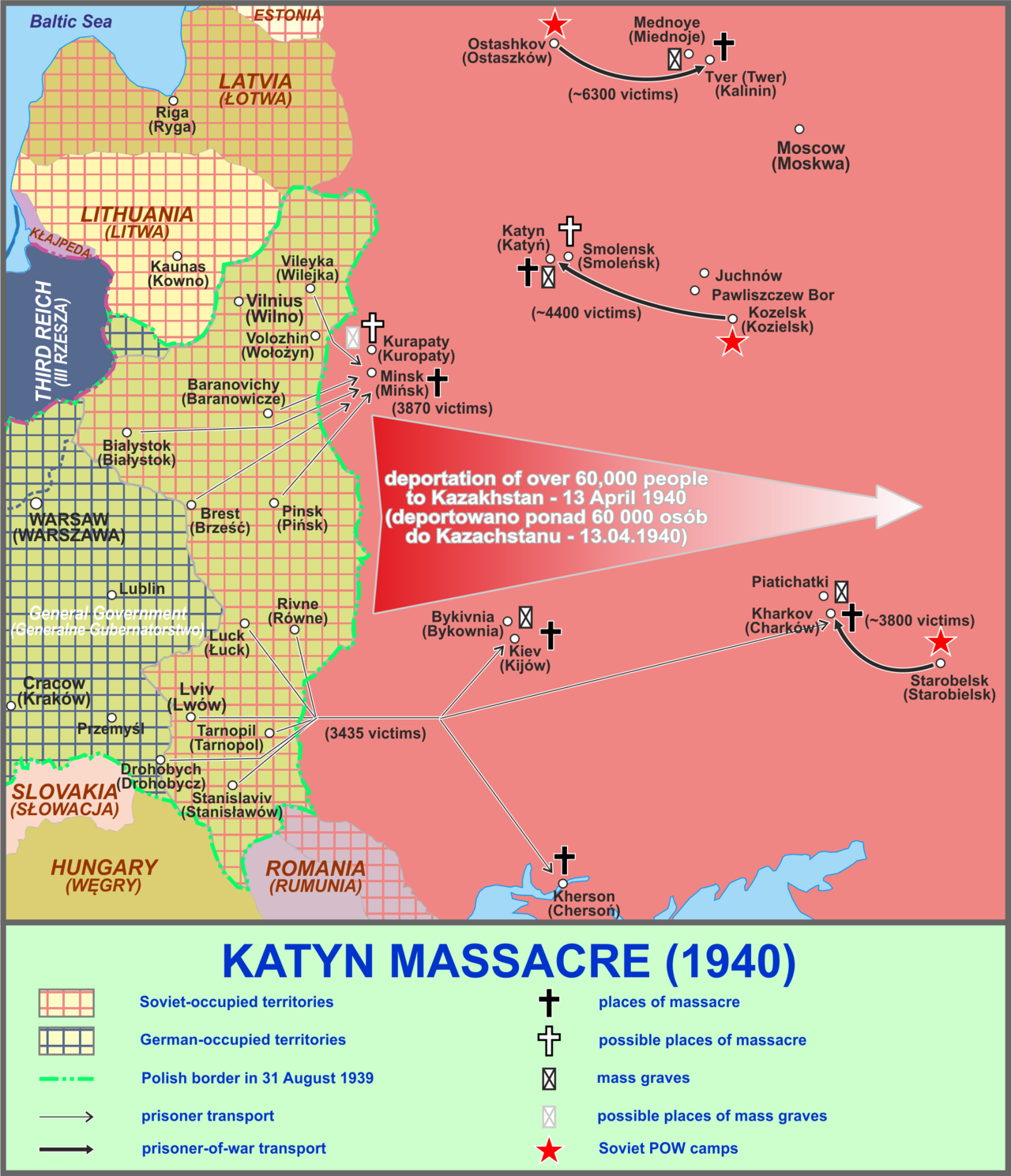
| Polish prisoners of war Soviet repressions of Polish citizens occurred as well over this period. Since Poland's conscription system required every nonexempt university graduate to become a military reserve officer,[22] the NKVD was able to round up a significant portion of the Polish educated class as prisoners of war. According to estimates by the Institute of National Remembrance (IPN), roughly 320,000 Polish citizens were deported to the Soviet Union (this figure is questioned by other historians, who hold to older estimates of about 700,000–1,000,000).[23][24] IPN estimates the number of Polish citizens who died under Soviet rule during World War II at 150,000 (a revision of older estimates of up to 500,000).[23][24] Of the group of 12,000 Poles sent to Dalstroy camp (near Kolyma) in 1940–1941, mostly POWs, only 583 men survived; they were released in 1942 to join the Polish Armed Forces in the East.[25] According to Tadeusz Piotrowski, "during the war and after 1944, 570,387 Polish citizens had been subjected to some form of Soviet political repression".[26] As early as 19 September 1939, the head of the NKVD, Lavrentiy Beria, ordered the secret police to create the Main Administration for Affairs of Prisoners of War and Internees to manage Polish prisoners. The NKVD took custody of Polish prisoners from the Red Army, and proceeded to organise a network of reception centres and transit camps, and to arrange rail transport to prisoner-of-war camps in the western USSR. The largest camps were at Kozelsk (Optina Monastery), Ostashkov (Stolobny Island on Lake Seliger near Ostashkov), and Starobilsk. Other camps were at Jukhnovo (rail station Babynino), Yuzhe (Talitsy), rail station Tyotkino (90 kilometres (56 mi) from Putyvl), Kozelshchyna, Oranki, Vologda (rail station Zaonikeevo), and Gryazovets.[27] 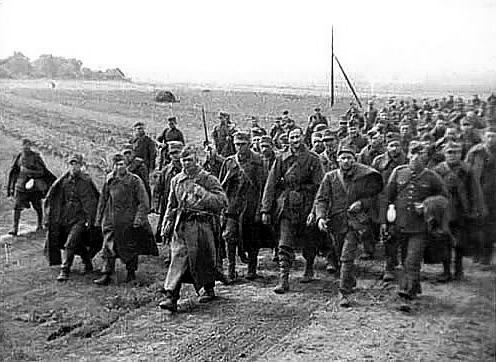 A large group of Polish Prisoners of War Polish POWs captured by the Red Army during the Soviet invasion of Poland Kozelsk and Starobelsk were used mainly for military officers, while Ostashkov was used mainly for Polish Scouting, gendarmes, police officers, and prison officers.[28] Some prisoners were members of other groups of Polish intelligentsia, such as priests, landowners, and law personnel.[28] The approximate distribution of men throughout the camps was as follows: Kozelsk, 5,000; Ostashkov, 6,570; and Starobelsk, 4,000. They totalled 15,570 men.[29] According to a report from 19 November 1939, the NKVD had about 40,000 Polish POWs: 8,000–8,500 officers and warrant officers, 6,000–6,500 officers of police, and 25,000 soldiers and non-commissioned officers who were still being held as POWs.[9][21][30] In December, a wave of arrests resulted in the imprisonment of additional Polish officers. Ivan Serov reported to Lavrentiy Beria on 3 December that "in all, 1,057 former officers of the Polish Army had been arrested".[18] The 25,000 soldiers and non-commissioned officers were assigned to forced labor (road construction, heavy metallurgy).[18] |
ポーランド人捕虜 この期間、ソ連によるポーランド市民への弾圧も発生した。ポーランドの徴兵制度では、免除対象外の大学卒業生全員が予備役将校となることが義務付けられて いたため[22]、NKVDはポーランドの知識層のかなりの部分を捕虜として一斉に連行することができた。国家記憶研究所(IPN)の推計によると、およ そ32万人のポーランド市民がソ連へ強制移送された(この数字については、従来の推計である約70万~100万人を支持する他の歴史家たちから疑問が呈さ れている)。[23][24] IPNは、第二次世界大戦中にソ連の支配下で死亡したポーランド市民の数を15万人と推計している(これは、最大50万人という従来の推計を修正したもの である)。[23] [24] 1940年から1941年にかけてダルストロイ収容所(コリマ近郊)に送られた1万2,000人のポーランド人(その大半は捕虜)のうち、生き残ったのは わずか583人の男性のみであった。彼らは1942年に釈放され、東方のポーランド軍に合流した。[25] タデウシュ・ピオトロフスキによれば、「戦争中および1944年以降、570,387人のポーランド国民が何らかの形のソ連による政治的弾圧を受けた」と いう。[26] 早くも1939年9月19日、NKVD長官のラヴレンティー・ベリヤは、秘密警察に対し、ポーランド人捕虜を管理するための「捕虜・抑留者問題総局」を設 置するよう命じた。NKVDは赤軍からポーランド人捕虜を引き取り、受け入れセンターや中継収容所のネットワークを構築するとともに、ソ連西部の捕虜収容 所への鉄道輸送の手配を進めた。最大の収容所は、コゼルスク(オプティナ修道院)、オスタシュコフ(オスタシュコフ近郊のセリゲル湖にあるストロブニー 島)、およびスタロビルスクにあった。その他の収容所は、ユフノヴォ(バビニノ駅)、ユジェ(タリツィ)、ティオトキノ駅(プティヴルから90キロメート ル(56マイル))、コゼルシュチナ、オランキ、ヴォログダ(ザオニケエヴォ駅)、グリアゾヴェツにあった。[27] 多数のポーランド人戦争捕虜 ソ連によるポーランド侵攻の際に赤軍に捕らえられたポーランド人戦争捕虜 コゼルスクとスタロベルスクは主に軍将校用として、オスタシュコフは主にポーランドのスカウト、憲兵、警察官、刑務官用として使用された。[28] 一部の捕虜は、司祭、地主、法律関係者など、ポーランドの知識人層に属する者たちであった。[28] 各収容所における収容者の概算内訳は以下の通りだった。コゼルスク:5,000人、オスタシュコフ:6,570人、スタロベルスク:4,000人。合計で 15,570人であった。[29] 1939年11月19日の報告書によると、NKVDは約4万人のポーランド人捕虜を収容していた。内訳は、将校および准将校8,000~8,500人、警 察官6,000~6,500人、そして依然として捕虜として拘束されていた兵士および下士官25,000人であった。[9][21] [30] 12月には一斉逮捕が行われ、さらに多くのポーランド人将校が投獄された。イワン・セロフは12月3日、ラヴレンチー・ベリヤに対し、「計1,057人の 元ポーランド軍将校が逮捕された」と報告した。[18] 25,000人の兵士および下士官は、強制労働(道路建設、重金属工業)に動員された。[18] |
| Preparations Once at the camps, from October 1939 to February 1940, the Poles were subjected to lengthy interrogations and constant political pressure by NKVD officers, such as Vasily Zarubin. The prisoners assumed they would be released soon, but the interviews were in effect a selection process to determine who would live and who would die.[31][32] According to NKVD reports, if a prisoner could not be induced to adopt a pro-Soviet attitude, he was declared a "hardened and uncompromising enemy of Soviet authority".[31] On 5 March 1940, pursuant to a note to Stalin from Beria, six members of the Soviet Politburo— Stalin, Vyacheslav Molotov, Lazar Kaganovich, Kliment Voroshilov, Anastas Mikoyan, and Mikhail Kalinin— signed an order to execute 25,700 Polish "nationalists and counterrevolutionaries" kept at camps and prisons in occupied western Ukraine and Belarus.[8] The reason for the massacre, according to the historian Gerhard Weinberg, was that Stalin wanted to deprive a potential future Polish military of a large portion of its talent.[33] The Soviet leadership, and Stalin in particular, viewed the Polish prisoners as a "problem" as they might resist being under Soviet rule. Therefore, they decided the prisoners inside the "special camps" were to be shot as "avowed enemies of Soviet authority".[9] |
準備 収容所に到着すると、1939年10月から1940年2月にかけて、ポーランド人たちはヴァシリー・ザルビンらNKVD将校による長時間にわたる尋問と絶 え間ない政治的圧力にさらされた。囚人たちはまもなく釈放されるだろうと考えていたが、その尋問は事実上、誰が生き残り、誰が死ぬかを決定するための選別 プロセスであった。[31][32] NKVDの報告書によれば、囚人が親ソ連的な態度をとるよう誘導できなかった場合、その者は「ソ連権威に対する頑なで妥協を許さない敵」と宣言された。 [31] 1940年3月5日、ベリヤからスターリン宛ての覚書に基づき、ソ連政治局の6名――スターリン、ヴィャチェスラフ・モロトフ、ラザール・カガノヴィチ、 クリメント・ヴォロシロフ、アナスタス・ミコヤン、ミハイル・カリニン――が、占領下のウクライナ西部およびベラルーシの収容所や刑務所に収容されていた 25,700人のポーランド人「民族主義者および反革命分子」を処刑する命令に署名した。[8] 歴史家ゲルハルト・ヴァインベルクによれば、この虐殺の理由は、スターリンが将来的に結成される可能性のあるポーランド軍から、その人材の大部分を奪い去 りたかったためである。[33] ソ連指導部、とりわけスターリンは、ポーランド人捕虜がソ連の支配に抵抗する可能性があるとして、彼らを「問題」と見なしていた。そのため、彼らは「特別 収容所」内の捕虜を「ソ連権威の公然たる敵」として銃殺することを決定した。[9] |
Executions Letter in Cyrillic, dated 5 March 1940, contents per caption Memo from Beria to Stalin which proposed the execution of Polish officers, policemen, etc. The number of victims is estimated at 22,000, with a lower limit of confirmed dead of 21,768.[9] According to Soviet documents declassified in 1990, 21,857 Polish internees and prisoners were executed after 3 April 1940: 14,552 prisoners of war (most or all of them from the three camps) and 7,305 prisoners in western parts of the Byelorussian and Ukrainian SSRs.[34] Of them 4,421 were from Kozelsk, 3,820 from Starobelsk, 6,311 from Ostashkov, and 7,305 from Byelorussian and Ukrainian prisons.[34] The head of the NKVD Administration for Affairs of Prisoners of War and Internees, Pyotr Soprunenko [ru], a Major-General born near Kiev in the Ukrainian SSR was involved in "selections" of Polish officers to be executed at Katyn and elsewhere.[35][36] Soprunenko was an NKVD captain in early 1940 and headed the organization, also called the Directorate for Prisoners of War Affairs and Internees, from September 1939 to February 1943.[37] In this capacity, he was reportedly involved in the planning and operational control of the executions, in following with Beria's and Merkulov's orders.[38] Those who died at Katyn included soldiers (an admiral, two generals, 24 colonels, 79 lieutenant colonels, 258 majors, 654 captains, 17 naval captains, 85 privates, 3,420 non-commissioned officers, and seven chaplains), 200 pilots, government representatives and royalty (a prince, 43 officials), and civilians (three landowners, 131 refugees, 20 university professors, 300 physicians; several hundred lawyers, engineers, and teachers; and more than 100 writers and journalists).[31] In all, the NKVD executed almost half the Polish officer corps.[31] Altogether, during the massacre, the NKVD executed 14 Polish generals:[39] Leon Billewicz (ret.), Bronisław Bohaterewicz (ret.), Xawery Czernicki (admiral), Stanisław Haller (ret.), Aleksander Kowalewski [pl], Henryk Minkiewicz (ret.), Kazimierz Orlik-Łukoski, Konstanty Plisowski (ret.), Rudolf Prich (killed in Lviv), Franciszek Sikorski (ret.), Leonard Skierski (ret.), Piotr Skuratowicz, Mieczysław Smorawiński, and Alojzy Wir-Konas (promoted posthumously).[citation needed] Not all of the executed were ethnic Poles, because the Second Polish Republic was a multiethnic state, and its officer corps included Belarusians, Ukrainians, and Jews.[40] It is estimated about 8% of the Katyn massacre victims were Polish Jews.[40] 395 prisoners were spared from the slaughter,[9] among them Stanisław Swianiewicz and Józef Czapski.[31] They were taken to the Yukhnov camp or Pavlishtchev Bor and then to Gryazovets.[27] Up to 99% of the remaining prisoners were killed. People from the Kozelsk camp were executed in Katyn Forest; people from the Starobelsk camp were killed in the inner NKVD prison of Kharkiv (among the victims was Józef Marcinkiewicz)[41][42] and the bodies were buried near the village of Piatykhatky; and police officers from the Ostashkov camp were killed in the internal NKVD prison in Kalinin (Tver) and buried in Mednoye.[27] All three burial sites had already been secret cemeteries of the victims of the Great Purge of 1937–1938. Later, recreational areas of NKVD/KGB were established there.[43]  Aerial view of the Katyn massacre grave  A mass grave, with multiple corpses visible A mass grave at Katyn, 1943 Detailed information on the executions in the Kalinin NKVD prison was provided during a hearing by Dmitry Tokarev, former head of the Board of the District NKVD in Kalinin. According to Tokarev, the shooting started in the evening and ended at dawn. The first transport, on 4 April 1940, carried 390 people, and the executioners had difficulty killing so many people in one night. The following transports held no more than 250 people. The executions were usually performed with German-made .25 ACP Walther Model 2 pistols supplied by Moscow,[44] but Soviet-made 7.62×38mmR Nagant M1895 revolvers were also used.[45] The executioners used German weapons rather than the standard Soviet revolvers, as the latter were said to offer too much recoil, which made shooting painful after the first dozen executions.[46] Vasily Mikhailovich Blokhin, chief executioner for the NKVD, is reported to have personally shot and killed 7,000 of the condemned, some as young as 18, from the Ostashkov camp at Kalinin prison, over 28 days in April 1940.[36][47] After the condemned individual's personal information was checked and approved, he was handcuffed and led to a cell insulated with stacks of sandbags along the walls, and a heavy, felt-lined door. The victim was told to kneel in the middle of the cell and was then approached from behind by the executioner and immediately shot in the back of the head or neck.[citation needed] The body was carried out through the opposite door and laid in one of the five or six waiting trucks, whereupon the next condemned was taken inside and subjected to the same treatment. In addition to muffling by the rough insulation in the execution cell, the pistol gunshots were masked by the operation of loud machines (perhaps fans) throughout the night. Some post-1991 revelations suggest prisoners were also executed in the same manner at the NKVD headquarters in Smolensk, though judging by the way the corpses were stacked, some captives may have been shot while standing on the edge of the mass graves.[10] This procedure went on every night, except for the public May Day holiday.[48] Some 3,000 to 4,000 Polish inmates of Ukrainian prisons and those from Belarus prisons were probably buried in Bykivnia and in Kurapaty respectively,[49][50] about 50 women including two sisters, Klara Auerbach-Margules and Stella Menkes, among them. Lieutenant Janina Lewandowska, daughter of Gen. Józef Dowbor-Muśnicki, was the only woman POW executed during the massacre at Katyn.[48][51]  1939 Polish passport issued to Medical Service Reserve Major Dr. Zygmunt Słoniński who was murdered at Katyn |
処刑 1940年3月5日付のキリル文字による書簡。内容はキャプションの通り ベリヤからスターリン宛ての覚書。ポーランド人将校や警察官などの処刑を提案したものである。 犠牲者の数は22,000人と推定され、確認された死者数の下限は21,768人である。[9] 1990年に機密解除されたソ連の文書によると、1940年4月3日以降、21,857人のポーランド人抑留者および囚人が処刑された。内訳は、捕虜 14,552人(その大半または全員が3つの収容所からの者)と、ベラルーシ・ウクライナ・ソビエト社会主義共和国の西部地域にいた囚人7,305人であ る。[34] そのうち、4,421人はコゼルスク、3,820人はスタロベルスク、6,311人はオスタシュコフ、7,305人はベラルーシおよびウクライナの刑務所 からの者であった。[34] NKVDの捕虜・抑留者問題管理局長、ピョートル・ソプルネンコ [ru](ウクライナ・ソビエト社会主義共和国キエフ近郊生まれの少将)は、カティーンやその他の場所で処刑されるポーランド人将校の「選別」に関与して いた。[35][36] ソプルネンコは1940年初頭にはNKVDの大尉であり、1939年9月から1943年2月まで、「捕虜・抑留者局」とも呼ばれる組織を率いていた。 [37] この職責において、彼はベリヤとメルクーロフの命令に従い、処刑の計画および作戦指揮に関与したと伝えられている。[38] カティンで死亡した者には、軍人(提督1名、将軍2名、大佐24名、中佐79名、少佐258名、大尉654名、海軍大尉17名、二等兵85名、下士官 3,420名、軍牧師7名)、 200人のパイロット、政府関係者および王族(王子1名、官僚43名)、そして民間人(地主3名、難民131名、大学教授20名、医師300名、数百名の 弁護士・技術者・教師、ならびに100名以上の作家・ジャーナリスト)が含まれていた。[31] 合計して、NKVDはポーランド将校団のほぼ半数を処刑した。[31] この虐殺の期間中、NKVDは計14人のポーランド人将軍を処刑した:[39] レオン・ビレヴィチ(退役)、ブロニスワフ・ボハテレヴィチ(退役)、シャヴェリ・チェルニツキ(海軍大将)、スタニスワフ・ハラー(退役)、アレクサン デル・コヴァレフスキ [pl]、ヘンリク・ミンケヴィチ(退役)、 カジミェシュ・オルリク=ルコスキ、コンスタンティ・プリソフスキ(退役)、ルドルフ・プリヒ(リヴィウで殺害)、フランシシェク・シコルスキ(退役)、 レオナルド・スキエルスキ(退役)、ピョトル・スクラトヴィチ、ミェチスワフ・スモラヴィンスキ、アロジィ・ヴィル=コナス(死後昇進)。[出典必要] 処刑された者全員がポーランド系だったわけではない。第二ポーランド共和国は多民族国家であり、その将校団にはベラルーシ人、ウクライナ人、ユダヤ人が含 まれていたからである。[40] カティンの虐殺の犠牲者のうち、約8%がポーランド系ユダヤ人だったと推定されている。[40] 395人の捕虜は虐殺を免れた[9]。その中にはスタニスワフ・スヴィアニエヴィチやヨゼフ・チャプスキもいた。[31] 彼らはユフノフ収容所またはパヴリシュチェフ・ボルへ移送され、その後グリャゾヴェツへ送られた。[27] 残りの収容者の最大99%が殺害された。コゼルスク収容所の収容者はカティンの森で処刑され、 スタロベルスク収容所の収容者はハルキウのNKVD内部刑務所で殺害され(犠牲者にはヨゼフ・マルチンキエヴィチが含まれていた)[41][42]、遺体 はピアティハトキ村の近くに埋葬された。また、オスタシュコフ収容所の警察官たちはカリーニン(トヴェリ)のNKVD内部刑務所で殺害され、メドノエに埋 葬された。[27] これら3つの埋葬地はすべて、1937年から1938年にかけて行われた大粛清の犠牲者たちの秘密の墓地となっていた。その後、その場所には NKVD/KGBのレクリエーション施設が設けられた。[43] カティンの虐殺現場の埋葬地の空撮写真 多数の遺体が確認できる集団埋葬地 1943年のカティンにおける集団埋葬地 カリーニンNKVD刑務所での処刑に関する詳細情報は、カリーニン地区NKVD局の元局長ドミトリー・トカレフによる公聴会で明らかにされた。トカレフに よれば、銃殺は夕方から始まり、夜明けに終わった。1940年4月4日の最初の移送では390人が運ばれたが、処刑人たちは一晩でこれほど多くの人を殺害 するのに苦労した。その後の移送では、250人以下しか運ばれなかった。処刑には通常、モスクワから供給されたドイツ製.25 ACP ヴァルター・モデル2拳銃が使用された[44]が、ソ連製の7.62×38mmR ナガンM1895リボルバーも用いられた[45]。処刑人たちが標準的なソ連製リボルバーではなくドイツ製武器を選んだのは、後者では反動が強すぎると言 われており、最初の十数回の処刑を過ぎると射撃が苦痛になるためだった。[46] NKVDの主任処刑人ヴァシーリー・ミハイロヴィチ・ブロヒンは、1940年4月の28日間にわたり、カリーニン刑務所内のオスタシュコフ収容所におい て、最年少で18歳だった者も含む7,000人の死刑囚を自ら射殺したと伝えられている。[36] [47] 死刑囚の身元確認と承認が終わると、手錠をかけられ、壁沿いに積み上げられた土嚢で断熱され、フェルトで裏打ちされた重い扉のある独房へと連行された。被 害者は独房の中央でひざまずくよう命じられ、その後、処刑人が背後から近づき、即座に後頭部または首筋を撃たれた。[出典必要] 遺体は反対側の扉から運び出され、待機していた5、6台のトラックのいずれかに安置された。その後、次の死刑囚が中へ連れて行かれ、同様の処置を受けた。 処刑室の粗末な防音材による遮音に加え、夜通し稼働する騒々しい機械(おそらく送風機)の音によって、拳銃の発砲音も隠されていた。1991年以降のいく つかの暴露によると、スモレンスクのNKVD本部でも囚人が同様の方法で処刑されていたことが示唆されているが、遺体の積み上げ方から判断すると、一部の 捕虜は集団墓地の縁に立った状態で射殺された可能性もある。[10] この手順は、メーデーの公休日を除き、毎晩行われていた。[48] ウクライナの刑務所に収容されていた約3,000人から4,000人のポーランド人受刑者と、ベラルーシの刑務所に収容されていた受刑者たちは、おそらく それぞれビキヴニャとクラパティに埋葬された[49][50]。その中には、クララ・アウアーバッハ=マルグレスとステラ・メンケスの2人の姉妹を含む約 50人の女性がいた。ヨゼフ・ドヴォボル=ムシュニツキ将軍の娘であるヤニナ・レヴァンドフスカ中尉は、カティンの虐殺で処刑された唯一の女性捕虜であっ た。[48][51] 1939年に発行された、カティンで殺害された医療予備役のジグムント・スロニンスキ少佐(医師)のポーランドパスポート |
Discovery 17 men, most in military uniform, stand in a cemetery, inspecting two graves. Secretary of State of the Vichy regime Fernand de Brinon and others in Katyn at the graves of Mieczysław Smorawiński and Bronisław Bohaterewicz, April 1943 The question about the fate of the Polish prisoners was raised soon after Operation Barbarossa began in June 1941. The Polish government-in-exile and the Soviet government signed the Sikorski–Mayski agreement, which announced the willingness of both to fight together against Nazi Germany and for a Polish army to be formed on Soviet territory. The Polish general Władysław Anders began organizing this army, and soon he requested information about the missing Polish officers. During a personal meeting, Stalin assured him and Władysław Sikorski, the Polish Prime Minister, all the Poles were freed, and not all could be accounted because the Soviets "lost track" of them in Manchuria.[52][53][better source needed] Józef Czapski investigated the fate of Polish officers between 1941 and 1942.[54] In 1942, with the territory around Smolensk under German occupation, captive Polish railroad workers heard from the locals about a mass grave of Polish soldiers at Kozelsk near Katyn; finding one of the graves, they reported it to the Polish Underground State.[55] The discovery was not seen as important, as nobody thought the discovered grave could contain so many victims.[55] German announcement In early 1943, Rudolf Christoph Freiherr von Gersdorff, a German officer serving as the intelligence liaison between the Wehrmacht's Army Group Centre and Abwehr, received reports about mass graves of Polish military officers. These reports stated the graves were in the forest of Goat Hill near Katyn. He passed the reports to his superiors (sources vary on when exactly the Germans became aware of the graves – from "late 1942" to January–February 1943, and when the German top decision makers in Berlin received those reports [as early as 1 March or as late as 4 April]).[56] Joseph Goebbels saw this discovery as an excellent tool to drive a wedge between Poland, the Western Allies, and the Soviet Union, and reinforcement for the Nazi propaganda line about the horrors of Bolshevism, and American and British subservience to it.[57] After extensive preparation, on 13 April, Reichssender Berlin broadcast to the world that German military forces in the Katyn forest near Smolensk had uncovered "a ditch…28 metres long and 16 metres wide [92 ft by 52 ft], in which the bodies of 3,000 Polish officers were piled up in 12 layers".[11] The broadcast went on to charge the Soviets with carrying out the massacre in 1940.[11] Initial investigation Main article: Katyn Commission  Refer to caption Polish banknotes and epaulets recovered from mass graves The Germans brought in a European Red Cross committee called the Katyn Commission, comprising 12 forensic experts and their staff, from occupied Belgium, Bulgaria, Croatia, Denmark, Finland, Vichy France, Hungary, Italy, the occupied Netherlands, Romania, Switzerland,[b] and occupied Bohemia and Moravia.[59] The Germans were so intent on proving the Soviets were behind the massacre they even included some Allied prisoners of war, among them writer Ferdynand Goetel, a Polish Home Army prisoner from Pawiak.[60] After the war, Goetel escaped with a fake passport due to an arrest warrant issued against him. Jan Emil Skiwski was a collaborator. Józef Mackiewicz has published several texts about the crime. Two of the 12, the Bulgarian Marko Markov and the Czech František Hájek [cs], with their countries becoming satellite states of the Soviet Union, were forced to recant their evidence, defending the Soviets and blaming the Germans.[61] The Croatian pathologist Eduard Miloslavić managed to escape to the US. The only civilian invited as a witness was Frank Stroobant, a British citizen deported from Guernsey and camp senior of Ilag VII.[62]: 118–145 The Katyn massacre was beneficial to Nazi Germany, which used it to discredit the Soviet Union. On 14 April 1943, Goebbels wrote in his diary: "We are now using the discovery of 12,000 Polish officers, killed by the GPU, for anti-Bolshevik propaganda on a grand style. We sent neutral journalists and Polish intellectuals to the spot where they were found. Their reports now reaching us from ahead are gruesome. The Führer has also given permission for us to hand out a drastic news item to the German press. I gave instructions to make the widest possible use of the propaganda material. We shall be able to live on it for a couple of weeks."[63]  The decomposing remains of Katyn victims, found in a mass grave. Katyn exhumation, 1943 When Goebbels was informed in September 1943 that the German Army had to withdraw from the Katyn area, he wrote a prediction in his diary. His entry for 29 September 1943 reads: "Unfortunately, we have had to give up Katyn. The Bolsheviks undoubtedly will soon 'find' that we shot 12,000 Polish officers. That episode is one that is going to cause us quite a little trouble in the future. The Soviets are undoubtedly going to make it their business to discover as many mass-graves as possible and then blame it on us."[63] |
発見 軍服を着た者が大半を占める17人の男性が、墓地に立ち、2つの墓を点検している。 1943年4月、カティンにて、ヴィシー政権のフェルナン・ド・ブリノン国務長官らが、ミェチスワフ・スモラヴィンスキとブロニスワフ・ボハテレヴィチの墓の前に立つ 1941年6月に「バルバロッサ作戦」が開始されて間もなく、ポーランド人捕虜の行方に関する疑問が提起された。亡命ポーランド政府とソ連政府は「シコル スキ=マイスキー協定」に調印し、両者がナチス・ドイツに対して共に戦う意思があること、およびソ連領内でポーランド軍を編成することを表明した。ポーラ ンドのヴワディスワフ・アンデルス将軍はこの軍の編成に着手し、まもなく行方不明のポーランド人将校に関する情報を求めた。直接会談の際、スターリンはア ンダースとポーランド首相ヴワディスワフ・シコルスキに対し、すべてのポーランド人が解放されたと保証した。また、全員が確認できなかったのは、ソ連側が 満州で彼らの「行方を失った」ためだと説明した。[52][53][より信頼できる出典が必要] ヨゼフ・チャプスキは1941年から1942年にかけて、ポーランド人将校たちの行方を調査した。[54] 1942年、スモレンスク周辺がドイツ軍に占領されていた際、捕虜となっていたポーランド人鉄道労働者たちは、地元住民からカティンの近くのコゼルスクに ポーランド兵の集団墓地があるとの話を聞いた。彼らはその墓の一つを発見し、ポーランド地下国家に報告した。[55] 発見された墓にこれほど多くの犠牲者が埋葬されているとは誰も考えていなかったため、この発見は重要視されなかった。[55] ドイツ側の発表 1943年初頭、ドイツ国防軍中央軍集団とアプヴェーアの諜報連絡役を務めていたルドルフ・クリストフ・フライヘル・フォン・ゲルスドルフ大尉は、ポーラ ンド軍将校の集団埋葬地に関する報告を受けた。これらの報告によると、墓地はカティン近郊の「ヤギの丘」の森にあるとのことだった。彼はその報告を上司に 伝えた(ドイツ側がいつ正確に墓地の存在を把握したかについては情報源によって異なり、「1942年後半」から1943年1月~2月まで幅があり、ベルリ ンのドイツ最高意思決定者がそれらの報告を受け取った時期についても[早ければ3月1日、遅くとも4月4日]とされている)。[56] ヨーゼフ・ゲッベルスは、この発見を、ポーランド、西側連合国、ソビエト連邦の間に亀裂を入れる絶好の手段であり、ボルシェヴィズムの恐怖や、それに従属 するアメリカとイギリスに関するナチスのプロパガンダを補強するものだと見なした。[57] 入念な準備を経て、4月13日、ライヒスゼンダー・ベルリンは、スモレンスク近郊のカティン森林でドイツ軍が発見したものを世界に向けて放送した。 「長さ28メートル、幅16メートル[92フィート×52フィート]の溝を発見し、その中には3,000人のポーランド将校の遺体が12層に積み上げられていた」と世界に放送した。[11] 放送はさらに、1940年にこの虐殺を実行したのはソ連であると非難した。[11] 初期の調査 本記事:カティン委員会 キャプションを参照 集団墓地から回収されたポーランドの紙幣と肩章 ドイツ軍は、占領下のベルギー、ブルガリア、クロアチア、デンマーク、フィンランド、ヴィシー・フランス、ハンガリー、イタリア、占領下のオランダ、ルー マニア、スイス[b]、および占領下のボヘミア・モラヴィアから、12人の法医学専門家とそのスタッフで構成される「カティン委員会」と呼ばれる欧州赤十 字委員会を招いた。[59] ドイツ側は、ソ連が虐殺の黒幕であることを証明することに執着していたため、連合軍の捕虜数名さえも委員に含めた。その中には、パヴィアク収容所に収監さ れていたポーランド国内軍の捕虜である作家フェルディナンド・ゲーテルもいた。[60] 戦後、ゲーテルは自身に対して発令された逮捕状を逃れるため、偽造パスポートを使って脱出した。ヤン・エミル・スキフスキは協力者であった。ヨゼフ・マッ ケヴィチは、この犯罪についていくつかの文章を発表している。12人のうち2人、ブルガリア人のマルコ・マルコフとチェコ人のフランティシェク・ハジェク [cs] は、それぞれの国がソ連の衛星国となったため、証言を撤回させられ、ソ連を擁護し、ドイツを非難せざるを得なかった。[61] クロアチア人の病理学者エドゥアルド・ミロスラヴィッチは、なんとか米国へ逃れることに成功した。証人として招かれた唯一の民間人は、ガーンジー島から強 制送還され、イラグVII収容所の収容所長を務めていた英国人フランク・ストローバントであった。[62]: 118–145 カティンの虐殺は、ソ連の信用を傷つけるためにこれを利用したナチス・ドイツにとって有益であった。1943年4月14日、ゲッベルスは日記に次のように記した: 「我々は現在、GPUによって殺害された1万2000人のポーランド人将校の発見を、大規模な反ボルシェビキ宣伝に利用している。中立国のジャーナリスト やポーランドの知識人を、遺体が発見された現場へ派遣した。現場から届き始めた彼らの報告は、ぞっとするような内容だ。総統もまた、ドイツの報道機関に対 して衝撃的なニュースを配信することを許可した。私は、この宣伝資料を可能な限り広く活用するよう指示を出した。これで数週間は話題に事欠かないだろ う。」[63] 集団墓地で発見されたカティンの犠牲者たちの腐敗した遺体。 1943年のカティン遺体発掘 1943年9月、ドイツ軍がカティン地域から撤退せざるを得ないとの報告を受けたゲッベルスは、日記に予言を記した。1943年9月29日の日記には次のように書かれている: 「残念ながら、我々はカティンを放棄せざるを得なかった。ボルシェビキは間違いなく、我々が1万2000人のポーランド人将校を銃殺したことをまもなく 『発見』するだろう。この一件は、将来、我々に少なからぬ厄介事を引き起こすことになる。ソ連側は間違いなく、できるだけ多くの集団埋葬地を発見し、それ を我々のせいにしようと躍起になるだろう。」[63] |
| Polish reaction The Polish government-in-exile led by Sikorski insisted on bringing the matter to the negotiation table with the Soviets and on opening an investigation by the International Red Cross. On 17 April 1943 the Polish government issued a statement on this issue, asking for a Red Cross investigation, which was rejected by Stalin, who used the fact that Germans also requested such an investigation as a "proof" of Polish-German conspiracy, and which led to a deterioration of Polish-Soviet relations.[64] According to the Polish diplomat Edward Bernard Raczyński, Raczyński and General Sikorski met privately with Churchill and Alexander Cadogan on 15 April 1943, and told them the Poles had proof the Soviets were responsible for the massacre. Churchill reportedly stated, "The Bolsheviks can be very cruel."[65] According to Raczyński, "Churchill... without committing himself, showed by his manner that he had no doubt of it."[65] In 1947, the Polish Government in exile 1944–1946 report on Katyn was transmitted to Telford Taylor.[66] Soviet response The Soviet government immediately denied the German charges. They claimed the Polish prisoners of war had been engaged in construction work west of Smolensk, and consequently were captured and executed by invading German units in August 1941. The Soviet response on 15 April to the initial German broadcast of 13 April, prepared by the Soviet Information Bureau, stated, "Polish prisoners-of-war who in 1941 were engaged in construction work west of Smolensk and who...fell into the hands of the German-Fascist hangmen".[67] In response to Polish demands, Stalin accused the Polish government of collaborating with Nazi Germany and broke off diplomatic relations with it.[12] The Soviet Union also started a campaign to get the Western Allies to recognize the pro-Soviet government-in-exile of the Union of Polish Patriots led by Wanda Wasilewska.[68] Having retaken the Katyn area almost immediately after the Red Army had recaptured Smolensk, around September–October 1943, NKVD forces began a cover-up operation.[31][69] They destroyed a cemetery the Germans had permitted the Polish Red Cross to build and removed other evidence.[31] Witnesses were "interviewed" and threatened with arrest for collaborating with the Nazis if their testimonies disagreed with the official line.[69][70] As none of the documents found on the dead had dates later than April 1940, the Soviet secret police planted false evidence to place the apparent time of the massacre in mid-1941, when the German military had controlled the area.[70] NKVD operatives Vsevolod Merkulov and Sergei Kruglov issued a preliminary report, dated 10–11 January 1944, that concluded the Polish officers were shot by German soldiers.[69] In January 1944, the Soviet Extraordinary State Commission for ascertaining and investigating crimes perpetrated by the German-Fascist invaders set up another commission, the Special Commission for Determination and Investigation of the Shooting of Polish Prisoners of War by German-Fascist Invaders in Katyn Forest [pl] (Специальная комиссия по установлению и расследованию обстоятельств расстрела немецко-фашистскими захватчиками в Катынском лесу (близ Смоленска) военнопленных польских офицеров). The commission's name implied a predestined conclusion.[31][69][70] It was headed by Nikolai Burdenko, the president of the USSR Academy of Medical Sciences, hence the commission is often known as the "Burdenko Commission", who was appointed by Moscow to investigate the incident.[31][69] Its members included prominent Soviet figures such as the writer Aleksey Nikolayevich Tolstoy, but no foreign personnel was allowed to join the commission.[31][69] The Burdenko Commission exhumed the bodies, rejected the 1943 German findings the Poles were shot by the Soviet army, assigned the guilt to the Nazis, and concluded all the shootings were done by German occupation forces in late 1941.[31] It is uncertain how many members of the commission were misled by the falsified reports and evidence, and how many actually suspected the truth. Cienciala and Materski note the commission had no choice but to issue findings in line with the Merkulov-Kruglov report, and Burdenko was likely aware of the cover-up. He reportedly admitted something like that to friends and family shortly before his death in 1946.[69] The Burdenko Commission's conclusions would be consistently cited by Soviet sources until the official admission of guilt by the Soviet government on 13 April 1990.[69] In January 1944, the Soviets also invited a group of more than a dozen mostly American and British journalists, accompanied by Kathleen Harriman, the daughter of the new American ambassador W. Averell Harriman, and John F. Melby, third secretary at the American embassy in Moscow, to Katyn.[70] Some regarded the inclusion of Melby and Harriman as a Soviet attempt to lend official weight to their propaganda.[70] Melby's report noted the deficiencies in the Soviet case: problematic witnesses; attempts to discourage questioning of the witnesses; statements of the witnesses obviously being given as a result of rote memorization; and that "the show was put on for the benefit of the correspondents." Nevertheless, Melby, at the time, felt on balance the Soviet case was convincing.[70] Harriman's report reached the same conclusion and after the war both were asked to explain why their conclusions seemed to be at odds with their findings, with the suspicion the conclusions were what the State Department wanted to hear.[70] The journalists were less impressed and not convinced by the staged Soviet demonstration.[70] An example of Soviet propaganda spread by some Western Communists is Alter Brody's monograph Behind the Polish-Soviet Break (with an introduction by Corliss Lamont).[71] |
ポーランドの反応 シコルスキ率いるポーランド亡命政府は、この問題をソ連との交渉の場に持ち出すこと、および国際赤十字による調査を開始することを強く求めた。1943年 4月17日、ポーランド政府はこの問題に関する声明を発表し、赤十字による調査を求めたが、スターリンはこれを拒否した。スターリンは、ドイツ側も同様の 調査を要求していた事実を、ポーランドとドイツの共謀の「証拠」として利用し、これがポーランドとソ連の関係悪化につながった。[64] ポーランドの外交官エドワード・バーナード・ラチンスキーによれば、1943年4月15日、ラチンスキーとシコルスキ将軍はチャーチルおよびアレクサン ダー・カドガンと非公開の会談を行い、ポーランド側はソ連が虐殺の責任を負うという証拠を握っていると伝えた。チャーチルは「ボルシェビキは極めて残酷に なり得る」と述べたと伝えられている。[65] ラチンスキーによれば、「チャーチルは……明言は避けたものの、その態度から、そのことを疑っていないことがうかがえた」という。[65] 1947年、1944年から1946年にかけてのポーランド亡命政府によるカティンの事件に関する報告書が、テルフォード・テイラーに送付された。[66] ソ連側の反応 ソ連政府は直ちにドイツ側の非難を否定した。ソ連側は、ポーランド人捕虜がスモレンスクの西側で建設作業に従事しており、その結果、1941年8月に侵攻 してきたドイツ軍部隊に捕らえられ、処刑されたと主張した。4月13日のドイツによる最初の放送に対する4月15日のソ連側の反論(ソ連情報局が作成) は、次のように述べていた。「1941年にスモレンスクの西側で建設作業に従事していたポーランド人捕虜たちは…… ドイツ・ファシストの処刑人の手に落ちた」と述べた。[67] ポーランド側の要求に対し、スターリンはポーランド政府がナチス・ドイツと協力していると非難し、同国との外交関係を断絶した。[12] また、ソ連は、ワンダ・ヴァシレフスカ率いる「ポーランド愛国者同盟」の親ソ連亡命政府を、西側連合国に承認させるための運動を開始した。[68] 赤軍がスモレンスクを奪還した直後、1943年9月から10月頃にかけてカティンの地域を奪還すると、NKVD部隊は隠蔽工作を開始した。[31] [69] 彼らは、ドイツ軍がポーランド赤十字社に建設を許可していた墓地を破壊し、その他の証拠も除去した。[31] 目撃者たちは「事情聴取」を受け、その証言が公式見解と食い違う場合はナチスとの協力容疑で逮捕されると脅された。[69][70] 遺体から発見された文書には1940年4月以降の日付が記されたものは一つもなかったため、ソ連の秘密警察は、虐殺が起きたとみられる時期を、ドイツ軍が この地域を支配していた1941年半ばに設定するよう、偽の証拠を仕込んだ。[70] NKVDの工作員ヴセヴォロド・メルクーロフとセルゲイ・クルグロフは、1944年1月10日から11日付けの予備報告書を提出し、ポーランド人将校たち はドイツ兵によって射殺されたとの結論を下した。[69] 1944年1月、ドイツ・ファシスト侵略者による犯罪の特定と調査を行うソ連国家特別委員会は、別の委員会、すなわち「カティンの森におけるドイツ・ファシスト侵略者によるポーランド人戦争捕虜の銃殺の特定と調査のための特別委員会」を設置した [pl](Специальная комиссия по установлению и расследованию обстоятельств расстрела немецко-фашистскими захватчиками в Катинском лесу (близ Смоленска) военнопленных польских офицеров)。この委員会の名称は、あらかじめ決められた結論を暗示していた。[31][69][70] 委員長を務めたのは、ソ連医学アカデミー会長のニコライ・ブルデンコであり、そのためこの委員会はしばしば「ブルデンコ委員会」として知られている。彼は モスクワからこの事件の調査を命じられていた。[31][69] 委員には作家アレクセイ・ニコラエヴィチ・トルストイといったソ連の著名人が含まれていたが、外国人の参加は認められなかった。[31][69] ブルデンコ委員会は遺体を発掘し、1943年のドイツ側の「ポーランド人将校らはソ連軍によって射殺された」という調査結果を退け、責任をナチスに帰し、 すべての射殺は1941年後半にドイツ占領軍によって行われたと結論付けた。[31] 委員会のメンバーのうち、どれだけの者が捏造された報告書や証拠に惑わされ、どれだけの者が実際に真実を疑っていたかは定かではない。チェンチャラとマテ ルスキは、委員会にはメルクーロフ=クルグロフ報告書に沿った調査結果を発表するほかなかったとし、ブルデンコも隠蔽工作を認識していた可能性が高いと指 摘している。伝えられるところによると、彼は1946年に死去する直前に、友人や家族に対してそのようなことを認めていたという。[69] ブルデンコ委員会の結論は、1990年4月13日にソ連政府が公式に罪を認めるまで、ソ連側の情報源によって一貫して引用され続けた。[69] 1944年1月、ソ連はまた、新任の米国大使W・アヴェレル・ハリマンの娘であるキャスリーン・ハリマンと、モスクワの米国大使館三等書記官ジョン・F・ メルビーに同行された、主に米国および英国のジャーナリスト十数名からなるグループをカティンに招待した。[70] 一部の人々は、メルビーとハリマンを同行させたことを、ソ連が自らのプロパガンダに公式な重みを与えようとした試みだと見なした。[70] メルビーの報告書は、ソ連側の主張における欠陥を指摘していた。具体的には、問題のある証人、証人への質問を妨げようとする試み、明らかに丸暗記の結果と して述べられた証人の供述、そして「この見せ物は特派員たちのために仕組まれたものだった」という点である。それにもかかわらず、メルビーは当時、総合的 に見てソ連側の主張は説得力があると感じていた。[70] ハリマンの報告書も同様の結論に達しており、戦後、両名には、その結論が調査結果と矛盾しているように見える理由を説明するよう求められた。その背景に は、結論が国務省が聞きたがっていた内容だったのではないかという疑念があった。[70] ジャーナリストたちはそれほど感銘を受けず、ソ連による演出された実演には納得していなかった。[70] 一部の西側共産主義者によって広められたソ連のプロパガンダの例として、アルター・ブロディの単行本『ポーランド・ソ連決裂の舞台裏』(コーリス・ラモントによる序文付き)が挙げられる。[71] |
Western reaction Eight soldiers in World War II-era uniforms, as per caption British, Canadian, and American officers (POWs) brought by the Germans to view the exhumations The growing Polish-Soviet tension was beginning to strain Western-Soviet relations at a time when the Poles' importance to the Allies, significant in the first years of the war, was beginning to fade. In retrospective review of records, both British prime minister Winston Churchill and U.S. president Franklin D. Roosevelt were increasingly torn between their commitments to their Polish ally and the demands by Stalin and his diplomats.[72] On 24 April 1943, British Foreign Secretary Anthony Eden "prevailed upon Sikorski... to withdraw the request for the Red Cross investigation",[64] and Churchill subsequently assured Stalin, "We shall certainly oppose vigorously any 'investigation' by the International Red Cross or any other body in any territory under German authority. Such an investigation would be a fraud and its conclusions reached by terrorism."[73] Unofficial or classified UK documents concluded Soviet guilt was a "near certainty," but the alliance with the Soviets was deemed to be more important than moral issues; thus the official version supported the Soviets, up to censoring any contradictory accounts.[74] Churchill asked Owen O'Malley to investigate the issue, but in a note to the Foreign Secretary he noted, "All this is merely to ascertain the facts, because we should none of us ever speak a word about it."[70] O'Malley pointed out several inconsistencies and near impossibilities in the Soviet version.[70] Later, Churchill sent a copy of the report to Roosevelt on 13 August 1943. The report deconstructed the Soviet account of the massacre and alluded to the political consequences within a strongly moral framework but recognized there was no viable alternative to the existing policy. No comment by Roosevelt on the O'Malley report has been found.[75] Churchill's own post-war account of the Katyn affair gives little further insight. In his memoirs, he refers to the 1944 Soviet inquiry into the massacre, which found the Germans responsible, and adds, "belief seems an act of faith."[76]  Lt. Col. John H. Van Vliet Jr communication on Katyn At the beginning of 1944, Ron Jeffery, an agent of British and Polish intelligence in occupied Poland, eluded the Abwehr and travelled to London with a report from Poland to the British government. His efforts were at first highly regarded, but subsequently ignored, which a disillusioned Jeffery later attributed to the actions of Kim Philby and other high-ranking Communist agents entrenched in the British government. Jeffery tried to inform the British government about the Katyn massacre but was as a result released from the Army.[77] In the United States a similar line was taken, notwithstanding two official intelligence reports into the Katyn massacre that contradicted the official position. In 1944, Roosevelt assigned his special emissary to the Balkans, Navy Lieutenant Commander George Earle, to produce a report on Katyn.[31] Earle concluded the massacre was committed by the Soviet Union.[31] Having consulted with Elmer Davis, director of the United States Office of War Information, Roosevelt rejected the conclusion (officially), declared he was convinced of Nazi Germany's responsibility, and ordered that Earle's report be suppressed. When Earle requested permission to publish his findings, the president issued a written order to desist.[31] Earle was reassigned and spent the rest of the war in American Samoa.[31] A further report in 1945, supporting the same conclusion, was produced and stifled. In 1943, the Germans took two U.S. POWs – Capt. Donald B. Stewart and Col. John H. Van Vliet Jr – to Katyn for an international news conference.[78] Documents released by the National Archives and Records Administration in September 2012 revealed Stewart and Van Vliet sent coded messages to their American superiors indicating they saw proof that implicated the Soviets. Three lines of evidence were cited. Firstly, the Polish corpses were in such an advanced state of decay that the Nazis could not have killed them, as they had only taken over the area in 1941. Secondly, none of the numerous Polish artifacts, such as letters, diaries, photographs and identification tags pulled from the graves, were dated later than the spring of 1940. Most incriminating was the relatively good state of the men's uniforms and boots, which showed they had not lived long after being captured. Later, in 1945, Van Vliet submitted a report concluding the Soviets were responsible for the massacre. His superior, Major General Clayton Lawrence Bissell, General George Marshall's assistant chief of staff for intelligence, destroyed the report.[79] Washington kept the information secret, presumably to appease Stalin and not distract from the war against the Nazis.[80][81][82] During the 1951–52 Congressional investigation into Katyn, Bissell defended his action before the United States Congress, arguing it was not in the U.S. interest to antagonize an ally (the USSR) whose assistance the nation needed against the Empire of Japan.[31] In 1950, Van Vliet recreated his wartime report.[83] In 2014, a copy of a report Van Vliet made in France during 1945 was discovered.[84][85] |
西側諸国の反応 キャプションにある通り、第二次世界大戦当時の軍服を着た兵士8名 ドイツ軍によって遺体発掘の現場に連れてこられたイギリス、カナダ、アメリカの将校(捕虜) ポーランドとソ連の間の緊張の高まりは、戦争初期には連合国にとって極めて重要だったポーランドの存在感が薄れ始めていた時期に、西側諸国とソ連の関係に ひずみを与え始めていた。記録を遡って検討すると、英国のウィンストン・チャーチル首相も米国のフランクリン・D・ルーズベルト大統領も、同盟国である ポーランドへの約束と、スターリンおよびその外交官たちからの要求との間で、ますます板挟みになっていった。[72] 1943年4月24日、英国のアンソニー・イーデン外相は「シコルスキを説得し……赤十字による調査の要請を撤回させた」[64]。その後、チャーチルは スターリンに対し、「我々は、ドイツの支配下にあるいかなる領土においても、国際赤十字やその他の機関によるいかなる『調査』に対しても、断固として反対 する。そのような調査は欺瞞であり、その結論はテロによって導き出されたものとなるだろう」と確約した。[73] 非公式または機密扱いの英国文書は、ソ連の有罪が「ほぼ確実」であると結論づけていたが、ソ連との同盟関係は道義的な問題よりも重要であると見なされた。 そのため、公式見解はソ連を支持し、矛盾する証言を検閲するまでに至った。[74] チャーチルはオーウェン・オマリーにこの問題の調査を依頼したが、外務大臣宛てのメモの中で、「これはあくまで事実を確認するためのものであり、我々誰も この件について一言も口にしてはならない」と記した。[70] オマリーは、ソ連側の説明にいくつかの矛盾や、ほぼ不可能な点があることを指摘した。[70] その後、チャーチルは1943年8月13日、報告書の写しをルーズベルトに送った。報告書は、虐殺に関するソ連側の説明を論破し、強い道徳的枠組みの中で 政治的影響に言及しつつも、現行の方針に代わる現実的な選択肢はないことを認めていた。オマリー報告書に対するルーズベルトのコメントは見つかっていな い。[75] チャーチル自身が戦後に記したカティン事件に関する記述も、これ以上の洞察を与えるものではない。回顧録の中で、彼は1944年のソ連による虐殺調査―― その調査ではドイツ軍が責任があると結論づけられた――に言及し、「それを信じることは、信仰行為のようだ」と付け加えている。[76] ジョン・H・ヴァン・フリート・ジュニア中佐によるカティン事件に関する報告 1944年初頭、占領下のポーランドで英国およびポーランドの諜報機関に所属していたロン・ジェフリーは、アプヴェーア(ドイツ軍情報部)の追跡をかわ し、ポーランドからの報告書を携えてロンドンへ赴き、英国政府に提出した。彼の努力は当初高く評価されたが、その後無視されることとなった。幻滅したジェ フリーは、このことを後に、英国政府内に深く浸透していたキム・フィルビーやその他の共産主義者高位の工作員たちの仕業だと指摘した。ジェフリーはカティ ンの虐殺について英国政府に知らせようとしたが、その結果、軍から除隊させられた。[77] 米国でも同様の姿勢がとられたが、カティンの虐殺に関する2つの公式情報報告書が政府の公式見解と矛盾していたにもかかわらずである。1944年、ルーズ ベルトはバルカン半島への特使である海軍中佐ジョージ・アールに、カティンに関する報告書の作成を命じた。[31] アールは、この虐殺がソ連によって行われたと結論付けた。[31] ルーズベルトは、米国戦争情報局長のエルマー・デイヴィスと協議した上で、この結論を(公式には)却下し、ナチス・ドイツの責任を確信していると宣言し、 アールの報告書を公表しないよう命じた。アールが調査結果の公表を許可するよう要請すると、大統領は中止を命じる書面による命令を下した。[31] アールは異動となり、戦争の残りの期間を米領サモアで過ごした。[31] 1945年には、同じ結論を支持するさらなる報告書が作成されたが、これも封殺された。1943年、ドイツ軍はドナルド・B・スチュワート大尉とジョン・ H・ヴァン・フリート・ジュニア大佐という2人の米国人捕虜を、国際記者会見のためにカティンへ連行した。[78] 2012年9月に米国国立公文書記録管理局が公開した文書によると、スチュワートとヴァン・フリートは、ソ連の関与を示す証拠を目撃したことを示す暗号文 を、米国の上官に送っていたことが明らかになった。3つの証拠が挙げられた。第一に、ポーランド人の遺体は腐敗が著しく進んでおり、ナチスが1941年に その地域を占領したばかりであることを考えると、彼らが殺害したとは考えられない。第二に、墓から回収された手紙、日記、写真、身分証明タグなど、数多く のポーランド人の遺品のうち、1940年春以降の日付が記されたものは一つもなかった。最も決定的な証拠は、兵士たちの制服やブーツが比較的良好な状態で あったことで、これは彼らが捕虜となってから長くは生き延びていなかったことを示していた。その後1945年、ヴァン・フリートはソ連が虐殺の責任を負う とする結論を記した報告書を提出した。彼の上官であるクレイトン・ローレンス・ビッセル少将(ジョージ・マーシャル将軍の諜報担当参謀次長)は、この報告 書を破棄した。[79] ワシントンはこの情報を秘密にしていた。おそらくスターリンをなだめ、ナチスとの戦争への関心をそらさないためであったと考えられる。[80][81] [82] 1951年から52年にかけて行われたカティンの事件に関する議会調査の際、ビッセルは米国議会の前で自らの行動を擁護し、大日本帝国に対する戦いで米国 の支援を必要としていた同盟国(ソ連)を敵に回すことは、米国の国益に反すると主張した。[31] 1950年、ヴァン・フリートは戦時中の報告書を再作成した。[83] 2014年、1945年にヴァン・フリートがフランスで作成した報告書の写しが発見された。[84][85] |
| Post-war trials From 28 December 1945 to 4 January 1946, a Soviet military court in Leningrad tried seven Wehrmacht servicemen. One of them, Arno Dürre, who was charged with murdering numerous civilians using machine-guns in Soviet villages, confessed to having taken part in the burial (though not the execution) of 15,000 to 20,000 Polish POWs in Katyn. For this he was spared execution and was given 15 years of hard labor. His confession was full of absurdities, and thus he was not used as a Soviet prosecution witness during the Nuremberg trials. He later recanted his confession, claiming the investigators forced him to confess through torture.[86] At the London conference that drew up the indictments of German war crimes before the Nuremberg trials, the Soviet negotiators put forward the allegation, "In September 1941, 925 Polish officers who were prisoners of war were killed in the Katyn Forest near Smolensk". The US negotiators agreed to include it but were "embarrassed" by the inclusion (noting the allegation had been debated extensively in the press) and concluded it would be up to the Soviets to sustain it.[87][better source needed] At the trials in 1946, Soviet General Roman Rudenko raised the indictment, stating "one of the most important criminal acts for which the major war criminals are responsible was the mass execution of Polish prisoners of war shot in the Katyn forest near Smolensk by the German fascist invaders",[88] but failed to make the case and the US and British judges dismissed the charges.[89] The Soviet inclusion of Katyn massacre in Nuremberg was based on an expectation that, based on Article 21 of the IMT Charter,[90] the Tribunal "should take judicial notice of official government documents" requiring no "proof of facts", including reports produced by various investigative commissions, which in case of Soviets was the Burdenko commission. Only 70 years later did it become known that former OSS chief William Donovan had succeeded in getting the American delegation in Nuremberg to block the Katyn indictment. A German officer, Fabian von Schlabrendorff, who was stationed in Smolensk during the war, had convinced Donovan that the true perpetrators were the Soviets, not the Germans.[91] It was not the purpose of the court to determine whether Germany or the Soviet Union was responsible for the crime, but rather to attribute the crime to at least one of the defendants, which the court was unable to do.[c] |
戦後の裁判 1945年12月28日から1946年1月4日にかけて、レニングラードのソ連軍事法廷で、ドイツ国防軍(ヴェルマハト)の兵士7人が裁判にかけられた。 そのうちの1人、アルノ・デュレは、ソ連の村々で機関銃を用いて多数の民間人を殺害した罪で起訴されたが、カティンにおける1万5000人から2万人の ポーランド人捕虜の埋葬(処刑そのものではなく)に加担したことを自白した。このため、彼は死刑を免れ、15年の重労働刑を言い渡された。彼の自白は荒唐 無稽な点が多く、そのためニュルンベルク裁判ではソ連側の検察側証人として採用されなかった。彼は後に自白を撤回し、捜査官らが拷問によって自白を強要し たと主張した。[86] ニュルンベルク裁判に先立ち、ドイツの戦争犯罪に関する起訴状を策定したロンドン会議において、ソ連の交渉団は「1941年9月、スモレンスク近郊のカ ティンの森で、捕虜となっていた925人のポーランド人将校が殺害された」という主張を提示した。米国側交渉団はこれを起訴状に盛り込むことに同意した が、その記載に「困惑」し(この主張がマスコミで広く議論されていたことを踏まえ)、その立証はソ連側の責任であると結論付けた。[87][より信頼でき る出典が必要] 1946年の裁判において、ソ連のロマン・ルデンコ将軍はこの起訴事実を取り上げ、「主要な戦争犯罪者が責任を負うべき最も重要な犯罪行為の一つは、ドイ ツのファシスト侵略者によってスモレンスク近郊のカティンの森で銃殺されたポーランド人捕虜に対する大量処刑であった」[88]と述べたが、立証には至ら ず、米国および英国の裁判官はこれらの訴因を却下した。[89] ソ連がカティンの虐殺をニュルンベルク裁判に盛り込んだのは、IMT憲章第21条[90]に基づき、同裁判所が「政府の公式文書を司法上の既知事実として 認めるべき」であり、その際には「事実の証明」を必要としないという期待に基づいていた。これには、様々な調査委員会が作成した報告書も含まれており、ソ 連の場合はブルデンコ委員会による報告書であった。 カティンの起訴を阻止するために、元OSS長官ウィリアム・ドノヴァンがニュルンベルクの米国代表団を説得することに成功していたことが明らかになったの は、それから70年後のことだった。戦時中にスモレンスクに駐留していたドイツ軍将校ファビアン・フォン・シュラブレンドルフは、真の加害者はドイツ人で はなくソ連側であるとドノヴァンを説得していた[91]。裁判所の目的は、この犯罪の責任がドイツにあるのかソ連にあるのかを判断することではなく、少な くとも被告の一人にその罪を帰属させることだったが、裁判所はそれを成し遂げることができなかった。[c] |
| 1950s In 1951 and 1952, during the Korean War, a US congressional investigation chaired by representative Ray Madden and known as the Madden Committee investigated the Katyn massacre. According to the Committee conclusion: "the Katyn massacre involved some 4,243 of the 15,400 Polish Army officers and intellectual leaders who were captured by the Soviets when Russia invaded Poland in September 1939." The committee concluded that these 4,243 Poles had been killed by the NKVD and that a case should be brought to the International Court of Justice.[78] However, the question of responsibility remained controversial in the West as well as behind the Iron Curtain. In the United Kingdom in the late 1970s, plans for a memorial to the victims bearing the date 1940 (rather than 1941) were condemned as provocative in the political climate of the Cold War. It has also been alleged that the choice made in 1969 for the location of the Byelorussian Soviet Socialist Republic war memorial at the former Belarusian village named Khatyn, the site of the 1943 Khatyn massacre, was made to cause confusion with Katyn.[93][94] The two names are similar or identical in many languages, and were often confused.[31][95] In Poland, the pro-Soviet authorities following the Soviet occupation after the war covered up the matter in accordance with the official Soviet propaganda line, deliberately censoring any sources that might provide information about the crime. Katyn was a forbidden topic in post-war Poland. Censorship in the Polish People's Republic was a massive undertaking and Katyn was specifically mentioned in the "Black Book of Censorship" used by the authorities to control the media and academia. Not only did government censorship suppress all references to it, but even mentioning the atrocity was dangerous. In the late 1970s, democracy groups like the Workers' Defence Committee and the Flying University defied the censorship and discussed the massacre, in the face of arrests, beatings, detentions, and ostracism.[96] In 1981, Polish trade union Solidarity erected a memorial with the simple inscription "Katyn, 1940". It was confiscated by the police and replaced with an official monument with the inscription: "To the Polish soldiers – victims of Hitlerite fascism – reposing in the soil of Katyn". Nevertheless, every year on the day of Zaduszki, similar memorial crosses were erected at Powązki Cemetery and numerous other places in Poland, only to be dismantled by the police. Katyn remained a political taboo in the Polish People's Republic until the fall of the Eastern Bloc in 1989.[31] In the Soviet Union during the 1950s, the head of KGB, Alexander Shelepin, proposed and carried out the destruction of many documents related to the Katyn massacre to minimize the chance the truth would be revealed.[97][98] His 3 March 1959 note to Nikita Khrushchev, with information about the execution of 21,857 Poles and with the proposal to destroy their personal files, became one of the documents that was preserved and eventually made public.[97][98][99][100] |
1950年代 1951年と1952年、朝鮮戦争の最中、レイ・マッデン下院議員が委員長を務めた、いわゆる「マッデン委員会」と呼ばれる米国議会の調査委員会が、カ ティンの虐殺について調査を行った。委員会の結論によれば、「カティンの虐殺には、1939年9月にソ連がポーランドに侵攻した際にソ連軍に捕らえられた ポーランド軍将校および知識人指導者15,400人のうち、約4,243人が関与していた」という。委員会は、これら4,243人のポーランド人が NKVDによって殺害されたと結論づけ、国際司法裁判所に提訴すべきであると判断した。[78] しかし、責任の所在をめぐる問題は、西側諸国でも鉄のカーテンの内側でも依然として論争の的となっていた。1970年代後半の英国では、犠牲者を追悼する 記念碑に「1940年」(1941年ではなく)という年号を刻む計画が、冷戦下の政治情勢において挑発的であるとして非難された。また、1969年にベラ ルーシ・ソビエト社会主義共和国の戦没者記念碑の建設地として、1943年のハティン虐殺の現場である旧ベラルーシの村「ハティン」が選ばれたのは、カ ティンと混同させる意図があったとの指摘もある。[93][94] これら2つの地名は多くの言語で類似あるいは同一であり、しばしば混同されていた。[31][95] ポーランドでは、戦後のソ連占領下で権力を握った親ソ連当局が、ソ連の公式プロパガンダ方針に従ってこの問題を隠蔽し、この犯罪に関する情報を提供しうる あらゆる資料を意図的に検閲した。カティンは戦後ポーランドにおいて禁じられた話題であった。ポーランド人民共和国における検閲は大規模な事業であり、当 局がメディアや学界を統制するために用いた『検閲の黒書』には、カティンが具体的に言及されていた。政府による検閲は、この事件への言及をすべて抑圧した だけでなく、その残虐行為に言及することさえ危険であった。1970年代後半、労働者防衛委員会やフライング・ユニバーシティといった民主化団体は、逮 捕、暴行、拘束、社会からの排除というリスクを冒して、検閲に抗い、この虐殺について議論した。[96] 1981年、ポーランドの労働組合「連帯」は、「カティン、1940年」という簡素な銘文が刻まれた記念碑を建立した。しかし、それは警察によって没収さ れ、代わりに「ヒトラー主義ファシズムの犠牲となった、カティンの地で眠るポーランド兵士たちに」という銘文が刻まれた公式の記念碑が設置された。それに もかかわらず、毎年ザドゥシュキの日には、ポワズキ墓地やポーランド国内の他の多くの場所で同様の追悼の十字架が建てられたが、そのたびに警察によって撤 去された。カティンは、1989年の東側諸国の崩壊まで、ポーランド人民共和国において政治的なタブーであり続けた。[31] 1950年代のソビエト連邦において、KGB長官アレクサンドル・シェレピンは、真実が明るみに出る可能性を最小限に抑えるため、カティンの虐殺に関連す る多くの文書の破棄を提案し、実行した。[97][98] 1959年3月3日にニキータ・フルシチョフ宛てに送られた彼のメモには、21,857人のポーランド人の処刑に関する情報と、彼らの個人ファイルの破棄 提案が記されており、このメモは保存され、最終的に公開された文書の一つとなった。[97][98][99][100] |
Revelations A low stone wall, curving upward. Three statues of Polish soldiers are mounted at its center. Below the statues, Text is mounted as per caption. Monument in Katowice, Poland, memorializing "Katyn, Kharkiv, Mednoye and other places of killing in the former USSR in 1940" During the 1980s, there was increasing pressure on both the Polish and Soviet governments to release documents related to the massacre. Polish academics tried to include Katyn in the agenda of the 1987 joint Polish-Soviet commission to investigate censored episodes of Polish-Russian history.[31] In 1989, Soviet scholars revealed Stalin had indeed ordered the massacre [citation needed], and in 1990 Mikhail Gorbachev admitted the NKVD had executed the Poles and confirmed two other burial sites similar to the site at Katyn: Mednoye and Piatykhatky. On 30 October 1989, Gorbachev allowed a delegation of several hundred Poles, organized by the Polish association Families of Katyń Victims, to visit the Katyn memorial. This group included former US national security advisor Zbigniew Brzezinski. A mass was held and banners hailing the Solidarity movement were laid. One mourner affixed a sign reading "NKVD" on the memorial, covering the word "Nazis" in the inscription such that it read "In memory of Polish officers killed by the NKVD in 1941." Several visitors scaled the fence of a nearby KGB compound and left burning candles on the grounds.[101] Brzezinski commented: It isn't a personal pain which has brought me here, as is the case in the majority of these people, but rather recognition of the symbolic nature of Katyń. Russians and Poles, tortured to death, lie here together. It seems very important to me that the truth should be spoken about what took place, for only with the truth can the new Soviet leadership distance itself from the crimes of Stalin and the NKVD. Only the truth can serve as the basis of true friendship between the Soviet and the Polish peoples. The truth will make a path for itself. I am convinced of this by the very fact that I was able to travel here.[102] His remarks were given extensive coverage on Soviet television.[103] On 13 April 1990, the forty-seventh anniversary of the discovery of the mass graves, the USSR formally expressed "profound regret" and admitted Soviet secret police responsibility.[104] The day was declared a worldwide Katyn Memorial Day (Polish: Światowy Dzień Pamięci Ofiar Katynia).[105] |
啓示 上に向かって湾曲した低い石の壁。その中央には、ポーランド兵の像が3体設置されている。像の下には、キャプションとしてテキストが掲げられている。 ポーランドのカトヴィツェにある記念碑。「1940年に旧ソ連のカティーン、ハルキウ、メドノエおよびその他の場所で起きた虐殺」を記念するものだ 1980年代、ポーランド政府とソ連政府の両方に対し、この虐殺に関連する文書の公開を求める圧力が高まっていた。ポーランドの学者たちは、ポーランド・ ロシア史における検閲された出来事を調査するための1987年のポーランド・ソ連合同委員会の議題にカティンを盛り込もうとした。[31] 1989年、ソ連の学者たちは、スターリンが実際に虐殺を命じていたことを明らかにした[出典必要]。また1990年、ミハイル・ゴルバチョフは、 NKVDがポーランド人を処刑したことを認め、カティンの現場と同様の埋葬地として、メドノエとピアティハトキの2か所を確認した。 1989年10月30日、ゴルバチョフは、ポーランドの団体「カティンの犠牲者の家族会」が組織した数百人のポーランド人代表団に対し、カティン記念碑へ の訪問を許可した。このグループには、元米国国家安全保障問題担当大統領補佐官のズビグニェフ・ブジェジンスキーも含まれていた。ミサが執り行われ、「連 帯」運動を称える横断幕が掲げられた。ある参列者は、記念碑に「NKVD」と書かれた看板を貼り付け、碑文の「ナチス」という言葉を覆い隠し、「1941 年にNKVDによって殺害されたポーランド人将校たちの追悼」と読めるようにした。数人の訪問者は、近くのKGB施設のフェンスを乗り越え、敷地内に燃え 続けるろうそくを残していった。[101] ブジェジンスキーは次のように述べた。 私をここに連れてきたのは、ここにいる人々の大半が抱くような個人的な悲しみではなく、カティンの象徴的な意義への認識だ。拷問の末に殺されたロシア人と ポーランド人が、ここに共に眠っているのだ。何が起きたかについて真実が語られることは、私にとって非常に重要だ。なぜなら、真実があってこそ、新たなソ 連指導部はスターリンとNKVDの犯罪から距離を置くことができるからだ。真実こそが、ソ連とポーランドの両国民の間の真の友情の基盤となり得る。真実は 自ずと道を開くだろう。私がここに来ることができたという事実そのものが、そのことを私に確信させている。[102] 彼の発言はソ連のテレビで広く報じられた。[103] 1990年4月13日、集団埋葬地の発見から47周年を迎えたこの日、ソ連は正式に「深い遺憾の意」を表明し、ソ連秘密警察の責任を認めた。[104] この日は世界的なカティン犠牲者追悼の日(ポーランド語:Światowy Dzień Pamięci Ofiar Katynia)と宣言された。[105] |
| Post-communist investigations In 1990, future Russian president Boris Yeltsin released the top-secret documents from the sealed "Package №1." and transferred them to the new Polish president Lech Wałęsa.[31][106] Among the documents was a proposal by Beria, dated 5 March 1940, to execute 25,700 Poles from Kozelsk, Ostashkov and Starobelsk camps, and from certain prisons of Western Ukraine and Belarus, signed by Stalin (among others).[31][106] Another document transferred to the Poles was Shelepin's 3 March 1959 note to Khrushchev, with information about the execution of 21,857 Poles, as well as a proposal to destroy their personal files to reduce the possibility documents related to the massacre would be uncovered later.[100] The revelations were also publicized in the Russian press, where they were interpreted as being one outcome of an ongoing power struggle between Yeltsin and Gorbachev.[106] Criminal prosecution attempts and further testimonies In 1991, the Chief Military Prosecutor for the Soviet Union began proceedings against Pyotr Soprunenko (1908–1992), the above-mentioned former head of the NKVD's Prisoners of War and Internees affairs department, for his role in the Katyn killings.[37] However, he eventually declined to prosecute because Soprunenko, who died a year later, was 83, almost blind, and recovering from a cancer operation. During his 29 April 1991 interrogation,[38] Soprunenko defended himself by denying his own signature.[36] He further claimed to prosecutors that from late March to late May 1940 he had been in Vyborg and that when he returned to Moscow the prisoners were gone and the NKVD management would not tell him where the Poles had gone, adding that 'in those times it was impossible to ask...'[107] Further testimonies were publicized in October 1991 via a report made by Nicholas Bethell, a British historian and Conservative member of the European Parliament, who obtained videotaped copies of the interrogations to surviving participants, statements, and met with military prosecutors in Moscow. His report mentioned Soprunenko and Tokarev (1902–1993),[108] named "Vladimir Tokaryev" in Bethell's and other sources.[109] Tokarev, the head of the Kalinin NKVD branch, was 89 but still recalled how 250 Poles were murdered every night in Kalinin.[110] Earlier in August 1991, Tokarev, who still lived in Miednoje, had reportedly told Colonel Aleksander Tretetsky of the Soviet Prosecutor's Office, the exact location where the Polish remains were.[109] However, Tokarev claimed that he had been "obliged to help them by putting my men at their disposal" and that he had not been in the "execution room."[109] Moreover, Tokarev, who had given a long deposition to prosecutors on 20 March 1991, emphasized that the Ostashkov camp was centrally controlled by the Moscow NKVD, enjoying a sort of "extra-territoriality" within the oblast. He also claimed that he was not involved in any intervention or activity in said camp or that he even dealt with POWs, despite documents from Soprunenko showing otherwise.[111] Bethell's report, which was published in The Observer, also quoted Tokarev as saying that he learned of the massacre's plan in March 1940; he was called to a meeting in Moscow with Bogdan Kobulov, Beria's deputy, and claimed that Soprunenko was present in said meeting, in which the latter explained details of the operation.[112] Moreover, Bethell's spoke of Soprunenko telling that he received an order from the Politburo to carry out the executions, signed by Stalin.[110] Bethell also characterized Soprunenko as ″evasive and shifty″ in his deposition, showing little regret for his role.[112] Bethell also claimed that the investigation had been hampered by the suspension of Maj. Gen. Alexander Katyusev because of his ″inactivity″ during the August coup attempt by hardline elements of the Soviet military and political establishment against Gorbachev. According to Bethell, around 19 August, KGB officers in Tver (formerly Kalinin) attempted to stop the exhumation of Polish graves. Major General Vladimir Kupiets, the leader of the four-man military prosecution team that investigated the massacre, said that ″They told us that our work was unnecessary and that they would not guarantee our safety. Still, we carried on.″[113] Kupiets further declared that ″The system of NKVD special commissions was completely outside the Soviet constitution. They had no basis in law, even in those days. An execution carried out under their authority was, quite simply, a murder. ″ And while Bethell said that Soviet prosecutors expected to recommend pressing charges against Tokaryev and Soprunenko, Russian law further prevented this due to Soviet doctrine considering that crimes against humanity, which were not universally subject to statute of limitations, were only committed in the name of Nazi Germany. In this line, Bethell suggested back then that "retroactive legislation could be passed, making mass murder of this sort a limitless crime."[113 |
ポスト共産主義時代の調査 1990年、後のロシア大統領となるボリス・エリツィンは、封印されていた「パッケージ第1号」に含まれる極秘文書を公開し、それらをポーランドの新大統 領レフ・ワレサに引き渡した。[31][106] これらの文書の中には、1940年3月5日付のベリヤによる提案書が含まれており、コゼルスク、オスタシュコフ、スタロベルスクの収容所、および西ウクラ イナとベラルーシの特定の刑務所に収容されていた25,700人のポーランド人を処刑するという内容で、スターリン(ほか数名)が署名していた。[31] [106] ポーランド側に引き渡されたもう一つの文書は、1959年3月3日付のシェレピンからフルシチョフへの覚書であり、21,857人のポーランド人の処刑に 関する情報に加え、虐殺に関連する文書が後になって発覚する可能性を減らすため、彼らの個人ファイルを破棄するという提案が記されていた。[100] これらの暴露はロシアの報道機関でも報じられ、エリツィンとゴルバチョフの間で続いている権力闘争の一つの結果であると解釈された。[106] 刑事訴追の試みとさらなる証言 1991年、ソ連の最高軍事検察官は、前述のNKVD(内務人民委員部)捕虜・抑留者担当部門の元責任者であるピョートル・ソプルネンコ (1908–1992)に対し、カティンの虐殺におけるその役割をめぐり、訴追手続きを開始した。[37] しかし、検察当局は最終的に起訴を見送った。ソプルネンコは1年後に死去したが、当時83歳で、ほとんど目が見えず、がんの手術からの回復期にあったため である。 1991年4月29日の取り調べにおいて[38]、ソプルネンコは自身の署名を否定することで身を守ろうとした[36]。さらに彼は検察官に対し、 1940年3月下旬から5月下旬にかけてヴィボルグに滞在しており、モスクワに戻った時には囚人たちはすでにいなくなっていたこと、またNKVDの幹部は ポーランド人たちがどこへ連れて行かれたのか教えてくれなかったと主張し、「あの時代、尋ねるなど不可能だった……」と付け加えた。[107] 1991年10月、英国の歴史家であり欧州議会の保守党議員であるニコラス・ベセルによる報告書を通じて、さらなる証言が公表された。ベセルは、生存する 関係者への尋問のビデオ録画や供述書の写しを入手し、モスクワで軍事検察官らと面会していた。彼の報告書には、ソプルネンコとトカレフ (1902–1993)[108] の名が挙げられており、ベセルや他の情報源では「ウラジーミル・トカリエフ」と記されていた[109]。カリーニンNKVD支部長のトカレフは当時89歳 だったが、カリーニンで毎晩250人のポーランド人が殺害されていたことを依然として鮮明に記憶していた[110]。 1991年8月の早い段階に、依然としてミエドノエに住んでいたトカレフは、ソ連検察庁のアレクサンドル・トレテツキー大佐に対し、ポーランド人の遺体が 埋葬されている正確な場所を伝えたと報じられている[109]。しかし、トカレフは「部下を彼らの自由に使えるようにして協力せざるを得なかった」と主張 し、自身は「処刑室」にはいなかったと述べた。[109] さらに、1991年3月20日に検察官に対して長時間にわたる供述を行ったトカレフは、オスタシュコフ収容所がモスクワのNKVDによって中央管理されて おり、同州内において一種の「治外法権」を享受していたことを強調した。また、ソプルネンコの文書がそれを裏付けているにもかかわらず、同収容所における いかなる介入や活動にも関与しておらず、捕虜と接したこともないと主張した。[111] 『オブザーバー』紙に掲載されたベセルの報告書は、トカレフが1940年3月に虐殺の計画を知ったと述べていることも引用している。彼はモスクワでベリア の副官であるボグダン・コブロフとの会議に呼び出され、その会議にはソプルネンコも同席しており、同氏が作戦の詳細を説明したと主張した。[112] さらに、ベセルは、ソプルネンコがスターリンの署名入りで、処刑を実行するよう政治局から命令を受けたと語ったと述べている。[110] またベセルは、ソプルネンコが供述において「曖昧で不誠実」であり、自身の役割についてほとんど後悔の念を示さなかったと評している。[112] ベセルはまた、ソ連の軍・政界の強硬派によるゴルバチョフに対する8月のクーデター未遂の際、アレクサンドル・カチューセフ少将が「不作為」を理由に停職 処分となったことで、捜査が妨げられたと主張した。ベセルによれば、8月19日頃、トヴェリ(旧カリーニン)のKGB将校らが、ポーランド人墓地の遺体発 掘を阻止しようとしたという。虐殺事件を捜査した4人の軍事検察チームを率いたウラジーミル・クピエツ少将は、「彼らは我々の仕事は不要であり、安全は保 証できないと告げた。それでも、我々は捜査を続けた」と述べた。[113] クピエツはさらに、「NKVD特別委員会の制度は、ソ連憲法の枠を完全に逸脱していた。当時でさえ、法的な根拠はなかった。その権限の下で執行された処刑 は、端的に言えば殺人だった」と断言した。」一方、ベセルによれば、ソ連の検察官たちはトカリョフとソプルネンコに対する起訴を勧告する予定だったが、ロ シアの法律上、人道に対する罪は普遍的に時効の対象とはならず、ナチス・ドイツの名の下でのみ犯されたものとみなすというソ連の法理により、これが阻まれ ていた。この点について、ベセルは当時、「遡及法を制定し、この種の大量殺戮を時効のない犯罪とすることができる」と示唆していた。[113] |
 A number of candles are arranged in a cross shape in a roadway, while a crowd of people look on. Ceremony commemorating the posthumous promotion of Katyn massacre victims, Piłsudski Square, Warsaw, 10 November 2007[114] Later events During Kwaśniewski's visit to Russia in September 2004, Russian officials announced they were willing to transfer all the information on the Katyn massacre to the Polish authorities as soon as it became declassified.[115] In March 2005 the Prosecutor-General's Office of the Russian Federation concluded a decade-long investigation of the massacre and announced that the investigation was able to confirm the deaths of 1,803 out of 14,542 Polish citizens who had been sentenced to death while in three Soviet camps.[116] He did not address the fate of about 7,000 victims who had not been in POW camps, but in prisons. Savenkov declared the massacre was not a genocide, that Soviet officials who had been found guilty of the crime were dead and that, consequently, "there is absolutely no basis to talk about this in judicial terms". Of the 183 volumes of files gathered during the Russian investigation, 116 were declared to contain state secrets and were classified.[117][118] On 22 March 2005, the Polish Sejm unanimously passed an act requesting the Russian archives to be declassified.[119] The Sejm also requested Russia to classify the Katyn massacre as a crime of genocide.[120] The resolution stressed that the authorities of Russia "seek to diminish the burden of this crime by refusing to acknowledge it was genocide and refuse to give access to the records of the investigation into the issue, making it difficult to determine the whole truth about the killing and its perpetrators."[120] In 2007, a case (Janowiec and Others v. Russia) was brought in front of the European Court of Human Rights, with the families of several victims claiming that Russia violated the European Convention on Human Rights by withholding documents from the public. The court declared admissible two complaints from relatives of the massacre victims against Russia regarding adequacy of the official investigation.[121] In a ruling on 16 April 2012, the court found Russia had violated the rights of victims' relatives by not providing them with sufficient information about the investigation and described the massacre as a "war crime". But it also refused to judge the effectiveness of the Soviet Russian investigation because the related events took place before Russia ratified the Human Rights Convention in 1998.[122] The plaintiffs filed an appeal but a 21 October 2013 ruling essentially reaffirmed the prior one, claiming that the matter is outside the court's competence, and only rebuking the Russian side for its failure to substantiate adequately why some critical information remained classified.[123] In late 2007 and early 2008, several Russian newspapers, including Rossiyskaya Gazeta, Komsomolskaya Pravda, and Nezavisimaya Gazeta, printed stories that implicated the Nazis in the crime, spurring concern, this was done with the tacit approval of the Kremlin.[124] As a result, the Polish Institute of National Remembrance decided to open its own investigation.[9] In 2008, the Polish Foreign Ministry asked the government of Russia about alleged footage of the massacre filmed by the NKVD during the killings, something the Russians have denied exists. Polish officials believe this footage, as well as further documents showing cooperation of Soviets with the Gestapo during the operations, are the reason for Russia's decision to classify most of the documents about the massacre.[125] In the following years, many volumes of the case were declassified and transferred to the Polish government, but others remained classified.[126] In June 2008, Russian courts consented to hear a case about the declassification of documents about Katyn and the judicial rehabilitation of the victims.[127] On 21 April 2010, the Russian Supreme Court ordered the Moscow City Court to hear an appeal in an ongoing Katyn legal case.[128] A civil rights group, Memorial, said the ruling could lead to a court decision to open up secret documents providing details about the killings of thousands of Polish officers.[128] Russia handed over to Poland copies of 137 of the 183 volumes of unclassified material of Russian investigation of the Katyn criminal case.[129] Russian president Dmitry Medvedev handed one of the volumes to the acting Polish president, Bronislaw Komorowski. Medvedev and Komorowski agreed the two states should continue to try to reveal the truth about the tragedy. The Russian president reiterated Russia would continue to declassify documents on the Katyn massacre and ordered to release the documents proving the guilt of Stalin and Beria.[130] In November 2010, the Russian State Duma issued an official declaration that condemned Stalin for the Katyn massacre.[131][132] Nevertheless, 35 out of 183 files about the Katyn massacre remain classified in Russia.[133] According to Belarus state archives known as "Belarusian Katyn List", some courts in the Belarusian SSR also issued death sentences to Poles, and there was a list with names of 3,870 officers whose identities and exact place of execution (presumably Bykivnia and Kuropaty) still remain to be established.[50] |
道路上には十字形に数本のろうそくが並べられ、大勢の人々がそれを見守っている。 カティンの虐殺犠牲者の追贈昇進を記念する式典、ワルシャワのピルスツキ広場、2007年11月10日[114] その後の展開 2004年9月のクワシニエフスキのロシア訪問の際、ロシア当局は、機密解除され次第、カティンの虐殺に関するすべての情報をポーランド当局に引き渡す用 意があると発表した。[115] 2005年3月、ロシア連邦検事総長局は、この虐殺に関する10年にわたる捜査を終了し、3つのソ連収容所に収容されていた間に死刑判決を受けた 14,542人のポーランド市民のうち、1,803人の死亡を確認できたと発表した。[116] 彼は、捕虜収容所ではなく刑務所に収容されていた約7,000人の犠牲者の行方については言及しなかった。サヴェンコフは、この虐殺はジェノサイドではな いとし、この犯罪で有罪とされたソ連当局者はすでに死亡しており、したがって「司法的な観点からこの件について論じる根拠は全くない」と述べた。ロシアの 調査中に収集された183巻の資料のうち、116巻は国家機密を含むとされ、機密指定された。[117][118] 2005年3月22日、ポーランド下院(セイム)は、ロシアの公文書館の機密解除を求める法案を満場一致で可決した。[119] また、セイムはロシアに対し、カティンの虐殺をジェノサイドの犯罪として認定するよう求めた。[120] この決議は、ロシア当局が「これがジェノサイドであったことを認めず、この問題に関する捜査記録へのアクセスを拒否することで、この犯罪の重みを軽視しよ うとしており、その結果、虐殺とその実行者に関する完全な真実を明らかにすることが困難になっている」と強調した。[120] 2007年、欧州人権裁判所に「ヤノヴィエツほか対ロシア」事件が提訴され、複数の犠牲者の遺族が、ロシアが文書を一般に公開しなかったことで欧州人権条 約に違反したと主張した。同裁判所は、公式調査の妥当性に関して、虐殺被害者の遺族からロシアに対して提起された2件の申し立てを受理可能であると宣言し た。[121] 2012年4月16日の判決において、同裁判所は、ロシアが捜査に関する十分な情報を遺族に提供しなかったことで遺族の権利を侵害したと認定し、この虐殺 を「戦争犯罪」と表現した。しかし、関連する出来事が1998年にロシアが人権条約を批准する以前に発生していたため、ソビエト・ロシアによる捜査の有効 性については判断を避けた。[122] 原告側は控訴したが、2013年10月21日の判決は、本件が裁判所の管轄外であるとして実質的に前判決を支持し、一部の重要な情報がなぜ機密扱いされ続 けているのかについて、ロシア側が十分な根拠を示せなかった点のみを非難した。[123] 2007年末から2008年初頭にかけて、『ロシyskayaガゼータ』、『コムソモリスカヤ・プラウダ』、『ネザヴィシマヤ・ガゼータ』を含む複数のロ シア紙が、この犯罪にナチスが関与していたとする記事を掲載した。これに対し、クレムリンの暗黙の承認の下で行われたのではないかという懸念が高まった。 [124] その結果、ポーランド国立記憶研究所は独自の調査を開始することを決定した。[9] 2008年、ポーランド外務省は、虐殺の最中にNKVDが撮影したとされる映像についてロシア政府に問い合わせたが、ロシア側はその存在を否定している。 ポーランド当局は、この映像や、作戦中にソ連がゲシュタポと協力していたことを示すその他の文書こそが、ロシアが虐殺に関する文書の大部分を機密指定した 理由であると考えている。[125] その後数年間で、事件に関する多くの資料が機密解除され、ポーランド政府に引き渡されたが、一部は依然として機密扱いとされた。[126] 2008年6月、ロシアの裁判所は、カティン事件に関する文書の機密解除および犠牲者の名誉回復を求める訴訟の審理を認めた。[127] 2010年4月21日、ロシア最高裁判所は、係争中のカティン事件に関する控訴審をモスクワ市裁判所が審理するよう命じた。[128] 市民権団体「メモリアル」は、この判決により、数千人のポーランド軍将校の殺害に関する詳細を記した機密文書の公開を命じる裁判所の決定につながる可能性 があると述べた。[128] ロシアは、カティンの刑事事件に関するロシアの捜査資料のうち、機密解除された183巻のうち137巻の写しをポーランドに引き渡した。[129] ロシアのドミトリー・メドベージェフ大統領は、そのうちの1巻をポーランドのブロニスワフ・コモロフスキ大統領代行に手渡した。メドベージェフとコモロフ スキは、両国がこの悲劇の真実を明らかにするための努力を継続すべきであることで合意した。ロシア大統領は、カティンの虐殺に関する文書の機密解除を継続 すると改めて表明し、スターリンとベリヤの罪を証明する文書の公開を命じた。[130] 2010年11月、ロシア連邦下院(国家ドゥーマ)は、カティンの虐殺についてスターリンを非難する公式声明を発表した。[131][132] それにもかかわらず、カティンの虐殺に関する183件のファイルのうち35件は、ロシアにおいて依然として機密扱いとなっている。[133] 「ベラルーシのカティン名簿」として知られるベラルーシ国家公文書館の記録によると、ベラルーシ・ソビエト社会主義共和国のいくつかの裁判所もポーランド 人に対して死刑判決を下しており、3,870名の将校の氏名が記載された名簿が存在したが、その身元や正確な処刑場所(おそらくビキヴニャとクロパティ) は依然として特定されていない。[50] |
| Legacy Further information: Anti-Katyn Polish–Russian relations  Russian president Dmitry Medvedev and Polish president Bronislaw Komorowski laying wreaths at the Katyn massacre memorial complex, 11 April 2011 Russia and Poland remained divided on the legal description of the Katyn crime. The Poles considered it a case of genocide and demanded further investigations, as well as complete disclosure of Soviet documents.[120][134][135] In June 1998, Boris Yeltsin and Aleksander Kwaśniewski agreed to construct memorial complexes at Katyn and Mednoye, the two NKVD execution sites on Russian soil. In September of that year, the Russians also raised the issue of Soviet prisoner of war deaths in the camps for Russian prisoners and internees in Poland (1919–24). About 16,000 to 20,000 POWs died in those camps due to communicable diseases.[136] Some Russian officials argued it was "a genocide comparable to Katyn".[31] A similar claim was raised in 1994; such attempts are seen by some, particularly in Poland, as a highly provocative Russian attempt to create an "anti-Katyn" and "balance the historical equation".[135][137] The fate of Polish prisoners and internees in Soviet Russia remains poorly researched.[citation needed] On 4 February 2010, the prime minister of Russia, Vladimir Putin, invited his Polish counterpart, Donald Tusk, to attend a Katyn memorial service in April.[138] The visit took place on 7 April 2010, when Tusk and Putin together commemorated the 70th anniversary of the massacre.[139] Before the visit, the 2007 film Katyń was shown on Russian state television for the first time. The Moscow Times commented that the film's premiere in Russia was likely a result of Putin's intervention.[140] On 10 April 2010, an aircraft carrying Polish president Lech Kaczyński with his wife and 87 other politicians and high-ranking army officers crashed in Smolensk, killing all 96 aboard the aircraft.[141] The passengers were to attend a ceremony marking the 70th anniversary of the Katyn massacre. The Polish nation was stunned; Prime Minister Donald Tusk, who was not on the plane, referred to the crash as "the most tragic Polish event since the war." In the aftermath, a number of conspiracy theories began to circulate.[142] The catastrophe has also had major echoes in the international and particularly the Russian press, prompting a rebroadcast of Katyń on Russian television.[143] The Polish president was to deliver a speech at the formal commemorations. The speech was to honour the victims, highlight the significance of the massacres in the context of post-war communist political history, as well as stress the need for Polish–Russian relations to focus on reconciliation. Although the speech was never delivered, it has been published with a narration in the original Polish[144] and a translation has also been made available in English.[145] In November 2010, the State Duma (lower house of the Russian parliament) passed a resolution declaring long-classified documents "showed that the Katyn crime was carried out on direct orders of Stalin and other Soviet officials". The declaration also called for the massacre to be investigated further to confirm the list of victims. Members of the Duma from the Communist Party denied the Soviet Union had been to blame for the Katyn massacre and voted against the declaration.[131] The release was seen as a significant acknowledgment of Soviet responsibility, although it did not come with a formal state apology. The move followed years of pressure from the Polish government and international human rights organizations. Russia's decision to publish the documents online was widely reported by international media and welcomed in Poland, though some critics noted that parts of the archive remained classified.[146][147] Those adopting pre-1990 views The Communist Party of the Russian Federation and a number of other pro-Soviet Russian politicians and commentators claim that the story of Soviet guilt is a conspiracy and that the documents released in 1990 were forgeries. They insist that the original version of events, assigning guilt to the Nazis, is the correct version, and they call on the Russian government to start a new investigation that would revise the findings of 2004.[148][149][150] These alternative versions were refuted by a number of Russian historians and organizations such as Memorial. They pointed to inconsistencies in this alternative version, namely the details of another contemporary mass execution site at Mednoye in the Tver Region.[151] That part of Central Russia, they stress, was never under German occupation and yet it contained the remains of victims originating from the same camps as those killed in Katyn; the victims at Mednoye were also killed in April–May 1940. Mednoye was only examined in the 1990s and was found to contain well-preserved Polish uniforms, documents, souvenirs, and Soviet newspapers dating back to 1940.[152] In September 2009, Yevgeny Dzhugashvili, Stalin's grandson, sued Russian opposition newspaper Novaya Gazeta after it published an article claiming his grandfather personally signed execution orders against civilians.[153] Dzhugashvili centered his case on the veracity of a document showing Stalin ordered the Katyn massacre.[154] On 13 October 2009, the Russian court rejected the suit.[155] In 2021, the Russian Ministry of Culture downgraded the memorial complex at Katyn on its Register of Sites of Cultural Heritage from a place of federal to one of only regional importance.[13] |
遺産 詳細情報:アンチ・カティン ポーランド・ロシア関係 2011年4月11日、カティン虐殺記念施設で献花を行うロシアのドミトリー・メドヴェージェフ大統領とポーランドのブロニスワフ・コモロフスキ大統領 カティン事件の法的定義をめぐり、ロシアとポーランドの間には依然として意見の相違があった。ポーランド側はこれをジェノサイドとみなしており、さらなる調査と、ソ連文書の完全な公開を要求した。[120][134][135] 1998年6月、ボリス・エリツィンとアレクサンデル・クワシニエフスキは、ロシア領内にあるNKVDの2つの処刑現場であるカティンとメドノエに記念施 設を建設することで合意した。同年9月、ロシア側は、ポーランド国内のロシア人捕虜および抑留者収容所(1919年~1924年)におけるソ連人捕虜の死 亡問題についても提起した。これらの収容所では、伝染病により約1万6000人から2万人の捕虜が死亡した。[136] 一部のロシア当局者は、これを「カティンに匹敵するジェノサイド」であると主張した。[31] 同様の主張は1994年にも提起された。こうした試みは、特にポーランドの一部では、「反カティン」を作り出し、「歴史的な均衡」を図ろうとするロシア側 の極めて挑発的な試みと見なされている。[135][137] ソビエト・ロシアにおけるポーランド人捕虜および抑留者の運命については、依然として研究が不十分である。[要出典] 2010年2月4日、ロシアのウラジーミル・プーチン首相は、ポーランドのドナルド・トゥスク首相に対し、4月に行われるカティンの追悼式典への出席を招 待した。[138] 訪問は2010年4月7日に行われ、トゥスクとプーチンは共に虐殺から70周年を偲んだ。[139] 訪問に先立ち、2007年の映画『カティーン』がロシアの国営テレビで初めて放映された。『モスクワ・タイムズ』紙は、同映画のロシアでの初放映はプーチ ンによる介入の結果である可能性が高いと論じた。[140] 2010年4月10日、レフ・カチンスキ・ポーランド大統領とその夫人、その他87名の政治家や軍高官を乗せた航空機がスモレンスクで墜落し、搭乗者96 名全員が死亡した。[141] 乗客たちはカティンの虐殺70周年を記念する式典に出席する予定だった。ポーランド国民は衝撃を受けた。機内にいなかったドナルド・トゥスク首相は、この 墜落事故を「戦後、ポーランドで起きた最も悲劇的な出来事」と表現した。その後、数々の陰謀説が流布し始めた。[142] この大惨事は国際社会、とりわけロシアのマスコミでも大きな反響を呼び、ロシアのテレビで『カティーン』の再放送が行われるきっかけとなった。[143] ポーランド大統領は、公式の追悼式典で演説を行う予定だった。その演説では、犠牲者を追悼し、戦後の共産主義政治史という文脈におけるカティンの虐殺の重 要性を強調するとともに、ポーランドとロシアの関係が和解に焦点を当てる必要性を訴える予定だった。演説は結局行われなかったが、ポーランド語の原文にナ レーションを添えて公開されており[144]、英語への翻訳も公開されている。[145] 2010年11月、ロシア連邦議会下院である国家ドゥーマは、長らく機密扱いとなっていた文書について、「カティンの犯罪がスターリンおよび他のソ連高官 の直接の命令によって実行されたことを示している」とする決議を可決した。この宣言では、犠牲者名簿を確認するため、虐殺についてさらなる調査を行うよう 求めた。共産党所属のドゥーマ議員たちは、カティン虐殺の責任がソ連にあることを否定し、この宣言に反対票を投じた。[131] 今回の公開は、正式な国家としての謝罪には至らなかったものの、ソ連の責任を認める重要な一歩と見なされた。この動きは、ポーランド政府や国際人権団体に よる長年にわたる圧力を受けてのものだった。ロシアが文書をオンラインで公開するという決定は、国際メディアによって広く報じられ、ポーランドでも歓迎さ れたが、一部の批判者は、アーカイブの一部が依然として機密扱いである点を指摘した。[146][147] 1990年以前の見解を支持する者たち ロシア連邦共産党や、その他の親ソ連派のロシア人政治家・評論家たちは、ソ連の責任を問う説は陰謀であり、1990年に公開された文書は偽造であると主張 している。彼らは、ナチスに責任を帰する当初の説こそが正しいと主張し、ロシア政府に対し、2004年の調査結果を修正する新たな調査を開始するよう求め ている。[148][149][150] こうした代替説は、多くのロシアの歴史家や「メモリアル」などの団体によって反論された。彼らは、この代替説における矛盾点、すなわちトヴェリ州メドノエ にある別の同時代の大量処刑現場の詳細を指摘した。[151] 彼らは、ロシア中部のその地域はドイツ軍の占領下にあったことは一度もなかったにもかかわらず、カティンで殺害された者たちと同じ収容所出身の犠牲者の遺 体が発見されたと強調する。メドノエの犠牲者も1940年4月から5月にかけて殺害された。メドノエは1990年代になって初めて調査が行われ、1940 年にさかのぼる保存状態の良いポーランド軍の軍服、文書、記念品、ソ連の新聞などが発見された。[152] 2009年9月、スターリンの孫であるエフゲニー・ジュガシュヴィリは、ロシアの野党系新聞『ノヴァヤ・ガゼータ』が、彼の祖父が民間人に対する処刑命令 に自ら署名したと主張する記事を掲載したことを受け、同紙を提訴した。[153] ジュガシュヴィリは、スターリンがカティンの虐殺を命じたことを示す文書の真偽を訴訟の核心とした。[154] 2009年10月13日、ロシアの裁判所はこの訴えを却下した。[155] 2021年、ロシア文化省は、カティンの記念複合施設を、文化遺産登録簿において、連邦重要文化財から地域重要文化財へと格下げした。[13] |
| Post 2022 invasion of Ukraine "Nyet, nyet, Soviet" memorial containing words: "Putin = Hitler", "Katyn = Bucha" On 10 April 2022, in response to Polish authorities demolishing or removing "Soviet occupation monuments", pro-government activists in support of the invasion parked heavy machinery with flags of the Russian Federation and the letter Z outside the Katyn Memorial Cemetery, which was interpreted as an act of intimidation. This was denied by the organizers, who stated they wished to draw attention to the "Russophobic Polish authorities".[156][157] A number of Russian politicians advocated demolishing the Polish part of the memorial complex. Among them were State Duma deputies Anatoly Wasserman and Alexey Chepa.[157] On 28 June 2022 the Leningradsky Court of Kaliningrad forbade distribution of the book "Katyn. On the trail of a crime".[158] According to the court the book "rehabilitated Nazism" and "violated the law on glorifying Soviet Victory in the Great Patriotic War".[159][160] In June 2022, Russia removed the Polish flag from the memorial complex, amidst a rise in Russia–Poland political tension due to the Russian invasion of Ukraine.[161] In April 2023 Russia ordered all Polish flags to be removed from the site before the commemoration on 20 April.[162] On 11 April 2023, RIA Novosti, Russian state-owned domestic news agency, reported that FSB Department for St. Petersburg and the Leningrad Region handed over "unique archival documents" on Katyn to the Central State Archive of St. Petersburg - including testimony of a German soldier, claiming that he took part in Katyn Massacre burials in early September 1941.[163] RIA article further reported how according to "a number of Russian historians, the executions in Katyn were carried out by the Nazis", that there are "inconsistencies in the evidence base on which Warsaw relies" and that the Russian Federation finds the "current approach to covering the "Katyn case" does not meet the principles of objectivity and historicism" and that it is just a part of "information and propaganda campaign" to blame the "USSR for unleashing World War II."[163] Memorials  Katyn-Kharkov-Mednoye memorial in the Świętokrzyskie Mountains, Poland Main article: List of Katyn massacre memorials Many monuments and memorials that commemorate the massacre have been erected worldwide, including Katyn war cemetery in Katyn, National Katyń Memorial in Baltimore, Maryland, and several memorials in the UK.[164][165] |
2022年のウクライナ侵攻以降 「ニェット、ニェット、ソビエト」と記された記念碑には、「プーチン=ヒトラー」、「カティン=ブチャ」という言葉が刻まれている 2022年4月10日、ポーランド当局が「ソ連占領の記念碑」を撤去または取り壊したことに対し、侵攻を支持する親政府派の活動家たちが、カティンの記念 墓地の外にロシア連邦の国旗と文字「Z」を掲げた重機を駐車した。これは威嚇行為と解釈された。これに対し主催者側はこれを否定し、「反ロシア的なポーラ ンド当局」に注目を集めることが目的だったと述べた。[156] [157] 多くのロシア人政治家が、記念施設のポーランド側部分の撤去を主張した。その中には、下院議員のアナトリー・ヴァッサーマンやアレクセイ・チェパらがい た。[157] 2022年6月28日、カリーニングラードのレニングラードスキー裁判所は、書籍『カティン。犯罪の痕跡を追って』の配布を禁止した。[158] 裁判所によれば、同書は「ナチズムを美化した」ものであり、「大祖国戦争におけるソ連の勝利を称える法律に違反した」という。[159][160] 2022年6月、ロシアのウクライナ侵攻に起因するロシアとポーランドの政治的緊張の高まりを受け、ロシアは記念施設からポーランド国旗を撤去した。 [161] 2023年4月、ロシアは4月20日の追悼式に先立ち、同施設からすべてのポーランド国旗を撤去するよう命じた。[162] 2023年4月11日、ロシアの国営国内通信社RIAノーボスチは、FSBのサンクトペテルブルク・レニングラード州局が、カティンに関する「貴重な公文 書」をサンクトペテルブルク中央国家公文書館に引き渡したと報じた。これには、1941年9月初旬にカティン虐殺の埋葬作業に参加したと主張するドイツ兵 の証言も含まれていた。[163] RIAの記事はさらに、「多くのロシアの歴史家によれば、 カティンの処刑はナチスによって行われた」と指摘していること、「ワルシャワが依拠する証拠基盤には矛盾がある」こと、そしてロシア連邦は「『カティン事 件』を扱う現在のアプローチは、客観性と歴史主義の原則を満たしていない」と見なしており、これは単に「ソ連が第二次世界大戦を引き起こした」と非難する ための「情報・プロパガンダキャンペーン」の一環に過ぎないと報じた。[163] 記念碑 ポーランドのシュヴィエントクシスキ山脈にあるカティン・ハルキウ・メドノエ記念碑 本記事:カティン虐殺の記念碑一覧 この虐殺を記念する多くの記念碑や記念施設が世界中に建立されている。これには、カティンにあるカティン戦没者墓地、メリーランド州ボルチモアの国立カティン記念碑、および英国にあるいくつかの記念碑などが含まれる。[164][165] |
| Fântâna Albă massacre History of Poland (1939–1945) Occupation of Poland (1939–1945) Soviet atrocities committed against prisoners of war during World War II Intelligenzaktion Massacres of Poles in Volhynia and Eastern Galicia The Last Witness List of mass graves from Soviet mass executions Massacres in Piaśnica Soviet war crimes Polish Operation of the NKVD Ukrainian Katyn List Smolensk air disaster Władysław Langner |
ファンタナ・アルバの虐殺 ポーランドの歴史(1939年–1945年) ポーランド占領(1939年–1945年) 第二次世界大戦中にソ連が捕虜に対して行った残虐行為 インテリゲンツァクション ヴォルィーニおよび東ガリシアにおけるポーランド人虐殺 最後の目撃者 ソ連による大量処刑の集団埋葬地一覧 ピアシュニツァでの虐殺 ソ連の戦争犯罪 NKVDによるポーランド作戦 ウクライナのカティンの名簿 スモレンスク航空機墜落事故 ヴワディスワフ・ラングネル |
| Notes a. Polish: zbrodnia katyńska, "Katyń crime"; Russian: Катынская резня Katynskaya reznya, "Katyn massacre", or Russian: Катынский расстрел, Katynsky rasstrel, "Katyn execution" b. François Naville, Swiss physician and director of the medico-legal Institute of the University of Geneva, was the only truly neutral expert participating in the international commission.[58] c. As described by Iona Nikitchenko, one of the judges and a military magistrate having been involved in Stalin's show trials, "the fact that the Nazi chiefs are criminals was already established [by the declarations and agreements of the Allies]. The role of this court is thus limited to determine the precise culpability of each one [charged]".[92] |
注 a. ポーランド語:zbrodnia katyńska、「カティンの犯罪」;ロシア語:Катынская резня(カティンスカヤ・レズニャ)、「カティンの虐殺」、またはロシア語:Катынский расстрел(カティンスキー・ラスストレル)、「カティンの銃殺」 b. スイスの医師であり、ジュネーブ大学法医学研究所所長であったフランソワ・ナヴィルは、国際委員会に参加した唯一の真に中立な専門家であった。[58] c. 裁判官の一人であり、スターリンのショー裁判に関与した軍事判事であるイオナ・ニキチェンコが述べたように、「ナチスの指導者たちが犯罪者であるという事 実は、すでに(連合国の宣言や合意によって)確立されていた。したがって、この裁判所の役割は、各被告の正確な責任の程度を決定することに限定される」。 [92] |
| Citations 01. Gurianov, Aleksander, ed. (2015). Убиты в Катыни. Книга памяти польских военнопленных – узников Козельского лагеря НКВД, расстрелянных по решению Политбюро ЦК ВКП(б) от 5 марта 1940 года [Those Killed in Katyn. The Memorial Book of Polish Prisoners of War – Prisoners of the Kozelsk NKVD Camp, Shot Dead at the Order of the Central Committee of the Bolshevik Communist Party from 5 March 1940 Onwards] (PDF) (in Russian). Moscow: Memorial. p. 68. ISBN 978-5-78700-123-5. "The Katyn Massacre – Mechanisms of Genocide". Warsaw Institute. 18 May 2020. Retrieved 11 April 2024. Janowiec and Others v. Russia, Applications nos. 55508/07 and 29520/09 (Grand Chamber of the European Court of Human Rights 21 October 2013). "Katyń można traktować jako zbrodnię wojenną – Europejski Trybunał Praw Człowieka" [Katyn Can be Regarded as a War Crime – European Court of Human Rights]. TVN24 (in Polish). 16 April 2012. Archived from the original on 17 July 2022. Retrieved 20 June 2024. Sejm of the Republic of Poland (13 January 2023). "Obwieszczenie marszałka Sejmu Rzeczypospolitej Polskiej z dnia 24 listopada 2022 r. w sprawie ogłoszenia jednolitego tekstu ustawy o Instytucie Pamięci Narodowej – Komisji Ścigania Zbrodni przeciwko Narodowi Polskiemu" [Announcement of the Marshal of the Sejm of the Republic of Poland of 24 November 2022 on the announcement of the uniform text of the Act on the Institute of National Remembrance – Commission for the Prosecution of Crimes against the Polish Nation] (PDF). Dziennik Ustaw Rzeczypospolitej Polskiej [Journal of Laws of the Republic of Poland] (102). Warsaw. Retrieved 20 June 2024. Art. 2. 1. Zbrodniami komunistycznymi, w rozumieniu ustawy, są czyny popełnione przez funkcjonariuszy państwa komunistycznego w okresie od dnia 8 listopada 1917 r. do dnia 31 lipca 1990 r. polegające na stosowaniu represji lub innych form naruszania praw człowieka wobec jednostek lub grup ludności bądź w związku z ich stosowaniem, stanowiące przestępstwa według polskiej ustawy karnej obowiązującej w czasie ich popełnienia. [Art. 2. 1. Communist crimes, as understood by the Law, are acts committed by officers of a Communist state from 8 November 1917 to 31 July 1990, involving repressions or other forms of the violation of human rights used against individuals or population groups or in connection with their use, constituting crimes under the Polish penal law in force at the time they were committed.] Kiepuszewski, Rafal (25 September 2009). "Poland condemns WWII invasion". dw.com. Retrieved 21 April 2025. Sejm of the Republic of Poland (23 September 2009). "Uchwała Sejmu Rzeczypospolitej Polskiej z dnia 23 września 2009 r. upamiętniająca agresję Związku Radzieckiego na Polskę 17 września 1939 r." [Resolution of the Sejm of the Republic of Poland of 23 September 2009 Commemorating the Aggression of the Soviet Union against Poland on 17 September 1939] (PDF). Monitor Polski (63): 3134. Retrieved 20 June 2024. Organizacja systemu, długotrwałość i skala zjawiska nadały tym zbrodniom, w tym zbrodni katyńskiej, znamiona ludobójstwa. [The organization of the system, the persistence and scale of the phenomenon give these crimes, including the Katyn Massacre, the hallmarks of genocide.] Brown, Archie (2009). The Rise and Fall of Communism. HarperCollins. p. 140. ISBN 978-0061138799. Archived from the original on 18 June 2013. Retrieved 7 May 2011. Kużniar-Plota, Małgorzata (30 November 2004). "Decision to commence investigation into Katyn Massacre". Departmental Commission for the Prosecution of Crimes against the Polish Nation. Archived from the original on 30 September 2012. Retrieved 4 August 2011. "The Katyn Controversy: Stalin's Killing Field". cia.gov. Archived from the original on 24 March 2010. Retrieved 23 July 2007. Engel, David (1993). Facing a holocaust: the Polish government-in-exile and the Jews, 1943–1945. UNC Press Books. p. 71. ISBN 978-0807820698. Archived from the original on 18 June 2013. Retrieved 16 June 2011. Leslie, Roy Francis (1983). The History of Poland since 1863. Cambridge University Press. p. 244. ISBN 978-0521275019. Archived from the original on 19 May 2016. Retrieved 29 October 2015. "Katyn Memorial Complex {C}** Execution & Burial site". Russia's Necropolis of Terror and the Gulag. Iofe Foundation. 2025 [2014]. Archived from the original on 22 November 2021. Retrieved 16 June 2026. "Polish-British CDP". britishmilitaryhistory.co.uk. Archived from the original on 2 November 2014. May, Ernest R. (2000). Strange Victory: Hitler's Conquest of France. I. B. Tauris. p. 93. ISBN 978-1850433293. Horner, David M.; Havers, Robin (2003). The Second World War: Europe, 1939–1943. Taylor & Francis. p. 34. ISBN 978-0415968461. Werth, Nicholas; Kramer, Mark (15 October 1999). "A State against Its People: Violence, Repression and Terror in the Soviet Union". In Stéphane Courtois (ed.). Livre noir du Communisme: crimes, terreur, répression. Harvard University Press. p. 208. ISBN 978-0674076082. Archived from the original on 18 June 2013. Retrieved 16 June 2011. Rieber, Alfred J. (2000). Forced migration in Central and Eastern Europe, 1939–1950. Psychology Press. pp. 31–33. ISBN 978-0714651323. Archived from the original on 6 December 2020. Retrieved 19 May 2011. Meltiukhov, Mikhail. Отчёт Украинского и Белорусского фронтов Красной Армии (in Russian). Archived from the original on 13 November 2003. Retrieved 4 August 2011. Sanford, George (2005). Katyn and the Soviet Massacre of 1940: Truth, Justice and Memory. Routledge Chapman & Hall. p. 44. ISBN 978-0415338738. Archived from the original on 6 December 2020. Retrieved 7 May 2011. Simon-Dubnow-Institut für Jüdische Geschichte und Kultur (2007). Shared History, Divided Memory: Jews and others in Soviet-occupied Poland, 1939–1941. Leipziger Universitätsverlag. p. 180. ISBN 978-3865832405. Archived from the original on 6 December 2020. Retrieved 19 May 2011. "Ustawa z dnia 9 kwietnia 1938 r. o powszechnym obowiązku wojskowym (Act of 9 April 1938, on Compulsory Military Duty)". Dziennik Ustaw (in Polish). 25 (220). 1938. Archived from the original on 28 September 2007. Gmyz, Cezary (18 September 2009). "1.8 mln polskich ofiar Stalina". Rzeczpospolita (in Polish). Archived from the original on 10 September 2015. Retrieved 4 August 2011. Szarota, Tomasz; Materski, Wojciech (2009). Polska 1939–1945. Straty osobowe i ofiary represji pod dwiema okupacjami. Instytut Pamięci Narodowej--Komisja Ścigania Zbrodni przeciwko Narodowi Polskiemu. ISBN 978-8376290676. Archived from the original on 19 November 2016. Retrieved 19 November 2016. Davies, Norman (2008). No Simple Victory: World War II in Europe, 1939–1945. Penguin. p. 292. ISBN 978-0143114093. Archived from the original on 18 June 2013. Retrieved 19 May 2011. Piotrowski, Tadeusz (2007). The Polish Deportees of World War II: Recollections of Removal to the Soviet Union and Dispersal Throughout the World. McFarland. p. 4. ISBN 978-0786432585. Archived from the original on 19 June 2013. Retrieved 16 June 2011. Juretzko, Werner. "The grave unknown elsewhere or any time before ... Katyń – Kharkiv – Mednoe". Archived from the original on 27 September 2007. Retrieved 4 August 2011. Article includes a note that it is based on a special edition of a "Historic Reference-Book for the Pilgrims to Katyń – Kharkow – Mednoe" by Jędrzej Tucholski Cienciala, Anna M.; Materski, Wojciech (2007). Katyn: A Crime without Punishment. Yale University Press. p. 30. ISBN 978-0300108514. Archived from the original on 18 June 2013. Retrieved 19 May 2011. Zawodny, Janusz K. (1972) [1962]. Death in the Forest: The Story of the Katyn Forest Massacre. University of Notre Dame Press. p. 77. ISBN 978-0268008499. Retrieved 2 September 2017. Cienciala, Anna M.; Materski, Wojciech (2007). Katyn: a crime without punishment. Yale University Press. p. 81. ISBN 978-0300108514. Archived from the original on 18 June 2013. Retrieved 19 May 2011. Fischer, Benjamin B. (1999–2000). "The Katyn Controversy: Stalin's Killing Field". Studies in Intelligence (Winter). Archived from the original on 24 March 2010. Retrieved 3 August 2011. Яжборовская, И. С.; Яблоков, А. Ю.; Парсаданова, B.C. (2001). "ПРИЛОЖЕНИЕ: Заключение комиссии экспертов Главной военной прокуратуры по уголовному делу № 159 о расстреле польских военнопленных из Козельского, Осташковского и Старобельского спецлагерей НКВД в апреле – мае 1940 г". Катынский синдром в советско-польских и российско-польских отношениях [The Katyn Syndrome in Soviet-Polish and Russian-Polish relations] (in Russian) (1st ed.). Росспэн. ISBN 978-5824310870. Archived from the original on 29 April 2010. Retrieved 9 November 2010. Weinberg, Gerhard (2005). A World at Arms. Cambridge University Press. p. 107. ISBN 978-0521618267. Łojek, Bożena (2000). Muzeum Katyńskie w Warszawie. Agencja Wydawm. CB Andrzej Zasieczny. p. 174. ISBN 978-8386245857. Archived from the original on 18 June 2013. Retrieved 7 May 2011. "Understanding the Ukrainians in WWII. Part 2. Stories of Ukrainians in the Red Army". Euromaidan Press. 11 June 2015. Retrieved 29 November 2023. Parrish, Michael (1996). The Lesser Terror: Soviet State Security, 1939–1953. Praeger Press. pp. 324, 325. ISBN 978-0275951139. Archived from the original on 26 February 2022. Retrieved 26 February 2022. "Biography of Major-General Petr Karpovich Soprunenko – (Петр Карпович Сопруненко) (1908–1992), Soviet Union". Generals.dk. Archived from the original on 18 January 2022. Retrieved 26 February 2022. "Katyn Files, 1940". Allworldwars.com. Archived from the original on 17 January 2022. Retrieved 26 February 2022. Andrzej Leszek Szcześniak, ed. (1989). Katyń; lista ofiar i zaginionych jeńców obozów Kozielsk, Ostaszków, Starobielsk. Warsaw, Alfa. p. 366. ISBN 978-8370012946.; Moszyński, Adam, ed. (1989). Lista katyńska; jeńcy obozów Kozielsk, Ostaszków, Starobielsk i zaginieni w Rosji Sowieckiej. Warsaw, Polskie Towarzystwo Historyczne. p. 336. ISBN 978-8385028819.; Tucholski, Jędrzej (1991). Mord w Katyniu; Kozielsk, Ostaszków, Starobielsk: lista ofiar. Warsaw, Pax. p. 987. ISBN 978-8321114088.; Banaszek, Kazimierz (2000). Kawalerowie Orderu Virtuti Militari w mogiłach katyńskich. Roman, Wanda Krystyna; Sawicki, Zdzisław. Warsaw, Chapter of the Virtuti Militari War Medal & RYTM. p. 351. ISBN 978-8387893798.; Maria Skrzyńska-Pławińska, ed. (1995). Rozstrzelani w Katyniu; alfabetyczny spis 4410 jeńców polskich z Kozielska rozstrzelanych w kwietniu-maju 1940, według źródeł sowieckich, polskich i niemieckich. Stanisław Maria Jankowski. Warsaw, Karta. p. 286. ISBN 978-8386713110.; Skrzyńska-Pławińska, Maria, ed. (1996). Rozstrzelani w Charkowie; alfabetyczny spis 3739 jeńców polskich ze Starobielska rozstrzelanych w kwietniu-maju 1940, według źródeł sowieckich i polskich. Porytskaya, Ileana. Warsaw, Karta. p. 245. ISBN 978-8386713127.; Skrzyńska-Pławińska, Maria, ed. (1997). Rozstrzelani w Twerze; alfabetyczny spis 6314 jeńców polskich z Ostaszkowa rozstrzelanych w kwietniu-maju 1940 i pogrzebanych w Miednoje, według źródeł sowieckich i polskich. Porytskaya, Ileana. Warsaw, Karta. p. 344. ISBN 978-8386713189. Snyder, Timothy (2010). Bloodlands: Europe Between Hitler and Stalin. Basic Books. p. 140. ISBN 978-0465002399. Archived from the original on 18 June 2013. Retrieved 7 May 2011. Monika Brzozowska-Pasieka (24 December 2021). "Who Were the Victims of the Katyn Massacre?". victimsofcommunism.org. Retrieved 16 July 2026. Tadeusz Wolsza. "The Katyn Massacre: Its Chronology, Scale, Victims and Unpunished Perpetrators". polishhistory.pl. Retrieved 16 July 2026. "Katyn massacre: how the truth prevailed". Katyn massacre: how the truth prevailed | Communist Crimes. Archived from the original on 27 October 2020. Retrieved 23 October 2020. Sanford, George (2005). Katyn and the Soviet Massacre of 1940: Truth, Justice and Memory. Routledge Chapman & Hall. p. 102. ISBN 978-0415338738. Archived from the original on 26 February 2022. Retrieved 16 September 2014. Stepanovich Tokariev, Dmitri (1994). Zeznanie Tokariewa (in Polish). Anatoliy Ablokov, Fryderyk Zbiniewicz. Warsaw, Niezależny Komitet Historyczny Badania Zbrodni Katyńskiej. p. 71., also in Gieysztor, Aleksander; Germanovich Pikhoya, Rudolf, eds. (1995). Katyń; dokumenty zbrodni. Materski, Wojciech; Belerska, Aleksandra. Warsaw, Trio. pp. 547–567. ISBN 978-8385660620. See for instance: Polak, Barbara (2005). "Zbrodnia katyńska". Biuletyn IPN (in Polish): 4–21. Archived from the original on 8 December 2009. Retrieved 22 November 2007. Sebag Montefiore, Simon (2004). Stalin: The Court of the Red Tsar. Random House. p. 334. ISBN 978-1400076789. various authors (collection of documents) (1962). Zbrodnia katyńska w świetle dokumentów (in Polish). Foreword by Władysław Anders. Gryf. pp. 16, 30, 257. cheko, Polish Press Agency (21 September 2007). "Odkryto grzebień z nazwiskami Polaków pochowanych w Bykowni". Gazeta Wyborcza (in Polish). Archived from the original on 15 September 2012. Retrieved 21 September 2007. "Forgotten document found hidden in Minsk archive could reveal secrets of 'Belarusian List' – an NKVD death list of nearly 4,000 murdered Poles". www.thefirstnews.com. Archived from the original on 19 April 2020. Retrieved 17 May 2020. Peszkowski, Zdzisław (2007). "Jedyna kobieta – ofiara Katynia (The only woman victim of Katyn)". Tygodnik Wileńszczyzny (in Polish) (10). Archived from the original on 2 October 2020. Retrieved 22 November 2007. Kukiel, Marian; Jagiełło, Barbara (2003). "Special Edition of Kombatant Bulletin on the occasion of the Year of General Sikorski. Official publication of the Polish government Agency of Combatants and Repressed" (PDF). Kombatant (in Polish) (148). Archived from the original (PDF) on 17 July 2011. Retrieved 3 August 2011. Brackman, Roman (2001). The Secret File of Joseph Stalin: A Hidden Life. Psychology Press. p. 358. ISBN 978-0714650500. Archived from the original on 18 June 2013. Retrieved 16 June 2011. Czapski, Josef (2018). Inhuman Land: Searching for the Truth in Soviet Russia, 1941–1942. New York: New York Review of books. ISBN 978-1681372563. Polak, Barbara (2005). "Zbrodnia katyńska". Biuletyn IPN (in Polish): 4–21. Archived from the original on 8 December 2009. Retrieved 22 November 2007. Basak, Adam (1993). Historia pewnej mistyfikacji: zbrodnia katyńska przed Trybunałem Norymberskim. Wydawn. Uniwersytetu Wrocławskiego. p. 37. ISBN 978-8322908853. Archived from the original on 18 June 2013. Retrieved 7 May 2011. (Also available at Adam Basak Archived 19 August 2011 at the Wayback Machine) Balfour, Michael (1979). Propaganda in War 1939–1945: Organisation, Policies and Publics in Britain and Germany. Routledge & Kegan Paul. pp. 332–333. ISBN 978-0710001931. Kazimierz Karbowski, Professeur François Naville (1883–1968): Son rôle dans l’enquête sur le massacre de Katyn Archived 28 November 2009 at the Wayback Machine, Texte élargi des conférences du 31 octobre 2002 à l’Université des aînés de langue francaise à Berne (UNAB), ainsi que du 14 novembre 2002 à la Société d’Histoire et d’Archéologie à Genève. Sanford, George (2005). Katyn and the Soviet Massacre of 1940: Truth, Justice and Memory. Routledge Chapman & Hall. p. 130. ISBN 978-0415338738. Archived from the original on 6 December 2020. Retrieved 7 May 2011. Sebastian Chosiński (January–February 2005). "Goetel, Skiwski, Mackiewicz" (in Polish). Magazyn ESENSJA Nr 1 (XLIII). Archived from the original on 4 January 2012. Retrieved 25 December 2011. Sanford, George (2005). Katyn and the Soviet Massacre of 1940: Truth, Justice and Memory. Routledge Chapman & Hall. p. 131. ISBN 978-0415338738. Archived from the original on 18 June 2013. Retrieved 7 May 2011. Stroobant, Frank. One Man's War. Guernsey Press 1967. Goebbels, Joseph; Translated by Lochner, Louis (1948). The Goebbels Diaries (1942–1943). Doubleday & Company. Sanford, George (2006). "The Katyn Massacre and Polish-Soviet Relations, 1941–43". Journal of Contemporary History. 41 (1): 95–111. doi:10.1177/0022009406058676. ISSN 0022-0094. JSTOR 30036372. S2CID 159589629. Raczynski, Edward (1962). In Allied London: The Wartime Diaries of the Polish Ambassador. p. 141. "Records Relating to the Katyn Forest Massacre at the National Archives". National Archives. The U.S. National Archives and Records Administration. 15 August 2016. Archived from the original on 8 April 2017. Retrieved 11 April 2017. Zawodny, Janusz K. (1972) [1962]. Death in the Forest: The Story of the Katyn Forest Massacre. University of Notre Dame Press. p. 15. ISBN 978-0268008499. Retrieved 2 September 2017. Dean, Martin (2003). Collaboration in the Holocaust: Crimes of the Local Police in Belorussia and Ukraine, 1941–44. Palgrave Macmillan. p. 144. ISBN 978-1403963710. Archived from the original on 18 June 2013. Retrieved 16 June 2011. Cienciala, Anna M.; Materski, Wojciech (2007). Katyn: A Crime without Punishment. Yale University Press. pp. 226–229. ISBN 978-0300108514. Retrieved 2 June 2011. Rees, Laurence (2010). World War II Behind Closed Doors: Stalin, the Nazis and the West. Random House Digital, Inc. pp. 243–246. ISBN 978-0307389626. Archived from the original on 18 June 2013. Retrieved 29 June 2011. "Behind the Polish-Soviet Break – by Alter Brody". latvians.com. Archived from the original on 18 November 2021. Retrieved 26 February 2022., an annotated text Dunn, Dennis J. (1998). Caught between Roosevelt & Stalin: America's ambassadors to Moscow. University Press of Kentucky. p. 184. ISBN 978-0813120232. Archived from the original on 19 June 2013. Retrieved 2 June 2011. Crawford, Steve (2006). The Eastern Front Day by Day, 1941–45: A Photographic Chronology. Potomac Books. p. 20. ISBN 978-1597970105. Davies, Norman (1998). Europe: A History. HarperCollins. p. 1004. ISBN 978-0060974688. Rees, Laurence (2010). World War II Behind Closed Doors: Stalin, the Nazis and the West. Random House Digital, Inc. pp. 188–189. ISBN 978-0307389626. Archived from the original on 18 June 2013. Retrieved 29 June 2011. Churchill, Winston (1986). The Hinge of Fate. Houghton Mifflin Harcourt. p. 680. ISBN 978-0395410585. Archived from the original on 20 June 2013. Retrieved 16 June 2011. Jeffery, Ron (1989). Red runs the Vistula. Nevron Associates. pp. 308–309. ISBN 978-0908734009. Archived from the original on 19 June 2013. Retrieved 29 June 2011. National Archives and Records Administration, documents related to Committee to Investigate and Study the Facts, Evidence, and Circumstances of the Katyn Forest Massacre (1951–52) online Archived 11 April 2020 at the Wayback Machine, last accessed on 14 April 2010. Also, Select Committee of the US Congress final report: "The Katyn Forest Massacre", House Report No. 2505, 82nd Congress, 2nd Session (22 December 1952) online pdf Archived 9 February 2006 at the Wayback Machine, unofficial reproduction of the relevant parts . "The Katyn Controversy: Stalin's Killing Field – Central Intelligence Agency". Cia.gov. Archived from the original on 24 March 2010. Retrieved 21 February 2011. "Katyn massacre: US hushed up Stalin's slaughter of Polish officers, released memos show". New York Daily News. 10 September 2012. Archived from the original on 14 September 2012. Retrieved 10 September 2012. "Documents: US, UK hushed up Soviet massacre of 22,000 Poles in WWII". NBC News. 11 September 2012. Retrieved 27 March 2026. "US 'hushed up' Soviet guilt over Katyn". BBC News. 10 September 2012. Retrieved 27 March 2026. "Colonel Van Vliet on the Katyn massacre". warbirdforum.com. Archived from the original on 18 July 2014. Retrieved 3 August 2014. "Newly-discovered US witness report describes evidence of 1939 Katyn massacre". Fox News Channel. Associated Press. 9 January 2014. Archived from the original on 26 March 2015. Retrieved 6 February 2015. Scislowska, Monika (8 January 2014). "US witness report found on Stalin's Katyn massacre". AP News. Archived from the original on 11 January 2025. Retrieved 27 March 2026. (in Russian) I. S. Yazhborovskaja, A. Yu. Yablokov, V. S. Parsadanova, Катынский синдром в советско-польских и российско-польских отношениях Archived 24 February 2021 at the Wayback Machine (The Katyn Syndrome in Soviet–Polish and Russian–Polish Relations), Moscow, ROSSPEN, 2001, ISBN 978-5824301977, pp. 336–337. (paragraph preceding footnote [40] in the web version). A review of this book appeared as Cienciala, A. M. (2006). "The Katyn Syndrome". The Russian Review. 65 (1): 117–121. doi:10.1111/j.1467-9434.2005.00389.x. Alderman, S. S., "Negotiating the Nuremberg Trial Agreements, 1945", in Raymond Dennett and Joseph E. Johnson, ed., Negotiating With the Russians (Boston, Massachusetts: World Peace Foundation, [1951]), p. 96 "Excerpts of Nuremberg archives, Fifty-Ninth Day: Thursday, 14 February 1946". Nizkor. 2 January 2006. Archived from the original on 6 March 2018. Retrieved 4 August 2011. Cook, Bernard A. (2001). Europe Since 1945: An Encyclopedia. Taylor & Francis. p. 712. ISBN 978-0815340584. Archived from the original on 26 January 2021. Retrieved 6 October 2014. "Charter of the International Military Tribunal" (PDF). United Nations. 1951. p. 296. Archived from the original (PDF) on 17 October 2017. Thomas Urban: The Katyn Massacre 1940. History of a Crime. Barnsley 2020, pp. 161–165. Nuremberg Trials, Leo Kahn, Bellantine, New York, 1972, p. 26. Silitski, Vitali (11 May 2005). "A Partisan Reality Show". Transitions Online. Archived from the original on 6 October 2011. Retrieved 4 August 2011. Coatney, Louis Robert (1993). The Katyn Massacre (A Master of Arts Thesis). Western Illinois University. Archived from the original on 2 February 2020. Retrieved 29 October 2010. Schemann, Serge (July 1985). "Soldiers Story' Shares Prize at Moscow Film Festival". New York Times: 10. Archived from the original on 31 May 2009. Retrieved 14 April 2010. Jan Józef Lipski (1985). KOR: a history of the Workers' Defense Committee in Poland, 1976–1981. Berkeley: University of California Press. ISBN 978-0520052437. see Index for Katyn references and information about beatings and repressions of the democracy activists Ouimet, Matthew J. (2003). The rise and fall of the Brezhnev Doctrine in Soviet foreign policy. UNC Press Books. p. 126. ISBN 978-0807854112. Archived from the original on 18 June 2013. Retrieved 7 May 2011. Cienciala, Anna M.; Materski, Wojciech (2007). Katyn: A Crime without Punishment. Yale University Press. pp. 240–241. ISBN 978-0300108514. Archived from the original on 18 June 2013. Retrieved 7 May 2011. Sanford, George (2005). Katyn and the Soviet Massacre of 1940: Truth, Justice and Memory. Routledge Chapman & Hall. p. 94. ISBN 978-0415338738. Archived from the original on 18 June 2013. Retrieved 7 May 2011. RFE/RL Research Institute (1993). RFE/RL research report: weekly analyses from the RFE/RL Research Institute. Radio Free Europe/Radio Liberty, Inc. p. 24. Archived from the original on 18 June 2013. Retrieved 7 May 2011. One of the documents turned over to the Poles on 14 October was Shelepin's handwritten report from 1959 Turek, Bogdan (30 October 1989). "Weeping Poles visit Katyn massacre site". United Press International. "Commemoration of Victims of Katyn Massacre". BBC News. 1 November 1989. "History: Judgment on Katyn". Time. 13 November 1989. Archived from the original on 25 June 2009. Retrieved 4 August 2011. "Chronology 1990; The Soviet Union and Eastern Europe". Foreign Affairs. 1990. p. 212. Sanford, George (2005). Katyn and the Soviet Massacre of 1940: Truth, Justice and Memory. Routledge Chapman & Hall. p. 199. ISBN 978-0415338738. Archived from the original on 18 June 2013. Retrieved 19 May 2011. Cienciala, Anna M.; Materski, Wojciech (2007). Katyn: A Crime without Punishment. Yale University Press. p. 256. ISBN 978-0300108514. Archived from the original on 18 June 2013. Retrieved 7 May 2011. "Death at the hands of the NKVD – Pamiętam Katyń en". Archived from the original on 14 October 2024. Retrieved 5 June 2023. "Biography of Major-General Dmitrii Stepanovich Tokarev - (Дмитрий Степанович Токарев) (1902 – 1993), Soviet Union". Scrivens, Barbara. "Katyń -The Unspeakable Crime – Polish History New Zealand". "Ex-Soviet Secret Police Aide Admits Role in 1940 Murder of Polish Officers". Los Angeles Times. 7 October 1991. Archived from the original on 18 January 2022. Sanford, George (7 May 2007). Katyn and the Soviet Massacre of 1940: Truth, Justice and Memory. Routledge. ISBN 978-1-134-30300-7. "Report: Soviet Officer Details Killing of Polish Officers at Kalinin". AP News. 6 October 1991. Archived from the original on 26 February 2022. Retrieved 26 February 2022. Remnick, David (19 December 1991). "Dead Souls". The New York Review. 38 (21). Retrieved 20 April 2025 – via www.nybooks.com. "Prezydent RP wziął udział w uroczystościach „Katyń Pamiętamy – Uczcijmy Pamięć Bohaterów”. Official Website of the President of the Republic of Poland. 10 November 2007. Retrieved 23 May 2026. "Newsline "...despite Poland's status as 'Key Economic Partner'"". Radio Free Europe. 2 January 2006. Archived from the original on 23 November 2011. Retrieved 4 August 2011. Kondratov, V. K. (2005). Ответ ГВП на письмо общества "Мемориал" [Answer of the General Prosecutor's Office to the letter of the Memorial Society] (in Russian). General Prosecutor's Office of the Russian Federation. Archived from the original on 5 June 2011. Retrieved 8 July 2011. "Statement on investigation of the "Katyn crime" in Russia". Memorial" human rights society. 31 January 2009. Archived from the original on 5 June 2011. Retrieved 4 August 2011. Traynor, Ian (29 April 2005). "Russian victory festivities open old wounds in Europe". Guardian Unlimited. London. Archived from the original on 29 August 2013. Retrieved 4 August 2011. "Katyn Resolution Adopted". Warsaw Voice. 30 March 2005. Archived from the original on 27 February 2012. Retrieved 4 August 2011. "Senate pays tribute to Katyn victims". The Embassy of the Polish Republic in Canada. 31 March 2005. Archived from the original on 20 April 2005. Retrieved 4 August 2011. "HUDOC Search Page". coe.int. Archived from the original on 12 August 2011. Retrieved 3 January 2012. "European court rules against Russia on 1940 Katyn massacre". Reuters. 16 April 2012. Archived from the original on 27 January 2016. Retrieved 16 April 2012. "Court makes final ruling on World War Two Katyń massacre complaint". humanrightseurope.org. 21 October 2013. Archived from the original on 21 October 2014. Retrieved 4 April 2014. Europe.view (7 February 2008). "In denial. Russia revives a vicious lie". The Economist. Archived from the original on 10 January 2011. Retrieved 8 July 2011. "NKWD filmowało rozstrzelania w Katyniu". gazetapl (in Polish). 17 July 2008. Archived from the original on 17 May 2013. Retrieved 27 March 2026. Joliet, François (16 April 2012). "Wyrok Trybunału w Strasburgu ws. Katynia: Rosja nie wywiązała się ze zobowiązań" [Judgment of the Court in Strasbourg regarding Katyn: Russia does not comply with its obligations] (in Polish). Archived from the original on 24 October 2013. Retrieved 20 April 2012. "Dead leaves in the wind: Poland, Russia and history". The Economist. 19 June 2008. Archived from the original on 5 August 2011. Retrieved 4 August 2011. "Russian Court Ordered to Hear Appeal in Katyn Case". The New York Times. 21 April 2010. Archived from the original on 28 April 2010. Retrieved 7 May 2010. "Case Western Reserve Journal of International Law | Vol 45 | Iss 3". scholarlycommons.law.case.edu. Archived from the original on 28 October 2020. "Excerpts: Letter to Stalin on Katyn". BBC News. 28 April 2010. Archived from the original on 8 September 2021. Retrieved 8 September 2021. "Russian parliament condemns Stalin for Katyn massacre". BBC News. 26 November 2010. Archived from the original on 1 September 2019. Retrieved 3 August 2011. Sterio, Milena (1 January 2012). "Katyn Forest Massacre: Of Genocide, State Lies, and Secrecy". Case Western Reserve Journal of International Law. 44 (3): 615. Archived from the original on 8 September 2021. "Batch of Katyn files handed over to Institute of National Remembrance". Polskie Radio dla Zagranicy. Archived from the original on 30 June 2017. Retrieved 19 April 2012. "IPN launches investigation into Katyn crime". IPN. 2 January 2006. Archived from the original on 19 March 2005. Retrieved 4 August 2011. Fredheim, Rolf (2014). "The Memory of Katyn in Polish Political Discourse: A Quantitative Study". Europe-Asia Studies. 66 (7): 1165–1187. doi:10.1080/09668136.2014.934135. S2CID 143516555. Archived from the original on 6 October 2019. Retrieved 6 September 2019. Rezmer, Waldemar; Zbigniew, Karpus; Matvejev, Gennadij (2004). Krasnoarmieitsy v polskom plenu v 1919–1922 g. Sbornik dokumentov i materialov (in Russian). Federal Agency for Russian Archives. Sanford, George (2005). Katyn and the Soviet Massacre of 1940: Truth, Justice and Memory. Routledge Chapman & Hall. p. 8. ISBN 978-0415338738. Archived from the original on 18 June 2013. Retrieved 19 May 2011. Easton, Adam (4 February 2010). "Russia's Putin invites Tusk to Katyn massacre event". BBC News. Archived from the original on 11 February 2021. Retrieved 19 March 2010. Schwirtz, Michael (7 April 2010). "Putin Marks Soviet Massacre of Polish Officers". The New York Times. Archived from the original on 13 January 2017. Retrieved 10 February 2017. The Moscow Times: "'Katyn' Film Premieres on State TV" Archived 7 April 2010 at the Wayback Machine, 5 April 2010 "Polish President Lech Kaczyński dies in plane crash". BBC News. BBC. 10 April 2010. Archived from the original on 11 April 2010. Retrieved 10 April 2010. Macintyre, Ben (13 April 2010). "In dark times Poland needs the sunlight of truth". The Times. London. Archived from the original on 26 May 2010. Retrieved 22 July 2011. PAP (11 April 2010). "Rosyjska telewizja państwowa wieczorem pokaże "Katyń" Wajdy". Gazeta Wyborcza. Archived from the original on 3 October 2012. Retrieved 26 August 2011. "Słowa które nie padły". Rzeczpospolita (in Polish). 12 April 2010. Archived from the original on 20 March 2012. Retrieved 4 July 2011. View From The Right "The Speech the Polish President was to give at the Katyn Memorial" Archived 23 April 2010 at the Wayback Machine (12 April 2010) Harding, Luke (28 April 2010). "Russia publishes Katyn massacre files". The Guardian. Retrieved 29 March 2025. "Katyn massacre files declassified". BBC News. 6 October 2010. Retrieved 29 March 2025.[dead link] Mukhin, Yuri (2003). Антироссийская подлость [Anti-Russian Treachery]. Реконструкция эпохи (in Russian). Форум. ISBN 978-5897470501. Archived from the original on 21 July 2011. Retrieved 8 July 2011. Izyumov, Yury (2005). "Катынь не по Геббельсу." Беседа с Виктором Илюхиным ["Katyn was not as Goebbels said", a discussion with Viktor Ilyukhin]. Досье [Dossier] (in Russian) (40). Archived from the original on 22 December 2018. Retrieved 8 July 2011. Natalya Velk (28 April 2010). The Communists Insist: Katyn was Perpetrated by the Fascists [Коммунисты настаивают: Катынь устроили фашисты] (in Russian). Infox.ru. Archived from the original on 26 December 2012. Retrieved 19 April 2012. "The Mednoye memorial complex", Russia's Necropolis of Terror and the Gulag Archived 22 November 2021 at the Wayback Machine. The Blue Land (Синяя земля). Новая газета – Novayagazeta.ru (in Russian). 24 April 2019. Archived from the original on 3 May 2019. Retrieved 3 May 2019. "Grandson sues to clear Stalin over killings". Reuters. 31 August 2009. "Josef Stalin grandson loses libel suit". NBC News. Associated Press. 13 October 2009. Retrieved 16 July 2022. "Russian court rejects Stalin case". BBC News. 13 October 2009. "In Russia, they threaten to demolish the memorial to the victims of political repression "Katyn" (video)". The Saxon. 16 April 2022. Retrieved 7 May 2022. "В России грозятся снести мемориал жертвам политических репрессий "Катынь" (видео)". ФОКУС (in Russian). 15 April 2022. Retrieved 7 May 2022. Rogoża, Jadwiga; Wyrwa, Maciej (2020). Катынь по следам преступления. Путеводитель : Козельск – Смоленск – Гнездово – Катынский лес. Centr pol'sko-rossijskogo dialoga i soglasiâ. ISBN 978-8364486784. "Калининградский суд запретил распространять книгу о Катынском расстреле". Novaya Gazeta. 20 July 2022. "Ленинградский районный суд г. Калининграда". leningradsky--kln.sudrf.ru. "Anger after Russia removes Polish flag from WWII memorial in Katyn". 27 June 2022. Retrieved 24 August 2022. "Russia bans Polish flags at Katyn cemetery". 4 April 2023. Archived from the original on 15 April 2023. Retrieved 15 April 2023. Новости, Р. И. А. (11 April 2023). "ФСБ опубликовало уникальные архивные документы по Катыни". РИА Новости (in Russian). Archived from the original on 12 April 2023. Retrieved 22 April 2023. Cienciala, Anna M.; Materski, Wojciech (2007). Katyn: A Crime without Punishment. Yale University Press. pp. 243–245. ISBN 978-0-300-10851-4. Retrieved 16 February 2011. 165. Meller, Hugh (10 March 1994). London Cemeteries: An Illustrated Guide and Gazetteer. Scolar Press. p. 139. ISBN 978-0-85967-997-8. Retrieved 14 January 2011. |
参考文献 01. グリアノフ、アレクサンダー 編(2015年)。『カティニで殺害された者たち。ポーランド人戦争捕虜――NKVDコゼルスク収容所の収容者――の追悼書:1940年3月5日のVKP (b)中央委員会政治局の決定に基づき銃殺された者たち』 [『カティンで殺害された者たち。ポーランド人戦争捕虜――NKVDコゼリスク収容所の収容者――の追悼書:1940年3月5日以降、ボルシェビキ共産党 中央委員会の命令により銃殺された者たち』] (PDF) (ロシア語). モスクワ:メモリアル。p. 68. ISBN 978-5-78700-123-5. 「カティンの虐殺 ― ジェノサイドのメカニズム」。ワルシャワ研究所。2020年5月18日。2024年4月11日閲覧。 ヤノヴィエツほか対ロシア事件、申立番号55508/07および29520/09(欧州人権裁判所大法廷、2013年10月21日)。 「カティンは戦争犯罪とみなすことができる――欧州人権裁判所」[Katyń można traktować jako zbrodnię wojenną – Europejski Trybunał Praw Człowieka]。TVN24(ポーランド語)。2012年4月16日。2022年7月17日にオリジナルからアーカイブされた。2024年6月20 日閲覧。 ポーランド共和国下院(2023年1月13日)。「2022年11月24日付 ポーランド共和国下院議長による『国家記憶研究所――ポーランド国民に対する犯罪追及委員会に関する法律』の統合法文の公布に関する公告」 [2022年11月24日付 ポーランド共和国下院議長による「国家記憶研究所――ポーランド国民に対する犯罪追及委員会に関する法律」の統一条文の公布に関する公告] (PDF)。『ポーランド共和国法令集』(Dziennik Ustaw Rzeczypospolitej Polskiej)(102)。ワルシャワ。2024年6月20日閲覧。第2条第1項。同法における「共産主義犯罪」とは、 本法における「共産主義犯罪」とは、1917年11月8日から1990年7月31日までの期間に、共産主義国家の公務員によって行われた、個人または集団 に対する弾圧その他の形態の人権侵害、あるいはその実施に関連する行為であり、その行為が行われた当時有効であったポーランド刑法において犯罪とみなされ るものをいう。[第2条 1. 本法においていう共産主義犯罪とは、1917年11月8日から1990年7月31日までの期間に、共産主義国家の公務員によって行われた行為であり、個人 または集団に対して、あるいはその行使に関連して、弾圧またはその他の人権侵害が行われたもので、その行為が行われた当時有効であったポーランドの刑法に 基づき犯罪を構成するものである。] キエプシェフスキ、ラファウ(2009年9月25日)。「ポーランド、第二次世界大戦時の侵攻を非難」。dw.com。2025年4月21日閲覧。 ポーランド共和国下院(2009年9月23日)。「1939年9月17日のソビエト連邦によるポーランドへの侵略を記念する2009年9月23日付ポーラ ンド共和国下院決議」 [1939年9月17日のソビエト連邦によるポーランドへの侵略を記念する2009年9月23日付ポーランド共和国下院決議] (PDF)。『Monitor Polski』(63):3134。2024年6月20日閲覧。体制の組織化、現象の持続性および規模により、カティンの虐殺を含むこれらの犯罪は、ジェ ノサイドの特徴を帯びた。[体制の組織化、現象の持続性および規模により、カティンの虐殺を含むこれらの犯罪は、ジェノサイドの特徴を帯びた。] ブラウン、アーチー (2009). 『共産主義の興亡』. ハーパーコリンズ. p. 140. ISBN 978-0061138799. 2013年6月18日にオリジナルからアーカイブされた。2011年5月7日閲覧。 クズニアール=プロタ、マルゴザタ (2004年11月30日). 「 カティンの虐殺に関する捜査開始の決定」。ポーランド国民に対する犯罪の訴追に関する省庁間委員会。2012年9月30日にオリジナルからアーカイブされた。2011年8月4日に閲覧。 「カティン論争:スターリンの殺戮の場」。cia.gov。2010年3月24日にオリジナルからアーカイブされた。2007年7月23日に閲覧。 エンゲル、デビッド(1993年)。『ホロコーストに直面して:亡命ポーランド政府とユダヤ人、1943–1945年』。UNC Press Books。71頁。ISBN 978-0807820698。2013年6月18日にオリジナルからアーカイブされた。2011年6月16日に閲覧。 レスリー、ロイ・フランシス(1983)。『1863年以降のポーランド史』。ケンブリッジ大学出版局。244頁。ISBN 978-0521275019。2016年5月19日にオリジナルからアーカイブされた。2015年10月29日に閲覧。 「カティンの記念複合施設 {C}** 処刑・埋葬地」。『ロシアの恐怖のネクロポリスとグラーグ』。イオフェ財団。2025年 [2014年]。2021年11月22日にオリジナルからアーカイブされた。2026年6月16日に閲覧。 「ポーランド・英国合同調査団(CDP)」。britishmilitaryhistory.co.uk。2014年11月2日にオリジナルからアーカイブされた。 メイ、アーネスト・R.(2000)。『奇妙な勝利:ヒトラーによるフランス征服』。I. B. タウリス。93頁。ISBN 978-1850433293。 ホーナー、デビッド・M.;ヘイバーズ、ロビン(2003年)。『第二次世界大戦:ヨーロッパ、1939–1943年』。テイラー・アンド・フランシス。34頁。ISBN 978-0415968461。 ワース、ニコラス;クレイマー、マーク(1999年10月15日) 。「国民に敵対する国家:ソビエト連邦における暴力、弾圧、恐怖」。ステファン・クルトワ(編)『共産主義の黒書:犯罪、恐怖、弾圧』。ハーバード大学出 版局。p. 208。ISBN 978-0674076082。2013年6月18日にオリジナルからアーカイブされた。2011年6月16日に閲覧。 リーバー、アルフレッド・J. (2000). 『中東欧における強制移住、1939–1950年』. サイコロジー・プレス. pp. 31–33. ISBN 978-0714651323. 2020年12月6日にオリジナルからアーカイブされた。2011年5月19日に閲覧。 メルティウホフ、ミハイル。『赤軍ウクライナ戦線およびベラルーシ戦線の報告』(ロシア語)。2003年11月13日にオリジナルからアーカイブされた。2011年8月4日閲覧。 サンフォード、ジョージ(2005)。『カティンと1940年のソ連による虐殺:真実、正義、そして記憶』。Routledge Chapman & Hall。p. 44。ISBN 978-0415338738。2020年12月6日にオリジナルからアーカイブされた。2011年5月7日に閲覧。 シモン=ドゥブノフ・ユダヤ歴史文化研究所 (2007). 『共有された歴史、分断された記憶:ソ連占領下のポーランドにおけるユダヤ人とその他の人々、1939–1941年』。ライプツィヒ大学出版局。p. 180。ISBN 978-3865832405。2020年12月6日にオリジナルからアーカイブされた。2011年5月19日に閲覧。 「1938年4月9日の普遍的兵役義務に関する法律(Ustawa z dnia 9 kwietnia 1938 r. o powszechnym obowiązku wojskowym)」。『法律公報』(ポーランド語)。25 (220)。1938年。2007年9月28日にオリジナルからアーカイブされた。 グミズ、チェザリー(2009年9月18日)。「180万人のポーランド人、スターリンの犠牲者」。『ジェチポスポリタ』(ポーランド語)。2015年9月10日にオリジナルからアーカイブされた。2011年8月4日に閲覧。 シャロタ、トマシュ;マテルスキ、ヴォイチェフ(2009年)。『ポーランド 1939–1945。二つの占領下における人的損失と弾圧の犠牲者』。国家記憶研究所――ポーランド国民に対する犯罪追及委員会。ISBN 978-8376290676。2016年11月19日にオリジナルからアーカイブされた。2016年11月19日に閲覧。 デイヴィス、ノーマン(2008)。『単純な勝利などない:ヨーロッパにおける第二次世界大戦、1939–1945』。ペンギン。292頁。 ISBN 978-0143114093。2013年6月18日にオリジナルからアーカイブされた。2011年5月19日に閲覧。 ピオトロフスキ、タデウシュ(2007)。『第二次世界大戦におけるポーランド人強制移送者:ソ連への移送と世界への離散の回想』。マク ファーランド。p. 4。ISBN 978-0786432585。2013年6月19日にオリジナルからアーカイブされた。2011年6月16日に閲覧。 ユレツコ、ヴェルナー。「これまでどこにも、いつの時代にも知られていなかった墓…… カティン – ハルキウ – メドノエ」。2007年9月27日にオリジナルからアーカイブされた。2011年8月4日に閲覧。記事には、イェンドジェイ・トゥホルスキ著『カティン – ハルキウ – メドノエ巡礼者のための歴史的参考書』の特別版に基づいているとの注記が含まれている チェンチャラ、アンナ・M.; マテルスキ、ヴォイチェフ(2007)。『カティン:罰せられない犯罪』。イェール大学出版局。p. 30. ISBN 978-0300108514. 2013年6月18日にオリジナルからアーカイブされた。2011年5月19日閲覧。 ザヴォドニー、ヤヌシュ・K. (1972) [1962]. 『森の死:カティンの森での虐殺の物語』. ノートルダム大学出版局. p. 77. ISBN 978-0268008499。2017年9月2日に閲覧。 チェンチャラ、アンナ・M.; マテルスキ、ヴォイチェフ(2007)。『カティン:罰せられざる犯罪』。イェール大学出版局。p. 81。ISBN 978-0300108514。2013年6月18日にオリジナルからアーカイブされた。2011年5月19日閲覧。 フィッシャー、ベンジャミン・B.(1999–2000)。「カティンの論争:スターリンの殺戮の場」。『Studies in Intelligence』(冬号)。2010年3月24日にオリジナルからアーカイブされた。2011年8月3日閲覧。 ヤジボロフスカヤ, I. S.; ヤブロコフ, A. Yu.; パルサダノヴァ, B.C. (2001). 「付録: 1940年4月~5月にNKVDのコゼルスキー、オスタシュコフスキー、スタロベルスキー特別収容所から連行されたポーランド人捕虜の銃殺に関する刑事事 件第159号についての、最高軍事検察庁専門家委員会の結論」。『ソ連・ポーランドおよびロシア・ポーランド関係におけるカティン・シンドローム』 [ソ連・ポーランドおよびロシア・ポーランド関係におけるカティン症候群](ロシア語)(第1版)。ロスパン。ISBN 978-5824310870。2010年4月29日にオリジナルからアーカイブされた。2010年11月9日閲覧。 ヴァインベルク、ゲルハルト(2005)。『A World at Arms』。ケンブリッジ大学出版局。107頁。ISBN 978-0521618267。 ロイェク、ボジェナ(2000)。『ワルシャワのカティン博物館』。CBアンジェイ・ザシエチニー出版。174頁。ISBN 978-8386245857。2013年6月18日にオリジナルからアーカイブされた。2011年5月7日に閲覧。 「第二次世界大戦におけるウクライナ人の理解。第2部。赤軍に所属したウクライナ人の物語」。Euromaidan Press。2015年6月11日。2023年11月29日に閲覧。 パリッシュ、マイケル(1996年)。『小恐怖:ソ連国家保安、1939–1953年』。プレガー・プレス。324、325頁。ISBN 978-0275951139。2022年2月26日にオリジナルからアーカイブされた。2022年2月26日閲覧。 「ペトル・カルポヴィチ・ソプルネンコ少将の略歴 – (Петр Карпович Сопруненко) (1908–1992)、ソビエト連邦」。Generals.dk。2022年1月18日にオリジナルからアーカイブされた。2022年2月26日に閲覧 した。 「カティンのファイル、1940年」。Allworldwars.com。2022年1月17日にオリジナルからアーカイブされた。2022年2月26日に閲覧した。 アンジェイ・レシェク・シュチェシュニャク編(1989年)。『カティン:コジェリスク、オスタシュコフ、スタロビエルスクの収容所における犠牲者および 行方不明の捕虜名簿』。ワルシャワ、アルファ。366頁。ISBN 978-8370012946。; アダム・モシンスキ編(1989年)。『カティンの名簿:コジエルスク、オスタシュコフ、スタロビエルスクの収容所の捕虜およびソビエト・ロシアで行方不 明となった者たち』。ワルシャワ、ポーランド歴史協会。336頁。ISBN 978-8385028819。; トゥホルスキ、イェンドジェイ(1991)。『カティンの虐殺;コジエルスク、オスタシュコフ、スタロビエルスク:犠牲者名簿』。ワルシャワ、パックス。 987頁。ISBN 978-8321114088。; バナシェク、カジミェシュ(2000)。『カティニの墓に眠るヴィルトゥティ・ミリタリ勲章受章者たち』。ローマン、ワンダ・クリスティナ;サヴィツキ、 ズジスワフ。ワルシャワ、ヴィルトゥティ・ミリタリ勲章・RYTM支部。351頁。ISBN 978-8387893798。; マリア・スクジンスカ=プラヴィンスカ編 (1995). 『カティニで銃殺された者たち』;1940年4月から5月にかけてコジエルスクから連行された4410名のポーランド人捕虜のアルファベット順名簿(ソ 連、ポーランド、ドイツの資料に基づく)。スタニスワフ・マリア・ヤンコフスキ。ワルシャワ、カルタ。p. 286。ISBN 978-8386713110。; マリア・スクジンスカ=プラヴィンスカ編(1996) 。『ハルキウで銃殺された者たち』;ソ連およびポーランドの資料に基づく、1940年4月から5月にかけてスターロビエルスクから銃殺された3739人の ポーランド人捕虜のアルファベット順名簿。ポリティスカヤ、イレアナ。ワルシャワ、カルタ。p. 245。ISBN 978-8386713127。; スクリンスカ=プラヴィンスカ、マリア 編 (1997). 『トヴェリで銃殺された者たち』;1940年4月から5月にかけてオスタシュコフから連行された6314名のポーランド人捕虜が銃殺され、メドノエに埋葬 された者たちのアルファベット順名簿(ソ連およびポーランドの資料に基づく)。ポリティスカヤ、イレアナ。ワルシャワ、カルタ。p. 344. ISBN 978-8386713189. スナイダー、ティモシー(2010年)。『ブラッドランズ:ヒトラーとスターリンの間のヨーロッパ』。ベーシック・ブックス。p. 140. ISBN 978-0465002399。2013年6月18日にオリジナルからアーカイブされた。2011年5月7日に閲覧。 モニカ・ブルゾゾフスカ=パシエカ(2021年12月24日)。「カティンの虐殺の犠牲者たちは誰だったのか?」。victimsofcommunism.org。2026年7月16日閲覧。 タデウシュ・ヴォルシャ。「カティンの虐殺:その年表、規模、犠牲者、そして処罰されなかった加害者たち」。polishhistory.pl。2026年7月16日に閲覧。 「カティンの虐殺:真実が勝った経緯」。カティンの虐殺:真実が勝った経緯 | 共産主義の犯罪。2020年10月27日にオリジナルからアーカイブされた。2020年10月23日閲覧。 サンフォード、ジョージ(2005)。『カティンと1940年のソ連による虐殺:真実、正義、そして記憶』。Routledge Chapman & Hall。p. 102。ISBN 978-0415338738。2022年2月26日にオリジナルからアーカイブされた。2014年9月16日に閲覧。 ステパノヴィチ・トカリエフ、ドミトリー(1994)。『トカリエフの証言』 (ポーランド語)。アナトリー・アブロコフ、フリデリク・ズビニエヴィチ。ワルシャワ、カティンの虐殺を調査する独立歴史委員会。71頁。また、ゲイシュ トル、アレクサンデル;ゲルマノヴィチ・ピホヤ、ルドルフ編(1995)。『カティン;虐殺の文書』。マテルスキ、ヴォイチェフ;ベレルスカ、アレクサン ドラ。ワルシャワ、トリオ。547–567頁。ISBN 978-8385660620。 例えば以下を参照:ポラック、バルバラ(2005)。「カティンの虐殺」。『IPN速報』(ポーランド語):4–21頁。2009年12月8日にオリジナルからアーカイブされた。2007年11月22日に閲覧。 セバグ・モンテフィオーレ、サイモン(2004)。『スターリン:赤きツァーリの宮廷』。ランダムハウス。334頁。ISBN 978-1400076789。 複数の著者(資料集)(1962年)。『Zbrodnia katyńska w świetle dokumentów』(ポーランド語)。ヴワディスワフ・アンデルスによる序文。グリフ。pp. 16, 30, 257. チェコ、ポーランド通信社 (2007年9月21日)。「ビコヴニに埋葬されたポーランド人の名前が刻まれた櫛が発見された」。『ガゼタ・ヴィボルチャ』(ポーランド語)。2012年9月15日にオリジナルからアーカイブされた。2007年9月21日閲覧。 「ミンスクの公文書館に隠されていた忘れ去られた文書が、『ベラルーシ名簿』――NKVDが作成した、殺害された約4,000人のポーランド人の死亡者名 簿――の秘密を明らかにするかもしれない」。www.thefirstnews.com。2020年4月19日にオリジナルからアーカイブされた。 2020年5月17日に閲覧。 ペシュコフスキ、 ズジスワフ(2007)。「カティンの唯一の女性犠牲者」。『ティゴドニク・ヴィレニシュチナ』(ポーランド語)(10号)。2020年10月2日にオリジナルからアーカイブされた。2007年11月22日に閲覧。 クキエル、マリアン;ヤギェウォ、バルバラ(2003)。「シコルスキ将軍の年に際しての『コンバタント・ブレティン』特別号。ポーランド政府戦闘員・弾 圧被害者庁の公式刊行物」(PDF)。『コンバタント』(ポーランド語)(148)。2011年7月17日にオリジナル(PDF)からアーカイブされた。 2011年8月3日閲覧。 ブラックマン、ローマン(2001)。『ヨシフ・スターリンの秘密ファイル:隠された生涯』。サイコロジー・プレス。p. 358。ISBN 978-0714650500。2013年6月18日にオリジナルからアーカイブされた。2011年6月16日に閲覧。 チャプスキ、ヨゼフ(2018)。『非人間的な土地:ソビエトロシアにおける真実の探求、1941–1942年』。ニューヨーク:ニューヨーク・レビュー・オブ・ブックス。ISBN 978-1681372563。 ポラック、バーバラ(2005年)。「Zbrodnia katyńska」。『Biuletyn IPN』(ポーランド語):4–21。2009年12月8日にオリジナルからアーカイブされた。2007年11月22日閲覧。 バサック、アダム(1993)。『ある捏造の歴史:ニュルンベルク裁判におけるカティン虐殺』。ヴロツワフ大学出版局。p. 37。ISBN 978-8322908853。2013年6月18日にオリジナルからアーカイブされた。2011年5月7日に閲覧。(Adam Basak でも閲覧可能。2011年8月19日にウェイバックマシンでアーカイブ) バルフォア、マイケル(1979) . 『1939–1945年の戦争におけるプロパガンダ:英国とドイツにおける組織、政策、そして大衆』. ラウトリッジ・アンド・キーガン・ポール. pp. 332–333. ISBN 978-0710001931. カジミェシュ・カルボフスキ、フランソワ・ナヴィル教授 (1883–1968) :カティンの虐殺に関する調査における彼の役割 2009年11月28日ウェイバックマシンにアーカイブ済み、2002年10月31日に ベルン・フランス語圏シニア大学(UNAB)および2002年11月14日にジュネーブの歴史・考古学協会で行われた講演の完全版。 サンフォード、ジョージ(2005)。『カティンと1940年のソ連による虐殺:真実、正義、そして記憶』。ラウトリッジ・チャップマン& ホール。p. 130. ISBN 978-0415338738. 2020年12月6日にオリジナルからアーカイブされた。2011年5月7日に閲覧した。 セバスティアン・ホシンスキ(2005年1月~2月)。「ゴエテル、スキフスキ、マッケヴィチ」(ポーランド語)。『Magazyn ESENSJA』第1号(XLIII)。2012年1月4日にオリジナルからアーカイブされた。2011年12月25日に閲覧。 サンフォード、ジョージ(2005年)。『カティンと1940年のソ連による虐殺:真実、正義、そして記憶』。Routledge Chapman & Hall。131頁。ISBN 978-0415338738。2013年6月18日にオリジナルからアーカイブされた。2011年5月7日に閲覧。 ストローバント、フランク。『ある男の戦争』。ガーンジー・プレス、1967年。 ゲッベルス、ヨーゼフ;翻訳:ロクナー、ルイス(1948)。『ゲッベルス日記(1942–1943)』。ダブルデイ・アンド・カンパニー。 サンフォード、ジョージ(2006)。「カティンの虐殺とポーランド・ソ連関係、1941–43年」。『現代史ジャーナル』41(1): 95–111. doi:10.1177/0022009406058676. ISSN 0022-0094. JSTOR 30036372. S2CID 159589629. ラチンスキ、エドワード(1962年)。『連合国のロンドン:ポーランド大使の戦時日記』p. 141. 「国立公文書館所蔵のカティンの森虐殺に関する記録」。国立公文書館。米国国立公文書記録管理局。2016年8月15日。2017年4月8日にオリジナルからアーカイブされた。2017年4月11日閲覧。 ザヴォドニー、ヤヌシュ・K. (1972) [1962]。『森の死:カティンの森虐殺の物語』。ノートルダム大学出版局。p. 15. ISBN 978-0268008499. 2017年9月2日閲覧。 ディーン、マーティン (2003). 『ホロコーストにおける協力:ベラルーシおよびウクライナにおける地方警察の犯罪、1941–44年』. パルグレイブ・マクミラン。p. 144。ISBN 978-1403963710。2013年6月18日にオリジナルからアーカイブされた。2011年6月16日閲覧。 チェンチャラ、アンナ・M.;マテルスキ、ヴォイチェフ(2007)。『カティン:罰せられぬ犯罪』。イェール大学出版局。pp. 226–229. ISBN 978-0300108514. 2011年6月2日に閲覧。 リース、ローレンス(2010年)。『閉ざされた扉の向こう側での第二次世界大戦:スターリン、ナチス、そして西側諸国』。ランダムハウス・ デジタル社。pp. 243–246. ISBN 978-0307389626。2013年6月18日にオリジナルからアーカイブされた。2011年6月29日閲覧。 「ポーランド・ソ連決裂の舞台裏――アルター・ブロディ著」。latvians.com。2021年11月18日にオリジナルからアーカイブされた。2022年2月26日閲覧。注釈付きテキスト ダン、デニス・J. (1998). 『ルーズベルトとスターリンの狭間で:モスクワ駐在のアメリカ大使たち』. ケンタッキー大学出版局. p. 184. ISBN 978-0813120232. 2013年6月19日にオリジナルからアーカイブされた。2011年6月2日に閲覧。 クロフォード、スティーブ (2006) . 『東部戦線の日々、1941–45:写真による年表』。ポトマック・ブックス。p. 20。ISBN 978-1597970105。 デイヴィス、ノーマン(1998)。『ヨーロッパ:その歴史』。ハーパーコリンズ。p. 1004。ISBN 978-0060974688。 リース、ローレンス(2010)。『密室の第二次世界大戦:スターリン、ナチス、そして西側諸国』。ランダム・ハウス・デジタル社。188–189頁。 ISBN 978-0307389626。2013年6月18日にオリジナルからアーカイブされた。2011年6月29日に閲覧。 チャーチル、ウィンストン(1986)。『運命の分かれ目』。ホートン・ミフリン・ハーコート。p. 680。ISBN 978-0395410585。2013年6月20日にオリジナルからアーカイブされた。2011年6月16日に閲覧。 ジェフリー、ロン (1989). 『ヴィスワ川は赤く染まる』。ネヴロン・アソシエイツ。308–309頁。ISBN 978-0908734009。2013年6月19日にオリジナルからアーカイブされた。2011年6月29日に閲覧。 国立公文書記録管理局、『カティンの森虐殺の事実、証拠および状況を調査・研究する委員会』関連文書(1951–52年)オンライン版。2020年4月 11日にウェイバックマシンにアーカイブ済み。最終アクセス日:2010年4月14日。また、米国議会特別委員会の最終報告書:「カティンの森虐殺」、下 院報告書第2505号、 第82回議会第2会期(1952年12月22日)、オンラインPDF(2006年2月9日、Wayback Machineにアーカイブ)、関連部分の非公式複製。 「カティンの論争:スターリンの殺戮の場 – 中央情報局(CIA)」。Cia.gov。2010年3月24日にオリジナルからアーカイブ。2011年2月21日閲覧。 「カティンの虐殺:公開されたメモが示す、米国によるスターリンによるポーランド将校虐殺の隠蔽」。ニューヨーク・デイリー・ニュース。2012年9月10日。2012年9月14日にオリジナルからアーカイブされた。2012年9月10日に閲覧。 「文書:米国と英国、第二次世界大戦中のソ連による2万2000人のポーランド人虐殺を隠蔽」。NBCニュース。2012年9月11日。2026年3月27日閲覧。 「米国、カティンの件でソ連の罪を『隠蔽』」。BBCニュース。2012年9月10日。2026年3月27日閲覧。 「カティン虐殺に関するヴァン・フリート大佐」。warbirdforum.com。2014年7月18日にオリジナルからアーカイブされた。2014年8月3日閲覧。 「新たに発見された米国の目撃者報告書が、1939年のカティンの虐殺の証拠を記述」。フォックス・ニュース・チャンネル。AP通信。2014年1月9日。2015年3月26日にオリジナルからアーカイブされた。2015年2月6日閲覧。 シスロフスカ、モニカ(2014年1月8日)。「スターリンによるカティンの虐殺に関する米国の目撃者報告書が発見された」。APニュース。2025年1月11日にオリジナルからアーカイブされた。2026年3月27日に閲覧。 (ロシア語)I. S. ヤジボロフスカヤ、A. Yu. ヤブロコフ、V. S. パルサダノヴァ、『ソ連・ポーランドおよびロシア・ポーランド関係におけるカティン症候群』 2021年2月24日ウェイバックマシンにアーカイブ済み(The Katyn Syndrome in Soviet–Polish and Russian–Polish Relations)、モスクワ、ROSSPEN、2001年、ISBN 978-5824301977、 336–337頁。(ウェブ版における脚注[40]の直前の段落)。本書の書評は、Cienciala, A. M. (2006) . 「カティンの症候群」。『ザ・ロシア・レビュー』。65 (1): 117–121. doi:10.1111/j.1467-9434.2005.00389.x. Alderman, S. S., 「1945年のニュルンベルク裁判協定の交渉」, Raymond Dennett および Joseph E. Johnson 編, 『Negotiating With the Russians』(マサチューセッツ州ボストン:World Peace Foundation, [1951]), p. 96 「ニュルンベルク公判記録の抜粋、第59日目: 1946年2月14日(木)」。Nizkor。2006年1月2日。2018年3月6日にオリジナルからアーカイブされた。2011年8月4日に閲覧。 クック、バーナード・A. (2001). 『1945年以降のヨーロッパ:百科事典』. テイラー・アンド・フランシス. 712頁. ISBN 978-0815340584. 2021年1月26日にオリジナルからアーカイブされた。2014年10月6日に閲覧。 「国際軍事法廷憲章」(PDF)。国連。1951年。p. 296。2017年10月17日にオリジナル(PDF)からアーカイブされた。 トーマス・アーバン:『カティンの虐殺 1940年。ある犯罪の歴史』。バーンズリー 2020年、pp. 161–165。 『ニュルンベルク裁判』、レオ・カーン、ベランティン、ニューヨーク、1972年、p. 26。 シリツキー、ヴィタリー(2005年5月11日)。「パルチザンのリアリティショー」。『トランジションズ・オンライン』。2011年10月6日にオリジナルからアーカイブされた。2011年8月4日閲覧。 コートニー、ルイス・ロバート(1993年)。『カティンの虐殺』(修士論文)。ウェスタン・イリノイ大学。2020年2月2日にオリジナルからアーカイブされた。2010年10月29日に閲覧。 シェマン、セルジュ(1985年7月)。「『兵士の物語』がモスクワ映画祭で賞を分け合う」。『ニューヨーク・タイムズ』:10面。2009年5月31日にオリジナルからアーカイブされた。2010年4月14日に閲覧。 ヤン・ヨゼフ・リプスキ(1985年)。『KOR:ポーランド労働者防衛委員会の歴史、1976–1981年』。バークレー:カリフォルニア大学出版局。 ISBN 978-0520052437。カティンの言及および民主化活動家に対する暴行や弾圧に関する情報は索引を参照 ウイメット、マシュー・J.(2003年)。『ソ連外交政策におけるブレジネフ・ドクトリンの興亡』。UNCプレス・ブックス。p. 126。ISBN 978-0807854112。2013年6月18日にオリジナルからアーカイブされた。2011年5月7日に閲覧。 チェンチャラ、アンナ・M.;マテルスキ、ヴォイチェフ(2007)。『カティン:処罰なき犯罪』。イェール大学出版局。240–241頁。 ISBN 978-0300108514。2013年6月18日にオリジナルからアーカイブされた。2011年5月7日に閲覧。 サンフォード、ジョージ(2005)。『カティンと1940年のソ連による虐殺:真実、正義、そして記憶』。ラウトリッジ・チャップマン& ホール。94頁。ISBN 978-0415338738。2013年6月18日にオリジナルからアーカイブされた。2011年5月7日に閲覧。 RFE/RL研究所 (1993)。『RFE/RL研究報告書:RFE/RL研究所による週次分析』。ラジオ・フリー・ヨーロッパ/ラジオ・リバティ社。24頁。2013年6 月18日にオリジナルからアーカイブされた。2011年5月7日に閲覧。10月14日にポーランド側に引き渡された文書の一つは、1959年のシェレピン の直筆報告書であった トゥレック、ボグダン(1989年10月30日)。「涙を流すポーランド人、カティンの虐殺現場を訪れる」。ユナイテッド・プレス・インターナショナル。 「カティン虐殺の犠牲者を追悼」。BBCニュース。1989年11月1日。 「歴史:カティンの判決」。『タイム』。1989年11月13日。2009年6月25日にオリジナルからアーカイブされた。2011年8月4日閲覧。 「年表 1990年:ソ連と東欧」。『フォーリン・アフェアーズ』。1990年。p. 212. サンフォード、ジョージ(2005)。『カティンと1940年のソ連による虐殺:真実、正義、そして記憶』。ラウトリッジ・チャップマン&ホール。p. 199。ISBN 978-0415338738。2013年6月18日にオリジナルからアーカイブされた。2011年5月19日に閲覧。 チェンチャラ、アンナ・M.;マテルスキ、ヴォイチェフ(2007)。『カティン:罰せられぬ犯罪』。イェール大学出版局。p. 256。ISBN 978-0300108514。2013年6月18日にオリジナルからアーカイブされた。2011年5月7日に閲覧。 「NKVDによる死 – Pamiętam Katyń en」。2024年10月14日にオリジナルからアーカイブされた。2023年6月5日に閲覧。 「ドミトリー・ステパノヴィチ・トカレフ少将の略歴 - (Дмитрий Степанович Токарев) (1902年 – 1993年)、ソビエト連邦」。 スクリヴェンス、バーバラ。「カティーン ― 言語に絶する犯罪 ― ポーランド歴史ニュージーランド」。 「元ソ連秘密警察の補佐官、1940年のポーランド将校殺害への関与を認める」。ロサンゼルス・タイムズ。1991年10月7日。2022年1月18日にオリジナルからアーカイブされた。 サンフォード、ジョージ(2007年5月7日)。『カティンと1940年のソ連による虐殺:真実、正義、そして記憶』。ラウトリッジ。ISBN 978-1-134-30300-7。 「報道:ソ連将校がカリニンでのポーランド将校殺害の詳細を語る」。AP通信。1991年10月6日。2022年2月26日にオリジナルからアーカイブされた。2022年2月26日に閲覧。 レムニック、デビッド(1991年12月19日)。「死せる魂」。『ニューヨーク・レビュー』。38 (21)。2025年4月20日閲覧 – www.nybooks.com 経由。 「ポーランド共和国大統領が『カティーンを忘れない――英雄たちの記憶を称えよう』式典に参加した」。ポーランド共和国大統領公式サイト。2007年11月10日。2026年5月23日閲覧。 「ニュースライン『…ポーランドが「主要経済パートナー」であるという立場にもかかわらず』」。ラジオ・フリー・ヨーロッパ。2006年1月2日。2011年11月23日にオリジナルからアーカイブされた。2011年8月4日閲覧。 コンドラトフ、V. K. (2005). 「『メモリアル』協会への書簡に対する検事総長庁の回答」 [Answer of the General Prosecutor's Office to the letter of the Memorial Society](ロシア語)。ロシア連邦検事総長庁。2011年6月5日にオリジナルからアーカイブされた。2011年7月8日閲覧。 「ロシアにおける『カティンの虐殺』の捜査に関する声明」。人権団体「メモリアル」。2009年1月31日。2011年6月5日にオリジナルからアーカイ ブされた。2011年8月4日閲覧。 トレイナー、イアン(2005年4月29日)。「ロシアの戦勝記念行事が欧州の古い傷口を開く」。ガーディアン・アンリミテッド。ロンドン。2013年8 月29日にオリジナルからアーカイブされた。2011年8月4日閲覧。「カティンの決議が採択される」。『ワルシャワ・ボイス』。2005年3月30日。 2012年2月27日にオリジナルからアーカイブされた。2011年8月4日閲覧。「上院がカティンの犠牲者に追悼の意を表す」。在カナダ・ポーランド共 和国大使館。2005年3月31日。2005年4月20日にオリジナルからアーカイブされた。2011年8月4日に閲覧。「HUDOC検索ページ」。 coe.int。2011年8月12日にオリジナルからアーカイブされた。2012年1月3日に閲覧。「欧州裁判所、1940年のカティンの虐殺をめぐり ロシアに不利な判決を下す」。ロイター。2012年4月16日。2016年1月27日にオリジナルからアーカイブされた。2012年4月16日に閲覧。 「裁判所、第二次世界大戦時のカティンの虐殺に関する申し立てについて最終判決を下す」。humanrightseurope.org。2013年10月 21日。2014年10月21日にオリジナルからアーカイブされた。2014年4月4日に閲覧。 Europe.view(2008年2月7日)。「否認。ロシアが凶悪な嘘を蒸し返す」。『エコノミスト』。2011年1月10日にオリジナルからアーカ イブされた。2011年7月8日閲覧。「NKVDがカティンの銃殺を撮影していた」。gazetapl(ポーランド語)。2008年7月17日。2013 年5月17日にオリジナルからアーカイブされた。2026年3月27日閲覧。ジョリエ、フランソワ(2012年4月16日)。「カティン事件に関するスト ラスブール裁判所の判決:ロシアは義務を履行していない」[Judgment of the Court in Strasbourg regarding Katyn: Russia does not comply with its obligations](ポーランド語)。2013年10月24日にオリジナルからアーカイブされた。2012年4月20日に閲覧。「風に舞う枯れ葉: ポーランド、ロシア、そして歴史」。『エコノミスト』。2008年6月19日。2011年8月5日にオリジナルからアーカイブされた。2011年8月4日 に閲覧。 「ロシア裁判所、カティン事件の控訴審審理を命じられる」。『ニューヨーク・タイムズ』。2010年4月21日。2010年4月28日にオリジナルから アーカイブされた。2010年5月7日に閲覧。「ケース・ウェスタン・リザーブ国際法ジャーナル | 第45巻 | 第3号」。scholarlycommons.law.case.edu。2020年10月28日にオリジナルからアーカイブされた。「抜粋:カティン事 件に関するスターリンへの書簡」。BBCニュース。2010年4月28日。2021年9月8日にオリジナルからアーカイブされた。2021年9月8日に閲 覧。 「ロシア議会、カティンの虐殺をめぐりスターリンを非難」。BBCニュース。2010年11月26日。2019年9月1日にオリジナルからアーカイブされた。2011年8月3日に閲覧。 ステリオ、ミレナ(2012年1月1日)。「カティンの森の虐殺:ジェノサイド、国家の嘘、そして秘密について」。『ケース・ウェスタン・リザーブ国際法ジャーナル』。44 (3): 615。2021年9月8日にオリジナルからアーカイブされた。 「カティン関連文書の一括分が国家記憶研究所に引き渡された」。ポスキエ・ラジオ・ドラ・ザグラニツィ。2017年6月30日にオリジナルからアーカイブされた。2012年4月19日に閲覧。 「IPN、カティンの犯罪に関する調査を開始」。IPN。2006年1月2日。2005年3月19日にオリジナルからアーカイブされた。2011年8月4日に閲覧。 フレッドハイム、ロルフ(2014年)。「ポーランドの政治言説におけるカティンの記憶:定量的研究」。『ヨーロッパ・アジア研究』。66 (7): 1165–1187. doi:10.1080/09668136.2014.934135. S2CID 143516555。2019年10月6日にオリジナルからアーカイブされた。2019年9月6日に閲覧。 レズメル、ヴァルデマル;ズビグニェフ、カルプス;マトヴェイェフ、ゲンナジー(2004)。『1919–1922年のポーランド捕虜となった赤軍兵士たち:文書・資料集』(ロシア語)。ロシア連邦公文書館。 サンフォード、ジョージ(2005年)。『カティンと1940年のソ連による虐殺:真実、正義、そして記憶』。ラウトリッジ・チャップマン&ホール。p. 8。ISBN 978-0415338738。2013年6月18日にオリジナルからアーカイブされた。2011年5月19日に閲覧。 イーストン、アダム(2010年2月4日)。「ロシアのプーチン大統領、タウスク氏をカティンの虐殺記念式典に招待」。BBCニュース。2021年2月11日にオリジナルからアーカイブされた。2010年3月19日に閲覧。 シュヴィルツ、マイケル(2010年4月7日)。「プーチン大統領、ポーランド将校に対するソ連による虐殺を悼む」。ニューヨーク・タイムズ。2017年1月13日にオリジナルからアーカイブされた。2017年2月10日閲覧。 モスクワ・タイムズ:「『カティン』映画が国営テレビで初放送」 2010年4月7日にウェイバックマシンでアーカイブ、2010年4月5日 「ポーランドのレフ・カチンスキ大統領、飛行機事故で死亡」。BBCニュース。BBC。2010年4月10日。2010年4月11日にオリジナルからアーカイブされた。2010年4月10日に閲覧。 マッキンタイア、ベン(2010年4月13日)。「暗黒の時代において、ポーランドには真実という陽光が必要だ」。『タイムズ』。ロンドン。2010年5月26日にオリジナルからアーカイブされた。2011年7月22日に閲覧。 PAP(2010年4月11日)。「ロシアの国営テレビが今夜、ワイダ監督の『カティン』を放映する」。ガゼタ・ヴィボルチャ。2012年10月3日にオリジナルからアーカイブされた。2011年8月26日に閲覧。 「語られなかった言葉」。『ジェシュポスポリタ』(ポーランド語)。2010年4月12日。2012年3月20日にオリジナルからアーカイブされた。2011年7月4日閲覧。 View From The Right 「ポーランド大統領がカティンの記念式典で予定していた演説」 2010年4月23日にウェイバックマシンでアーカイブされた (2010年4月12日) ハーディング、ルーク(2010年4月28日)。「ロシア、カティンの虐殺に関する文書を公開」。『ガーディアン』。2025年3月29日閲覧。 「カティンの虐殺に関する文書が機密解除」。BBCニュース。2010年10月6日。2025年3月29日閲覧。[リンク切れ] ムキン、ユーリ(2003年)。『アンチロシアの卑劣さ』[Anti-Russian Treachery]。『時代の再構築』(ロシア語)。フォーラム。ISBN 978-5897470501。2011年7月21日にオリジナルからアーカイブされた。2011年7月8日閲覧。 イジュモフ、ユーリー(2005年)。「カティンはゲッベルスの言う通りではなかった」。ヴィクトル・イリュヒンとの対談 [“Katyn was not as Goebbels said”, a discussion with Viktor Ilyukhin]。『ドシエ』 [Dossier](ロシア語)(40号)。2018年12月22日にオリジナルからアーカイブされた。2011年7月8日閲覧。 ナタリア・ヴェルク(2010年4月28日)。『共産党は主張する:カティンはファシストによって引き起こされた』[Коммунисты настаивают: Катынь устроили фашисты](ロシア語)。Infox.ru。2012年12月26日にオリジナルからアーカイブされた。2012年4月19日に閲覧。 「メドノエ記念複合施設」、ロシアの恐怖の墓地とグラーグ 2021年11月22日ウェイバックマシンにアーカイブ済み。 『青い大地』(Синяя земля)。ノヴァヤ・ガゼータ – Novayagazeta.ru(ロシア語)。2019年4月24日。2019年5月3日にオリジナルからアーカイブされた。2019年5月3日に閲覧。 「孫が殺害事件をめぐりスターリンの汚名返上を求めて提訴」。ロイター。2009年8月31日。 「ヨシフ・スターリンの孫、名誉毀損訴訟で敗訴」。NBCニュース。AP通信。2009年10月13日。2022年7月16日閲覧。 「ロシアの裁判所、スターリン訴訟を却下」。BBCニュース。2009年10月13日。 「ロシアで、政治的弾圧の犠牲者を追悼する『カティン』記念碑の撤去が脅かされている(動画)」。ザクソン。2022年4月16日。2022年5月7日閲覧。 「ロシアで、政治的弾圧の犠牲者を追悼する『カティン』記念碑の取り壊しが脅かされている(動画)」。フォーカス(ロシア語)。2022年4月15日。2022年5月7日閲覧。 ロゴジャ、ヤドヴィガ;ヴィルワ、マチェイ (2020). 『犯罪の足跡をたどるカティン。ガイドブック:コゼリスク – スモレンスク – グネズドヴォ – カティンの森』。ポーランド・ロシア対話・和解センター。ISBN 978-8364486784。 「カリーニングラードの裁判所、カティンの銃殺事件に関する書籍の配布を禁止」。『ノヴァヤ・ガゼータ』。2022年7月20日。 「カリーニングラード市レニングラード地区裁判所」。leningradsky--kln.sudrf.ru。 「ロシアがカティンの第二次世界大戦記念碑からポーランド国旗を撤去、怒りの声」。2022年6月27日。2022年8月24日閲覧。 「ロシア、カティン墓地でのポーランド国旗を禁止」。2023年4月4日。2023年4月15日にオリジナルからアーカイブされた。2023年4月15日閲覧。 ノヴォスチ、R. I. A.(2023年4月11日)。「FSBがカティンに関する貴重なアーカイブ文書を公開」。RIAノヴォスチ(ロシア語)。2023年4月12日にオリジナルからアーカイブされた。2023年4月22日閲覧。 チェンチャラ、アンナ・M.; マテルスキ、ヴォイチェフ(2007年)。『カティン:罰せられぬ犯罪』。イェール大学出版局。243–245頁。ISBN 978-0-300-10851-4。2011年2月16日閲覧。 165。メラー、ヒュー(1994年3月10日)。『ロンドンの墓地:図解ガイドと地名辞典』。スカラー・プレス。p. 139。ISBN 978-0-85967-997-8。2011年1月14日閲覧。 |
| Further reading Cienciala, Anna M.; S. Lebedeva, Natalia; Materski, Wojciech, eds. (2008). Katyn: A Crime Without Punishment. Annals of Communism Series. Yale University Press. ISBN 978-0300108514. Davies, Norman (1997). "Katyń Capsule". Europe: A History (reprinted with corrections). London: Pimlico, Random House. pp. 1004–5. ISBN 0-7126-6633-8. Etkind, Alexander; Finnin, Rory; Blacker, Uilleam; Fedor, Julie; Lewis, Simon; Mälksoo, Maria; Mroz, Matilda (2013). Remembering Katyn. John Wiley & Sons. ISBN 978-0745662961. Eyerman, Ron (2019). "The Worst Was the Silence: The Unfinished Drama of the Katyn Massacre: (With Dominik Bartmanski)". Memory, Trauma, and Identity. Springer International Publishing. pp. 111–142. doi:10.1007/978-3-030-13507-2_6. ISBN 978-3030135072. S2CID 167006815. Paul, Allen (2010). Katyń: Stalin's Massacre and the Triumph of Truth. DeKalb: Northern Illinois University Press. ISBN 978-0875806341. Paul, Allen (1996). Katyń: Stalin's massacre and the seeds of Polish Resurrection. Annapolis, Md.: Naval Institute Press. ISBN 978-1557506702. Paul, Allen (1991). Katyn: The Untold Story of Stalin's Polish Massacre. Scribner Book Company. ISBN 978-0684192154. Przewoźnik, Andrzej; Adamska, Jolanta (2011). Zbrodnia katyńska: mord, kłamstwo, pamięć. Wydawn. Literackie. ISBN 978-8308046340. OCLC 732798404. In Polish. Rogoyska, Jane (2021). Surviving Katyn: Stalin's Polish Massacre and the Search for Truth. Simon & Schuster. ISBN 978-1786078926. Archived from the original on 10 May 2021. Retrieved 9 May 2021. Sandford, George (2006). "The Katyn Massacre and Polish–Soviet relations 1941–1943". Journal of Contemporary History. 41 (1): 95–111. doi:10.1177/0022009406058676. S2CID 159589629. Sanford, George (2007). Katyn and the Soviet Massacre of 1940: Truth, Justice and Memory. Routledge. ISBN 978-1134303007. Swianiewicz, Stanisław (2000) [1976]. W cieniu Katynia [In the Shadow of Katyn: Stalin's Terror]. Borealis Pub. ISBN 978-1894255165. Urban, Thomas: The Katyn Massacre 1940. History of a Crime. Barnsley 2020 ISBN 978-1526775351 Wawrzynski, Patryk (2012). "The Remembrance of the Katyn Massacre and President Lech Kaczynski's Concept of Polish-Russian Relations [2005–2010]". Polish Political Science Yearbook. 41: 507. |
参考文献 Cienciala, Anna M.; S. Lebedeva, Natalia; Materski, Wojciech 編 (2008). 『カティン:罰せられぬ犯罪』. 『共産主義年報』シリーズ. イェール大学出版局. ISBN 978-0300108514. Davies, Norman (1997). 「カティン・カプセル」. 『ヨーロッパ:その歴史』(訂正版再版)。ロンドン:ピムリコ、ランダムハウス。1004–5頁。ISBN 0-7126-6633-8。 エトキンド、アレクサンダー;フィニン、ロリー;ブラックアー、ウィリアム;フェドール、ジュリー;ルイス、サイモン;マルクソー、マリア;ムロズ、マチルダ(2013)。『カティンの記憶』。ジョン・ワイリー・アンド・サンズ。ISBN 978-0745662961。 アイヤーマン、ロン(2019)。「最悪だったのは沈黙だった:カティン虐殺の未完のドラマ:(ドミニク・バルトマンスキとの共著)」。『記憶、トラウ マ、そしてアイデンティティ』。スプリンガー・インターナショナル・パブリッシング。pp. 111–142。doi:10.1007/978-3-030-13507-2_6。ISBN 978-3030135072。S2CID 167006815。 ポール、アレン(2010)。『カティン:スターリンの虐殺と真実の勝利』。ディカルブ:ノーザン・イリノイ大学出版局。ISBN 978-0875806341. ポール、アレン(1996)。『カティーン:スターリンの虐殺とポーランド再生の種』。メリーランド州アナポリス:海軍研究所出版局。ISBN 978-1557506702。 ポール、アレン(1991)。『カティン:スターリンによるポーランド人虐殺の知られざる物語』。スクリブナー・ブック・カンパニー。ISBN 978-0684192154。 プシェヴォズニク、アンジェイ;アダムスカ、ヨランタ(2011)。『カティンの犯罪:殺害、嘘、記憶』。ヴィダヴニ・リテラツキェ。ISBN 978-8308046340。OCLC 732798404。ポーランド語。 ロゴイスカ、ジェーン(2021)。『カティンを生き延びて:スターリンによるポーランド人虐殺と真実の探求』。サイモン&シュスター。ISBN 978-1786078926。2021年5月10日にオリジナルからアーカイブされた。2021年5月9日閲覧。 サンドフォード、ジョージ(2006)。「カティンの虐殺と1941~1943年のポーランド・ソ連関係」。『現代史ジャーナル』。41 (1): 95–111。doi:10.1177/0022009406058676. S2CID 159589629. サンフォード、ジョージ(2007)。『カティンと1940年のソ連による虐殺:真実、正義、そして記憶』。ラウトリッジ。ISBN 978-1134303007。 スヴィアニエヴィチ、スタニスワフ(2000年)[1976年]. 『カティンの影で』[In the Shadow of Katyn: Stalin's Terror]. ボレアリス出版. ISBN 978-1894255165. アーバン、トーマス:『1940年のカティン虐殺。ある犯罪の歴史』. バーンズリー 2020年 ISBN 978-1526775351 ヴァヴジンスキ、パトリック(2012年)。「カティンの虐殺の記憶とレフ・カチンスキ大統領のポーランド・ロシア関係に関する構想 [2005–2010]」。『ポーランド政治学年報』。41: 507。 |
| https://en.wikipedia.org/wiki/Katyn_massacre |
リ ンク
文 献
そ の他の情報
CC

Copyleft,
CC, Mitzub'ixi Quq Chi'j, 1996-2099
