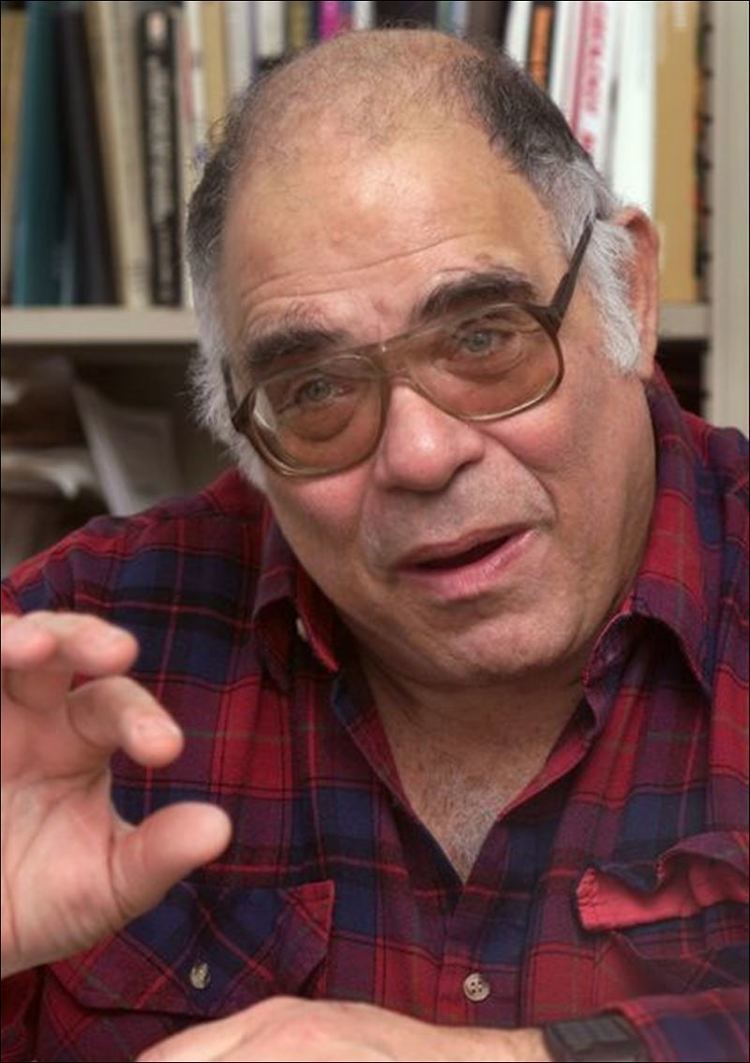
ミルフォード・ウォルポフ
Milford H. Wolpoff, b.1942
☆ ミルフォード・ハウエル・ウォルポフ(Milford Howell Wolpoff) は、ミシガン大学および同大学人類学博物館の人類学者で、古人類学者である。彼は、ホモ・サピエンスの進化が、単一種内の大陸間の進化プロセスと遺伝子流 動の結果として起こったとする多地域進化仮説の第一人者である。Wolpoff は、広く使用されている教科書『Paleoanthropology』(1980年および1999年版)の著者であり[1]、『Race and Human Evolution: 『Race and Human Evolution: A Fatal Attraction』は、人類の進化に関する解釈についての科学的根拠や相反する理論、生物人類学と人種観の関係について論じた共著である[2] [3]。 ウォルポフは、「アフリカ単一起源説」が唱えられた際に、人類進化の多地域モデルを声高に支持したことで最もよく知られている。多地域進化説を支持する根 拠は、彼の更新世の人類に対する正確なモデルとしての断続平衡説[Punctuated equilibrium](進化は通常、種分化における緩やかな変化ではなく、長い静的期間と突然の変化を伴うとい う考え方)に対する懐疑論に由来している。種分化は、人類の進化においてより早い段階で役割を果たしていたことに注目している[4][注釈が必要]。
| Milford Howell
Wolpoff is a paleoanthropologist and professor of anthropology at
the
University of Michigan and its museum of Anthropology. He is the
leading proponent of the multiregional evolution hypothesis that
explains the evolution of Homo sapiens as a consequence of evolutionary
processes and gene flow across continents within a single species.
Wolpoff authored the widely used textbook Paleoanthropology (1980 and
1999 eds.),[1] and co-authored Race and Human Evolution: A Fatal
Attraction, which reviews the scientific evidence and conflicting
theories about the interpretation of human evolution, and biological
anthropology's relationship to views about race.[2][3] Wolpoff is best known for his vocal support of the multiregional model of human evolution when it was challenged by the 'Out of Africa' theory. The basis for advancing the multiregional interpretation stems from his skepticism of punctuated equilibrium (the idea evolution typically proceeds with long static periods and abrupt changes, instead of gradual modification during speciation) as an accurate model for Pleistocene humanity, noting that speciation played a role earlier in human evolution.[4][clarification needed] |
ミルフォード・ハウエル・ウォルポフは、ミシガン大学および同大学人類
学博物館の人類学者で、古人類学者である。彼は、ホモ・サピエンスの進化が、単一種内の大陸間の進化プロセスと遺伝子流動の結果として起こったとする多地
域進化仮説の第一人者である。Wolpoff
は、広く使用されている教科書『Paleoanthropology』(1980年および1999年版)の著者であり[1]、『Race and
Human Evolution: 『Race and Human Evolution: A Fatal
Attraction』は、人類の進化に関する解釈についての科学的根拠や相反する理論、生物人類学と人種観の関係について論じた共著である[2]
[3]。 ウォルポフは、「アフリカ単一起源説」が唱えられた際に、人類進化の多地域モデルを声高に支持したことで最もよく知られている。多地域進化説を支持する根 拠は、彼の更新世の人類に対する正確なモデルとしての断続平衡説(進化は通常、種分化における緩やかな変化ではなく、長い静的期間と突然の変化を伴うとい う考え方)に対する懐疑論に由来している。種分化は、人類の進化においてより早い段階で役割を果たしていたことに注目している[4][注釈が必要]。 |
| Education Wolpoff was born in 1942 to Ruth (Silver) and Ben Wolpoff, in Chicago. He received an A.B. in 1964 with a major in anthropology and a minor in mathematics, and a PhD in 1969 in physical anthropology, with minors in zoology and archaeology, from the University of Illinois in Urbana, Illinois. His research advisor and intellectual mentor was Eugene Giles.[5] He joined the faculty of the University of Michigan in 1971, and became a professor of anthropology in 1977.[3] |
学歴 [編集] ウォルポフは1942年、ルース(シルバー)とベン・ウォルポフ夫妻の間にシカゴで生まれた。1964年にイリノイ州アーバナのイリノイ大学を卒業し、人 類学を専攻、数学を副専攻して文学士号を取得。1969年には、動物学と考古学を副専攻して、物理人類学で博士号を取得した。彼の研究アドバイザーであ り、精神的指導者であったのはユージン・ジャイルズであった[5]。1971年にミシガン大学の教員となり、1977年に人類学の教授に就任した[3]。 |
| Professional work Wolpoff was trained primarily as a paleoanthropologist at the University of Illinois under Eugene Giles. With his multidisciplinary training, he brings to the study of the human and non-human primate fossil record a background that combines evolutionary theory, population genetics, and biomechanics. With over 50 grants funded by the National Science Foundation, National Academy of Sciences, and the University of Michigan, Wolpoff has visited the museums where human and primate fossils are stored and has studied in detail and at length all the materials addressing the fossil evidence for human evolution across Europe, Asia, and Africa. His research foci have included the evolution and fate of the European Neandertals, the role of culture in early hominid evolution, the nature and explanation of allometry, robust australopithecine evolution, the distribution and explanation of sexual dimorphism, hominid origins, the pattern and explanation of Australasian hominid evolution, the contributions and role of genetics in paleoanthropological research, and the taxonomy of the genus Homo. In addition, he is a primary describer of many hominid fossil remains. Since 1976 Wolpoff has graduated more than 20 PhD students.[2] Multiregional evolution and the punctuated equilibrium theory Main article: Multiregional origin of modern humans Drawing on this background and research experience, Wolpoff's continuing research in the last 15 years has been the development, articulation, and defense of his multiregional model of human evolution.[6] He suggests that after an African origin of the Homo lineage (including Homo ergaster/Homo erectus) and the subsequent migration of H. erectus throughout much of the globe (Africa, Europe, Asia), local evolutionary events took place, and when they were advantageous, they spread everywhere else. According to Wolpoff, populations of Homo evolved together as a single species. Change in Pleistocene populations did not involve speciation (the splitting of one species into two): all this time, the geographically distinct populations maintained small amounts of gene flow. This idea directly challenges the Out of Africa model, which claims Homo sapiens evolved recently as a new species in Africa, and then dispersed throughout the Old World, replacing the existing human populations without mixing with them.[7][8] His theory evoked rivalry with the proponents of punctuated equilibrium, Stephen Jay Gould and Niles Eldredge, who endorsed H. erectus as a model of their theory.[4][9] In an earlier example of punctuated evolution preceding the global diffusion of Homo sapiens genes from Africa, some two million years ago, Wolpoff points to evidence of an earlier 'genetic revolution' that took place in a small group isolated from australopithecine forebears. "The earliest H. sapiens remains differ significantly from australopithecines in both size and anatomical details," he notes, "Insofar as we can tell, these changes were sudden and not gradual."[10] |
プロフェッショナルとしての仕事 ウォルポフは、イリノイ大学でユージン・ジャイルズのもとで主に古人類学者としての訓練を受けた。 彼の学際的な訓練は、進化論、集団遺伝学、生物力学を組み合わせたバックグラウンドを、ヒトとヒト以外の霊長類の化石記録の研究にもたらしている。全米科 学財団、全米科学アカデミー、ミシガン大学から50以上の助成金を受けたウォルポフは、人類と霊長類の化石が保管されている博物館を訪れ、ヨーロッパ、ア ジア、アフリカ全域にわたる人類の進化に関する化石証拠を扱う資料をすべて詳細に、かつ時間をかけて研究してきた。彼の研究テーマは、ヨーロッパのネアン デルタール人の進化と運命、初期の人類進化における文化の役割、アロメトリーの本質と説明、頑強なアウストラロピテクスの進化、性的二型性の分布と説明、 人類起源、オーストラリア・アジアの人類進化パターンと説明、古人類学における遺伝学の貢献と役割、ヒト属の分類など多岐にわたる。さらに、彼は多くの類 人猿の化石の主な記述者でもある。1976年以来、ウォルポフは20人以上の博士課程の学生を指導してきた[2]。 多地域進化と断続平衡説 メイン記事: 現代人の多地域起源 このような背景と研究経験を生かし、ウォルポフは過去15年にわたり、人類進化の多地域モデルを開発、明確化し、擁護する研究を続けている[6]。彼は、 ホモ属(ホモ・エルガスター/ホモ・エレクトスを含む)がアフリカで誕生し、その後ホモ・エレクトスが地球上の多くの地域(アフリカ、ヨーロッパ、アジ ア)へと移動した後、それぞれの地域で進化的出来事が起こり、それが有利になると、それが他の地域にも広がっていった。ウォルポフによると、ホモ属の個体 群は単一の種として進化してきた。更新世における個体群の変化は、種の分化(1つの種が2つに分裂すること)を伴わなかった。地理的に離れた個体群は、こ の期間を通じてわずかな遺伝子流動を維持していた。この考えは、ホモ・サピエンスがアフリカで最近になって新種として進化し、旧世界中に拡散し、既存のヒ ト集団と混血することなく置き換わったとする「アフリカ単一起源説」に直接反論するものである[7][8]。 彼の理論は、ホモ・エレクトゥスを彼らの理論のモデルとして支持したスティーブン・ジェイ・グールドとナイルズ・エルドリッジの断続的平衡説の支持者たち との対立を呼び起こした[4][9]。 。 erectus を彼らの理論のモデルとして支持していた。[4][9] 200万年前、アフリカからホモ・サピエンスの遺伝子が世界中に拡散する以前の断続的進化の一例として、ウォルポフは、アウストラロピテクスの祖先から隔 離された小さな集団で起こった、より早い「遺伝的革命」の証拠を指摘している。「現存する最古の人類化石は、大きさや解剖学的特徴の点でアウストラロピテ クスとは大きく異なる」と彼は指摘し、「私たちが知る限り、これらの変化は急激で、徐々に起こったものではない」と述べている[10]。 |
| Awards and honours Wolpoff is a member of many anthropological organizations, and is an Honorary Life Member of the Honor Society of Phi Kappa Phi, a Fellow of the American Association for the Advancement of Science (in 2001) and Fellow of the American Anthropological Association. Some notable awards are[5] LS&A Excellence in Education Award in 1998 W.W. Howells Book Prize in Biological Anthropology, presented by the Biological Anthropology Section of the American Anthropological Association in 1999 Dragutin Gorjanović-Kramberger Award at the Krapina 1899–1999 Conference, presented by the Croatian Natural History Museum Sigma Xi Distinguished Lecturer of 2001–2004 Darwin Lifetime Achievement Award from the American Association of Physical Anthropologists in 2011[11] |
受賞歴 ウォルポフは多くの人類学団体に所属しており、Phi Kappa Phi 名誉学会の名誉終身会員、アメリカ科学振興協会(2001年)およびアメリカ人類学会のフェローでもある。主な受賞歴は以下の通り[5]。 1998年LS&A優秀教育賞 1999年アメリカ人類学会生物人類学部門によるW.W.ハウエルズ生物人類学図書賞 1999年クロアチア自然史博物館によるドラグティン・ゴルヤノヴィッチ=クラムベルガー賞 クロアチア自然史博物館が主催するクラピナ1899-1999会議 2001-2004年のシグマ・シ・ディストゥルクト・レクチャラー 2011年のアメリカ物理人類学会によるダーウィン生涯功労賞[11] |
| Media Books and monographs 1971 Metric Trends in Hominid Dental Evolution. Case Western Reserve Studies in Anthropology 2. Case Western Reserve University Press, Cleveland; 244 pp. 1976 William R. Farrand, Richard W. Redding, Milford H. Wolpoff, and Henry T. Wright, III). An Archaeological Investigation on the Loboi Plain, Baringo District, Kenya. Museum of Anthropology, The University of Michigan Technical Reports Number 4, Research Reports in Archaeology, Contribution 1, Ann Arbor. 1980 Paleoanthropology. Knopf, New York; 379 pp. ISBN 0-394-32197-9 1988 Jakov Radovčić, Fred H. Smith, Erik Trinkaus, and Milford H. Wolpoff . The Krapina Hominids: An Illustrated Catalog of the Skeletal Collection. Mladost Press and the Croatian Natural History Museum, Zagreb. 1994 Paleoanthropology. Preliminary publication of the 2nd edition. College Custom Series, McGraw-Hill, New York. ISBN 0-07-071679-X 1995 Human Evolution. 1996 edition. College Custom Series, McGraw-Hill, New York. ISBN 0-07-071827-X 1996 Human Evolution. 1996-1997 edition. College Custom Series, McGraw-Hill, New York. ISBN 0-07-071833-4 1997 Milford H. Wolpoff and Rachel Caspari: Race and Human Evolution. Simon and Schuster, New York. ISBN 0-684-81013-1. Published in paperback in 1998 by Westview press ISBN 0-8133-3546-9. A Canadian National Institute for the Blind talking book RC18623 (4 cassettes, narrated by Roy Avers). 1999 Paleoanthropology. 2nd edition. McGraw-Hill, New York. ISBN 0-07-071676-5. Reviewed by A. Bilsborough (2001) Clash of the Titans. Journal of Human Evolution 41:701-709. His work with Rachel Caspari, Race and Human Evolution earned them the W.W. Howells Book Prize in 1999. Besides these, he has published 5 other books, 160 papers, and 22 book reviews, has presented numerous lectures and meetings papers, and has had many interviews and video appearances. Magazines and films Wolpoff has also appeared in The New York Times, New Scientist, Discover, and Newsweek.[2] He has appeared in numerous video documentaries, notable ones include[5][12] Origins (SABC) in 1990 Beyond 2000 (Video Australia), The Roots of Humanity (NHK) and The Dawn of Humankind (PBS) in 1992 Apeman (4 part series produced by Granada TV), Dead Men Talk (Equinox), Wir Neandertaler (ORF) and Paleoworld: Missing Links (New Dominion in 1994) Paleoworld: Trail of the Neanderthal (TLC) in 1995 Ancient Mysteries: The Fate of the Neandertals (A&E), The Last Neandertal (Discovery) and Bipedalism and Human Evolution (TCJ) in 1997 Neanderthals on Trial (Nova) and Creationism and Evolution (PBS) in 2002 The Lapedo Child (Anglica Television) in 2003 |
メディア 書籍および単行本 1971年『ホミニッドの歯牙進化におけるメートル法の傾向』。ケース・ウェスタン・リザーブ大学出版、クリーブランド。244ページ。 1976年『ケニア、バリンゴ地区ロボイ平野における考古学的調査』。ウィリアム・R・ファランド、リチャード・W・レディング、ミルフォード・H・ウォ ルポフ、ヘンリー・T・ライト3世著。ミシガン大学人類学博物館 技術報告書第4号、考古学研究報告書第1号、アナーバー 1980 古人類学. Knopf, New York; 379 pp. ISBN 0-394-32197-9 1988 Jakov Radovčić、Fred H. Smith、Erik Trinkaus、Milford H. Wolpoff. スケルトンコレクション図解カタログ。Mladost Pressおよびクロアチア自然史博物館、ザグレブ。 1994年 古人類学。第2版の予備出版。College Custom Series、McGraw-Hill、ニューヨーク。ISBN 0-07-071679-X 1995年 ヒトの進化。1996年版。College Custom Series、McGraw-Hill、ニューヨーク。ISBN 0-07-071827-X 1996年『Human Evolution(人間の進化)』1996-1997年版。 1997年『Milford H. Wolpoff and Rachel Caspari: Race and Human Evolution(ミルフォード・H・ウォルポフとレイチェル・カスパリ:人種と人間の進化)』。ISBN 0-684-81013-1。1998年にWestview pressからペーパーバック版が出版された。ISBN 0-8133-3546-9。カナダ国立盲人協会による録音図書RC18623(4本のカセットテープ、ナレーションはロイ・アヴァース)。 1999年『古人類学』第2版。McGraw-Hill、ニューヨーク。ISBN 0-07-071676-5。A. Bilsboroughによる書評(2001年)『Clash of the Titans. Journal of Human Evolution 41:701-709. レイチェル・カスパリとの共著『Race and Human Evolution』により、1999年にW.W.ハウエルズ・ブック賞を受賞。これらの著作以外にも、5冊の著書、160本の論文、22本の書評を発表 し、数多くの講演や会議での発表を行ってきたほか、多くのインタビューやテレビ出演もこなしている。 雑誌および映画 ウォルポフは『ニューヨーク・タイムズ』、『ニューサイエンテイスト』、『ディスカバー』、『ニューズウィーク』にも登場している[2]。また、数多くの ビデオドキュメンタリーにも出演しており、主なものには以下のものがある[5][12]。 1990年の『Origins』(SABC) 1992年の『Beyond 200 1992年の『人類の起源』(NHK)、『人類の夜明け』(PBS) 『猿人』(グラナダTV制作の4部シリーズ)、『死者が語る』(エクイノックス)、『われわれはネアンデルタール人』(ORF)、『パレオワールド: ミッシングリンク(1994年、ニュー・ドミニオン制作) パレオワールド:ネアンデルタール人の足跡(1995年、TLC制作) 古代の謎: ネアンデルタール人の運命(A&E)、最後のネアンデルタール人(ディスカバリー)、二足歩行と人類の進化(TCJ) 1997年 ネアンデルタール人の裁判(ノヴァ)、創造論と進化(PBS) 2002年 ラペドの子供(アンジリカ・テレビジョン) 2003年 |
| University of Michigan March 2012 GHMB community interview with Milford H. Wolpoff Discover: Milford Wolpoff Evolution Enough for Everyone Rate My Professors Author profile at Amazon Encyclopedia profile Omnilexica online dictionary Dictionary of Meaning |
ミシガン大学 2012年3月GHMBコミュニティによるミルフォード・H・ウォルポフ氏へのインタビュー Discover: Milford Wolpoff Evolution Enough for Everyone Rate My Professors Amazonでの著者プロフィール 百科事典プロフィール Omnilexicaオンライン辞書 Dictionary of Meaning |
| https://en.wikipedia.org/wiki/Milford_H._Wolpoff |
|
★断 続平衡説[Punctuated equilibrium]: 進化生物学において、断続的平衡(punctuated equilibrium、またはpunctuated equilibriaとも呼ばれる)とは、ある種が化石記録に現れると、その個体群は安定し、地質学的歴史の大部分において進化的な変化をほとんど示さな くなるという説である。[1] 形態的変化がほとんどない、あるいは全くないこの状態を「スタシス」と呼ぶ。著しい進化的変化が生じる場合、この理論では、それは一般的に「クラドジェネ シス」と呼ばれる、稀で地質学的に急速な分岐的種分化の事象に限定されると提唱している。クラドジェネシスとは、ある種が徐々に別の種へと変化するのでは なく、一つの種が二つの異なる種に分かれる過程のことである。 断続的平衡説は、一般的に「系統的漸進説」と対比される。系統的漸進説とは、進化は概して、系統全体が着実かつ漸進的に変容すること(アナジェネシス)に よって均一に起こるという考え方である。[2] 1972年、古生物学者のナイルズ・エルドレッドとスティーブン・ジェイ・グールドは、彼らの理論を展開した画期的な論文を発表し、それを「断続的平衡 説」と名付けた。[1] 彼らの論文は、エルンスト・マイヤーの地理的種分化モデル[3]、I. M. ラーナーの発達および遺伝的ホメオスタシスに関する理論[4]、そして彼ら自身の実証的研究[5][6]に基づいていた。エルドレッドとグールドは、 チャールズ・ダーウィン[7]に一般的に帰せられる漸進主義の程度は、化石記録においては事実上存在せず、ほとんどの化石種の歴史においては停滞が支配的 であると提唱した。
| In evolutionary
biology, punctuated equilibrium (also called punctuated equilibria) is
a theory that proposes that once a species appears in the fossil
record, the population will become stable, showing little evolutionary
change for most of its geological history.[1] This state of little or
no morphological change is called stasis. When significant evolutionary
change occurs, the theory proposes that it is generally restricted to
rare and geologically rapid events of branching speciation called
cladogenesis. Cladogenesis is the process by which a species splits
into two distinct species, rather than one species gradually
transforming into another. Punctuated equilibrium is commonly contrasted with phyletic gradualism, the idea that evolution generally occurs uniformly by the steady and gradual transformation of whole lineages (anagenesis).[2] In 1972, paleontologists Niles Eldredge and Stephen Jay Gould published a landmark paper developing their theory and called it punctuated equilibria.[1] Their paper built upon Ernst Mayr's model of geographic speciation,[3] I. M. Lerner's theories of developmental and genetic homeostasis,[4] and their own empirical research.[5][6] Eldredge and Gould proposed that the degree of gradualism commonly attributed to Charles Darwin[7] is virtually nonexistent in the fossil record, and that stasis dominates the history of most fossil species. |
進化生物学において、断続的平衡(punctuated
equilibrium、またはpunctuated
equilibriaとも呼ばれる)とは、ある種が化石記録に現れると、その個体群は安定し、地質学的歴史の大部分において進化的な変化をほとんど示さな
くなるという説である。[1]
形態的変化がほとんどない、あるいは全くないこの状態を「スタシス」と呼ぶ。著しい進化的変化が生じる場合、この理論では、それは一般的に「クラドジェネ
シス」と呼ばれる、稀で地質学的に急速な分岐的種分化の事象に限定されると提唱している。クラドジェネシスとは、ある種が徐々に別の種へと変化するのでは
なく、一つの種が二つの異なる種に分かれる過程のことである。 断続的平衡説は、一般的に「系統的漸進説」と対比される。系統的漸進説とは、進化は概して、系統全体が着実かつ漸進的に変容すること(アナジェネシス)に よって均一に起こるという考え方である。[2] 1972年、古生物学者のナイルズ・エルドレッドとスティーブン・ジェイ・グールドは、彼らの理論を展開した画期的な論文を発表し、それを「断続的平衡 説」と名付けた。[1] 彼らの論文は、エルンスト・マイヤーの地理的種分化モデル[3]、I. M. ラーナーの発達および遺伝的ホメオスタシスに関する理論[4]、そして彼ら自身の実証的研究[5][6]に基づいていた。エルドレッドとグールドは、 チャールズ・ダーウィン[7]に一般的に帰せられる漸進主義の程度は、化石記録においては事実上存在せず、ほとんどの化石種の歴史においては停滞が支配的 であると提唱した。 |
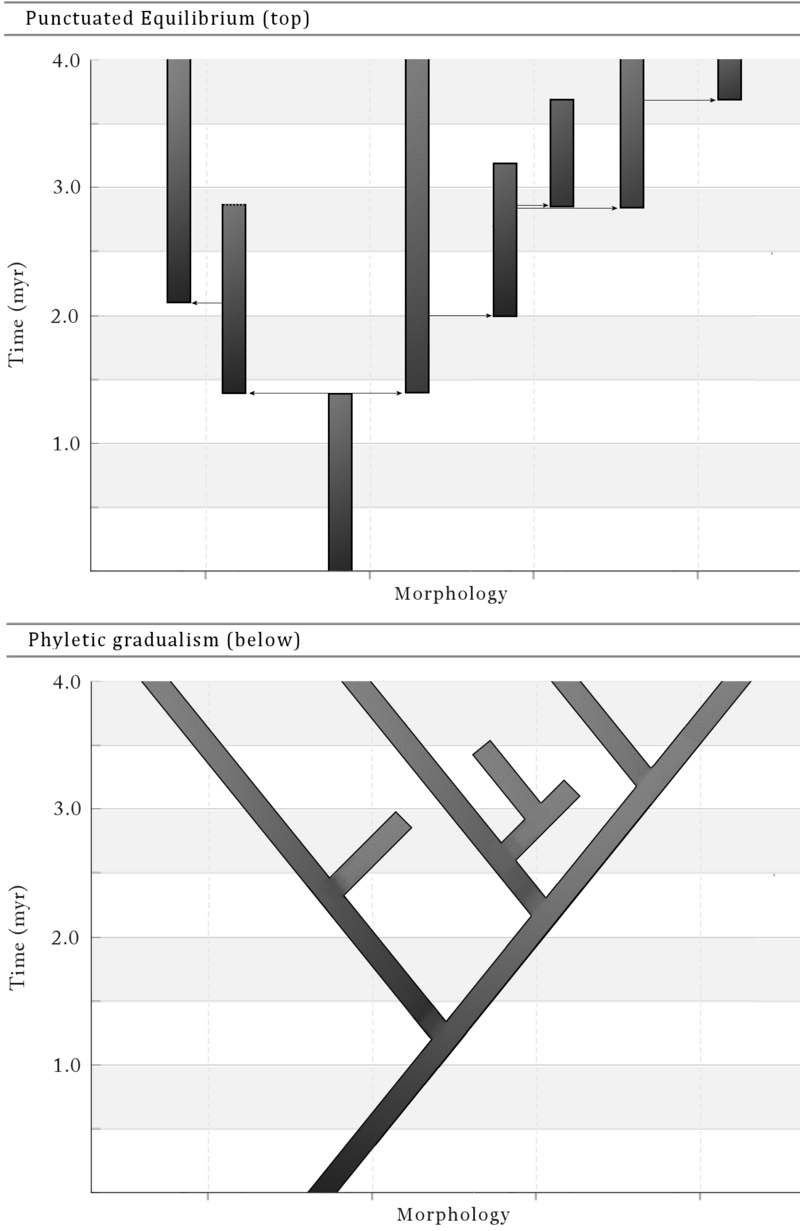
A caricature illustrating extreme versions of punctuation equilibrium and evolutionary gradualism. The punctuated equilibrium model (top) consists of morphological stability followed by rare bursts of evolutionary change via rapid cladogenesis – vertical equilibrium states separated by horizontal "jump" phases. In contrast, phyletic gradualism (below), is a more gradual, continuous model of evolution – with accumulation of small incremental changes represented by slanted bars that split at branch-points, where two separate modes of life are feasible but of which, each prospers best with divergent specializations. |
断続的平衡説と漸進的進化説の極端な形態を表現した風刺画だ。断続的平衡説(上)は、形態の安定性に続き、急速な分岐による稀な進化の変化の爆発が起ころ うとするものであり、水平的な「飛躍」の段階によって隔てられた垂直的な平衡状態から成る。対照的に、系統的漸進主義(下)は、より緩やかで連続的な進化 モデルである。分岐点で分かれる斜めの棒で表される、小さな漸進的な変化の蓄積を特徴とし、そこでは2つの異なる生活様式が可能であるが、それぞれが異な る専門化によって最も繁栄する。 |
| History Punctuated equilibrium originated as a logical consequence of Ernst Mayr's concept of genetic revolutions by allopatric and especially peripatric speciation as applied to the fossil record. Although the sudden appearance of species and its relationship to speciation was proposed and identified by Mayr in 1954,[3] historians of science generally recognize the 1972 Eldredge and Gould paper as the basis of the new paleobiological research program.[8][9][10][11] Punctuated equilibrium differs from Mayr's ideas mainly in that Eldredge and Gould placed considerably greater emphasis on stasis, whereas Mayr was concerned with explaining the morphological discontinuity (or "sudden jumps")[12] found in the fossil record.[8] Mayr later complimented Eldredge and Gould's paper, stating that evolutionary stasis had been "unexpected by most evolutionary biologists" and that punctuated equilibrium "had a major impact on paleontology and evolutionary biology."[8] A year before his and Gould's 1972 paper, Niles Eldredge published a paper in the journal Evolution which suggested that gradual evolution was seldom seen in the fossil record and argued that Ernst Mayr's standard mechanism of allopatric speciation might suggest a possible resolution.[5] The Eldredge and Gould paper was presented at the Annual Meeting of the Geological Society of America in 1971.[1] The symposium focused its attention on how modern microevolutionary studies could revitalize various aspects of paleontology and macroevolution. Tom Schopf, who organized that year's meeting, assigned Gould the topic of speciation. Gould recalls that "Eldredge's 1971 publication [on Paleozoic trilobites] had presented the only new and interesting ideas on the paleontological implications of the subject—so I asked Schopf if we could present the paper jointly."[13] According to Gould "the ideas came mostly from Niles, with yours truly acting as a sounding board and eventual scribe. I coined the term punctuated equilibrium and wrote most of our 1972 paper, but Niles is the proper first author in our pairing of Eldredge and Gould."[14] In his book Time Frames Eldredge recalls that after much discussion the pair "each wrote roughly half. Some of the parts that would seem obviously the work of one of us were actually first penned by the other—I remember for example, writing the section on Gould's snails. Other parts are harder to reconstruct. Gould edited the entire manuscript for better consistency. We sent it in, and Schopf reacted strongly against it—thus signaling the tenor of the reaction it has engendered, though for shifting reasons, down to the present day."[15] John Wilkins and Gareth Nelson have argued that French architect Pierre Trémaux proposed an "anticipation of the theory of punctuated equilibrium of Gould and Eldredge."[16] |
歴史 断続的平衡説は、エルンスト・マイヤーが提唱した「遺伝的革命」の概念——特に地理的隔離による種分化、とりわけ周縁的種分化——を化石記録に適用した結 果として、論理的に導き出されたものである。種の突然の出現とその種分化との関係については、1954年にマイヤーによって提唱・特定されていたが [3]、科学史家たちは概して、1972年のエルドレッドとグールドの論文を、この新しい古生物学的研究プログラムの基礎と見なしている。[8][9] [10][11] 断続的平衡説がマイヤーの考えと異なる点は、主にエルドレッドとグールドが停滞(スタシス)をかなり重視したのに対し、マイヤーは化石記録に見られる形態 学的不連続性(あるいは「急激な飛躍」)[12]の説明に関心を寄せていたことにある。[8] マイヤーは後にエルドレッドとグールドの論文を称賛し、進化的静止状態は「ほとんどの進化生物学者にとって予想外のものだった」とし、断続的平衡説は「古 生物学および進化生物学に多大な影響を与えた」と述べた。[8] 1972年のエルドレッドとグールドの論文の1年前、ナイルズ・エルドレッドは学術誌『Evolution』に論文を発表し、化石記録において漸進的な進 化はめったに見られないことを示唆するとともに、エルンスト・マイヤーの標準的なメカニズムである地理的隔離による種分化が、その解決策となり得ると論じ た。[5] エルドレッドとグールドの論文は、1971年のアメリカ地質学会年次総会で発表された。[1] このシンポジウムでは、現代の微小進化研究が、古生物学や巨視的進化のさまざまな側面をどのように活性化できるかに焦点が当てられた。その年の会議を主催 したトム・ショプフは、グールドに種分化というテーマを割り当てた。グールドは、「エルドレッドジの1971年の論文[古生代の三葉虫に関するもの]が、 この主題の古生物学的な意味合いについて、唯一の新奇で興味深い考えを提示していた。そこで私はショプフに、共同で論文を発表できないかと尋ねた」と回想 している。[13] グールドによれば、「アイデアのほとんどはナイルズから出たもので、私(グールド)は意見の聞き役を務め、最終的には執筆を担当した。私は『断続的平衡』 という用語を考案し、1972年の論文の大部分を執筆したが、エルドレッドとグールドというコンビにおいて、ナイルズこそが正当な筆頭著者である」 [14]。エルドレッドは著書『タイム・フレームズ』の中で、長い議論の末、二人は「それぞれおよそ半分ずつ執筆した」と回想している。一見すると明らか にどちらか一方の執筆によると思われる部分も、実際にはもう一方が最初に筆を執ったものだった――例えば、私はグールドのカタツムリに関する節を書いたこ とを覚えている。他の部分は再構成するのが難しい。グールドは一貫性を高めるために原稿全体を編集した。我々はそれを投稿したが、ショプフはこれに強く反 発した――これは、理由こそ変化しつつあるものの、今日に至るまで引き起こされてきた反応の基調を示唆するものであった。」[15] ジョン・ウィルキンスとガレス・ネルソンは、フランスの建築家ピエール・トレモーが「グールドとエルドレッドの断続的平衡説を先取りした」提案を行ったと 主張している。[16] |
| Evidence from the fossil record Main article: Rate of evolution The fossil record includes well documented examples of both phyletic gradualism and punctuational evolution.[17] As such, much debate persists over the prominence of stasis in the fossil record.[18][19] Before punctuated equilibrium, most evolutionary biologists considered stasis to be rare or unimportant.[8][20][21] The paleontologist George Gaylord Simpson, for example, believed that phyletic gradual evolution (called horotely in his terminology) comprised 90% of evolution.[22] More modern studies,[23][24][25] including a meta-analysis examining 58 published studies on speciation patterns in the fossil record showed that 71% of species exhibited stasis,[26] and 63% were associated with punctuated patterns of evolutionary change.[27] According to Michael Benton, "it seems clear then that stasis is common, and that had not been predicted from modern genetic studies."[17] A paramount example of evolutionary stasis is the fern Osmunda claytoniana. Based on paleontological evidence it has remained unchanged, even at the level of fossilized nuclei and chromosomes, for at least 180 million years.[28] |
化石記録からの証拠 本記事:進化の速度 化石記録には、系統的漸進説と断続的進化説の両方について、十分に立証された例が含まれている。[17] そのため、化石記録における静止状態の顕著性については、依然として多くの議論が続いている。[18][19] 断続的平衡説が登場する以前、ほとんどの進化生物学者は、静止状態を稀なもの、あるいは重要ではないものと考えていた。[8][20][21] 例えば、古生物学者のジョージ・ゲイロード・シンプソンは、系統的漸進進化(彼の用語では「ホロテリー」と呼ばれる)が進化の90%を占めると考えてい た。[22] 化石記録における種分化パターンに関する58件の既発表研究を検証したメタ分析を含む、より近年の研究[23][24][25]によれば、71%の種がス タシスを示しており[26]、63%が断続的な進化変化のパターンと関連していた。[27] マイケル・ベントンによれば、「したがって、静止状態が一般的であることは明らかであり、それは現代の遺伝学的研究からは予測されていなかった」 [17]。進化的静止状態の最も顕著な例は、シダの一種であるオスマンダ・クレイトニアナ(Osmunda claytoniana)である。古生物学的証拠に基づけば、この種は少なくとも1億8000万年にわたり、化石化した核や染色体のレベルにおいてさえ、 変化していないことが示されている。[28] |
| Theoretical mechanisms Punctuational change When Eldredge and Gould published their 1972 paper, allopatric speciation was considered the "standard" model of speciation.[1] This model was popularized by Ernst Mayr in his 1954 paper "Change of genetic environment and evolution,"[3] and his classic volume Animal Species and Evolution (1963).[29] Allopatric speciation suggests that species with large central populations are stabilized by their large volume and the process of gene flow. New and even beneficial mutations are diluted by the population's large size and are unable to reach fixation, due to such factors as constantly changing environments.[29] If this is the case, then the transformation of whole lineages should be rare, as the fossil record indicates. Smaller populations on the other hand, which are isolated from the parental stock, are decoupled from the homogenizing effects of gene flow. In addition, pressure from natural selection is especially intense, as peripheral isolated populations exist at the outer edges of ecological tolerance. If most evolution happens in these rare instances of allopatric speciation then evidence of gradual evolution in the fossil record should be rare. This hypothesis was alluded to by Mayr in the closing paragraph of his 1954 paper: Rapidly evolving peripherally isolated populations may be the place of origin of many evolutionary novelties. Their isolation and comparatively small size may explain phenomena of rapid evolution and lack of documentation in the fossil record, hitherto puzzling to the palaeontologist.[3] Although punctuated equilibrium generally applies to sexually reproducing organisms,[30] some biologists have applied the model to non-sexual species like viruses,[31][32] which cannot be stabilized by conventional gene flow. As time went on biologists like Gould moved away from wedding punctuated equilibrium to allopatric speciation, particularly as evidence accumulated in support of other modes of speciation.[2] Gould, for example, was particularly attracted to Douglas Futuyma's work on the importance of reproductive isolating mechanisms.[33] Stasis Many hypotheses have been proposed to explain the putative causes of stasis. Gould was initially attracted to I. Michael Lerner's theories of developmental and genetic homeostasis. However this hypothesis was rejected over time,[34] as evidence accumulated against it.[18] Other plausible mechanisms which have been suggested include: habitat tracking,[35][36] stabilizing selection,[37] the Stenseth-Maynard Smith stability hypothesis,[38] constraints imposed by the nature of subdivided populations,[37] normalizing clade selection,[39] and koinophilia.[40][41] Evidence for stasis has also been corroborated from the genetics of sibling species, species which are morphologically indistinguishable, but whose proteins have diverged sufficiently to suggest they have been separated for millions of years.[42] Fossil evidence of reproductively isolated extant species of sympatric Olive Shells (Amalda sp.) also confirm morphological stasis in multiple lineages over three million years.[43][44] According to Gould, "stasis may emerge as the theory's most important contribution to evolutionary science."[45] Philosopher Kim Sterelny in clarifying the meaning of stasis adds, "In claiming that species typically undergo no further evolutionary change once speciation is complete, they are not claiming that there is no change at all between one generation and the next. Lineages do change. But the change between generations does not accumulate. Instead, over time, the species wobbles about its phenotypic mean. Jonathan Weiner's The Beak of the Finch describes this very process."[46] Hierarchical evolution Punctuated equilibrium has also been cited as contributing to the hypothesis that species are Darwinian individuals, and not just classes, thereby providing a stronger framework for a hierarchical theory of evolution.[47] |
理論的メカニズム 断続的変化 エルドレッドとグールドが1972年に論文を発表した当時、地理的隔離による種分化は種分化の「標準」モデルと見なされていた。[1] このモデルは、エルンスト・マイヤーが1954年の論文「遺伝的環境の変化と進化」[3] およびその名著『動物種と進化』(1963年)で広めたものである。[29] 地理的隔離による種分化説によれば、中心個体群の規模が大きい種は、その巨大な個体群規模と遺伝子流動の過程によって安定化される。新規の、さらには有益 な突然変異でさえも、個体群の規模の大きさによって希釈され、絶えず変化する環境などの要因により、固定に至ることはできない。[29] もしそうであるならば、化石記録が示すように、系統全体が変容することは稀であるはずだ。一方、親集団から隔離された小規模な個体群は、遺伝子流動による 均質化作用から切り離されている。さらに、周辺部の隔離個体群は生態学的許容範囲の限界に存在するため、自然選択の圧力が特に強い。もし進化の大部分が、 こうした稀な地理的隔離による種分化の事例において起こるのなら、化石記録における漸進的進化の証拠は稀であるはずだ。この仮説は、マイヤーが1954年 の論文の締めくくりの段落でほのめかしている: 急速に進化する周辺的に隔離された個体群は、多くの進化的新奇性の発祥地である可能性がある。それらの隔離状態と比較的小さな規模こそが、急速な進化とい う現象や、化石記録における証拠の欠如――これまでは古生物学者にとって謎であった――を説明するかもしれない。[3] 断続的平衡説は一般的に有性生殖を行う生物に適用されるが[30]、一部の生物学者は、従来の遺伝子流動では安定化できないウイルスのような無性生殖種に もこのモデルを適用している[31][32]。時が経つにつれ、特に他の種分化様式を支持する証拠が蓄積するにつれて、グールドのような生物学者たちは、 断続的平衡説と地理的隔離による種分化を結びつける見解から距離を置くようになった。[2] 例えば、グールドは、生殖的隔離メカニズムの重要性に関するダグラス・フツヤマの研究に特に惹かれた。[33] スタシス スタシスの推定される原因を説明するために、多くの仮説が提唱されてきた。グールドは当初、I・マイケル・ラーナーの発生的および遺伝的ホメオスタシスに 関する理論に惹かれていた。しかし、この仮説に反する証拠が蓄積するにつれて、やがてこの仮説は退けられることになった。[34] [18] 他に提唱されている妥当なメカニズムには、生息地の追従[35][36]、安定化選択[37]、ステンスス・メイナード・スミス安定性仮説[38]、細分 化された個体群の性質による制約[37]、正規化クレード選択[39]、およびコイノフィリア[40][41]などがある。 スタシスの証拠は、形態学的には区別できないが、タンパク質が十分に分化しており、数百万年にわたって分離していたことを示唆する「姉妹種」の遺伝学から も裏付けられている[42]。同域分布する現生のオリーブ貝(Amalda sp.)のうち、生殖的に隔離された種の化石証拠も、300万年以上にわたる複数の系統における形態学的スタシスを裏付けている[43]。[44] グールドによれば、「スタシスは、この理論が進化科学にもたらした最も重要な貢献として浮上するかもしれない」[45]。哲学者キム・ステレルニーは、ス タシスの意味を明確化して次のように付け加えている。「種分化が完了すると、種は通常それ以上の進化的変化を遂げないという主張は、世代間で全く変化がな いと主張しているわけではない。系統は確かに変化する。しかし、世代間の変化は蓄積されない。その代わりに、時間の経過とともに、種はその表現型の平均値 を中心に揺れ動く。ジョナサン・ワイナーの『フィンチのくちばし』は、まさにこの過程を描いている。」[46] 階層的進化 断続的平衡説は、種が単なる分類群ではなくダーウィニアンな個体であるという仮説に寄与するものとしても引用されており、それによって階層的進化論のため のより強固な枠組みを提供している。[47] |
| Common misconceptions Much confusion has arisen over what proponents of punctuated equilibrium actually argued, what mechanisms they advocated, how fast the punctuations were, what taxonomic scale their theory applied to, how revolutionary their claims were intended to be, and how punctuated equilibrium related to other ideas like saltationism, quantum evolution, and mass extinction.[48] Saltationism 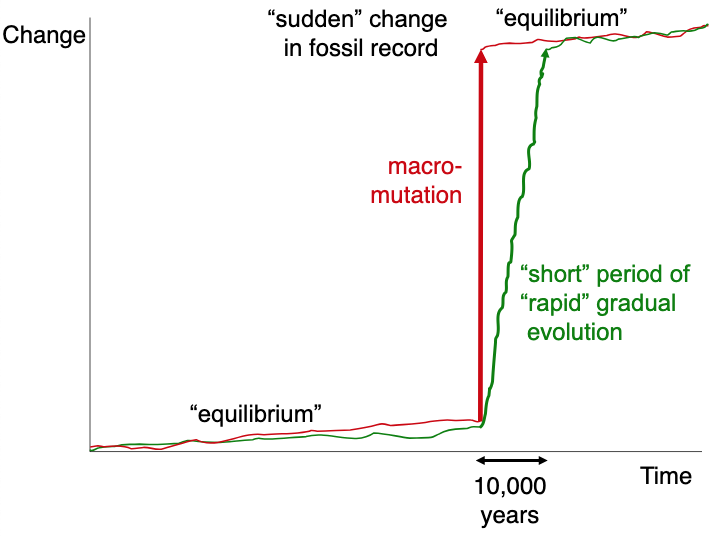 Alternative explanations for the punctuated pattern of evolution observed in the fossil record. Both macromutation and seemingly "rapid" episodes of gradual evolution could give the appearance of instantaneous change, since 10,000 years seldom registers in the geological record. The punctuational nature of punctuated equilibrium has engendered perhaps the most confusion over Eldredge and Gould's theory. Gould's sympathetic treatment of Richard Goldschmidt,[49] the controversial geneticist who advocated the idea of "hopeful monsters," led some biologists to conclude that Gould's punctuations were occurring in single-generation jumps.[50][51][52][53] This interpretation has frequently been used by creationists to characterize the weakness of the paleontological record, and to portray contemporary evolutionary biology as advancing neo-saltationism.[54] In an often quoted remark, Gould stated, "Since we proposed punctuated equilibria to explain trends, it is infuriating to be quoted again and again by creationists – whether through design or stupidity, I do not know – as admitting that the fossil record includes no transitional forms. Transitional forms are generally lacking at the species level, but they are abundant between larger groups."[55] Although there exist some debate over how long the punctuations last, supporters of punctuated equilibrium generally place the figure between 50,000 and 100,000 years.[56] |
よくある誤解 断続的平衡説の提唱者たちが実際に何を主張していたのか、どのようなメカニズムを提唱していたのか、その「断続」の速度はどの程度だったのか、彼らの理論 がどの分類学的スケールに適用されるものだったのか、彼らの主張がどれほど画期的なものとして意図されていたのか、そして断続的平衡説が飛躍説、量子進 化、大量絶滅といった他の考えとどのように関連していたのかについて、多くの混乱が生じてきた。[48] サルタショニズム 化石記録に見られる断続的な進化パターンに対する代替説である。マクロ突然変異も、一見「急速」に見える漸進的進化のエピソードも、地質学的記録において 1万年という期間はほとんど記録されないため、瞬間的な変化のように見える可能性がある。 断続的平衡説の「断続的」という性質は、エルドレッドとグールドの理論に関して、おそらく最も大きな混乱を招いてきた。グールドが、「希望に満ちた怪物」 という概念を提唱した物議を醸した遺伝学者リチャード・ゴールドシュミット[49]に好意的な態度を示したことから、一部の生物学者は、グールドの言う 「断続」が単一代での飛躍として起こっていると結論づけた[50][51][52]。[53] この解釈は、創造論者たちによって、古生物学的な記録の弱点を指摘し、現代の進化生物学が新サルタシオン主義を推進しているかのように描くために頻繁に利 用されてきた。[54] よく引用される発言の中で、グールドは次のように述べている。 「我々は傾向を説明するために断続的平衡を提唱したのだから、創造論者たちによって――それが意図的なものか愚かさによるものかは分からないが――化石記 録には過渡的な形態が含まれていないと認めたかのように、繰り返し引用されるのは腹立たしい。過渡的な形態は種レベルでは一般的に欠如しているが、より大 きな分類群の間では豊富に存在する。」[55] 断続的平衡の期間がどれほど続くかについては議論があるものの、その支持者たちは一般的に、その期間を5万年から10万年の間と見なしている。[56] |
| George Gaylord Simpson A similar view of variable evolutionary rates was proposed by George Gaylord Simpson in the 1950s. Simpson was regarded by Gould as "the greatest and most biologically astute paleontologist of the twentieth century."[57] His multi-tempo theory of evolution proposed that evolutionary rates differ from group to group and even among closely related lineages. These different rates of evolutionary change were designated by Simpson as bradytelic (slow tempo), horotelic (medium tempo), and tachytelic (rapid tempo), similar to the patterns proposed by punctuated equilibrium. One component of Simpson's view of multi-tempo evolution was the controversial quantum evolution. Simpson's conjecture was that according to the geological record, on occasion evolution would proceed very rapidly to form entirely new families, orders, and classes of organisms.[58][59] Quantum evolution (but not Simpson's more general multi-tempo evolution) differs from punctuated equilibrium in several respects. First, punctuated equilibrium and Simpson's multi-tempo evolution were more modest in scope, in that they addressed evolution specifically at the species level.[24] quantum evolution was principally concerned with evolution at higher taxonomic groups.[58] Second, Eldredge and Gould relied upon a different mechanism. Where Simpson's quantum evolution relied upon a synergistic interaction between genetic drift and a shift in the adaptive fitness landscape,[60] Eldredge and Gould relied upon ordinary speciation, particularly Ernst Mayr's concept of allopatric speciation. Lastly, and perhaps most significantly, quantum evolution took no position on the issue of stasis. Although Simpson acknowledged the existence of stasis in what he called the bradytelic mode, he considered it (along with rapid evolution) to be unimportant in the larger scope of evolution.[61] In his Major Features of Evolution Simpson stated, "Evolutionary change is so nearly the universal rule that a state of motion is, figuratively, normal in evolving populations. The state of rest, as in bradytely, is the exception and it seems that some restraint or force must be required to maintain it." Despite such differences between the two models, critiques from such eminent commentators as Sewall Wright as well as Simpson himself have argued that punctuated equilibrium is little more than multi-tempo evolution relabeled.[62][63] |
ジョージ・ゲイロード・シンプソン 1950年代、ジョージ・ゲイロード・シンプソンもまた、進化速度の変動に関する同様の見解を提唱した。シンプソンはグールドから「20世紀で最も偉大か つ生物学的に鋭い洞察力を持つ古生物学者」と評されていた。[57] 彼の「多テンポ進化論」は、進化の速度が群ごとに異なり、近縁な系統間でも異なることを提唱した。こうした進化の変化速度の違いについて、シンプソンは 「ブラディテリック(遅いテンポ)」「ホロテリック(中程度のテンポ)」「タキテリック(速いテンポ)」と分類したが、これは断続的平衡説が提唱するパ ターンと類似していた。 シンプソンの多テンポ進化論の一要素として、物議を醸した「量子進化」があった。シンプソンの仮説によれば、地質学的記録から判断して、時折、進化が極め て急速に進み、全く新しい生物の科、目、綱が形成されることがあるというものであった。[58][59] 量子進化(ただし、シンプソンのより一般的な多テンポ進化論は除く)は、断続的平衡説とはいくつかの点で異なる。第一に、断続的平衡説とシンプソンの多テ ンポ進化論は、特に種レベルでの進化を扱っていたという点で、その範囲はより限定的であった。[24] 量子進化論は、主に上位の分類群における進化を扱っていた。[58] 第二に、エルドレッドとグールドは異なるメカニズムに依拠していた。シンプソンの量子進化論が、遺伝的浮動と適応適性ランドスケープのシフトとの相乗的な 相互作用に依拠していたのに対し、 [60] エルドレッドとグールドは、通常の種分化、特にエルンスト・マイヤーの地理的隔離による種分化の概念に依拠していた。最後に、そしておそらく最も重要な点 として、量子進化論は停滞の問題について何ら立場を表明しなかった。シンプソンは、自身が「ブラディテレック様式」と呼んだものにおける停滞の存在を認め ていたものの、進化というより大きな枠組みにおいては、それを(急速な進化と同様に)重要ではないと考えていた。[61] シンプソンは著書『進化の主要な特徴』の中で、次のように述べている。「進化的変化はほぼ普遍的な法則であるため、進化する個体群において、比喩的に言え ば、変化の状態こそが正常である。ブラディテリックに見られるような静止状態は例外であり、それを維持するには何らかの抑制力や作用が必要であるように思 われる。」という。両モデル間のこうした相違にもかかわらず、セウォール・ライトやシンプソン自身といった著名な評論家による批判では、断続的平衡説は、 単に「多テンポ進化」という名称を変えたに過ぎないと主張されている。[62][63] |
| Multiple meanings of gradualism Punctuated equilibrium is often portrayed to oppose the concept of gradualism, when it is actually a form of gradualism.[64] This is because even though evolutionary change appears instantaneous between geological sedimentary layers, change is still occurring incrementally, with no great change from one generation to the next. To this end, Gould later commented that "Most of our paleontological colleagues missed this insight because they had not studied evolutionary theory and either did not know about allopatric speciation or had not considered its translation to geological time. Our evolutionary colleagues also failed to grasp the implication(s), primarily because they did not think at geological scales".[14] Richard Dawkins dedicates a chapter in The Blind Watchmaker to correcting, in his view, the wide confusion regarding rates of change. His first point is to argue that phyletic gradualism—understood in the sense that evolution proceeds at a single uniform speed, called "constant speedism" by Dawkins—is a "caricature of Darwinism"[65] and "does not really exist".[66] His second argument, which follows from the first, is that once the caricature of "constant speedism" is dismissed, we are left with one logical alternative, which Dawkins terms "variable speedism". Variable speedism may also be distinguished one of two ways: "discrete variable speedism" and "continuously variable speedism". Eldredge and Gould, proposing that evolution jumps between stability and relative rapidity, are described as "discrete variable speedists", and "in this respect they are genuinely radical."[67] They assert that evolution generally proceeds in bursts, or not at all. "Continuously variable speedists", on the other hand, advance that "evolutionary rates fluctuate continuously from very fast to very slow and stop, with all intermediates. They see no particular reason to emphasize certain speeds more than others. In particular, stasis, to them, is just an extreme case of ultra-slow evolution. To a punctuationist, there is something very special about stasis."[68] |
漸進主義の複数の意味 断続的平衡説は、しばしば漸進主義の概念に対立するものとして描かれるが、実際には漸進主義の一形態である。[64] これは、地質学的堆積層の間では進化の変化が瞬間的に見えるとしても、変化は依然として漸進的に起こっており、世代から世代へと大きな変化はないからであ る。この点について、グールドは後に次のように述べている。「我々の古生物学者の同僚の多くは、この洞察を見逃していた。彼らは進化論を学んでおらず、地 理的隔離による種分化について知らなかったか、あるいはそれが地質学的時間スケールにどう当てはまるかを考慮していなかったからだ。また、我々の進化生物 学者の同僚たちも、その含意を把握できなかった。主な理由は、彼らが地質学的なスケールで考えていなかったことにある」。[14] リチャード・ドーキンスは、『盲目の時計職人』の一章を割き、変化の速度に関する広範な誤解を、自身の見解に基づいて正そうとしている。彼の第一の論点 は、系統的漸進主義――進化が単一の均一な速度で進行するという意味で理解されるもので、ドーキンスはこれを「定速説」と呼ぶ――は「ダーウィニズムの歪 曲された像」[65]であり、「実際には存在しない」と主張することである。[66] 第一の論点から導かれる第二の論点は、「一定速度説」という歪曲像を退けた後、残される論理的な選択肢は一つだけであり、ドーキンスはこれを「可変速度 説」と呼んでいる。可変速度説もまた、「離散的可変速度説」と「連続的可変速度説」という2つの方法で区別することができる。エルドレッドとグールドは、 進化が安定状態と比較的急速な状態の間を跳躍すると提唱しており、「離散的可変速度説者」と形容され、「この点において彼らは真に急進的である」 [67]。彼らは、進化は一般的に突発的に進むか、あるいは全く進まないかのどちらかであると主張する。一方、「連続可変速度論者」は、「進化の速度は、 非常に速い状態から非常に遅い状態まで、すべての中間段階を含めて連続的に変動し、停止することもある」と主張する。彼らは、特定の速度を他の速度よりも 強調する特別な理由はないと考えている。特に、彼らにとって停滞とは、単に超低速な進化の極端な事例に過ぎない。断続進化論者にとっては、停滞には何か非 常に特別な意味があるのだ。[68] |
| Criticism See also: Species problem, Species complex, and Push of the past Richard Dawkins regards the apparent gaps represented in the fossil record as documenting migratory events rather than evolutionary events. According to Dawkins, evolution certainly occurred but "probably gradually" elsewhere.[69] However, the punctuational equilibrium model may still be inferred from both the observation of stasis and examples of rapid and episodic speciation events documented in the fossil record.[70] Dawkins also emphasizes that punctuated equilibrium has been "oversold by some journalists",[71] but partly due to Eldredge and Gould's "later writings".[72] Dawkins contends that the hypothesis "does not deserve a particularly large measure of publicity".[73] It is a "minor gloss," an "interesting but minor wrinkle on the surface of neo-Darwinian theory," and "lies firmly within the neo-Darwinian synthesis".[74] In his book Darwin's Dangerous Idea, philosopher Daniel Dennett is especially critical of Gould's presentation of punctuated equilibrium. Dennett argues that Gould alternated between revolutionary and conservative claims, and that each time Gould made a revolutionary statement—or appeared to do so—he was criticized, and thus retreated to a traditional neo-Darwinian position.[75] Gould responded to Dennett's claims in The New York Review of Books,[76] and in his technical volume The Structure of Evolutionary Theory.[77] English professor Heidi Scott argues that Gould's talent for writing vivid prose, his use of metaphor, and his success in building a popular audience of nonspecialist readers altered the "climate of specialized scientific discourse" favorably in his promotion of punctuated equilibrium.[78] While Gould is celebrated for the color and energy of his prose, as well as his interdisciplinary knowledge, critics such as Scott, Richard Dawkins, and Daniel Dennett have concerns that the theory has gained undeserved credence among non-scientists because of Gould's rhetorical skills.[78] Philosopher John Lyne and biologist Henry Howe believed punctuated equilibrium's success has much more to do with the nature of the geological record than the nature of Gould's rhetoric. They state, a "re-analysis of existing fossil data has shown, to the increasing satisfaction of the paleontological community, that Eldredge and Gould were correct in identifying periods of evolutionary stasis which are interrupted by much shorter periods of evolutionary change."[79] Evolutionary biologist Robert Trivers accused Gould of being "something of an intellectual fraud" for using claims that were "well known from the time of Darwin" (that evolution displayed "periods of long stasis interspersed with periods of rapid change") to support distinct but more "grandiose" claims regarding species selection, despite the "rate of species turnover [having] nothing to do with the traits within species—only with the relative frequency of species showing these traits".[80] According to Bernard Davis, Gould's theory was inspired by the dialectics of Marx and Hegel. Davis wrote, "To most scientists (other than those tethered to a party line) such a claim of support from (or for) Hegel is silly, and such an insertion of an ideological preference, whether from the left or the right, is a corruption of science."[81] Some critics jokingly referred to the theory of punctuated equilibrium as "evolution by jerks",[82] which reportedly prompted punctuationists to describe phyletic gradualism as "evolution by creeps."[83] |
批判 関連項目:種の問題、種複合体、過去の推進力 リチャード・ドーキンスは、化石記録に見られる明らかな空白を、進化の出来事ではなく、移動の出来事を示すものと見なしている。ドーキンスによれば、進化 は確かに起こったが、それは「おそらく他の場所で徐々に」起こったという。[69] しかし、停滞の観察結果と、化石記録に記録された急速かつ断続的な種分化の事例の両方から、断続的平衡モデルを依然として推論することは可能である。 [70] ドーキンスはまた、断続的平衡説が「一部のジャーナリストによって過大評価されてきた」[71]と強調しているが、その一因はエルドレッドとグールドの 「後期の著作」にある[72]。ドーキンスは、この仮説は「特に大きな注目を集めるに値するものではない」と主張している。[73] これは「些細な脚色」であり、「新ダーウィン主義理論の表面にある興味深いが些細なひだ」であり、「新ダーウィン主義の統合理論の枠内にしっかりと収まっ ている」ものである。[74] 哲学者ダニエル・デネットは著書『ダーウィンの危険な思想』において、グールドによる断続的平衡説の提示を特に批判している。デネットは、グールドが革命 的な主張と保守的な主張を交互に繰り返しており、革命的な発言をするたびに――あるいはそう見えたたびに――批判を受け、その結果、伝統的な新ダーウィン 主義の立場へと後退したと論じている。[75] グールドは、『ニューヨーク・レビュー・オブ・ブックス』[76] および専門書『進化論の構造』において、デネットの主張に反論した。[77] 英文学教授のハイディ・スコットは、グールドの鮮やかな散文を書く才能、比喩の使い方、そして専門家ではない一般読者を獲得した成功が、断続的平衡説の普 及において「専門的な科学的議論の風土」を好ましい方向に変えたと論じている。[78] グールドはその文章の彩りと活力、そして学際的な知識で称賛されている一方で、スコットやリチャード・ドーキンス、ダニエル・デネットといった批評家たち は、グールドの修辞的技量ゆえに、この理論が非科学者の間で不当な信頼を得てしまったのではないかと懸念している。[78] 哲学者ジョン・ラインと生物学者ヘンリー・ハウは、断続的平衡説の成功は、グールドの修辞の性質よりも、地質学的記録の性質に大きく起因すると考えてい た。彼らは、「既存の化石データの再分析により、エルドレッドとグールドが、はるかに短い進化の変化の期間によって中断される進化の停滞期を特定したこと は正しかったことが示され、古生物学界の納得度も高まっている」と述べている。[79] 進化生物学者のロバート・トライヴァーズは、グールドが「ダーウィンの時代からよく知られていた」主張 (すなわち、進化には「長い停滞期と急速な変化の時期が交互に現れる」という主張)を、種選択に関する別個の、しかしより「壮大な」主張を裏付けるために 用いたとして、「ある種の知的詐欺師」であると非難した。にもかかわらず、「種の入れ替わり率は、種内の形質とは何の関係もなく、単にそれらの形質を示す 種の相対的な頻度のみに関係している」のである。[80] バーナード・デイヴィスによれば、グールドの理論はマルクスとヘーゲルの弁証法に触発されたものだった。デイヴィスは次のように記している。「(党の路線 に縛られていない)ほとんどの科学者にとって、ヘーゲルからの(あるいはヘーゲルのための)支持を主張するようなことは馬鹿げているし、左派であれ右派で あれ、そのようなイデオロギー的志向を介入させることは、科学の腐敗である。」[81] 一部の批評家は、断続的平衡説を冗談めかして「ぎくしゃくした進化」と呼んだ[82]。これに対し、断続平衡説の支持者たちは、系統的漸進説を「じわじわ した進化」と表現したと言われている[83]。 |
| Darwin's theory The sudden appearance of most species in the geologic record and the lack of evidence of substantial gradual change in most species—from their initial appearance until their extinction—has long been noted, including by Charles Darwin, who appealed to the imperfection of the record as the favored explanation.[84][85] When presenting his ideas against the prevailing influences of catastrophism and progressive creationism, which envisaged species being supernaturally created at intervals, Darwin needed to forcefully stress the gradual nature of evolution in accordance with the gradualism promoted by his friend Charles Lyell. He privately expressed concern, noting in the margin of his 1844 Essay, "Better begin with this: If species really, after catastrophes, created in showers world over, my theory false."[86] It is often incorrectly assumed that he insisted that the rate of change must be constant, or nearly so, but even the first edition of On the Origin of Species states that "Species of different genera and classes have not changed at the same rate, or in the same degree. In the oldest tertiary beds a few living shells may still be found in the midst of a multitude of extinct forms... The Silurian Lingula differs but little from the living species of this genus". Lingula is among the few brachiopods surviving today but also known from fossils over 500 million years old.[87] In the fourth edition (1866) of On the Origin of Species Darwin wrote that "the periods during which species have undergone modification, though long as measured in years, have probably been short in comparison with the periods during which they retain the same form."[88] Thus punctuationism in general is consistent with Darwin's conception of evolution.[86] According to early versions of punctuated equilibrium, "peripheral isolates" are considered to be of critical importance for speciation. However, Darwin wrote, "I can by no means agree ... that immigration and isolation are necessary elements. ... Although isolation is of great importance in the production of new species, on the whole I am inclined to believe that largeness of area is still more important, especially for the production of species which shall prove capable of enduring for a long period, and of spreading widely."[89] The importance of isolation in forming species had played a significant part in Darwin's early thinking, as shown in his Essay of 1844. But by the time he wrote the Origin he had downplayed its importance.[86] He explained the reasons for his revised view as follows: Throughout a great and open area, not only will there be a greater chance of favourable variations, arising from the large number of individuals of the same species there supported, but the conditions of life are much more complex from the large number of already existing species; and if some of these species become modified and improved, others will have to be improved in a corresponding degree, or they will be exterminated. Each new form, also, as soon as it has been improved, will be able to spread over the open and continuous area, and will thus come into competition with many other forms ... the new forms produced on large areas, which have already been victorious over many competitors, will be those that will spread most widely, and will give rise to the greatest number of new varieties and species. They will thus play a more important role in the changing history of the organic world.[90] Thus punctuated equilibrium is incongruous with some of Darwin's ideas regarding the specific mechanisms of evolution, but generally accords with Darwin's theory of evolution by natural selection.[86][91] |
ダーウィンの理論 地質学的記録において、ほとんどの種が突然出現していること、また、最初の出現から絶滅に至るまで、ほとんどの種において著しい漸進的な変化の証拠が見ら れないことは、かねてより指摘されてきた。チャールズ・ダーウィンもその一人であり、彼はこの現象について、記録の不完全さを主な説明として挙げた。 [84][85] 種が超自然的な力によって断続的に創造されたとする、当時主流だったカタストロフィズムや漸進的創造説に対抗して自らの考えを提示するにあたり、ダーウィ ンは友人のチャールズ・ライエルが提唱した漸進主義に従い、進化の漸進的な性質を力強く強調する必要があった。彼は私的に懸念を表明し、1844年の 『エッセイ』の余白に「こう書き出すのがよいだろう。『もし種が本当に、大災害の後、世界中で一斉に創造されたのであれば、私の説は誤りである』」と記し ている。[86] 彼は変化の速度が一定、あるいはほぼ一定でなければならないと主張していたと誤って考えられがちだが、『種の起源』の初版でさえ、「異なる属や綱に属する 種は、同じ速度で、あるいは同じ程度に変化してきたわけではない。最も古い第三紀の地層では、多数の絶滅した形態の中に、まだいくつかの現生の貝殻が見つ かっている…… シルル紀のリンギュラ(Lingula)は、この属の現生種とほとんど変わらない」。リンギュラは、今日まで生き残っている数少ない腕足類の一つだが、5 億年以上前の化石としても知られている。[87] 『種の起源』第4版(1866年)において、ダーウィンは「種が変容を遂げた期間は、年単位で測れば長いものの、同じ形態を維持していた期間と比較すれ ば、おそらく短いものであっただろう」と記している。[88] したがって、断続平衡説は概して、ダーウィンの進化観と整合している。[86] 断続的平衡説の初期の説によれば、「周辺部の隔離個体群」は種分化において極めて重要であると見なされている。しかし、ダーウィンは「移入と隔離が不可欠 な要素であるという点には、私は決して同意できない」と記している。……隔離は新種の生成において極めて重要ではあるが、全体として、特に長期間存続し、 広く分布することが証明される種の生成においては、生息域の広さがさらに重要であると私は考える傾向にある。」[89] 種の形成における隔離の重要性は、1844年の『エッセイ』に示されているように、ダーウィンの初期の思考において重要な役割を果たしていた。しかし、 『種の起源』を執筆する頃には、彼はその重要性を軽視するようになっていた。[86] 彼は、見解を改めた理由を次のように説明した。 広大で開放的な地域においては、そこに生息する同種の個体数が多いため、有利な変異が生じる可能性が高まるだけでなく、すでに存在する種が多数いることか ら、生活環境もはるかに複雑になる。そして、もしこれらの種の一部が変化し、改良されれば、他の種もそれに見合う程度に改良されなければならず、さもなけ れば絶滅することになる。また、新しい形態は、改良され次第、広大で連続した地域全体に広がることができ、それによって他の多くの形態と競合することにな る……広大な地域で生み出され、すでに多くの競合相手に打ち勝った新しい形態こそが、最も広く広がり、最も多くの新しい変種や種を生み出すことになるだろ う。それゆえ、それらは有機界の変遷の歴史において、より重要な役割を果たすことになる。[90] したがって、断続的平衡説は、進化の具体的なメカニズムに関するダーウィンの考えの一部とは整合しないが、自然選択による進化というダーウィンの理論とは 概ね一致している。[86][91] |
| Supplemental modes of rapid
evolution See also: Rapid modes of evolution Recent work in developmental biology has identified dynamical and physical mechanisms of tissue morphogenesis that may underlie abrupt morphological transitions during evolution. Consequently, consideration of mechanisms of phylogenetic change that have been found in reality to be non-gradual is increasingly common in the field of evolutionary developmental biology, particularly in studies of the origin of morphological novelty. A description of such mechanisms can be found in the multi-authored volume Origination of Organismal Form (MIT Press; 2003). |
急速な進化の補足的な様式 関連項目:急速な進化の様式 発生生物学における最近の研究により、進化過程における急激な形態的変化の根底にある可能性のある、組織の形態形成に関する動的および物理的なメカニズム が特定された。その結果、進化発生生物学の分野、とりわけ形態的新奇性の起源に関する研究において、現実には漸進的ではないことが判明している系統発生的 変化のメカニズムを検討することが、ますます一般的になりつつある。こうしたメカニズムに関する記述は、複数の著者が執筆した書籍 『Origination of Organismal Form』(MIT Press; 2003)に見ることができる。 |
| Language change For broader coverage of this topic, see Language change. In linguistics, R. M. W. Dixon has proposed a punctuated equilibrium model for language histories,[92] with reference particularly to the prehistory of the indigenous languages of Australia and his objections to the proposed Pama–Nyungan language family there. Although his model has raised considerable interest, it does not command majority support within linguistics.[93] Separately, recent work using computational phylogenetic methods claims to show that punctuational bursts play an important factor when languages split from one another, accounting for anywhere from 10 to 33% of the total divergence in vocabulary,[94] and around 24% of divergence among cognates in the Indo-European language family.[95] |
言語変化 このトピックに関するより広範な解説については、「言語変化」を参照のこと。 言語学において、R. M. W. ディクソンは、特にオーストラリア先住民言語の先史時代および同地で提唱されているパマ・ニュンガン語族に対する自身の異議を根拠として、言語の歴史に関 する「断続的平衡」モデルを提唱している[92]。彼のモデルは大きな関心を集めているものの、言語学界内で過半数の支持を得ているわけではない。 [93] これとは別に、計算機を用いた系統発生学的手法を用いた最近の研究では、言語が互いに分岐する際、断続的な急激な変化が重要な要因となり、語彙の総分岐の 10~33%[94]、およびインド・ヨーロッパ語族における同源語間の分岐の約24%[95]を占めていることが示されている。 |
| Mythology Punctuational evolution has been argued to explain changes in folktales and mythology over time.[96] |
神話 民話や神話が時代とともに変化した理由として、断続的進化説が提唱されてきた。[96] |
| Speciation Adaptive radiation Catastrophe theory Convergent evolution Court Jester Hypothesis Critical juncture theory Evolutionary capacitance Gene orders Koinophilia Punctuated equilibrium in social theory Punctuated gradualism |
種分化 適応的放射 カタストロフ理論 収斂進化 道化師仮説 臨界点理論 進化的キャパシタンス 遺伝子の配列 コイノフィリア 社会理論における断続的平衡 断続的漸進主義 |
| References 01. Eldredge, Niles; Gould, S.J. (1972). "Punctuated equilibria: An alternative to phyletic gradualism". In Schopf, T.J.M. (ed.). Models in Paleobiology. San Francisco, CA: Freeman Cooper. pp. 82–115. Reprinted in Eldredge, N., ed. (1985). Time Frames (PDF). Princeton, NJ: Princeton University Press. pp. 193–223. Archived from the original (PDF) on 2020-01-13. Retrieved 2018-01-27. Eldredge, Niles (1972). "2nd draft (unpublished)". doi:10.5531/sd.paleo.4. hdl:2246/6564. {{cite journal}}: Cite journal requires |journal= (help) Eldredge, Niles; Gould, Stephen Jay (1972). "3rd draft (final, published)". doi:10.5531/sd.paleo.7. hdl:2246/6567. {{cite journal}}: Cite journal requires |journal= (help) Gould, S.J. (15 April 1982). "Punctuated equilibrium — a different way of seeing". New Scientist. Vol. 94. pp. 137–139 – via Google Books.[permanent dead link] Mayr, Ernst (1954). "Change of genetic environment and evolution". In Huxley, J.; Hardy, A.C.; Ford, E.B. (eds.). Evolution as a Process. London, UK: Allen and Unwin. pp. 157–180 – via Blackwell Publishing. Lerner, I.M. (1954). Genetic Homeostasis. New York, NY: John Wiley. Eldredge, Niles (1971). "The allopatric model and phylogeny in Paleozoic invertebrates". Evolution. 25 (1): 156–167. doi:10.2307/2406508. hdl:2246/6568. JSTOR 2406508. PMID 28562952. Gould, S.J. (1969). "An evolutionary microcosm: Pleistocene and recent history of the land snail P. (Poecilozonites) in Bermuda". Bull. Mus. Comp. Zool. 138: 407–532. Rhodes, F.H.T. (1983). "Gradualism, punctuated equilibrium and the Origin of Species". Nature. 305 (5932): 269–272. Bibcode:1983Natur.305..269R. doi:10.1038/305269a0. PMID 6353241. S2CID 32953263. Mayr, Ernst (1992). "Speciational Evolution or Punctuated Equilibria." In Albert Somit and Steven Peterson The Dynamics of Evolution. New York: Cornell University Press, pp. 21-48. Shermer, Michael (2001). The Borderlands of Science. New York: Oxford University Press, pp. 97-116. Archived 2018-01-26 at the Wayback Machine Geary, Dana (2008). "The Legacy of Punctuated equilibrium." In Warren D. Allmon et al. Stephen Jay Gould: Reflections on His View of Life. Oxford: Oxford University Press, pp. 127-145. Prothero, D. (2007). "Punk eek, Transitional Formsand Quote Miners." In Evolution: what the fossils say and why it matters. New York: Columbia University Press, pp. 78–85. Schindewolf, Otto (1936). Paldontologie, Entwicklungslehre und Genetik. Berlin: Borntraeger. Gould, S. J. (2002). The Structure of Evolutionary Theory. Cambridge, Massachusetts: The Belknap Press of Harvard University Press. p. 775. ISBN 978-0-674-00613-3. S. J. Gould (1991). "Opus 200" Natural History 100 (August): 12-18. Eldredge, Niles (1985) Time Frames: The evolution of punctuated equilibria. Princeton: Princeton University Press, p. 120. Wilkins, John S.; Nelson, G. J. (2008). "Trémaux on species: A theory of allopatric speciation (and punctuated equilibrium) before Wagner" (PDF). History and Philosophy of the Life Sciences. 30 (2): 179–206. PMID 19203015. Benton, Michael and David Harper (2009) Introduction to Paleobiology and the Fossil Record New York: John Wiley & Sons, pp. 123-124. Futuyma, Douglas (2005). Evolution. Sunderland, MA: Sinauer Associates, p. 86. Erwin, D. H. and R. L. Anstey (1995) New approaches to speciation in the fossil record. New York : Columbia University Press. S. J. Gould 2002. The Structure of Evolutionary Theory. Cambridge MA: Harvard University Press, p. 875. Wake, David B.; Roth, G.; Wake, M. H. (1983). "On the problem of stasis in organismal evolution". Journal of Theoretical Biology. 101 (2): 212. Bibcode:1983JThBi.101..211W. doi:10.1016/0022-5193(83)90335-1. Simpson, G. G. (1944). Tempo and Mode in Evolution. Columbia University Press. New York, p. 203. Campbell, N.A. (1990) Biology p. 450–451, 487–490, 499–501. Redwood City CA: Benjamin Cummings Publishing Company. S. J. Gould, & Eldredge, Niles (1977). "Punctuated equilibria: the tempo and mode of evolution reconsidered." Archived 2018-05-08 at the Wayback Machine Paleobiology 3 (2): 115-151. (p.145) McCarthy, T. & Rubridge, B. (2005) The Story of Earth and Life. Cape Town: Struik Publishers. ISBN 1-77007-148-2. de Brito Neto, S. G.; Fernando Alves, E.; Cavalcante e Almeida Sá, Mariana (2017). "Speciation in real time and historical-archaeological and its absence in geological time". Academia Journal of Scientific Research. doi:10.15413/ajsr.2017.0413 (inactive 12 July 2025). ISSN 2315-7712. Erwin, D. H. and Anstey, R. L (1995). "Speciation in the fossil record." Archived 2019-03-23 at the Wayback Machine In Erwin, D. H. & Anstey, R. L. (eds). New Approaches to Speciation in the Fossil Record. Columbia University Press, New York, pp. 11–39. Bomfleur, B.; McLoughlin, S.; Vajda, V. (March 2014). "Fossilized nuclei and chromosomes reveal 180 million years of genomic stasis in royal ferns". Science. 343 (6177): 1376–1377. Bibcode:2014Sci...343.1376B. doi:10.1126/science.1249884. PMID 24653037. S2CID 38248823. Mayr, Ernst (1963). Animal Species and Evolution. Cambridge, MA: Harvard University Press. Eldredge, Niles and S. J. Gould (1997). "On punctuated equilibria (letter)." Science 276 (5311): 337-341. Nichol, S.T, Joan Rowe, and Walter M. Fitch (1993). "Punctuated equilibrium and positive Darwinian evolution in vesicular stomatitis virus." Proceedings of the National Academy of Sciences 90 (Nov.): 10424-28. Elena S.F., V.S. Cooper, and R. Lenski (1996). "Punctuated Evolution Caused by Selection of Rare Beneficial Mutations." Science 272 (June 21): 1802-1804. Futuyma, Douglas (1987). "On the role of species in anagenesis". American Naturalist. 130 (3): 465–473. Bibcode:1987ANat..130..465F. doi:10.1086/284724. S2CID 83546424. S. J. Gould 2002. The Structure of Evolutionary Theory. Cambridge, Massachusetts: Harvard University Press, p. 39. Eldredge, Niles; Gould, S. J. (1974). "Morphological Transformation, the Fossil Record, and the Mechanisms of Evolution: A Debate". Evolutionary Biology. Vol. 7. pp. 305–306. doi:10.1007/978-1-4615-6944-2_8. ISBN 978-1-4615-6946-6. Niles Eldredge (1989). Time Frames. Princeton University Press, pp. 139-141. Lieberman, B. S.; Dudgeon, S. (1996). "An evaluation of stabilizing selection as a mechanism for stasis". Palaeogeogr. Palaeoclimatol. Palaeoecol. 127 (1–4): 229–238. Bibcode:1996PPP...127..229L. doi:10.1016/S0031-0182(96)00097-1. Stenseth, N. C.; Maynard Smith, John (1984). "Coevolution in ecosystems: Red Queen evolution or stasis?". Evolution. 38 (4): 870–880. doi:10.2307/2408397. JSTOR 2408397. PMID 28555824. Williams, G. C. (1992). Natural Selection: Domains, Levels and Challenges. New York: Oxford University Press, p. 132. Koeslag, J. H. (1990). "Koinophilia groups sexual creatures into species, promotes stasis, and stabilizes social behaviour". Journal of Theoretical Biology. 144 (1): 15–35. Bibcode:1990JThBi.144...15K. doi:10.1016/s0022-5193(05)80297-8. PMID 2200930. Koeslag, J.H. (1995). On the engine of speciation. J. theor. Biol. 177, 401-409 Maynard Smith, John (1989). Did Darwin Get it Right?. New York: Chapman and Hall. p. 126. Gemmell, Michael R.; Trewick, Steven A.; Hills, Simon F. K.; Morgan-Richards, Mary (2019). "Phylogenetic topology and timing of New Zealand olive shells are consistent with punctuated equilibrium". Journal of Zoological Systematics and Evolutionary Research. 58 (1): 209–220. doi:10.1111/jzs.12342. S2CID 213493738. Michaux, B. (1989). "Morphological variation of species through time". Biological Journal of the Linnean Society. 38 (3): 239–255. doi:10.1111/j.1095-8312.1989.tb01577.x. Stephen Jay Gould 2002. The Structure of Evolutionary Theory. Cambridge MA: Harvard University Press, p. 872. Sterelny, Kim (2007). Dawkins vs. Gould: Survival of the Fittest. Cambridge, U.K.: Icon Books, p. 96. Brett, Carlton E.; Ivany, Linda C.; Schopf, Kenneth M. (1996). "Coordinated stasis: An overview". Palaeogeography, Palaeoclimatology, Palaeoecology. 127 (1–4): 1–20. Bibcode:1996PPP...127....1B. doi:10.1016/S0031-0182(96)00085-5. S. J. Gould (1992) "Punctuated equilibrium in fact and theory." Archived 2018-01-26 at the Wayback Machine In Albert Somit and Steven Peterson The Dynamics of Evolution. New York: Cornell University Press. pp. 54–84. Gould, S.J. (June–July 1976). "The return of hopeful monsters". Natural History. Vol. 86. pp. 22–30. Mayr, Ernst (1982). Growth of Biological Thought (PDF). Harvard University Press. p. 617. Archived from the original (PDF) on 2016-06-23. Maynard Smith, J. (1983). "The genetics of stasis and punctuations" (PDF). Annual Review of Genetics. 17: 12. Archived from the original (PDF) on 2010-12-06. Ruse, Michael (1985). Sociobiology, Sense or Nonsense?. New York, NY: Springer. p. 216. For reply see: Gould, S.J. (2002). Structure. pp. 765, 778, 1001, 1005, 1009. Dawkins, R. (1996). The Blind Watchmaker. W. W. Norton & Company. pp. 230-236. ISBN 9780393315707 – via Google Books. Dennett, D. (1996). Darwin's Dangerous Idea. Simon and Schuster. pp. 288–289. ISBN 9780684824710 – via Google Books. Hanegraaff, H. (1998). The Face that Demonstrates the Farce of Evolution. Nashville, TN: Word Publishing. pp. 40-45. ISBN 9781418515096 – via Google Books. Gould, S.J. (May 1981). "Evolution as fact and theory". Discover. Vol. 2. pp. 34–37. Ayala, F. (2005). "The structure of evolutionary theory" (PDF). Theology and Science. 3 (1): 104. doi:10.1080/14746700500039800. S2CID 4293004. Archived from the original (PDF) on 2018-09-23. Retrieved 2007-04-22. S. J. Gould (2007) Punctuated equilibrium. Cambridge MA: Harvard University Press, p. 26. Simpson, G. G. (1944). Tempo and Mode in Evolution. New York: Columbia Univ. Press, p. 206 Fitch, W. J. and F. J. Ayala (1995) Tempo and mode in evolution: genetics and paleontology 50 years after Simpson. Washington, D.C.: National Academy Press. Simpson, G. G. (1953). The Major Features of Evolution Archived 2019-04-21 at the Wayback Machine. New York: Columbia Univ. Press, p. 390. Simpson, G. G. (1944). Tempo and Mode in Evolution. New York: Columbia Univ. Press, pp. 205-206. Wright, Sewall (1982). "Character change, speciation, and the higher taxa" (PDF). Evolution. 56 (3): 427–443. doi:10.2307/2408092. JSTOR 2408092. PMID 28568042. Archived from the original (PDF) on 2011-08-28. Simpson, G. G. (1984) Tempo and Mode in Evolution. Reprint. Columbia University Press, p. xxv. Dawkins, Richard (1996). The Blind Watchmaker. New York: W. W. Norton & Co., Chapter 9. (p. 224-252) Dawkins, Richard (1996). The Blind Watchmaker. New York: W. W. Norton & Co., p. 227. Dawkins, Richard (1996). The Blind Watchmaker, p. 228. Dawkins' exception to this rule is the non-adaptive evolution observed in molecular evolution. Dawkins, Richard (1996) The Blind Watchmaker, p. 245. Dawkins, Richard (1996). The Blind Watchmaker, p. 245-246. Dawkins, Richard (1996). The Blind Watchmaker, p. 240. Cheetham, Alan; Jackson, Jeremy; Hayek, Lee-Ann (1994). "Quantitative genetics of bryozoan phenotypic evolution". Evolution. 48 (2): 360–375. doi:10.2307/2410098. JSTOR 2410098. Dawkins, Richard (1996). The Blind Watchmaker, p. 250-251. Dawkins, Richard (1996). The Blind Watchmaker, p. 241. Dawkins, Richard (1996). The Blind Watchmaker, p. 250. Dawkins, Richard (1996). The Blind Watchmaker, p. 251. Dennett, Daniel (1995). Darwin's Dangerous Idea. New York: Simon & Schuster, pp. 282-299. Gould, S. J. (1997). "Darwinian Fundamentalism" The New York Review of Books, June 12, pp. 34-37; and "Evolution: The Pleasures of Pluralism" The New York Review of Books, June 26, pp. 47-52. "Stephen Jay Gould, "Punctuated Equilibrium's Threefold History," 2002". 2019-10-19. Archived from the original on 19 October 2019. Retrieved 2022-02-16. Scott, Heidi (2007). "Stephen Jay Gould and the Rhetoric of Evolutionary Theory". Rhetoric Review. 26 (2): 120–141. doi:10.1080/07350190709336705. S2CID 144947503. Lyne, John; Howe, Henry F. (1986). ""Punctuated equilibria": Rhetorical dynamics of a scientific controversy". Quarterly Journal of Speech. 72 (2): 132–147 [135]. doi:10.1080/00335638609383764. Trivers, Robert (October 4, 2012). "Fraud in the Imputation of Fraud". Psychology Today. Retrieved 2023-02-26. Davis, Bernard (1983). "Neo-Lysenkoism, IQ and the press". The Public Interest. 74 (2): 45. PMID 11632811. Turner, John (1984). "Why we need evolution by jerks". New Scientist. Vol. 101, no. Feb. 9. pp. 34–35. Gould, S. J. and Steven Rose, ed. (2007). The Richness of Life: The Essential Stephen Jay Gould. New York: W. W. Norton & Co., p. 6. Darwin, Charles (1859). On the Origin of Species. London: John Murray, p. 301. Darwin, Charles (1871). The Origin of Species. London: John Murray, p. 119-120. Eldredge, Niles (2006) "Confessions of a Darwinist." Archived 2013-12-24 at the Wayback Machine The Virginia Quarterly Review 82 (Spring): 32-53. Darwin, Charles (1859). On the Origin of Species. London: John Murray. p. 313. Darwin, Charles (1869). The Origin of Species. London: John Murray. 5th edition, p. 551. Darwin, Charles (1869). The Origin of Species. London: John Murray. 5th edition, pp. 120-121. Darwin, Charles (1869). The Origin of Species. London: John Murray. 5th edition, pp. 121-122. Gould, Stephen Jay; Eldredge, Niles (1993), "Punctuated equilibrium comes of age", Nature, 366 (6452): 223–227, Bibcode:1993Natur.366..223G, doi:10.1038/366223a0, PMID 8232582, S2CID 4253816 Dixon, R.M.W. (1997). The rise and fall of languages Cambridge: Cambridge University Press. Bowern, Claire; Koch, Harold, eds. (2004-03-18). Australian Languages. Current Issues in Linguistic Theory. Vol. 249. John Benjamins Publishing Company. doi:10.1075/cilt.249. ISBN 9789027295118. Atkinson, Quentin D.; Meade, Andrew; Venditti, Chris; Greenhill, Simon J.; Pagel, Mark (2008). "Languages Evolve in Punctuational Bursts". Science. 319 (5863): 588. doi:10.1126/science.1149683. hdl:1885/33371. PMID 18239118. S2CID 29740420.; Dan Dediu mail, Stephen C. Levinson, Abstract Profiles of Structural Stability Point to Universal Tendencies, Family-Specific Factors, and Ancient Connections between Languages, PLoS ONE,7(9), 2012, e451982012. Douglas, J.; Bouckaert, R.; Harris, S. C.; Carter Jr., C. W.; Wills, P. R. (2025). "Evolution is coupled with branching across many granularities of life". Proceedings B. 292 (2047). doi:10.1098/rspb.2025.0182. 96. Julien d'Huy, A Cosmic Hunt in the Berber sky : a phylogenetic reconstruction of Palaeolithic mythology. Les Cahiers de l'AARS, 15, 2012; Polyphemus (Aa. Th. 1137) A phylogenetic reconstruction of a prehistoric tale. Nouvelle Mythologie Comparée / New Comparative Mythology 1, 2013; Les mythes évolueraient par ponctuations Archived 2020-05-28 at the Wayback Machine. Mythologie française, 252, 2013, 8-12. |
参考文献 01. Eldredge, Niles; Gould, S.J. (1972). 「断続的平衡:系統的漸進説に代わる説」. Schopf, T.J.M. (編). 『古生物学のモデル』. カリフォルニア州サンフランシスコ: Freeman Cooper. pp. 82–115. 再掲載先 エルドレッドジ, N., 編 (1985). 『タイム・フレームズ』 (PDF). ニュージャージー州プリンストン: プリンストン大学出版局. pp. 193–223. 2020年1月13日にオリジナル (PDF) からアーカイブされた。2018年1月27日に閲覧。 エルドレッドジ, ナイルズ (1972). 「第2稿(未発表)」。doi:10.5531/sd.paleo.4。hdl:2246/6564。{{cite journal}}: ジャーナル引用には |journal= が必要である(ヘルプ) エルドレッドジ、ナイルズ;グールド、スティーブン・ジェイ(1972)。「第3稿(最終稿、発表済み)」。doi: 10.5531/sd.paleo.7. hdl:2246/6567. {{cite journal}}: ジャーナル引用には |journal= が必要である (ヘルプ) グールド, S.J. (1982年4月15日). 「断続的平衡 — 異なる視点」. 『ニュー・サイエンティスト』. 第94巻. pp. 137–139 – Google Books経由。[リンク切れ] マイヤー、エルンスト (1954). 「遺伝的環境の変化と進化」. ハクスリー, J.; ハーディ, A.C.; フォード, E.B. (編). 『プロセスとしての進化』. ロンドン, 英国: アレン・アンド・アンウィン. pp. 157–180 – ブラックウェル・パブリッシング経由. ラーナー, I.M. (1954). 『遺伝的恒常性』. ニューヨーク州ニューヨーク: ジョン・ワイリー. エルドレッド, ナイルズ (1971). 「古生代の無脊椎動物における地理的隔離モデルと系統発生」. 『エボリューション』. 25 (1): 156–167. doi:10.2307/2406508. hdl:2246/6568. JSTOR 2406508. PMID 28562952. グールド, S.J. (1969). 「 「進化の縮図:バミューダにおける陸生カタツムリ P. (Poecilozonites) の更新世および近年の歴史」. 『Bull. Mus. Comp. Zool.』 138: 407–532. ローズ, F.H.T. (1983). 「漸進主義、断続的平衡、そして『種の起源』」 . 『ネイチャー』 305 (5932): 269–272. Bibcode:1983Natur.305..269R. doi:10.1038/305269a0. PMID 6353241. S2CID 32953263. マイヤー、エルンスト (1992). 「種分化進化か、断続的平衡か」。アルバート・ソミット、スティーブン・ピーターソン編『進化のダイナミクス』。ニューヨーク:コーネル大学出版局、 21–48頁。 シャーマー、マイケル(2001)。『科学の境界地帯』。ニューヨーク:オックスフォード大学出版局、97–116頁。2018年1月26 日、ウェイバックマシンにアーカイブ済み ギアリー、ダナ(2008)。「断続的平衡説の遺産」。ウォーレン・D・オールモン他編『スティーブン・ジェイ・グールド:その人生観を振り返って』所 収。オックスフォード:オックスフォード大学出版局、127-145頁。 プロテロ、D.(2007)。「パンク・イーク、過渡的形態、そして引用採掘者たち」。『進化:化石が語るものと、その重要性』所収。ニュー ヨーク:コロンビア大学出版局、78–85頁。 シンデヴォルフ、オットー(1936)。『古歯類学、発生学、遺伝学』。ベルリン:ボルントレーガー。 グールド、S. J.(2002)。『進化論の構造』。マサチューセッツ州ケンブリッジ:ハーバード大学出版局ベルナップ・プレス。p. 775。ISBN 978-0-674-00613-3。 S. J. グールド (1991)。「Opus 200」『Natural History』100号(8月):12-18。 エルドレッド、ナイルズ (1985) 『タイム・フレームズ:断続的平衡の進化』。プリンストン:プリンストン大学出版局、p. 120. ウィルキンス、ジョン・S.;ネルソン、G. J. (2008). 「種に関するトレモー:ワグナー以前の地理的隔離による種分化(および断続的平衡)の理論」 (PDF). 『生命科学の歴史と哲学』. 30 (2): 179–206. PMID 19203015. ベントン、マイケルおよびデビッド・ハーパー(2009)『古生物学と化石記録入門』ニューヨーク:ジョン・ワイリー・アンド・サンズ、123–124 頁。 フツヤマ、ダグラス(2005)。『進化』。マサチューセッツ州サンダーランド:シナウアー・アソシエイツ、86頁。 アーウィン, D. H. および R. L. アンステイ (1995) 『化石記録における種分化への新たなアプローチ』。ニューヨーク:コロンビア大学出版局。 S. J. グールド 2002. 『進化論の構造』。マサチューセッツ州ケンブリッジ:ハーバード大学出版局、p. 875。 ウェイク, デビッド・B.;ロス, G.;ウェイク, M. H. (1983). 「生物の進化における停滞の問題について」。『理論生物学ジャーナル』。101 (2): 212。Bibcode:1983JThBi.101..211W。doi:10.1016/0022-5193(83)90335-1。 シンプソン, G. G. (1944). 『進化のテンポと様式』. コロンビア大学出版局. ニューヨーク, p. 203. キャンベル, N.A. (1990) 『生物学』 p. 450–451, 487–490, 499–501. カリフォルニア州レッドウッドシティ: ベンジャミン・カミングス出版. S. J. グールド、およびエルドレッド、ナイルズ (1977). 「断続的平衡:進化のテンポと様式の再考」. 2018年5月8日、ウェイバックマシンにアーカイブ. 『Paleobiology』 3 (2): 115-151. (p.145) McCarthy, T. & Rubridge, B. (2005) 『地球と生命の物語』. ケープタウン:Struik Publishers. ISBN 1-77007-148-2. de Brito Neto, S. G.; Fernando Alves, E.; Cavalcante e Almeida Sá, Mariana (2017). 「リアルタイムおよび歴史・考古学的観点からの種分化、ならびに地質学的時間スケールにおけるその欠如」。『Academia Journal of Scientific Research』。doi:10.15413/ajsr.2017.0413(2025年7月12日現在、アクセス不可)。ISSN 2315-7712。 アーウィン, D. H. および アンステイ, R. L (1995)。「化石記録における種分化」。2019年3月23日にウェイバックマシンにアーカイブ済み。Erwin, D. H. & Anstey, R. L. (編)『化石記録における種分化への新たなアプローチ』所収。コロンビア大学出版局、ニューヨーク、pp. 11–39。 ボムフルール、B.;マクローリン、S.;ヴァイダ、V.(2014年3月)。「化石化した核と染色体が明らかにした、ロイヤルシダにおける 1億8000万年にわたるゲノムの停滞」。『Science』。343 (6177): 1376–1377。Bibcode:2014Sci...343.1376B. doi:10.1126/science.1249884. PMID 24653037. S2CID 38248823. マイヤー、エルンスト(1963)。『動物種と進化』。マサチューセッツ州ケンブリッジ:ハーバード大学出版局。 エルドレッド、ナイルズおよびS. J. グールド(1997)。「断続的平衡について(書簡)」。『サイエンス』276 (5311): 337-341。 ニコル、S.T、ジョアン・ロウ、およびウォルター・M・フィッチ(1993)。「水疱性口内炎ウイルスにおける断続的平衡と正のダーウィン的進化」。 『米国科学アカデミー紀要』90(11月):10424-28。 エレナ・S.F.、V.S. クーパー、およびR. レンスキー(1996)。「希少な有益な突然変異の選択によって引き起こされる断続的進化」。『サイエンス』272号(6月21日):1802-1804 頁。 フツヤマ、ダグラス(1987)。「新種形成における種の役割について」。『アメリカン・ナチュラリスト』130巻(3号):465–473 頁。Bibcode:1987ANat..130..465F. doi:10.1086/284724. S2CID 83546424. S. J. グールド 2002. 『進化論の構造』. マサチューセッツ州ケンブリッジ:ハーバード大学出版局、p. 39. エルドレッドジ, ナイルズ; グールド, S. J. (1974). 「形態的変容、化石記録、および進化のメカニズム:討論」. 『Evolutionary Biology』. 第7巻. pp. 305–306. doi:10.1007/978-1-4615-6944-2_8. ISBN 978-1-4615-6946-6. ナイルズ・エルドレッドジ (1989). 『タイム・フレームズ』. プリンストン大学出版局, pp. 139-141. リーバーマン, B. S.; ダッジョン, S. (1996). 「停滞のメカニズムとしての安定化選択の評価」. 『Palaeogeogr. Palaeoclimatol. Palaeoecol.』127 (1–4): 229–238。Bibcode:1996PPP...127..229L。doi:10.1016/S0031-0182(96)00097-1。 ステンセス, N. C.; メイナード・スミス、ジョン (1984). 「生態系における共進化:レッド・クイーンの進化か、それとも停滞か?」. 『Evolution』. 38 (4): 870–880. doi:10.2307/2408397. JSTOR 2408397. PMID 28555824. Williams, G. C. (1992). 『自然選択:領域、レベル、そして課題』. ニューヨーク:オックスフォード大学出版局、p. 132. Koeslag, J. H. (1990). 「コイノフィリアは性を持つ生物を種としてグループ化し、停滞を促進し、社会行動を安定させる」 . 『Journal of Theoretical Biology』. 144 (1): 15–35. Bibcode:1990JThBi.144...15K. doi:10.1016/s0022-5193(05)80297-8. PMID 2200930. Koeslag, J.H. (1995). 種分化の原動力について。J. theor. Biol. 177, 401-409 メイナード・スミス, ジョン (1989). 『ダーウィンは正しかったのか?』。ニューヨーク:チャップマン・アンド・ホール。p. 126。 ジェメル, マイケル・R.; トゥルーウィック, スティーブン・A.; ヒルズ, サイモン・F・K.; Morgan-Richards, Mary (2019). 「ニュージーランド産オリーブ貝の系統樹トポロジーと年代は、断続的平衡説と一致する」。『Journal of Zoological Systematics and Evolutionary Research』 58 (1): 209–220. doi:10.1111/jzs.12342. S2CID 213493738. ミショー, B. (1989). 「時間経過に伴う種の形態的変異」. 『リンネ協会生物学雑誌』. 38 (3): 239–255. doi:10.1111/j.1095-8312.1989.tb01577.x. スティーブン・ジェイ・グールド 2002. 『進化論の構造』. マサチューセッツ州ケンブリッジ:ハーバード大学出版局、p. 872. ステレルニー、キム (2007). 『ドーキンス対グールド:適者生存』. 英国ケンブリッジ:アイコン・ブックス、p. 96. ブレット、カールトン・E.;アイヴァニー、リンダ・C.;ショプフ、ケネス・M.(1996)。「協調的停滞:概説」。『古地理学・古気候 学・古生態学』127 (1–4): 1–20。Bibcode:1996PPP...127....1B。doi:10.1016/S0031-0182(96)00085-5. S. J. グールド (1992) 「事実と理論における断続的平衡」. 2018年1月26日、ウェイバックマシンにアーカイブ済み。アルバート・ソミット、スティーブン・ピーターソン編『The Dynamics of Evolution』所収。ニューヨーク:コーネル大学出版局。54–84頁。 Gould, S.J. (1976年6月–7月). 「希望に満ちた怪物の復活」. 『Natural History』. 第86巻. pp. 22–30. Mayr, Ernst (1982). 『Growth of Biological Thought』 (PDF). ハーバード大学出版局. p. 617. 2016年6月23日にオリジナル (PDF) からアーカイブされた。 メイナード・スミス, J. (1983). 「停滞と断続の遺伝学」 (PDF). 『Annual Review of Genetics』. 17: 12. 2010年12月6日にオリジナル (PDF) からアーカイブされた。 ルース, マイケル (1985). 『社会生物学、理にかなっているか、それともナンセンスか?』. ニューヨーク州ニューヨーク: スプリンガー. p. 216. 反論については以下を参照: グールド, S.J. (2002). 『構造』. pp. 765, 778, 1001, 1005, 1009. ドーキンス, R. (1996). 『盲目の時計職人』. W. W. ノートン・アンド・カンパニー. pp. 230-236. ISBN 9780393315707 – Google Books経由。 デネット, D. (1996). 『ダーウィンの危険な思想』. サイモン・アンド・シュスター. pp. 288–289. ISBN 9780684824710 – Google Books経由。 ハネグラフ, H. (1998). 『進化論の茶番を暴く顔』. テネシー州ナッシュビル: ワード・パブリッシング. pp. 40-45. ISBN 9781418515096 – Google Books経由。 グールド, S.J. (1981年5月) 。「事実としての進化と理論としての進化」。『ディスカバー』。第2巻。pp. 34–37。 アヤラ、F. (2005)。「進化論の構造」 (PDF)。『神学と科学』。第3 (1): 104. doi:10.1080/14746700500039800. S2CID 4293004. 2018年9月23日にオリジナル (PDF) からアーカイブされた。2007年4月22日に閲覧。 S. J. グールド (2007) 『断続的平衡』. マサチューセッツ州ケンブリッジ: ハーバード大学出版局, p. 26. シンプソン, G. G. (1944). 『進化のテンポとモード』. ニューヨーク: コロンビア大学出版局, p. 206 フィッチ, W. J. および F. J. アヤラ (1995) 『進化におけるテンポとモード:シンプソンから50年後の遺伝学と古生物学』。ワシントンD.C.:ナショナル・アカデミー・プレス。 シンプソン, G. G. (1953). 『進化の主要な特徴』 2019年4月21日にウェイバックマシンにアーカイブされた。ニューヨーク:コロンビア大学出版局、390頁。 シンプソン、G. G. (1944). 『進化のテンポとモード』. ニューヨーク:コロンビア大学出版局、205-206頁。 ライト、セウォール (1982). 「形質の変異、種分化、および高等分類群」 (PDF). 『エボリューション』. 56 (3): 427–443. doi:10.2307/2408092. JSTOR 2408092. PMID 28568042. 2011年8月28日にオリジナル (PDF) からアーカイブされた。 シンプソン, G. G. (1984) 『進化におけるテンポとモード』. 復刻版。コロンビア大学出版局、p. xxv. ドーキンス、リチャード (1996). 『盲目の時計職人』. ニューヨーク:W. W. ノートン社、第9章。(p. 224-252) ドーキンス、リチャード (1996). 『盲目の時計職人』. ニューヨーク:W. W. ノートン社、p. 227. ドーキンス、リチャード(1996)。『盲目の時計職人』、p. 228。ドーキンスがこの規則に対する例外として挙げているのは、分子進化において観察される非適応的進化である。 ドーキンス、リチャード(1996)『盲目の時計職人』、p. 245。 ドーキンス、リチャード(1996)。『盲目の時計職人』、245-246頁。 ドーキンス、リチャード(1996)。『盲目の時計職人』、240頁。 チータム、アラン;ジャクソン、ジェレミー;ヘイエク、リー・アン(1994)。「コケムシの表現型進化の定量的遺伝学」。 『Evolution』。48 (2): 360–375。doi:10.2307/2410098。JSTOR 2410098。 ドーキンス、リチャード(1996)。『盲目の時計職人』、p. 250-251。 ドーキンス、リチャード(1996)。『盲目の時計職人』、p. 241。 ドーキンス、リチャード (1996). 『盲目の時計職人』, p. 250. ドーキンス, リチャード (1996). 『盲目の時計職人』, p. 251. デネット, ダニエル (1995). 『ダーウィンの危険な思想』. ニューヨーク: サイモン・アンド・シュスター, pp. 282-299. グールド, S. J. (1997). 「ダーウィニズム原理主義」『ニューヨーク・レビュー・オブ・ブックス』6月12日号、34-37頁;および「進化:多元主義の喜び」『ニューヨーク・レ ビュー・オブ・ブックス』6月26日号、47-52頁。 「スティーブン・ジェイ・グールド、『断続的平衡説の三つの歴史』、2002年」。2019年10月19日。2019年10月19日にオリジ ナルからアーカイブされた。2022年2月16日に閲覧。 スコット、ハイディ(2007)。「スティーブン・ジェイ・グールドと進化論のレトリック」。『レトリック・レビュー』。26 (2): 120–141。doi:10.1080/07350190709336705. S2CID 144947503. ライン、ジョン;ハウ、ヘンリー・F.(1986年)。「『断続的平衡』:科学的論争の修辞的ダイナミクス」。『クォータリー・ジャーナル・ オブ・スピーチ』。72 (2): 132–147 [135]。doi:10.1080/00335638609383764。 トライバース、ロバート(2012年10月4日)。「詐欺の帰属における詐欺」。『Psychology Today』。2023年2月26日閲覧。 デイヴィス、バーナード (1983年)。「新リセンコ主義、IQ、そしてマスコミ」。『ザ・パブリック・インタレスト』。74 (2): 45. PMID 11632811. ターナー、ジョン(1984年)。「なぜ『ジャークによる進化』が必要なのか」。『ニュー・サイエンティスト』。第101巻、2月9日号。34–35頁。 グールド、S. J. およびスティーブン・ローズ編(2007)。『生命の豊かさ:エッセンシャル・スティーブン・ジェイ・グールド』。ニューヨーク:W. W. ノートン・アンド・カンパニー、p. 6。 ダーウィン、チャールズ(1859)。『種の起源』。ロンドン:ジョン・マレー、p. 301。 ダーウィン、チャールズ(1871)。『種の起源』。ロンドン:ジョン・マレー、p. 119-120。エルドレッド、ナイルズ(2006)「あるダーウィニストの告白」。2013年12月24日ウェイバックマシンにアーカイブ。『バージニ ア・クォータリー・レビュー』82(春号):32-53。 ダーウィン、チャールズ(1859)。『種の起源』。ロンドン:ジョン・マレー。p. 313. ダーウィン、チャールズ(1869)。『種の起源』。ロンドン:ジョン・マレー。第5版、p. 551。 ダーウィン、チャールズ(1869)。『種の起源』。ロンドン:ジョン・マレー。第5版、pp. 120-121。 ダーウィン、チャールズ(1869)。『種の起源』。ロンドン:ジョン・マレー。第5版、121-122頁。 グールド、スティーブン・ジェイ;エルドレッド、ナイルズ(1993)、「断続的平衡説の成熟」、『ネイチャー』、366 (6452): 223–227、Bibcode:1993Natur.366. .223G, doi:10.1038/366223a0, PMID 8232582, S2CID 4253816 ディクソン, R.M.W. (1997). 『言語の興亡』 ケンブリッジ:ケンブリッジ大学出版局。 ボウエン, クレア;コッホ, ハロルド 編 (2004年3月18日). 『オーストラリアの言語』. 『言語理論の現状』. 第249巻. ジョン・ベンジャミンズ出版. doi:10.1075/cilt.249. ISBN 9789027295118. アトキンソン, クエンティン・D.; ミード, アンドルー; ヴェンディッティ, クリス; グリーンヒル, サイモン・J.; パゲル, マーク (2008). 「言語は断続的な急激な変化を経て進化する」。『サイエンス』。319 (5863): 588. doi:10.1126/science.1149683. hdl:1885/33371. PMID 18239118. S2CID 29740420.; ダン・デディウ、スティーブン・C・レビンソン、「構造的安定性の概要は、普遍的な傾向、語族固有の要因、および言語間の古代のつながりを示唆する」、 PLoS ONE, 7(9), 2012, e451982012. ダグラス, J.; ブッカート, R.; ハリス, S. C.; カーター・ジュニア, C. W.; ウィルズ, P. R. (2025). 「進化は、生命の多くの粒度における分岐と結びついている」。Proceedings B. 292 (2047). doi:10.1098/rspb.2025.0182. 96. ジュリアン・デュイ、『ベルベル人の空における宇宙の狩り:旧石器時代の神話の系統発生学的再構築』。Les Cahiers de l'AARS, 15, 2012; 『ポリフェムス』(Aa. Th. 1137)先史時代の物語の系統発生学的再構築。『ヌーヴェル・ミトロジー・コンパラエ/ニュー・コンパラティブ・ミソロジー』1、2013年;「神話は 断続的に進化する」2020年5月28日ウェイバックマシンにアーカイブ済み。『ミトロジー・フランセーズ』、252、2013年、8-12頁。 |
| Punctuated
Equilibrium - by Stephen Jay Gould Punctuated Equilibrium at Twenty - by Donald R. Prothero Punctuated Equilibria? - by Wesley Elsberry, TalkOrigins Archive Scholarpedia: Punctuated equilibria - by Bruce Lieberman and Niles Eldredge All you need to know about Punctuated Equilibrium (almost) Archived 2017-04-27 at the Wayback Machine - by Douglas Theobald Enigmas of Evolution - by Jerry Adler and John Carey, Newsweek |
「断続的平衡」―スティーブン・ジェイ・グールド著 「断続的平衡、20年を経て」―ドナルド・R・プロテロ著 「断続的平衡?」―ウェスリー・エルズベリー著(TalkOrigins Archive) Scholarpedia:「断続的平衡」―ブルース・リーバーマン、ナイルズ・エルドレッド著 「断続的平衡について知っておくべきこと(ほぼすべて)」2017年4月27日ウェイバックマシンにアーカイブ済み - ダグラス・テオバルド著 『進化の謎』 - ジェリー・アドラー、ジョン・キャリー著、『ニューズウィーク』 |
| https://en.wikipedia.org/wiki/Punctuated_equilibrium |
リ ンク
文 献
そ の他の情報
Copyleft, CC, Mitzub'ixi Quq Chi'j, 1996-2099

☆
 ☆
☆
