ソイレント・グリーンの思想
Philosophy of the Soylent Green

ソイレント・グリーンの思想
Philosophy of the Soylent Green
☆『ソイレント・グリーン』[Soylent Green]は、
1973年に公開されたリチャード・フライシャー監督によるアメリカのディストピア・スリラー映画であり、チャールトン・ヘストン、リー・テイラー=ヤン
グ、そしてエドワード・G・ロビンソン(これが彼の最後の出演作となった)が主演を務めている。本作は、ハリー・ハリソンの1966年のSF小説『メイ
ク・ルーム!メイク・ルーム!』を大まかに基にしており、SFと警察小説の要素を融合させたストーリーとなっている。物語は、温室効果による海洋の死滅や
一年中続く湿気、それに伴う汚染、資源の枯渇、貧困、過密人口といったディストピア的な未来を舞台に、ある殺人事件の捜査を追う。[2][3]
本作は1973年4月19日にメトロ・ゴールドウィン・メイヤーから公開され、批評家からは概ね好評を博し、興行収入は360万ドルを記録した。1973
年には、ネビュラ賞の最優秀ドラマ作品賞およびサターン賞の最優秀SF映画賞を受賞した。
●もう少し別の観点から:サステイナブル な安楽死とは?(ソイレントグリーンの思想)philisophy of Soylent
| Soylent Green is a
1973 American dystopian thriller film directed by Richard Fleischer,
and starring Charlton Heston, Leigh Taylor-Young, and Edward G.
Robinson in his final film role. It is loosely based on the 1966
science-fiction novel Make Room! Make Room! by Harry Harrison, with a
plot that combines elements of science fiction and a police procedural.
The story follows a murder investigation in a dystopian future of dying
oceans and year-round humidity caused by the greenhouse effect, with
the resulting pollution, depleted resources, poverty, and
overpopulation.[2][3] The film was released on April 19, 1973, by Metro-Goldwyn-Mayer, and received mostly favorable reviews from critics, while earning $3.6 million at the box office. In 1973, it won the Nebula Award for Best Dramatic Presentation and the Saturn Award for Best Science Fiction Film. |
『ソイレント・グリーン』[Soylent Green]は、1973
年に公開されたリチャード・フライシャー監督によるアメリカのディストピア・スリラー映画であり、チャールトン・ヘストン、リー・テイラー=ヤング、そし
てエドワード・G・ロビンソン(これが彼の最後の出演作となった)が主演を務めている。本作は、ハリー・ハリソンの1966年のSF小説『メイク・ルー
ム!メイク・ルーム!』を大まかに基にしており、SFと警察小説の要素を融合させたストーリーとなっている。物語は、温室効果による海洋の死滅や一年中続
く湿気、それに伴う汚染、資源の枯渇、貧困、過密人口といったディストピア的な未来を舞台に、ある殺人事件の捜査を追う。[2][3] 本作は1973年4月19日にメトロ・ゴールドウィン・メイヤーから公開され、批評家からは概ね好評を博し、興行収入は360万ドルを記録した。1973 年には、ネビュラ賞の最優秀ドラマ作品賞およびサターン賞の最優秀SF映画賞を受賞した。 |
| Plot By 2022,[4] the cumulative effects of overpopulation, global warming, and pollution have caused ecocide, leading to severe worldwide shortages of food, water, and housing, bringing human civilization to the brink of collapse.[5] New York City has a population of 40 million, and only the elite can afford spacious apartments, clean water, and natural food in walled-off communities patrolled by armed guards. Their homes are fortified, with moats, security systems, and bodyguards for their tenants. Usually, they include concubines (who are referred to as "furniture" and have no human rights and are passed from one apartment owner to the next). Meanwhile, the majority live in squalor, haul water from communal spigots, and eat highly processed food wafers made by the Soylent Corporation — a large food processing firm. Their mainstay products, Soylent Red and Soylent Yellow, are a staple food, and the latest product, a new, more nutritious, and flavorful wafer derived from plankton, Soylent Green, is introduced to the populace. NYPD Detective Robert Thorn lives in a cramped apartment with his aged co-worker and friend Sol Roth, a brilliant former college professor and police researcher (referred to as a "Book"), who helps him with his cases. Thorn is called to investigate the murder of the wealthy and influential William R. Simonson, a member of the Soylent Corporation's board, which he suspects was an assassination. With the help of Simonson's concubine Shirl, his investigation leads to a priest whom Simonson had visited shortly before his death. Due to the sanctity of the confessional, the visibly exhausted priest can only hint to Thorn at the contents of the confession. Soon after, the priest is murdered in the confessional by Tab Fielding, Simonson's former bodyguard. Under the direction of Governor Henry C. Santini, Thorn's superiors order him to end the investigation. Still, he continues. He soon becomes aware that a stalker is following him. As Thorn tries to control a violent mob during a Soylent Green shortage riot, he is attacked by the assassin who killed Simonson. The killer shoots three times at Thorn but misses, accidentally striking several innocent bystanders in the crowd. Thorn manages to locate the killer and throw him to the ground. The killer shoots Thorn in the leg before being crushed by the hydraulic shovel of a police riot-control vehicle, which continually scoops up shovelfuls of people in the crowd and swivels to dump them for disposal. |
あらすじ 2022年までに[4]、人口過密、地球温暖化、汚染の累積的な影響がエコサイドを引き起こし、世界的な食料・水・住居の深刻な不足を招き、人類文明は崩 壊の瀬戸際に追い込まれる。[5] ニューヨーク市の人口は4000万人に達し、武装警備員が巡回する壁で囲まれたコミュニティ内で、広々としたアパート、清潔な水、自然食品を手に入れられ るのはエリート層だけだ。彼らの住居は要塞化されており、堀や警備システム、入居者用のボディガードが配備されている。通常、そこには側室(「家具」と呼 ばれ、人権を持たず、アパートの所有者から次へと渡される)が含まれている。一方、大多数の人々は劣悪な環境で暮らし、共同の水道から水を汲み、大手食品 加工会社ソイレント社が製造する高度に加工された食品ウエハースを食べている。同社の主力製品である「ソイレント・レッド」と「ソイレント・イエロー」は 主食となっており、プランクトンを原料とした、より栄養価が高く風味豊かな新製品「ソイレント・グリーン」が一般に導入される。 NYPDの刑事ロバート・ソーンは、年老いた同僚であり友人でもあるソル・ロスと狭いアパートで暮らしている。ソルは優秀な元大学教授であり、警察の研究 員(「ブック」と呼ばれる)で、ソーンの事件捜査を手助けしている。ソーンは、ソイレント社の取締役であり、富裕で影響力のあるウィリアム・R・サイモン ソンの殺人事件の捜査を命じられる。彼はこの事件が暗殺だったのではないかと疑っている。シモンソンの愛人シャールの協力を得て、調査を進めるうちに、シ モンソンが死の直前に訪れていたある司祭にたどり着く。告解の秘匿性のため、明らかに疲労困憊したその司祭は、告解の内容についてソーンにほのめかすこと しかできなかった。その直後、その神父は、サイモンソンの元ボディーガードであるタブ・フィールディングによって、告解室で殺害される。ヘンリー・C・サ ンティーニ知事の指示の下、ソーンの上司たちは彼に捜査を打ち切るよう命じる。それでも彼は捜査を続ける。やがて、ストーカーに尾行されていることに気づ く。ソイレント・グリーンの不足による暴動の最中、ソーンが暴徒を鎮めようとした時、サイモンソンを殺害した暗殺者に襲われる。殺し屋はソーンに3発発砲 するが外れ、誤って群衆の中の無関係な通行人数名を撃ってしまう。ソーンはなんとか殺し屋を見つけ出し、地面に投げ倒す。殺し屋はソーンの脚を撃つが、そ の直後、警察の暴動鎮圧車両の油圧ショベルに押しつぶされる。その車両は絶えず群衆の中から人々をショベルで掬い上げ、回転させて処分のために投棄してい たのだ。 |
| In
researching the case for Thorn, Roth brings two volumes of the Soylent
Oceanographic Survey Report, 2015–2019, taken by Thorn from Simonson's
apartment, to the team of other "Books" (elderly former professors and
retired judges now turned researchers) at the "Supreme Exchange". The
"Books" quickly conclude from the oceanographic reports that the oceans
are dying and cannot actually produce the plankton from which Soylent
Green is allegedly made, thus revealing that the ingredients in Soylent
Green are, in fact, human bodies. This information confirms to Roth
that Simonson's murder was ordered by his fellow Soylent Corporation
board members, who knew Simonson was increasingly troubled by this
truth and feared he might disclose it to the public. Shaken by the truth, Roth decides to "return to the home of God" and seeks assisted suicide at a government clinic. Thorn discovers this and rushes to stop him, but he arrives too late. Before dying, Roth whispers his discovery to Thorn, who is horrified. Thorn moves to uncover proof of crimes against humanity and to bring it to the attention of the Supreme Exchange so the case can be brought to the Council of Nations to take action. Thorn secretly boards a waste truck transporting human bodies from the euthanasia center to a waste-disposal plant, where he witnesses human corpses instead being processed and turned into Soylent Green. Thorn is discovered but escapes. As he returns to the Supreme Exchange, he is ambushed by Fielding and his men. Finding refuge in the church where Simonson confessed, Thorn kills his attackers but is seriously wounded in a gunfight. As paramedics tend to Thorn, he urges his commanding officer, Chief Hatcher, to spread the truth. Thorn shouts to the surrounding crowd, "Soylent Green is people!" |
ソー
ンの事件を調査するにあたり、ロスは、ソーンがサイモンソンのアパートから持ち出した『ソイレント海洋調査報告書(2015–2019年)』全2巻を、
「最高交換所」に集う他の「ブック」たち(現在は研究者となった高齢の元教授や引退した判事たち)のチームに持ち込む。「ブック」たちは海洋調査報告書か
ら、海が死にかけており、ソイレント・グリーンの原料とされるプランクトンを実際には生産できないと即座に結論づける。これにより、ソイレント・グリーン
の成分が実は人間の死体であることが明らかになる。この情報は、サイモンソンがこの真実をますます重く受け止め、世間に暴露するのではないかと恐れたソイ
レント・コーポレーションの取締役たちが、サイモンソンの殺害を命じたことをロスに確信させる。 真実に打ちのめされたロスは、「神の御許へ帰る」ことを決意し、政府のクリニックで安楽死を求める。ソーンはこれを知り、彼を止めようと急ぐが、到着した のは遅すぎた。死ぬ間際、ロスは自分の発見をソーンに囁き、ソーンは恐怖に震える。ソーンは人道に対する罪の証拠を暴き、それを「至高取引所」に突きつ け、この件を「国家評議会」に持ち込んで措置を講じさせるべく動き出す。 ソーンは、安楽死センターから廃棄物処理場へ人間の遺体を運ぶ廃棄物処理車に密かに乗り込み、そこで人間の死体が処理され、「ソイレント・グリーン」に加 工されるのを目撃する。ソーンは発見されるが、逃げ延びる。最高取引所へ戻る途中、彼はフィールディングとその部下に待ち伏せされる。サイモンソンが懺悔 した教会に避難したソーンは、襲撃者を倒すものの、銃撃戦で重傷を負う。救急隊員がソーンの手当てをする中、彼は指揮官であるハッチャー署長に対し、真実 を広めるよう強く訴える。ソーンは周囲の群衆に向かって叫ぶ。「ソイレント・グリーンは人間だ!」 |
| Cast Charlton Heston as Robert Thorn Leigh Taylor-Young as Shirl Chuck Connors as Tab Fielding Brock Peters as Chief Hatcher Paula Kelly as Martha Fielding Edward G. Robinson as Solomon Roth Stephen Young as Gilbert Joseph Cotten as William R. Simonson Mike Henry as Kulozik Lincoln Kilpatrick as The Priest Roy Jenson as Donovan Leonard Stone as Charles Whit Bissell as Governor Henry C. Santini Jane Dulo as Mrs. Santini Celia Lovsky as the Exchange Leader Dick Van Patten as Euthanasia Center Usher #1 |
キャスト チャールトン・ヘストン(ロバート・ソーン役) リー・テイラー=ヤング(シャール役) チャック・コナーズ(タブ・フィールディング役) ブロック・ピーターズ(ハッチャー警部役) ポーラ・ケリー(マーサ・フィールディング役) エドワード・G・ロビンソン(ソロモン・ロス役) スティーブン・ヤング(ギルバート役) ジョセフ・コットン(ウィリアム・R・シモンソン役) マイク・ヘンリー(クロジック役) リンカーン・キルパトリック(司祭役) ロイ・ジェンソン(ドノヴァン役) レナード・ストーン(チャールズ役) ウィット・ビッセル(ヘンリー・C・サンティーニ知事役) ジェーン・デュロ(サンティーニ夫人役) セリア・ロフスキー(交換リーダー役) ディック・ヴァン・パッテン(安楽死センター案内係 #1 役) |
Production Harry Harrison, whose 1966 novel Make Room! Make Room! was adapted into Soylent Green, had no creative control over the film and was of mixed opinion on the final product. The screenplay was based on Harry Harrison's novel Make Room! Make Room! (1966), which was set in the year 1999 with the theme of overpopulation and overuse of resources leading to increasing poverty, food shortages, and social disorder. Harrison was contractually denied control over the screenplay and was not told during negotiations that Metro-Goldwyn-Mayer was buying the film rights.[6] He discussed the adaptation in Omni's Screen Flights/Screen Fantasies (1984), noting the "murder and chase sequences [and] the 'furniture' girls are not what the film is about – and are completely irrelevant" and answered his own question, "Am I pleased with the film? I would say 50 percent."[6][7] While the book refers to "soylent steaks" (made from soy and lentil), it makes no reference to "Soylent Green", the processed food rations depicted in the film. The book's title was not used for the movie on grounds that it might have confused audiences into thinking it was a big-screen version of Make Room for Daddy.[8] This was the 101st and final film in which Edward G. Robinson appeared; he died of bladder cancer on January 26, 1973, two months after the completion of filming. In his book The Actor's Life: Journal 1956–1976, Charlton Heston wrote, "He knew while we were shooting, though we did not, that he was terminally ill. He never missed an hour of work, nor was late to a call. He never was less than the consummate professional he had been all his life. I'm still haunted, though, by the knowledge that the very last scene he played in the picture, which he knew was the last day's acting he would ever do, was his death scene. I know why I was so overwhelmingly moved playing it with him."[9] Robinson had previously worked with Heston in The Ten Commandments (1956) and the make-up tests for Planet of the Apes (1968). The film's opening sequence, depicting America becoming more crowded with a series of archive photographs set to music, was created by filmmaker Charles Braverman. The "going home" score in Solomon Roth (Robinson)'s death scene was conducted by Gerald Fried and consists of the main themes from Symphony No. 6 ("Pathétique") by Pyotr Ilyich Tchaikovsky, Symphony No. 6 ("Pastoral") by Ludwig van Beethoven and Peer Gynt ("Morning Mood" and "Åse's Death") by Edvard Grieg. A custom cabinet unit of the early arcade game Computer Space was used in Soylent Green and is considered the first appearance of a video game in a film.[10] |
製作 1966年の小説『メイク・ルーム!メイク・ルーム!』が『ソイレント・グリーン』として映画化されたハリー・ハリソンは、本作の制作において創作上の決定権を持たず、完成した作品に対しては賛否両論の意見を持っていた。 脚本は、ハリー・ハリソンの小説『メイク・ルーム!メイク・ルーム!』(1966年)を基にしていた。同作は1999年を舞台とし、人口過密と資源の過剰 利用が貧困の拡大、食糧不足、社会混乱を招くというテーマを扱っていた。ハリソンは契約上、脚本に対する決定権を認められておらず、交渉の際にもメトロ・ ゴールドウィン・メイヤーが映画化権を購入していることは伝えられていなかった。[6] 彼は『オムニ』誌の『Screen Flights/Screen Fantasies』(1984年)でこの映画化について論じ、「殺人や追跡シーン、そして『家具』の少女たちは、この映画の本質ではなく、全く無関係 だ」と指摘し、自身の問い「この映画に満足しているか? 50パーセントだ」と答えた。[6][7] 原作では「ソイレント・ステーキ」(大豆とレンズ豆で作られたもの)について言及されているが、映画で描かれた加工食品の配給食「ソイレント・グリーン」 については一切触れられていない。映画のタイトルに原作の書名が使われなかったのは、観客が『パパの部屋を空けて』の映画版だと誤解する恐れがあったため である。[8] これはエドワード・G・ロビンソンが出演した101作目にして最後の映画となった。彼は撮影終了から2ヶ月後の1973年1月26日、膀胱がんで死去し た。チャールトン・ヘストンは著書『The Actor's Life: Journal 1956–1976』の中で、次のように記している。「撮影中、私たちには分からなかったが、彼は自分が末期がんであることを知っていた。彼は一度も仕事 を休むことはなく、撮影開始時間に遅れることもなかった。生涯を通じてそうであったように、彼は常に完璧なプロフェッショナルであり続けた。しかし、彼が この映画で演じた最後のシーンが、自分にとって演技をする最後の日になることを知っていたにもかかわらず、死のシーンであったという事実が、今も私の心を 離れない。彼と一緒にそのシーンを演じて、なぜあれほど圧倒的な感動を覚えたのか、私には分かっている。」[9] ロビンソンは以前、『十戒』(1956年)や『猿の惑星』(1968年)のメイクアップテストでヘストンと共演していた。 音楽に乗せて一連のアーカイブ写真でアメリカがますます混雑していく様子を描いた本作のオープニング・シーケンスは、映画監督のチャールズ・ブレイバーマ ンによって制作された。ソロモン・ロス(ロビンソン)の死のシーンで流れる「帰郷」の音楽はジェラルド・フリードが指揮を執り、ピョートル・イリイチ・ チャイコフスキーの交響曲第6番(「悲愴」)、ルートヴィヒ・ヴァン・ベートーヴェンの交響曲第6番(「田園」)、エドヴァルド・グリーグの『ペール・ ギュント』(「朝の気分」および「オーセの死」)の主要テーマで構成されている。初期のアーケードゲーム『コンピュータ・スペース』の特注キャビネットが 『ソイレント・グリーン』で使用され、映画におけるビデオゲームの初登場とされている。[10] |
Critical response Edward G. Robinson was praised by critics for his performance in Soylent Green, which he completed filming 84 days before his death. The film was released on April 19, 1973, and met with mixed reactions from critics.[11] Time called it "intermittently interesting", noting that "Heston forsak[es] his granite stoicism for once" and asserting the film "will be most remembered for the last appearance of Edward G. Robinson.... In a rueful irony, his death scene, in which he is hygienically dispatched with the help of piped-in light classical music and movies of rich fields flashed before him on a towering screen, is the best in the film."[12] New York Times critic A. H. Weiler wrote, "Soylent Green projects essentially simple, muscular melodrama a good deal more effectively than it does the potential of man's seemingly witless destruction of the Earth's resources"; Weiler concludes "Richard Fleischer's direction stresses action, not nuances of meaning or characterization. Mr. Robinson is pitiably natural as the realistic, sensitive oldster facing the futility of living in dying surroundings. But Mr. Heston is simply a rough cop chasing standard bad guys. Their 21st-century New York occasionally is frightening but it is rarely convincingly real."[11] Roger Ebert gave the film three stars out of four, calling it "a good, solid science-fiction movie, and a little more".[13] Gene Siskel gave the film one-and-a-half stars out of four and called it "a silly detective yarn, full of juvenile Hollywood images. Wait 'til you see the giant snow shovel scoop the police use to round up rowdies. You may never stop laughing."[14] Arthur D. Murphy of Variety wrote, "The somewhat plausible and proximate horrors in the story of Soylent Green carry the Russell Thacher-Walter Seltzer production over its awkward spots to the status of a good futuristic exploitation film."[15] Charles Champlin of the Los Angeles Times called it "a clever, rough, modestly budgeted but imaginative work".[16] Penelope Gilliatt of The New Yorker was negative, writing, "This pompously prophetic thing of a film hasn't a brain in its beanbag. Where is democracy? Where is the popular vote? Where is women's lib? Where are the uprising poor, who would have suspected what was happening in a moment?"[17] On Rotten Tomatoes, the film has an approval rating of 70%, based on 40 reviews, with an average rating of 6.30/10. The site's consensus states: "While admittedly melodramatic and uneven in spots, Soylent Green ultimately succeeds with its dark, plausible vision of a dystopian future."[18] |
批評家の反応 エドワード・G・ロビンソンは、『ソイレント・グリーン』での演技を批評家から称賛された。同作の撮影を終えたのは、彼の死の84日前だった。 同作は1973年4月19日に公開され、批評家からは賛否両論の反応が寄せられた。[11] 『タイム』誌は本作を「ところどころ興味深い」と評し、「ヘストンが珍しくその岩のようなストイックさを捨て去っている」と指摘するとともに、本作は「エ ドワード・G・ロビンソンの最後の出演作として最も記憶に残るだろう」と断言した……。皮肉なことに、軽快なクラシック音楽が流れ、背後の巨大スクリーン には豊かな田園風景が映し出される中、衛生的に処理される彼の死の場面こそが、本作で最も優れたシーンである。」 [12] 『ニューヨーク・タイムズ』の批評家A・H・ワイラーは、「『ソイレント・グリーン』は、人類による地球資源の愚かな破壊という潜在的な問題を扱うより も、本質的に単純で力強いメロドラマをはるかに効果的に描き出している」と記した。ワイラーは「リチャード・フライシャーの演出は、意味や人物描写のニュ アンスではなく、アクションを強調している」と結論づけている。ロビンソン氏は、死にゆく環境での生活の無意味さに直面する、現実的で感受性豊かな老人役 を、哀れなほど自然に演じている。しかしヘストン氏は、ありふれた悪党を追いかける粗野な警官に過ぎない。彼らの描く21世紀のニューヨークは時折恐ろし いが、説得力のある現実感に欠ける。」[11] ロジャー・イーバートはこの映画に4つ星中3つ星を与え、「良質で堅実なSF映画であり、それ以上のものもある」と評した。[13] ジーン・シスケルは4つ星中1.5つ星を与え、「幼稚なハリウッドのイメージに満ちた、馬鹿げた探偵物語だ。警察が騒ぎを起こす連中を捕まえるために使う 巨大な雪かきシャベルを見るまで待て。きっと笑いが止まらなくなるだろう」[14]。『バラエティ』誌のアーサー・D・マーフィーは、「『ソイレント・グ リーン』の物語にある、ある程度説得力があり身近な恐怖が、ラッセル・セイチャーとウォルター・セルツァーによるこの作品を、不自然な部分を超えて、良質 な近未来エクスプロイテーション映画の域へと引き上げている」と書いた。[15]『ロサンゼルス・タイムズ』のチャールズ・チャムプリンは、これを「巧妙 で荒削り、低予算ながら想像力豊かな作品」と呼んだ。[16] 『ニューヨーカー』誌のペネロペ・ギリアットは否定的な評価を下し、次のように記した。「この大げさな予言めいた映画には、豆袋の中に脳みそなどない。民 主主義はどこにある? 国民投票はどこにある? 女性の解放運動はどこにある? 何が起きているのか一瞬で察知したはずの、蜂起する貧民たちはどこにいるのか?」[17] Rotten Tomatoesでは、40件のレビューに基づき、本作の支持率は70%、平均評価は10点満点中6.30となっている。同サイトの総評は次のように述べ ている。「確かにメロドラマ的であり、ところどころでムラがあるものの、『ソイレント・グリーン』は、ディストピア的な未来に対する暗くも説得力のあるビ ジョンを描くことで、最終的に成功を収めている。」[18] |
| Awards and honors Winner Best Science Fiction Film of Year – Saturn Award, Academy of Science Fiction, Fantasy and Horror Films (Richard Fleischer, Walter Seltzer, Russell Thacher) Winner Grand Prize – Avoriaz International Fantastic Film Festival (Richard Fleischer) Nominee Best Film of Year (Best Dramatic Presentation) – Hugo Award (Richard Fleischer, Stanley Greenberg, Harry Harrison) Winner Best Film Script of Year (Best Dramatic Presentation) – Nebula Award, Science Fiction and Fantasy Writers of America (Stanley Greenberg, Harry Harrison) "Soylent Green is people!" is ranked 77th on the American Film Institute's list AFI's 100 Years...100 Movie Quotes. |
受賞歴 最優秀SF映画賞受賞 – サターン賞、SF・ファンタジー・ホラー映画アカデミー(リチャード・フライシャー、ウォルター・セルツァー、ラッセル・サッチャー) グランプリ受賞 – アヴォリアズ国際ファンタスティック映画祭(リチャード・フライシャー) 最優秀映画賞(最優秀ドラマ作品賞)ノミネート – ヒューゴー賞(リチャード・フライシャー、スタンリー・グリーンバーグ、ハリー・ハリソン) 受賞 年間最優秀脚本賞(最優秀ドラマ作品賞) – ネビュラ賞、アメリカSFファンタジー作家協会(スタンリー・グリーンバーグ、ハリー・ハリソン) 「ソイレント・グリーンは人間だ!」は、アメリカ映画協会(AFI)のリスト『AFIの100年…100の名台詞』で77位にランクインしている。 |
| Home media Soylent Green was released on Capacitance Electronic Disc by MGM/CBS Home Video and later on LaserDisc by MGM/UA in 1992 (ISBN 0-7928-1399-5, OCLC 31684584).[19] In 2003, the film was released on DVD by Warner Home Video [20], and again in November 2007 to concurrent with the DVD releases of two other science fiction films: Logan's Run (1976), a film that covers similar themes of dystopia and overpopulation, and Outland (1981).[21] A Blu-ray release followed on March 29, 2011. The film will be released on 4K Ultra HD Blu-Ray on July 28, 2026 by Arrow Films.[22] |
ホームメディア 『ソイレント・グリーン』は、MGM/CBSホームビデオよりキャパシタンス・エレクトロニック・ディスクで発売され、その後1992年にMGM/UAよ りレーザーディスクで発売された(ISBN 0-7928-1399-5、OCLC 31684584)。[19] 2003年、本作はワーナー・ホーム・ビデオよりDVDで発売された[20]。さらに2007年11月には、ディストピアや人口過密といった類似のテーマ を扱った『ローガンズ・ラン』(1976年)および『アウトランド』(1981年)の2つのSF映画のDVD発売に合わせて再リリースされた。[21] 2011年3月29日にはブルーレイが発売された。2026年7月28日には、アロー・フィルムズより4K Ultra HDブルーレイが発売される予定である。[22] |
| Cannibalism in popular culture Cloud Atlas, a 2012 film based on a novel by David Mitchell Judge Dredd – in Mega-City One, the deceased are recycled into food after their funeral Logan's Run, a 1976 dystopian movie Oddworld: Abe's Oddysee, a 1997 dystopian science fiction video game Soylent (meal replacement), a brand of meal replacement products Tender Is the Flesh, a 2017 dystopian novel by Agustina Bazterrica The Wanting Seed (1962) by Anthony Burgess, in which overpopulation leads to cannibalism |
大衆文化における人食 『クラウド・アトラス』:デヴィッド・ミッチェルの小説を原作とした2012年の映画 『ジャッジ・ドレッド』:メガシティ・ワンでは、死者は葬儀の後、食料としてリサイクルされる 『ローガンズ・ラン』:1976年のディストピア映画 『オッドワールド:エイブのオディシー』:1997年のディストピアSFビデオゲーム ソイレント(食事代替品):食事代替製品のブランド名 『テンダー・イズ・ザ・フレッシュ』(2017年):アグスティナ・バステリカによるディストピア小説 アンソニー・バージェス著『ザ・ウォンティング・シード』(1962年):人口過密が人食いを招く物語 |
| References 01. "Big Rental Films of 1973". Variety. January 9, 1974. p. 19. Shirley, John (September 23, 2007). "Soylent Green: An Appreciation 34 Years Too Late". Locus Online. Retrieved November 17, 2016. "Soylent Green ( 1973)". archive.org. Internet Archive Digital Library. March 10, 2021. Retrieved October 16, 2023. Topic Soylent Green, Richard Fleisher, 1973, Charlton Heston, Edward G. Robinson, Harry Harrison, Stanley R. Greenberg. Full film free download. 1h 36m 48s. Kooser, Amanda (January 13, 2022). "Soylent Green predicted 2022 as a dystopian hellscape. Did the movie get it right?". CNET. Retrieved January 17, 2022. Valls Oyarzun, Eduardo; Gualberto Valverde, Rebeca; Malla García, Noelia; Colom Jiménez, María; Cordero Sánchez, Rebeca, eds. (2020). "17". Avenging nature: the role of nature in modern and contemporary art and literature. Ecocritical theory and practice. Lanham Boulder NewYork London: Lexington Books. ISBN 978-1-7936-2144-3. Stafford, Jeff (July 28, 2003). "Soylent Green". Turner Classic Movies. Retrieved June 12, 2011. Peary, Danny, ed. (1984). Omni's Screen Flights/Screen Fantasies. Garden City, NY: Doubleday. ISBN 0-385-19202-9. Harrison, Harry (1984). "A Cannibalised Novel Becomes Soylent Green". Omni's Screen Flights/Screen Fantasies. Ireland On-Line. Retrieved September 7, 2009. Heston, Charlton (1978). Alpert, Hollis (ed.). The Actor's Life: Journal 1956–1976. E. P. Dutton. p. 395. ISBN 0-525-05030-2. 10. Goldberg, Marty; Vendel, Curt (2012). Atari Inc: Business Is Fun. Syzygy Press. p. 45. ISBN 978-0-9855974-0-5. Retrieved May 16, 2018. Weiler, A. H. (April 20, 1973). "Screen: 'Soylent Green'". The New York Times. Retrieved June 12, 2011. "Cinema: Quick Cuts". Time. Vol. 101, no. 18. April 30, 1973. Retrieved June 12, 2011. Ebert, Roger (April 27, 1973). "Soylent Green". RogerEbert.com. Retrieved December 10, 2018. Siskel, Gene (May 1, 1973). "Scorpio & Soylent". Chicago Tribune. Section 2, p. 5. Murphy, Arthur D. (April 18, 1973). "Soylent Green". Variety. p. 22. Champlin, Charles (April 18, 1973). "Grim Future in 'Soylent Green'". Los Angeles Times. Part IV, p. 1. Gilliatt, Penelope (April 28, 1973). "The Current Cinema: Hungry?". The New Yorker. p. 131. "Soylent Green (1973)". Rotten Tomatoes. Retrieved June 9, 2024. "Soylent green / Metro-Goldwyn-Mayer, Inc". Miami University Libraries. Archived from the original on September 26, 2011. Retrieved June 12, 2011. 20. "Soylent Green DVD". blu-ray.com. Retrieved April 25, 2026. Hendrix, Grady (November 27, 2007). "The Future Is Then". The New York Sun. Archived from the original on July 13, 2011. Retrieved June 12, 2011. 22. "Soylent Green (1973) 4K UHD (Arrow Video)". blu-ray.com. Retrieved April 25, 2026. |
参考文献 01. 「1973年のレンタル映画ヒット作」。『バラエティ』。1974年1月9日。19ページ。 シャーリー、ジョン(2007年9月23日)。「ソイレント・グリーン:34年遅れの賛辞」。『ロカス・オンライン』。2016年11月17日閲覧。 「ソイレント・グリーン (1973)」。archive.org。インターネット・アーカイブ・デジタル・ライブラリー。2021年3月10日。2023年10月16日閲覧。ト ピック:ソイレント・グリーン、リチャード・フライシャー、1973年、チャールトン・ヘストン、エドワード・G・ロビンソン、ハリー・ハリソン、スタン リー・R・グリーンバーグ。映画全編無料ダウンロード。1時間36分48秒。 クーザー、アマンダ(2022年1月13日)。「『ソイレント・グリーン』は2022年をディストピア的な地獄のような世界として予言していた。映画の予測は的中したのか?」。CNET。2022年1月17日閲覧。 ヴァルス・オヤルズン、エドゥアルド;グアルベルト・バルベルデ、レベカ;マラ・ガルシア、ノエリア;コロム・ヒメネス、マリア;コルデロ・サンチェス、 レベカ(編)(2020年)。「17」。『復讐する自然:現代および近現代の芸術・文学における自然の役割』。エコクリティカル理論と実践。ラナム・ボル ダー・ニューヨーク・ロンドン:レクサントン・ブックス。ISBN 978-1-7936-2144-3. スタッフォード、ジェフ(2003年7月28日)。「ソイレント・グリーン」。ターナー・クラシック・ムービーズ。2011年6月12日閲覧。 ピアリー、ダニー編(1984)。『オムニのスクリーン・フライト/スクリーン・ファンタジー』。ニューヨーク州ガーデンシティ:ダブルデイ。ISBN 0-385-19202-9. ハリソン、ハリー(1984年)。「『ソイレント・グリーン』となった食人小説」。『オムニのスクリーン・フライト/スクリーン・ファンタジー』。アイルランド・オンライン。2009年9月7日閲覧。 ヘストン、チャールトン(1978年)。アルパート、ホリス(編)。『俳優の人生:日記 1956–1976』。E. P. ダットン。395頁。ISBN 0-525-05030-2。 10. ゴールドバーグ、マーティ;ヴェンデル、カート(2012年)。『アタリ社:ビジネスは楽しい』。シジジー・プレス。45頁。ISBN 978-0-9855974-0-5。2018年5月16日閲覧。 ワイラー、A. H.(1973年4月20日)。「スクリーン:『ソイレント・グリーン』」。『ニューヨーク・タイムズ』。2011年6月12日閲覧。 「シネマ:クイック・カット」. タイム. 第101巻、第18号. 1973年4月30日. 2011年6月12日閲覧. イーバート、ロジャー (1973年4月27日). 「ソイレント・グリーン」. RogerEbert.com. 2018年12月10日閲覧. シスケル、ジーン(1973年5月1日)。「スコーピオ&ソイレント」。『シカゴ・トリビューン』。第2部、5ページ。 マーフィー、アーサー・D.(1973年4月18日)。「ソイレント・グリーン」。『バラエティ』。22ページ。 チャムプリン、チャールズ(1973年4月18日)。「『ソイレント・グリーン』の陰鬱な未来」。『ロサンゼルス・タイムズ』。第4部、1ページ。 ギリアット、ペネロペ(1973年4月28日)。「現在の映画:空腹か?」。『ニューヨーカー』。131ページ。 「ソイレント・グリーン(1973年)」。Rotten Tomatoes。2024年6月9日閲覧。 「ソイレント・グリーン / メトロ・ゴールドウィン・メイヤー社」。マイアミ大学図書館。2011年9月26日にオリジナルからアーカイブ。2011年6月12日閲覧。 20. 「ソイレント・グリーン DVD」。blu-ray.com。2026年4月25日閲覧。 ヘンドリックス、グレイディ(2007年11月27日)。「The Future Is Then」。『ニューヨーク・サン』。2011年7月13日にオリジナルからアーカイブされた。2011年6月12日に閲覧。 22. 「ソイレント・グリーン (1973) 4K UHD (Arrow Video)」。blu-ray.com。2026年4月25日に閲覧。 |
| Further reading Smith, Wesley J. (January 16, 2022). "What 1973's Soylent Green Accurately Predicted about 2022". National Review. Retrieved January 17, 2022. Sokol, Tony (January 7, 2022). "Soylent Green Predicted 2022, Including Impossible Meat Substitutes". Den of Geek. Retrieved January 17, 2022. Osteried, Peter (January 15, 2022). "Bedingt prophetisch". Golem.de (in German). Retrieved January 17, 2022. Küveler, Jan (January 3, 2022). "Soylent Green: Die Gegenwart holt die Ökodystopie ein". Die Welt (in German). Retrieved January 17, 2022. Eckner, Constantin (January 12, 2022). "Ökodystopie "Soylent Green" – Prognosen fürs Katastrophenjahr 2022". Deutschlandfunk Kultur (in German). Retrieved January 17, 2022. |
参考文献 スミス、ウェスリー・J.(2022年1月16日)。「1973年の映画『ソイレント・グリーン』が2022年について正確に予言したこと」。『ナショナル・レビュー』。2022年1月17日閲覧。 ソコル、トニー(2022年1月7日)。「『ソイレント・グリーン』は、実現不可能な肉代替品を含め、2022年を予言していた」。『デン・オブ・ギーク』。2022年1月17日閲覧。 オステリード、ピーター(2022年1月15日)。「Bedingt prophetisch」。Golem.de(ドイツ語)。2022年1月17日閲覧。 キュヴェラー、ヤン(2022年1月3日)。「ソイレント・グリーン:現代がエコディストピアに追いつく」。『ディ・ヴェルト』(ドイツ語)。2022年1月17日閲覧。 エックナー、コンスタンティン(2022年1月12日)。「エコディストピア『ソイレント・グリーン』――災害の年2022年への予測」。Deutschlandfunk Kultur(ドイツ語)。2022年1月17日閲覧。 |
| External links Wikiquote has quotations related to Soylent Green. Soylent Green at IMDb Soylent Green at the TCM Movie Database (archived) Soylent Green at the AFI Catalog of Feature Films Soylent Green at Rotten Tomatoes "Soylent Green ( 1973)". archive.org. Internet Archive Digital Library. March 10, 2021. Retrieved October 16, 2023. Topic Soylent Green, Richard Fleisher, 1973, Charlton Heston, Edward G. Robinson, Harry Harrison, Stanley R. Greenberg. Full film free download. 1h 36m 48s. Soylent Green at Box Office Mojo Soylent Green at Internet Archive |
外部リンク ウィキクォートには『ソイレント・グリーン』に関連する引用がある。 IMDbの『ソイレント・グリーン』 TCM映画データベースの『ソイレント・グリーン』(アーカイブ) AFI長編映画カタログの『ソイレント・グリーン』 Rotten Tomatoesの『ソイレント・グリーン』 「ソイレント・グリーン (1973)」. archive.org. インターネット・アーカイブ・デジタル・ライブラリー. 2021年3月10日。2023年10月16日閲覧。トピック 『ソイレント・グリーン』、リチャード・フライシャー、1973年、チャールトン・ヘストン、エドワード・G・ロビンソン、ハリー・ハリソン、スタン リー・R・グリーンバーグ。映画全編無料ダウンロード。1時間36分48秒。 Box Office Mojoの『ソイレント・グリーン』 インターネット・アーカイブの『ソイレント・グリーン』 |
| https://en.wikipedia.org/wiki/Soylent_Green |
★
| Soylent Green is a
1973 science fiction film set in an overpopulated futuristic Earth,
when a New York police detective finds himself marked for murder by
government agents when he gets too close to a bizarre state secret
involving the origins of a revolutionary and needed new foodstuff. Directed by Richard Fleischer. Written by Stanley R. Greenberg, based on the 1966 novel Make Room! Make Room!, by Harry Harrison. What is the secret of Soylent Green?taglines |
『ソイレント・グリーン』は、1973年に公開されたSF映画だ。過密化した未来の地球を舞台に、ニューヨークの刑事がある画期的な新食品の起源に関わる奇妙な国家機密に深く踏み込みすぎたため、政府の工作員から命を狙われることになる。 監督はリチャード・フライシャー。脚本はスタンリー・R・グリーンバーグが担当し、ハリー・ハリソンの1966年の小説『メイク・ルーム!メイク・ルーム!』を原作としている。 ソイレント・グリーンの秘密とは?キャッチコピー |
| Det. Thorn You know, there are 20 million guys out of work in Manhattan alone just waiting for my job and yours too. [after smoking a cigarette at a party] You know if I had the money I would smoke two... three of these every day. |
ソーン刑事 なあ、マンハッタンだけでも2000万人の失業者がいて、俺の仕事も、お前の仕事も狙っているんだ。 [パーティーでタバコを吸った後] もし金があれば、毎日2本……いや3本は吸うだろうな。 |
| Other Announcer: Governor Santini is brought to you today by Soylent Red, and Soylent Yellow, high-energy vegetable concentrates, and new, delicious Soylent Green: The "miracle food" of high energy plankton, gathered from the oceans of the world. Due to its enormous popularity, Soylent Green is in short supply, so remember—Tuesday is Soylent Green day. |
その他 アナウンサー:本日のサンティーニ知事のお話は、「ソイレント・レッド」と「ソイレント・イエロー」――高エネルギーの野菜濃縮液――、そして新登場の美 味しい「ソイレント・グリーン」がお届けする。ソイレント・グリーンは、世界中の海から採取された高エネルギーのプランクトンによる「奇跡の食品」だ。絶 大な人気のため、ソイレント・グリーンは品薄となっている。だから覚えておいてほしい――火曜日はソイレント・グリーンの日だ。 |
| Dialogue Sol: You know. When I was a kid food was food. Before our scientific magicians poisoned the water, polluted the soil. Decimated plant and animal life. Why, in my day you could buy meat anywhere. Eggs, they had. Real butter. Fresh lettuce in the– Det. Thorn: I know. Sol. You told me before. A heat wave all year long. A greenhouse effect. Everything is burning up. |
対話 ソル:なあ。俺が子供の頃、食べ物はただの食べ物だったんだ。科学の魔術師どもが水を毒し、土壌を汚染し、動植物を絶滅寸前まで追い込む前の話だ。あの頃は、どこでも肉が買えたんだ。卵だってあったし、本物のバターもあった。新鮮なレタスも―― ソーン刑事:わかってるよ、ソル。前に話してくれただろ。一年中続く熱波。温室効果。すべてが焼け焦げているんだ。 |
| Simonson: What do you want? Gilbert: You. Mr. Simonson. Simonson: I knew soon. Gilbert: Uh... they told me to uh... to say that they were sorry, but that you had become... unreliable. Simonson: That's true. Gilbert: They can't risk, uh... catastrophe, they say. Simonson: They're right. Gilbert: Then, uh... this is right? Simonson: No, not right... Necessary. Gilbert: To who? Simonson: To... God. |
サイモンソン:何がしたいんだ? ギルバート:君だ。サイモンソンさん。 サイモンソン:すぐに分かったよ。 ギルバート:えっと……彼らから、えっと……謝罪の言葉を伝えるよう言われたんだ。でも、君は……頼りにならなくなったって。 サイモンソン:それは事実だ。 ギルバート:彼らは、えっと……大惨事を招くリスクは負えない、と言っている。 シモンソン:彼らの言う通りだ。 ギルバート:じゃあ、えっと……これは正しいことなのか? シモンソン:いや、正しいわけじゃない……必要なんだ。 ギルバート:誰にとって? シモンソン:……神にとってだ。 |
| Hatcher: What's the story with the Simonson homicide? Det. Thorn: It was carefully set up to make it look like he was killed after he caught some punk burglarizing his apartment. Hatcher: What do you think it was? Det. Thorn: It was an assassination. A well-planned assassination. Hatcher: You know this for a fact? Det. Thorn: Four reasons. One: the alarm system in the building was out of order for the first time in two years. Two: the bodyguard who was supposed to be protecting him was conveniently out shopping. Three: the punk that broke into the apartment didn't take anything. And four: the punk who killed Simonson was no punk because he used a meat hook instead of a gun to make it look like a punk. Hatcher: Well, if the punk didn't take anything from the apartment, what did you take? Det. Thorn: Everything I could lay my hands on. |
ハッチャー:サイモンソン殺害事件の真相は? ソーン刑事:彼が自分のアパートに侵入した若造を捕まえた後に殺されたように見せかけるよう、入念に仕組まれた事件だ。 ハッチャー:君はどう思う? ソーン刑事:暗殺だ。綿密に計画された暗殺だ。 ハッチャー:それが事実だと確信しているのか? ソーン刑事:理由が4つある。第一に、建物の警報システムが2年ぶりに故障していた。第二に、彼を守るはずだったボディーガードが、都合よく買い物に出か けていた。第三に、アパートに侵入した若造は何も盗んでいない。そして第四に、サイモンソンを殺した若造は、銃ではなく肉用フックを使って若造の犯行に見 せかけたことから、単なる若造ではなかったということだ。 ハッチャー: まあ、あのチンピラがアパートから何も持って行かなかったなら、君は何を盗んだんだ? ソーン刑事: 手に入るものはすべてだ。 |
| Priest: Forgive me. It's destroying me. Det. Thorn: What is? Priest: The truth. Det. Thorn: The truth Simonson told you? Priest: All truth. |
司祭:許してくれ。それが私を蝕んでいる。 ソーン刑事:何が? 司祭:真実だ。 ソーン刑事:サイモンソンが話した真実か? 司祭:すべての真実だ。 |
| Det. Thorn: Something stinks here. Hatcher: Look. You'll sign this. And I'll bury it. Det. Thorn: Like hell you will. A member of the board of the Soylent Corporation was torn apart with a meat hook! You can't sweep that carcass under the rug. Who bought you? Hatcher: You're bought as soon as they pay you a salary. Det. Thorn: Yeah, well, who is "they?" Hatcher: High and hot, and they want this case closed permanently, their way, now you sign this! Det. Thorn: You sign it! If my name closes this case and someone higher and hotter wants to know why, it's my job! Hatcher: Sign it, I'll cover for you! Det. Thorn: I won't put my job on the line for you, Hatcher... Hatcher: But... Det. Thorn: Not my damn job!! |
ソーン刑事:ここ、何か臭うぞ。 ハッチャー:いいか。お前はこれにサインしろ。そうすれば、俺が片付けてやる。 ソーン刑事:そんなこと絶対にさせない。ソイレント社の取締役が肉用フックで引き裂かれたんだぞ! そんな死体を隠蔽なんてできない。誰に買収されたんだ? ハッチャー:給料をもらった時点で、お前は買収されたも同然だ。 ソーン刑事:ああ、そうか。だが、「奴ら」って誰だ? ハッチャー:上層部だ。奴らはこの事件を、自分たちのやり方で永久に幕引きしたいんだ。さあ、これに署名しろ! ソーン刑事:お前が署名しろ!俺の名前で事件を終わらせ、もし上層部が理由を問い詰めてきたら、それは俺の仕事だ! ハッチャー:署名しろ、俺が庇ってやる! ソーン刑事:お前のために自分の職を危険にさらすつもりはない、ハッチャー…… ハッチャー:だが…… ソーン刑事:俺の職なんて、クソ食らえだ!! |
| Sol: Son of a bitch. I haven't eaten like this in years. Det. Thorn: I never ate like this. Sol: And now you know what you've been missing. There was a world, once, you punk. Det. Thorn: Yes, so you keep telling me. Sol: I was there. I can prove it. Det. Thorn: I know, I know. When you were young, people were better. Sol: Aw, nuts. People were always rotten. But the world was beautiful. |
ソル:ちくしょう。こんな食事は数年ぶりだ。 ソーン刑事:俺はこんな食事なんてしたことがない。 ソル:これで、お前が何を逃していたか分かっただろう。かつては、そんな世界があったんだぞ、このガキ。 ソーン刑事:ああ、何度も言ってるよ。 ソル:俺はそこにいた。証明できる。 ソーン刑事:わかってる、わかってるよ。お前が若い頃、人間はもっとまともだったんだ。 ソル:ああ、ふざけるな。人間は昔から腐っていた。だが、世界は美しかった。 |
Sol: Oh, my God. Presiding Librarian: What God, Mr. Roth? Where will we find Him? Sol: [hesitates] Perhaps "at home". Yes: "at home". |
ソル:ああ、神様。 司書長:どの神様のことだ、ロスさん? どこにいらっしゃるというのか? ソル:[ためらって] たぶん「家」だろう。そうだ、「家」だ。 |
| Det. Thorn: Hatcher, get to the Exchange. You gotta tell them they're right. Hatcher: But let's take care of you first. Det. Thorn: You don't understand. I've got proof. They need proof, I've seen it. I've seen it happening. They've gotta tell people. Hatcher: Tell them what? Det. Thorn: The ocean's dying. The plankton's dying. Soylent Green is made out of people. Don't you see? It's people. They're making our food out of people. Next thing, they'll be breeding us like cattle for food. You've gotta tell them. You've gotta tell them! Hatcher: I promise, Tiger. I promise, I'll tell the Exchange. Det. Thorn: You tell everybody. Listen to me, Hatcher! You've gotta tell 'em! SOYLENT GREEN IS PEOPLE! We gotta stop them! Somehow! Note: the bolded line is ranked #77 in the American Film Institute's list of the top 100 movie quotations in American cinema. |
ソーン刑事:ハッチャー、エクスチェンジへ行け。奴らが正しいと伝えなきゃならない。 ハッチャー:でも、まずはお前のことを何とかしよう。 ソーン刑事:お前は分かっていない。俺には証拠がある。奴らには証拠が必要だ、俺はそれを見た。実際に起きているのを目撃したんだ。奴らは人々に伝えなきゃならない。 ハッチャー:何を伝えるんだ? ソーン刑事:海が死にかけている。プランクトンが死にかけている。「ソイレント・グリーン」は人間から作られているんだ。分からないか?人間なんだ。奴ら は人間を食料にしている。次は、食料として人間を家畜のように飼育し始めるだろう。奴らに伝えなきゃいけない。伝えなきゃいけないんだ! ハッチャー:約束するよ、タイガー。約束する、エクスチェンジに伝える。 ソーン刑事:みんなに伝えろ。よく聞け、ハッチャー! みんなに伝えなきゃいけないんだ! 『ソイレント・グリーン』は人間なんだ! 奴らを止めなきゃ! どうにかして! 注:太字のセリフは、全米映画協会(AFI)が選ぶ「アメリカ映画の名セリフトップ100」で77位にランクインしている。 |
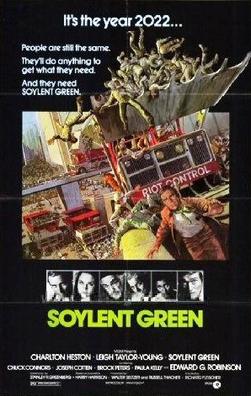
| Taglines What is the secret of Soylent Green? It's the year 2022... People are still the same. They'll do anything to get what they need. And they need SOYLENT GREEN. |
キャッチコピー 『ソイレント・グリーン』の秘密とは? 時は2022年……人間は相変わらずだ。必要なものを手に入れるためなら、何でもする。そして彼らが必要としているのは、ソイレント・グリーンだ。 |
| https://en.wikiquote.org/wiki/Soylent_Green |
|
★
★Make Room! Make Room!(邦訳「人間がいっぱい」)
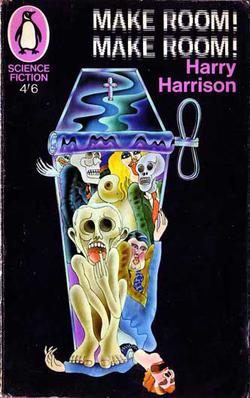

| Make Room! Make Room!
is a 1966 science fiction novel written by Harry Harrison exploring the
consequences of both unchecked population growth on society and the
hoarding of resources by a wealthy minority.[1] It was originally
serialized in Impulse magazine. Set in 1999 from August until moments after New Year's Eve ends and the year 2000 begins, the novel explores trends in the proportion of world resources used by the United States and other countries compared to population growth, depicting a world where the global population is seven billion people, plagued with overcrowding, resource shortages and a crumbling infrastructure. The plot jumps from character to character, recounting the lives of people in various walks of life in New York City, population 35 million.[a] The novel was the basis of the 1973 science fiction film Soylent Green, although the film changed much of the plot and theme and introduced cannibalism as a solution to feeding people.[2] |
『Make Room! Make Room!』は、ハリー・ハリソンが1966年に執筆したSF小説であり、抑制されない人口増加が社会にもたらす影響と、富裕な少数派による資源の独占という両方の問題を扱っている[1]。当初は雑誌『インパルス』に連載された。 1999年8月から大晦日の終わり、そして2000年が始まる直後までの期間を舞台に、この小説は人口増加と比較した米国やその他の国々による世界資源の 消費比率の推移を探求し、世界人口が70億人に達し、過密状態、資源不足、そして老朽化したインフラに悩まされる世界を描いている。物語は登場人物から登 場人物へと移り変わり、人口3500万人のニューヨーク市で、様々な立場の人々の生活を描いている。[a] この小説は1973年のSF映画『ソイレント・グリーン』の原作となったが、映画ではプロットやテーマの多くが変更され、人々の食料問題の解決策として人食いが導入された。[2] |
| Plot summary Make Room! Make Room! is set in an overpopulated New York City in 1999 (33 years after the time of first publication). Thirty-year-old Police Detective Andy Rusch lives in half a room, sharing it with Sol, a retired engineer who has adapted a bicycle to generate power for an old television set and a refrigerator. When Andy lines up for their continually reducing water ration, he witnesses a public speech by the "Elders", older people forcibly retired from work. A riot breaks out after a nearby food shop has a surprise sale on "soylent" (soy and lentil) steaks. The shop is looted by the mob. Billy Chung, an 18-year-old Taiwanese-American, grabs a box of steaks. He eats some of them and sells the rest to raise enough money to land a job as a Western Union messenger boy. His first delivery takes him into a fortified apartment block, complete with the rare luxuries of air conditioning and running water for showers. He delivers his message to a rich racketeer named "Big Mike" O'Brien and sees Shirl, Mike's 23-year-old live-in mistress. Billy leaves the apartment but fixes it so he can get back into the building later. He breaks into Mike's place, but when Mike catches him in the act, Billy accidentally kills him and flees, empty-handed. A piece of evidence may connect an out-of-town crime boss who may be trying to expand into New York City, a threat to Mike's associates. They see to it that Andy keeps working on the case, in addition to his regular duties. During his investigation, Andy becomes enamored of Shirl. He ensures that she is permitted to stay in the apartment until the end of the month. During this month, they enjoy the luxuries. Afterwards, Shirl moves in with Andy. Shirl soon becomes disappointed with how little time the overworked Andy has for her. She eventually sleeps with a wealthy man she meets at a party. To evade capture, Billy leaves the city, eventually breaking into the abandoned Brooklyn Navy Yard, where he comes to live with Peter, who is eagerly awaiting the new millennium as the end of the world. Soon they are attacked and displaced by a trio. They find a new home in a car. Months after the murder, Billy decides to visit his family, believing the police have lost interest in him. Meanwhile, Sol decides he can no longer remain passive in the face of humanity's overpopulation crisis. He joins a march to protest the overturning of a legislative bill that supports population control. Sol is injured in a riot and catches pneumonia. A few days after his death, an obnoxious family takes over his living quarters, making Shirl and Andy's life much more miserable than before. Andy stumbles upon Billy Chung, cornering him in his family's home. When Billy moves to attack Andy with a knife, he stumbles, and Andy accidentally shoots and kills him. The gangsters have lost interest by this point, but his superiors disavow Andy's actions, and he is temporarily demoted to ordinary patrolman. When he returns to his quarters, he finds Shirl has left him. Andy is on patrol in Times Square on New Year's Eve, where he spots Shirl among rich party-goers. As the clock strikes midnight, Andy encounters Peter, who is distraught that the world has not ended and asks how life can continue as it is. The story concludes with the Times Square screen announcing that "Census says United States had biggest year ever, end-of-the-century, 344 million citizens." |
あらすじ 『Make Room! Make Room!』の舞台は、1999年の過密状態にあるニューヨーク市だ(初版発行から33年後)。30歳の警察刑事アンディ・ラッシュは、半部屋ほどの住居 で、引退したエンジニアのソルと共同生活を送っている。ソルは自転車を改造し、その発電で古いテレビと冷蔵庫を動かしている。 アンディが、ますます減り続ける水の配給を受けるために列に並んでいると、強制的に仕事を引退させられた高齢者たちによる「長老たち」の演説を目撃する。 近くの食料品店で「ソイレント」(大豆とレンズ豆)ステーキの突発的なセールが行われた後、暴動が発生する。店は暴徒によって略奪される。18歳の台湾系 アメリカ人、ビリー・チョンはステーキの箱を手に取る。彼はその一部を食べ、残りを売って得た金で、ウェスタンユニオンの配達少年としての仕事を手に入れ る。最初の配達先で、彼は要塞のようなマンションに入る。そこには、エアコンやシャワー用の水道といった、今では珍しい贅沢な設備が整っていた。彼は 「ビッグ・マイク」・オブライエンという名の金持ちの暴力団員に伝言を届け、マイクの23歳の同棲愛人、シャールを見る。ビリーはアパートを後にしたが、 後で建物に戻れるよう仕掛けを施しておいた。彼はマイクの部屋に侵入したが、現場をマイクに見つかり、誤って彼を殺して何も持たずに逃げ出した。 ある証拠品が、ニューヨーク市への進出を図っているかもしれない地方の犯罪組織のボスと結びつく可能性がある。それはマイクの仲間たちにとって脅威となる。彼らは、アンディが通常の職務に加え、この事件の捜査を続けられるよう手配する。 捜査の過程で、アンディはシャールに心を奪われる。彼は、シャールが月末までそのアパートに滞在できるよう手配する。その一ヶ月間、二人は贅沢な暮らしを 楽しむ。その後、シャールはアンディと同居を始める。しかし、過労のアンディが自分に割く時間がほとんどないことに、シャールはすぐに失望する。彼女は最 終的に、パーティーで出会った金持ちの男と関係を持つ。 逮捕を逃れるため、ビリーは街を離れ、やがて廃墟となったブルックリン海軍工廠に侵入し、そこでピーターと共に暮らすようになる。ピーターは新千年紀を世 界の終わりと待ちわびていた。やがて彼らは3人組に襲われ、追い出される。二人は車の中で新たな住まいを見つける。殺人から数ヶ月後、ビリーは警察が自分 への関心を失ったと信じ、家族を訪ねることにする。 一方、ソルは人類の過密化危機に対し、もはや傍観しているわけにはいかないと決意する。彼は人口抑制を支持する法案の廃案に抗議するデモ行進に参加する。 ソルは暴動で負傷し、肺炎を患う。彼の死から数日後、嫌味な一家が彼の住居を占拠し、シャールとアンディの生活は以前よりもはるかに悲惨なものとなる。 アンディはビリー・チョンに偶然出くわし、実家で彼を追い詰める。ビリーがナイフでアンディを襲おうとした際、足元をすくわれ、アンディは誤って彼を撃ち 殺してしまう。この時点でギャングたちは関心を失っていたが、上司たちはアンディの行動を不承認とし、彼は一時的に普通の巡査に降格される。宿舎に戻る と、シャールが彼のもとを去っていたことに気づく。 大晦日、タイムズスクエアでパトロール中のアンディは、裕福なパーティー客の中にいるシャールを見つける。時計が真夜中を告げる頃、アンディはピーターと 出会う。ピーターは世界が終わらなかったことに落胆し、このまま人生が続いていくのかと問いかける。物語は、タイムズスクエアのスクリーンに「国勢調査に よると、米国は史上最大の年を迎えた。世紀末時点で、国民数は3億4400万人」と表示される場面で幕を閉じる。 |
| Concept and creation Author Harry Harrison claimed, "The idea came from an Indian I met after the war, in 1946. He told me, 'Overpopulation is the big problem coming up in the world' (nobody had ever heard of it in those days) and he said, 'Want to make a lot of money, Harry? You have to import rubber contraceptives to India.' I didn't mind making money, but I didn't want to be the rubber king of India!"[3] |
構想と創作 著者のハリー・ハリソンは次のように述べている。「そのアイデアは、戦後の1946年に出会ったあるインド人から得たものだ。彼は私に『人口過密は、世界 が直面しようとしている大きな問題だ』(当時は誰もそんな話を聞いたことがなかった)と言い、さらに『ハリー、大金を稼ぎたいか?『インドにゴム製の避妊 具を輸入すればいいんだ』と。金を稼ぐこと自体は構わなかったが、インドの『ゴムの王様』になる気はなかった!」[3] |
| Short story Several years after writing the novel, Harrison created the short story "Roommates" (1971), largely by joining excerpts from the novel. Harrison describes the impetus and creation of the short story in his introduction for it in The Best of Harry Harrison. He recounts how he was asked for an excerpt for reprinting, but that he did not think any simple excerpt stood alone. So he took various scenes from the "roommates" plot strand and combined them into the short story. |
短編小説 小説を執筆してから数年後、ハリソンは主にその小説からの抜粋を組み合わせることで、短編小説『ルームメイト』(1971年)を執筆した。ハリソンは 『The Best of Harry Harrison』に収録された同短編の序文の中で、その執筆のきっかけと制作過程について述べている。彼は、再刊用に抜粋を依頼されたものの、単なる抜 粋だけでは独立した作品として成立しないと考えていたと回想している。そこで彼は、「ルームメイツ」というプロットラインから様々な場面を取り出し、それ らを組み合わせてこの短編小説を完成させた。 |
| References 1. Netzley, Patricia (1999). Environmental Literature. California: ABC-CLIO. ISBN 1-57607-000-X. 2. Westfahl, Gary (2005), The Greenwood Encyclopedia of Science Fiction and Fantasy: Themes, Works and Wonders, Greenwood Publishing, p. 575, ISBN 978-0-313-32952-4 3. "Harry Harrison: When the World Was Young", Locus Magazine, March 2006 |
参考文献 1. ネッツリー、パトリシア(1999)。『環境文学』。カリフォルニア:ABC-CLIO。ISBN 1-57607-000-X。 2. ウェストファール、ゲイリー(2005年)『グリーンウッドSF・ファンタジー百科事典:テーマ、作品、そして驚異』グリーンウッド出版、575頁、ISBN 978-0-313-32952-4 3. 「ハリー・ハリソン:世界が若かった頃」、『ロカス・マガジン』、2006年3月号 |
| Footnotes a.Note that while none of the population predictions in the book came true by 2000, two out of the three were satisfied (in the real world) by the year 2025: the world human population surpassed 7 billion in the year 2010, and the United States population was over 345 million in 2025; in contrast, the population of New York City remained less than 10 million as of the end of 2025 (the entire surrounding metropolitan area had an estimated population below 20 million, as recently as 2022). |
脚注 a. 本書における人口予測は2000年までにいずれも的中しなかったが、3つのうち2つは(現実世界において)2025年までに実現したことに留意すべきであ る。すなわち、世界人口は2010年に70億人を突破し、米国の人口は2025年に3億4500万人を超えた。対照的に、ニューヨーク市の人口は2025 年末時点で1000万人未満にとどまった(周辺の都市圏全体でも、2022年時点の推計人口は2000万人未満であった)。 |
| Make Room! Make Room! title listing at the Internet Speculative Fiction Database Roommates title listing at the Internet Speculative Fiction Database Make Room! Make Room! |
『Make Room! Make Room!』の作品リスト(インターネット・スペキュレイティブ・フィクション・データベース) 『Roommates』の作品リスト(インターネット・スペキュレイティブ・フィクション・データベース) 『Make Room! Make Room!』 |
| https://en.wikipedia.org/wiki/Make_Room!_Make_Room! |
|
★
★成長の限界(LTG)とは、資源の供給が有限 である中で、指数関数的な経済成長、人口増加をコンピューターシミュレーションによって研究した1972年の報告書である。この研究は、地球と人間のシス テムの相互作用の結果をシミュレートするためにWorld3コンピューターモデルを使用した。このモデルは、MITのジェイ・フォレスターの著書『ワール ド・ダイナミクス』に記載されている研究に基づいている。 ローマクラブの依頼で、1971年夏にモスクワとリオデジャネイロで開催された国際会議で、この研究結果が初めて発表された。 報告書の著者は、ドネラ・H・メドウズ、デニス・L・メドウズ、ヨルゲン・ランダース、ウィリアム・W・ベーレンス3世で、17人の研究者からなるチーム を代表している。 この報告書では、資源消費に大きな変化がない限り、「最も起こりうる結果は、人口と産業能力の両方がかなり急激に、制御不能に減少することであろう」と結 論づけている。発表当時はその手法や前提に大きな疑問が呈されたが、その後の検証の結果、1972年以降も予測の本質を大きく変えるほどの変化は見られな いことが確認され続けている。 出版以来、この本は30カ国語で約3000万部が購入された。この本は今も議論を呼び起こし続け、その後もいくつかの出版物の題材となっている。 『限界を越えて』『成長の限界』(原題:The Limits to Growth: 1992年と2004年にはそれぞれ『Beyond the Limits』と『The Limits to Growth: The 30-Year Update』が出版され[8][9]、2012年にはこの本の原著者の一人であるヨルゲン・ランダースによる40年予測が『2052:A Global Forecast for the Next Forty Years』として出版され、2022年には『Limits and Beyond』に他の19名が参加し、原著者の二人、デニスメドウスとヨルゲン・ランダースはこの本を出版している。

| general description |
The Limits
to Growth (LTG) is
a 1972 report on the exponential economic and population growth with a
finite supply of resources, studied by computer simulation. The study
used the World3 computer model to simulate the consequence of
interactions between the earth and human systems. The model was based
on the work of Jay Forrester of MIT as described in his book World
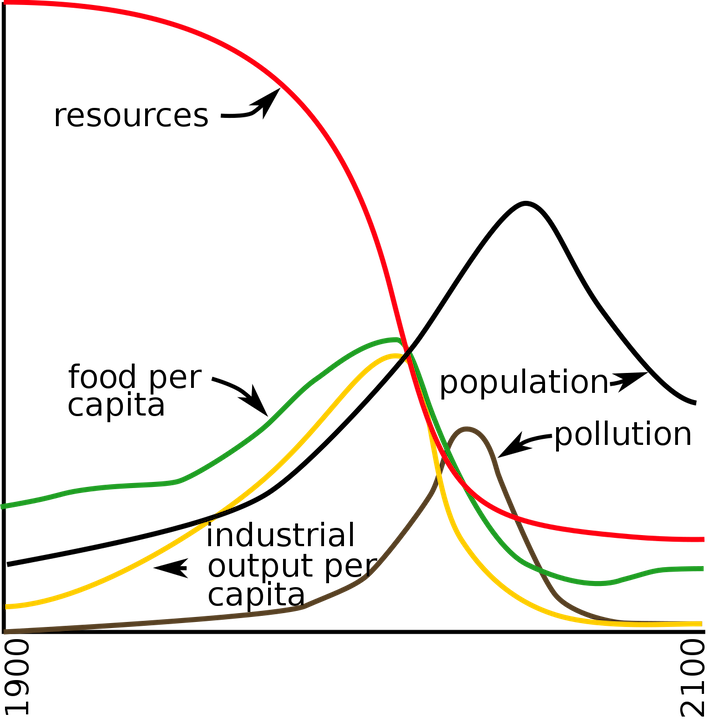
Dynamics. Commissioned by the Club of Rome, the findings of the study were first presented at international gatherings in Moscow and Rio de Janeiro in the summer of 1971. The report's authors are Donella H. Meadows, Dennis L. Meadows, Jørgen Randers, and William W. Behrens III, representing a team of 17 researchers. The report concludes that, without substantial changes in resource consumption, "the most probable result will be a rather sudden and uncontrollable decline in both population and industrial capacity". Although its methods and premises were heavily challenged on its publication, subsequent work to validate its forecasts continue to confirm that insufficient changes have been made since 1972 to significantly alter their nature. Since its publication, some 30 million copies of the book in 30 languages have been purchased.s It continues to generate debate and has been the subject of several subsequent publications. Beyond the Limits and The Limits to Growth: The 30-Year Update were published in 1992 and 2004 respectively,[8][9] in 2012, a 40-year forecast from Jørgen Randers, one of the book's original authors, was published as 2052: A Global Forecast for the Next Forty Years,and in 2022 two of the original Limits to Growth authors, Dennis Meadows and Jorgen Randers, joined 19 other contributors to produce Limits and Beyond. |
成長の限界(LTG)とは、資源の供給が有限である中で、指数関数的な
経済成長、人口増加をコンピューターシミュレーションによって研究した1972年の報告書である。この研究は、地球と人間のシステムの相互作用の結果をシ
ミュレートするためにWorld3コンピューターモデルを使用した。このモデルは、MITのジェイ・フォレスターの著書『ワールド・ダイナミクス』に記載
されている研究に基づいている。 ローマクラブの依頼で、1971年夏にモスクワとリオデジャネイロで開催された国際会議で、この研究結果が初めて発表された。 報告書の著者は、ドネラ・H・メドウズ、デニス・L・メドウズ、ヨルゲン・ランダース、ウィリアム・W・ベーレンス3世で、17人の研究者からなるチーム を代表している。 この報告書では、資源消費に大きな変化がない限り、「最も起こりうる結果は、人口と産業能力の両方がかなり急激に、制御不能に減少することであろう」と結 論づけている。発表当時はその手法や前提に大きな疑問が呈されたが、その後の検証の結果、1972年以降も予測の本質を大きく変えるほどの変化は見られな いことが確認され続けている。 出版以来、この本は30カ国語で約3000万部が購入された。この本は今も議論を呼び起こし続け、その後もいくつかの出版物の題材となっている。 『限界を越えて』『成長の限界』(原題:The Limits to Growth: 1992年と2004年にはそれぞれ『Beyond the Limits』と『The Limits to Growth: The 30-Year Update』が出版され[8][9]、2012年にはこの本の原著者の一人であるヨルゲン・ランダースによる40年予測が『2052:A Global Forecast for the Next Forty Years』として出版され、2022年には『Limits and Beyond』に他の19名が参加し、原著者の二人、デニスメドウスとヨルゲン・ランダースはこの本を出版している。 |
| Purpose |
In commissioning the MIT team to
undertake the project that resulted in LTG, the Club of Rome had three
objectives; 1. Gain insights into the limits of our world system and the constraints it puts on human numbers and activity. 2. Identify and study the dominant elements, and their interactions, that influence the long-term behavior of world systems. 3. To warn of the likely outcome of contemporary economic and industrial policies, with a view to influencing changes to a sustainable life-style. |
LTGを実現するプロジェクトをMITのチームに依頼するにあたり、
ローマクラブは次の3つの目的を掲げていた。 1.世界システムの限界と、それが人間の数と活動に与える制約について洞察すること。 2. 世界システムの長期的な挙動に影響を与える支配的な要素とその相互作用を特定し、研究する。 3. 持続可能なライフスタイルへの変化を促すために、現代の経済・産業政策がもたらすであろう結果を警告する。 |
| Methodology |
The World3 model is based on
five variables: "population, food production, industrialization,
pollution, and consumption of nonrenewable natural resources". At the
time of the study, all these variables were increasing and were assumed
to continue to grow exponentially, while the ability of technology to
increase resources grew only linearly. The authors intended to explore
the possibility of a sustainable feedback pattern that would be
achieved by altering growth trends among the five variables under three
scenarios. They noted that their projections for the values of the
variables in each scenario were predictions "only in the most limited
sense of the word", and were only indications of the system's
behavioral tendencies. Two of the scenarios saw "overshoot and
collapse" of the global system by the mid- to latter-part of the 21st
century, while a third scenario resulted in a "stabilized world". |
World3モデルは、5つの変数に基づいている。"人口、食糧生産、
工業化、汚染、再生不可能な天然資源の消費
"である。研究当時、これらの変数はすべて増加しており、今後も指数関数的に増加すると想定されていたが、一方で、資源を増加させる技術の能力は直線的に
しか増加しなかった。著者らは、3つのシナリオのもと、5つの変数の成長傾向を変化させることで、持続可能なフィードバックパターンの可能性を探ることを
意図している。彼らは、各シナリオにおける変数の値の予測は、「最も限定的な意味での予測」であり、システムの行動傾向を示すものに過ぎないことを指摘し
た。その結果、2つのシナリオでは21世紀半ばから後半にかけて地球システムが「オーバーシュートと崩壊」し、3つ目のシナリオでは「安定化した世界」が
到来することが示された。 |
| Exponential reserve index |
A key idea in The Limits to
Growth is the notion that if the rate of resource use is increasing,
the amount of reserves cannot be calculated by simply taking the
current known reserves and dividing by the current yearly usage, as is
typically done to obtain a static index. For example, in 1972, the
amount of chromium reserves was 775 million metric tons, of which 1.85
million metric tons were mined annually. The static index is
775/1.85=418 years, but the rate of chromium consumption was growing at
2.6 percent annually, or exponentially. If instead of assuming a
constant rate of usage, the assumption of a constant rate of growth of
2.6 percent annually is made, the resource will instead last (formula) In general, the formula for calculating the amount of time left for a resource with constant consumption growth is: (formula) where: y = years left; r = the continuous compounding growth rate; s = R/C or static reserve; R = reserve; C = (annual) consumption. |
成長の限界』の重要な考え方は、資源の使用量が増加している場合、一般
的に静的な指標を得るために行われるように、現在知られている埋蔵量を現在の年間使用量で割るだけでは埋蔵量を算出することはできないという考え方であ
る。例えば、1972年のクロムの埋蔵量は775百万トンであり、そのうち年間採掘量は185万トンであった。静的指数は775/1.85=418年であ
るが、クロムの消費速度は年率2.6%、すなわち指数関数的に増加していた。使用率が一定と仮定する代わりに、年率2.6パーセントの成長率と仮定する
と、資源はかえって長持ちすることになる (計算式)  一般に、消費量の伸びが一定である資源の残り時間を計算する式は次のとおりである。 (式) 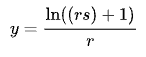 ここで y = 残りの年数 r = 連続的な複合成長率 s = R/Cまたは静的予備量。 R = 積立金。 C = (年間)消費量。 |
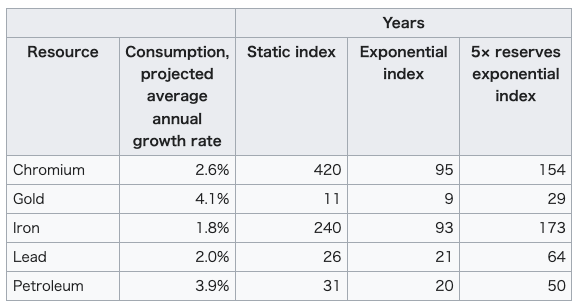
| Commodity reserve extrapolation |
The chapter contains a large
table that spans five pages in total, based on actual geological
reserves data for total 19 non-renewable resources and analyzes their
reserves at 1972 modeling time of their exhaustion under three
scenarios: static (constant growth), exponential and exponential with
reserves multiplied by 5 to account for possible discoveries. A short
excerpt from the table is presented below: |
この章では、19種類の非再生可能資源について、実際の地質埋蔵量デー
タをもとに、静的(一定成長)、指数的、発見可能性を考慮して埋蔵量を5倍した指数的の3つのシナリオで、1972年の枯渇時のモデリングを行い、合計5
ページにわたる大きな表で分析を行っている。以下、表からの抜粋を紹介する。 |
 |
||
| The chapter also contains a
detailed computer model of chromium availability with current (as of
1972) and double the known reserves as well as numerous statements on
the current increasing price trends for discussed metals: Given present resources consumption rates and the projected increase in the rates, the great majority of the currently important nonrenewable resources will be extremely costly 100 years from now. (...) The prices of those resources with the shortest static reserve indices have already begun to increase. The price of mercury, for example, has gone up 500 percent in the last 20 years; the price of lead has increased 300 percent in the last 30 years. — Chapter 2, page 66 Due to the detailed nature and use of actual reserves of actual resources and their real-world price trends, the indexes have been interpreted as a prediction of the number of years until the world would "run out" of them, both by environmentalist groups calling for greater conservation and restrictions on use, and by skeptics criticizing the predictions accuracy. This interpretation has been widely propagated by media and environmental organizations, and authors who, apart from a note about the possibility of the future flows being "more complicated", did not clearly constrain or deny this interpretation. While environmental organizations used it to support their arguments, a number of economists used it to criticize LTG as a whole shortly after publication in the 1970s (Peter Passel, Marc Roberts, and Leonard Ross), with similar criticism reoccurring from Ronald Baily, George Goodman and others in the 1990s. In 2011 Ugo Bardi in "The Limits to Growth Revisited" argued that "nowhere in the book was it stated that the numbers were supposed to be read as predictions", nonetheless as they were the only tangible numbers referring to actual resources, they were promptly picked as such by both supporters as well as opponents. While Chapter 2 serves as an introduction to the concept of exponential growth modeling, the actual World3 model uses an abstract "non-renewable resources" component based on static coefficients rather than actual physical commodities described above. |
また、この章では、現在(1972年現在)と2倍の既知の埋蔵量を持つ
クロムの利用可能性に関する詳細なコンピュータモデルや、議論されている金属の現在の価格上昇傾向に関する多数の記述も含まれている。 現在の資源消費率とその増加予測を考えると、現在重要な非再生可能資源の大部分は、100年後には非常に高価になる。(中略)最も静的な埋蔵量指数が短い 資源の価格は、すでに上昇を始めている。例えば、水銀の価格は過去20年間で500%上昇し、鉛の価格は過去30年間で300%上昇している。 - 第2章 66ページ 実際の資源の埋蔵量とその現実の価格推移を詳細に記述しているため、この指標は、世界が「使い果たす」までの年数を予測したものと解釈され、環境保護や使 用制限の強化を求める団体や、予測精度を批判する懐疑論者の両方から、そのような解釈がなされてきたのである。この解釈は、メディアや環境団体によって広 く伝播され、著者も、将来の流れが「より複雑」になる可能性についての注釈を除けば、この解釈を明確に制約したり否定したりすることはなかった。環境保護 団体が自分たちの主張の裏付けに使う一方で、1970年代の出版直後には多くの経済学者がこの解釈を用いてLTG全体を批判し(Peter Passel, Marc Roberts, Leonard Ross)、1990年代にはRonald Baily, George Goodmanらから同様の批判が繰り返されるようになった。2011年にはウーゴ・バルディが "The Limits to Growth Revisited "で「この本のどこにも、この数字が予測として読まれるべきものだとは書かれていない」と主張したが、実際の資源に言及した唯一の具体的な数字であったた め、支持者と反対者の双方からすぐにそのように取り上げられることになった。 第2章は指数関数的成長モデルの概念を紹介するものであるが、実際のWorld3モデルでは、上記のような実際の物理的商品ではなく、静的係数に基づく抽 象的な「非再生可能資源」コンポーネントが使用されている。 |
|
| Conclusions |
After reviewing their computer
simulations, the research team came to the following conclusions: If the present growth trends in world population, industrialization, pollution, food production, and resource depletion continue unchanged, the limits to growth on this planet will be reached sometime within the next one hundred years. The most probable result will be a rather sudden and uncontrollable decline in both population and industrial capacity. It is possible to alter these growth trends and to establish a condition of ecological and economic stability that is sustainable far into the future. The state of global equilibrium could be designed so that the basic material needs of each person on earth are satisfied and each person has an equal opportunity to realize his individual human potential. If the world's people decide to strive for this second outcome rather than the first, the sooner they begin working to attain it, the greater will be their chances of success. — Limits to Growth, Introduction The introduction goes on to say: These conclusions are so far-reaching and raise so many questions for further study that we are quite frankly overwhelmed by the enormity of the job that must be done. We hope that this book will serve to interest other people, in many fields of study and in many countries of the world, to raise the space and time horizons of their concerns and to join us in understanding and preparing for a period of great transition-the transition from growth to global equilibrium. |
コンピュータ・シミュレーションの結果、研究チームは次のような結論に
達した。 世界人口、工業化、汚染、食糧生産、資源枯渇の現在の増加傾向が変わらなければ、今後100年以内にこの惑星の成長の限界に達するだろう。その結果、人口 と工業生産力の両方が突然、制御不能なまでに減少する可能性が最も高い。 しかし、このような成長の傾向を変え、将来にわたって持続可能な生態系と経済の安定した状態を確立することは可能である。地球上の一人ひとりの基本的な物 質的ニーズが満たされ、一人ひとりが人間の潜在能力を発揮する機会を平等に得られるような、地球規模の平衡状態を設計することができる。 もし世界の人々が、第一の結果ではなく、この第二の結果を目指すと決めたなら、それを達成するための努力を早く始めれば始めるほど、成功の可能性は高くな る。 - 成長の限界」序文 序文にはこう続く。 これらの結論はあまりにも広範囲に及び、さらなる研究を必要とする多くの問題を提起しているため、我々は率直に言って、なすべき仕事の重大さに圧倒されて いる。本書が、世界のさまざまな分野の、さまざまな国の、さまざまな人々の関心を引きつけ、関心事の空間と時間の地平を広げ、成長から世界均衡への大転換 期を理解し準備するために、われわれと手を携えてくれることを願っている。 |
| Criticism |
LTG provoked a wide range of
responses, including immediate criticisms almost as soon as it was
published. Peter Passell and two co-authors published a 2 April 1972 article in the New York Times describing LTG as "an empty and misleading work ... best summarized ... as a rediscovery of the oldest maxim of computer science: Garbage In, Garbage Out". Passell found the study's simulation to be simplistic, while assigning little value to the role of technological progress in solving the problems of resource depletion, pollution, and food production. They charged that all LTG simulations ended in collapse, predicted the imminent end of irreplaceable resources. Passell also charged that the entire endeavour was motivated by a hidden agenda: to halt growth in its tracks. In 1973, a group of researchers at the Science Policy Research Unit at the University of Sussex concluded that simulations in Limits to Growth were very sensitive to a few key assumptions and suggest that the MIT assumptions were unduly pessimistic, and the MIT methodology, data, and projections were faulty. However, the LTG team, in a paper entitled "A Response to Sussex", described and analyzed five major areas of disagreement between themselves and the Sussex authors. The team asserted that the Sussex critics applied "micro reasoning to macro problems", and suggested that their own arguments had been either misunderstood or wilfully misrepresented. They pointed out that the critics had failed to suggest any alternative model for the interaction of growth processes and resource availability, and "nor had they described in precise terms the sort of social change and technological advances that they believe would accommodate current growth processes." At the time, "the very hint of any global limitation as suggested in the report [...] was met with disbelief and rejection by businesses and most economists." Critics declared that history proved the projections to be incorrect, such as the predicted resource depletion and associated economic collapse by the end of the 20th century. The methodology, the computer, the conclusions, the rhetoric and the people behind the project were criticised. Yale economist Henry C. Wallich agreed that growth could not continue indefinitely, but that a natural end to growth was preferable to intervention. Wallich stated that technology could solve all the problems the report was concerned about, but only if growth continued apace. By stopping growth too soon, Wallich warned, the world would be "consigning billions to permanent poverty". Julian Simon, a professor at the Universities of Illinois and, later, Maryland, argued that the fundamental underlying concepts of the LTG scenarios were faulty, because the very idea of what constitutes a "resource" varies over time. For instance, wood was the primary shipbuilding resource until the 1800s, and there were concerns about prospective wood shortages from the 1500s on. But then boats began to be made of iron, later steel, and the shortage issue disappeared. Simon argued in his book The Ultimate Resource that human ingenuity creates new resources as required from the raw materials of the universe. For instance, copper will never "run out". History demonstrates that as it becomes scarcer its price will rise and more will be found, more will be recycled, new techniques will use less of it, and at some point a better substitute will be found for it altogether. His book was revised and reissued in 1996 as The Ultimate Resource 2. To the US Congress in 1973, Allen V. Kneese and Ronald Riker of Resources for the Future (RFF) testified that in their view, "The authors load their case by letting some things grow exponentially and others not. Population, capital and pollution grow exponentially in all models, but technologies for expanding resources and controlling pollution are permitted to grow, if at all, only in discrete increments." However, their testimony also noted the possibility of "relatively firm long-term limits" associated with carbon dioxide emissions, that humanity might "loose upon itself, or the ecosystem services on which it depends, a disastrously virulent substance", and (implying that population growth in "developing countries" is problematic) that "we don't know what to do about it". In 1997, the Italian economist Giorgio Nebbia observed that the negative reaction to the LTG study came from at least four sources: those who saw the book as a threat to their business or industry; professional economists, who saw LTG as an uncredentialed encroachment on their professional perquisites; the Catholic church, which bridled at the suggestion that overpopulation was one of mankind's major problems; finally, the political left, which saw the LTG study as a scam by the elites designed to trick workers into believing that a proletarian paradise was a pipe dream. |
LTGは様々な反響を呼び、出版されるや否やすぐに批判が起こった。 Peter Passellと2人の共著者は1972年4月2日付のNew York Times紙で、LTGを「空虚で誤解を招く作品......コンピュータサイエンスの最も古い格言を再発見したものとして最もよく要約される」と評する 記事を発表しました。ゴミのデータを計算機にインプットするとゴミの結果が出てくる」。Passellは、この研究のシミュレーションが単純化されている 一方で、資源の枯渇、汚染、食糧生産などの問題を解決するための技術進歩の役割にほとんど価値を与えていないことを見出した。彼らは、LTGのシミュレー ションはすべて崩壊に終わり、かけがえのない資源の終焉が差し迫っていることを予言していると告発した。また、パッセルは、この試みには、成長を軌道から 外すという隠された意図があるとも指摘した。 1973年、サセックス大学科学政策研究ユニットの研究者グループは、『成長の限界』のシミュレーションはいくつかの重要な仮定に非常に敏感であり、 MITの仮定は不当に悲観的であり、MITの手法、データ、予測に欠陥があったことを示唆していると結論づけた。しかし、LTGチームは「サセックスへの 反論」と題する論文で、自分たちとサセックスの著者たちとの間の意見の相違を5つの主要な領域で説明し、分析した。チームは、サセックスの批評家たちが 「マクロな問題にミクロな推論」を適用していると主張し、彼ら自身の議論が誤解されているか、故意に誤った表現をしていると示唆した。彼らは、成長プロセ スと資源利用可能性の相互作用について、代替モデルを提案することができず、「また、彼らが現在の成長プロセスに適合すると考える社会変化や技術進歩の種 類を正確な言葉で説明していない」と指摘している。 当時、「報告書で示唆されたような世界的な制限の暗示は、企業やほとんどの経済学者から不信と拒絶の目で見られた」のである。批評家たちは、20世紀末ま でに資源枯渇とそれに伴う経済崩壊が予測されるなど、予測が誤っていることは歴史が証明していると断じた。方法論、コンピュータ、結論、レトリック、そし てこのプロジェクトの背後にいる人々は批判された。 エール大学の経済学者ヘンリー・C・ウォリックは、成長は無限に続くわけではないが、介入するよりも自然に終わる方が望ましいという意見に同意した。しか し、このまま成長を続けるのであれば、テクノロジーによって、報告書が懸念しているような問題はすべて解決できる。しかし、それは成長が続けばの話であ る。成長を早急に止めることは、「何十億もの人々を永久に貧困に追いやることになる」とウォリック氏は警告した。 イリノイ大学、後にメリーランド大学のジュリアン・サイモン教授は、LTGシナリオの基本概念に誤りがあると主張した。例えば、1800年代まで造船の主 要資源は木材であり、1500年代から木材不足の懸念があった。しかし、その後、船は鉄、後に鋼鉄で作られるようになり、不足の問題はなくなりました。サ イモンは、著書『究極の資源』の中で、人間の創意工夫が宇宙の原材料から必要に応じて新しい資源を生み出すと主張している。例えば、銅は決して「無くな る」ことはない。歴史が証明しているように、銅が不足すればするほど、その価格は上がり、より多くの銅が発見され、リサイクルされ、新しい技術がより少な い銅しか使わなくなり、ある時点で、銅に代わるより良いものが完全に発見されることになる。この本は、1996年に「究極の資源2」として改訂・再版され た。 1973年、米国議会で、Resources for the Future(RFF)のAllen V. KneeseとRonald Rikerは、彼らの見解として「著者はあるものを指数関数的に成長させ、あるものをさせないことによって、そのケースに負荷を与えている」と証言してい る。人口、資本、汚染はどのモデルでも指数関数的に成長するが、資源を拡大し汚染をコントロールする技術は、成長するとすれば、離散的な増分だけしか許さ れない」。しかし、彼らの証言は、二酸化炭素の排出に関連した「比較的強固な長期的限界」の可能性や、人類が「自分自身や、それに依存している生態系サー ビスに、悲惨な毒性を持つ物質を放つ」可能性、(「途上国」の人口増加が問題であることを示唆)「我々はそれについて何をすべきかわからない」ことにも言 及している。 1997年、イタリアの経済学者Giorgio Nebbiaは、LTGの研究に対する否定的な反応は、少なくとも4つの原因からきていると観察している。一つは、この本を自分のビジネスや産業に対する 脅威と考えた人たち、もう一つは、LTGを自分たちの職業上の特権に対する無資格の侵害と考えたプロの経済学者たち、もう一つは、人口過剰が人類の主要問 題の一つであるという指摘に躊躇したカトリック教会、最後に、LTG研究をエリートが労働者を騙してプロレタリア天国が夢物語であると思わせようと考えた 政治左派であった。 |
| Positive reviews |
In a 2008 blog post, Ugo Bardi
commented that "Although, by the 1990s LTG had become everyone's
laughing stock, among some the LTG ideas are becoming again popular".
Reading LTG for the first time in 2000, Matthew Simmons concluded his
views on the report by saying, "In hindsight, The Club of Rome turned
out to be right. We simply wasted 30 important years ignoring this
work." Research from the University of Melbourne has found the book's
forecasts are accurate, 40 years on. In 2008 Graham Turner of CSIRO found that the observed historical data from 1970 to 2000 closely match the simulated results of the "standard run" limits of growth model for almost all the outputs reported. "The comparison is well within uncertainty bounds of nearly all the data in terms of both magnitude and the trends over time." Turner also examined a number of reports, particularly by economists, which over the years have purported to discredit the limits-to-growth model. Turner says these reports are flawed, and reflect misunderstandings about the model. Turner reprised these observations in another opinion piece in The Guardian in 2014. Turner used data from the UN to claim that the graphs almost exactly matched the 'Standard Run' from 1972 (i.e. the worst-case scenario, assuming that a 'business as usual' attitude was adopted, and there were no modifications of human behaviour in response to the warnings in the report). Birth rates and death rates were both slightly lower than projected, but these two effects cancelled each other out, leaving the growth in world population almost exactly as forecast. In 2010, Nørgård, Peet and Ragnarsdóttir called the book a "pioneering report", and said that it "has withstood the test of time and, indeed, has only become more relevant." The journalist Christian Parenti, writing in 2012, sees parallels between the reception of LTG and the contemporary global warming controversy, and went on to comment, "That said, The Limits to Growth was a scientifically rigorous and credible warning that was actively rejected by the intellectual watchdogs of powerful economic interests. A similar story is playing out now around climate science." In 2012, John Scales Avery, a member of Nobel Prize (1995) winning group associated with the Pugwash Conferences on Science and World Affairs, supported the basic thesis of LTG by stating, "Although the specific predictions of resource availability in [The] Limits to Growth lacked accuracy, its basic thesis – that unlimited economic growth on a finite planet is impossible – was indisputably correct." |
2008年のブログで、ウーゴ・バルディは「1990年代にはLTGは
みんなの笑いものになっていたが、一部の人の間ではLTGの考え方は再び人気が出てきている」とコメントしている。2000年に初めてLTGを読んだマ
シュー・シモンズは、「今にして思えば、ローマクラブが正しかったことがわかった」と、このレポートに対する見解を結んでいる。我々は、この仕事を無視し
て重要な30年間を無駄にしたに過ぎない" と。メルボルン大学の研究によると、この本の予測は40年たった今でも正確であることがわかった。 2008年、CSIROのグラハム・ターナー氏は、1970年から2000年までの観測された過去のデータが、報告されたほぼすべての出力について、成長 の限界モデルの「標準的な実行」によるシミュレーション結果と密接に一致していることを発見した。"比較は、大きさと時間経過の傾向の両方において、ほぼ すべてのデータの不確実性の範囲内にあります。" ターナーはまた、特に経済学者による、長年にわたって成長限界モデルの信用を落とすとされる多くの報告書を検証した。ターナー氏は、これらの報告書には欠 陥があり、このモデルに対する誤解を反映していると述べている。 ターナーは、2014年にガーディアン紙に掲載された別の意見書でも、こうした見解を繰り返している。ターナーは国連のデータを使って、グラフは1972 年の「スタンダード・ラン」(つまり、「ビジネス・アズ・ユージャル」な姿勢が採用され、報告書の警告に応じた人間の行動の修正がなかったと仮定した最悪 のシナリオ)とほぼ一致すると主張したのだ。出生率、死亡率ともに予測を若干下回ったが、この2つの効果は相殺され、世界人口の増加はほぼ予測通りになっ た。 2010年、Nørgård、Peet、Ragnarsdóttirはこの本を「先駆的な報告書」と呼び、"時の試練に耐え、実際、より適切になってきて いる "と述べている。 ジャーナリストのクリスチャン・パレンティは、2012年に書いた文章で、『成長の限界』の受容と現代の地球温暖化論争との間に類似性を見ており、さら に、「とはいえ、『成長の限界』は科学的に厳密で信頼できる警告だったが、強力な経済利益団体の知的監視役によって積極的に拒否された」とコメントしてい る。同じような話が、今、気候科学をめぐって繰り広げられている」。 2012年、ノーベル賞(1995年)を受賞した「科学と世界情勢に関するパグウォッシュ会議」に関連するグループのメンバーであるジョン・スケールズ・ エイブリーは、「『成長の限界』における資源の利用可能性に関する特定の予測は正確さを欠いていたが、有限な地球における無限の経済成長は不可能だという その基本テーゼは疑いなく正しい 」として、LTGの基本テーゼを支持している。 |
| Updates and symposia |
The Club of Rome has persisted
after The Limits of Growth and has generally provided comprehensive
updates to the book every five years. An independent retrospective on the public debate over The Limits to Growth concluded in 1978 that optimistic attitudes had won out, causing a general loss of momentum in the environmental movement. While summarizing a large number of opposing arguments, the article concluded that "scientific arguments for and against each position ... have, it would seem, played only a small part in the general acceptance of alternative perspectives." In 1989, a symposium was held in Hanover, entitled "Beyond the Limits to Growth: Global Industrial Society, Vision or Nightmare?" and in 1992, Beyond the Limits (BTL) was published as a 20-year update on the original material. It "concluded that two decades of history mainly supported the conclusions we had advanced 20 years earlier. But the 1992 book did offer one major new finding. We suggested in BTL that humanity had already overshot the limits of Earth's support capacity." Limits to Growth: The 30-Year Update was published in 2004. The authors observed that "It is a sad fact that humanity has largely squandered the past 30 years in futile debates and well intentioned, but halfhearted, responses to the global ecological challenge. We do not have another 30 years to dither. Much will have to change if the ongoing overshoot is not to be followed by collapse during the twenty-first century." In 2012, the Smithsonian Institution held a symposium entitled "Perspectives on Limits to Growth". Another symposium was held in the same year by the Volkswagen Foundation, entitled "Already Beyond?" Limits to Growth did not receive an official update in 2012, but one of its coauthors, Jørgen Randers, published a book, 2052: A Global Forecast for the Next Forty Years. |
ローマクラブは『成長の限界』の後も存続し、おおむね5年ごとにこの本
の包括的なアップデートを提供してきた。 成長の限界』をめぐる公の議論を独自に回顧した1978年の論文は、楽観的な態度が勝り、環境保護運動の全般的な勢いが失われたと結論づけている。その記 事は、多くの反対意見を要約しながらも、「それぞれの立場に対する科学的な賛否両論は、代替的な視点が一般に受け入れられる上で、ほんの少ししか役に立っ ていないように思われる」と結論づけている。 1989年、ハノーバーで「成長の限界を超えて」と題するシンポジウムが開かれた。そして1992年、この20年間の成果をまとめた『Beyond the Limits(BTL)』が出版された。この本は、「20年の歴史は、主に20年前に我々が進めた結論を支持するものであると結論づけた。しかし、 1992年に出版された本では、1つの大きな新しい発見があった。私たちはBTLで、人類はすでに地球の支持能力の限界を超えつつあることを示唆した。 成長の限界。30年後のアップデート」が2004年に出版された。著者らは、「人類が過去30年間、地球規模の生態学的課題に対する無益な議論と、善意で はあるが中途半端な対応に費やしてきたことは、悲しい事実である」と観察している。もう30年も逡巡している暇はない。21 世紀中にオーバーシュートが進行し、崩壊に至らないようにするためには、多くのことを変えなければならない。 2012年、スミソニアン協会は「Perspectives on Limits to Growth」と題するシンポジウムを開催した。また、同年にはフォルクスワーゲン財団が "Already Beyond? "と題したシンポジウムを開催している。 成長の限界』は2012年に公式なアップデートを受けなかったが、共著者の一人であるヨルゲン・ランダースは、『2052: A Global Forecast for the Next Forty Years』という本を出版している。 |
| Validation |
In 2008, physicist Graham
Turner[c] at the Commonwealth Scientific and Industrial Research
Organisation (CSIRO) in Australia published a paper called "A
Comparison of 'The Limits to Growth' with Thirty Years of Reality". It
compared the past thirty years of data with the scenarios laid out in
the 1972 book and found that changes in industrial production, food
production, and pollution are all congruent with one of the book's
three scenarios—that of "business as usual". This scenario in Limits
points to economic and societal collapse in the 21st century. In 2010,
Nørgård, Peet, and Ragnarsdóttir called the book a "pioneering report".
They said that, "its approach remains useful and that its conclusions
are still surprisingly valid ... unfortunately the report has been
largely dismissed by critics as a doomsday prophecy that has not held
up to scrutiny." Also in 2008, researcher Peter A. Victor wrote that, even though the Limits team probably underestimated price mechanism's role in adjusting outcomes, their critics have overestimated it. He states that Limits to Growth has had a significant impact on the conception of environmental issues and notes that (in his view) the models in the book were meant to be taken as predictions "only in the most limited sense of the word". In a 2009 article published in American Scientist entitled Revisiting the Limits to Growth After Peak Oil, Hall and Day noted that "the values predicted by the limits-to-growth model and actual data for 2008 are very close."[44] These findings are consistent with the 2008 CSIRO study which concluded: "The analysis shows that 30 years of historical data compares favorably with key features ... [of the Limits to Growth] "standard run" scenario, which results in collapse of the global system midway through the 21st Century." In 2011, Ugo Bardi published a book-length academic study of The Limits to Growth, its methods and historical reception and concluded that "The warnings that we received in 1972 ... are becoming increasingly more worrisome as reality seems to be following closely the curves that the ... scenario had generated." A popular analysis of the accuracy of the report by science writer Richard Heinberg was also published. In 2012, writing in American Scientist, Brian Hayes stated that the model is "more a polemical tool than a scientific instrument". He went on to say that the graphs generated by the computer program should not, as the authors note, be used as predictions. In 2014, Turner concluded that "preparing for a collapsing global system could be even more important than trying to avoid collapse." In 2015, a calibration of the updated World3-03 model using historical data from 1995 to 2012 to better understand the dynamics of today's economic and resource system was undertaken. The results showed that human society has invested more to abate persistent pollution, to increase food productivity and have a more productive service sector however the broad trends within Limits to Growth still held true. In 2016, a report published by the UK Parliament's 'All-Party Parliamentary Group on Limits to Growth' concluded that "there is unsettling evidence that society is still following the 'standard run' of the original study – in which overshoot leads to an eventual collapse of production and living standards". The report also points out that some issues not fully addressed in the original 1972 report, such as climate change, present additional challenges for human development. In 2020, an analysis by Gaya Herrington, then Director of Sustainability Services of KPMG US, was published in Yale University's Journal of Industrial Ecology. The study assessed whether, given key data known in 2020 about factors important for the "Limits to Growth" report, the original report's conclusions are supported. In particular, the 2020 study examined updated quantitative information about ten factors, namely population, fertility rates, mortality rates, industrial output, food production, services, non-renewable resources, persistent pollution, human welfare, and ecological footprint, and concluded that the "Limits to Growth" prediction is essentially correct in that continued economic growth is unsustainable under a "business as usual" model. The study found that current empirical data is broadly consistent with the 1972 projections, and that if major changes to the consumption of resources are not undertaken, economic growth will peak and then rapidly decline by around 2040. |
2008年、オーストラリア連邦科学産業研究機構(CSIRO)の物理
学者グラハム・ターナー[c]は、「『成長の限界』と30年間の現実の比較」という論文を発表しました。この論文では、過去30年間のデータと1972年
の著書で示されたシナリオを比較し、工業生産、食糧生産、汚染の変化が、この本の3つのシナリオのうちの1つである「通常通り」というシナリオに一致して
いることを明らかにしている。このシナリオは、21世紀における経済と社会の崩壊を意味している。2010年、Nørgård、Peet、
Ragnarsdóttirは、この本を「先駆的な報告書」と呼んだ。彼らは、「そのアプローチは依然として有用であり、その結論は今でも驚くほど有効で
ある...残念ながら、この報告書は批判者たちによって、精査に耐えない終末予言として大きく退けられてきた」と述べている。 また、2008年には、研究者のピーター・A・ビクターが、「限界」チームはおそらく価格メカニズムが成果を調整する役割を過小評価していたにもかかわら ず、彼らの批判者はそれを過大評価していると書いています。彼は、『成長の限界』が環境問題の概念に大きな影響を与えたと述べ、(彼の考えでは)この本の モデルは「最も限定された意味での予測」としてとらえるべきものであったと指摘している。 ピークオイル後の成長の限界の再検討と題された2009年のAmerican Scientistに掲載された論文で、ホールとデイは、「成長の限界モデルによって予測された値と2008年の実際のデータは非常に近い」と指摘してい る[44]。これらの発見は、結論を下したCSIROの2008年の研究と一致している。「分析は、30年間の歴史的データが主要な特徴と良好に比較され ることを示す...。このシナリオは21世紀半ばに地球システムの崩壊をもたらすものである[44]。 2011年、ウーゴ・バルディは、『成長の限界』、その手法、歴史的受容についての学術的研究を本として出版し、"1972年に受けた警告は、...現実 が...シナリオが生み出したカーブに忠実に沿っているように見え、ますます心配になる "と結論付けています。 科学ライター、リチャード・ハインバーグによる報告書の正確さについての分析も好評だった。 2012年、アメリカンサイエンティストに寄稿したブライアン・ヘイズは、このモデルは「科学的な道具というより、極論的な道具」だと述べている。さら に、コンピュータ・プログラムが生成したグラフは、著者が指摘するように、予測として使用すべきではないと述べた。 2014年、ターナーは、"崩壊する世界システムに備えることは、崩壊を避けようとすることよりもさらに重要かもしれない "と結論づけた。 2015年、今日の経済・資源システムのダイナミクスをより理解するために、1995年から2012年までの過去のデータを用いて、更新された World3-03モデルのキャリブレーションが行われた。その結果、人類社会は、持続的な汚染の緩和、食料生産性の向上、より生産的なサービス部門を持 つために、より多くの投資を行ったが、「成長の限界」の広範な傾向は依然として真実であることが示された。 2016年、英国議会の「成長の限界に関する議員連盟」が発表した報告書は、「オーバーシュートが最終的に生産と生活水準の崩壊につながるという、当初の 研究の『標準的な走り』を社会が今も続けているという不安な証拠がある」と結論付けています。また、気候変動など、1972年のオリジナルレポートでは十 分に扱われていない問題もあり、人類の発展にとってさらなる課題となっていると指摘している。 2020年、当時KPMG USのサステナビリティ・サービス担当ディレクターだったガヤ・ヘリントンによる分析が、イェール大学の「Journal of Industrial Ecology」に掲載された。この研究では、「成長の限界」報告書の重要な要素について2020年に判明した重要なデータをもとに、当初の報告書の結論 が裏付けられるかどうかを評価した。特に、2020年の研究では、人口、出生率、死亡率、工業生産高、食糧生産、サービス、非再生可能資源、持続的汚染、 人間の福祉、エコロジカルフットプリントの10要素について最新の定量情報を調査し、「通常のビジネス」モデルでは経済成長の継続は維持できないという 「成長の限界」の予測は本質的に正しいという結論を出している。この研究では、現在の実証データは1972年の予測とほぼ一致しており、資源の消費に大き な変更を加えなければ、経済成長は2040年ごろにピークを迎え、その後急速に低下するとした。 |
資源枯渇(この場合は原油)の噂に関し て、グローバル経済に大きな影響を与えたのが石油ショック=1973年の原油危機(1973 oil crisis) である。この経済的パニックとローマクラブによ る報告書『成長の限界』の公刊にはおおいなる関係があるというのが、アカロフとシラーの『アニマルスピリット』所説である。
「1970年代の原油価格上昇は、人口爆発やそれがもたらす商品不足などに関するすさまじいレトリックを伴った。石油危機が10年後に終 わったときには、このレトリックは消えはしないにし//ても、大幅に減った。OPECの生産調整のちょうど18ヵ月前、マサチューセッツ工科大学の研究者 チームが、ジェイ・フォレスター(Jay Wright Forrester, 1918-2016)の指導下で警鐘的な報告を発表した。フォレスターは20年ほど前に、初の普及型大型コンピュータであるIBM650の磁気 メモリシステムを設計したコンピュータ科学者として有名だった。かれの報告は、世界の天然資源が枯渇しつつあると結論づけていた。
この研究は『成長の限界:人類の命運に関するローマクラブのプロジェクト報告』と題されており、世界的に壊滅的な経済問題が訪れると予測 していた。あるシナリオだと21世紀末には、世界人口の四分の一から半分が死ぬ。天然資源のすさまじい不足で資源価格が高騰するため、やがて「死亡率は食 料と保健サービスの不足により上昇する」。批判者たちは、この報告の前提が怪しいと論じたが、フォレスターの名声でこの報告は世間的な信用を得た。だが 『成長の限界』は当時の一般的な考え方の典型的な症例となっていた。 そしてこの見方は、OPECの大臣たちがカルテルを組むための後押しとなった。いまの 原油生産を減らせば、即座に価格が上がって報われるばかりではない。残り少ない原油を、万が一のために温存することになるし、そのときにはその値段はもっ と高くなっている。そしてもちろん、OPEC の決断は、ローマクラブの結果を信じる人々にとっては何よりの証拠となった。原油価格が目の前で3倍になったじゃないか、自分たちの理論の劇的な裏付けと してこれ以上のものがあるか、というわけだ。
だがそこで考えられないことが起こった。1980年代の深刻な不況の後で、原油価格は下がった。そして、しばらくの間ではあったが、資源 枯渇の記事も減った。プロクエスト(ProQuest)の//新聞記事検索で『ニューヨーク・タイムズ』、『ロサンゼルス・タイムズ』、『ワシントンポス ト』から、確認埋蔵量と原油ということばを含む記事を検索してみると、それを確認できる。1965年から69年の5年間では、これらのことばを含む記事は 18件のみ。1970年から74年だと、それが60記事。1975年から79年では115件、1980年から84年では137件、そして1985年から 89年ではたった73件。再生不可能資源ということばを含む記事かけても、似たようなパターンとなっている。
もちろんこれらの時期におけるOPEC と石油産業の台頭と衰退においては、経済や政治的な問題も大きな役割を果たしている。そして——原油価格が2008年7月2日にバレル145.31ドルと いうピークを迎えてから再び崩壊したことからも示唆されるように——確かに資源は有限だ。地球温暖化は脅威として迫っている。だが地球と原油生産をめぐる こうした長期的な見通しの中、原油価格やそれに関する物語は、株式市場やその神話と驚くほどにている。変動しすぎるだ。ここでも、天気予報をしているのが だれであれ、そいつはクビにするべきだ※」(アカロフとシラー 2009:214-216)。
※ただし山形浩生のあとがき(山形 2009:274)によると「クビにしろ」というのはさすがに著者たちの極論であると論評している。また、私(池田)は、アカロフとシラーのこのマインド (=「非合理な奴はクビにしろ!」という情動) もまた合理性に裏付けられない、アニマル・スピリットではないかと思われます。「パイオニアたちはしばしば、最終的に損をするんじゃないかという考えに襲 われます(これは経験的に私たちも彼らもまちがいなく知っていることです)が、アニマルスピリットの働きがあればこそ、健康な人が死の予想を無視するよう に、そうした考えも振り払えるのです」(ケインズ 2012:233)
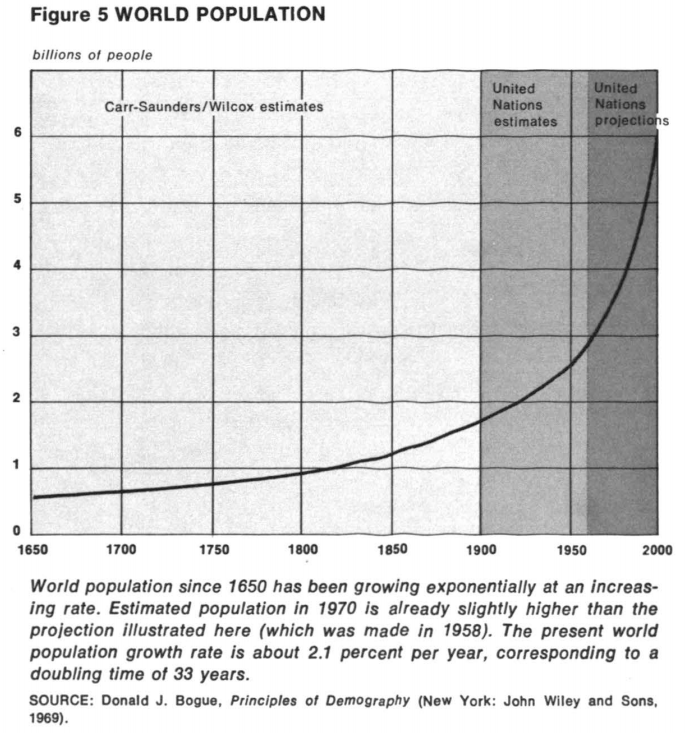
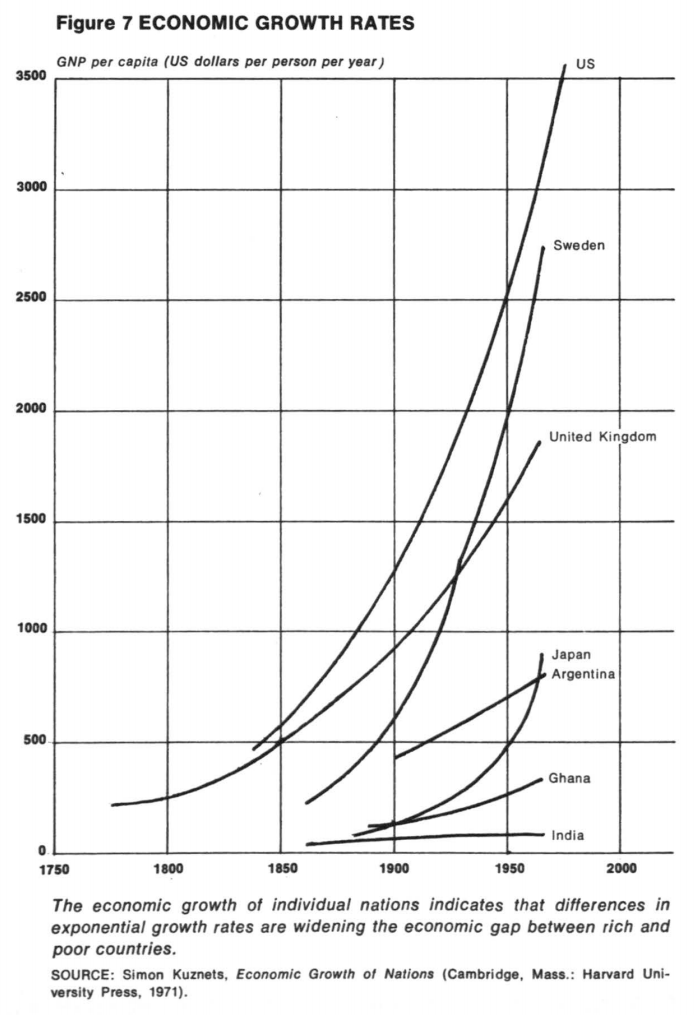
今から考えると、人口は幾何級数的に増え るのに、農業生産は算術級数的にしか増加しないので、人口増による貧困に人類社会は直面するというトマス・ロバート・マルサス(Thomas Robert Malthus, 1766-1834)の20世紀の後半の四半世紀のエコロジー危機を煽るネオ・マルサス的的な警鐘を鳴らしたということだろうか。ちなみに、経済成長を比 較した2枚目の図には、21世紀の世界経済の牽引国とも言える中国の名がない。


ち なみに、アニマル・スピリット(animal spirit)とは、「企業家の投資行動の動機となる、将来に対する主観的な期待。英国の経済学者ケインズが「雇傭・利子および貨幣の一般理論」のなかで 使用した用語。経済活動の多くは合理的動機に基づいて行われるが、その一方で、将来の収益を期待して事業を拡大しようとする、合理的には説明できない不確 定な心理によって左右されるとし」たものとのことだ(出典:「アニマルスピリット」デ ジタル大辞泉)。
☆
☆
リンク
文献
その他の情報
Copyleft, CC, Mitzub'ixi Quq Chi'j, 1996-2099

☆
 ☆
☆
