国家の乗っ取り
State capture
☆「ステート・キャプチャー[State capture](国
家の捕獲/
捕縛/乗っ取り)」とは、私的利益が国家の意思決定プロセスに多大な影響を及ぼし、自らの利益を図るという、制度的な政治腐敗の一形態である。
この用語は2000年に世界銀行によって初めて用いられ、ソビエト共産主義から移行期にある特定の中央アジア諸国を指して使われた。そこでは、腐敗した小
規模なグループが政府高官に対する影響力を利用し、自らの経済的地位を強化するために政府の意思決定を乗っ取っていた。[1]
ステート・キャプチャーに関する疑惑は、2013年から2014年および2020年から2021年のブルガリア、2017年のルーマニアにおいて政府に対
する抗議運動を引き起こし[2]、2016年から南アフリカで現在も続く論争の原因となっている。トルコは、2002年以降のステート・キャプチャーの事
例と見なされている。[3]
また、この用語は、ドナルド・トランプ米大統領の批判者たちによって、イーロン・マスク氏に対しても用いられている。[4][5]
| State capture is a
type of systemic political corruption in which private interests
significantly influence a state's decision-making processes to their
own advantage. The term was first used by the World Bank in 2000 to describe certain Central Asian countries making the transition from Soviet communism, where small corrupt groups used their influence over government officials to appropriate government decision-making in order to strengthen their own economic positions.[1] Allegations of state capture have led to protests against the government in Bulgaria in 2013–2014 and in 2020–2021 and Romania in 2017,[2] and have caused an ongoing controversy in South Africa beginning in 2016. Turkey is considered as a post-2002 example of state capture.[3] The term has also been used against Elon Musk by critics of U.S. President Donald Trump.[4][5] |
「ステート・キャプチャー[State capture](国家の捕獲/
捕縛/乗っ取り)」とは、私的利益が国家の意思決定プロセスに多大な影響を及ぼし、自らの利益を図るという、制度的な政治腐敗の一形態である。 この用語は2000年に世界銀行によって初めて用いられ、ソビエト共産主義から移行期にある特定の中央アジア諸国を指して使われた。そこでは、腐敗した小 規模なグループが政府高官に対する影響力を利用し、自らの経済的地位を強化するために政府の意思決定を乗っ取っていた。[1] ステート・キャプチャーに関する疑惑は、2013年から2014年および2020年から2021年のブルガリア、2017年のルーマニアにおいて政府に対 する抗議運動を引き起こし[2]、2016年から南アフリカで現在も続く論争の原因となっている。トルコは、2002年以降のステート・キャプチャーの事 例と見なされている。[3] また、この用語は、ドナルド・トランプ米大統領の批判者たちによって、イーロン・マスク氏に対しても用いられている。[4][5] |
| Definition The original definition of state capture refers to the way formal procedures (such as laws and social norms) and government bureaucracy are manipulated by government officials, state-backed companies, private companies or private individuals, so as to influence state policies and laws in their favour.[6] State capture seeks to influence the formation of laws, in order to protect and promote influential actors and their interests. In this way it differs from most other forms of corruption which instead seek selective enforcement of already existing laws.[6] State capture is not necessarily illegal, depending on determination by the captured state itself,[7] and may be attempted through private lobbying and influence. The influence may be through a range of state institutions, including the legislature, executive, ministries, and the judiciary, or through a corrupt electoral process. It is similar to regulatory capture but differs in the scale and variety of influenced areas and, unlike regulatory capture, the private influence is never overt.[8] A distinguishing factor from corruption is that, though in cases of corruption the outcome (of policy or regulatory decision) is not certain, in cases of state capture the outcome is known and is highly likely to be beneficial to the captors of the state. In 2017, a group of South African academics further developed the concept in a report on state capture in South Africa, titled "Betrayal of the Promise Report".[9] The analysis emphasised the political character of state capture, arguing that in South Africa a power elite violated the Constitution and broke the law in the service of a political project, which they believed unachievable in the existing constitutional/legal framework. A 2023 academic paper argued that "the concept of state capture helps to structure our understanding of patterns of grand corruption seen around the world in varied contexts, and increasingly even in countries once regarded as secure democracies."[3] |
定義 「ステート・キャプチャー(国家乗っ取り)」の本来の定義とは、政府高官、国営企業、民間企業、あるいは個人が、正式な手続き(法律や社会的規範など)や 政府の官僚機構を操作し、自らの利益にかなうよう国家の政策や法律に影響を及ぼすことを指す。[6] ステート・キャプチャーは、影響力のある主体やその利益を保護・促進するために、法律の制定に影響を及ぼそうとするものである。この点において、既存の法 律の選択的な執行を求める他のほとんどの腐敗形態とは異なる。[6] ステート・キャプチャーは、キャプチャーされた国家自身の判断によっては必ずしも違法とは限らず[7]、民間のロビー活動や影響力行使を通じて試みられる ことがある。その影響力は、立法府、行政府、各省庁、司法府といった幅広い国家機関を通じて、あるいは腐敗した選挙プロセスを通じて及ぶ可能性がある。こ れは「規制の乗っ取り(regulatory capture)」と類似しているが、影響を受ける領域の規模や多様性において異なり、また規制の乗っ取りとは異なり、民間からの影響は決して表立っては いない。[8] 汚職との決定的な違いは、汚職の場合、政策や規制上の決定の結果が不確実であるのに対し、国家乗っ取りの場合、結果は既知であり、国家を乗っ取った者に とって有益となる可能性が極めて高いという点にある。2017年、南アフリカの学者グループは、「Betrayal of the Promise Report(約束の裏切り報告書)」と題した南アフリカにおける国家乗っ取りに関する報告書の中で、この概念をさらに発展させた。[9] この分析は国家乗っ取りの政治的性格を強調し、南アフリカでは権力エリートが、既存の憲法・法的枠組みでは達成不可能だと考えた政治的プロジェクトのため に、憲法に違反し、法を破ったと論じた。 2023年の学術論文は、「国家乗っ取りという概念は、世界中の多様な文脈で見られる大規模な汚職のパターンを理解する上で役立ち、かつては安定した民主 主義国家と見なされていた国々においても、その傾向がますます顕著になっている」と論じている。[3] |
| Examples by region or country Africa The Ghana Centre for Democratic Development (CDD Ghana) in 2025 issued a new Democracy Capture Index (DEMCAP) indicates concern that powerful interests are increasingly taking control of democratic institutions, undermining legitimate state governance, particularly in nations transitioning from authoritarianism to liberal democracy.[10][11] Bulgaria Main articles: 2014 Bulgarian Protests and 2020–2021 Bulgarian protests Protests in Bulgaria in 2013–14 against the Oresharski cabinet were prompted by allegations that it came to power due to the actions of an oligarchic structure (formerly allied to Boyko Borisov) which used underhand maneuvers to discredit the GERB party.[12] Conversely, in 2020 large anti-GERB protests broke out, accusing Borisov and his party of once again allying themselves with oligarchic organizations, permitting corruption and undermining political opposition.[13] Press freedom in Bulgaria diminished to the point it was rated worst in the EU;[14] one oligarch, Delyan Peevski, controls close to 80% of the newspaper distribution market.[15] Bulgaria's exposure to oligarchic networks has had a negative impact, most significantly in the area of energy policy. The close proximity between Bulgarian and Russian elites is largely underpinned by Russia's significant economic presence in Bulgaria, with Gazprom being Bulgaria's sole natural gas provider and Rosatom having a dominant position in the country's nuclear sector. As Russia has increased influence over Bulgaria's economy, it has used dominant positions in strategic sectors to strengthen relationships and cultivate new ones with corrupt businessmen and local oligarchs. This has allowed for access to prominent politicians, over which they are able to exert considerable control.[16] |
地域・国別の事例 アフリカ 2025年、ガーナ民主主義開発センター(CDDガーナ)が発表した新たな「民主主義乗っ取り指数(DEMCAP)」は、特に権威主義体制から自由民主主 義へ移行しつつある国々において、強力な利益団体が民主主義制度をますます掌握し、正当な国家統治を損なっていることへの懸念を示している。[10] [11] ブルガリア 主な記事:2014年ブルガリア抗議運動および2020年–2021年ブルガリア抗議運動 2013年から2014年にかけてのオレシャルスキ内閣に対するブルガリアでの抗議運動は、同内閣が(かつてボイコ・ボリソフと結託していた)寡頭制構造 の行動によって権力を掌握したとの疑惑がきっかけとなった。この構造は、GERB党の信用を傷つけるために不正な手段を用いたとされている。[12] 一方、2020年には大規模な反GERB抗議活動が勃発し、ボリソフ氏とその政党が再びオリガルヒ組織と結託し、汚職を容認し、政治的野党を弱体化させて いると非難された。[13] ブルガリアの報道の自由は、EU内で最悪と評価されるほど低下した。[14] あるオリガルヒであるデリアン・ペエフスキ氏は、新聞流通市場の80%近くを支配している。[15] ブルガリアがオリガルヒのネットワークにさらされていることは、特にエネルギー政策の分野において、悪影響を及ぼしている。ブルガリアとロシアのエリート 層の密接な関係は、主にロシアのブルガリアにおける大きな経済的存在感に支えられており、ガスプロムがブルガリア唯一の天然ガス供給業者であり、ロサトム が同国の原子力部門で支配的な地位を占めている。ロシアはブルガリア経済への影響力を強めるにつれ、戦略的分野における支配的地位を利用して、腐敗した実 業家や地元のオリガルヒとの関係を強化し、新たな関係を築いてきた。これにより、彼らは有力な政治家へのアクセスを得て、彼らに対して相当な支配力を行使 することが可能となっている。[16] |
| Latin America Instances where politics have been ostensibly deformed by the power of drug barons in Colombia and Mexico are also considered as examples of state capture.[1] Both Argentina and Bolivia have been the subject of Russian strategic corruption efforts by its usage of corrosive capital. While the Kremlin has used similar strategies in Argentina and Bolivia, it has adopted strategies that suit local conditions.[17] In Argentina, political decision-making is more dispersed, while transfers of power are more frequent, making large-scale, long-term projects more difficult to implement. Therefore, in Argentina, Putin has used trade as a bargaining chip. In 2015 Argentina suspended the television license for RT, to which the Kremlin retaliated by threatening to ban Argentine beef exports and suspend investment projects; several weeks later, RT was officially allowed to continue operating.[17] In Bolivia, power is concentrated, allowing Russian state-owned companies deeper traction, pushing through projects with no significant resistance. Therefore, the Kremlin strategy in Bolivia has been to maximise influence by focusing on strategic markets and long-term infrastructure deals.[17] 17. Stefanov, Ruslan; Vladimirov, Martin (November 2020). "Deals in the Dark: Russian Corrosive Capital in Latin America" (PDF). National Endowment for Democracy. |
ラテンアメリカ コロンビアやメキシコにおいて、麻薬王の権力によって政治が表向き歪められた事例も、国家乗っ取りの例と見なされている[1]。アルゼンチンとボリビアの 両国は、ロシアによる腐敗資本を用いた戦略的な汚職工作の対象となってきた。クレムリンはアルゼンチンとボリビアで同様の戦略を用いているものの、現地の 状況に合わせた戦略を採用している[17]。 アルゼンチンでは、政治的意思決定が分散しており、政権交代も頻繁であるため、大規模かつ長期的なプロジェクトの実施は困難である。そのため、アルゼンチ ンにおいてプーチンは貿易を交渉の切り札として用いてきた。2015年、アルゼンチンがRTの放送免許を停止すると、クレムリンはアルゼンチン産牛肉の輸 出禁止や投資プロジェクトの停止を脅して報復したが、数週間後、RTは正式に放送継続を許可された。[17] ボリビアでは権力が集中しており、ロシアの国営企業がより深く浸透し、大きな抵抗を受けることなくプロジェクトを推進できる。そのため、ボリビアにおけるクレムリンの戦略は、戦略的市場と長期的なインフラ契約に焦点を当てることで、影響力を最大化することにある。[17] |
| Western Balkans As of 2020, state capture in the Western Balkans was undermining the EU enlargement process, strengthening ruling parties and weakening independent institutions and political opposition.[18][19] For instance, in 2020, through clientelist networks and loyalty-based appointments, the ruling party of Serbia, the Serbian Progressive Party, had effectively captured the state, resulting in the country losing its status as a "free" country according to the Freedom House Freedom in the World index.[20] Middle East The influence that Hezbollah in Lebanon and pro-Iran militias in Iraq exert over their respective governments has often been characterized as a form of state capture.[21] |
西バルカン諸国 2020年時点で、西バルカン諸国における「国家乗っ取り」は、EU拡大プロセスを阻害し、与党の勢力を強化する一方で、独立した機関や野党を弱体化させていた。[18][19] 例えば、2020年、セルビアの与党であるセルビア進歩党は、縁故主義的なネットワークや忠誠心に基づく人事を通じて事実上国家を掌握し、その結果、フリーダム・ハウスの「世界の自由度」指数において、同国は「自由」な国の地位を失った。[20] 中東 レバノンのヒズボラやイラクの親イラン系民兵組織がそれぞれの政府に及ぼす影響力は、しばしば「国家乗っ取り」の一形態として特徴づけられてきた。[21] |
| outh Africa Further information: Zondo Commission See also: Corruption in South Africa In May 2017, a group of academics convened by Mark Swilling and including Ivor Chipkin, Lumkile Mondi, Haroon Bhorat and others, published the Betrayal of the Promise report, the first major study of state capture in South Africa.[9] It helped galvanise civil-society opposition to the unconstitutional developments in South African civil-society responses.[22] The analysis was further developed in the book Shadow State: The Politics of State Capture written by Chipkin and Swilling.[23] The 2017 book How to Steal a City details state capture within the Nelson Mandela Bay Metropolitan Municipality in South Africa during the Zuma government. Gupta family Main article: Gupta family The pattern [of state capture] is a simple one. "You remove management, and put in compliant management. You remove boards, and put in boards that are compliant. The rest is very easy. That has been the scenario at state-owned enterprises. - Mcebisi Jonas, former Deputy Finance Minister; explaining the process of state capture.[24] In 2016, there were allegations of an overly close and potentially corrupt relationship between the wealthy Gupta family and the South African president Jacob Zuma, his family and leading members of the African National Congress (ANC).[25][26][27][28] South African opposition parties have made claims of "state capture" following allegations that the Guptas had inserted themselves into a position where they could offer Cabinet positions and influence the running of government.[29] These allegations were made in light of revelations by former ANC MP Vytjie Mentor and Deputy Finance Minister Mcebisi Jonas that they had been offered Cabinet positions by the Guptas at the family's home in Saxonwold, a suburb in Johannesburg.[30]  A COSATU protester in Cape Town holding a protest placard calling for the prosecution of "all people involved in the state capture activities." The protest was against government corruption and state capture in the administration of South African President Jacob Zuma.[31] Mentor claimed that, in 2010, the Guptas had offered her the position of Minister of Public Enterprises, provided that she arranged for South African Airways to drop their India route, allowing a Gupta-linked company (Jet Airways) to take on the route.[32][33] She said that she declined the offer, which occurred at the Guptas' Saxonwold residence, while President Zuma was in another room. This came a few days before a cabinet reshuffle in which minister Barbara Hogan (then Minister of Public Enterprises) was dismissed by Zuma. The Gupta family denied that the meeting took place and also denied offering Vytjie Mentor a ministerial position,[34] while President Zuma claimed that he had no recollection of Mentor.[35] Deputy Finance Minister Jonas said that he had been offered a ministerial position by the Guptas shortly before the dismissal of Finance Minister Nhlanhla Nene in December 2015, but had rejected the offer as "it makes a mockery of our hard-earned democracy‚ the trust of our people and no one apart from the President of the Republic appoints ministers."[36] The Gupta family denied offering Jonas the job of Finance Minister.[37] In 2016, Paul O'Sullivan's 'Forensics for Justice' published a report, which alleged that South Africa's criminal justice system had been "captured" by the underworld.[38] Following a formal complaint submitted in March 2016 by a catholic priest, Father Stanslaus Muyebe,[39] the Guptas' alleged "state capture" was investigated by Public Protector Thuli Madonsela. President Zuma and Minister Des van Rooyen applied for a court order to prevent the publication of the report on 14 October 2016, Madonsela's last day in office.[40] Van Rooyen's application was dismissed, and the President withdrew his application, leading to the release of the report on 2 November 2016. On 25 November 2016, Zuma announced that the Presidency would be reviewing the contents of the state capture report.[41] He said it "was done in a funny way" with "no fairness at all," and argued he was not given enough time to respond to the public protector.[42] Zuma and Van Rooyen denied any wrongdoing[43] whilst the Guptas disputed evidence in the report and also denied being involved in corrupt activities.[44][45][46][47] In an exclusive interview with ANN7 (belonging to the Gupta Family), President Zuma said that 'state capture' was a fancy word used by media houses for propaganda proliferation. He said that a real state capture would include seizure of the three arms of the constitution—Legislative, Executive, and Judiciary—which has never been the case in South Africa.[48] The report recommended establishment of a judicial commission of inquiry into the issues identified,[49] including a full probe of Zuma's dealings with the Guptas, with findings to be published within 180 days. In May 2017, Jacob Zuma denied the allegation of blocking an attempt to set up a commission of inquiry to probe state capture.[50] The report led to the establishment of the Zondo Commission of Inquiry in 2018, set up to investigate allegations of state capture in South Africa. Economic impact On 11 September 2017, former Finance Minister Pravin Gordhan estimated the cost of state capture at 250 billion rand (almost $17 billion USD), in a presentation at the University of Cape Town Graduate School of Business.[51] The Daily Maverick, a South African news publication, estimated that state capture cost the country roughly R1.5 trillion (roughly US$100 billion) in the four years preceding 2019.[52] South African Reserve Bank economist David Fowkes stated that the negative impact of state capture on the country's economy was worse than expected, stating that it likely reduced GDP growth by an estimated 4% a year.[53] Russian involvement in SA state capture Allegations of state capture were also known to have increased as the relationship between South Africa and Russia grew, resulting in a partnership that increasingly impacted upon the decision-making process of the African state. Soon after President Zuma took office, Moscow attempted to make inroads into Africa, all the while capitalizing on a South African leader who had extensive Soviet Bloc connections. The transactional nature of the relationship began when Zuma pushed to be included in the BRIC grouping during the 2008 financial crisis, receiving important backing from the Kremlin which ultimately led to Zuma attending his first BRICS meeting in 2011. The Kremlin also worked to establish ties between the two states’ security services, with some suggesting that Zuma had sought to implement state surveillance capabilities with Russia's help. Finally, amid countrywide debate surrounding the future electrical need of South Africa, a joint press statement with the Russian state nuclear cooperation, Rosatom, announced an agreement to provide up to 8 nuclear reactors. In 2017, that agreement was struck down in court as unconstitutional.[54] |
南アフリカ 詳細情報:ゾンド委員会 関連項目:南アフリカの汚職 2017年5月、マーク・スウィリングが招集し、アイヴァー・チップキン、ルムキレ・モンディ、ハルーン・ボラットらが参加した学者グループは、南アフリ カにおける「国家乗っ取り」に関する初の主要な研究報告書『Betrayal of the Promise』を発表した。[9] この報告書は、南アフリカの市民社会における憲法違反の動向に対する市民社会の反対運動を活性化させる一助となった。[22] この分析は、チップキンとスウィリングが著した『シャドウ・ステート:国家乗っ取りの政治学』においてさらに展開された。[23] 2017年に出版された『都市を盗む方法』は、ズマ政権下における南アフリカのネルソン・マンデラ・ベイ大都市圏自治体での国家乗っ取りについて詳述している。 グプタ家 本記事:グプタ家 [国家乗っ取りの]パターンは単純だ。「経営陣を排除し、従順な経営陣を据える。取締役会を排除し、従順な取締役会を据える。あとは極めて容易だ。これが国有企業におけるシナリオであった。 - ムセビシ・ジョナス(元財務副大臣);国家乗っ取りのプロセスを説明。[24] 2016年、富裕なグプタ家と、南アフリカのジェイコブ・ズマ大統領、その家族、およびアフリカ民族会議(ANC)の主要メンバーとの間に、過度に親密で腐敗の疑いのある関係があるとの疑惑が浮上した。[25][26][27] [28] 南アフリカの野党各党は、グプタ家が閣僚ポストを提供し、政府運営に影響を及ぼし得る立場に自らを据えたとの疑惑を受け、「国家乗っ取り」を主張してい る。[29] これらの疑惑は、元ANC議員のヴィティ・メントール氏とムセビシ・ジョナス財務副大臣が、ヨハネスブルグ郊外のサクソンウォルドにあるグプタ家の自宅 で、同家から閣僚ポストの打診を受けていたことを明かしたことを受けて浮上した。[30] ケープタウンで、「国家乗っ取り活動に関与したすべての人物の起訴」を求めるプラカードを掲げるCOSATU(南アフリカ労働組合会議)の抗議参加者。この抗議活動は、ジェイコブ・ズマ南アフリカ大統領政権下の政府腐敗と国家乗っ取りに反対するものであった。[31] メントール氏は、2010年にグプタ家から、南アフリカ航空にインド路線の運航中止を手配し、グプタ家と関係のある企業(ジェットエアウェイズ)がその路 線を引き継げるようにすることを条件に、公共企業大臣のポストを提示されたと主張した。[32][33] 彼女は、ズマ大統領が別の部屋にいる間に、グプタ家のサクソンウォルドの邸宅で行われたこの申し出を断ったと述べた。これは、バーバラ・ホーガン大臣(当 時公営企業大臣)がズマ大統領によって解任された内閣改造の数日前に起きた出来事であった。グプタ家は、その会合が行われた事実も、ヴィチー・メントール に大臣職を提示した事実も否定した[34]。一方、ズマ大統領はメントールについて記憶にないとした。[35] ジョナス財務副大臣は、2015年12月にンランラ・ネネ財務大臣が解任される直前に、グプタ家から閣僚ポストの打診を受けたが、「それは我々が苦労して 勝ち取った民主主義と国民の信頼を愚弄するものであり、共和国大統領以外の誰も大臣を任命することはできない」として、その申し出を拒否したと述べた。 [36] グプタ家は、ジョナス氏に財務大臣の職を打診したことを否定した。[37] 2016年、ポール・オサリバン氏の「フォレンジクス・フォー・ジャスティス(Forensics for Justice)」は、南アフリカの刑事司法制度が裏社会によって「乗っ取られた」と主張する報告書を発表した。[38] 2016年3月、カトリック司祭のスタンスラウス・ムイェベ神父[39]による正式な申し立てを受け、グプタ家によるいわゆる「国家乗っ取り」について、 トゥリ・マドンセラ公的保護官が調査を行った。2016年10月14日、マドンセラの任期最終日、ズマ大統領とデス・ファン・ルーイエン大臣は、報告書の 公表を阻止するための裁判所命令を申請した。[40] ヴァン・ルーイェン大臣の申請は却下され、大統領も自身の申請を取り下げたため、2016年11月2日に報告書が公表された。2016年11月25日、ズ マ大統領は、大統領府が国家乗っ取り報告書の内容を検討すると発表した。[41] 彼は、報告書が「奇妙なやり方で作成され」、「公平性が全く欠如している」と述べ、公的監視機関への回答に十分な時間が与えられなかったと主張した。 [42] ズマとヴァン・ルーイエンは不正行為を一切否定した[43]一方、グプタ家は報告書内の証拠に異議を唱え、汚職行為への関与も否定した。[44][45] [46][47] グプタ家が所有するANN7との独占インタビューで、ズマ大統領は、「国家乗っ取り」とはメディア各社がプロパガンダを広めるために用いる大げさな言葉に 過ぎないと述べた。彼は、真の国家乗っ取りとは、憲法の三権(立法、行政、司法)の掌握を意味するが、南アフリカではそのような事態は一度も起きていない と語った。[48] 報告書は、特定された問題について司法調査委員会の設置を勧告した[49]。これには、ズマとグプタ家との取引に関する徹底的な調査も含まれ、調査結果は 180日以内に公表されることになっていた。2017年5月、ジェイコブ・ズマは、「国家乗っ取り」を調査するための調査委員会設置の試みを妨害したとの 疑惑を否定した[50]。この報告書を受け、2018年に南アフリカにおける「国家乗っ取り」疑惑を調査するため、ゾンゴ調査委員会が設置された。 経済的影響 2017年9月11日、プラヴィン・ゴードハン元財務相は、ケープタウン大学ビジネススクールでの講演において、「国家乗っ取り」による損失額を 2,500億ランド(約170億米ドル)と推計した。[51] 南アフリカのニュースメディア『デイリー・マーベリック』は、2019年以前の4年間で、ステート・キャプチャーが同国に約1.5兆ランド(約1,000 億米ドル)の損失をもたらしたと推定した。[52] 南アフリカ準備銀行のエコノミスト、デビッド・フォークスは、ステート・キャプチャーが同国経済に与えた悪影響は予想以上に深刻であり、GDP成長率を年 間推定4%押し下げたと述べた。[53] 南アフリカの国家乗っ取りへのロシアの関与 南アフリカとロシアの関係が深まるにつれ、国家乗っ取りの疑惑も高まったことが知られており、その結果、アフリカ諸国の意思決定プロセスにますます影響を 及ぼすパートナーシップが形成された。ズマ大統領が就任して間もなく、モスクワはアフリカへの進出を図り、その一方で、ソ連圏との広範な人脈を持つ南アフ リカの指導者を利用しようとした。この関係の取引的な性質は、2008年の金融危機の際にズマがBRICsへの参加を強く求めたことに端を発する。彼はク レムリンから重要な支援を受け、最終的に2011年に初のBRICS会合に出席することとなった。クレムリンはまた、両国の治安機関間の連携構築にも尽力 し、一部ではズマがロシアの支援を得て国家監視能力の導入を図ったとの指摘もある。最後に、南アフリカの将来の電力需要をめぐる全国的な議論の中で、ロシ アの国営原子力企業ロスアトムとの共同プレスリリースにより、最大8基の原子炉を供給する合意が発表された。2017年、この合意は違憲として裁判所で無 効とされた。[54] |
| Kenya In May 2019, reports of state capture in Kenya started emerging. Inside Kenya's Inability to Fight Corruption,[55] which was published by Africa Centre for Open Governance (AfriCOG) highlighted the issue, outlining why President Uhuru Kenyatta's anti-corruption measures were not working. This was attributed to state capture where state institutions had been repurposed for private profiteering mainly by the first family.[55] The study concluded that public-driven prosecutions, rampant in Kenya, were likely to worsen corruption rather than reduce it. In June 2022, UDA presidential candidate William Ruto (now the current president) stated that he would end state capture in Kenya if he took office after the August 2022 General Elections. He claimed he would form a quasi-judicial public inquiry within 30 days to establish the extent of cronyism and state capture in the nation and make recommendations.[56] |
ケニア 2019年5月、ケニアにおける「国家乗っ取り」の報告が相次ぎ始めた。アフリカ・オープン・ガバナンス・センター(AfriCOG)が発表した『ケニア の腐敗対策の無力さの内幕』[55]は、この問題を浮き彫りにし、ウフル・ケニヤッタ大統領の腐敗防止策が機能していない理由を概説した。その原因は「国 家乗っ取り」にあり、国家機関が主に大統領一家による私利私欲のために悪用されていたためである。[55] この研究は、ケニアで横行している市民主導の起訴は、汚職を減少させるどころか、むしろ悪化させる可能性が高いと結論づけた。 2022年6月、UDAの大統領候補ウィリアム・ルト(現大統領)は、2022年8月の総選挙後に就任した場合、ケニアにおける「ステート・キャプ チャー」を終わらせると表明した。彼は、就任後30日以内に準司法的な公的調査委員会を設置し、国内における縁故主義とステート・キャプチャーの実態を明 らかにし、提言を行うと主張した。[56] |
| Crony capitalism Democratic backsliding Entryism Narco-state Regulatory capture 2023 Israeli judicial reform protests: government accused of attempted state capture by judicial coup |
縁故資本主義[Crony capitalism] 民主主義の後退[Democratic backsliding] 浸透工作・エントリー主義[Entryism] 麻薬国家[Narco-state] 規制の乗っ取り[Regulatory capture] 2023年のイスラエル司法改革抗議運動[2023 Israeli judicial reform protests]:政府が司法クーデターによる国家乗っ取りを図ったと非難される |
| References 01. Crabtree, John; Durand, Francisco (2017). Peru: Elite Power and Political Capture. London, United Kingdom: Zed Books Ltd. p. 1. ISBN 978-1-78360-904-8. "Romanian Democracy at Grave Danger". 14 December 2017. Dávid-Barrett, Elizabeth (2023). "State capture and development: A conceptual framework". Journal of International Relations and Development. 26 (2): 224–244. doi:10.1057/s41268-023-00290-6. PMC 10034251. PMID 37363285. McBrien, Tyler (February 5, 2025). "What Is 'State Capture'? A Warning for Americans". The New York Times. Retrieved 2025-02-09. Barrón-López, Laura (February 5, 2025). "Protests erupt as Elon Musk moves to gut government agencies". PBS News Hour. Retrieved 2025-02-09. Hellman, Joel S.; Jones, Geraint; Kaufmann, Daniel (September 2000). "Policy Research Working Paper 2444: "Seize the State, Seize the Day": State Capture, Corruption, and Influence in Transition" (PDF). The World Bank. Kaufmann, Daniel; Vicente, Pedro C. "Legal Corruption (October 2005)" (PDF). Retrieved 7 April 2017. World Bank (2000). Anticorruption in Transition: Contribution to the Policy Debate. World Bank Publications. ISBN 9780821348024. State Capacity Research Group. 2017. "Betrayal of the Promise Report." Johannesburg: Public Affairs Research Institute 10. Ghana news Agency: Ghana Centre for Democratic Development report Deutsche Welle:Can African countries resist democracy capture? "Политическата криза и дневният ред на промяната (pp.1–2)" (PDF) (in Bulgarian). iris.bg. 17 June 2013. Archived from the original (PDF) on 27 June 2013. Retrieved 2 March 2014. "Bulgarian PM reshuffles government in bid to quell protests". Reuters. 2020-07-23. Retrieved 2020-07-23. "They will leave me jobless.’ Why declining press freedom in Bulgaria should worry us all". Retrieved: 7 June 2021. Bulgarian independent media operating in a ‘captured state’, International Press Institute (18 February 2020). Retrieved: 7 June 2021. Conley, Heather A.; Stefanov, Ruslan; Mina, James; Vladimirov, Martin (2016). "Case Studies" (PDF). Appendix. pp. 36–63. doi:10.5771/9781442279599-36. JSTOR resrep23311.13. {{cite book}}: |journal= ignored (help) Stefanov, Ruslan; Vladimirov, Martin (November 2020). "Deals in the Dark: Russian Corrosive Capital in Latin America" (PDF). National Endowment for Democracy. Lemstra, Maarten. "The Destructive Effects of State Capture in the Western Balkans" (PDF). Clingendael. Djokić, Katarina; Djordjević, Saša; Ignjatijević, Marija (2020). "State Capture in Serbia — A Conceptual and Contextual Introduction". Security Sector Capture in Serbia. Belgrade Centre for Security Policy: 11–19. 20. "Nations in Transit 2020" (PDF). Freedom House. "Manfredi Firmian, F. (2024). When Militias capture the state: evidence from Lebanon, Iraq, and Sudan. Small Wars & Insurgencies, 35(1), 1-26" (PDF). Small Wars & Insurgencies. doi:10.1080/09592318.2023.2271244. Chipkin, Ivor. n.d. "The end of tyranny: South Africa’s civil society fights back." OpenGlobalRights. Retrieved on 2021 March 21. Chipkin, Ivor, and Mark Swilling, et al. 2018. Shadow State: The Politics of State Capture. Johannesburg: Wits University Press. Cairns, Patrick (12 October 2017). "Jonas: All institutions in SA are under threat". Moneyweb.co.za. Retrieved 2017-10-12. "Zuma allies 'break ranks' with him over Guptas". Rand Daily Mail. 1 February 2016. Retrieved 9 February 2016. Wild, Franz (17 December 2015). "Gupta family seen as symbol of Zuma's failing rule". Sunday Times. Retrieved 9 February 2016. "Who are the Guptas?". BBC. 14 May 2013. Retrieved 7 February 2016. Munusamy, Ranjeni (1 February 2016). "Keeping Up with the Guptas: What's behind the anti-Saxonwold revolt". Daily Maverick. Retrieved 9 February 2016. "Parliament must deal with 'state capture' – DA". News24.com. 27 March 2016. Archived from the original on 12 August 2018. Retrieved 30 March 2016. 30. "Zuma defends relationship with Guptas – report". News24.com. 23 March 2016. Archived from the original on 4 December 2019. Retrieved 30 March 2016. "Cosatu Protest: Future of the alliance on the line | Daily Maverick". www.dailymaverick.co.za. 26 September 2017. Retrieved 2017-09-27. "Vytjie Mentor: I can prove Zuma was with me in the Gupta house". Rand Daily Mail. 17 March 2016. Retrieved 10 April 2016. "'Zuma said it's OK Ntombazana,' says former ANC MP Vytjie Mentor". Times Live. 18 March 2016. Khoza, Amanda (15 March 2016). "Gupta family denies offering former ANC MP top job". news24. Retrieved 24 June 2016. Khoza, Amanda; Tandwa, Lizeka (15 March 2016). "Zuma has 'no recollection' of Mentor - Presidency". news24. Retrieved 24 June 2016. "Full statement by Deputy Finance Minister Mcebisi Jonas on Gupta job offer". The Sowetan. 16 March 2016. "Gupta family denies offering Jonas South Africa's finance minister role". Reuters. 16 March 2016. Archived from the original on August 17, 2016. Retrieved 24 June 2016. "Joining the dots: Capture of the criminal justice system". Forensics for Justice. Paul O'Sullivan. 13 July 2017. Retrieved 12 February 2019. "State Capture Report 2016". Scribd. Retrieved 7 May 2019. 40. "Zuma halts Madonsela's state capture report". eNCA. 13 October 2016. "Zuma to take state capture report on review". CityPress. Retrieved 2016-12-08. Williams, Denise. "Zuma to launch a review on Madonsela's state capture report". The Citizen. Retrieved 2016-12-08. Parkinson, Joe; Steinhauser, Gabriele (6 November 2016). "South Africa report cites 'worrying' signs of government corruption". Wall Street Journal. Retrieved 1 December 2016. "#StateCapture report: Molefe-Gupta ties revealed | IOL". Retrieved 2016-12-25. n.a. (November 3, 2016). "South Africa's Guptas to challenge influence-peddling report at inquiry". Reuters India. Archived from the original on November 4, 2016. Retrieved 2016-12-25. Macharia, James (3 Nov 2016). "South Africa's Guptas to challenge state capture report at inquiry". CNBC Africa. Retrieved 1 December 2016. Cohen, Mike; Dzonzi, Thembisile Augustine. "Gupta bombshell: Zuma on the ropes after Gordhan's gloves come off". The M&G Online. Retrieved 2016-12-25. ANN (2017-11-13). #StraightTalk: ANN7 exclusive interview with Pres Jacob Zuma. Retrieved 2017-11-21 – via YouTube. "State Capture Report: What John Cena Wants Inquiry to Probe". EWN. 3 November 2016. 50. "Zuma denies blocking state capture probe | IOL News". Retrieved 2017-10-16. reporter, Citizen. "R250bn lost to state capture in the last three years, says Gordhan". The Citizen. Retrieved 2017-11-29. Merten, Marianne (28 February 2019). "ANALYSIS: State Capture wipes out third of SA's R4.9-trillion GDP – never mind lost trust, confidence, opportunity". Daily Maverick. Retrieved 2019-06-09. Maguban, Khulekani (2019-06-06). "Damage from state capture 'worse than suspected' - SARB". Fin24. Retrieved 2019-07-29. Weiss, Andrew S.; Rumer, Eugene (1 December 2019). "Nuclear Enrichment: Russia's Ill-Fated Influence Campaign in South Africa" (PDF). Carnegie Endowment for International Peace. Retrieved 6 January 2021. Maina, Wachira (May 2019). "State Capture: Inside Kenya's Inability to Fight Corruption". Africa Centre for Open Governance. Retrieved 2022-07-20. 56. "Kenya Kwanza Manifesto: DP Ruto promises to end state capture". Citizen Digital. 2022-06-30. Retrieved 2022-07-20. |
参考文献 01. Crabtree, John; Durand, Francisco (2017). 『ペルー:エリートの権力と政治的乗っ取り』. 英国ロンドン:Zed Books Ltd. p. 1. ISBN 978-1-78360-904-8. 「深刻な危機に瀕するルーマニアの民主主義」. 2017年12月14日. Dávid-Barrett, Elizabeth (2023). 「国家の乗っ取りと開発:概念的枠組み」. Journal of International Relations and Development. 26 (2): 224–244. doi:10.1057/s41268-023-00290-6. PMC 10034251. PMID 37363285. マクブライエン、タイラー(2025年2月5日)。「『国家乗っ取り』とは何か? アメリカ人への警告」。『ニューヨーク・タイムズ』。2025年2月9日閲覧。 バロン=ロペス、ローラ(2025年2月5日)。「イーロン・マスクが政府機関の解体を推進する中、抗議活動が勃発」。PBSニュースアワー。2025年2月9日閲覧。 ヘルマン、ジョエル・S.;ジョーンズ、ジェライント;カウフマン、ダニエル(2000年9月)。「政策研究ワーキングペーパー2444:『国家を掌握せよ、時を逃すな』:移行期における国家乗っ取り、汚職、および影響力」(PDF)。世界銀行。 カウフマン, ダニエル; ビセンテ, ペドロ・C. 「法的腐敗(2005年10月)」 (PDF). 2017年4月7日閲覧。 世界銀行 (2000). 『移行期における腐敗防止:政策論争への寄与』. 世界銀行出版局. ISBN 9780821348024. 国家能力研究グループ. 2017. 「約束の裏切り報告書」。ヨハネスブルグ:パブリック・アフェアーズ・リサーチ・インスティテュート 10. ガーナ通信社:ガーナ民主開発センター報告書 ドイチェ・ヴェレ:アフリカ諸国は民主主義の乗っ取りに抵抗できるか? 「政治危機と変革の課題(pp.1–2)」 (PDF) (ブルガリア語)。iris.bg。2013年6月17日。2013年6月27日にオリジナル(PDF)からアーカイブ。2014年3月2日取得。 「ブルガリア首相、抗議活動鎮静化に向け内閣改造」。ロイター。2020年7月23日。2020年7月23日取得。 「『彼らは私を職なしにするだろう』。ブルガリアにおける報道の自由の後退が、なぜ私たち全員を懸念させるべきなのか」。2021年6月7日閲覧。 「『乗っ取られた状態』で活動するブルガリアの独立系メディア」、国際報道機関(2020年2月18日)。2021年6月7日閲覧。 コンリー、ヘザー・A.;ステファノフ、ルスラン;ミナ、ジェームズ;ヴラディミロフ、マーティン(2016年)。「事例研究」(PDF)。 付録。pp. 36–63。doi:10.5771/9781442279599-36。JSTOR resrep23311.13。{{cite book}}: |journal= が無視されました(ヘルプ) ステファノフ、ルスラン;ヴラディミロフ、マーティン(2020年11月)。「闇の取引:ラテンアメリカにおけるロシアの腐食的資本」 (PDF). ナショナル・エンドウメント・フォー・デモクラシー. レムストラ、マーテン. 「西バルカン諸国における国家乗っ取りの破壊的影響」 (PDF). クリンゲンダール. ジョキッチ、カタリーナ; ジョルジェヴィッチ、サーシャ; イグニャティエヴィッチ、マリヤ (2020). 「セルビアにおける国家乗っ取り — 概念的・文脈的導入」。『セルビアにおける安全保障セクターの乗っ取り』。ベオグラード安全保障政策センター:11–19。 20. 「Nations in Transit 2020」(PDF)。フリーダム・ハウス。 「マンフレディ・フィルミアン, F. (2024). 民兵組織が国家を乗っ取ったとき:レバノン、イラク、スーダンの事例。『Small Wars & Insurgencies』, 35(1), 1-26」(PDF)。『Small Wars & Insurgencies』。doi:10.1080/09592318.2023.2271244. チップキン、アイヴァー。発行年不明。「専制政治の終焉:南アフリカの市民社会が反撃する。」 OpenGlobalRights. 2021年3月21日閲覧。 チップキン、アイヴァー、マーク・スウィリングほか. 2018. 『シャドウ・ステート:国家乗っ取りの政治学』. ヨハネスブルグ:ウィッツ大学出版局. ケアンズ、パトリック (2017年10月12日). 「ジョナス:南アフリカのあらゆる制度が脅威にさらされている」. Moneyweb.co.za. 2017年10月12日閲覧。 「ズマ氏の盟友、グプタ家問題を巡り彼と『決別』」。ランド・デイリー・メール。2016年2月1日。2016年2月9日閲覧。 ワイルド、フランツ(2015年12月17日)。「グプタ家はズマ政権の失墜の象徴と見なされる」。サンデー・タイムズ。2016年2月9日閲覧。 「グプタ家とは?」。BBC。2013年5月14日。2016年2月7日閲覧。 ムヌサミー、ランジェニ(2016年2月1日)。「グプタ家を追う:サクソンウォルド反対運動の背景」。デイリー・マーベリック。2016年2月9日閲覧。 「議会は『国家乗っ取り』に対処すべき――DA」. News24.com. 2016年3月27日. 2018年8月12日にオリジナルからアーカイブ. 2016年3月30日閲覧. 30. 「ズマ大統領、グプタ家との関係を擁護――報道」. News24.com. 2016年3月23日. 2019年12月4日にオリジナルからアーカイブ。2016年3月30日閲覧。 「コサトゥ抗議:同盟の行方が懸かる | デイリー・マーベリック」。www.dailymaverick.co.za。2017年9月26日。2017年9月27日閲覧。 「ヴィチエ・メンター:ズマがグプタ邸に私と一緒にいたことを証明できる」。Rand Daily Mail。2016年3月17日。2016年4月10日閲覧。 「『ズマは「大丈夫だ、ントンバザナ」と言った』と元ANC議員ヴィチエ・メンターが語る」。Times Live。2016年3月18日。 コザ、アマンダ(2016年3月15日)。「グプタ家、元ANC議員への要職提供を否定」。news24。2016年6月24日閲覧。 コザ、アマンダ;タンワ、リゼカ(2016年3月15日)。「ズマ大統領、メントール氏との件を『記憶にない』と大統領府」。news24。2016年6月24日閲覧。 「グプタ家によるジョナスへの南アフリカ財務大臣職のオファーに関する、ムセビシ・ジョナス財務副大臣の声明全文」。The Sowetan。2016年3月16日。 「グプタ家、ジョナスへの南アフリカ財務大臣職のオファーを否定」。ロイター。2016年3月16日。2016年8月17日にオリジナルからアーカイブ。2016年6月24日閲覧。 「点と点を結ぶ:刑事司法制度の乗っ取り」。Forensics for Justice。ポール・オサリバン。2017年7月13日。2019年2月12日閲覧。 「2016年国家乗っ取り報告書」。Scribd。2019年5月7日閲覧。 40. 「ズマ大統領、マドンセラ氏の国家乗っ取り報告書を差し止め」。eNCA。2016年10月13日。 「ズマ大統領、国家乗っ取り報告書を再検討へ」。CityPress。2016年12月8日閲覧。 ウィリアムズ、デニス。「ズマ大統領、マドンセラ氏の国家乗っ取り報告書に関する再検討を開始へ」。The Citizen。2016年12月8日閲覧。 パーキンソン、ジョー;シュタインハウザー、ガブリエレ(2016年11月6日)。「南アフリカの報告書、政府腐敗の『懸念すべき』兆候を指摘」。ウォール・ストリート・ジャーナル。2016年12月1日閲覧。 「#StateCapture報告書:モレフェとグプタ家のつながりが明らかに | IOL」。2016年12月25日閲覧。 n.a. (2016年11月3日). 「南アフリカのグプタ家、調査委員会で影響力行使に関する報告書に異議を唱える」。ロイター・インディア。2016年11月4日にオリジナルからアーカイブ。2016年12月25日閲覧。 マチャリア、ジェームズ(2016年11月3日)。「南アフリカのグプタ家、調査委員会で『国家乗っ取り』報告書に異議申し立てへ」。CNBCアフリカ。2016年12月1日閲覧。 コーエン、マイク; ゾンジ、テンビシレ・オーガスティン。「グプタ家の衝撃:ゴードハン財務相が本気を出し、ズマ大統領は窮地に」。The M&G Online。2016年12月25日閲覧。 ANN (2017年11月13日). #StraightTalk: ANN7によるジェイコブ・ズマ大統領独占インタビュー。2017年11月21日閲覧 – YouTube経由。 「国家乗っ取り報告書:ジョン・シナが調査委員会に求めていること」。EWN。2016年11月3日。 50. 「ズマ大統領、国家乗っ取り調査の妨害を否定 | IOL News」。2017年10月16日閲覧。 記者、Citizen。「過去3年間で国家乗っ取りにより2,500億ランドが失われたとゴードハン氏」。The Citizen。2017年11月29日閲覧。 マーテン、マリアンヌ(2019年2月28日)。「分析:国家乗っ取りが南アフリカの4.9兆ランドのGDPの3分の1を消し去る――失われた信頼、自信、機会は言うまでもない」。『デイリー・マーベリック』。2019年6月9日閲覧。 マグバン、クレカニ(2019年6月6日)。「国家乗っ取りによる損害は『予想以上に深刻』――南アフリカ準備銀行(SARB)」。Fin24。2019年7月29日閲覧。 ワイス、アンドルー・S.;ルーマー、ユージーン(2019年12月1日)。「核濃縮:南アフリカにおけるロシアの不運な影響力行使キャンペーン」(PDF)。カーネギー国際平和財団。2021年1月6日閲覧。 マイナ、ワチラ(2019年5月)。「ステート・キャプチャー:ケニアの腐敗対策不能の内幕」. アフリカ・オープン・ガバナンス・センター. 2022年7月20日閲覧. 56. 「ケニア・クワンザ宣言:ルト副大統領、ステート・キャプチャーの終結を約束」. シチズン・デジタル. 2022年6月30日. 2022年7月20日閲覧. |
| Further reading State Capture: How Conservative Activists, Big Businesses, and Wealthy Donors Reshaped the American States and the Nation, by Alexander Hertel-Fernandez (2021). Elite Capture: How the Powerful Took Over Identity Politics (And Everything Else), by Olúfẹ́mi O. Táíwò (2022). State Capture by Gupta Family: What Were the Consequences for Ordinary South African Citizens?, by Dr BA Mabaso (2024). The State of Capture - Report by the South African Public Protector. ‘No Room To Hide: A President Caught in the Act’ Report by South African Organisation Undoing Tax Abuse State Capture Portfolio Organisation Undoing Tax Abuse State Capture Portfolio |
関連文献 『ステート・キャプチャー:保守派活動家、大企業、富裕な寄付者がいかにして米国の各州と国家を再構築したか』、アレクサンダー・ヘルテル=フェルナンデス著(2021年)。 『エリート・キャプチャー:権力者たちがアイデンティティ政治(そしてその他すべて)を掌握した方法』、オルフェミ・O・タイウォ著(2022年)。 『グプタ家による国家乗っ取り:一般の南アフリカ市民にどのような影響があったのか?』B.A. マバソ博士著(2024年)。 『国家乗っ取りの現状』-南アフリカ公的保護官による報告書。 『隠れ場所なし:現行犯で捕まった大統領』-南アフリカの組織「Undoing Tax Abuse」による報告書 国家乗っ取り関連資料 組織「Undoing Tax Abuse」 国家乗っ取り関連資料 |
| Corruption |
Categories: Deep politics Economics of regulation Political corruption Public choice theory Conflict of interest Political neologisms |
| Conflict of interest |
|
| https://en.wikipedia.org/wiki/State_capture |
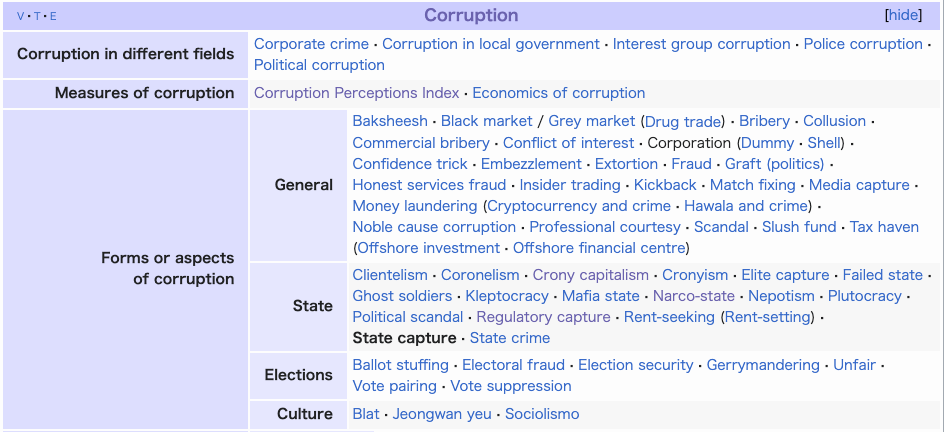
★ウィキペディアの腐敗/汚職(Corruption)のエントリーリスト
リ ンク
文 献
そ の他の情報
CC
Copyleft,
CC, Mitzub'ixi Quq Chi'j, 1996-2099
