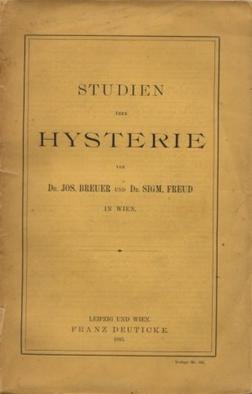
ヒステリーの研究
Studies on Hysteria, 1895
☆ 『ヒステリー研究』[Studies on Hysteria](ドイツ語: Studien über Hysterie)は、精神分析の創始者であるジークムント・フロイトと医師ヨーゼフ・ブローエルの1895年の著書である。1893年の論文の再版であ る共同序文に続き、ヒステリー患者5人についての個別の研究が掲載されている。すなわち、精神分析の発展に重要な意味を持つ、ブルールの有名なアンナ・ O.(本名:ベルタ・パップフェンハイム)の症例と、フロイトによる4つの症例である。その中には、エミー・フォン・Nに対するフロイトの評価も含まれて いる。最後に、ブルールによる理論的な論文と、フロイトによるより実践的な治療に関する論文が掲載されている。
| Studies
on Hysteria (German: Studien über Hysterie) is an 1895 book by Sigmund
Freud, the founder of psychoanalysis, and the physician Josef Breuer.
It consists of a joint introductory paper (reprinted from 1893);
followed by five individual studies of hysterics – Breuer's famous case
of Anna O. (real name: Bertha Pappenheim), seminal for the development
of psychoanalysis, and four more by Freud—[1] including his evaluation
of Emmy von N—[2] and finishing with a theoretical essay by Breuer and
a more practice-oriented one on therapy by Freud.[3] |
『ヒステリー研究』[Studies on Hysteria](ドイツ語: Studien über Hysterie)は、精神分析の創始者であるジークムント・フロイトと医師ヨーゼフ・ブローエルの1895年の著書である。1893年の論文の再版であ る共同序文に続き、ヒステリー患者5人についての個別の研究が掲載されている。すなわち、精神分析の発展に重要な意味を持つ、ブルールの有名なアンナ・ O.(本名:ベルタ・パップフェンハイム)の症例と、フロイトによる4つの症例である。[1] その中には、エミー・フォン・Nに対するフロイトの評価も含まれている。[2] 最後に、ブルールによる理論的な論文と、フロイトによるより実践的な治療に関する論文が掲載されている。[3] |
| Summary Freud sees symptomology as stratified in an almost geological way, with the outermost strata being easily remembered and accepted, while “the deeper one goes the more difficult it is to recognize the recollections that are surfacing”.[4] |
要約 フロイトは、症状学を地質学的な層のように層状に捉えており、最も外側の層は容易に記憶され受け入れられるが、「深層に潜れば潜るほど、表面に浮かび上がってくる記憶を認識することが難しくなる」と述べている。[4] |
| Reception and influence Breuer's work with Bertha Pappenheim provided the founding impetus for psychoanalysis, as Freud himself would acknowledge.[5] In their preliminary (1893) paper, both men agreed that “the hysteric suffers mainly from reminiscences”.[6] Freud however would come to lay more stress on the causative role of sexuality in producing hysteria, as well as gradually repudiating Breuer's use of hypnosis as a means of treatment.[7] Some of the theoretical scaffolding of the Studies – "strangulated affect", hypnoid state[8] – would be abandoned with the crystallisation of psychoanalysis as an independent technique. However, many of Freud’s clinical observations – on mnemic symbols[9] or deferred action[10] for example – would continue to be confirmed in his later work. At the same time, Breuer’s theoretical essay, with its examination of the principle of constancy, and its differentiation of bound and mobile cathexis,[11] would continue to inform Freud’s thinking as late as the twenties and the writing of Beyond the Pleasure Principle. At the time of its release, Studies on Hysteria tended to polarise opinion, both within and outside by the medical community.[12] While many were critical, Havelock Ellis offered an appreciative account, while a leading Viennese paper would characterise the work as “the kind of psychology used by poets”.[13] Studies on Hysteria received a positive review from psychiatrist Eugen Bleuler, although Bleuler nevertheless suggested that the results Freud and Breuer reported could have been the result of suggestion. |
受容と影響 フロイト自身も後に認めることになるが、ブルアーとベルタ・パップフェンハイムの共同作業は精神分析の創始のきっかけとなった。[5] 1893年の予備的な論文において、両者は「ヒステリー患者は主に回想に苦しんでいる」という点で意見が一致した。[6] しかし、フロイトはヒステリーを引き起こす原因として性的な要素をより重視するようになり、 また、徐々に治療手段としての催眠術の使用を否定するようになった。[7] 研究の理論的枠組みの一部、「絞扼された情動」や「ヒプノイド状態」[8] は、精神分析が独立した技術として確立されるにつれ、放棄されることとなった。しかし、フロイトの臨床観察の多く、例えば記憶記号[9]や遅延反応 [10]などについては、その後の研究でも引き続き確認されている。同時に、ブローエルの理論的論文は、恒常性の原則の検証や、束縛型と流動型カセクシス の区別[11]など、20年代の『快楽原則を超えて』の執筆に至るまで、フロイトの思考に影響を与え続けた。 『ヒステリー研究』が発表された当時、医学界内外で意見が二極化する傾向にあった。[12] 批判的な意見が多かったが、ハヴロック・エリスは評価的な見解を示し、ウィーンの有力紙は 「詩人が用いる心理学の一種」と評した。[13] 『ヒステリー研究』は精神科医オイゲン・ブローラーから肯定的な評価を受けたが、ブローラーはそれでも、フロイトとブリュアーが報告した結果は暗示による ものかもしれないと示唆した。 |
| Criticism Anna von Lieben Freud's later critics have argued that his continuing treatment of Anna von Lieben, given awareness of her incurability, amounted to using her as a kind of cash-cow.[14] Freud continued during the six years of psychoanalysis to treat her continuously with injections of morphine without any success or therapeutic result.[15] Anna O The philosopher Mikkel Borch-Jacobsen and the psychologist Sonu Shamdasani comment that Studies on Hysteria gave Freud, "a certain local and international notoriety". Borch-Jacobsen and Shamdasani write that, contrary to what Freud and Breuer claimed, Freud "always knew that the treatment of Bertha Pappenheim...had not been an unmitigated success".[16] In 1996, Mikkel Borch-Jacobsen completed a treatise on the case of Bertha Pappenheim, "Anna O.", subtitled Une mystification centenaire ("A 100-year-old mystification"), in which, according to Claude Meyer, he "met un terme à l'un des mythes fondateurs de la psychanalyse" ("put an end to one of the founding myths of psychoanalysis").[17] It is also the opinion of Elizabeth Loentz, who had also written a book on Pappenheim,[18] and Paul Roazen, who considers this work a major stage of university and historiographical work on psychoanalysis, and a fly in the ointment of the "defenders of the status quo".[19] |
批判 アンナ・フォン・リーベン フロイトの晩年の批判者たちは、アンナ・フォン・リーベンが不治の病であることを知った上で、彼女の治療を続けたことは、彼女を金づるとして利用したに等しいと主張している。[14] フロイトは、6年間にわたる精神分析の期間中、モルヒネ注射による治療を継続したが、何の成果も治療効果も得られなかった。[15] アンナ・O 哲学者のミッケル・ボルチ・ヤコブセンと心理学者のソヌ・シャムダサーニは、ヒステリーに関する研究が「ある程度の国内および国際的な悪評」をフロイトに もたらしたと論評している。ボルチ・ヤコブセンとシャムダサーニは、フロイトとブリュアーが主張したこととは逆に、フロイトは「ベルタ・パップフェンハイ ムの治療が...完全な成功ではなかったことを常に知っていた」と書いている。[16] 1996年、ミケル・ボルヒ・ヤコブセンは、ベアタ・パップenハイムの事例に関する論文「アンナ・O.」を完成させた。この論文には「100年目の謎」 という副題が付けられており、クロード・メイヤーによると、この論文で「精神分析の創設神話のひとつに終止符を打った」という 精神分析の創設神話の一つに終止符を打った」と述べている。[17] また、パッペンハイムに関する著書もあるエリザベス・ロエンツも同じ意見であり、[18] ポール・ローゼンは、この研究を精神分析に関する大学および歴史学上の主要な段階であり、「現状維持派」の目障りな存在であるとみなしている。[19] |
| Translations There are currently three English translations of Studies on Hysteria, the first by A. A. Brill (1937), the second by James Strachey (1955), included in the Standard Edition, and the third by Nicola Luckhurst (2004).[citation needed] |
翻訳 『ヒステリーに関する研究』の英語訳は現在3種類あり、最初のものはA. A. Brill(1937年)、2番目のものはジェイムズ・ストラチェリー(1955年)によるもので、スタンダード・エディションに収録されている。3番目 のものはニコラ・ラックハースト(2004年)によるものである。[要出典] |
| Cäcilie M. Emma Eckstein Hypnotic induction Pierre Janet Talking cure Psychoanalytic theory ++++++++++++++++++++ References 01. Ernest Jones, The life and Work of Sigmund Freud (1964) p. 223 Micale, Mark S., ed. (1993). "10. The Story of "Emmy von N.": A Critical Study with New Documents". Beyond the Unconscious: Essays of Henri F. Ellenberger in the History of Psychiatry. Translated by Dubor, Françoise. Princeton, New Jersey: Princeton University Press. pp. 273–290. ISBN 978-1-4008-6342-6 – via Project MUSE. Ernest Jones, The life and Work of Sigmund Freud (1964) p. 223 * Freud, Sigmund – Breuer, Joseph: Translated by Nicola Luckhurst trans, Studies in Hysteria. ( London 2004. ISBN 978-0-141-18482-1) p. 290 Peter Gay, Freud (1989) p. 63 Peter Gay, Freud (1989) p. 71 Peter Gay, Freud (1989) p. 66-7 and p. 71 Sigmund Freud: Five Lectures on Psycho-Analysis (1995) p. 18–23. Sigmund Freud: On Psychopathology (PFL 10) p. 91 10. Sigmund Freud: Case Histories II (PFL 9), p. 278. Sigmund Freud: On Metapsychology, PFL 11), p. 277 and p. 298. Ernest Jones, The life and Work of Sigmund Freud (1964) p. 223-4 Ernest Jones, The life and Work of Sigmund Freud (1964) p. 224 F. B. Michael, Ingenious Nonsense (2012) p. 80 Les patients de Freud. Destins. by Mikkel Borch-Jacobsen, Éditions Sciences Humaines, 2011 Borch-Jacobsen, Mikkel; Shamdasani, Sonu (2012). The Freud Files: An Inquiry into the History of Psychoanalysis. Cambridge: Cambridge University Press. pp. 56, 107, 166. ISBN 978-0-521-72978-9. Meyer, Claude (2007), Une histoire des représentations. Contribution à une archéologie de la société de la connaissance [A history of representation. Contribution to an archaeology of a society of knowledge] (in French), L'Harmattan, p. 186 Loentz, Elizabeth (2007), Let Me Continue to Speak the Truth: Bertha Pappenheim as Author and Activist, Hebrew Union College Press, pp. 216–217 Roazen, Paul (2002), The Trauma of Freud: Controversies in Psychoanalysis, Transaction, pp. 253–254 20. Miller, Gavin (2009). "Book Review: Richard A. Skues, Sigmund Freud and the History of Anna O.: Reopening a Closed Case". History of Psychiatry. 20 (4): 509–10. doi:10.1177/0957154X090200040205. S2CID 162260138. Skues, Richard A. Sigmund Freud and the History of Anna O.: Reopening a Closed Case. Basingstoke, UK, and New York: Palgrave Macmillan, 2006. Penguin Books ++++++++++++++++++++ https://en.wikipedia.org/wiki/Studies_on_Hysteria |
セシリー・M. エマ・エックシュタイン 催眠誘導 ピエール・ジャネット 会話療法 精神分析理論 ++++++++++++++++++++ 参考文献 01. アーネスト・ジョーンズ『ジークムント・フロイトの生涯と業績』(1964年)p. 223 マイケル、マーク・S. 編(1993年)。「10. 『エミー・フォン・N.』の物語:新資料を用いた批判的研究」。『無意識の彼方:精神医学史におけるアンリ・F・エレンベルガーの論考』。フランソワー ズ・デュボール訳。ニュージャージー州プリンストン:プリンストン大学出版局。273–290頁。ISBN 978-1-4008-6342-6 – Project MUSE経由。 アーネスト・ジョーンズ、『ジグムント・フロイトの生涯と業績』(1964年)223頁 * フロイト、ジグムント – ブロイアー、ヨーゼフ:ニコラ・ラックハースト訳、『ヒステリー研究』(ロンドン 2004年。ISBN 978-0-141-18482-1)p. 290 ピーター・ゲイ、『フロイト』(1989年)p. 63 ピーター・ゲイ、『フロイト』(1989年)p. 71 ピーター・ゲイ、『フロイト』(1989年)p. 66-7 および p. 71 ジークムント・フロイト:『精神分析に関する5つの講義』(1995年)p. 18–23。 ジークムント・フロイト:『精神病理学について』(PFL 10)p. 91 10. ジークムント・フロイト:『症例集 II』(PFL 9)、p. 278。 ジークムント・フロイト:『メタ心理学について』(PFL 11)、p. 277 および p. 298。 アーネスト・ジョーンズ、『ジグムント・フロイトの生涯と業績』(1964年)p. 223-4 アーネスト・ジョーンズ、『ジグムント・フロイトの生涯と業績』(1964年)p. 224 F. B. マイケル、『独創的なナンセンス』(2012年)p. 80 『フロイトの患者たち。運命』ミッケル・ボルヒ=ヤコブセン著、Éditions Sciences Humaines、2011年 ボルヒ=ヤコブセン、ミッケル;シャムダサニ、ソヌ(2012年)。『フロイト・ファイルズ:精神分析の歴史に関する考察』。ケンブリッジ:ケンブリッジ大学出版局。56、107、166頁。ISBN 978-0-521-72978-9. メイエール、クロード(2007年)、『表象の歴史。知識社会の考古学への寄与』(フランス語)、ラルマタン、p. 186 ロエンツ、エリザベス(2007)、『真実を語り続けさせて:作家かつ活動家としてのベルタ・パッペンハイム』、ヘブライ・ユニオン・カレッジ・プレス、pp. 216–217 ロアゼン、ポール(2002)、『フロイトのトラウマ:精神分析における論争』、トランザクション、pp. 253–254 20. ミラー、ギャビン(2009)。「書評:リチャード・A・スキューズ著『ジークムント・フロイトとアンナ・O.の歴史:閉ざされた事件の再審』」。『精神 医学史』。20 (4): 509–10。doi:10.1177/0957154X090200040205. S2CID 162260138. スキューズ、リチャード・A. 『ジークムント・フロイトとアンナ・O.の歴史:閉ざされた症例の再検討』. 英国ベージングストークおよびニューヨーク:パルグレイブ・マクミラン、2006年。 ペンギン・ブックス |
 Cäcilie M. (Anna von Lieben,
born Anna von Tedesco; c. 1847–1900) is the pseudonym of one of Freud's
first patients, whom he called in 1890 his “principal client” and in
1897 his “instructress”.[1] Cäcilie M. (Anna von Lieben,
born Anna von Tedesco; c. 1847–1900) is the pseudonym of one of Freud's
first patients, whom he called in 1890 his “principal client” and in
1897 his “instructress”.[1]Life Born into a rich Austrian Jewish family, Anna von Lieben was referred to Freud in the late eighties for help with a long-standing series of nervous disorders. After referring her for a consultation with Charcot, Freud treated her (with some short-term success) through hypnotism, taking her with him to see Hippolyte Bernheim in 1889 in the (unsuccessful) hope that he might be able to work a permanent cure.[2] He also used abreaction for temporary relief of her symptoms,[3] noting however that her sense of guilt and self-reproaches would swiftly return after the treatment sessions.[4] Her symptoms, including hallucinations and physical spasms, provided the basis for many of Freud's claims about conversion hysteria; and how to interpret back from physical symptom or hallucination to the underlying (symbolic) emotional meaning it expressed,[5] often by a 'punning' logic.[6] Criticism Freud's later critics have argued that his continuing treatment of Anna, given awareness of her incurability, amounted to using her as a kind of cash-cow.[7] Freud continued during the six years of psychoanalysis to treat her continuously with injections of morphine without any success or therapeutic result.[8] See also Anna O. Franz Brentano (her brother-in-law) Robert von Lieben (her son) Somatization disorder Studies on Hysteria Talking cure https://en.wikipedia.org/wiki/C%C3%A4cilie_M. |
ツェツィーリエ・M.(アンナ・フォン・リーベン、旧姓アンナ・フォン・テデスコ、1847年頃 - 1900年)は、フロイトの最初の患者の一人の偽名であり、1890年には「主要な患者」、1897年には「指導者」と呼ばれていた。[1] 生涯 裕福なオーストリア系ユダヤ人の家庭に生まれたアンナ・フォン・リーベンは、長年にわたる神経疾患の治療を求めて、1880年代後半にフロイトのもとを訪 れた。フロイトはシャルコーに彼女を紹介した後、催眠術を用いて彼女を治療した(一時的な効果はあった)。1889年には、催眠術で彼女を連れてイポリッ ト・ベルナームのもとを訪れたが、それはベルナームが恒久的な治療を行えるかもしれないという(成功しなかった)期待からだった。[2] また、彼は症状の一時的な緩和のために abreaction も用いたが、[3] しかし、彼女の罪悪感や自己非難は治療セッションの後すぐに戻ってくると指摘した。[4] 幻覚や身体の痙攣などの彼女の症状は、転換ヒステリーに関するフロイトの主張の多くを裏付ける根拠となった。また、身体の症状や幻覚から、それが表現して いる根本的な(象徴的な)感情的な意味をどのように解釈するかという点についても、しばしば「言葉遊び」の論理によって解釈された。 批判 フロイトの後の批判者たちは、アンナの病気が治らないことを知りながら治療を続けたことは、彼女を一種の金づるとして利用したに等しいと主張している。[7] フロイトは6年間にわたる精神分析の期間中、モルヒネ注射による治療を継続したが、何の成果も治療効果も得られなかった。[8] 関連項目 アンナ・O. フランツ・ブレンターノ(義理の兄弟 ロベルト・フォン・リーベン(息子 身体化障害 ヒステリーに関する研究 会話療法 |
| References 01. Peter Gay, Freud: A Life for Our Time (1988) p. 69 Ernest Jones, The Life and Work of Sigmund Freud (1964) p. 211 Herman Westerink, A Dark Trace: Sigmund Freud on the Sense of Guilt (2009) p. 12 Malcolm Macmillan, Freud Evaluated: The Completed Arc (1991) p. 106 05. Joseph Schwartz, Cassandra's Daughter (2003) pp. 51-52 Mignon Nixon, Fantastic Reality: Louise Bourgeois and a Story of Modern Art (2005) pp. 138-139 Fouad Bishay Michael, Ingenious Nonsense: Religion, Philosophy, Pseudoscience, and the Paranormal (2012) p. 80 08. Mikkel Borch-Jacobsen (2011). Les patients de Freud. Destins. Éditions Sciences Humaines |
参考文献 01. ピーター・ゲイ『フロイト:現代のための生涯』(1988年)69ページ アーネスト・ジョーンズ『ジグムント・フロイトの生涯と業績』(1964年)211ページ ハーマン・ウェステリンク『暗い痕跡:罪悪感に関するジグムント・フロイト』(2009年)12ページ マルコム・マクミラン、『フロイトの再評価:完結した弧』(1991年)p. 106 05. ジョセフ・シュワルツ、『カッサンドラの娘』(2003年)pp. 51-52 ミグノン・ニクソン、『幻想的な現実:ルイーズ・ブルジョワと現代美術の物語』(2005年)pp. 138-139 フアド・ビシャイ・マイケル、『独創的なナンセンス:宗教、哲学、疑似科学、そして超常現象』(2012年)p. 80 08. ミッケル・ボルク=ヤコブセン(2011年)。『フロイトの患者たち』。デスティン。エディション・サイエンス・ユマイン |
| Further reading Peter J. Swales, "Freud, his Teacher, and the Birth of Psychoanalysis", in Paul E. Stepansky, ed., Freud, Appraisals and Reappraisals, vol. 1 (1986) 3-82 |
追加文献(さらに読む) ピーター・J・スウェールズ「フロイト、その師、そして精神分析の誕生」、ポール・E・ステパンスキー編『フロイト――評価と再評価』第1巻(1986年)3-82頁 |
リ ンク
文 献
そ の他の情報
Copyleft, CC, Mitzub'ixi Quq Chi'j, 1996-2099

☆
 ☆
☆
