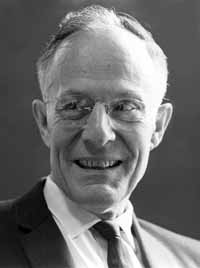
セオドア・シュルツ
Theodore William
Schultz, 1902-1998
☆セオドア・ウィリアム・シュルツ[Theodore William Schultz](/ʃʊlts/ シュルツ;1902年4月30日 – 1998年2月26日)は、アメリカの農業経済学者であり、シカゴ大学経済学部長を務めた。シュルツは、1979年にノーベル経済学賞を受賞したことで、全米的にその名を知られるようになった。
| Theodore William Schultz
(/ʃʊlts/ SHUULTS; 30 April 1902 – 26 February 1998) was an American
agricultural economist and chairman of the University of Chicago
Department of Economics. Schultz rose to national prominence after
winning the 1979 Nobel Memorial Prize in Economic Sciences. |
セオドア・ウィリアム・シュルツ[Theodore William Schultz](/ʃʊlts/ シュルツ;1902年4月30日 – 1998年2月26日)は、アメリカの農業経済学者であり、シカゴ大学経済学部長を務めた。シュルツは、1979年にノーベル経済学賞を受賞したことで、全米的にその名を知られるようになった。 |
| Early life and education Theodore William Schultz was born on April 30, 1902, in a small town ten miles northwest of Badger, South Dakota, on a 560-acre farm. When Schultz was in the eighth grade, his father Henry decided to pull him out of attending Kingsbury County Schoolhouse. His father's view was that if his eldest son continued to get an education he would be less inclined to continue working on the farm. Schultz subsequently did not have any formal post-secondary education. He eventually enrolled in the Agriculture College at South Dakota State, in a three-year program that met for four months a year during the winter. After being recognized for possessing great potential as a student, Schultz moved on to a bachelor's program, earning his degree in 1927 in agriculture and economics. He also received an honorary doctorate of science degree from the college in 1959. He graduated in 1927, then entered the University of Wisconsin–Madison earning his doctorate in Agricultural Economics in 1930 under Benjamin H. Hibbard with a thesis, titled The Tariff in Relation to the Coarse-Feed Grains and a Development of Some of the Theoretical Aspects of Tariff Price Research.[1] |
生い立ちと教育 セオドア・ウィリアム・シュルツは、1902年4月30日、サウスダコタ州バジャーの北西10マイルにある小さな町で、560エーカーの農場に生まれまし た。シュルツが中学2年生の時、父ヘンリーは彼をキングズベリー郡立学校から退学させることを決めた。父の考えは、長男が教育を受け続ければ、農場での仕 事を続ける意欲が薄れてしまうというものだった。その結果、シュルツはその後、高等教育を一切受けなかった。 彼はやがてサウスダコタ州立大学の農学部に入学し、冬期に年4ヶ月間開講される3年制の課程に在籍した。学生として大きな可能性を認められたシュルツは、 学士課程に進み、1927年に農業学と経済学の学位を取得した。また、1959年には同大学から名誉理学博士号を授与された。1927年に卒業した後、 ウィスコンシン大学マディソン校に進学し、ベンジャミン・H・ヒバードの指導の下、1930年に農業経済学の博士号を取得した。博士論文の題目は『粗飼料 用穀物に関連する関税および関税価格研究の理論的側面に関する考察』であった。[1] |
| Academic career Schultz taught at Iowa State College from 1930 to 1943.[2] He left Iowa State in the wake of the "oleomargarine controversy",[3] and he served as the chair of economics at the University of Chicago from 1946 to 1961. He became a member of the American Academy of Arts and Sciences in 1958,[4] the American Philosophical Society in 1962,[5] and the United States National Academy of Sciences in 1974.[6] He became president of the American Economic Association in 1960. He retired in 1970 though he remained active at the University of Chicago into his 90s until a fractured hip left him bedridden.[7] Shortly after his move to Chicago, Schultz recruited his former student, D. Gale Johnson to the department. Their research in farm and agricultural economics was widely influential and attracted funding from the Rockefeller Foundation to the agricultural economics program at the university. Among the graduate students and faculty affiliated with the pair in the 1940s and 1950s were Clifford Hardin, Zvi Griliches, Marc Nerlove, and George S. Tolley.[8] In 1979, Schultz was awarded the Nobel Prize in Economics for his work in human capital theory and economic development. |
学歴 シュルツは1930年から1943年までアイオワ州立大学で教鞭をとった。[2] 彼は「オレオマーガリン論争」[3]をきっかけに同大学を去り、1946年から1961年までシカゴ大学の経済学部長を務めた。1958年に米国芸術科学 アカデミー[4]、1962年に米国哲学協会[5]、1974年に米国科学アカデミー[6]の会員となった。1960年には米国経済学会の会長に就任し た。1970年に引退したが、90代になってもシカゴ大学で活動を続け、股関節を骨折して寝たきりになるまでその活動を続けた。[7] シカゴに移った直後、シュルツはかつての教え子であるD・ゲイル・ジョンソンを同学科に招いた。彼らの農業経済学に関する研究は広く影響力を持ち、ロック フェラー財団から同大学の農業経済学プログラムへの資金提供を引き寄せた。1940年代から1950年代にかけて、この2人に所属した大学院生や教員に は、クリフォード・ハーディン、ズヴィ・グリリチェス、マーク・ネルラブ、ジョージ・S・トーリーらがいた。[8] 1979年、シュルツは人的資本理論と経済開発に関する功績により、ノーベル経済学賞を受賞した。 |
| Contribution to economic theory Human capital theory  Schultz receiving Nobel Prize from King of Sweden Carl XVI Gustaf in 1979. While he was chair of economics at Chicago he led research into why post-World War II Germany and Japan recovered, at almost miraculous speeds, from the widespread devastation. Contrast this with the United Kingdom which was still rationing food long after the war. His conclusion was that the speed of recovery was due to a healthy and highly educated population; education makes people productive and good health care keeps the education investment around and able to produce. One of his main contributions was later called Human Capital Theory, which he formulated with the help of Gary Becker and Jacob Mincer.[9] Schultz coined this theory in his book titled Investment in Human Capital; however, he experienced negative feedback from other economists. He states that knowledge and skill are a form of capital, and investments in human capital leads to an increase in both economic output and workers' earnings. Many economists refused to support his theory of considering humans as a form of capital due to slavery, which at the time was an understandable critique given the civil rights movements at this time. Schultz argues that his theory does not dismiss humanity but instead encourages individuals to invest in themselves. He advocates for humans to invest in their health, internal migration, and on-the-job training; however, he focuses on encouraging individuals to better their education in order to increase their level of productivity.[10] He states that if people were to do these things, they would have many more opportunities available for them to better their economic situations. He also inspired much work in international development in the 1980s, motivating investments in vocational and technical education by Bretton Woods system International Financial Institutions such as the International Monetary Fund and the World Bank. During his research Schultz got down to details and went out among the poor farming nations of Europe, talking to farmers and political leaders in small towns. He was "not afraid to get his shoes a little muddy." He noticed that the aid the United States sent in the form of food or money was not only of little help but actually harmful to such nations, as the farmers and agricultural producers within those nations were not able to compete with the free prices of the "aid" sent and therefore they were not able to sustain themselves or invest the money they made from crops back into the economy. He theorized that if the U.S. instead used its resources to help educate these rural producers and provide them with technology and innovations they would be more stable, productive and self-sustaining in the long run. This was another key part of his work "Investment in Human Capital". |
経済理論への貢献 人的資本理論 1979年、スウェーデンのカール16世グスタフ国王からノーベル賞を授与されるシュルツ。 シカゴ大学経済学部長在任中、彼は第二次世界大戦後のドイツと日本が、広範囲にわたる壊滅的な被害から、ほぼ奇跡的な速さで復興した理由について研究を主 導した。これに対し、戦後かなり経ってもなお食料配給制が続いていた英国とは対照的であった。彼の結論は、回復の速さは健全で高度な教育を受けた人口によ るものであるというものであった。教育は人々を生産的にし、良質な医療は教育への投資を維持し、生産能力を保たせるのである。彼の主な貢献の一つは、後に 「人的資本理論」と呼ばれるようになり、彼はゲイリー・ベッカーやジェイコブ・ミンサーの協力を得てこれを定式化した。[9] シュルツはこの理論を著書『人的資本への投資』で提唱したが、他の経済学者からは否定的な反応を受けた。彼は、知識と技能は資本の一形態であり、人的資本 への投資は経済生産高と労働者の所得の両方の増加につながると述べている。当時の人権運動を考慮すれば理解できる批判ではあるが、多くの経済学者は、人間 を資本の一形態と見なす彼の理論を、奴隷制を連想させるとして支持することを拒んだ。シュルツは、自身の理論が人間性を否定するものではなく、むしろ個人 が自己投資を行うよう促すものであると主張する。彼は、健康、国内移動、職場内研修への投資を提唱しているが、生産性の向上を図るために教育水準を高める よう個人を奨励することに重点を置いている。[10] 彼は、人々がこうした行動をとれば、経済状況を改善するための機会がはるかに多く得られると述べている。 また、彼は1980年代の国際開発分野における多くの取り組みに影響を与え、国際通貨基金(IMF)や世界銀行といったブレトン・ウッズ体制下の国際金融 機関による職業教育・技術教育への投資を促進した。研究の過程で、シュルツは細部にまで目を向け、ヨーロッパの貧しい農業国を訪れ、小さな町の農民や政治 指導者たちと対話した。彼は「靴を少し泥だらけにすることさえ厭わなかった」のである。彼は、米国が食料や金銭の形で送る援助が、ほとんど役に立たないば かりか、実際にはこうした国々にとって有害であることに気づいた。なぜなら、それらの国々の農民や農業生産者は、送られてくる「援助」の自由価格と競争で きず、その結果、自活することも、作物から得た収益を経済に再投資することもできなかったからである。彼は、もし米国が代わりにその資源を使って、こうし た農村部の生産者を教育し、技術や革新を提供すれば、長期的には彼らがより安定し、生産的になり、自立できるようになると論じた。これが、彼の著作『人的 資本への投資』におけるもう一つの重要な部分であった。 |
| Agricultural Development Theory One of Theodore Schultz's major contributions to economic theory is his theory outlined in his book Transforming Traditional Agriculture which was published in 1964. This theory combats a popular thought at the time held among development economists that the unwillingness of farmers of poor underdeveloped countries to innovate and expand their agricultural sectors was an irrational decision. Schultz argued that the farmers in these poor underdeveloped countries are making the most rational decision to not innovate or expand the agricultural sector because of high taxes and artificially low agriculture prices set by their governments. Schultz stated that in these poor underdeveloped countries resources were already being perfectly allocated and agriculture was already efficient. Despite these two things farmers in these countries were still poor, so the only solution to this problem was the transformation of their traditional agriculture system. Schultz argued that the best change to make for these poor underdeveloped countries to make was to replace all old inputs with new more profitable inputs. He stated the best way to do this was with a market approach where farmers were left free to decide which changes in the factors of production would be made. With this approach they would be free to try out any new innovations in technology and change in crops they decide to grow in pursuit of profits with very limited government intervention.[11] |
農業開発理論 セオドア・シュルツが経済理論に与えた主要な貢献の一つは、1964年に出版された著書『伝統的農業の変革(Transforming Traditional Agriculture)』で概説された理論である。この理論は、当時開発経済学者の間で広く受け入れられていた「貧しい未開発国の農民が農業部門の革新 や拡大に消極的であるのは非合理的な決定である」という通説に異を唱えるものである。シュルツは、これらの貧しい未開発国の農民が農業部門の革新や拡大を 行わないのは、政府による高税率や人為的に低く抑えられた農産物価格のためであり、それこそが最も合理的な判断であると主張した。シュルツは、これらの貧 しい未開発国においては、資源はすでに最適に配分されており、農業もすでに効率的であると述べた。これら二つの条件が満たされているにもかかわらず、これ らの国の農民は依然として貧しかったため、この問題に対する唯一の解決策は、彼らの伝統的な農業システムの変革にあった。シュルツは、これらの貧しく未開 発な国々にとって最善の変革は、従来の生産要素をすべて、より収益性の高い新しい生産要素に置き換えることであると主張した。彼は、これを行う最善の方法 は、生産要素のどの変更を行うかを農家が自由に決定できる市場アプローチであると述べた。このアプローチにより、政府の介入を最小限に抑えつつ、農家は利 益を追求するために、技術の革新や栽培作物の変更を自由に試みることができるようになるだろう。[11] |
| Nobel Memorial Prize in Economic Sciences Schultz was awarded the Nobel Prize jointly with Sir William Arthur Lewis in 1979 for his work in development economics, focusing on the economics of agriculture. He analyzed the role of agriculture within the economy, and his work has had far reaching implications for industrialization policy, both in developing and developed nations. Schultz also promulgated the idea of educational capital, an offshoot of the concept of human capital, relating specifically to the investments made in education.[12] |
ノーベル経済学賞 シュルツは、農業経済学を中心とした開発経済学における功績により、1979年にウィリアム・アーサー・ルイス卿と共同でノーベル賞を受賞した。彼は経済 における農業の役割を分析し、その研究は発展途上国および先進国双方の工業化政策に広範な影響を与えた。またシュルツは、人的資本という概念から派生し、 特に教育への投資に関連する「教育資本」という概念を提唱した。[12] |
| Family and personal life Schultz married Esther Florence Werth (1905–1991) in 1930. She was born and raised on a farm near Frankfort, South Dakota, of German parents, who encouraged her to pursue schooling. Werth was the first in her family to attend college, receiving a bachelor's degree in commercial science from South Dakota State College in Brookings in 1927,[13] and subsequently worked as a school teacher in Waubay, South Dakota, from 1927 to 1929 and then in Gregory, South Dakota, from 1929 to 1930. Werth shared Schultz's background in agriculture and commitment to ideals of education and economic development, and throughout his career worked as a primary editor of his published works. In his Nobel Prize Lecture, he acknowledged her contributions thus: "I am also indebted to my wife, Esther Schultz, for her insistence that what I thought was stated clearly was not clear enough." The couple was survived by two daughters and one son. |
家族と私生活 シュルツは1930年にエスター・フローレンス・ワース(1905年–1991年)と結婚した。彼女はサウスダコタ州フランクフォート近郊の農場で生まれ 育ち、ドイツ系移民の両親のもとで育ったが、両親は彼女が学業を続けるよう後押しした。ワースは家族の中で初めて大学に進学し、1927年にブルッキング スにあるサウスダコタ州立大学で商業科学の学士号を取得した[13]。その後、1927年から1929年までサウスダコタ州ウォーベイで、1929年から 1930年まで同州グレゴリーで学校教師として勤務した。ワースはシュルツと同様に農業のバックグラウンドを持ち、教育と経済発展の理念に献身しており、 シュルツのキャリアを通じて、彼の著作の主要な編集者として活動した。シュルツはノーベル賞受賞講演において、彼女の貢献を次のように称えた。「私が明確 に述べたと思っていたことが、実は十分に明確ではなかったと指摘してくれた妻、エスター・シュルツにも感謝している。」夫妻には2人の娘と1人の息子が残 された。 |
| Legacy Schultz received eight honorary degrees in his career. He had the distinction of being the first South Dakota State University graduate and the second South Dakotan to win a Nobel Prize after Ernest Lawrence winner of the 1939 Nobel Prize for Physics. Between 2012 and 2013, South Dakota State University built the Theodore W. Schultz Hall, a residence hall for students pursuing degrees in agriculture.[14] Schultz also was awarded the Francis A. Walker Medal in 1972, which is the highest award given out by the American Economic Association.[9] Schultz died in Evanston, Illinois, on February 26, 1998, at the age of 95. He is interred at Badger Cemetery in Badger, South Dakota. |
功績 シュルツは生涯で8つの名誉学位を授与された。彼は、サウスダコタ州立大学の卒業生としては初めて、また1939年のノーベル物理学賞受賞者アーネスト・ ローレンスに次いでサウスダコタ州出身者としては2人目となるノーベル賞受賞者という栄誉に輝いた。2012年から2013年にかけて、サウスダコタ州立 大学は、農業分野の学位取得を目指す学生のための学生寮「セオドア・W・シュルツ・ホール」を建設した。[14] シュルツはまた、1972年にアメリカ経済学会が授与する最高賞であるフランシス・A・ウォーカー・メダルを受賞した。[9] シュルツは1998年2月26日、イリノイ州エバンストンで95歳で死去した。彼はサウスダコタ州バジャーにあるバジャー墓地に埋葬されている。 |
| Quotes The dominant social thought shapes the institutionalized order of society...and the malfunctioning of established institutions in turn alters social thought. — Theodore W. Schultz (1977)[15] Most people in the world are poor. If we knew the economy of being poor, we would know much of the economics that really matter.[16] Farmers the world over, in dealing with costs, returns and risks, are calculating economic agents. Within their small, individual, allocative domain, they are fine-tuning entrepreneurs, tuning so subtly that many experts fail to recognize how efficient they are. – Theodore W. Schultz 1980[17] |
引用 支配的な社会思想は、社会の制度化された秩序を形作る……そして、確立された制度の機能不全は、ひいては社会思想を変化させる。 — セオドア・W・シュルツ (1977)[15] 世界の人々の大半は貧しい。もし私たちが「貧しいこと」の経済学を理解していれば、真に重要な経済学の多くを理解することになるだろう。[16] 世界中の農民は、コスト、収益、リスクに対処する上で、計算を行う経済主体である。彼らそれぞれの小さな資源配分の領域において、彼らは微調整を行う起業 家であり、その調整は極めて繊細なため、多くの専門家でさえ彼らがどれほど効率的であるかを認識できていない。– セオドア・W・シュルツ 1980[17] |
| Articles Schultz, Theodore W. (1956). "Reflections on Agricultural Production, Output and Supply". Journal of Farm Economics. 38 (3): 748–762. doi:10.2307/1234459. JSTOR 1234459. Schultz, Theodore W. (1960). "Capital Formation by Education". Journal of Political Economy. 68 (6): 571–583. doi:10.1086/258393. JSTOR 1829945. S2CID 154572248. Schultz, Theodore W. (1961). "Investment in Human Capital". The American Economic Review. 51 (1): 1–17. JSTOR 1818907. Books authored 1943. Redirecting Farm Policy, New York: Macmillan Company. 1945. Agriculture in an Unstable Economy, New York: McGraw-Hill. 1953. The Economic Organization of Agriculture, McGraw-Hill. 1963. The Economic Value of Education, New York: Columbia University Press. 1964. Transforming Traditional Agriculture, New Haven: Yale University Press. 1968.Economic Growth and Agriculture, New York: MacGraw-Hill. 1971. Investment in Human Capital: The Role of Education and of Research, New York: Free Press. 1972. Human Resources (Human Capital: Policy Issues and Research Opportunities), New York: National Bureau of Economic Research, 1981. Investing in People, University of California Press. Description and chapter-preview links. 1993. The Economics of Being Poor, Cambridge, Massachusetts, Blackwell Publishers 1993. Origins of Increasing Returns, Cambridge, Massachusetts, Blackwell Publishers Books edited 1945. Food for the World, Chicago: University of Chicago Press. 1962. Investment in Human Beings, Chicago: University of Chicago Press. 1972. Investment in Education: Equity-Efficiency Quandary, Chicago: University of Chicago Press. 1973.New Economic Approaches to Fertility, Chicago: University of Chicago Press, 1974. Economics of the Family: Marriage, Children, and Human Capital, Chicago: University of Chicago Press. |
論文 シュルツ、セオドア・W. (1956). 「農業生産、生産高および供給に関する考察」. 『Journal of Farm Economics』. 38 (3): 748–762. doi:10.2307/1234459. JSTOR 1234459. シュルツ, セオドア・W. (1960). 「教育による資本形成」. 『政治経済学ジャーナル』. 68 (6): 571–583. doi:10.1086/258393. JSTOR 1829945. S2CID 154572248. シュルツ, セオドア・W. (1961). 「人的資本への投資」. 『アメリカン・エコノミック・レビュー』. 51 (1): 1–17. JSTOR 1818907. 著書 1943. 『農業政策の転換』, ニューヨーク: マクミラン社. 1945. 『不安定な経済における農業』, ニューヨーク: マグロウ・ヒル. 1953. 『農業の経済組織』, マグロウ・ヒル. 1963. 『教育の経済的価値』, ニューヨーク: コロンビア大学出版局. 1964. 『伝統的農業の変革』, ニューヘイブン: イェール大学出版局. 1968年。『経済成長と農業』、ニューヨーク:マグロウヒル。 1971年。『人的資本への投資:教育と研究の役割』、ニューヨーク:フリープレス。 1972年。『人的資源(人的資本:政策課題と研究の機会)』、ニューヨーク:全米経済研究所、 1981年。『人への投資』、カリフォルニア大学出版局。概要および各章のプレビューリンク。 1993年. 『貧困の経済学』, マサチューセッツ州ケンブリッジ, ブラックウェル出版社 1993年. 『規模の利益の起源』, マサチューセッツ州ケンブリッジ, ブラックウェル出版社 編著書 1945年. 『世界の食糧』, シカゴ: シカゴ大学出版局. 1962年. 『人間への投資』, シカゴ: シカゴ大学出版局. 1972年。『教育への投資:公平性と効率性のジレンマ』、シカゴ:シカゴ大学出版局。 1973年。『出生率に関する新しい経済学的アプローチ』、シカゴ:シカゴ大学出版局。 1974年。『家族の経済学:結婚、子供、そして人的資本』、シカゴ:シカゴ大学出版局。 |
| References 01. Shaars, Marvin A. (1972). "The Story of The Department of Agricultural Economics: 1909–1972" (PDF). Archived from the original (PDF) on 2020-04-02. Retrieved 2009-09-17. Theodore W. Schultz on Nobelprize.org Edit this at Wikidata///"the Sveriges Riksbank Prize in Economic Sciences in Memory of Alfred Nobel 1979Theodore W. Schultz, Sir Arthur Lewis". Nobelprize.org. Retrieved October 3, 2012. Burnett, Paul (2011). "Academic Freedom or Political Maneuvers: Theodore W. Schultz and the Oleomargarine Controversy Revisited". Agricultural History. 85 (3): 373–397. doi:10.3098/ah.2011.85.3.373. PMID 21901904. "Theodore William Schultz". American Academy of Arts & Sciences. Retrieved 2022-11-15. 05. "APS Member History". search.amphilsoc.org. Retrieved 2022-11-15. "Theodore W. Schultz". www.nasonline.org. Retrieved 2022-11-15. "Theodore Schultz, 95, Winner Of a Key Prize in Economics". Sumner, Daniel A. "Agricultural Economics at Chicago", in David Gale Johnson, John M. Antle. "The Economics of Agriculture: Papers in honor of D. Gale Johnson". University of Chicago Press, 1996 pp. 14–29 "Theodore William Schultz (1902–98)". 10. "History of Education: Selected Moments". Schutlz, Theodor. 1964. Transforming Traditional Agriculture. New Haven: Yale University Press "Theodore Schultz, 95, Winner Of a Key Prize in Economics". The New York Times. Retrieved October 3, 2012. "Theodore and Esther Schultz Society". Archived from the original on 2015-02-02. Retrieved 2015-02-02. "Schultz Hall". Archived from the original on 2015-09-05. Retrieved 2014-08-04. 15. Justin Yifu Lin. "Cambridge University Marshall Lecture – Development and Transition: Idea, Strategy, and Viability" (PDF). Archived from the original (PDF) on 2011-07-26. Theodore W. Schultz, 1981.Investing in People. p. 3. University of California Press. 17. Townsend, R. M. (2013). Accounting for the Poor. American Journal of Agricultural Economics, 95(5), 1196–1208. JSTOR 24476900 |
参考文献 01. Shaars, Marvin A. (1972). 「農業経済学部の歴史:1909–1972」 (PDF). 2020年4月2日にオリジナル (PDF) からアーカイブ。2009年9月17日閲覧。 Nobelprize.orgにおけるセオドア・W・シュルツ ウィキデータで編集///「1979年アルフレッド・ノーベル記念スウェーデン国立銀行経済学賞:セオドア・W・シュルツ、サー・アーサー・ルイス」. Nobelprize.org. 2012年10月3日閲覧。 バーネット、ポール (2011). 「学問の自由か政治的駆け引きか:セオドア・W・シュルツとオレオマーガリン論争の再考」。『Agricultural History』85巻3号、373–397頁。doi:10.3098/ah.2011.85.3.373。PMID 21901904。 「セオドア・ウィリアム・シュルツ」。アメリカ芸術科学アカデミー。2022年11月15日閲覧。 05. 「APS会員履歴」。search.amphilsoc.org。2022年11月15日閲覧。 「セオドア・W・シュルツ」。www.nasonline.org。2022年11月15日閲覧。 「セオドア・シュルツ氏(95歳)、経済学の主要賞受賞者」。 サムナー、ダニエル・A. 「シカゴにおける農業経済学」、デイヴィッド・ゲイル・ジョンソン、ジョン・M・アントル編『農業経済学:D・ゲイル・ジョンソン記念論文集』。シカゴ大学出版局、1996年、pp. 14–29 「セオドア・ウィリアム・シュルツ(1902–98)」。 10. 「教育史:選りすぐりの瞬間」。 シュルツ、セオドア。1964年。『伝統的農業の変革』。ニューヘイブン:イェール大学出版局 「セオドア・シュルツ氏(95)、経済学の主要賞受賞者」。『ニューヨーク・タイムズ』。2012年10月3日閲覧。 「セオドア・アンド・エスター・シュルツ協会」。2015年2月2日にオリジナルからアーカイブ。2015年2月2日閲覧。 「シュルツ・ホール」。2015年9月5日にオリジナルからアーカイブ。2014年8月4日閲覧。 15. ジャスティン・イーフー・リン。「ケンブリッジ大学マーシャル・レクチャー – 開発と移行:理念、戦略、そして実現可能性」(PDF)。2011年7月26日にオリジナル(PDF)からアーカイブ。 セオドア・W・シュルツ, 1981. 『Investing in People』. p. 3. カリフォルニア大学出版局. 17. タウンゼンド, R. M. (2013). 「貧困層の会計処理」. 『American Journal of Agricultural Economics』, 95(5), 1196–1208. JSTOR 24476900 |
| https://en.wikipedia.org/wiki/Theodore_Schultz |
リ ンク
文 献
そ の他の情報
CC
Copyleft,
CC, Mitzub'ixi Quq Chi'j, 1996-2099
