
全体主義
Totalitarianism
☆全体主義[Totalitarianism]と
は、政党による反対を禁じ、国家に反対する個人や集団の政治的主張を非合法化する政治体制および統治形態である。この体制は、社会の公的領域と私的領域を
完全に支配する。政治学の分野において、全体主義は権威主義の極端な形態であり、すべての政治権力が独裁者によって掌握される。この人物は、国家が管理す
る、あるいは国家と結託した民間のマスメディアを通じて放送される絶え間ないプロパガンダキャンペーンにより、国家の政治と国民を支配する。 [4]
全体主義政府は、イデオロギーを用いて、国の政治経済、教育制度、芸術・科学、さらには市民の私的な道徳など、人間の生活のほぼすべての側面を支配する。
[5]
権力の行使において、全体主義政府と権威主義政府は異なる。全体主義にはカリスマ的な独裁者と固定された世界観が見られるのに対し、権威主義には単に権力
そのものを目的として権力を握る独裁者が存在するだけである。権威主義的な独裁者は、軍事政権およびその国の支配階級である社会経済的エリート層から、共
同であるいは個別に支持されている。[6]
「全体主義」という言葉は、1920年代初頭にイタリアのファシスト政権を形容するために初めて用いられた。[7][8]
「全体主義」という用語は、戦間期の政治においてより広く使用されるようになった。冷戦の初期には、ヨシフ・スターリン統治下のソビエト連邦とアドルフ・
ヒトラー統治下のナチス・ドイツを比較する中で、西側政治学の理論的概念として浮上した。この用語は、ファシスト国家や共産主義国家の本質を説明する上で
ヘゲモニーを確立し、後に共産主義、ソビエト連邦、ロシア革命に関する西側の歴史学にも取り入れられた。21世紀には、イスラム主義運動やその政府にも適
用されるようになった。全体主義という概念は、ナチス・ドイツやスターリン主義下のソ連を研究する一部の歴史家から異議を唱えられ、批判されてきた。これ
ら二つの国家は全体主義の典型例と定義されているが、これらの歴史家たちは、社会に対する完全な統制、大衆の全面的な動員、そして政府の単一的で中央集権
的な性格といった、この概念の主な特徴は、「全体主義」と呼ばれる独裁体制によって決して達成されなかったと主張している。この主張を裏付けるため、歴史
家たちは、これらの国家の政治構造は組織化されておらず混沌としていたこと、またナチズムとスターリン主義の間には表面上の類似点があるとはいえ、その内
部の論理や構造は本質的に異なること、またこの概念をイスラム主義に適用することについても、批判がなされている。[9][10][11]
| Totalitarianism is a
political system and a form of government that prohibits opposition
from political parties as well as outlaws the political claims of
individual and group opposition to the state. This system completely
controls the public sphere and the private sphere of society. In the
field of political science, totalitarianism is the extreme form of
authoritarianism, wherein all political power is held by a dictator.
This figure controls the national politics and peoples of the nation
with continual propaganda campaigns that are broadcast by
state-controlled and state-aligned private mass communications media.[4] A totalitarian government uses ideology to control most aspects of human life, such as the political economy of the country, the system of education, the arts and sciences, and the private morality of its citizens.[5] In the exercise of power, the difference between a totalitarian government and an authoritarian government is one of degree. Wherein totalitarianism features a charismatic dictator and a fixed worldview, authoritarianism only features a dictator who holds power for the sake of holding power. The authoritarian dictator is supported, either jointly or individually, by a military junta and by the socio-economic elites who are the ruling class of the country.[6] The word totalitarian was first used in the early 1920s to describe the Italian Fascist government.[7][8] The term totalitarianism gained wider usage in politics of the interwar period; in the early years of the Cold War, it arose from comparison of the Soviet Union under Joseph Stalin to Nazi Germany under Adolf Hitler as a theoretical concept of Western political science. The term achieved hegemony in explaining the nature of Fascist and Communist states, and later entered the Western historiography of Communism, the Soviet Union and the Russian Revolution; in the 21st century, it became applied to Islamist movements and their governments. The concept of totalitarianism has been challenged and criticized by some historians of Nazi Germany and Stalinist USSR. While the two states are defined as exemplary cases of totalitarianism, these historians argue that the main characteristics of the concept – total control over society, total mobilization of the masses, and a monolithic centralized character of the government – were never achieved by the dictatorships called totalitarian. To support this claim, the historians argue that the political structures of these states were disorganized and chaotic, and that despite the supposed external similarities between Nazism and Stalinism, their internal logic and structure were substantially different. The applicability of the concept to Islamism has also been criticized.[9][10][11] |
全体主義[Totalitarianism]とは、政党による反対を禁じ、国家に反対する個人や集団の政治
的主張を非合法化する政治体制および統治形態である。この体制は、社会の公的領域と私的領域を完全に支配する。政治学の分野において、全体主義は権威主義
の極端な形態であり、すべての政治権力が独裁者によって掌握される。この人物は、国家が管理する、あるいは国家と結託した民間のマスメディアを通じて放送
される絶え間ないプロパガンダキャンペーンにより、国家の政治と国民を支配する。[4] 全体主義政府は、イデオロギーを用いて、国の政治経済、教育制度、芸術・科学、さらには市民の私的な道徳など、人間の生活のほぼすべての側面を支配する。 [5] 権力の行使において、全体主義政府と権威主義政府は異なる。全体主義にはカリスマ的な独裁者と固定された世界観が見られるのに対し、権威主義には単に権力 そのものを目的として権力を握る独裁者が存在するだけである。権威主義的な独裁者は、軍事政権およびその国の支配階級である社会経済的エリート層から、共 同であるいは個別に支持されている。[6] 「全体主義」という言葉は、1920年代初頭にイタリアのファシスト政権を形容するために初めて用いられた。[7][8] 「全体主義」という用語は、戦間期の政治においてより広く使用されるようになった。冷戦の初期には、ヨシフ・スターリン統治下のソビエト連邦とアドルフ・ ヒトラー統治下のナチス・ドイツを比較する中で、西側政治学の理論的概念として浮上した。この用語は、ファシスト国家や共産主義国家の本質を説明する上で ヘゲモニーを確立し、後に共産主義、ソビエト連邦、ロシア革命に関する西側の歴史学にも取り入れられた。21世紀には、イスラム主義運動やその政府にも適 用されるようになった。全体主義という概念は、ナチス・ドイツやスターリン主義下のソ連を研究する一部の歴史家から異議を唱えられ、批判されてきた。これ ら二つの国家は全体主義の典型例と定義されているが、これらの歴史家たちは、社会に対する完全な統制、大衆の全面的な動員、そして政府の単一的で中央集権 的な性格といった、この概念の主な特徴は、「全体主義」と呼ばれる独裁体制によって決して達成されなかったと主張している。この主張を裏付けるため、歴史 家たちは、これらの国家の政治構造は組織化されておらず混沌としていたこと、またナチズムとスターリン主義の間には表面上の類似点があるとはいえ、その内 部の論理や構造は本質的に異なること、またこの概念をイスラム主義に適用することについても、批判がなされている。[9][10][11] |
| Two versions of the World War II
U.S. propaganda poster "Your Lot in a Totalitarian State" depicting a
process of compulsory sham election which took place in totalitarian
states, the flags of which – Nazi Germany, Fascist Italy[a] and the
Soviet Union – are presented below. In the version on the right,
produced after Operation Barbarossa, the flag of the Soviet Union
(Allied member) is replaced with that of the Empire of Japan[b] (Axis
member), which is not always regarded as totalitarian by Western
scholars.[1] In regards to the USSR, the label has also received some
criticism.[2][3] |
第二次世界大戦中の米国のプロパガンダポスター『全体主義国家における
あなたの運命』には、全体主義国家で行われた強制的な見せかけの選挙の過程が描かれており、その国旗――ナチス・ドイツ、ファシスト・イタリア[a]、ソ
ビエト連邦――が以下に示されている。右側のバージョンは「バルバロッサ作戦」後に制作されたもので、ソビエト連邦(連合国側)の国旗が、日本帝国[b]
(枢軸国側)の国旗に置き換えられている。日本帝国については、西洋の学者によって必ずしも全体主義国家と見なされているわけではない[1]。ソビエト連
邦に関しては、この表記についてもいくつかの批判が寄せられている[2][3]。 |
| Definitions Contemporary background   Joseph Stalin (left), leader of the Soviet Union, and Adolf Hitler (right), leader of Nazi Germany, respectively to their positions on the left–right political spectrum; totalitarianism as a concept of Western political science and later historiography emerged from comparison of their regimes[9] defined as exemplary cases of totalitarianism.[10] Modern political science catalogues three régimes of government: (i) the democratic, (ii) the authoritarian, and (iii) the totalitarian.[12][13] Varying by political culture, the functional characteristics of the totalitarian régime of government are: political repression of all opposition (individual and collective); a cult of personality about The Leader; official economic interventionism (controlled wages and prices); official censorship of all mass communication media (the press, textbooks, cinema, television, radio, internet); official mass surveillance-policing of public places; and state terrorism.[4] In the essay "Democide in Totalitarian States" (1994) the American political scientist Rudolph Rummel, while acknowledging that there is "much confusion about what is meant by totalitarian" up to denial that totalitarian systems have ever existed, defined a totalitarian state as "one with a system of government that is unlimited, [either] constitutionally or by countervailing powers in society (such as by a Church, rural gentry, labor unions, or regional powers); is not held responsible to the public by periodic secret and competitive elections; and employs its unlimited power to control all aspects of society, including the family, religion, education, business, private property, and social relationships." According to Rummel, such governments act as "agencies of totalitarianism" itself, that is, "the ideology of absolute power", which installs "mortacracy" in states controlled by it. Rummel cited Marxism–Leninism and communism in the Soviet Union under Joseph Stalin, China under Mao Zedong and in East Germany, Nazism in Germany under Adolf Hitler and fascism in other states, state socialism (Burmese Way to Socialism) in Burma under U Ne Win and Islamic fundamentalism (Islamism) in Iran as examples of totalitarianism.[14][15] However, not all scholars believe these regimes and ideologies exemplify totalitarianism: some of those who support of the concept of totalitarianism exclude Burma,[16] Iran[17] and even Fascist Italy[18] from this category, while historians who state that the concept can not adequately describe Stalinism nor Nazism criticize the concept of totalitarianism in general (see below). |
定義 当時の背景 ソビエト連邦の指導者ヨシフ・スターリン(左)と、ナチス・ドイツの指導者アドルフ・ヒトラー(右)は、それぞれ政治スペクトルの左派・右派に位置づけら れる。西洋の政治学およびその後の歴史学における「全体主義」という概念は、全体主義の典型例と定義された両者の体制の比較から生まれた[9]。[10] 現代の政治学では、三つの政治体制が分類されている:(i) 民主主義、(ii) 権威主義、(iii) 全体主義。[12][13] 政治文化によって異なるが、全体主義体制の機能的特徴は以下の通りである:あらゆる反対勢力(個人および集団)に対する政治的弾圧;「指導者」をめぐる個 人的崇拝;公的な経済介入主義(賃金および価格の統制);あらゆるマスメディア(報道、教科書、映画、テレビ、ラジオ、インターネット)に対する公的な検 閲;公共の場における公的な大規模監視・警察活動;そして国家テロリズム。[4] エッセイ『全体主義国家におけるデモサイド』(1994年)において、米国の政治学者ルドルフ・ルメルは、「全体主義とは何を意味するかについて多くの混 乱がある」こと、さらには全体主義体制が過去に存在したことさえ否定される事態があることを認めつつも、全体主義国家を「政府の体制が無制限であり、 [いずれにせよ] 憲法上あるいは社会における対抗勢力(教会、地方の地主階級、労働組合、地域勢力など)によって制約されることなく、定期的な秘密かつ競争的な選挙を通じ て国民に対して説明責任を負わず、その無制限の権力を用いて、家族、宗教、教育、ビジネス、私有財産、社会的関係を含む社会のあらゆる側面を統制する国 家」と定義した。ルメルによれば、そのような政府は「全体主義そのものの機関」、すなわち「絶対権力のイデオロギー」として機能し、その支配下にある国家 に「モルタクラシー」を確立する。ルメルは、全体主義の例として、マルクス・レーニン主義や、ヨシフ・スターリン統治下のソビエト連邦、毛沢東統治下の中 国、東ドイツにおける共産主義、アドルフ・ヒトラー統治下のドイツにおけるナチズムや他国におけるファシズム、ウ・ネ・ウィン統治下のビルマにおける国家 社会主義(ビルマ式社会主義)、イランにおけるイスラム原理主義(イスラミズム)を挙げた。[14][15] しかし、すべての学者がこれらの体制やイデオロギーを全体主義の典型例と見なしているわけではない。全体主義の概念を支持する学者の中には、ビルマ [16]、イラン[17]、さらにはファシスト・イタリア[18]をこの範疇から除外する者もいる一方で、この概念ではスターリン主義やナチズムを適切に 説明できないと主張する歴史家たちは、全体主義の概念そのものを批判している(後述参照)。 |
| Degree of control In exercising the power of government upon society, the application of an official dominant ideology differentiates the worldview of the totalitarian régime from the worldview of the authoritarian régime, which is "only concerned with political power, and, as long as [government power] is not contested, [the authoritarian government] gives society a certain degree of liberty."[6] Having no ideology to propagate, the politically secular authoritarian government "does not attempt to change the world and human nature",[6] whereas the "totalitarian government seeks to completely control the thoughts and actions of its citizens",[5] by way of an official "totalist ideology, a [political] party reinforced by a secret police, and monopolistic control of industrial mass society."[6] |
統制の度合い 社会に対して政府の権力を行使するにあたり、公式の支配的イデオロギーを適用する点において、全体主義体制の世界観は、権威主義体制の世界観とは一線を画 す。権威主義体制は「政治的権力のみに関心を持ち、[政府の権力]が争われない限り、[権威主義政府]は社会にある程度の自由を与える」ものである。 [6] 広めるべきイデオロギーを持たない政治的に世俗的な権威主義政府は、「世界や人間の本質を変えようとはしない」[6]のに対し、「全体主義政府は、公式の 『全体主義的イデオロギー』、秘密警察によって強化された『政党』、そして産業化された大衆社会に対する独占的な支配」[6]を通じて、「市民の思想と行 動を完全に支配しようとする」[5]。 |
| Historical background For influential philosopher Karl Popper, the social phenomenon of political totalitarianism is a product of Modernism, which Popper said originated in humanist philosophy; in the Republic (res publica) proposed by Plato in Ancient Greece, in Hegel's conception of the State as a polity of peoples, and in the political economy of Karl Marx in the 19th century.[19] Yet historians and philosophers of those periods dispute the historiographic accuracy of Popper's 20th-century interpretation and delineation of the historical origins of totalitarianism, because, for example, the ancient Greek philosopher Plato did not invent the modern State.[20] Popper's approach has been described as a radical denial of historical causation[21] and as an ahistorical attempt to present totalitarianism and liberalism not as products of historical development, but as eternal and timeless categories of humankind itself.[22] There were similar "ideocratic"[9] attempts in traditions of the Counter-Enlightenment[23] to trace totalitarianism back to the times preceding the 20th century: Eric Voegelin saw totalitarianism as "the journey's end of the Gnostic search for a civil theology", an epilogue of the process of secularization which began with the Reformation and led to a world deprived of any religiosity; Jacob Talmon thought totalitarianism to be a merger of left-wing radical democracy (from Jean-Jacques Rousseau, Maximilien Robespierre and François-Noël Babeuf) and right-wing irrationalism (from Johann Gottlieb Fichte) as traditions opposed to empirical liberalism;[9] the German philosophers Max Horkheimer and Theodor W. Adorno viewed totalitarianism as an ineluctable destiny of modernity rooted in the origins of the Western civilization and as an ultimate end of the evolution of the Enlightenment from emancipatory reason to instrumental rationality,[22] and as a product of anthropocentrist proposition that: "Man has become the master of the world, a master unbound by any links to Nature, society, and history", which excludes the intervention of supernatural beings to earthly politics of government.[24] Enzo Traverso believes that the idea of "total state", or "totalitarian state" as it would be called later, came from the concept of "total war" which was used to describe World War I by its contemporaries: the war "shaped the imagination of an entire generation" by rationalizing nihilism and "methodical destruction of the enemy", introducing "a new warrior ethos in which the old ideals of heroism and chivalry merged with modern technology" and a process of brutalization of politics and such examples of "continentally planned industrial killing" as the Armenian genocide. "Total war" became "total state", and after the war, it was used as a pejorative by the Italian anti-fascists of the 1920s and later by the Italian Fascists themselves.[9] American historian William Rubinstein wrote that: The 'Age of Totalitarianism' included nearly all the infamous examples of genocide in modern history, headed by the Jewish Holocaust, but also comprising the mass murders and purges of the Communist world, other mass killings carried out by Nazi Germany and its allies, and also the Armenian genocide of 1915. All these slaughters, it is argued here, had a common origin, the collapse of the elite structure and normal modes of government of much of central, eastern and southern Europe as a result of World War I, without which surely neither Communism nor Fascism would have existed except in the minds of unknown agitators and crackpots.[25] In the 20th century, Giovanni Gentile classified Italian Fascism as a political ideology with a philosophy that is "totalitarian, and [that] the Fascist State—a synthesis and a unity inclusive of all values—interprets, develops, and potentiates the whole life of a people"; Gentile expressed his ideas in "The Doctrine of Fascism" (1932), an essay he co-authored with Benito Mussolini.[26] In 1920s Germany, during the Weimar Republic (1918–1933), the Nazi jurist Carl Schmitt integrated Gentile's Fascist philosophy of united national purpose to the supreme-leader ideology of the Führerprinzip. Since the Cold War, the so-called 'traditionalist', or 'totalitarian', historians (see below) have argued[27][28] that Vladimir Lenin, one of the leaders of the 1917 October Revolution in Russia, was the first politician to establish a totalitarian state;[29][30][31][32][33] such description of Lenin is opposed by the so-called 'revisionist' historians of Communism and the Soviet Union[27] as well as by a broad range of authors including Hannah Arendt.[34][28] As the Duce leading the Italian people to the future, Benito Mussolini said that his dictatorial régime of government made Fascist Italy (1922–1943) the representative Totalitarian State: "Everything in the State, nothing outside the State, nothing against the State."[35] Likewise, in The Concept of the Political (1927), the Nazi jurist Schmitt used the term der Totalstaat (the Total State) to identify, describe, and establish the legitimacy of a German totalitarian state led by a supreme leader;[36] later Joseph Goebbels would call a totalitarian state the goal of the Nazi Party,[37] although the concept became downplayed in Nazi discourse.[9] After the Second World War (1937–1945), U.S. political discourse (domestic and foreign) included the concepts (ideologic and political) and the terms totalitarian, totalitarianism, and totalitarian model. In the post-war U.S. of the 1950s, to politically discredit the anti-fascism of the Second World War as misguided foreign policy and at the same time direct anti-fascists against Communism, McCarthyite politicians claimed that Left-wing totalitarianism was an existential threat to Western civilization, and so facilitated the creation of the American national security state to execute the anti-communist Cold War (1945–1989) that was fought by client-state proxies of the US and the USSR.[38][39][40][41][42] While the concept of totalitarianism became dominant in Anglo-American political discourse after World War II, it remained neglected in continental Europe except for West Germany: in such countries as Italy and France, where the Communist parties played a hegemonic role in the anti-fascist resistance, the pioneering works of the theory of totalitarianism by such authors as Hannah Arendt, Zbigniew Brzezinski and Carl Friedrich were often ignored or not even translated; the political theory of totalitarianism in these countries was promoted by Congress for Cultural Freedom supported by the CIA.[9] |
歴史的背景 影響力のある哲学者カール・ポッパーにとって、政治的全体主義という社会現象はモダニズムの産物であり、ポッパーは、その起源がヒューマニズム哲学、すな わち古代ギリシャのプラトンが提唱した「共和国(res publica)」、ヘーゲルの「国家を諸民族の共同体とする」という概念、そして19世紀のカール・マルクスの政治経済学にあると述べた。[19] しかし、当時の歴史家や哲学者たちは、全体主義の歴史的起源に関するポッパーの20世紀的な解釈と定義の史学的正確性について異議を唱えている。その理由 の一つとして、例えば、古代ギリシャの哲学者プラトンが近代国家を発明したわけではないことが挙げられる。[20] ポッパーのアプローチは、歴史的因果関係の根本的な否定[21]であり、全体主義と自由主義を歴史的発展の産物としてではなく、人類そのものの永遠かつ時 代を超越した範疇として提示しようとする非歴史的な試みであると評されてきた[22]。 反啓蒙主義[23]の伝統においても、全体主義を20世紀以前の時代に遡って解明しようとする同様の「イデオクラティック」[9]な試みが見られた。エ リック・フォーゲリンは、全体主義を「市民神学を求めるグノーシス主義的探求の終着点」、すなわち宗教改革に始まり、あらゆる宗教性を失った世界へと至っ た世俗化の過程のエピローグと見なした。ジェイコブ・タルモンは、全体主義を、経験主義的自由主義に対立する伝統として、左派の急進的民主主義(ジャン= ジャック・ルソー、マクシミリアン・ロベスピエール、フランソワ=ノエル・バブーフに由来)と右派の非合理主義(ヨハン・ゴットリープ・フィヒテに由来) の融合であると考えた; [9] ドイツの哲学者マックス・ホルクハイマーとテオドール・W・アドルノは、全体主義を、西洋文明の起源に根ざした近代性の避けがたい宿命であり、解放的な理 性から手段的合理性への啓蒙主義の進化の究極の帰結[22]、そして次のような人間中心主義的な命題の産物であると見なした。「人間は世界の支配者とな り、自然、社会、歴史とのいかなる絆にも縛られない支配者となった」というものであり、これは地上の政治への超自然的存在の介入を排除するものである。 [24] エンツォ・トラヴェルソは、「全体国家」、あるいは後に「全体主義国家」と呼ばれるようになるこの概念が、第一次世界大戦を同時代の人が描写するために用 いた「総力戦」という概念に由来すると考えている: この戦争は、ニヒリズムと「敵の系統的な破壊」を合理化することで「一世代全体の想像力を形作り」、 「英雄主義や騎士道といった古い理想が近代技術と融合した新たな戦士倫理」をもたらし、政治の残虐化の過程や、アルメニア人虐殺のような「大陸規模で計画 された工業的殺戮」の事例を生み出した。「総力戦」は「全体国家」へと変容し、戦後、1920年代のイタリアの反ファシストたちによって蔑称として用いら れ、その後、イタリアのファシストたち自身によっても用いられるようになった。[9] アメリカの歴史家ウィリアム・ルービンスタインは次のように記している。 「全体主義の時代」には、ユダヤ人ホロコーストを筆頭に、現代史における悪名高いジェノサイドのほぼすべての事例が含まれていた。これには、共産主義世界 における大量殺戮や粛清、ナチス・ドイツとその同盟国によって行われたその他の大量殺戮、そして1915年のアルメニア人虐殺も含まれる。ここで論じられ ているように、これらすべての虐殺には共通の起源があった。それは、第一次世界大戦の結果として、中央・東・南ヨーロッパの大部分においてエリート構造と 通常の統治形態が崩壊したことであり、これがなければ、共産主義もファシズムも、無名の扇動者や狂人の頭の中以外には存在しなかったに違いない。[25] 20世紀、ジョヴァンニ・ジェンティーレは、イタリアのファシズムを「全体主義的」な哲学を持つ政治的イデオロギーとして分類し、「ファシスト国家――あ らゆる価値を包含する総合体かつ統一体――が、国民の生活全体を解釈し、発展させ、その可能性を最大限に引き出す」と述べた; ジェンティーレは、ベニート・ムッソリーニと共著したエッセイ『ファシズムの教義』(1932年)において、自身の思想を表明した。[26] 1920年代のドイツ、ワイマール共和国(1918年~1933年)の時代、ナチスの法学者カール・シュミットは、ジェンティーレの「統一された国家的目 的」というファシズム哲学を、「総統原理(Führerprinzip)」という最高指導者イデオロギーに統合した。 冷戦以降、いわゆる「伝統主義者」あるいは「全体主義者」の歴史家たち(後述)は[27][28]、1917年のロシア十月革命の指導者の一人であるウラ ジーミル・レーニンが、全体主義国家を樹立した最初の政治家であったと主張してきた[29]; [30][31][32][33] このようなレーニン像に対しては、共産主義およびソビエト連邦に関するいわゆる「修正主義」史家[27]をはじめ、ハンナ・アーレントを含む幅広い著者た ちが異議を唱えている。[34] [28] イタリア国民を未来へと導く「ドゥーチェ」として、ベニート・ムッソリーニは、自身の独裁政権によってファシスト・イタリア(1922年~1943年)が 典型的な全体主義国家となったと述べた。「国家の中にすべてあり、国家の外には何もなく、国家に逆らうものはない。」 [35] 同様に、ナチスの法学者シュミットは『政治の概念』(1927年)において、「der Totalstaat(全体国家)」という用語を用い、最高指導者が率いるドイツの全体主義国家を特定・記述し、その正当性を確立した[36]。後にヨー ゼフ・ゲッベルスは、全体主義国家をナチ党の目標と呼んだ[37]が、この概念はナチスの言説において軽視されるようになった。[9] 第二次世界大戦(1937–1945)後、米国の政治的言説(国内および対外)には、(イデオロギー的・政治的な)概念や、「全体主義」、「全体主義」、 「全体主義モデル」といった用語が含まれるようになった。1950年代の戦後米国において、第二次世界大戦時の反ファシズムを誤った外交政策として政治的 に信用を失墜させると同時に、反ファシストたちを共産主義への対抗へと誘導するために、 マッカーシー主義の政治家たちは、左翼的全体主義が西洋文明に対する存亡の危機であると主張し、それによって、米国とソ連の傀儡国家が代理戦争を繰り広げ た反共産主義の冷戦(1945–1989)を実行するための、米国の国家安全保障体制の構築を促進した。[38][39][40][41][42] 第二次世界大戦後、全体主義という概念は英米の政治的言説において支配的なものとなったが、西ドイツを除く大陸ヨーロッパでは依然として軽視されていた。 イタリアやフランスといった国々では、反ファシスト抵抗運動において共産党が主導的な役割を果たしていたため、ハンナ・アーレント、ズビグニェフ・ブレジ ンスキー、カール・フリードリヒといった著者による全体主義理論の先駆的な著作は、しばしば無視されたり、翻訳さえされなかったりした。これらの国々にお ける全体主義の政治理論は、CIAの支援を受けた「文化の自由のための会議」によって推進された。[9] |
| Historiography "Totalitarians" and "Revisionists"  Anti-communist propaganda in West Germany (1953): "All ways of Marxism lead to Moscow! Therefore CDU". The Western historiography of the USSR and the Soviet period of Russian history is divided into two schools of research and interpretation: (i) the traditionalist school of historiography and (ii) the revisionist school of historiography;[43] the traditionalists and neo-traditionalists, or anti-revisionists, are also known as 'totalitarian school' or 'totalitarian approach' and 'Cold War' historians,[27][28] for relying on concepts and interpretations rooted in the early years of the Cold War and even in the sphere Russian White émigrés of the 1920s.[27] Traditionalist-school historians characterize themselves as objective reporters of the claimed totalitarianism allegedly inherent to Marxism, to Communism, and to the political nature of Communist states, such as the USSR, while the Cold War revisionists criticized the politically liberal and anti-communist bias they perceived in the predominance of the traditionalists and describe their approach as emotional and oversimplifying.[43] Revisionist-school historians criticise the traditionalist school's concentration upon the police-state aspects of Cold War history which they say leads it to[failed verification] anti-communist interpretation of history biased towards a right-wing interpretation of the documentary facts. The revisionists also oppose the equation of Nazism and Communism and Stalinism and stress such their ideological differences as the humanist and egalitarian origins of Communist ideology.[43] In the 1960s, revisionists studying the Cold War and the Communist movement in the U.S. criticized the dominant ideas that American Communists were an actual threat to the United States[43] and that the Cold War was the fault of Stalin's territorial and political ambitions and that Soviet expansionism and its alleged strife to conquer the world forced the U.S. to turn from isolationism to a global containment policy.[28] The difference between these two historiographic directions is not only political, but also as methodological: the 'traditionalists' focus on politics, ideology and personalities of the Bolshevik and Communist leaders, putting the latter in the center of history while largely ignoring social processes,[28] and traditionalists present "history from above", directed by the leaders, while the revisionists put emphasis on "history from below"[27] and social history of the Soviet government,[28] and they describe the traditionalists as '(right-wing) romantics.'[43] In their turn, the traditionalists defend their approach and methodology, dismiss focus on social history and accuse their opponents of Marxism and of rationalizing the actions of the Bolsheviks and failing to recognize the primary role of "one man" leading a movement (Vladimir Lenin or Adolf Hitler). Between the late 1970s and early 1980s, revisionist approaches became largely accepted in academic circles, and the term "revisionism" migrated to characterize a group of social historians focusing on the working class and the upheavals of the Stalin years. At the same time, traditionalist historians retained popularity and influence outside academic circles, especially in politics and public spheres of the United States, where they supported harder policies towards the USSR: for example, Zbigniew Brzezinski served as National Security Advisor to President Jimmy Carter, while Richard Pipes, a prominent historian of 'totalitarian school', headed the CIA group Team B; after 1991, their views have found popularity not only in the West, but also in the former USSR.[28] |
歴史学 「全体主義者」と「修正主義者」 西ドイツにおける反共産主義プロパガンダ(1953年):「マルクス主義のあらゆる道はモスクワに通じる! それゆえCDUだ」。 ソ連およびロシア史のソビエト期に関する西側の歴史学は、研究と解釈の面で二つの学派に分かれている:(i)伝統主義的歴史学派と(ii)修正主義的歴史 学派である[43]。伝統主義者や新伝統主義者、あるいは反修正主義者は、「全体主義学派」や「全体主義的アプローチ」、「冷戦」史家としても知られてい る。[27][28] これは、冷戦の初期、さらには1920年代のロシア白系亡命者の圏内に根ざした概念や解釈に依拠しているためである。[27] 伝統主義学派の歴史家たちは、マルクス主義や共産主義、そしてソ連などの共産主義国家の政治的性質に内在するとされる全体主義について、客観的な報告者で あると自らを位置づけている。一方、冷戦修正主義者たちは、伝統主義者たちの優位性に見られる政治的リベラル主義や反共産主義的な偏向を批判し、そのアプ ローチを感情的で過度に単純化していると評している。[43] 修正主義学派の歴史家たちは、伝統主義学派が冷戦史の警察国家的な側面に過度に焦点を当てていることを批判している。彼らは、それが[検証不能]、文書上 の事実に対する右派的な解釈に偏った反共産主義的な歴史解釈につながると主張する。また、修正主義者たちは、ナチズムと共産主義、およびスターリン主義を 同一視することに反対し、共産主義イデオロギーの人道主義的・平等主義的な起源といった、両者のイデオロギー的相違を強調している。[43] 1960年代、冷戦と米国内の共産主義運動を研究する修正主義者たちは、米国の共産主義者が米国にとって実際の脅威であった[43]という支配的な見解 や、冷戦はスターリンの領土的・政治的野心のせいであるという見解、さらにはソ連の拡張主義と世界征服への野望が、米国を孤立主義から世界的な封じ込め政 策へと転換させたという主張を批判した。[28] これら二つの歴史学的な方向性は異なる。政治的なものにとどまらず、方法論的なものでもある。「伝統主義者」は、ボルシェビキや共産主義指導者たちの政 治、イデオロギー、人物像に焦点を当て、後者を歴史の中心に据えつつ、社会的過程をほとんど無視している[28]。また、伝統主義者は指導者によって主導 される「上からの歴史」を提示するのに対し、修正主義者は「下からの歴史」 [27] およびソビエト政府の社会史[28]に重点を置き、伝統主義者を「(右派の)ロマンチスト」と評している。[43] 一方、伝統主義者たちは自らのアプローチと方法論を擁護し、社会史への注目を退け、対立する側をマルクス主義的であると非難し、ボルシェビキの行動を合理 化しようとしていると批判し、運動を率いる「一人の人物」(ウラジーミル・レーニンやアドルフ・ヒトラー)の主要な役割を認識していないと指摘する。 1970年代後半から1980年代初頭にかけて、修正主義的アプローチは学界で広く受け入れられるようになり、「修正主義」という用語は、労働者階級やス ターリン時代の激動に焦点を当てる社会史家たちのグループを特徴づけるものへと転用された。一方、伝統主義的な歴史家たちは、学界の外、特に米国の政界や 公共の場において、依然として人気と影響力を維持していた。彼らはソ連に対する強硬な政策を支持していた。例えば、ズビグニェフ・ブレジンスキーはジ ミー・カーター大統領の国家安全保障問題担当大統領補佐官を務め、一方、「全体主義学派」の著名な歴史家であるリチャード・パイプスは、CIAの「チーム B」を率いた。1991年以降、彼らの見解は西側諸国だけでなく、旧ソ連でも支持を集めるようになった。[28] |
 1920 Soviet propaganda poster with a complimentary cartoon of Vladimir Lenin by Viktor Deni. According to 'traditionalist' historians, Lenin was the first politician to establish a totalitarian regime; such description have been opposed by the 'revisionists' and other authors. Leninism and the October Revolution Main article: October Revolution § Historiography Since the 1980s, there has been a debate over the nature of the October Revolution between the traditionalists and the revisionists as well as a debate about the nature of the government of Vladimir Lenin. Traditionalist scholars believe that the government of Vladimir Lenin was a totalitarian dictatorship but revisionist scholars do not; the core argument of the traditionalists was based on their belief that the Revolution was a violent act which was carried out "from above" by a small group of intellectuals with brute force.[27] Such traditionalist historians as Richard Pipes claimed that Soviet Russia of 1917–1924 was as totalitarian as the Soviet Union under Stalin was, and they also claim that Stalinist totalitarianism was a mere continuation of Lenin's policies because Stalinism was prefigured by Lenin's ideology,[34][44] that Lenin was the "inventor" (Riley) of totalitarianism, and that further totalitarian governments just implemented the policies already invented:[30] for example, Pipes compared Lenin to Hitler and stated that "The Stalinist and Nazi holocausts" stemmed from Lenin's Red Terror and had "much greater decorum" than the latter.[28] The revisionists, on the contrary, stressed the genuinely 'popular' nature of the 1917 Revolution, and tended to see a discontinuity between Leninism and Stalinism;[27] a revisionist historian Ronald Suny cites Hannah Arendt who distinguished Lenin's terror of the Russian Civil War, "a means to exterminate and frighten opponents", from totalitarian terror aimed not at specific enemies but at fulfilling ideological goals, solving the problem of inequality and poverty, "an instrument to rule masses who are perfectly obedient."[28] It was also noted that Stalin became an uncontested dictator after a period of "authoritarian pluralism",[10] while the one-party dictatorship and mass violence (the Red Terror) were interpreted not as a result of Lenin's totalitarian "blueprint", but rather of reactions (yet justified by the ideology) to current events and external factors, including wartime conditions and the struggle for survival,[44][28] some historians highlighted the initial attempts of the Bolsheviks to form a coalition government.[45] Martin Malia noted that the debates on history were politically significant: if the 'traditionalists' were right, "Communism" "must be abolished", but if they were not, it could be reformed.[28] Understanding of relationship of Lenin and Stalin as a continuity of the totalitarian regime was consensual for a major period; the first revisionists of the 1960s, social historians, also believed it to be a continuity, but as a continuity of policies of modernization, not as a continuity of totalitarianism; starting from the end of the 1960s, availability of new Soviet materials allowed to dispute the continuity for such historians as Moshe Lewin and break the consensus.[46] According to Evan Mawdsley, "the 'revisionist' school had been dominant from the 1970s", and achieved "some success" in challenging the traditionalists.[27] |
1920年のソビエトの宣伝ポスター。ヴィクトル・デニによるウラジーミル・レーニンの風刺画が添えられている。「伝統主義」の歴史家によれば、レーニン は全体主義体制を確立した最初の政治家であったとされるが、こうした見解には「修正主義者」やその他の著者たちが異議を唱えている。 レーニン主義と十月革命 本記事:十月革命 § 歴史学 1980年代以降、十月革命の性質をめぐって伝統主義者と修正主義者の間で論争が続いており、ウラジーミル・レーニン政権の性質についても議論が交わされ ている。伝統主義派の学者たちは、ウラジーミル・レーニンの政権が全体主義的独裁であったと主張するが、修正主義派の学者たちはそうは考えていない。伝統 主義派の核心的な主張は、革命が少数の知識人グループによって「上からの」暴力的な手段で実行されたという彼らの信念に基づいていた。[27] リチャード・パイプスといった伝統主義の歴史家たちは、1917年から1924年のソビエトロシアはスターリン下のソビエト連邦と同様に全体主義的であっ たと主張し、さらに、スターリン主義はレーニンのイデオロギーによって予見されていたものであるため、スターリン主義的全体主義はレーニンの政策の単なる 継続に過ぎないと主張している。[34][44] レニンこそが全体主義の「発明者」(ライリー)であり、その後の全体主義政権はすでに発明された政策を実行したに過ぎないと主張している。[30] 例えば、パイプスはレニンをヒトラーと比較し、「スターリン主義とナチスによるホロコースト」はレニンの『赤のテロ』に端を発するものであり、後者よりも 「はるかに礼儀正しかった」と述べた。[28] これに対し、修正主義者たちは、1917年の革命が真に「大衆的」な性質を持っていたことを強調し、レーニン主義とスターリン主義の間に不連続性があると する傾向があった; [27] 修正主義史家のロナルド・サニーは、ハンナ・アーレントを引用している。アーレントは、ロシア内戦時のレーニンのテロ――「敵対者を殲滅し威嚇するための 手段」――を、特定の敵ではなく、イデオロギー的目標の達成や不平等・貧困問題の解決を目的とし、「完全に服従する大衆を支配するための道具」である全体 主義的テロと区別した。[28] また、スターリンは「権威主義的多元主義」の時期を経て、異論のない独裁者となった[10]ことが指摘された一方で、一党独裁と大衆に対する暴力(赤の恐 怖)は、レーニンの全体主義的な「青写真」の結果ではなく、戦時下の状況や生存をかけた闘争を含む時事問題や外的要因に対する(とはいえイデオロギーに よって正当化された)反応として解釈された。[44][28] 一部の歴史家は、ボルシェビキが当初、連立政権の樹立を試みたことを強調した。[45] マーティン・マリアは、歴史をめぐる議論が政治的に重要であると指摘した。「伝統主義者」の主張が正しければ、「共産主義」は「廃止されなければならな い」が、そうでなければ、改革が可能である。[28] レーニンとスターリンの関係を全体主義体制の連続性として捉える見解は、長きにわたり共通認識であった。1960年代の最初の修正主義者たちである社会史 家たちも、これを連続性であると見なしていたが、それは全体主義の連続性ではなく、近代化政策の連続性としてであった。 1960年代末以降、新たなソ連資料が入手可能になったことで、モシェ・レヴィンら歴史家はこの連続性を争うことができ、コンセンサスを打ち破った。 [46] エヴァン・モーズリーによれば、「『修正主義』学派は1970年代から支配的であった」とし、伝統主義者への挑戦において「ある程度の成功」を収めたとい う。[27] |
Revisionists on Stalinism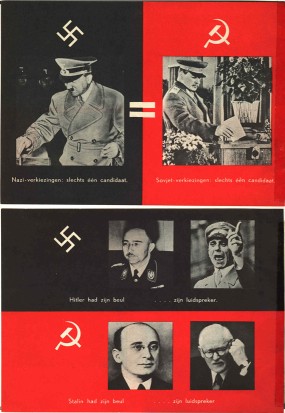 A document from the collection of Henri Max Corwin, equating Nazism with Stalinism. The death of Stalin in 1953 voided the simplistic totalitarian model of the police-state USSR as the epitome of the totalitarian state.[47] Starting from the 1970s, the 'revisionist' historians,[48] described as those who "insisted that the old image of the Soviet Union as a totalitarian state bent on world domination was oversimplified or just plain wrong" and focused not on typology of power, but social history,[49][9] such as Sheila Fitzpatrick began challenging the totalitarian paradigm; without denying the state violence by the government, these scholars argued that the Stalinist system could not and did not rule only through coercion and terror, and pointed to support within the population for many of Stalin's policies and argued that the party and state were often responsive to people's desires and values.[48] More to it, they examined the substantial differences of Stalinist and Nazi violence that inevitably put into question the attempt to gather Stalin's and Hitler's regimes into a single category which was presented by the concept of totalitarianism.[9] In 1999 the sociologists Randall Collins and David Waller grouped the concept of totalitarianism among the "theories that were completely wrong"; in Beyond Totalitarianism: Stalinism and Nazism Compared (2008), Fitzpatrick and Michael Geyer critically examined the concept of totalitarianism and made a very detailed comparison of similarities and substantial differences between Hitler and Stalin and made conclusion in agreement with the point of Collins and Waller.[50] Some historians who did not align themselves with the 'revisionist school' later openly stated that Stalinist system cannot be regarded as totalitarian. For example, the historian Robert Service in his biography of Stalin wrote that "this was not a totalitarian dictatorship as conventionally defined because Stalin lacked the capacity, even at the height of his power, to secure automatic universal compliance with his wishes."[51] Eric Hobsbawm wrote that although Stalin indeed wanted to achieve total control of the population, he did not establish an actual totalitarian system, what, as he said, "throws considerable doubt on the usefulness of the term."[52] According to Fitzpatrick, "totalitarian-model scholarship" - the USSR as a "top-down entity," a monolithic party grounded on ideology and ruling by terror over a passive society – "was in effect a mirror image of the Soviet self-representation, but with the moral signs reversed (instead of the party being always right, it was always wrong)."[9] A fact common to the revisionist-school interpretations of the reign of Stalin (1927–1953) was that the USSR was a country with weak social institutions, and that state terrorism against Soviet citizens indicated the political illegitimacy of Stalin's government:[47] to critics of totalitarian model state terror was a mark of a weak government, and J. Arch Getty wrote of a "technically weak and politically divided party whose organizational relationships seem more primitive than totalitarian", commenting the Smolensk Archive, and so, the criticism of accepted model began with labelling Stalinism as "inefficient totalitarianism", where the dictator had to rely on "shock methods" to counter the resistance of local autonomies and administrations and political factionalism within the apparatus (including its highest levels);[10] the citizens of the USSR were not devoid of personal agency or of material resources for living, nor were Soviet citizens psychologically atomized by the totalist ideology of the Communist Party of the Soviet Union[53]—because "the Soviet political system was chaotic, that institutions often escaped the control of the center, and that Stalin's leadership consisted, to a considerable extent, in responding, on an ad hoc basis, to political crises as they arose",[54] and many purges and forced collectivizations were local or even "popular initiatives which Stalin and his henchmen' could not control", while the people collectively resisted by such methods as refusing to work efficiently and migrating by the millions.[10] That the legitimacy of Stalin's régime of government relied upon the popular support of the Soviet citizenry as much as Stalin relied upon state terrorism for their support. That by politically purging Soviet society of anti–Soviet people Stalin created employment and upward social mobility for the post–War generation of working class citizens for whom such socio-economic progress was unavailable before the Russian Revolution (1917–1924). That the people who benefited from Stalin's social engineering became Stalinists loyal to the USSR; thus, the Revolution had fulfilled her promise to those Stalinist citizens and they supported Stalin because of the state terrorism.[53] The revisionists also conducted new comparative studies of the Third Reich and the USSR, but stressed substantial differences between them. Thus, fascisms lasted much shorter, but experienced cumulative radicalization until their collapse, while Stalinism arose in stabilized and pacified country and fell apart due to an internal crisis after a post-totalitarian period; fascism maintained traditional elites, while Stalinism was a result of revolution and radical social transformation; their ideologies were antipodal; totalitarian model likened "charismatic authorities" of Stalin and Hitler and Mussolini, but they were different: Hitler and Mussolini were popular figures of "providential men" who needed an almost physical contact with the followers and exemplified the totalitarian "New Man" with their bodies and behavior, while Stalin's cult is described as "afar", purely artificial and much more distant, and Stalin never merged with the people, always staying "hidden from his followers". Mass state violence was also different: Soviet violence was primarily internal, while that of the Nazis primarily external; the former was an ineffective and irrational means of a rational goal, modernization, while Nazis sought extremely irrational goals with rational industrial means; the efficiency of Soviet forced labor camps (Gulags) was measured by the authorities by practical results, like building train tracks, which would eventually lay a basis of modernity, while Nazism mobilized industry for extermination, and the efficiency of extermination camps was measured by the number of deaths. Thus, the revisionists have argued, both regimes committed inhumane mass violence, but their internal logic was fundamentally different.[9] In the case of East Germany, Eli Rubin posited that East Germany was not a totalitarian state but rather a society shaped by the confluence of unique economic and political circumstances interacting with the concerns of ordinary citizens.[55] |
スターリニズムに関する修正主義者たち アンリ・マックス・コーウィンのコレクションに含まれる、ナチズムとスターリニズムを同列に扱う文書。 1953年のスターリンの死により、警察国家としてのソ連を全体主義国家の典型とする単純化された全体主義モデルは、その妥当性を失った。[47] 1970年代以降、「修正主義」史家たち[48]――「世界支配を目論む全体主義国家としての旧来のソ連像は過度に単純化されているか、あるいは単に間 違っている」と主張し、権力の類型論ではなく社会史に焦点を当てた者たち―― [49][9] シーラ・フィッツパトリックら[48]は、全体主義のパラダイムに異議を唱え始めた。政府による国家暴力を否定することなく、これらの学者たちは、スター リン主義体制が強制と恐怖のみによって統治することはできず、またそうではなかったと論じ、スターリンの政策の多くに対する民衆の支持を指摘し、党と国家 はしばしば人々の願望や価値観に応えていたと主張した。[48] さらに、彼らはスターリン主義とナチズムの暴力における実質的な異なる点を検証し、それによって、全体主義という概念によって提示された、スターリンとヒ トラーの体制を単一のカテゴリーにまとめようとする試みを必然的に疑問視することとなった。[9] 1999年、社会学者のランドール・コリンズとデビッド・ウォーラーは、全体主義という概念を「完全に誤っていた理論」の一つに分類した。また、『全体主 義を超えて:スターリン主義とナチズムの比較』(2008年)において、フィッツパトリックとマイケル・ガイヤーは全体主義という概念を批判的に検証し、 ヒトラーとスターリンの類似点および実質的な相違点を極めて詳細に比較検討した上で、コリンズとウォーラーの見解に同意する結論を下した。[50] 「修正主義学派」に同調しなかった一部の歴史家も、後にスターリン体制を全体主義とは見なせないことを公然と表明した。例えば、歴史家のロバート・サービ スは、自身の著したスターリンの伝記の中で、「これは従来定義されるような全体主義的独裁体制ではなかった。なぜなら、スターリンには、権力の絶頂期に あっても、自らの意思に対して自動的かつ普遍的な服従を確保する能力が欠けていたからである」と記している。[51] エリック・ホブズボームは、スターリンが確かに国民の完全な支配を望んでいたものの、実際の全体主義体制を確立したわけではないと記し、それゆえ「この用 語の有用性には相当な疑問が投げかけられる」と述べた。[52] フィッツパトリックによれば、「全体主義モデルに基づく学説」――すなわち、ソ連を「トップダウン型の組織」、イデオロギーに根ざし、受動的な社会を恐怖 政治で支配する一元的な政党と見なす見方――は、「実質的にソ連の自己表象の鏡像であったが、道徳的な評価が逆転していた(党が常に正しいのではなく、常 に間違っているとされた)」[9]。スターリン統治期(1927–1953)に関する修正主義学派の解釈に共通する点は、ソ連が社会的制度の脆弱な国であ り、ソ連市民に対する国家テロリズムがスターリン政権の政治的正統性の欠如を示していたという点であった[47]。全体主義モデルを批判する者たちにとっ て、国家テロリズムは弱体な政府の証であり、J. アーチ・ゲッティは、スモレンスク文書館について論じ、「技術的に脆弱で政治的に分裂し、その組織関係は全体主義的というよりはむしろ原始的であるように 見える党」と記述した。こうして、定説に対する批判は、スターリン主義を「非効率的な全体主義」とレッテル貼りすることから始まった。そこでは、独裁者は 地方の自治組織や行政機関の抵抗、および機構内部(最高レベルを含む)の政治的派閥争いに対抗するために、「衝撃的手法」に頼らざるを得なかった。 [10] ソ連の市民は、個人的な主体性や生活のための物質的資源を欠いていたわけではなく、またソ連共産党の全体主義的イデオロギーによって心理的に分断されてい たわけでもなかった[53]――なぜなら、「ソ連の政治体制は混沌としており、制度はしばしば中央の統制を逃れ、スターリンの指導は、かなりの程度におい て、発生した政治的危機にその都度対応することから成り立っていた」からである [54]。また、多くの粛清や強制集団化は地方レベルで行われたものであり、さらには「スターリンとその手下たちが制御できなかった民衆の主導によるも の」でさえあった。一方、民衆は効率的な労働を拒否したり、数百万単位で移住したりといった方法で集団的に抵抗していた。[10] スターリン政権の正当性は、スターリンが国家テロリズムによって支持を得ていたのと同様に、ソ連市民の民衆的支持にも依存していた。スターリンは、反ソ連 的な人々をソ連社会から政治的に粛清することで、ロシア革命(1917–1924)以前にはそのような社会経済的進歩が得られなかった戦後の労働者階級の 世代に対して、雇用と社会的上昇の機会を創出した。スターリンの社会工学の恩恵を受けた人々は、ソ連に忠実なスターリン主義者となった。したがって、革命 はそうしたスターリン主義的市民に対する約束を果たし、彼らは国家テロリズムゆえにスターリンを支持したのだ。[53] 修正主義者たちは第三帝国とソ連に関する新たな比較研究も行ったが、両者の間には実質的な異なる点があると強調した。すなわち、ファシズムは存続期間がは るかに短かったものの、崩壊に至るまで漸進的な過激化をたどったのに対し、スターリン主義は安定し平定された国で台頭し、ポスト全体主義期を経て内部危機 によって崩壊した。ファシズムは伝統的なエリート層を維持したのに対し、スターリン主義は革命と急進的な社会変革の結果であった。両者のイデオロギーは正 反対であった。全体主義モデルはスターリン、ヒトラー、ムッソリーニの「カリスマ的権威」を類似したものとして捉えたが、彼らは異なる: ヒトラーとムッソリーニは、支持者とのほぼ身体的な接触を必要とし、その身体と行動によって全体主義的な「新人間」を体現した「天命を受けた人物」として の人気者であったのに対し、スターリンの個人崇拝は「遠く離れた」、純粋に人工的で遥かに距離のあるものと描写されており、スターリンは決して民衆と融合 することはなく、常に「支持者から隠れた」ままであった。大規模な国家による暴力も異なる。ソ連の暴力は主に国内向けであったのに対し、ナチスの暴力は主 に国外向けであった; 前者は合理的な目標である近代化を達成するための、非効率的で非合理的な手段であったのに対し、ナチスは合理的な産業的手段を用いて極めて非合理的な目標 を追求した。ソ連の強制労働収容所(グラーグ)の効率性は、鉄道線路の建設といった実質的な成果によって当局によって測定され、それは最終的に近代化の基 盤を築くものだった。一方、ナチズムは絶滅のために産業を動員し、絶滅収容所の効率性は死者数によって測定された。したがって、修正主義者たちは、両体制 とも非人道的な大量暴力を行使したが、その内部論理は根本的に異なるものであったと主張してきた。[9] 東ドイツの場合、イーライ・ルービンは、東ドイツは全体主義国家ではなく、むしろ、独特な経済的・政治的状況と一般市民の関心事が相互作用して形成された社会であったと論じた。[55] |
Nazism and Fascism Otto Schumann, Arthur Seyss-Inquart and Fritz Schmidt award a sportswoman with a portrait of Adolf Hitler. Enzo Traverso and Andrew Vincent point out that the "totalitarian approach" or the theoretical concept of totalitarianism, which presented the idea of a monolithic party, no separation between state and society, and total mobilization of the atomized masses and total control over the state, society and economy, is not applicable not only to the USSR, but also to Nazi Germany and Fascist states as well, since it also did not present a monolithic structure exercising total control over society, but on the contrary, that Nazi bureaucracy was highly "chaotic", anomic and disorganized and disunited, and that Adolf Hitler was a "weak dictator" and a "laissez-faire leader", as said by such historians as Hans Mommsen and Ian Kershaw;[9][10] this description of Nazi Germany was first introduced in 1942 by Franz Leopold Neumann in the work Behemoth: The Structure and Practice of National Socialism, where he provocatively presented Hitlerism as "a Behemoth, a non-state, a chaos, a rule of lawlessness, disorder, and anarchy", and later entered historiography of Nazism. In the 1970s, the German historians of functionalist school presented Nazism as a "polycratic" system grounded on different centers of power – the Nazi party, the army, the economic elites, and the state bureaucracy; to such historians, totalitarian monolithic state and party were just a facade (similarly to Fitzpatrick's assessment of Stalinism).[9][11] Historians like Mommsen and Ian Kershaw were critical of concepts of totalitarianism and focused on lack of bureaucratic coherence in the Nazi system and on its immanent tendency towards self-destruction. Michael Mann wrote that these descriptions doubted theories of totalitarianism, since "anything less like the rigid top-down bureaucracy of totalitarian theory is hard to imagine", but that Stalinism and Nazism "belong together", and that "it is only a question of finding the right family name". According to Mann, "totalitarian theorists depicted an unreal level of coherence for any state. Modern states are a long way short of Hegelian or Weberian rational bureaucracy and they rarely act as singular, coherent actors. Normally regimes are factionalized; in an unpredictable world they stumble along with many foul-ups. Second, we should remember Weber's essential point about bureaucracy: it kept politics out of administration. Political and moral values ('value rationality') were settled outside of bureaucratic administration, which then limited itself to finding efficient means of implementing those values ('formal rationality'). Contrary to totalitarian theory, the twentieth-century states most capable of such formally rational bureaucracy were not the dictatorships but the democracies."[10] The concept of totalitarianism appeared in the debates among German historians and public intellectuals which is known as the Historikerstreit, in which one of the parties defended the idea of exceptionalism of Nazism, while their conservative opponents believed that the Third Reich may be explained through comparison with the USSR; at the same time, such conservative historians as Karl-Dietrich Bracher and Klaus Hildebrand rejected the notion of Nazism as a branch of generic fascism, on the grounds that the uniqueness of Nazism lay in the person and ideology of Hitler and that Nazism was defined primarily by Hitler's personality and personal beliefs rather than by any external factors.[56] Stanley Payne wrote that indeed, both Mussolini and Hitler failed to achieve full totalitarianism, and of Mussolini it was said that his regime was not totalitarian (excluding "merely fascist" Italy from totalitarian regimes, started by Hannah Arendt who also thought that Nazism became totalitarian only in 1938–1942, is a not unpopular but contested position in contemporary historiography[18]), so Payne concludes that "only a socialist or Communist system can achieve full totalitarianism, since total control requires total institutional revolution that can only be effected by state socialism" (according to Payne, both Lenin and Stalin were totalitarian). Payne writes that "it is easy to argue either that many different kinds of regimes are totalitarian or conversely that none were perfectly total", yet, he writes that the concept "totalitarianism is both valid and useful if defined in the precise and literal sense of a state system that attempts to exercise direct control over all significant aspects of all major national institutions."[57] |
ナチズムとファシズム オットー・シューマン、アルトゥール・ザイス=インクヴァルト、フリッツ・シュミットが、ある女性スポーツ選手にアドルフ・ヒトラーの肖像画を贈呈している。 エンツォ・トラヴェルソとアンドルー・ヴィンセントは、「全体主義的アプローチ」、すなわち、一元的政党、国家と社会の分離の欠如、細分化された大衆の全 面的な動員、そして国家・社会・経済に対する完全な統制という概念を提示した全体主義の理論的枠組みは、ソ連だけでなく、 ナチス・ドイツやファシスト国家にも当てはまらないと指摘している。というのも、それらもまた社会を完全に支配する一元的構造を呈していたわけではなく、 それどころか、ナチスの官僚機構は極めて「混沌」としており、規範を欠き、組織化されておらず、結束もなかった。また、ハンス・モムゼンやイアン・カー ショウといった歴史家たちが述べているように、アドルフ・ヒトラーは「弱い独裁者」であり、「放任主義的な指導者」であったからである; [9][10] ナチス・ドイツに関するこの描写は、1942年にフランツ・レオポルド・ノイマンが著書『ビヒモス:国家社会主義の構造と実践』で初めて提示したもので、 彼はそこで挑発的にヒトラー主義を「ビヒモス、非国家、混沌、無法、無秩序、そして無政府状態」として描き、後にナチズムの歴史学に定着した。1970年 代、機能主義学派のドイツ人歴史家たちは、ナチズムを、ナチ党、軍、経済エリート、国家官僚機構といった異なる権力中枢に根ざした「多頭制」のシステムと して提示した。こうした歴史家たちにとって、全体主義的な一元的な国家と党は、単なる表向きの装いに過ぎなかった(フィッツパトリックによるスターリン主 義の評価と同様に)。[9][11] モムゼンやイアン・カーショウのような歴史家たちは、全体主義という概念に批判的であり、ナチ体制における官僚機構の整合性の欠如や、その内在的な自滅傾 向に焦点を当てた。マイケル・マンは、こうした記述が全体主義理論に疑問を呈するものであると記した。というのも、「全体主義理論が想定するような硬直的 なトップダウン型の官僚制に似ていないものを想像するのは難しい」一方で、スターリン主義とナチズムは「同一のカテゴリーに属する」ものであり、「適切な 分類名を見つけるだけの問題に過ぎない」からである。マンによれば、「全体主義理論家たちは、いかなる国家にとっても非現実的なレベルの整合性を描き出し ていた。近代国家は、ヘーゲルやウェーバーが想定する合理的な官僚制には程遠く、単一で首尾一貫した主体として振る舞うことはめったにない。通常、政権は 派閥に分裂しており、予測不可能な世界の中で、多くの失態を犯しながらもたつきながら進んでいるのだ。第二に、官僚制に関するウェーバーの核心的な指摘を 忘れてはならない。すなわち、官僚制は政治を行政から切り離したということだ。政治的・道徳的価値観(「価値合理性」)は官僚的行政の外で決定され、行政 はそれらの価値観を実行に移すための効率的な手段(「形式的合理性」)を見出すことに限定された。全体主義理論とは対照的に、20世紀において、このよう な形式的に合理的な官僚制を最も実現できた国家は、独裁政権ではなく民主主義国家であった。」[10] 全体主義という概念は、「歴史家論争(Historikerstreit)」として知られるドイツの歴史家や公共知識人たちの議論の中で登場した。この論 争では、一方の陣営がナチズムの例外性を主張したのに対し、保守派の反対派は、第三帝国はソ連との比較を通じて説明できると信じていた; 同時に、カール=ディートリヒ・ブラッハーやクラウス・ヒルデブランドといった保守派の歴史家たちは、ナチズムの独自性はヒトラーという人格とそのイデオ ロギーにあり、ナチズムは外部要因ではなく、主にヒトラーの個性と個人的信念によって定義されるという理由で、ナチズムを一般的なファシズムの一派とする 見解を拒否した。[56] スタンリー・ペインは、実際、ムッソリーニもヒトラーも完全な全体主義を実現できなかったと記している。また、ムッソリーニについては、その政権は全体主 義的ではなかったとされた(「単なるファシスト」であるイタリアを全体主義体制から除外するという見解は、ハンナ・アーレントによって提唱されたものであ り、彼女はナチズムが全体主義となったのは1938年から1942年の間だけだと考えていたが、これは現代の歴史学において、決して少数派ではないもの の、議論の余地のある立場である[18])。そこでペインは、「完全な全体主義を実現できるのは社会主義または共産主義体制のみである。なぜなら、完全な 統制には、国家社会主義によってのみ実現可能な、制度的な全面革命が必要だからだ」と結論づけている(ペインによれば、レーニンもスターリンも全体主義者 であった)。ペインは、「多くの異なる種類の体制が全体主義的であると主張することも、逆に、完全に全体主義的な体制は一つもなかったと主張することも容 易である」と記している。しかし、彼は、「全体主義という概念は、すべての主要な国家機関のあらゆる重要な側面に対して直接的な統制を行おうとする国家体 制という、正確かつ文字通りの意味で定義されるならば、妥当かつ有用である」と述べている[57]。 |
| Further debates 1980s - 1990s  An 'anti-totalitarian' graffiti in Bucharest, Romania, in 2013, equating Communism with Nazism and Iron Guard Writing in 1987, Walter Laqueur dismissed the arguments of revisionists as "reappraisals of Stalin and Stalinism" and compared them with German 'revisionist' historians of Nazism, particularly Ernst Nolte, whom he did not distinguish from functionalist historians of Nazism ("weak dictator" thesis), and called their analysis "Marxist", for which Stalin was "not promising material".[58] As Laqueur wrote, the historians who disagreed with the revisionists "still ha[d] very strong feelings" towards Stalinism and found concepts such as modernization inadequate tools for explaining Soviet history, unlike the concept of totalitarianism; citing Mikhail Gorbachev using the term "totalitarianism", Laqueur wrote that the efforts of the revisionists to abolish the totalitarian model "ha[d] become difficult."[59] Laure Neumayer posited that "despite the disputes over its heuristic value and its normative assumptions, the concept of totalitarianism made a vigorous return to the political and academic fields at the end of the Cold War".[60] In 1978, the term was 'revived' in Western Europe: such historians as François Furet produced 'revisionist' critical re-evaluations of the French Revolution which, according to them, led to the emergence of totalitarianism, while in Italy, "anti-anti-Fascist" historians, notably Renzo De Felice and after him Emilio Gentile, challenged the 'myth' produced by the hegemonic role of the Communists in the Italian resistance, stated that the choice between Fascism and Communism was equal for Italy, and implied that the latter could be even worse, what led to the resurgence of the concept of totalitarianism as a new dimension of studies of Fascism, while the ones who doubted their theories were "swept away" with the collapse of the Eastern Bloc between 1989 and 1991. The 'revival' of the concept which started in the 1970s in Europe took some time to re-appear in English-language literature, as the 'revisionists' achieved hegemony in the academy, while the 'totalitarians' retained control over public discourse; the European debates were transferred to English-language historiography by Martin Malia. In 1995,[61] Furet made a comparative analysis[62] and used the term totalitarian twins to link Nazism and Stalinism.[63][64][65] Pipes and Malia continued depicting ideological developments as the grounds of communism, and thus, totalitarianism, drawing a line from utopianism and the French Revolution, which Pipes compared to a "virus", to Lenin, and to describe the nature of totalitarianism, they used the concept of ideocracy. Furet and Ernst Nolte, a historian praised by Furet, also identified anti-Fascism as Communist totalitarianism; Nolte presented a conflict between totalitarianisms as European Civil War, stating that it was begun by Bolshevism and produced Nazism, an "inverted Bolshevism", thus assessing the latter as only a response to the threat of Bolshevism and the Holocaust and Operation Barbarossa as "both a retaliation and a preventive measure" against Bolshevism. Another major work belonging to the same period was The Black Book of Communism (1997), the editor of which, Stephane Courtois, stressed structural homology of totalitarian systems embodied in identity of "class genocide" of Communism and "race genocide" of Nazism, and concluded that Communism was more murderous than Nazism[9][66] or any other ideology from counting and summing the number of victims that can be attributed to 'Communist states' and thus communism in general, what triggered an emotional debate in France on whether Communism should be treated as a single unified phenomena and whether "a blanket condemnation" of Communism as an ideology makes sense.[67] While Nolte and the historians supporting him were not victorious in the Historikerstreit, but his influence on Furet and the historians outside Germany legitimized his ideas, and they returned to Germany in other forms, what thus led to the resurgence of the concept in Germany. The concept entered historiography in Eastern Europe, in former countries of the Eastern Bloc, describing not only Stalinism, but the whole Communist project in general[61] along with the "Double genocide theory", a form of Holocaust trivialization which summarized Nazi and Stalinist violence into a single metanarrative and became an influential framework of interpretation.[67] Furet's totalitarian interpretation of the French Revolution, directed against the classic "Marxist" or "Jacobin" interpretation, triggered debates with such historians as Michel Vovelle, who led new studies on it; as Eric Hobsbawm concluded in 2007, "the Furet Revolution" was "now over".[68] In regards to Furet's ideas on the 20th century, Hobsbawm wrote that "[Nazism and Stalinism] were functionally and not ideologically derived [...] Furet, as a distinguished historian of ideas, knows that they belonged to different if structurally convergent taxonomic families"; contrary to conception of anti-Fascism as a mask of Stalinism, Hobsbawm attributed the "alliance" between liberalism and communism, which had enabled capitalism to overcome its crisis, and wrote that Furet's work "reads like a belated product of the Cold War era".[69][70] Historians Enzo Traverso and Arno J. Mayer and the author Domenico Losurdo accepted Nolte's concept of the "European Civil War", although set its beginning to 1914 and differently interpreted it, not in terms of struggle between two totalitarianisms.[71] Michael Parenti (1997) and James Petras (1999) have suggested that the totalitarianism concept has been politically employed and used for anti-communist purposes. Parenti has also analysed how "left anti-communists" attacked the Soviet Union during the Cold War.[72] For Petras, the CIA funded the Congress for Cultural Freedom to attack "Stalinist anti-totalitarianism."[73] According to some scholars and authors, such as Domenico Losurdo calling Joseph Stalin totalitarian instead of authoritarian has been asserted to be a high-sounding but specious excuse for Western self-interest, just as surely as the counterclaim that allegedly debunking the totalitarian concept may be a high-sounding but specious excuse for Russian self-interest. For Losurdo, totalitarianism is a polysemic concept with origins in Christian theology and applying it to the political sphere requires an operation of abstract schematism which makes use of isolated elements of historical reality to place fascist regimes and the Soviet Union in the dock together, serving the anti-communism of Cold War-era intellectuals rather than reflecting intellectual research.[74] |
さらなる議論 1980年代~1990年代 2013年、ルーマニアのブカレストで見られた「反全体主義」の落書き。共産主義をナチズムや鉄の衛兵と同列に扱っている 1987年の著作において、ウォルター・ラッカーは修正主義者たちの主張を「スターリンとスターリン主義の再評価」として一蹴し、それらをナチズムに関す るドイツの「修正主義」歴史家、特にエルンスト・ノルテと比較した。彼はノルテを、ナチズムの機能主義的歴史家(「弱き独裁者」説)と区別せず、彼らの分 析を「マルクス主義的」と呼び、その観点からスターリンは「有望な素材ではない」と述べた。[58] ラッカーが記したように、修正主義者に反対する歴史家たちは、スターリン主義に対して「依然として非常に強い感情を抱いており」、全体主義という概念とは 異なり、近代化といった概念はソ連の歴史を説明するための不十分な手段であると考えていた。ミハイル・ゴルバチョフが「全体主義」という用語を用いたこと を引用し、ラッカーは、修正主義者たちが全体主義モデルを廃止しようとする試みは「困難なものとなっていた」と記した。[59] ローレ・ノイマイヤーは、「その発見的価値や規範的前提をめぐる論争にもかかわらず、全体主義という概念は冷戦の終結とともに、政治および学術の分野に力 強く復活した」と指摘した。[60] 1978年、この用語は西ヨーロッパで「復活」した。フランソワ・フュレら歴史家は、フランス革命について「修正主義的」な批判的再評価を行い、彼らによ れば、それが全体主義の台頭につながったとされる。一方、イタリアでは、「反反ファシスト」派の歴史家、特にレンツォ・デ・フェリーチェ、そしてその後を 継いだエミリオ・ジェンティーレが、イタリアのレジスタンスにおける共産党の覇権的役割が生み出した「神話」に異議を唱え、 彼らは、イタリアにとってファシズムと共産主義の選択は同等であり、後者の方がさらに悪質である可能性さえあると示唆した。これが、ファシズム研究の新た な側面として全体主義という概念の復活につながった。一方、彼らの理論に疑問を呈した者たちは、1989年から1991年にかけての東側陣営の崩壊ととも に「一掃」された。1970年代にヨーロッパで始まったこの概念の「復活」が、英語圏の文献に再び登場するまでには時間を要した。これは、学界では「修正 主義者」がヘゲモニーを握っていた一方で、公的な言説においては「全体主義論者」が支配力を維持していたためである。ヨーロッパでの議論は、マーティン・ マリアによって英語圏の歴史学へと持ち込まれた。1995年[61]、フュレは比較分析[62]を行い、「全体主義の双子」という用語を用いてナチズムと スターリニズムを結びつけた[63][64]。[65] パイプスとマリアは、共産主義、ひいては全体主義の根拠としてイデオロギー的展開を描き続け、ユートピア主義やフランス革命(パイプスはこれを「ウイル ス」に例えた)からレーニンへと一線を引いた。また、全体主義の本質を説明するために、彼らは「イデオクラシー」という概念を用いた。フュレと、フュレが 称賛した歴史家エルンスト・ノルテもまた、反ファシズムを共産主義的全体主義と同定した; ノルテは、全体主義間の対立を「ヨーロッパ内戦」として提示し、それがボルシェヴィズムによって引き起こされ、「逆転したボルシェヴィズム」であるナチズ ムを生み出したと述べた。したがって、彼はナチズムをボルシェヴィズムの脅威に対する単なる反応と評価し、ホロコーストおよびバルバロッサ作戦を、ボル シェヴィズムに対する「報復であり、予防措置でもある」ものと位置づけた。同時期に発表されたもう一つの主要な著作は『共産主義の黒書』(1997年)で あり、その編集者であるステファン・クルトワは、共産主義の「階級ジェノサイド」とナチズムの「人種ジェノサイド」の同一性に体現される全体主義体制の構 造的同質性を強調し、共産主義はナチズムよりも殺戮的であったと結論づけた [9][66] あるいは他のいかなるイデオロギーよりも殺戮的であると結論づけた。これは、「共産主義国家」、ひいては共産主義全般に帰属させられる犠牲者の数を集計・ 合計した結果によるものであり、フランスでは、共産主義を単一の統一された現象として扱うべきか、またイデオロギーとしての共産主義に対する「一概な非 難」が妥当であるか否かについて、感情的な議論を巻き起こした。[67] ノルテや彼を支持する歴史家たちは「歴史家論争」では勝利を収めなかったものの、フュレやドイツ国外の歴史家たちへの影響を通じて彼の思想は正当化され、 それらは別の形でドイツに持ち帰られ、その結果、ドイツにおいてこの概念が再浮上することとなった。この概念は、東欧や旧東側諸国の歴史学にも導入され、 スターリン主義だけでなく、共産主義プロジェクト全体[61]を記述するようになった。これには「二重のジェノサイド説」も含まれており、これはホロコー ストを軽視する一形態として、ナチスとスターリン主義の暴力を単一のメタナラティブに集約し、影響力のある解釈の枠組みとなった。[67] フュレによるフランス革命の全体主義的解釈は、従来の「マルクス主義的」あるいは「ジャコバン的」解釈に対抗するものであり、ミシェル・ヴォヴェルといっ た歴史家との論争を引き起こし、彼らがこのテーマに関する新たな研究を主導することとなった。エリック・ホブズボームが2007年に結論づけたように、 「フュレ革命」は「今や終わった」のである。[68] 20世紀に関するフュレの思想について、ホブズボームは「[ナチズムとスターリン主義]はイデオロギー的にではなく、機能的に派生したものである [……]。卓越した思想史家であるフュレは、それらが構造的には収斂しつつも、異なる分類学的系統に属していたことを知っている」と記した; 反ファシズムをスターリニズムの仮面と見なす見解とは対照的に、ホブズボームは、資本主義がその危機を克服することを可能にした自由主義と共産主義の「同 盟」を指摘し、フュレの著作は「冷戦時代の遅れて生まれた産物のように読める」と記した。[69][70] 歴史家のエンツォ・トラヴェルソとアルノ・J・メイヤー、そして著者のドメニコ・ロスルードは、ノルテの「ヨーロッパ内戦」という概念を受け入れたが、そ の始まりを1914年と定め、二つの全体主義間の闘争という観点からは異なる解釈を示した。[71] マイケル・パレンティ(1997年)とジェームズ・ペトラス(1999年)は、全体主義という概念が政治的に利用され、反共産主義の目的のために用いられ てきたと指摘している。パレンティはまた、冷戦期に「左派の反共産主義者」がソ連をどのように攻撃したかについても分析している。[72] ペトラスによれば、CIAは「スターリン主義的反全体主義」を攻撃するために「文化の自由会議」に資金を提供した。[73] ドメニコ・ロスルードら一部の学者や著述家によれば、ヨシフ・スターリンを権威主義的ではなく全体主義的と呼ぶことは、西側の国益のための大仰だが虚偽の 口実であると主張されている。同様に、全体主義という概念を否定するとの反論もまた、ロシアの国益のための大仰だが虚偽の口実である可能性は確実だ。ロス ルードにとって、全体主義とはキリスト教神学に起源を持つ多義的な概念であり、これを政治領域に適用するには、歴史的現実の孤立した要素を利用してファシ スト政権とソ連を共に被告席に立たせるような抽象的な図式化が必要となる。これは、知的探究を反映するものではなく、冷戦時代の知識人たちの反共産主義に 奉仕するものである。[74] |
| After the 1990s After 1990s, criticisms of totalitarianism as a historical concept and a tool of analysis continued; however, while these critics called for expulsion of the concept from academic field, they stated that its legitimate outside it.[9] Hans Mommsen criticized it as "a descriptive concept, not a theory" with "little or no explanatory power": "But the basis of comparison is a shallow one, largely confined to the apparatus of rule." However, he wrote that "the totalitarianism concept allows comparative analysis of a number of techniques and instruments of domination, and this, too, must be seen as legitimate in itself", and that it is legitimate in "non-scholarly usage".[10] Enzo Traverso in his essay "Totalitarianism Between History and Theory" (2017) dismisses the term as "both useless and irreplaceable" for political science and academic history and cites Franz Leopold Neumann who called it a Weberian "ideal type", an abstraction that does not exist in reality as opposed to concrete totality of history, and believes it to be a term of abuse in Western political science and propaganda, he writes about its legitimacy for storing traumatic collective experience of the 20th century state violence: Thus, if the concept of totalitarianism continues to be criticized for its ambiguities, weaknesses, and abuses, it probably will not be abandoned. Beyond being a Western banner, it stores the memory of a century that experienced Auschwitz and Kolyma, the death camps of Nazism, the Stalinist Gulags, and Pol Pot's killing fields. There lies its legitimacy, which does not need any academic recognition.[9] In the essay, "Totalitarianism: Defunct Theory, Useful Word" (2010), the historian John Connelly said that totalitarianism is a useful word, but that the old 1950s theory about totalitarianism is defunct among scholars, because "The word is as functional now as it was fifty years ago. It means the kind of régime that existed in Nazi Germany, the Soviet Union, the Soviet satellites, Communist China, and maybe Fascist Italy, where the word originated. . . . Who are we to tell Václav Havel or Adam Michnik that they were fooling themselves when they perceived their rulers as totalitarian? Or, for that matter, any of the millions of former subjects of Soviet-type rule who use the local equivalents of the Czech [word] totalita to describe the systems they lived under before 1989? [Totalitarianism] is a useful word, and everyone knows what it means as a general referent. Problems arise when people confuse the useful descriptive term with the old 'theory' from the 1950s."[75] |
1990年代以降 1990年代以降も、歴史的概念および分析ツールとしての全体主義に対する批判は続いた。しかし、こうした批判者たちは、学術分野からこの概念を排除する よう求めた一方で、学術分野の外ではその概念が正当であると述べた。[9] ハンス・モムゼンは、全体主義を「理論ではなく記述的概念」であり、「説明力はほとんど、あるいはまったくない」として批判した: 「しかし、その比較の根拠は浅薄であり、主に統治機構に限定されている。」とはいえ、彼は「全体主義という概念は、支配のための数多くの技法や手段の比較 分析を可能にするものであり、これ自体もまた正当なものとして見なされなければならない」と記し、また「学術的ではない用法」においては正当であると述べ た。[10] エンツォ・トラヴェルソは、エッセイ『歴史と理論の間の全体主義』(2017年)において、この用語を政治学や学術的な歴史研究にとって「無用であると同 時にかけがえのないもの」として退け、フランツ・レオポルド・ノイマンを引用している。ノイマンはこれをウェーバー的な「理想型」と呼び、 現実には存在しない抽象概念であり、歴史の具体的な全体性とは対照的であると指摘したフランツ・レオポルド・ノイマンを引用し、西洋の政治学やプロパガン ダにおいては蔑称であると見なしている。しかし、20世紀の国家による暴力というトラウマ的な集団的経験を記憶に留める上での正当性については、次のよう に述べている: したがって、全体主義という概念が、その曖昧さ、弱点、乱用について批判され続けたとしても、おそらく放棄されることはないだろう。それは単なる西洋の旗 印であるだけでなく、アウシュヴィッツやコリマ、ナチズムの死の収容所、スターリン主義のグラーグ、ポル・ポトのキリング・フィールドを経験した一世紀の 記憶を宿している。そこにこそ、いかなる学術的承認をも必要としない、その正当性があるのだ。[9] 歴史家ジョン・コネリーはエッセイ『全体主義:廃れた理論、有用な言葉』(2010年)の中で、全体主義は有用な言葉であるものの、1950年代の全体主 義に関する古い理論は学者の間では廃れたものであると述べた。その理由は、「この言葉は50年前と変わらず、現在も機能しているからだ。この言葉は、ナチ ス・ドイツ、ソビエト連邦、その衛星国、共産主義中国、そしておそらくこの言葉が生まれたファシスト・イタリアに存在したような体制を指す……。ヴァーツ ラフ・ハヴェルやアダム・ミフニクが、自分たちの支配者を全体主義的だと見なしていたのは自己欺瞞だったと、我々に誰が言えるだろうか。あるいは、 1989年以前にソ連型支配下に置かれていた何百万人もの元被支配者たちが、チェコ語の『トタリタ』に相当する現地の言葉で、自分たちが暮らしていた体制 を表現していることについても同様だ。[全体主義]は有用な言葉であり、一般的な指称としてその意味は誰もが知っている。問題は、人々がこの有用な記述用 語を、1950年代の古い「理論」と混同したときに生じるのだ。」[75] |
| Politics Early usages Self-description of autocracies The term "totalitarian" was used by leaders and top officials of right-wing and far-right dictatorships and autocracies established during the interwar period and World War II to describe their regimes—most notably by Benito Mussolini of Fascist Italy. Among the Soviet Union (USSR), Nazi Germany, and Fascist Italy, it became an official self-description only in the case of Fascist Italy; it was also used in Nazi Germany but to a lesser extent, and it was not used at all by the USSR—this pattern was later reversed by theorists of totalitarianism who viewed the USSR as a prime example. Therefore, the meaning of the term as used in the self-descriptions by fascists differed from its post-World War II interpretations.[76]  Facade of the Palazzo Braschi (Rome, 1934) with Il Duce Benito Mussolini's face. As the leader of Fascist Italy (1922–1943), Mussolini and his ideologues used the term 'totalitarian' to characterize his government. In 1923, early in the reign of Mussolini's government (1922–1943), the anti-fascist academic Giovanni Amendola defined and described totalitarianism as a form of government in which a supreme leader personally exercises total power (i.e., political, military, economic, and social) as Il Duce of the state. Italian fascism was a political system with an ideological, utopian worldview that was unlike the realistic politics of a personal dictatorship, which holds power for the sake of holding power.[5] The term "totalitarian" became used by Italian fascists themselves: later, theoretician of Italian fascism Giovanni Gentile ascribed politically positive meanings to the terms totalitarianism and totalitarian in defence of Duce Mussolini's legal, illegal, and legalistic social engineering of Italy. As ideologues, the intellectual Gentile and the politician Mussolini used the term totalitario to identify and describe the ideological nature of Italian societal structures and the practical economic, geopolitical, and social goals of the new Fascist Italy, which was the "total representation of the nation and total guidance of national goals."[77] In proposing the totalitarian society of Italian fascism, Gentile described a civil society wherein totalitarian ideology (i.e., subservience to the state) determined the public sphere and the private sphere of the Italian nation.[26] To achieve a fascist utopia, Italian totalitarianism needed to politicize human existence into state subservience, which Mussolini summarized with the epigram: "Everything within the state, nothing outside the state, nothing against the state."[5][78] Hannah Arendt, in her book The Origins of Totalitarianism, contended that Mussolini's dictatorship was not a totalitarian regime until 1938.[79] Arguing that one of the key characteristics of a totalitarian movement was its ability to garner mass mobilization, Arendt wrote: "While all political groups depend upon proportionate strength, totalitarian movements depend on the sheer force of numbers to such an extent that totalitarian regimes seem impossible, even under otherwise favorable circumstances, in countries with relatively small populations.... [E]ven Mussolini, who was so fond of the term "totalitarian state," did not attempt to establish a full-fledged totalitarian regime and contented himself with dictatorship and one-party rule."[80] For example, Victor Emmanuel III still reigned as a figurehead and helped play a role in the dismissal of Mussolini in 1943. Additionally, the Catholic Church was allowed to independently exercise its religious authority in the Vatican City, per the 1929 Lateran Treaty, under the leadership of Pope Pius XI (1922–1939) and Pope Pius XII (1939–1958).  A 1937 propaganda image featuring Francisco Franco and his motto Una patria! Un estado! Un caudillo! resembling the Nazi motto Ein Volk, ein Reich, ein Führer. During the Spanish Civil War, Franco proclaimed that his Spanish State would be modelled after "other countries of totalitarian regimes", these being Nazi Germany and Fascist Italy. As the Nazi Party rose to power in 1933, it began using the concept of a totalitarian state propagated by Mussolini and Carl Schmitt to characterize its ideal regime. Joseph Goebbels stated in a 1933 speech: "Our party has always aspired to the totalitarian state. […] the goal of the revolution [National Socialist] has to be a totalitarian state that penetrates into all spheres of public life."[37] However, the concept of totalitarianism was downplayed among Nazi ideologues, who preferred the term Volksstaat ('people's state' or 'racial state') to describe said regime.[9] José María Gil-Robles y Quiñones, the leader of Spanish Confederation of the Autonomous Right (CEDA),[81] declared his intention[when?] to "give Spain a true unity, a new spirit, a totalitarian polity". He went on to say: "Democracy is not an end but a means to the conquest of the new state. When the time comes, either parliament submits or we will eliminate it."[82] General Francisco Franco was determined to prevent the growth of competing right-wing parties in Spain, and CEDA was dissolved in April 1937. Later, Gil-Robles went into exile.[83] Franco began applying "totalitarian" to his regime during the Spanish Civil War (1936–1939). On 1 October 1936, he announced his intent to organize Spain "within a broad totalitarian concept of unity and continuity"; practical realization of this began with the forced unification of all parties of the Nationalist zone into FET y de las JONS, the sole governing party of the new state. Afterward, he and his ideologues stressed the similarly "missionary and totalitarian" nature of the state under construction vis-à-vis Nazi Germany and Fascist Italy, and totalitarianism was described as an essentially Spanish way of government. In December 1942, as World War II progressed, Franco stopped using the term, and it received a negative connotation as Franco called for a struggle with "Bolshevist totalitarianism."[37][84] Ioannis Metaxas, the leader of the 4th of August Regime in Greece, which took some inspiration from fascism, wrote[when?] in his diary that he had established "an anti-communist, anti-parliamentary state, a totalitarian state, a state based on agriculture and labour, and therefore anti-plutocratic". After the Italian and German invasions of Greece, he wrote that "by beating Greece, they were beating what their flag stood for."[85] Although Metaxas did not create a one-party state, he believed that the whole of the Greek people—the nation—constituted said party, excluding any real or hypothetical communists, reactionaries, or democrats.[86] Ion Antonescu, the Axis-aligned dictator of the Kingdom of Romania during World War II, described his regime as "ethnocratic" and "ethnic Christian" and as "the national-totalitarian regime, the regime of national and social restoration"—devoted to the ideology of an extreme Romanian nationalism and Romanian heritage. It enacted antisemitic and racist legislation and was active in perpetrating the Holocaust; however, in 1941, Antonescu dissolved the ruling party, the Iron Guard, denounced its terrorist methods, and continued his rule without a single-party system. The regime also spared half of resident Romanian Jews during its existence.[87][88] In 1940, then-foreign minister of the Empire of Japan Matsuoka Yosuke expressed in an interview the ideological assumptions prevailing within the Shōwa statist government: "In the battle between democracy and totalitarianism the latter adversary will without question win and will control the world. The era of democracy is finished and the democratic system bankrupt... Fascism will develop in Japan through the people's will. It will come out of love for the Emperor."[89] A document produced by the government's cabinet-planning board pointed out that, "since the founding of our country, Japan has had an unparalleled totalitarianism... an ideal totalitarianism is manifest in our national polity... Germany's totalitarianism has existed for only eight years, but Japanese [totalitarianism] has shone through 3,000 years of ageless tradition".[90] |
政治 初期の用法 独裁政権による自己表現 「全体主義」という用語は、戦間期および第二次世界大戦中に樹立された右翼および極右の独裁政権や専制政治の指導者や高官たちが、自らの体制を表現するた めに用いた。中でも特に顕著なのは、ファシスト・イタリアのベニート・ムッソリーニである。ソビエト連邦(USSR)、ナチス・ドイツ、ファシスト・イタ リアのうち、公式な自己表現として用いられたのはファシスト・イタリアのみであった。ナチス・ドイツでも使用されたが、その程度は比較的低く、ソビエト連 邦では全く使用されなかった。この傾向は、後にソビエト連邦を典型例と見なした全体主義理論家たちによって逆転することとなった。したがって、ファシスト たちによる自己表現において用いられたこの用語の意味は、第二次世界大戦後の解釈とは異なるものだった。[76] 「イル・ドゥーチェ」ベニート・ムッソリーニの顔が描かれたブラスキ宮殿(ローマ、1934年)のファサード。ファシスト・イタリア(1922年 ~1943年)の指導者として、ムッソリーニとそのイデオローグたちは、自らの政権を特徴づけるために「全体主義」という用語を用いた。 1923年、ムッソリーニ政権(1922–1943)の初期において、反ファシストの学者ジョヴァンニ・アメンダラは、全体主義を、最高指導者が国家の 「イル・ドゥーチェ」として、政治的、軍事的、経済的、社会的なあらゆる権力を個人的に掌握する統治形態であると定義し、説明した。イタリアのファシズム は、権力そのものを目的とする個人的独裁の現実主義的な政治とは異なり、イデオロギー的かつユートピア的な世界観を持つ政治体制であった。[5] 「全体主義的」という用語は、イタリアのファシストたち自身によっても使用されるようになった。その後、イタリア・ファシズムの理論家ジョヴァンニ・ジェ ンティーレは、ムッソリーニ総統によるイタリアへの合法的、非合法的、そして法理主義的な社会工学を擁護するため、全体主義および全体主義的という用語に 政治的に肯定的な意味を付与した。イデオローグとして、知識人であるジェンティーレと政治家であるムッソリーニは、「トータリタリオ」という用語を用い て、イタリアの社会構造のイデオロギー的性質、および「国民の完全な代表と国民目標の完全な指導」[77]である新たなファシスト・イタリアの実践的な経 済的、地政学的、社会的目標を特定し、描写した。イタリア・ファシズムの全体主義社会を提唱するにあたり、ジェンティーレは、全体主義的イデオロギー(す なわち国家への服従)がイタリア国民の公的領域と私的領域を決定づける市民社会を描写した。[26] ファシスト的ユートピアを実現するため、イタリアの全体主義は人間の存在を国家への服従へと政治化する必要があり、ムッソリーニはこれを次の警句で要約し た。「国家の内にはすべてあり、国家の外には何もなく、国家に敵対するものはない。」[5][78] ハンナ・アーレントは著書『全体主義の起源』において、ムッソリーニの独裁政権は1938年までは全体主義体制ではなかったと主張した。[79] 全体主義運動の重要な特徴の一つは、大衆動員を巻き起こす能力にあると論じ、アーレントは次のように記した: 「あらゆる政治団体が相応の勢力に依存している一方で、全体主義運動は数の圧倒的な力にこれほどまでに依存しているため、人口が比較的少ない国では、たと え他の条件が好ましい状況下であっても、全体主義体制の成立は不可能に思われる……。『「全体主義国家」という用語をこよなく好んだムッソリーニでさえ、 本格的な全体主義体制の確立には着手せず、独裁と一党支配に満足していた』[80] 例えば、ヴィットーリオ・エマヌエーレ3世は依然として名目上の君主として在位しており、1943年のムッソリーニ解任にも一役買った。さらに、1929 年のラテラン条約に基づき、カトリック教会は教皇ピウス11世(1922–1939)および教皇ピウス12世(1939–1958)の指導の下、バチカン 市国において独立して宗教的権威を行使することが認められていた。 1937年のプロパガンダ画像には、フランシスコ・フランコと、ナチスのモットー「Ein Volk, ein Reich, ein Führer(一つの民族、一つの帝国、一人の総統)」を彷彿とさせる彼のモットー「Una patria! Un estado! Un caudillo!(一つの祖国!一つの国家!一人の指導者!)」が掲げられている。スペイン内戦中、フランコは自らのスペイン国家を「他の全体主義体制 の国々」、すなわちナチス・ドイツとファシスト・イタリアをモデルにすると宣言した。 1933年にナチ党が権力を掌握すると、同党はムッソリーニやカール・シュミットが提唱した全体主義国家の概念を用い始め、自らの理想的な体制を特徴づけ るようになった。ヨーゼフ・ゲッベルスは1933年の演説で次のように述べた。「わが党は常に全体主義国家を志向してきた。[…] [国家社会主義]革命の目標は、公的生活のあらゆる領域に浸透する全体主義国家でなければならない。」[37] しかし、ナチスのイデオローグたちの間では、全体主義という概念は軽視され、彼らは当該体制を表すのに「フォルクスシュタット」(「人民国家」または「人 種国家」)という用語を好んで用いた。[9] スペイン自治右派連合(CEDA)の指導者ホセ・マリア・ギル=ロブレス・イ・キニョネス[81]は、「スペインに真の統一、新たな精神、全体主義的な政 治体制をもたらす」という意図を[いつ?]表明した。彼はさらに次のように述べた。「民主主義は目的ではなく、新しい国家を築くための手段に過ぎない。時 が来れば、議会が服従するか、さもなければ我々が議会を排除する」[82]。フランシスコ・フランコ将軍は、スペイン国内で競合する右派政党の台頭を阻止 する決意を固めており、CEDAは1937年4月に解散した。その後、ギル=ロブレスは亡命した[83]。 フランコはスペイン内戦(1936年~1939年)の最中に、自らの政権を「全体主義的」と称し始めた。1936年10月1日、彼は「統一と継続という広 範な全体主義的概念」の下でスペインを組織する意向を表明した。その実践的な実現は、ナショナリスト支配地域のすべての政党を、新国家の唯一の与党である FET y de las JONSへと強制的に統合することから始まった。その後、フランコとそのイデオローグたちは、ナチス・ドイツやファシスト・イタリアと比較して、建設中の 国家が同様に「宣教的かつ全体主義的」な性質を持つことを強調し、全体主義は本質的にスペイン的な統治形態であると説明された。1942年12月、第二次 世界大戦が進行する中、フランコはこの用語の使用をやめ、フランコが「ボルシェビキ的全体主義」との闘争を呼びかけたことで、この用語は否定的な意味合い を持つようになった。[37][84] ファシズムからある程度の影響を受けたギリシャの「8月4日体制」の指導者、イオアニス・メタクサスは、[いつ?]自身の日記に、自身が「反共産主義、反 議会主義の国家、全体主義国家、農業と労働に基づく国家、ひいては反財閥主義の国家」を樹立したと記した。イタリアとドイツによるギリシャ侵攻後、彼は 「ギリシャを打ち負かすことは、彼らの国旗が象徴するものを打ち負かすことだ」と記した。[85] メタクサスは一党独裁国家を築いたわけではないが、ギリシャ国民全体――すなわち国家――こそが当該政党を構成しており、実在する、あるいは想定される共 産主義者、反動派、民主主義者はすべて排除されるべきだと考えていた。[86] 第二次世界大戦中にルーマニア王国の独裁者として枢軸国に与したイオン・アントネスクは、自身の政権を「民族主義的」かつ「民族キリスト教的」であり、 「国家全体主義体制、すなわち国家的・社会的復興の体制」であると表現した――それは極端なルーマニアナショナリズムとルーマニアの伝統というイデオロ ギーに献身するものであった。同政権は反ユダヤ主義的かつ人種差別的な法律を制定し、ホロコーストの実行に積極的に関与したが、1941年、アントネスク は与党である「鉄の衛兵」を解散させ、そのテロリスト的な手法を非難し、一党制を採らずに統治を続けた。また、同政権は存続期間中、ルーマニア在住のユダ ヤ人の半数を救った。[87] [88] 1940年、当時の大日本帝国外務大臣・松岡洋介はインタビューの中で、昭和時代の国家主義政府内に支配的だったイデオロギー的前提を次のように述べた。 「民主主義と全体主義の戦いにおいて、後者の敵が疑いなく勝利し、世界を支配することになるだろう。民主主義の時代は終わり、民主主義体制は破綻した…… ファシズムは、国民の意志を通じて日本において発展するだろう。それは天皇への愛から生まれるものである。」[89] 政府の内閣企画局が作成した文書は、次のように指摘している。「建国以来、日本は比類なき全体主義を有してきた……理想的な全体主義はわが国の政治体制に 顕現している…… ドイツの全体主義はわずか8年間しか存在していないが、日本の[全体主義]は3,000年にわたる不朽の伝統を通じて輝き続けてきた」[90] |
| Criticism and analysis Leon Trotsky formulated a concept of totalitarianism in his analysis of the USSR in the 1930s. In the interwar period, totalitarianism emerged as a term used to criticize and analyze the dictatorships of the time. It was used to describe fascism and later became a ground for comparing fascist states to the Soviet Union; it was not understood as an element of a liberal–totalitarian dichotomy or as the inverse of liberal democracy.[9] By the 1930s, left-wing critics of Stalinism began applying the term to the Soviet state and using it in comparison to fascist states. Leon Trotsky was one of the first to do so,[91] producing perhaps the most famous example of such usage by a left-wing anti-Stalinist dissident.[92] The first to direct the term toward the USSR was writer and left-wing activist Victor Serge, who did so shortly before his arrest in a letter published in France. Also that year,[which?] Trotsky compared fascist and Soviet bureaucracies, describing both as parasitic, and later stated that "in the last period, the Soviet bureaucracy has familiarized itself with many traits of victorious fascism, first of all by getting rid of the control of the party and establishing the cult of the leader." In The Revolution Betrayed (1936), Trotsky used "totalitarian" to analyse the USSR, attributing to totalitarianism—rooted in "the dilatoriness of the world proletariat in solving the problems set for it by history"—such features as concentration of power in the hands of a single individual, the abolition of popular control over the leadership, the use of extreme repression, and the elimination of contending loci of power. Later,[when?] he included "the suppression of all freedom to criticize; the subjection of the accused to the military; examining magistrates, a prosecutor and judge in one; a monolithic press whose howlings terrorize the accused and hypnotize public opinion". Trotsky wrote[when?] that the USSR "had become totalitarian" in character several years before the word arrived from Germany. However, his concept was much less defined than those of the Cold War theorists, and he would have disagreed with their core points—e.g., that "central control and direction of the entire economy" applied to fascism—and would have rejected their tendency to depict totalitarian societies as politically monolithic and inherently static, as well as their anti-communist perspective and description of Lenin as a totalitarian dictator.[93] Scholars have argued that for him it was a pejorative, not a sociological concept based on equating fascism and socialism like it was for Cold War theorists.[94]  1938 satirical illustration "Carriers of the New Black Plague" by William Cotton; the caption mentions "Totalitarian Eclipse" threatening democracy. One of the uses of totalitarianism in English was by Austrian writer Franz Borkenau in his 1938 book The Communist International, in which he commented that it united the Soviet and German dictatorships more than it divided them.[95] The label totalitarian was twice affixed to Nazi Germany during Winston Churchill's speech of 5 October 1938 before the House of Commons of the United Kingdom, in opposition to the Munich Agreement, by which France and Great Britain consented to Nazi Germany's annexation of the Sudetenland.[96] Churchill was then a backbencher member of parliament representing the Epping constituency. In a radio address two weeks later, Churchill again employed the term, this time applying the concept to "a communist or a Nazi tyranny."[97] The concept gained legitimacy in 1939 with the Molotov–Ribbentrop Pact, after which it became accepted, at least until 1941, to present Stalin and Hitler as "twin dictators" and call Nazism "brown Bolshevism" and Stalinism "red fascism". The same year, scholars of various disciplines held the first international symposium on totalitarianism in Philadelphia.[98][22] The concept was abandoned in 1941 as the Third Reich invaded the USSR, and the latter became depicted in Western propaganda as a "valiant freedom-loving" ally in the war.[23] Among the major productions of pro-Stalinist Western propaganda was the film Mission to Moscow (1943), based on the 1941 book of the same name.[28] In the aftermath of the Second World War, in a lecture series (1945) and book (1946) titled The Soviet Impact on the Western World, the British historian E. H. Carr contended that "the trend away from individualism and towards totalitarianism [was] everywhere unmistakable" in the then-decolonising countries of Eurasia. He noted that revolutionary Marxism–Leninism was the most successful type of totalitarianism, as proved by the USSR's revolutionary rapid industrialization (1929–1941) and the Great Patriotic War (1941–1945) that defeated Nazi Germany. Despite those achievements in social engineering and warfare, in dealing with the countries of the communist bloc, only the "blind and incurable" ideologue could ignore the communist régimes' trend towards police-state totalitarianism.[99] Politically matured by having fought and been wounded in and survived the Spanish Civil War, in the essay "Why I Write" (1946), the democratic socialist George Orwell writes: "the Spanish war and other events in 1936–37 turned the scale and thereafter I knew where I stood. Every line of serious work that I have written since 1936 has been written, directly or indirectly, against totalitarianism and for democratic socialism, as I understand it." He argued that future totalitarian régimes would spy upon their societies and use mass communications media to perpetuate their dictatorships, and that "if you want a vision of the future, imagine a boot stamping on a human face—forever."[100] |
批判と分析 レオン・トロツキーは、1930年代のソ連に関する分析の中で、全体主義という概念を提唱した。 戦間期において、全体主義という用語は、当時の独裁体制を批判・分析するために用いられるようになった。当初はファシズムを形容するために用いられ、後に ファシスト国家とソビエト連邦を比較する根拠となった。この用語は、自由主義と全体主義の二分法の一要素として、あるいは自由民主主義の対極として理解さ れていたわけではない。[9] 1930年代になると、スターリン主義を批判する左翼勢力が、この用語をソビエト国家に適用し、ファシスト国家との比較に用いるようになった。レオン・ト ロツキーはそうした最初の人物の一人であり[91]、左派の反スターリン主義者によるこの用語の使用例としては、おそらく最も有名なものを生み出した [92]。この用語をソ連に向けて初めて用いたのは、作家であり左派活動家であるヴィクトル・セルジュであり、彼は逮捕される直前にフランスで発表された 書簡の中でそうした。またその年[どの年か?]、トロツキーはファシストの官僚機構とソビエトの官僚機構を比較し、両者を寄生的なものと描写した。その 後、彼は「最近の時期において、ソビエトの官僚機構は、勝利したファシズムの多くの特徴を身につけてきた。まず第一に、党の統制を排除し、指導者崇拝を確 立したことだ」と述べた。『裏切られた革命』(1936年)において、 トロツキーはソ連を分析する際に「全体主義」という用語を用い、「世界プロレタリアートが歴史によって課された問題を解決する上での遅滞」に根ざす全体主 義に、権力の単一個人への集中、指導部に対する大衆の統制の廃止、極端な弾圧の行使、対立する権力拠点の排除といった特徴を帰属させた。その後、[い つ?]彼は「あらゆる批判の自由の抑圧、被告の軍への服従、捜査判事、検察官、裁判官を兼ねた者、その咆哮が被告を恐怖に陥れ、世論を催眠状態に陥れる一 元的な報道機関」をその特徴に加えた。トロツキーは[いつ?]、この言葉がドイツから伝わってくる数年前から、ソ連はすでにその性格において「全体主義 的」になっていたと記した。しかし、彼の概念は冷戦期の理論家たちのものよりはるかに曖昧であり、彼は彼らの核心的な主張――例えば、「経済全体の集中管 理と指導」がファシズムにも当てはまるという主張――には反対しただろう。また、全体主義社会を政治的に一元的かつ本質的に静的であると描写する傾向や、 反共産主義的な視点、そしてレーニンを全体主義的独裁者と描写する点についても、彼は拒否したであろう。[93] 学者たちは、彼にとって「全体主義」は蔑称であり、冷戦期の理論家たちのようにファシズムと社会主義を同一視することに基づく社会学的概念ではなかったと 論じている。[94] 1938年のウィリアム・コットンによる風刺画『新たな黒死病の運び手たち』;キャプションには、民主主義を脅かす「全体主義の蝕」について言及されている。 英語で「全体主義」という用語が用いられた例の一つは、オーストリアの作家フランツ・ボルケナウによる1938年の著書『共産主義インターナショナル』で ある。同書の中で彼は、この用語がソ連とドイツの独裁体制を分断するよりもむしろ結びつけるものであると論じている。[95] 「全体主義」というレッテルは、1938年10月5日、ウィンストン・チャーチルが英国下院で行った演説の中で、ナチス・ドイツに対して2度付けられた。 この演説は、フランスと英国がナチス・ドイツによるズデーテン地方の併合に同意したミュンヘン協定に反対するものであった。[96] 当時、チャーチルはエッピング選挙区を代表する後列議員であった。2週間後のラジオ演説で、チャーチルは再びこの用語を用い、今度はその概念を「共産主義 あるいはナチスの専制政治」に適用した。[97] この概念は1939年のモロトフ=リッベントロップ協定によって正当性を獲得し、その後、少なくとも1941年までは、スターリンとヒトラーを「双子の独 裁者」として描き、ナチズムを「褐色のボルシェヴィズム」、スターリン主義を「赤のファシズム」と呼ぶことが一般に受け入れられるようになった。同年、様 々な分野の学者たちがフィラデルフィアで、全体主義に関する初の国際シンポジウムを開催した。[98] [22] 1941年、第三帝国がソ連に侵攻すると、この概念は放棄され、ソ連は西側のプロパガンダにおいて、戦争における「勇敢で自由を愛する」同盟国として描か れるようになった。[23] 親スターリン主義的な西側プロパガンダの主要な作品の一つに、1941年の同名小説を原作とする映画『モスクワへの使節』(1943年)がある。[28] 第二次世界大戦後、英国の歴史家E. H. カーは、『ソ連が西洋世界に与えた影響』(1945年の講演シリーズおよび1946年の著書)において、当時脱植民地化が進んでいたユーラシア諸国におい て、「個人主義から離れ、全体主義へと向かう傾向が至る所で紛れもなく見られた」と主張した。彼は、革命的なマルクス・レーニン主義こそが最も成功した全 体主義の形態であると指摘した。その証拠として、ソ連による革命的な急速な工業化(1929年~1941年)や、ナチス・ドイツを打ち破った大祖国戦争 (1941年~1945年)を挙げた。社会工学や戦争におけるこうした成果にもかかわらず、共産主義圏諸国を扱う上で、共産主義体制が警察国家的な全体主 義へと向かっている傾向を無視できるのは、「盲目的で救いようのない」イデオロギー信奉者だけだった。[99] スペイン内戦で戦い、負傷し、生き延びることで政治的に成熟した民主社会主義者のジョージ・オーウェルは、エッセイ『なぜ私は書くのか』(1946年)の 中で次のように書いている。「スペイン内戦や1936年から37年にかけてのその他の出来事が決定的な転機となり、それ以来、私は自分の立場を確信した。 1936年以降に私が書いた真剣な著作の一行一行は、直接的あるいは間接的に、全体主義に反対し、私が理解する民主的社会主義を支持するために書かれたも のである。」 彼は、将来の全体主義体制は社会を監視し、大衆通信メディアを利用して独裁体制を永続させるだろうと主張し、「未来の姿を想像したいなら、人間の顔を永遠 に踏みつけ続けるブーツを思い描けばよい」と述べた。[100] |
Cold War Anti-totalitarian: Hannah Arendt thwarted the totalitarian model Kremlinologists who sought to co-opt the thesis of The Origins of Totalitarianism (1951) as American anti–Communist propaganda that claimed that every Communist state was of the totalitarian model. In The Origins of Totalitarianism (1951), political theorist Hannah Arendt writes that, in their infancy in the early 20th century, corporatist Nazism and Soviet communism were novel forms of government, not updated versions of the old tyrannies of military or a corporate dictatorships. She argues that the human emotional comfort of political certainty is the source of the mass appeal of revolutionary totalitarian régimes, given that the totalitarian worldview offers psychologically comforting, definitive answers to the complex socio-political mysteries of the past, present, and future. Thus, Nazism proposed that all history is the history of ethnic conflict, of the survival of the fittest race. In contrast, Marxism–Leninism proposed that all history is the history of class conflict, of the survival of the fittest social class. Thus, upon the believers' acceptance of the universal applicability of totalitarian ideology, the Nazi revolutionary and the communist revolutionary then possessed the simplistic moral certainty with which to justify all other actions by the state, either by an appeal to historicism or by an appeal to nature, as expedient actions necessary to establish an authoritarian state apparatus.[101] True belief In The True Believer (1951), Eric Hoffer writes that political mass movements, such as Italian Fascism (1922–1943), German Nazism (1933–1945), and Russian Stalinism (1929–1953), featured the common political praxis of negatively comparing their totalitarian society as culturally superior to the morally decadent societies of democratic countries of Western Europe. Such mass psychology indicates that participating in and joining a political mass movement offers individuals the prospect of a glorious future, and that such membership in a community is an emotional refuge for those with few real-world accomplishments. The 'true believer', then, is assimilated into a collective body of other true believers who are psychologically protected with "fact-proof screens from reality" drawn from the official texts of the totalitarian ideology.[102] Collaborationism In a 2018 article titled "European Protestants Between Anti-Communism and Anti-Totalitarianism: The Other Interwar Kulturkampf?", historian Paul Hanebrink writes that Hitler's assumption of power in Germany in 1933 frightened Christians into anti-communism because, for European Christians—Catholic and Protestant alike—the culture war crystallized as a struggle against communism. Throughout the European interwar period (1918–1939), right-wing totalitarian régimes indoctrinated Christians into demonizing the communist régime in Russia as the apotheosis of secular materialism and as a militarized threat to worldwide Christian social and moral order.[103] Throughout Europe, Christians who became anti-communist totalitarians perceived communism and communist governments as existential threats to the moral order of their respective societies, and they collaborated with Nazi leadership and other fascists in the hope that anti-communism would restore the societies of Europe to a form of Christendom.[104] |
冷戦 反全体主義:ハンナ・アーレントは、すべての共産主義国家が全体主義モデルであるとする『全体主義の起源』(1951年)の論旨を、アメリカの反共産主義プロパガンダとして利用しようとしたクレムリン学者たちの企てを挫いた。 『全体主義の起源』(1951年)において、政治理論家のハンナ・アーレントは、20世紀初頭の黎明期において、コーポラティズム的なナチズムとソビエト 共産主義は、軍事独裁や企業独裁といった古い専制政治の改変版ではなく、斬新な統治形態であったと記している。彼女は、全体主義的世界観が過去・現在・未 来の複雑な社会政治的謎に対して、心理的に安らぎを与える決定的な答えを提供する以上、政治的な確実性から得られる人間の感情的な安らぎこそが、革命的な 全体主義体制が大衆に支持される源泉であると論じている。したがって、ナチズムは、すべての歴史は民族紛争の歴史であり、適者生存の歴史であると提唱し た。対照的に、マルクス・レーニン主義は、すべての歴史が階級闘争の歴史であり、最も適した社会階級の生存の歴史であると提唱した。したがって、信奉者た ちが全体主義的イデオロギーの普遍的な適用可能性を受け入れた時点で、ナチスの革命家も共産主義の革命家も、歴史主義への訴えか自然への訴えのいずれかに よって、権威主義的な国家機構を確立するために必要な便宜的な措置として、国家によるあらゆる他の行動を正当化するための単純化された道徳的確信を手にす ることになった。[101] 真の信念 『真の信者』(1951年)において、 エリック・ホッファーは、イタリアのファシズム(1922–1943)、ドイツのナチズム(1933–1945)、ロシアのスターリン主義 (1929–1953)といった政治的大衆運動には、自らの全体主義社会を、西ヨーロッパの民主主義諸国の道徳的に退廃した社会よりも文化的に優れている と否定的に比較するという共通した政治的実践が見られたと記している。このような大衆心理は、政治的大衆運動への参加や加入が個人に輝かしい未来の展望を もたらすこと、また、そのような共同体への所属が、現実世界での実績がほとんどない人々にとって感情的な避難所となることを示している。したがって、「真 の信者」は、全体主義イデオロギーの公式文書から導き出された「現実からの事実を遮断するフィルター」によって心理的に保護された、他の真の信者たちから なる集団に同化されるのだ。[102] 協力主義 2018年の論文「反共産主義と反全体主義の狭間にあるヨーロッパのプロテスタント:もうひとつの戦間期の文化闘争?」において、歴史家のポール・ハネブ リンクは、1933年のドイツにおけるヒトラーの権力掌握が、キリスト教徒を反共産主義へと駆り立てたと記している。なぜなら、ヨーロッパのキリスト教徒 ――カトリックもプロテスタントも同様に――にとって、文化闘争は共産主義に対する闘争として結晶化していたからである。ヨーロッパの戦間期(1918年 ~1939年)を通じて、右派の全体主義政権は、ロシアの共産主義体制を世俗的唯物論の極致であり、世界的なキリスト教的社会・道徳秩序に対するミリタリ ズム的な脅威であると見なすよう、キリスト教徒に洗脳した。[103] ヨーロッパ全土において、反共産主義の全体主義者となったキリスト教徒たちは、共産主義および共産主義政権を、それぞれの社会の道徳的秩序に対する存亡を 脅かす脅威と捉え、反共産主義によってヨーロッパ社会がキリスト教世界のような形態へと回復することを期待して、ナチス指導部やその他のファシストたちと 協力した。[104] |
| Totalitarian model In late-1950s American geopolitics, totalitarianism, totalitarian, and the "totalitarian model", from Carl Joachim Friedrich and Zbigniew Brzezinski's Totalitarian Dictatorship and Autocracy (1956), became common in U.S. foreign policy. The totalitarian model became a key paradigm for Kremlinology—the study of the USSR's police state. Kremlinologists analyzed internal politics (policy and personality) of the Politburo of the Communist Party of the Soviet Union to craft national and foreign policy, providing strategic intelligence about the USSR. The U.S. also used the model to approach fascist regimes, such as banana republics.[105] As anti-communist political scientists, Friedrich and Brzezinski described totalitarianism with a model of six interlocking, mutually supporting characteristics,[106] including: 1. An elaborate guiding ideology 2. A one-party state 3. Use of state terrorism 4. A monopoly on the control of weapons 5. A monopoly on the control of mass media 6. A centrally directed and controlled planned economy Criticism and evolution of the totalitarian model  The American political scientist Zbigniew Brzezinski popularized combating left-wing totalitarianism in U.S. foreign policy,[75] and he served as United States National Security Advisor to President Jimmy Carter.[28] As traditionalist historians, Friedrich and Brzezinski argued that the totalitarian régimes of the USSR (1917), Fascist Italy (1922–1943), and Nazi Germany (1933–1945) originated from political discontent in the socioeconomic aftermath of the First World War (1914–1918), which rendered impotent the government of Weimar Germany (1918–1933) to resist and quell extremist sentiment and actions of pro-totalitarian groups.[107] Revisionist historians[example needed] criticized the totalitarian model for its inability to fully describe Soviet and Russian history. They argued that Friedrich and Brzezinski overlooked how the Soviet social system functioned both as a political entity (the USSR) and as a social entity (Soviet civil society). This social system could be understood through socialist class struggles among professional elites—political, academic, artistic, scientific, and military—seeking upward mobility into the nomenklatura, the ruling class. Revisionists pointed out that the Politburo's political economy allowed for some executive power to be delegated to regional authorities for policy implementation. They viewed this as evidence that a totalitarian regime adapts its economy to new demands from civil society. Traditionalist historians, however, saw the USSR's political and economic collapse as proof that the totalitarian economic system failed because the Politburo did not incorporate genuine popular participation in the economy.[108] The historian of Nazi Germany Karl Dietrich Bracher noted that the "totalitarian typology" developed by Friedrich and Brzezinski was an inflexible one because it did not include the revolutionary dynamics of bellicose people committed to realizing the violent revolution required to establish totalitarianism in a sovereign state.[109] Bracher argued that the essence of totalitarianism is total control to remake every aspect of civil society using a universal ideology—which is interpreted by an authoritarian leader—to create a collective national identity by merging civil society into the state.[109] Given that the supreme leaders of the communist, fascist, and Nazi total states did possess government administrators, Bracher contends that a totalitarian government did not necessarily require an actual supreme leader, and could function by way of collective leadership. The American historian Walter Laqueur agreed that Bracher's totalitarian typology more accurately described the functional reality of the politburo than did the totalitarian typology proposed by Friedrich and Brzezinski.[110] |
全体主義モデル 1950年代後半のアメリカの地政学において、カール・ヨアヒム・フリードリヒとズビグニェフ・ブレジンスキーの著書『全体主義的独裁と専制政治』 (1956年)に由来する「全体主義」、「全体主義的」、「全体主義モデル」といった用語が、米国の外交政策において一般的になった。この全体主義モデル は、ソ連の警察国家を研究する「クレムリン学」の重要なパラダイムとなった。クレムリン学者たちは、ソ連共産党政治局の内部政治(政策と人物)を分析して 国内政策および外交政策を策定し、ソ連に関する戦略的情報を提供した。米国もまた、このモデルを用いて、いわゆる「バナナ共和国」のようなファシスト政権 に対処した。[105] 反共産主義の政治学者であるフリードリヒとブジェジンスキーは、相互に連動し、互いに補完し合う6つの特徴からなるモデルを用いて全体主義を説明した [106]。その特徴には以下が含まれる: 1. 精巧に構築された指導イデオロギー 2. 一党独裁体制 3. 国家テロリズムの行使 4. 武器の支配における独占 5. マスメディアの支配における独占 6. 中央から指導・統制される計画経済 全体主義モデルの批判と変遷 米国の政治学者ズビグニェフ・ブジェジンスキーは、米国の外交政策における左翼全体主義との闘いを広めた[75]。彼はジミー・カーター大統領の下で米国国家安全保障問題担当大統領補佐官を務めた[28]。 伝統主義的な歴史家として、フリードリヒとブジェジンスキーは、ソ連(1917年)、 ファシスト・イタリア(1922年~1943年)、ナチス・ドイツ(1933年~1945年)といった全体主義体制は、第一次世界大戦(1914年 ~1918年)後の社会経済的混乱に伴う政治的不満に端を発するものであり、その状況下ではワイマール共和国(1918年~1933年)政府は、全体主義 支持グループによる過激な感情や行動に抵抗し、鎮圧する力を失っていたと論じた。[107] 修正主義史家[例が必要]は、全体主義モデルがソ連およびロシアの歴史を完全に説明できないとして批判した。彼らは、フリードリヒとブジェジンスキーが、 ソ連の社会システムが政治的実体(ソ連)としても社会的実体(ソ連の市民社会)としても機能していたという点を看過していたと主張した。この社会システム は、支配階級であるノメンクラトゥーラへの昇進を目指す、政治・学術・芸術・科学・軍事の各分野の専門的エリート層の間で繰り広げられる社会主義的な階級 闘争を通じて理解することができた。修正主義者たちは、政治局の政治経済体制において、政策実施のために一部の執行権限が地方当局に委譲されていた点を指 摘した。彼らはこれを、全体主義体制が市民社会からの新たな要求に応じて経済を適応させている証拠と見なした。しかし、伝統主義的な歴史家たちは、ソ連の 政治的・経済的崩壊を、政治局が経済への真の民衆参加を取り入れなかったために、全体主義的経済体制が失敗した証拠と見なした。[108] ナチス・ドイツの歴史家カール・ディートリヒ・ブラッハーは、フリードリヒとブジェジンスキーが提唱した「全体主義の類型論」は、主権国家において全体主 義を確立するために必要な暴力革命の実現に献身する好戦的な人々の革命的ダイナミクスを含んでいないため、柔軟性に欠けるものであると指摘した。 [109] ブラッハーは、全体主義の本質とは、権威主義的な指導者によって解釈される普遍的なイデオロギーを用いて市民社会のあらゆる側面を再構築し、市民社会を国 家に統合することで集団的な国民的アイデンティティを創出するための、全面的な統制にあると論じた。[109] 共産主義、ファシズム、ナチスの全体主義国家の最高指導者には確かに政府の行政官が存在していたことを踏まえ、ブラッハーは、全体主義政府には必ずしも実 際の最高指導者が必要ではなく、集団的指導体制によって機能し得ると主張した。アメリカの歴史家ウォルター・ラッカーは、フリードリヒとブジェジンスキー が提唱した全体主義類型論よりも、ブラッハーの全体主義類型論の方が、政治局の機能的な実態をより正確に描写しているという点で同意した。[110] |
 Ba'athist Iraq under Saddam Hussein was a totalitarian state.[111][112][113]  Dynasty of totalitarians: Ba'athist Syria was ruled by the generational dictatorships of Hafez al-Assad (r. 1971–2000) and his son Bashar al-Assad (r. 2000 – 2024) between the late Cold War in the 1970s[114][115][116] until 2024.[117] In Democracy and Totalitarianism (1968), the political scientist Raymond Aron writes that for a régime to be considered totalitarian, it can be characterized by the presence of five mutually supportive characteristics: 1. A one-party state, wherein the ruling party has a monopoly on all political activity. 2. A state ideology upheld by the ruling party that is given official status as the only authority. 3. A state monopoly on information—control of the mass communications media to broadcast the official truth. 4. A state-controlled economy featuring major economic entities under state control. 5. An ideological police-state terror organization and criminalization of political, economic, and professional activities.[118] In a 1980 review of How the Soviet Union is Governed (1979) by Jerry F. Hough and Merle Fainsod, scholar of authoritarianism William Zimmerman writes: "the Soviet Union has changed substantially. Our knowledge of the Soviet Union has changed, as well. We all know that the traditional paradigm [of the totalitarian model] no longer satisfies [our ignorance], despite several efforts, primarily in the early 1960s (the directed society, totalitarianism without police terrorism, the system of conscription) to articulate an acceptable variant [of Communist totalitarianism]. We have come to realize that models which were, in effect, offshoots of totalitarian models do not provide good approximations of post–Stalinist reality [of the USSR]."[119] In a book review of Totalitarian Space and the Destruction of Aura (2019) by Saladdin Ahmed, Michael Scott Christofferson writes that Hannah Arendt's interpretation of the USSR after Stalin was her attempt to intellectually distance her work from "the Cold War misuse of the concept [of the origins of totalitarianism]" as anti-communist propaganda.[120][full citation needed] |
サダム・フセイン率いるバアス党政権下のイラクは、全体主義国家であった。[111][112] [113] 全体主義者の王朝:バアス党支配下のシリアは、1970年代の冷戦末期から [114][115][116]から2024年まで[117]、バアス党政権下のシリアは、世代にわたる独裁体制によって統治されていた。[117] 政治学者のレイモン・アロンは著書『民主主義と全体主義』(1968年)において、ある体制が全体主義と見なされるためには、相互に補完し合う5つの特徴が存在することが必要であると述べている: 1. 一党独裁国家であり、与党がすべての政治活動を独占していること。 2. 与党によって支持され、唯一の権威として公式に認められた国家イデオロギー。 3. 情報の国家独占――公式の「真実」を放送するためのマスメディアの統制。 4. 主要な経済主体が国家の管理下にある、国家統制経済。 5. イデオロギーに基づく警察国家的な恐怖組織の存在、および政治的・経済的・職業的活動の犯罪化。[118] 1980年、ジェリー・F・ホフとマール・フェインソッドによる『ソ連の統治の仕組み』(1979年)の書評において、権威主義研究者のウィリアム・ジ マーマンは次のように記している。「ソ連は著しく変化した。ソ連に関する我々の認識もまた変化した。1960年代初頭を中心に(『指導社会』、『警察テロ のない全体主義』、『徴兵制』など)、受け入れ可能な[共産主義的全体主義の]変種を提示しようとする幾つかの試みがあったにもかかわらず、[全体主義モ デルの]伝統的なパラダイムがもはや[我々の無知を]満たさないことは、誰もが知っている。我々は、実質的に全体主義モデルの派生形であったモデルでは、 [ソ連の]ポスト・スターリン主義の現実を適切に近似できないことに気づくに至ったのだ。」 [119] マイケル・スコット・クリストファーソンは、サラディン・アーメド著『Totalitarian Space and the Destruction of Aura』(2019年)の書評において、ハンナ・アーレントによるスターリン後のソ連に関する解釈は、反共産主義プロパガンダとしての「[全体主義の起 源という]概念の冷戦下での誤用」から、自身の著作を知的に距離を置く試みであったと述べている。[120][完全な出典が必要] |
| Kremlinology During the Cold War (1945–1989), the academic field of Kremlinology (analysing Politburo of the Communist Party of the Soviet Union policies and politics) produced historical and policy analyses dominated by the totalitarian model of the USSR as a police state controlled by the absolute power of the supreme leader Stalin, who headed a monolithic, centralized hierarchy of government.[121] The study of the internal politics of the Politburo's crafting of policy in the Kremlin produced two schools of historiography of the Cold War: traditionalist Kremlinology and revisionist Kremlinology. Traditionalist Kremlinologists worked with and for the totalitarian model and produced interpretations of Kremlin politics and policies that supported the police-state portrait of communist Russia. The revisionist Kremlinologists presented alternative interpretations of Kremlin politics and reported the effects of Politburo policies on Soviet society, both civilian and military. Despite the limitations of police-state historiography, revisionist Kremlinologists argued that the old image of Stalinist Russia of the 1950s—a totalitarian state intent on world domination—was oversimplified and inaccurate, given that Stalin's death changed Soviet society.[49] After the Cold War and the dissolution of the Warsaw Pact, most revisionist Kremlinologists worked in the national archives of post-communist states, especially the State Archive of the Russian Federation on Soviet-era period Russia.[122][123] Totalitarian model as an official policy In the 1950s, the political scientist Carl Joachim Friedrich argued that communist states, such as Soviet Russia and Red China, were countries that were systematically controlled by a supreme leader who used the five features of the totalitarian model: an official dominant ideology that includes a cult of personality about the leader; control of all civil and military weapons; control of the public and the private mass communications media; the use of state terrorism to police the populace; a political party of mass membership that perpetually re-elects the leader.[124] In the 1960s, revisionist Kremlinologists researched communist organizations, as well as the relatively autonomous bureaucracies that influenced high-level policy of Soviet governance.[122] Revisionist Kremlinologists, such as J. Arch Getty and Lynne Viola, transcended the interpretational limitations of the totalitarian model by recognising and reporting that the Soviet government, its party leadership, and the civil society of the USSR had greatly changed upon the death of Stalin. Revisionist social history indicated that the social forces of Soviet society had compelled the government of the USSR to adjust public policy to an actual political economy composed of pre-War and post-War generations with differing perceptions of the utility of communist economics.[49] Hence, Russia had evolved beyond the totalitarian model of the post-Stalinist, 1950s-era, police-state USSR.[119] |
クレムリノロジー 冷戦期(1945年~1989年)において、クレムリノロジー(ソビエト連邦共産党政治局の政策や政治を分析する学問分野)は、最高指導者スターリンの絶 対的な権力によって統制され、一元的かつ中央集権的な政府階層を率いる警察国家としてのソ連という全体主義モデルを基調とした歴史的・政策的な分析を生み 出した。[121] クレムリンにおける政治局の政策立案という内部政治の研究は、冷戦史学において二つの学派を生み出した。すなわち、伝統主義的クレムリノロジーと修正主義 的クレムリノロジーである。伝統主義的クレムリノロジストたちは、全体主義モデルに基づいて研究を行い、共産主義ロシアを警察国家として描く見方を支持す るクレムリンの政治・政策解釈を提示した。修正主義的クレムリノロジーの研究者たちは、クレムリンの政治に対する代替的な解釈を提示し、政治局の政策がソ 連社会(民間および軍双方)に与えた影響を報告した。警察国家史観の限界はあるものの、修正主義的クレムリノロジーの研究者たちは、スターリンの死によっ てソ連社会が変化したことを踏まえると、1950年代のスターリン主義ロシア――世界支配を目論む全体主義国家――という従来のイメージは過度に単純化さ れており、不正確であると主張した。[49] 冷戦の終結とワルシャワ条約機構の解散後、修正主義的なクレムリン学者の大半は、ポスト共産主義諸国の国立公文書館、とりわけソ連時代のロシアに関するロ シア連邦国家公文書館で活動した。[122] [123] 公式政策としての全体主義モデル 1950年代、政治学者のカール・ヨアヒム・フリードリヒは、ソビエトロシアや赤中国といった共産主義国家は、全体主義モデルの5つの特徴を用いる最高指導者によって体系的に統制されている国であると論じた。 指導者に対する個人的な崇拝を含む公式の支配的イデオロギー; すべての民間および軍用兵器の管理; 公的および私的なマスメディアの管理; 国民を統制するための国家テロリズムの行使; 指導者を永続的に再選する大衆党。[124] 1960年代、修正主義的なクレムリン学者たちは、共産主義組織だけでなく、ソ連統治の上層部の政策に影響を及ぼした比較的自律的な官僚機構についても研 究を行った。[122] J・アーチ・ゲッティやリン・ヴィオラといった修正主義的なクレムリン学者たちは、スターリンの死後、ソ連政府、その党指導部、そしてソ連の市民社会が大 きく変化したことを認識し報告することで、全体主義モデルの解釈上の限界を乗り越えた。修正主義的社会史は、ソ連社会の社会的勢力が、共産主義経済の有用 性について異なる認識を持つ戦前・戦後の世代から成る実際の政治経済に合わせて、ソ連政府に公共政策の調整を迫ったことを示唆している。[49] したがって、ロシアは、ポスト・スターリン主義の1950年代における警察国家としてのソ連という全体主義モデルを超えて進化していたのである。 [119] |
Post-Cold War President Isaias Afwerki has ruled Eritrea as a totalitarian dictator since the country's independence in 1993.[125] 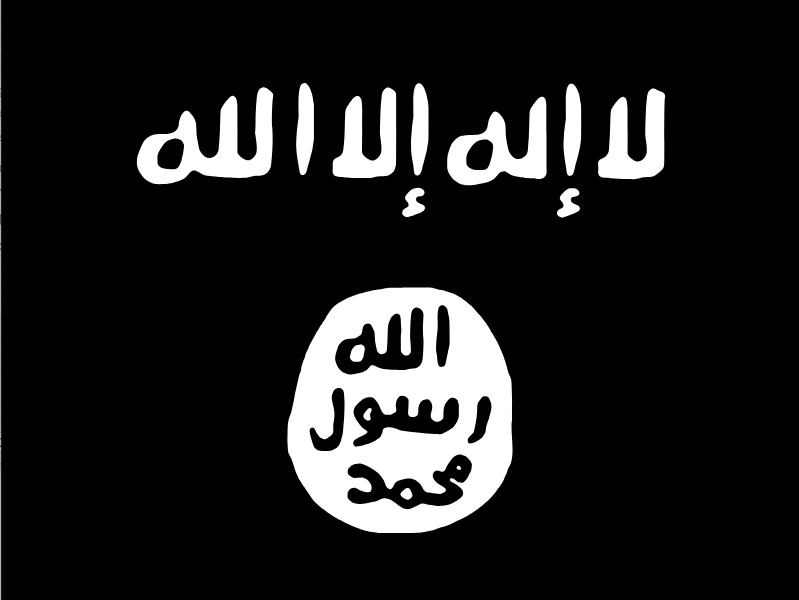 Flag of the Islamic State, which is a self-proclaimed caliphate that demands the religious, political, and military obedience of Muslims worldwide In Did Somebody Say Totalitarianism?: Five Interventions in the (Mis)Use of a Notion, Slavoj Žižek ironically described the concept of totalitarianism as an "ideological antioxidant" similar to the "Celestial Seasonings" green tea that, according to its advertisement, "neutralizes harmful molecules in the body known as free radicals". He further wrote that "[t]he notion of 'totalitarianism', far from being an effective theoretical concept, is a kind of stopgap: instead of enabling us to think, forcing us to acquire a new insight into the historical reality it describes, it relieves us of the duty to think, or even actively prevents us from thinking".[126] Saladdin Ahmed criticizes the concept of totalitarianism as formulated by Brzezinski and Friedrich and, to a lesser extent, Arendt, in Totalitarian Space and the Destruction of Aura (2019), noting that their definitions of totalitarianism are invalid if transported to other regimes. "This was the case in General August Pinochet's Chile", he writes, "yet it would be absurd to exempt it from the class of totalitarian regimes for that reason alone", since while Pinochet did not adopt an "official" ideology, but "ideological hegemony, whereby the dominant ideology becomes internalized and normalized, is far more effective than imposing an official ideology." Saladdin posited that while Chile under Pinochet had no "official" ideology, there was one man who ruled Chile from "behind the scenes", "none other than Milton Friedman, the godfather of neoliberalism and the most influential teacher of the Chicago Boys, was Pinochet's adviser". To Saladdin, such hegemonic yet not "official" ideology is much a more effective means of "totalitarian" control of society than an "official" ideology openly imposed by the state, what is exemplified by comparing Chile to Nicolae Ceaușescu's Romania, which collapsed within a short period: "No one defended them; no masses poured onto the streets to mourn their deaths. Ceausescu's Romania, as an exemplary Stalinist state, met all of Friedrich and Brzezinski's criteria of a totalitarian state, but it was nowhere close to achieving total domination." In this sense, Saladdin criticized the concept of totalitarianism because it was only being applied to "opposing ideologies" and it was not being applied to liberalism. He also criticized the other criterion of totalitarianism formulated by Brzezinski, Friedrich and Arendt: "In sum, a regime that does not meet all of Friedrich and Brzezinski's criteria would not necessarily be nontotalitarian or even less totalitarian, if we agree that totalitarianism ultimately amounts to total domination. If anything, realizing a greater degree of domination would necessarily require going beyond each of Friedrich and Brzezinski's criteria. Even without empirical cases which can always be dismissed to spare the proposed criteria – we could, with little difficulty, imagine a system that demonstrates none of the six criteria but is nonetheless more efficient as a totalitarian system. This will become clearer over the course of the rest of this chapter, but it should already be evident that the pioneers of the Cold War definition of totalitarianism molded their conception on the least developed of totalitarian systems... Tailored to Stalinism, [totalitarianism] aimed to predetermine that the negation of liberal capitalism would logically and empirically lead to a horrific system of total and arbitrary terror"; "Philosophically, their account of totalitarianism is invalid because it stipulates "criteria" that amount to an abstracted description of Stalin's USSR, rendering the notion predeterministic."[120] In the early 2010s, Richard Shorten, Vladimir Tismăneanu, and Aviezer Tucker posited that totalitarian ideologies can take different forms across political systems, yet all focus on utopianism, scientism, or political violence. They posit that Nazism and Stalinism both emphasized the role of specialization in modern societies, saw polymathy as a thing of the past, and stated that their claims were supported by statistics and science, which led them to impose strict ethical regulations on culture, use psychological violence, and persecute entire groups.[127][128][129] Other scholars have criticized their arguments due to their partiality and anachronism. Juan Francisco Fuentes treats totalitarianism as an "invented tradition" and he believes that the notion of "modern despotism" is a "reverse anachronism"; for Fuentes, "the anachronistic use of totalitarian/totalitarianism involves the will to reshape the past in the image and likeness of the present".[130] Other studies try to link modern technological changes to totalitarianism. According to Shoshana Zuboff, the economic pressures of modern surveillance capitalism are driving the intensification of online connection and monitoring, with spaces of social life becoming saturated by corporate actors, directed toward the making of profit and/or the regulation of action.[131] Toby Ord believed that George Orwell's fears of totalitarianism constituted a notable early precursor to modern notions of anthropogenic existential risk, the concept that a future catastrophe could permanently destroy the potential of Earth-originating intelligent life due in part to technological changes, creating a permanent technological dystopia. Ord said that Orwell's writings show that his concern was genuine rather than just a throwaway part of the fictional plot of Nineteen Eighty-Four. In 1949, Orwell wrote that "[a] ruling class which could guard against (four previously enumerated sources of risk) would remain in power permanently".[132] That same year, Bertrand Russell wrote that "modern techniques have made possible a new intensity of governmental control, and this possibility has been exploited very fully in totalitarian states".[133] In 2016, The Economist described China's Social Credit System, developed under General Secretary of the Chinese Communist Party Xi Jinping's administration to screen and rank Chinese citizens based on their personal behavior, as totalitarian.[134] Opponents of China's ranking system say that it is intrusive and it is just another tool which a one-party state can use to control the population. Supporters say that it will transform China into a more civilized and law-abiding society.[135] Shoshana Zuboff considers it instrumentarian rather than totalitarian.[136] In Revolution and Dictatorship: The Violent Origins of Durable Authoritarianism (2022), the political scientists Steven Levitsky and Lucan Way argued that nascent revolutionary régimes usually became totalitarian régimes unless they were destroyed by a military invasion. Such a revolutionary régime begins as a social revolution independent of the state's existing social structures (not political succession, election to office, or a military coup d'état). For example, the Soviet Union and Maoist China were founded after the years-long Russian Civil War (1917–1922) and Chinese Civil War (1927–1936 and 1945–1949), respectively, not merely state succession. They produce totalitarian dictatorships with three functional characteristics: (i) a cohesive ruling class comprising the military and the political élites, (ii) a strong and loyal coercive apparatus of police and military forces to suppress dissent, and (iii) the destruction of rival political parties, organizations, and independent centers of socio-political power. Moreover, the unitary functioning of the characteristics of totalitarianism allow a totalitarian government to perdure against economic crises (internal and external), large-scale failures of policy, mass social-discontent, and political pressure from other countries.[137] Some totalitarian one-party states were established through coups orchestrated by military officers loyal to a vanguard party that advanced socialist revolution, such as the Socialist Republic of the Union of Burma (1962),[138] the Syrian Arab Republic (1963),[139] and the Democratic Republic of Afghanistan (1978).[140] |
冷戦後 イサイアス・アフェウェルキ大統領は、1993年の独立以来、エリトリアを全体主義的な独裁者として統治してきた。[125] イスラム国の国旗。同組織は、世界中のイスラム教徒に対し、宗教的・政治的・軍事的な服従を要求する、自称カリフ制国家である スラヴォイ・ジジェクは『誰かが「全体主義」と言ったか?:ある概念の(誤)用に関する5つの介入』の中で、全体主義という概念を、広告によれば「体内の フリーラジカルと呼ばれる有害な分子を中和する」とされる「セレスティアル・シーズンズ」の緑茶に似た「イデオロギー的な抗酸化物質」であると皮肉を込め て描写した。彼はさらに、「『全体主義』という概念は、有効な理論的概念とは程遠く、一種のその場しのぎに過ぎない。それは、私たちが思考し、それが描写 する歴史的現実について新たな洞察を得ることを可能にするどころか、思考する義務から私たちを解放し、さらには積極的に思考することを妨げさえする」と記 した。[126] サラディン・アーメドは、『Totalitarian Space and the Destruction of Aura』(2019年)において、ブジェジンスキーやフリードリヒ、そして(程度は低いものの)アーレントによって定式化された全体主義の概念を批判 し、彼らの全体主義の定義は他の体制に当てはめた場合には無効であると指摘している。「アウグスト・ピノチェト将軍のチリもそうだった」と彼は記す。「し かし、その理由だけでチリを全体主義体制の範疇から除外するのは不条理だ」。なぜなら、ピノチェトは「公式」なイデオロギーを採用しなかったものの、「支 配的なイデオロギーが内面化され、常態化されるというイデオロギー的ヘゲモニーは、公式なイデオロギーを押し付けることよりもはるかに効果的だからだ」。 サラディンは、ピノチェト政権下のチリには「公式」なイデオロギーは存在しなかったものの、「舞台裏」からチリを支配していた人物が一人いたと指摘した。 「新自由主義のゴッドファーザーであり、シカゴ・ボーイズにとって最も影響力のある師であるミルトン・フリードマンこそが、ピノチェトの顧問だったの だ」。サラディンによれば、このようなヘゲモニックでありながら「公式」ではないイデオロギーは、国家によって公然と押し付けられる「公式」イデオロギー よりも、社会を「全体主義的」に統制する上ではるかに効果的な手段である。その好例として、チリと、短期間で崩壊したニコラエ・チャウシェスクのルーマニ アを比較している。「彼らを擁護する者は誰もおらず、その死を悼んで街頭に溢れ出る大衆もいなかった。「典型的なスターリン主義国家であったチャウシェス クのルーマニアは、フリードリヒとブジェジンスキーが掲げた全体主義国家の基準をすべて満たしていたが、完全な支配を達成するには程遠かった」。この意味 で、サラディンは、全体主義という概念が「対立するイデオロギー」にのみ適用され、自由主義には適用されていないことを批判した。また、彼はブジェジンス キー、フリードリヒ、アレントによって定式化された全体主義のもう一つの基準についても批判した: 「要するに、もし全体主義が究極的には完全な支配に帰着すると認めるならば、フリードリヒとブジェジンスキーの基準をすべて満たさない体制であっても、必 ずしも非全体主義的であるとは限らず、ましてや全体主義的でないわけでもない。むしろ、より高度な支配を実現するためには、必然的にフリードリヒとブジェ ジンスキーの各基準を超えていく必要があるだろう。提案された基準を正当化するために常に排除され得る実証的な事例がなくても――6つの基準のいずれも満 たさないにもかかわらず、全体主義体制としてより効率的なシステムを想像することは、さほど難しくない。これはこの章の残りの部分でより明確になるだろう が、冷戦期の全体主義定義の先駆者たちが、最も未発達な全体主義体制に基づいてその概念を形作ったことは、すでに明らかであるはずだ…… スターリン主義に合わせて調整された[全体主義]は、自由主義的資本主義の否定が、論理的かつ実証的に、完全かつ恣意的な恐怖の恐ろしい体制 へと導くことをあらかじめ決定づけることを目的としていた」;「哲学的に言えば、彼らの全体主義に関する説明は、スターリン時代のソ連を抽象化した記述に 等しい『基準』を規定しており、その概念を決定論的なものにしているため、無効である」[120] 2010年代初頭、リチャード・ショーテン、ウラジミール・ティスマネアヌ、アヴィエゼル・タッカーは、全体主義的イデオロギーは政治体制によって異なる 形態をとる可能性があるものの、いずれもユートピア主義、科学主義、あるいは政治的暴力に焦点を当てていると論じた。彼らは、ナチズムとスターリニズムの 双方が、近代社会における専門化の役割を強調し、博学を過去の遺物と見なし、自らの主張が統計や科学によって裏付けられていると主張したため、文化に対し て厳格な倫理的規制を課し、心理的暴力を用いて、集団全体を迫害することにつながったと論じている。[127][128][129] 他の学者たちは、彼らの主張が偏りや時代錯誤を含んでいるとして批判している。フアン・フランシスコ・フエンテスは、全体主義を「発明された伝統」として 扱い、「近代的専制」という概念は「逆時代錯誤」であると考えている。フエンテスにとって、「全体主義/全体主義的という用語の時代錯誤的な使用には、過 去を現在の姿や様相に合わせて再構築しようとする意志が込められている」のである。[130] 他の研究では、近代の技術的変化と全体主義を結びつけようとしている。ショシャナ・ズボフによれば、現代の監視資本主義による経済的圧力が、オンライン上 のつながりと監視の強化を推進しており、社会生活の場は、利益の創出や行動の規制を目的とした企業主体によって飽和状態にあるという。[131] トビー・オードは、ジョージ・オーウェルが抱いた全体主義への恐怖が、現代における「人為的実存的リスク」という概念の顕著な初期の前兆であったと見なし た。この概念とは、将来の大災害が、技術的変化を一部の原因として、地球起源の知的生命体の可能性を永久に破壊し、恒久的な技術的ディストピアを生み出す 可能性があるというものである。オードは、オーウェルの著作は、その懸念が単なる『1984年』のフィクション上のプロットの一部分ではなく、真摯なもの であったことを示していると述べた。1949 年、オーウェルは「(前述の4つのリスク要因)から身を守ることができる支配階級は、永久に権力を維持し続けるだろう」と記した。[132] 同年、バートランド・ラッセルは「現代の技術は、政府による統制をかつてないほど強めることを可能にし、この可能性は全体主義国家において極めて徹底的に 利用されてきた」と記した。[133] 2016年、『エコノミスト』誌は、中国共産党の習近平総書記の政権下で開発され、個人的な行動に基づいて中国市民を審査・ランク付けする中国の社会信用 システムを、全体主義的であると評した。[134] 中国のランク付けシステムに反対する人々は、それがプライバシーを侵害するものであり、一党独裁国家が国民を統制するために利用できる単なるもう一つの手 段に過ぎないと主張している。支持者たちは、この制度が中国をより文明的で法遵守の社会へと変革すると主張している。[135] ショシャナ・ズボフは、これを全体主義的というよりは「手段主義的」であると見なしている。[136] 『革命と独裁:永続的な権威主義の暴力的な起源』(2022年)において、政治学者のスティーブン・レヴィツキーとルーカン・ウェイは、新生革命政権は、 軍事侵攻によって破壊されない限り、通常は全体主義体制へと変貌すると論じた。このような革命政権は、国家の既存の社会構造とは独立した社会革命として始 まる(政治的継承、公職への選挙、あるいは軍事クーデターではない)。例えば、ソビエト連邦と毛沢東主義の中国は、それぞれ長年にわたるロシア内戦 (1917–1922年)および中国内戦(1927–1936年および1945–1949年)の後に成立したものであり、単なる国家の継承ではない。これ らは、次の3つの機能的特徴を備えた全体主義的独裁体制を生み出す。(i)軍部と政治エリートからなる結束した支配階級、(ii)異議を弾圧するための強 力かつ忠実な警察・軍隊による強制機構、そして(iii)対立する政党、組織、および社会政治的権力の独立した中心の破壊である。さらに、全体主義の特徴 が一体となって機能することで、全体主義政府は(内外の)経済危機、大規模な政策の失敗、大衆の社会的不満、他国からの政治的圧力に対しても存続し得る。 [137] 一部の全体主義的一党独裁国家は、社会主義革命を推進する先鋒党に忠実な軍将校たちが仕組んだクーデターを通じて樹立された。その例としては、ビルマ連邦 社会主義共和国(1962年)[138]、シリア・アラブ共和国(1963年)[139]、アフガニスタン民主共和国(1978年)[140]などが挙げ られる。 |
| Possible future emergence Other emerging technologies that could empower future totalitarian regimes include brain-reading and various applications of artificial intelligence.[141][142][143] Philosopher Nick Bostrom said that there is a possible trade-off, namely that some existential risks might be mitigated by the establishment of a powerful and permanent world government, and in turn the establishment of such a government could enhance the existential risks which are associated with the rule of a permanent dictatorship.[144] Religious totalitarianism Islamic  Flag of the Taliban The Taliban is a totalitarian Sunni Islamist militant group and political movement in Afghanistan that emerged in the aftermath of the Soviet–Afghan War and the end of the Cold War. It governed most of Afghanistan from 1996 to 2001 and returned to power in 2021, controlling the entire country. Features of its totalitarian governance include the imposition of the Pashtunwali culture of the majority-Pashtun ethnic group as religious law, the exclusion of minorities and non-Taliban members from the government, and extensive violations of women's rights.[145] The Islamic State is a Salafi-Jihadist militant group that was established in 2006 by Abu Omar al-Baghdadi during the Iraqi insurgency, under the name "Islamic State of Iraq". Under the leadership of Abu Bakr al-Baghdadi, the organization later changed its name to the "Islamic State of Iraq and the Levant" in 2013. The group espouses a totalitarian ideology that is a fundamentalist hybrid of Global Jihadism, Wahhabism, and Qutbism. Following its territorial expansion in 2014, the group renamed itself as the "Islamic State" and declared itself a caliphate[c] that sought domination over the Muslim world, establishing what has been described as a "political-religious totalitarian regime". The quasi-state held significant territory in Iraq and Syria during the course of the Third Iraq War and the Syrian civil war from 2013 to 2019 under the dictatorship of its first caliph, Abu Bakr al-Baghdadi, who imposed a strict interpretation of Sharia law.[148][149][150][151] |
将来出現する可能性 将来の全体主義体制を強化しうるその他の新興技術としては、脳波読み取り技術や人工知能のさまざまな応用が挙げられる。[141][142][143] 哲学者ニック・ボストロムは、ある種のトレードオフが存在し得ると指摘している。すなわち、強力かつ恒久的な世界政府の樹立によって一部の存亡的リスクが 軽減される可能性がある一方で、そのような政府の樹立自体が、恒久的な独裁体制の支配に伴う存亡的リスクを増大させる恐れがあるというのだ。[144] 宗教的全体主義 イスラム タリバンの旗 タリバンは、ソ連・アフガニスタン戦争と冷戦の終結を契機に台頭した、アフガニスタンの全体主義的なスンニ派イスラム主義武装組織であり、政治運動であ る。1996年から2001年にかけてアフガニスタンの大部分を統治し、2021年に再び政権を握って国全体を支配下においた。その全体主義的統治の特徴 としては、多数派であるパシュトゥーン民族の「パシュトゥーンワリ」文化を宗教法として強制すること、少数派やタリバン非加盟者を政府から排除すること、 そして女性の権利に対する広範な侵害などが挙げられる。[145] イスラム国は、2006年にイラク反乱の最中にアブ・オマール・アル=バグダディによって「イラク・イスラム国」という名称で設立されたサラフィ・ジハー ド主義の過激派組織である。アブ・バクル・アル=バグダディの指導の下、同組織は2013年に「イラク・レバント・イスラム国」へと名称を変更した。同組 織は、グローバル・ジハード主義、ワッハーブ主義、クトブ主義を融合させた原理主義的な全体主義イデオロギーを掲げている。2014年の領土拡大に伴い、 同組織は名称を「イスラム国」に変更し、イスラム世界への支配を目論むカリフ制国家[c]を宣言し、いわゆる「政治・宗教的全体主義体制」を確立した。こ の準国家は、2013年から2019年にかけての第3次イラク戦争およびシリア内戦の期間中、初代カリフであるアブ・バクル・アル=バグダディの独裁下 で、イラクとシリアの広大な領土を支配していた。同カリフは、シャリーア法の厳格な解釈を強いた。[148][149][150][151] |
| Criticism of the classification of Islamism as totalitarianism Enzo Traverso, a critic of totalitarianism as a theoretical concept of historical and political sciences, is also critical of the usage of it in relation to Islamist movements like the Islamic State and the Taliban and their state formations. According to Traverso, such a notion contradicts the very theoretical concept of totalitarianism. Systems which are commonly described as totalitarian, fascism and communism, sought to create a utopian "New Man" and as a result, they set their projects toward the future, not to revive old forms of absolutism, as noted by Tzvetan Todorov: "The reactionary modernism of Islamic terrorism, on the contrary, employs modern technologies in order to return to the original purity of a mythical Islam. If it has utopian tendencies, they look to the past rather than the future." More to it, totalitarianism has been applied to secular movements which have been described as irrational "political religions" which seek to abolish traditional religions, liturgies and symbols and replace them with their own liturgies and symbols, while Islamic fundamentalism, on the contrary, is a politicized religion and a reaction to secularization and modernization. Besides that, as a form of violence, terrorism is usually described as antipodal to state violence; while fascism was a reaction to democracy, Islamism arose in authoritarian, but weak states. "Speaking of a 'theocratic' totalitarianism makes this concept even more flexible and ambiguous than ever, once again confirming its essential function: not critically interpreting history and the world, but rather fighting an enemy," argues Traverso. Traverso writes that the term was adopted by Western propaganda after 9/11, which had previously used it against other enemies while maintaining the West's geopolitical interests. He notes that the Islamic state which most resembles the concept of totalitarianism, Saudi Arabia, is an ally of the West and as a result, it cannot be considered a part of the "Axis of Evil", and for that reason, as he believes, Saudi Arabia is rarely described as "totalitarian", unlike Iran.[9] |
イスラミズムを全体主義と分類することへの批判 歴史学および政治学における理論的概念としての全体主義を批判するエンツォ・トラヴェルソは、イスラム国やタリバンといったイスラミスト運動や、それらの 国家形成に関してこの概念が用いられることに対しても批判的だ。トラヴェルソによれば、そのような見解は、全体主義という理論的概念そのものと矛盾する。 一般的に全体主義と形容される体制、すなわちファシズムや共産主義は、ユートピア的な「新人間」の創造を目指しており、その結果、ツヴェタン・トドロフが 指摘するように、古い形態の絶対主義を復活させるのではなく、未来に向けたプロジェクトを掲げていた。「それとは対照的に、イスラム過激主義の反動的なモ ダニズムは、神話的なイスラムの本来の純粋さへと回帰するために、現代の技術を利用している。もしそこにユートピア的な傾向があるとしても、それは未来で はなく過去に向けられているのだ」。さらに言えば、全体主義という概念は、伝統的な宗教や儀式、象徴を廃止し、それらを独自の儀式や象徴に置き換えようと する、非合理的な「政治的宗教」と評される世俗的な運動に適用されてきた。それに対し、イスラム原理主義は、政治化された宗教であり、世俗化や近代化に対 する反動である。さらに、暴力の一形態として、テロリズムは通常、国家の暴力とは正反対のものとして描かれる。一方、ファシズムは民主主義への反動であっ たのに対し、イスラミズムは権威主義的ではあるが脆弱な国家の中で台頭した。「『神権的』全体主義という表現は、この概念をこれまで以上に柔軟かつ曖昧な ものにし、その本質的な機能――歴史や世界を批判的に解釈することではなく、むしろ敵と戦うこと――を改めて裏付けている」とトラヴェルソは論じる。トラ ヴェルソによれば、この用語は9・11同時多発テロ後に西側のプロパガンダによって採用されたものであり、それ以前にも西側の地政学的利益を維持しつつ、 他の敵に対してこの用語が用いられていたという。彼は、全体主義という概念に最も近いイスラム国家であるサウジアラビアが西側の同盟国であり、その結果、 「悪の枢軸」の一員とは見なされ得ないことを指摘している。そのため、彼の見解によれば、イランとは異なり、サウジアラビアが「全体主義的」と形容される ことはめったにないのだ。[9] |
| Christian See also: National Catholicism, Christian fascism, and Clerical fascism Francoist Spain (1936–1975), under the dictator Francisco Franco, had been commonly characterized as totalitarian until 1964, when Juan Linz challenged this characterization and instead described Francoism as "authoritarian" because of its "limited degree of political pluralism" caused by the struggle between "Francoist families" (e.g., Falangists, Carlists, etc.) within the sole legal party FET y de las JONS and the Movimiento Nacional and by other such features as, according to Linz, lack of 'totalitarian' ideology, as Franco relied on National Catholicism and traditionalism. Such revision caused a major debate; some critics of Linz felt that his concept may be a form of acquittal of Francoism and did not concern its early phase (often called "First Francoism"). Later debates focused on whether the regime could be described as 'fascist' rather than 'totalitarian'; some historians stressed the traits of a military dictatorship, while others emphasized the Fascist component, calling the regime a para-fascist or 'fascistized' dictatorship. While Enrique Moradiellos notes that "it is now increasingly rare to define Francoism as a truly fascist and totalitarian regime", he writes that the debates on Francoism have not finished yet.[37] Ismael Saz notes that "it has also begun to be recognized that" Francoism underwent a "totalitarian or quasi-totalitarian, fascist or quasi-fascist" phase.[76] The historians who continue to criticize Linz and describe the regime as totalitarian usually limit such characterization to ten to twenty years of the "First Francoism."[152][153][154][155]  Francoist minister Esteban Bilbao (left) and Catholic archbishop Enrique Pla y Deniel (center) doing the Roman salute in Toledo Cathedral, Spain, March 1942 Linz wrote that "the heteronomous control of the ideological content of Catholic thought by a universal church and specifically by the Pope is one of the most serious obstacles to the creation of a truly totalitarian system..."[156] Linz's argument has been debated: "The frequent and saturated references to Francoist Catholic humanism... coming from Christian theology, could hardly conceal the fact that the individual was only understood as a citizen to the extent of his adherence to the Catholic, hierarchical and economically privatist community that the military uprising had saved," argues Guillermo Portilla Contreras.[157] Furthermore, Luis Aurelio Gonzalez Prieto argues that "Catholic values that permeated the conservative ideological substratum... were precisely what was wielded by the Francoist Spanish political doctrine of the late thirties and early forties to justify the need for the constitution of a totalitarian State at the service and expansion of the Catholic religion."[158] Franco was portrayed as a fervent Catholic and a staunch defender of Catholicism, the declared state religion.[159] Civil marriages that had taken place in the Republic were declared null and void unless they had been validated by the Catholic Church, along with divorces. Divorce, contraception and abortions were forbidden.[160] According to historian Stanley G. Payne, an opponent of describing Francoism as a totalitarian system, Franco had more day-to-day power than Adolf Hitler or Joseph Stalin possessed at the respective heights of their power. Payne noted that Hitler and Stalin at least maintained rubber-stamp parliaments, while Franco dispensed with even that formality in the early years of his rule. According to Payne, the lack of even a rubber-stamp parliament made Franco's government "the most purely arbitrary in the world."[161] However, from 1959 to 1974, the "Spanish Miracle" took place under the leadership of technocrats, many of whom were members of Opus Dei and a new generation of politicians that replaced the old Falangist guard.[162] Reforms were implemented in the 1950s and Spain abandoned autarky, reassigning economic authority from the isolationist Falangist movement.[163] This led to massive economic growth that lasted until the mid-1970s, known as the "Spanish miracle". This is comparable to de-Stalinization in the Soviet Union in the 1950s, whereby Francoist Spain changed from being openly totalitarian to being an authoritarian dictatorship with a certain degree of economic freedom.[citation needed] |
キリスト教 関連項目:国民カトリシズム、キリスト教ファシズム、聖職者ファシズム 独裁者フランシスコ・フランコ統治下のフランコ主義スペイン(1936年~1975年)は、1964年まで一般的に全体主義と特徴づけられていた。しか し、その年、フアン・リンツがこの見解に異議を唱え、代わりにフランコ主義を「権威主義的」と表現した。その根拠は、唯一の合法政党であるFET y de las JONSやMovimiento Nacional内部における「フランコ主義者一族」(例:ファランジスト、カルリスト、 など)間の対立、およびリンツによれば、フランコが国民カトリック主義と伝統主義に依拠していたことから生じる「全体主義的」イデオロギーの欠如といった 特徴を根拠に、フランコ主義を「権威主義的」と定義した。このような見直しの提唱は大きな論争を引き起こした。リンツの批判者の中には、彼の概念がフラン コ主義を無罪放免する形になりかねず、その初期段階(しばしば「第一期フランコ主義」と呼ばれる)には当てはまらないと考える者もいた。その後の議論は、 この体制を「全体主義的」ではなく「ファシスト的」と形容できるかどうかに焦点が当てられた。一部の歴史家は軍事独裁政権としての特徴を強調した一方、他 の歴史家はファシスト的要素を強調し、この体制を準ファシスト的あるいは「ファシスト化された」独裁政権と呼んだ。エンリケ・モラディエロスは、「フラン コ主義を真にファシスト的かつ全体主義的な体制と定義することは、現在ではますます稀になっている」と指摘する一方で、フランコ主義をめぐる議論はまだ終 わっていないと記している。[37] イスマエル・サズは、「フランコ主義が『全体主義的あるいは準全体主義的、ファシスト的あるいは準ファシスト的』な段階を経たことも、認識され始めてい る」と述べている。[76] リンツを批判し続け、この体制を全体主義的と描写する歴史家たちは、通常、そのような特徴付けを「第一期フランコ主義」の10年から20年の期間に限定し ている。[152][153][154] [155] 1942年3月、スペインのトレド大聖堂にて、ローマ式敬礼を行うフランコ政権のエステバン・ビルバオ大臣(左)とカトリックのエンリケ・プラ・イ・デニエル大司教(中央) リンツは、「カトリック思想のイデオロギー的内容に対する、普遍的な教会、とりわけ教皇による他律的な統制は、真に全体主義的な体制の構築にとって最も深 刻な障害の一つである……」と記した。[156] リンツの主張については議論がある。「キリスト教神学に由来する、フランコ主義的カトリック・ヒューマニズムへの頻繁かつ過剰な言及は……、個人が、軍事 蜂起によって救われたカトリック的、階層的、かつ経済的に私有主義的な共同体への帰属の範囲内でのみ、市民として理解されていたという事実を、到底隠しき れなかった」とギジェルモ・ポルティージャ・コントレラスは論じている。[157] さらに、ルイス・アウレリオ・ゴンサレス・プリエトは、「保守的なイデオロギーの基盤に浸透していたカトリックの価値観……こそが、1930年代後半から 1940年代初頭にかけてのフランコ主義的スペイン政治ドクトリンによって、カトリック教の奉仕と拡大に奉仕する全体主義国家の樹立の必要性を正当化する ために利用されたものだった」と論じている。[158] フランコは、熱心なカトリック教徒であり、国教と宣言されたカトリック教の断固たる擁護者として描かれた。[159] 共和国時代に挙行された民事婚は、カトリック教会による承認を受けていない限り無効と宣言され、離婚も同様であった。離婚、避妊、中絶は禁止された。 [160] フランコ主義を全体主義体制と見なすことに反対する歴史家スタンリー・G・ペインによれば、フランコは、アドルフ・ヒトラーやヨシフ・スターリンがそれぞ れの権力の絶頂期に持っていたものよりも、日常的な権力をより多く握っていた。ペインは、ヒトラーとスターリンは少なくとも形だけの議会を維持していたの に対し、フランコは統治初期の段階でその形式さえも省略したと指摘した。ペインによれば、形だけの議会さえ存在しなかったことが、フランコ政権を「世界で 最も純粋に恣意的な政権」にしたという。[161] しかし、1959年から1974年にかけて、テクノクラートたちの指導の下で「スペインの奇跡」が起こった。彼らの多くはオプス・デイのメンバーであり、 旧来のファランジスト勢力を置き換えた新世代の政治家たちであった。[162] 1950年代に改革が実施され、スペインは自給自足政策を放棄し、孤立主義的なファランジスト運動から経済権限を移管した。[163] これにより、1970年代半ばまで続いた「スペインの奇跡」として知られる大規模な経済成長がもたらされた。これは1950年代のソビエト連邦における脱 スターリン化に匹敵するものであり、フランコ政権下のスペインは、公然と全体主義的であった状態から、ある程度の経済的自由を伴う権威主義的独裁体制へと 変化した。[出典必要] |
| Inverted totalitarianism Totalitarian democracy Totalitarian architecture Police state The Black Book of Communism Double genocide theory Surveillance capitalism List of cults of personality List of totalitarian regimes Religious supremacism Total institution |
逆転した全体主義 全体主義的民主主義 全体主義的建築 警察国家 『共産主義の黒書』 二重ジェノサイド説 監視資本主義 個人崇拝の一覧 全体主義体制の一覧 宗教的優越主義 総体機関 |
| Notes a. shows the Standard of the Duce instead of the national flag b. shows the Rising Sun Flag instead of the national one c. Caliphate claim of "Islamic State" group is disputed and declared as illegal by traditional Islamic scholarship.[146][147] |
注 a. 国旗の代わりに「ドゥーチェの旗」を掲げている b. 国旗の代わりに「旭日旗」を掲げている c. 「イスラム国」グループによるカリフ制の主張は議論の的となっており、伝統的なイスラム学界からは違法であると宣言されている。[146][147] |
| References 01. Lucken, Michael (2013). The Japanese and the War: Expectation, Perception, and the Shaping of Memory. Columbia University: Columbia University Press. ISBN 978-0-231-54398-9. Fitzpatrick, Sheila (1986). "New Perspectives on Stalinism". The Russian Review. 45 (4): 357–373. doi:10.2307/130466. JSTOR 130466. Shaw, Denis J.B.; Oldfield, Jonathan D. (January 2008). "Totalitarianism and geography: L. S. Berg and the defence of an academic discipline in the age of Stalin". Political Geography. 27 (1): 96–112. doi:10.1016/j.polgeo.2007.07.001. Conquest, Robert (1999). Reflections on a Ravaged Century. Norton. pp. 73–74. ISBN 0393048187. Pipes, Richard (1995). Russia Under the Bolshevik Regime. New York: Vintage Books, Random House. p. 243. ISBN 0394502426. Cinpoes, Radu (2010). Nationalism and Identity in Romania: A History of Extreme Politics from the Birth of the State to EU Accession. London, Oxford, New York, New Delhi and Sydney: Bloomsbury. p. 70. ISBN 978-1848851665. Traverso, Enzo (December 2017). "Totalitarianism Between History and Theory". History and Theory. 56 (4): 97–118. doi:10.1111/hith.12040. "Totalitarismo - Enciclopedia". Traverso, Enzo (2017). "Totalitarianism Between History and Theory". History and Theory. 56 (4): 97–118. doi:10.1111/hith.12040. JSTOR 26650707. Kershaw, Ian; Lewin, Moshe (28 April 1997). Stalinism and Nazism: Dictatorships in Comparison. Cambridge University Press. ISBN 978-0-521-56521-9. Vincent, Andrew (15 December 2023). Modern Political Ideologies. John Wiley & Sons. ISBN 978-1-119-98165-7. Linz, Juan José (2000). Totalitarian and Authoritarian Regimes. Lynne Rienner Publisher. p. 143. ISBN 978-1-55587-890-0. OCLC 1172052725. Jonathan Michie, ed. (3 February 2014). Reader's Guide to the Social Sciences. Routledge. p. 95. ISBN 978-1-135-93226-8. Rummel, Rudolph (1994). "Democide in Totalitarian States: Mortacracies and Megamurderers". In Charny, Israel W.; Horowitz, Irving Louis (eds.). The Widening Circle of Genocide (1st ed.). Routledge. pp. 3–40. doi:10.4324/9781351294089-2. ISBN 9781351294089. Wayman, Frank W; Tago, Atsushi (January 2010). "Explaining the onset of mass killing, 1949—87". Journal of Peace Research. 47 (1): 3–13. doi:10.1177/0022343309342944. William Ebenstein (1980). American Democracy in World Perspective. Harper & Row. p. 182. ISBN 9780060418618. The second category includes one-party states in Asia and Africa such as Burma, Iraq, and Zaire - which are not totalitarian but allow only one political party. Pesaran, Evaleila (25 April 2011). Iran's Struggle for Economic Independence: Reform and Counter-Reform in the Post-Revolutionary Era. Taylor & Francis. ISBN 978-1-136-73557-8. Hannah Arendt and Isaiah Berlin: Freedom, Politics and Humanity. Princeton University Press. 21 November 2023. ISBN 978-0-691-22612-5. Of course, the exclusion of fascist Italy from the totalitarian family is not a surprising claim today. Those who separate ('merely' fascist) Italy from (properly totalitarian) Germany and Russia are hardly a minority among recent scholars, though their view remains contested. Popper, Karl (2013). Gombrich, E. H. (ed.). The Open Society and Its Enemies. Princeton University Press. ISBN 978-0691158136. Archived from the original on 11 January 2022. Retrieved 17 August 2021. Wild, John (1964). Plato's Modern Enemies and the Theory of Natural Law. Chicago: University of Chicago Press. p. 23. "Popper is committing a serious historical error in attributing the organic theory of the State to Plato, and accusing him of all the fallacies of post–Hegelian and Marxist historicism — the theory that history is controlled by the inexorable laws governing the behaviour of superindividual social entities of which human beings and their free choices are merely subordinate manifestations." Levinson, Ronald B. (1970). In Defense of Plato. New York: Russell and Russell. p. 20. "In spite of the high rating, one must accord his [Popper's] initial intention of fairness, his hatred for the enemies of the 'open society', his zeal to destroy whatever seems, to him, destructive of the welfare of mankind, has led him into the extensive use of what may be called terminological counter-propaganda. [...] With a few exceptions in Popper's favour, however, it is noticeable that [book] reviewers possessed of special competence in particular fields – and here Lindsay is again to be included – have objected to Popper's conclusions in those very fields. [...] Social scientists and social philosophers have deplored his radical denial of historical causation, together with his espousal of Hayek's systematic distrust of larger programs of social reform; historical students of philosophy have protested his [Popper's] violent, polemical handling of Plato, Aristotle, and, particularly, Hegel; ethicists have found contradictions in the ethical theory ('critical dualism') upon which his [anti-Modernist] polemic is largely based." Enzo Traverso, Despina Lalaki. Against "Totalitarianism": A Conversation with Enzo Traverso Stalinism and the Dialectics of Saturn: Anticommunism, Marxism, and the Fate of the Soviet Union. Rowman & Littlefield. 20 March 2023. ISBN 978-1-6669-3090-0. Horkheimer, Max; Adorno, Theodor W.; Noeri, Gunzelin (2002). Dialectic of Enlightenment. Stanford University Press. ISBN 978-0804736336. Archived from the original on 2022-01-10. Retrieved 2021-08-17. Rubinstein, W.D. (2004). Genocide: a history. Pearson Education. p. 7. ISBN 978-0-582-50601-5. Gentile, Giovanni; Mussolini, Benito (1932). La dottrina del fascismo [The Doctrine of Fascism]. Mawdsley, Evan (2011). The Russian Civil War. Birlinn. ISBN 9780857901231. Ronald Suny. Red Flag Unfurled: History, Historians and the Russian Revolution (Verso Books, 2017). Hough, Jerry F. (1987). "The 'Dark Forces,' the Totalitarian Model, and Soviet History". The Russian Review. 46 (4): 397–403. doi:10.2307/130293. JSTOR 130293. Riley, Alexander; Siewers, Alfred Kentigern (June 18, 2019). The Totalitarian Legacy of the Bolshevik Revolution. Rowman & Littlefield. ISBN 9781793605344. Archived from the original on April 17, 2022. Retrieved April 17, 2022 – via Google Books. Fuentes, Juan Francisco (April 29, 2019). Totalitarianisms: The Closed Society and Its Friends. A History of Crossed Languages. Ed. Universidad de Cantabria. ISBN 9788481028898. Archived from the original on April 17, 2022. Retrieved April 17, 2022 – via Google Books. Gerson, Lennard (September 1, 2013). Lenin and the Twentieth Century: A Bertram D. Wolfe Retrospective. Hoover Press. ISBN 9780817979331. Archived from the original on April 17, 2022. Retrieved April 17, 2022 – via Google Books. Gregor, Richard (1974). Resolutions and Decisions of the Communist Party of the Soviet Union Volume 2: The Early Soviet Period 1917–1929. University of Toronto Press. ISBN 9781487590116. Archived from the original on April 17, 2022. Retrieved April 17, 2022 – via Google Books. The Totalitarian Experiment in Twentieth-century Europe: Understanding the Poverty of Great Politics. Taylor & Francis. 2006. ISBN 978-0-415-19278-1. Delzell, Charles F. (1988). "Remembering Mussolini". The Wilson Quarterly. 12 (2): 118–135. JSTOR 40257305. Retrieved April 8, 2022 Schmitt, Carl (1927). University of Chicago Press (ed.). Der Begriff des Politischen [The Concept of the Political] (in German) (1996 ed.). Rutgers University Press. p. 22. ISBN 0226738868. Franco: Anatomy of a Dictator. Bloomsbury. 18 December 2017. ISBN 978-1-78672-300-0. Siegel, Achim (1998). The Totalitarian Paradigm After the End of Communism: Towards a Theoretical Reassessment (hardback ed.). Amsterdam: Rodopi. p. 200. ISBN 978-9042005525. Concepts of totalitarianism became most widespread at the height of the Cold War. Since the late 1940s, especially since the Korean War, they were condensed into a far-reaching, even hegemonic, ideology, by which the political elites of the Western world tried to explain and even to justify the Cold War constellation. Guilhot, Nicholas (2005). The Democracy Makers: Human Rights and International Order (hardcover ed.). New York City: Columbia University Press. p. 33. ISBN 978-0231131247. The opposition between the West and Soviet totalitarianism was often presented as an opposition both moral and epistemological between truth and falsehood. The democratic, social, and economic credentials of the Soviet Union were typically seen as 'lies' and as the product of deliberate and multiform propaganda. ... In this context, the concept of totalitarianism was itself an asset. As it made possible the conversion of prewar anti-fascism into postwar anti-communism. Reisch, George A. (2005). How the Cold War Transformed Philosophy of Science: To the Icy Slopes of Logic. Cambridge University Press. pp. 153–154. ISBN 978-0521546898. Defty, Brook (2007). "2. Launching the New Propaganda Policy, 1948. 3. Building a Concerted Counter-offensive: Co-operation with other powers. 4. Close and Continuous Liaison: British and American co-operation, 1950–51. 5. A Global Propaganda Offensive: Churchill and the revival of political warfare". Britain, America and Anti-Communist Propaganda 1945–1953: The Information Research Department (1st paperback ed.). London: Routledge. ISBN 978-0714683614. Caute, David (2010). Politics and the Novel during the Cold War. Transaction Publishers. pp. 95–99. ISBN 978-1412831369. Archived from the original on 2021-04-14. Retrieved 2020-11-22. Haynes, John Earl; Klehr, Harvey (2003). "Revising History". In Denial: Historians, Communism and Espionage. San Francisco: Encounter. pp. 11–57. ISBN 1893554724. Lenin's Terror: The Ideological Origins of Early Soviet State Violence. Routledge. 2012. ISBN 978-0-415-67396-9. Carr, Edward Hallett (1977). The Bolshevik revolution 1917 – 1923. Vol. 1 (Reprinted ed.). Penguin books. pp. 111–112. ISBN 978-0-14-020749-1. Stalinism: Essays in Historical Interpretation. Transaction Publishers. ISBN 978-1-4128-3502-2. Laqueur, Walter (1987). The Fate of the Revolution: Interpretations of Soviet History from 1917 to the Present. New York: Scribner's. pp. 225–227. ISBN 978-0684189031. Riasanovsky, Nicholas Valentine; Steinberg, Mark D. (2011). A History of Russia (8th ed.). New York Oxford: Oxford University Press. p. 468. ISBN 978-0-1953-4197-3. Lenoe, Matt (June 2002). "Did Stalin Kill Kirov and Does It Matter?". The Journal of Modern History. 74 (2): 352–380. doi:10.1086/343411. Orlow, D. (December 2011). "Beyond Totalitarianism: Stalinism and Nazism Compared, Michael Geyer and Sheila Fitzpatrick, eds. (New York: Cambridge University Press, 2009), ix + 563 pp., hardcover $95.00, pbk. $28.99, eBook $23.00". Holocaust and Genocide Studies. 25 (3): 457–459. doi:10.1093/hgs/dcr052. Project MUSE 460844. Stalin: A Biography. Harvard University Press. 2005. ISBN 978-0-674-01697-2. Totalitarian Societies and Democratic Transition: Essays in memory of Victor Zaslavsky. Central European University Press. 10 July 2017. ISBN 978-963-386-130-1. Fitzpatrick, Sheila (1999). Everyday Stalinism: Ordinary Life in Extraordinary Times: Soviet Russia in the 1930s. New York: Oxford University Press. ISBN 978-0195050004. Davies, Sarah; Harris, James (8 September 2005). "Joseph Stalin: Power and Ideas". Stalin: A New History. Cambridge University Press. pp. 4–5. ISBN 978-1-139-44663-1. Rubin, Eli (2008). Synthetic Socialism: Plastics & Dictatorship in the German Democratic Republic. Chapel Hill: University of North Carolina Press. ISBN 978-1469606774. Kershaw, Ian (31 July 1989). "The Nazi State: An Exceptional State?". New Left Review. 1 (176) 778: 47–67. doi:10.64590/8qe. Payne, Stanley G. (January 1996). A History of Fascism, 1914–1945. University of Wisconsin Pres. ISBN 978-0-299-14873-7. Laqueur, Walter (1987). The Fate of the Revolution: Interpretations of Soviet History from 1917 to the Present. New York: Scribner's. p. 224, 228. ISBN 978-0684189031. Laqueur, Walter (1987). The Fate of the Revolution: Interpretations of Soviet History from 1917 to the Present. New York: Scribner's. p. 233. ISBN 978-0684189031. Neumayer, Laure (2018). The Criminalisation of Communism in the European Political Space after the Cold War. Routledge. ISBN 9781351141741. Totalitarian Dictatorship: New Histories. Routledge. 8 October 2013. ISBN 978-1-135-04397-1. Schönpflug, Daniel (2007). "Histoires croisées: François Furet, Ernst Nolte and a Comparative History of Totalitarian Movements". European History Quarterly. 37 (2): 265–290. doi:10.1177/0265691407075595. Singer, Daniel (17 April 1995). "The Sound and the Furet". The Nation. Archived from the original on 17 March 2008. Retrieved 7 August 2020. Furet, borrowing from Hannah Arendt, describes Bolsheviks and Nazis as totalitarian twins, conflicting yet united. Singer, Daniel (2 November 1999). "Exploiting a Tragedy, or Le Rouge en Noir". The Nation. Archived from the original on 26 July 2019. Retrieved 7 August 2020. ... the totalitarian nature of Stalin's Russia is undeniable. Grobman, Gary M. (1990). "Nazi Fascism and the Modern Totalitarian State". Remember.org. Archived from the original on 2 April 2015. Retrieved 7 August 2020. The government of Nazi Germany was a fascist, totalitarian state. Traverso, Enzo. "The New Anti-Communism: Rereading the Twentieth Century" // History and Revolution: Refuting Revisionism, ed. Mike aynes and Jim Wolfreys (London: Verso, 2007), 138–155., Toth, Mano (25 October 2021). European Memory and Conflicting Visions of the Past. Springer. ISBN 978-3-030-79843-7. McPhee, Peter (15 December 2014). A Companion to the French Revolution. John Wiley & Sons. ISBN 978-1-118-97752-1. Hobsbawm, Eric (30 November 1996). "History and Illusion". New Left Review. 1 (220) 2062: 116–125. doi:10.64590/l1u. Bresciani, Marco (18 June 2024). Learning from the Enemy: An Intellectual History of Antifascism in Interwar Europe. Verso Books. ISBN 978-1-80429-227-3. Greene, Douglas (20 March 2023). Stalinism and the Dialectics of Saturn: Anticommunism, Marxism, and the Fate of the Soviet Union. Rowman & Littlefield. ISBN 978-1-6669-3090-0. Parenti, Michael (1997). Blackshirts and Reds: Rational Fascism and the Overthrow of Communism. San Francisco: City Lights Books. pp. 41–58. ISBN 978-0872863293. Petras, James (4 November 1999). "The CIA and the Cultural Cold War Revisited". Monthly Review. 51 (6): 47. doi:10.14452/MR-051-06-1999-10_4. Losurdo, Domenico (January 2004). "Towards a Critique of the Category of Totalitarianism". Historical Materialism. 12 (2): 25–55. doi:10.1163/1569206041551663. Connelly, John (2010). "Totalitarianism: Defunct Theory, Useful Word". Kritika: Explorations in Russian and Eurasian History. 11 (4): 819–835. doi:10.1353/kri.2010.0001. Saz, Ismael (2004). Fascismo y Franquismo (in Spanish). València: Universitat de València. ISBN 978-84-370-5910-5. Payne, Stanley G. (1980). Fascism: Comparison and Definition. University of Washington Press. p. 73. ISBN 978-0299080600. Conquest, Robert (1990). The Great Terror: A Reassessment. Oxford University Press. p. 249. ISBN 0195071328. Arendt 1958, pp. 256–257. Arendt 1958, pp. 308–309. Mann, Michael (2004). Fascists. New York: Cambridge University Press. p. 331. ISBN 978-0521831314. Archived from the original on 2020-08-19. Retrieved 2017-10-26. Preston, Paul (2007). The Spanish Civil War: Reaction, Revolution and Revenge (3rd ed.). New York: W. W. Norton & Company. p. 64. ISBN 978-0393329872. Salvadó, Francisco J. Romero (2013). Historical Dictionary of the Spanish Civil War. Scarecrow Press. p. 149. ISBN 978-0810880092. Archived from the original on 2020-08-19. Retrieved 2019-04-27. Totalitarianism: The Inner History of the Cold War. Oxford University Press. 20 March 1997. ISBN 978-0-19-028148-9. Bogiatzis, Vassilios A. (2022). "From the 'Nobleman's Sword' to the 'Flag of the Fascist Ideals'". Fascism. 11 (2): 315–337. doi:10.1163/22116257-bja10043. Vatikiotis, P. J. (23 April 2014). Popular Autocracy in Greece, 1936-1941: A Political Biography of General Ioannis Metaxas. Routledge. ISBN 978-1-134-72926-5. "The holocaust in Romania" (PDF). Yad Vashem. "Trials of the war criminals" (PDF). Archived from the original (PDF) on 2011-07-17. Freyer, Tony A. (9 October 2006). Antitrust and Global Capitalism, 1930–2004. Cambridge University Press. ISBN 978-1-139-45558-9. Overy, R. J. (2015). The Oxford Illustrated History of World War II. Oxford University Press. ISBN 978-0-19-960582-8. Wrong, Dennis Hume. Power: Its Forms, Bases, and Uses. Transaction Publishers. ISBN 978-1-4128-3165-9. Jones, William David (1999). The Lost Debate: German Socialist Intellectuals and Totalitarianism. University of Illinois Press. ISBN 978-0-252-06796-9. Twiss, Thomas M. (8 May 2014). Trotsky and the Problem of Soviet Bureaucracy. BRILL. ISBN 978-90-04-26953-8. Brotherstone, Terry; Dukes, Paul (1992). The Trotsky Reappraisal. ISBN 978-0-7486-0317-6. Nemoianu, Virgil (December 1982). "Review of End and Beginnings". Modern Language Notes. 97 (5): 1235–1238. Churchill, Winston (5 October 1938). The Munich Agreement (Speech). House of Commons of the United Kingdom: International Churchill Society. Archived from the original on 26 June 2020. Retrieved 7 August 2020. We in this country, as in other Liberal and democratic countries, have a perfect right to exalt the principle of self-determination, but it comes ill out of the mouths of those in totalitarian states who deny even the smallest element of toleration to every section and creed within their bounds. Many of those countries, in fear of the rise of the Nazi power, ... loathed the idea of having this arbitrary rule of the totalitarian system thrust upon them, and hoped that a stand would be made. Churchill, Winston (16 October 1938). Broadcast to the United States and to London (Speech). International Churchill Society. Archived from the original on 25 September 2020. Retrieved 7 August 2020. Traverso, Enzo (29 January 2019). The New Faces of Fascism: Populism and the Far Right. Verso Books. ISBN 978-1-78873-046-4. Laqueur, Walter (1987). The Fate of the Revolution. New York: Scribner. p. 131. ISBN 0684189038. Orwell, George (1946). "Why I Write". Gangrel. Archived from the original on 25 July 2020. Retrieved 7 August 2020. Villa, Dana Richard (2000). The Cambridge Companion to Hannah Arendt. Cambridge University Press. pp. 2–3. ISBN 0521645719. Hoffer, Eric (2002). The True Believer: Thoughts on the Nature of Mass Movements. Harper Perennial Modern Classics. pp. 61, 163. ISBN 0060505915. Hanebrink, Paul (July 2018). "European Protestants Between Anti-Communism and Anti-Totalitarianism: The Other Interwar Kulturkampf?". Journal of Contemporary History. 53 (3): 624. doi:10.1177/0022009417704894. Hanebrink, Paul (July 2018). "European Protestants Between Anti-Communism and Anti-Totalitarianism: The Other Interwar Kulturkampf?". Journal of Contemporary History. 53 (3): 622–643. doi:10.1177/0022009417704894. Brzezinski, Zbigniew; Friedrich, Carl (1956). Totalitarian Dictatorship and Autocracy. Harvard University Press. ISBN 978-0674332607. Brzezinski & Friedrich, 1956, p.22. Brzezinski & Friedrich 1956, p. 22. Laqueur, Walter (1987). The Fate of the Revolution: Interpretations of Soviet History from 1917 to the Present. New York: Scribner's. pp. 186–189, 233–234. ISBN 978-0684189031. Kershaw, Ian (2000). The Nazi Dictatorship: Problems and Perspectives of Interpretation. London; New York: Arnold; Oxford University Press. p. 25. ISBN 978-0340760284. OCLC 43419425. Laqueur, Walter (1987). The Fate of the Revolution: Interpretations of Soviet History from 1917 to the Present. New York: Scribner's. p. 241. ISBN 978-0684189031. Sassoon, Joseph (February 2017). "Aaron M. Faust, The Baʿthification of Iraq: Saddam Hussein's Totalitarianism (Austin, Tex.: University of Texas Press, 2015). Pp. 296. $55.00 cloth. ISBN: 9781477305577". International Journal of Middle East Studies. 49 (1): 205–206. doi:10.1017/S0020743816001392. First, Faust totally ignores the economy in his analysis. This oversight is remarkable given his attempt to trace how the regime became totalitarian, which, by definition, encompasses all facets of life. ... Second, the comparison with Stalin or Hitler is weak when one takes into consideration how many Iraqis were allowed to leave the country. Although citizens needed to undergo a convoluted and bureaucratic procedure to obtain the necessary papers to leave the country, the fact remains that more than one million Iraqis migrated from Iraq from the end of the Iran–Iraq War in 1988 until the US-led invasion in 2003. Third, religion under Stalin did not function in the same manner as it did in Iraq, and while Faust details how the Shi'a were not allowed to engage in some of their ceremonies, the average Iraqi was allowed to pray at home and in a mosque. ... it is correct that the security services kept a watch on religious establishments and mosques, but the Iraqi approach is somewhat different from that pursued by Stalin's totalitarianism. Blaydes, Lisa (2018). State of Repression: Iraq under Saddam Hussein. Princeton University Press. ISBN 978-1-4008-9032-3. OCLC 1104855351. Makiya, Kanan (1993). Cruelty and Silence: War, Tyranny, Uprising, and the Arab World. W. W. Norton & Company. p. 19. ISBN 978-0-393-31141-9. Bengio, Ofra (1998). Saddam's Word: The Political Discourse in Iraq. Oxford University Press. ISBN 978-0-19-511439-3. Woods, Kevin M.; Stout, Mark E. (August 2010). "New Sources for the Study of Iraqi Intelligence during the Saddam Era". Intelligence and National Security. 25 (4): 547–587. doi:10.1080/02684527.2010.537033. Faust, Aaron M. (15 November 2015). The Ba'thification of Iraq: Saddam Hussein's Totalitarianism. University of Texas Press. ISBN 978-1-4773-0557-7. Khamis, B. Gold, Vaughn, Sahar, Paul, Katherine (2013). "22. Propaganda in Egypt and Syria's "Cyberwars": Contexts, Actors, Tools, and Tactics". In Auerbach, Castronovo, Jonathan, Russ (ed.). The Oxford Handbook of Propaganda Studies. 198 Madison Avenue, New York, NY 10016: Oxford University Press. p. 422. ISBN 978-0-19-976441-9. Wedeen, Lisa (2015). Ambiguities of Domination: Politics, Rhetoric, and Symbols in Contemporary Syria. Chicago: University of Chicago Press. doi:10.7208/chicago/978022345536.001.0001 (inactive 6 April 2026). ISBN 978-0-226-33337-3. Meininghaus, Esther (2016). Creating Consent in Ba'thist Syria: Women and Welfare in a Totalitarian State. I. B. Tauris. ISBN 978-1-78453-115-7. "Syrian rebels topple President Assad, prime minister calls for free elections". Reuters. 8 December 2024. Retrieved 8 December 2024. Aron, Raymond (1968). Democracy and Totalitarianism. Littlehampton Book Services. p. 195. ISBN 978-0297002529. Zimmerman, William (September 1980). "Review: How the Soviet Union is Governed". Slavic Review. 39 (3). Cambridge University Press: 482–486. doi:10.2307/2497167. JSTOR 2497167. Ahmed, Saladdin (2019). Totalitarian Space and the Destruction of Aura. Albany: SUNY Press. p. 7. ISBN 978-1438472935. Davies, Sarah; Harris, James (2005). "Joseph Stalin: Power and Ideas". Stalin: A New History. Cambridge: Cambridge University Press. p. 3. ISBN 978-1139446631. Academic Sovietology, a child of the early Cold War, was dominated by the 'totalitarian model' of Soviet politics. Until the 1960s it was almost impossible to advance any other interpretation, in the USA at least. Davies, Sarah; Harris, James (2005). "Joseph Stalin: Power and Ideas". Stalin: A New History. Cambridge: Cambridge University Press. pp. 4–5. ISBN 978-1139446631. Tucker's work stressed the absolute nature of Stalin's power, an assumption which was, increasingly, challenged by later revisionist historians. In his Origins of the Great Purges, Arch Getty argued that the Soviet political system was chaotic, that institutions often escaped the control of the centre, and that Stalin's leadership consisted to a considerable extent in responding, on an ad hoc basis, to political crises as they arose. Getty's work was influenced by political [the] science of the 1960s onwards, which, in a critique of the totalitarian model, began to consider the possibility that relatively autonomous bureaucratic institutions might have had some influence on policy-making at the highest level. Fitzpatrick, Sheila (November 2007). "Revisionism in Soviet History". History and Theory. 46 (4): 77–91. doi:10.1111/j.1468-2303.2007.00429.x. . . . the Western scholars who, in the 1990s and 2000s, were most active in scouring the new archives for data on Soviet repression were revisionists (always 'archive rats') such as Arch Getty and Lynne Viola. Davies, Sarah; Harris, James (2005). "Joseph Stalin: Power and Ideas". Stalin: A New History. Cambridge: Cambridge University Press. pp. 3–4. ISBN 978-1139446631. In 1953, Carl Friedrich characterised totalitarian systems in terms of five points: an official ideology, control of weapons and of media, use of terror, and a single mass party, 'usually under a single leader.' There was, of course, an assumption that the leader was critical to the workings of totalitarianism: at the apex of a monolithic, centralised, and hierarchical system, it was he who issued the orders which were fulfilled, unquestioningly, by his subordinates. Saad, Asma (21 February 2018). "Eritrea's Silent Totalitarianism". McGill Journal of Political Studies (21). Archived from the original on 7 October 2018. Retrieved 7 August 2020. Žižek, Slavoj (2002). Did Somebody Say Totalitarianism?: Five Interventions in the (Mis)Use of a Notion. London and New York: Verso. p. 169. ISBN 9781859844250. Shorten, Richard (2012). Modernism and Totalitarianism: Rethinking the Intellectual Sources of Nazism and Stalinism, 1945 to the Present. Palgrave. ISBN 978-0230252073. Tismăneanu, Vladimir (2012). The Devil in History: Communism, Fascism, and Some Lessons of the Twentieth Century. University of California Press. ISBN 978-0520954175. Tucker, Aviezer (2015). The Legacies of Totalitarianism: A Theoretical Framework. Cambridge University Press. ISBN 978-1316393055. Fuentes, Juan Francisco (2015). "How Words Reshape the Past: The 'Old, Old Story of Totalitarianism". Politics, Religion & Ideology. 16 (2–3): 282–297. doi:10.1080/21567689.2015.1084928. Zuboff, Shoshana (2019). The Age of Surveillance Capitalism: The Fight for a Human Future at the New Frontier of Power. New York: PublicAffairs. ISBN 978-1610395694. OCLC 1049577294. Ord, Toby (2020). "Future Risks". The Precipice: Existential Risk and the Future of Humanity. Bloomsbury Publishing. ISBN 978-1526600196. Clarke, R. (1988). "Information Technology and Dataveillance". Communications of the ACM. 31 (5): 498–512. doi:10.1145/42411.42413. "China invents the digital totalitarian state". The Economist. 17 December 2017. Archived from the original on 14 September 2018. Retrieved 14 September 2018. Leigh, Karen; Lee, Dandan (2 December 2018). "China's Radical Plan to Judge Each Citizen's Behavior". The Washington Post. Archived from the original on 2 January 2019. Retrieved 23 January 2020. Lucas, Rob (January–February 2020). "The Surveillance Business". New Left Review. 121. Archived from the original on 21 June 2020. Retrieved 23 March 2020. Levitsky, Steven; Way, Lucan (13 September 2022). Revolution and Dictatorship: The Violent Origins of Durable Authoritarianism. Princeton University Press. ISBN 978-0691169521. Rummel, R.J. (1994). "Democide in Totalitarian States: Mortacracies and Megamurderers.". In Charney, Israel W. (ed.). Widening circle of genocide. Transaction Publishers. p. 5. Sources: Wieland, Carsten (2018). "6: De-neutralizing Aid: All Roads Lead to Damascus". Syria and the Neutrality Trap: The Dilemmas of Delivering Humanitarian Aid Through Violent Regimes. London: I.B. Tauris. p. 68. ISBN 978-0-7556-4138-3. Meininghaus, Esther (2016). Creating Consent in Ba'thist Syria: Women and Welfare in a Totalitarian State. London: I. B. Tauris. pp. 69, 70. ISBN 978-1-78453-115-7. Hashem, Mazen (Spring 2012). "The Levant Reconciling a Century of Contradictions". AJISS. 29 (2): 141. Archived from the original on 5 March 2024 – via academia.edu. Sources: Tucker, Ernest (2019). "21: Middle East at the End of the Cold War, 1979–1993". The Middle East in Modern World History (2nd ed.). New York: Routledge. p. 303. ISBN 978-1-138-49190-8. LCCN 2018043096. Kirkpatrick, Jeane J (1981). "Afghanistan: Implications for Peace and Security". World Affairs. 144 (3): 243. JSTOR 20671902. S.Margolis, Eric (2005). "2: The Bravest Men on Earth". War at the top of the World. 29New York: Routledge. pp. 14, 15. ISBN 0-415-92712-9. Brennan-Marquez, K. (2012). "A Modest Defence of Mind Reading". Yale Journal of Law and Technology. 15 (214). Archived from the original on 2020-08-10. Helbing, Dirk; Frey, Bruno S.; Gigerenzer, Gerd; Hafen, Ernst; Hagner, Michael; Hofstetter, Yvonne; van den Hoven, Jeroen; Zicari, Roberto V.; Zwitter, Andrej (2019). "Will Democracy Survive Big Data and Artificial Intelligence?". Towards Digital Enlightenment. pp. 73–98. doi:10.1007/978-3-319-90869-4_7. ISBN 978-3-319-90868-7. Archived (PDF) from the original on 2022-05-26. (also published in Helbing, D.; Frey, B. S.; Gigerenzer, G.; et al. (2019). "Will democracy survive big data and artificial intelligence?". Towards Digital Enlightenment: Essays on the Dark and Light Sides of the Digital Revolution. Springer, Cham. pp. 73–98. ISBN 978-3319908694.) Turchin, Alexey; Denkenberger, David (3 May 2018). "Classification of global catastrophic risks connected with artificial intelligence". AI & Society. 35 (1): 147–163. doi:10.1007/s00146-018-0845-5. Bostrom, Nick (February 2013). "Existential Risk Prevention as Global Priority". Global Policy. 4 (1): 15–31. doi:10.1111/1758-5899.12002. Sakhi, Nilofar (December 2022). "The Taliban Takeover in Afghanistan and Security Paradox". Journal of Asian Security and International Affairs. 9 (3): 383–401. doi:10.1177/23477970221130882. Afghanistan is now controlled by a militant group that operates out of a totalitarian ideology. Madadi, Sayed (6 September 2022). "Dysfunctional centralization and growing fragility under Taliban rule". Middle East Institute. Retrieved 28 November 2022. In other words, the centralized political and governance institutions of the former republic were unaccountable enough that they now comfortably accommodate the totalitarian objectives of the Taliban without giving the people any chance to resist peacefully. Sadr, Omar (23 March 2022). "Afghanistan's Public Intellectuals Fail to Denounce the Taliban". Fair Observer. Retrieved 28 November 2022. The Taliban government currently installed in Afghanistan is not simply another dictatorship. By all standards, it is a totalitarian regime. "Dismantlement of the Taliban regime is the only way forward for Afghanistan". Atlantic Council. 8 September 2022. Retrieved 28 November 2022. As with any other ideological movement, the Taliban's Islamic government is transformative and totalitarian in nature. Akbari, Farkhondeh (7 March 2022). "The Risks Facing Hazaras in Taliban-ruled Afghanistan". George Washington University. Archived from the original on 14 January 2023. Retrieved 28 November 2022. In the Taliban's totalitarian Islamic Emirate of Afghanistan, there is no meaningful political inclusivity or representation for Hazaras at any level. Yusuf al-Qaradawi stated: "[The] declaration issued by the Islamic State is void under sharia and has dangerous consequences for the Sunnis in Iraq and for the revolt in Syria", adding that the title of caliph can "only be given by the entire Muslim nation", not by a single group. – Strange, Hannah (5 July 2014). "Islamic State leader Abu Bakr al-Baghdadi addresses Muslims in Mosul". The Daily Telegraph. Archived from the original on 12 January 2022. Retrieved 6 July 2014. Hamid, Shadi (1 November 2016). "What a caliphate really is—and how the Islamic State is not one". Brookings. Archived from the original on 1 April 2020. Retrieved 5 February 2020. Winter, Charlie (27 March 2016). "Totalitarianism 101: The Islamic State's Offline Propaganda Strategy". Lawfare. Filipec, Ondrej (2020). The Islamic State From Terrorism to Totalitarian Insurgency. Routledge. ISBN 9780367457631. Peter, Bernholz (February 2019). "Supreme Values, Totalitarianism, and Terrorism". The Oxford Handbook of Public Choice. Vol. 1. Haslett, Allison (30 June 2021). "The Islamic State: A Political-Religious Totalitarian Regime". Scientia et Humanitas. 11: 73–84. Islamic State embraces the most violent, extreme traits of Jihadi-Salafism. the State merged religious dogma and state control together to create a political-religious totalitarian regime that was not bound by physical borders European Dictatorships 1918-1945. Routledge. 12 February 2016. ISBN 978-1-317-29422-1. La construcción de la dictadura franquista en Cantabria. Ed. Universidad de Cantabria. 20 November 2020. ISBN 978-84-8102-695-5. El Franquismo y la apropiación del pasado: El uso de la historia, de la arqueología y de la historia del arte para la legitimación de la dictadura. Editorial Pablo Iglesias. 2 July 2016. ISBN 978-84-95886-89-7. Estado y derecho en el franquismo: El nacionalsindicalismo. F. J. Conde y Luis Legaz Lacambra. Centro de Estudios Constitucionales. 1996. ISBN 978-84-259-1008-1. Totalitarian and Authoritarian Regimes. Lynne Rienner Publishers. 2000. ISBN 978-1-55587-890-0. Contreras, Guillermo Portilla (2022). El derecho penal bajo la dictadura franquista: Bases ideológicas y protagonistas (in Spanish). Madrid: Editorial Dykinson, S.L. Retrieved 17 January 2025.[page needed] González Prieto, Luis Aurelio (28 June 2021). "La voluntad totalitaria del Franquismo". Revista del Posgrado en Derecho de la UNAM (14): 44. doi:10.22201/ppd.26831783e.2021.14.170. Martín, Ángel Viñas (2020). En el combate por la historia: La República, la Guerra Civil, el Franquismo (in Spanish). Pasado y Presente. ISBN 978-84-121383-4-4.[page needed] "Franco edicts". Archived from the original on 26 June 2008. Retrieved 16 December 2005. Payne, Stanley G. (1987). The Franco Regime, 1936–1975. Univ of Wisconsin Press. pp. 323–324. ISBN 978-0-299-11070-3. Jensen, Geoffrey. "Franco: Soldier, Commander, Dictator". Washington D.C.: Potomac Books, Inc., 2005. p. 110–111. 163. Reuter, Tim (19 May 2014). "Before China's Transformation, There Was The 'Spanish Miracle'". Forbes Magazine. Archived from the original on 24 December 2019. Retrieved 22 August 2017. |
参考文献 01. ラッケン、マイケル(2013)。『日本人と戦争:期待、認識、そして記憶の形成』。コロンビア大学:コロンビア大学出版局。ISBN 978-0-231-54398-9。 フィッツパトリック、シーラ(1986)。「スターリニズムに関する新たな視点」。『ザ・ロシア・レビュー』。45 (4): 357–373. doi:10.2307/130466. JSTOR 130466. ショー、デニス・J・B.;オールドフィールド、ジョナサン・D.(2008年1月)。「全体主義と地理学:L・S・バーグとスターリン時代 における学術分野の擁護」。『ポリティカル・ジオグラフィー』。27 (1): 96–112. doi:10.1016/j.polgeo.2007.07.001. コンクエスト、ロバート (1999). 『荒廃した世紀の省察』. ノートン. pp. 73–74. ISBN 0393048187. パイプス、リチャード (1995). 『ボルシェビキ政権下のロシア』. ニューヨーク:ヴィンテージ・ブックス、ランダムハウス. p. 243. ISBN 0394502426. チンポエス、ラドゥ(2010)。『ルーマニアにおけるナショナリズムとアイデンティティ:国家の誕生からEU加盟までの過激政治の歴史』。ロンドン、 オックスフォード、ニューヨーク、ニューデリー、シドニー:ブルームズベリー。p. 70。ISBN 978-1848851665。 トラヴェルソ、エンツォ(2017年12月)。「歴史と理論の狭間における全体主義」。『History and Theory』. 56 (4): 97–118. doi:10.1111/hith.12040. 「全体主義 - 百科事典」。 トラヴェルソ、エンツォ(2017年)。「歴史と理論の狭間における全体主義」。『History and Theory』. 56 (4): 97–118. doi:10.1111/hith.12040. JSTOR 26650707. カーショウ、イアン;レウィン、モーシェ(1997年4月28日)。『スターリニズムとナチズム:独裁体制の比較』. ケンブリッジ大学出版局。ISBN 978-0-521-56521-9。 ヴィンセント、アンドルー(2023年12月15日)。『現代の政治イデオロギー』。ジョン・ワイリー・アンド・サンズ。ISBN 978-1-119-98165-7。 リンツ、フアン・ホセ(2000年)。『全体主義と権威主義体制』。リン・リナー・パブリッシャー。p. 143。ISBN 978-1-55587-890-0。OCLC 1172052725。 ジョナサン・ミチー編(2014年2月3日)。『社会科学読本』。ラウトリッジ。95頁。ISBN 978-1-135-93226-8。 ルメル、ルドルフ(1994)。「全体主義国家におけるデモサイド:モルタクラシーとメガ殺人者」。チャーニー、イスラエル・W.、ホロ ウィッツ、アーヴィング・ルイス(編)。『拡大するジェノサイドの輪』(第1版)。ラウトリッジ。pp. 3–40。doi:10.4324/9781351294089-2。ISBN 9781351294089。 ウェイマン、フランク・W;田子篤(2010年1月)。「1949年~1987年の大量殺戮の発生要因の解明」。『Journal of Peace Research』47巻1号:3–13頁。doi:10.1177/0022343309342944。 ウィリアム・エベンスタイン(1980年)。『世界から見たアメリカの民主主義』。ハーパー&ロウ。p. 182。ISBN 9780060418618。第2のカテゴリーには、ビルマ、イラク、ザイールなど、アジアやアフリカの一党制国家が含まれる。これらは全体主義ではない が、唯一の政党のみを認めている。 ペサラン、エヴァレイラ(2011年4月25日)。『イランの経済的自立をめぐる闘争:革命後の時代における改革と反改革』。テイラー&フランシス。ISBN 978-1-136-73557-8。 ハンナ・アーレントとアイザイア・ベルリン:自由、政治、そして人間性。プリンストン大学出版局。2023年11月21日。ISBN 978-0-691-22612-5。もちろん、ファシスト・イタリアを全体主義の系譜から除外するという主張は、今日では驚くべきものではない。(「単 なる」ファシストである)イタリアを、(真の全体主義である)ドイツやロシアから区別する学者は、近年の学者の中でも決して少数派ではないが、その見解に は依然として異論がある。 ポッパー、カール(2013)。ゴンブリッチ、E. H.(編)。『開かれた社会とその敵』。プリンストン大学出版局。ISBN 978-0691158136。2022年1月11日にオリジナルからアーカイブされた。2021年8月17日に閲覧。 ワイルド、ジョン(1964)。『プラトンの現代の敵と自然法理論』。シカゴ:シカゴ大学出版局。p. 23。「ポッパーは、国家の有機的理論をプラトンに帰属させ、ポスト・ヘーゲル的およびマルクス主義的歴史主義――すなわち、歴史は、人間とその自由な選 択が単なる従属的な現れに過ぎない超個体的社会実体の行動を支配する不可避の法則によって制御されているという理論――のあらゆる誤謬をプラトンに帰する 点で、重大な歴史的誤りを犯している。」 レヴィンソン、ロナルド・B. (1970). 『プラトンの擁護』. ニューヨーク:ラッセル・アンド・ラッセル. p. 20. 「高い評価にもかかわらず、彼[ポッパー]の当初の公平さを認めざるを得ない。しかし、『開かれた社会』の敵に対する憎悪、そして彼にとって人類の福祉を 損なうと思われるあらゆるものを破壊しようとする熱意が、いわゆる用語上の反宣伝を多用する結果を招いてしまったのだ。[...] ただし、ポッパーに好意的な数少ない例外を除けば、特定の分野に特別な専門知識を持つ書評家たち――ここでもまたリンゼイが挙げられる――が、まさにそれ らの分野におけるポッパーの結論に異議を唱えていることは注目に値する。[...] 社会科学者や社会哲学者は、歴史的因果関係の徹底的な否定と、社会改革の大規模な計画に対するハイエクの体系的な不信をポッパーが支持していることを嘆い てきた。哲学史の研究者たちは、プラトン、アリストテレス、そしてとりわけヘーゲルに対する彼[ポッパー]の過激で論争的な扱いに対して抗議している。倫 理学者たちは、彼の[反モダニズム的]論争の大部分の根拠となっている倫理理論(「批判的二元論」)に矛盾を見出している。」 エンツォ・トラヴェルソ、デスピナ・ララキ。『「全体主義」に抗して:エンツォ・トラヴェルソとの対話』 『スターリニズムと土星の弁証法:反共産主義、マルクス主義、そしてソビエト連邦の運命』。ロウマン&リトルフィールド。2023年3月20日。ISBN 978-1-6669-3090-0。 ホルクハイマー、マックス;アドルノ、テオドール・W.; ノエリ、グンツェリン(2002)。『啓蒙の弁証法』。スタンフォード大学出版局。ISBN 978-0804736336。2022年1月10日にオリジナルからアーカイブされた。2021年8月17日に閲覧。 ルービンスタイン、W.D.(2004)。『ジェノサイド:その歴史』。ピアソン・エデュケーション。p. 7。ISBN 978-0-582-50601-5. ジェンティーレ、ジョヴァンニ;ムッソリーニ、ベニート(1932年)。『ファシズムの教義』[La dottrina del fascismo]。 モーズリー、エヴァン(2011年)。『ロシア内戦』。バーリン。ISBN 9780857901231. ロナルド・サニー。『翻る赤旗:歴史、歴史家、そしてロシア革命』(ヴェルソ・ブックス、2017年)。 ホフ、ジェリー・F.(1987年)。「『闇の勢力』、全体主義モデル、そしてソ連史」。『ザ・ロシア・レビュー』。46 (4): 397–403。doi:10.2307/130293. JSTOR 130293. ライリー、アレクサンダー;シーワーズ、アルフレッド・ケントイガーン(2019年6月18日)。『ボルシェビキ革命の全体主義的遺産』。 Rowman & Littlefield. ISBN 9781793605344. 2022年4月17日にオリジナルからアーカイブされた。2022年4月17日閲覧 – Google Books経由。 フエンテス、フアン・フランシスコ(2019年4月29日)。『全体主義:閉鎖社会とその友人たち』。A History of Crossed Languages。編:カンタブリア大学。ISBN 9788481028898。2022年4月17日にオリジナルからアーカイブされた。2022年4月17日に閲覧 – Googleブックス経由。 ガーソン、レナード(2013年9月1日)。『レーニンと20世紀:バートラム・D・ウルフ回顧録』。フーバー・プレス。ISBN 9780817979331。2022年4月17日にオリジナルからアーカイブされた。2022年4月17日に閲覧 – Google Books経由。 グレゴール、リチャード(1974年)。『ソビエト連邦共産党の決議と決定 第2巻:ソビエト初期 1917–1929』。トロント大学出版局。ISBN 9781487590116。2022年4月17日にオリジナルからアーカイブされた。2022年4月17日に閲覧 – Googleブックス経由。 『20世紀ヨーロッパにおける全体主義の実験:大政治の貧困を理解する』。テイラー・アンド・フランシス。2006年。ISBN 978-0-415-19278-1。 デルゼル、チャールズ・F. (1988). 「ムッソリーニを偲んで」。『ウィルソン・クォータリー』. 12 (2): 118–135. JSTOR 40257305. 2022年4月8日に閲覧 シュミット、カール(1927年)。シカゴ大学出版局(編)。『Der Begriff des Politischen』[政治の概念](ドイツ語)(1996年版)。ラトガース大学出版局。p. 22。ISBN 0226738868。 『フランコ:独裁者の解剖』。ブルームズベリー。2017年12月18日。ISBN 978-1-78672-300-0。 ジーゲル、アヒム(1998)。『共産主義終焉後の全体主義パラダイム:理論的再評価に向けて』(ハードカバー版)。アムステルダム:ロド ピ。200頁。ISBN 978-9042005525。全体主義の概念は、冷戦の最盛期に最も広く普及した。1940年代後半、とりわけ朝鮮戦争以降、 それらは広範囲にわたり、さらには覇権的なイデオロギーへと凝縮され、西側世界の政治エリートたちは、それによって冷戦の構図を説明し、さらには正当化さ えしようとした。 ギヨ、ニコラス(2005)。『民主主義の創造者たち:人権と国際秩序』(ハードカバー版)。ニューヨーク市:コロンビア大学出版局。p. 33. ISBN 978-0231131247. 西側とソ連の全体主義との対立は、しばしば、真実と虚偽との間の道徳的かつ認識論的な対立として提示された。ソビエト連邦の民主的、社会的、経済的実績 は、典型的には「嘘」であり、意図的かつ多面的なプロパガンダの産物と見なされていた。……こうした文脈において、全体主義という概念自体が資産となって いた。それは、戦前の反ファシズムを戦後の反共産主義へと転換することを可能にしたからである。 ライシュ、ジョージ・A. (2005). 『冷戦が科学哲学をどう変えたか:論理の氷の斜面へ』. ケンブリッジ大学出版局. pp. 153–154. ISBN 978-0521546898. デフティ、ブルック (2007). " 2. 新しいプロパガンダ政策の開始、1948年。3. 協調的な反撃の構築:他国との協力。4. 緊密かつ継続的な連携:英米の協力、1950–51年。5. 世界規模のプロパガンダ攻勢:チャーチルと政治戦の復活」。『英国、米国、そして反共産主義プロパガンダ 1945–1953:情報調査局』(第1版 ペーパーバック)。ロンドン:ラウトリッジ。ISBN 978-0714683614。 コーテ、デビッド (2010). 『冷戦期の政治と小説』. トランザクション・パブリッシャーズ. pp. 95–99. ISBN 978-1412831369. 2021年4月14日にオリジナルからアーカイブされた。2020年11月22日に閲覧。 ヘインズ、ジョン・アール;クレア、ハーヴェイ (2003). 「歴史の改訂」。『否定:歴史家、共産主義、そしてスパイ活動』所収。サンフランシスコ:エンカウンター。11–57頁。ISBN 1893554724。 『レーニンの恐怖:初期ソビエト国家暴力のイデオロギー的起源』。ラウトリッジ。2012年。ISBN 978-0-415-67396-9。 カー、エドワード・ハレット(1977)。『ボルシェビキ革命 1917–1923』。第1巻(再版)。ペンギン・ブックス。111–112頁。ISBN 978-0-14-020749-1。 『スターリニズム:歴史的解釈に関する論考』。トランザクション・パブリッシャーズ。ISBN 978-1-4128-3502-2. ラッカー、ウォルター(1987)。『革命の運命:1917年から現在に至るソ連史の解釈』。ニューヨーク:スクリブナーズ。pp. 225–227。ISBN 978-0684189031。 リアサノフスキー、ニコラス・ヴァレンタイン;スタインバーグ、マーク・D.(2011年)。『ロシア史』(第8版)。ニューヨーク・オックスフォード:オックスフォード大学出版局。p. 468。ISBN 978-0-1953-4197-3。 レノエ、マット(2002年6月)。「スターリンはキーロフを殺害したのか、そしてそれは重要なのか?」。『現代史ジャーナル』。74 (2): 352–380. doi:10.1086/343411. オルロウ、D. (2011年12月)。「『全体主義を超えて:スターリン主義とナチズムの比較』、マイケル・ガイヤー、シーラ・フィッツパトリック編(ニューヨーク:ケ ンブリッジ大学出版局、2009年)、ix + 563頁、ハードカバー95.00ドル、ペーパーバック28.99ドル、電子書籍23.00ドル」。『ホロコースト・ジェノサイド研究』。25 (3) : 457–459. doi:10.1093/hgs/dcr052. Project MUSE 460844. 『スターリン:伝記』。ハーバード大学出版局。2005年。ISBN 978-0-674-01697-2。 『全体主義社会と民主化への移行:ヴィクトル・ザスラフスキー追悼論文集』。中央ヨーロッパ大学出版局。2017年7月10日。ISBN 978-963-386-130-1。 フィッツパトリック、シーラ(1999)。『日常のスターリン主義:非凡な時代における平凡な生活――1930年代のソビエトロシア』。ニューヨーク:オックスフォード大学出版局。ISBN 978-0195050004。 デイヴィス、サラ;ハリス、ジェームズ(2005年9月8日)。「ヨシフ・スターリン:権力と思想」。『スターリン:新たな歴史』。ケンブリッジ大学出版局。4–5頁。ISBN 978-1-139-44663-1。 ルービン、イーライ(2008)。『合成社会主義:ドイツ民主共和国におけるプラスチックと独裁』。チャペルヒル:ノースカロライナ大学出版局。ISBN 978-1469606774。 カーショウ、イアン(1989年7月31日)。「ナチス国家:例外的な国家か?」。『ニュー・レフト・レビュー』。1 (176) 778: 47–67. doi:10.64590/8qe. ペイン、スタンリー・G.(1996年1月)。『ファシズムの歴史、1914–1945』。ウィスコンシン大学出版局。ISBN 978-0-299-14873-7。 ラッカー、ウォルター(1987年)。『革命の運命:1917年から現在に至るソ連史の解釈』。ニューヨーク:スクリブナーズ。p. 224, 228。ISBN 978-0684189031。 ラッカー、ウォルター(1987)。『革命の運命:1917年から現在に至るソ連史の解釈』。ニューヨーク:スクリブナーズ。p. 233。ISBN 978-0684189031。 ノイマイヤー、ローレ(2018)。『冷戦後の欧州政治空間における共産主義の犯罪化』。ラウトリッジ。ISBN 9781351141741。 『全体主義独裁:新たな歴史』。ラウトリッジ。2013年10月8日。ISBN 978-1-135-04397-1。 シェーンプフルーク、ダニエル(2007年)。「交差する歴史:フランソワ・ピュレ、エルンスト・ノルテ、そして全体主義運動の比較史」。 『European History Quarterly』。37 (2): 265–290. doi:10.1177/0265691407075595. シンガー、ダニエル(1995年4月17日) 。「音とフュレ」。『ザ・ネイション』。2008年3月17日にオリジナルからアーカイブされた。2020年8月7日に閲覧。フュレはハンナ・アーレント の考えを借りて、ボルシェビキとナチスを、対立しつつも一体となった「全体主義の双子」と描写している。 シンガー、ダニエル(1999年11月2日)。「悲劇の悪用、あるいは『ル・ルージュ・アン・ノワール』」。『ザ・ネイション』。2019年 7月26日にオリジナルからアーカイブされた。2020年8月7日閲覧。……スターリン時代のロシアの全体主義的性質は否定できない。 グロブマン、ゲイリー・M.(1990年)。「ナチ・ファシズムと現代の全体主義国家」。Remember.org。2015年4月2日にオ リジナルからアーカイブされた。2020年8月7日に閲覧。ナチス・ドイツ政府は、ファシスト的な全体主義国家であった。 トラヴェルソ、エンツォ。「新たな反共産主義:20世紀の再読」 // 『歴史と革命:修正主義への反論』、マイク・エイネス、ジム・ウルフレイズ編(ロンドン:ヴェルソ、2007年)、138–155頁。 トート、マノ(2021年10月25日)。『ヨーロッパの記憶と過去をめぐる対立する視点』。スプリンガー。ISBN 978-3-030-79843-7。 マクフィー、ピーター(2014年12月15日)。『フランス革命コンパニオン』。ジョン・ワイリー・アンド・サンズ。ISBN 978-1-118-97752-1。 ホブズボーム、エリック (1996年11月30日)。「歴史と幻想」。『ニュー・レフト・レビュー』。1 (220) 2062: 116–125。doi:10.64590/l1u。 ブレスチャーニ、マルコ (2024年6月18日)。『敵から学ぶ:戦間期ヨーロッパにおける反ファシズムの知的歴史』。ヴェルソ・ブックス。ISBN 978-1-80429-227-3。 グリーン、ダグラス(2023年3月20日)。『スターリニズムと土星の弁証法:反共産主義、マルクス主義、そしてソビエト連邦の運命』。Rowman & Littlefield。ISBN 978-1-6669-3090-0。 パレンティ、マイケル(1997年)。『黒シャツと赤軍:合理的なファシズムと共産主義の打倒』。サンフランシスコ:シティ・ライツ・ブックス。41–58頁。ISBN 978-0872863293。 ペトラス、ジェームズ(1999年11月4日)。「CIAと文化冷戦再考」。『マンスリー・レビュー』。51 (6): 47. doi:10.14452/MR-051-06-1999-10_4. ロスルード、ドメニコ(2004年1月)。「全体主義という範疇の批判に向けて」。『ヒストリカル・マテリアリズム』。12 (2): 25–55. doi:10.1163/1569206041551663. コネリー、ジョン(2010年)。「全体主義:廃れた理論、有用な言葉」。『クリティカ:ロシアおよびユーラシア史の探求』。11 (4): 819–835. doi:10.1353/kri.2010.0001. サズ、イスマエル(2004年) . 『ファシズムとフランコ主義』(スペイン語)。バレンシア:バレンシア大学。ISBN 978-84-370-5910-5。 ペイン、スタンリー・G.(1980)。『ファシズム:比較と定義』。ワシントン大学出版局。p. 73。ISBN 978-0299080600。 コンクエスト、ロバート (1990)。『大恐怖:再評価』。オックスフォード大学出版局。p. 249。ISBN 0195071328。 アレント 1958、pp. 256–257。 アレント 1958、pp. 308–309。 マン、マイケル(2004)。『ファシストたち』。ニューヨーク:ケンブリッジ大学出版局。p. 331。ISBN 978-0521831314。2020年8月19日にオリジナルからアーカイブされた。2017年10月26日に閲覧。 プレストン、ポール(2007)。『スペイン内戦:反動、革命、そして復讐』(第3版)。ニューヨーク:W. W. ノートン・アンド・カンパニー。p. 64。ISBN 978-0393329872。 サルバド、フランシスコ・J・ロメロ(2013)。『スペイン内戦歴史事典』。スケアクロウ・プレス。p. 149. ISBN 978-0810880092. 2020年8月19日にオリジナルからアーカイブされた。2019年4月27日に閲覧。 『全体主義:冷戦の内部史』。オックスフォード大学出版局。1997年3月20日。ISBN 978-0-19-028148-9。 ボギアツィス、ヴァシリオス・A.(2022年)。「『貴族の剣』から『ファシストの理想の旗』へ」。『ファシズム』11 (2): 315–337. doi:10.1163/22116257-bja10043. ヴァティキオティス, P. J. (2014年4月23日). 『ギリシャにおける大衆独裁、1936-1941年:イオアニス・メタクサス将軍の政治的伝記』。Routledge。ISBN 978-1-134-72926-5。 「ルーマニアにおけるホロコースト」(PDF)。ヤド・ヴァシェム。 「戦争犯罪人の裁判」(PDF)。2011年7月17日にオリジナル(PDF)からアーカイブされた。 フライヤー、トニー・A.(2006年10月9日)。『独占禁止法とグローバル・キャピタリズム、1930–2004』。ケンブリッジ大学出版局。ISBN 978-1-139-45558-9。 オーベリー、R. J.(2015年)。『オックスフォード図説 第二次世界大戦史』。オックスフォード大学出版局。ISBN 978-0-19-960582-8。 ロング、デニス・ヒューム。『権力:その形態、基盤、および用途』。トランザクション・パブリッシャーズ。ISBN 978-1-4128-3165-9。 ジョーンズ、ウィリアム・デイヴィッド(1999)。『失われた論争:ドイツの社会主義知識人と全体主義』。イリノイ大学出版局。ISBN 978-0-252-06796-9。 トゥイス、トーマス・M.(2014年5月8日)。『トロツキーとソビエト官僚制の問題』。ブリル社。ISBN 978-90-04-26953-8。 ブラザーストーン、テリー;デュークス、ポール(1992年)。『トロツキーの再評価』。ISBN 978-0-7486-0317-6。 ネモイアヌ、ヴァージル(1982年12月)。「『End and Beginnings』の書評」。『Modern Language Notes』。97 (5): 1235–1238。 チャーチル、ウィンストン(1938年10月5日)。『ミュンヘン協定』(演説)。英国下院:国際チャーチル協会。2020年6月26日にオ リジナルからアーカイブされた。2020年8月7日閲覧。我々この国の国民は、他の自由主義的・民主主義的な国々と同様、自決の原則を称揚する完全な権利 を有している。しかし、自国の領土内にあるあらゆる集団や信条に対して、ほんのわずかな寛容ささえも否定する全体主義国家の者たちの口から、その原則が語 られるのは不自然である。そうした国の多くは、ナチスの台頭を恐れ、…… 全体主義体制によるこの恣意的な支配を押し付けられるという考えを嫌悪し、誰かが立ち向かってくれることを望んでいた。 チャーチル、ウィンストン(1938年10月16日)。米国およびロンドンへの放送(演説)。国際チャーチル協会。2020年9月25日にオリジナルからアーカイブされた。2020年8月7日に閲覧。 トラヴェルソ、エンツォ(2019年1月29日)。『ファシズムの新たな顔:ポピュリズムと極右』。ヴェルソ・ブックス。ISBN 978-1-78873-046-4。 ラッカー、ウォルター(1987年)。『革命の運命』。ニューヨーク:スクリブナー。131頁。ISBN 0684189038。 オーウェル、ジョージ(1946年)。「なぜ私は書くのか」。『ギャングレル』。2020年7月25日にオリジナルからアーカイブされた。2020年8月7日に閲覧。 ヴィラ、ダナ・リチャード(2000年) 。『ハンナ・アーレント・ケンブリッジ・コンパニオン』。ケンブリッジ大学出版局。pp. 2–3。ISBN 0521645719。 ホッファー、エリック(2002)。『真の信者:大衆運動の本質に関する考察』。ハーパー・ペレニアル・モダン・クラシックス。pp. 61, 163。ISBN 0060505915。 ハネブリンク、ポール(2018年7月)。「反共産主義と反全体主義の狭間にあるヨーロッパのプロテスタント:もうひとつの戦間期の文化闘争?」。 『Journal of Contemporary History』。53 (3): 624. doi:10.1177/0022009417704894. ハネブリンク、ポール(2018年7月)。「反共産主義と反全体主義の狭間にあるヨーロッパのプロテスタント:もうひとつの戦間期の文化闘 争?」。『Journal of Contemporary History』. 53 (3): 622–643. doi:10.1177/0022009417704894. ブジェジンスキー、ズビグニェフ;フリードリヒ、カール(1956年)。『全体主義的独裁と専制政治』。ハーバード大学出版局。ISBN 978-0674332607。 ブジェジンスキー&フリードリヒ、1956年、p.22。 ブジェジンスキー&フリードリヒ 1956年、p. 22。 ラッカー、ウォルター(1987年)。『革命の運命:1917年から現在に至るソ連史の解釈』。ニューヨーク:スクリブナーズ。pp. 186–189, 233–234。ISBN 978-0684189031。 カーショウ、イアン(2000)。『ナチス独裁:解釈上の問題と展望』。ロンドン;ニューヨーク:アーノルド;オックスフォード大学出版局。p. 25。ISBN 978-0340760284。OCLC 43419425。 ラッカー、ウォルター(1987)。『革命の運命:1917年から現在に至るソ連史の解釈』。ニューヨーク:スクリブナーズ。p. 241。ISBN 978-0684189031。 サッソン、ジョセフ(2017年2月)。「アーロン・M・ファウスト著『イラクのバース党化:サダム・フセインの全体主義』(テキサス州オースティン:テ キサス大学出版局、2015年)。296ページ。ハードカバー55.00ドル。ISBN: 9781477305577」。『International Journal of Middle East Studies』49(1): 205–206. doi:10.1017/S0020743816001392. まず、 ファウストは分析において経済を完全に無視している。この見落としは、体制がいかにして全体主義的になったかを追跡しようとする彼の試みを考えると注目に 値する。全体主義とは、定義上、生活のあらゆる側面を網羅するものであるからだ。…… 第二に、どれだけのイラク人が国外への出国を許可されていたかを考慮すれば、スターリンやヒトラーとの比較は説得力に欠ける。市民は出国に必要な書類を取 得するために複雑で官僚的な手続きを経る必要があったものの、1988年のイラン・イラク戦争終結から2003年の米国主導の侵攻に至るまで、100万人 以上のイラク人がイラクから移住したという事実は変わらない。第三に、 スターリン統治下の宗教は、イラクでのそれとは異なる形で機能していた。ファウストは、シーア派が一部の儀式を行うことを許されなかったことを詳述してい るが、一般のイラク人は自宅やモスクで祈りを捧げることは許されていた。……治安機関が宗教施設やモスクを監視していたのは事実だが、イラクにおけるその 手法は、スターリンの全体主義が追求したものとは多少異なる。 ブレイズ、リサ(2018)。『抑圧国家:サダム・フセイン統治下のイラク』。プリンストン大学出版局。ISBN 978-1-4008-9032-3。OCLC 1104855351。 マキヤ、カナン(1993)。『残虐と沈黙:戦争、専制、蜂起、そしてアラブ世界』。W. W. ノートン・アンド・カンパニー。p. 19。ISBN 978-0-393-31141-9。 ベンジオ、オフラ(1998)。『サダムの言葉:イラクにおける政治的言説』。オックスフォード大学出版局。ISBN 978-0-19-511439-3。 ウッズ、ケヴィン・M.;スタウト、マーク・E.(2010年8月)。「サダム時代におけるイラク情報機関の研究のための新たな資料」。『インテリジェン ス・アンド・ナショナル・セキュリティ』。25 (4): 547–587. doi:10.1080/02684527.2010.537033. ファウスト、アーロン・M.(2015年11月15日)。『イラクのバース党化:サダム・フセインの全体主義』。テキサス大学出版局。ISBN 978-1-4773-0557-7。 Khamis, B. Gold, Vaughn, Sahar, Paul, Katherine (2013). 「22. エジプトとシリアの『サイバー戦争』におけるプロパガンダ:文脈、主体、手段、戦術」. アウアーバッハ、カストロノヴォ、ジョナサン、ラス(編)『オックスフォード・プロパガンダ研究ハンドブック』。198 Madison Avenue, New York, NY 10016:オックスフォード大学出版局。p. 422。ISBN 978-0-19-976441-9。 ウィーディーン、リサ(2015)。『支配の曖昧さ: 現代シリアにおける政治、レトリック、そしてシンボル」。シカゴ:シカゴ大学出版局。doi: 10.7208/chicago/978022345536.001.0001(2026年4月6日現在、リンク切れ)。ISBN 978-0-226-33337-3。 マイニングハウス、エスター(2016)。『バース党支配下のシリアにおける同意の形成:全体主義国家における女性と福祉』。I. B. タウリス。ISBN 978-1-78453-115-7。 「シリア反政府勢力がアサド大統領を打倒、首相が自由選挙を呼びかける」。ロイター。2024年12月8日。2024年12月8日閲覧。 アーロン、レイモンド(1968)。『民主主義と全体主義』。リトルハンプトン・ブック・サービス。p. 195。ISBN 978-0297002529。 ジマーマン、ウィリアム(1980年9月)。「書評:『ソ連はどのように統治されているか』」。『スラブ・レビュー』。39巻3号。ケンブリッジ大学出版局:482–486頁。doi:10.2307/2497167。JSTOR 2497167。 アフメド、サラディン(2019年)。『全体主義的空間とオーラの破壊』. オールバニ:SUNYプレス. p. 7. ISBN 978-1438472935. デイヴィス、サラ;ハリス、ジェームズ(2005年).「ヨシフ・スターリン:権力と思想」.『スターリン:新たな歴史』.ケンブリッジ:ケ ンブリッジ大学出版局.p. 3. ISBN 978-1139446631。冷戦初期に生まれた学術的ソビエト学は、ソ連政治の「全体主義モデル」に支配されていた。1960年代までは、少なくとも 米国においては、これ以外の解釈を提唱することはほぼ不可能であった。 デイヴィス、サラ;ハリス、ジェームズ(2005)。「ヨシフ・スターリン:権力と思想」。『スターリン:新たな歴史』。ケンブリッジ:ケン ブリッジ大学出版局。4–5頁。ISBN 978-1139446631。タッカーの研究はスターリンの権力の絶対性を強調していたが、この前提は後の修正主義史家たちによって次第に疑問視される ようになった。アーチ・ゲティは著書『大粛清の起源』において、ソ連の政治体制は混沌としており、 制度がしばしば中央の統制を逃れ、スターリンの指導力とは、発生した政治的危機に対してその都度臨機応変に対応することにある程度依存していたと論じた。 ゲッティの研究は、1960年代以降の政治学の影響を受けており、同分野では全体主義モデルに対する批判の中で、比較的自律的な官僚機構が最高レベルの政 策決定に何らかの影響を及ぼしていた可能性が検討され始めていた。 フィッツパトリック、シーラ(2007年11月)。「ソ連史における修正主義」。『History and Theory』。46 (4): 77–91. doi:10.1111/j.1468-2303.2007.00429.x. ……1990年代から2000年代にかけて、新たな公文書館をくまなく調べ、ソ連の弾圧に関するデータを収集する活動に最も熱心だった西側の学者たちは、 アーチ・ゲッティやリン・ヴィオラといった修正主義者 (常に「アーカイブのネズミ」と呼ばれていた)アーチ・ゲッティやリン・ヴィオラといった者たちだった。 デイヴィス、サラ;ハリス、ジェームズ(2005)。「ヨシフ・スターリン:権力と思想」。『スターリン:新たな歴史』。ケンブリッジ:ケン ブリッジ大学出版局。pp. 3–4。ISBN 978-1139446631。1953年、カール・フリードリヒは、全体主義体制を5つの点から特徴づけた。すなわち、公式イデオロギー、武器とメディ アの統制、恐怖の行使、そして「通常は単一の指導者の下にある」単一の大衆政党である。もちろん、指導者が全体主義の機能において極めて重要であるという 前提があった。一枚岩で中央集権的かつ階層的なシステムの頂点に立ち、命令を下すのは指導者であり、その命令は部下によって疑いもなく実行されるのだ。 サアド、アスマ(2018年2月21日)。「エリトリアの沈黙する全体主義」。『マギル政治学ジャーナル』(21)。2018年10月7日にオリジナルからアーカイブされた。2020年8月7日閲覧。 ジジェク、スラヴォイ(2002)。『誰かが「全体主義」と言ったか?:ある概念の(誤)用に関する5つの介入』。ロンドンおよびニューヨーク:ヴェルソ。p. 169。ISBN 9781859844250。 ショートン、リチャード(2012年)。『モダニズムと全体主義:ナチズムとスターリニズムの知的源泉の再考、1945年から現在まで』。パルグレイブ。ISBN 978-0230252073。 ティスマネアヌ、ウラジミール(2012)。『歴史の中の悪魔:共産主義、ファシズム、そして20世紀の教訓』。カリフォルニア大学出版局。ISBN 978-0520954175。 タッカー、アヴィエゼル(2015)。『全体主義の遺産:理論的枠組み』。ケンブリッジ大学出版局。ISBN 978-1316393055。 フエンテス、フアン・フランシスコ(2015)。「言葉がいかに過去を再構築するか:『全体主義の古くからの物語』」。『Politics, Religion & イデオロギー』16巻2–3号:282–297頁。doi:10.1080/21567689.2015.1084928。 ズボフ、ショシャナ(2019)。『監視資本主義の時代:権力の新たなフロンティアにおける人間の未来をめぐる闘い』。ニューヨーク:パブリックアフェアーズ。ISBN 978-1610395694. OCLC 1049577294. オード、トビー(2020年)。「未来のリスク」。『絶壁:実存的リスクと人類の未来』。ブルームズベリー・パブリッシング。ISBN 978-1526600196。 クラーク、R.(1988年)。「情報技術とデータ監視」。『Communications of the ACM』。31 (5): 498–512. doi:10.1145/42411.42413. 「中国がデジタル全体主義国家を創り出す」。『エコノミスト』。2017年12月17日。2018年9月14日にオリジナルからアーカイブされた。2018年9月14日に閲覧。 リー、カレン;リー、ダンダン(2018年12月2日)。「市民一人ひとりの行動を評価する中国の過激な計画」。『ワシントン・ポスト』。2019年1月2日にオリジナルからアーカイブされた。2020年1月23日に閲覧。 ルカーチ、ロブ(2020年1月–2月)。「監視ビジネス」。『ニュー・レフト・レビュー』。121号。2020年6月21日にオリジナルからアーカイブされた。2020年3月23日に閲覧。 レヴィツキー、スティーブン;ウェイ、ルーカン(2022年9月13日)。『革命と独裁:永続的な権威主義の暴力的な起源』。プリンストン大学出版局。ISBN 978-0691169521. ラムメル、R.J.(1994年)。「全体主義国家におけるデモサイド:モルタクラシーとメガ殺人者」。チャーニー、イスラエル・W.(編)『ジェノサイドの拡大する輪』。トランザクション・パブリッシャーズ。p. 5。 出典: ヴィーランド、カルステン(2018年)。「 6: 援助の中立性の喪失:すべての道はダマスカスに通ず」。『シリアと中立性の罠:暴力的な政権下での人道援助提供のジレンマ』。ロンドン:I.B. タウリス。p. 68。ISBN 978-0-7556-4138-3。 マイニングハウス、エスター(2016年)。『バース党支配下のシリアにおける同意の形成:全体主義国家における女性と福祉』。ロンドン:I. B. タウリス。69、70頁。ISBN 978-1-78453-115-7. ハシェム、マゼン(2012年春)。「レバント:一世紀にわたる矛盾の和解」。『AJISS』。29 (2): 141。2024年3月5日にオリジナルからアーカイブされた – academia.edu経由。 出典: タッカー、アーネスト(2019年)。「21:冷戦終結期の中東、1979–1993年」。『現代世界史における中東』(第2版)。ニューヨーク:ラウトリッジ。p. 303。ISBN 978-1-138-49190-8。LCCN 2018043096. カークパトリック、ジーン・J(1981)。「アフガニスタン:平和と安全保障への示唆」。『ワールド・アフェアーズ』。144 (3): 243。JSTOR 20671902。 S.マーゴリス、エリック(2005)。「2:地球上で最も勇敢な男たち」。『世界の頂上での戦争』。29ニューヨーク:ラウトリッジ。pp. 14, 15。ISBN 0-415-92712-9。 ブレナン=マルケス、K. (2012)。「心読の控えめな擁護」。『イェール・ジャーナル・オブ・ロー・アンド・テクノロジー』。15 (214)。2020年8月10日にオリジナルからアーカイブされた。 ヘルビング、ディルク;フレイ、ブルーノ・S.;ギゲレンツァー、ゲルト;ハーフェン、エルンスト;ハーグナー、ミヒャエル;ホフステッ ター、イヴォンヌ;ファン・デン・ホーヴェン、イェロエン;ジカリ、ロベルト・V.;ツヴィッター、アンドレイ(2019)。「民主主義はビッグデータと 人工知能を生き残れるか?」。『Towards Digital Enlightenment』. pp. 73–98. doi:10.1007/978-3-319-90869-4_7. ISBN 978-3-319-90868-7. 2022年5月26日に (PDF) 2022年5月26日時点のオリジナルよりアーカイブ済み。(また、ヘルビング, D.; フレイ, B. S.; ギゲレンツァー, G.; 他 (2019) にも掲載されている。「民主主義はビッグデータと人工知能を生き残れるか?」。『デジタル啓蒙へ:デジタル革命の暗部と光明に関するエッセイ』。 Springer, Cham。73–98頁。ISBN 978-3319908694。) ターチン、アレクセイ;デンケンベルガー、デビッド (2018年5月3日)。「人工知能に関連する地球規模の破滅的リスクの分類」。『AI & Society』。35 (1): 147–163. doi:10.1007/s00146-018-0845-5. ボストロム、ニック(2013年2月)。「地球規模の優先課題としての実存的リスクの予防」。『Global Policy』. 4 (1): 15–31. doi:10.1111/1758-5899.12002. サキ、ニロファー(2022年12月)。「アフガニスタンにおけるタリバンの政権掌握と安全保障のパラドックス」。『Journal of Asian Security and International Affairs』. 9 (3): 383–401. doi:10.1177/23477970221130882. アフガニスタンは現在、全体主義的イデオロギーに基づいて活動する過激派組織によって支配されている。 マダディ、サイード(2022年9月6日)。「タリバン支配下における機能不全に陥った中央集権化と増大する脆弱性」。『ミドル・イースト・インスティ テュート』。2022年11月28日閲覧。言い換えれば、旧共和国の中央集権的な政治・統治機構は、説明責任をほとんど果たしていなかったため、現在で は、国民に平和的に抵抗する機会を一切与えずに、タリバンの全体主義的な目的を容易に受け入れているのである。 サドル、オマール(2022年3月23日)。「アフガニスタンの公共知識人たちはタリバンを非難できない」。『フェア・オブザーバー』。2022年11月 28日閲覧。現在アフガニスタンに樹立されているタリバン政権は、単なるもう一つの独裁政権ではない。あらゆる基準から見て、それは全体主義体制である。 「タリバン政権の解体こそが、アフガニスタンの唯一の道だ」。アトランティック・カウンシル。2022年9月8日。2022年11月28日閲覧。他のいかなるイデオロギー的運動と同様、タリバンのイスラム政権は変革的かつ全体主義的な性質を持つ。 アクバリ、ファルコンデ(2022年3月7日)。「タリバン支配下のアフガニスタンでハザラ人が直面するリスク」。ジョージ・ワシントン大学。2023年 1月14日にオリジナルからアーカイブされた。2022年11月28日閲覧。タリバンによる全体主義的な「アフガニスタン・イスラム首長国」においては、 いかなるレベルにおいても、ハザラ人に対する実質的な政治的包摂や代表権は存在しない。 ユスフ・アル=カラダウィは次のように述べた。「『イスラム国』が発表した宣言はシャリーアの下では無効であり、イラクのスンニ派やシリアで の反乱にとって危険な結果をもたらす 」と述べ、カリフの称号は「単一の集団ではなく、イスラム教徒の国民全体によってのみ与えられる」ものであると付け加えた。– ストレンジ、ハンナ(2014年7月5日)。「イスラム国の指導者アブ・バクル・アル=バグダディ、モスルのイスラム教徒に演説」。『デイリー・テレグラ フ』。2022年1月12日にオリジナルからアーカイブされた。2014年7月6日に閲覧。 ハミド、シャディ(2016年11月1日)。「カリフ制の正体――そして『イスラム国』がそれではない理由」。ブルッキングス研究所。2020年4月1日にオリジナルからアーカイブされた。2020年2月5日に閲覧。 ウィンター、チャーリー(2016年3月27日)。「全体主義入門:イスラム国のオフライン宣伝戦略」。『ローフェア』。 フィリペック、オンドレイ(2020年)。『イスラム国:テロリズムから全体主義的反乱へ』。ラウトリッジ。ISBN 9780367457631。 ピーター、バーンホルツ(2019年2月)。「至高の価値観、全体主義、そしてテロリズム」。『オックスフォード・パブリック・チョイス・ハンドブック』。第1巻。 ハズレット、アリソン(2021年6月30日)。「イスラム国:政治・宗教的全体主義体制」 。Scientia et Humanitas。11: 73–84。イスラム国は、ジハード・サラフィズムの最も暴力的で過激な特徴を取り入れている。同組織は、宗教的教義と国家統制を融合させ、物理的な国境 に縛られない政治・宗教的全体主義体制を築き上げた 『1918-1945年のヨーロッパの独裁政権』。ラウトリッジ。2016年2月12日。ISBN 978-1 -317-29422-1。 カンタブリアにおけるフランコ独裁体制の構築。カンタブリア大学出版局。2020年11月20日。ISBN 978-84-8102-695-5。 『フランコ体制と過去の占有:独裁体制の正当化のための歴史・考古学・美術史の活用』。パブロ・イグレシアス出版社。2016年7月2日。ISBN 978-84-95886-89-7。 『フランコ政権における国家と法:国家労働組合主義』。F. J. コンデ、ルイス・レガス・ラカンブラ著。憲法研究センター。1996年。ISBN 978-84-259-1008-1。 『全体主義・権威主義体制』。リン・リナー・パブリッシャーズ。2000年。ISBN 978-1-55587-890-0。 コントレラス、ギジェルモ・ポルティージャ (2022). 『フランコ独裁政権下の刑法:イデオロギー的基盤と主要人物』(スペイン語)。マドリード:エディトリアル・ダイキンソン社。2025年1月17日閲覧。[ページ番号不明] ゴンサレス・プリエト、ルイス・アウレリオ(2021年6月28日) . 「フランコ主義の全体主義的意志」。『UNAM法学大学院誌』(14):44。doi:10.22201/ppd.26831783e.2021.14.170。 マルティン、アンヘル・ビニャス(2020年)。『歴史をめぐる闘い:共和国、内戦、フランコ体制』(スペイン語)。パサド・イ・プレセンテ。ISBN 978-84-121383-4-4。[ページ番号不明] 「フランコの布告」 。2008年6月26日にオリジナルからアーカイブされた。2005年12月16日閲覧。 ペイン、スタンリー・G. (1987). 『フランコ政権、1936–1975』. ウィスコンシン大学出版局. pp. 323–324. ISBN 978-0-299-11070-3. ジェンセン、ジェフリー。「フランコ:兵士、司令官、独裁者」。ワシントンD.C.:ポトマック・ブックス社、2005年。p. 110–111. 163. ロイター、ティム(2014年5月19日)。「中国の変革の前に、『スペインの奇跡』があった」。『フォーブス』誌。2019年12月24日にオリジナルからアーカイブされた。2017年8月22日閲覧。 |
| Further reading Arendt, Hannah (1958). The Origins of Totalitarianism (Second Enlarged ed.). New York: Meridian Books. LCCN 58-11927. Armstrong, John A. The Politics of Totalitarianism (New York: Random House, 1961). Béja, Jean-Philippe (March 2019). "Xi Jinping's China: On the Road to Neo-totalitarianism". Social Research: An International Quarterly. 86 (1): 203–230. doi:10.1353/sor.2019.0009. ProQuest 2249726077. Bernholz, Peter. "Ideocracy and totalitarianism: A formal analysis incorporating ideology", Public Choice 108, 2001, pp. 33–75. Bernholz, Peter. "Ideology, sects, state and totalitarianism. A general theory". In: H. Maier and M. Schaefer (eds.): Totalitarianism and Political Religions, Vol. II (Routledge, 2007), pp. 246–270. Borkenau, Franz, The Totalitarian Enemy (London: Faber and Faber 1940). Bracher, Karl Dietrich, "The Disputed Concept of Totalitarianism," pp. 11–33 from Totalitarianism Reconsidered edited by Ernest A. Menze (Kennikat Press, 1981) ISBN 0804692688. Congleton, Roger D. "Governance by true believers: Supreme duties with and without totalitarianism." Constitutional Political Economy 31.1 (2020): 111–141. online Connelly, John (September 2010). "Totalitarianism: Defunct Theory, Useful Word". Kritika. 11 (4): 819–835. doi:10.1353/kri.2010.0001. Gale A251724944 Project MUSE 398247. Curtis, Michael. Totalitarianism (1979) online Devlin, Nicholas (March 2023). "Hannah Arendt and Marxist Theories of Totalitarianism". Modern Intellectual History. 20 (1): 247–269. doi:10.1017/S1479244321000603. Diamond, Larry (2019). "The Threat of Postmodern Totalitarianism". Journal of Democracy. 30 (1): 20–24. doi:10.1353/jod.2019.0001. Project MUSE 713719. Fitzpatrick, Sheila, and Michael Geyer, eds. Beyond Totalitarianism: Stalinism and Nazism Compared (Cambridge University Press, 2008). Friedrich, Carl and Z. K. Brzezinski, Totalitarian Dictatorship and Autocracy (Harvard University Press, 1st ed. 1956, 2nd ed. 1965). Gach, Nataliia (2020). "From Totalitarianism to Democracy: Building Learner Autonomy in Ukrainian Higher Education" (PDF). Issues in Educational Research. 30 (2): 532–554. Gleason, Abbott. Totalitarianism: The Inner History Of The Cold War (New York: Oxford University Press, 1995), ISBN 0195050177. Gray, Phillip W. Totalitarianism: The Basics (New York: Routledge, 2023), ISBN 9781032183732. Gregor, A. Totalitarianism and political religion (Stanford University Press, 2020). Hanebrink, Paul (July 2018). "European Protestants Between Anti-Communism and Anti-Totalitarianism: The Other Interwar Kulturkampf?". Journal of Contemporary History. 53 (3): 622–643. doi:10.1177/0022009417704894. JSTOR 26500313. Hermet, Guy, with Pierre Hassner and Jacques Rupnik, Totalitarismes (Paris: Éditions Economica, 1984). Jainchill, Andrew; Moyn, Samuel (2004). "French Democracy between Totalitarianism and Solidarity: Pierre Rosanvallon and Revisionist Historiography". The Journal of Modern History. 76 (1): 107–154. doi:10.1086/421186. JSTOR 10.1086/421186. Joscelyne, Sophie (March 2022). "Norman Mailer and American Totalitarianism in the 1960s". Modern Intellectual History. 19 (1): 241–267. doi:10.1017/S1479244320000323. ProQuest 2627066308. Keller, Marcello Sorce. "Why is Music so Ideological, Why Do Totalitarian States Take It So Seriously", Journal of Musicological Research, XXVI (2007), no. 2–3, pp. 91–122. Kirkpatrick, Jeane, Dictatorships and Double Standards: Rationalism and reason in politics (London: Simon & Schuster, 1982). Laqueur, Walter, The Fate of the Revolution Interpretations of Soviet History From 1917 to the Present (London: Collier Books, 1987) ISBN 002034080X. Menze, Ernest, ed. Totalitarianism reconsidered (1981) online essays by experts Ludwig von Mises, Omnipotent Government: The Rise of the Total State and Total War (Yale University Press, 1944). Murray, Ewan. Shut Up: Tale of Totalitarianism (2005). Nicholls, A. J. (October 2001). "Historians and Totalitarianism: The Impact of German Unification". Journal of Contemporary History. 36 (4): 653–661. doi:10.1177/002200940103600406. Patrikeeff, Felix (June 2003). "Staliism, totalitaria society ad the politics of 'perfect control'". Totalitarian Movements and Political Religions. 4 (1): 23–46. doi:10.1080/14690760412331326068. Payne, Stanley G., A History of Fascism (London: Routledge, 1996). Rak, Joanna; Bäcker, Roman (March 2020). "Theory behind Russian Quest for Totalitarianism. Analysis of Discursive Swing in Putin's Speeches". Communist and Post-Communist Studies. 53 (1): 13–26. doi:10.1525/cpcs.2020.53.1.13. Ritterbusch, Paul. Demokratie und Diktatur : über Wesen und Wirklichkeit des westeuropäischen Parteienstaates (Berlin; Wien : Deutscher Rechtsverlag, 1939). online. Roberts, David D. Totalitarianism (John Wiley & Sons, 2020). Rocker, Rudolf, Nationalism and Culture (Covici-Friede, 1937). Sartori, Giovanni, The Theory of Democracy Revisited (Chatham, N.J: Chatham House, 1987). Sauer, Wolfgang (1967). "National Socialism: Totalitarianism or Fascism?". The American Historical Review. 73 (2): 404–424. doi:10.2307/1866167. JSTOR 1866167. Saxonberg, Steven. Pre-modernity, totalitarianism and the non-banality of evil: A comparison of Germany, Spain, Sweden and France (Springer Nature, 2019). Schapiro, Leonard. Totalitarianism (London: The Pall Mall Press, 1972). Selinger, William. "The politics of Arendtian historiography: European federation and the origins of totalitarianism." Modern Intellectual History 13.2 (2016): 417–446. Skotheim, Robert Allen. Totalitarianism and American social thought (1971) online Talmon, J. L., The Origins of Totalitarian Democracy (London: Seeker & Warburg, 1952). Traverso, Enzo, Le Totalitarisme : Le XXe siècle en débat (Paris: Poche, 2001). Tuori, Kaius (May 2019). "Narratives and Normativity: Totalitarianism and Narrative Change in the European Legal Tradition after World War II". Law and History Review. 37 (2): 605–638. doi:10.1017/S0738248019000130. Žižek, Slavoj, Did Somebody Say Totalitarianism? (London: Verso, 2001). online |
追加文献(さらに読む) アーレント、ハンナ(1958)。『全体主義の起源』(第2版・増補版)。ニューヨーク:メリディアン・ブックス。LCCN 58-11927。 アームストロング、ジョン・A. 『全体主義の政治学』(ニューヨーク:ランダムハウス、1961)。 ベジャ、ジャン=フィリップ(2019年3月)。「習近平の中国:新全体主義への道」。『ソーシャル・リサーチ:国際季刊』86 (1): 203–230. doi:10.1353/sor.2019.0009. ProQuest 2249726077. ベルンホルツ、ピーター。「イデオクラシーと全体主義:イデオロギーを組み込んだ形式分析」、『パブリック・チョイス』108、2001年、33–75頁。 ベルンホルツ、ピーター。「イデオロギー、宗派、国家、そして全体主義。一般理論」。H. マイヤーおよびM. シェーファー(編):『全体主義と政治宗教』第II巻(Routledge、2007年)、pp. 246–270。 ボルケナウ、フランツ、『全体主義の敵』(ロンドン:ファーバー・アンド・ファーバー、1940年)。 ブラッハー、カール・ディートリヒ、「論争の的となっている全体主義の概念」、アーネスト・A・メンツ編『全体主義の再考』(ケニカット・プレス、1981年)所収、pp. 11–33、ISBN 0804692688。 コングルトン、ロジャー・D. 「真の信者による統治:全体主義の有無における至高の義務」『Constitutional Political Economy』31巻1号(2020年):111–141頁。オンライン コネリー、ジョン(2010年9月)。「全体主義:廃れた理論、有用な言葉」。『クリティカ』11巻4号:819–835頁。doi:10.1353/kri.2010.0001。Gale A251724944 Project MUSE 398247。 カーティス、マイケル。『全体主義』(1979年)オンライン デヴリン、ニコラス(2023年3月)。「ハンナ・アーレントとマルクス主義的全体主義理論」。『Modern Intellectual History』。20 (1): 247–269. doi:10.1017/S1479244321000603. ダイヤモンド、ラリー(2019年)。「ポストモダン・全体主義の脅威」。『ジャーナル・オブ・デモクラシー』。30 (1): 20–24. doi:10.1353/jod.2019.0001. Project MUSE 713719. フィッツパトリック、シーラ、およびマイケル・ガイヤー編。『全体主義を超えて:スターリン主義とナチズムの比較』(ケンブリッジ大学出版局、2008年)。 フリードリヒ、カールおよびZ. K. ブジェジンスキー、『全体主義的独裁と専制政治』(ハーバード大学出版局、第1版 1956年、第2版 1965年)。 ガッチ、ナタリア(2020年)。「全体主義から民主主義へ:ウクライナの高等教育における学習者の自律性の構築」(PDF)。『教育研究の諸問題』。30 (2): 532–554。 グリーソン、アボット。『全体主義:冷戦の内部史』(ニューヨーク:オックスフォード大学出版局、1995年)、ISBN 0195050177。 グレイ、フィリップ・W。『全体主義:基礎』(ニューヨーク:ラウトリッジ、2023年)、ISBN 9781032183732。 グレゴール、A. 『全体主義と政治的宗教』(スタンフォード大学出版局、2020年)。 ハネブリンク、ポール(2018年7月)。「反共産主義と反全体主義の狭間にあるヨーロッパのプロテスタント:もうひとつの戦間期の文化闘争?」。 『Journal of Contemporary History』第53巻第3号:622–643頁。doi:10.1177/0022009417704894. JSTOR 26500313. エルメット、ギイ、ピエール・ハスナーおよびジャック・ルプニク共著、『全体主義』(パリ:エディション・エコノミカ、1984年)。 ジェインチル、アンドルー;モイン、サミュエル(2004年)。「全体主義と連帯の狭間にあるフランスの民主主義:ピエール・ロザンヴァロンと修正主義的 歴史学」。『The Journal of Modern History』. 76 (1): 107–154. doi:10.1086/421186. JSTOR 10.1086/421186. ジョスリン、ソフィー(2022年3月)。「1960年代のノーマン・メイラーとアメリカの全体主義」。『現代思想史』。19 (1): 241–267. doi:10.1017/S1479244320000323. ProQuest 2627066308. ケラー、マルチェロ・ソルチェ。「なぜ音楽はこれほどイデオロギー的であり、なぜ全体主義国家はそれをこれほど真剣に受け止めるのか」、『音楽学研究誌』、XXVI (2007)、第2–3号、91–122頁。 カークパトリック、ジーン、『独裁政権と二重基準:政治における合理主義と理性』(ロンドン:サイモン&シュスター、1982年)。 ラッカー、ウォルター、『革命の運命:1917年から現在に至るソ連史の解釈』(ロンドン:コリアー・ブックス、1987年)ISBN 002034080X。 メンツェ、アーネスト編『全体主義の再考』(1981年)専門家によるオンライン論考 ルートヴィヒ・フォン・ミーゼス『全能の政府:全体国家と総力戦の台頭』(イェール大学出版局、1944年)。 マレー、ユーアン『黙れ:全体主義の物語』(2005年)。 ニコルズ、A. J.(2001年10月)。「歴史家と全体主義:ドイツ統一の影響」。『現代史ジャーナル』。36 (4): 653–661. doi:10.1177/002200940103600406。 パトリキーフ、フェリックス(2003年6月)。「スターリズム、全体主義社会、そして『完全な統制』の政治」。『全体主義運動と政治宗教』。4 (1): 23–46. doi:10.1080/14690760412331326068. ペイン、スタンリー・G.、『ファシズムの歴史』(ロンドン:ラウトリッジ、1996年)。 ラク、ジョアンナ;ベッカー、ローマン(2020年3月)。「ロシアの全体主義追求の背後にある理論。プーチン演説における言説の揺らぎの分析」。『共産 主義およびポスト共産主義研究』。53 (1): 13–26。doi:10.1525/cpcs.2020.53.1.13. リッターブッシュ、パウル。『民主主義と独裁:西ヨーロッパの政党国家の本質と現実について』(ベルリン・ウィーン:ドイチェル・レヒツヴェルラグ、1939年)。オンライン。 ロバーツ、デビッド・D. 『全体主義』(ジョン・ワイリー・アンド・サンズ、2020年)。 ロッカー、ルドルフ、『ナショナリズムと文化』(コヴィチ=フリーデ、1937年)。 サルトーリ、ジョヴァンニ、『民主主義理論の再考』(ニュージャージー州チャタム:チャタム・ハウス、1987年)。 ザウアー、ヴォルフガング(1967年)。「国家社会主義:全体主義か、ファシズムか?」。『アメリカ歴史評論』。73 (2): 404–424. doi:10.2307/1866167. JSTOR 1866167. サクソンバーグ、スティーブン。『前近代、全体主義、そして悪の非平凡性:ドイツ、スペイン、スウェーデン、フランスの比較』(スプリンガー・ネイチャー、2019年)。 シャピロ、レナード。『全体主義』(ロンドン:ザ・パル・モール・プレス、1972年)。 セリンジャー、ウィリアム。「アーレント的歴史学の政治学:欧州連邦と全体主義の起源」。『モダン・インテレクチュアル・ヒストリー』13.2(2016年):417–446。 スコットハイム、ロバート・アレン。『全体主義とアメリカの社会思想』(1971年)オンライン版 タルモン、J. L.、『全体主義的民主主義の起源』(ロンドン:シーカー&ウォーバーグ、1952年)。 トラヴェルソ、エンツォ、『全体主義:20世紀をめぐる議論』(パリ:ポッシュ、2001年)。 トゥオリ、カイウス(2019年5月)。「ナラティブと規範性:第二次世界大戦後のヨーロッパ法伝統における全体主義とナラティブの変化」。『法と歴史のレビュー』37巻2号:605–638頁。doi:10.1017/S0738248019000130. ジジェク、スラヴォイ、『誰かが「全体主義」と言ったか?』(ロンドン:ヴェルソ、2001年)。オンライン |
| Fieser, James; Dowden, Bradley (eds.). "Totalitarianism". Internet Encyclopedia of Philosophy. ISSN 2161-0002. OCLC 37741658. |
フィーザー、ジェームズ;ダウデン、ブラッドリー(編)。「全体主義」。『インターネット哲学百科事典』。ISSN 2161-0002。OCLC 37741658。 |
| https://en.wikipedia.org/wiki/Totalitarianism |
リ ンク
文 献
そ の他の情報
CC
Copyleft,
CC, Mitzub'ixi Quq Chi'j, 1996-2099
