アンチ・オイディプス
Anti-Oedipus
『アンチ・オイディプス:資本主義と分裂病』(英語: Anti-Oedipus、反エディプス)は、1972年に哲学者ジル・ドゥルーズと精神分析家フェリックス・ガタリによって発表された著作であり、また 『資本主義と分裂症』のシリーズの第1巻である。この著作は、人類学から派生して研 究されていた構造主義を踏まえつつ、精神科医のジークムント・フロイトにより主張されていた学説に対して批判を加える哲学的な研究であっ た。ドゥルーズとガタリは、1968年にフランスで五月革命が発生した後に出会い、この著作をはじめとして『千のプラトー:資本主義と分裂病』、『カフカ』、『哲学とはなに か』を共著で発表している。それまで、ドゥルーズは西欧で前提とされてきた形而上学 を批判し、ガタリは従来の精神医学の革新を主張していた。 この著作では、人間の精神、経済活動、社会、歴史などさまざまな主題を扱っており、全体としては4部から構成されている。

| L'Anti-Œdipe
est un ouvrage du philosophe Gilles Deleuze et du philosophe et
psychanalyste Félix Guattari[1], publié en 1972. Il est le premier des
deux volumes ayant pour sous-titre Capitalisme et schizophrénie (le
second sera Mille Plateaux). |
『アンチ・オイディプス[L'Anti-Œdipe]』は、哲学者ジル・ドゥルーズと哲学者兼精神分析学者フェリックス・ガッタリ[1]による著作で、1972年に出版された。これは『資本主義と統合失調症』という副題を持つ全2巻のうちの第1巻である(第2巻は『千の平原(ミル・プラトー)』となる)。 |
| Situation et controverses L'Anti-Œdipe est une généalogie culturelle et intellectuelle qui part de Sigmund Freud et l'expansion de la psychanalyse, va ensuite de Wilhelm Reich (La fonction de l'orgasme) à Herbert Marcuse (Eros et civilisation) puis de Foucault (Histoire de la folie à l'âge classique) à l'antipsychiatrie (La politique de l'expérience de Ronald Laing) ou encore D. H. Lawrence (Eros et les chiens) et Henry Miller (Hamlet). Cet opus fait partie des œuvres qui, à l'instar de celles de quelques contemporains (Michel Foucault[2], Jean-François Lyotard, Jean Baudrillard), amenèrent à reconsidérer la question du pouvoir[3], et notamment celle de savoir comment le pouvoir répressif peut être reconduit par les opprimés eux-mêmes[4]. Livre philosophique important de la conjoncture Mai 68, L'Anti-Œdipe eut un écho retentissant notamment chez des auteurs redécouverts aujourd'hui par la pensée queer[5], comme Hocquenghem (Le désir homosexuel)[6] ou Wittig (La Pensée straight), ou encore chez les autonomes italiens des années 70, comme Bifo (Radio Alice, Radio libre)[7]. |
状況と論争 『アンチ・オイディプス』は、ジークムント・フロイトと精神分析の広がりを起点とし、ウィルヘルム・ライヒ(『オルガズムの機能』)からヘルベルト・マル クーゼ(『エロスと文明』)へ、さらにフーコー (『古典時代の狂気の歴史』)を経て、反精神医学(ロナルド・レインの『体験の政治学』)や、さらにはD・H・ローレンス(『エロスと犬』)やヘンリー・ ミラー(『ハムレット』)に至るまでを網羅する文化的・知的系譜である。本書は、ミシェル・フーコー[2]、ジャン=フランソワ・リオタール、ジャン・ ボードリヤールといった同時代の思想家たちの著作と同様に、権力の問題[3]、とりわけ抑圧的な権力が被抑圧者自身によっていかに再生産されるかという問 い[4]を再考させるきっかけとなった作品の一つである。1968年5月運動という時代的状況下で重要な哲学書となった 『アンチ・オイディプス』は、今日クィア理論によって再発見されたホッケンゲム(『同性愛的欲望』)[5]やウィッティグ(『ストレートな思考』)といっ た著者たち、あるいは70年代のイタリアのオートノム運動のビフォ(『ラジオ・アリス』、『ラジオ・リブレ』)[6]らをはじめ、大きな反響を呼んだ。 |
| Rapports à la psychanalyse Selon Didier Eribon, L'Anti-Œdipe est « une critique de la normativité psychanalytique et de l’Œdipe » et « une mise en question dévastatrice de l'œdipinianisme »[8]. Dans leur ouvrage, Deleuze et Guattari s'en prennent surtout au travail de Jacques Lacan. Florent Gabarron-Garcia s'est interrogé à ce sujet: « S’agit-il seulement d’œdipianiser même le schizo ? ou s’agit-il d’autre chose, ou même du contraire ? De schizophréniser, schizophréniser le champ de l’inconscient »[9]. « C’est tout cet envers de la structure que Lacan découvre avec le “a” comme machine, et le “A” comme sexe non humain : schizophréniser le champ analytique, au lieu d’œdipianiser le champ psychotique » (L'Anti-Œdipe, p. 369). |
精神分析との関係 ディディエ・エリボンによれば、『アンチ・オイディプス』は「精神分析の規範性とオイディプスに対する批判」であり、「オイディプス主義に対する破壊的な問いかけ」である[8]。 ドゥルーズとガタリは、その著作において、とりわけジャック・ラカンの業績を批判している。フロラン・ガバロン=ガルシアはこの点について次のように問い を投げかけている。「それは単に、統合失調症さえもエディプス化することなのか?それとも、別の何か、あるいは正反対のことなのか?すなわち、無意識の領 域を統合失調症化すること、統合失調症化することなのか」[9]。「ラカンが『a』を機械として、『A』を非人間的な性として発見したのは、まさにこの構 造の裏側全体である。すなわち、精神病質的な領域をエディプス化することではなく、分析的な領域を統合失調症化することである」(『アンチ・エディプ ス』、p. 369)。 |
| Table des matières de l'ouvrage Chapitre I - Les machines désirantes. La production désirante Le corps sans organes Le sujet et la jouissance Psychiatrie matérialiste Les machines Le tout et les parties Chapitre II - Psychanalyse et familialisme, la sainte famille. L'impéralisme d'Œdipe Trois textes de Freud La synthèse connective de production La synthèse disjonctive d’enregistrement La synthèse conjonctive de consommation Récapitulation des trois synthèses Répression et refoulement Névrose et psychose Le processus Chapitre III - Sauvages, barbares, civilisés. Socius inscripteur La machine territoriale primitive Problème d'Œdipe Psychanalyse et ethnologie La représentation territoriale La machine despotique barbare La représentation barbare ou impériale L'Urstaat La machine capitaliste civilisée La représentation capitaliste Œdipe enfin Chapitre IV - Introduction à la schizo-analyse. Le champ social L'inconscient moléculaire Psychanalyse et capitalisme Première tâche positive de la schizo-analyse Seconde tâche positive Index des noms propres Appendice - Bilan-programme pour machine désirantes |
本書の目次 第I章 ― 欲望する機械。 欲望する生産 器官なき身体 主体と快楽 唯物論的精神医学 機械 全体と部分 第II章 ― 精神分析と家族主義、聖なる家族。 エディプス的帝国主義 フロイトの三つのテキスト 生産の結合的総合 記録の分離的合成 消費の結合的合成 三つの合成の総括 抑圧と追放 神経症と精神病 プロセス 第III章 - 野蛮人、未開人、文明人。 記入するソシウス 原始的領土的機械 エディプス問題 精神分析と民族学 領土的表象 野蛮な専制的な機械 野蛮的あるいは帝国的表象 ウルシュタット 文明化された資本主義的機械 資本主義的表象 ついにエディプス 第IV章 - スキゾ分析への序論 社会的場 分子的無意識 精神分析と資本主義 スキゾ分析の第一の積極的課題 第二の積極的課題 固有名詞索引 付録 - 欲望する機械のための総括・プログラム |
| Notes et références 01. Les écrits préparatoires de ce dernier ont été rassemblés et agencés par Stéphane Nadaud pour leur publication posthume en 2004. Cf. Félix Guattari, Écrits pour l'anti-œdipe, Paris, Léo Scheer, coll. « Lignes & Manifeste », 2004, 509 p. (ISBN 2-84938-023-7) 02. Deleuze ne cessa jamais de s'intéresser au travail de Foucault. Voir la lettre « Désir et plaisir » [archive] qu'il lui adressa en 1977, relevant leur approche différente de la question du désir. 03. Voir François Châtelet, Évelyne Pisier-Kouchner, Les conceptions politiques du xxe siècle, Paris, P.U.F., coll. « Thémis », 1981, 1088 p., chapitre V : L'État en question. 04. Voir la préface de Michel Foucault à la traduction américaine de L'Anti-Œdipe (1977) [archive] 05. Voir les Queer and Gender Studies 06. Cf. Stéphane Nadaud, « Sodome ou Hocquenghem, fils de Vincennes... jusqu'à la mort », Chimères, no 69, 2008/2009 [lire en ligne [archive]] 07. Voir la rétrolecture par Nicolas Weill, Le Monde, août 2008 [archive] 08. Didier Eribon,Échapper à la psychanalyse, Éditions Léo Scheer, 2005, p. 14. 09. Florent Gabarron-Garcia, « L'anti-oedipe », un enfant fait par Deleuze-Guattari dans le dos de Lacan, père du « Sinthome » », Chimères, 2010/1 (N° 72), p. 303-320, [lire en ligne [archive]]. |
注釈および参考文献 01. 同書の準備段階の原稿は、2004年の死後出版に際し、ステファン・ナドーによって収集・編集された。参照:フェリックス・ガッタリ『アンチ・オイディプ スのためのエクリ』、パリ、レオ・シェール、「Lignes & Manifeste」叢書、2004年、509頁。(ISBN 2-84938-023-7) 02. ドゥルーズは、フーコーの研究に絶えず関心を寄せ続けていた。1977年にフーコーに宛てた書簡「欲望と快楽」[アーカイブ]を参照のこと。そこでは、欲望の問題に対する両者の異なるアプローチが指摘されている。 03. フランソワ・シャトレ、エヴリーヌ・ピシエ=クシュネル著『20世紀の政治思想』(パリ、P.U.F.、「テミス」叢書、1981年、1088頁)の第5章「国家の問い直し」を参照。 04. 『アンチ・オイディプス』(1977年)の米国版へのミシェル・フーコーによる序文を参照 [アーカイブ] 05. クィア・アンド・ジェンダー・スタディーズを参照 06. ステファン・ナドー、「ソドムか、それともヴァンセンヌの息子ホッケンゲムか……死に至るまで」、『キメール』第69号、2008/2009年 [オンラインで読む [アーカイブ]] 07. ニコラ・ウェイルによる回顧的読解を参照、『ル・モンド』、2008年8月 [アーカイブ] 08. ディディエ・エリボン、『精神分析からの脱出』、レオ・シェール社、2005年、14頁。 09. フロラン・ガバロン=ガルシア、「『アンチ・オイディプス』――『シントーム』の父ラカンの背後に、ドゥルーズ=ガタリによって生み出された子供」、『Chimères』、2010/1(第72号)、p. 303-320、[オンラインで読む [アーカイブ]]。 |
| Bibliographie Dans l'ordre alphabétique des noms d'auteurs. Jean-Philippe Cazier, « Freud, Deleuze, Guattari », Nessie, no 2, 2009 [lire en ligne [archive]]. [PDF] Nicolas Cornibert et Jean-Christophe Goddard (dir.), Ateliers sur l'Anti-Œdipe, Genève, MētisPresses & Mimesis, 2008, 302 p. (ISBN 978-2-940406-03-6), compte rendu des ateliers du 2 et 3 décembre 2005 sur L’Anti-Œdipe à l'université de Poitiers [archive]. (en) Martin Fuglsang, Bent Meier Sørensen (eds), Deleuze and the Social, Édimbourg, Edinburgh University Press, 2006, 256 p. (ISBN 0-7486-2093-1). Florent Gabarron-Garcia, « L'Anti-Œdipe, un enfant fait par Deleuze-Guattari dans le dos de Lacan, père du "Sinthome" », Chimères, vol. 72, no 1, 2010, p. 303 (ISSN 0986-6035 et 2111-4412, DOI 10.3917/chime.072.0303, lire en ligne [archive], consulté le 21 mars 2023). Sylvie Gosne-Séguret, « Capitalisme et schizophrénie. L'Anti-Œdipe », dans Alain de Mijolla (dir.), Dictionnaire international de la psychanalyse, Paris, Hachette, 2005 (ISBN 201279145X), p. 278-279. Eugene W. Holland, Deleuze and Guattari's Anti-Oedipus : introduction to schizoanalysis, Routledge, 1999 (ISBN 0-203-17007-5, 978-0-203-17007-6 et 0-203-00742-5, OCLC 48140004, lire en ligne [archive]). Stéphane Nadaud, Manuel à l'usage de ceux qui veulent réussir leur [anti]œdipe, Paris, Fayard, 2006, 321 p. (ISBN 2-213-62237-X). Frédéric Neyrat, Surexposés, Paris, Léo Scheer, coll. « Lignes & Manifeste », 2005, 509 p. (ISBN 2-84938-025-3). Anne Querrien, « Les cartes et les ritournelles d'une panthère arc-en-ciel », Multitudes, 2008/3 (n° 34), p. 108-120, [lire en ligne [archive]]. Fabien Richert (thèse de doctorat en sémiologie), « La pensée guattarienne : une critique émancipatrice du monde social [archive] », université du Québec à Montréal, 2020. Elisabeth Roudinesco et Michel Plon, Dictionnaire de la psychanalyse, Paris, Fayard, coll. « La Pochothèque », 2011 (1re éd. 1997), 1789 p. (ISBN 978-2-253-08854-7), « Guattari Félix (1930-1992) », p. 623-624. Guillaume Sibertin-Blanc, Deleuze et l'Anti-Œdipe. La production du désir, Paris, PUF, coll. « Philosophies », 2010, 160 p. (ISBN 978-2-13-056901-5). |
参考文献 著者名のアルファベット順。 ジャン=フィリップ・カジエ、「フロイト、ドゥルーズ、ガタリ」、『ネッシー』第2号、2009年 [オンラインで読む [アーカイブ]]. [PDF] ニコラ・コルニベール、ジャン=クリストフ・ゴダール(編)、 『アンチ・オイディプス』に関するワークショップ、ジュネーヴ、MētisPresses & Mimesis、2008年、302頁(ISBN 978-2-940406-03-6)、2005年12月2日および3日にポワチエ大学で開催された『アンチ・オイディプス』に関するワークショップの報 告 [アーカイブ]。 (en) マーティン・フグルサング、ベント・マイヤー・ソレンセン(編)、『ドゥルーズと社会』、エディンバラ、エディンバラ大学出版局、2006年、256頁(ISBN 0-7486-2093-1)。 フロラン・ガバロン=ガルシア、「『アンチ・オイディプス』――『シントーム』の父ラカンの背後に、ドゥルーズ=ガタリによって生み出された子供」、『キ メール』第72巻第1号、2010年、303頁(ISSN 0986-6035 および 2111-4412、 DOI 10.3917/chime.072.0303、オンラインで読む [アーカイブ]、2023年3月21日閲覧)。 シルヴィ・ゴスヌ=セギュレ、「資本主義と統合失調症。『アンチ・オイディプス』」、アラン・ド・ミジョラ(編)、 『国際精神分析辞典』、パリ、アシェット、2005年(ISBN 201279145X)、278-279頁。 ユージン・W・ホランド、『ドゥルーズとガタリの『アンチ・オイディプス』:シゾ分析への序説』、ラウトリッジ、1999年 (ISBN 0-203-17007-5、978-0-203-17007-6 および 0-203-00742-5、OCLC 48140004、オンラインで読む [アーカイブ])。 ステファン・ナドー、『[アンチ]オイディプスを成功させたい人のための手引き』、 パリ、ファヤール、2006年、321頁(ISBN 2-213-62237-X)。 フレデリック・ネイラ、『Surexposés』、パリ、レオ・シェール、「Lignes & Manifeste」叢書、2005年、509頁(ISBN 2-84938-025-3)。 アンヌ・ケリエン、「虹のパンサーの地図とリフレイン」、『Multitudes』、2008年3月号(第34号)、108-120頁、[オンラインで読む [アーカイブ]]。 ファビアン・リシェール(記号論博士論文)、「グアタリの思想:社会世界に対する解放的な批判 [アーカイブ]」、ケベック大学モントリオール校、2020年。 エリザベート・ルディネスコ、ミシェル・プロン、『精神分析辞典』、パリ、ファヤール、 「ラ・ポショテーク」叢書、2011年(初版1997年)、1789頁(ISBN 978-2-253-08854-7)、「フェリックス・グアタリ(1930-1992)」、623-624頁。 ギヨーム・シベルタン=ブラン、『ドゥルーズと『アンチ・オイディプス』。欲望の生成』、パリ、PUF、「フィロソフィー」叢書、2010年、160頁(ISBN 978-2-13-056901-5)。 |
| La pensée politique de Deleuze et Guattari - Partie 1 / L'anti-Oedipe [YouTube]-解説 Deleuze: Anti-Oedipe et autres réflexions, séance 1 -ドゥルーズ自身による講義 |
|
| Complexe d'Œdipe Antipsychiatrie Critique de la psychanalyse |
エディプス・コンプレックス 反精神医学 精神分析批判 |
| Gilles Deleuze, cours à Vincennes le 16 novembre 1971 autour de L'Anti-Œdipe et Mille Plateaux. |
|
| https://fr.wikipedia.org/wiki/L%27Anti-%C5%92dipe |
『アンチ・オイディプス』(英語: Anti-Oedipus、反エディプス)は、1972年に哲学者ジル・ドゥルーズと精神分析家フェリックス・ガタリによって発表された著作であり、また 『資本主義と分裂症』のシリーズの第1巻である。この著作は、人類学から派生して研 究されていた構造主義を踏まえつつ、精神科医のジークムント・フロイトにより主張されていた学説に対して批判を加える哲学的な研究であっ た。ドゥルーズとガタリは、1968年にフランスで五月革命が発生した後に出会い、この著作をはじめとして『千のプラトー』、『カフカ』、『哲学とはなに か』を共著で発表している。それまで、ドゥルーズは西欧で前提とされてきた形而上学 を批判し、ガタリは従来の精神医学の革新を主張していた。 この著作では、人間の精神、経済活動、社会、歴史などさまざまな主題を扱っており、全体としては4部から構成されている。/この研究では、題名でも示され ている通り、フロイトが主張したエディプスコンプレックスの学説に対する反論として読むことができる。ここで議論の中心となっているのは、人間の無意識の 欲望の概念である。フロイトは、人間が児童から大人へ移行すると きや、社会が未開状態から文明状態へと移行するとき、欲望がどれほど抑圧されるのかを判断の基準においていた。つまり、欲望を抑制するほどに人間は大人で あり、社会は文明状態であると判断していた。 したがって、人間の欲望あるいは無意識とは、「欲望する諸機械」で、エディプスコン プレックスという欲望の抑圧を家族という社会的単位に留める装置が働く中でしか是認されないと考えられてきた。このような欲望の概念は、近 代においてルネ・デカルトやトマス・ホッブズが人間に備わっている「情念のある主」の実体を指す考え方に根ざしたものであった。ドゥルーズとガタリは、こ の説に対して、無意識の欲望の概念を再検討し、欲望とはそれ自体で成立している実体 ではなく、ある関係の中で存在するものであると考えた。そして、欲望 をさまざまな事物を生産する機械として定義している。この見解によれば、エディプスコンプレックスは、フロイトの弟子ラカンが言うように人 間が原初的に備えているものではなく、社会的な発明によるものである。
「フランスの精神分析家 J.ラカンが記述した,人間の子供の6ヵ月から
18ヵ月までの形成時期を指す言葉。鏡像段階は,主体の構造という観点に立つとき,発達の基本となる重要な時期である。子供は鏡の中に自分と同じ姿をした
像を見つけて,これに同一化しながら,自我の最初の輪郭を形づくる。これは将来の自我像のひな型になる。この時期の特徴を詳しく記述することによって,個
人の精神発達のみならず,個人間の攻撃的な関係についても知識が増し,また精神の想像的な働きが個人の発達において果たす役割について解明が進んだ」ブリ
タニカ国際大百科事典)
| 『アンチ・オイディ
プス』(英語:
Anti-Oedipus、反エディプス)は、1972年に哲学者ジル・ドゥルーズと精神分析家フェリックス・ガタリによって発表された著作であり、また
『資本主義と分裂症』のシリーズの第1巻である。この著作は、人類学から派生して研
究されていた構造主義を踏まえつつ、精神科医のジークムント・フロイトにより主張されていた学説に対して批判を加える哲学的な研究であっ
た。ドゥルーズとガタリは、1968年にフランスで五月革命が発生した後に出会い、この著作をはじめとして『千のプラトー』、『カフカ』、『哲学とはなに
か』を共著で発表している。それまで、ドゥルーズは西欧で前提とされてきた形而上学
を批判し、ガタリは従来の精神医学の革新を主張していた。
この著作では、人間の精神、経済活動、社会、歴史などさまざまな主題を扱っており、全体としては4部から構成されている。/この研究では、題名でも示され
ている通り、フロイトが主張したエディプスコンプレックスの学説に対する反論として読むことができる。ここで議論の中心となっているのは、人間の無意識の欲望の概念である。フロイトは、人間が児童から大人へ移行すると
きや、社会が未開状態から文明状態へと移行するとき、欲望がどれほど抑圧されるのかを判断の基準においていた。つまり、欲望を抑制するほどに人間は大人であり、社会は文明状態であると判断していた。
したがって、人間の欲望あるいは無意識とは、「欲望する諸機械」で、エディプスコン
プレックスという欲望の抑圧を家族という社会的単位に留める装置が働く中でしか是認されないと考えられてきた。このような欲望の概念は、近
代においてルネ・デカルトやトマス・ホッブズが人間に備わっている「情念のある主」の実体を指す考え方に根ざしたものであった。ドゥルーズとガタリは、こ
の説に対して、無意識の欲望の概念を再検討し、欲望とはそれ自体で成立している実体
ではなく、ある関係の中で存在するものであると考えた。そして、欲望
をさまざまな事物を生産する機械として定義している。この見解によれば、エディプスコンプレックスは、フロイトの弟子ラカンが言うように人
間が原初的に備えているものではなく、社会的な発明によるものであ
る。 |
Fascism in detail - "It could
even be said that Deleuze and Guattari care so little for
power that they have tried to neutralize the effects of power linked to
their own discourse. Hence the games and snares scattered throughout
the book, rendering its translation a feat of real prowess. But these
are
not the familiar traps of rhetoric; the latter work to sway the reader
without his being aware of the manipulation, and ultimately win him
over against his will. The traps of Anti-Oedipus are those of humor: so
many invitations to let oneself be put out, to take one's leave of the
text
and slam the door shut. The book of ten leads one to believe it is all
fun
and games, when something essential is taking place, something of
extreme seriousness: the tracking down of all varieties of fascism,
from
the enormous ones that surround and crush us to the petty ones that
constitute the tyrannical bitterness of our everyday lives." Michael
Foucault 1972[1977], Preface of "Anti-Oedipus." "It would be a mistake to read Anti-Oedipus as the new theoretical reference (you know, that much-heralded theory that finally encompasses everything, that finally totalizes and reassures, the one we are told we "need so badly" in our age of dispersion and specialization where "hope" is lacking). One must not look for a "philosophy" amid the extraordinary profusion of new notions and surprise concepts: AntiOedipus is not a flashy Hegel. I think that Anti-Oedipus can best be read as an "art," in the sense that is conveyed by the term "erotic art," for example. Informed by the seemingly abstract notions of multiplicities, flows, arrangements, and connections, the analysis of the relationship of desire to reality and to the capitalist "machine" yields answers to concrete questions. Questions that are less concerned with why this or that than with how to proceed. How does one introduce desire into thought, into discourse, into action? How can and must desire deploy its forces within the political domain and grow more intense in the process of overturning the established order? Ars erotica, ars theoretica, ars politica." |
| ウィキペディア「https://bit.ly/3t3QpN3」日本
語 |
|
| 作品の目次 第1章 欲望機械 第1節 欲望的生産 第2節 器官なき身体 第3節 主体と享受 第4節 唯物論的精神医学 第5節 欲望機械 第6節 全体と諸部分 第2章 精神分析と家族主義 すなわち神聖家族 第1節 オイディプス帝国主義 第2節 フロイトの三つのテクスト 第3節 生産の接続的総合 第4節 登録の離接的総合 第5節 消費の連接的総合 第6節 三つの総合の要約 第7節 抑制と抑圧 第8節 神経症と精神病 第9節 プロセス 第3章 未開人、野蛮人、文明人 第1節 登記する社会体 第2節 原始大地機械 第3節 オイディプス問題 第4節 精神分析と人類学 第5節 大地的表象 第6節 野蛮な専制君主機械 第7節 野蛮な、あるいは帝国の表象 第8節 <原国家> 第9節 文明資本主義機械 第10節 資本主義の表象 第11節 最後はオイディプス 第4章 分裂分析への序章 第1節 社会野 第2節 分子的無意識 第3節 精神分析と資本主義 第4節 分裂分析の肯定的な第一の課題 第5節 第二の肯定的課題 補遺 欲望機械のための総括とプログラム https://bit.ly/3t3QpN3 |
Table des matières de l'ouvrage Chapitre I - Les machines désirantes. La production désirante Le corps sans organes Le sujet et la jouissance Psychiatrie matérialiste Les machines Le tout et les parties Chapitre II - Psychanalyse et familialisme, la sainte famille. L'impéralisme d'Œdipe Trois textes de Freud La synthèse connective de production La synthèse disjonctive d’enregistrement La synthèse conjonctive de consommation Récapitulation des trois synthèses Répression et refoulement Névrose et psychose Le processus Chapitre III - Sauvages, barbares, civilisés. Socius inscripteur La machine territoriale primitive Problème d'Œdipe Psychanalyse et ethnologie La représentation territoriale La machine despotique barbare La représentation barbare ou impériale L'Urstaat La machine capitaliste civilisée La représentation capitaliste Œdipe enfin Chapitre IV - Introduction à la schizo-analyse. Le champ social L'inconscient moléculaire Psychanalyse et capitalisme Première tâche positive de la schizo-analyse Seconde tâche positive Index des noms propres Appendice - Bilan-programme pour machine désirantes |
| Anti-Oedipus:
Capitalism and Schizophrenia (French: Capitalisme et schizophrénie.
L'anti-Œdipe) is a 1972 book by French authors Gilles Deleuze and Félix
Guattari, the former a philosopher and the latter a psychoanalyst. It
is the first volume of their collaborative work Capitalism and
Schizophrenia, the second being A Thousand Plateaus (1980). In the book, Deleuze and Guattari developed the concepts and theories in schizoanalysis, a loose critical practice initiated from the standpoint of schizophrenia and psychosis as well as from the social progress that capitalism has spurred. They refer to psychoanalysis, economics, the creative arts, literature, anthropology and history in engagement with these concepts.[1] Contrary to contemporary French uses of the ideas of Sigmund Freud, they outlined a "materialist psychiatry" modeled on the unconscious regarded as an aggregate of productive processes of desire, incorporating their concept of desiring-production which interrelates desiring-machines and bodies without organs, and repurpose Karl Marx's historical materialism to detail their different organizations of social production, "recording surfaces", coding, territorialization and the act of "inscription". Friedrich Nietzsche's ideas of the will to power and eternal recurrence also have roles in how Deleuze and Guattari describe schizophrenia; the book extends from much of Deleuze's prior thinking in Difference and Repetition and The Logic of Sense that utilized Nietzsche's ideas to explore a radical conception of becoming. Deleuze and Guattari also draw on and criticize the philosophies and theories of: Spinoza, Kant, Charles Fourier, Charles Sanders Peirce, Carl Jung, Melanie Klein, Karl Jaspers, Lewis Mumford, Karl August Wittfogel, Wilhelm Reich, Georges Bataille, Louis Hjelmslev, Jacques Lacan, Gregory Bateson, Pierre Klossowski, Claude Lévi-Strauss, Jacques Monod, Louis Althusser, Victor Turner, Jean Oury, Jean-François Lyotard, Michel Foucault, Frantz Fanon, R. D. Laing, David Cooper, and Pierre Clastres.[2] They additionally draw on authors and artists whose works demonstrate their concept of schizophrenia as "the universe of productive and reproductive desiring-machines",[3] such as Antonin Artaud, Samuel Beckett, Georg Büchner, Samuel Butler, D. H. Lawrence, Henry Miller, Marcel Proust, Arthur Rimbaud, Daniel Paul Schreber, Adolf Wölfli, Vaslav Nijinsky, Gérard de Nerval and J. M. W. Turner.[2] Thus, given the richness and diversity of the source material it draws upon and the grand task it sets out to accomplish, Anti-Oedipus can, as Michel Foucault suggests in the preface to the text, "best be read as an 'art,'" and it would be a "mistake to read [it] as the new theoretical reference" in philosophy.[4] Anti-Oedipus became a sensation upon publication and was widely celebrated, creating shifts in contemporary philosophy. It is seen as a key text in the "micropolitics of desire", alongside Lyotard's Libidinal Economy. It has been credited with devastating Lacanianism due to its unorthodox criticism of the movement. |
反エディプス: フランス語:Capitalisme
et schizophrénie.
L'anti-Œdipe)は、フランスの作家ジル・ドゥルーズとフェリックス・ガタリ(前者は哲学者、後者は精神分析家)による1972年の著作。二人
の共著『資本主義と分裂症』の第一巻であり、第二巻は『千のプラトー』(1980年)である。 この本の中でドゥルーズとガタリは、精神分裂病や精神病の立場から、また資本主義がもたらした社会的進歩の立場から始まった緩やかな批評実践である精神分 析の概念と理論を展開した。彼らは精神分析、経済学、創造的芸術、文学、人類学、歴史学に言及し、これらの概念に取り組んでいる。 [ジークムント・フロイトの思想を現代フランス人が利用するのとは対照的に、彼らは欲望の生産過程の集合体とみなされる無意識をモデルとした「唯物論的精 神医学」を概説し、欲望機械と器官のない身体を相互に関連付ける欲望生産の概念を取り入れ、カール・マルクスの史的唯物論を再利用して、社会的生産、「記 録面」、コード化、領土化、「銘記」行為のさまざまな組織を詳述している。フリードリヒ・ニーチェの「力への意志」と「永遠回帰」の考え方は、ドゥルーズ とガタリが精神分裂病をどのように描写するかにも関わっている。本書は、『差異と反復』や『感覚の論理』におけるドゥルーズの先行思索の多くを発展させた もので、ニーチェの考えを利用して、ラディカルな「なりゆき」の概念を探求している。 ドゥルーズとガタリはまた、以下の哲学や理論を引用し、批判している: スピノザ、カント、シャルル・フーリエ、チャールズ・サンダース・パイス、カール・ユング、メラニー・クライン、カール・ヤスパース、ルイス・マンフォー ド、カール・アウグスト・ヴィトフォーゲル、ヴィルヘルム・ライヒ、ジョルジュ・バタイユ、ルイ・ヘルムスレフ、ジャック・ラカン、グレゴリー・ベイトソ ン、ピエール・クロソウスキー、クロード・レヴィ=ストロース、ジャック・モノー、ルイ・アルチュセール、ヴィクトール・ターナー、ジャン・オリー、ジャ ン=フランソワ・リオタール、ミシェル・フーコー、フランツ・ファノン、R. D.レイング、デイヴィッド・クーパー、ピエール・クラストル[2]。 彼らはさらに、アントナン・アルトー、サミュエル・ベケット、ゲオルク・ビュヒナー、サミュエル・バトラー、D・H・ローレンス、ヘンリー・ミラー、マル セル・プルースト、アルチュール・ランボー、ダニエル・ポール・シュレーバー、アドルフ・ヴェルフリ、ヴァスラフ・ニジンスキー、ジェラール・ド・ネル ヴァル、J・M・W・ターナーなど、「生産的で再生産的な欲望機械の宇宙」[3]としての精神分裂病の概念を実証する作家や芸術家の作品を利用している [2]。 このように、『アンチ・オイディプス』は、その典拠となる資料の豊かさと多様性、そして成し遂げようとする壮大な課題を考えれば、ミシェル・フーコーが序 文で示唆しているように、「『芸術』として読むのが最善」であり、哲学における「新たな理論的参照として読むのは間違い」であろう[4]。 アンチ・オイディプス』は出版と同時にセンセーションを巻き起こし、広く称賛され、現代哲学に変化をもたらした。リオタールの『リビディナル・エコノ ミー』と並んで、「欲望のミクロ政治学」の重要なテキストとみなされている。ラカニアニズムに対する異端的な批判により、ラカニアニズムに壊滅的な打撃を 与えたとされている。 |
| Summary Schizoanalysis 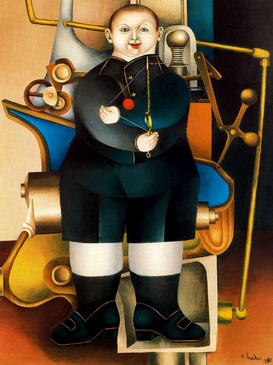 Deleuze and Guattari argue that Richard Lindner's painting Boy with Machine (1954) demonstrates the schizoanalytic thesis of the primacy of desire's social investments over its familial ones: "the turgid little boy has already plugged a desiring-machine into a social machine, short-circuiting the parents."[5] Main article: Schizoanalysis Deleuze and Guattari's "schizoanalysis" is a social and political analysis that responds to what they see as the reactionary tendencies of psychoanalysis.[6] It proposes a functional evaluation of the direct investments of desire—whether revolutionary or reactionary—in a field that is social, biological, historical, and geographical.[7] Deleuze and Guattari develop four theses of schizoanalysis: Every unconscious libidinal investment is social and bears upon a socio-historical field. Unconscious libidinal investments of group or desire are distinct from preconscious investments of class or interest. Non-familial libidinal investments of the social field are primary in relation to familial investments. Social libidinal investments are distinguished according to two poles: a paranoiac, reactionary, fascisizing pole and a schizoid revolutionary pole.[8] In contrast to the psychoanalytic conception, schizoanalysis assumes that the libido does not need to be de-sexualised, sublimated, or to go by way of metamorphoses in order to invest economic or political factors. "The truth is," Deleuze and Guattari explain, "sexuality is everywhere: the way a bureaucrat fondles his records, a judge administers justice, a businessman causes money to circulate; the way the bourgeoisie fucks the proletariat; and so on. [...] Flags, nations, armies, banks get a lot of people aroused."[9] In the terms of classical Marxism, desire is part of the economic, infrastructural "base" of society, they argue, not an ideological, subjective "superstructure."[10] Unconscious libidinal investments of desire coexist without necessarily coinciding with preconscious investments made according to the needs or ideological interests of the subject (individual or collective) who desires.[11] A form of social production and reproduction, along with its economic and financial mechanisms, its political formations, and so on, can be desired as such, in whole or in part, independently of the interests of the desiring-subject. It was not by means of a metaphor, even a paternal metaphor, that Hitler was able to sexually arouse the fascists. It is not by means of a metaphor that a banking or stock-market transaction, a claim, a coupon, a credit, is able to arouse people who are not necessarily bankers. And what about the effects of money that grows, money that produces more money? There are socioeconomic "complexes" that are also veritable complexes of the unconscious, and that communicate a voluptuous wave from the top to the bottom of their hierarchy (the military–industrial complex). And ideology, Oedipus, and the phallus have nothing to do with this, because they depend on it rather than being its impetus.[12] Schizoanalysis seeks to show how "in the subject who desires, desire can be made to desire its own repression—whence the role of the death instinct in the circuit connecting desire to the social sphere."[13] Desire produces "even the most repressive and the most deadly forms of social reproduction."[14] Desiring machines and social production Main article: Desiring-production The traditional understanding of desire assumes an exclusive distinction between "production" and "acquisition."[15] This line of thought—which has dominated Western philosophy throughout its history and stretches from Plato to Freud and Lacan—understands desire through the concept of acquisition, insofar as desire seeks to acquire something that it lacks. This dominant conception, Deleuze and Guattari argue, is a form of philosophical idealism.[15] Alternative conceptions, which treat desire as a positive, productive force, have received far less attention; the ideas of the small number of philosophers who have developed them, however, are of crucial importance to Deleuze and Guattari's project: principally Nietzsche's will to power and Spinoza's conatus.[16] Deleuze and Guattari argue that desire is a positive process of production that produces reality.[17] On the basis of three "passive syntheses" (partly modelled on Kant's syntheses of apperception from his Critique of Pure Reason), desire engineers "partial objects, flows, and bodies" in the service of the autopoiesis of the unconscious.[18] In this model, desire does not "lack" its object; instead, desire "is a machine, and the object of desire is another machine connected to it."[17] On this basis, Deleuze and Guattari develop their notion of desiring-production.[19] Since desire produces reality, social production, with its forces and relations, is "purely and simply desiring-production itself under determinate conditions."[14] Like their contemporary, R. D. Laing, and like Reich before them, Deleuze and Guattari make a connection between psychological repression and social oppression. By means of their concept of desiring-production, however, their manner of doing so is radically different. They describe a universe composed of desiring-machines, all of which are connected to one another: "There are no desiring-machines that exist outside the social machines that they form on a large scale; and no social machines without the desiring machines that inhabit them on a small scale."[20] When they insist that a social field may be invested by desire directly, they oppose Freud's concept of sublimation, which posits an inherent dualism between desiring-machines and social production: "The truth is that sexuality is everywhere: the way a bureaucrat fondles his records, a judge administers justice, a businessman causes money to circulate; the way the bourgeoisie fucks the proletariat; and so on."[21] This dualism, they argue, limited and trapped the revolutionary potential of the theories of Laing and Reich. Deleuze and Guattari develop a critique of Freud and Lacan's psychoanalysis, anti-psychiatry, and Freudo-Marxism (with its insistence on a necessary mediation between the two realms of desire and the social). Deleuze and Guattari's concept of sexuality is not limited to the interaction of male and female gender roles, but instead posits a multiplicity of flows that a "hundred thousand" desiring-machines create within their connected universe; Deleuze and Guattari contrast this "non-human, molecular sexuality" to "molar" binary sexuality: "making love is not just becoming as one, or even two, but becoming as a hundred thousand," they write, adding that "we always make love with worlds."[22] Reframing the Oedipal complex The "anti-" part of their critique of the Freudian Oedipal complex begins with that original model's articulation of society[clarification needed] based on the family triangle of father, mother and child.[page needed] Criticizing psychoanalysis "familialism", they want to show that the oedipal model of the family is a kind of organization that must colonize its members, repress their desires, and give them complexes if it is to function as an organizing principle of society.[page needed] Instead of conceiving the "family" as a sphere contained by a larger "social" sphere, and giving a logical preeminence to the family triangle, Deleuze and Guattari argue that the family should be opened onto the social, as in Bergson's conception of the Open, and that underneath the pseudo-opposition between family (composed of personal subjects) and social, lies the relationship between pre-individual desire and social production. Furthermore, they argue that schizophrenia is an extreme mental state co-existent with the capitalist system itself[23] and capitalism keeps enforcing neurosis as a way of maintaining normality. However, they oppose a non-clinical concept of "schizophrenia" as deterritorialization to the clinical end-result "schizophrenic" (i.e. they do not intend to romanticize "mental disorders"; instead, they show, like Foucault, that "psychiatric disorders" are always second to something else). Body without organs  Deleuze and Guattari describe the BwO as an egg: "it is crisscrossed with axes and thresholds, with latitudes and longitudes and geodesic lines, traversed by gradients marking the transitions and the becomings, the destinations of the subject developing along these particular vectors."[24] Main article: Body without organs Deleuze and Guattari develop their concept of the "body without organs" (often rendered as BwO) from Antonin Artaud's text "To Have Done With the Judgment of God". Since desire can take on as many forms as there are persons to implement it, it must seek new channels and different combinations to realize itself, forming a body without organs for every instance. Desire is not limited to the affections of a subject, nor the material state of the subject. Bodies without organs cannot be forced or willed into existence, however, and they are essentially the product of a zero-intensity condition that Deleuze and Guattari link to catatonic schizophrenia that also becomes "the model of death". Criticism of psychoanalysts Deleuze and Guattari address the case of Gérard Mendel, Bela Grunberger and Janine Chasseguet-Smirgel, who were prominent members of the most respected psychoanalytic association (the International Psychoanalytical Association). They argue that this case demonstrates that psychoanalysis enthusiastically embraces a police state:[25] As to those who refuse to be oedipalized in one form or another, at one end or the other in the treatment, the psychoanalyst is there to call the asylum or the police for help. The police on our side!—never did psychoanalysis better display its taste for supporting the movement of social repression, and for participating in it with enthusiasm. [...] notice of the dominant tone in the most respected associations: consider Dr. Mendel and the Drs Stéphane, the state of fury that is theirs, and their literally police-like appeal at the thought that someone might try to escape the Oedipal dragnet. Oedipus is one of those things that becomes all the more dangerous the less people believe in it; then the cops are there to replace the high priests. Bela Grunberger and Janine Chasseguet-Smirgel were two psychoanalysts from the Paris section of the International Psychoanalytical Association. In November 1968 they disguised themselves under the pseudonym André Stéphane and published L'univers Contestationnaire, in which they argued that the left-wing rioters of May 68 were totalitarian stalinists, and proceeded to psychoanalyze them as having a sordid infantilism caught up in an Oedipal revolt against the Father.[26][27] Jacques Lacan regarded Grunberger and Chasseguet-Smirgel's book with great disdain; while they were still disguised under the pseudonym, Lacan remarked that he was certain that neither author belonged to his school, as none would abase themselves to such low drivel.[28] The IPa analysts responded with an accusation against the Lacan school of "intellectual terrorism."[26] Gérard Mendel published La révolte contre le père (1968) and Pour décoloniser l'enfant (1971). Fascism, the family, and the desire for oppression Desiring self-repression Deleuze and Guattari address a fundamental problem of political philosophy: the contradictory phenomenon whereby an individual or a group comes to desire their own oppression.[29] This contradiction had been mentioned briefly by the 17th-century philosopher Spinoza: "Why do men fight for their servitude as stubbornly as though it were their salvation?"[30] That is, how is it possible that people cry for "More taxes! Less bread!"? Wilhelm Reich discussed the phenomenon in his 1933 book The Mass Psychology of Fascism:[31][32] The astonishing thing is not that some people steal or that others occasionally go out on strike, but rather that all those who are starving do not steal as a regular practice, and all those who are exploited are not continually out on strike: after centuries of exploitation, why do people still tolerate being humiliated and enslaved, to such a point, indeed, that they actually want humiliation and slavery not only for others but for themselves?" To address this question, Deleuze and Guattari examine the relationships between social organisation, power, and desire, particularly in relation to the Freudian "Oedipus complex" and its familial mechanisms of subjectivation ("daddy-mommy-me"). They argue that the nuclear family is the most powerful agent of psychological repression, under which the desires of the child and the adolescent are repressed and perverted.[33][34] Such psychological repression forms docile individuals that are easy targets for social repression.[35] By using this powerful mechanism, the dominant class, "making cuts (coupures) and segregations pass over into a social field", can ultimately control individuals or groups, ensuring general submission. This explains the contradictory phenomenon in which people "act manifestly counter to their class interests—when they rally to the interests and ideals of a class that their own objective situation should lead them to combat".[36] Deleuze and Guattari's critique of these mechanisms seeks to promote a revolutionary liberation of desire: If desire is repressed, it is because every position of desire, no matter how small, is capable of calling into question the established order of a society: not that desire is asocial, on the contrary. But it is explosive; there is no desiring-machine capable of being assembled without demolishing entire social sectors. Despite what some revolutionaries think about this, desire is revolutionary in its essence—desire, not left-wing holidays!—and no society can tolerate a position of real desire without its structures of exploitation, servitude, and hierarchy being compromised.[37] The family under capitalism as an agent of repression The family is the agent to which capitalist production delegates the psychological repression of the desires of the child.[38] Psychological repression is distinguished from social oppression insofar as it works unconsciously.[39] Through it, Deleuze and Guattari argue, parents transmit their angst and irrational fears to their child and bind the child's sexual desires to feelings of shame and guilt. Psychological repression is strongly linked with social oppression, which levers on it. It is thanks to psychological repression that individuals are transformed into docile servants of social repression who come to desire self-repression and who accept a miserable life as employees for capitalism.[40] A capitalist society needs a powerful tool to counteract the explosive force of desire, which has the potential to threaten its structures of exploitation, servitude, and hierarchy; the nuclear family is precisely the powerful tool able to counteract those forces.[41] The action of the family not only performs a psychological repression of desire, but it disfigures it, giving rise to a consequent neurotic desire, the perversion of incestuous drives and desiring self-repression.[41] The Oedipus complex arises from this double operation: "It is in one and the same movement that the repressive social production is replaced by the repressing family, and that the latter offers a displaced image of desiring-production that represents the repressed as incestuous familial drives."[39] Capitalism and the political economy of desire Territorialization, deterritorialization, and reterritorialization Although (like most Deleuzo-Guattarian terms) deterritorialization has a purposeful variance in meaning throughout their oeuvre, it can be roughly described as a move away from a rigidly imposed hierarchical, arborescent context, which seeks to package things (concepts, objects, etc.) into discrete categorised units with singular coded meanings or identities, towards a rhizomatic zone of multiplicity and fluctuant identity, where meanings and operations flow freely between said things, resulting in a dynamic, constantly changing set of interconnected entities with fuzzy individual boundaries. Importantly, the concept implies a continuum, not a simple binary – every actual assemblage (a flexible term alluding to the heterogeneous composition of any complex system, individual, social, geological) is marked by simultaneous movements of territorialization (maintenance) and of deterritorialization (dissipation). Various means of deterritorializing are alluded to by the authors in their chapter "How to Make Yourself A Body Without Organs" in A Thousand Plateaus, including psychoactives such as peyote. Experientially, the effects of such substances can include a loosening (relative deterritorialization) of the worldview of the user (i.e. his/her beliefs, models, etc.), subsequently leading to an antiredeterritorialization (remapping of beliefs, models, etc.) that is not necessarily identical to the prior territory. Deterritorialization is closely related to Deleuzo-Guattarian concepts such as line of flight, destratification and the body without organs/BwO (a term borrowed from Artaud), and is sometimes defined in such a way as to be partly interchangeable with these terms (most specifically in the second part of Capitalism and Schizophrenia, A Thousand Plateaus). Deleuze and Guattari posit that dramatic reterritorialization often follows relative deterritorialization, while absolute deterritorialization is just that... absolute deterritorialization without any reterritorialization. Terminology borrowed from science 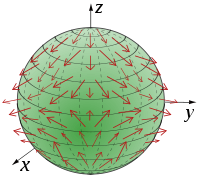 A vector field on a sphere During the course of their argument, Deleuze and Guattari borrow a number of concepts from different scientific fields. To describe the process of desire, they draw on fluid dynamics, the branch of physics that studies how a fluid flows through space. They describe society in terms of forces acting in a vector field. They also relate processes of their "body without organs" to the embryology of an egg, from which they borrow the concept of an inductor.[42] |
概要 分裂分析 ドゥルーズとガタリは、リチャード・リンドナーの絵画『機械を持つ少年』(1954年)は、欲望が家族的なものよりも社会的なものに優先的に投資されると いう精神分裂病のテーゼを示していると主張する: 「この退屈な少年は、すでに欲望機械を社会的機械に接続し、両親を短絡させている」[5]。 主な記事 分裂分析 ドゥルーズとガタリの「シゾアナリシス」は、彼らが精神分析の反動的傾向とみなすものに対応する社会的・政治的分析である: あらゆる無意識的なリビドー投資は社会的であり、社会歴史的な場に影響を及ぼす。 集団や欲望の無意識的なリビドナル投資は、階級や利害の事前意識的な投資とは区別される。 社会的場の非家族的リビドナル投資は、家族的投資との関係において第一義的である。 社会的なリビドナル投資はパラノイアック、反動的、ファシズム的な極とシゾイド的な革命的な極という2つの極によって区別される[8]。 精神分析の概念とは対照的に、精神分裂病はリビドーが経済的、政治的要素に投資するために、脱性的になったり、昇華されたり、変成する必要はないと仮定し ている。「真実は、」ドゥルーズとガタリは説明する。「セクシュアリティはどこにでもある。官僚が自分の記録をもてあそび、裁判官が正義を執行し、ビジネ スマンが貨幣を流通させる方法、ブルジョワジーがプロレタリアートを犯す方法などなど。[国旗、国家、軍隊、銀行は多くの人々を興奮させる」[9]。古典 的マルクス主義の用語で言えば、欲望は社会の経済的、インフラ的な「基盤」の一部であり、イデオロギー的、主観的な「上部構造」ではないと彼らは主張する [10]。 欲望の無意識的なリビドー的投資は、欲望する主体(個人または集団)のニーズやイデオロギー的利益に従って行われる事前意識的投資と必ずしも一致すること なく共存している[11]。 社会的生産と再生の形態は、その経済的・財政的メカニズムや政治的形成などとともに、欲望する主体の利益とは無関係に、全体的あるいは部分的に、そのよう なものとして欲望されうる。ヒトラーがファシストたちを性的に興奮させることができたのは、たとえ父性的な隠喩であっても、隠喩によってではない。銀行や 株式市場の取引、債権、クーポン、信用が、必ずしも銀行家ではない人々を興奮させることができるのは、比喩によるものではない。そして、成長する貨幣、よ り多くの貨幣を生み出す貨幣の効果についてはどうだろうか。社会経済的な 「コンプレックス 」は、無意識のコンプレックスでもあり、ヒエラルキーの頂点から底辺まで官能的な波を伝える(軍産コンプレックス)。そして、イデオロギー、オイディプ ス、そしてファルスは、このこととは何の関係もない。 分裂分析は「欲望する主体において、欲望がいかにしてそれ自身の抑圧を欲望させられるか-それゆえ、欲望と社会圏をつなぐ回路における死の本能の役割」 [13]を示そうとするものであり、欲望は「社会的再生産の最も抑圧的で最も致命的な形態さえも」生み出す[14]。 欲望機械と社会的生産 主な記事 欲望-生産 欲望に関する伝統的な理解は、「生産」と「獲得」の間の排他的な区別を前提としている[15]。この思想の流れは、その歴史を通じて西洋哲学を支配し、プ ラトンからフロイト、ラカンにまで及んでおり、欲望が欠けている何かを獲得しようとする限りにおいて、獲得の概念を通じて欲望を理解している。この支配的 な概念は哲学的観念論の一形態であるとドゥルーズとガタリは主張している[15]。欲望を肯定的で生産的な力として扱う代替的な概念はあまり注目されてこ なかったが、それらを発展させた少数の哲学者の考えはドゥルーズとガタリのプロジェクトにとって極めて重要である。 [このモデルでは、欲望はその対象を「欠く」のではなく、欲望は「機械であり、欲望の対象はそれに接続された別の機械である」。 「欲望は現実を生み出すので、その力と関係を伴う社会的生産は、「決定された条件のもとでの純粋かつ単純な欲望-生産そのもの」である[14]。 同時代のR.D.レインや彼ら以前のライヒのように、ドゥルーズとガタリは心理的抑圧と社会的抑圧を結びつけている。しかし、欲望生産という概念によっ て、その方法は根本的に異なっている。彼らは、欲望機械で構成された宇宙を描写している: 「大規模に形成される社会的機械の外に存在する欲求機械はなく、小規模に生息する欲求機械のない社会的機械はない」[20]。社会的場が欲求によって直接 的に投資されるかもしれないと主張するとき、彼らは欲求機械と社会的生産の間に固有の二元論を仮定するフロイトの昇華の概念に反対する: 「この二元論は、レイングとライヒの理論の革命的可能性を制限し、閉じ込めたと彼らは主張する。ドゥルーズとガタリは、フロイトとラカンの精神分析、反精 神医学、フロイト=マルクス主義(欲望と社会という2つの領域の間に必要な媒介を主張)への批判を展開する。ドゥルーズとガタリのセクシュアリティの概念 は、男性と女性のジェンダー的役割の相互作用に限定されるものではなく、「十万台」の欲望機械がその接続された宇宙の中で生み出す多様な流れを想定してい る。ドゥルーズとガタリは、この「非人間的で分子的なセクシュアリティ」を「臼歯状」の二元的セクシュアリティと対比させている: ドゥルーズとガタリは、この「非人間的な分子的セクシュアリティ」を「モル」的な二元的セクシュアリティと対比させている。 エディプス・コンプレックスのリフレーミング フロイトのエディプス・コンプレックスに対する彼らの批判の「反」部分は、父、母、子という家族の三角形に基づく社会[要明示]のオリジナル・モデルの明 確化から始まる[要ページ]。精神分析の「家族主義」を批判する彼らは、エディプス・モデルの家族が社会の組織原理として機能するためには、メンバーを植 民地化し、彼らの欲望を抑圧し、彼らにコンプレックスを与えなければならない一種の組織であることを示したいのである。 [ドゥルーズとガタリは、「家族」をより大きな「社会」圏に含まれる圏として考え、家族の三角形に論理的な優位性を与えるのではなく、ベルクソンの「開か れたもの」概念のように、家族は社会的なものの上に開かれるべきであり、(個人的主体からなる)家族と社会との間の擬似的な対立の根底には、個人以前の欲 望と社会的生産との関係があると主張する。 さらに彼らは、精神分裂病は資本主義システムそのものと共存する極端な精神状態であり[23]、資本主義は正常性を維持する方法として神経症を強制し続け ていると主張する。しかし、彼らは臨床的な最終結果である「精神分裂病患者」に対する非臨床的な概念としての「精神分裂病」に反対している(つまり、彼ら は「精神障害」をロマン主義的に捉えるつもりはなく、その代わりに、フーコーのように、「精神障害」は常に他の何かに次ぐものであることを示している)。 器官なき身体 ドゥルーズとガタリはBwOを卵のように表現している: 「それは軸と閾値、緯度と経度、測地線によって十字に交差しており、移行となること、これらの特定のベクトルに沿って展開する主体の行き先を示す勾配に よって横断されている」[24]。 主な記事 器官のない身体 ドゥルーズとガタリは、アントナン・アルトーのテクスト『神の裁きと決別する』から「器官なき身体」(しばしばBwOと表記される)の概念を発展させた。 欲望は、それを実現する人の数だけ形をとることができるため、欲望を実現するためには、新たな経路やさまざまな組み合わせを模索し、その都度、器官のない 身体を形成しなければならない。欲望は、対象の愛情や対象の物質的状態に限定されるものではない。ドゥルーズとガタリが緊張病型精神分裂病と結びつけ、 「死のモデル」ともなっている。 精神分析家への批判 ドゥルーズとガタリは、最も尊敬される精神分析協会(国際精神分析協会)の著名なメンバーであったジェラール・メンデル、ベラ・グランベルガー、ジャニー ヌ・シャスゲ=スミルゲルのケースを取り上げる。彼らは、この事件は精神分析が警察国家を熱狂的に受け入れていることを示していると主張している [25]。 何らかのかたちでエディプス化されることを拒否する人たちについては、治療の端か端かで、精神分析医は精神病院か警察に助けを求めるためにそこにいる。警 察は我々の味方だ!-社会的抑圧の動きを支援し、それに熱狂的に参加することに、精神分析がこれほどその趣味を発揮したことはない。[メンデル博士とステ ファン博士、彼らの怒り、そしてエディプスの網の目から逃れようとする者がいるかもしれないと考えたときの、文字通り警察のような訴え。オイディプスは、 人々がそれを信じなくなればなるほど危険になるもののひとつである。 ベラ・グランベルジェとジャニーヌ・シャスゲ=スミルゲルは、国際精神分析協会パリ支部の2人の精神分析家だった。1968年11月、彼らはAndré Stéphaneというペンネームで変装し、『L'univers Contestationnaire』を出版した。その中で彼らは、5月68日の左翼暴徒は全体主義的なスターリニストであると主張し、彼らを父に対する エディプスの反乱に巻き込まれた劣悪な幼児性を持っていると精神分析を進めた。 [26][27]ジャック・ラカンはグランベルジェとシャスゲ=スミルゲルの著書を非常に軽蔑して見ていた。彼らがまだペンネームの下に身を隠していたと き、ラカンは、このような低俗な戯言のために身を卑下するような著者はいないことから、どちらの著者も自分の学派に属していないと確信していると発言し た。 [28] IPaの分析家たちは、ラカン派を「知的テロリズム」と非難し、これに反論した[26] ジェラール・メンデルは、La révolte contre le père(1968年)とPour décoloniser l'enfant(1971年)を出版した。 ファシズム、家族、抑圧への欲望 自己抑圧への欲望 ドゥルーズとガタリは政治哲学の根本的な問題、すなわち個人や集団が自らの抑圧を望むようになるという矛盾した現象に取り組んでいる[29]。 この矛盾は17世紀の哲学者スピノザによって少し言及されている!パンを減らせ!」。ヴィルヘルム・ライヒは1933年の著書『ファシズムの大衆心理学』 の中で、この現象について次のように論じている[31][32]。 驚くべきことは、一部の人々が盗んだり、他の人々が時折ストライキに出たりすることではなく、むしろ飢えているすべての人々が常習的に盗んだりせず、搾取 されているすべての人々が継続的にストライキに出たりしないことである:何世紀にもわたって搾取されてきたのに、なぜ人々はいまだに屈辱を受け、奴隷にさ れることを容認しているのだろうか。 この問いに取り組むため、ドゥルーズとガタリは、社会組織、権力、欲望の関係を、特にフロイトの「エディプス・コンプレックス」とその家族的な主体化のメ カニズム(「パパ・ママ・私」)との関連において検証する。彼らは、核家族は心理的抑圧の最も強力なエージェントであり、そのもとで子どもや思春期の欲望 は抑圧され、変質させられると論じている[33][34]。このような心理的抑圧は、社会的抑圧の対象となりやすい従順な個人を形成する[35]。この強 力なメカニズムを利用することで、支配階級は「切断(coupures)と分離を社会的フィールドに通過させる」ことで、最終的に個人や集団を支配し、一 般的な服従を確保することができる。このことは、人々が「自分たちの階級的利益に反して明白に行動する-自分たち自身の客観的状況が闘うように導くはずの 階級の利益と理想に結集するとき」[36]という矛盾した現象を説明する: 欲望が抑圧されているとすれば、それは欲望のあらゆる立場が、どんなに小さなものであっても、社会の既成秩序に疑問を投げかけることができるからである。 欲望は非社会的なものではなく、それどころか爆発的なものなのである。社会全体を破壊することなく組み立てられる欲望機械など存在しないのだ。一部の革命 家がこのことについてどう考えているかにかかわらず、欲望はその本質において革命的である-欲望であって、左翼的な休日ではない!-そしていかなる社会 も、搾取、隷属、ヒエラルキーの構造が損なわれることなく、真の欲望の立場を容認することはできない[37]。 抑圧の主体としての資本主義下の家族 家族は、資本主義的生産が子どもの欲望の心理的抑圧を委ねる主体である。心理的抑圧は、それが無意識に働く限りにおいて、社会的抑圧とは区別される [39]。ドゥルーズとガタリは、それを通して、親は自分の怒りや不合理な恐怖を子どもに伝え、子どもの性的欲望を羞恥心や罪悪感に縛り付けると主張す る。心理的抑圧は社会的抑圧と強く結びついている。心理的抑圧のおかげで、個人は社会的抑圧の従順な下僕へと変容し、自己抑圧を望むようになり、資本主義 のための従業員として悲惨な人生を受け入れるようになるのである[40]。資本主義社会は、その搾取、隷属、ヒエラルキーの構造を脅かす可能性を持つ欲望 の爆発的な力に対抗する強力な道具を必要としている。核家族はまさに、こうした力に対抗することのできる強力な道具である[41]。 家族の作用は欲望を心理的に抑圧するだけでなく、欲望を形骸化させ、結果として神経症的な欲望、近親相姦的な衝動の倒錯、自己抑圧を欲望する欲望を生み出 す。エディプス・コンプレックスはこの二重の作用から生じる[41]: 「抑圧的な社会的生産が抑圧的な家族によって置き換えられ、後者が近親相姦的な家族的衝動として抑圧されたものを表象する欲望的生産のずれたイメージを提 供することは、同じ運動の中にある」[39]。 資本主義と欲望の政治経済学 領土化、非領土化、再領土化 ほとんどのドゥルーズ=ガタリアン用語と同様に)非領土化には、彼らの作品全体を通じて意図的な意味のばらつきがあるが、大まかに言えば、物事(概念、物 体など)を個別のカテゴリー化された単位にパッケージ化しようとする、厳格に押しつけられた階層的で樹枝状的な文脈からの脱却である。 そこでは、意味と操作が物事の間を自由に流れ、個々の境界があいまいな、相互に結びついたダイナミックで絶えず変化する実体の集合が生まれる。重要なの は、この概念が単純な二項対立ではなく、連続性を意味していることだ。実際のあらゆるアッサンブラージュ(個人、社会、地質など、あらゆる複雑なシステム の異質な構成を暗示する柔軟な用語)は、領土化(維持)と非領土化(消滅)の同時進行によって特徴づけられる。著者は『千のプラトー』の「臓器のない身体 を作る方法」の章で、ペヨーテのような精神薬も含め、非領土化のさまざまな手段に言及している。経験的に、このような物質の効果には、使用者の世界観(す なわち、その人の信念やモデルなど)を緩める(相対的な非領土化)ことが含まれ、その後、必ずしも以前の領域と同一ではない反領土化(信念やモデルなどの 再マッピング)をもたらすことがある。 脱領土化は、ドゥルーズ=ガタリの概念である「飛翔線」、「脱領土化」、「器官なき身体/BwO」(アルトーから借用した用語)と密接に関連しており、こ れらの用語と部分的に互換性を持つように定義されることもある(特に『資本論と分裂症』の第二部『千のプラトー』)。ドゥルーズとガタリは、劇的な再領土 化はしばしば相対的な非領土化の後に起こり、絶対的な非領土化はまさにそれである......再領土化を伴わない絶対的な非領土化であるとしている。 科学から借用した用語 球面上のベクトル場 議論の過程で、ドゥルーズとガタリはさまざまな科学分野から多くの概念を借りている。欲望のプロセスを記述するために、彼らは流体力学(流体が空間をどの ように流れるかを研究する物理学の一分野)を利用している。彼らはベクトル場に作用する力という観点から社会を描写する。彼らはまた、「臓器のない身体」 のプロセスを卵子の発生学に関連づけ、そこからインダクターの概念を借りている[42]。 |
| Reception and influence The philosopher Michel Foucault wrote that Anti-Oedipus can best be read as an "art", in the sense that is conveyed by the term "erotic art." Foucault considered the book's three "adversaries" as the "bureaucrats of the revolution", the "poor technicians of desire" (psychoanalysts and semiologists), and "the major enemy", fascism. Foucault used the term "fascism" to refer "not only historical fascism, the fascism of Hitler and Mussolini...but also the fascism in us all, in our heads and in our everyday behavior, the fascism that causes us to love power, to desire the very thing that dominates and exploits us." Foucault added that Anti-Oedipus is "a book of ethics, the first book of ethics to be written in France in quite a long time", and suggested that this explains its popular success. Foucault proposed that the book could be called Introduction to the Non-Fascist Life. Foucault argued that putting the principles espoused in Anti-Oedipus into practice involves freeing political action from "unitary and totalizing paranoia" and withdrawing allegiance "from the old categories of the Negative (law, limit, castration, lack, lacuna), which western thought has so long held sacred as a form of power and an access to reality."[43] The psychiatrist David Cooper described Anti-Oedipus as "a magnificent vision of madness as a revolutionary force", crediting its authors with using "the psychoanalytic language and the discourse of Saussure (and his successors)" to pit "linguistics against itself in what is already proving to be an historic act of depassment."[44] The critic Frederick Crews wrote that when Deleuze and Guattari "indicted Lacanian psychoanalysis as a capitalist disorder" and "pilloried analysts as the most sinister priest-manipulators of a psychotic society", their "demonstration was widely regarded as unanswerable" and "devastated the already shrinking Lacanian camp in Paris."[45] The philosopher Douglas Kellner described Anti-Oedipus as its era's publishing sensation, and, along with Jean-François Lyotard's Libidinal Economy (1974), a key text in "the micropolitics of desire."[46] The psychoanalyst Joel Kovel wrote that Deleuze and Guattari provided a definitive challenge to the mystique of the family, but that they did so in the spirit of nihilism, commenting, "Immersion in their world of 'schizoculture' and desiring machines is enough to make a person yearn for the secure madness of the nuclear family."[47] Anthony Elliott described Anti-Oedipus as a "celebrated" work that "scandalized French psychoanalysis and generated heated dispute among intellectuals" and "offered a timely critique of psychoanalysis and Lacanianism at the time of its publication in France". However, he added that most commentators would now agree that "schizoanalysis" is fatally flawed, and that there are several major objections that can be made against Anti-Oedipus. In his view, even if "subjectivity may be usefully decentred and deconstructed", it is wrong to assume that "desire is naturally rebellious and subversive." He believed that Deleuze and Guattari see the individual as "no more than various organs, intensities and flows, rather than a complex, contradictory identity" and make false emancipatory claims for schizophrenia. He also argued that Deleuze and Guattari's work produces difficulties for the interpretation of contemporary culture, because of their "rejection of institutionality as such", which obscures the difference between liberal democracy and fascism and leaves Deleuze and Guattari with "little more than a romantic, idealized fantasy of the 'schizoid hero'". He wrote that Anti-Oedipus follows a similar theoretical direction to Lyotard's Libidinal Economy, though he sees several significant differences between Deleuze and Guattari on the one hand and Lyotard on the other.[48] Some of Guattari's diary entries, correspondence with Deleuze, and notes on the development of the book were published posthumously as The Anti-Oedipus Papers (2004).[49] The philosopher Mikkel Borch-Jacobsen and the psychologist Sonu Shamdasani wrote that rather than having their confidence shaken by the "provocations and magnificent rhetorical violence" of Anti-Oedipus, the psychoanalytic profession felt that the debates raised by the book legitimated their discipline.[50] Joshua Ramey wrote that while the passage into Deleuze and Guattari's "body without organs" is "fraught with danger and even pain ... the point of Anti-Oedipus is not to make glamorous that violence or that suffering. Rather, the point is to show that there is a viable level of Dinoysian [sic] experience."[51] The philosopher Alan D. Schrift wrote in The Cambridge Dictionary of Philosophy (2015) that Anti-Oedipus was "read as a major articulation of the philosophy of desire and a profound critique of psychoanalysis."[52] |
受容と影響 哲学者ミシェル・フーコーは、『アンチ・オイディプス』は、「エロティック・アート 」という言葉が伝える意味で、「アート 」として読むのが最もふさわしいと書いた。フーコーは、この本の3人の「敵」を「革命の官僚」、「欲望の貧弱な技術者」(精神分析家と意味論者)、そして 「大敵」であるファシズムと考えた。フーコーは 「ファシズム 」という言葉を使って、「歴史的ファシズム、ヒトラーやムッソリーニのファシズムだけでなく......私たち全員の中にあるファシズム、私たちの頭の中 にあるファシズム、私たちの日常の行動の中にあるファシズム、私たちに権力を愛させ、私たちを支配し搾取するものそのものを欲望させるファシズム」を指し ている。フーコーは、『アンチ・オイディプス』は「倫理の書であり、フランスで書かれた久しぶりの倫理の書である」と付け加え、この本が人気を博した理由 をこう示唆した。フーコーは、この本を『非ファシズム的生活入門』と呼ぶこともできると提案した。フーコーは、『アンチ・オイディプス』で主張されている 原則を実践することは、「一元的で全体化するパラノイア」から政治的行動を解放し、「西洋思想が権力の形態として、また現実へのアクセスとして長い間神聖 視してきた否定的なものの古いカテゴリー(法則、制限、去勢、欠如、欠落)から」忠誠を撤回することを含むと主張した[43]。 精神科医のデイヴィッド・クーパーは、『アンチ・オイディプス』を「革命的な力としての狂気の壮大なヴィジョン」と評し、その著者たちが「精神分析的な言 語とソシュール(とその後継者たち)の言説」を用いて、「すでに歴史的な脱落行為であることが証明されつつある言語学を自分自身と戦わせた」と評価してい る。 批評家フレデリック・クルーズは、ドゥルーズとガタリが「ラカンの精神分析を資本主義的障害として告発」し、「分析者を精神病社会の最も邪悪な司祭操作者 として嘲笑」したとき、彼らの「実証は広く答えのないものとみなされ」、「すでに縮小していたパリのラカン陣営を荒廃させた」と書いている。 哲学者のダグラス・ケルナーは、『アンチ・オイディプス』を同時代の出版界のセンセーションであり、ジャン=フランソワ・リオタールの『リビディナル・エ コノミー』(1974年)とともに、「欲望のミクロ政治学」の重要なテキストであると評した。 精神分析学者のジョエル・コヴェルは、ドゥルーズとガタリは家族の神秘性への決定的な挑戦を提供したが、彼らはニヒリズムの精神でそれを行ったと書いてお り、「彼らの『分裂文化』と欲望機械の世界に浸ることは、核家族の安全な狂気への憧れを抱かせるのに十分である」とコメントしている[47]。 アンソニー・エリオットは『アンチ・オイディプス』を「フランスの精神分析をスキャンダラスにし、知識人の間で激しい論争を巻き起こした」「有名な」作品 であり、「フランスで出版された当時、精神分析とラカニアニズムに対するタイムリーな批判を提供した」と評している。しかし、現在ではほとんどの論者が 「分裂分析」には致命的な欠陥があり、『アンチ・オイディプス』にはいくつかの大きな反論があることに同意するだろう、と彼は付け加えた。彼の見解では、 たとえ「主観性が有益にまとも化され、脱構築される」としても、「欲望が自然に反抗的で破壊的である」と仮定するのは間違っている。彼は、ドゥルーズとガ タリは個人を「複雑で矛盾したアイデンティティではなく、さまざまな器官、強度、流れにすぎない」と見ており、精神分裂病に対して誤った解放的な主張をし ていると考えた。また、ドゥルーズとガタリの作品は現代文化の解釈に困難をもたらすが、それは彼らの「制度としての制度性の拒絶」が、自由民主主義とファ シズムの違いをあいまいにし、ドゥルーズとガタリに「『シゾイドの英雄』というロマンチックで理想化されたファンタジーに過ぎないもの」を残しているから だと論じた。彼は『アンチ・オイディプス』がリオタールの『リビディナル・エコノミー』と同様の理論的方向性を辿っていると書いているが、一方でドゥルー ズとガタリ、他方でリオタールの間にはいくつかの重大な違いがあると見ている[48]。 哲学者のミッケル・ボルク=ヤコブセンと心理学者のソヌ・シャムダサニは、『アンチ・オイディプス』の「挑発と壮大な修辞的暴力」によって自信を揺るがさ れるどころか、精神分析の専門家たちはこの本によって提起された議論が自分たちの学問領域を正当化していると感じていると書いている。 [50] ジョシュア・レイミーは、ドゥルーズとガタリの「器官なき身体」への通路は「危険と苦痛に満ちているが......『アンチ・オイディプス』のポイント は、その暴力や苦痛を美化することではない。むしろ重要なのは、ディノイス的な(中略)体験の実行可能なレベルが存在することを示すことである」 [51]。哲学者のアラン・D・シュリフトは『ケンブリッジ哲学辞典』(2015年)で、『アンチ・オイディプス』は「欲望の哲学の主要な明確化として、 また精神分析の深遠な批判として読まれている」と書いている[52]。 |
| Accelerationism Antipsychiatry Feminism and the Oedipus complex Id, ego, and super-ego La Borde clinic Plane of immanence Psychoanalytic conceptions of language Psychological repression Schizoanalysis |
加速主義 反精神医学 フェミニズムとエディプス・コンプレックス イド、自我、超自我 ラ・ボルド・クリニック 内在の平面 精神分析的言語概念 心理的抑圧 分裂分析 |
| https://en.wikipedia.org/wiki/Anti-Oedipus |
|
| Notes 01. Foucault (1977, 14). Deleuze and Guattari (1980, 423–427). Deleuze and Guattari, Anti-Oedipus, p.4 Deleuze and Guattari (1972, xli). Deleuze and Guattari (1972, 8, 51, 392). The painting forms the frontispiece of Anti-Oedipus. Deleuze and Guattari (1972, 54, 108, 127–128, 325-xx). Deleuze and Guattari argue that there was no specific "turning point" in the theoretical development of Freudianism at which it became reactionary; instead, it contained "revolutionary, reformist, and reactionary elements" from the start. "We refuse to play 'take it or leave it'," they write. This politically ambiguous mixture of tendencies in psychoanalysis arises, they argue, from its ambiguous relationship with its discoveries: "As if every great doctrine were not a combined formation, constructed from bits and pieces, various intermingled codes and flux, partial elements and derivatives, that constitute its very life or becoming. As if we could reproach someone for having an ambiguous relationship with psychoanalysis, without first mentioning that psychoanalysis owes its existence to a relationship, theoretically and practically ambiguous, with what it discovers and the forces that it wields" (1972, 128). Despite the militancy of the analyses proposed within Deleuze and Guattari's project, they insist that "no political program will be elaborated within the framework of schizoanalysis" (1972, 415). Guattari developed the implications of their theory for a concrete political project in his book with the Italian autonomist marxist philosopher Antonio Negri, Communists Like Us (1985). For the variable relations between the socius of capital and revolutionary autonomous territorialities, see Deleuze and Guattari (1972, 410). Deleuze and Guattari (1972, 93, 115, 322–333, 354, 400). First thesis (1972, 375); second thesis (1972, 377); third thesis (1972, 390); fourth thesis (1972, 401). Deleuze and Guattari (1972, 322–333). Deleuze and Guattari (1972, 114, 378). In failing to recognise this, Deleuze and Guattari argue, Wilhelm Reich fell short of the materialist psychiatry towards which he aimed and was unable to provide an adequate answer to his question "Why did the masses desire fascism?" Deleuze and Guattari (1972, 114, 322). Deleuze and Guattari qualify this distinction between unconscious desire and preconscious need or interest when they write: "It is doubtless true that interests predispose us to a given libidinal investment"; however, they go on to insist once again that the interests "are not identical with this investment" (1972, 379). Deleuze and Guattari (1972, 114–115). Section 2.5 The Conjunctive Synthesis of Consumption-Consummation, pp. 98, 105 Deleuze and Guattari (1972, 31). Deleuze and Guattari (1972, 26). Kant's analysis of superstitious beliefs, hallucinations, and fantasies in his Critique of Judgment treats desire as a creative, productive force, Deleuze and Guattari explain, although his analysis limits its effects to the production of a psychic reality and thereby retains the validity of desire-as-lack; (1972, 26–27). Deleuze and Guattari (1972, 28). Deleuze and Guattari (1972, 28), Guattari (1992, 15), and Holland (1999, 25). Deleuze and Guattari (1972, 1–9). Deleuze and Guattari (1972, 373). Deleuze and Guattari (1972). Anti-Oedipus. University of Minnesota Press. p. 293. Deleuze and Guattari (1972, 323, 325). Deleuze and Guattari (1972, 34–35) Deleuze and Guattari (1972, 21). section 2.4 The disjunctive synthesis of recording p. 89 Jean-Michel Rabaté (2009) 68 + 1: Lacan's année érotique published in Parrhesia, Number 6 • 2009 pp. 28–45 André Stéphane [Bela Grunberger and Janine Chasselet-Smirguel], L'Univers Contestationnaire (Paris: Payot, 1969). Jacques Lacan, The Seminars of Jacques Lacan, Seminar XVI D'un Autre à l'autre, 1968–9, p. 266 Deleuze and Guattari (1972, 31); see also Deleuze and Foucault (1972, 212). In Theologico-Political Treatise, Preface. The original Latin text reads: "ut pro servido, tanquam pro salute pugnent". Anti-Oedipus, section I.4 A Materialist Psychiatry Wilhelm Reich (1946) The Mass Psychology of Fascism, section I.3 The Problem of Mass Psychology, originally published in 1933 Section II.7 Social Repression and Psychic repression, pp. 123–32 Holland (1999) p. 57 Deleuze and Guattari (1972, 396). Anti-Oedipus, section 2.5 The Conjunctive Synthesis of Consumption-Consummation, Desire and the infrastructure, p.104 Deleuze and Guattari (1972, 126–127). Deleuze and Guattari (1972, 130–131). Deleuze and Guattari (1972, 130). Deleuze and Guattari (1972, 396). pp.115, 119–20 Deleuze and Guattari (1972, 92–93, 100–101). Deleuze and Guattari develop this relation further in the chapter "November 28, 1947: How Do You Make Yourself a Body Without Organs?" in their sequel to Anti-Oedipus, A Thousand Plateaus (1980, 165–184). Foucault, Michel; Deleuze, Gilles; Guattari, Félix (1992). Anti-Oedipus. Minneapolis: University of Minnesota Press. pp. xii–xiii. ISBN 0-8166-1225-0. Cooper, David (1978). The Language of Madness. London: Allen Lane. p. 138. ISBN 0-7139-1118-2. Crews, Frederick (1986). Skeptical Engagements. Oxford: Oxford University Press. p. 176. ISBN 0-19-503950-5. Kellner, Douglas (1989). Jean Baudrillard: From Marxism to Postmodernism and Beyond. Cambridge: Polity Press. pp. 127, 223. ISBN 0-7456-0562-1. Kovel, Joel (1991). History and Spirit: An Inquiry into the Philosophy of Liberation. Boston: Beacon Press. pp. 82, 255. ISBN 0-8070-2916-5. Elliott, Anthony (2002). Psychoanalytic Theory: An Introduction. New York: Palgrave. pp. 157, 161–163. ISBN 0-333-91912-2. Guattari (2004). Borch-Jacobsen, Mikkel; Shamdasani, Sonu (2012). The Freud Files: An Inquiry into the History of Psychoanalysis. Cambridge: Cambridge University Press. pp. 30–1. ISBN 978-0-521-72978-9. Ramey, Joshua (2012). The Hermetic Deleuze: Philosophy and Spiritual Ordeal. Durham: Duke University Press. p. 199. ISBN 978-0-8223-5229-7. 52. Schrift, Alan D. (2017). Audi, Robert (ed.). The Cambridge Dictionary of Philosophy. Cambridge: Cambridge University Press. p. 251. ISBN 978-1-107-64379-6. |
注 01. フーコー(1977, 14)。 ドゥルーズとガタリ(1980, 423–427)。 ドゥルーズとガタリ、『アンチ・オイディプス』、p.4 ドゥルーズとガタリ(1972, xli)。 ドゥルーズとガタリ(1972, 8, 51, 392)。この絵画は『アンチ・オイディプス』の口絵を飾っている。 ドゥルーズとガタリ(1972, 54, 108, 127–128, 325-xx)。ドゥルーズとガタリは、フロイト主義の理論的発展において、それが反動的になった特定の「転換点」など存在しなかったと論じる。むしろ、 それは当初から「革命的、改革的、そして反動的な要素」を含んでいたのだ。「我々は『受け入れるか、拒否するか』というゲームには加わらない」と彼らは記 す。精神分析におけるこうした政治的に曖昧な傾向の混合は、その発見との曖昧な関係から生じていると彼らは論じる。「あたかもあらゆる偉大な教義が、その 生命や生成そのものを構成する断片や、様々な混在するコードや流動、部分的な要素や派生物から構築された複合的な形成物ではないかのように。あたかも、精 神分析が、その発見や行使する力との、理論的にも実践的にも曖昧な関係にその存在を負っているという点をまず言及することなく、誰かが精神分析と曖昧な関 係にあると非難できるかのように」(1972, 128)。ドゥルーズとガタリのプロジェクト内で提示された分析の闘争性にもかかわらず、彼らは「スキゾ分析の枠組み内では、いかなる政治的プログラムも 策定されない」と主張している(1972, 415)。ガタリは、イタリアの自律派マルクス主義哲学者アントニオ・ネグリとの共著『私たちのような共産主義者たち』(1985)において、具体的な政 治プロジェクトに向けた彼らの理論の含意を展開した。資本のソシウスと革命的自律的領域性との間の変動的な関係については、ドゥルーズとガタリ (1972, 410)を参照のこと。 ドゥルーズとガタリ(1972, 93, 115, 322–333, 354, 400)。 第一テーゼ(1972, 375); 第二のテーゼ(1972, 377);第三のテーゼ(1972, 390);第四のテーゼ(1972, 401)。 ドゥルーズとガタリ(1972, 322–333)。 ドゥルーズとガタリ(1972, 114, 378)。ドゥルーズとガタリは、この点を認識できなかったために、ヴィルヘルム・ライヒは自らが目指した唯物論的精神医学に到達できず、「なぜ大衆は ファシズムを欲したのか」という自身の問いに対して適切な答えを提供できなかったと論じている ドゥルーズとガタリ(1972年、114、322)。ドゥルーズとガタリは、無意識の欲望と前意識的な欲求や関心とのこの区別について、次のように述べて 補足している。「関心が、特定のリビドー的投資への素地を作るというのは、疑いようのない事実である」。しかし、彼らはさらに、その関心は「この投資と同 一ではない」と改めて主張する(1972, 379)。 ドゥルーズとガタリ(1972年、114–115頁)。 第2.5節 消費と完結の結合的総合、98、105頁 ドゥルーズとガタリ(1972年、31頁)。 ドゥルーズとガタリ(1972年、26頁)。 『判断力批判』における迷信的信念、幻覚、空想に関するカントの分析は、欲望を創造的かつ生産的な力として扱っているとドゥルーズとガタリは説明する。た だし、その分析は欲望の効果を精神的な現実の生成に限定しており、それによって「欠如としての欲望」の妥当性を維持している(1972, 26–27)。 ドゥルーズとガタリ(1972, 28)。 ドゥルーズとガタリ(1972, 28)、ガタリ(1992, 15)、およびホランド(1999, 25)。 ドゥルーズとガタリ(1972, 1–9)。 ドゥルーズとガタリ(1972, 373)。 ドゥルーズとガタリ(1972)。『アンチ・オイディプス』。ミネソタ大学出版局。p. 293。 ドゥルーズとガタリ(1972, 323, 325)。 ドゥルーズとガタリ(1972, 34–35) ドゥルーズとガタリ(1972, 21)。 第2.4節 記録の分離的総合 p. 89 ジャン=ミシェル・ラバテ(2009)『68 + 1:ラカンのエロティックな年』Parrhesia第6号・ 2009年 pp. 28–45 アンドレ・ステファン [ベラ・グルンベルガーとジャニヌ・シャスレ=スミルゲル]、『L『Univers Contestationnaire』(パリ:パヨ、1969年)。 ジャック・ラカン、『ジャック・ラカンのセミナー』、セミナーXVI『D』un Autre à l'autre』、1968–9年、p. 266 ドゥルーズとガタリ(1972年、31頁);ドゥルーズとフーコー(1972年、212頁)も参照。 『神学政治論』序文。『ut pro servido, tanquam pro salute pugnent』とラテン語の原文にはある。 『アンチ・オイディプス』第I部第4章「唯物論的精神医学」 ヴィルヘルム・ライヒ(1946)『ファシズムの大衆心理学』、第I部第3章「大衆心理学の問題」、初版は1933年 第II部第7章「社会的抑圧と精神的抑圧」、pp. 123–32 ホランド(1999)p. 57 ドゥルーズとガタリ(1972, 396)。 『アンチ・オイディプス』第2.5節「消費・完結、欲望、そしてインフラストラクチャーによる結合的総合」、p.104 ドゥルーズとガタリ(1972, 126–127)。 ドゥルーズとガタリ(1972, 130–131)。 ドゥルーズとガタリ(1972, 130)。 ドゥルーズとガタリ(1972, 396)。 pp.115, 119–20 ドゥルーズとガタリ(1972, 92–93, 100–101)。ドゥルーズとガタリは、『アンチ・オイディプス』の続編である『千の平原』(1980, 165–184)の「1947年11月28日:いかにして器官なき身体を作り出すか?」という章において、この関係をさらに展開している。 フーコー、ミシェル;ドゥルーズ、ジル;ガタリ、フェリックス(1992)。『アンチ・オイディプス』。ミネアポリス:ミネソタ大学出版局。xii–xiii頁。ISBN 0-8166-1225-0。 クーパー、デヴィッド(1978)。『狂気の言語』。ロンドン:アレン・レーン。p. 138。ISBN 0-7139-1118-2。 クルーズ、フレデリック(1986)。『懐疑的関与』。オックスフォード:オックスフォード大学出版局。p. 176。ISBN 0-19-503950-5。 ケルナー、ダグラス(1989)。『ジャン・ボードリヤール:マルクス主義からポストモダニズム、そしてその先へ』。ケンブリッジ:ポリティ・プレス。pp. 127, 223。ISBN 0-7456-0562-1。 コーヴェル、ジョエル(1991)。『歴史と精神:解放の哲学への探究』。ボストン:ビーコン・プレス。pp. 82, 255. ISBN 0-8070-2916-5. エリオット、アンソニー(2002)。『精神分析理論:入門』。ニューヨーク:パルグレイブ。pp. 157, 161–163. ISBN 0-333-91912-2. ガタリ(2004)。 ボルク=ヤコブセン、ミッケル;シャムダサニ、ソヌ(2012)。『フロイト・ファイルズ:精神分析の歴史に関する考察』。ケンブリッジ:ケンブリッジ大学出版局。pp. 30–1。ISBN 978-0-521-72978-9。 レイミー、ジョシュア(2012)。『秘教的ドゥルーズ:哲学と精神的試練』。ダーラム:デューク大学出版局。p. 199。ISBN 978-0-8223-5229-7。 52. シュリフト、アラン・D.(2017)。アウディ、ロバート(編)。『ケンブリッジ哲学辞典』。ケンブリッジ:ケンブリッジ大学出版局。p. 251。ISBN 978-1-107-64379-6。 |
| Sources Deleuze, Gilles. 2004. Desert Islands and Other Texts, 1953–1974. Trans. Michael Taormina. Ed. David Lapoujade. Semiotext(e) Foreign Agents ser. Los Angeles and New York: Semiotext(e). ISBN 1-58435-018-0. Deleuze, Gilles and Michel Foucault. 1972. "Intellectuals and Power." In Deleuze (2004, 206–213). Deleuze, Gilles and Félix Guattari. 1972. Anti-Oedipus. Trans. Robert Hurley, Mark Seem and Helen R. Lane. London and New York: Continuum, 2004. Vol. 1 of Capitalism and Schizophrenia. 2 vols. 1972–1980. Trans. of L'Anti-Oedipe. Paris: Les Editions de Minuit. ISBN 0-8264-7695-3. Preview available on Google Books ---. 1980. A Thousand Plateaus. Trans. Brian Massumi. London and New York: Continuum, 2004. Vol. 2 of Capitalism and Schizophrenia. 2 vols. 1972–1980. Trans. of Mille Plateaux. Paris: Les Editions de Minuit. ISBN 0-8264-7694-5. Foucault, Michel. 1977. Preface. In Deleuze and Guattari (1972, xiii–xvi). Guattari, Félix. 1992. Chaosmosis: An Ethico-Aesthetic Paradigm. Trans. Paul Bains and Julian Pefanis. Bloomington and Indianapolis: Indiana UP, 1995. Trans. of Chaosmose. Paris: Éditions Galilée. ISBN 0-909952-25-6. ---. 2004 The Anti-Oedipus Papers. Ed. Stéphane Nadaud. Trans. Kélina Gotman. New York: Semiotext(e), 2006. ISBN 1-58435-031-8. Holland, Eugene W. 1999. Deleuze and Guattari's Anti-Oedipus: Introduction to Schizoanalysis. London and New York: Routledge. ISBN 0-415-11319-9. Seem, Mark. 1977. Introduction. In Deleuze and Guattari (1972, xvii–xxvi). |
出典 ドゥルーズ、ジル。2004年。『砂漠の島とその他のテキスト、1953–1974』。マイケル・タオミナ訳。デヴィッド・ラプジャード編。 Semiotext(e) Foreign Agents シリーズ。ロサンゼルスおよびニューヨーク:Semiotext(e)。ISBN 1-58435-018-0。 ドゥルーズ、ジルおよびミシェル・フーコー。1972年。「知識人と権力」。ドゥルーズ(2004年、206–213頁)所収。 ドゥルーズ、ジルおよびフェリックス・ガタリ。1972年。『アンチ・オイディプス』。ロバート・ハーレー、マーク・シーム、ヘレン・R・レーン訳。ロン ドンおよびニューヨーク:コンティニュアム、2004年。『資本主義と統合失調症』第1巻。全2巻。1972–1980年。『L'Anti- Oedipe』の英訳。パリ:レ・エディション・ド・ミニュイ。ISBN 0-8264-7695-3。Google Booksでプレビュー可能 ---. 1980年。『千の平原』。ブライアン・マッスミ訳。ロンドンおよびニューヨーク:コンティニュアム、2004年。『資本主義と精神分裂』第2巻。全2 巻。1972–1980年。『Mille Plateaux』の英訳。パリ:レ・エディション・ド・ミニュイ。ISBN 0-8264-7694-5。 フーコー、ミシェル。1977年。序文。ドゥルーズとガタリ(1972年、xiii–xvi)所収。 ガタリ、フェリックス。1992年。『カオスモーズ:倫理的・美学的パラダイム』。ポール・ベインズ、ジュリアン・ペファニス訳。ブルーミントンおよびイ ンディアナポリス:インディアナ大学出版局、1995年。『カオスモーズ』の英訳。パリ:エディション・ガリレ。ISBN 0-909952-25-6。 ---. 2004 『アンチ・オイディプス・ペーパーズ』。ステファン・ナドー編。ケリーナ・ゴットマン訳。ニューヨーク:セミオテキスト(e)、2006年。ISBN 1-58435-031-8。 ホランド、ユージン・W. 1999年. 『ドゥルーズとガタリの『アンチ・オイディプス』:スキゾ分析への序説』. ロンドンおよびニューヨーク:ラウトリッジ. ISBN 0-415-11319-9. シーム、マーク. 1977年. 「序文」. ドゥルーズとガタリ(1972年、xvii–xxvi)所収. |
| Further reading Abou-Rihan, Fadi. 2008. "Deleuze and Guattari: A Psychoanalytic Itinerary." London/New York: Continuum. ISBN 1-84706-371-3. Alliez, Éric. 2004. "Anti-Oedipus – Thirty Years On (Between Art and Politics)." Trans. Alberto Toscano. In Deleuze and the Social. Ed. Martin Fulgsang and Bent Meier Sorenson. Deleuze Connections ser. Edinburgh: Edinburgh UP, 2006. 151–68. ISBN 0-7486-2093-1. Badiou, Alain. 2004. "The Flux and the Party: In the Margins of Anti-Oedipus." Trans. Laura Balladur and Simon Krysl. Polygraph 15/16: 75–92. Buchanan, Ian, ed. 1999. A Deleuzean Century? Durham, NC: Duke UP. ISBN 0-8223-2392-3. ---. 2008. Deleuze and Guattari's Anti-Oedipus: A Reader's Guide. London and New York: Continuum. ISBN 0-8264-9149-9. Deleuze, Gilles and Félix Guattari 1975. Kafka: Towards a Minor Literature. Trans. Dana Polan. Theory and History of Literature 30. Minneapolis and London: U of Minnesota P, 1986. Trans. of Kafka: Pour une literature mineure. Paris: Les Editions de Minuit. ISBN 0-8166-1515-2. Flieger, Jerry Aline. 1999. "Overdetermined Oedipus: Mommy, Daddy and Me as Desiring-Machine." In Buchanan (1999, 219–240). Guattari, Félix. 1984. Molecular Revolution: Psychiatry and Politics. Trans. Rosemary Sheed. Harmondsworth: Penguin. ISBN 0-14-055160-3. ---. 1995. Chaosophy. Ed. Sylvère Lotringer. Semiotext(e) Foreign Agents Ser. New York: Semiotext(e). ISBN 1-57027-019-8. ---. 1996. Soft Subversions. Ed. Sylvère Lotringer. Trans. David L. Sweet and Chet Wiener. Semiotext(e) Foreign Agents Ser. New York: Semiotext(e). ISBN 1-57027-030-9. Hocquenghem, Guy. 1972. Homosexual Desire. Trans. Daniella Dangoor. 2nd ed. Series Q ser. Durham, NC: Duke UP, 1993. ISBN 0-8223-1384-7. Jameson, Fredric. 1999. "Marxism and Dualism in Deleuze." In Buchanan (1999, 13–36). Lambert, Gregg. 2006. Who's Afraid of Deleuze and Guattari? London and New York: Continuum. Massumi, Brian. 1992. A User's Guide to Capitalism and Schizophrenia: Deviations from Deleuze and Guattari. Swerve editions. Cambridge, United States and London: MIT. ISBN 0-262-63143-1. Perez, Rolando. 1990. On An(archy) and Schizoanalysis. New York: Autonomedia. |
追加文献(さらに読む) アブ=リハン、ファディ。2008年。「ドゥルーズとガタリ:精神分析的遍歴」。ロンドン/ニューヨーク:コンティニュアム。ISBN 1-84706-371-3。 アリエ、エリック。2004年。「『アンチ・オイディプス』――30年を経て(芸術と政治の間)」。アルベルト・トスカノ訳。マーティン・フルグサング、 ベント・マイヤー・ソレンソン編『ドゥルーズと社会』所収。Deleuze Connectionsシリーズ。エディンバラ:エディンバラ大学出版局、2006年。151–68頁。ISBN 0-7486-2093-1. バディウ、アラン。2004年。「流動と党:『アンチ・オイディプス』の境界にて」。ローラ・バラドゥール、サイモン・クリスル訳。『ポリグラフ』15/16号:75–92頁。 ブキャナン、イアン編。1999年。『ドゥルーズの世紀か?』ノースカロライナ州ダーラム:デューク大学出版局。ISBN 0-8223-2392-3。 ---。2008年。『ドゥルーズとガタリの『アンチ・オイディプス』:読者のためのガイド』。ロンドンおよびニューヨーク:コンティニュアム。ISBN 0-8264-9149-9。 ドゥルーズ、ジル、フェリックス・ガタリ 1975. 『カフカ:マイナー文学へ』。ダナ・ポラン訳。Theory and History of Literature 30。ミネアポリスおよびロンドン:ミネソタ大学出版局、1986年。『カフカ:マイナー文学へ』(原題:Kafka: Pour une littérature mineure)。パリ:レ・エディション・ド・ミニュイ。ISBN 0-8166-1515-2。 フリーガー、ジェリー・アリーン。1999年。「過剰決定されたオイディプス:欲望の機械としてのママ、パパ、そして私」。ブキャナン(1999年、219–240頁)所収。 ガタリ、フェリックス。1984年。『分子革命:精神医学と政治』。ローズマリー・シード訳。ハーモンズワース:ペンギン。ISBN 0-14-055160-3. ---. 1995. 『カオソフィー』. 編:シルヴェール・ロトリンガー. Semiotext(e) Foreign Agents Ser. ニューヨーク:Semiotext(e). ISBN 1-57027-019-8. ---. 1996. 『ソフト・サブヴァージョンズ』. 編:シルヴェール・ロトリンガー. 訳:デヴィッド・L・スウィート、チェット・ウィーナー。セミオテキスト(e)・フォーリン・エージェント・シリーズ。ニューヨーク:セミオテキスト (e)。ISBN 1-57027-030-9。 オクエンゲム、ギー。1972年。『ホモセクシュアル・デザイア』。訳:ダニエラ・ダンゴール。第2版。シリーズQ。ノースカロライナ州ダーラム:デューク大学出版局、1993年。ISBN 0-8223-1384-7. ジェイムソン、フレデリック。1999年。「ドゥルーズにおけるマルクス主義と二元論」。ブキャナン(1999年、13–36頁)所収。 ランバート、グレッグ。2006年。『ドゥルーズとガタリを恐れるのは誰か』。ロンドンおよびニューヨーク:コンティニュアム。 マッスミ、ブライアン。1992年。『資本主義と統合失調症のユーザー・ガイド:ドゥルーズとガタリからの逸脱』。スワーヴ・エディションズ。米国ケンブリッジおよびロンドン:MIT。ISBN 0-262-63143-1。 ペレス、ロランド。1990年。『ア(ナキー)とスキゾ分析について』。ニューヨーク:オートノメディア。 |
| Reading Notes on Deleuze and Guattari, Capitalism and Schizophrenia" by Michael Hardt |
★シュレーバー院長(1842–1911)
| 「シュレーバー院長」は、精神医学、心理学、
哲学の歴史において極めて有名な症例であるダニエル・パウル・シュレーバー(1842–1911)を指すのが一般的である。彼はザクセン王国の最高裁判所
にあたる控訴院の議長(院長)を務めた優秀な法学者であったが、重度の妄想症(パラノイア)を発症し、長期間の療養生活を送った。 |
|
| 『ある神経病者の回想録』: 1903年に彼が出版した手記。自らが「神」と交信し、身体が女性に変形させられ、新しい人類を生み出すという壮大な妄想体験が詳細に記録されている。 |
|
| 精神分析の対象: ジークムント・フロイトをはじめ、ジャック・ラカンやジル・ドゥルーズといった名だたる思想家・精神分析家たちが、この手記をもとに人間の心理や精神病のメカニズムを分析した。 |
|
| シュレーバー回想録 : ある神経病者の手記 / D.P.シュレーバー著 ; 尾川浩, 金関猛訳, 東京 : 平凡社 , 2002.12. - (平凡社ライブラリー ; 451)/ 東京 : 平凡社 , 1991.1 |
|
| Denkwürdigkeiten eines Nervenkranken Daniel Paul Schreber: Denkwürdigkeiten eines Nervenkranken, Leipzig: O. Mulze, 1903の全訳 「神」の言葉を聞き、崩壊した世界を救済するために女性となって「神」の子を身ごもる…そんな妄想に襲われ、苦しめられた男は、みずからの壮絶な闘いを生 々しく記録した。フロイト、ラカン、カネッティ、ドゥルーズ&ガタリなど、知の巨人たちに衝撃を与え、二〇世紀思想に不可逆的な影響を与えた稀代の書物。 第一級の精神科医による渾身の全訳! 神と不死性 神の国の危機?/魂の殺害 最初の神経病と二度目の神経病の初期における個人的体験 続き/神経言語(内なる声)/思考強迫/世界秩序が要請する事情としての脱男性化 個人的体験の続き/幻影/「視霊者」 個人的体験の続き/独特の病的現象/幻影 ピエルゾン博士の精神病院での入院生活期間における個人的体験/「試練に曝された魂」 ゾンネンシュタインへの移送/光線交流における変化/「記録方式」/「天体への接合」 ゾンネンシュタインでの個人的体験/光線交流の随伴現象としての「妨害」/「気分造り」 奇蹟による肉体的な完璧さの損傷〔ほか〕 |
|
| https://ci.nii.ac.jp/ncid/BB19685710 |
★聖家族 (Die heilige Familie, oder Kritik der kritischen Kritik. Gegen Bruno Bauer & Consorten)
| Die heilige Familie, oder Kritik der kritischen Kritik. Gegen Bruno Bauer & Consorten ist der Titel eines Buches von Karl Marx und Friedrich Engels, das im Frühjahr 1845 erschien. Es ist die erste Schrift, die Marx und Engels gemeinsam verfassten. Sie entschlossen sich dazu bei ihrem ersten persönlichen Treffen im August 1844 |
『聖家族、あるいは批判的批判への批判。ブルーノ・バウアーとその一派に対する[Die heilige Familie, oder Kritik der kritischen Kritik. Gegen Bruno Bauer & Consorten]』は、1845年春に出版されたカール・マルクスとフリードリヒ・エンゲルスの著書のタイトルである。 これはマルクスとエンゲルスが共同で執筆した最初の著作である。二人は1844年8月の初対面時に、この著作を執筆することを決意した |
| Druckvorbereitung In einem undatierten Brief vom Herbst 1844 an Heinrich Börnstein fragte Marx, ob A. Frank in Brüssel das Buch verlegen könnte.[1] Eine weitere Anfrage richtete Marx an Julius Campe in Hamburg.[2] Schließlich trat Marx in Briefwechsel mit der erst am 1. Juli 1844 gegründeten Literarischen Anstalt (J. Rütten).[3] Am 3. Dezember 1844 schrieben die beiden Verleger Joseph Rütten und Zacharias Loewenthal an Marx, dass der Buchsatz fast fertig sei und schickten einen Wechsel über 1000 Franc.[4][5] Am 9. Dezember 1844 berichtete der metternichsche Konfident Hermann Ebner, dass Marx eine Schrift gegen Bruno Bauer bei Rütten drucken lassen würde. Am 27. Dezember 1844 schlug Loewenthal Marx den endgültigen Titel der Schrift vor: Die Heilige Familie, oder Kritik der kritischen Kritik. Gegen Bruno Bauer und Consorten.[6][7] Am 15. Januar 1845 fügte Loewenthal die letzten von Marx erbetenen Korrekturen ein.[8][9] Am 24. Februar 1845 wurde das Buch dann ausgeliefert.[10] Den Druck bewirkte die Frankfurter Buch- und Steindruckerei Streng[11] und Schneider.[12] 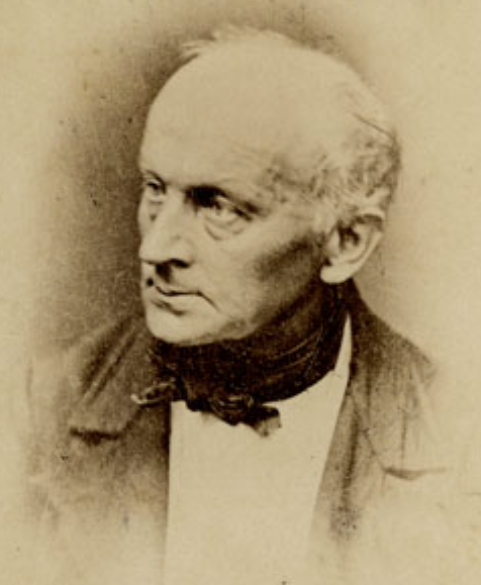 Bruno Bauer. Fotografie von Leopold Haase (1831–1901) |
印刷準備 1844年秋、ハインリヒ・ベルンシュタイン宛ての日付不明の手紙の中で、マルクスはブリュッセルのA・フランクがその本を出版できるかどうか尋ねた。 [1] マルクスはハンブルクのユリウス・カンペにも問い合わせを行った。[2] 最終的にマルクスは、1844年7月1日に設立されたばかりの「リテラリッシェ・アンシュタルト」(J・リュッテン)と文通を始めた。[3] 1844年12月3日、2人の出版者ヨゼフ・リュッテンとザカリアス・ローウェンタールは、組版がほぼ完了したことをマルクスに伝え、1000フランの小 切手を送った。[4][5] 1844年12月9日、メッテルニヒ派の情報提供者ヘルマン・エブナーは、マルクスがリュッテン社でブルーノ・バウアーに対する論考を印刷する予定である と報告した。1844年12月27日、レーヴェンタールはマルクスに、この著作の最終的なタイトルとして『聖家族、あるいは批判的批判の批判。ブルーノ・ バウアーとその一派に対する』を提案した。[6][7] 1845年1月15日、レーヴェンタールはマルクスから求められた最後の校正を加えた。[8][9] 1845年2月24日、本書は出荷された。[10] 印刷はフランクフルトの書籍・石版印刷所シュトレン[11]とシュナイダー[12]が担当した。 ブルーノ・バウアー。レオポルト・ハーゼ(1831–1901)撮影 |
| Absicht der Schrift Absicht der Autoren war, sich von der Theorieentwicklung Bruno Bauers – ehemals Mentor von Marx – zu distanzieren und sich zum „realen Humanismus“ Ludwig Feuerbachs zu bekennen.[13] Hauptinhalt ist der Widerspruch zwischen Hegels idealistischer und Marx’ materialistischer Auffassung von Dialektik und insbesondere eine Kritik an den Junghegelianern Bruno Bauer und dessen Bruder Edgar Bauer sowie an einer Reihe weniger bekannter Autoren aus dem Kreis der Berliner „Freien“. Auffällig ist, dass Marx hier Max Stirner, der zum engeren Umkreis Bauers gehörte, nicht zu den „Consorten“ zählte und von seiner Kritik ausnahm. Der Tenor des Textes, der zu etwa 90 % von Marx stammt,[14] ist durchgehend polemisch bis verhöhnend, was nicht erst der Untertitel anzeigt: Gegen Bruno Bauer & Consorten. Schon der Haupttitel verspottet Bruno Bauers Philosophie mit dem erfundenen Begriff „kritische Kritik“. Denn Bauer nannte seine kritische Theorie,[15] die er vor allem in Artikeln des Jahrgangs 1844 der Allgemeinen Literaturzeitung entwickelte nicht „Kritische Kritik“, sondern „Reine Kritik“.[16] Die Junghegelianer gingen in Anlehnung an Hegel davon aus, dass die Geschichte nur Ausdruck der Weiterentwicklung menschlicher Vernunft sei und lehnten daher jedes politische Engagement ab. Marx und Engels kritisierten diese Auffassung in der Heiligen Familie als realitätsfern: „Wie bei Hegel ist das Resultat der wirklichen Entwickelung nichts anderes als die bewiesene, d. h. zum Bewußtsein gebrachte Wahrheit. [...] Die absolute Kritik spricht von ‚Wahrheiten, die sich von vornherein von selbst verstehen‘. [...] Eine Wahrheit, die sich von selber versteht, hat für die absolute Kritik, wie für die göttliche Dialektik, ihr Salz, ihren Sinn, ihren Wert verloren. Sie ist fad geworden wie abgestandnes Wasser. Die absolute Kritik beweist daher einerseits alles, was sich von selbst versteht, und außerdem viele Dinge, die das Glück haben, unverständig zu sein, sich also niemals von selbst verstehen werden. Andrerseits versteht sich ihr alles das von selbst, was einer Entwickelung bedarf. Warum? Weil es sich bei wirklichen Aufgaben von selber versteht, daß sie sich nicht von selber verstehn.“[17] Nach Friedrich Engels eigenen Worten habe er selbst „fast nichts“[18] zu dem Werk beigetragen, weshalb er es für „kurious“[19] erachtet, dass er neben Marx als Autor genannt wird. Ansonsten bewertet er das Werk als „famos“, „prächtig geschrieben und zum kranklachen“, aber in seiner Gänze „zu groß“ und insgesamt „dem größeren Publikum unverständlich“.[20] |
本書の趣旨 著者らの意図は、マルクスの元指導者であったブルーノ・バウアーの理論展開から距離を置き、ルートヴィヒ・フォイエルバッハの「現実的なヒューマニズム」を支持することにあった。[13] 主な内容は、ヘーゲルの観念論的弁証法とマルクスの唯物論的弁証法との対立であり、特に、若ヘーゲル派のブルーノ・バウアーとその弟エドガー・バウアー、 およびベルリンの「自由派」のサークルに属するあまり知られていない一連の著者たちに対する批判である。注目すべきは、マルクスがここで、バウアーの近し い仲間であったマックス・シュティルナーを「一味」には含めず、批判の対象から外した点だ。 本文の約90%をマルクスが執筆した[14]この文章の基調は、通して論争的であり、時には嘲笑的さえある。これは副題『ブルーノ・バウアーとその一味に 対して』が示す通りだ。表題そのものが、ブルーノ・バウアーの哲学を「批判的批判」という造語を用いて嘲笑している。というのも、バウアーは、主に『アル ゲマイネ・リテラトゥールツァイトゥング』1844年分の記事で展開した自身の批判理論[15]を、「批判的批判」ではなく「純粋な批判」と呼んでいたか らである[16]。 若ヘーゲル派は、ヘーゲルに倣い、歴史は人間の理性のさらなる発展の表れに過ぎないと見なし、したがってあらゆる政治的関与を拒絶した。マルクスとエンゲルスは、『聖家族』において、この見解を現実離れしていると批判した: 「ヘーゲルの場合と同様、現実の発展の結果は、証明された、すなわち意識化された真理に他ならない。[...] 絶対的批判は、『最初から自明である真理』について語る。[...] 自明である真理は、絶対的批判にとっても、神の弁証法にとっても、その味、意味、価値を失っている。それは、古くなった水のように味気ないものになってし まった。したがって、絶対的批判は、一方で自明なものをすべて証明し、さらに、理解しがたいという幸運に恵まれ、したがって決して自明になることのない多 くの事柄をも証明する。他方で、発展を必要とするものはすべて、彼女にとっては自明である。なぜか? なぜなら、現実の課題においては、それらが自明ではないことは自明だからだ。」[17] フリードリヒ・エンゲルス自身の言葉によれば、彼自身はこの著作に「ほとんど何も」[18]貢献していないため、マルクスと並んで著者として名を連ねてい ることを「奇妙」[19]だと考えている。それ以外では、彼はこの著作を「素晴らしい」、「見事に書かれていて、腹を抱えて笑ってしまうほど」と評価して いるが、全体としては「大きすぎる」ものであり、総じて「一般大衆には理解できない」としている。[20] |
| Bedeutung der Schrift Die heilige Familie ist eine Schrift des Übergangs in der theoretischen Entwicklung von Marx. Während er sich hier noch zu Feuerbach bekennt, zeigt die Niederschrift seiner Thesen über Feuerbach, kurz nach Erscheinen des Buches im Februar 1845, dass er sich bereits von Feuerbach zu lösen begann. Dieser Prozess begann unter dem Eindruck der Feuerbach-Kritik in Max Stirners Buch Der Einzige und sein Eigentum (Oktober 1844) und wurde abgeschlossen, nachdem Marx im September 1845 Feuerbachs Replik auf Stirner und dessen Duplik gelesen hatte.[21] Anschließend begann Marx mit seiner Stirner-Kritik „Sankt Max“, die aber unveröffentlicht blieb und erst 1932 im Rahmen des Textkonvoluts Die deutsche Ideologie in der Marx-Engels-Gesamtausgabe erschien.[22] |
この著作の意義 『聖家族』は、マルクスの理論的発展における過渡期の著作である。ここではまだフェーエルバッハを支持しているものの、1845年2月の本書出版直後に執 筆された『フェーエルバッハに関するテーゼ』の草稿からは、彼がすでにフェーエルバッハから距離を置き始めていたことがうかがえる。この過程は、マック ス・シュティルナーの著書『唯一者とその所有』(1844年10月)におけるフェーエルバッハ批判の影響を受けて始まり、1845年9月にマルクスがシュ ティルナーに対するフェーエルバッハの反論およびその再反論を読んだ後に完了した。[21] その後、マルクスはシュティルナー批判『聖マックス』の執筆に着手したが、これは未発表のままであり、1932年に『ドイツ・イデオロギー』のテキスト集 として『マルクス・エンゲルス全集』に収録されるまで日の目を見なかった。[22] |
| Ausgaben Originalausgabe, Literarische Anstalt (J. Rütten). Frankfurt a. M. 1845. (Digitalisat) Marx-Engels-Gesamtausgabe. Abt. 1, Sämtliche Werke und Schriften mit Ausnahme des Kapital, Bd. 3: Die heilige Familie und Schriften von Marx von Anfang 1844 bis Anfang 1845. Marx-Engels-Verlag, Berlin 1932 (Reprint Auvermann, Glashütten im Taunus 1970) Faksimilisierter Reprint, Rütten & Loening, Berlin 1953. Marx-Engels-Werke Bd. 2, Dietz Verlag, Berlin 1957, S. 3–223. (DEA Archiv) Die heilige Familie. In: Marx-Engels-Gesamtausgabe (MEGA). I. Abteilung, Band 4. Karl Marx / Friedrich Engels: Werke, Artikel, Entwürfe. Ende August 1844 bis April 1846. Bearbeitet von Regina Roth und Christine Weckwerth. Herausgegeben von der Internationalen Marx-Engels-Stiftung (IMES), Amsterdam. De Gruyter Akademie Forschung, Berlin und Boston 2022. ISBN 978-3-11-068326-4. |
版 初版、リテラリシェ・アンシュタルト(J. リュッテン)。フランクフルト・アム・マイン、1845年。(デジタル版) マルクス・エンゲルス全集。第1部、『資本論』を除く全著作集、第3巻: 『聖家族』および1844年初頭から1845年初頭までのマルクスの著作。マルクス・エンゲルス出版社、ベルリン、1932年(再版:アウヴァーマン、タウヌスのグラスヒュッテン、1970年) 複製版、リュッテン&レーニング、ベルリン、1953年。 『マルクス・エンゲルス全集』第2巻、ディーツ出版社、ベルリン、1957年、3–223頁。(DEAアーカイブ) 『聖家族』。掲載:『マルクス・エンゲルス全集』(MEGA)。第I部、第4巻。カール・マルクス/フリードリヒ・エンゲルス:著作、記事、草稿。 1844年8月末から1846年4月まで。レジーナ・ロスおよびクリスティン・ヴェックヴェルト編。国際マルクス・エンゲルス財団(IMES)、アムステ ルダム刊。デ・グルイター・アカデミー・フォルシュング、ベルリンおよびボストン、2022年。ISBN 978-3-11-068326-4。 |
| Literatur Alexis Schmidt: Rezension: In: Jahrbücher für wissenschaftliche Kritik. W. Besser, Berlin 1845. Nr. 55 bis 58 März 1845, Spalte 438 bis 461. Digitalisat Lenin: Konspekt zu Marx’ und Engels’ Werk „Die heilige Familie“. In: W. I. Lenin. Werke. Bd. 38. Philosophische Hefte. Dietz Verlag, Berlin 1968, S. 3–37. Fritz Brügel: Die Verlagsgeschichte der ‚Heiligen Familie‘. In: Der Kampf. Sozialdemokratische Monatsschrift hrsg. von F. Adler, Wien 1928, Band 21, Heft 10, S. 508–510. Werner Sellhorn: Marx und Engels: Die Heilige Familie u. a. Die Deutsche Ideologie. In: Deutsche Zeitschrift für Philosophie. 2. Jg. (1954) Heft 3, S. 698 ff. Walter Markov: Jacques Roux und Karl Marx. Zum Einzug der Enragés in die Heilige Familie. Akademieverlag, Berlin 1965. (=Sitzungsberichte der Deutschen Akademie der Wissenschaften zu Berlin, Klasse für Philosophie, Geschichte, Staats-, Rechts- und Wirtschaftswissenschaften. Deutsche Akademie der Wissenschaften <Berlin, Ost> / Klasse für Philosophie, Geschichte, Staats-, Rechts- und Wirtschaftswissenschaften 1) Wolfgang Mönke: Die heilige Familie. Zur Ersten Gemeinschaftsarbeit von Karl Marx und Friedrich Engels. Akademie Verlag, Berlin 1972. (Enthält u. a. 86 Dokumente von 1842–1895.) Wolfgang Mönke: Zur Redaktions- und Verlagsgeschichte der „Heiligen Familie“. In: Hundertfünfundzwanzig Jahre Rütten & Loening. 1844–1969. Ein Almanach. Rütten & Loening, Berlin 1969, S. 100–123. Horst Ullrich: Zur Reaktion der bürgerlichen Ideologie auf die „Heilige Familie“. In: Deutsche Zeitschrift für Philosophie. 17. Jg., 1969, Heft 7. ISSN 2192-1482 Die heilige Familie, oder Kritik der kritischen Kritik. Gegen Bruno Bauer & Consorten. In: Bert Andréas: Karl Marx / Friedrich Engels. Das Ende der klassischen deutschen Philosophie. Bibliographie. Trier 1983, S. 73–86 (Schriften aus dem Karl-Marx-Haus Nr. 28). Marion Barzen: Die „Heilige Familie“ in Charlottenburg. In: Studien zu Marx’ erstem Paris-Aufenthalt und zur Entstehung der Deutschen Ideologie. Internationale Konferenz am 12. Februar 1990 im Studienzentrum Karl-Marx-Haus in Trier. Trier 1990, S. 138–162. (Schriften aus dem Karl-Marx-Haus Trier, Heft 43). 150 Jahre Rütten & Loening. … mehr als eine Verlagsgeschichte. 1844–1994. Hrsg. von Carsten Wurm. Mit einem Geleitwort von Alfred Grosser. Rütten & Loening, Berlin 1994. ISBN 3-352-00500-1 Hermann-Peter Eberlein: Bruno Bauer. Vom Marx-Freund zum Antisemiten. Karl Dietz Verlag, Berlin 2009, ISBN 978-3-320-02180-1, S. 139–144. |
参考文献 アレクシス・シュミット:書評:『科学批評年報』所収。W. ベッサー、ベルリン、1845年。第55号~第58号、1845年3月、438~461欄。デジタル版 レーニン:マルクスとエンゲルスの著作『聖家族』に関する要約。W. I. レーニン『全集』 第38巻。『哲学ノート』。ディーツ出版社、ベルリン、1968年、3–37頁。 フリッツ・ブリュゲル:『聖家族』の出版史。『闘争』。F. アドラー編、社会民主党月刊誌、ウィーン、1928年、第21巻、第10号、508–510頁。 ヴェルナー・ゼルホルン:マルクスとエンゲルス:『聖家族』ほか『ドイツ・イデオロギー』。掲載:『ドイツ哲学雑誌』。第2巻(1954年)第3号、698頁以降。 ヴァルター・マルコフ:ジャック・ルーとカール・マルクス。『聖家族』へのアンラジェの参入について。アカデミー出版社、ベルリン、1965年。(=ベル リン・ドイツ科学アカデミー会議録、哲学・歴史・政治・法学・経済学部門。ドイツ科学アカデミー<ベルリン、東>/哲学・歴史・政治・法学・経済学部門 1) ヴォルフガング・メンケ:『聖家族』。カール・マルクスとフリードリヒ・エンゲルスの最初の共同作業について。アカデミー出版社、ベルリン、1972年。(1842年から1895年までの文書86点などを収録。) ヴォルフガング・メンケ:『「聖家族」の編集・出版史について』。収録:『リュッテン&レーニング社創立250周年。1844–1969年。年鑑。リュッテン&レーニング、ベルリン、1969年、100–123頁。 ホルスト・ウルリッヒ:『聖家族』に対するブルジョア的イデオロギーの反応について。『ドイツ哲学雑誌』第17巻、1969年、第7号。ISSN 2192-1482 『聖家族』、あるいは批判的批判への批判。ブルーノ・バウアーらに対する。Bert Andréas: Karl Marx / Friedrich Engels. Das Ende der klassischen deutschen Philosophie. Bibliographie. トリーア 1983年、73–86頁(カール・マルクス・ハウス刊行物 第28号)。 Marion Barzen: シャルロッテンブルクにおける『聖家族』。収録:『マルクスの最初のパリ滞在と「ドイチェ・イデオロギー」の成立に関する研究』。1990年2月12日、 トリーアのカール・マルクス・ハウス研究センターにて開催された国際会議。トリーア 1990年、138–162頁。(トリーア・カール・マルクス・ハウス刊行物、第43号)。 『リュッテン&レーニング150年。…単なる出版史以上のもの。1844–1994』。カルステン・ヴルム編。アルフレート・グロッサーによる序文付き。リュッテン&レーニング、ベルリン、1994年。ISBN 3-352-00500-1 ヘルマン=ペーター・エバーライン:ブルーノ・バウアー。マルクスの友人から反ユダヤ主義者へ。カール・ディーツ出版社、ベルリン 2009年、ISBN 978-3-320-02180-1、139–144頁。 |
| Einzelnachweise 01.Marx-Engels-Gesamtausgabe. Abteilung III. Bd. 1, S. 249. Alfred Frommhold: Hundertundzehn Jahre Verlag Rütten & Loening Berlin. 1844 bis 1954. Rütten & Loening, Berlin 1954, S. 28. Marx-Engels-Gesamtausgabe. Abteilung III. Bd. 1, S. 247. Faksimile der Gründungsanzeige in: Hundertfünfundzwanzig Jahre Rütten & Loening 1844 – 1969. Ein Almanach, S. 21. Wolfgang Mönke, S. 160 f. Marx-Engels-Gesamtausgabe. Abteilung III. Band 1, S. 446. Wolfgang Mönke, S. 163. Marx-Engels-Gesamtausgabe. Abteilung III. Band 1, S. 447. Wolfgang Mönke, S. 164 ff. Marx-Engels-Gesamtausgabe. Abteilung III. Band 1, S. 448 f. 10. Zacharias Loewenthal an Hermann Ebner 24. Februar 1845. (Hans Adler (Hrsg.): Literarische Geheimberichte. Protokolle der Metternich-Agenten. Bamd II. 1844-1848-C. W. Leske, Köln 1981, S. 95.) Friedrich Reinhard Streng (Geb. 11. Februar 1792 in Frankfurt am Main; gest. 4. November 1875 ebenda.) (Alexander Dietz: Frankfurter Handelsgeschichte. 4. Band. II. Teil. Frankfurt am Main 1925, S. 511.) Friedrich Schneider (Geb. Januar 1789 in Freiberg (Sachsen)). Das Sterbedatum konnte nicht ermittelt werden.(Auskunft vom 19. Januar 2009 von Michael Mattheus, Stadtarchiv Frankfurt a. M.) Siehe die „Vorrede“ zum Buch, speziell den ersten Satz. Der Textanteil von Marx (ungefähr 90 %) ergibt sich aufgrund der Angaben im Inhaltsverzeichnis – Band 2 der MEW, S. 723–725 –, wo zu jedem Kapitel der Autor genannt ist Einer von Bauers diesbezüglichen Artikeln Was ist jetzt Gegenstand der Kritik? Gleichwohl ist sie aufgrund der Wirkungsmacht von Marx fast nur noch als „kritische Kritik“ – und auch nur noch als Phrase – bekannt. Karl Marx: Die heilige Familie, VI. Kapitel online Friedrich Engels in Marx Friedrich Engels Werke Band 27, S. 22 Friedrich Engels in Marx Friedrich Engels Werke Band 27, S. 22 20. Friedrich Engels in Marx Friedrich Engels Werke Band 27, S. 26 anonym [Ludwig Feuerbach]: Über das „Wesen des Christentums“ in Beziehung auf den „Einzigen und sein Eigentum“. In: ders.: Gesammelte Werke, Band 9, Berlin 1990, S. 427–441; M[ax] St[irner]: Recensenten Stirners. In: Max Stirner: Parerga, Kritiken, Repliken, Nürnberg 1986, S. 147–205. 22. Eine material- und kenntnisreiche Studie zu dieser Phase der Theorieentwicklung bei Marx ist: Wolfgang Eßbach: Die Bedeutung Max Stirners für die Genese des historischen Materialismus (Diss. 1978), unter dem Titel Gegenzüge. Frankfurt/M.: Materialis 1982. Vgl. auch das Standardwerk von Eßbach: Die Junghegelianer. München: Wilhelm Fink 1988; einen Abriss bietet: Bernd A. Laska: Den Bann brechen ! – Max Stirner redivivus. Teil 1: Über Marx und die Marxforschung In: Der Einzige. Vierteljahresschrift des Max-Stirner-Archivs Leipzig, Nr. 3 (11), 3. August 2000, S. 17–24. |
参考文献 01.マルクス・エンゲルス全集。第III部。第1巻、249ページ。 アルフレート・フロムホルト:『ベルリンのルッテン&レーニング出版社110年史。1844年から1954年』。ルッテン&レーニング、ベルリン、1954年、28ページ。マルクス・エンゲルス全集。第III部 第1巻、247頁。 設立告知の複製:『リュッテン&レーニング社125年 1844年~1969年。年鑑』、21頁。 ヴォルフガング・メンケ、160頁以降。 『マルクス・エンゲルス全集』。第III部。第1巻、446頁。 ヴォルフガング・メンケ、163頁。 『マルクス・エンゲルス全集』。第III部。第1巻、447頁。 ヴォルフガング・メンケ、164頁以降。 『マルクス・エンゲルス全集』。第III部。第1巻、448頁以降。 10. ザカリアス・ローウェンタールからヘルマン・エブナーへの書簡、1845年2月24日。(ハンス・アドラー(編):『文学的秘密報告書。メッテルニヒの工作員たちの議事録』。第II巻。1844-1848-C。W. レスケ、ケルン、1981年、95頁。) フリードリヒ・ラインハルト・シュトレンク(1792年2月11日、フランクフルト・アム・マイン生まれ;1875年11月4日、同地にて死去。)(アレ クサンダー・ディーツ:『フランクフルト商業史』。第4巻。第2部。フランクフルト・アム・マイン、1925年、511頁。) フリードリヒ・シュナイダー(1789年1月、フライベルク(ザクセン)生まれ)。没日は特定できなかった。(2009年1月19日、フランクフルト・アム・マイン市公文書館のミヒャエル・マテウスからの情報) 本書の「序文」、特に最初の文を参照のこと。 マルクスの執筆割合(約90%)は、目次(『マルクス・エンゲルス全集』第2巻、723–725ページ)の記載に基づき算出されたもので、そこでは各章ごとに著者が明記されている バウアーによるこの件に関する論文の一つでは、現在、批判の対象となっているのは何なのか? とはいえ、マルクスの影響力ゆえに、それはもはやほとんど「批判的批判」として――そして単なる決まり文句として――しか知られていない。 カール・マルクス:『聖家族』、第6章 オンライン フリードリヒ・エンゲルス『マルクス・フリードリヒ・エンゲルス著作集』第27巻、22ページ フリードリヒ・エンゲルス『マルクス・フリードリヒ・エンゲルス著作集』第27巻、22ページ 20. フリードリヒ・エンゲルス『マルクス・フリードリヒ・エンゲルス著作集』第27巻、26ページ 匿名[ルートヴィヒ・フォイエルバッハ]:「『唯一者とその所有物』に関連する『キリスト教の本質』について」。同著:『全集』第9巻、ベルリン、 1990年、427–441頁;M[ax] St[irner]:『シュティルナーの書評家たち』。Max Stirner:『パレルガ、批評、反論』、ニュルンベルク、1986年、147–205頁。 22. マルクスの理論展開におけるこの段階に関する、資料豊富で知見に満ちた研究として、ヴォルフガング・エスバッハ:『歴史的唯物論の生成におけるマックス・ シュティルナーの意義』(1978年博士論文)、『Gegenzüge』の題名で出版。フランクフルト・アム・マイン:マテリアリス、1982年。また、 エスバッハの標準的な著作『若ヘーゲル派』も参照のこと。ミュンヘン:ヴィルヘルム・フィンク、1988年。概要については、ベルント・A・ラスカ『呪縛 を解く!――マックス・シュティルナー・レディヴィヴス。第1部:マルクスとマルクス研究について』を参照。掲載誌:『Der Einzige』。ライプツィヒ・マックス・シュティルナー・アーカイブ季刊誌、第3号(11)、2000年8月3日、17–24頁。 |
| https://de.wikipedia.org/wiki/Die_heilige_Familie |
☆Reading Notes on Deleuze and Guattari, Capitalism and Schizophrenia" by Michael Hardt
| Anti-Oedipus: Part One connective synthesis disjunctive synthesis conjunctive synthesis (and ... and) (or ... or) (it's me ...) desiring machine body without organs subject (intensity=0) (zones of intensity) schizophrenia paranoia machine célibataire pleasure production enregistrement / coding consumption anti-production forme miraculeuse labor capital libido Numen Voluptas .m:2 |
『アンチ・オイディプス』:第一部 結合的合成 分離的合成 結合的合成(そして……そして)(あるいは……あるいは)(それは私だ……) 欲望の機械 器官なき身体 主体(強度=0)(強度の領域) 統合失調症 偏執 機械 独身者 快楽 生産 記録/コーディング 消費 反生産 奇跡的な形態 労働 資本 リビドー ヌメン ヴォルプタス .m:2 |
| Let's start with machine
production. Everything is machines, machines connected to other
machines. I think we should read this as a properly ontological claim,
a claim about the nature of reality. What does it mean to say that all
is machinic? |
まずは機械による生産から始めよう。すべてが機械であり、機械は他の機械とつながっている。これは、真に存在論的な主張、つまり現実の本質に関する主張として読み解くべきだと私は考える。「すべてが機械的である」とは、どういう意味なのだろうか。 |
| All is ... Take just the first
half of that statement: "All is ...." The form of this statement "All
is ..." already implies an ontological claim that being is one, being
is always and everywhere the same, or rather that being is univocal.
Nietzsche uses the same form when he says "The world is will to power
and nothing else." Spinoza says very much the same thing when he says
that all being is striving (conatus). And I assume it is Lucretius
and/or Aristotle that D&G are referring to when they use the term
flow or the Greek word hylé , which means matter: being consists of
flows or matter (rather than atoms, say). [Help me if this is wrong.]
(Compare this too to how Marx would say that labor is the source of all
wealth in capitalist society -- but let's leave that aside for the
moment.) So what is common to these three ontological claims: the world
is will to power, being is striving, and being is flows or becoming.
Well, first of all, there is no other to the world, to being; being or
the world is all there is. There is no other world or other realm
beyond this one. Second, being is one; there is no difference in nature
among its parts; it is all in some sense the same. Third, the unifying
factor in each of these ontological claims is not a thing but a
movement: will to power, striving, flows. Clearly D&G's notions of
desire and production are meant to fit in this line of fundamental
ontological concepts. So, what we have so far with the statement "All
is ..." is that being is all (it has no other), being is one (always
and everywhere the same), and being is a process (will to power,
striving, flow, desire, production). I'll be coming back to this
ontological point. |
「万物は……」――この文の前半部分、「万物は……」だけを取り上げて
みよう。「万物は……」というこの文の形式は、すでに、存在は一つであり、存在は常に、そしてどこでも同じである、あるいはむしろ、存在は一義的であると
いう存在論的主張を暗示している。ニーチェも「世界は力への意志であり、それ以外には何もない」と言う際、同じ形式を用いている。スピノザも、すべての存
在は「コンアトゥス(conatus)」、すなわち「努力」であると述べる点で、ほぼ同じことを言っている。そして、D&Gが「流れ」という用語
や、物質を意味するギリシャ語の「ヒュレー(hylé)」を用いる際、彼らが言及しているのはルクレティウスやアリストテレスであると私は推測する。つま
り、存在は(例えば原子ではなく)流れや物質から成っているのだ。[もし間違っていたら指摘してほしい。](これと、マルクスが資本主義社会において労働
こそがすべての富の源泉だと述べた点も比較してみるとよい――だが、それはひとまず置いておこう。)では、これら三つの存在論的主張――世界は力への意志
であり、存在は志向であり、存在は流れあるいは生成である――に共通するものは何か。まず第一に、世界や存在に対して「他者」は存在しない。存在、あるい
は世界こそが、あるがままのすべてである。この世界の外側に、別の世界や領域は存在しない。第二に、存在は一つである。その構成要素の間には本質的な差異
はなく、ある意味ではすべてが同一である。第三に、これら各存在論的主張を統一する要素は、物ではなく運動である。すなわち、力への意志、奮闘、流れであ
る。明らかに、D&Gの「欲望」と「生産」という概念は、この一連の根本的な存在論的概念に組み込まれることを意図している。したがって、「すべ
ては……」という命題から現時点で得られるのは、存在こそがすべてである(他に何もない)、存在は一つである(常に、どこでも同じである)、そして存在は
プロセスである(力への意志、奮闘、流れ、欲望、生産)ということだ。この存在論的な点については、後ほど再び触れることにする。 |
| Machines Let's go on now to the
second half of the claim: "All is machines." Our common notion of
machines, first of all, is that they are asubjective and unnatural;
that is, they are distinct from the human subjects and from nature. But
this is precisely the first distinction that D&G want to attack.
The human, the machinic, and the natural are all one. They are all
processes of production. The first great advantage of the schizophrenic
is its recognition of this unity. Here D&G are following Büchner's
Lenz: "There is no such thing as either man or nature now, only a
process of that produces the one within the other and couples the
machines together. Producing- machines, desiring-machines everywhere,
schizophrenic machines, all of species life [la vie générique]: the
self and the non-self, outside and inside, no longer have any meaning
whatsoever" (p. 2). First of all, the schizophrenic recognizes
correctly the ontological notion that all is one, that humans and
nature are all one process. In other words, there is no such thing is a
human nature that is separate from nature itself. (Spinoza: imperium in
imperio.) Our first definition of schizophrenia, then, is simply the
recognition of this fact of being. "Schizophrenia is the universe of
productive and reproductive desiring- machines, universal primary
production as 'the essential reality of man and nature'" (p. 5). Ok. So
the schizophrenic can recognize the truth of being that there is no
fundamental distinction between humans and nature -- but what about
machines? Why say being is machinic? Normally we think of machines
being even a third realm, not human and not natural. This might be the
first advantage of the concept "machine" for D&G, a kind of
negative advantage -- negative in the sense of highlighting what
machines are not. A being of machines is a being that does not refer to
either the human or nature. In fact, human subjects and nature will
only arise as effects or products of machinic being. Being itself is
asubjective and unnatural, being is anonymous and artificial. But
really it goes farther than that, because machines are what demonstrate
that humans and nature are really one. "... we make no distinction
between man and nature: the human essence of nature and the natural
essence of man become one within nature in the form of production or
industry" (p. 4) that is, they become one in the conception of being as
machine. Now, although machines themselves are asubjective and
unnatural, however, we normally conceive of machines as connected to
humans and nature. In fact, normally we would say that the subject that
operates the machine is human and the object that the machine
transforms is nature. Think of the way a human subject might use a
bulldozer or a chainsaw. The human subject directs the machine to
modify the natural object: to move dirt or cut wood. Now, this is not
at all D&G's conception of machines. The machines here have no
subject and no object, or at least not a natural object. This is the
second important aspect of the concept of "machine" for D&G, a
rather paradoxical aspect considering the way we normally conceive of
machines. Begin with the subject part. When I say there is no subject
of these machines I mean that there is no intelligence that stands
behind them and directs their operation. This seems very close to a
Nietzschean claim that you might be familiar with, that there is no
doer behind the doing. Nietzsche means that there is no subject that
stands outside of its actions as a foundation, directing them; what is
primary is activity itself, or rather the field of forces. In very much
the same way D&G's machines have no subject that is prior to them
and directs them. The machines act of their own accord (they connect
and cut), but we should not then think that the machines themselves are
subjects. D&G want them to be anonymous and asubjective. Subjects
do not stand behind these machines in another sense. Not only are there
no human subjects that use or direct the operation of machines also the
machines were not created by human subjects. If we look for their
genealogy, all machines are created by other machines and back in an
infinite chain of production. D&G write "desiring production is
production of production, just as every machine is a machine of a
machine" (p. 6). There is no original point that starts the production
process; all production and machines are result of other production and
machines. Now to the object part. I want to say that just as the
machines have no subject behind them, they also have no objects -- but
that is not quite right. Machines cut and connect. They operate on
flows and on other machines. The anus is a machine that cuts the flow
of shit or the infant's mouth is a machine that connects to the breast,
which is a milk producing machine. These machines, then, don't operate
on an object that is in any fundamental way other to or exterior to
them; rather, together with the object the machine forms a new process,
or a new machine. The infant's mouth connected to the milk producing
breast form a new machine. A machine is a process and thus connected or
cut apart the machines modulate. (Parenthetically I wonder here if
there is a significant difference be a machine and a flow. Can a flow
be conceived as a machine so that machines only act on other machines,
connecting and disconnecting to form always new machines? Or are flows
distinct because passive as opposed to the activity of machines? I
would tend towards thinking they are at base the same, but I'm not sure
about this.) In any case, this is all part of what I'm proposing as the
second important aspect of the machines, that they do not have subjects
or objects in the conventional sense. Let me read a passage that links
this back to the first aspect of machines. "... man and nature are not
like two opposite terms confronting each other ... rather, they are one
and the same essential reality, the producer- product" (pp. 4-5). In
other words, producer and product have the same essence, and that
essence is production. Once again, the schizophrenic is the one who
recognizes this truth about being. "The schizophrenic is the universal
producer. There is no need to distinguish here between producing and
its product. We need merely note that the pure "thisness" of the object
produced is carried over into a new act of producing" (p. 7). All is
production, and producer and product are indistinguishably absorbed
into this process. The first two reasons I've given for why using the
concept of "machine" were both really negative: first to separate it
from the division between the human and the natural, and second to
highlight the lack of subjects and objects (producer and product) in
the functioning of the machines. The third and most important reason
for using the concept "machine" is more straightforward and positive,
and that is to emphasize the productivity of being. "Everything is
production" (p. 4); or more conventionally being is becoming. Being is
not a fixed thing but a continually modulating process. This third
aspect seems clearer to me and not in need of much explanation. At this
point the connective synthesis should be rather clear. Machines connect
one to another to form together new machines. "...there is always a
flow-producing machine, and another machine connected to it that
interrupts or draws off part of this flow (the breast -- the mouth).
And because the first machine is in turn connected to another whose
flow it interrupts or partially drains off, the binary series is linear
in every direction" (p. 5). All the machines are capable of potentially
infinite connections in all senses. |
機械 それでは、この主張の後半部分、「すべては機械である」に移ろ
う。まず、私たちが一般的に抱く機械のイメージとは、それが非主体性かつ非自然的なものである、つまり、人間の主体や自然とは区別されるものであるという
ことだ。しかし、これこそが、D&Gが真っ先に攻撃しようとしている区別なのである。人間、機械的、そして自然はすべて一つだ。それらはすべて生
産のプロセスである。統合失調症者の最初の大きな利点は、この統一性を認識している点にある。ここでD&Gはビュヒナーの『レンツ』に従ってい
る。「もはや人間も自然も存在しない。あるのは、一方が他方の内に生み出され、機械同士が結びつくというプロセスだけだ。生産する機械、欲望する機械が至
る所にあり、統合失調症的な機械、あらゆる種としての生命[la vie
générique]:自己と非自己、外側と内側は、もはや何の意味も持たない」(p.
2)。まず第一に、統合失調症者は、すべてが一つであり、人間と自然がすべて一つのプロセスであるという存在論的概念を正しく認識している。言い換えれ
ば、自然そのものから切り離された「人間の本性」などというものは存在しないのだ。(スピノザ:imperium in
imperio。)したがって、統合失調症の最初の定義とは、単にこの存在の事実を認識することである。「統合失調症とは、生産的かつ再生産的な欲望機械
の宇宙であり、『人間と自然の本質的現実』としての普遍的第一次生産である」(p.
5)。なるほど。では、統合失調症者は、人間と自然の間に根本的な区別などないという存在の真実を認識できる――だが、機械についてはどうだろうか?
なぜ存在は機械的だと言うのか?
通常、私たちは機械を、人間でも自然でもない、第三の領域として捉えている。これこそが、D&Gにとっての「機械」という概念の最初の利点であ
り、ある種の否定的な利点――機械が何でないかを浮き彫りにするという意味での否定的な利点――かもしれない。機械の在り方とは、人間にも自然にも帰属し
ない在り方である。実際、人間の主体性や自然は、機械的な在り方の結果や産物としてのみ現れる。在り方そのものは非主体性かつ非自然であり、在り方は匿名
的かつ人工的である。しかし実際には、それ以上に深い意味がある。なぜなら、機械こそが、人間と自然が実のところ一つであることを示すものだからだ。
「……我々は人間と自然の間に区別を設けない。自然における人間の本質と、人間における自然の本質は、生産や産業という形態において自然の中で一つとな
る」(p.
4)――つまり、それらは「機械としての存在」という概念において一つとなるのだ。さて、機械そのものは非主観的かつ非自然的であるにもかかわらず、我々
は通常、機械を人間や自然と結びつけて捉えている。実際、通常なら、機械を操作する主体は人間であり、機械が変容させる対象は自然だと言うだろう。人間の
主体がブルドーザーやチェーンソーを使う様子を想像してみてほしい。人間の主体は、土を動かしたり木を切ったりするために、機械に指示を出して自然の対象
を改変させるのだ。しかし、これはD&Gの機械観とは全く異なる。ここでの機械には主体も対象も存在しない。少なくとも、自然の対象は存在しない
のだ。これがD&Gにとっての「機械」という概念の第二の重要な側面であり、私たちが通常機械を捉える方法を考えれば、かなり逆説的な側面だ。ま
ず主体について考えてみよう。私が「これらの機械には主体が存在しない」と言うとき、その背後に立ち、その動作を指揮する知性がないという意味だ。これ
は、おそらくお馴染みのニーチェの主張――「行為の背後に行為者はいない」――に非常に近いように思える。ニーチェが意味するのは、その行為の外側に立
ち、それを指図する基盤となる主体は存在しないということだ。第一義的なのは活動そのもの、あるいはむしろ力の場である。これとほぼ同様に、D&
Gの機械には、それ以前に存在し、それを指図する主体は存在しない。機械は自らの意思で行動する(接続し、切断する)が、だからといって機械そのものが主
体であると考えるべきではない。D&Gは、機械を匿名的かつ非主体的な存在として捉えたいと考えている。別の意味でも、これらの機械の背後には主
体は存在しない。機械を操作したりその動作を指揮したりする人間の主体が存在しないだけでなく、機械そのものも人間の主体によって創造されたものではな
い。その系譜をたどれば、あらゆる機械は他の機械によって創造されており、無限の生産の連鎖へと遡る。D&Gは「生産を欲することは生産の生産で
あり、あらゆる機械が機械の機械であるのと同じである」と記している(p.
6)。生産プロセスを開始する原点など存在しない。すべての生産と機械は、他の生産と機械の結果に過ぎない。さて、対象の部分についてだ。機械の背後に主
体が存在しないのと同様に、対象も存在しないと言いたいところだが、それは正確ではない。機械は切り離し、結びつける。それらは流れや他の機械に対して作
用する。肛門は糞便の流れを切り離す機械であり、乳児の口は乳房——すなわち乳を生産する機械——に接続する機械である。したがって、これらの機械は、根
本的にそれとは異なったり、外部に存在したりする対象に対して作用するわけではない。むしろ、機械は対象と共に、新たなプロセス、あるいは新たな機械を形
成するのだ。乳を生産する乳房に接続された乳児の口は、新たな機械を形成する。機械とはプロセスであり、したがって、機械が接続されたり切り離されたりす
ることで、それらは変調する。(余談だが、ここで機械と流れの間に重要な違いがあるのかどうか疑問に思う。流れを機械として捉えることは可能だろうか。そ
うすれば、機械は他の機械に対してのみ作用し、接続や切断を繰り返して常に新しい機械を形成することになるのではないか。それとも、流れは機械の主体性と
は対照的に受動的であるため、区別されるものなのだろうか。私は、それらは根本的には同じものであると考えがちだが、確信は持てない。)いずれにせよ、こ
れらはすべて、私が機械の第二の重要な側面として提唱していることの一部であり、すなわち、機械には従来の意味での主体や対象が存在しないということだ。
これを機械の第一の側面へと結びつける一節を読み上げよう。「……人間と自然は、互いに対峙する二つの対立項のようなものではない……むしろ、それらは同
一の本質的実在、すなわち生産者=生産物である」(pp.
4-5)。言い換えれば、生産者と生産物は同じ本質を持ち、その本質こそが生産である。繰り返すが、この存在に関する真実を認識する者こそが、統合失調症
者である。「統合失調症患者は普遍的な生産者である。ここでは、生産とその産物を区別する必要はない。単に、生産された対象の純粋な『これ性』が、新たな
生産行為へと引き継がれることに留意すればよい」(p.
7)。すべてが生産であり、生産者と産物は区別不能なままこの過程に吸収される。私が「機械」という概念を用いる理由として挙げた最初の二つは、どちらも
本質的に否定的なものであった。第一に、人間と自然の間の区分からそれを切り離すためであり、第二に、機械の機能において主体と客体(生産者と産物)が存
在しないことを浮き彫りにするためである。「機械」という概念を用いる第三の、そして最も重要な理由は、より直接的で肯定的なものであり、それは存在の生
産性を強調することである。「すべては生産である」(p.
4);あるいはより一般的な言い方をすれば、存在とは生成である。存在は固定されたものではなく、絶えず変調するプロセスである。この第三の側面は私に
とってより明確であり、多くの説明を必要としない。この時点で、連関的統合はかなり明確になっているはずだ。機械は互いに結びつき、共に新しい機械を形成
する。「……常に流れを生み出す機械があり、それに接続された別の機械が、この流れの一部を遮断したり引き出したりする(乳房――口)。そして、最初の機
械は、その流れを遮断したり部分的に引き出したりする別の機械にさらに接続されているため、この二項系列はあらゆる方向において線形的である」(p.
5)。すべての機械は、あらゆる意味で潜在的に無限の接続を可能としている。 |
| Desire All of this about
machines sets up the central question, which is about desire. I know
that they don't always use it this way, but I think it makes no sense
to talk about "desire" per se in this framework. There is no such thing
as desire, only desiring-machines. I mean by this that desire has to be
given the same attributes that I just claimed belong to machines. First
of all, desire as desiring- machine is not a thing but a process, an
act of producing. That's rather straightforward and not so different
from other notions of desire. Second, desire as desiring machine has no
subject and no object. For example, the statement "the boy desires to
have sex with his mother" is completely out of context here. In this
framework there is no subject that has the desire or the
desiring-machine, nor can desire really function as a verb unless
somehow it could be a verb refering to no subject. The subject does not
exist before desiring-machines but only after, as an effect or residue
of production. Perhaps precisely because desiring machines are
asubjective, with no subject behind them, we cannot conceive of the
object of desire in the same way. Desiring- machines cannot be
conceived as a desire to do or have an object or even achieve a state.
(Hence "the object of desire" really doesn't make sense here.)
Desiring-machines have no object, or goal, or telos, but rather are
completely invested in the process, the production. Desiring-machines
can thus never be "satisfied" or come to a completion. In this sense,
desiring-machines are again very like Nietzsche's notion of will to
power. The will to power is not the will to have power (such as the
will to be president of the United States) nor even really the will to
be powerful. If it were then the will to power could be satisfied, it
could come to an end. He is made president and thus his will to power
goes away. The will to power does not have an object in that way. It is
a driving force. Desiring- machines similarly are focused a movement or
a production, not on a goal or an object. The only object of
desiring-machines is production itself. "The satisfaction the handyman
[bricoleur] experiences when he plugs something into an electric socket
or diverts a stream of water can scarcely be explained in terms of
"playing mommy and daddy." or by the pleasure of violating a taboo
[transgression]. The rule of continually producing production, of
grafting producing onto the product, is a characteristic of
desiring-machines or of primary production: the production of
production" (p. 7). So desire is always about production, or even the
production of production. That is why I think that even when they use
the work "desire" you should always read "desiring-machine." This is
also why desire here has nothing to do with lack as it does in Freudian
and Lacanian terminology. Since desiring machines are focused only on
their own production, there is no object of desire and hence no object
lacking. "Lack is created, planned, and organized in and through social
production" (p. 28). Lack is not cause but a result. Third, I wonder if
we can turn this question of desire always being desiring-machine
around. In other words, if all desire should be read as
desiring-machine, that is, if there is no such thing as "desire"
itself, then should we also read all machines as desiring- machines?
Are all machines desiring-machines? I'm not prepared to answer that but
I think the answer is yes, all machines are desiring- machines. (Is a
paranoiac machine a desiring-machine?) |
欲望 機械に関するこれらすべての議論は、欲望に関する核心的な問いへ
とつながる。必ずしもこのように使われるわけではないことは承知しているが、この枠組みにおいて「欲望」そのものについて語るのは意味がないと思う。欲望
というものは存在せず、あるのは欲望する機械だけだ。つまり、欲望には、私が先ほど機械に属すると主張したのと同じ属性が与えられなければならないという
ことだ。第一に、欲望機械としての欲望は「物」ではなく、プロセスであり、生産の行為である。これはかなり単純明快であり、他の欲望の概念とそれほど異な
ることはない。第二に、欲望機械としての欲望には主体も対象もない。例えば、「少年は母親とセックスをしたいと望んでいる」という文は、ここでは完全に文
脈から外れている。この枠組みにおいては、欲望や「欲望する機械」を持つ主体は存在しない。また、何らかの形で主体を伴わない動詞となり得ない限り、欲望
が実際に動詞として機能することもできない。主体は「欲望する機械」の前に存在するのではなく、生産の結果や残滓として、その後にのみ存在するのだ。おそ
らく、「欲望する機械」が非主体性を持ち、その背後に主体が存在しないからこそ、我々は欲望の対象を同じように捉えることができないのだろう。欲望機械
は、何かを行うこと、対象を持つこと、あるいはある状態を達成することへの欲望として捉えることはできない。(したがって、「欲望の対象」という表現は、
ここでは実際には意味をなさない。)欲望機械には対象も、目標も、テロス(目的)もない。むしろ、それらはプロセス、すなわち生産そのものに完全に注ぎ込
まれている。したがって、欲望機械が「満足」したり、完結したりすることは決してない。この意味で、欲望機械は再びニーチェの「力への意志」の概念に非常
に似ている。力への意志とは、権力を得ようとする意志(例えばアメリカ合衆国大統領になろうとする意志)でもなければ、そもそも本当に「力強い」存在にな
ろうとする意志ですらない。もしそうであれば、力への意志は満たされ、終わりを迎えることになるだろう。彼が大統領に就任すれば、それによって彼の力への
意志は消え去る。「力への意志」には、そのような意味での対象はない。それは原動力である。同様に、欲望機械もまた、目標や対象ではなく、運動や生産その
ものに焦点を当てている。欲望機械の唯一の対象は、生産そのものである。「便利屋[ブリコルール]が何かをコンセントに差し込んだり、水の流れを迂回させ
たりした際に感じる満足感は、『ママやパパごっこ』や、タブーを破る快楽[越境]といった言葉では到底説明できない。生産を絶えず生産し続けるという法
則、すなわち生産を産物に接ぎ木するという法則は、欲望機械、あるいは一次生産、すなわち「生産の生産」の特徴である」(p.
7)。したがって、欲望とは常に生産、あるいは生産の生産そのものに関わるものである。だからこそ、たとえ「欲望」という言葉が使われていても、常に「欲
望機械」と読み替えるべきだと私は考える。また、これが、ここでの欲望が、フロイトやラカンの用語法におけるような「欠如」とは何の関係もない理由でもあ
る。欲望機械は自らの生産のみに焦点を当てているため、欲望の対象は存在せず、したがって欠如している対象も存在しない。「欠如は、社会的生産の中で、そ
してそれを通じて、創造され、計画され、組織化される」(p.
28)。欠如は原因ではなく、結果である。第三に、欲望が常に「欲望する機械」であるというこの問いを、逆に捉え直せないだろうか。言い換えれば、もしあ
らゆる欲望が「欲望する機械」として読み解かれるべきであるなら、つまり「欲望」そのものというものが存在しないのであれば、すべての機械もまた「欲望す
る機械」として読み解くべきなのだろうか。すべての機械は「欲望する機械」なのだろうか。私はその問いに答える準備はできていないが、答えは「はい」、す
べての機械は「欲望する機械」であると思う。(パラノイアックな機械は「欲望する機械」なのだろうか?) |
| Body without Organs What is a
body without organs? Well, first of all they take the term from Artaud,
who producing organs such as the mouth, the anus, the stomach, and so
forth. D&G say that the body without organs is full. The body
without organs is full in the sense that it is a blank surface without
the interconnected functions or parts that organs would be. It is full
precisely in the sense that it lacks any depth or differentiation.
Without organs this body has no means of production, and precisely
D&G write "The full body without organs belongs to the realm of
antiproduction" (p. 8). Hence the "apparent conflict" between
desiring-machines and the body without organs. It is important to
D&G that the body without organs is actually produced by desiring
machines and the connective synthesis, but I don't want to go into
that. What seems interesting to me is the relation of the body without
organs to paranoia on one hand and to capitalism on the other. First
paranoia. "This is the real meaning of the paranoiac machine: the
desiring-machines attempt to break into the body without organs, and
the body without organs repels them, since it experiences them as an
over-all persecution apparatus" (p. 9). While the schizophrenic follows
desiring-machines everywhere on its errant walk, the paranoiac is
hypersensitive, it suffers from desiring-machines, and wishes it could
turn them all off. Desiring-machines are torment to the paranoiac. The
body without organs is thus defined by the zero state of intensity:
"intensity=0 ... designates the body without organs" (p. 21). The body
without organs has no intensity, no production. Example of BwO: "eyes
closed tight, nostrils pinched shut, ears stopped up" (pp. 37-38). Now
the two aspects of the BwO that most interest D&G are its function
of recording (enregistrement) and its apparent productive capacities,
that is the miraculous form, the appearance of miracles. "The body
without organs, the unproductive, the unconsumable, serves as a surface
for the recording of the entire process of production of desire, so
that desiring-machines seem to emanate from it in the apparent
objective movement that establishes a relationship between the machines
and the body without organs" (p. 11). First of all, in the first half
of that sentence, the BwO is a surface on which the production of
desire is recorded or really on which it is coded. Desiring-machines or
production becomes signification. In the second half of the sentence,
they claim that because of this recording or coding of production it
appears that desiring-machines actually spring from the body without
organs, even though we know that they really don't. This second part,
this false appearance of production is what they call the
"miraculating-machine." Miracle here seems only to refer to the
appearance of an impossible production. These two aspects of the body
without organs (recording production and miraculous production) are
both also an aspect of capital, and I think more comprehensible in this
domain. Capital is a body without organs and labor is a productive
machine. Capital is thus the unproductive surface on which the
production of labor is recorded or on which it is coded. We might say
that in this case the recording or coding means that the value of
labor/production is determined on capital. For the miraculous aspect
they refer to Marx's concept of relative surplus value. Marx uses
relative surplus value to name a strategy of capital to increase
profits by increasing the value produced during a given amount of labor
time. If the labor is more productive and wages remain the same there
will be more profit. One rather crude strategy of relative surplus
value might be to speed up the assembly line and thus produce more in
the same amount of labor time. More often relative surplus value has to
do with technological advances that make labor more productive. So what
D&G pick up on in Marx here is the fact that with the development
of relative surplus value it seems like capital not labor is what
produces capital. "It [capital] makes the machine responsible for
producing a relative surplus value, while embodying itself in the
machine as fixed capital. Machines and agents cling so closely to
capital that their very functioning appears to be miraculated by it.
Everything seems objectively to be produced by capital as quasi cause.
As Marx observes, in the beginning capitalists are necessarily
conscious of the opposition between capital and labor, and of the use
of capital as a means of extorting surplus labor. [And I would add,
what they are most importantly aware of is the fact that capital is
produced by labor, that capital itself is unproductive.] But a
perverted, bewitched world quickly comes into being, as capital
increasingly plays the role of a recording surface that falls back on
all of production. (Furnishing or realizing surplus value is the right
of recording.)" (pp. 10-11). Ok. Here, then, capital is a body without
organs in these two respects. First, production or labor is recorded or
coded or really given value in capital, on the surface of the body
without organs (the role of money will be central here). Second, while
capital is unproductive, it appears to be productive as if through a
miracle and thus masks the real productive processes. This second
aspect of capital as the body without organs is precisely what Marx
calls commodity fetishism: the fact that the production process is
masked or eclipsed. "... we cannot tell from the mere taste of wheat
who grew it; the product gives us no hint as to the system and the
relations of production. The product appears to be all the more
specific, incredibly specific and readily describable, the more closely
the theoretician relates it to ideal forms of causation, comprehension,
or expression, rather than to the real process of production on which
it depends" (p. 24). We have disjunction, then, between the way a
commodity appears to have been caused and its real process of
production. "Production is not recorded in the same way it is produced"
(p. 12). This disjunction operated by the body without organs is what
D&G call the disjunctive synthesis. "The disjunctive synthesis of
recording therefore comes to overlap [cover over, recouvrir] the
connective syntheses of production" (pp. 12-13). It seems that in this
first example of capital as the body without organs the disjunction,
the either/or, is between a real process of production and a false
reinsription of that process: capital is really produced by labor, but
it seems to be produced by capital. My sense is that this shouldn't be
understood merely as a real process versus an illusion, but ... Finally
here we can arrive at Oedipus, because in the process of recording or
really in the disjunctive synthesis, Oedipus acts just like capital.
"... does the recording of desire go by way of the various stages in
the formation of the Oedipus complex [pass through oedipal terms]?
Disjunctions are the form that the genealogy of desire assumes; but is
this genealogy Oedipal, is it recorded in the Oedipal triangulation?"
(p. 13). First of all, oedipalization and familialism involves a
disjunctive synthesis in that it assigns to desiring production another
(and false) genealogy. Well, I haven't talked at all about the third
synthesis and its coordinated elements, but we can take that up later,
along with the other questions that arise. |
器官なき身体 器官なき身体とは何か。まず第一に、彼らはこの用語をア
ルトーから借用している。アルトーは、口、肛門、胃といった器官を提示した人物だ。D&Gは、器官なき身体は「満ちている」と述べる。器官なき身
体が満ちているというのは、器官が持つような相互に連関した機能や部位を欠いた、空白の表面であるという意味だ。それは、深みや差異を一切欠いているとい
う点において、まさに満ちているのである。器官を持たないこの身体には生産手段がなく、まさにD&Gは「満ち溢れた器官なき身体は、反生産の領域
に属する」と記している(p.
8)。したがって、欲望機械と器官なき身体の間に「表向きの対立」が生じるのだ。D&Gにとって重要なのは、器官なき身体が実際には欲望機械と結
合的合成によって生産されているという点だが、その点についてはここでは触れない。私が興味深いと思うのは、器官なき身体と、一方では偏執、他方では資本
主義との関係だ。まず偏執について。「これが偏執的機械の真の意味である。欲望機械は器官なき身体に侵入しようと試みるが、器官なき身体はそれらを全体的
な迫害装置として体験するため、それらを撃退する」(p.
9)。統合失調症患者が放浪の旅の至る所で欲望機械を追いかける一方で、パラノイア患者は過敏であり、欲望機械に苦悩し、それらをすべて停止させたいと
願っている。欲望機械はパラノイア患者にとって苦痛である。したがって、「器官なき身体」は強度のゼロ状態によって定義される。「強度=0……は『器官な
き身体』を指定する」(p.
21)。器官なき身体には、強度も生産もない。器官なき身体の例:「目をぎゅっと閉じ、鼻の穴を塞ぎ、耳をふさぐ」(pp.
37-38)。さて、D&Gが最も関心を寄せる器官なき身体の二つの側面は、その記録(enregistrement)機能と、その表向きの生産
能力、すなわち奇跡的な形態、奇跡の出現である。「器官なき身体、すなわち非生産的かつ消費不可能なものは、欲望の生産プロセス全体を記録するための表面
として機能し、それによって、欲望機械がそこから発せられているかのように見え、機械と器官なき身体との間に関係を確立する、一見客観的な運動が生じる」
(p.
11)。まず、その文の前半において、器官なき身体(BwO)は、欲望の生産が記録される、あるいは実際にはコード化される表面である。欲望機械、すなわ
ち生産は、意味化となる。文の後半では、彼らは、この生産の記録あるいはコード化によって、実際にはそうではないと我々が知っているにもかかわらず、欲望
機械が実際に器官なき身体から湧き出ているかのように見えると主張している。この第二の部分、すなわち生産のこの虚偽的な表れこそが、彼らが「奇跡化機
械」と呼ぶものである。ここでの「奇跡」とは、不可能な生産の表れを指すに過ぎないようだ。器官なき身体のこれら二つの側面(生産の記録と奇跡的な生産)
は、どちらも資本の側面でもあり、この領域においてより理解しやすいと考える。資本は器官なき身体であり、労働は生産機械である。したがって、資本とは、
労働の生産が記録され、あるいはコード化される非生産的な表面である。この場合、記録やコード化とは、労働/生産の価値が資本によって決定されることを意
味すると言えるだろう。奇跡的な側面については、彼らはマルクスの相対的剰余価値の概念を参照している。マルクスは相対的剰余価値を用いて、所定の労働時
間中に生産される価値を増大させることで利益を増加させる資本の戦略を名付けている。もし労働の生産性が向上し、賃金が同じままであれば、利益は増えるこ
とになる。相対的剰余価値のかなり単純な戦略の一つは、組立ラインの速度を上げ、それによって同じ労働時間内でより多くを生産することかもしれない。より
一般的には、相対的剰余価値は、労働の生産性を高める技術的進歩と関係している。したがって、D&Gがここでマルクスから読み取っているのは、相
対的剰余価値の発展に伴い、資本を生み出しているのは労働ではなく資本であるかのように見えるという事実だ。「資本は、機械を相対的剰余価値の生産の担い
手としつつ、それ自身を機械の中に固定資本として具現化する。機械と労働者は資本にこれほど密接に結びついているため、その機能そのものが資本によっても
たらされた奇跡のように見える。あらゆるものが、準原因としての資本によって客観的に生産されているかのように見える。マルクスが指摘するように、当初、
資本家は必然的に資本と労働の対立、および剰余労働を搾取する手段としての資本の使用を自覚している。[そして私は付け加えたい。彼らが最も重要だと認識
しているのは、資本が労働によって生産されるという事実、すなわち資本そのものが非生産的であるということだ。]
しかし、資本がますます生産全体に立ち返る記録媒体としての役割を果たすにつれ、歪められ、魔法にかけられた世界が急速に現れる。(剰余価値を供給し、あ
るいは実現することは、記録する権利である。)」(pp.
10-11)。なるほど。ここで、資本はこれら二つの点において「器官なき身体」である。第一に、生産あるいは労働は、資本という「器官なき身体」の表面
において、記録され、コード化され、あるいは実質的に価値を与えられる(ここでは貨幣の役割が中心となる)。第二に、資本は非生産的であるにもかかわら
ず、あたかも奇跡のように生産的であるかのように見え、それによって真の生産過程を覆い隠す。この「器官なき身体」としての資本の第二の側面こそが、まさ
にマルクスが商品フェティシズムと呼ぶものである。すなわち、生産過程が覆い隠され、覆い隠されるという事実だ。「……小麦の味だけでは、誰がそれを育て
たのかは分からない。製品は、生産のシステムや関係について何のヒントも与えてくれない。理論家が、製品が依存する現実の生産過程ではなく、因果関係、理
解、あるいは表現の理想的な形式とそれを密接に結びつけるほど、その製品はより具体的で、信じられないほど具体的で、容易に記述可能であるかのように見え
る」(p.
24)。したがって、商品がどのようにして生じたと見なされるかという方法と、その実在する生産過程との間には断絶がある。「生産は、それが生産されるの
と同じ方法では記録されない」(p.
12)。この「器官なき身体」によって作用する断絶こそが、D&Gが「断絶的合成」と呼ぶものである。「したがって、記録の分離的合成は、生産の
結合的合成と重なり合う[覆い隠す、recouvrir]ことになる」(pp.
12-13)。この「器官なき身体」としての資本の最初の例において、分離、すなわち「あるいは/あるいは」は、現実の生産過程とその過程の誤った再記述
との間に生じているようだ。資本は実際には労働によって生産されるが、資本によって生産されたかのように見えるのである。私の理解では、これは単に実在す
るプロセス対幻想として理解されるべきではなく、……ついにここでオイディプスに辿り着くことができる。なぜなら、記録のプロセス、あるいは実際には分離
的総合において、オイディプスはまさに資本のように振る舞うからだ。「……欲望の記録は、オイディプス・コンプレックスの形成における様々な段階を経由す
る[オイディプス的な用語を通過する]のだろうか?分離は、欲望の系譜がとる形式である。しかし、この系譜はエディプス的なものなのか、エディプス的な三
角関係の中に記録されているのか?」(p.
13)。まず第一に、エディプス化と家族主義は、欲望の生成に別の(そして虚偽の)系譜を割り当てるという点で、分離的統合を伴う。さて、第三の統合とそ
の構成要素についてはまだ全く触れていないが、それについては、生じる他の諸問題と共に、後で取り上げることができるだろう。 |
| https://people.duke.edu/~hardt/ao1.htm |
☆身体なき器官
ジジェクに言わせると、ドゥルーズの思想は「身体なき器官」である。『意味の論理学』でドゥルーズが示したのは、非身体的、非物質的で不毛な表面的次元である。ドゥ ルーズは、言語存在を支える意味を、身体なき器官(=シニカルな資本主義のシニカルな思想)であるとしたというのがジジェクの見立て。それは非身体的領域 に参入するための身体的切断すなわち去勢である。しかし、ガタリに押されて、ドゥルーズは、器官なき身体を弄するにいたっているという(宇野 2006:399)(ジジェク 2004)
リンク
文献
その他の情報
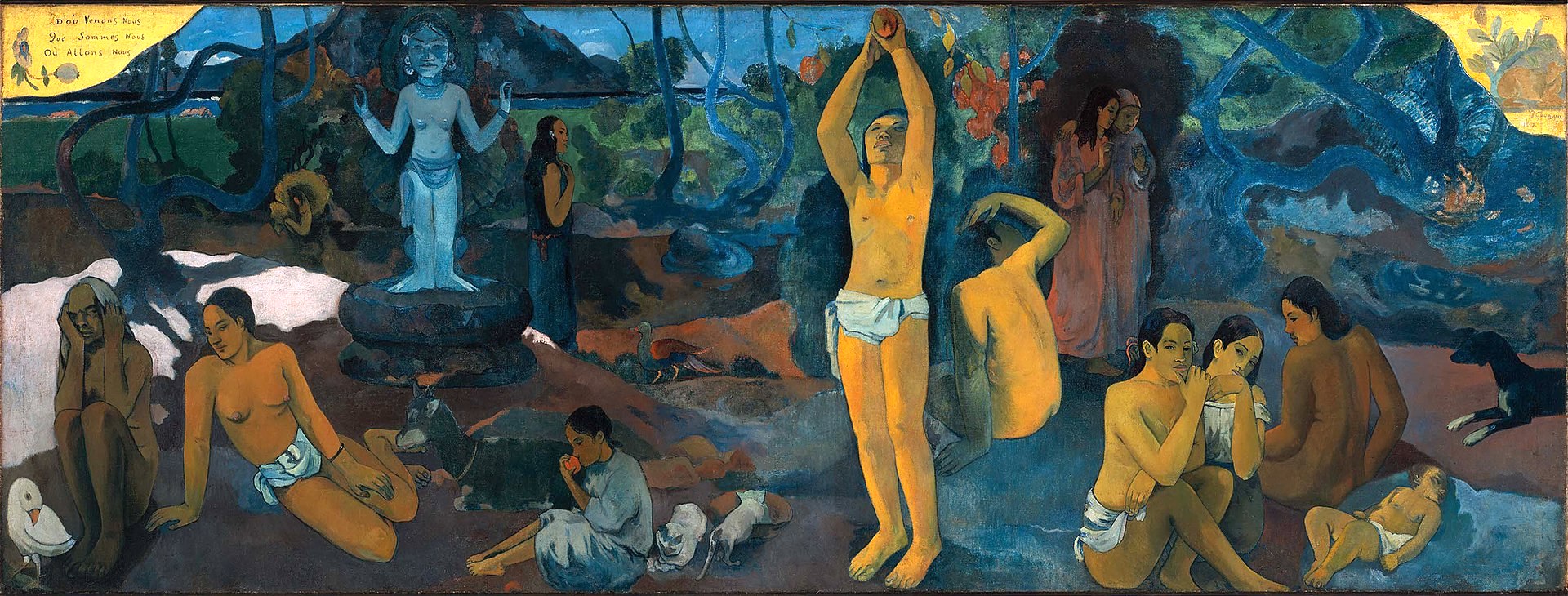


++
Copyleft, CC, Mitzub'ixi Quq Chi'j, 1996-2099

☆
 ☆
☆
