この書物の説明は、"Nielsen BookData"にあり、以下に引用する。
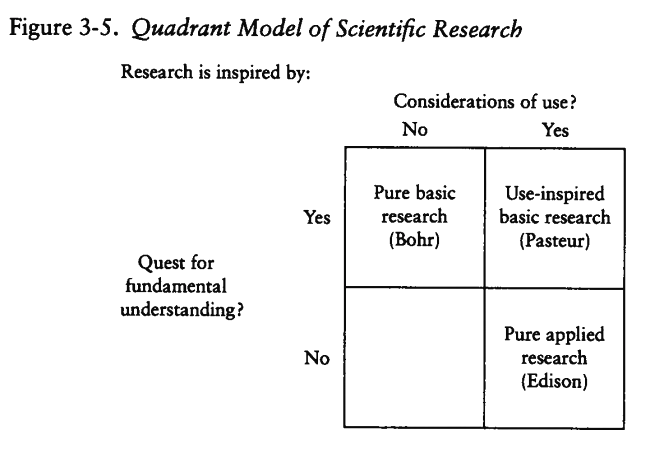
"Over fifty years ago, Vannevar Bush released his enormously influential report, Science, the Endless Frontier, which asserted a dichotomy between basic and applied science. This view was at the core of the compact between government and science that led to the golden age of scientific research after World War II - a compact that is currently under severe stress. In this book, Donald Stokes challenges Bush's view and maintains that we can only rebuild the relationship between government and the scientific community when we understand what is wrong with that view. Stokes begins with an analysis of the goals of understanding and use in scientific research. He recasts the widely accepted view of the tension between understanding and use, citing as a model case the fundamental yet use-inspired studies by which Louis Pasteur laid the foundations of microbiology a century ago. Pasteur worked in the era of the second industrial revolution, when the relationship between basic science and technological change assumed its modern form. Over subsequent decades, technology has been increasingly science-based. But science has been increasingly technology-based - with the choice of problems and the conduct of research often inspired by societal needs. An example is the work of the quantum-effects physicists who are probing the phenomena revealed by the miniaturization of semiconductors from the time of the transistor's discovery after World War II. On this revised, interactive view of science and technology, Stokes builds a convincing case that by recognizing the importance of use-inspired basic research we can frame a new compact between science and government. His conclusions have majorimplications for both the scientific and policy communities and will be of great interest to those in the broader public who are troubled by the current role of basic science in American democracy."- "Nielsen BookData"
「50年以上前、ヴァネヴァー・ブッシュは、基礎科学と応用科学の二分法を主張した、極めて影響力の大きい報告書『科学、果てしないフロン
ティア』を発表した。この見解は、第二次世界大戦後の科学研究の黄金時代をもたらした政府と科学界の「協定」の中核をなしていたが、その協定は現在、深刻
な危機に直面している。本書において、ドナルド・ストークスはブッシュの見解に異議を唱え、その見解のどこが誤っているかを理解して初めて、政府と科学界
の関係を再構築できると主張する。ストークスはまず、科学研究における「理解」と「利用」という二つの目標の分析から始める。彼は、理解と利用の間に緊張
関係があるという広く受け入れられている見解を再構築し、そのモデルケースとして、一世紀前にルイ・パスツールが微生物学の基礎を築いた、基礎的でありな
がら実用志向の研究を挙げている。パスツールが活躍したのは第二次産業革命の時代であり、基礎科学と技術革新の関係が現代的な形を帯び始めた時期であっ
た。その後の数十年にわたり、技術はますます科学に基づくものとなっていった。しかし、科学もまたますます技術に基づくものとなり、研究課題の選定や研究
の遂行は、しばしば社会的ニーズに触発されるようになった。その一例が、第二次世界大戦後のトランジスタ発明以来、半導体の微細化によって明らかになった
現象を探求している量子効果物理学者たちの研究である。科学と技術に関するこの改訂された双方向的な見解に基づき、ストークスは、「実用志向の基礎研究」
の重要性を認識することで、科学と政府の間に新たな協定を構築できるという説得力のある論拠を提示している。彼の結論は、科学界と政策立案者の双方にとっ
て重大な意味を持ち、また、アメリカの民主主義における基礎科学の現在の役割に懸念を抱く一般市民にとっても、大きな関心を集めることになるだろう。
そしてここからはジョークであるが、ストークス(1997)の四分類の第3象限は長く空白のままでしたが、ただいまその謎を垂水源之介が解きま した!

リンク
- Pasteur's quadrant by Wikipeia
- ︎トーマス・クーン『科学革命の構造』ノー
ト▶︎科学のイノベーションはあらかじめ計画できるか?▶︎︎▶︎▶︎︎▶︎▶︎︎▶︎▶︎︎▶︎▶︎
文献
- Stokes, Donald E. (1997). Pasteur's Quadrant : Basic Science
and Technological Innovation. Washington, D.C.: Brookings Institution
Press.
その他