Research Integrity
研究公正
Research Integrity
解説:池田光穂
ちなみに、研究不正
(scientific
misconduct)と言われているものは、実験データの改竄(falsify)、捏造(fabrication)、剽窃
(plagiarism)、他
の研究からの窃盗(data theft)、そして論文共著者としての名義貸し(gift authorship)などからなる。
Research integrity may be defined as active adherence to the ethical principles and professional standards essential for the responsible practice of research.
研究公正とは、〈倫理的諸原則の積極的な厳守〉と〈研究の責任ある実践に不可欠な専門職がもつべき基準〉として定義することができよう。
出典:http://ori.hhs.gov/education/products/ucla/chapter1/page02.htm
ORIの定義によると、研究公正は〈倫理 の厳守〉と〈研究専門職の行動規範〉という2 つの側面をあわせもつことがよくわかる。研究公正(research integrity)は、科学的公正さ(scientific integrity)とほぼ同義である。
すなわち、研究を公正におこなうとは、 (1)組織の研究者としての倫理規範(コンプライアンス)と、(2)研究専門職の行動規範——研究不正を おこなわないという否定的面から公正で創造性を実現する肯定的側面へ——の遵守という側面がある。まとめると、次の2つの項目にリンクして議論しているの で、参考にされたい。
★What is Research Integrity?
| Research integrity
or scientific integrity is an aspect of research ethics that deals with
best practice or rules of professional practice of scientists. First introduced in the 19th century by Charles Babbage, the concept of research integrity came to the fore in the late 1970s. A series of publicized scandals in the United States led to heightened debate on the ethical norms of sciences and the limitations of the self-regulation processes implemented by scientific communities and institutions. Formalized definitions of scientific misconduct, and codes of conduct, became the main policy response after 1990. In the 21st century, codes of conduct or ethics codes for research integrity are widespread. Along with codes of conduct at institutional and national levels, major international texts include the European Charter for Researchers (2005), the Singapore Statement on Research Integrity (2010), the European Code of Conduct for Research Integrity (2011 & 2017), and the Hong Kong Principles for assessing researchers (2020). Scientific literature on research integrity falls mostly into two categories: first, mapping of the definitions and categories, especially in regard to scientific misconduct, and second, empirical surveys of the attitudes and practices of scientists.[1] Following the development of codes of conduct, taxonomies of non-ethical uses have been significantly expanded, beyond the long-established forms of scientific fraud (plagiarism, falsification and fabrication of results). Definitions of "questionable research practices" and the debate over reproducibility also target a grey area of dubious scientific results, which may not be the outcome of voluntary manipulations. The concrete impact of codes of conduct and other measures put in place to ensure research integrity remain uncertain. Several case studies have highlighted that while the principles of typical codes of conduct adhere to common scientific ideals, they are seen as remote from actual work practices and their efficiency is criticized. After 2010, debates on research integrity have been increasingly linked to open science. International codes of conduct and national legislation on research integrity have officially endorsed open sharing of scientific output (publications, data, and code used to perform statistical analyses on the data[clarification needed]) as ways to limit questionable research practices and to enhance reproducibility. Having both the data and the actual code enables others to reproduce the results for themselves (or to uncover problems in the analyses when trying to do so). The European Code of Conduct for Research Integrity 2023 states, for example, the principles that, "Researchers, research institutions, and organisations ensure that access to data is as open as possible, as closed as necessary, and where appropriate in line with the FAIR Principles (Findable, Accessible, Interoperable and Reusable) for data management" and that "Researchers, research institutions, and organisations are transparent about how to access and gain permission to use data, metadata, protocols, code, software, and other research materials".[2] References to open science have incidentally opened up the debate over scientific integrity beyond academic communities, as it increasingly concerns a wider audience of scientific readers. |
研究公正[Research integrity](あるいは科学的誠実性あるいは研究の誠実性)とは、研究倫理の一側面であり、科学者のベストプラクティスや専門的実践の規範を扱うものである。 19世紀にチャールズ・バベッジによって初めて提唱された研究公正という概念は、1970年代後半に脚光を浴びるようになった。米国で相次いで公表さ れた一連のスキャンダルを契機に、科学の倫理規範や、科学コミュニティや機関によって実施されている自主規制プロセスの限界について、議論が活発化した。 1990年以降、科学的不正行為の正式な定義や行動規範が、主要な政策対応となった。21世紀に入り、研究公正に関する行動規範や倫理規範は広く普及 している。機関や国家レベルでの行動規範に加え、主要な国際的な文書としては、『欧州研究者憲章』(2005年)、『研究公正に関するシンガポール声 明』(2010年)、『研究公正に関する欧州行動規範』(2011年および2017年)、『研究者評価に関する香港原則』(2020年)などが挙げら れる。 研究公正に関する科学文献は、主に2つのカテゴリーに分類される。第一に、特に科学的不正行為に関する定義や分類の整理であり、第二に、科学者の態度 や実践に関する実証的な調査である。[1] 行動規範の策定に伴い、非倫理的な行為の分類体系は、長年確立されてきた科学的な不正行為(剽窃、結果の改ざん、捏造)の枠を超えて、大幅に拡大された。 「疑わしい研究慣行」の定義や再現性に関する議論は、意図的な操作の結果ではない可能性のある、疑わしい科学的結果というグレーゾーンも対象としている。 研究公正を確保するために導入された行動規範やその他の措置がもたらす具体的な影響は、依然として不透明である。いくつかの事例研究は、典型的な行動 規範の原則が一般的な科学的理想に則っている一方で、実際の業務慣行からはかけ離れていると見なされており、その有効性が批判されていることを浮き彫りに している。 2010年以降、研究公正に関する議論は、オープンサイエンスとますます結びつけられるようになった。研究公正に関する国際的な行動規範や各国の 法規制は、疑わしい研究慣行を抑制し、再現性を高める手段として、科学的成果(出版物、データ、およびデータに対する統計分析を行うために使用されたコー ド[注釈が必要])のオープンな共有を公式に支持している。データと実際のコードの両方を公開することで、他者が自ら結果を再現できるようになる(あるい は、再現を試みる際に分析上の問題点を明らかにできるようになる)。例えば、『欧州研究倫理行動規範2023』では、次のような原則が定められている。 「研究者、研究機関、および組織は、データへのアクセスが可能な限りオープンであり、必要な範囲でクローズドであり、かつ適切な場合にはデータ管理におけ るFAIR原則(発見可能、アクセス可能、相互運用可能、再利用可能)に沿うよう確保する」こと、および「研究者、研究機関、および組織は、データ、メタ データ、プロトコル、コード、ソフトウェア、およびその他の研究資料へのアクセス方法や利用許可の取得方法について透明性を確保する」こと。[2] オープンサイエンスへの言及は、科学的な読者の層がますます広がっていることから、学術コミュニティを超えて科学的誠実性に関する議論を巻き起こすきっか けとなった。 |
| Definition and history Research integrity or scientific integrity became an autonomous concept within scientific ethics in the late 1970s. In contrast with other forms of ethical misconducts, the debate over research integrity is focused on "victimless offence" that only hurts "the robustness of scientific record and public trust in science".[3] Infractions to research integrity include chiefly "data fabrication, falsification, or plagiarism".[3] In that sense, research integrity mostly deal with the internal process of science. It can be treated as community issue, that should not involve external observers: "research integrity is more autonomously defined and regulated by the community, while research ethics (again, a narrow definition) has closer links to legislation".[3] Emergence of the issue Before the 1970s, ethical issues were largely focused on the conduct of medical experiments, especially in regard to tests on humans. In 1803, the "code" of Thomas Percival created a moral foundation for experimental treatments that "was built upon fairly regularly" throughout the next two centuries, notably by Walter Reed in 1898 and by the Berlin code in 1900.[4] After the Second World War, the Nazi human experimentations motivated the development of international, widely acknowledged codes of research ethics, such as the Nuremberg code (1947) and the World Medical Association Declaration of Helsinki.[5] According to Kenneth Pimple, Charles Babbage was the first author to set aside[clarification needed] the specific issue of scientific integrity.[5] In the Reflections on the Decline of Science in England, and on Some of its Causes, first published in 1830, Babbage identified four classes of scientific frauds,[6] from outright forgery to varied degrees of arrangements and cooking of the data or the methods. Research integrity became a major debated topic in biological sciences after 1970, due to a combination of factors: the development of advanced data analysis methods, the growing commercial relevancy of fundamental research,[7] and the increased focus of federal funding agencies in the context of big science.[8] In 1974, the "painted mouse incident" attracted unprecedented media attention: William Summerlin inked a black dot on a mouse[Needs more explanation.] to claim a treatment has been a success.[9] Between 1979 and 1981, several major cases of scientific fraud and plagiarism drew a greater focus on the issue from researchers and policymakers in the United States:[7] as many as four important frauds occurred in the summer of 1980. At the time, the "scientific community responded to reports of 'scientific fraud' (as it was often called) by asserting that such cases are rare and that neither errors nor deception can be hidden for long because of science's self-correcting nature".[8] A journalist of Science, William Brad, took the opposite position and made an influential contribution to the issue of research integrity. In an answer to the US House of Representatives Science and Technology subcommittee, he highlighted that "cheating in science was nothing new" but, until recently, "had been handled as an internal affair". In a detailed investigation co-signed with Nicholas Wade, Betrayers of Science, Brad described scientific fraud as a structural problem: "As more cases of frauds broke into public view (…) we wondered if fraud wasn't a quite regular minor feature of the scientific landscape (…) Logic, replication, peer review — all had been successfully defied by scientific forgers, often for extended periods of time."[10] Other early assessments of the systematicity of scientific frauds presented a more nuanced picture.[11] For Patricia Wolff, along with a few obvious manipulations, there were a wide range of grey areas, which were due to the complexity of fundamental research: "the boundaries between egregious self-deception, culpable carelessness, fraud, and just plain error, can be very blurred indeed".[12] Characteristically, the debate led to a re-evaluation of past scientific practices. In 1913, a well-known scientific experiment on electron charge by Robert Millikan was explicitly based on discarding some results that would not agree with the underlying theory: while well received at the time, by the 1980s this work had come to be considered as a textbook example of scientific manipulation.[13] |
定義と歴史 研究公正(または科学的誠実性)は、1970年代後半に科学倫理における独立した概念として確立した。他の形態の倫理的違反とは対照的に、研究の誠実 性に関する議論は、「科学的記録の信頼性や科学に対する社会の信頼」を損なうだけであり、「被害者のいない違反」に焦点を当てている。[3] 研究公正に対する違反には、主に「データの捏造、改ざん、または剽窃」が含まれる。[3] その意味で、研究公正は主に科学の内部プロセスに関わるものである。これは、外部の観察者を巻き込むべきではないコミュニティの問題として扱われるこ とができる。「研究公正はコミュニティによってより自律的に定義・規制されるのに対し、研究倫理(これもまた狭義の定義である)は法規制とより密接な 関連を持っている」[3]。 問題の浮上 1970年代以前、倫理的問題は主に医学実験の実施、特に人間を対象とした試験に焦点が当てられていた。1803年、トーマス・パーシヴァルの「規範」は 実験的治療のための道徳的基盤を築き、その後2世紀にわたり、特に1898年のウォルター・リードや1900年のベルリン規範によって「かなり規則的に発 展」していった。[4] 第二次世界大戦後、ナチスによる人体実験を契機として、ニュルンベルク綱領(1947年)や世界医師会ヘルシンキ宣言など、国際的に広く認められた研究倫 理綱領が策定された。[5] ケネス・ピンプルによれば、チャールズ・バベッジは、科学的誠実性という具体的な問題を[説明が必要]脇に置いた最初の著者であった。[5] 1830年に初版が刊行された『イングランドにおける科学の衰退とその原因に関する考察』において、バベッジは、完全な捏造から、データや方法の様々な程 度の操作や改ざんに至るまで、4つの種類の科学的不正を特定した。[6] 研究公正は、1970年以降、生物科学分野において主要な議論の的となった。その背景には、高度なデータ解析手法の発展、基礎研究の商業的意義の高ま り[7]、そしてビッグサイエンスの文脈における連邦資金提供機関の注目の高まりといった要因が複合的に作用していた。[8] 1974年、「ペイントマウス事件」が前例のないメディアの注目を集めた。ウィリアム・サマーリンは、ある治療法の成功を主張するために、マウスに黒い点 をインクで描いた[詳細な説明が必要]。[9] 1979年から1981年にかけて、いくつかの重大な科学不正や盗用事件が発生し、米国の研究者や政策立案者の間でこの問題への関心が高まった[7]。 1980年の夏には、4件もの重大な不正事件が相次いで発生した。 当時、「科学界は(しばしばそう呼ばれた)『科学不正』の報告に対し、そのような事例は稀であり、科学には自己修正機能があるため、誤りや欺瞞は長く隠し 通すことはできないと主張して対応した」[8]。『サイエンス』誌のジャーナリスト、ウィリアム・ブラッドはこれとは反対の立場を取り、研究公正とい う問題に多大な影響を与える貢献をした。米国下院科学技術小委員会への回答の中で、彼は「科学における不正行為は決して新しいことではない」と強調した が、最近までは「内部問題として扱われてきた」と述べた。ニコラス・ウェイドと共同執筆した詳細な調査記事『科学の裏切り者たち(Betrayers of Science)』の中で、ブラッドは科学的な不正を構造的な問題として描写した。「不正の事例が次々と公の目にさらされるにつれ(…)、我々は、不正が 科学界においてごく日常的な些細な特徴ではないかと疑い始めた(…)。論理、再現性、ピアレビュー――これらすべてが、科学的な偽造者たちによって、しば しば長期間にわたり、見事に覆されてきたのである。」 [10] 科学的な不正行為の体系性に関する初期の他の評価は、より微妙な状況を描き出していた。[11] パトリシア・ウォルフによれば、いくつかの明白な操作に加え、基礎研究の複雑さゆえに生じる幅広いグレーゾーンが存在した。「甚だしい自己欺瞞、過失によ る不注意、不正、そして単なる誤りの境界線は、実に曖昧になり得る」と彼女は述べた。[12] 特徴的なことに、この議論は過去の科学的実践の再評価へとつながった。1913年、ロバート・ミリカンによる電子の電荷に関する有名な科学実験は、基礎と なる理論と一致しない結果を意図的に排除することに明示的に基づいていた。当時は高く評価されたが、1980年代までに、この研究は科学的操作の典型例と 見なされるようになった。[13] |
| Formalization of research integrity By the end of the 1980s, the amplification of misconduct scandals and the heightened political and public scrutiny put scientists in a difficult position in the United States and elsewhere: "The tone of the 1988 US congressional oversight hearings, chaired by Rep. John Dingell (D-MI), that investigated how research institutions were responding to misconduct allegations reinforced many scientists' view that both they and scientific research itself were under siege."[14] The main answer was procedural: research integrity has "been codified into numerous codes of conduct field specific, national, and international alike."[15] This policy response largely stemmed from research communities, funders and scientific administrators. In the United States, the United States Public Health Service and the National Science Foundation adopted "similar definitions of misconduct in science" in 1989 and 1991.[11] The concepts of research integrity and its reverse, scientific misconduct were especially relevant from the perspective funding bodies, since it made it possible to "delineate the research-related practices that merit intervention":[16] lack of integrity led not only to unethical but inefficient research and funds have better to be allocated elsewhere. After 1990, there was a "veritable explosion of scientific codes of conduct".[17] In 2007 the OECD published a report on best practices for promoting scientific integrity and preventing misconduct in science (Global Science Forum). Such international texts include: European Charter for Researchers (2005) the Singapore statement on research integrity (2010)[18] European Code of Conduct for Research Integrity of All European Academies (ALLEA) and the European Science Foundation (ESF) (2011 revised in 2017).[19] There are no global estimates of the total number of codes of conduct related to research integrity.[20] A UNESCO project, the Global Ethics Observatory (no longer accessible after 2021), referenced 155 codes of conduct[21] but "this is probably just a fraction of the total number of codes produced in recent years."[17] Codes have been created in highly diverse settings and show a wide variation in scale and ambition. Along with national-scale codes, there are codes for scientific societies, institutions and R&D services.[Unclear sentence: which is the main verb?][20] While these normative texts may frequently share a core of common principles, there has been growing concern "over fragmentation, lack of interoperability and varying understandings of central terms can be sensed".[1] |
研究公正の制度化 1980年代末までに、不正行為スキャンダルの相次ぐ発覚と、政治的・社会的監視の強化により、米国をはじめとする各地の科学者たちは困難な立場に追い込 まれた。「1988年にジョン・ディンゲル下院議員(民主党・ミシガン州選出)が議長を務め、研究機関が不正行為の申し立てにどのように対応しているかを 調査した米国議会の監視聴聞会の雰囲気は、科学者自身と科学研究そのものが包囲されているという多くの科学者の見方を強めるものとなった。」 [14] 主な対応は手続き的なものであった。すなわち、研究公正は「分野別、国内、国際を問わず、数多くの行動規範に明文化された」のである。[15] この政策対応は、主に研究コミュニティ、資金提供者、および科学行政担当者によって主導された。米国では、米国公衆衛生局と米国国立科学財団が、1989 年および1991年に「科学における不正行為に関する類似の定義」を採択した。[11] 研究公正とその対極にある科学的不正行為という概念は、資金提供機関の観点から特に重要であった。なぜなら、それによって「介入を要する研究関連の実 践を明確に区別する」ことが可能になったからである。[16] 誠実性の欠如は、非倫理的であるだけでなく非効率的な研究につながり、資金は他の分野に配分した方がよい。 1990年以降、「科学行動規範のまさに爆発的な増加」が見られた。[17] 2007年、OECDは、科学的誠実性を促進し、科学における不正行為を防止するためのベストプラクティスに関する報告書(グローバル・サイエンス・ フォーラム)を公表した。このような国際的な文書には以下が含まれる: 欧州研究者憲章(2005年) 研究公正に関するシンガポール声明(2010年) [18] 全欧州アカデミー(ALLEA)および欧州科学財団(ESF)による「研究公正に関する欧州行動規範」(2011年、2017年改訂)。[19] 研究公正に関連する行動規範の総数に関する世界的な推計は存在しない。[20] ユネスコのプロジェクトである「グローバル・エシックス・オブザーバトリー」(2021年以降アクセス不可)は155の行動規範を挙げている[21]が、 「これはおそらく、近年作成された規範の総数のごく一部に過ぎない」とされる。[17] 行動規範は極めて多様な状況下で作成されており、その規模や目標には大きなばらつきが見られる。国家規模の規範に加え、科学学会、研究機関、研究開発機関 向けの規範も存在する。[不明確な文:主語は何か?][20] これらの規範的文書は共通の原則を核として共有していることが多いものの、「断片化、相互運用性の欠如、および中心的な用語に対する理解の相違が懸念され ている」[1]。 |
| Taxonomy and classification In codes of conduct, the definition of research integrity is usually negative: the collection of norms aims to single out different forms of unethical research and scientific misconduct with varying degrees of gravity. The multiplication of codes of conduct has also corresponded with an expansion of scope. While the initial debate was focused on "three deadly sins of scientific and scholarly research: fabrication, falsification and plagiarism", attention has later shifted "to the lesser breaches of research integrity".[22] In 1830, Charles Babbage introduced the first taxonomy of scientific frauds that already encover some forms of questionable research practices : hoaxing (a voluntary fraud "far from justifiable"[6]), forging ("whereas the forger is one who, wishing to acquire a reputation for science, records observations which he has never made"[23]), trimming (which "consists in clipping off little bits here and there from those observations which differ most in excess from the mean"[24] and cooking. Cooking is the main focus of Babbage as an "art of various forms, the object of which is to give to ordinary observations the appearance and character of those of the highest degree of accuracy".[24] It falls done under several sub-cases such as data selection ("if a hundred observations are made, the cook must be very unlucky if he cannot pick out fifty or twenty to do the serving up",[25] model/algorithm selection ("another approved receipt (…) is to calculate them by two different formulae"[25]) or use of different constants.[26] In the late 20th century, this classification has been greatly expanded and have come to encompass a wider range of deficiencies than intentional frauds. The formalization of research integrity entailed a structural change in the vocabularies and the concept associated with it.[27] By the end of the 1990s, use of the expression "scientific fraud" was discouraged in the United States, in favor a "semi-legal term": scientific misconducts. The scope of scientific misconducts is expansive: along with data fabrication, falsification and plagiarism it includes "other serious deviations" that are demonstrably done in bad faith.[28] The associated concept of questional research practice, first incepted in a 1992 report of the Committee on Science, Engineering, and Public Policy, has an even broader scope, as it also encompass potentially non-intentional research failures (such as inadequacies in the research data management process).[29] In 2016, a study identified as much as 34 questionable research practices or "degree of freedom", that can occur at all the steps of the project (the initial hypothesis, the design of the study, collection of the data, the analysis and the reporting).[30] After 2005, research integrity has been additionally redefined through the perspective of research reproducibility and, more specifically, of the "reproducibility crisis". Studies of reproducibility suggest that there is continuum between irreproducibility, questionable research practices and scientific misconducts: "Reproducibility is not just a scientific issue; it is also an ethical one. When scientists cannot reproduce a research result, they may suspect data fabrication or falsification."[31] In this context, ethical debates are less focused on a few highly publicized scandals and more on the suspicion that the standard scientific process is broken and fails to meet its own standard. Another type of risk to scientific integrity is reduced political diversity among scientists, which can lead to conformity and political bias.[32] |
分類と体系 行動規範において、研究公正の定義は通常、否定的な形でなされる。すなわち、一連の規範は、その重大度の異なる様々な形態の非倫理的な研究や科学的不正行為を特定することを目的としている。 行動規範の増加は、その適用範囲の拡大とも相まってきた。当初の議論は「科学・学術研究における三つの大罪:捏造、改竄、剽窃」に焦点を当てていたが、そ の後、注目は「研究公正に対する軽微な違反」へと移行した。[22] 1830年、チャールズ・バベッジは、すでにいくつかの疑わしい研究慣行を網羅した、科学的な不正行為に関する最初の分類法を導入した。それには、ホーク シング(「正当化とは程遠い」意図的な詐欺[6])、偽造(「偽造者とは、科学的な名声を得たいと願って、実際には行ったことのない観察を記録する者であ る」 [23])、トリミング(「平均値から最も大きく外れた観測値から、あちこちで少しずつ切り取ることに由る」[24])、そしてクッキングである。クッキ ングは、バベッジが「様々な形態をとる技法であり、その目的は、ありふれた観測結果に、最高度の正確さを備えたもののような外観と性質を与えることにあ る」として主に焦点を当てたものである。[24] これには、データの選択(「100件の観測が行われた場合、調理人が50件や20件を選んで盛り付けられないのは、非常に不運なことだ」[25])、モデ ル/アルゴリズムの選択(「もう一つの定評ある手法(…)は、2つの異なる式を用いて計算することである」[25])、あるいは異なる定数の使用[26] など、いくつかのサブケースが含まれる。 20世紀後半には、この分類は大幅に拡大され、意図的な不正行為よりも幅広い欠陥を包含するようになった。研究公正の形式化は、関連する用語や概念に おける構造的な変化を伴った。[27] 1990年代末までに、米国では「科学的詐欺」という表現の使用が控えられるようになり、代わりに「準法的用語」である「科学的不正行為」が用いられるよ うになった。科学的不正行為の範囲は広範であり、データの捏造、改ざん、盗用に加え、悪意を持って行われたことが証明できる「その他の重大な逸脱」も含ま れる。[28] これに関連する「問題のある研究慣行」という概念は、1992年の科学・工学・公共政策委員会の報告書で初めて提唱されたものであり、その範囲はさらに広 範である。なぜなら、これには(研究データ管理プロセスの不備など)意図的ではない可能性のある研究上の失敗も含まれるからである。[29] 2016年の研究では、プロジェクトの全段階(初期仮説、研究設計、データ収集、分析、報告)で発生し得る、34もの「疑わしい研究慣行」または「自由 度」が特定された。[30] 2005年以降、研究公正は、研究の再現性、より具体的には「再現性の危機」という観点から、さらに再定義されてきた。再現性に関する研究は、再現不 能、疑わしい研究慣行、および科学的不正行為の間に連続性があることを示唆している。「再現性は単なる科学的な問題ではなく、倫理的な問題でもある。科学 者が研究結果を再現できない場合、データの捏造や改ざんを疑うことになるかもしれない。」[31] このような文脈において、倫理的な議論は、数件の世間に大きく取り上げられたスキャンダルに焦点を当てるというよりは、標準的な科学的プロセスが機能不全 に陥り、自らの基準を満たせていないという疑念に重点が置かれている。 科学的誠実性に対するもう一つのリスクは、科学者間の政治的多様性の低下であり、これは同調や政治的偏見につながる可能性がある。[32] |
| Current landscape and issues Prevalence of ethical issues In 2009, a meta-analysis of 18 surveys estimated that less than 2% of scientists "admitted to have fabricated, falsified or modified data or results at least once". Real prevalence may be under-estimated due to self-reporting: regarding "the behaviour of colleagues admission rates were 14.12%".[33] Questionable research practices are more widespread as more than one third of the respondents admit to have done it once.[33] A large 2021 survey of 6,813 respondents in the Netherlands found significantly higher estimate, with 4% of the respondents engaging in data fabrication and more than half of the respondents engaging in questionable research practices.[34] Higher rates can be either attributed to a deterioration of ethic norms or to "the increased awareness of research integrity in recent years".[35] The higher rates of self-declared scientific misconducts are found in the medical and life science, with at much as 10.4% respondents surveyed in the Nerthelands admitting a scientific fraud (either fabrication of falsification of the data).[35] Other forms or scientific misconducts or questionable research practices are both less problematic and much more widespread. A 2012 survey of 2,000 psychologists found that "the percentage of respondents who have engaged in questionable practices was surprisingly high",[36] especially in regard to selective reporting.[36] A 2018 survey of 807 researchers in ecology an evolutionary biology showed that 64% "did not report results because they were not statistically significant", 42% have decided to collect additional data "after inspecting whether results were statistically significant" and 51% "reported an unexpected finding as though it had been hypothesised from the start".[37] As they come from self-declared survey, these estimations are likely to be underestimated.[38] |
現状と課題 倫理的問題の蔓延 2009年に行われた18件の調査のメタ分析によると、「少なくとも一度はデータや結果を捏造、改ざん、または改変したことがある」と認めた科学者は2% 未満と推定された。自己申告による調査であるため、実際の発生率は過小評価されている可能性がある。「同僚の行動」に関しては、その認める割合は 14.12%であった。[33] 回答者の3分の1以上が一度は行ったことがあると認めていることから、疑わしい研究慣行はより広範に蔓延している。[33] 2021年にオランダで実施された6,813人を対象とした大規模な調査では、はるかに高い推定値が得られ、回答者の4%がデータの捏造に関与し、半数以 上が疑わしい研究慣行に関与していた。[34] この高い割合は、倫理規範の低下、あるいは「近年の研究公正に対する意識の高まり」のいずれかに起因する可能性がある。[35] 自己申告による科学的不正行為の割合は医学および生命科学分野で高く、オランダでの調査では回答者の最大10.4%が科学的な不正行為(データの捏造また は改ざん)を認めている。[35] その他の形態の科学的不正行為や疑わしい研究慣行は、問題の深刻度は低いものの、はるかに広範に蔓延している。2012年に2,000人の心理学者を対象 に行った調査では、「疑わしい慣行に関与したことがあると回答した割合が驚くほど高かった」[36]ことが判明しており、特に選択的報告に関してその傾向 が顕著であった。[36] 2018年に生態学および進化生物学の研究者807名を対象に行った調査では、64%が「統計的に有意ではなかったため結果を報告しなかった」、42%が 「結果が統計的に有意かどうかを確認した後」に追加データの収集を決定し、51%が「予期せぬ発見を、あたかも当初から仮説として立てていたかのように報 告した」ことが示された。[37] これらは自己申告による調査であるため、これらの推定値は過小評価されている可能性が高い。[38] |
| Implementation and assessment of codes of conduct Several case studies and retrospective analyses have been devoted to the reception of codes of conduct in scientific communities. They frequently highlight a discrepancy between the theoretical norms and the "lived[clarification needed] morality of researchers".[39] In 2004, Caroline Whitbeck underlined that the enforcement of a few formal rules has overall failed to answer[clarification needed] to a structural "erosion or neglect" of scientific trust.[40] In 2009, Schuurbiers, Osseweijer and Kinderler led a series of interviews in the aftermath[clarification needed] of the Dutch code of conduct on research integrity, introduced in 2005. Overall, most respondents were unaware of the code and complementary ethical recommendations.[41] While the principles "were seen to reflect the norms and values within science rather well", they seemed to be isolated from the actual work practices, which "may lead to morally complex situations".[42] Respondents were also critical of the underlying individualist philosophy of the code, which shifted the entire blame to individual researchers without taking into account institutional or community-wide issues.[43] In 2015, a survey of "64 faculty members at a large southwestern university" in the United States "yielded similar results":[39] many of the respondents were not aware of the existing ethical guidelines, and the communication process remained poor.[44] In 2019, a case study on Italian universities noted that the proliferation of research codes "has a reactive nature because codes of ethics are drawn up in response to scandals and as a result are punitive and negative, with lists of prohibitions".[45] Codes of conduct on research integrity may have a more significant impact on professional identity.[clarification needed] Development of research codes has been equated to an internalization of issues related to research integrity within scientific social circles and its close associate[clarification needed] with disputed results, which made it a typical form of "knowledge club" governance.[clarification needed] In contrast to a wider range of ethical issues that may overlap with more general social debates (such as gender equality), research integrity belongs to a form of professional ethics analogous to the ethical standards applied by journalists or medical practicians.[46] As such, not only does it create a common moral framework but also, incidentally, "justifies the existence of the profession as separate from other professions".[46] While the impact of codes on actual ethical practices remains difficult to assess, they have a more measurable impact on the professionalization of research, by transforming informal norms and customs into a set of predefined principles: "codes in general are supported both by those pursuing them as a vehicle to encourage the greater professionalization of biologists (e.g., an initial stage to introducing professional licensing) and those seeking them to forestall any further regulation."[47] |
行動規範の実施と評価 科学コミュニティにおける行動規範の受容については、いくつかの事例研究や事後分析が行われてきた。それらはしばしば、理論上の規範と「研究者の『生きた』[説明が必要]道徳観」との間に乖離があることを指摘している。[39] 2004年、キャロライン・ウィットベックは、いくつかの形式的な規則の施行だけでは、科学的な信頼の構造的な「浸食または軽視」[説明が必要]に対処で きていないと強調した。[40] 2009年、シューアビース、オッセウェイヤー、キンダーラーは、2005年に導入されたオランダの研究倫理行動規範の施行後[説明が必要]に、一連のイ ンタビューを実施した。全体として、回答者の大半は、この規範および補足的な倫理的勧告について認識していなかった。[41] その原則は「科学界内の規範や価値観をかなりよく反映している」と見なされていたものの、実際の業務慣行からは切り離された存在であり、それが「道徳的に 複雑な状況を引き起こす可能性がある」とされた。[42] また、回答者らは、この規範の根底にある個人主義的な哲学に対しても批判的であった。それは、組織やコミュニティ全体の問題を考慮することなく、責任のす べてを個々の研究者に転嫁するものであったからである。[43] 2015年、米国「南西部の大規模大学」の「教員64名」を対象とした調査でも「同様の結果」が得られた。[39] 回答者の多くは既存の倫理指針を認識しておらず、情報伝達プロセスは依然として不十分であった。[44] 2019年、イタリアの大学に関するケーススタディでは、研究規範の増加について、「倫理規範はスキャンダルへの対応として策定されるため、反応的な性質 を持ち、その結果、禁止事項のリストを伴う懲罰的かつ否定的なものとなっている」と指摘された。[45] 研究公正に関する行動規範は、専門的アイデンティティにより大きな影響を与える可能性がある。[要明確化] 研究規範の策定は、科学界およびその密接な関係者の間における研究公正に関連する問題の内部化と同一視されてきた[要明確化]が、その結果には議論の 余地があり、それが「知識クラブ」型ガバナンスの典型的な形態となった。[説明が必要] より一般的な社会的議論(ジェンダー平等など)と重なる可能性のある幅広い倫理的問題とは対照的に、研究公正は、ジャーナリストや医療従事者が適用す る倫理基準に類似した専門職倫理の一形態に属する。[46] その意味で、それは共通の道徳的枠組みを構築するだけでなく、付随的に「他の専門職とは区別された専門職の存在を正当化する」役割も果たす。[46] 規範が実際の倫理的実践に与える影響を評価することは依然として困難であるが、それらは非公式な規範や慣習をあらかじめ定義された一連の原則へと転換させ ることで、研究の専門化に対してより測定可能な影響を及ぼしている。「一般的に、規範は、生物学者のさらなる専門化を促進する手段(例:専門資格制度導入 への第一段階)としてそれを追求する者たちと、さらなる規制を未然に防ぐためにそれを求める者たちの双方から支持されている。」[47] |
| Research integrity and open science In the 2000s and 2010s, scientific integrity was gradually reframed in the context of open science, and increased accessibility to scientific publications. The debate on research reproducibility has significantly contributed to this evolution. Ethics of open science The underlying ethical principles of open science predates the development of an organized open science movement. In 1973, Robert K. Merton theorized a normative "ethos of science" structured on a "norm of disclosure". This norm "was far from universally accepted" in the early development of scientific communities and has remained "one of the many ambivalent precepts contained in the institution of science."[48] Disclosure was counterbalanced by the limitations of the publication and evaluation process, that tended to slow down the divulgation of research results.[48] In the early 1990s, this norm of disclosure was reframed as norm of "openness" or "open science".[49] The early open access and open science movements emerged partly as a reaction against the large corporate model that has come to dominate scientific publishing since the Second World War.[50] Open science was not framed as a radical transformation of scientific communication but as a realization of core underlying principles, already visible at the start of the scientific revolution of the 17th and the 18th century: the autonomy and self-governance of scientific communities and the divulgation of research results.[51] Since 2000, the open science movement has expanded beyond access to scientific outputs (publication, data or software) to encompass the entire process of scientific production. The reproducibility crisis has been an instrumental factor in this development, as it moved the debates over the definition open science further from scientific publishing. In 2018, Vicente-Saez and Martinez-Fuentes have attempted to map the common values shared by the standard definitions of open science in the English-speaking scientific literature indexed on Scopus and the Web of Science.[52] Access is no longer the main dimension of open science, as it has been extended by more recent commitments toward transparency, collaborative work and social impact.[53] These diverse conceptual dimensions "encompasses (Graph 5) the emerging trends on Open Science such as open code […] open notebooks, open lab books, science blogs, collaborative bibliographies, citizen science, open peer review, or pre-registration"[54] Through this process, open science has been increasingly structured over a consisting set of ethical principles: "novel open science practices have developed in tandem with novel organising forms of conducting and sharing research through open repositories, open physical labs, and transdisciplinary research platforms. Together, these novel practices and organising forms are expanding the ethos of science at universities."[55] |
研究公正とオープンサイエンス 2000年代から2010年代にかけて、科学の誠実性は、オープンサイエンスや科学出版物へのアクセス向上という文脈の中で、徐々に再定義されていった。研究の再現性に関する議論は、この変遷に大きく寄与している。 オープンサイエンスの倫理 オープンサイエンスの根底にある倫理的原則は、組織的なオープンサイエンス運動の発展よりも以前から存在していた。1973年、ロバート・K・マートン は、「開示の規範」に基づいて構築された規範的な「科学の精神(ethos of science)」を理論化した。この規範は、科学コミュニティの初期の発展段階において「普遍的に受け入れられていたとは程遠い」ものであり、現在もな お「科学という制度に含まれる多くの曖昧な教訓の一つ」として残っている。[48] 開示は、研究成果の公表を遅らせる傾向にあった出版および評価プロセスの制約によって相殺されていた。[48] 1990年代初頭、この開示の規範は「開放性」または「オープンサイエンス」の規範として再定義された。[49] 初期のオープンアクセスおよびオープンサイエンス運動は、第二次世界大戦以降、科学出版を支配するようになった大企業モデルへの反発として部分的に台頭し た。[50] オープンサイエンスは、科学コミュニケーションの急進的な変革としてではなく、17世紀および18世紀の科学革命の初期段階ですでに顕在化していた、科学 コミュニティの自律性と自主運営、ならびに研究成果の公開という、根底にある中核的な原則の実現として位置づけられた。[51] 2000年以降、オープンサイエンス運動は、科学的成果物(出版物、データ、ソフトウェア)へのアクセスを超えて、科学的な生産プロセス全体を包含するよ う拡大してきた。再現性の危機は、オープンサイエンスの定義をめぐる議論を科学出版の枠組みからさらに遠ざけることとなったため、この展開において重要な 要因となった。2018年、ビセンテ=サエスとマルティネス=フエンテスは、ScopusおよびWeb of Scienceに収録された英語圏の科学文献におけるオープンサイエンスの標準的な定義に共通する価値観を整理しようと試みた。[52] アクセスはもはやオープンサイエンスの主要な側面ではなく、透明性、共同作業、社会的影響力に向けたより最近の取り組みによってその範囲が拡大している。 [53] これらの多様な概念的側面は、「オープンコード […] オープンノートブック、オープンラボブック、科学ブログ、共同書誌、市民科学、オープンピアレビュー、あるいは事前登録といった、オープンサイエンスにお ける新たな潮流を包含している(図5)」[54] このプロセスを通じて、オープンサイエンスは一貫した倫理原則の体系に基づいてますます構造化されてきた。「オープンリポジトリ、オープンな物理的ラボ、 学際的研究プラットフォームを通じた研究の実施と共有という新たな組織形態と並行して、新しいオープンサイエンスの実践が発展してきた。これらの新しい実 践と組織形態が相まって、大学における科学の精神を拡大している。」[55] |
| Codification of open science ethics The translation of the ethical values of open science toward applied recommendation[clarification needed] was mostly undertaken by institutional and communities initiatives until the 2010s. The TOP guidelines were elaborated in 2014 by a committee for Transparency and Openness Promotion that included "disciplinary leaders, journal editors, funding agency representatives, and disciplinary experts largely from the social and behavioral sciences".[56] The guidelines rely on eight standards, with different levels of compliance. While the standards are modular, they also aim to articulate a consistent ethos of science as "they also complement each other, in that commitment to one standard may facilitate adoption of others.".[56] The highest levels of compliance for each standard include the following requirements: 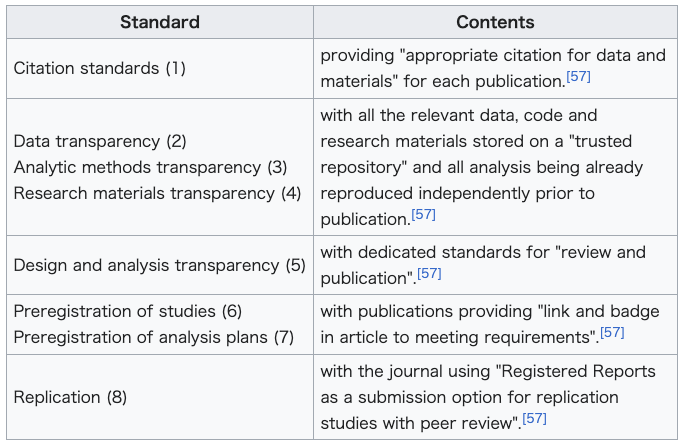 In 2018, Heidi Laine attempted to establish a nearly-exhaustive list of "ethical principles associated with open science":[58] 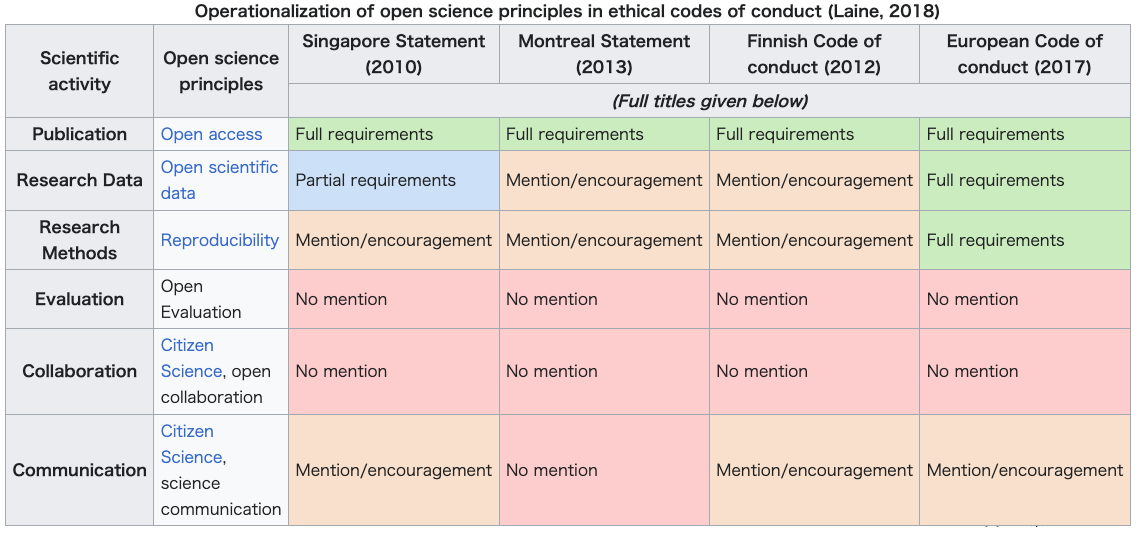 This categorization has to contend with the diversity of approaches and values associated with the open science movement and their ongoing evolutions, as the "term will likely remain as fluid as any other attempt to coin a complex system of practices, values and ideologies in one term".[59] Laine identified a significant variation in the way open science principles have been embedded in four major codes of conduct and statements on research integrity: the Singapore Statement on Research Integrity (2010), the Montreal Statement on Research Integrity in Cross-Boundary Research Collaborations (2013), the Responsible Conduct of Research and Procedures for Handling Allegations of Misconduct in Finland (2012) and the European Code of Conduct for Research Integrity (2017). Access to research publications is recommended in all four codes. Integrations of data sharing and reproducibility practices are less obvious, and vary from a tacit approval to detailed support, in the case of the later European Code of Conduct: "The European code pays data management almost an equal amount of attention as publishing and is also in this sense the most advanced of the four CoCs."[60] Yet, important areas of open science, are consistently ignored, especially regarding the development of open science infrastructure, increased transparency of evaluation or support for citizen science and wider social impact. Overall, Laine found "none of the evaluated CoCs to be in blatant contradiction with the ethical principles of open science, but only the European code of conduct can be said to actively support and give guidance on open science." After 2020, new forms of open science code of conduct have explicitly claimed to "foster the ethos of open scientific practices".[61] First adopted in July 2020, the Hong Kong principles for assessing researchers acknowledge open science as one of the five pillars of scientific integrity: "It seems clear that the various modalities of open science need to be rewarded in the assessment of researchers because these behaviors strongly increase transparency, which is a core principle of research integrity."[62] |
オープンサイエンスの倫理の体系化 オープンサイエンスの倫理的価値観を応用的な提言[要明確化]へと転換する取り組みは、2010年代までは主に機関やコミュニティ主導で行われていた。 TOPガイドラインは2014年、「主に社会科学および行動科学分野の学問分野のリーダー、学術誌編集者、助成機関の代表者、および専門家のほか」で構成 される「透明性と開放性の促進委員会」によって策定された。[56] このガイドラインは8つの基準に基づいており、遵守レベルはそれぞれ異なる。基準はモジュール式であるが、「ある基準への取り組みが他の基準の採用を促進 する可能性があるという点で、互いに補完し合う」ものであり、一貫した科学の精神を明確に示すことも目的としている。[56] 各基準における最高レベルの遵守要件には、以下のものが含まれる: 2018年、ハイディ・レインは「オープンサイエンスに関連する倫理原則」のほぼ網羅的なリストを作成しようと試みた:[58] (欄外に拡大) この分類は、オープンサイエンス運動に伴うアプローチや価値観の多様性、そしてそれらの絶え間ない変化に対処しなければならない。というのも、「この用語 は、実践、価値観、イデオロギーからなる複雑な体系を一つの言葉にまとめようとする他のいかなる試みと同様に、今後も流動的なままである可能性が高い」か らである。[59] Laineは、オープンサイエンスの原則が、4つの主要な行動規範および研究公正に関する声明(『研究公正に関するシンガポール声明』(2010 年)、 『国境を越えた研究協力における研究公正に関するモントリオール声明』(2013年)、『フィンランドにおける責任ある研究の実施および不正行為の申 し立てへの対応手順』(2012年)、そして『欧州研究公正に関する行動規範』(2017年)である。これら4つの規範すべてにおいて、研究出版物へ のアクセスが推奨されている。一方、データ共有や再現性の実践の組み込みはそれほど明確ではなく、後発の欧州行動規範の場合、暗黙の承認から詳細な支援ま でその程度は様々である。「欧州規範は、出版とほぼ同等の注意をデータ管理に払っており、この点において4つの行動規範の中で最も進んでいる。」 [60] しかし、オープンサイエンスの重要な分野、特にオープンサイエンス・インフラの整備、評価の透明性向上、市民科学への支援、およびより広範な社会的影響に ついては、一貫して無視されている。全体として、Laineは「評価対象となった行動規範のいずれもがオープンサイエンスの倫理原則と明白に矛盾している わけではないが、オープンサイエンスを積極的に支援し、指針を示していると言えるのは欧州行動規範のみである」と結論づけた。 2020年以降、新たな形態のオープンサイエンス行動規範は、「オープンな科学実践の精神を育む」ことを明示的に掲げている。[61] 2020年7月に初めて採択された「研究者の評価に関する香港原則」は、オープンサイエンスを科学的誠実性の5つの柱の一つとして認めている。「オープン サイエンスの様々な形態は、研究公正の核心的な原則である透明性を著しく高めるものであるため、研究者の評価において報われるべきであることは明らか である。」[62] |
| Research integrity and society While there is still a continuum between the procedural norms of the codes of conduct and the range of values encompassed by open science, open science has significantly altered the setting and the context of the ethical debate. Open scientific productions can be universally shared in theory: their dissemination is not constrained to the classic membership model of the "knowledge club". Implications are wider as well, as potential misuses of scientific publications is no longer limited to professional scientists. The discrepancy was already visible in the late 2000s, although it was framed under "different buzzwords":[39] in a case study on the implementation of the Dutch code of conduct, Schuubiers, Osseweijer and Kinderlerer already identified a "shift in practices" that "goes by many names like Mode 2 science, post-normal science, or post-academic science" that a diverse array of transfrom such as technological evolution in the management of research, increased involvement of private actors, open innovation or open access.[63] These structural trends were not well covered by the existing codes of conduct.[63] In the 1990s and the 2000s, discussions about research integrity have become increasingly professionalized and detached from the public domain. The shift toward open science may potentially contradict this trend, as the range of interesting parties and potential reusers of scientific production has expanded well beyond professional academic circles. In 2018, Heidi Laine underlines that established codes of conduct have not yet taken this decisive step: "The one aspect where even the European code falls short of a full recognition of open science is in crossing the traditional professional borders of the research community, i.e. citizen science, open collaboration and science communication."[64] By not taking into account this new framework, existing codes of conduct risk becoming increasingly out of touch with the reality of scientific practices: If the ethical aspects of open science continue to be left out of RCR (Responsible Code of Research) guidance and ponderings, the research community risks losses on both fronts: open science as well as RI (Research integrity). Open science is just as much about values and ethics as it is about technology. Most of all it is about the role of science in society. It is perhaps the most all-encompassing value discussion that the research community has ever known, and the research integrity angle and community of experts risks being side-lined.[65] The broadened discussion about scientific integrity led to an increased involvement of political institutions and representatives, beyond specialized scientific committee and funders. In 2021, the French government passed a decree on scientific integrity, which called for generalization of open science practices.[66] |
研究公正と社会 行動規範の手続き上の規範とオープンサイエンスが包含する価値観の範囲との間には依然として連続性があるものの、オープンサイエンスは倫理的議論の舞台と 文脈を大きく変えた。オープンサイエンスによる成果物は、理論上は普遍的に共有可能であり、その普及は「知識のクラブ」という従来の会員制モデルに限定さ れない。また、科学出版物の悪用がもはや専門の科学者に限定されなくなったことから、その影響もより広範なものとなっている。この乖離は2000年代後半 にはすでに顕在化していたが、当時は「異なる流行語」の下で捉えられていた[39]。オランダの行動規範の実施に関するある事例研究において、 シュービエールズ、オッセウェイヤー、キンダーレラーはすでに、「モード2サイエンス、ポストノーマル・サイエンス、あるいはポストアカデミック・サイエ ンス」など多くの名称で呼ばれる「実践の転換」を特定しており、これには研究管理における技術的進化、民間主体の関与の拡大、オープンイノベーション、あ るいはオープンアクセスといった多様な変革が含まれる。[63] これらの構造的傾向は、既存の行動規範では十分にカバーされていなかった。[63] 1990年代から2000年代にかけて、研究公正に関する議論はますます専門化が進み、公共の領域から切り離されていった。オープンサイエンスへの移 行は、この傾向と矛盾する可能性がある。なぜなら、科学的成果に関心を寄せる関係者や潜在的な再利用者の範囲が、専門的な学術界をはるかに超えて拡大して いるからである。2018年、ハイディ・レインは、確立された行動規範がまだこの決定的な一歩を踏み出していないことを強調している。「欧州の規範でさ え、オープンサイエンスを完全に認識するに至っていない唯一の側面は、研究コミュニティの伝統的な専門的境界を越えること、すなわち市民科学、オープンコ ラボレーション、そして科学コミュニケーションにある。」[64] この新しい枠組みを考慮に入れなければ、既存の行動規範は、科学の実践の現実からますます乖離するリスクを負うことになる。 もしオープンサイエンスの倫理的側面が、RCR(責任ある研究規範)の指針や考察から引き続き除外され続けるならば、研究コミュニティはオープンサイエン スとRI(研究公正)の両面で損失を被るリスクがある。オープンサイエンスは、技術と同様に価値観や倫理に関するものであり、何よりも科学が社会にお いて果たす役割に関するものである。これはおそらく、研究コミュニティがこれまでに経験した中で最も包括的な価値観に関する議論であり、研究の健全性とい う視点や専門家コミュニティが脇に追いやられるリスクがある。[65] 科学の健全性に関する議論の広がりは、専門的な科学委員会や資金提供者を超え、政治機関や代表者の関与の拡大につながった。2021年、フランス政府は科学の健全性に関する政令を可決し、オープンサイエンスの実践の一般化を求めた。[66] |
| Initiatives In 2007 the OECD published a report on best practices for promoting scientific integrity and preventing misconduct in science (Global Science Forum). Main international texts in this field: European Charter for Researchers (2005) the Singapore statement on research integrity (2010)[18] European Code of Conduct for Research Integrity of All European Academies (ALLEA) and the European Science Foundation (ESF) (2011 revised in 2017).[19] In Europe The European Code of Conduct for Research Integrity, published in 2011 and revised in 2017, develops the concept of scientific integrity along four main lines : Reliability: concerns the quality and reproducibility of research. Honesty: concerns the transparency and objectivity of research. Respect: for the human, cultural, and ecological environment of research. Accountability: concerns the implications of publishing the research. In the USA US Department of Health and Human Services  HHS Seal In a statement made by the US Department of Health and Human Services (HHS), they adopted the definition of Scientific Integrity as stated below.[67] This policy is currently being reviewed and will be officially published in early 2024.[68] " Scientific integrity is the adherence to professional practices, ethical behavior, and the principles of honesty and objectivity when conducting, managing, using the results of, and communicating about science and scientific activities. Inclusivity, transparency, and protection from inappropriate influence are hallmarks of scientific integrity."-HHS To promote a culture of scientific integrity at HHS, they have outlined their policy in seven specific areas:[67] Protecting Scientific Processes Ensuring the Free Flow of Scientific Information Supporting Policymaking Processes Ensuring Accountability Protecting Scientists Professional Development for Government Scientists Federal Advisory Committees As a result of these areas, open science practices can be promoted to protect against bias, plagiarism, and data fabrication, falsification as well as inappropriate influencing, political interference, and censorship.[69] National Institute of Health  NIH 2013 logo The National Institute of Health (NIH) is a branch of the HHS. They act as the nation's medical research agency which focuses on making important discoveries that improve health and save lives.[70] The mission of NIH is to provide a fundamental understanding of the nature and behavior of living systems and applying that understanding to improve health, extend life, and reduce illness and disability.[71] The NIH fosters the definition of Scientific Integrity from the HHS Scientific Integrity Policy draft to ensure their scientific findings are objective, creditable, transparent, and readily available to the public. All NIH staff are expected to: Foster an organizational Culture of Scientific Integrity Protect the Integrity of the Research Process Communicate Science with Integrity Safeguard Scientific Integrity |
取り組み 2007年、OECDは、科学の誠実性を促進し、科学における不正行為を防止するためのベストプラクティスに関する報告書(グローバル・サイエンス・フォーラム)を公表した。 この分野における主な国際文書: 欧州研究者憲章(2005年) 研究公正に関するシンガポール声明(2010年)[18] 全欧州アカデミー(ALLEA)および欧州科学財団(ESF)による研究公正に関する欧州行動規範(2011年、2017年改訂)[19] 欧州において 2011年に公表され、2017年に改訂された「欧州研究誠実性行動規範」は、科学的誠実性の概念を以下の4つの主要な軸に沿って展開している: 信頼性:研究の質と再現性に関するものである。 誠実性:研究の透明性と客観性に関するものである。 尊重:研究における人間、文化、および生態系環境に対するものである。 説明責任:研究の公表に伴う影響に関するものである。 米国において 米国保健社会福祉省(HHS) HHSのロゴ 米国保健社会福祉省(HHS)による声明において、同省は以下に示す「科学的誠実性」の定義を採用した。[67] この方針は現在見直しが行われており、2024年初頭に正式に公表される予定である。[68] 「科学的誠実性とは、科学および科学的活動を実施、管理、その結果を利用し、またそれらについて伝達する際に、専門的慣行、倫理的行動、ならびに誠実さと 客観性の原則を遵守することである。包括性、透明性、および不適切な影響からの保護は、科学的誠実性の特徴である。」-HHS HHSにおいて科学的誠実性の文化を促進するため、同省は7つの具体的な分野において方針を定めている: [67] 科学的プロセスの保護 科学的情報の自由な流通の確保 政策決定プロセスの支援 説明責任の確保 科学者の保護 政府所属科学者の専門能力開発 連邦諮問委員会 これらの分野を通じて、バイアス、盗用、データの捏造・改ざん、さらには不適切な影響力、政治的干渉、検閲から守るために、オープンサイエンスの実践を推進することができる。[69] 国立衛生研究所 NIH 2013年ロゴ 国立衛生研究所(NIH)はHHSの一部門である。同機関は、健康の向上と人命の救助につながる重要な発見を行うことに焦点を当てた、米国の医学研究機関 としての役割を果たしている。[70] NIHの使命は、生命システムの性質と挙動に関する基礎的な理解を深め、その理解を応用して健康を増進し、寿命を延ばし、疾病や障害を軽減することであ る。[71] NIHは、科学的知見が客観的、信頼性が高く、透明性があり、一般市民が容易に利用できるようにするため、HHSの「科学的誠実性に関する方針」草案に基 づく「科学的誠実性」の定義を推進している。すべてのNIH職員は、以下を行うことが求められる: 科学的誠実性を重んじる組織文化の醸成 研究プロセスの誠実性の保護 誠実さを伴った科学の伝達 科学的誠実性の保護 |
| Academic careerism Academic integrity Replication crisis Research Integrity Risk Index |
学界における出世主義 学術的誠実性(学術的公正) 再現性の危機 研究誠実性リスク指数 |
| References 01. Laine 2018, p. 52. "European Code of Conduct for Research Integrity" (PDF). ALLEA All European Academies. Retrieved 9 August 2024. Laine 2018, p. 50. Pimple 2017, p. XV. Pimple 2017, p. XVI. Babbage 1830, p. 176. Löppönen & Vuorio 2013, p. 3. Pimple 2017, p. XVIII. Woolf 1988, p. 69. 10. Broad & Wade 1983, p. 8. Pimple 2017, p. XIX. Woolf 1988, p. 80. Whitbeck 2004, p. 49. Whitbeck 2004, p. 50. Laine 2018, p. 49. Pimple 2017, p. XX. Schuurbiers et al. 2009. Singapore Statement on Research Integrity (PDF). 2nd World Conference on Research Integrity, 21–24 July 2010, Singapore. 2010. "ALLEA publishes revised edition of The European Code of Conduct for Research Integrity". All European Academies (ALLEA). 24 March 2017. 20. Laine 2018, p. 53. "Database 5: code of conduct". Global Ethics Observatory (GEObs). UNESCO. Archived from the original on 2021-06-17. Bouter 2020, p. 2364. Babbage 1830, p. 177. Babbage 1830, p. 178. Babbage 1830, p. 179. Babbage 1830, p. 180. Pimple 2002, p. 199. Pimple 2002, p. 200. Pimple 2002, p. 202. 30. Wicherts et al. 2016. Resnik & Shamoo 2017. Duarte, José L.; Crawford, Jarret T.; Stern, Charlotta; Haidt, Jonathan; Jussim, Lee; Tetlock, Philip E. (2015). "Political diversity will improve social psychological science". Behavioral and Brain Sciences. 38. doi:10.1017/S0140525X14000430. ISSN 0140-525X. Retrieved 2026-02-24. Fanelli 2009. Gopalakrishna et al. 2021. Gopalakrishna et al. 2021, p. 5. John, Loewenstein & Prelec 2012, p. 525. Fraser et al. 2018, p. 1. Fraser et al. 2018, p. 12. Laine 2018, p. 54. 40. Whitbeck 2004, p. 48. Schuurbiers et al. 2009, p. 218. Schuurbiers et al. 2009, p. 222. Schuurbiers et al. 2009, p. 224. Giorgini et al. 2015, p. 10. Mion et al. 2019. Laine 2018, p. 51. Rappert 2007, p. 8. Merton 1973, p. 337. Partha & David 1994. 50. Suber 2012, p. 29. Rentier 2019, p. 19. Vicente-Saez & Martinez-Fuentes 2018. Vicente-Saez & Martinez-Fuentes 2018, p. 2. Vicente-Saez & Martinez-Fuentes 2018, p. 7. Vicente-Saez, Gustafsson & Van den Brande 2020, p. 1. Nosek et al. 2015, p. 1423. Nosek et al. 2015, p. 1424. Laine 2018, p. 58. Laine 2018, p. 56. 60. Laine 2018, p. 65. Pauly 2021, p. 5. Moher et al. 2020, p. 6. Schuurbiers et al. 2009, p. 229. Laine 2018, p. 68. Laine 2018, p. 69. "Décret n° 2021-1572 du 3 décembre 2021 relatif au respect des exigences de l'intégrité scientifique par les établissements publics contribuant au service public de la recherche et les fondations reconnues d'utilité publique ayant pour activité principale la recherche publique" [Decree No. 2021-1572 of 3 December 2021 on compliance with the requirements of scientific integrity by public institutions contributing to the public research service and foundations recognized as being of public utility whose main activity is public research]. Journal officiel de la République française (in French). 5 December 2021. The Scientific Integrity Policy of the U.S. Department of Health and Human Services (PDF) (Policy). Archived from the original (PDF) on November 2, 2023. Retrieved 2024-03-05. Assistant Secretary for Planning and Evaluation (ASPE) (2023-06-27). "HHS Scientific Integrity". HHS.gov. Retrieved 2023-10-10. "Scientific Integrity and Research Misconduct". www.usda.gov. Retrieved 2023-10-10. 70. "Who We Are". National Institutes of Health (NIH). Archived from the original on October 31, 2015. Retrieved 2023-10-10. NIH Policies and Procedures for Promoting Scientific Integrity (PDF) (Report). National Institutes of Health. 2022. Retrieved 2024-03-05. |
参考文献 01. Laine 2018, p. 52. 「欧州研究倫理行動規範」(PDF)。ALLEA All European Academies。2024年8月9日閲覧。 Laine 2018, p. 50. Pimple 2017, p. XV. Pimple 2017, p. XVI. Babbage 1830, p. 176. Löppönen & Vuorio 2013, p. 3. Pimple 2017, p. XVIII. Woolf 1988, p. 69. 10. Broad & Wade 1983, p. 8. Pimple 2017, p. XIX. Woolf 1988, p. 80. Whitbeck 2004, p. 49. Whitbeck 2004, p. 50. Laine 2018, p. 49. Pimple 2017, p. XX. Schuurbiers et al. 2009. 研究公正に関するシンガポール声明 (PDF)。第2回研究公正に関する世界会議、2010年7月21日~24日、シンガポール。2010年。 「ALLEA、『研究公正に関する欧州行動規範』改訂版を公表」。全欧州アカデミー(ALLEA)。2017年3月24日。 20. Laine 2018, p. 53. 「データベース5:行動規範」。グローバル・エシックス・オブザーバトリー(GEObs)。ユネスコ。2021年6月17日にオリジナルからアーカイブ。 Bouter 2020, p. 2364. Babbage 1830, p. 177. Babbage 1830, p. 178. Babbage 1830, p. 179. Babbage 1830, p. 180. Pimple 2002, p. 199. Pimple 2002, p. 200. Pimple 2002, p. 202. 30. Wicherts et al. 2016. Resnik & Shamoo 2017. Duarte, José L.; Crawford, Jarret T.; Stern, Charlotta; Haidt, Jonathan; Jussim, Lee; Tetlock, Philip E. (2015). 「政治的多様性は社会心理学を向上させる」。『Behavioral and Brain Sciences』. 38. doi:10.1017/S0140525X14000430. ISSN 0140-525X. 2026年2月24日閲覧。 Fanelli 2009. Gopalakrishna et al. 2021. Gopalakrishna et al. 2021, p. 5. John, Loewenstein & Prelec 2012, p. 525. Fraser et al. 2018, p. 1. Fraser et al. 2018, p. 12. Laine 2018, p. 54. 40. Whitbeck 2004, p. 48. Schuurbiers et al. 2009, p. 218. Schuurbiers et al. 2009, p. 222. Schuurbiers et al. 2009, p. 224. Giorgini et al. 2015, p. 10. Mion et al. 2019. Laine 2018, p. 51. Rappert 2007, p. 8. Merton 1973, p. 337. Partha & David 1994. 50. Suber 2012, p. 29. Rentier 2019, p. 19. Vicente-Saez & Martinez-Fuentes 2018. Vicente-Saez & Martinez-Fuentes 2018, p. 2. Vicente-Saez & Martinez-Fuentes 2018, p. 7. Vicente-Saez, Gustafsson & Van den Brande 2020, p. 1. Nosek et al. 2015, p. 1423. Nosek et al. 2015, p. 1424. Laine 2018, p. 58. Laine 2018, p. 56. 60. Laine 2018, p. 65. Pauly 2021, p. 5. Moher et al. 2020, p. 6. Schuurbiers et al. 2009, p. 229. Laine 2018, p. 68. Laine 2018, p. 69. 「2021年12月3日付け政令第2021-1572号:公共研究サービスに寄与する公的機関および公共研究を主たる活動とする公益財団による科学的誠 実性の要件遵守に関する政令」 [2021年12月3日付け政令第2021-1572号:公共研究サービスに寄与する公的機関および主要な活動が公共研究である公益財団による科学的誠実 性の要件遵守に関するもの]。フランス共和国官報(フランス語)。2021年12月5日。 米国保健社会福祉省(HHS)の科学的誠実性に関する方針(PDF)(方針)。2023年11月2日にオリジナル(PDF)からアーカイブ。2024年3月5日に閲覧。 計画・評価担当次官補(ASPE)(2023年6月27日)。「HHSの科学的誠実性」。HHS.gov。2023年10月10日閲覧。 「科学的誠実性と研究不正」。www.usda.gov。2023年10月10日閲覧。 70. 「私たちについて」。国立衛生研究所(NIH)。2015年10月31日にオリジナルからアーカイブ。2023年10月10日閲覧。 科学的誠実性の促進に関するNIHの方針と手順(PDF)(報告書)。国立衛生研究所。2022年。2024年3月5日閲覧。 |
| Bibliography Books & Thesis Babbage, Charles (1830). Reflections on the Decline of Science in England: And on Some of Its Causes, by Charles Babbage (1830). To which is Added On the Alleged Decline of Science in England, by a Foreigner (Gerard Moll) with a Foreword by Michael Faraday (1831). B. Fellowes. Merton, Robert K. (1973). The Sociology of Science: Theoretical and Empirical Investigations. University of Chicago Press. ISBN 978-0-226-52092-6. Broad, William J.; Wade, Nicholas (1983). Betrayers of the Truth. Simon and Schuster. ISBN 978-0-671-44769-4. Suber, Peter (2012-07-20). Open Access. Cambridge, Mass: The MIT Press. ISBN 978-0-262-51763-8. Rentier, Bernard (2019-03-08). Open Science, the challenge of transparency (1er édition ed.). Académie royale de Belgique. Pimple, Kenneth D., ed. (2017-05-15). Research Ethics. Routledge. ISBN 978-1-351-90400-1. Reports Pauly, Gerhard (2021). OSCAR open science code of conduct (Report). Fraunhofer-Gesellschaft zur Förderung der Angewandten Forschung e.V. Henriet, M Pierre; Ouzoulias, M Pierre (2021). Promouvoir et protéger une culture partagée de l'intégrité scientifique (Report). Assemblée nationale. Journal articles Woolf, Patricia K. (1988). "Deception in Scientific Research". Jurimetrics. 29 (1): 67–95. ISSN 0897-1277. JSTOR 29762108. PMID 11654908. Partha, Dasgupta; David, Paul A. (1994-09-01). "Toward a new economics of science". Research Policy. Special Issue in Honor of Nathan Rosenberg. 23 (5): 487–521. doi:10.1016/0048-7333(94)01002-1. ISSN 0048-7333. Pimple, Kenneth D. (2002-06-01). "Six domains of research ethics". Science and Engineering Ethics. 8 (2): 191–205. doi:10.1007/s11948-002-0018-1. ISSN 1471-5546. PMID 12092490. S2CID 25084326. Whitbeck, Caroline (2004). "Trust and the Future of Research". Physics Today. 57 (11): 48–53. Bibcode:2004PhT....57k..48W. doi:10.1063/1.1839377. ISSN 0031-9228. Retrieved 2022-02-12. Ioannidis, John P. A. (2005). "Why Most Published Research Findings Are False". PLOS Medicine. 2 (8): –124. doi:10.1371/journal.pmed.0020124. ISSN 1549-1676. PMC 1182327. PMID 16060722. Rappert, Brian (2007). "Codes of conduct and biological weapons: an in-process assessment". Biosecurity and Bioterrorism: Biodefense Strategy, Practice, and Science. 5 (2): 145–154. doi:10.1089/bsp.2007.0003. hdl:10036/32132. ISSN 1538-7135. PMID 17608600. David, Paul A. (2008-10-24). "The Historical Origins of 'Open Science': An Essay on Patronage, Reputation and Common Agency Contracting in the Scientific Revolution". Capitalism and Society. 3 (2). doi:10.2202/1932-0213.1040. ISSN 1932-0213. S2CID 41478207. Retrieved 2021-11-11. Schuurbiers, Daan; Osseweijer, Patricia; Kinderlerer, Julian (2009). "Implementing the Netherlands code of conduct for scientific practice-a case study". Science and Engineering Ethics. 15 (2): 213–231. doi:10.1007/s11948-009-9114-9. ISSN 1353-3452. PMID 19156537. Fanelli, Daniele (2009). "How Many Scientists Fabricate and Falsify Research? A Systematic Review and Meta-Analysis of Survey Data". PLOS ONE. 4 (5): –5738. Bibcode:2009PLoSO...4.5738F. doi:10.1371/journal.pone.0005738. ISSN 1932-6203. PMC 2685008. PMID 19478950. John, Leslie K.; Loewenstein, George; Prelec, Drazen (2012-05-01). "Measuring the Prevalence of Questionable Research Practices With Incentives for Truth Telling". Psychological Science. 23 (5): 524–532. doi:10.1177/0956797611430953. ISSN 0956-7976. PMID 22508865. S2CID 8400625. Löppönen, Paavo; Vuorio, Eero (2013-02-21). "Tutkimusetiikka Suomessa 1980-luvulta tähän päivään". Tieteessä tapahtuu. 31 (1). ISSN 1239-6540. Retrieved 2022-02-12. Resnik, David B.; Rasmussen, Lisa M.; Kissling, Grace E. (2015-09-03). "An International Study of Research Misconduct Policies". Accountability in Research. 22 (5): 249–266. doi:10.1080/08989621.2014.958218. ISSN 0898-9621. PMC 4449617. PMID 25928177. Giorgini, Vincent; Mecca, Jensen T.; Gibson, Carter; Medeiros, Kelsey; Mumford, Michael D.; Connelly, Shane; Devenport, Lynn D. (2015). "Researcher Perceptions of Ethical Guidelines and Codes of Conduct". Accountability in Research. 22 (3): 123–138. doi:10.1080/08989621.2014.955607. ISSN 0898-9621. PMC 4313573. PMID 25635845. Nosek, B. A.; Alter, G.; Banks, G. C.; Borsboom, D.; Bowman, S. D.; Breckler, S. J.; Buck, S.; Chambers, C. D.; Chin, G.; Christensen, G.; Contestabile, M.; Dafoe, A.; Eich, E.; Freese, J.; Glennerster, R.; Goroff, D.; Green, D. P.; Hesse, B.; Humphreys, M.; Ishiyama, J.; Karlan, D.; Kraut, A.; Lupia, A.; Mabry, P.; Madon, T.; Malhotra, N.; Mayo-Wilson, E.; McNutt, M.; Miguel, E.; Paluck, E. Levy; Simonsohn, U.; Soderberg, C.; Spellman, B. A.; Turitto, J.; VandenBos, G.; Vazire, S.; Wagenmakers, E. J.; Wilson, R.; Yarkoni, T. (2015-06-26). "Promoting an open research culture". Science. 348 (6242): 1422–1425. Bibcode:2015Sci...348.1422N. doi:10.1126/science.aab2374. ISSN 0036-8075. PMC 4550299. PMID 26113702. Wicherts, Jelte M.; Veldkamp, Coosje L. S.; Augusteijn, Hilde E. M.; Bakker, Marjan; van Aert, Robbie C. M.; van Assen, Marcel A. L. M. (2016). "Degrees of Freedom in Planning, Running, Analyzing, and Reporting Psychological Studies: A Checklist to Avoid p-Hacking". Frontiers in Psychology. 7: 1832. doi:10.3389/fpsyg.2016.01832. ISSN 1664-1078. PMC 5122713. PMID 27933012. Baker, Monya (2016-05-26). "1,500 scientists lift the lid on reproducibility". Nature News. 533 (7604): 452–454. Bibcode:2016Natur.533..452B. doi:10.1038/533452a. PMID 27225100. Retrieved 2020-02-08. Resnik, David B.; Shamoo, Adil E. (2017). "Reproducibility and Research Integrity". Accountability in Research. 24 (2): 116–123. doi:10.1080/08989621.2016.1257387. ISSN 0898-9621. PMC 5244822. PMID 27820655. Fraser, Hannah; Parker, Tim; Nakagawa, Shinichi; Barnett, Ashley; Fidler, Fiona (2018). "Questionable research practices in ecology and evolution". PLOS ONE. 13 (7): –0200303. Bibcode:2018PLoSO..1300303F. doi:10.1371/journal.pone.0200303. ISSN 1932-6203. PMC 6047784. PMID 30011289. Vicente-Saez, Ruben; Martinez-Fuentes, Clara (2018-07-01). "Open Science now: A systematic literature review for an integrated definition". Journal of Business Research. 88: 428–436. doi:10.1016/j.jbusres.2017.12.043. ISSN 0148-2963. S2CID 158229869. Retrieved 2022-04-18. Laine, Heidi (2018-12-31). "Open science and codes of conduct on research integrity". Informaatiotutkimus. 37 (4). doi:10.23978/inf.77414. hdl:10138/293054. ISSN 1797-9129. Fanelli, Daniele (2018-03-13). "Opinion: Is science really facing a reproducibility crisis, and do we need it to?". Proceedings of the National Academy of Sciences. 115 (11): 2628–2631. doi:10.1073/pnas.1708272114. ISSN 0027-8424. PMC 5856498. PMID 29531051. Mion, Giorgio; Broglia, Angela; Bonfanti, Angelo (2019). "Do Codes of Ethics Reveal a University's Commitment to Sustainable Development? Evidence from Italy". Sustainability. 11 (4): 1134. Bibcode:2019Sust...11.1134M. doi:10.3390/su11041134. ISSN 2071-1050. Moher, David; Bouter, Lex; Kleinert, Sabine; Glasziou, Paul; Sham, Mai Har; Barbour, Virginia; Coriat, Anne-Marie; Foeger, Nicole; Dirnagl, Ulrich (2020). "The Hong Kong Principles for assessing researchers: Fostering research integrity". PLOS Biology. 18 (7): –3000737. doi:10.1371/journal.pbio.3000737. ISSN 1545-7885. PMC 7365391. PMID 32673304. Vicente-Saez, Ruben; Gustafsson, Robin; Van den Brande, Lieve (2020-07-01). "The dawn of an open exploration era: Emergent principles and practices of open science and innovation of university research teams in a digital world". Technological Forecasting and Social Change. 156 120037. doi:10.1016/j.techfore.2020.120037. ISSN 0040-1625. Bouter, Lex (2020-08-01). "What Research Institutions Can Do to Foster Research Integrity". Science and Engineering Ethics. 26 (4): 2363–2369. doi:10.1007/s11948-020-00178-5. ISSN 1471-5546. PMC 7417389. PMID 31965429. Moher, David; Bouter, Lex; Kleinert, Sabine; Glasziou, Paul; Sham, Mai Har; Barbour, Virginia; Coriat, Anne-Marie; Foeger, Nicole; Dirnagl, Ulrich (2020). "The Hong Kong Principles for assessing researchers: Fostering research integrity". PLOS Biology. 18 (7): –3000737. doi:10.1371/journal.pbio.3000737. ISSN 1545-7885. PMC 7365391. PMID 32673304. Gopalakrishna, Gowri; Riet, Gerben ter; Vink, Gerko; Stoop, Ineke; Wicherts, Jelte; Bouter, Lex (2021-07-06). Prevalence of questionable research practices, research misconduct and their potential explanatory factors: a survey among academic researchers in The Netherlands. Retrieved 2022-02-18. Other sources "Public and Scientists' Views on Science and Society". Pew Research Center Science & Society. 2015-01-29. Retrieved 2021-11-11 |
参考文献 書籍・論文 バベッジ、チャールズ(1830年)。『イングランドにおける科学の衰退に関する考察:およびその原因の一部について』(1830年)。これに付録とし て、『イングランドにおける科学の衰退説について』(著者:ジェラード・モール、序文:マイケル・ファラデー)(1831年)が収録されている。B. フェローズ。 マートン、ロバート・K. (1973). 『科学社会学:理論的・実証的研究』. シカゴ大学出版局. ISBN 978-0-226-52092-6. ブロード、ウィリアム・J.;ウェイド、ニコラス(1983)。『真実の裏切り者たち』。サイモン・アンド・シュスター。ISBN 978-0-671-44769-4。 スーバー、ピーター(2012年7月20日)。『オープン・アクセス』。マサチューセッツ州ケンブリッジ:MITプレス。ISBN 978-0-262-51763-8。 ランティエ、ベルナール(2019年3月8日)。『オープンサイエンス、透明性の課題』(第1版)。ベルギー王立アカデミー。 ピンプル、ケネス・D. 編(2017年5月15日)。『研究倫理』。ラウトリッジ。ISBN 978-1-351-90400-1。 報告書 パウリー、ゲルハルト(2021年)。『OSCARオープンサイエンス行動規範』(報告書)。フラウンホーファー応用研究振興協会。 アンリエ、M・ピエール;ウズリアス、M・ピエール(2021年)。『科学的誠実性の共有文化の促進と保護』(報告書)。フランス国民議会。 学術論文 ウールフ、パトリシア・K. (1988). 「科学研究における欺瞞」. Jurimetrics. 29 (1): 67–95. ISSN 0897-1277. JSTOR 29762108. PMID 11654908. Partha, Dasgupta; David, Paul A. (1994-09-01). 「科学の新しい経済学に向けて」. Research Policy. Nathan Rosenberg 記念特別号. 23 (5): 487–521. doi:10.1016/0048-7333(94)01002-1. ISSN 0048-7333. ピンプル, ケネス・D. (2002-06-01). 「研究倫理の6つの領域」. Science and Engineering Ethics. 8 (2): 191–205. doi:10.1007/s11948-002-0018-1. ISSN 1471-5546. PMID 12092490. S2CID 25084326. Whitbeck, Caroline (2004). 「Trust and the Future of Research」. Physics Today. 57 (11): 48–53. Bibcode:2004PhT....57k..48W. doi:10.1063/1.1839377. ISSN 0031-9228. 2022年2月12日閲覧。 イオアニディス, ジョン・P・A. (2005). 「なぜ公表された研究結果のほとんどが誤りなのか」. PLOS Medicine. 2 (8): –124. doi:10.1371/journal.pmed.0020124. ISSN 1549-1676. PMC 1182327. PMID 16060722. Rappert, Brian (2007). 「行動規範と生物兵器:進行中の評価」. 『バイオセキュリティとバイオテロリズム:生物防衛戦略、実践、および科学』. 5 (2): 145–154. doi:10.1089/bsp.2007.0003. hdl:10036/32132. ISSN 1538-7135. PMID 17608600. David, Paul A. (2008-10-24). 「『オープンサイエンス』の歴史的起源:科学革命におけるパトロネージ、評判、および共同代理契約に関するエッセイ」. Capitalism and Society. 3 (2). doi:10.2202/1932-0213.1040. ISSN 1932-0213. S2CID 41478207. 2021年11月11日閲覧。 シューアビース, ダーン; オッセウェイヤー, パトリシア; キンダーレラー, ジュリアン (2009). 「オランダの科学実践行動規範の実施――事例研究」. 『Science and Engineering Ethics』. 15 (2): 213–231. doi:10.1007/s11948-009-9114-9. ISSN 1353-3452. PMID 19156537. Fanelli, Daniele (2009). 「How Many Scientists Fabricate and Falsify Research? A Systematic Review and Meta-Analysis of Survey Data」. PLOS ONE. 4 (5): –5738. Bibcode:2009PLoSO...4.5738F. doi:10.1371/journal.pone.0005738. ISSN 1932-6203. PMC 2685008. PMID 19478950. John, Leslie K.; Loewenstein, George; Prelec, Drazen (2012-05-01). 「真実を語るためのインセンティブを用いた、疑わしい研究慣行の有病率の測定」. Psychological Science. 23 (5): 524–532. doi:10.1177/0956797611430953. ISSN 0956-7976. PMID 22508865. S2CID 8400625. Löppönen, Paavo; Vuorio, Eero (2013-02-21). 「1980年代から今日に至るフィンランドの研究倫理」。『Tieteessä tapahtuu』. 31 (1). ISSN 1239-6540. 2022年2月12日閲覧。 Resnik, David B.; Rasmussen, Lisa M.; Kissling, Grace E. (2015年9月3日). 「研究不正対策に関する国際的研究」. 『アカウンタビリティ・イン・リサーチ』. 22 (5): 249–266. doi:10.1080/08989621.2014.958218. ISSN 0898-9621. PMC 4449617. PMID 25928177. Giorgini, Vincent; Mecca, Jensen T.; Gibson, Carter; Medeiros, Kelsey; Mumford, Michael D.; Connelly, Shane; Devenport, Lynn D. (2015). 「倫理指針および行動規範に対する研究者の認識」. Accountability in Research. 22 (3): 123–138. doi:10.1080/08989621.2014.955607. ISSN 0898-9621. PMC 4313573. PMID 25635845. Nosek, B. A.; Alter, G.; Banks, G. C.; Borsboom, D.; Bowman, S. D.; Breckler, S. J.; Buck, S.; Chambers, C. D.; Chin, G.; Christensen, G.; Contestabile, M.; Dafoe, A.; Eich, E.; Freese, J.; Glennerster, R.; ゴロフ, D.; グリーン, D. P.; ヘッセ, B.; ハンフリーズ, M.; 石山, J.; カーラン, D.; クラウト, A.; ルピア, A.; マブリー, P.; マドン, T.; マルホトラ, N.; メイヨー=ウィルソン, E.; マクナット, M.; ミゲル, E.; パルック, E. レヴィ; サイモンソン, U.; ソーダーバーグ, C.; スペルマン, B. A.; トゥリット, J.; ヴァンデンボス, G.; ヴァジレ, S.; ワーゲンメイカーズ, E. J.; ウィルソン, R.; ヤルコニ, T. (2015-06-26). 「オープンな研究文化の促進」. Science. 348 (6242): 1422–1425. Bibcode:2015Sci...348.1422N. doi:10.1126/science.aab2374. ISSN 0036-8075. PMC 4550299. PMID 26113702. Wicherts, Jelte M.; Veldkamp, Coosje L. S.; Augusteijn, Hilde E. M.; Bakker, Marjan; van Aert, Robbie C. M.; van Assen, Marcel A. L. M. (2016). 「心理学研究の計画、実施、分析、報告における自由度:p値操作を回避するためのチェックリスト」. Frontiers in Psychology. 7: 1832. doi:10.3389/fpsyg.2016.01832. ISSN 1664-1078. PMC 5122713. PMID 27933012. Baker, Monya (2016-05-26). 「1,500人の科学者が再現性の実態を明らかにする」. Nature News. 533 (7604): 452–454. Bibcode:2016Natur.533..452B. doi:10.1038/533452a. PMID 27225100. 2020年2月8日閲覧。 レスニック, デビッド・B.; シャムー, アディル・E. (2017). 「再現性と研究公正」. 『アカウンタビリティ・イン・リサーチ』. 24 (2): 116–123. doi:10.1080/08989621.2016.1257387. ISSN 0898-9621. PMC 5244822. PMID 27820655. Fraser, Hannah; Parker, Tim; Nakagawa, Shinichi; Barnett, Ashley; Fidler, Fiona (2018). 「生態学および進化生物学における疑わしい研究慣行」. PLOS ONE. 13 (7): –0200303. Bibcode:2018PLoSO..1300303F. doi:10.1371/journal.pone.0200303. ISSN 1932-6203. PMC 6047784. PMID 30011289. ビセンテ=サエス, ルーベン; マルティネス=フエンテス, クララ (2018-07-01). 「今、オープンサイエンス:統合的な定義に向けた系統的文献レビュー」 . Journal of Business Research. 88: 428–436. doi:10.1016/j.jbusres.2017.12.043. ISSN 0148-2963. S2CID 158229869. 2022年4月18日閲覧。 Laine, Heidi (2018-12-31). 「オープンサイエンスと研究公正に関する行動規範」. Informaatiotutkimus. 37 (4). doi:10.23978/inf.77414. hdl:10138/293054. ISSN 1797-9129. ファネッリ、ダニエレ(2018年3月13日)。「論説:科学は本当に再現性の危機に直面しているのか、そしてそれは必要なのか?」。『米国科学アカデ ミー紀要』。115 (11): 2628–2631. doi:10.1073/pnas.1708272114. ISSN 0027-8424. PMC 5856498. PMID 29531051. ミオン, ジョルジオ; ブロリア, アンジェラ; ボンファンティ, アンジェロ (2019). 「倫理規定は大学の持続可能な開発への取り組みを明らかにするか? イタリアからの証拠」. Sustainability. 11 (4): 1134. Bibcode:2019Sust...11.1134M. doi:10.3390/su11041134. ISSN 2071-1050. モーハー, デビッド; バウター, レックス; クライナート, サビーネ; グラスジオウ, ポール; シャム, マイ・ハー; バーバー, バージニア; コリア, アンヌ=マリー; フォエガー, ニコール; ディルナグル, ウルリッヒ (2020). 「研究者を評価するための香港原則:研究公正の促進」. PLOS Biology. 18 (7): –3000737. doi:10.1371/journal.pbio.3000737. ISSN 1545-7885. PMC 7365391. PMID 32673304. ビセンテ=サエス、ルーベン;グスタフソン、ロビン;ヴァン・デン・ブランデ、リーヴェ(2020年7月1日)。「オープン・エクスプロレーション時代の 幕開け:デジタル世界における大学研究チームのオープンサイエンスとイノベーションの新たな原則と実践」。Technological Forecasting and Social Change. 156 120037. doi:10.1016/j.techfore.2020.120037. ISSN 0040-1625. Bouter, Lex (2020-08-01). 「研究機関が研究公正を促進するためにできること」. Science and Engineering Ethics. 26 (4): 2363–2369. doi:10.1007/s11948-020-00178-5. ISSN 1471-5546. PMC 7417389. PMID 31965429. Moher, David; Bouter, Lex; Kleinert, Sabine; Glasziou, Paul; Sham, Mai Har; Barbour, Virginia; Coriat, Anne-Marie; Foeger, Nicole; Dirnagl, Ulrich (2020). 「研究者を評価するための香港原則:研究公正の促進」。PLOS Biology. 18 (7): –3000737. doi:10.1371/journal.pbio.3000737. ISSN 1545-7885. PMC 7365391. PMID 32673304. ゴパラクリシュナ、ゴウリ;リート、ゲルベン・テル;ヴィンク、ゲルコ;ストープ、イネケ;ウィヒェルツ、イェルテ;バウター、レックス(2021年7月 6日)。「疑わしい研究慣行、研究不正の有病率およびその潜在的な説明要因:オランダの学術研究者を対象とした調査」。2022年2月18日閲覧。 その他の出典 「科学と社会に関する一般市民と科学者の見解」。ピュー・リサーチ・センター 科学・社会。2015年1月29日。2021年11月11日閲覧。 |
| https://en.wikipedia.org/wiki/Scientific_integrity |
☆
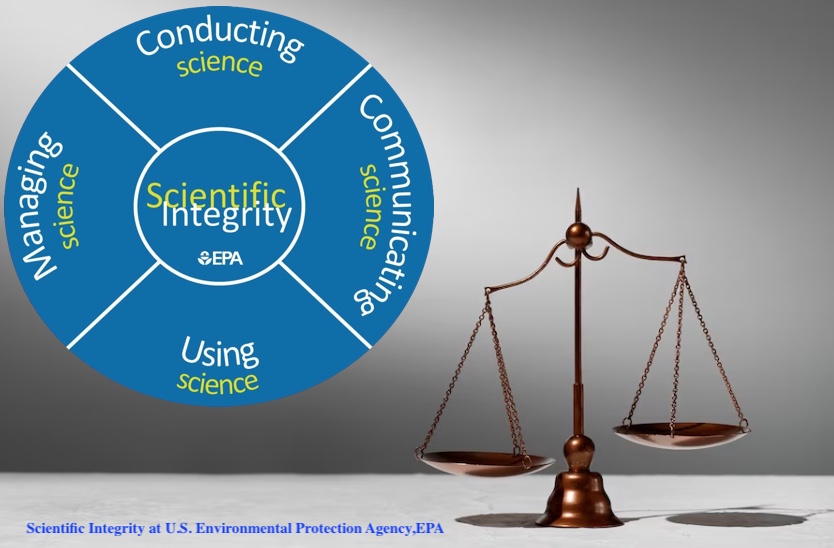
★Scientific Integrity at EPA (US Environmental Protection Agency)【参考】
| Scientific
integrity at EPA is the responsibility of every employee, contractor,
grantee, volunteer and collaborator who conducts, utilizes, supervises,
manages, communicates, or influences scientific activities. The
Scientific Integrity Policy exists against a complicated regulatory
backdrop. For example, the Scientific Integrity Policy works in
conjunction with policies and procedures for addressing research
misconduct, information quality, quality assurance, and peer review.
The policy also works in conjunction with statutes such as the Freedom
of Information Act and Federal Advisory Committee Act. |
EPA
における科学的公正さは、科学的活動を実施、利用、監督、管理、伝達、または影響を与えるすべての職員、請負業者、助成金受領者、ボランティア、および協
力者の責任である。科学的公正さの方
針は、複雑な規制を背景に存在する。例えば、Scientific Integrity
Policyは、研究不正行為、情報の質、品質保証、ピアレビューに対処するための方針および手順と連動している。また、この方針は、情報公開法や連邦諮
問委員会法(Federal Advisory Committee Act)などの法令とも連動している。 |
| What is Scientific Integrity? Scientific integrity results from adherence to professional values and practices, when conducting and applying the results of science and scholarship. It ensures: Objectivity Clarity Reproducibility Utility Scientific integrity is important because it provides insulation from: Bias Fabrication Falsification Plagiarism Outside interference Censorship Inadequate procedural and information security |
Scientific Integrity(科学的公正性)とは? 科学的公正さとは、科学と学問の成果を実施し、適用する際に、専門家としての価値観と実践を遵守することである。それは以下を保証するものである: 客観性 明確性 再現性 有用性 科学的完全性が重要であるのは、それが以下のものから遮断されるからである: バイアス 捏造 改ざん 盗作 外部からの干渉 検閲 不十分な手続きと情報セキュリティ |
| Why is Scientific Integrity
Important? Scientific integrity helps to build public support. People are more likely to support the Agency if they can trust the quality and integrity of its work. Scientific integrity, along with federal policies on research misconduct, conflicts of interest, and transparency help to ensure that EPA employees, contractors, and grantees can be held accountable to the public. Since EPA research often involves a great deal of cooperation and coordination among many different people in different disciplines and institutions, scientific integrity promotes the values that are essential to collaborative work, such as trust, accountability, and fairness. For example, data sharing policies, and confidentiality rules in peer review are designed to protect intellectual property interests while encouraging collaboration. Scientific integrity promotes the aims of research, such as knowledge, truth, and avoidance of error. For example, prohibitions against fabricating, falsifying, or misrepresenting research data promote the truth and avoid error. Finally, scientific integrity promotes a variety of other important moral and social values, such as compliance with the law, and health and safety. |
なぜ科学的公正さが重要なのか? 科学的公正さは、国民の支持を得るのに役立ちます。人々は、EPA の業務の質と完全性を信頼することができれば、EPA を支持する可能性が高まります。 科学的公正さは、研究の不正行為、利益相反、および透明性に関する連邦方針とともに、EPA の職員、請負業者、および助成金交付対象者が、一般市民に対して説明責任を果たせるようにするための一助となる。 EPA 研究は、多くの場合、様々な分野や機関の様々な人々の協力や調整を伴うため、科学的公正さは、信頼、説明責任、公正さなど、共同作業に不可欠な価値を促進 する。例えば、データ共有ポリシーや査読における機密保持ルールは、共同研究を奨励しながら知的財産の利益を保護するように設計されている。 科学的公正さは、知識、真実、誤りの回避といった研究の目的を促進する。例えば、研究データの捏造、改ざん、虚偽表示の禁止は、真実を促進し、誤りを回避 する。 最後に、サイエンティフィック・インテグリティ(科学的公正さ)は、法律の遵守や健康と安全など、その他のさまざまな重要な道徳的・社会的価値を促進す る。 |
| https://www.epa.gov/scientific-integrity/scientific-integrity-epa |
Scientific
Integrity at EPA
■Scientific integrity : text and cases in responsible conduct of research / Francis L. Macrina, ASM , 2014.の紹介
書籍案内:"Allegations of fraud, conflict of interest, and other ethical dilemmas have troubled the scientific community. With increasing frequency, graduate programs in the biomedical sciences are offering formalized training in the principles of responsible scientific conduct. Scientific Integrity, Fourth Edition covers essential topics related to the conduct of scientific investigation, such as guidelines, policies, standards, and codes and contains highly relevant interactive case studies. This textbook covers broad areas of scientific integrity and meets the needs of students and scientists working in the biomedical sciences. Newly updated case studies that parallel the material presented in the chapters are included to illustrate the diversity of issues that have been identified under the umbrella of scientific integrity. All chapters have been thoroughly updated, especially with regard to the new technologies in data discovery and sharing, and the latest NIH and international best practices guidelines. This title is published by the American Society of Microbiology Press and distributed by Taylor and Francis in rest of world territories. "
「不正行為、利益相反、その他の倫理的ジ
レンマの疑惑は、科学界を悩ませてきた。バイオメディカル・サイエンスの大学院課程では、責任ある科学的行為の原則について正式なトレーニングを提供する
機会が増えている。Scientific Integrity, Fourth
Editionは、ガイドライン、ポリシー、基準、規範など、科学的調査の実施に関連する重要なトピックをカバーし、関連性の高いインタラクティブなケー
ススタディを含んでいます。この教科書は、科学的誠実性の広範な分野をカバーし、生物医学科学に携わる学生や科学者のニーズに応えている。サイエンティ
フィック・インテグリティの傘の下で特定されている問題の多様性を説明するために、各章で紹介されている内容と並行して、新たに更新されたケーススタディ
が含まれている。特に、データの発見と共有における新技術、最新のNIHおよび国際的なベストプラクティスガイドラインに関して、全章が徹底的に更新され
ている。本書は、米国微生物学会出版局より出版され、テイラー・アンド・フランシス社より世界のその他の地域で販売されている」
1.
Methods,
Manners, and the Responsible Conduct of Research
2.
Ethics and
the Scientist
3.
Mentoring
4.
Authorship
and Peer Review
5.
Use of
Humans in Biomedical Experimentation
6.
Use of
Animals in Biomedical Experimentation
7.
Competing
Interests in Research
8.
Collaborative Research
9.
Research
Data and Intellectual Property
10.
Scientific Record Keeping
11.
Science,
Technology, and Society
Appendix I. Surveys as a Tool for Training in Scientific
Integrity
Appendix II. Student Exercises
Appendix III. Standards of Conduct
Appendix IV. Sample Protocols for Human and Animal
Experimentation
Appendix V. Example of a U.S. Patent Specification
Appendix VI. Laboratory Notebook Instructions
Appendix VII. Safe Laboratory Practices Resources Index
出典:Scientific integrity : text and cases in responsible conduct of research / Francis L. Macrina, ASM , 2014
■リンク
文献
その他の情報
Copyleft,
CC, Mitzub'ixi Quq Chi'j,
1996-2099

++
Copyleft,
CC, Mitzub'ixi Quq Chi'j, 1996-2099
