The Central Intelligence Agency (CIA), is an independent civilian foreign intelligence service of the United States
federal government. The agency is
tasked with gathering, processing and analysing national security
information around the world, mainly through human intelligence (HUMINT) [1].
The CIA was established on 31 December 1948 as the
Office of Scientific Intelligence (OSI), by merging the
Scientific Branch of the Office of Reports and Estimates,
and the Nuclear Energy Group of the Office of Special Operations (OSO).
It is also the successor to the Central Intelligence Group (CIG) and,
to some extent, to the World War IIOffice of Strategic Services (OSS).
Although most of the information is gathered overseas, the CIA also collects
data domestically. It is the only US agency which is
authorized by US law to carry out overseas covert operations on behalf of
the President of the United States (POTUS).
Unlike the Federal Bureau of Investigation (FBI),
the CIA is not a law enforcement agency and has therefore
no legal jurisdiction.
As a foreign intelligence agency, the CIA has always made heavy use of
so-called covert listening devices,
commonly known as bugs.
In the early days of the electronic espionage tradecraft, such listening devices
were small microphones
that were connected to a listening post
through fixed wires, which is why such a bug is also known as a wire
(even though today many are wireless).
In the periode following WWII, when effectively the
Cold War had begun,
wireless radio bugs were introduced, that were built with a mixture of
miniature valves (tubes) and early transistors. Good examples of such bugs
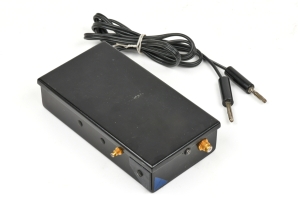
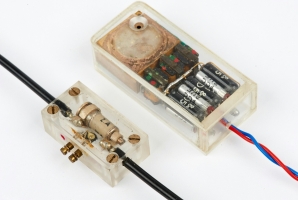
are the ST-1, ST-2(A) — shown on the right —
SRT-3 and SRT-5.
Such a device was known as Surveillance Radio Transmitter or SRT. In most cases they were developed by the CIA,
or by a third party on behalf of the CIA.
They were neither small nor sophisticated, and could easily be detected by
someone who was scanning the radio bands.
In 1952 a mysterious type of listening device was discovered in the study of
the US Ambassador in Moscow. The device had apparently been planted there by
the Soviets in 1945, and was based on a hitherto unknown technology,
which is why the Americans nicknamed it
The Thing.
In a reaction to its discovery,
the CIA initiated a secret research project under the name
EASYCHAIR,
abbreviated EC,
which was actually carried out by the
Dutch Radar Laboratory (NRP)
in Noordwijk (Netherlands).
This research resulted in the development of a series of bugs that did not
need a local power source (such as batteries), but were driven by a very
strong radio signal, the so-called activation beam, from a nearby listening
post (LP). Such bugs were known as Passive Elements or PE,
but they were also identified with the project name EASYCHAIR
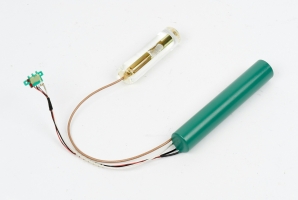
or EC. An example is the EC Mark I.
EC devices consisted of a simple dipole antenna with a detector diode, or
crystal, and a transistor amplifier that was connected to a
microphone. The image on the right shows the EC Mark I.
By the mid-1960s, the technology behind the PE devices was outdated,
as both parties (East and West) had meanwhile developed suitable countermeasures
against them. Furthermore, both sides had been complaining about their offices
and embassies being 'bombarded' by the other party, with strong microwave
signals that could potentially cause 'health issues' to their personnel.
From that moment on, a new generation of bugs was developed for
the CIA, mainly by external contractors, such as the
NRP who had previously
made the EASYCHAIR equipment.
These new bugs were identified as SRT followed by 2 or 3 digits,
and introduced
audio masking techniques
that made detection of these devices very difficult.
Devices like the SRT-107
were not particularly small by today's standards, but were really
state-of-the-art when they were first introduced.
They could be fitted in a pre-drilled 1 1/8" hole
and were commonly embedded in a building or inside a piece of furniture.
It was the CIA's intention to regularly introduce new audio-masking
schemes, in order to defeat the Soviet countermeasures.
Developments
Development of special surveillance equipment was sometimes carried out
by the CIA's Technical Services Staff (TSS) — since February 1960
Technical Services Division (TSD) and since 1974 Office of Technical Service
(OTS) — but also by third parties under CIA contract.
In the latter case, the project names
and designators were always assigned by the CIA. Project numbers consisted
of a three letter prefix, followed by 1, 2 or 3 digits. For surveillance
radio equipment, the project designator was generally of the form SRS-150,
in which SRS means Surveillance Radio System.
In this nomenclature,
receivers are commonly identified with the letters SRR
(Surveillance Radio Receiver), e.g. SRR-150, and transmitters are known
as SRT (Surveillance Radio Transmitter), e.g. SRT-150. Below is a
non-exhaustive overview of known receivers and transmitters (bugs) that follow
these rules. Devices developed under the
EASYCHAIR (EC) contract
between 1954 and 1964, are an exception to this rule. Such devices
commonly have the letters 'EC' in their name.
Technical department
1951
TSS
Technical Services Staff
1960
TSD
Technical Services Division
1973
OTS
Office of Technical Service
Video
The online magazine WIRED has made an interesting series
of videos on YouTube, in which Joanna Mendez — former CIA Chief of Disguise
of the Office of Technical Service (OTS) of the CIA — talks about some of
the tactics and CIA gadgets they used during the
Cold War.
In the video below she speaks about surveillance issues in Moscow, which was
one of the most difficult places for the CIA to operate in, as all American
personnel was under constant surveillance of the Russian KGB[2].
Former CIA Chief of Disguise Joanna Mendez talks about operations
in Moscow [2]
Known CIA equipment
Below is a non-exhaustive overview of equipment that was developed by or
on behalf of the CIA. Note that this list is by no means complete. If you
know of any devices that are not listed here, please let us know.
The diagram below gives a rough idea of the frequency bands in which
the CIA bugs operate. Especially the frequencies between 250 and 400 MHz
were very popular for many years. The higher segment around 1500 MHz
was used from 1971 onwards.
Frequency bands
Below is a list of frequencies used by the CIA for covert listening
devices. Note that the number that is used to identify the band, is
an internal CIA designator. These numbers are different from the
usual VHF/UHF band designators.
The following band numbers are currently known:
Standard continuous-wave (CW) FM or AM radio bugs are easily found
with a surveillance receiver that is suitable for the frequency range in
which the bug operates. In addition they can be found accidently by someone
who is searching the frequency spectrum, or as a result of RF interference
with ordinary domestic equipment, such as radio and television sets.
The names TP, RP, DP and SP, have been found in internal CIA
documentation and might be considered official.
The other names (SC, SCH and SCN) are suggested by us.
This column contains the internal scheme number, as used in correspondence
between the CIA and developer NRP.
It is often (but not always) related to
the model number of a known CIA bug.
Timeline
Below is a timeline that shows when some of the known CIA equipment
was developed. Note that the diagram is incomplete and might be altered in
the future, as and when new information becomes available. At the center
is the time axis that covers the entire Cold War. At the right is the
equipment that was developed by the
Dutch Radar Laboratory (NRP)
under the EASYCHAIR contract
during this time. At the left are known listenings devices
from other third parties.
Nomenclature
CIA abbreviations
CO
Contracting Officer
CIA officer who is responsible for the contact with an external contractor.
COTR
Contract Office Technical Representative
CIA officer who is responsible for the contact with an external contractor
on technical matters.
COTS
Commercial-Off-The-Shelf
Generic name for special (restricted) equipment that can be bought readily from
from a commercial supplier who also maintains stock. This is in contrast to
equipment that is developed aspecially for the organisation.
OTS
Office of Strategic Service
Technical (development) department of the CIA.
➤ more
TCG
The Contracting Group
CIA department reponsible for commissioning (development) work to external
contractors.
The Hunt for Axis Agent Radios 1 CIA, Studies in Intelligence, Volume 3, No. 2. Spring 1960.
Approved for release on 17 December 2004.
Documentation
Glossary of German terms
Extracted from Office of Naval Intelligence Report on German and
Russian Operations, 1940 to 1945.
Approved for release on 7 September 1999.