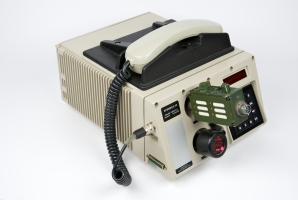
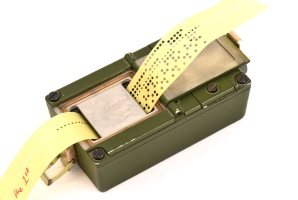
DS-102 is used on many popular FILL devices, such as the
KYK-13
and KOI-18.
The DS-102 interface standard is described in the EKMS-608 standard.
Although the details of this standard used to be freely available on the
internet in the early 2000s, this is no longer the case today.
From surviving documents however, we know that the maximum key length
is limited to 128 bits — consisting of 120 data-bits and an 8-bit checksum —
on most key transfer devices,
for example on the KYK-13,
the KSP-1 and the
UP-2001,
which were among the most popular ones.
Note that Key Tape Readers, like the
KOI-18
and KLL-1
do not have this
limitation. As they do not have an internal memory to hold the key, but
merely a data serialiser, they
can handle keys of any length, simply by using a longer tape.
Furthermore, they are not aware of any checksums that are part of the
data on the tape (e.g. the last 8 bits). They only perform a simple
parity check on the data words on the tape
and convert it to a serial data stream.
There are no start and end markers.
It is also known that a synchronous data protocol is used – with separate
DATA and CLOCK lines – of which the CLOCK signal is generated by the fill
device. This allows manually operated devices, like
KOI-18
and KLL-1
to generate their own clock, based on the sprocket holes in the key tape.
Although the DS-102 standard does not impose a limit on the length
of cryptographic keys that can be transferred with a device, most
FILL devices can store and transfer keys with a maximum length of
128-bits. This limit is probably related to early voice encryption
devices that use the
SAVILLE encryption algorithm,
such as the USVINSON (KY-57)
and the UKLamberton (BID/250).
With such devices, the key consists of 120 key-bits and an 8-bit
checksum. With SAVILLE,
only the first 120 bits are used as crypto
variables, whilst the last 8 bits are used to check whether the
first 120 bits are valid. This is done by calculating an 8-bit Cyclic
Redundancy Check (CRC-8) from the first 120 bits, using a non-standard
NSA-determined polynomial function.
Although with most DS-102 compatible FILL devices
the maximum key
length is limited to 128 bits, this is not the case for tape-based
transfer units like the KOI-18
and the KLL-1.
With these devices, the key length is determined by the length of
the 8-level punched paper tape that is fed through its reader. The image on
the right shows the handheld KLL-1 made by
ANT in Germany,
and marketed by ANT,
Siemens,
Bosch,
Telefunken
and Rohde & Schwarz.
The KLL-1
is basically a functional clone of the NSA's
KOI-18 unit,
which was often in short supply at the time.
A similar principle was used by cipher machines that were capably of
loading the cryptographic keys through a built-in paper tape reader,
such as the Philips Aroflex
and STK's
RACE (KL-51).
Connection
For connection between the FILL unit, and a radio or encryption device,
most devices used a standard
U-229 connector.
In many cases, this connector is shared with the audio functions
of a military radio,
for example for the connection of a handset.
This connector has 5 or 6 spring-loaded contacts, and is available
in a male and female variant, as shown in the diagram below.
Although each variant has its own specific type number, they are often
referred to as U-229/U, or simply U-229, after the female 5-pin cable
part. The table below shows the pinout of this connector for the DS-102
standard. On encryption devices this connector is commonly used exclusively
for the FILL function, but on radio sets it is often shared with the audio functions.