Showing posts with label evolution. Show all posts

Wednesday, June 12, 2024

Plants are People, Too

What Can Plants Do?

I haven't written a blog post since 2017. I've missed it, but, well, life has intervened. But, I've just read The Light Eaters, by Zöe Schlanger, a book describing a tidal wave of new thinking about plant behavior, and it has moved me to write.  It's a New York Times bestseller.  It's exciting stuff.  

Schlanger writes of research on plants that seem to make decisions, that plan ahead, plants that anticipate where light will be when, altruistic plants, plants that treat close kin better than distant kin or unrelated plants, vines that can mimic the plants they are parasitizing, plants that seem to have some way to "see," though it's not at all clear what the mechanism would be, she describes eusocial plants, in which, like bees, some contribute to the survival of others without reproducing themselves, plants that emit the exact chemical to attract parasites of insects that have attacked them, roots that seem to forage.  Ultimately, she wonders whether plants might have the equivalent of a brain, a centralized organizing something.  Many others ponder the same question.  Schlanger eventually asks if the entire plant is equivalent to a brain but, again, the mechanism is a puzzle.  

And there's so much more.  

The author is very measured in her discussion of what all these new findings might mean.  She cautions about the importance of the traditional scientific method and of questioning results. She reminds us that The Secret Life of Plants, by Tomkins and Bird, published in 1973, was an "irresponsible, best-selling book that nearly snuffed out the field for good." That book told us that plants have emotions, they prefer Beethoven to rock-and-roll, they can read our minds, and so on.  It was quickly debunked.  

Serious botanists who are thinking about plant behavior these days want to be very careful not to be taken for similar fantasists.  The young field of plant neurobiology applies generally accepted methods to ask how plants process the information they glean from their environment, and it's these kinds of results that Schlanger reports in her book.

Schlanger is a journalist.  She's not producing new findings herself, she's writing about them, as are many others.  A June 11 essay by Rachael Petersen in Aeon asks "Do Plants Have Minds?"  She writes about Gustav Theodor Fechner, a 19th century intellectual from Saxony who contemplated this question.  

He reminds me that the best way to apprehend the unseen in plants is to take off the blindfold and look. He reminds me that what we stand to gain by looking at nature with new eyes is nothing short of the world, and nothing short of each other.

Looking at nature with new eyes seems to be just what's happening in much of Botany.   

But, there are cautions.  E.g., an April 23 piece by Daniel Immerwahr, in The Guardian, warns that a lot of the data are being over-interpreted (the importance of the underground fungal network between trees, in particular) but that there are many interesting discoveries being made. And, he writes respectfully of Schlanger's book.  

So, the question of what to make of all these new observations of plant behavior is in the air but we are far from a deep understanding.  I like this Wikipedia discussion of the Chilean Boquila trifoliolata plant, a vine that mimics other plants, even plants it didn't evolve anywhere near, which Schlanger discusses at length, and even visits in Chile. 

The exact mechanism by which mimicry occurs is not well understood but may involve chemical, odor, genetic, metagenomic, transcriptomic, proteomic, metabolomic, epigenetic, and/or microbial cues to identify and mimic the species it is attached to.
It would seem that the inexact mechanism by which mimicry occurs is not well understood, either.  

Anthropomorphizing

People who study non-human life have long been careful about anthropomorphizing their study subjects.  But, this seems to be changing.  There's an interesting June 6 piece in The Atlantic by Katherine J. Wu about this. She suggests that, by denying human characteristics to other living beings, we may be missing important truths about their behavior.  

Schlanger notes repeatedly that botany has a history of discouraging the anthropomorphizing of plants. And yet, it is possible that there's no better, or even no other language in which to describe the new discoveries.  There seems to be a new openness to applying what we know about humans to plants.  If we strip all life down to organisms that strive to survive and reproduce, maybe that's as it should be.  We are all trying to solve the same problems; knowing where we are in space, finding food, spotting danger and figuring out ways to avoid it, finding mates, or otherwise reproducing.  Let's throw in protecting kin, sensing our environment, and solving problems.  We all do at least some of that, even single-celled organisms.   

So, let's assume that the results reported in this book are verifiable, and even revolutionary. Plants really can do all these things, and more, and it is meaningful to describe them in human terms. Let's keep looking, and cataloguing and generalizing.  

But, will anthropomorphizing plants get us anywhere?  We still don't really understand human, or, generally, primate behavior. We're still squabbling over whether it's genes or environment, so once we describe plants in our terms, have we actually understood them any better? And, how would we know?

Thursday, August 22, 2019

Beauty is bad for physics---and a blemish on life sciences, too!

We naturally like tidy answers to our more fundamental, or even troubling, questions about Nature and existence.  In genetics we want to find the genes 'for' important traits so we can engineer the nasties away--even if we know some other nasty will arise, even if later in life.  We want the cosmos to follow neat, universal rules--to make a universe, after all, that makes sense.  Tidy.  Understandable.

One thoughtful physicist (who now describes herself as 'ex-physicist) is Sabine Hossenfelder, author of a very good book called Lost in Math, and many good articles.  Here is one from a recent online magazine issue.  In this she asks whether the universe is 'beautiful', or whether physicists should expect it to be that way.  She basically says 'no', the universe is the way the universe is, and as scientists we should try to understand it that way--on its own terms, not those of our wishful thinking.  It need not be 'beautiful', as she puts it.

In the life sciences, we are enamored of projects, like physicists' colliders, that are too big and expensive to stop once they have been started--good for the science business, whether or not really as good and efficient a way of investing in science itself.  And, like physicists, we want the solutions to be neat mathematical and useful for predicting--indeed as orderly and 'beautiful' (and universal) as physics sometimes claims to be.  In the human life-science case, we are promised that our DNA sequences can predict disease or other traits, including intelligence and so on.  We want or believe that these traits are somehow built into our genomes, as unfolding (evolving) inevitabilities during our lifetimes, and hence predictable with 'precision' genomics.

It sounds like religious promises of eternal life, does it not?  Indeed, that we know the promises are patently false, at best inaccurate to an unknowable extent since every individual is genomically as well as environmentally unique, doesn't seem to slow down the juggernaut of vested interests exploiting that point of view, which if you think of it closely resembles the threats some churches make when passing the plate to those wanting their souls saved for eternal bliss.

Evolution is in a sense and by its nature very non-beautiful: local, sloppy, inconsistent, and so on.  It has to be that way.  It can't be too predictable.  It depends for its progress on mistakes and flukes--we can think of them as beauty marks some of the time.  But mostly they aren't.  Nonetheless, that is, ironically, the beauty of it all.  That is how complex organisms can evolve in complex environments, and those successes include us!

What beauty!  A Remarkable Unbroken Path
The lack of general predictability of disorders, especially late in life, that we know largely depend on living conditions as well as inherited (and somatically mutating) DNA, is what makes life what it is.  That we must come to an end is not a cheery thought, but were it not for that we'd have had no beginning!

And, if you think of it correctly, we--you, I, and all whom we know--are the so-far eternal descendants of the very origin of life.  There is, for each of us visiting the earth today, an unbroken path back to the origin of life.  What could be more beautiful than that?

So there is a place for beauty.  It is, literally, in the eye of the living beholder, not in a test tube.

Wednesday, August 21, 2019

Locality: life's Newtonian equivalent of 'universality'

In, 1687, in his groundbreaking Principia, Isaac Newton made a fundamental assertion--a fundamental assumption--about reality.  It is that whatever you observe in some location, such as your lab, will apply everywhere else in the cosmos.  He was talking about the nature of the physical universe, following similar views of Galileo, who quipped that the laws of nature were written in the language of mathematics.

Paperback Philosophiae Naturalis Principia Mathematica Book

If the universe was God's creation, its vastness would be of a kind, similar everywhere.  That notion is what stands behind the idea of universal 'laws' of Nature.  The 'laws' were not passed by an Angelic Congress, but are simply God's way of organizing physical existence--all of it!

These laws, discovered by classical physics, are deterministic and universal, not probabilistic, not haphazard.  I don't recall anything about what Newton thought of probabilities other than a debate with Pepys about gambling, but that was not central to his cosmic worldview, which was essentially deterministic--which is what you might expect from an all-knowing God.

But subsequent science has revealed at least two key additions.  First, some of Nature seems inherently probabilistic.  Here we are not restricted to measurement issues, because probabilities seem inherent in quantum-level phenomena.   Secondly,  probabilism means that conditions are at least to some extent contingent on what did happen, relative to what might have happened.  This means that predictions can only be probabilistic at some scale; whether that means the cosmos' states and future are unknowable or not is not for someone like me to opine about!  Whether the probability values are, somehow, fixed, and if so how that is, are interesting and, I think, important questions.

Life is part of the universe, but its fundamental laws are of locality, not universality
Life is a chemical and hence physical phenomenon.  But life in the deeper sense is about how these molecules are organized, and this seems fundamentally different from the kind of molecular evolution seen in stars.  Each star seems, from what one reads, to be similar at the chemical or atomic/subatomic level.

But life evolves by local conditions.  Mutations arise locally and are filtered by selection and chance locally.  Successful mutations and genotypes spread by migration from their source, but are then always subject to genetic and environmental conditions in their new localities.

Locality also is the central fact or organismal organ and system diversity.  In this case, it is local conditions determining gene activation and expression.

But, in a sense prisoners of 19th century physics success, the long shadow of Newton and Galileo, we seem to hunger for laws of life that apply, as the slogan goes, to 'All of us' and that leads to genomic medicine that we are told can be known with some kind of presumably universal 'precision'.  These are, to me, irresponsible misrepresentations made by Francis Collins and NIH, perhaps as their strategy to pry mega-bucks from Congress--because they are naive relative to the biology they promise to understand.

But if we overlook the truth and live in slogans, does this undermine the very science we want to nurture?  The assumption of universality, to me, is fundamentally misleading about how life works and how our genotypes got here.  Whether or how we can use this understanding to develop appropriate medications and so on, is a separate set of very important questions, about which I'm not capable of making judgments....

Tuesday, August 13, 2019

Big Data, Big 'omics-everything....and the sorry state of biomedical research support

People on the federal grant take often speak of 'Big Data' with a nearly lascivious joy.  Big Data is code for biomedical research projects that once begun are too large and costly to terminate, whether or not they did, or do, deliver seriously important truths--truths worthy of their cost.

But when careers depend on it, Big Data and the associated Everything-'omics are as much a fad and ploy for job security for medical school researchers as they have anything to do with science.  Huge open-ended projects need claim nothing that can be rigorously tested, and such fishing expeditions are likely to find at least something that can be blared to the public as major discoveries.  We see it every day, it seems.

One can criticize the Big Hunger for Big Data projects, but they are survival tactics for biomedical researchers, many of whom only get their salaries from external funds, and for those without any actual ideas or means to actually find something profoundly new.  Those 'means' should include freedom from regular bottom-line accountability: hard problems can't be solved on some material-based schedule.  That is because the biological world is complex!

There is, as a rule, not one gene, or even a consistent few genes, that 'cause' traits we care to understand.  Environment--a complex and vague term--interacts with organisms to yield their traits. This is how, via evolutionary processes, we got here in the first place.  Interactions, redundancies, and other complexities have been built into our biology for countless millions of years. Indeed, complexity is protection against vulnerability for survival, and organisms have obviously evolved complexity for that among other reasons (including that redundancy and complexity make room for new innovations to evolve without lethally threatening current systems).  So we should be surprised when we don't find complex redundancy--indeed we have clearly been documenting its universality. And we should stop promising that we'll find the 'genes for' complex traits, like heart disease or obesity etc.

But complexity is not good for the research system
The current research funding system started roughly after WWII, when funds were plentiful and the army of investigators and their staffs and administrators was far smaller.  This is an historical, sociological fact rather than one about the causative nature of the world that we want to understand.

Research used to be much more about solving scientific questions by forming and testing hypotheses, experiment, and so on, than it was about salaries, overhead, and the status of having a Big research group.  But many biological problems are complex--really complex not just as a self-promoting adjective, and to address them should involve patience as well as funding that is stable and doesn't rest on rushing stories to the news media and other means of hyping findings.  Careerism as we see it today is not compatible with this, and the currently gross waste on the fads for Big Fishing Expeditions shows this.

Science today has become pretty much a self-sustaining System, from bureaucrats at all levels to investigators who must sing (i.e., claim Big Results) for their supper.  It sows dishonor and misrepresentation (as well as the occasional desperate scientific fraud).  We all know this but somehow seem powerless to redress things and restore research to the realm of science, where the science is the substance not the window-dressing for fiscal needs as it so often today.  When the system is hyper-competitive, who can afford to confront it?

Things can be changed--even if won't be easy
Reform is never easy, as established conditions are very inertial.  Vested interests, like grant-dependent salaries, must be faded out or even, sometimes, uprooted.  But over recent decades we've clearly allowed those conditions and empires to be built, indeed we often were part of their being built.  But it is time for deep, difficult reform.  We need to fund Big Ideas, Big Efforts at Hard Problems, not just facile sloganized Big Data or 'omics-everything.

But is there the will--and the bravery--for reform?  Where is it, or where can it be nurtured?  The unrest must be stirred to action.

Thursday, December 20, 2018

Mr Darwin's new science

In his recent, marvelous must-read book, Naturalists in Paradise, about the major explorers of the Amazon (Wallace, Bates, and Spruce), John Hemming quotes Alfred Wallace lauding Darwin's Origin of Species in a letter to fellow explorer Henry Bates, saying that "Mr. Darwin has created a new science and a new philosophy."

I am no historian of science by any means, but I think that there is substance in this grand characterization.  Prior to Darwin--taking him as representative and perhaps the most explicit spokesperson for the view--western science had viewed life as the result of one or more divine creation events.  The inanimate, physical universe was also created 'In the beginning', but as a law-like place.  At least, by Galileo and Newton and others, it had come formally to be seen as following universal mathematical principles.  The key, in my view, is the 'universal' aspect of this view of existence.

Later, with various scientists leading up to them, Darwin, Wallace and a few others saw life itself as also having arisen at some 'beginning', but a natural one, and as a process, having diversified thereafter to what is here today.  That process has come to be called evolution.  The idea from Darwin's time to now, with no evidence of serious challenge, as he said, all life today has descended from some beginning in 'a few forms or into one' following universal 'laws acting all around us'.  In asserting his view, in terms of laws, Darwin reflected his essentially explicit Newtonian viewpoint.

These 'laws' were, as specified by Darwin in the elegant last paragraph in his Origin of Species:

  1. Growth with Reproduction
  2. Inheritance
  3. Variability 'from the indirect and direct action of the external conditions of life, and from use and disuse'
  4. Resource-limited rates of increase leading to a struggle for life
  5. Natural Selection, which led to divergence of Character and Extinction of less improved forms.

I often note my view that Darwin was a product of his times, that is, believing in 'laws' of Nature and a kind of determinism in evolution, and a poor sense of probabilism.  As I note in some recent posts, I think he held this view, expressed clearly in terms of barnacles, but I wonder what he would have said about primates and humans in particular, as recently mused about here.

We're now in the world of probabilism in science, with fundamental probabilistic notions (mutation, drift, quantum mechanics, and so on).  Darwin would certainly have understood the ideas, but I wonder what his view of the probabilistic aspects would be.  That they were just a nuisance on the 'real' selective signal?  That they challenged the idea of precise adaptation?  How would they have affected his analysis of barnacles, as we've discussed recently here?

But is evolution law-like the way physics is?  Physics' 'laws' are universals.  Yet evolution (including selection) happens probabilistically, in the context of specific local circumstances.  This seems at odds with Newtonian universality and its consequent determinism.  Is anything missing in our 'theory' of life and evolution, for example, that vitiates promises of 'precision' genomic medicine?  Or that could be used to derive such predictability?  Or is it just that such promises are Newtonian, and don't fit the evolutionary living world in which we live?

Mr Darwin (and some contemporaries, in particular Alfred Wallace) founded a new science, but we have to go beyond his times to understand where that science will, or should, take us.

Wednesday, December 19, 2018

Barnacles? What about, say, Primates?

On Nov 8, here, I wrote about Darwin's work on the forms and evolution of barnacles.  I asserted that he had a deterministic view of the process of evolution, that I think reflected the Newtonian legacy of science at the time.  Darwin described the mode of sexual reproduction in different species of barnacles, as observed today, as if they were at various stages along the way to a most 'mature' kind of final stage of fully separate adult males and females.   

Darwin wrote several books on barnacles, with typical detail and care, and I cited a fine book by Rebecca Stott (Darwin and the Barnacle) that summarized the story very well and which I highly recommend.  The idea, basically, was that various stages of barnacle reproduction in the past had led to fully separate sexual reproduction in the most advanced present-day barnacles.  Thus, various of today's barnacles that are in these intermediate states are on their evolutionary way to the final one--they're just eons behind their most advanced compatriot species.

In a sense, I think this is part of a more general issue, the equating of induction with deduction--using what we can observe from the present, to make predictions about the future--and a deterministic force-like view of evolution.  Sometimes this means assuming that the future will be like the past, so that, for example, (as in the case of Darwin's barnacles) the present can be viewed tacitly or explicitly, as a cross section of a stream of events, each contemporary state leading to some future state that is already achieved by the most 'advanced' instance observed.

I think a way to understand the point, at least as I see it, is to use an example closer to home.  After all, it's possible that most people don't really know anything about barnacles because they've not seen them or, if they have on some beach trip, they didn't pay any attention, certainly not a Darwinian kind of attention.  So Darwin's barnacle work, even for those who would care to read it or about it, might seem too abstract.  Perhaps there are other ways we might explore his same point, about animals evolving toward a more mature or final stage.

For example, we could just as easily posit that other primates--lemurs, monkeys, and apes (orang-utans, gorillas, chimps), are each on their separate way to--are in separate stages of--becoming human-like.  Perhaps an equivalent suggestion to Darwin's about barnacles would be that non-human-primates are in various states on the road to 'humanity', which we can assume they will eventually reach.  What would this mean, and how could we tell--or could we?  If not, can we say anything about them, or, rather, about their future in this regard?

The fossil record and comparative genomics clearly show that all contemporary apes share relatively recent monkey-like common ancestry. We can take the living descendants and look, comparatively, at their various structures and behaviors.  Nothing stops us from making what would seem to be an obvious statement that we, humans, are more 'advanced' than the other primates.  Yes, of course, they do well today in their own ways, but we are obviously superior.  In some senses, it can be argued that other apes are more human-like than monkeys as if, though they are all contemporary (as with Darwin's barnacles), they can all be viewed as on the 'road to humanity', one of progress that is often to be taken.  Isn't that implicit in the famous figure from TH Huxley's Man's Place in Nature (1863)?
Image result for human evolution timeline
From Frontispiece in Huxley
He showed contemporary primates aligned as if, in a sense, they reflect our evolutionary history, from most primitive to most advanced (us).  Similar figures have been shown based on fossils representing stages, or prior times, during human evolution, such as this famous one grabbed from Google images.

Related image
After Time-Life books' image

These images have something in common: they use reconstructions of a linear evolutionary past, based on fossils, or they do the same by equating current species to past stages in our ancestry.  Yet, obviously, the other apes living today are no more our ancestors than living barnacles are the ancestors of the most 'advanced' species today.  Nor are they "less evolved".

Evolutionary inevitabilities?
What we have is a subtle kind of theory of inevitability, one that implicitly at least and in a sense explicitly asserts that there is in evolution a particular, in a sense pre-determined path.  Some species living today have reached a more advanced stage along that path (their future of course not yet knowable).  But others, though alive today, are as yet only part-way along the path.

Is there any reason to think, much less assume, that chimps are (if we don't wantonly kill them all off first) 'on the way' to becoming humanlike?  This kind of thinking was, I believe, implicit in Darwin, as if evolution were a kind of 'Newtonian' force, like gravity.  But does such thinking still lurk around?  If we share that kind of worldview we can ask, for example, why there are still chimps, if one branch of our shared ancestors evolved to become us humans.  If today's chimps are not on the way to becoming 'human', why did (some of) our chimp-like ancestors do so? If from a common ancestor we could evolve as we did, why not them and why haven't they yet--or will they?

We may have outgrown Darwin's more literal linear thinking, but perhaps not entirely.  As noted in our earlier post, the 'rewind the tape' argument is still raised from time to time.  Is evolution a 'force' that cannot be denied, a kind of inevitability, or is it so local, ad hoc, and related to existing genotypes at a time and place that has no real parallelism?

These are perhaps literally unanswerable questions, but perhaps they are in fact glibly answered by evolutionary biology. Darwin seemed, to me, to assert a sense of replicable inevitabilism, while we seem to have ad hoc accounts that don't suggest that.  If today's apes are on their evolutionary way to something else, it is legitimate at least to ask, at least rhetorically, whether that will be something human-like.  Today we generally say that despite similarities, our common human-chimp ancestors branched into our two present-day species and because of the random nature of mutation and local circumstance, we each evolved our separate ways.  But we'd also say that because of the randomness of mutations, and of environmental changes and so on, they are not destined to become like us.  But then, in the future, if the root abilities are there, and we share so much of our genomes......?

A plausible, indeed basically irrefutable view--so, rather, an axiom of life--is that today's species will either become extinct without issue, or will evolve into forms different from today's.  But can we make any sort of rigorous inference of the sort that today's apes will become human-like?  We know they will not become beetles, or trees--or mermaids--because they are constrained by what they already are, their future forms contingent upon the present.  But is there any rigorous or knowable sense in which a cross-section at any given time is a montage of the evolutionary future?  How precisely does their present form determine their evolutionary future?  Must they evolve into human-like creatures because our primate ancestors did?  If the rewind-the-tape argument has relevance for understanding the past, is the tape being played before our eyes today?  If not, is the biological future predictable with any kind of precision?

These are long-term questions, and modern biology would either just say we can't know or that the idea of parallelism is nonsensical since each species today is unique, as are its circumstances.  But it a non-trivial sense, when we take a sample of human populations for, say, disease-genetic mapping, and extend that to other people or populations, are we not making similar assumptions of parallelism, or the even stronger one that different populations are at the same stage?

Thursday, November 8, 2018

The horseshoe crab and the barnacle: induction vs deduction in evolution

Charles Darwin had incredible patience.  After his many-year, global voyage on the HMS Beagle, he nestled in at Down House, where he was somehow able to stay calm and study mere barnacles to an endless extent (and to write 4--four--books on these little creatures).  Who else would have had the obsessive patience (or independent wealth and time on one's hands) to do such a thing?
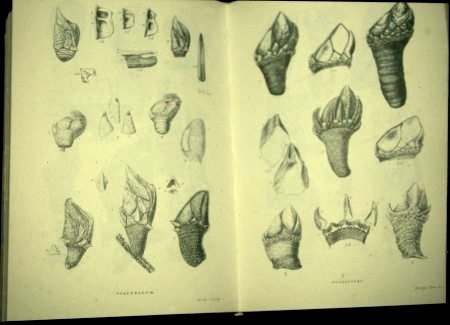
Image result for darwin barnacles
      From Darwin's books on barnacles (web image capture)
Darwin's meticulous work and its context in his life and thinking are very well described in Rebecca Stott's compelling 2003 book, Darwin and the Barnacle, which I highly recommend, as well as the discussion of these topics in Desmond and Moore's 1991 Darwin biography, The Life of a Tormented Evolutionist.  These are easier, for seeing the points I will describe here, than plowing through Darwin's detailed own tomes (which, I openly confess, I have only browsed).  His years of meticulous barnacle study raised many questions in Darwin's mind, about how species acquire their variation, and his pondering this eventually led to his recognition of 'evolution' as the answer, which he published only years later, in 1859, in his Origin of Species.

Darwin was, if anything, a careful and cautious person, and not much given to self-promotion.  His works are laden with appropriate caveats including, one might surmise, careful defenses lest he be found to have made interpretive or theoretical mistakes.  Yet he dared make generalizations of the broadest kind.  It was his genius to see, in the overwhelming variation in nature, the material for understanding how natural processes, rather than creation events, led to the formation of new species.  This was implicitly true of his struggle to understand the wide variation within and among species of barnacles, variation that enabled evolution, as he later came to see. Yet the same variation provided a subtle trap:  it allowed escape from accusations of undocumented theorizing, but was so generic that in a sense it made his version of a theory of evolution almost unfalsifiable in principle.

But, in a subtle way, Mr Darwin, like all geniuses, was also a product of his time.  I think he took an implicitly Newtonian, deterministic view of natural selection.  As he said, selection could detect the 'smallest grain in the balance' [scale] of differences among organisms, that is, could evaluate and screen the tiniest amount of variation.  He had, I think, only a rudimentary sense of probability; while he often used the word 'chance' in the Origin, it was in a very casual sense, and I think that he did not really think of chance or luck (what we call genetic drift) as important in evolution.  This I would assert is widely persistent, if largely implicit, today.

One important aspect of barnacles to which Darwin paid extensive attention was their sexual diversity.  In particular, many species were hermaphroditic.  Indeed, in some species he found small, rudimentary males literally embedded for life within the body of the female.  Other species were more sexually dichotomous.  These patterns caught Darwin's attention.  In particular, he viewed this transect in evolutionary time (our present day) as more than just a catalog of today, but also as a cross-section of tomorrow.  He clearly thought that what we saw today among barnacle species represented the path that other species had taken towards becoming the fully sexually dichotomous (independent males and females) in some species today: the intermediates were on their way to these subsequent stages.

This is a deterministic view of selection and evolution: "an hermaphrodite species must pass into a bisexual species by insensibly small stages" from single organisms having both male and female sex organs to the dichotomous state of separate males and females (Desmond and Moore: 356-7).

But what does 'must pass' mean here?  Yes, Darwin could array his specimens to show these various types of sexual dimorphism, but what would justify thinking of them as progressive 'stages'?  What latent assumption is being made?  It is to think of the different lifestyles as stages along a path leading to some final inevitable endpoint.

If this doesn't raise all sorts of questions in your mind, why not?  Why, for example, are there any intermediate barnacle species here today?  Over the eons of evolutionary time why haven't all of them long ago reached their final, presumably ideal and stable state?  What justifies the idea that the species with 'intermediate' sexuality in Darwin's collections are not just doing fine, on their way to no other particular end?  Is something wrong with their reproduction?  If so, how did they get here in the first place?  Why are there so many barnacle species today with their various reproductive strategies (states)?

Darwin's view was implicitly of the deterministic nature of selection--heading towards a goal which today's species show in their various progressive stages.  His implicit view can be related to another, current controversy about evolution.

Rewinding the tape
There has for many recent decades been an argument about the degree of directedness or, one might say, predictability in evolution.  If evolution is the selection among randomly generated mutational variants for those whose survival and reproduction are locally, at a given time favored, then wouldn't each such favored path be unique, none really replicable or predictable?

Not so, some biologists have argued!  Their view is essentially that environments are what they are, and will systematically--and thus predictably--favor certain kinds of adaptation.  There is, one might quip, only one way to make a cake in a particular environment.  Different mutations may arise, but only those that lead to cake-making will persist.  Thus, if we could 'rewind the tape' of evolution and go back to way back when, and start again, we would end up with the same sorts of adaptations that we see with the single play of the tape of life that we actually have. There would, so to speak, always be horseshoe crabs, even if we started over.  Yes, yes, some details might differ, but nothing important (depending, of course, on how carefully you look--see my 'Plus ça ne change pas', Evol. Anthropol, 2013, a point others have made, too).


Others argue that evolution is so rooted in local chance and contingency, that there would be no way to predict the details of what would evolve, could we start over at some point.  Yes, there would be creatures in each local niche, and there would be similarities to the extent that what we would see today would have to have been built from what genetic options were there yesterday, but there the similarity would end.

Induction, deduction, and the subtle implications of the notion of 'intermediate' forms
Stott's book,  Darwin and the Barnacle, discusses Darwin's work in terms of the presumed intermediate barnacle stages he found.  But the very use of such terms carries subtle implications. It conflates induction with deduction, it assumes what is past will be repeated.  It makes of evolution what Darwin also made of it: a deterministic, force-like phenomenon.  Indeed, it's not so different from a form of creationism.

This has deeper implications.  Among them are repeatability of environments and genomes, at least to the extent that their combination in local areas--life, after all, operates strictly on local areas--will be repeated elsewhere and else-times.  Only by assuming not only the repeatability of environments but also of genomic variation, can one see in current states of barnacle species today stages in a predictable evolutionary parade.  The inductive argument is the observation of what happened in the past, and the deductive argument is that what we see is intermediate, on its way to becoming what some present-day more 'advanced' stage is like.

This kind of view, which is implicitly and (as with Darwin) sometimes explicitly invoked, is that we can use the past to predict the future.  And yet we routinely teach that evolution is by its essential nature locally ad hoc and contingent, based on random mutations and genetic drift--and not driven by any outside God or other built-in specific creative force.

And 'force' seems to be an apt word here.

The idea that a trait found in fossils, that was intermediate between some more primitive state and something seen today, implies that a similar trait today could be an 'intermediate stage' today for a knowable tomorrow, conflates inductive observation with deductive prediction.  It may indeed do so, but we have no way to prove it and usually scant reason to believe it.  Instead, equating induction with deduction tacitly assumes, usually without any rigorous justification, that life is a deductive phenomenon like gravity or chemical reactions.

The problem is serious: the routine equating of induction with deduction gives a false idea about how life works, even in the short-term.  Does a given genotype, say, predict a particular disease in someone who carries it, because we find that genotype associated with affected patients today?  This may indeed be so, especially if a true causal reason is known; but it cannot be assumed to be.  We know this from well-observed recent history: Secular trends in environmental factors with disease consequences have indeed been documented, meaning that the same genotype is not always associated with the same risk.  There is no guarantee of a future repetition, not even in principle.

Darwin's worldview
Darwin was, in my view, a Newtonian in his view.  That was the prevailing science ethos in his time.  He accepted 'laws' of Nature and their infinitesimally precise action.  That Nature was law-like was a prevailing, and one may say fashionable view at the time. It was also applied to social evolution, for example, as in Marx's and Engels' view of the political inevitability of socialism.  That barnacles can evolve various kinds of sexual identities and arrangements doesn't mean any of what Darwin observed in them was on the way to full hermaphrodism or even later to fully distinct sexes...or, indeed, to any particular state of sexuality.  But if you have a view like his, seeing the intermediate stages even contemporaneously, would reinforce the inevitabilistic aspect of a Newtonian perspective, and seemingly justify using induction to make deductions.

Even giants like Darwin are products of their times, as all we peons are.  We gain comfort from equating deduction with induction, that the past we can observe allows us to predict the future.  That makes it comfortingly safe to make assertions, the feeling that we understand the complex environment in which we must wend our way through life.  But in science, at least, we should know the emptiness of the equation of the past with the future.  Too bad we can't seem to see further.

Monday, October 8, 2018

Evolution, to Engels--and a kind of lesson for us all?

We tend to think of Friedrich Engels as Karl Marx's pal, co-author, supporter--and financial benefactor.  That's all true.  But he was also perhaps a better synthesizer of ideas, and certainly a more approachable author.  A core aspect of their economic idea was that, through historic processes, the nature of societies evolve, from simple states of our early human forebears ultimately to come to rest as communism.  I am no expert but I think that since there would then (they thought) no longer be opposition or competition, history would, so to speak, come to an end.  At least the uninterrupted history of unfairness, conflict, strife, and governments that oppressed their people. A good discussion of Engels' life can be heard in a recent broadcast/podcast presented recently on BBC Radio.

That Beeb program went over many things about Engels that are familiar to anthropologists, among others.  But it ended by referring to a work I'd not known of, a partly unfinished book on science called The Dialectics of Nature, which is available on line or as a pdf.  The latter has an Introduction by JBS Haldane, one of the early 20th century's founding evolutionary geneticists, and a political leftist.

Image result for friedrich engels
Engels. (One of many versions on the web)

Engels discusses the various sciences as existed at the time (1883).  Haldane points out some errors that were known by his (Haldane's) time, but Engels' book is a surprisingly deep, broad review of science at his time.  I do not know how Engels knew so much science, but apparently he did.

Although Engels never completed it, the book was written only about 25 years after Darwin's Origin of Species, which to Engels was highly relevant to his views on society.  But he went much further! He viewed essentially everything, not just human society, as evolving phenomena.  While with various errors based on what was known at the time, he recognized astronomical change, geological evolution, and biological evolution as manifestations of the fundamental idea that things cosmic were not Created and thereafter remaining static, as prevailing biblically-derived views generally held, but had beginnings, and then changed.  Engels applied his ideas to inanimate physical phenomena as they were then understood, as well as to life itself. In essence, his view was that everything is about change, with human society as just another instance.

Engels was looking for what we might call universal 'laws', in this case concerning how systems change.  This would be a major challenge, by science, to the theologically based idea that once Created, worldly things were mainly constant.  Engels noted that the classic Greeks had had a more 'modern' and correct view of the dynamics of existence than western Europe had developed under the reign of the Church.

Engles' book shows how grand thinking had led to, or could be made consistent with, the social thinking by which Marx and Engels could believe that sociocultural evolution was similarly non-static.  If so, they claimed to see how societal dynamics would lead to future states in which the rather cruel, relatively primitive nature of nation states in his time would evolve to a fairer, more egalitarian kind of society.  But Dialectics of Nature shows that Engles was thinking very broadly and 'scientifically', in the sense of trying to account for things not just in terms of opinions or wishes, but of natural forces, and the resulting dynamics of change.  He wasn't the only one in his time who thought that the idea of an evolutionary process enabled one to predict its outcome--as seemed to be possible in physics and chemistry.

I am no Engels scholar, and I had no idea he was so knowledgeable about science as it stood at his time, nor that the idea of evolutionary change that he and Marx applied to society was, in a sense, based on the finding, in their view, of similar kinds of change in the physical cosmos.  This in a sense, conveniently made the extension of the theory to society seem quite logical, or perhaps even obvious, and as noted above, many were speculating in similar ways.  Marx and Engels scholars must be aware of this, but when I was exposed to these theories as an anthropology graduate student decades ago, I did not know of this connection between social and physical dynamics and evolution.

These alleged connections or similarities do not make the Marxist conclusions 'true', in the sense of scientific truth.  The idea that geology and species evolve may seem similar to the idea that societal structures evolve.  But just because two areas have some sort of similarity, or change over time and space, does not mean they have the same causes.  Human culture involves the physical aspects of a society's environment, but culture is largely or mainly about human interactions, beliefs, kinship, and so on.  There is no necessary physically causal or deep connection between that and species evolution or the growth and erosion of mountain ranges.  A planetary orbit, a hula hoop, and an orange are all more or less 'round', but that does not establish connections between them.

At the same time, Engels worked at the height, one might say, of the idea that there were universal 'laws of Nature'.  Darwin informally likened evolution to planetary motion, with law-like properties, and in some of his writing (e.g., about barnacles) he seems to have believed in a kind of selective inevitability--some species being, essentially, on the way to a terminal end found in related species (terminal, at least, as Darwin saw them in his time).  This may not be as benighted as it may seem.  Biologists still debate the question of what would happen if you could 'rewind the tape' of evolution, and start over.  Some have argued that you'd get the same result.  Others vigorously oppose this sort of belief in predictable destiny.

Given the ambience of science in the 19th century, and in the legacy of the 'Enlightenment' period in Europe only a century or two before, it is not surprising that Engels, wanting society also to be constrained by 'laws' or forces, and hence to be predictable if not leading to inevitable causal effects, would see parallels in the physical world.  Many others in that general time period in Europe had similar law-like ideas about societies. It is, at the very least, interesting that Engles tried to make his social ideas be as reflective of natural laws as are the orbits of planets.

What about us, today?
It is easy to look back and see what was 'in the air' in some past time, and how it influenced people, even across a spectrum of interest areas.  In this case, evolutionary concepts spanned the physical, biological, and social sciences.  We can see how very clever, insightful people were influenced by the ambient ideas.

So it's easy to look back and discern common themes, about which each person invoking them thought he was having specific, original insights.  But that's us looking back at them.  What about us in our own time?  How much might we, today, be affected by prevailing views--in scientific or societal affairs--that are 'in the air' but may not be as widely applicable as some argue that they are?  How many of our prevailing views, that we of course think of as modern and better than the more primitive ones of the past, are similarly just part of the ambience of our times, that will be viewed with patronizing smiles at our naiveté?  Does going with the flow, so to speak, of current tides make us see more deeply than our forebears--and how much is it just that we see things differently?

How can we know?

Monday, September 10, 2018

From Darwin's own thoughts. Part I.

I have just been re-reading Charles Darwin's autobiography.  He wrote it with his son's encouragement shortly before the great man passed away in 1882, and was first published in 1887.  I think he wrote it to tell his children and so on about his famous life.  Yet as famous as he had become, he is as modest as one would expect from that exemplar of the best of humanity.

I encourage anyone in the life sciences, who doesn't presume to think s/he already knows everything, to read it, for reasons I'll suggest below.  It has various versions, as his son Francis edited it a bit, redacting some personal family-related  comments (these were later restored, but are unimportant here). You can find it here.

I thought that some of the things he said would be worth posting on a site like this.  Darwin was right about many things, and even he was wrong about others (as, indeed, he himself freely says).  But it is his thinking, his perspective, standards, reasons, and outlook that are important.  So what follows are some quotes that I chose (easy to find by searching the ebook), with my reflections separated in italics and in blue.  (Because there are many pithy quotes, I've split this into four successive posts):

"To my deep mortification my father once said to me, "You care for nothing but shooting, dogs, and rat-catching, and you will be a disgrace to yourself and all your family."

Darwin was an idler as a privileged young gentleman, but, to our great benefit, circumstances grabbed his attention and serious side. And he explains it thus:

"Looking back as well as I can at my character during my school life, the only qualities which at this period promised well for the future, were, that I had strong and diversified tastes, much zeal for whatever interested me, and a keen pleasure in understanding any complex subject or thing.


I mention this because later in life I wholly lost, to my great regret, all pleasure from poetry of any kind, including Shakespeare."

Darwin more than once admitted, or even bemoaned, his narrow focus and neglect of some of the finer things in life.  Yes, he was successful, but this could be a lesson for us all: keep a balance!

"I almost made up my mind to begin collecting all the insects which I could find dead, for on consulting my sister I concluded that it was not right to kill insects for the sake of making a collection."

Even Darwin saw the evil in killing other living things just to gawk at them.  We do it routinely, even including mammals (mice, etc.), but to salve our conscience (for those who have one) we get IRB approval first, to keep their suffering under at least some constraint and prevent our suffering from lack of a project to do.

"This was the best part of my education at school, for it showed me practically the meaning of experimental science."

He observed rather than simply conjectured, and his patience and eye for detail and for identifying the critical variables were at the root of his success.

"...but to my mind there are no advantages and many disadvantages in lectures compared with reading."

Ooops, professors!  Some of us do need to hear a message live and have it explained.  Darwin, though, had the drive, and patience, to study a subject in great detail.  How many of us have that?

"At this time I admired greatly the 'Zoonomia;' but on reading it a second time after an interval of ten or fifteen years, I was much disappointed; the proportion of speculation being so large to the facts given.

....in after years I have deeply regretted that I did not proceed far enough at least to understand something of the great leading principles of mathematics, for men thus endowed seem to have an extra sense."

He reasoned in his own way, and did't really suffer by his non-numerical abilities.  Maybe he was not misled by math's oversimplification and rigidity?  Maybe we rely far too much on the latter, as a safer and quicker course to 'results', than patient, deeper thinking?

"During my last year at Cambridge, I read with care and profound interest Humboldt's 'Personal Narrative'."

"...science consists in grouping facts so that general laws or conclusions may be drawn from them."

If he was anything, it was a patient, careful sponge for detail.  And reading stimulated his original thinking.

"I heard that I had run a very narrow risk of being rejected, on account of the shape of my nose! He was an ardent disciple of Lavater, and was convinced that he could judge of a man's character by the outline of his features; and he doubted whether any one with my nose could possess sufficient energy and determination for the voyage."

Here he's talking about having almost been rejected for the voyage that became the basis of his life's work by Fitzroy, the captain of the Beagle.  Beware of hoaxes even in science!  We see unwarranted speculative conclusions being asserted almost every week in the news media, and even in journals (though there, couched in dense professorialized terms!).

"The investigation of the geology of all the places visited was far more important, as reasoning here comes into play."

"Everything about which I thought or read was made to bear directly on what I had seen or was likely to see; and this habit of mind was continued during the five years of the voyage."

Again, his integrative detail-sponging patience and reasoning.  No rush to conclusions (or to print).  Indeed, he waited for 25 years before publishing his ideas on evolution, and only did so then when he was prompted by Alfred Russel Wallace's discovery of the same ideas.  

"The sight of a naked savage in his native land is an event which an never be forgotten."

(Here he's writing of being in Tierra del Fuego.  But he did not think of such people as inferior, as his experience later makes clear)

"Nor must I pass over the discovery of the singular relations of the animals and plants inhabiting the several islands of the Galapagos archipelago, and of all of them to the inhabitants of South America."

We know how important that set of observations was!  The islands are still under close observation.

"But I was also ambitious to take a fair place among scientific men,— whether more ambitious or less so than most of my fellow-workers, I can form no opinion."

"...I am sure that I have never turned one inch out of my course to gain fame."

Ambition, yes--but egotism and show-boating, never: no rushing to the news media, no spin doctors!

Sunday, December 3, 2017

What do ravens do?

"As behavioral ecologists, we try to reveal rules of behavior as though we were discovering truths.  In reality, the word 'rule' as applied to animal behavior is a verbal shortcut.  A 'rule' means nothing more than  a consistency of response.  It is not adherence to dictum.  Animals adhere no more to rules than we do by showing up at the beach when its 110 degrees but not when it's 30 degrees.  Rules are the sum of decisions made by individuals that are then exhibited by crowds, not vice versa.  Rules are thus a result.  They are the average behavior that we and many animals are programmed with, learn, or make up as we go along."

This is a cogent quote from Bernd Heinrich's book Mind of the Raven (1999, Ecco books), which I was given as a birthday gift.  The idea was that I would like to read about the various capabilities of ravens, relative to our informal and even formal ideas about what 'mind' or 'consciousness' mean and how we might know, and whether these interesting birds might have it, whatever it is.

However, the quote I've given is more than just the author's views on what ravens' internal experiences might be.  It applies to much that we have to deal with in science--at least, in biological and behavioral sciences themselves.  I've used it because I think the observation also applies to something I've been writing about in recent posts--related to what may seem to be a very different topic, whether life is parametric or not.

The physical world seems to be parametric, that is, driven ultimately by some universally true processes, like gravity, that are in turn reflections of underlying, universal, fixed parameters, or numerical values.  Of course, 'numerical values' refers to human-derived mathematics and science, and might, from some wholly different point of view, be differently perceived or characterized.

But to us, phenomena like the speed of light, c, and various quantum phenomena etc., have fixed, universal values.  The value is the same everywhere, even if its manifestation may be modified by local circumstances.  For example, c is specified as in a vacuum.  Whether or not there exists any true total vacuum, the idea--and the belief in its universality--are clear and important bedrock aspects of physics, chemistry, and cosmology.  In some other substance, rather than a vacuum, the speed of light is altered in an orderly way.

But what about life?
We can ask whether, while life is a physical and molecular phenomenon, it is part and parcel of the same parametric cosmos, or if it has exceptions at the level at which we want answers to our basic questions.  That would be analogous to physics adhering to a dictum, in the raven quote.  But maybe life is not analogous to a vacuum.  This, at least, is what I mean by asking whether life is a parametric phenomenon, and expression doubts that it could be so.

An a priori reason, in my mind, is that life is a molecular process of regular molecular activity (genes, proteins, and so on), but it evolves because the specifics are different--they vary.  Without that, there would be no evolution, and organismal complexity, and the underlying genetic and proteinic complexity by which life, and its interacting ecosystems have come about, would not be here.  In that sense, I think it is appropriate to suggest that life is not a parametric phenomenon.

This, to me, is not the same as saying that life is a kind of self-organized complexity. It certainly is that, but the phrase misses what I think is the underlying fact, which is that life is not parametric.  Complexities like the mandelbrot set (figure below) are parametric: they repeat the same phenomenon in an evermore complex but always rigorously.  This is a form of 'complexity' but it is very rigorously regular.  Life is, if anything, rigorously irregular, among individuals, populations, species, and the structures within each of those.

Mandelbrot set.  From Wikipedia entry
Many people have written about life's complexity with analogies to things like the Mandelbrot set and many others of the sort.  But while that sounds as if it acknowledges the complexity of life, it really is an implicit hunger for just the opposite: for regularity, tractability, and 'parametricity'.   I think that is at best an ad hoc approximation but theoretically fundamentally wrong.

The consequences are obvious: we can describe existing data by various statistical and even mathematical data-fitting procedures.  But we cannot make predictions or projections with known 'precision' and indeed that is why I think that rhetoric like 'precision genomic medicine' is strictly an advertising slogan, scientifically misleading (and culpably so), and misunderstood by most people even those who use it, and perhaps even by the NIH that proffer it as a funding or marketing ploy for its budgets.  It is a false promise, as stated (saying instead that we want funds for research to make medicine more precise by including genomic information would be honest and appropriate).

Heinrich's description of ravens' behavior seemed an apt way to make my point, as I see things at any rate, clear by an easily digested analogy.  Some ravens did what they were seen to do, but that was the net result of what some observed ravens did on some occasions, not what 'ravens do' in the parametric sense.  The ravens are not all following a rule and even the 'consistency' of their responses is not like that (different ravens do different things, as Heinrich's book makes clear).

We want rules that explain 'truth' in genetics and evolution.  We ought to be able to see that that may be a misleading way to view the nature of the living world.  And, seeing that, to change what we promise to the public and, as important as what we promise to them, to change how we think.

Or, as quoth the raven: nevermore!

Friday, January 27, 2017

Evolution as a pachinko history: what is 'random'?

We discussed a Japanese pachinko machine in an earlier post, a pinball machine, as an example of the difference between randomness and determinism, in an evolutionary context.   Here we want to use pachinko machine imagery in a different way.

The prevailing, often unstated but just-under-the-surface assumption is that every trait in life is here because of natural selection.  Of course, for a trait to be here at all, bearers of its ancestral states up to the present (or, at least, the recent past) were successful enough to have reproduced.  It would not be here if it were otherwise, unless, for example, it's itself harmful, or without function but connected to a much better, related trait since genes are usually used in many different bodily contexts and may be associated with both beneficial and harmful traits.  Most sensible evolutionary geneticists know that many or even most sites in genomes tolerate variation that has either no effect or effects so small that in realistic population sizes they change in frequency essentially by chance.


However, the widespread default assumption that there must be an adaptive explanation for every trait usually also tacitly assumes that probabilism doesn't make much difference.  Some alert evolutionary biologists will acknowledge that one version among contemporary but equivalent versions of a trait can evolve by chance relative to other versions.  But the insistence, tacit or expressed, is that natural selection, treated essentially as a force, is responsible.  The very typical view is that the trait arose because of selection 'for' it, and that's why it's here.  And speaking of 'here', here's where a pachinko analogy may be informative.

If a bevy of metal balls tumbles through the machine, each bouncing off the many pins, they will end up scattered across the bottom ledge of the machine (the gambling idea is to have them end up in a particular place, but that's not our point here).  So let's take a given ball and ask 'Why did it end up where it did?"


The obvious and clearly true answer is 'Gravity is responsible'.  That is the analogue of 'selection is responsible'.   But it is rather an empty answer.  One can always say that what's here must be here because it was favored (that is, not excluded) by fitness considerations: its ancestral bearers obviously reproduced!  We can define that as 'adaptation' and indeed in a sense that is what is done every day, almost thoughtlessly.

Gravity is, like the typical if tacit assumption about natural selection, a deterministic force for all practical purposes here.  But why did this ball end up in this particular place?  One obvious answer is that each starts out in a slightly different place at the top, and no two balls are absolutely identical. However, each ball makes a different path from the top to the bottom of the obstacle course it faces. Yes, it is gravity that determines that they go down (adapt), but not how they go down.

In fact, each ball takes a different path, zigging and zagging at each point based on what happens, essentially by chance, at that point.   This one might think of as local ecosystems on the evolutionary path of any organism, that are beyond its control.  So, in the end, even if the entire journey is deterministic, in the sense that every collision is, the result is not one that can, in practice, be understood except by following the path of each ball (each trait, in the biological analogy).  And this means that the trajectory cannot be predicted ahead of time. And in turn, this means that our interpretation of what a trait we see today was selected 'for' is often if not usually either basically just a guess or, more often, equates what the trait does today to what it was selected to be, expressed as if it were an express train from then to now.

And this doesn't consider another aspect of the chaotic and chance-affected nature of evolutionary adaptation: the interaction with the other balls bouncing around at the same time in such an obstacle course.  Collisions are in every meaningful sense in the game of life, if not pachinko, chance events that affect selective ones, even were we to assume that selection is simple, straightforward, and deterministic.

The famous argument by Gould and Lewontin that things useful for one purpose, such as 'spandrels' in cathedral roofs, are incidental traits that provide the options for future adaptations--life exploits today with what yesterday produced for whatever reason even if just by chance.  The analogy or metaphor has been questioned, but that is not important here.  What is important is that contingencies of this nature are chance events, relative to what builds on them.  Selectionism as a riposte to creationism is fine but hyper-selectionism becomes just another often thought-free dogma.  Darwin gave us inspiration and insight, but we should think for ourselves, not in 19th century terms.

A far humbler, and far less 'Darwinian' (but not anti-Darwinian!), explanation of life is called for if we really want to understand evolution as a subtle often noisy process, rather than as a faith.  Instead, even serious biologists freely invent--and that's an apt word for it--selective accounts, as if true explanations, for almost any trait one might mention. It's invented because some reason is imagined without any direct evidence other than present-day function, but then treated as if directly observed, which is rarely possible. Here is an interview that I just came across that in a different way makes some of the same points we are trying to make here.

Everything here today is 'adaptive' in the sense that it has worked up to now.  Everything here today is also a 4 billion year successful lineage, that all made its way through the pachinko pins.  But these are almost vacuous tautologies.  Understanding life requires understanding one's biases in trying to force simple solutions on complicated reality.

Tuesday, December 27, 2016

Is genetics still metaphysical? Part VI. What might lead to a transformative insight in biology today--if we need one

It's easy to complain about the state of the world, in this case, of the life sciences, and much harder to provide the Big New Insights one argues might be due.  Senioritis makes it even easier: when my career in genetics began, not very much was known.  Genes figuratively had 2 alleles, with measurable rates of recurrence by mutation.  Genetically tractable traits were caused by the proteins in these genes; quantitative traits were too complex to be considered seriously to be due to individual genes, so were tacitly assumed to be the additive result of an essentially infinite number of them.

How many genes there were was essentially unknowable, but using identified proteins as a gauge, widely thought to be around 100,000. The 'modern evolutionary synthesis' solved the problem, conceptually, by treating these largely metaphorical causal items as largely equivalent, if distinct, entities whose identities were essentially unknowable.  That is, at least, we didn't have to think about them as specific entities, only their collective actions.  Mendelian causal genes, evolving by natural selection was, even if metaphorical or even in a serious way metaphysical, a highly viable worldview in which to operate.  A whole science enterprise grew around this worldview.  But things have changed.

Over the course of my career, we've learned a lot about these metaphysical units.  Whether or not they are now more physical than metaphysical is the question I've tried to address in this series of posts, and I think there's not an easy answer--but what we have, or should have, understood is that they are not units!  If we have to have a word for them, perhaps it should be interactants.  But even that is misleading because the referents are not in fact unitary.  For example, many if not  most 'genes' are only active in context-dependent circumstances, are multiply spliced, may be post-trascriptionally edited, are chemically modified, and have function only when combined with other units (e.g., don't code for discretely functioning proteins), etc.

Because interaction is largely a trans phenomenon--between factors here and there, rather than just everything here, the current gene concept, and the panselectionistic view in which every trait has an adaptive purpose, whether tacit or explicit, is a serious or even fundamental impediment to a more synthetic understanding. I feel it's worth piling on at this point, and adding that the current science is also pan-statistical in ways that in my view are just as damaging.  The reason, to me, is that these methods are almost entirely generic, based on internal comparison among samples, using subjective decision-criteria (e.g., p-values) rather than testing data against a serious-level theory.

If this be so, then perhaps if the gene-centered view of life, or even the gene concept itself as life's fundamental 'atomic' unit, needs to be abandoned as a crude if once important approximation to the nature of life. I have no brilliant ideas, but will try here to present the sorts of known facts that might stimulate some original thinker's synthesizing insight--or, alternatively, might lead us to believe that no such thing is even needed, because we already understand the relevant nature of life: that as an evolutionary product it is inherently not 'regular' the way physics and chemistry are.  But if our understanding is already correct, then our public promises of precision medicine are culpably misleading slogans.

In part V of this series I mentioned several examples of deep science insight, that seemed to have shared at least one thing in common:  they were based on a synthesis that unified many seemingly disparate facts.  We have many facts confronting us.  How would or might we try to think differently about them?  One way might be to ask the following questions: What if biological causation is about difference, not replication?  What if 'the gene' is misleading, and we were to view life in terms of interactions rather than genes-as-things?  How would that change our view?

Here are some well-established facts that might be relevant to a new, synthetic rather than particulate view of life:

1. Evolution works by difference, not replication Since Newton or perhaps back to the Greek geometers, what we now call 'science' largely was about understanding the regularities of existence.  What became known as 'laws' of Nature were, initially for theological reasons, assumed to be the basis of existence.  The same conditions led to the same outcomes anywhere.  Two colliding billiard balls here on Earth or in any other galaxy, would react in identical ways (yes, I know, that one can never have exactly the same conditions--or billiard balls--but the idea is that the parts of the cosmos were exchangeable.)  But one aspect of life is that it is an evolved chemical phenomenon whose evolution occurred because elements were different rather than exchangeable.  Evolution and hence life, is about interactions or context-specific relative effects (e.g., genetic drift, natural selection). 
2.  Life is a phenomenon of nested (cladistic) tree-like relationships Life is not about separated, independent entities, but about entities that from the biosphere down (at least) to individual organisms are made of sets of variations of higher-level components.  Observation at one level, at least from cells up to organs to systems to individuals, populations, species and ecosystems, are reflections of the nested level(s) the observational level contains. 
3.  Much genetic variation works before birth or on a population level Change may arise by genetic mutation, but function is about interactions, and success--which in life means reproduction--depends on the nature of the interactions at all levels.  That is, Darwinian competition among individuals of different species is only one, and perhaps one of the weakest, kinds of such interaction.  Embryonic development is a much more direct, and stronger arena for filtering interactions, than competition (natural selection) among adults for limited resources.  In a similar way, some biological and even genetic factors work only in a population way (bees and ants are an obvious instance, as are bacterial microfilm and the life cycles of sponges or slime molds). 
4.  Homeostasis is one of the fundamental and essential ways that organisms interact Homeostasis as an obvious example of a trans phenomenon.  It's complexly trans because not only do gene-expression combinations change, but they are induced to change by extra-cellular and even extra-organismal factors both intra and inter-species.  The idea of a balance or stasis, as with organized and orchestrated combinatorial reaction surely cannot be read of in cis.  We have known about interactions and reactions and so on, so this is not to invoke some vague Gaia notions, but to point out the deep level of interactions, and these depend on many factors that themselves vary, etc. 
5. Environments include non-living factors as well as social/interaction ones No gene is an island, even if we could identify what a 'gene' was, and indeed that no gene stands alone is partly why we can't.  Environments are like the celestial spheres: from each point of view everything else is the 'environment', including the rest of a cell, organ, system, organism, population, ecosystem.  In humans and many other species, we must include behavioral or social kinds of interactions as 'environment'.  There is no absolute reference frame in life any more than in the cosmos.  Things may appear linear from one point of view, but not another.  The 'causal' effects of a protein code (a classical 'gene') depend on its context--and vice versa. 
6. The complexity of factors often implies weak or equivalent causation--and that's evolutionarily fundamental. Factors or 'forces' that are too strong on their own--that is, that appear as individually identifiable 'units'--are often lethal to evolutionary survival.  Most outcomes we (or evolution) care about are causally complex, and they are always simultaneously multiple: a species isn't adapting to just one selective factor at a time, for example.  Polygenic causation (using the term loosely to refer to complex multi-factoral causation) is the rule.  These facts mean that individually identified factors usually have weak effects and/or that there are alternative ways to achieve the same end, within or among individuals.  Selection, even of the classical kind, must be typically weak relative to any given involved factor. 
7. The definition of traits is often subjective and affects their 'cause' Who decides what 'obesity', 'intelligence', or 'diabetes' is?  In general, we might say that 'Nature' decides what is a 'trait', but in practice it is often we, via our language and our scientific framework, who try to divide up the living world into discrete categories and hence to search for discrete causal factors.  It is no surprise that what we find is rather arbitrary, and gives the impression of biological causation as packaged into separate items rather than being fundamentally about a 'fabric' of interactions.  But the shoehorn is often a major instrument in our causal explanations. 
8. The 'quantum mechanics' effect: interaction affects the interactors In many aspects of life, obviously but not exclusively applied to humans, when scientists ask a question or publicize a result, it affects the population in question.  This is much like the measurement effect in quantum mechanics.  Studying something affects it in ways relevant to the causal landscape we are studying.  Even in non-human life, the 'studying' of rabbits by foxes, or of forests by sunlight, affects what is being studied.  This is another way of pointing out the pervasive centrality of interaction.  Just like political polls, the science 'news' in our media, affect our behavior and it is almost impossible to measure the breadth and impact of this phenomenon.

All of these phenomena can be shoe-horned into the 'gene' concept or a gene-centered view of life or of biomedical 'precision'.  But it's forced: each case has to be treated differently, by statistical tests rather than a rigorous theory, and with all sorts of exceptions, involving things like those listed here, that have to be given post hoc explanations (if any). In this sense, the gene concept is outmoded and an overly particulate and atomized view of a phenomenon--life--whose basic nature is that it is not so particularized.

Take all of these facts, and many others like them, and try to view them as a whole, and as a whole that, nonetheless can evolve.  Yesterday's post on how I make doggerel was intended to suggest a similar kind of mental exercise.  There can be wholes, and they can evolve, but they do it as wholes. If there is a new synthesis to be found, my own hunch it would be in these sorts of thoughts.  As with the examples I discussed a few days ago (plate techtonics, evolution itself, and relativity), there was a wealth of facts that were not secret or special, and were well-known. But they hadn't been put together until someone thinking hard about them, who was also smart and lucky, managed it. Whether we have this in the offing for biology, or whether we even need it, is what I've tried to write about in this series of posts.

Of course, one shouldn't romanticize scientific 'revolutions'.  As I've also tried to say, these sorts of facts, which are ones I happen to have thought of to list, do not in any way prove that there is a grand new synthesis out there waiting to be discovered. It is perfectly plausible that this kind of ad hoc, chaotic view of life is what life is like.  But if that's the case, we should shed the particulate, gene-centered view we have and openly acknowledge the ad hoc, complex, fundamentally trans nature of life--and, therefore, of what we can promise in terms of health miracles.

Friday, December 23, 2016

Is genetics still metaphysical? Part V. Examples of conditions that lead to transformative insights

A commenter on this series asked what I thought that "a theory of biology should (realistically) aspire to predict?" The series (part 1 here) has discussed aspects of life sciences in which we don't currently seem to have the kind of unifying underlying theory found in other physical sciences. I'm not convinced that many people even recognize the problem.

I couched the issues in the context of asking whether the 'gene' concept was metaphysical or was more demonstrably or rigorously concrete.  I don't think it is concrete, and I do think many areas of the life sciences are based on internal generic statistical or sampling comparison of one sort of data against another (e.g., genetic variants found in cases vs controls in a search for genetic causes of disease), rather than comparing data against some prior specific theory of causation other than vacuously true assertions like 'genes may contribute to risk of disease'.  I don't think there's an obvious current answer to my view that we need a better theory of biology, nor of course that I have that answer.   

I did suggest in this series that perhaps we should not expect biology to have the same kind of theory found in physics, because our current understanding doesn't (or at least shouldn't) lead us to expect the same kind of cause-effect replicability.  Evolution--which was one of the sort of basic revolutionary insights in the history of science, and is about life, specifically asserts that life got the way it is by not being replicable (e.g., in one process, by natural selection among different--non-replicate--individuals).  But that's also a very vanilla comment.

I'll try to answer the commenter's question in this and the next post.  I'll do it in a kind of 'meta' or very generic way, through the device of presenting examples of the kind of knowledge landscape that has stimulated new, deeply synthesizing insight in various areas of science.

1.  Relativity
History generally credits Galileo for the first modern understanding that some aspects of motion appear differently from different points of view.  A classic case was of a ship gliding into the port of Genoa: if someone inside the ship dropped a ball it would land at his feet, just as it would for someone on land.  But someone on land watching the sailor through a window would see the ball move not just down but also along an angled path toward the port, the hypotenuse of a right triangle, which is longer than the straight-down distance.  But if the two observations of the same event were quantitatively different, which was 'true'?  Eventually, Einstein extended this question using images such as trains and railroad stations: a passenger who switched on two lightbulbs, one each at opposite ends of a train, would see both flashes at the same time.  But a person at a station the train was passing through would see the rearmost flash before the frontward one.  So what does this say about simultaneity?

These and many other examples showed that, unlike Isaac Newton's view of space and time as existing in an absolute sense, they depend on one's point of view, in the sense that if you adjust for that, all observers will see the same laws of Nature at work.  Einstein was working in the Swiss patent office and at the time there were problems inventors were trying to solve in keeping coordinated time--this affected European railroads, but also telecommunication, marine transport and so on. Thinking synthetically about various aspects of the problem led Einstein later to show that a similar answer applied to acceleration and a fundamentally different, viewpoint-dependent, understanding of gravity as curvature in space and time itself, a deeply powerfully deeper understanding of the inherent structure of the universe.  A relativisitic viewpoint helped account for the nature and speed of light, aspects of both motion and momentum, of electromagnetism, the relationship between matter and energy, the composition of 'space', the nature of gravity, of time and space as a unified matrix of existence, the dynamics of the cosmos, and so on, all essentially in one go.

The mathematics is very complex (and beyond my understanding!).   But the idea itself was mainly based on rather simple observations (or thought experiments), and did not require extensive data or exotically remote theory, though it has been shown to fit very diverse phenomena better than former non-relativisitc views, and are required for aspects of modern life, as well as our wish to understand the cosmos and our place in it.  That's how we should think of a unifying synthesis. 

The insight that led to relativity as a modern concept, and that there is no one 'true' viewpoint ('reference frame'), is a logically simple one, but that united many different well-known facts and observations that had not been accounted for by the same underlying aspect of Nature.

2.  Geology and Plate Techtonics (Continental Drift)
Physics is very precise from a mathematical point of view, but transformative synthesis in human thinking does not require that sort of precision.  Two evolutionary examples will show this, and that principles or 'laws' of Nature can take various forms.  

The prevailing western view until the last couple of centuries, even among scientists, was that the cosmos had a point Creation, basically in its present form, a few thousand years ago.  But the age of exploration occasioned by better seagoing technology and a spirit of global investigation, found oddities, such as sea shells at high elevations, and fossils.  The orderly geographical nature of coral atolls, Pacific island chains, volcanic and earthquake-prone regions was discovered.  Remnants of very different climates than present ones in some locations were found.  Similarly looking biological species (and fossils) were found in disjoint parts of the world, such as South Africa, South America, and eventually Antarctica.  These were given various local, ad hoc one-off explanations.  There were hints in previous work, but an influential author was Alfred Wegener who wrote (e.g., from 1912--see Wikipedia: Alfred Wegener) about the global map, showing evidence of continental drift, the continents being remnants of a separating jigsaw puzzle, as shown in the first image here; the second shows additional evidence of what were strange similarities in distantly separated lands.  This knowledge had accumulated by the many world collectors and travelers during the Age of Exploration. Better maps showed that continents seemed sometimes to be 'fitted' to each other like pieces of a jigsaw puzzle.  


Geological ages and continental movement (from Hallam, A Revolution in the Earth Sciences, 1973; see text)


Evidence for the continental jigsaw puzzle (source Wikipedia: Alfred Wegener, see text)

Also, if the world were young and static since some 'creation' event, these individual findings were hard to account for. This complemented ideas by early geologists like Hutton and Lyell around the turn of the 19th century. They noticed that deep time also was consistent with the idea of (pardon the pun) glacially slow observable changes in glaciers, river banks, and coastlines that had been documented since by geologists  Their idea of 'uniformitarianism' was that processes observable today occurred as well during the deep past, meaning that extrapolation was a valid way to make inferences.  Ad hoc isolated and unrelated explanations had generally been offered piecemeal for these sorts of facts.  Similar plants or animals on oceanically separated continents must have gotten there by rafting on detritus from rivers that had been borne to the sea.

Many very different kinds of evidence were then assembled and a profound insight was the result, which we today refer to by terms such as 'plate techtonics' or 'continental drift'.   There are now countless sources for the details, but one that I think is interesting is A Revolution in the Earth Sciences, by A. Hallam, published by Oxford Press in 1973, only a few years after what is basically the modern view had been convincingly accepted.  His account is interesting because we now know so much more that reinforces the idea, but it was as stunning a thought-change as was biological evolution in Darwin's time.  I was a graduate student at the time, and we experienced the Aha! realization that was taking place was that, before our very observational eyes so to speak, diverse facts were being fit under the same synthesizing explanation (even some of our faculty were still teaching old, forced, stable-earth explanations).

Among much else, magnetic orientation of geological formations, including symmetric stripes of magnetic reversals flanking the Mid-Atlantic Trench documented the sea-floor spreading that separated the broken-off continental fragments--the pieces of the jigsaw puzzle.  Mountain height and sea depth patterns gained new explanations on a geologic (and very deep time) scale, because the earth was accepted as being older than biblical accounts).  Atolls and the volcanic ring of fire are accounted for by continental motions.  

This was not a sudden one-factor brilliant finding, but rather the accumulation of centuries of slowly collected global data from the age of sail (corresponding to today's fervor for 'Big Data'?).  A key is that the local facts were not really accounted for by locally specific explanations, but were globally united as instances of the same general, globally underlying processes.  Coastlines, river gorges, mountain building, fossil-site locations, current evidence of very different past climates and so on were brought under the umbrella of one powerful, unifying theory.  It was the recognition of very disparate facts that could be synthesized that led to the general acceptance of the theory.  Indeed, subsequent and extensive global data, continue to this day to make the hypothesis of early advocates like Wegener pay off.

3.  Evolution itself
It is a 100% irrefutable explanation for life's diversity to say that God created all the species on Earth. But that is of no use in understanding the world, especially if we believe, as is quite obvious, that the world and the cosmos more broadly follows regular patterns or 'laws'.  Creationist views of life's diversity, of fossils, and so on, are all post hoc, special explanations for each instance. Each living species can be credited to a separate divine reason or event of creation.  But when world traveling became more common and practicable, many facts and patterns were observed that seemed to make such explanations lame and tautological at best.  For example, fossils resembled crude forms of species present today in the same area.  Groups of similar species are found living in a given region, with clusters of somewhat less similar species elsewhere. The structures of species, such as of vertebrates, or insects, showed similar organization, and one could extend this to deeper if more different patterns in other groups (e.g., that we now would call genera, phyla, and so on).  Basic aspects of inheritance seemed to apply to species, plant and animal alike.  If all species had been, say, on the same Ark, why were similar species so geographically clustered?

It dawned on investigators scanning the Victorian Age's global collections, and in particular Darwin and Wallace, that because offspring resemble their parents, though are not identical to them, and individuals and species have to feed on each other or compete for resources, that those that did better would proliferate more.  If they became isolated, they could diverge in form, and not only that but the traits of each species were suited to its circumstances, even if species fed off each other.  Over time this would also produce different, but related species in a given area.  New species were not seen directly to arise, but precedents from breeders' history showed the effects of selective reproduction, and geologists like Lyell had made biologists aware of the slow but steady nature of geological change.  If one accepted the idea that rather than the short history implied by biblical reading, life on earth instead had been here for a very long time, these otherwise very disparate facts about the nature of life and the reasons for its diversity might have a common 'uniformitarian' explanation--a real scientific explanation in terms of a shared causative process, rather than a series of unrelated creations: the synthesis of a world's worth of very diverse facts made the global pattern of life make causal and explanatory sense, in a way that it had never had before.

Of course the fact of evolution does not directly inform us about genetic causation, which has been the motivating topic of this series of posts.  We'll deal with this in our next post in the series.

Insight comes from facing a problem by synthesis related to pattern recognition
The common feature of these examples of scientific insight is that they involve synthesis derived from pattern recognition. There is a problem to be solved or something to be explained, and multiple facts that may not have seemed related and have been given local, ad hoc, one-off 'explanations'. Often the latter are forced or far-fetched, or 'lazy' (as in Creationism, because it required no understanding of the birds and the beasts). Or because the explanations are not based on any sort of real-world process, they cannot be tested and tempered, and improved.  And, unlike Creationist accounts, scientific accounts can be shown to be wrong, and hence our understanding improved.

In our examples of the conditions in which major scientific insights have occurred, someone or some few, looking at a wealth of disparate facts, or perhaps finding some new fact that is relevant to them, saw through the thicket of 'data', and found meaning.  The more a truly new idea strikes home, in each case, the more facts it incorporates, even facts not considered to be relevant.

Well!  If we don't have diverse, often seemingly disparate facts in genetics then nobody does!  But the situation now seems somewhat different from the above examples: indeed, with the precedents like those above, and several others including historic advances in chemistry, quantum physics, and astronomy, we seem to hasten to generalize, and claim our own synthesizing 'laws'.  But how well are we actually doing, and have we identified the right primary units of causation on which to do the same sort of synthesizing?  Or do we need to?

 I'll do my feeble best to offer some thoughts on this in the final part of this series.