Showing posts with label Russia. Show all posts

Monday, July 29, 2024

Decisive Battles: Frontiers 1914 - Part 2: Keep The Right Wing Strong

 Last time we looked - very briefly! - at the geopolitical buildup to August 1914. 


The tl:dr version is that:
1) Europe in the waning years of the 19th and the opening of the 20th Centuries was a cross-cutting tangle of alliances meant to reassure the major powers that they wouldn't be isolated in a Great Power war.

2) These included:
a) Germany and Austria-Hungary, a peculiar and one-sided arrangement that seems to have persisted because i) Austria needed German economic and military strength, while ii) Germany needed SOMEbody to be their pals, and the Austrians were that desperate.
b) Italy and the Ottomans were kind of strap-hanging on to the Austro-German alliance, but i) Italy was pretty much the definition of "not really a Power" AND pretty much hated the Austrians, while ii) the Ottomans weren't useful for much of anything in Europe AND were pretty much "The Sick Man" they're conventionally portrayed.
c) On the "other side" were France and Russia, forced into an arranged marriage when Germany dumped Russia and France was looking for help to offset its economic and demographic weakness vis-a-vis Germany.
d) Great Britain wasn't really sold on all this Continental dick-waving, but i) had patched things up with France because of concerns about Kaiser Wilhelm's idiotic Navy fetish, and ii) had an arrangement with Belgium, who, sensibly given the aggro dudebros all around, had declared their absolute neutrality on the whole Franco-German pissing contest.

3) When the political crisis in the Balkans that exploded at the end of June (and, remember, Franz Ferdinand was just the final spark; the problems between Austria-Hungary, Serbia, Russia, the Ottomans, as well as the Balkan minorities within and without the Austrian borders, had been festering for decades) the immediate military concerns of the various powers were (in alphabetical order):

Austria-Hungary: defeating Serbia before the Russians could mobilize and threaten the northern regions of Bohemia and Moravia (in what are now the Czech Republic and Slovakia) and Galicia (in modern Poland):

By ArdadN - Transferred from en.wikipedia to Commons., Public Domain, https://commons.wikimedia.org/w/index.php?curid=5867649


France: A German invasion (I know - it was that simple, but not easy...)

Great Britain: Kind of nothing, at first. France versus Germany? Not their problem, tho I'm sure Herb Asquith and Downing Street were giving the HochSeeFlotte the side-eye just in case...

Italy: Not happy to be dragged into a European war by the fucking Austrians (bastardos!) over some damn thing in the Balkans. 

(This eventually led to Italian reneging on their Central Power-alliance commitment, BTW.)

Ottoman Empire: Kind of wanted to slap Russia, but the overall involvement was a fuckup. Turkish  historian Kemal Kaspat summed it up as follows:

“Ottoman entry into the war was not the consequence of careful preparation and long debate in the parliament (which was recessed) and press. It was the result of a hasty decision by a handful of elitist leaders who disregarded democratic procedures, lacked long-range political vision, and fell easy victim to German machinations and their own utopian expectations of recovering the lost territories in the Balkans."

 So, yeah, kind of a fuckup.

Russia: Fulfillment of promises to the Slavic nationalists in the Balkans, as well as a fear of Austro-German attacks from Galicia and East Prussia.

Great Power Chess: Germany Moves First

Of the Powers Germany was in what appeared to be the scariest military position.

Everyone else had a border to worry about, but Germany had two; in the East against Russia, in the West, France.

(Technically so did Austria-Hungary. But the Serbians were feisty, not insane, so they weren't coming at Vienna. Russia? Ohfuckyes.)

The Eastern German border around what is today Poland was 1) open geographically - rivers (and other water bodies like marshes and lakes) were the only real defensible obstacles - and 2) perfect for the "mass effect" of Russian attacks. 

The whole "Russian Steamroller" was a thing for a reason.

German war planning, then, had to either figure out a way to fight a modern, dangerous French Army in the West while simultaneously facing a monster Russian invasion from the East, or...

Strike quickly and decisively on one front, defeat that enemy, then turn to the other side of Germany to beat the other.

Meaning that in the 1914 war chess game Germany was playing white and had to move first.

When you look up at the whole "Eastern border" description you can see why that move also had to be to the West. Russia had bodies and ground to lose and keep fighting; trying to force a Russian "Sedan 1870" was a mug's game. If beat along the border the Russians would just take their lickings and fall back into the vast expanse of western Russia.

France couldn't. Simple distances show why:

So prewar German planning (after the lapse of the Reinsurance Treaty pretty much ensured a two-front war) was based on:
1) German mobilization - both troop formation and rail transport to the forward railheads - running more quickly that either France or Russia's,
2) Fighting delaying actions in East Prussia, while
3) Attacking France and knocking it out of the war ASAP.

But.

How to do this?

Because the French knew what had to happen as well as Germany did, and had the advantage of knowing where it was coming from: the former pieces of France grabbed in 1871, Alsace and Lorraine.


Le systÃĻme SÃĐrÃĐ de RiviÃĻres

After the debacle of 1870 the French Government formed a committee to develop a defensive barrier to the next foreign (presumably German) invasion. The Wiki entry has a nice summary of this:

"France created the Defence Committee (ComitÃĐ de dÃĐfense), which was active between 1872 and 1888, whose mission was to reorganize the defence of the French frontiers and coasts. It was necessary to compensate for the lost territories of the north-east; to modernise old fortifications, which had been shown to be wanting in the last war and to create new fortifications proof against modern weaponry using new and more powerful explosives."

This organization oversaw the creation of the fortifications known as the "SÃĐrÃĐ de RiviÃĻres" system after the engineer officer who ran the committee from 1874 to 1880.

These forts ran the length of France's northern and eastern borders, but were densest (and strongest) in the northeastern corner along the Franco-German frontier:

Note that this wasn't intended as a wall, but more like a sabo dam; separated blocking points with corridors between them that would funnel attackers (the green arrows in the cartoon above) where they could be engaged by the French maneuver forces and defeated.

Now...mind you, by 1914 this system had a big problem, and I do mean BIG...

The development of superheavy artillery like this Krupp 420mm howitzer meant that the forts couldn't defend themselves; typical fortress guns ran in the 75mm to 155mm caliber.

The 155mm 155 "L de Bange" design from 1877 was the heaviest artillery the de Rivieres forts mounted, with a maximum range of about 13,000 meters.

The superheavies' maximums ran from 8-9,000 meters up to 14-20,000, and they were semi-mobile (though slow to emplace and displace) which meant that even when they didn't outrange the fortress batteries they were difficult to hit without forward observation. 

The forts had no such benefits.

Still, even outdated, the de Rivieres forts presented some difficulties to a German assault that depended on speed. The monster cannon meant that even the strongest fortification could be destroyed or taken. But that would take time, and time wasn't on Germany's side.

So we're back to where we were when we talked about sieges. The only ways to crack the walls was over - escalade - through - breaching or treachery - or under - mining. All took too much time or too many lives.

The alternative is obvious when you look at it.

Around.

If you attack where the forts aren't, they can't slow or stop you.

Which is where we meet this guy:

A Man, A Plan, A Strong Right Wing...Schlieffen!

Alfred von Schlieffen (1833-1911) was a Prussian of Prussia, son of a major in the 19th Century Prussian Army. The only unusual part of the junior von Schlieffen story is his choice to skip the more usual cadet school route to a commission for the University of Berlin.

Instead Alfred chose the EinjÃĪhrig-Freiwilliger ("One-Year Volunteer") option, which the von Schlieffen Wiki entry kind of messes up.

The volunteer system - let's use the common shorthand "EF" for it - was a way for wealthy and/or aristocratic types to shortcut the officer training program. You came in like a regular draftee, but 1) only for one year as opposed to two or three, and 2) paid for everything yourself. The EF Wiki entry is much better at describing this:

"...would opt to serve a one-year term rather than the regular two or three-year conscription term, and who would be allowed a free choice of service branch and unit, but who were obliged to equip and support themselves at their own expense throughout. In today's monetary value this cost might equate to at least 10,000 Euros, which restricted the option to members of the affluent social classes, considered to be "officer material", who hoped to pursue a Reserve-Officer career path."
Instead of the reserves, von Schlieffen was tapped for a regular officer career and started the Kriegsakademie - the Prussian Sandhurst or St. Cyr - in 1858 and was commissioned three years later in the topographic bureau of the Generalstabs, the Prussian General Staff.

A very Prussian officer career followed. War service in 1866 against Austria (including the Battle of Koniggratz, which I should really write up someday) and in France in 1870. 

Advancement through the ranks, although I get the sense that his superiors kind of saw him as a Big Military Brain - Schlieffen got a lot of staff postings under the Prussian (and Imperial German) flagpole - so more staff than troop unit time.

By 1886 he was a two-star Generalmajor, a three-star Generalleutnant by 1888 and in 1891 nicked the top Army job, Chief of the General Staff.

This meant von Schlieffen had tremendous influence on German military policy...but not alone. Ian Senior's 2012 work Invasion 1914 has a good breakdown of the forces in play in the Imperial war planning arena. 

These included Schlieffen as Chief of Staff, but also the Prussian Ministry for War (Preußisches Kriegsministerium), the three-star corps commanders (all 23 of them), and of course the Emperor and the Imperial "War Cabinet".

You need to keep this in mind, because it plays a huge part in the "Schlieffen Plan" story. 

Because there were plans, and then there were budgets, and though Schlieffen could make the former the Minister for War had control of the latter.

So a lot of Schlieffen's "planning" had to do with shaking Reichsmarks out of the Minister and the rest of the Imperial machinery, including the Emperor, the Cabinet, and the Reichstag - all of whom had their own objectives.

Ch-ch-ch-changes

When he set his ass behind the Chief's desk in 1891 Schlieffen inherited a general war plan that (to sum it up briefly) anticipated two fronts, Russia and France, and doped out a quick strike to the East that would catch the Russians still mobilizing and grab some land and cash to use negotiating a favorable peace. 

In the West, though, the de Rivieres forts ruled out an aggressive move. The plans prescribed a defensive fight to pull the French Army out of their fortified lines where they could be counterattacked and defeated.

Schlieffen haaaated this, both because he was an aggro kind of guy and because he wanted to win outright rather than depend on the tricksy machinations of politicians and diplomats. Senior (2012) details his work through the process of changing up the general war plan between 1891 and 1906.

He changed to defense in the East, for all the reasons we've detailed (plus improvements in the Russian defense lines around East Prussia).

Then planned that the attack would come in the West, where the Rhine armies would be heavily weighted-up to include the new superheavy artillery to crack the fort problem. Schlieffen counted on a quick victory there (somehow) and then the efficiency of the German rail system to transfer forces East to hold off the Russian hordes.

But.

The fort problem in the West remained difficult. Senior (2012) explains: "...in 1894 he briefly toyed with the idea of outflanking the fortress belt to the north of Verdun while at the same time pinning down the French center by means of an attack on Nancy, but reluctantly came to the conclusion that he did not have enough men for both tasks...in 1897...he returned to the theme..."

The major problems with these schemes were manpower and movement. One solution was that Schlieffen wanted more maneuver forces, up to seven full Armeekorps. The Minister for War repeated replied not just no but fuck no.

The other issue was the rough and close terrain along the area along the Alsace-Lorraine frontier "north of Verdun"; few or no rail lines; small, narrow roads and not many of those. The area was okay for defense, not so much for a major attack.

That's probably what got Schlieffen thinking that the way to go was around, not through.

Specifically, around France through Luxembourg, Belgium, and (he'll get there) Holland.

This first emerged in the 1899 plan set.

The plan - and these things were called "Aufmarsch" (deployment) plans, more a general set of instructions for the who went where than what a modern GI would consider an "operations order" - called for a big right-wing swing up through Belgium, and Luxembourg. It was still relatively modest but you can see Schlieffen already thinking "big enveloping hook".

So that's where things still stood in 1904.

Then several pieces of news arrived. The French extended the fortress lines to the northwest, past the Franco-German border towards Belgium and Luxembourg. 

Russia, meanwhile, was getting handed its ass by Japan.

That spring Schlieffen mounted up his boys for his semiannual "staff ride" along the Western frontiers. Apparently this was his thing; he'd trot around the prospective engagement areas, throwing out ideas and asking his staff pogues to snipe at them. 

It sounds like it was all very taxing and saddle-sore-ass-wearying, but it was Schlieffen's way of testing his ideas.


The 1904 ride produced Aufmarsch I (West) in 1905; what we think of when we think "Schlieffen Plan";  big sweep - seven full Armies - through Belgium and the dangly bit of southeastern Holland. These heroes would strike west deep into central Belgium then hook back south and east into France to trap the presumed French offensive that would have rammed into the Metz/Rhine region of the Franco-German border.

This was the plan Schlieffen tossed out to his staff in his final staff ride, and invited three staffers to take swings at it. Senior (2012) discusses this ride in detail (p. 32-34), but the tl:dr is that in Schlieffen's mind, anyway, his "big sweep" plan beat the three opponents' rebuttals. It was a war-winner. 

The "final version" emerged as what's called the "GroBe Denkschrift" ("Great Memorandum") distributed after Schlieffen's retirement, in January, 1906.

The basic idea was that a huge portion of the German Army would be committed to the West, leaving the East to a small defensive force to delay the (presumably lagging) Russian advance. 

Then a huge portion of the Western force - 71 of a possible 81 divisions, including a ginormous assembly of Reserve ("Ersatz") Armeekorps to be raised on mobilization - would drive through the Dutch "Maastricht Appendix", Belgium, and Luxembourg, turning the French left and then looping in behind the Franco-German border - ideally west of Paris - to crush the French Army between the swinging German left wing hammer and the German right wing that would  buttressed by the German border fortress belt anvil.


The "conventional narrative" then goes on to detail a series of gradual modifications to Schlieffen's original all-or-nothing left-wing sweep effected under the aegis of Schlieffen's successor, Helmuth Johannes Ludwig Graf von Moltke (usually referred to as "Moltke the Younger"), particularly:

1) Refusal to cross the Dutch border. (Moltke explained that a hostile Holland would close the Rhine ports, "closing Germany's windpipe", as well as possibly opening a debarkation point for British troops),

2) Strengthening the left wing by pulling one right-wing army out to double the size of the left, and then

3) Further weakening the right wing by pulling out more troops to reinforce East Prussia in 1914.

Supposedly these modifications collectively doomed the actual invasion by denuding the German right of enough force to accomplish its mission. Hence the repetition of the apocryphal Schlieffen deathbed admonition "Keep the right wing strong!" and the conventional "wisdom" that the unmodified Schlieffen Plan would have succeeded.

There's a good discussion of this "narrative" tradition in the "Civilization Fanatics Center" blog by someone named "Dachs" out of Russia. 

 (I know nothing about this guy, or his intent in posting the piece. It's still a useful analysis, so, spasiba.)

Apparently the "narrative" appeared in the early post-WW1 period, among historians and military theorists like Basil Liddell-Hart, and was amplified in the aftermath of WW2, principally in a 1958 book by Gerhard Ritter, Schlieffen Plan, Critique of a Myth. 

The Ritter book centers on a series of previously unpublished drafts of the 1905 memo, and it reflected his take on Imperial German militarism, which "Dachs" summarizes as:

"Schlieffen's militarism precluded any discussion of whether invading Belgium and the Netherlands was morally or legally correct, and instead sent a million men headlong into infamy on the grounds of national interest and winning the war. His uniquely German sense of precision had timed the campaign so exactingly - down to the hour, as Ritter had it - and demanded that France be defeated in forty-two days, so as to turn on Russia before it could mobilize its own armies."

But.

"Dachs" then runs down the subsequent scholarship of the 1914 invasion, including the work of Terence Zuber's 1999 The Schlieffen Plan Reconsidered, which posited that the 1905 drafts Ritter relied on and the supposed "ideal" 1906 Denkschrift "plan" were, in fact; 

"...relics of that omnipresent feature of army politics, a budget debate. Schlieffen wanted more troops and more money to hire them with, so he drew up the "war plan" employing a number of soldiers outlandishly higher than anything the Germans could employ in 1905 in order to demonstrate how kickass the German military could be if the Reichstag would but give it the cash necessary to implement Schlieffen's vision. Explaining it as an actual war plan, Zuber said, made no sense."

Among the other "Schlieffen skeptics" Martin van Creveld's work on the logistical issues which we discussed in the Battle of the Marne piece suggested that:

"...an attack through Belgium simply could not have incorporated the numbers of troops Schlieffen envisioned in Ritter's memo, even in peacetime...van Creveld argued that if Moltke had dispatched more men to the right flank, they would have just been an extra drain on already-overstretched supply lines, and the Germans might have run out of steam even before they reached the Marne."

In conclusion, "Dachs" says: "What does it mean for European diplomacy if Germany's war plan was not always predicated on a war with both Russia and France, or an offensive against France? The Sonderweg and the Griff nach der Weltmacht (NB: two schools of thought regarding the connection between German geopolitical thinking and the resulting aggressive military adventures) have been generally disproven, for various reasons (which I might go into in another history article). But that does not mean there is a dominant interpretation to replace them. So the state of historiography on the period today: many voices, but no chorus."


Okay, then...so what? What does all this mean?

So.

The bottom line seems to be that, regardless of the details of operations or the geopolitical intent, the German 1914 war plan called for 1) a defensive posture along the Franco-German border coupled with 2) a big hook through Belgium - with the implied acceptance of that triggering a British declaration of war and a British Expeditionary Force landing on the Channel Coast - to avoid the fortress belt and round the west end of the French (and British) defenses.

The right-wing armies would then "roll up" the Allied defenses from the northwest most quick smart, forcing evacuation of the Verdun/Toul/Epinal/Nancy fortresses and - presumably - capitulation.

To do that, the German reconnaissance elements had to be sure to find that open flank, while the security elements along the French border had to keep the Deuxeme Bureau from spying out weak points in the German defensive lines.

So cooked down to general mission tasks, based on the actual 1914 Aufmarsch, the job(s) of the German reconnaissance and security/counter-reconnaissance elements looked something like this:

1. Due west of the northern start lines - the central Belgian plateau from roughly the fringes of Antwerp to the areas around the French fortress town of Maubeuge - the primary mission was reconnaissance. The commanders of the German First and Second Army needed to know where their enemies were - and, even more importantly, weren't - to ensure the right wing sweep was wide enough to net their catch.

These areas were complicated by the "big-picture/small-picture" range of information needed. The overall German commanders - Moltke and the Emperor and his War Cabinet - needed long-range planning intelligence. Meaning well ahead of the forward infantry strength so those march columns could be routed or re-routed to envelop the Allied troop units.

The individual Army commanders (Kluck with First, Bulow with Second) also needed tactical intelligence, though, in order to figure out their most effective course of action for engaging those Allied units.

Overall, this was the trickiest and most recon-asset-consuming part of the theater.

2. To the southeast - west of Luxembourg, mostly in and around the Argonne Forest - the mission was more complicated. It still had a reconnaissance component, but that was more for the tactical and local needs of Third and Fourth Armies rather than the strategic recon needs of the first two armies. 

And in that area the German cavalry and light infantry would need to screen out French (and/or British) recon teams to prevent the premature discovery of the "hinge" in the German line.

3. Furthest to the southeast - ahead of the Fifth, Sixth, and Seventh Armies along the Franco-German border - the primary task was screening, fighting off French cavalry and their light infantry recon units to mask any potential weak points in the German defenses and keep the anvil together until the hammer could strike.

We're going to get deep in the weeds of "who's doing all this stuff", be before that we're going to look at the Other Side of The Hill; France, and its war plans that all this strong-right-wing-ing was intended to unhinge and knock sideways.

Next: I Got XVII Plans But the Krauts Got One

Wednesday, July 17, 2024

Decisive Battles: Frontiers 1914 - Part 1: How Did We Get Here?

This entry is a bit unusual in the "Battles" series, so let me take a moment to discuss my intentions.


The Beginnings:

The origins of this series go back over a decade, to the 2009 piece on the 1914 First Battle of the Marne. 

In the course of researching and writing that article my attention was drawn to the tactical issues that arose from both combatants' mis- (or lack of) understanding of their opponents. A lot of the "whys" of the Marne ran directly from the failure of strategic and/or tactical reconnaissance.

To make a long story short (and for the long story the linked Marne piece is worth a look) German operational success required knowing where the left end of the Entente' line ended (in order to envelop it), while the Entente' needed to prevent that and to figure out where and what the German right wing was doing.

Neither side really accomplished either of their reconnaissance or security objectives, and the result was the chaotic collision that we call the Marne.

The question that I kept coming back to was...why not?

Was the problem baked into the larger operational or even the strategic planning? 

Was this the result of both sides' failure to anticipate the tactical "facts on the ground" affecting reconnaissance and making plans that assumed conditions that no longer existed?

Or was it technical, the conditions themselves, that had changed beyond the ability of clever plans to account for them? Was the problem that the older means and methods of reconnaissance - horse cavalry and light infantry - and security were just no longer effective in the tactical environment of 1914, and the new techniques - air reconnaissance - un- or under-developed to the point where the commanders didn't receive (or were unable to process) the intelligence?

Those questions just hung out there, unanswered.

The Sequelae:

So for the following years I kind of kept this curiosity in the vest pocket, as it were. Both because I had other engagements I wanted to explore, and because it seemed like a massive and difficult task to research and write.

Slowly, though, I worked through the other "battles" pieces, to the point where I'm down to a mix of the "sort of peripheral interest topics" - that is, stuff I'm only vaguely interested in discussing, like Manzikert (important historically, fairly boring tactically) or Sekigara (important historically, more about treachery and clan rivalries that actual fighting) - or stuff like this, difficult and time-consuming.

I'm retired now, so the "time" component is kind of peripheral. I have the time if I want to use it for this.

And the difficulty?

Well...I decided to go ahead and tackle it, with the understanding that if I try and write this as a single one-off post it would be insane; I'd be writing it and you'd be reading it during the heat-death of the Universe.

So.

The Plan:

I laid this out in the last post. It's to:

Focus is on the reconnaissance and security aspects of the battle(s); specifically,
1) What were the requirements for intelligence, from tactical up to strategic intelligence, (that is, reconnaissance and counter-reconnaissance) for the opposing sides plans to succeed. Or in simple terms, what did each commander need to know about his opponent (and need to deny his opponent knowledge of) to achieve their operational objectives?,
1a) Which implies at least a brief discussion of the opposing plans and objectives,
2) What resources were available to the commanders to perform these recon and counter-recon tasks?
3) What recon/counter-recon operations were planned to use those assets in ways to accomplish those tasks, and
4) How well did the opposing organizations and commanders at crafting those plans, and carrying them out?

I'm still working up a frame for this. My guess is that it will include:
1a) a post on the general conditions leading up to August 1914
1b) a post on the German Army and the Revised Schlieffen Plan
1c) a post on the French Army and Plan XVII

2) a post on the recon elements of the opposing forces; cavalry and air assets - number, composition, organization, training and doctrine

3) a post on the opening days of the war - from 1 AUG 1914 to about 21 AUG and the performance of the recon/counter-recon elements during the opening phases

4) a post on the actions on the central portions of the front (Battle of the Ardennes), 21-23 AUG

5) a post on the actions to the west (Mons/ Charleroi) during 21-23 AUG, and

6) a post on "The Great Retreat" and the lead-in to First Marne, 24 AUG-5 SEP.

This is Post 1a, then - taking us up to the plans of the opposing forces that kicked off in August 1914.


So...How DID We Get Here?

The Marne post is a good place to start as a tl:dr version of the lead-up to 1914. The diplomatic and political backstory pretty much comes down to:

1. For a huge portion of the late Medieval and early Modern periods France was the major continental European Great Power. The reasons - political, demographic, economic, and military - were many and varied, but the result was that if there was something going on in the European heartland France usually had a finger (or an arm, or it's whole ass) in it.

2) To the east of the Rhine France's monkey business typically ran into one or more of the German states; Austria first, in the 17th Century, then Austria and Prussia in the 18th, then Prussia in the bulk of the 19th.

3) By the late 19th Century France was the bogeyman and rival of the rising German power of Prussia. Otto Bismarck, the architect of German (as opposed to Prussian) nationhood, used that to herd the cats of the multifarious German statelets into a "German Empire" 

4) This process led to war in 1870, and the resulting French debacle - which we discussed back in 2012 with the Battle of Sedan - and punitive diplomatic settlement of the Treaty of Frankfurt left Germany strutting as the Great Power of mittelEuropa and France stuffed with angry, bitter French itching for revenge.

5) This anger produced a series of French diplomatic maneuvers that forged new connections (with imperial Russia) and broke down old enmities (with Great Britain) that shifted the balance of European power and intensified the dangers of a general European war.

6) While the British were largely driven into the Entente by German naval ambitions (Bob Massie's 1991 work Dreadnought is essential for this) the autocratic imperial Russian government was willing to align with egalitarian republican France for several reasons, not all of them military. 

Russian industrialization had been heavily bankrolled by German investment, which had fallen away as German industry, much of it military, absorbed more and more Reichsmarks. Thrifty France had francs to replace those marks.

As part of his diplomatic planning to keep Germany secure Bismarck had doped up something called the "Reinsurance Treaty" with the Russians (needed after problems between Russia and Germany's ally Austria-Hungary over fuckery in the Balkans had broken up the earlier German-Austrian-Russian Dreikaiserbund). 

The treaty - which was kept secret from both the publics and the national legislatures - promised that the two Powers would stay neutral if the other got into a Great Power war (sorta - it was void if Germany attacked France or Russia attacked Austria-Hungary). Still; it secured much of Russia's western borders and kept the two from giving each other the constant side-eye.

When German Emperor Wilhelm II shitcanned Bismarck in 1888 Bismarck's successors didn't bother to renew the Reinsurance Treaty in 1890. This opened up a can of military and diplomatic worms that the Russians dealt with by looking to France for support, especially as things with Austria-Hungary in the Balkans got ever sketchier.

So as the 20th Century opened Europe had congealed into two major Power axes; one around France and Russia along with Britain - the "Triple Entente" - and the other around Germany and Austria-Hungary along with the Ottomans and notionally Italy, notionally the "Triple Alliance" but commonly termed the "Central Powers".

To me the oddest part of the run-up to war was the German attachment to the ramshackle Hapsburg empire. The German ambassador to Vienna summed up the problem: "...is it worth it to attach ourselves...to this state which is almost falling apart and...continue the exhausting work of pulling it along with us..?"

Because the two couldn't have been more unlike; powerful, efficient, militarized Germany, and struggling, haphazard, obsolescent Austria-Hungary. Why did the German government cling to the Austr0-Hungarians?


Strange Bedfellows

The problems with Austria-Hungary as an ally were;
1) It was a mess politically, a patchwork of ethnicity and polities pasted together by Hapsburg dynastic rule, militarily suspect - its army was likewise divided by language and ethnic incomprehension - and the product of generations of defeats by, most recently, the Germans themselves. The government in Vienna was antiquated and inefficient. But...
2) ...the Royal and Imperial ('konigliche und kaiserliche", usually abbreviated as "k.u.k.") regime in Vienna brought with it an ugly quilt of old quarrels and hostilities; with the small states of the Balkans, with Italy (much of which had been Austrian before unification), with the Ottomans, and with Russia.

The single biggest problem was that the k.u.k. was a 15th Century answer to the question of "how should a state be defined?". 

In 1450 saying "By the ruling house" would have been accepted by the ruled - Hungarians and Croats and Slovaks and Poles regardless of from where that house arose, so for the k.u.k. congeries to exist because it had been a Hapsburg county or dukedom or electorship or bishopric for centuries was generally jake with the locals.

In 1914? No. Nationalism had been rising throughout the 19th Century, Czechs wanted to be Czech, Poles Polish, Bosniaks Bosnian, Hungarians Hungarian. The consensus that had kept the Royal and Imperial domains together was fraying.

So why did many German authorities - the Emperor, ministers, diplomats, politicians - persist in trying their rising power to the falling one?

I get the sense that it was mostly a "what we can get" rather than "the best we can get" sort of settling. Here's Tschirschky, the German ambassador from abive, continuing: "But I cannot see any other constellation that could replace the still-existing advantages in an alliance with the Central European power." 

The problem with that was that the Austrians were not truly a particularly advantageous power and definitely not a controllable one. Germany's prewar Chancellor von BÞlow said later that the crucial part of the alliance for Germany was: "...letting Austria drag us, against our will, into a world war." 

Which, of course, it did.


Why?

As I've discussed repeatedly, the reasons for the decisions and acts that led to war are so complex and multivariate as to provide material for decades of academic study and volumes of popular prose, as far beyond the scope of this essay. Ambition, distraction, uglification...hubris, mistakes, fear, anger...and that is as nations, peoples, and governments, leaving out the influence of individual character.

But to me the single biggest factor was the failure - on all sides but particularly in Austria-Hungary - to recognize the changes in warfare that had been going on over the preceding century.

The industrialization and mechanization of combat, and the vastly inflated human and material needs that would demand, had made the artisanal warfare of the 19th Century as quaint and useless as a wooden gearbox inside a cuckoo clock. 

All the major combatants underestimated the effects both on their tactics and strategies as well as their economies, but none so disastrously as Austria-Hungary.

The initial confrontation between Serbia and Austria surely looked to the k.u.k hierarchy like the same old damn thing in the Balkans they'd been doing like, well, forever.

But.

When Russia mobilized in support of Serbia - indeed, the very likelihood that Russia would mobilize - that should have given pause to the Austrians. 

A war with Serbia was one thing (albeit one that went shockingly poorly for Austria, a reminder of how badly the k.u.k Generalstab had prepared for the war...), a war with Russia and, by implication, a general European war, was very, very much another.

The Austrians didn't get that. So, regardless of the danger, the combination of treaty obligations, political calculation, "national honor", error, and miscalculation, brought the major combatants to the start line on 1 AUG 1914, and from there across it into war.

And that's where we're going next; into the war plans of the three nations that were going to collide along the Franco-Belgian borders with Germany, beginning with the German scheme we know as the Schlieffen Plan.

Next: Keep the Right Wing Strong.

Thursday, February 23, 2023

Ukraine, one year on

I'll admit freely that I was one of those who assumed that the Russian invasion of Ukraine would be, if not a walkover, over quickly and in Russia's favor.

"The fighting continues in Ukraine, with the Russian forces doing surprisingly poorly (relative to the preponderance of weight-of-metal on the Russian side...). I still doubt the outcome is in play - poor or not, quantity has a quality all it's own (just hard on the people in the "quantity"...)."

Well.


I'm a well-known Eeyore in Portland soccer circles and that carries over into geopolitics, as well. I still don't see how this ends well for Ukraine. Largely, though, not so much because of Russian battlefield performance but because of Western and especially United States political attention span.

It's difficult for the Western democracies, driven by the short electoral cycle, to keep eyes on the prize - in this case, ensuring that a rapacious kleptocracy isn't rewarded for its neighborhood aggressions - and this problem is made even more difficult because the EU/US Right is openly Russiaphilic. 

This isn't just Trump, either. He's obviously either 1) just a stooge, 2) deeply in hock to the Russian oligarchs/Deutschbank execs who are propping up his "wealth", or 3) compromised in some truly vile way (old saying: "dead girl or live boy" because nothing short would genuinely shame Trump...) by Russian intelligence. Throw in his visible man-crush on Shirtless Vlad, and his stanning the Russians is utterly unsurprising.

But the remainder of the Western Right is all-in on Putinism because it clearly fits into the jigsaw puzzle weirdness of their worldview, where transgender teens and moms-against-assault-rifles are existential threats while rapacious plutocrats and anthropogenic global warming aren't.

Unfortunately for Ukraine these people are either close to or holding the levers of power. Watch this U.S. Congress - the nutbars in the House WILL strip out support for Ukraine. Empty G and her fellow Nazis have a Molitov-Ribbentrop Pact that ensures their constant attacks on Ukrainian aid in hopes of ensuring a Russian victory.

And without Western help the Russians will win; if not the complete subjugation of Ukraine - occupying the Ruthenian heartland will be no easier in 2025 - worse, if anything - than it was in 1946 - then the effective "Finlandization" of Ukraine or worse.

Even with that help, it's going to be damn near impossible for a true Ukrainian "victory". Russia is still immensely larger and can keep hammering at the Ukraine so long as the Ukrainians can't effectively hammer back. They can't; Russia has the geographic strategic depth that no Ukrainian weapons can threaten short of risking Putin throwing a nuke.

And if he does...


So I think we're still stuck with the "lessons learned" we learned a year ago:

1. Thucydides is still correct: the strong do what they can and the weak suffer what they must.

No real explication needed; we're still here.

I still agree with Point #4. But that doesn't mean that everyone else does, so being capable of giving a bloody response to those who, like Putin, believe that they can just take what they want by force is still, sadly, a necessity.

But.

Anyone who's familiar with the U.S. procurement and doctrine processes knows that neither one is particularly well suited for ensuring that We the People get a most our of our tax dollars. The "conservatives" love to blabber on about how there's SO much "waste, fraud, and abuse" in the federal government, yet are unwilling to look for it where it lives; in the "defense" budget.

2. When someone tells you what they are, believe them.

This applies both to Putin - who told us he was going to put the USSR back together repeatedly - and to the Western Right, which has told us over and over that they want what Putin has; the ability to harm, jail, and kill those he/they hate and the power to bind and loose regardless of the democratic norms and opinions of others who disagree. And are fine with him doing what he wants if he helps them with what they want.

3. The Russian military is proving what a bad fucking idea personal autocracy is.

As if we hadn't seen enough of that from the reign of Dick Cheney, who intended to reverse the Decline of the Imperial Presidency, and Donald Trump. There's a reason that old imperialist Churchill said that democracy was the worst form of government...except all the others. And the worst form - both for those who live within it and for those who outside who are the targets of it - is autocracy, whether in the sort of kleptocracy currently in Russia or the theocracy dreamed of by Western Christopaths or the Dictatorship of the GOProletariat that lives inside Lauren Bobert's head.

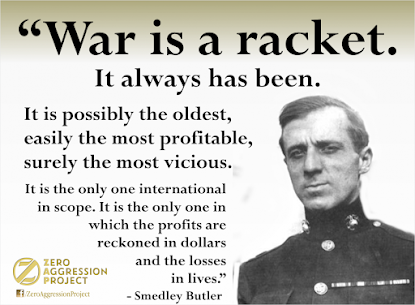
4. Smedley Butler is still right, too; war was a racket and still is.

The "leaders" - in Russia and here in the US - will never pay and never have paid the price for their war crimes. Dubya isn't in jail in the Hague, Cheney is still a bloated remainder of the stupidity of the Iraq Misadventure, and Putin won't be the one who falls out of the window.

So here we are; a year on, with more dying and more killing to come, and with no real hope for a "good" outcome, merely bad and worse.

And if there's a more powerful statement about how war is all hell, I can't think of one.


Thursday, December 22, 2022

America Worst

Long before Orange Foolius and his gang of GQP nitwits adopted it, the slogan "America First" was the boast of another gang of fascist-fluffing traitors.

That would be Charles "Lucky Lindy" Lindbergh and the original, isolationist version.

The Wiki entry at the link cited claims that most of the Forties Firsters were genuine isolationists who didn't want the nation to get involved in "foreign wars".

That's fine. I'm all for not getting involved in other people's wars, or wars, period, if it comes to that.

On the other hand, there are some people who have some ideas or goals rotten enough that only killing enough of them will stop them, and those people will force wars on you whether that's a good idea or not.

The bulk of the original Firsters recognized that; the outfit killed itself on December 11, 1941 when it became brutally obvious who those really rotten people were. 


That brings us to the ongoing war in Ukraine.

I'm not going to make a case for war. Or that war. Or for Americans to fight, kill, and die in that, or any war not forced upon us.

If I was going to make that argument I'd be learning Ukrainian on my way to volunteer to run a battery fire direction center for ÐĄŅƒŅ…ÐūÐŋ҃́Ņ‚Ð―Ņ– ÐēŅ–ÐđŅŅŒÐšÃĄ Ð—ÐąŅ€ÃģÐđÐ―ÐļŅ… ҁÐļÐŧ ÐĢÐšŅ€Ð°Ņ—́Ð―Ðļ. 

I'm not, and so I refuse to be a hypocrite and cheer for other people's sons and daughters to go and fight.

But.

There doesn't seem to be any gray area on which side as Americans we should be fighting for if it comes to fighting, and it sure as fuck isn't Vlad Putin and his gang. My compa the Rude Pundit pretty much sums it up:

"Here's the thing: I've been watching the United States fund bullshit fascists and totalitarians my entire fucking life. In Latin America, in Africa, in the Middle East, this country has provided arms and money to the worst goddamn people and the most worthless causes. We've funded mercenaries and weapons manufacturers. We've funded crazed terrorists by calling them "insurgents" and funded evil militaries crushing freedom-fighting insurgents. 

What Zelensky did was say to us, to we who live in this goddamned ludicrously powerful country in this goddamned ludicrously debased age, that we're supposed to represent some fucking ideals to the rest of the world. Look, Zelensky said, your mythology is based on real shit that happened, real battles with real lives and real consequences. Now we have this battle against this enemy. The consequences for failure would be genocide and expanded aggression by the lunatic Putin. For the US to walk away would be shameful. It would make us an accessory to mass murder, even more than we usually are."

Yes. Ohhellyes.

We now have the same choice that We the People faced in 1939. Do we help out the dictator whose people will - who are - cheerfully butchering anyone in their conquests they can catch? Or do we help the people fighting those sonsofbitches?

It's not really a hard choice.

The Ukrainians don't have to be great. And they aren't; there's a lot of post-Soviet fuckery there.

But they sure as Hell are better than the actual Putin-led post-Soviets.

And that brings me to the Latter-Day America Firsters.

That's a couple of them there; January 6th traitors; Matt Gaetz and Lauren "I luv gunz" Boebert during the speech that the ;leader of Ukraine gave to the joint session of Congress. The Wordle of that day must have been a real toughie; both the little rascals are still glued to their phones during the applause lines. 

But that's just another day at the shop for the New Firsters. It's part of their job as the Putin Wing of the GQP, to stan for a criminal fascist.

Well, hell; if you're gonna rep for Donald Trump, how is Putin a stretch?

Look. There's no such thing as a "good war". I can certainly understand being on the fence about, say, the war in Yemen. There's a lot of bad and no real good options there. Most wars are a choice between worse and even worse.

But here?

Fuck that noise.

We shipped millions of tanks and trucks to that rotten bastard Stalin to beat that rotten-er bastard, Hitler because it was in our national interest.

To send arms and ammo to Zelensky - who is not anywhere near as rotten as Stalin - to beat that rotten bastard Putin is a no-brainer.

Unless you're a MAGAt-loving, QAnon-huffing, Putin-fluffing GOP shitweasel.

Like these two and the other Firsters, the Cosplay Mossy Oak Militia (thanks, Jim Wright!) and all the other Putin Fanbois?

You know how I keep saying these people are traitors?

Well, if you were an original Firster and you still had your Adolf poster up on the wall on December 12?

Yeah. You were a traitor.

Who's gonna tell these people about that?

Their domestic policies, such as they are, are enough to make me loathe them. But to prefer a brutal foreign dictator over a flawed but still-better polity that dictator is invading?

The new Firsters are...what their Adolf-loving predecessors were. 

I'll let the Rude One see me out here:

"That's why the conservatives who dangle from Putin's taint hair went crazy. It's because they say constantly that the United States is the greatest country in the history of everything. They say all the time that we are something special. And we're saying, and Zelensky is imploring, that we fucking well act like it once in a while. Sometimes even a superpower has to put the fuck up or shut the fuck up."


Saturday, April 16, 2022

Naval makeover! (cruiser-to-submarine edition)

 The cruiser МÐūŅÐšÐēа has passed on.


He is no more. 

(Russian naval vessels are by tradition "he's" rather than the "she's" of English or American sailor tradition) 

He has ceased to be, expired and gone to meet his maker. Bereft of life, he rests in peace, has shuffled off his mortal coil, rung down the curtain and joined the choir invisible.

Okay.

Rule #1 of war is "Shit happens", and the fact that this vessel is now full of water is not in itself either shocking or particularly interesting. 

If one was in a snarky mood one might make the same sort of observation Bismarck might have made about continental powers like Germany or Russia wanting (let alone "needing") large capital ships: "...the fuck?" (only in the original German, of course...). 

If one was in a snarky mood.

To me there are two interesting parts about this, though.

The first is that the Russian official line is that the cruiser was lost "under tow in heavy seas after an internal ammunition explosion". 

Not because nasty enemy missiles turned him into a flaming pyre, no, no! Just your basic head-on-collision-twenty-car pileup of fucked-up munitions handling and/or storage, piss-poor damage control, and incompetent seamanship.

I kind of get the dictator-grade level of "not wanting to admit that your enemy hurt you" propaganda. But to want to make the story "our sailors are lethally incompetent" seems...a bit louche' at best. Tell me...how does that make things in your navy sound...better?

Now, that said; damage control at sea is goddamn hard. It requires constant, repetitive, realistic training led by good petty officers and planned and overseen by competent and demanding officers.

Even the best navies have their bad days; we saw that back in 2015 when we talked about the loss of HIJMS Taiho during the Battle of the Philippine Sea. 

The æ—Ĩ朎æĩ·čŧ Nippon Kaigun - the Imperial Japanese Navy - was one of the best-led (at the tactical level, at least...) and best-trained in the world in 1944. But that didn't prevent the sinking of one of their newest carriers because of poor damage control after a single torpedo strike.

On the other end of the military scale, though? Damage control is one of those massive-training-fail issues that seems to be endemic in "gangster" military organizations. Think Idi Amin's or Saddam's "armies" if you want a model. 

If nothing else this Russo-Ukrainian War has done a pretty good job of throwing a nastily bright light on exactly how fucking brutally bad the Russian armed services are. As bad as the Ugandans or the Iraqis.

Turns out that when your national model is "kleptocracy" your national military is just about as good as you'd expect based on that. 

When your soldiers and sailors are "led" by people - from petty officers and NCOs through general officers to their political masters - whose whole mode of thought is "steal what you can, neglect what you can't, and lie about everything to everyone both above and below you"  and those troops are either not trained for shit (or completely untrained) and their "leaders" are often incompetent, either because the system is designed to ensure the leaders are piss-poor, or unable to demand they aren't, to find that the entire organization those soldiers and sailors are part of ends up being criminally incompetent at the difficult business of war, including the difficult task of naval damage control, should hardly be shocking.

If you choose shitty crooks to "lead" you, you shouldn't be shocked when they "lead" you into shitty crookedness. 

Which leads me back from the shores of Ukraine to the shores of North America.

Because you'd think that this sort of military clusterfuckery would be a cautionary tale for those of us here on the sidelines in the United States about the whole business of being all enthusiastic for dictators because, say, they hate homosexuals and you do, too. That getting your dream of "leaders" hating on liberal soy-boys and darkies and uppity women isn't worth the sort of incompetent "leadership" that ends up getting your sailors killed and their capital ships sunk. 

Even for the most foaming-mouthed-rabid MAGAt groupies of Tubby and his crooked little weasel pals.

But, no.

They won't believe that.

Ever.

And that's a problem, a problem deeper than the bottom of the Black Sea, where the МÐūŅÐšÐēа now rests.


Saturday, March 19, 2022

Lessons learned from Ukraine

I've been kicking this around for a while, and wanted to get it down before I wander away from it.

What have we learned from what's been happening in Eastern Europe over the past month or so?

 
1. Thucydides is still correct: the strong do what they can and the weak suffer what they must.

We like to think, we pampered wealthy white Americans, that there is a "justice" that transcends simple brute force. If we're Christian we like to think that there's a "God" (and his kid) who cares about people and sort of wants them to do justly and love mercy.

And then comes something like Ukraine, where the ugly reality is impossible to hide.

So no. There's no arc of history that bends towards justice. If people want justice, they need to defend it, by force at times, with their lives if they must.

That lesson is bolded by the actions of Russia in Ukraine. But it should resonate with us here, since we have steadfastly refused to take action against those who have already attempted once to use force to "do what they can" thinking that they were the strong and we are the weak. If we do not, then we ARE the weak, and they will do with us what they can.

Putin isn't the only leader of authoritarian goons in the northern hemisphere.


2. When someone tells you what they are, believe them.

Vladimir Putin has said one thing consistently since loooong before he was Donald Trump's mancrush; that the devolution of the USSR was the Worst Thing EVAH and that if he could he would get the band back together.

Well, because the successor state to the Soviet Union looked like a shitshow and its' dictator seemed full of shit like many other dictators, a lot of us got complacent about how serious he was.

Ask the resident of Kyiv how serious.

If I was a Latvian or and Estonian right now I'd be hugging everyone who insisted that the Baltics scurry into NATO as soon as the ÐĄÐūÐēÐĩ́Ņ‚ŅÐšÐļÐđ Ņ„ÐŧаÐģ came down.

Now the NATO countries - including the U.S. - need to accept that those former Soviet republics are all on Putin's list. That means taking Article 5 seriously. Is Riga worth Manhattan? We might find out sooner than we like, because...

 
3. The Russian military is proving what a bad fucking idea personal autocracy is.

We in the Western militaries listened to and, often, believed the tales the Russian media and government told about the modernization and professionalization they'd done with the successor to the old Soviet Red Army.

I'm not sure if they were fooling us, or themselves, or both, but boy fucking howdy were they full of shit.

Turns out that the Russian conventional forces are bad. Reeeeally bad. "Iraqi Army" bad.

It's hard to imagine that Putin kicked off this war knowing that Saddam's Republican Guard made his regulars look like an anime goon squad. So I suspect he's been fed the diet of bullshit and flattery that people who can kill you whenever they please tend to get. His military advisors told him what he wanted to hear, not what he needed to hear.

"Dictatorships foster oppression, dictatorships foster servitude, dictatorships foster cruelty; more abominable is the fact that they foster idiocy." ~ Jorge Luis Borges

But the bottom line is that modern warfare is goddamned hard to do, and the Russians are no better at it than you'd think given the open kleptocracy and brutal autocracy that permeates Russia the country.

That's...actually kind of a Bad Thing for us as well as for them.

Because if the Russian armed forces would get waxed in the first 48 hours of combat with a Western military?

All Putin has to swing is his nukes.

And that should worry all of us at least a little bit.


4. Smedley Butler is still right, too; war was a racket and still is.

No matter the outcome in Ukraine, everyone involved is likely to be the worse for it. Obviously the dead, but those wounded, or homeless, the refugees, the prisoners, those impoverished by war or sanctions or economic collapse. Those who have lost family, friends. The citizens of Russia's "near abroad", who must now fear that success in Ukraine will make them next in line for death and mayhem.

Of course, the Russian leadership is likely to be insulated from all that. War "leaders"  -unless they make the mistake of losing war and being captured by the victors - are seldom punished, no more than the "leaders" here that committed the identical war crime of waging aggressive war in 2003 were punished. 

It's always the "ordinary" people who suffer when the Great and the Good amongst us choose to use force to get - or try and get - what they want.

So, like most rackets, it's the bosses that profit and the footsoldiers - military and civilian - that die.

I wish I had a happier conclusion.

But, just like Ukraine today, there is no lightness; only ruin and hatred, the strong doing what they can and the weak, well, suffering.

Monday, February 21, 2022

The lights are going out...

 I'm reading that Russian maneuver forces have crossed into the southeastern oblasts of Ukraine and are moving towards Donetsk.

Assuming that the Ukranian forces around that city do not retreat we may be seeing war in Eastern Europe for the first time since the early 1950s (if you count the UPA guerilla resistance) or 1944 (if you only count conventional inter-state warfare).

The real question at this point is whether Putin will push his forces into the old Ruthenian heartland of the western Ukraine. The distance from the southern border of Belarus to Kyiv is relatively short, and the temptation for Putin and the Russian Army leadership to try to roll the dice of a "decapitation strike" seems almost too vast to resist.

If in case you were wondering why the Trumpkin reaction to all this Russian invading seems so weird and peculiar, consider that while Putin polls at around 75% negative with self-identified Republicans, Biden polls somewhere around minus-90%.

At least you can't say the treasonous sonsofbitches don't walk their walk...

Update 2/24: It now appears that Putin's goal is full-on subjugation of Ukraine. I'm not sure if this will involve prolonged Russian occupation; if Putin doesn't, I'll bet his military chiefs remember both the Chechen and Afghan nightmares as well as the post-WW2 Ukrainian resistance. But the actual conquest is pretty much guaranteed; the relative strengths of the two militaries all but ensures that T-90s will be parked in the Maidan fairly soon.

My guess is that after a brief occupation and ratissage of Ukrainian nationalists the Russians will leave behind a Quisling government including a mini-KGB/FSB and antipartisan militia to hunt the resistance. How well this will work in Ruthenia is anyone's guess.

Now...my further, and more worried, question is whether the success of this move will embolden Putin to go after his other lust-objects, the pieces of the former USSR. The Baltics? Georgia? One of the lessons of the fascist 1930s is that once a fascist dictator is on a roll he's often unwilling or unable to stop himself. For a long time I thought that Putin was too canny to go full-on Hitler.

Now? I'm not convinced he has. 

But I'm not so sure he hasn't, either.

Update 2, 2/24: Thomas Zimmer has a nice breakdown of the weird Putin-fapping we're seeing from the American Right. Here's the bottom line (but the whole thread is worth reading...):

"Take note: Reactionaries and far-right movements across the “West” are siding with Putin. They see him as an ally in the struggle to uphold white Christian patriarchal rule – the kind of authoritarian strongman that can turn the tide against the forces of “woke” pluralism."

Zimmer had been on this beat for a long time, and his conclusion - one that I can't help but agree with completely - is that the rise of the Trumpkin Right (which long predates Trump and is largely the result of absorbing the Birchers and fundie religious zealots in the GOP) means that "conservatives" will choose to protect their status as ubermensch rather than accept becoming one among many.

Update 2/25: Juan Cole observes that Dick n' Dubya's Excellent Iraqi Adventure "enabled" the Russian invasion of Ukraine. Over at Milpub our reilable commentor Sven makes pretty much the same point.

I have a fair amount of respect for Cole's opinions on the Middle East, and Sven's opinions overall, but I think they overstate the case.

Reassembling the old Soviet Union has been an obsession of Putin's for as long as I've known about Putin. I can't believe that some sort of move to re-absorb Ukraine wasn't on his bucket list for a loooong time; the recent Ukrainian move to try and become more closely integrated with its western neighbors rather than Russia probably moved it up the list as well as making armed force more plausible.

(and, while we're on the subject, who the hell would WANT to be a "Russian" given the current conditions in Russia? Life as an American wage-slave sucks pretty big ass. Throw in open kleptocracy for the discreet American version along with shittier living conditions? Ugh. Our return-to-the-Gilded-Age economy may make life pretty grinding for the 99%, but I can't see voluntarily wanting to swap that for life in the post-Soviet Russia. There's frying pans and there's fires.)

Anyway, I agree with Cole that American foreign policy makes it harder for the U.S. to oppose other's military fucktardry. I agree with Sven that the U.S. and the West has done badly, both in general and in Eastern Europe.

But I disagree that Putin needed any help to decide to kill Ukrainians, or that anyone else deserves to go directly to Hell for that decision.

The U.S. was wrong in Iraq, just as it's been wrong all over the world in places like Nicaragua and Vietnam. Iraq is and was a war crime, making aggressive war, the crime for which the victorious Allies hung Nazi leaders. Dick and Dubya should be in jail, not enjoying a comfy elder statesmen's retirement.

But that simply makes Putin just as guilty. 

They all should be sharing a cell in SuperMax, and We the People of the United States should be ashamed for letting them do otherwise.

To those Russians who are trying to stop Putin...I have no words, and doubt I have that kind of bravery. I wish I thought you could succeed. I hate what I know will happen to you

And I'm just sorry, sorry for this sorry world that has so much wrong in it.


Update 2/26: The fighting continues in Ukraine, with the Russian forces doing surprisingly poorly (relative to the preponderance of weight-of-metal on the Russian side...). I still doubt the outcome is in play - poor or not, quantity has a quality all it's own (just hard on the people in the "quantity"...).

My opinion remains unchanged. As much as the U.S. has been a bad actor globally that doesn't excuse this. In the last words of the guys on Snake Island, "Russian warship, go fuck yourself."

Krugman has a column that makes a good point, though; for all that fingers are pointing at Putin and Russia right now, there's a mote/beam problem related to our own plutocratic/kleptocratic economies and the malefactors of great wealth therein that emphasizes the degree to which We the People have casually let the very sort of corruption endemic in Putin's Russia become less blatant but almost as endemic all over the West. 

That makes even economic war problematic.

"There are two uncomfortable facts here. First, a number of influential people, both in business and in politics, are deeply financially enmeshed with Russian kleptocrats. This is especially true in Britain. Second, it will be hard to go after laundered Russian money without making life harder for all money launderers, wherever they come from — and while Russian plutocrats may be the world champions in that sport, they’re hardly unique: Ultrawealthy people all over the world have money hidden in offshore accounts.

What this means is that taking effective action against Putin’s greatest vulnerability will require facing up to and overcoming the West’s own corruption.

Can the democratic world rise to this challenge? We’ll find out over the next few months."

Remember the "Panama Papers"? The revelation of the vast coterie of Western vulture capitalists that were thieving and cheating right alongside the cartoon Latin caudillos, African "strongmen", and Russian oligarchs? Remember how many of them we prosecuted, convicted, mulcted of their stolen lucre, and sent to the Crossbar Hotel?

Yeah, me neither.

I'm not saying "Oh, we're just as bad as Russia, so we can't point fingers."  Sure we can - we just need to be willing to point fingers at our own when they go wrong. We haven't done that. The fact that people like Dubya and Paul Wolfowitz and Dick Cheney and a gajillion Wall Street thieves and, yes, Trump are still walking around free is living testimony to the degree we've failed.

Putin is still a sonofabitch.

We really need to use this occasion of naked kleptocratic criminality, though, to think hard about how much rope we want to give our own oligarchs.