
Video courtesy of Rae Okawa. This is the last parrotlet video. Big thanks to Rae!
Showing posts with label Behavior. Show all posts
Showing posts with label Behavior. Show all posts
Monday, March 16, 2009
Parrotlet Videos: Forpus Riot
Green-rumped Parrotlet (Forpus passerinus) pairs can stick together for years... until death do them part. When that happens, the parrotlet crew finds out about it pretty fast, because all hell breaks loose. All of the lone males in the area somehow notice those suddenly single females remarkably fast, and they descend upon her and her nest looking to woo her. This is the result:


Sunday, March 15, 2009
Parrotlet Videos: Neighborhood Fights
Green-rumped Parrotlet (Forpus passerinus) pairs sometimes claim nestboxes close to other pairs. This can lead to some intense territorial scuffles on the fence between them.
Video courtesy of Rae Okawa
Up next: It hits the fan
Up next: It hits the fan
Parrotlet Videos: Intruder Male
Pairs of Green-rumped Parrotlets (Forpus passerinus) that have bonded and claimed a nest box must always be vigilant against intruders. In these videos, a lone male is pushing the limits of a pair at a nest box. He is probably not looking to takeover the box itself, for he is alone, but instead is interested in the female.
In the first video, after the pair drives the lone male away from the box, he retreats down the fence and watches from a distance. When the pair male enters the box and the female is on the perch, he makes his move, working his way down the fence towards her. This is a good video to check out the 'slow lift' wing-flashing behavior, in which males flash their indigo blue wing patches and make certain calls directed at females (Waltman and Beissinger 1992). When the lone male gets too close, the pair drive him away again.
The lone male makes a second attempt while the pair is inside the nest box. He approaches and investigates the nest box, giving head bowing, tail fanning, and slow lift wing flashing displays while calling. The pair once again have to drive him away, although it takes them a surprisingly long time to come up from the bottom of the nest box.
Videos courtesy of Rae Okawa
Up next: Trouble with the neighbors
Reference
Waltman JR, Beissinger SR (1992) Breeding behavior of the Green-rumped Parrotlet. Wilson Bulletin 104(1):65-84 (Available as a free pdf via SORA)
Up next: Trouble with the neighbors
Reference
Waltman JR, Beissinger SR (1992) Breeding behavior of the Green-rumped Parrotlet. Wilson Bulletin 104(1):65-84 (Available as a free pdf via SORA)
Saturday, March 14, 2009
Parrotlet Videos: Duetting
Green-rumped Parrotlet (Forpus passerinus) pairs that are in the courtship and nest prospecting mood have several more distinctive behaviours beyond allopreening. In the following video (courtesy of Rae Okawa), a parrotlet pair is duetting outside their chosen box. Watch for the behaviors identified by Waltman and Beissinger (1992), including 'head bowing', 'tail fanning', and 'nipping bouts'.
Up next: An intruder at the nest
Reference
Waltman JR, Beissinger SR (1992) Breeding behavior of the Green-rumped Parrotlet. Wilson Bulletin 104(1):65-84 (Available as a free pdf via SORA)
Up next: An intruder at the nest
Reference
Waltman JR, Beissinger SR (1992) Breeding behavior of the Green-rumped Parrotlet. Wilson Bulletin 104(1):65-84 (Available as a free pdf via SORA)
Tuesday, March 3, 2009
Parrotlet Videos: Allopreening

After Green-rumped Parrotlets (Forpus passerinus) have selected a proper nest box, they engage in several behaviors to maintain a loving pair-bond. One of these is allopreening. If you don't find this to be the cutest thing ever, you have a cold, cruel heart.
Photo and video courtesy of Rae Okawa.
Next up: More pair-bonding
Monday, March 2, 2009
Parrotlet Videos: Prospecting

As I've mentioned in previous posts about Green-rumped Parrotlets (Forpus passerinus), the first stage in the parrotlet breeding cycle is a pair selecting a nest site. They accomplish this by examining the different boxes we put up. They are very cautious about it at first, prospecting the box without actually entering. Here are several birds prospecting (video courtesy of Rae Okawa):
Up next: Parrotlet love
Tuesday, February 17, 2009
Frog Calls of the Llanos
One big disadvantage I had in herping a place like Venezuela is a lack of easily obtainable audio guides to the frog calls of the region (if there are any out there that I missed, let me know). So what I did to learn the frog choruses I heard many nights was to simply track down every unknown voice (simple, right?). Well, I didn't get them all, but I did capture video of seven calling species. Here are my results, compiled all in one handy little youtube guide. I'll write more on these species soon.
Friday, February 13, 2009
Cruel Lords of the Bovine
Field work on a cattle ranch brings with it certain difficulties - particularly the constant contact with large mammals.

While we are stuck dodging pies, some birds have adapted well to the presence of these smelly beasts. The lumbering beasts kick up insects with their trampling and grass-munching habits, providing easy foraging for birds. Some birds, most notably the Oxpeckers (Buphagidae) of Africa, go so far as a mutualistic (win-win) relationship, picking and eating parasites off the mammals in exchange for a free ride.
Another African mammal-follower has undergone one of the greatest natural range expansions in the last 100 years - the Cattle Egret (Bubulcus ibis). Of course one could argue that their colonization of North and South America, Australia, and range expansions in their native Old World was still human-assisted, what with the abundance of domesticated mammals worldwide providing a proxy for their original habits of following grassland mammals. However you view their origin, they are now a regular sight in agricultural areas in Venezuela and just about everywhere else. They are one of the most common waders (I use the term loosely, they shun water and prefer pasture more than most other herons) on Hato Masaguaral, following the cattle, horses and pigs around in the extensive pastures.

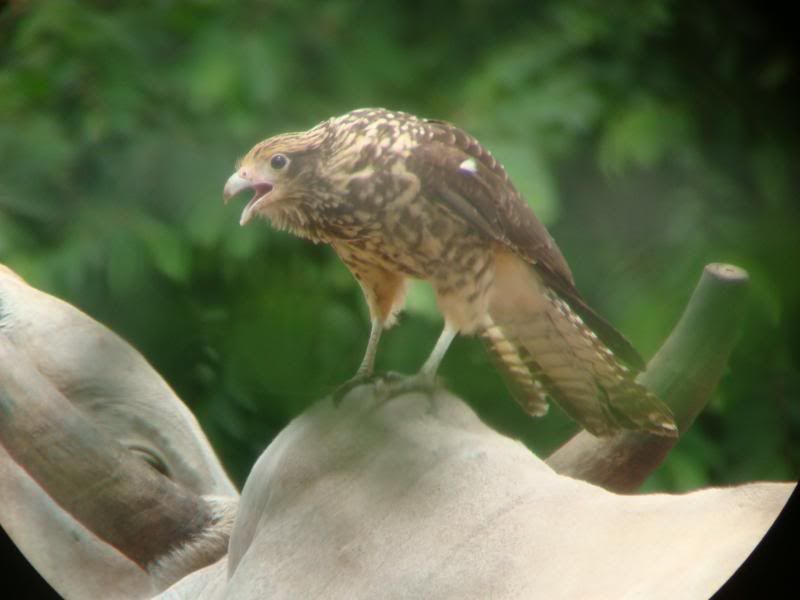
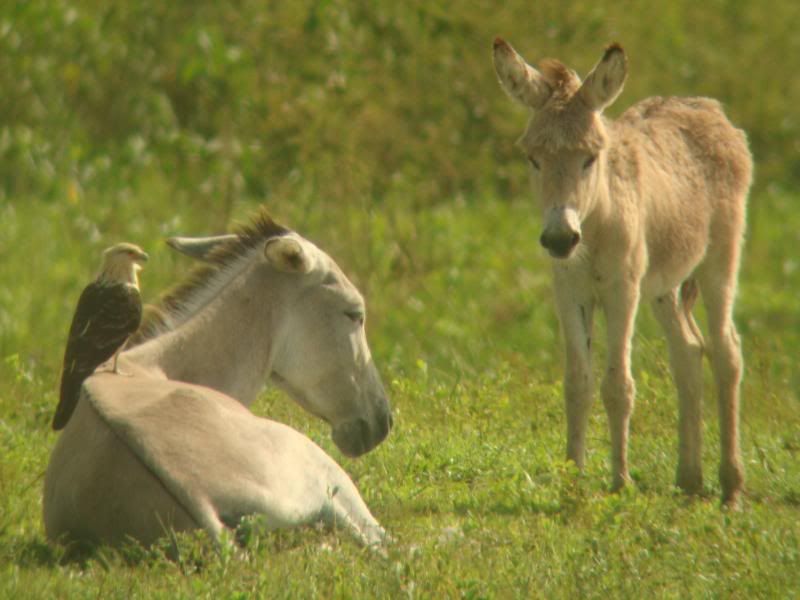
In the Venezuelan llanos and elsewhere in South America, Cattle Egrets are not alone in their mammal-following habits. They are joined by a rather unlikely mammal-lovers - the Yellow-headed Caracara (Milvago chimachima), a member of the family Falconidae. It seems odd to see a mid-sized raptor hunting insects around mammals, yet they are frequently spotted using cattle for a perch as they watch for kicked-up prey. They also readily provide the cattle with deticking services.

While we are stuck dodging pies, some birds have adapted well to the presence of these smelly beasts. The lumbering beasts kick up insects with their trampling and grass-munching habits, providing easy foraging for birds. Some birds, most notably the Oxpeckers (Buphagidae) of Africa, go so far as a mutualistic (win-win) relationship, picking and eating parasites off the mammals in exchange for a free ride.
Another African mammal-follower has undergone one of the greatest natural range expansions in the last 100 years - the Cattle Egret (Bubulcus ibis). Of course one could argue that their colonization of North and South America, Australia, and range expansions in their native Old World was still human-assisted, what with the abundance of domesticated mammals worldwide providing a proxy for their original habits of following grassland mammals. However you view their origin, they are now a regular sight in agricultural areas in Venezuela and just about everywhere else. They are one of the most common waders (I use the term loosely, they shun water and prefer pasture more than most other herons) on Hato Masaguaral, following the cattle, horses and pigs around in the extensive pastures.

Cattle Egret foraging (video courtesy of Rae Okawa)
If embed doesn't work: link
In the Venezuelan llanos and elsewhere in South America, Cattle Egrets are not alone in their mammal-following habits. They are joined by a rather unlikely mammal-lovers - the Yellow-headed Caracara (Milvago chimachima), a member of the family Falconidae. It seems odd to see a mid-sized raptor hunting insects around mammals, yet they are frequently spotted using cattle for a perch as they watch for kicked-up prey. They also readily provide the cattle with deticking services.
Juvenile (top) and adult (bottom) Yellow-headed Caracara (Photos courtesy of Rae Okawa)


Yellow-headed Caracara ticking (video courtesy of Rae Okawa)
The Caracara and Egret have nothing on the third common mammal-lover of Hato Masaguaral (and real subject of this post). This fearsome bird leaves cows trembling, horses whinnying, and pigs quaking with fear - it is the mighty Cattle Tyrant (Machetornis rixosus).

Okay, so they're not really that imposing, but don't they deserve a little recognition for their awesome despotic name?
In North America, tyrant flycatchers (Tyrannidae) are represented by such drab look-alike birds as Empidonax flycatchers, phoebes (Sayornis), and pewees (Contopus). In Central and South America, Tyrannids explode in species numbers, morphological and color diversity, and ecological habits. The Cattle Tyrant is one of the flycatchers that has adapted to open habitats and is particularly fond of the mutalistic mammal-loving foraging style. They don't just stick to their namesake - they freely exert their will over horses, pigs, capybara, and anyone else weak enough to subjugate.
This trio of dictators kept me entertained one afternoon as they directed their hog peon to forage this way and that.


Cattle Tyrants are the only member of their genus, Machetornis, and belong in the tyrannine clade of flycatchers - the 'true tyrants' (Ohlson et al 2008). Other members of this group include the familiar kingbirds (Tyrannus) and the diverse assemblage of kiskadees (Pitangus) and what I refer to as the 'kiskadee-patterned' flycatchers (Myiozetetes, Megarhynchus, etc) that are common and widespread in the neotropics. Machetornis does show shape and pattern affinities with the tyrannines, including the presence of a hidden colorful crown patch:


With pressure from their tyrannid overlords and the constant nipping from egrets and caracara, it's no wonder that sometimes the cattle break under the strain.

References
Ohlson J, Fjeldsa J, Ericson P (2008) Tyrant flycatchers coming out in the open: phylogeny and ecological radiation of Tyrannidae (Aves, Passeriformes). Zoologica Scripta 37(3):315-335.
The Caracara and Egret have nothing on the third common mammal-lover of Hato Masaguaral (and real subject of this post). This fearsome bird leaves cows trembling, horses whinnying, and pigs quaking with fear - it is the mighty Cattle Tyrant (Machetornis rixosus).

Okay, so they're not really that imposing, but don't they deserve a little recognition for their awesome despotic name?
In North America, tyrant flycatchers (Tyrannidae) are represented by such drab look-alike birds as Empidonax flycatchers, phoebes (Sayornis), and pewees (Contopus). In Central and South America, Tyrannids explode in species numbers, morphological and color diversity, and ecological habits. The Cattle Tyrant is one of the flycatchers that has adapted to open habitats and is particularly fond of the mutalistic mammal-loving foraging style. They don't just stick to their namesake - they freely exert their will over horses, pigs, capybara, and anyone else weak enough to subjugate.
This trio of dictators kept me entertained one afternoon as they directed their hog peon to forage this way and that.


Cattle Tyrants are the only member of their genus, Machetornis, and belong in the tyrannine clade of flycatchers - the 'true tyrants' (Ohlson et al 2008). Other members of this group include the familiar kingbirds (Tyrannus) and the diverse assemblage of kiskadees (Pitangus) and what I refer to as the 'kiskadee-patterned' flycatchers (Myiozetetes, Megarhynchus, etc) that are common and widespread in the neotropics. Machetornis does show shape and pattern affinities with the tyrannines, including the presence of a hidden colorful crown patch:
Cattle Tyrant orange head patch just visible

Lesser Kiskadee (Philohydor lictor) yellow head patch

With pressure from their tyrannid overlords and the constant nipping from egrets and caracara, it's no wonder that sometimes the cattle break under the strain.

References
Ohlson J, Fjeldsa J, Ericson P (2008) Tyrant flycatchers coming out in the open: phylogeny and ecological radiation of Tyrannidae (Aves, Passeriformes). Zoologica Scripta 37(3):315-335.
Sunday, December 7, 2008
Nature Fight!

The life of a Green-rumped Parrotlet (Forpus passerinus) is not an easy one. Adults face a constant risk of death by tooth and talon, and their nests are easy targets for all manner of raiding predators. The long-running Forpus project has generated empirical knowledge about mortality rates, predation risks, competition, and the life-history strategies parrotlets have adapted to survive them. I’ve broken the struggles of the parrotlet into three rounds:
Round 1: Finch vs Parrot! (Interspecific competition)
Many other species attempt to make use of the parrotlet nestboxes for themselves, providing competition for a limited resource – nesting sites. Several different types of ants frequently colonize the woodchips in the bottom of the nest box. Various small mammals including rats and mice build grass nests in the boxes. Wasps and bees use the PVC boxes as anchor points to build colonies (we abandon any hope of checking those boxes until they clear out on their own!). Several bird species also think the parrotlet nest boxes make good homes – Myiarchus flycatchers, the Straight-billed Woodcreeper (Xiphorhynhus picus), and the Saffron Finch (Sicalis flaveola) being the most common. We try to empty out the nest material of these species before they get an egg laid (we are here to study parrotlets, not finches!), but sometimes they beat us. This Saffron Finch nest was particularly crafty and had us stymied for a while, so we let them breed. This pair, instead of lining the bottom of the chamber with plant fibers, somehow built a platform and a nest suspended right up by the entrance of the box.


The woodcreepers have also snuck a few nests in this year. They line the boxes with woodchips, making for a very distinctive nest.

In September I saw some parrotlets decide they liked a box occupied by woodcreepers. A woodcreeper was brooding three chicks unseen inside the box while her partner was off foraging. The parrotlet pair, in typical prospecting behavior, approached the box, chattering. They sat on the top, looking down at the hole, then moved down on the perch and looked nervously inside. At this the woodcreeper came up and sat in the hole, with a chick’s fecal sac in her beak. The parrotlets retreated to the top of the box and the fence, chattering. It was something of a standoff for several minutes – the woodcreeper in the box, not leaving because of the parrotlet overhead, and the other woodcreeper on a nearby tree trunk, calling, bill full of invertebrate prey. Eventually the parrotlets gave in and flew off, allowing the woodcreepers to reunite and feed their nest.


Generally, this kind of interspecific competition for nest sites doesn’t lead to violence. How about something with a bit more blood?
Round 2: Snake vs Bird! (Predation)
The most obvious mortality risk to a parrotlet of any age is predation. Parrotlet nestlings and eggs fall victim to snakes (including the boids Boa constrictor, Epicrates cenchria, Corallus ruschenbergii, and the colubrid Spilotes pullatus), mammals (including the lowly Rat (Rattus rattus) and the mouse opossum (Marmosa robinsoni)), and even nasty carnivorous ants (any entomologists want to join the project?).
On average, a little less than 40% of the parrotlet nests monitored by the project failed without fledging young. Of these, the proportion of failures due to predation varies year to year, but somewhere between 10 and 30% of the nest failures are due to predation, which is concentrated mostly when the parrotlets have nestlings and are frequently away collecting food. The impact of snake predation on the Forpus project can be significant when nests under observation get hit, so we catch and relocate any potential snake predator we can. This means I get to play with more snakes! The most common snake I found in the parrotlet boxes is Leptodeira annulata, all of which have been too small to pose much of a threat to the parrotlet nests except maybe to the eggs. I’ve even found them residing in the bottom of a box underneath an active nest.

The next most common snake I found is the tree boa, Corallus ruschenbergerii. I recovered three of these lovely guys from boxes (none with active nests) and relocated them to distant forest patches.


The third snake I caught in the act. While approaching an active nest, I noticed both adults sitting on the surrounding fenceposts, quiet. Thinking this was odd, I stopped and realized there was a snake crawling up the fencepost and across the top of the nestbox. It was a gorgeous adult Chironius carinatus. I chased it off the box, but it kept the fence between us and escaped up a tree. Later I cornered it in the tree and got some pictures of it, before it again saw fit to flee.


We know less about adult parrotlet survival, since it is impossible to separate emigration from the study area from death, but we can make some estimates. Sandercock et al. (2000) estimated an average local survival rate on the parrotlets at Masaguaral of 0.56, meaning a little more than half of the adult population persists locally each year. As you might guess from these data, Green-rumped Parrotlets are not very long-lived, with the oldest individuals monitored by the project reaching an old age of around ten years.
Adult parrotlets have plenty to fear from the predators that also attack their nests, but they also face aerial predators outside of the box. Aplomado Falcons (Falco femoralis), Savannah Hawks (Buteogallus meridionalis), and Roadside Hawks (Buteo magnirostris) are known to attack adults or recently fledged parrotlets. I myself witnessed an unsuccessful Aplomado Falcon attack on a parrotlet, and I’ve seen plenty of strafing runs from the resident pair.

Round 3: Parrot vs Parrot! (Intraspecific competition)
Even if a parrotlet succeeds in claiming a nestbox for its own, even if it avoids the attention of any predators as they raise their young, they may still fall to their most vicious foe: another parrotlet’s beak. Competition for nesting sites is fierce, and these tiny, compact little birds are actually quite vicious to one another, putting those powerful parrot jaws to good use (as my band-aid covered fingers can attest). Prospecting pairs looking for a suitable nestbox will destroy any unattended nests they happen across, breaking and burying the eggs. An experiment (Beissinger et al 1998) placed extra boxes containing eggs along the fences to monitor the rate of nest destruction. 40% of these unguarded nests were destroyed by prospected birds within 72 hours, a third of those were destroyed on the same day the nest was placed in the field.
Beissinger et al. believe this rate of destruction is one of the factors influencing parrotlet breeding biology. Parrotlets begin incubation on laying the first egg, and space their eggs out every 1-3 days. With large clutch sizes (7-10 eggs), this creates a huge asynchrony in hatching. The first egg hatches not that long after the last egg is laid. It is believed that limited nesting opportunities (rotten stumps) drives this fierce competition for nests and frequent nest destruction, which in turn drives females to incubate earlier, because Beissinger’s studies have also shown that a female’s presence significantly reduces the rate of nest destruction.

Even worse than destruction of eggs is what happens when nestlings are targeted. Sometimes prospecting birds can actually stage a takeover of a box, killing of the nest and driving away the parents. Infanticide also happens when a member of a pair is killed or otherwise goes missing, and the remaining parent cannot defend the nest. Somehow the other parrotlets in the neighborhood quickly discover these undefended nests, and flocks of lone males and prospecting pairs can bring a whirlwind of chaos down on them. Sometimes the lone bird persists in defending the box and raising the young, or selects a new partner and starts over. The bloodiest result, as I observed at B106, is when the parent is driven off and the whole nest killed. Infanticide is a really nasty business, as the following pictures of a massacre at Box 106 show. All of the nestlings were killed by bites on the head and cleaving off the beak, the mark of infanticide in parrotlets.


Well, I think that is a good note to end this post on. I hope you enjoyed a glimpse of the dark side of parrotlet study.
References
Beissinger SR, Tygielski S, Elderd B (1998) Social constraints on the onset of incubation in a neotropical parrot: a nestbox addition experiment. Animal Behavior 55:21-32
Sandercock BK, Beissinger SR, Stoleson SH, Melland RR, Hughes CR (2000) Survival rates of a neotropical parrot: implications for latitudinal comparisons of avian demography. Ecology 81(5):1351-1370
Stoleson SH, Beissinger SR (2001) Does risk of nest failure or adult predation influence hatching patterns of the green-rumped parrotlet? Condor 103:85-97
Waltman JR, Beissinger SR (1992) Breeding behavior of the green-rumped parrotlet. Wilson Bulletin 104(1):65-84
Wednesday, December 19, 2007
Last of the new hatchlings
The last of my Crested eggs have hatched, a clutch from Jiminy and Dagoji.


D4 is very active. He was not even partly out of the egg when I arrived home at 7pm, he was completely out and about by 11. A far cry different from Jiminy and Dagoji's previous success: two runtish types hatched out of four clutches. D4 reacted to my spraying to remove the perlite by jumping to the floor. He left his tail behind when I scooped him up. Those tails are crazy when they drop. Well, I guess D4 just wanted to be a frogbutt like Mom.


D3, a sweet tiger


D4, a feisty one


D4 is very active. He was not even partly out of the egg when I arrived home at 7pm, he was completely out and about by 11. A far cry different from Jiminy and Dagoji's previous success: two runtish types hatched out of four clutches. D4 reacted to my spraying to remove the perlite by jumping to the floor. He left his tail behind when I scooped him up. Those tails are crazy when they drop. Well, I guess D4 just wanted to be a frogbutt like Mom.
Video


Thursday, September 27, 2007
Death from above
I've been feeding crickets heavily for the past week after getting a shipment of 500. I've noticed the flying geckos have responded very well by adopting "hunting positions" in the dark. I have to snap quick pictures before they go running when I turn on the lights. I pity an cricket who runs beneath them.


It seems hanging upside down is a fun, social activity in geckos, because Dagoji started hanging out, too:


It seems hanging upside down is a fun, social activity in geckos, because Dagoji started hanging out, too:


Subscribe to:
Posts (Atom)

