By JW Randolph. Cross-Posted from Appalachian Voices' Front Porch Blog
Some members of Congress have started a war on the Clean Water Act by attempting to revoke a vital resource that allows the EPA do its job to better protect our nation's waterways.
Congressman McKinley (R-WV01) recently introduced legislation (HR 457) for consideration United States House of Representatives that would remove EPA's ability to veto Clean Water Act permits under Section 404(c) if the permit has already been approved by the Army Corps of Engineers. Senator Joe Manchin (D-WV) has promised to introduced similar legislation in the US Senate. These bills might have the unintended affect of encouraging the Army Corps to approve permits quickly. Congressman Don Young (R-AK)'s bill, H.R. 517 cuts even deeper by entirely removing EPA's veto authority.
In the entire existence of the Clean Water Act (1972), the EPA has only exercised this prerogative 13 times.
The EPA recently used this long-standing though seldom-used tool to veto the Spruce Mine No. 1 permit, which would have been the largest single permitted mine in West Virginia history, because of the massive negative impacts to water quality. Mountaintop removal mines have already buried over 2000 miles of Appalachian headwater streams in a witch’s brew of heavy metals and chemicals such as arsenic, lead, chromium, mercury, and selenium.
The coal industry is attempting to nationalize this recent veto, claiming the EPA’s recent decision creates regulatory uncertainty across all industries. The truth is that Arch Coal, the company who had applied for the permit, refused to work with the EPA on modifications that would have made the mine more than likely immune to a veto. 
Furthemore, Big Coal doesn’t seem to be too concerned about “regulatory certainty” when it comes to industries that depend on a strong Clean Water Act, like fisheries, outdoor recreation and tourism. Studies have shown that the annual financial benefits of the 1972 Clean Water Act are somewhere in the realm of $11 billion.
However HR 457 and 517, however, truly do have national implications for communities' basic right to clean water. The EPA would lose their ability to intervene in projects that would have serious impacts to water quality, environmental and human health across the entire nation.
Appalachian Voices stands with national, regional, community, human health organizations and fisherman prepared to fight this perilous political theatre from Representatives McKinley, Young and Senator Manchin.
The Clean Water Act was put into place in the 70s, at a time when corporate pollution was virtually unregulated and a national consciousness grew that without clean water, our nation could not prosper and grow. Attempts at weakening the Clean Water should be taken seriously, because there are parts of American history that do not bear repeating.
Our children don’t need to find themselves back to a time where major rivers catch on fire. Remember the Cuyahoga!

Wednesday, February 02, 2011
America Says: Keep Your Dirty Hands Off my Clean Water


Wednesday, May 05, 2010
Round One of the EPA "Coal Ash Bowl" Goes to Big Coal
By Matt Wasson, originally posted at Huffington Post
Yesterday, the EPA issued their long-awaited proposal for new rules on how to regulate the disposal and storage of coal combustion waste (CCW), the byproduct of coal-fired power plants. Since December of 2008, when more than a billion gallons of toxic coal ash spilled into the Emory River from a breached impoundment at the TVA's Kingston Fossil Plant, environmental and industry groups have been waiting with tense anticipation to see how the Administration will approach regulating this highly toxic waste.
As it turns out, they're still waiting. The EPA actually issued two proposals which, as James Bruggers of the Louisville Courier-Journal reported, can be simply (though far from completely) summarized as follows:
One approach would eventually phase out coal ash storage ponds. The other would would allow ash ponds, but only if they have plastic liners.
The EPA will decide which of those approaches to adopt following a 90-day public comment period that began yesterday. While EPA Administrator Lisa Jackson heralded the action as "the first-ever national rules to assure the safe management and disposal of coal ash," reporters like Bruggers and Ken Ward at the Charleston Gazette saw EPA's announcement as more of a "punt."
Environmental groups had a mixed reaction, expressing enthusiasm for the EPA's overall 563-page analysis, which, despite Jackson's apparent ambivalence, provides enormously compelling scientific evidence that should favor the more stringent proposal for regulating CCW under hazardous waste provisions of the Resource Conservation and Recovery Act. But groups also expressed some frustration at the Obama Administration's unwillingness to follow the EPA's analysis to its logical conclusion.
But whichever path the EPA ultimately chooses, Big Coal scores thanks to an issue that was entirely excluded from the scope of both proposals: the virtually unregulated practice of dumping CCW into abandoned mines.
To mix a metaphor, in the great 90-day EPA Coal Ash Bowl that began with a punt, the environmental and public health team is down a star player and Big Coal has the ball on the 50 yard line. It ain't over, but it's gonna be a rough game.
Dumping coal ash waste into abandoned mines- "Beneficial" for whom?
The industry backlash against any regulation of CCW disposal has long centered on the issue of "beneficial use," which typically implies using CCW to manufacture wallboard and other construction materials.
According to its promoters, minefilling is a "beneficial use" because CCW is alkaline and, at least the theory goes, dumping it into abandoned mines will neutralize the acidic mine drainage from active and abandoned mines.
The problem with this theory is that there really isn't any good science to back it up. A study on the water quality impacts of minefilling published by the Clean Air Taskforce in 2007 provided an excellent test of how "beneficial" the dumping of CCW into mine pits actually is. As explained in a more recent and comprehensive report by Earthjustice:
...in two-thirds of all the mines studied, the introduction of coal combustion waste resulted in more severe, long-term water quality contamination than had ever existed at these sites from the mining operation itself. Furthermore, as a practical matter, dumping large quantities of CCW directly into water tables in highly fractured sites under massive quantities of mine overburden makes the prospect of cleaning up resulting contamination far more daunting than halting leakages from conventional landfills and ash ponds.
The pressure on the administration from industry to not designate CCW as a hazardous waste was intense because of the stigma it would put on the use of CCW for "beneficial use" purposes. The unprecedented extent of that pressure from the coal industry was underscored in a letter to the White House signed by 239 public interest organizations from across the country in April. According to the letter:
Industry groups that oppose mandatory federal standards have had nearly 30 meetings with OMB [Office of Management and Budget] on this rule - more than ever before on any single topic. These groups continue to present unfounded claims of power plant closures and exaggerated cost estimates as "fact," thereby fomenting widespread but unwarranted fear of EPA regulations.
Wait... The coal industry presented exaggerated cost estimates to foment unwarranted fear of EPA regulations? Well I never!
That pressure was clearly effective in that, even if EPA chooses to regulate CCW under the hazardous waste provisions, it will not be labeled "hazardous" so as to avoid the dangerous connotations implied by the label.
But the industry pressure was equally effective in taking regulatory control of minefilling out of the hands of EPA scientists, who are no doubt well aware of the bad science underlying the practice and who are generally very serious about their job of protecting public health. In fact, the EPA already weighed in on the issue:
We believe that certain minefilling practices have the potential to degrade, rather than improve, existing groundwater quality and can pose a threat to human health and the environment.
It's statements like this that apparently disqualified the EPA from regulating minefilling, which instead will be subject to a subsequent rule-making process headed up by the Office of Surface Mining, Reclamation and Enforcement (OSM). No timeframe was mentioned for when that rule-making would be initiated.
Putting OSM in charge of developing minefilling regulations, even with input from the EPA, is a huge victory for polluters for a number of reasons. First, the OSM is led by Joseph Pizarchik, nick-named "Coal Ash Joe" by community organizations in Pennsylvania for his unwavering support of minefilling when he was director of the Bureau of Mining and Reclamation in that state. Second, the "scientists" at OSM are a very different breed than those at the EPA.
OSM scientists are generally trained in "reclamation science" at one of the big mine engineering programs at schools like West Virginia University and Virginia Tech. The fundamental premise of reclamation science can be summed up in a statement from Dink Shackleford, past executive director of the Virginia Mining Association, who often said: "We have a chance to improve on God's creation." The science of mining and reclamation starts with a fundamental premise that must not be questioned- that no matter how toxic the pollution, how much mountain we blast away, that we can engineer nature back to as "good as new" or even better.
Viewed through this distorted lens, replacing the remarkably diverse and productive Appalachian hardwood forests with a barren plain covered in exotic grasses dotted with a few pines becomes an ecological benefit because it "improves forestry;" burying the headwaters of streams in millions of tons of mine waste is an ecological benefit because it "helps regulate stream flow;" and the virtually unregulated dumping of mine waste into abandoned mines is a "beneficial use" of coal ash.
There is a lot at stake for the coal industry in how minefilling is regulated because, according to the Earthjustice report, the cost of disposal in minefills is 89-95% less than the cost of disposal in engineered landfills. Also according to Earthjustice, about 25 million tons of CCW - 20% of total annual production - is disposed of in abandoned mines. While the EPA estimates that minefilling accounts for just 7% of CCW disposal, Earthjustice explains that the discrepancy is because, "industry and state regulators are hiding CCW dumping in mines behind the labels 'beneficial use, or 'recycling.'"
This minefilling loophole will become all the more important as EPA rules make regulated disposal of CCW more expensive. As the financial incentives for utilities to exploit this loophole become stronger, the pressure on the Obama Administration to delay action on minefilling, or to implement weak regulations, will become even more intense. Given that current regulations in most states for CCS minefilling are considerably weaker than regulations on disposal of household garbage, minefilling could quickly become the predominant method for CCW disposal.
How Does Minefilling Affect Health and the Environment?
The lede and photo from a story in the Miami Herald from November, 2009, helps put the health hazards associated with coal ash into perspective:
"When I was pregnant, I was dizzy, vomiting and could barely walk," said Maximiliano's mother, Anajai Calcano, 20. "My tooth cracked and fell out. Then my baby was born like that, without arms. Nothing like that had ever happened here before."
By "before," Calcano means before a U.S. power company's coal ash arrived at a nearby port, sitting there for more than two years.
The story goes on to tell how citizens of Arroyo Barril in the Dominican Republican are suing a Virginia-based energy company for a variety of health problems they say resulted from the illegal disposal of coal ash on the shore of the town. The phrase "health problems" hardly does justice to the godawful deformities found in children born of mothers who had abnormally high levels of arsenic in their blood, one of many toxic metals associated with coal ash. Those "health problems" ranged from cranial deformities to missing limbs to organs outside their bodies.
The situation in Arroyo Barril is an extreme example, but it illustrates the general problem of toxic metal contamination of both air and water near coal ash disposal sites. The composition of coal ash includes a high concentration of toxic metals found in coal including arsenic, selenium, chromium, lead and thallium. While conventional disposal of CCW in wet impoundments has had demonstrable impacts on water quality, the practice of minefilling makes the problem of groundwater contamination far worse. According to the Earthjustice report:
The unique geologic characteristics of mines maximizes the risk of contamination from coal ash dumping. Mining breaks up solid rock layers into small pieces, called spoil. Compared to the flow through undisturbed rock, water easily and quickly infiltrates spoil that has been dumped back into the mined-out pits. Fractures from blasting become underground channels that allow groundwater to flow rapidly offsite. Because mines usually excavate aquifers (underground sources of water), the spoil fills up with groundwater. Unlike engineered landfills, which are lined with impervious membranes (clay or synthetic) and above water tables by law, coal ash dumped into mine pits continually leaches its toxic metals and other contaminants into the water that flows through and eventually leaves the site.
There are many cases where water contamination has already been found, according to the Clean Air Taskforce study of 15 minefilling operations in Pennsylvania.
So what's next?
To be fair to the administration, the EPA specifically referenced a 2006 report on minefilling from the National Academy of Sciences as one of the documents that should guide the rule-making on minefilling. The recommendations of that report, as summarized by Earthjustice, include:
- Generators should pursue safe reuse of coal combustion waste ash before minefilling;
- Disposal sites must be investigated to determine the quality and location of groundwater, groundwater flow paths, the potential for coal ash to react with minerals or groundwater, etc.;
- Coal ash must be kept out of groundwater;
- Monitoring must be designed to detect movement of coal combustion waste contaminants;
- Deeds must record and fully disclose that coal combustion waste was disposed at the mine site;
- Bonds must be adequate to clean up any groundwater damaged by coal combustion waste disposal;
- Public input must be solicited in the development of national regulations and permits issued pursuant to those regulations.
If all of those recommendations were turned into regulations, the problems associated with minefilling would be largely alleviated. But the success of industry in stripping the EPA of regulatory oversight of minefilling provides little confidence that the administration will ignore that pressure when it comes to developing regulations on minefilling.
An even greater concern is that the industry will successfully delay rule-making on minefilling for another decade, the way they were able to delay disposal regulations for years until the TVA disaster woke people up to the hazards of unregulated coal ash storage. If their delay tactics are successful, the financial advantages of minefilling will make it the predominant method of coal ash disposal within a matter of years.
And if the momentum generated by the TVA disaster to regulate coal ash disposal is lost, it's terrifying to think what the next disaster will be that would be needed to motivate agencies to action in the face of enormous industry pressure. As Lisa Evans, an attorney with Earthjustice who has tracked coal ash issues for nearly a decade, told the media in January:
Minefilling coal ash is a slow-motion and invisible counterpart to the TVA catastrophe. There, the destruction was unleashed in a matter of minutes. For communities with water poisoned by the country's hundreds of coal ash mine dumps, the damage has been gradual and largely unseen, but it also presents a grave threat.
People in coal mining regions have suffered pollution of their water and air for decades, and with the EPA finally beginning to crack down on mountaintop removal mining and the disposal of mine waste into streams, what a tragic irony it would be if pollution from valley fills was replaced by even greater pollution from minefills. That's the way it's headed, and it's going to take the involvement of thousands of Americans to counter the coal industry's powerful pressure to keep regulations weak or nonexistent.
This is no time to sit on the sidelines - there are 89 days in the EPA's Coal Ash Bowl, and your help is needed now.
[UPDATE: The link to take action above, "your help is needed now," is not yet set up by the EPA - I will update again as soon as the EPA gets it straightened out]
Read more!
Tuesday, May 04, 2010
EPA Proposes Regulatory Options for Coal Ash
New Rules Would Provide Varying Levels of Protection for NC's Waterways
An update from our friends at Appalachian Voices...
-------------------------------------
CONTACT: Donna Lisenby, Upper Watauga Riverkeeper....828-262-1500
-------------------------------------
The U.S. Environmental Protection Agency unveiled two options today to regulate coal ash waste from coal-fired power plants, amid concerns by environmental groups that one of the options would not be strong enough to protect North Carolina's waterways.
The competing alternatives would provide varying levels of protection to the state's water resources, and could take years to implement.
"Coal ash impoundments have been minimally regulated in the past. These proposed new rules are a long overdue, positive first step towards helping to protect our water and our communities," said Donna Lisenby, Upper Watauga Riverkeeper.
The announcement comes eight months after an independent analysis confirmed that all thirteen of the North Carolina's coal ash ponds adjacent to coal-fired power plants were leaking toxic pollutants into groundwater. Data research conducted by the Upper Watauga Riverkeeper revealed 681 instances where levels of heavy metals and other pollutants ranged from 1.1 to 380 times higher than North Carolina's groundwater standard.
"The time has come for common-sense national protections to ensure the safe disposal of coal ash," said EPA Administrator Lisa Jackson. "We’re proposing strong steps to address the serious risk of groundwater contamination and threats to drinking water and we’re also putting in place stronger safeguards against structural failures of coal ash impoundments. The health and the environment of all communities must be protected."
[Aerial photograph of the December, 2009 coal slurry disaster in Kingston, Tennessee. The breached wet coal ash impoundment pond is at center with the TVA's Kingston coal plant above and massive slurry spill below. The Emory River can be seen next to the disaster site. Photo is copyright Antrim Caskey]
The Subtitle C proposal would designate coal ash as a hazardous waste, while Subtitle D would regulate coal ash under a non-hazardous waste designation.
With a hazardous-waste designation, wet coal ash ponds—also known as surface impoundments—would be phased out, a process that would be monitored by the states and by the EPA. Dry ash storage units would require the installation of composite liners, with retrofits of all units due within five years after the rule is finalized.
Subtitle C would also enable the EPA to enforce federal regulations to ensure these requirements are carried out.
Under Subtitle D, or non-hazardous regulation, the EPA would require wet coal ash impoundments to be retrofitted with a composite liner, rather than being phased out. If the disposal site chooses not to comply, the regulation would prohibit receiving additional coal ash, and require the closure of the unit within five years. The closure process and post-closure groundwater monitoring would be self-implemented, with no federal or state oversight.
Both designations would leave in place the rule allowing coal ash to be recycled in what are called beneficial uses, such as drywall, concrete and other construction materials. Both options would also prohibit coal ash disposal in unlined landfills, although disposal in old mining sites would still be allowed.
The announcement comes after the EPA failed to meet self-imposed deadlines in the past concerning the designation of coal ash as a hazardous substance.
"Regulating coal ash as a hazardous waste under Subtitle C is clearly justified by the science and will better protect water resources from toxic coal ash impacts," Lisenby said. "The industry-backed option of regulating coal ash as household waste under Subtitle D is not sufficient to keep arsenic, lead, chromium, cadmium and other toxic heavy metals from contaminating water."
The proposals will be turned over to the public for a 90-day comment period and one or more public and stakeholder hearings, after which the EPA will announce a decision.
"I would want communities to know that I believe, that EPA believes, it is very important to get on with this regulatory process," said Jackson. "There has been lots of discussion already. We've heard from elected officials, from members of congress, from state governments, from private industries. I'd like to hear from public citizens about what they think is the most effective rule."
In December of 2008, one billion gallons of toxic coal ash burst through a dam near a Tennessee Valley Authority power plant in Kingston, Tenn., polluting the Clinch and Emory Rivers and launching the safety of coal ash into the national environmental debate.
The public can make comments on the coal ash regulations, docket #EPA–HQ–RCRA–2009–0640, at www.regulations.gov.
###
See also:
Wednesday, April 28, 2010
They're Still Blowing Up Our Mountains
A guest post by Matthew Wasson, Ph.D., Director of Programs for Appalachian Voices
A month ago, before the nation's attention was drawn to the tragedies at the Upper Big Branch Mine in West Virginia and the oil rig off the Louisiana coast, the EPA issued a blockbuster announcement about a strict new guidance for the permitting of mountaintop removal mines in Appalachia. The announcement left many people - reporters, politicians and the general public alike - confused whether or not the EPA had just put an end to mountaintop removal. The announcement generated headlines ranging from a fairly modest "E.P.A. to Limit Water Pollution From Mining" in the New York Times to "New regulations will put an end to mountaintop mining?" in the Guardian.
Certainly at the press conference EPA Administrator Lisa Jackson used some strong language:
"Coal communities should not have to sacrifice their environment or their health or their economic future to mountaintop mining. They deserve the full protection of our clean water laws."
 On a recent trip through eastern Kentucky, set up by our good friends at Kentuckians For The Commonwealth, the answer to whether mountaintop removal in Appalachia has come to an end was abundantly obvious.
The photo of a new active mountaintop removal mine looming above Route 23 in Pike County, Kentucky, at right, tells the story.
(All photos in this post were taken on April 18th in Kentucky: Here's a link a to flickr photo set from that trip)
To the extent that some in the media overstated the impact of the EPA's new guidance, they can be forgiven. During the press conference, Jackson herself said, "You're talking about no or very few valley fills that are going to meet standards like this."
Valley fills are the typical disposal sites for the waste that is generated when coal companies blow the tops off mountains to access thin seams of coal. As community activist Judy Bonds of the organization Coal River Mountain Watch describes it, "A valley fill is an upside down mountain turned inside out." Most - but not all - mountaintop removal mines require valley fills.
But Jackson was also very clear that this was not a blanket ban on mountaintop removal permitting and that the guidance would not apply to permits that had already been granted. The standards Jackson said would lead to "no or very few valley fills" establish limits on the permissible level of stream water conductivity. Conductivity is a measure of salt - and an indicator of metals including toxic and heavy metals - in water. Remember the experiment where you put salt in a glass of water to make it conduct electricity and light a bulb?
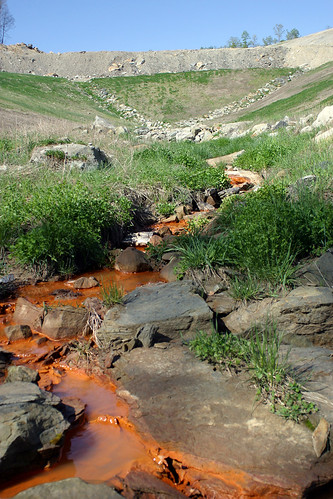 A plethora of recent scientific research has shown that conductivity higher than about five times the normal level downstream from valley fills is associated with severe impairment of the ecological communities in Appalachian headwater streams. The photo to the right that I took below a valley fill in Magoffin County, Kentucky, illustrates the trouble these standards create for coal companies. According to a huge compilation of scientific studies that the EPA simultaneously released with their guidance, conductivity levels below Appalachian valley fills average around 10 times normal levels. The bright orange water coming out of this valley fill indicates enormously high levels of iron, which in turn suggests both high conductivity levels and high levels of toxic and heavy metals regulated under the Clean Water Act.
To be sure, the EPA's move is a big first step that provides immediate protection to Appalachian families threatened with new mountaintop removal permits above their homes. It's a tourniquet that will stop the hemorrhaging, but here are five reasons why this guidance doesn't immediately or permanently put an end to mountaintop removal:
- The EPA's action will not affect permits that have already been issued. Moreover, an excellent piece of reporting by Charleston Gazette reporter Ken Ward revealed that those existing permits will allow some companies to continue mountaintop removal operations without a hitch for the next couple of years.
- Not all mountaintop removal mines require valley fills and coal companies are already using loopholes by which they can obliterate miles of streams without the need to obtain a valley fill permit. The million or so acres of wholesale destruction that coal companies drove through a narrow loophole in the Surface Mine Control and Reclamation Act since 1977 is testament to their skill and creativity at exploiting loopholes.
- Some valley fills will still be allowed under this guidance and the EPA even provided a set of "best practices" by which companies can do mountaintop removal in a manner consistent with it. Moreover, there are a number of recent cases where coal companies went ahead and constructed valley fills without even bothering to obtain a permit.
- While the guidance takes effect immediately, it is a preliminary document released in response to calls from coal state legislators and coal companies for greater clarity on how the EPA was basing its decision whether to grant a valley fill permit for an Appalachian surface mine. The EPA plans to initiate an extended public comment period before the guidelines will be finalized.
- An agency guidance document is different from a formal rule and can be easily overturned by a new administration. Even if this guidance proves to be effective in curtailing mountaintop removal, environmental and community advocates still need to ask what happens when a hypothetical President Palin enters the White House in January of 2013 or 2017.
There are any number of laws and regulations that affect surface mining, and so there is no single mechanism to ensure mountaintop removal is stopped permanently. But the first and most important step is for Congress to pass a strong law that prohibits the dumping of mine waste into streams.
In 2002, Representative Frank Pallone of New Jersey introduced just such a bill called the Clean Water Protection Act (H.R. 1310). Pallone, together with Republican Cristopher Shays, introduced this bipartisan bill in response to the Bush Administration's catastrophic "fill rule," which made it easier to permit mountaintop removal mining and for coal companies anywhere to dump waste into streams. Since then, people and organizations across Appalachia have supported Pallone's bill by carrying a simple message to universities, church groups and Rotary Clubs across America: they're blowing up our mountains and there oughtta be a law!
Over the past eight years, the nationwide organizing efforts led by groups in Appalachia have generated a remarkable 170 co-sponsors of the Clean Water Protection Act - more than almost any other bill before Congress. Unfortunately, the bill continues to be held up in the House Transportation and Infrastructure Committee, with West Virginia Congressman Nick Rahall recently claiming credit in a West Virginia newspaper for bottling it up.
If Rahall's contention is true, it's a powerful testament to the level of influence he has accumulated, given that the bill has more cosponsors than any other of the 323 bills currently before the Transportation and Infrastructure Committee. More importantly, Rahall does not actually have the power to prevent the bill from being heard except through his influence over Chairman James Oberstar of Minnesota, who is the only one with the actual power to decide whether the bill is brought up in his committee.
It's particularly unfortunate that House Democratic leaders and committee chairs like Oberstar would give Rahall so much power over national policy, given how poorly his own constituents have fared under his leadership. After 33 years in office, Rahall's district ranked 434th out of all 435 Congressional districts in Gallup's recently-released 2009 well-being index rankings (see map below).

The only district that ranked lower was Hal Roger's neighboring district in eastern Kentucky. Notably, Rogers' is the only district that has suffered more destruction from mountaintop removal mining than Rahall's.
A big question in the wake of the tragedy at Massey Energy's Upper Big Branch mine is whether the obescience of coal state legislators toward the coal industry will change after the disaster. Traditionally, the pandering of Congressman Rahall and Senator Rockefeller toward Big Coal has been almost embarrassing to watch - kind of like witnessing an overly-exuberant public display of affection on a park bench. But when it comes to the safety of the guys in the hardhats, these gentlemen strike a very different tune.
Given that the same company, Massey Energy, is by far the largest operator of mountaintop removal mines, was assessed the largest penalty in the history of the Clean Water Act, and has a record of environmental violations to which their horrible safety record pales in comparison, these legislators have a unique opportunity to lead their constituents in a new direction. And Senator Byrd of West Virginia has paved the way.
One of the most under-reported elements of the EPA's announcement was that Administrator Jackson specifically mentioned the EPA had worked with Senator Byrd to develop their new guidelines. She would not have said that without explicit approval from Senator Byrd. While Byrd has not explicitly called for an end to mountaintop removal or co-sponsored legislation to do that, his leadership in promoting a more thoughtful and reasonable view on climate and the future of coal in his state represents a sea change from the public statements of statewide elected officials over the past few decades. Rahall and Rockefeller would serve their constituents and their country far better if they followed Byrd's lead.
Is Passing a Law in this Polarized Congress Realistic?
More important than the enormous number of cosponsors that legislation to stop mountaintop removal enjoys is the fact that the support is bipartisan. Immediately following the EPA's announcement, Senator Lamar Alexander, Republican of Tennessee, said in a press release:
"The new EPA guidelines are useful in stopping some inappropriate coal mining in Appalachia but Congress still needs to pass the Cardin-Alexander legislation that would effectively end mountaintop removal mining."
Alexander, together with Senator Ben Cardin of Maryland, introduced the Appalachia Restoration Act (S. 696) last year, a Senate companion to the Clean Water Protection Act designed to eliminate mountaintop removal (or at least permanently curtail it - we'll see what the final language says after mark-up). That bill got a boost the same week of the EPA announcement when coal-state Senator Sherrod Brown of Ohio announced he would become the 11th co-sponsor of the bill.
Whether the Senate bill can survive the committee mark-up process in a form that Appalachian citizens groups can support remains to be seen, however. The Nashville Tennessean recently published an editorial that gave voice to the concerns many coalfield citizens have about forms of mining that may not be covered by the Senate bill, particularly cross-ridge mining. Cross-ridge is a type of mountaintop removal mining that requires little or no valley fill and is based on the assumption that a mountain can be put back more or less how it was after it's been blown up - kind of like putting Humpty Dumpty back together again.
 The photo to the right illustrates one of many problems with the theory that mountains can be put back together without causing major ecological degradation. While the type of mining shown in the photo would not be classified by state agencies as mountaintop removal (only part of the ridgeline has been removed and there is no valley fill at the headwaters of this stream), the impact of this mining on water quality is indistinguishable from the impact shown in the previous photo below a valley fill.
Some insiders have also expressed concern that the EPA's strict new guidance will take the wind out the sails of the campaign to pass a law, but from the perspective of Appalachian groups that have been working to ban mountaintop removal for decades, that concern is misplaced. The citizens of Appalachia have led this fight from the beginning, and have a much more vested interest in making these protections permanent than any group in Washington, D.C.
It may be that some big environmental groups that have only recently made mountaintop removal a priority will move on to other priorities once the Administrative decisions are played out - and make no mistake that the contributions of those groups over the past few years in pressuring the Obama Administration to take action were exceedingly welcome and timely. But it was not the Big Greens that made mountaintop removal a national issue or whose organizing in communities across America has generated such broad bipartisan support of the Clean Water Protection Act and Appalachia Restoration Act.
The people of Appalachia aren't sitting around waiting for beltway insiders to tell them whether or how to pass a law, they're just doing it. The legislative effort is led by the Alliance for Appalachia, an alliance of thirteen local and regional organizations that formed several years ago with the mission of ending mountaintop removal and bringing a prosperous new economy to the Appalachian coalfields that is based on sustainable industries.
The Alliance for Appalachia represents by far the greatest number of people impacted by mountaintop removal mining, and the alliance is composed of some organizations that have been fighting Appalachian strip mining for decades. The battle to end mountaintop removal will not be over until the Alliance for Appalachia says it is, and I'm confident that won't happen until, at a minimum, President Obama signs a law banning the practice.
So What's Next?
There is a window of opportunity right now to pass a strong law that will rein in mountaintop removal permanently. Also, with coal demand down dramatically due to the recession, now is the time to begin replacing mountaintop removal coal with aggressive energy efficiency and renewable energy policies in states like North Carolina, Georgia and Virginia that are most dependent on this source of coal.
From a local perspective, more delays, half-measures and uncertainty about the future of mountaintop removal will only lead to a myopic approach to rebuilding the Appalachian economy and bringing new jobs and new industries to the region.
And from a global perspective, at a time when America is finally getting serious about addressing climate change and moving toward a 21st century energy future built around renewable energy, isn't it absurd that we're still fighting to stop the wholesale destruction of the most biologically diverse forests and streams on the continent in order to mine climate-destroying coal? Can we really address climate change if we can't even stop mountaintop removal?
For people around the country that want to see mountaintop removal end - and that should be anyone concerned about climate change, human rights, clean water or endangered species - a great place to start is by telling your Senators and Representatives that the time to pass legislation to end mountaintop removal is now. There are plenty of tools on the web to make it easy.
Let's keep up the momentum, pass a strong law, and relegate mountaintop removal to its rightful place as just another tragic episode in American history books.
Cross-posted with iLoveMountains.org and HuffingtonPost.com
Friday, January 02, 2009
Tests Show Toxic Water Contamination After Tennessee Coal Sludge Disaster
Coal sludge contains dangerously elevated concentrations of arsenic, EPA says
It's been nearly two weeks since a torrent of over a billion gallons of coal ash sludge spilled out of an impoundment pond near a massive coal plant in Harriman, TN, but the full horror of the disaster is still being revealed. Yesterday, preliminary results of independent water testing showed dangerously high levels of toxic heavy metals at three locations near the environmental disaster, which spans over 300 acres of land and water at the confluence of the Emory and Clinch Rivers in eastern Tennessee. And today, the EPA confirmed that elevated levels of arsenic can be found in the coal sludge now caked over the area.
 [Aerial photograph of the coal slurry disaster, taken Dec 29th, 2008. The breached impoundment pond is at center with the TVA's Kingston coal plant above and massive slurry spill below. The Emory River can be seen next to the disaster site. Photo is copyright Antrim Caskey]
The Tennessee Valley Authority (TVA), which operates the Kingston coal plant previously said the spill shouldn’t cause “any adverse health effects” unless people “regularly drink untreated river water” downstream from the plant. EPA has also said preliminary testing results show the drinking water in the area is safe.
Now however, independent testing conducted on water samples from the Emory River by scientists working in coordination with Appalachian Voices and the Waterkeeper Alliance has found concentrations of eight toxic chemicals ranging from two to 300 times higher than safe drinking water limits. Tests were conducted using standard EPA procedures and results were analyzed by scientists at Appalachian State University.
“Although these results are preliminary, we want to release them because of the public health concern and because we believe the TVA and EPA aren’t being candid,” said Robert F. Kennedy, Jr., chair of the Waterkeeper Alliance.
 While EPA still contends that drinking well and treated river water in the area does not pose a risk, they have confirmed that the sludge, which TVA had initially told residents was harmless, actually contains dangerously high levels of arsenic that would normally warrant a response under agency protocols. Arsenic is a natural element found in soil and minerals, but exposure to it can cause sickness, according to the National Institutes of Health.
Residents of the area are worried that when the coal ash dries, it will be blown around in the wind, easily filling their lungs with the arsenic-laden ash particles. "We have a 2-year-old daughter whose health is not worth the risk, even if it is a minuscule risk," said Suzanne Solomon, who rents a home about 2½ miles downwind. "I am an opera singer with mild asthma [and] I do not wish to expose [my lungs] to any dust which might become airborne. ... I do not see any way that they can keep all of this out of the air."
The coal sludge spill occurred on December 22nd, and covered over 300 acres of the eastern Tennessee county with several feet of inky black muck, destroyed three homes and damaged 42 other properties, and contaminating the nearby Emory River, a tributary of the Tennessee River which supplies drinking water for thousands. The disaster occurred 35 miles southwest of Knoxville, Tennessee.
[Aerial photo of spill used with permission from Antrim Caskey. See www.antrim-new.com/] Read more!
Sunday, December 02, 2007
There’s Something in the Water - Spoken Word Performance Rocks Power Shift
Anyone who attended Power Shift 2007's Saturday keynote presentations/festivities was surely struck by the performance of Youth Speaks poet Just Greg. Greg delivered an inspired and powerful performance of his spoken word piece, "There's Something in the Water" before the pumped up crowd up thousands at Power Shift.
Now, thanks to some digging by Jenny Bedell-Stiles, I can finally post a link to a video of Greg's performance for those who missed out, or who just want to see it again.