


Introduction
Electronic circuits are interconnected networks of electronic components designed to perform a specific function. They are the fundamental building blocks of all electronic devices and systems — from the simplest LED flasher to the most complex industrial PLC or medical imaging system. Circuits process signals using a combination of active components such as transistors, diodes, and integrated circuits, along with passive components including resistors, capacitors, and inductors, all powered by a voltage or current source.
While circuit design is the creative act of defining functionality, PCBA (printed circuit board assembly) is the engineering discipline that transforms that design into a physical, reliable, and manufacturable product. At Guangzhou Huachuang Precision Technology Co., Ltd. (HCJMPCBA), we specialize in this translation — taking circuit designs from schematic to fully assembled, tested boards ready for deployment in demanding industrial, medical, and automation environments.
With nearly 2,500 m² of ESD‑protected workshop space, multiple high-speed SMT lines, automated optical inspection (AOI), X-ray inspection systems, and IATF 16949‑certified quality management, our production capacity supports volumes ranging from pilot runs of a few dozen boards to mass production of tens of thousands per month. But capacity alone does not guarantee quality — the process controls do.
This article provides an overview of electronic circuit fundamentals, the journey from design to assembly, and the manufacturing disciplines that separate reliable PCBA from field failures.
Electronic Components: The Building Blocks of Circuits
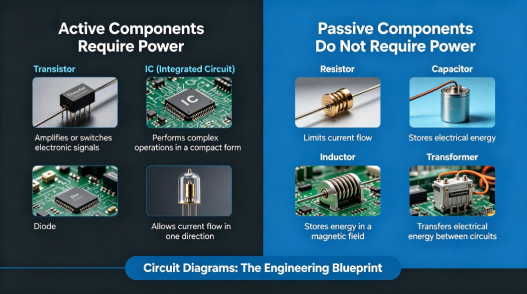
Electronic components fall into two main categories — active and passive — each serving distinct roles in circuit functionality.
Active Components
Active components require an external power source to operate and can amplify signals or control current flow:
-
Transistors — Semiconductor devices used for amplifying and switching signals. The workhorse of modern electronics.
-
Integrated Circuits (ICs) — Microchips integrating thousands to billions of transistors and other components into a single package.
-
Diodes — Allow current flow in only one direction, essential for rectification and protection.
-
Vacuum Tubes — Early amplifier devices, now largely obsolete except in specialized high-power or audio applications.
Passive Components
Passive components do not require an external power source and cannot amplify signals:
-
Resistors — Limit and resist current flow; control voltage division and signal levels.
-
Capacitors — Store electrical charge, filter signals, and decouple power supplies.
-
Inductors — Store and release electromagnetic energy; used in filters and power conversion.
-
Transformers — Transfer electrical energy between circuits through magnetic coupling.
Selecting the right components and combining them properly is the essence of circuit design. However, component selection also drives manufacturability — package types, thermal characteristics, and moisture sensitivity levels all impact assembly yield and long-term reliability.
Circuit Diagrams: The Engineering Blueprint
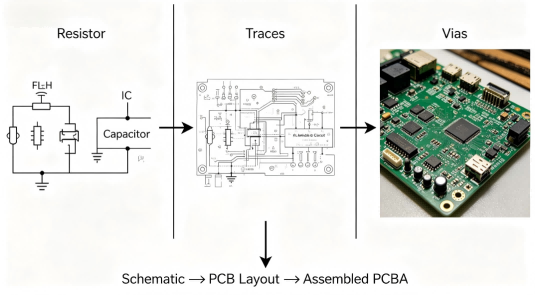
Circuit diagrams — also known as schematics — use standardized symbols to describe the components and interconnections in a circuit. They serve as the engineering blueprint for constructing and analyzing circuits. Standardized schematic symbols represent each component type, with lines between them showing electrical nodes and branches.
Circuit diagrams provide a quick visual representation of circuit function and topology. They allow designers to simulate and optimize the circuit before constructing it physically. For the PCBA manufacturer, the schematic is the starting point — it defines the netlist that drives component placement and routing, and it specifies the BOM (bill of materials) that determines what components will be sourced and assembled.
Analog and Digital Circuits
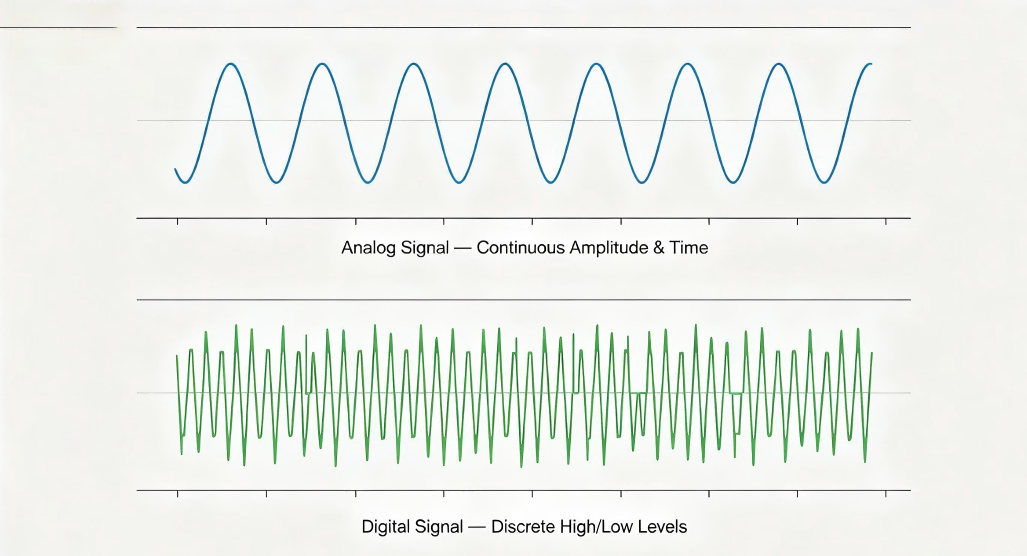
Electronic circuits divide into two major classes — analog and digital — each serving fundamentally different purposes.
Analog Circuits
Analog circuits work with signals that are continuous in time — typically voltage or current waveforms whose amplitude and frequency vary continuously. They are extensively used for interfacing with sensors, instrumentation, control systems, and real-world signals. Common analog circuit types include:
-
Voltage Dividers — Produce an output voltage that is a fraction of the input, used for measurement and signal conditioning.
-
Current Mirrors — Mirror current from one branch to another, widely used in IC biasing.
-
Voltage Amplifiers — Amplify low-level signals while preserving waveform shape.
-
Active Filters — Use op-amps with resistors and capacitors to create low-pass, high-pass, bandpass, and other filter responses.
Digital Circuits
Digital circuits operate on discrete signal levels representing binary 1s and 0s. They perform calculations, data processing, encoding, and logic operations. Common digital building blocks include:
-
Logic Gates — Process binary inputs to produce a single binary output (AND, OR, NOT, NAND, NOR, XOR, XNOR).
-
Flip-Flops — Bistable circuits that latch data based on clock timing; essential for registers and counters.
-
Multiplexers — Switch a common output between multiple input sources.
-
Analog-to-Digital Converters (ADCs) — Convert continuous analog signals into discrete digital values for processing.
Both analog and digital circuits are essential building blocks of modern electronics and serve very different, complementary purposes.
Printed Circuit Boards: The Physical Foundation
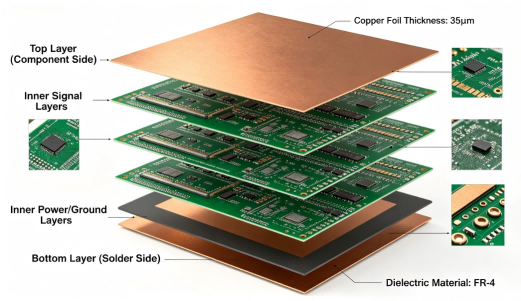
Printed circuit boards (PCBs) provide the physical base for assembling electronic circuits and components. PCBs have conductive copper traces etched on an insulating substrate that interconnects components mechanically and electrically. They provide the pathways for signals and power.
PCBs allow constructing multilayer circuits with much higher component densities than point-to-point wiring. They are essential for all but the simplest electronic devices. The PCB itself — its layer count, copper weight, material selection, and surface finish — directly impacts the reliability and performance of the assembled circuit.
The PCBA Manufacturing Process: From Components to Completed Board
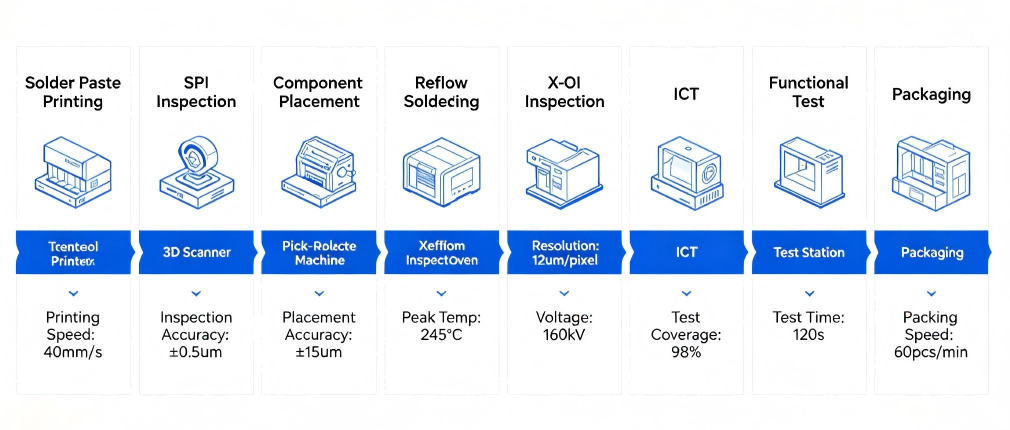
Assembling a circuit board is a multi-step process that demands precision at every stage. At HCJMPCBA, our PCBA process follows a disciplined workflow:
Solder Paste Printing
Solder paste — a mixture of tiny solder spheres and flux — is applied to the PCB pads where components will be placed. For fine-pitch components (0.4 mm pitch and below), print accuracy is critical. Our 3D SPI (solder paste inspection) systems verify paste height, volume, and position on every pad before components are placed, catching printing defects at the source.
Component Placement
High-speed pick-and-place machines mount components onto the solder paste deposits. Our lines handle component types ranging from 01005 passives to large BGAs and connectors. Placement accuracy for fine-pitch devices is maintained within tight tolerances through closed-loop vision alignment.
Reflow Soldering
The assembled board passes through a reflow oven with a precisely controlled temperature profile. The profile must melt the solder paste without damaging moisture-sensitive components or thermally stressing the PCB. Our reflow ovens are equipped with closed-loop temperature control and nitrogen atmosphere capability for demanding assemblies.
Inspection and Testing
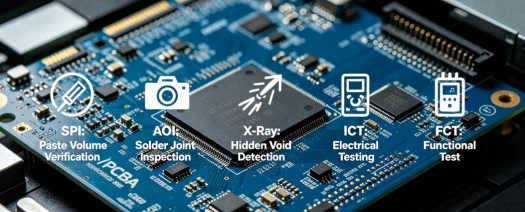
Post-reflow inspection is where quality is verified:
-
AOI (Automated Optical Inspection) — Captures high-resolution images of each board and compares them against the CAD data to detect missing components, misalignment, bridging, and solder defects.
-
X-Ray Inspection — For BGAs, QFNs, and other components with hidden solder joints, X-ray is the only way to verify joint integrity and void content.
-
ICT (In-Circuit Test) — Electrical testing of individual components and circuit nodes to verify opens, shorts, and component values.
-
Functional Test — The board is powered up and its actual functionality is verified against specifications.
Quality Control: The Discipline Behind Reliable PCBA
Quality in PCBA is not achieved through inspection alone — it is built into the process. At HCJMPCBA, our IATF 16949‑certified quality management system enforces process controls across every production stage:
Material Traceability — Every component reel is logged with manufacturer, date code, and batch information. Our intelligent MES system provides UID-level component traceability, linking each assembled board to its complete material history.
MSD (Moisture-Sensitive Device) Control — Components with MSL (moisture sensitivity level) ratings are tracked for floor-life exposure. Components exceeding their allowable exposure are baked before reflow, preventing popcorning and delamination.
Statistical Process Control (SPC) — Key process parameters — paste print volume, reflow peak temperature, placement accuracy — are monitored in real time. Trends that indicate process drift trigger corrective action before defects occur.
First-Article Inspection — The first board of every production run undergoes full inspection before the run continues. Any systematic placement offset or solder issue is corrected immediately, preventing the propagation of defects across the entire batch.
100% X-Ray for Power Modules — For assemblies with BGAs, QFNs, or power modules, X-ray inspection is performed on every board, not just on a sample basis. Hidden solder joint defects are the most costly to discover in the field — we catch them at the factory.
Major Applications of Electronic Circuits
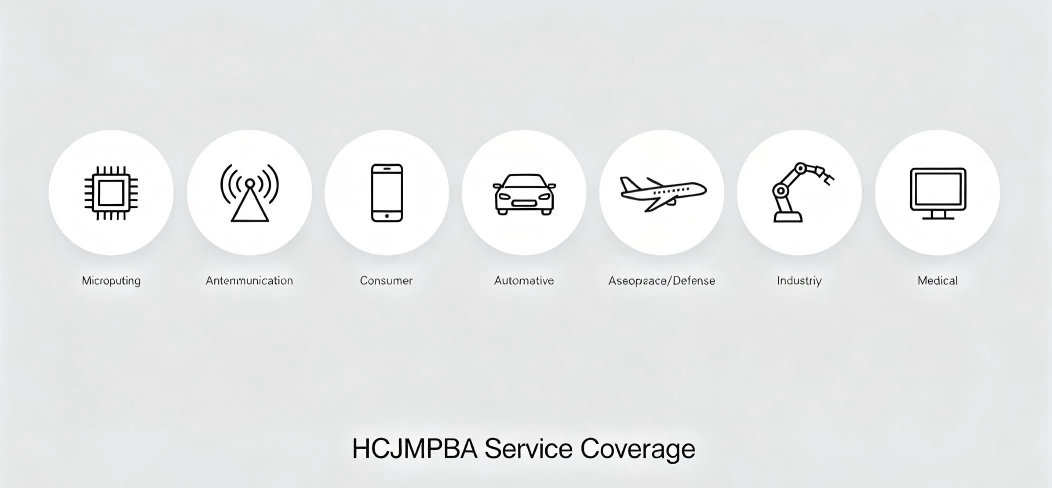
Electronic circuits power functionality across every sphere of technology, industry, science, and daily life. Nearly all electronic devices and systems are enabled by integrated circuits and PCBs populated with discrete components. Major application areas include:
-
Computing — Microprocessors, memory, data storage, interfaces in PCs, servers, and embedded systems
-
Communications — Radio, cellular, WiFi, Bluetooth modules for transmitting and receiving data
-
Consumer Electronics — Audio, video, mobile devices, gaming, home appliances, IoT devices
-
Automotive — Engine control units, infotainment, diagnostics, safety systems
-
Aerospace & Defense — Avionics, radar, guidance systems, communications, tracking
-
Industrial — PLCs, instrumentation, process control systems, robotics
-
Medical — Patient monitors, imaging equipment, diagnostics, prosthetics
Electronics and circuits are integral to all modern technological capabilities across every industry and domain. At HCJMPCBA, we serve customers across industrial automation, medical devices, power electronics, and semiconductor test equipment — segments where reliability is not optional.
Circuit Design Considerations for Manufacturability
While circuit design is the domain of the electrical engineer, certain design choices have profound implications for assembly yield and cost. Hardware engineers who understand these relationships can design circuits that are not only functional but also manufacturable at scale.
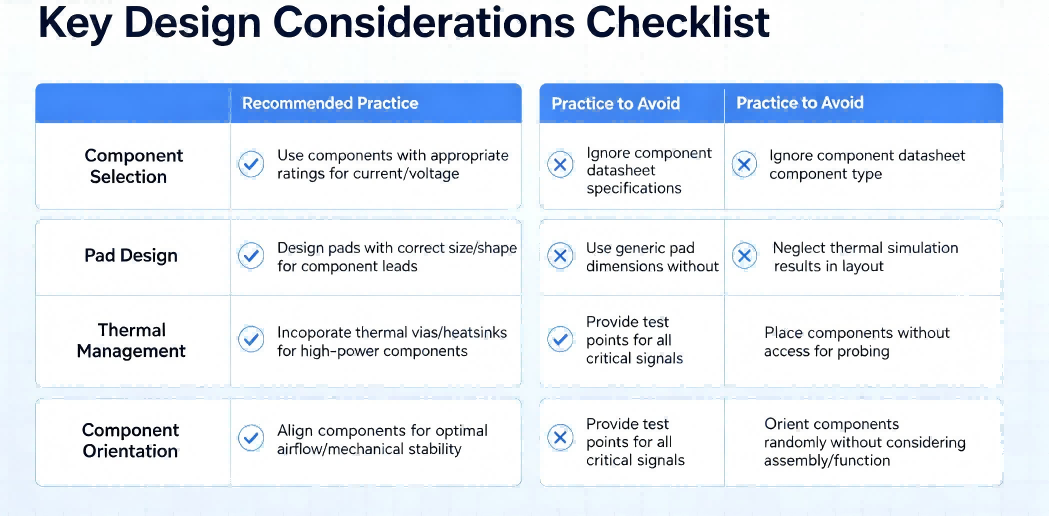
Component Selection — Choose components that are available, preferably with multiple sources. Exotic or end-of-life parts create supply chain risk. Consider package types — fine-pitch BGAs and QFNs require advanced assembly capabilities and X-ray inspection.
Pad and Land Pattern Design — Follow IPC-7351 land pattern standards. Inadequate pad sizes cause tombstoning or insufficient solder fillets. Oversized pads increase the risk of bridging.
Thermal Management — High-power components require thermal vias and adequate copper pour for heat spreading. Insufficient thermal relief leads to overheating and premature failure.
Test Access — Include test points for ICT and functional test. Boards that cannot be electrically tested are boards that cannot be qualified before shipment.
Component Orientation — Consistent orientation of polarized components (diodes, capacitors, ICs) reduces placement errors. Silkscreen polarity markings must be clear and unambiguous.
From Prototype to Production: Scaling with Confidence
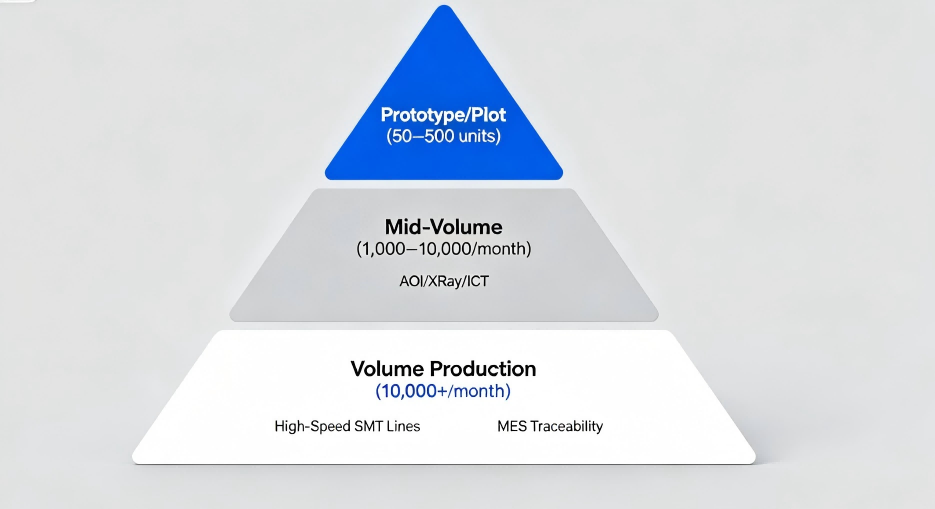
One of the most critical transitions in product development is moving from prototype quantities — where boards may be hand-assembled or run in small batches with extra attention — to volume production, where consistency and repeatability are paramount.
At HCJMPCBA, we support this transition with a manufacturing infrastructure designed for both flexibility and scale. Our multiple high-speed SMT lines, automated inspection systems, and MES-integrated process controls deliver the same quality at 10,000 units as at 100 units.
For customers moving from prototype to production, we offer:
-
Process parameter development — Establishing solder profiles, placement programs, and inspection criteria optimized for your specific board
-
Material qualification — Verifying that components, solder paste, and PCB materials are compatible and perform consistently across batches
-
First-article qualification — Full inspection and testing of the first production batch before release
-
Ongoing SPC monitoring — Real-time tracking of process capability to detect and correct drift
Our production capacity supports volumes from pilot runs of a few dozen boards to mass production of tens of thousands per month, with consistent process discipline across every batch. Our engineering team provides upfront process parameter recommendations and production readiness reviews before your first board enters the line. We work closely with component suppliers to ensure material availability and compatibility, and we maintain transparent quality reporting with full traceability documentation for procurement teams who require audit-ready records.
Conclusion
Electronic circuits provide the underlying foundation across every electrical and electronic system. Combining active and passive components in infinite innovative configurations enables all modern technology capabilities. Circuit designers employ rigorous methodologies to translate application requirements into functioning implementations.
But a great circuit design is only half the story. The other half — the translation from schematic to reliable, manufacturable PCBA — is where engineering discipline meets manufacturing execution. At Guangzhou Huachuang Precision Technology Co., Ltd. (HCJMPCBA), we bring that discipline to every board we assemble. From component traceability and MSD control to 3D SPI, AOI, X-ray inspection, and IATF 16949‑certified quality management, our processes are engineered to deliver PCBA that performs reliably in the field — not just at the test bench.
If you are developing an electronic circuit design and need a manufacturing partner that understands both the engineering and the execution, contact our engineering team for a no-obligation assessment of your assembly requirements, component mix, and production schedule.





 扫一扫
扫一扫


 200
200

 被折叠的 条评论
为什么被折叠?
被折叠的 条评论
为什么被折叠?
 到【灌水乐园】发言





