



Softmax回归——基于葡萄酒品类鉴别数据集
1.Softmax回归模型
相比于用于拟合问题的线性回归,Softmax回归则主要用于分类问题。对于待分类类别数为
q
q
q,有
n
n
n个样本,每个样本特征维度为
d
d
d,则Softmax回归模型可表示为
o
=
W
x
+
b
o=Wx+b
o=Wx+b
y
^
=
s
o
f
t
m
a
x
(
o
)
=
exp
(
o
)
∑
k
=
1
q
exp
(
o
k
)
\hat{y}=softmax(o)=\frac{\exp (o)}{\sum\limits_{k=1}^{q}{\exp ({{o}_{k}})}}
y^=softmax(o)=k=1∑qexp(ok)exp(o)
其中
x
∈
R
d
×
1
x\in {{R}^{d\times 1}}
x∈Rd×1为单个样本特征,
W
∈
R
q
×
d
W\in {{R}^{q\times d}}
W∈Rq×d为权重,
b
∈
R
q
×
1
b\in {{R}^{q\times 1}}
b∈Rq×1为偏置,
y
^
∈
R
q
×
1
\hat{y}\in {{R}^{q\times 1}}
y^∈Rq×1为模型输出。样本真实标签
y
∈
R
q
×
1
y\in {{R}^{q\times 1}}
y∈Rq×1为独热编码格式。
2. 基于最大似然的交叉熵损失公式推导
由于 y ^ \hat{y} y^的值均在 ( 0 , 1 ) (0,1) (0,1)范围内,可以利用均方误差作为损失函数进行模型训练。由于 s u m ( y ^ ) = 1 sum(\hat{y})=1 sum(y^)=1,不能将误差 y − y ^ y-\hat{y} y−y^假设为高斯分布的随机变量进行处理,因此利用均方误差作为损失函数不满足最大似然准则。
但也正是 s u m ( y ^ ) = 1 sum(\hat{y})=1 sum(y^)=1,可以将 y ^ \hat{y} y^假设为样本 x x x属于各个类别的概率,此时可以利用最大似然准则推导出更合适的损失函数,推导过程如下:
首先定义条件概率
P
(
y
(
i
)
∣
x
(
i
)
)
P({{y}^{(i)}}|{{x}^{(i)}})
P(y(i)∣x(i)),表示模型输入第
i
i
i个样本
x
(
i
)
{{x}^{(i)}}
x(i),输出为真实样本标签
y
(
i
)
{{y}^{(i)}}
y(i)的概率。则
P
(
y
(
i
)
∣
x
(
i
)
)
=
∑
j
=
1
q
y
j
y
^
j
P({{y}^{(i)}}|{{x}^{(i)}})=\sum\limits_{j=1}^{q}{{{y}_{j}}{{{\hat{y}}}_{j}}}
P(y(i)∣x(i))=j=1∑qyjy^j
对于样本集
{
X
∈
R
n
×
d
,
Y
∈
R
n
×
q
}
\left\{ X\in {{R}^{n\times d}},Y\in {{R}^{n\times q}} \right\}
{X∈Rn×d,Y∈Rn×q},条件概率
P
(
Y
∣
X
)
P(Y|X)
P(Y∣X)表示为
P
(
Y
∣
X
)
=
∏
i
=
1
n
P
(
y
(
i
)
∣
x
(
i
)
)
P(Y|X)=\prod\limits_{i=1}^{n}{P({{y}^{(i)}}|{{x}^{(i)}})}
P(Y∣X)=i=1∏nP(y(i)∣x(i))
两边取对数
log
P
(
Y
∣
X
)
=
∑
i
=
1
n
log
P
(
y
(
i
)
∣
x
(
i
)
)
=
∑
i
=
1
n
log
∑
j
=
1
q
y
j
y
^
j
=
∑
i
=
1
n
∑
j
=
1
q
y
j
log
y
^
j
=
−
∑
i
=
1
n
l
(
y
(
i
)
,
x
(
i
)
)
\begin{align} & \log P(Y|X)=\sum\limits_{i=1}^{n}{\log P({{y}^{(i)}}|{{x}^{(i)}})}=\sum\limits_{i=1}^{n}{\log \sum\limits_{j=1}^{q}{{{y}_{j}}{{{\hat{y}}}_{j}}}} \\ & =\sum\limits_{i=1}^{n}{\sum\limits_{j=1}^{q}{{{y}_{j}}\log {{{\hat{y}}}_{j}}}}=-\sum\limits_{i=1}^{n}{l({{y}^{(i)}},{{x}^{(i)}})} \\ \end{align}
logP(Y∣X)=i=1∑nlogP(y(i)∣x(i))=i=1∑nlogj=1∑qyjy^j=i=1∑nj=1∑qyjlogy^j=−i=1∑nl(y(i),x(i))
其中
l
(
y
(
i
)
,
x
(
i
)
)
=
−
∑
j
=
1
q
y
j
log
y
^
j
l({{y}^{(i)}},{{x}^{(i)}})=-\sum\limits_{j=1}^{q}{{{y}_{j}}\log {{{\hat{y}}}_{j}}}
l(y(i),x(i))=−j=1∑qyjlogy^j
基于最大似然准则,
∑
i
=
1
n
l
(
y
(
i
)
,
x
(
i
)
)
\sum\limits_{i=1}^{n}{l({{y}^{(i)}},{{x}^{(i)}})}
i=1∑nl(y(i),x(i))应取得最小值才能使得
P
(
Y
∣
X
)
P(Y|X)
P(Y∣X)最大,因此在假设Softmax输出为概率的条件下,基于最大似然准则推导的损失函数为
L
(
Y
^
,
Y
)
=
1
n
∑
i
=
1
n
l
(
y
(
i
)
,
x
(
i
)
)
L(\hat{Y},Y)=\frac{1}{n}\sum\limits_{i=1}^{n}{l({{y}^{(i)}},{{x}^{(i)}})}
L(Y^,Y)=n1i=1∑nl(y(i),x(i))
所推导出的函数
l
(
y
,
x
)
l(y,x)
l(y,x)被称为交叉熵函数,其和熵的计算公式形式很类似,因为是两个不同的概率分布,因此这里称为交叉熵。
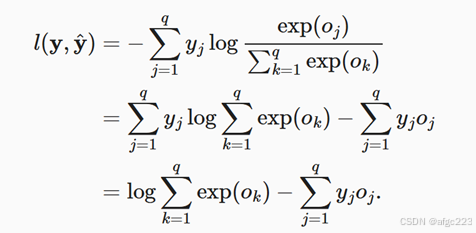
《动手学深度学习》中有一段关于熵和交叉熵物理意义很形象的解释,这里引用如下:

书中还给出了交叉熵函数的进一步推导及其导数计算公式:

3. Softmax回归与对数几率回归
1)对数几率回归采用sigmod函数进行分类,同样是将输出假设为概率,因此同样可以利用最大似然准则推导出交叉熵损失函数,两者损失函数是一致的。
2)对数几率回归只能用于解决二分类问题,而Softmax回归则可以解决二分类和多分类问题,因此Softmax回归使用范围更广。
3)Sigmod回归可以认为是Softmax回归的简化版,二分类的Softmax回归的权重参数量是Sigmod回归的两倍,因此模型的表达能力要更强。
4. 基于葡萄酒品类鉴别数据集的仿真验证
所采用的数据集共有三个类别葡萄酒,包括酒精含量、苹果酸,色调等13种不同的特征,一共178个样本,将其中30%作为测试集。
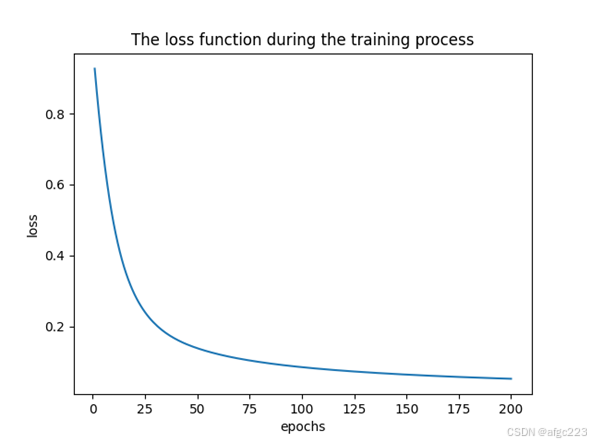
设置epochs=200,学习率0.01,网络训练的Loss函数下降过程为
测试集54个样本的真实标签与模型输出标签的对比结果为
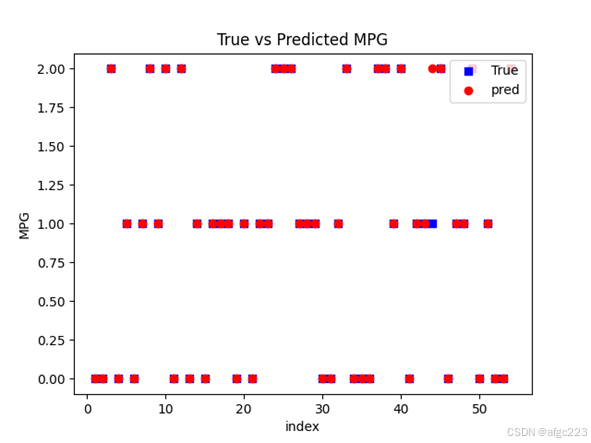
其中有一个测试样本出现错误,测试准确率为98.15%。
仿真代码如下:
import numpy as np
import torch
import torch.nn as nn
import torch.optim as optim
from sklearn import datasets
from sklearn.model_selection import train_test_split
from sklearn.preprocessing import StandardScaler
from sklearn.metrics import accuracy_score
import matplotlib.pyplot as plt

# Step 1: 加载 Wine 数据集
wine = datasets.load_wine()
X = wine.data
y = wine.target

# Step 2: 数据预处理(标准化)
scaler = StandardScaler()
X = scaler.fit_transform(X)

# Step 3: 将数据集分为训练集和测试集
X_train, X_test, y_train, y_test = train_test_split(X, y, test_size=0.3, random_state=42)

# Step 4: 将 NumPy 数组转换为 PyTorch 张量
X=torch.tensor(X, dtype=torch.float32)
y=torch.tensor(y, dtype=torch.long)
X_train_tensor = torch.tensor(X_train, dtype=torch.float32)
X_test_tensor = torch.tensor(X_test, dtype=torch.float32)
y_train_tensor = torch.tensor(y_train, dtype=torch.long)
y_test_tensor = torch.tensor(y_test, dtype=torch.long)

# Step 5: 定义 Softmax 回归模型
class SoftmaxRegression(nn.Module):
    def __init__(self, input_dim, output_dim):
        super(SoftmaxRegression, self).__init__()
        self.linear = nn.Linear(input_dim, output_dim)

    def forward(self, x):
        return self.linear(x)

# 创建模型实例
model = SoftmaxRegression(input_dim=X_train.shape[1], output_dim=3)  # 3 是葡萄酒的类别数

# Step 6: 定义损失函数和优化器
criterion = nn.CrossEntropyLoss()  # 交叉熵损失函数(适用于多分类问题)
optimizer = optim.Adam(model.parameters(), lr=0.01)  # Adam 优化器

# Step 7: 训练模型
num_epochs = 200
L_all=np.zeros(num_epochs)
for epoch in range(num_epochs):
    # 前向传播
    outputs = model(X_train_tensor)
    loss = criterion(outputs, y_train_tensor)

    # 反向传播和优化
    optimizer.zero_grad()  # 清零梯度
    loss.backward()  # 计算梯度
    optimizer.step()  # 更新权重
    L_all[epoch] = criterion(model(X), y).item()
    if (epoch+1) % 10 == 0:
        print(f'Epoch [{epoch+1}/{num_epochs}], Loss: {loss.item():.4f}')

# Step 8: 评估模型
with torch.no_grad():  # 不计算梯度,节省内存
    # 对测试集进行预测
    outputs = model(X_test_tensor)
    _, predicted = torch.max(outputs, 1)

    # 计算准确率
    accuracy = accuracy_score(y_test_tensor.numpy(), predicted.numpy())
    print(f'Accuracy on test set: {accuracy * 100:.2f}%')

# 可视化训练Loss函数
plt.plot(np.arange(num_epochs)+1,L_all)
plt.title('The loss function during the training process')
plt.xlabel('epochs')
plt.ylabel('loss')
plt.show()

# 可视化预测结果
plt.scatter(np.arange(len(X_test_tensor))+1,y_test_tensor.numpy(),color='blue',label='True',marker='s')
plt.scatter(np.arange(len(X_test_tensor))+1, predicted.numpy(),color='red',label='pred')
plt.xlabel('index')
plt.ylabel('MPG')
plt.title('True vs Predicted MPG')
plt.legend()
plt.show()
5.参考
《动手学深度学——Pytorch版》,阿斯顿张,李沐等著,p71-p73





 扫一扫
扫一扫


 116
116

 被折叠的 条评论
为什么被折叠?
被折叠的 条评论
为什么被折叠?
 到【灌水乐园】发言





