The Kookaburras (genus Dacelo) are stout, thickset kingfishers native to Australia and New Guinea. They are the largest members of the family Kingfishers, and they inhabit woodland, open forest, and even the suburban gardens of eastern and south-western Australia. Kookaburras are best known to the rest of the world for their extraordinary, almost human laughter — a chorus call that has stood in for “the sound of the jungle” in dozens of films set nowhere near Australia.
If you have ever heard a Kookaburra at dawn, you do not forget it. The call is loud, percussive, and utterly self-confident, and it is the bird’s primary tool for marking out territory. They are also serious predators — sit-and-wait hunters that drop on snakes, lizards and rodents from a high perch, often killing them by battering them against a branch.
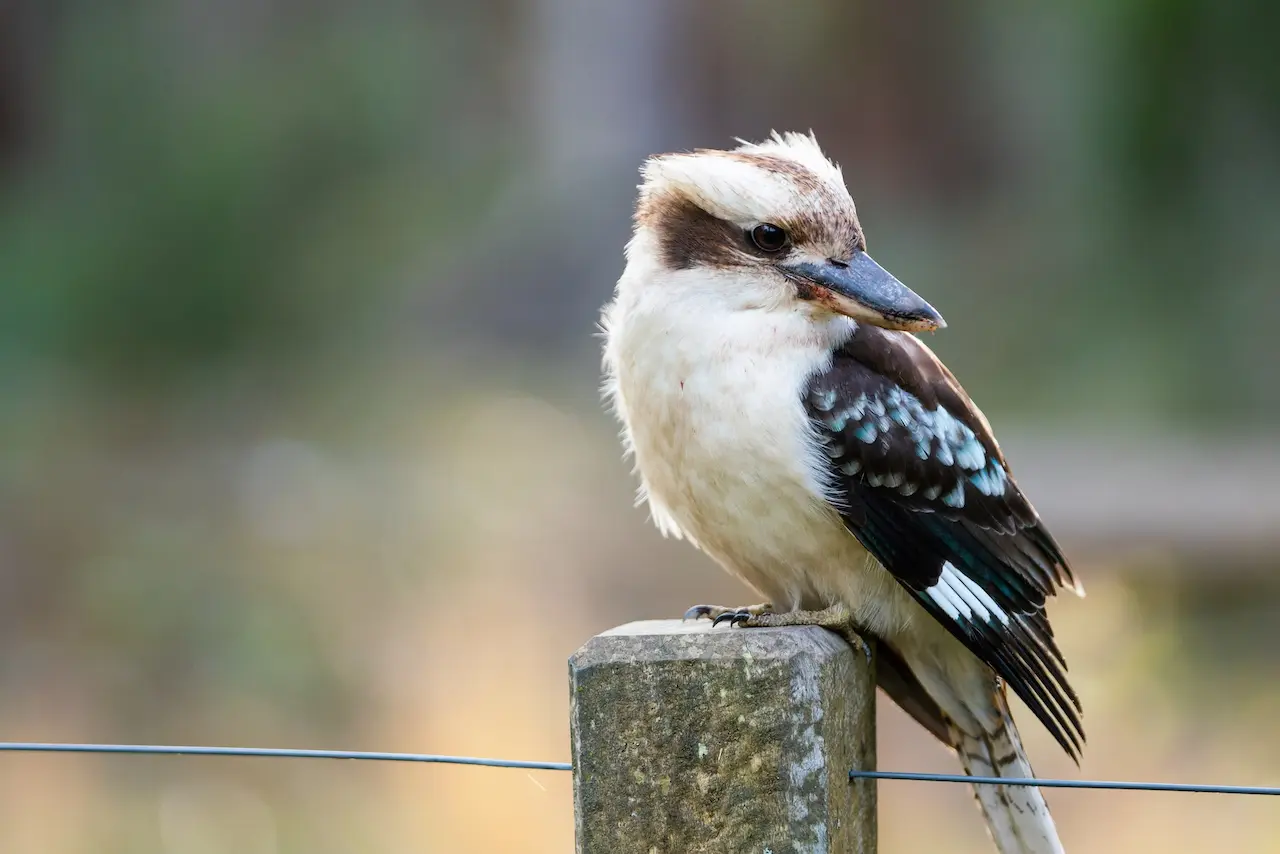



The Five Species of Kookaburra
There are five recognised species of Kookaburra. Two of them live mostly in Australia, and the other three are found across mainland New Guinea and the surrounding islands. They are all big-headed, short-necked, large-billed birds — the unmistakable kingfisher silhouette, scaled up.
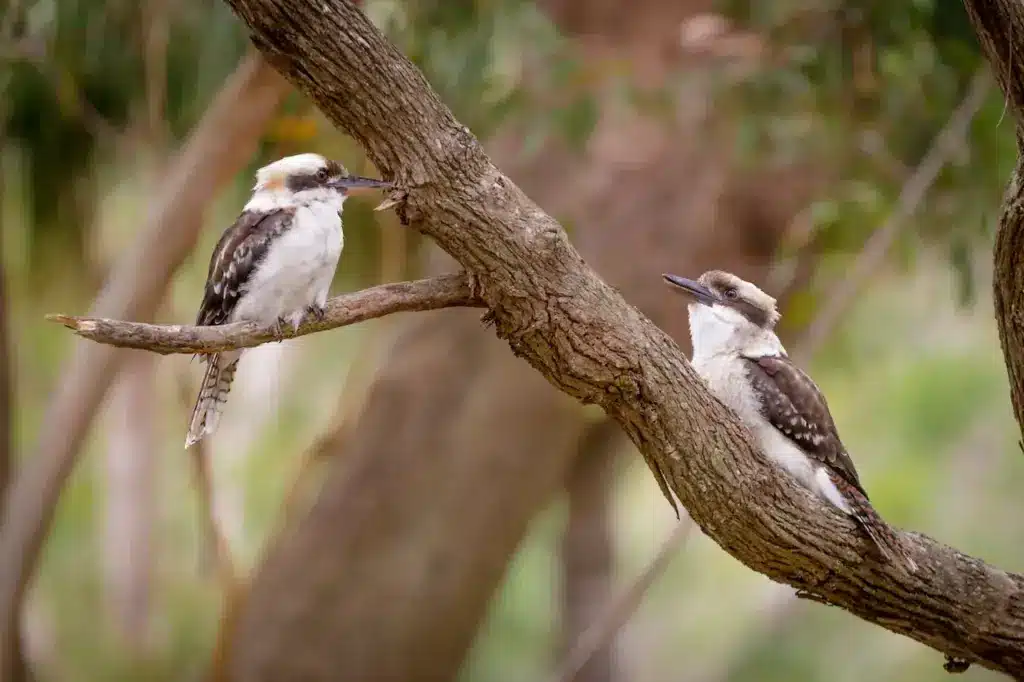
- Laughing Kookaburra (Dacelo novaeguineae) — the species behind the famous laughing chorus. Native to eastern Australia and introduced to south-western Australia, Tasmania, and parts of New Zealand.
- Blue-winged Kookaburra (Dacelo leachii) — found across northern Australia and southern New Guinea. Smaller than the Laughing Kookaburra and more brightly coloured, with a vivid blue patch on the wing.
- Spangled Kookaburra (Dacelo tyro) — restricted to the Aru Islands and the Trans-Fly region of southern New Guinea.
- Rufous-bellied Kookaburra (Dacelo gaudichaud) — widespread in lowland forest across mainland New Guinea and on Saibai Island in the Torres Strait.
- Shovel-billed Kookaburra (Clytoceyx rex) — the odd one out, sometimes placed in its own genus. Endemic to mid-altitude rainforest on New Guinea, with a uniquely short, broad, conical bill it uses to dig invertebrates out of the forest floor.
Habitat and Distribution
Kookaburras are remarkably adaptable. Their habitats range from open, humid forests and woodlands through arid savannah to the cultivated parks, golf courses and gardens of suburban Australia. The Laughing Kookaburra in particular has become a familiar urban bird in Sydney, Melbourne and Brisbane — anywhere with mature trees and a reasonable supply of small animals it can hunt.
The two Australian species are essentially sedentary; they hold the same patch of bush year after year. The New Guinea species occupy denser tropical forest, and the Shovel-billed Kookaburra is a montane forest specialist found between roughly 300 and 2,400 metres of elevation. Anywhere there is a high perch, prey on the ground, and a hollow log to nest in, you can usually expect a kookaburra.
Description
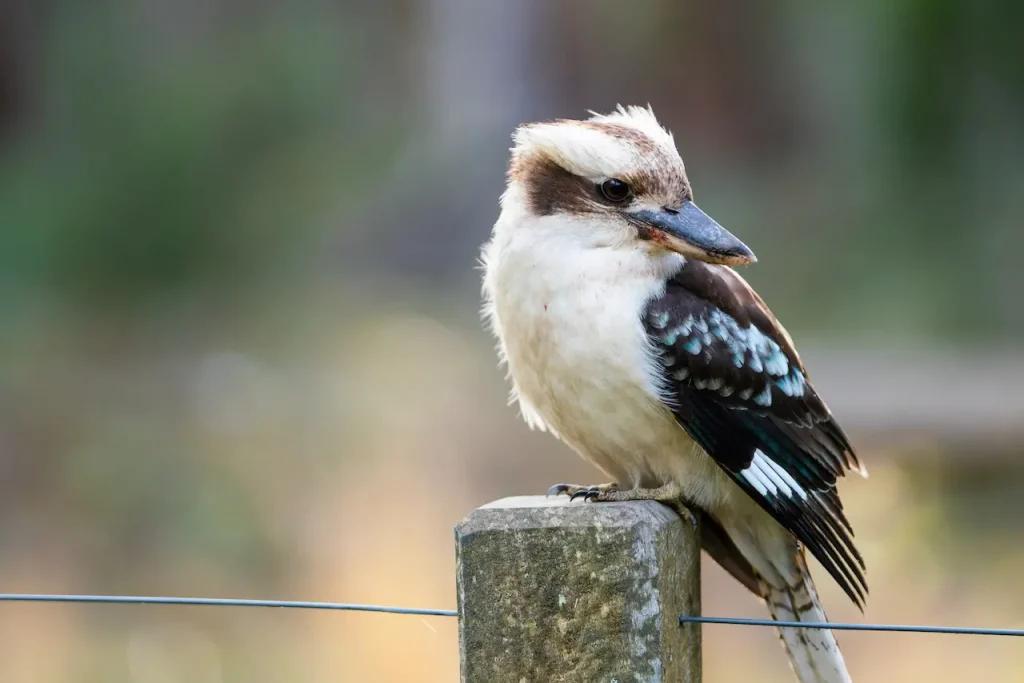
Kookaburras are nicknamed the Laughing Jackasses of Australia, and the body plan matches the personality. They have a sturdy, solid body, a short neck, a long, stout bill with a pointed tip, and short, strong legs. The plumage is mostly brown and cream, with darker barring on the wings and tail; the eye is set in a broad, dark mask that runs back from the bill.
They range from large to very large for kingfishers — the Laughing Kookaburra is 28–42 cm (11–17 in) long and weighs around 300–500 g. All kookaburras are sexually dimorphic to some degree, but it is most obvious in the Blue-winged and Rufous-bellied: males of both species have blue tails, while females have rufous tails with black bars. In the Laughing Kookaburra the difference is far subtler — the male shows a slightly bluer rump.
Calls and Vocalisations
The Laughing Kookaburra’s call is one of the most recognisable sounds in the natural world. It begins with a low chuckle, rises into a peal of cackling laughter, and is almost always answered by every other kookaburra within earshot. It is delivered most often at dawn and dusk — the so-called “bushman’s clock” — and serves to advertise and defend the family group’s territory rather than to attract a mate.
The other kookaburra species call too, but their voices are quite different. The Blue-winged Kookaburra produces a harsh, screeching trill that sounds almost mechanical; the Rufous-bellied Kookaburra has a slower, more haunting song; and the Shovel-billed Kookaburra utters a series of low, deliberate hoots that carry a long way through dense forest. In every case, the call is loud, repetitive, and unmistakably territorial.
Feeding and Hunting
Kookaburras have always had an awkward kind of folk-celebrity status with Australians. They are unique and captivating birds, and they contribute to the rural ecology by feeding on snakes and lizards that most farmers would rather not have around. When it hunts, the Kookaburra waits patiently on a low, exposed branch and pounces straight down on its prey, folding its wings back and extending its beak to capture the meal in a single drop. It then returns to a perch to deal with whatever it has caught.
For snakes, the technique is gruesomely efficient. The Kookaburra grips the snake just behind the head, carries it back to a perch, and batters it repeatedly against a branch or against a rock until it is dead and pliable enough to swallow whole. The same method is used on large lizards and on the heavier insects. An unusual anatomical fact: the Kookaburra’s crop sits low in the body, between the legs, rather than just below the neck as in most birds. That makes a lot of sense once you have watched one swallow something the length of its own body.
The diet is as broad as the bird is opportunistic. They will take insects, small fish, mice and other rodents, raw meat, worms, beetles, lizards, small snakes, frogs, and the occasional small bird or duckling. They are a real problem on small farms — they will raid farmyards for ducklings and chicks, and any meat left out at a barbecue is fair game. A surprisingly large number of suburban Australians have learned the hard way that you do not turn your back on a sausage when there are kookaburras in the trees.
Breeding and Family Life
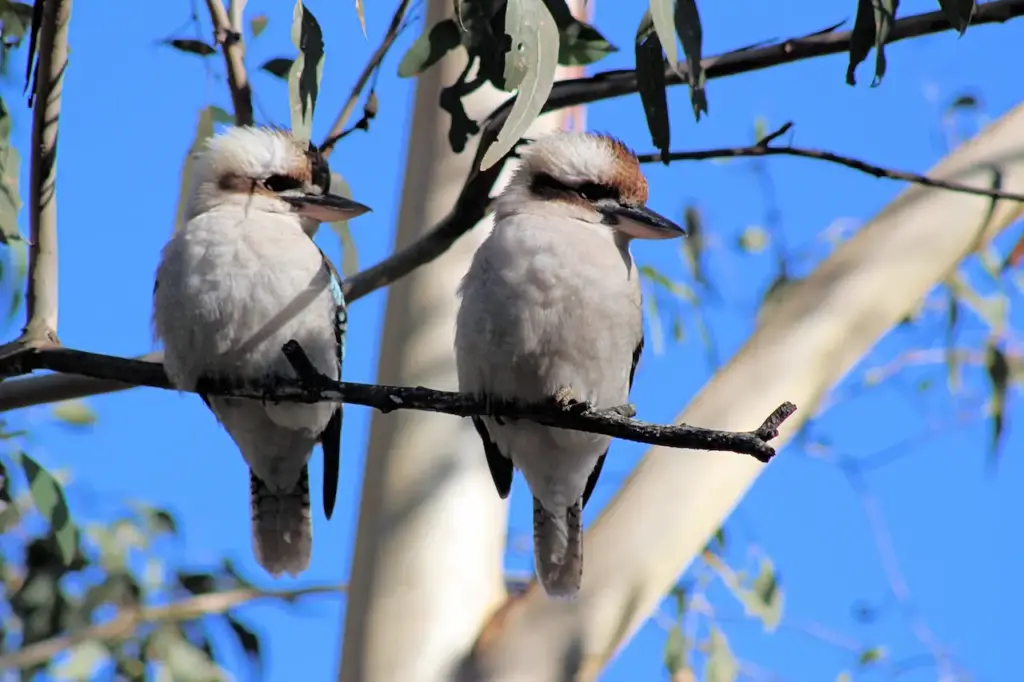
Most kingfisher species prefer to live alone and seek a mate only during the breeding season, but Kookaburras are different — they live in cooperative family groups. The Laughing Kookaburra and Blue-winged Kookaburra both form groups made up of a breeding pair plus several older offspring from previous years, who help raise the next clutch. Most of these “helpers” are males. The Rufous-bellied Kookaburra usually lives as a simple pair, or in a small loose group in open woodland. Little is known about the nesting habits of the Spangled Kookaburra; according to eBird, sightings remain sparse.
Pairs are monogamous and form long-term bonds — usually for life. The chorus call is partly a duet between the established pair, and partly a coordinated announcement by the entire family that the territory is occupied. According to BirdLife International, the Laughing Kookaburra is one of the most thoroughly studied kingfishers anywhere in the world.
Breeding season runs from September to January in Australia. Nests are built in hollow tree trunks, in tree holes, on the ground in a riverbank, or excavated into the side of an arboreal termite mound — a remarkable behaviour given how aggressively termites usually defend their colony. Nests are rarely more than 12 metres above the ground. The female lays one to four round, white eggs without bothering with any nesting material; the wood chips and termite carton inside the cavity are enough.
Both parents and the older helpers share the 25-day incubation, and both parents and helpers feed the chicks. The young leave the nest at roughly 30 days old, but the parents continue to provide food for at least another 40 days. Because the breeding cycle is so long, a pair will rarely raise more than one clutch in a season. The low birth rate is balanced by the species’ longevity — wild Kookaburras commonly live more than 15 years, and captive birds have reached 20.
Habits and Behaviour Around People
Kookaburras are bold birds. They will tolerate humans at very close range, and a few will become tame enough to accept food from the hand — a habit that wildlife authorities discourage, because handouts of mince and processed meat are nutritionally poor for a bird whose digestive tract evolved to deal with whole, raw prey. Occasionally Kookaburras have shown defensive or aggressive behaviour towards humans, particularly during the breeding season when the family group is protecting fledglings.
The behaviour most people actually find annoying, though, is the bird’s habit of attacking windows or polished exterior surfaces of houses. The cause is usually territorial: the Kookaburra sees its own reflection, takes it for an intruder, and starts trying to drive it off. There is no good cure beyond temporarily breaking up the reflection — taping paper to the inside of the window, or leaving the curtains drawn for a week or two — until the bird gives up and moves on.
Conservation Status
The Laughing Kookaburra and Blue-winged Kookaburra are both classified as Least Concern by the IUCN, with stable populations across most of their range. They are protected under Australian wildlife law — like all native Australian birds — and they continue to do well in suburban and agricultural landscapes that suit very few other large insectivorous predators. The New Guinea species are harder to assess; the Spangled and Shovel-billed Kookaburras both have restricted ranges and depend on intact forest, and ongoing logging in lowland and mid-elevation New Guinea is a slow but real threat to both.
The biggest medium-term concern for Australian kookaburras is bushfire intensity and the loss of mature, hollow-bearing eucalypts. Kookaburras need old trees to nest in, and old trees are exactly what catastrophic fires take out first. Keeping kookaburras in the suburbs means keeping the big old trees standing.
Species research and information provided by Avian Contributor: Jeannine Miesle.