

The Expansion of Voting Before Election Day, 2000-2026
The last 25 years have seen a large expansion in the number of states offering options to vote before Election Day, from 24 states in 2000 to 47 states and Washington, DC, in 2026. Put another way: In the 2000 general election, 40% of all voting-age citizens lived in states that offered at least one option for voting before Election Day—such as early in-person voting or mail ballots. In the upcoming 2026 general election, 97% of all voting-age citizens live in states that will offer at least one option to vote before Election Day in the 2026 election.
While the details of voting before Election Day vary by state, the availability of options to vote before Election Day has expanded across the nation since the 2000 general election. The figure above compares the options to vote early in-person and by mail in each state and Washington, DC, in the 2000 and 2026 general elections. For each state’s options to vote early in-person and by mail in each federal election since 2000, scroll down for an interactive visual.
How many states will have options to vote before Election Day in the 2026 general election?
For the upcoming 2026 general election, 47 states and Washington, DC, will offer all voters the opportunity to vote early in person; 37 states and Washington, DC, will also offer all voters the option to vote by mail without the need to cite a reason.
The interactive visual below shows options to vote before Election Day in each state and Washington, DC, in each general election since 2000. Click pause or on any year to stop the animation.
What options for voting before Election Day have changed since 2024?
In 2026, Connecticut implemented mail voting for all voters, representing the only change in the availability of voting before Election Day between the 2024 and 2026 general elections. Connecticut voters had approved a state constitutional amendment in 2024 to allow voters to request and cast mail ballots without providing a specific reason. The state legislature formally enacted mail voting in 2026.
Defining terms
This report uses the term “early in-person voting” to refer to voting that is available to all voters and conducted in person before the day of the election. This includes policies referred to by states as early voting, in-person no-excuse absentee voting, and advance (or advanced) voting. Similarly, this report uses the term “mail voting” to refer to voting where all voters are eligible to receive their ballot via mail, including policies referred to by states as all-mail voting and no-excuse absentee by mail.
Click here for a snapshot of changes between recent midterm election years or select midterms in the interactive visual above.
Click here for more CEIR resources on early in-person and mail voting.
How does expanding options to vote before Election Day benefit voters and election officials?
Options to vote before Election Day bolster election integrity and provide eligible voters more opportunity to cast a ballot. When most voters cast their ballot on Election Day, any problem can have an outsized effect. A simple technical problem on Election Day may lead to a loss of voter confidence or even disenfranchisement. Any disinformation spread on Election Day could affect voters in ways that are difficult to correct by the time the polls close. By contrast, when voting is spread over several days, election officials can detect issues earlier, address challenges more easily, and offer a greater number of options to any voters who may be impacted. Disinformation can be mitigated, enabling voters to vote another day. Voters can also decide to vote at another time if issues lead to long lines, closed polling places, or similar problems. Put simply, research has demonstrated that more options to vote before Election Day mean more opportunities to identify and counteract any human error, machine breakdown, power outage, cyberattack, rumor campaign, or other potential issue that may arise.1
Early in-person and mail voting options are also widely popular across states in every region and of every partisan stripe. State legislatures and governors from both parties have passed legislation creating and expanding options to vote before Election Day over several decades. And research repeatedly affirms that such policies do not advantage one party more than the other.2
How much has voting before Election Day increased over time?
Options to vote early in-person and by mail have grown in popularity among voters nationwide over time. The proportion of ballots cast before Election Day increased steadily from 2000 to 2024, according to data from the U.S. Census Bureau. In 2000, 14% of ballots were cast before Election Day. Voting before Election Day rose to 21% of ballots cast in 2004, 31% in 2008, 33% in 2012, and 40% in 2016—then jumped to 69% during the COVID-19 pandemic in 2020, before returning to the long-term trend with 50% in 2022 and 60% of ballots cast before Election Day in 2024.3
Has the number of states with options to vote before Election Day increased?
The number of states offering at least one unrestricted option to vote before Election Day has steadily increased since 2000. As shown in the chart below, 24 states offered all voters the opportunity to vote early in-person during the 2000 general election, and 21 of these states also offered all voters the option to vote by mail without the need to provide a specific reason.
In the upcoming 2026 general election, 47 states and Washington, DC, will offer all voters the opportunity to vote early in person, with 37 states and Washington, DC, also offering all voters the option to vote by mail without the need to provide a specific reason. Because of temporary expansions during the COVID-19 emergency, more states afforded such options to voters during the 2020 and 2022 elections. In the upcoming 2026 general election, only three states offer no options to vote before Election Day.
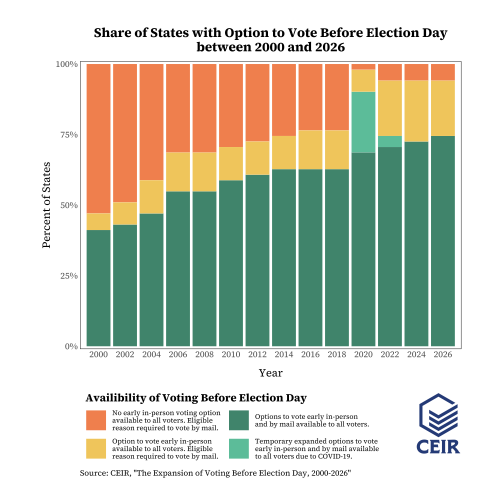
Table 1 below shows the options to vote before Election Day in each state over time, the steady expansion of these policies across the country over the last 25 years.
Table 1. Change in options to vote before Election Day in each state, 2000 to 2026
Table
How has the availability of options to vote before Election Day changed between recent midterm election years (2022-2026)?
Options to vote early in-person and by mail available to all voters: 37 states and DC (net permanent increase of 2 states from 2022)
Option to vote early in person available to all voters. Eligible reason required to vote by mail: 10 states (net permanent decrease of 2 states from 2022)
- Moved to the category above because mail voting was implemented: Connecticut and New York
No option to vote early in-person. Eligible reason required to vote by mail: 3 states (no changes from 2022)
Measuring the growth in states with options to vote before Election Day
Methodology
To trace the expansion of options to vote before Election Day nationwide since the 2000 general election, the CEIR research team reviewed the enacting or extant legislation and legislative history for early voting and mail voting in each state. This data was then cross-referenced with other state government sources, news articles, research publications, and policy survey responses from Election Administration and Voting Survey (EAVS) reports published by the U.S. Election Assistance Commission.
This report focuses on the voter experience for each federal general election. Where the impacts of a given law on voter experience were obscure or ambiguous, the research team relied on the interpretation of state election officials. For the 2020 and 2022 general elections, this report categorizes states according to the options available to voters before Election Day, including temporary expansions during the COVID-19 emergency.6
All information in this report regarding the 2026 general election is current as of February 25, 2026, and may be subject to change in response to legislation, litigation, or other developments as the election approaches. For more information on early in-person and mail voting dates in 2026, keep an eye out for CEIR’s upcoming report Dates for 2026 Early In-Person and Mail Voting. Voters should visit vote.gov or ask their local election officials to confirm dates, locations, and procedures for early in-person and mail voting in their area.
This report expands upon CEIR’s previous work on voting before Election Day: Voting Before Election Day (October 2022) and How Easy Is It to Vote Early in Your State? (April 2021). We are grateful for the inquiry from Miles Parks, a journalist from National Public Radio, about past availability of options to vote before Election Day that prompted us to undertake this research on the policy trend over time.
Click here for more information on early in-person and mail voting.
Section note
6. The CDC declared an end to the federal COVID-19 Public Health Emergency on May 11, 2023. U.S. Centers for Disease Control and Prevention. “End of the Federal COVID-19 Public Health Emergency (PHE) Declaration.” Updated Sept 12, 2023.
Contributors
- Kyle Yoder: Project lead; conceptualization; writing; review and editing; quality control
- April Tan: Conceptualization; policy research; data visualization; writing; review and editing; quality control
- Carly Colen: Policy research; writing; quality control
- Iris Ong: Policy research; interactive data visualization
- Amelia Minkin: Data visualization
- Stefan Martinez-Ruiz: Data visualization; policy research
- Chris Mann: Supervision; review and editing
Additional CEIR resources
Additional CEIR research on voting before Election Day include:
- The Growing Use of Voting Before Election Day
- The Growth of Early In-Person and Mail Voting
- Dates for 2026 Early In-Person and Mail Voting
- Key Considerations for Effective and Efficient Ballot Cure Procedures
- Policy Options for Mail Ballot Identity Verification
- The Benefits of Pre-Processing Mail Ballots
- Pre-Processing Timelines, Update Spring 2026
- Early In-Person Voting in the State of Connecticut
- Voting Before Election Day (2022)
- How Easy is it to Vote Early in Your State? (2021)
Additional resources
Additional information and perspectives on voting before Election Day are available at the following resources:
- The Pew Charitable Trusts, Non-Precinct Place Voting
- MIT Election Data and Science Lab, How We Voted in 2024: A Topical Look at the Survey of the Performance of American Elections
- National Conference of State Legislatures, Early In-Person Voting
- National Conference of State Legislatures, Voting Outside the Polling Place: Absentee, All-Mail and Other Voting at Home Options
Citations
Alabama
Early in-person voting
820-2-3-0.6-0.4ER Absentee Voting During State of Emergency-General Election 2020
Mail voting
820-2-3-0.6-0.4ER Absentee Voting During State of Emergency-General Election 2020
Alaska
Early in-person voting
1995 AK. HB 211; 1999 AK. HB 163
Mail voting
1995 AK. HB 211; 1999 AK. HB 163
Arizona
Early in-person voting
1991 Ariz. SB 1320
Mail voting
1991 Ariz. SB 1320
California
Early in-person voting
1978 Cal AB 1699; 2016 Cal SB 450
Mail voting
1978 Cal AB 1699; 2020 Cal AB 860; 2021 Cal AB 37
Colorado
Early in-person voting
1992 Colo. HB 92-1004;
1993 Colo. H.B. 93-1255
Mail voting
1992 Colo. HB 92-1004
2013 Colo. HB 1303
Connecticut
Early in-person voting
2020 Ct. HB 6002; 2023 Ct. H.B. 5004
Mail voting
2020 Ct. HB 6002; Connecticut Office of the Secretary of the State. “Reminder: Absentee Ballot Voter Eligibility Expansion Includes November Election.” August 31, 2022; HJ 1 (2023), Resolution Approving a State Constitutional Amendment to Allow No-Excuse Absentee Voting; 2026 Ct. HB 5001
DC
Early in-person voting
56 D.C. REG. 9169
Mail voting
56 D.C. REG. 9169;
DC Board of Elections 2020 Election Page;
69 D.C. Reg. 14609
Delaware
Early in-person voting
2019 Del. HB 346 (In 2020, The Office of the State Election Commissioner stated that, in practice, absentee voting was expanded to allow for a no-excuse in-person option as well as a by mail option.);
2019 Del. HB 38;
On February 23, 2024, the Delaware Superior Court declared that early voting as provided under this legislation was in violation of the state constitution. On June 28, 2024, the Delaware Supreme Court unanimously reversed the lower court decision, upholding the state’s early voting law (Albence v. Mennella).
Mail voting
2019 DE HB 346
Florida
Early in-person voting
2001 Fla. SB 1118; 2004 Fla. SB 2346
Mail voting
2001 Fla. SB 1118
Georgia
Early in-person voting
2003 Ga. SB 258
Mail voting
2005 Ga. HB 244
Hawaii
Early in-person voting
1993 Hi. HB 620; 2019 Hi. HB 1248
Mail voting
1993 Hi. HB 620; 2019 Hi. HB 1248
Idaho
Early in-person voting
1970 Idaho Sess. Laws 140 §§ 162 & 167;
2013 Ida. HB 107
Mail voting
1970 Idaho Sess. Laws 140 §§ 162 and 166
Illinois
Early in-person voting
2005 ILL. HB 1968
Mail voting
2009 ILL. SB 2022
Indiana
Early in-person voting
2002 Ind. HEA 1101
Mail voting
N/A
Iowa
Early in-person voting
1990 Ia. HF 2329
Mail voting
1990 Ia. HF 2329
Kansas
Early in-person voting
1995 Kan. SB 232
Mail voting
1995 Kan. SB 232
Kentucky
Early in-person voting
Executive Order 2020-688;
2021 Ky. HB 574
Mail voting
Executive Order 2020-688
Louisiana
Early in-person voting
2005 La. HB 336
Mail voting
N/A
Maine
Early in-person voting
PL 1999, c. 645, Sec. 4
Mail voting
PL 1999, c. 645, Sec. 4
Maryland
Early in-person voting
2005 Md. HB 622; 2009 Md. HB 1179
Mail voting
2005 Md. HB 622
Massachusetts
Early in-person voting
2013 Mass. HB 3788
Mail voting
2019 Mass. HB 4820; 2022 Mass. SB 2924
Michigan
Early in-person voting
Amendment: 2018 Initiative Petition 3; 2017 Mi. SB 1238;
Ballot Proposal 22-2; 2023 Mi. SB 367
Mail voting
Amendment: 2018 Initiative Petition 3; 2017 Mi. SB 1238
Minnesota
Early in-person voting
2013 Minn. H.F. No. 894
Mail voting
2013 Minn. H.F. No. 894
Mississippi
Early in-person voting
N/A
Mail voting
N/A
Missouri
Early in-person voting
2020 Mo. SB 631; 2022 Mo. HB 1878
Mail voting
2020 Mo. SB 631
Montana
Early in-person voting
1999 Mt. SB 140
Mail voting
1999 Mt. SB 140
Nebraska
Early in-person voting
1999 Neb. LB 571
Mail voting
1999 Neb. LB 571
Nevada
Early in-person voting
1991 Nev. AB 652; 1993 Nev. SB 250
Mail voting
1991 Nev. AB 652; 2020 Nev. AB 4B; 2021 Nev. AB 321
New Hampshire
Early in-person voting
2019 N.H. HB 1266
Mail voting
2019 N.H. HB 1266
New Jersey
Early in-person voting
2004 N.J. AN 35; 2020 N.J. SN 3203
Mail voting
2004 N.J. AN 35; Executive Order No. 77; 2020 N.J. AB 4475
New Mexico
Early in-person voting
1993 N.M. SB 51; 2005 N.M. SB 678
Mail voting
1993 N.M. SB 51
New York
Early in-person voting
2019 N.Y. AB 10833; 2019 N.Y. SB 1102
Mail voting
2019 N.Y. AB 10833; New York State Board of Elections. “Absentee Voting”; 2023 N.Y. SB 7394
North Carolina
Early in-person voting
1999 N.C. SB 568; 2001 N.C. HB 977
Mail voting
1999 N.C. SB 568
North Dakota
Early in-person voting
1997 N.D. SB 2151; 2003 N.D. SB 2248
Mail voting
1997 N.D. SB 2151
Ohio
Early in-person voting
2005 Ohio HB 234
Mail voting
2005 Ohio HB 234
Oklahoma
Early in-person voting
1992 OK. SB 653
Mail voting
1992 OK. SB 653
Oregon
Early in-person voting
1993 Ore. HB 2280
Mail voting
Oregon Measure 60, Vote by Mail for Biennial Elections Initiative (1998); 1999 Ore. SB 369
Pennsylvania
Early in-person voting
2019 Pa. SB 421
Mail voting
2019 Pa. SB 421
Rhode Island
Early in-person voting
2011 R.I. HB 5748; 2020 R.I. HB 8102; 2022 R.I. SB 2007
Mail voting
2011 R.I. HB 5748
South Carolina
Early in-person voting
2019 S.C. HB 5305; 2021 S.C. SB 108
Mail voting
2019 S.C. HB 5305
South Dakota
Early in-person voting
2003 S.D. HB 1176
Mail voting
2003 S.D. HB 1176
Tennessee
Early in-person voting
1993 Tenn. SB 2556
Mail voting
N/A
Texas
Early in-person voting
1987 Tex. HB 612;
1991 Tex. SB 1234
Mail voting
N/A
Utah
Early in-person voting
2004 Ut. HB 9; 2006 Ut. HB 15
Mail voting
2004 Ut. HB 9; 2020 UT H.B. 36
Vermont
Early in-person voting
1993 Vt. H. 191
Mail voting
1993 Vt. H. 191;
2020 Vt. SB 348; First Statewide Elections Directive;
2021 Vt. S. 15
Virginia
Early in-person voting
2020 Va. HB 1
Mail voting
2020 Va. HB 1
Washington
Early in-person voting
1974 ex.s. c 35 § 1;
2011 Wa. SB 5124
Mail voting
1974 ex.s. c 35 § 1;
2011 Wa. SB 5124
West Virginia
Early in-person voting
2001 W.V. HB 3066; 2003 W.V. SB 648
Mail voting
2020 General Election FAQ
Wisconsin
Early in-person voting
1999 Wis. AB 700
Mail voting
1999 Wis. AB 700
Wyoming
Early in-person voting
1991 Wy. SF 118
Mail voting
1991 Wy. SF 118
Endnotes
- O’Neill, Patrick Howell. “Why More, Earlier Voting Means Greater Election Security—Not Less.” MIT Technology Review, December 14, 2020.↩
- Research repeatedly shows that the availability of options to vote before Election Day do not confer a consistent advantage to either party, despite partisan rhetoric attempting to shape voter choices about different voting methods. For more, see Gronke, Paul, Eva Galanes-Rosenbaum, Peter A. Miller, and Daniel Toffey. “Convenience Voting.” The Annual Review of Political Science 11 (June 2008): 437-455; Thompson, Daniel M., Jennifer A. Wu, Jesse Yoder, and Andrew B. Hall. “Universal vote-by-mail has no impact on partisan turnout or vote share.” PNAS 117, no. 25 (June 2020): 14052-14056; Yoder, Jesse, Cassandra Handan-Nader, Andrew Myers, Tobias Nowacki, Daniel M. Thompson, Jennifer A Wu., Chenoa Yorgason, and Andrew B. Hall.“How did absentee voting affect the 2020 U.S. election?” Science Advances 7, no. 52 (December 2021); Herrnson, Paul S. and Charles Stewart, III. “The Impact of COVID-19, Election Policies, and Partisanship on Voter Participation in the 2020 U.S. Election.” Election Law Journal 22, no. 2 (June 2023).↩
- Stewart III, Charles, How We Voted in 2022: A Topical Look at the Survey of the Performance of American Elections, MIT Election Data and Science Lab, May 23, 2023. Charles Stewart III, How We Voted in 2024: A Topical Look at the Survey of the Performance of American Elections, MIT Election Data and Science Lab, July 21, 2025.↩
- Connecticut offered early in-person and mail voting in the 2022 general election as part of temporary policy expansions due to the COVID-19 emergency. The state formally implemented early in-person voting in the 2024 general election and mail voting in the 2026 general election.↩
- New York offered mail voting in the 2022 general election as part of temporary policy expansions due to the COVID-19 emergency. The state formally implemented mail voting in the 2024 general election.↩
