

The bell-endery starts here — LiveJournal
Jan. 26th, 2008
02:35 pm - The Greatest (comic book) Stories Ever Told Part Three: The Death and Return Of Superman
Comic: Various
Principle Character: Superman
Publisher: DC
Issues: Action Comics #684, Adventures of Superman #497, Justice League America #69, Superman vol. 2 #74-75, Superman: The Man of Steel #18-19, Action Comics #685-686, Adventures of Superman #498-500, Justice League America #70, Superman vol. 2, #76-77, Superman: The Legacy of Superman #1, Superman: The Man of Steel #20-21, Action Comics #687-691, Adventures of Superman #501-505, Superman vol. 2, #78-82, Superman: The Man of Steel #22-26, Green Lantern vol. 3 #46 (1992 – 1993)
Story: The Death and Return of Superman
The cover of Superman #75 produces one of comics’ most famous images
In 1992, apparently stuck for ideas, Superman’s writing team decided to kill off DCs biggest and brightest character. So far, so ho-hom. Comic writers kill off heroes all the time, usually in an attempt to boost sales, and is done so often that no-one takes them seriously. In Deadpool’s 69-issue run for example, the title character was killed no less than three times and Superman had in fact already been killed a few years earlier by The Banshee. Maybe that didn’t have much impact because the death, funeral and return of Superman all took place in the same issue, causing The Banshee to scream so loud that she exploded. I expect that many readers of the comic did much the same thing.
This illustrates a point though: If superhero deaths have routinely been handled in such an off-hand way, why would Supes’ 1992 demise have any more gravity?
Perhaps it was because DC didn’t repeat The Banshee debacle and this time decided to play the long game. Superman’s battle with his eventual killer Doomsday was drawn out over several issues, during which the monstrous Doomsday was presented as a terrifyingly powerful combatant and a credible threat to The Man Of Steel. Even Doomsday’s appearance was revealed piecemeal as his green containment suit is gradually torn off to reveal his hideous appearance.
Superman risks meeting both his match and his maker on the same day
Doomsday came from nowhere and immediately began a path of destruction, taking only a few minutes out of his day to utterly trash The Justice League and throw a few punches in Superman’s direction. Some may criticise the story for largely being one long slugfest, but it was ironic that where the genius of Lex Luthor had repeatedly failed, the single-minded brutality of Doomsday prevailed. This was a story which humanised Superman, not just in terms of realising his mortality but also by revealing his limitations. Maybe if he’d used his head, he may have been able to win the day, but instead Superman identified a threat and ploughed into the action, sure that his fists alone would be enough to quell the menace of Doomsday. Superman was wrong.
During a battle in which the two foes’ fists land with such impact that windows nearby are shattered, their final strikes land simultaneously, each killing the other in the process.
The news of this went around the world as did the rumours. Though canny comic fans knew that this would only be a temporary setback, it was rumoured that Superman had been killed off because he’d become DCs poorest-selling character and that they had no intention of bringing him back.
Once again, DC played the long game and would keep Superman out of their comics for an unprecedented 12 months. In the wake of his passing, the Funeral For A Friend story arc began in which the people of Metropolis struggle to cope with the loss of their reality’s greatest hero and greatest celebrity rolled into one. These stories dealt with the funeral, the impact on both heroes and ordinary people, Luthor’s rage at not being the man to finally off his nemesis and even the theft of Superman’s body by the Cadmus Project.
Though many would attempt to fill the void, none would be successful until the emergence of four pretenders to the throne in the Reign Of The Supermen story arc.
While two of the four obviously weren’t Superman; the armour-clad gangbuster named Steel and a youthful clone who would eventually be named Superboy, the writers did an excellent job however of teasing that the other two just might be the real McCoy.
The first was Cyborg Superman, an amnesiac who appeared to be the original, albeit repaired by Kryptonian technology. The second; The Last Son Of Krypton possessed all of Superman’s memories but none of his compassion.
Eventually it was revealed that The Last Son Of Krypton was an ancient Kryptonian weapon and the Cyborg Superman was an imposter, actually the insane consciousness of Hank Henshaw who is set on destroying Metropolis, though he settles on annihilating Coast City instead. In short order, Superman does of course return, regains his power from The Last Son Of Krypton and destroys the evil Cyborg.
This is where the main “Death and Return” story ends although it’s worth also making mention of the Superman/Doomday: Hunter/Prey miniseries which retcons an origin for Doomsday as well as setting up a rematch on the planet Apokolips which ends – somewhat disappointingly – with Doomsday being eradicated from existence.
Though it seems odd to label such a wide range of titles as being among the best comics ever written, precisely what made this run so good was the consistency both of art and writing. The actual death of Superman is only really a small part in the extended story, one of the few ‘Superhero Death’ stories to actually deal seriously with grief and loss, rather than use death as just another minor plot twist.
Doomsday is more a force of nature than a sentient being, indeed his hatred of Superman is the result of deep genetic programming (as revealed in Superman/Doomsday: Hunter/Prey), rather than any conscious prejudice. This divorces Doomsday from shouldering much of the blame: He arrives, kills Superman and is himself killed in the process. The people of Metropolis are left to pick up the pieces.
Superman’s death humanised him and also chronicled the mass grief and hysteria left in his wake
Nov. 7th, 2007
02:04 pm - The Greatest (comic book) Stories Ever Told Part Two: Iron Man vs Titanium Man
Comic: Tales Of Suspense
Principle Character: Iron Man
Publisher: Marvel
Issues: 69 – 71 (1965)
Story: Iron Man vs Titanium Man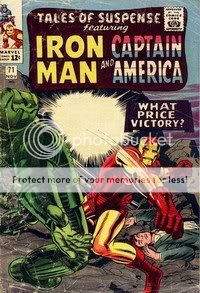
Iron Man strikes a blow for freedom in Tales Of Suspense #71
To modern sensibilities, the comics of the Silver Age seem more than a little formulaic. Pick any Marvel title off the shelf in the 60s and you’d most likely be treated to a story in which a villain turns up out of the blue to menace the titular hero and – after initial gains – the hero either finds himself or someone he loves under threat and so takes a pounding for the second half of the book before reversing his fortunes and winning the day by the closing frame.
To criticize this however is to miss the point of The Mighty Marvel Age of comics. The comics were as much about overcoming personal difficulties as they were world-threatening ones and if the structure of the stories lacked invention, Stan Lee more than made up for it by producing up to around half a dozen never-seen-before supervillains each and every month. Having said that, Iron Man seemed to be one character who got gypped from both angles in that his stories hardly ever deviated one iota from the Marvel formula and – excepting The Mandarin – fought villains who’s lameness was only equaled by their stupid costumes. Melter? Black Knight? Unicorn? Goofballs all.
Thankfully, Iron Man vs The Identity-Crisis Morons came to an end with a three issue epic in which Iron Man was called out by Communist Madman Boris Bullski in his guise as Titanium Man, in the hope of scoring a decisive propaganda victory en-route to becoming supreme dictator of the USSR. Phew!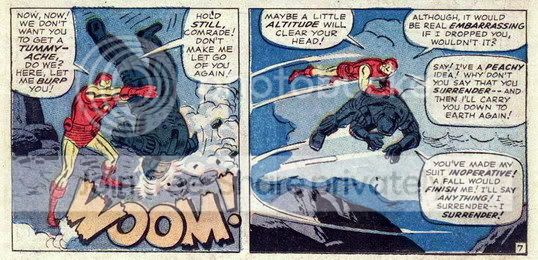
All together: “Tony Stark makes you feel, he’s a cool exec with a heart of steel…”
The ‘stage’ for their battle was the “Flyspeck on the map” country of Alberia on open ground littered with the relics of the aftermath of World War II, a nice touch as battle itself was the product of the WWII-aftermath Cold War. The build up was well handled too, Titanium Man actually being presented as a more than credible threat (Bigger! Stronger! Tougher! Etc) even as the man under the iron suit, Tony Stark’s heart was about to give out at any moment.
As the two give battle before the eyes of the world, the differences between Democracy and Communism are made clear (at least in Marvel-world) as Bullski declares “Fool! I relied upon your weak American Compassion to bring you within striking range!”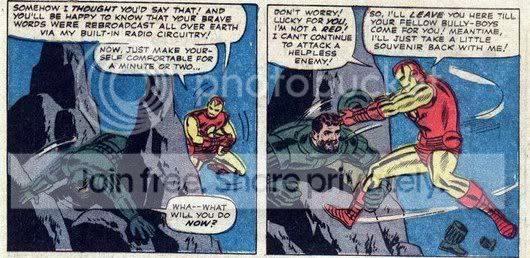
Americans: Physically incapable of wrong-doing
When Tony Stark’s driver, Happy Hogan, almost dies in bringing Iron Man’s newest weapon to the battlefield, it gives the armour-clad avenger all the inspiration he needs to utterly beat the tar of his dastardly Red foe. That’s one of the two major twists in the story, first that Titanium Man was never in the same league as Iron Man and that in the end, Stark suffers condemnation for apparently not being present at either the fight or at Happy’s bedside, losing the woman he loves in the process. A massive propaganda victory for the U.S of A and a personal tragedy for her hero Iron Man. That’s as definitely Silver Age as it gets.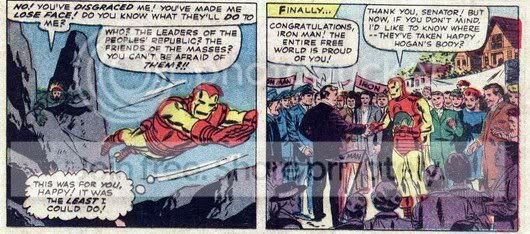
Tony Stark’s happiness is destined to be short-lived
May. 3rd, 2007
12:43 pm - The History Of Midgets
It is somewhat ironic that the great Isambard Kingdom Brunel, that giant of British engineering, is generally regarded as the inventor of the midget. He would often tell friends that he felt that “There is something unwieldy about a man, something which suggests that he is no longer fit for the purpose which his creator intended. The proper size for a man is small, with small cunning hands and small legs and that.”
When he learned of his wife Mary’s pregnancy he was determined that his first child would be a midget and so, after consulting several physicians of normal height, he prescribed a diet for his wife consisting only of small foods. Though she complained bitterly about being forced to exclusively eat beans, peas and a certain variety of potatoes which grew no larger than the size of a gnat’s house, it paid off when she gave birth to Dennis Kingdom Brunel who weighed only 4lbs at birth and at the age of eighteen stood no more than 3ft tall. Sadly, Isambard’s dreams of his midget son being a superior worker never came to fruition, instead the diminutive younger Brunel made a living posing for erotic woodcuts, this in turn led to a short-lived craze for eroticising little people and in 1868 Prime Minister Benjamin Disraeli remarked “When will our citizenry tire of the sight of a midget’s cock?”
Isambard’s second son, Wayne was born even smaller thanks largely to Mary only eating cauliflower dust. Though he was keen to emulate his father’s genius and success, at less than an inch tall he was rarely taken seriously. His only lasting achievement was the invention of the ‘Turning William’, a tiny loom used to spin mittens for cats.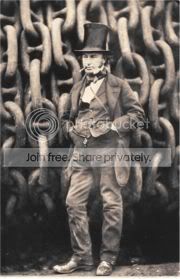
Wayne Kingdom Brunel photographed in front of his father’s watch-chain
It is widely believed that Isambard’s inspiration came from the tale of Gulliver’s Travels though it is more likely that he was influenced by several prominent midget figures in history, particularly the six-inch Pharaoh Pnut who is remembered less for his height than for his unusual wishes concerning his post-mortem internment. History records that Pnut worried that his royal architect, the notoriously stingy Inmyhonestopiniontep, would seize the opportunity to construct a four-foot pyramid as the tomb of his Pharaoh. Instead Pnut decreed that following his death, he was to be buried beneath the ground.
If Inmyhonestopiniontep had gone ahead with a tiny pyramid for his tiny monarch, history would have been very different. For example, Shelley’s poem Ozymandias probably would have gone something like:
“I met a traveller from an antique land
Who said:—A really small pyramid
Stands in the desert
What do you mean you can’t see it?
It’s there
There
Behind the Nissan Micra you halfwit
And on the pyramid these words appear:
"My name is Ozymandias, king of kings:
Look on my works, ye mighty, and…no, there you twat!"
Pnut’s burial plot was purchased by the fourth Earl of Bilston in 1923 and was on loan to the London museum until 1988 when it suffered serious damage, as pictured below:
CCTV captures the defiling of King Pnut’s final resting place
Midgets appear at various other points throughout history, such as Barry The Hun, the barbarian leader who rode a small chicken into battle and who led a disastrous assault upon a small suburb of Rome in 336AD. While a prisoner he converted to Christianity and was later deified as St Barry, the patron saint of chicken rodeos. It is common knowledge that Catherine The Great employed a variety of midgets in the position of ‘Royal Dildo’.
Anyone familiar with the epic poem Safety Dance will also know that midgets were a regular sight in many a medieval court where they were invariably employed as court jesters or dunnykin divers. It is sad however that the role of midgets during the Crusades is all but forgotten.
Prior to the 4th Crusade, in an act of desperation Pope Innocent III gathered together “Knights of good Christian character and impoverished stature” from all over Europe, in the belief that the Mohammedans would believe the midgets to be Djinns – demons of Arab folklore. Whether this ‘small crusade’ would have been a success will never be known as the Pope appointed one Sir Derek ‘Tich’ Tichson to lead them into the holy land, not realising that Sir Derek had received his knighthood only by accident when King Richard I hurled his sword at him when he caught Derek widdling on the royal turnip patch. The sword struck Derek upon the shoulder, severing his arm but knighting him in the process.
Under the leadership of Sir Derek, the small crusade failed to reach the holy land although they did win a decisive victory over the people of the tiny Cornish village Plankton-Upon-Whelk and convincingly converted the entire population of twelve to Christianity, though it’s certainly possible that they were Christian to begin with.
Midgets pop up again in history in even less auspicious circumstances when in 1642 Oliver Cromwell passed a law to mollify an increasingly frustrated clergy. The law stated that “Anye man of thee clothe who shalle desyre thee release of his fecundity, whilst he remaineth goodly in thee sight of thee Lord, shalle procure for hymself a man of more than eighteen summers who standeth no higher than a Christian sheepe. Thee mydgetty man shalle noe that he doeth both the work of thee law and Lord.”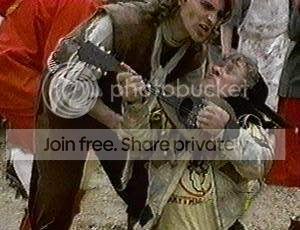
A typical medieval scene
Why then, if midgets have featured prominently throughout history, did Victorians seem to be ignorant of their existence and believe that Isambard Kingdom Brunel was their inventor? In his memoirs, John Delane the editor of the Times newspaper claimed that journalists and authors were effectively prohibited from mentioning midgets in any context, due to the fact that Queen Victoria herself loathed them, believing that they presented a poor image to the rest of the world of Britain as a haven for “little weirdos”.
Despite being entirely marginalised by the printed media, midgets were to play a pivotal role in the abolition of child labour in Britain, campaigning tirelessly to alter the law in order to prevent employers (particularly mine-owners) from hiring children as young as six to work in dangerous conditions. These jobs included ‘Hurreyers’ who worked the ventilation ports in mine shafts, ‘Millies’ who would make repairs to machinery in dangerous conditions and ‘Spinners’ who would be have rope wounded around them so that they could be used as giant yo-yos by bored businessmen.
Largely thanks to the efforts of the midget lobbyists and the martyrdom of the she-midget Elspeth Sprout who threw herself beneath the paws of the King’s hamster Mr Simons, child labour was effectively banned in the UK. However, those that would celebrate the tenacity of these big-hearted midgets should look to their ulterior motives. Unsurprisingly, many employers had problems filling the roles previously occupied by children and had problems with the idea of paying a man two pence a day to do a job previously done by a seven year-old for one groat per month. This is of course where the midgets came in and soon the little people could boast 100% employment for their kind.
The low wages and poor working conditions, together with the discrimination midgets suffered (a popular Victorian insult for them was “Shorty little short legs shorty bastard shortarse twat bastard short bastard twat), meant that they quickly became disillusioned. Luckily the advent of cinema provided a huge range of employment opportunities.
In 1904 the pioneer film-maker Sergei Tonks made a short entitled Midget Wearing A Hat which he followed up with Midget Walking A Dog, Midget Posts A Letter and Midget Wearing A Hat II: This Time It’s Personal.
It wasn’t until DW Griffiths took an interest in midget movies that the genre really took off, despite the fact that his first and only foray into midget movie-making was a complete disaster. His 1916 film Birth Of A Nation II: Back In The Saddle was effectively a remake of the original, albeit with midgets taking the roles of the Klansmen.
While the first film outraged blacks and civil rights groups, the sequel upset just about everyone from Jews and Blacks to midgets and even the Klan themselves. Most controversial however was a twelve-minute sequence in which every racial epithet that Griffiths could think of was displayed onscreen.
However, this did not deter many other film-makers from making their own shortarsed classics such as Hell Comes To Tiny Town, Even Dwarfs Started Small, Time Bandits and the haunting drama-documentary Willow.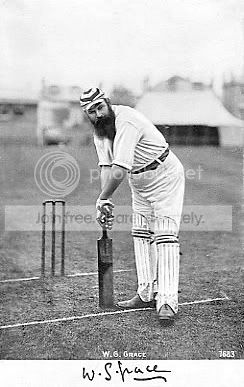
A recreation of how a midget might look if he was normal sized. And if he played cricket. And if he was W G Grace
In Nazi Germany, a midget’s lot was a typically unpleasant one particularly at the hands of Josef Mengele who performed many hideous and degrading experiments upon them in order to discover “What makes der little fellows so Gott-damn funny.”
There were five midgets however who escaped death, five who were employed as Hitler’s doubles. It’s well known that Hitler used scores of doubles who looked absolutely nothing like him, his reasoning being that this would confuse the allies than if the doubles were indistinguishable from the real thing. Sadly, the five (known affectionately as Der Smallenfuhrer) almost all came to a bad end.
The first of them, the 3ft 6 inch Klaus Weinstein was exposed as having Jewish parents and his life ended in a midget concentration camp. The second, Hans Unterwurst fell out of favour with the Fuhrer when he was caught riding Hitler’s dog, Blondi around like a horse. In his autobiography, Albert Speer wrote that Hitler confided in him, saying “It wasn’t so much that he was riding Blondi around the Reichstag, or even that he was whooping with joy. Rather it was the little pink cowboy hat and leather chaps which was most irksome.”
The third, Wilhelm Strucker perished in the bombing of Dresden and the fourth, US-born Richard Brenner fled to Brazil at the close of the war only to be found and arrested in 1961 and was sentenced to life imprisonment. He was deported to his native Texas and would have lived out the rest of his days there had he not strangled a guard to death in 1970. Brenner was subsequently sentenced to death by electric chair and it is said that it took a mere four volts to kill the unfortunate shorty.
The fifth of the Smallenfuhrers currently lives in Salzburg and recently collaborated on a book with a Jewish midget holocaust-survivor. The book, entitled The Smallest Hell On Earth portrayed life in the midget concentration camp Pollipokketen. He can also be seen playing the part of ‘Sneezy’ in Wolverhampton Hippodrome’s production of Snow White & The Seven Dwarves.
Some of the more famous ‘Hitler Doubles’:
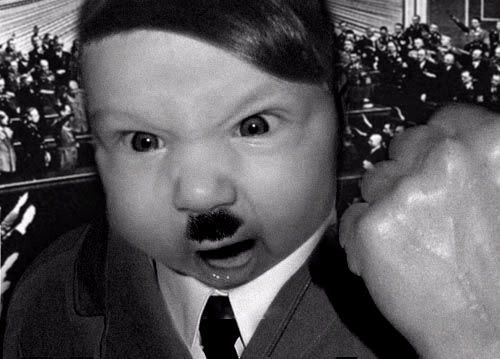
National Socialist midgets were back in the news in Sweden in 1992 when a midget by the name of Oystein Aarsøl was arrested for multiple counts of arson as well as the murder of another midget, Brian Briansson.
Aarsøl was the influential head of Sweden’s Short Metal scene and performed with the Short Metal band Nokturnal Shortum, using the stage name ‘Thingy’ because he claimed that he was “too short to have a real name.” A staunch white-supremacist, Aarsøl stabbed his former friend Briansson (sole member of the band Brusqum) to death after he caught the latter laughing at an episode of Hangin’ With Mr Cooper.
Aarsøl is due for release this year although he is unlikely to return to Short Metal, as he claimed in a recent interview that the music industry is infested with “Blacks, Jews and people of above-average height”. During his inarceration however, Short Metal has become big business for such bands as Cot Of Grime and Finnhobbit, the style of music being characterised by inaudible bass, raw production values and lyrical venom directed towards tall people as exemplified by the band My Duck in their song ‘Robert Wadlow-Raping Short Metal’.
Aarsøl pictured in a photo-shoot to promote his 1991 album ‘Betraying The Shire’
Though midgets have longed enjoyed roles in the entertainment industry, new technology looks to spell the end of that. Peter Jackson’s epic cinematic versions of The Lord Of The Rings used special effects to make normal-sized actors look like diminutive Hobbits and Dwarves. Asked how he achieved this, Peter Jackson remains tight-lipped about the processes used, although he has made vague references to ‘boxes’, ‘tip-toes’ and ‘the Tom Cruise technique’.
There was one role for a little person though, the actor Elijah Wood who was the only actor who’s size was digitally manipulated. In reality Wood is microscopic in size and was discovered living on a grain of salt by Peter Jackson.
Though the history of the midgets has not always been a happy one since the time of Pharaoh Pnut, midgets are here to stay and only time will tell what the future will hold for these proud people.
Mar. 28th, 2007
06:01 pm - My Gaming Wishlist
Ever think to yourself: “I want to play a game that doesn’t exist?”
No?
Oh.
Never mind, here are some games I wanna see:
SIEGE OF THE DEAD
After playing through a reasonably terrifying section of Resident Evil 4 where the player and a trigger-happy Spaniard have to defend a wooden cabin from hordes of maniacs, I realised that the world is primed for a really good Siege game. On a large scale, there are plenty of games which put the player in the shoes of both the besieger and the besieged.
The first four levels of King Arthur’s World on the SNES were a sheer joy as your army methodically assaulted a series of castles and towers, employing footsoldiers, knights, catapults, battering rams, explosives, archers and even the odd wizard for the task. Both Stronghold and Dungeon Keeper were also good examples of siege-style games though again on a fairly grand scale.
Mmm…King Arthur’s World…look at it!
What I want to see are games which deal with only a handful of individuals in modern setting. Imagine playing five or six different characters which you could set to certain tasks while occasionally taking control of individuals for more specific actions. Perhaps they could be based in a small two-storey building which is attacked at night by vampires. During the day the characters could sleep and spend time repairing defences and erecting new ones, preparing for a new assault each night.
Gratuitous Resident Evil 4 screenshot!
Each night the attacks would get more difficult to repel but each day fortifications would get better and more elaborate. Periodically the player would get the opportunity to move his or her characters to a new location, picking up more survivors along the way. House, Mississippi riverboat, wrecked train, skyscraper and shopping mall; all would be interesting and unusual places to defend against vampires, zombies, whatever.
POLICE QUEST X
Police Quest = Good
The thing I liked most about the Police Quest games was the nod to proper police procedure, particularly in the fourth in the series. Not surprising considering that the games’ creator was an ex-cop himself. Nail the baddie, sure but make sure you bag up all the evidence and have it analysed along the way and don’t put you or your partner in unnecessary danger. What I’m getting at is that I’m tired of being a supercop or supersoldier, alone against impossible odds. What I want instead is a cop simulator, featuring a myriad of everyday problems and crimes that confront the average policeman.
Okay, it’d take some ingenuity on the designers’ part to give even the most ordinary problem the same gravitas as the threat of alien invasion. If handled correctly though the end result could be interesting, taxing and – dare I say – educational.
CHEATERS: THE GAME
An increasingly popular theme in games today is photography (believe it or not). Bully features a smattering of photography missions, as does Dead Rising which apparently (I haven’t played the game myself) awards the player’s photographical skills based on criteria such as Horror, Brutality and…er…Erotica. Combine that with a bit of stealth and you have Cheaters: The Games. Yep, what I want is a game putting you in the shoes of a private detective, hired by suspicious husbands and wives to track down their other halves in order to prove or disprove their infidelity.
Stealth, photography and maybe a little fisticuffs would be the order of the day as you prowl around seedy motels and office blocks attempting to catch cheaters in the act. Bad taste of course, but undeniably a fun idea.
A particularly erotic moment in Dead Rising. Makes you wonder doesn’t it?
What games would you like to see made?
Feb. 21st, 2007
06:50 pm - The Greatest Games Ever: 1985 - 1995. Part Six: Mega Man II

Mega Man is a game so sequelled that there now exists a different iteration of the franchise for every man, woman and child in Lichtenstein. This would obviously be good news for all Lichtensteinians, should they ever suffer a nationwide malaise caused by a lack of colourful platformers featuring a little blue catamite.
Mega Man himself was created in 1963 by the education department of Japan as a way to teach sex education to children via the medium of cutesy ultraviolence. While no part of this entry so far has been true, it is true that Mega Man is just a little guy. A little guy with an urge to KILL!
Mega Man is a robotic little boy, built by Dr Light in order to combat the forces of evil, usually in the form of Dr Wily who is perfectly able to churn out his own legions of tech-midgets. This only asks more questions than it answers though, questions such as:
“What does Dr Light want with a perfectly formed little boy android?”
“Why did he give Mega Man a gun-hand, instead of…y’know…two hands and an actual gun?”
“What’s up with that all-in-one blue bodysuit?”
It’s not easy to pick out one Mega Man game as being the best example, mostly because they all follow the same format. In each, Mega Man must face a series of robot villains (with names like Needle Man and Elec Man) in their own themed levels in the order of his choice. After defeating an enemy robot, Mega Man would acquire a version of their weapon although some were so useless it’s a wonder why he bothered.
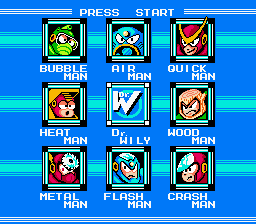
One particularly fine edition was Mega Man X on the SNES, although villains such as Spark Mandrill and Flame Elephant sounded more like rejects from a Metal Gear game. Mega Man 2 then is my choice for this list.
At heart, the second game to feature the little blue bully was less than remarkable. A dumpy little bastard at the best of times, he jumped like an elderly hedgehog, could only fire his gun in one bloody direction and he must be the only platform game character in history who couldn’t fucking duck. Thankfully, Capcom really seemed to have put their souls into the game. Great locations, brilliantly designed enemies (the giant robot lantern-fish was sublime), cunning level design and possibly the best bosses ever seen. Yep, you heard it here first – Mega Man’s boss battles were a joy rather than the chore that we’ve come to expect from most games.
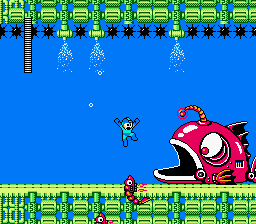
In fact, it’s probably more appropriate to focus on these weird little buggers than anything else. The rogue’s gallery follows:
AIR MAN
Level Description: High altitude flying platforms
Appearance: Stocky little sod with a huge fan in his chest
Weapon: Tornado thing
Notes: Perhaps the shittiest-named robot, Air Man was the first choice of foe for any canny Mega Man player. Occasionally chucking little tornadoes, his main method of attack was to blow you backwards with his chest fan really hard. Sadly, Air Man’s rubbish fan was somehow no match for Mega Man’s laser-cannon and so he could be trounced with ease.
BUBBLE MAN
Level Description: Dark underwater tunnels
Appearance: Weird little green bloke
Weapon: Bubble Lead
Notes: Swimming up and down slowly and occasionally firing the odd killer bubble, Mega Man could murder this soggy little bastard without breaking a robo-sweat. Bubble Man’s “Bubble Lead” weapon was entirely useless as – out of water it would trundle along the ground, only panicking the odd passing hydrophobe.
Get equipped with Bubble Lead!
FLASH MAN
Level Description: Ice. Lots of ice.
Appearance: A serious-looking guy with a big gun
Weapon: Flash Gun
Notes: Ice Man had already been done and ‘Snow Man’ sounded silly so Flash Man ended up as the boss of the obligatory frozen level. Flash Man was quite a challenge, stopping time with his “Flash Gun” before pounding Mega Man with a rapid-fire laser. Mega Man’s reward for defeating this irritating foe was the time-stopper. No rapid-fire laser though. Booo!
METAL MAN
Level Description: Factory
Appearance: Purple armour and a natty little buzz-saw on his helmet
Weapon: Metal Blade
Notes: Small and fast, Metal Man was a real challenge as he chucked his buzz-saws around like a rabid lumberjack. The immensely useful multi-directional buzz-saw gun was the reward here.
QUICK MAN
Level Description: Just…stuff
Appearance: Boomerang helmet that made him look as if he had one huge eyebrow
Weapon: Quick Boomerang
Notes: Fast Man had already been done and so Quick Man was only ever going to sound second-rate. Give him his due though, he was quick and his imaginatively-titled “Quick Boomerang” was a good weapon to have.
HEAT MAN
Level Description: Foundry
Appearance: A baby in a metal carton
Weapon: Heat Gun
Notes: Heat Man was quite cute, peeping out of his weird little box-armour. He was a proper pain in the arse though until the usually-useless “Bubble Lead” put paid to his evil/stupid ways. The chargeable Heat Gun was a decent weapon though.
WOOD MAN
Level Description: Forest
Appearance: Large wooden bloke
Weapon: Leaf Shield
Notes: Nobody makes robots out of wood. Do you know why? Because it’s a fucking stupid idea. This environmentally friendly idiot was practically immobile and couldn’t do much other than chuck leaves around while Mega Man immolated him with Heat Man’s weapon. The part where Mega Man snaps off Wood Man’s charcoaled penis and uses it to write “Japan #1” on the side of a passing elk was cut from western releases.
CRASH MAN
Level Description: A tower…to space!
Appearance: I have no idea what this arsehole was supposed to be wearing
Weapon: Crash Bombs
Notes: By now Dr Wily had clearly lost the plot. This robot’s name was Crash Man, he lived on a tower that reached into orbit and he chucked limpet mines around. Ummm, what was the theme supposed to be here?
LIMITED ANECDOTE MAN
Level Description: A branch of Woolworth’s, quite near to where pet hygiene products are kept
Appearance: Dishevelled
Weapon: The veil of exposition
Notes: Limited Anecdote Man was one of the game’s most dastardly foes, and it took all of Mega Man’s courage to overcome this cunning veteran. Limited Anecdote Man would initially pound our hero with a series of relentless stories from personal experience which often had no point or segued seamlessly into another equally pointless story. Luckily, with the power of true love and a little girl who never gave up hope…Mega Man can really win!
TERRY SMEWINS MAN
Level Description: A ‘Plenny’
Appearance: Four Clackstons held together with a bit of rope
Weapon: Monsoon Stevens’ Express Delivery
Notes: This secret character could only be found by pressing A + B + B + SELECT + B + B + START on controller 2, while a friend forces a lemon meringue into the ‘Hussy’ port on the rear of the NES.
WIZARD KITTEN MAN
Level Description: ???
Appearance: ???
Weapon: ‘Wand’
Notes: ???
After murdering and robbing Dr Wily’s stupidly-named army of weirdos, all that was left for Mega Man was to bash his way through Wily’s fortress, encountering along the way a huge robot dragon and a colossal monster brilliantly named Guts-Dozer. Again, the level-design really came to the fore with Wily’s fortress often seeming quite bleak and eerie. All of Mega Man’s purloined weapons could be used in innovative ways to battle through to Dr Wily himself who was an absolute bugger to defeat.
Looking back, it’s strange to compare the slow, plodding nature of Mega Man 2 with something like Tomb Raider. Even stranger when you consider that the former was the better game.
Dec. 14th, 2006
09:13 pm - The Princess Diana Memorial Concert: A Special Report
Because no-one demanded it…
For those of you in a permanent state of amnesia and unable to remember events from one moment to the next, a few years ago Britain’s Princess Diana died in an automobile accident in France. The accident wasn’t her fault although if she’d been wearing her seat-belt, she may well have lived to warm the cockles of the nation’s hearts for a few years more.
So far so Paris Pancake Princess.
Also a few months later the citizens of the United States Of America elected it’s first wizard President. President Zanathor of the Seven Mystic Keys of Ur-P’thakk will be fondly remembered for his conference with Russian Premier Boris Yeltsin during which he produced a series of pigeon’s eggs from behind the Soviet Vodka-holic leader’s ear. There was also the scandal involving a drab intern by the name of Moronica Thrimble who was turned into a newt during a private meeting in the Oval Office (which had been renamed The Crucible Of Torments). It’s true my amnesiac friends, check it out.
Trot on a decade or so and Diana’s sons, Prince Hitler and Prince Toff-Twat-Arse are planning a Princess Diana Memorial Concert. All well and good I hear you weep but I for one have three major issues with the planned Mourn-o-ganza and these issues are the words “Diana”, “Memorial” and “Concert”.
Let’s examine those words and their connotations in greater depth (caution: the following may feature a ritual stamping upon the memory of the Princess Of Hearts™ and may be unsuitable for those of a stupid disposition).
DIANA
Lady Diana has joined a select group which includes John F Kennedy (the ‘F’ interestingly stood for ‘Fuck’), Marilyn Monroe, Bruce Lee, Kurt Cobain and Dale Winton all of whom have died with their deaths inspiring conspiracy theories. In the cases of Kennedy and Monroe the evidence is compelling, for Lee it’s thought-provoking and for Cobain and Winton the theories are tenuous at best.
Although much has been made of the fact that Diana’s death may have saved the Royal Family a good deal of embarrassment and that it paved the way for Prince Charles to marry his horse, rather than being a cause for suspicion, Diana’s death should probably be considered to be the least mysterious death in the history of not being alive.
Princess Diana died from injuries that she sustained in a car crash. The car was being driven at between 70 and 100mph by a man so drunk that passers-by became intoxicated by osmosis. While speeding along Terence Trent D’arby Tunnel in the area of Paris known as “Le Wanky”, Diana’s car narrowly avoided a collision with a white Fiat Uno (possibly driven by blundering Gallic detective Inspector Clouseau) but failed to avoid a collision with a big wall. If I was writing for The News Of The World I’d write “like some hellish game of ping-pong, Our Princess Of Hearts’™ brum-brum rebounded off the Froggy wall and ker-smack-smashed into a big pillar. Diana (godresthersoul) was so splatty that ambulance men had to carry her to the hospital in a series of Italian-style espresso cups which are made extra-small because of science.”
If I had died in similar circumstances your first thought would most likely be no thought at all. Guy killed in drunked-up moto-prang. The world continues to turn. So what?
Your second thought may well have been “So he was taking it in the ass from Dodi Fayed huh? Interesting…”
For the record, I have never allowed any of the Fayed family to enter my rectal regions.
If anything, it could be suggested that Diana rigged her own suicide in order to kick-start the cult of maudlin fuckwittery that writhes along in her wake. Perhaps through the power of belief she will lIVE again as Dianor the thrice-damned soul drinking Princess Of Hearts™. Her holy book shall be The Daily Express and only one hymn shall be sung in tribute to her and you all know what that is.
Aside from the tendrils of stupidity that keep obscuring any rational view that anyone can possibly have on the matter, it is fair to say that her death was tragic. She died young-ish in a car accident which also claimed the life of her boyfriend which is a scenario so quintessentially tragic that it should be added to The Dictionary Of Tragedy (now online as Tragipedia!).
Fun fact:
Other events recorded in The Dictionary Of Tragedy include “The time that Young Alf the kitten stubbed his toe” and “That fucking awful Michael Richards interview on Letterman”.
Particularly crap is the suspicion that the car was being driven at such naughty speeds to escape Paparazzi who were desperate to snap pics of Our Sacred Lady Of Flowers And Happiness™ for the entertainment of braindead neo-peons.
Exit pursued by twats.
I googled “Paparazzi” and all I got was this disturbing image. Catamites with Cameras.
At the time the amazingly repugnant Daily Express had been printing grainy photographs of the People’s Princess™ - taken through long lenses over walls and under hedges - on an almost daily basis.
After DDDD-day (Diana and Dodi’s Deadly Death day) the Express got a fair amount of stick, though not quite as much as they should have done. Most likely other media outlets were slow to criticise them for fear of having the microscope turned upon themselves. The problem with living in shit is that it’s often difficult to complain about the smell of your neighbours.
More about the Daily Express later, but suffice to say that Britain’s Favourite Princess™ didn’t go the way that many would have liked her to go. Personally I’d like to have seen her stuffed to the gills with Chewits and detonated over the city of Wolverhampton as a kind of Piñata Of Hearts™
This tragic and possibly untimely death was the perfect fuel for a cult of Diana which fits the maudlin celeb-obsessed parasites that infect Britain like a glove. I don’t begrudge her the amazingly overblown funeral because – as crap as it was – as a former member of the Royal Family it was due to her if only to stop one million sub-idiotic Britons just turning up at the church. I don’t begrudge the Elton John tribute song largely because just slightly altering the words to a song that you’ve already written about someone else is a tribute so half-arsed that it renders the entire thing a farce.
I mean come on Elton, you cock-chobbling dullard, even I could do better than that. To prove that rather bold statement I have rewritten the lyrics to top cock-er-nee music hall song “My Old Man” so that it’s now a heartfelt tribute to the Princess Diana (Of Hearts)™:
My old man said "Follow the van,
And don't dilly dally on the way".
Off went the van wiv me 'ome packed in it,
I walked behind wiv me old cock linnet.
But I dillied and dallied, dallied and I dillied
Lost me way and don't know where to roam.
Well you can't trust a special like the old time coppers
When you can't find your way 'ome
DIANA’S DEAD AND SHE’S NEVER COMING BACK
SHE’S NEVER COMING BACK
YOU KILLED HER, YOU FUCKS
YOU KILLED HER AND SHE’S NEVER COMING BACK
What really grates is that Diana Supporters (two words which when joined together have precisely the same meaning as “Jizz-gulping donkey fellators”) pass off the most uninspiring facts about her as if they’re a cause to have her deified. 
The Flame Of Liberty: a tribute to Diana at the mouth of Le Tunnel De Royale Morte. I think it looks like a really big poo. Or maybe a croissant. The Croissant Of Liberty?
“She was so beautiful” Really? Was she? I’d have said that she was above-average at best. A bit too mumsy for me quite frankly.
“She shook hands with a guy what had an AIDS!” True but like many Royals, she had her hands removed immediately after and new hands were grafted on in a matter of seconds. This is a common procedure amongst the Royals and is for our protection as much as theirs.
“She did so much work for charity” so do the repugnantly ugly cleaning ladies that scrub the toilets where I work but I don’t see no tribute fountains for them. Unless of course you call the volcanic sprays of shit which someone keeps doing in the second cubicle a “Tribute Fountain”.
My personal favourite is “She gave so much of her time”. Of course she did. One thing that we can all be pretty sure of is that Princesses have stacks and stacks of time. Really, think of all the things you know about Princesses and see if any of those things involve working in Tescos.
I know a story about a Princess that Kissed a frog (the frog later filed a sexual harrasment law-suit). I know a story about a Princess that did a pee through a mattress. The hard-hitting documentary series Super Mario Bros has taught us that Princesses can be expected to be kidnapped on an hourly basis.
My personal favourite Princess though is Princess Stephanie of Monaco because she’s the only Royal person that I know of who’s been pictured in a magazine having a wank, as can be seen here.
Wanking, widdling. Sexually molesting amphibians and continuous abductions. It’s not hod-carrying is it?
So Diana: A slightly attractive over-privileged toff with Borderline Personality Disorder who did a bit of work for charity and died because she was too dim to know that if you’re going to let Oliver Reed drive you home then you probably shouldn’t let him put his foot down.
MEMORIAL
I have no shitting clue as to why the planet needs more Diana memorials. We already have a crap fountain, the French have a crap croissant and every single day we have The Daily Express, a newspaper which ensures that there is no danger of anyone forgetting any time soon that Diana died for our sins (despite the fact that they were paying photographers who routinely made her life a misery).
Super-good thing Wikipedia has this to say about Britain’s most fucking useless newspaper:
“The Daily Express has a reputation for consistently printing conspiracy theories based on the death of Princess Diana as front page news; this is often satirised in Private Eye and the newspaper is joked as being called the Diana Express or the Di'ly Express. Even on July 7, 2006, the anniversary of the London bombings (used by most other newspapers to publish commemorations) the front page was given over to Diana. This tendency has also been satirised by the website Mailwatch, which satirises and discusses the Express, the Daily Mail, and other newspapers. BBC News Online's Magazine Monitor has frequently noted that articles about Princess Diana are often printed on Mondays regardless of the existence of more pressing news.
As of December 8, 2006 the Daily Express has devoted its front page to Diana on 51 occasions during 2006 alone. For the week beginning August 27, 2006, the paper printed the "Diana Dossier" in which it claimed to ask all the questions related to the death. Diana was on the front page every day (except Sunday) that week.”
I asked top cultural commentator and skateboard enthusiast Ricky Tubular for a deconstruction of the Daily Express phenomenon.
“Radical! Oh man, my hang-time is boss! Dude! Daily Express though dude, that is so not cool. Daily Express is whack, dude.
In fact if you read the Daily Express then you deserve to have be hoisted into the air by pins driven part-way into your skull. Then while candle-flames lick at the souls of your feet, your jaw should be dislocated while your eyes are gradually extracted from their sockets and replaced by angry vinegar-soaked scorpions. As your fingers are gently smashed with toffee-hammers you should be forced to defecate, consume your issue and then defecate again thereby creating a cycle of disgust. Just before your kneecaps are smashed, removed and then driven through your heart, your stomach will be opened and a large hot coal in the shape of a foetus will be planted there until you give birth any way you are fucking able.
Gnarly! Peace out.”
Neither myself nor Ricky Tubular are in favour of a memorial.
CONCERT
I understand that for this memorial to be a success, only mainstream acts can be booked. Still, as the acts are supposed to represent the musical tastes of Diana and her sons, it says that between the three of them they haven’t a fucking clue. Actually, that’s not strictly true because Diana was said to be a big fan of Swamp Blues lunatic Captain Beefheart, but I suppose that your musical tastes become blander as you get older and deader. I mean, you might well be planning to have “Black Flames and Blood” by Barathrum at your funeral but you just know that some nonce is just going to play “Angels” by Robbie Williams instead. “It’s what he/she would have wanted” they’ll say. “It fucking isn’t” you’ll say. In hell.
Wouldn’t it be great though to see the faces on thousands of terrified Diana-ites as some Captain Beefheart tribute band belts out “Ice-cream for croooooooow!” We can only fantasise.
Remember ages ago when I put up this picture of Good Friends cereal that I’d potatoshopped to include a Jew and Josef Mengele? Yes, it was funny wasn’t it?
Particularly tragic is the addition of hipple-hopper Pharrell Williams. Now, I have no idea about this Williams aside from the fact that he’s a rapper. This means that Prince Charles, a posh old white guy is going to be forced to attend and will have to listen to rap and pretend to enjoy it and let me tell you, he’s not going to like that at all man. I remember when my Dad heard Sean Paul, I thought that he was going to collapse from culture-shock alone.
Still, I bet that was a funny invitation. “Oi Charles, we’re having this big love-fest for your dead ex-wife. You know, the one which everyone thinks was killed on your orders. Well anyway, there’ll be rap and pop music and Joss Stone whoever the fuck he is. You will be there won’t you?”
Elton John is of course going to be there too. With his ten year-old’s haircut he’ll most likely be singing Candle In The Bastard Wind. Some people say that Sir Elton gives homosexuals a bad name. I say that he gives bipedal life a bad name.
Announcing the concert, Prince William said: "We both wanted to put our stamp on it. We want it to represent exactly what our mother would have wanted.”
Really, are you sure that your mother would have wanted a memorial concert to herself? I think she would have preferred just not to be dead, thusly rendering a memorial concert unnecessary. Less money for memorials and asylum seekers and more money for Princess resurrections.
And that’s it. I have no idea what my original point was but I’m sure you’ll agree that it was well made and is a fine tribute to Dirty Diana, one of Michael Jackson’s best-loved hits.
Aug. 18th, 2006
11:52 am - 100 Secret Heroes Of Cinema Part Four: Klaus Kinski

A glance at the quotes attributed to Klaus Kinski on imdb.com are as instructive as to the man’s character as anything could be:
“One should judge a man mainly from his depravities. Virtues can be faked. Depravities are real.”
"I'd have been better than Adolf Hitler. I could've delivered his speeches a lot better. That's for certain."
"I choose films with the shortest schedule and the most money."
Of Polish-German heritage, Kinski was born into poverty and spent much of his early life in Berlin and much of WWII as a POW. He gravitated to the theatre shortly afterwards as it apparently fed his passion for performing as well as supplying him with a continuous stream of young women. Whether his ardour for performance was greater than his ardour for the opposite sex is debatable and the description of him in one review of his autobiography as a “Walking appetite” is apt.
Though seemingly most comfortable in solo performances and incredibly critical of those that he deigned to work with, Kinski seems to have been entirely undiscerning when it came to accepting film roles. His appearance – generally ghoulish and bug-eyed – made him stand out in any scene he was in, to say nothing of his often wild, energetic performances. Unsurprisingly this made him much in demand as a villain and his place in world cinema may well have been no more than a footnote if it hadn’t been for a series of collaborations with director Werner Herzog. Though every one of his performances in these films is nothing less than a mesmerising tour-de-force, he was dismissive of most of them and variously described Herzog himself as a cretin, coward, a sadist and a murderer!
Again, Kinski puts this across better in his own words:
"Now I absolutely despise the murderer Herzog. I tell him to his face that I want to see him perish like the llama he executed. He should be thrown to the crocodiles alive! An anaconda should throttle him slowly! The sting of a deadly spider should paralyze him! His brain should burst from the bite of the most poisonous of all snakes! Panthers shouldn't slit his throat open with their claws, that would be too good for him! No. Big red ants should piss in his eyes, eat his balls, penetrate his asshole, and eat his guts! He should get the plague! Syphilis! Malaria! Yellow fever! Leprosy! In vain. The more I wish the most horrible of deaths on him and treat him like the scum of the earth that he is, the less I can get rid of him!"
The first of their films together Aquirre, Wrath Of God (1972) has him as the insane conquistador Aguirre leading a doomed expedition to find El Dorado. In the title role, Kinski seems to project himself out of the screen as a menacing tyrant heading into his own Heart Of Darkness. Off-camera Kinski managed to menace the crew too, threatening to kill Herzog and shooting a crewmember.
Despite continual abuse and threats, Herzog would cast Kinski in a further four films; Woyzeck (1979), Nosferatu the Vampyre (1979), Fitzcarraldo (1982) (in which they would both return again to South America) and Cobra Verde (1987). In each he appears to be possessed by a different mania to the point where it’s almost impossible to see the actor beneath the performance. Asked about his technique in portraying Aguirre, he replied “You just have to remember yourself in the 16th century”.
While his films with Herzog are undoubtedly among the finest ever produced in Europe, he made little impact in English and American films, generally playing a second-string villain – most memorably perhaps in Sergio Leone’s For A Few Dollars More as a hunchback.
Thankfully in amongst a mass of instantly forgotten films and roles, Kinski has left his mark as one of the greatest actors of the twentieth century and led life so debauched as to make a Roman Emperor blush.
Aug. 16th, 2006
02:32 pm - The Greatest Games Ever: 1985 - 1995. Part Five: Tecmo World Wrestling

"Hello! ....And welcome to the Tecmo World Wrestling extravaganza. I'm
your announcer Tom Talker coming to you live from the magnificent Tecmo
Coliseum. The Mega-Event is about to begin where the TWW Title Crown is
on the line. Who will win and become the new champion of Tecmo World
Wrestling? Just think, you could be sitting on top of the world wearing
the TWW Champion Belt! Go for it!"
This is how Tecmo World Wrestling commentator Tom Talker welcomed the player to the divine wonder that was the NES’s premier wrestling game. Anyone familiar with Nintendo’s little grey brick will not be able to read the rest of this review as they collapse into a heap, dribbling and muttering “A good wrestling game on the NES?! With…with commentary…but how…and why?”
Dribble ye-not Nintendo faithful for Tecmo did indeed sneak out a wrestling game for the NES in 1990 that would be the best wrestling game in the entire world until WCW vs The World came out on the Psone seven years later. Okay, I’ll quit with the italics now.
Before I get on with the Tecmo love-ups I’d like to digress a little now that we’ve staggered onto the greatest games of the NES. Aside from the Mario games (which won’t be covered here as they’re much too storied already) it struck me that the NES wasn’t exactly awash with great games. Good games yes, tons and tons of good games but very little which still provokes an-erection-for-the-worst-reasons in me today. What many NES games lacked was innovation. The Mario games cast a shadow over gaming of such length that almost every developer in the world was desperate to release it’s own Mario-beater which of course never happened. In fact, the only platformer to eclipse Super Mario Bros was…Super Mario Bros 3.
Okay, so you could say that the most innovative platformers on the NES was Gyromite a game which friendless shut-ins could play with R.O.B, a useless robot peripheral. But get this: It was rubbish.
Yes, R.O.B was a waste of cheap plastic and he made children cry. Not all robots are rubbish though and proof of this can be found here:
Baron Von Joy? Oh man!
Yes, the NES had loads of quite good/extremely insane games but greatness would have to wait for the SNES years later.
Okay, if you’ve been sitting here for the past two minutes imagining the NES’s sound-chip being put through the wringer as it utters thousands of lines of digitised commentary then put your cock away and look at this bubble-burster:
Yes, Tecmo’s commentary was printed on-screen below the action. I actually credit Tecmo with the fact that I have so little trouble watching subtitled films today as I quickly got used to reading Tom’s witty comments while placing my opponent in the Cambodian Reverse Donkey Breaker.
I’m not being facetious here either, whoever wrote Tom’s script possessed both a sense of humour and an adequate grasp of the English Language. Being Nintendo, we would have forgiven TWW if the commentary had been something like:
The stream of greatness didn’t end there though as TWW also featured close-up replays (actually standard cut-scenes) whenever your character performed one of his signature moves. Every wrestling game up to then (and for a long time after) suffered from a severely limited moveset which was completely inexcusable when you consider that each character in TWW had 23 moves apiece which should technically be impossible when you consider that the NES joypad only had two buttons.
Tecmo got around this by changing the moves which your character could perform when he got down to 50% health or less, meaning that your opponent would get more dangerous the more that you wore him down…Hulk Hogan style! The makers of the game were clearly wrestling aficionados too, as they’d crammed it with lots of technical (and properly named holds) and fun of the most brutal kind imaginable to a twelve year-old.
Hurl your opponent over the top rope with a Gorilla Press? No problem.
Elbow drop him from the top turnbuckle to the outside? No problem.
Scoop him up and pile-drive him onto the concrete? No problem.
Dance around his corpse while urinating and singing “Carry on my wayward son”? No problem (as long as your imagination was as vivid as mine was).
But wait, it doesn’t have to be:
There was such a satisfying crunchiness to it all too. When Road Warrior Animal-a-like Rex Beat piledrove Hulk Hogan-a-like Julio Falcon you really could hear the nuances of compacted vertebrae and Dr Guildo’s Argentine Backbreaker would have provoked copious vomiting in anyone sensitive to the sound of a snapped spine.
TWW’s only real weakness was that it was a button-basher, in that when your wrestler’s locked-up, the fastest to hammer on the joypad buttons was the winner. Games like this have left me with the nimble fingers of a jazz pianist and thumb-bones with the consistency of crunchy peanut butter.
I can only imagine that Tecmo World Wrestling was an unpopular title because no sequel to it ever appeared, in contrast to the ten billion lame and limp WWF/WWE games that are still being coughed up today. A shame really because anyone missing out on this was missing out on the greatest NES game never to feature Mario or that little blue catamite Mega Man.
Now don’t you cry no more!
02:32 pm - The Greatest (comic book) Stories Ever Told Part One: Dragon's Claws
Comic: Dragon’s Claws
Principle Characters: Dragon’s Claws (Dragon, Steel, Mercy, Digit and Scavenger)
Publisher: Marvel UK
Issues: 1 – 10 (1988 – 1989)
Story: Various
Dragon’s Claws assemble for the cover of issue 7
Originally existing only to reprint US titles, by the end of the 80s Marvel UK was producing an impressive range of home-grown titles such as Doctor Who, Real Ghostbusters, Death’s Head and The Sleeze Brothers. It’s stand-out release however was the Dragon’s Claws mini-series.
Written by Simon Furman and drawn by Geoff Senior, Dragon’s Claws was set on Earth in the year 8162, a planet plunged into chaos and anarchy since it had shifted from it’s orbit and was slowly moving closer to the Sun. As an opiate for the masses, The Game was created. Although never fully fleshed out, The Game seemed to be a televised sport where two teams of five strove to eliminate one another by non-lethal means. There were a few teams however who refused to abide by this no-kill rule, leading The Game to be banned due to it’s escalating violent content.
The comic begins with the reformation of a team called Dragon’s Claws, brought back together by a powerful organisation called N.U.R.S.E (National Union of Retired Sports Experts), essentially as a special forces unit doing the government’s dirty work.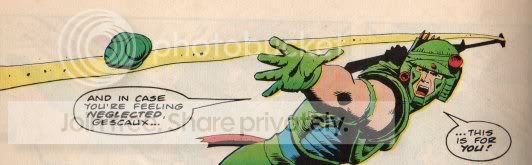
Dragon makes a point
Consisting of Dragon, Digit (a cyborg), Steel (a samurai), Mercy (an assassin) and Scavenger (a mutant ex-con), the Claws went up against other former teams, criminals, insurrectionists, the mechanoid bounty-hunter Death’s Head and eventually N.U.R.S.E itself. Brilliantly drawn and sardonically scripted, the world of Dragon’s Claws was twisted, apocalyptic and violent but ultimately very believable. Like the world of 8162 itself, all of the major characters arrived as complex and fully-formed constructions.
On many occasions Dragon found himself undertaking jobs for his masters which stretched his moral boundaries to breaking point. The pacifier for the proles had failed and those same proles could hardly be blamed for rising up against a seemingly uncaring government.
Unfortunately, due to poor sales another series was never commissioned which is criminal considering how much more the characters had to offer. As it stands, Dragon’s Claws was Marvel UK’s finest hour and remains one of the best comics ever produced. 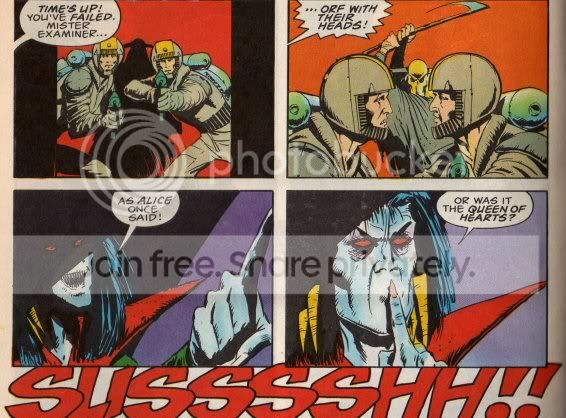
Dragon’s arch-nemesis Slaughterhouse and Evil Dead team member Kronos
Feb. 13th, 2006
10:52 am - 100 Secret Heroes Of Cinema Part 3: Takeshi Kitano

Apparently, in Japan he’s well known as a satirist and gameshow host, but in the west ‘Beat’ Takeshi is a name synonymous with highly artistic gangster films which are notable for shocking and disturbing violence. Even so, it seems highly unfair to pin Kitano down as any one thing. His films can be achingly beautiful, loaded with visual poetry and poignant moments, they can be blackly humorous and then – of course – they can scare you witless with the sheer aggressive intensity of the characters that he plays. A poet, satirist, novelist and painter: all of these elements are evident in his film-making.
Kitano first came to the attention of western audiences (or at least, what few of them would sit through a Japanese film) in Violent Cop (or Sono otoko, kyôbô ni tsuki which roughly translates as “Warning, This Man Is Dangerous”). Very much his quintessential film, Kitano’s character Azuma exhibits the zen-like calm pierced with explosive violence that he would soon become well-known for. Many have compared the film to Dirty Harry, though it seems likely that if Harry Callaghan ever ran across the amoral Azuma, the former would shoot the latter inside of two minutes.
In Sonatine he introduced a gentler and much more charismatic side as the troubled Aniki Murakawa. Essentially “gangsters on holiday”, Sonatine portrays a group of Yakuza who are forced to hide out in a beach-house. With none of their usual diversions, each gangster seems to revert back to a gentler state, as if remembering a happier and more carefree time.
Many of Kitano’s visual standards are in evidence here too. Lingering shots, long shots and his highly effective habit of depicting reaction rather than action. Murakawa becomes a highly sympathetic character as he struggles with the idea of escaping what he is and the result is one which you’ll probably carry with you for the rest of your life.
It was Hana-Bi though which gave Kitano true univeral acclaim however. Telling the story of two retired cops (one through his own choice and another through a crippling injury), Hana-Bi tells the story of them both coping with their new lives. While one rediscovers inner peace through painting, Yoshitaka Nishi (played by Kitano) falls into debt with the Yakuza after borrowing money to pay for his wife’s medical bills.
Throughout the film words are used sparingly, with images (which are after all, the language of film) conveying emotion in place of dialogue. The result is a disarmingly human film with characters that you feel you could reach out and touch. A masterpiece.
Since then Takeshi Kitano has continued to make incredible and fascinating films such as Gohatto, Brother, Battle Royale (directed by Kinji Fukusaku) and Zatoichi. The latter being a resurrection of an iconic Japanese character who had already appeared in twenty-five films. Zatoichi was quite a mold-breaker for Kitano with bolder humour and a more conventional approach to film-making. Interviewed later, he did however assure everyone that soon enough he’d be back with his trademark lingering long-shots and artistic sensibilities. Completely un-Hollywood and completely brilliant.
Navigate: (Previous 10 Entries)

