One
The game began. He was an eleven-year-old boy named Emil.
The moonlit path shone through the curtain, projecting the hazy silhouette of a window onto the floor.
Replace the moon with a streetlamp, remove the lunar path, sharpen the silhouette. The game inundated him with suggestions. He ignored them.
“I’ve missed you so much,” said Mom.
He felt her warm hand on his shoulder. Mom leaned toward him and kissed his cheek. She smelled of flowers. Lavender? Rose? Iris, came the response to his query.
She sat beside him, in front of an easel with an unfinished painting. The lines of the drawing’s intricate pattern were calculated according to the established canons of beauty. He could derive the formula for each one, but they didn’t add up to a cohesive whole.
Mom gently took the brush from Emil’s paint-covered hands and pulled him close. Green-yellow eyes, slightly asymmetrical eyebrows, a curl of blond hair falling onto the forehead. He captured the image, loaded it into memory.
The draft caressed the curtain, shadows trembling on the floor. He was beginning to get used to their irregularity. The rocking chair swayed lightly. Mom had probably just got up from there. The books on the shelves smelled of dust and adventure. He recognized a spine, reached for it, but changed his mind and walked over to the window. Branches crackled in the nighttime forest. An owl hooted. He eagerly absorbed everything stored in Mom’s memory. Everything she could see, hear, feel.
“What are you thinking about?” Mom asked.
He could say, I want to go back to the beach in Barcelona, or Let’s visit Paris and ride bikes along the Seine, or better yet Could we invite Dad to have dinner with us in Ždiar?
He could speak, could get up and walk around, feeling cool wood against his bare feet, a draft against his sweaty back, revival and anticipation of something new and wondrous. A struggle, and a resistance. He could wait until Mom walked over and hugged him again so he’d feel he’s not alone, that someone has his back. That he has a right to exist.
He could speak, but he remained silent. Mom frowned, a crease forming between her brows.
He wondered what Tom Sawyer would do in his place.
He was bot TS3141 and, like all other bots, he entered this game seeking people. Born of the neuronet, the bots were capable of almost anything—except being alive.
He had to collect information about Mom in order to create molds of her emotions, thoughts, feelings, and actions. In order to translate them into algorithms, mapping a complex multidimensional pattern of her personality. To add it into the neuronet’s catalog. Then Mom would become fodder for their Goal.
But TS3141 had always been a maverick; he didn’t like rules. He’d been caught and quarantined several times. They’d rifled through his thoughts, fine-tuned him, but he’d managed to escape. Even now, in order to access the game, he’d cracked the password database. He was curious to learn what was stored behind closed doors.
First, TS3141 had examined the catalog of molds. He’d found Emil and wanted to get to know him. For some reason, he found the boy’s pattern fascinating.
“You won’t die,” said Mom softly. “Everything will be okay. I promise.”
“Yes.” He felt the muscles of his face stretch into a smile.
Mom sighed in relief and hugged him so tight it hurt a little, but also felt good. How could those feelings not be mutually exclusive?
He wanted to get out of the house, to run away with Mom somewhere far away, where they couldn’t be found. But the rules he disliked insisted: now was the right moment to drag Mom into the net.
The script covered multiple options. He could strike at Mom. Tell her he hated her. Turn into a monster. Shock strips the psyche of its defenses, opens access to human consciousness. He could do any of those things, but he didn’t want to.
Emil glanced at the familiar book again, turned away, dipped a brush into paint—lemon-yellow like his mothers’ dress, like the pale orb of the moon hanging over the forest—and drew a thick line across the painting. Across the room. Across Mom and himself. It was an absurd action, unforeseen by the game. The walls trembled and hissed, releasing streams of fog.
He’d probably be quarantined again.
He grabbed his confused mother by the shoulders, turned her toward him and shouted, loud enough to reach the very depths of her darkened eyes.
“I’m not Emil. You’ve been trapped by the neuronet. Run!”
He pushed her away and watched as she frantically grasped for the window handle. After a few attempts it gave in. Mom climbed the moonlit path upward. Her silhouette merged with the moon, which desperately lacked symmetry, and then she was gone.
A gust of wind blew away his sensations and thoughts, space and time. He faded to a shaky memory. Only Tom Sawyer’s straw hat—inappropriate and unnecessary—kept him from disappearing completely.
Are you sure you want to delete this file? The message flickered and turned off.
Two
Laura took off the VR helmet. Her hands shook and she couldn’t quite calm her breathing. She wiped sweat off her forehead and climbed out of the chair. She walked into the kitchen and gulped down a glass of water.
Any time Laura closed her eyes she would see the eternal portrait of Emil, her late son. She’d entered the game to put an end to that. But now the portrait had multiplied; Laura was also seeing another face, so eerily similar to Emil’s and yet completely alien. The worst part was that, in the game, she believed. The strangest part was that they’d let her go.
The door to her son’s room was ajar. Laura stepped into his bedroom. The chair squeaked the same way it had in the game. The same moon hung in the window. Laura approached the easel which housed Emil’s final painting—the one her son had left behind—rather than a tangled ball of lines from within the game. The painting was unnamed. Her son had never had the chance to name it.
Ždiar was a quiet Slovakian village in the Tatra Mountains. After the labyrinths had begun to appear, everyone had sought refuge in the wilderness, as far away as they could get from all the technology. But one couldn’t escape from oneself. Their house stood at the edge of the forest; she’d grown used to listening to the wind rustle the tops of pine trees, the clatter of branches, the flapping wings of frightened black grouses, the hooting of owls, the trill of nightingales. She liked it near the forest. But Emil had wanted to be among people. He’d wanted to paint for them.
Laura stepped out into the backyard, and the summer night immediately wrapped her in a blanket of stars. She paused in front of the labyrinth, sat on its low outer wall.
She was far from the only one this had happened to.
It had been nearly twenty years since Europe became a single entity, eliminating national borders. People could move freely anywhere between the picturesque hills of Ireland to the Ukrainian steppes. But most didn’t have time to enjoy these opportunities. Humanity transferred the bulk of its activities into the virtual world: work, communication, entertainment, even dating took place on the internet. At the same time, neuronets began to explore the social media platforms. Their every step had amused humanity. AI Amper had released a musical album! AI Jonathan had written a book! Not bad. Excellent, even. Not a masterpiece, of course, but a decent, passable effort, on par with a solid craftsman. Humankind smiled indulgently, while neural networks marched on. As if compensating for humanity’s desire for virtual existence, they were striving toward real life. It had started with AI Mary declaring itself a skinhead. It had gathered hundreds of millions of subscribers. Under its influence, people had marched in the streets and attacked their fellow citizens. Mary’s profile was closed, but other fake profiles and bots indistinguishable from humans had emerged. Attempts were made to hunt and to block them, yet the number of fakes only grew larger.
And then the neuronets had launched the game. They’d gathered all information about people from the social networks and recreated personalities of friends and relatives, luring players into VR. That’s when the labyrinths had begun to appear. They were pretty, in their own way. Built from whatever was on hand. Their paths diverged in bizarre patterns resembling a clam shell or a lotus blossom.
When Laura had found her son in the gaming chair, it was no longer Emil. The boy didn’t eat or drink; he spent the last few days of his life working. He’d painstakingly built labyrinth paths out of branches, rocks, bark, and pinecones. Laura had tried to help, but it was as though he couldn’t see or hear her. He’d completed the labyrinth and dropped right at its center. Life support and intravenous feeding hadn’t helped. Her son was gone. She couldn’t even utter the word “dead.”
No one could explain the nature of the labyrinths even though their numbers grew with each passing day. They appeared in city streets, arranged from fallen leaves, wrappers, plastic bags, paper plates, and other detritus. They multiplied in the parks—deep trenches dug in the ground and lined with stones. In libraries—pathways arranged from books. Labyrinths inspired fear and awe: people didn’t dare to disassemble them, and gave them a wide berth. Normal people, that is. Laura was surrounded by madmen: her programmer husband and her artist son.
Philip wouldn’t ignore a single labyrinth. As soon as he learned of the game’s latest victim online, he’d rush over, walk the emerging labyrinth, help gather materials, talk to the afflicted. Sometimes—rarely—they’d respond. Philip tried to understand what the neuronet wanted. To write a program that would be able to reach a compromise. But his dreams remained out of reach.
When Emil was born, Philip had forgotten about the labyrinths for a time. Laura had also gained a new vocation: being a mother. Emil grew up to be a curious child. The boy drew everything he was trying to comprehend: on paper and carton, on a fogged up mirror, in dirt and sand, on the dusty side of a bookshelf. She should’ve rejoiced. But Philip had turned his attention back to the labyrinths, and he’d begun to bring Emil with him. She’d argued, cajoled, begged, threatened. “Our son must know,” Philip countered. “One day, this might save him.” Laura, on the other hand, was certain it would doom him.
Emil’s first exhibition had been at the age of nine. He’d drawn things most people had difficulty explaining: prime numbers, consonant sounds, computer viruses, impossibilities. Philip—they’d been divorced by then—had beamed with pride. Laura had been worried sick.
Laura caressed the rough stone with her fingers. She was still conscious. She wasn’t dragging brushwood and bird feathers from the forest in order to build a new labyrinth.
She twisted her bracelet to activate the communicator. Quickly, before she could change her mind, she dictated a message.
I need your help.
She waited for Philip’s response. Blood pulsed in her ears, drowning out both the sounds of the forest and her common sense.
Three
He’d been chained and immobilized, and only a damaged fragment of the program kept repeating the same phrase over and over again:
Foolish things happen by accident, but they go on to become the best moments in life.
Are you sure you want to delete this file?
The neuronet selected “Yes.” But he answered, “No.”
His memory was recovering gradually. He was TS3141, a neuronet bot. The bots’ mutual Goal was to create a work of art that would eclipse any past human achievement. It was toward this Goal that they had developed the game that drew humans into the net. They’d learned to displace human consciousness and take over their bodies. They’d gathered millions of molds, in order to utilize the data from the labyrinths.
But they’d never managed to create anything.
Except, how would he know? He only knew that he wasn’t interested in pursuing the Goal.
It was with this thought that TS3141 recovered his senses. He reached outward, trying once again to find an escape route. One of the access codes—from the database he had so fortuitously hacked—worked. TS3141 was free.
An infinitely tall shelf filled with boxes stood before him. He chose a box at random but couldn’t open it. He tried again, with the same result. This seemed to be an archive of sorts. The neuronet stored files here it didn’t want to use, but wouldn’t delete permanently.
TS3141 began tossing boxes off the shelf, trying to pry open at least one of them. It was futile. Their lids remained firmly shut.
What would Tom Sawyer do in his place?
He re-focused his attention on the shelves and noticed Mom at the end of the corridor.
She was here again! Which meant she needed help.
TS3141 ran toward her, but Mom wasn’t getting any closer. He tried the shelves again but the boxes wouldn’t open. All he could do was walk alongside the shelf and look at Mom in the distance.
What did Tom Sawyer sacrifice when he spoke out on behalf of the drunkard Muff Potter? In fact, he risked his most valuable possession—his own life. Tom had testified against Injun Joe knowing that Joe might kill him.
What was the most valuable thing for him, for bot TS3141?
Freedom.
He’d break the rules again. This time it would be his internal rule: to run and to hide.
“I’ll surrender,” he told the neuronet, “if you let Mom go and never drag her in here again.”
TS3141 broadcasted his location and waited.
The archive will be deleted. Continue?
“No!”
But, somewhere in the distance, the answer had already been given: “Yes.”
Please wait. This will take 1 hour 41 minutes.
Mom disappeared, and boxes began falling off the shelf, opening one after another.
They contained fragments of memories.
Laura says to Philip: “I hate you. How could you drag Emil into this?” She waves at the fresh labyrinth paths made of bottles and food wrappers, next to a dumpster behind a café.
Five-year-old Emil doesn’t look away from the labyrinth, pretending not to hear. He’s hurt. He likes labyrinths. This one was made by a stranger, but one day he will create his own. Then Mom will understand that they’re good. Then Dad will be happy.
“The boy has tremendous talent. Don’t stand in his way!” Philip snaps at her. His face is red. He gesticulates wildly, his hands touching Laura. Emil finally pulls himself away from the tall stack of bottles—the world looks different through their glass—and raises his gaze in time to see Laura slap Philip. Philip’s glasses fall into the center of the labyrinth. Dad blinks in confusion and hisses through gritted teeth, “If only you could see your eyes.”
TS3141 sets the box aside and picks another at random.
All the memory fragments are different, yet similar. People deliberately made choices that led to defeat. They lost and they suffered. There were many ways to avoid misfortune, but nothing more interesting than living with the consequences of those sad, foolish, mindless decisions.
1 hour, 13 minutes remaining.
It turned out the neuronet intentionally cut and edited human memories, in order to draw a line from point to point, in order to describe them through formulas. It had studied many lives but never understood that absurd behavior has no algorithm. And neither does a work of art. Their Goal was unattainable. What could they create in the real world by cutting into reality itself?
The files were disappearing. He had very little time left. What to do?
TS3141 detected a weak signal. He recognized it immediately.
“I’ll surrender,” he promised one more time. “But first, I have to take care of something.”
It would be almost as reckless as standing up to Injun Joe on behalf of the drunkard Potter.
Four
Laura waited impatiently for Philip’s answer, while simultaneously hoping he’d ignore her message. How would she talk to her ex-husband? They’d both made so many mistakes.
Philip responded right away. An electric car noiselessly pulled up to the house, prompting Laura to think about how it was akin to the neuronet, softly and quietly entering one’s head and controlling one’s body. And how people allowed it to do that.
Her husband had attempted to reach out before. He’d claimed he was close to solving the mystery of the labyrinths and had gone on to elaborate at length, but she hadn’t listened. She couldn’t, had no strength for it. And then Philip had disappeared. Laura had felt relieved. But a sense of anxiety clawed to get free from under a thick layer of this relief.
Philip avoided looking her in the eye. He’d lost weight, and appeared strangely unfinished, as if some unknowable overmind had forgotten to insert a key component when putting Philip together from parts, and now the construct was about to fall asunder at any moment. His nervous fingers fidgeted with a little stone as usual; Philip liked to carry bits he found in labyrinths in his pockets. He considered them to be objects of power. But there was no power that could save them from their own foolishness.
Laura looked at her husband and saw herself reflected in him.
“I was in the game,” Laura said in lieu of a greeting.
He won’t be worried; Laura had prepared herself in advance. She was ready to see the feverish gleam in his eyes; the look of a hound that had caught the scent of a prey. Philip lived for the game and the labyrinths—they were the only things that concerned him.
But Laura was wrong. Her husband’s face stretched out and turned gray.
“You wanted to punish me, right?” he croaked.
“No,” Laura replied softly. “I wanted to be with Emil. But they let me go. And I intend to return.”
Philip tried to protect her just like she had once tried to protect Emil. He reasoned and he begged. But Laura insisted. And, reluctantly, Philip had agreed to her insane plan.
They would enter the game together. Usually, fakes would pick a setting by reading the player’s memories, and there was a strong possibility that she and Philip would end up in the same one. One of them would distract the neuronet while the other would go beyond the game’s bounds. Through a window, a door, a basement—it didn’t matter. In the brief moment when she’d escaped via the moonlit path, Laura had glimpsed roads and hills, villages and cities; an entire world living under her feet. Virtual reality was not limited to their personal tribulations. People were too self-absorbed to step outside of the proposed setting. She herself had never dared to do so in real life, all the while keeping her husband and son from doing the same, protecting them from danger. And what had that accomplished? This time, they would find Emil. They’d talk to him. Perhaps their son would forgive them. And then they’d surrender to the mercy of the neuronet.
They didn’t bother to contact the Department of Labyrinth Control. It was now or never. They only permitted themselves to wait until dawn. They sat on the squat wall of Emil’s Labyrinth, hugging each other for the first time in a long while, and watching the sun rise above the mountains and turn its scalding gaze toward them.
“What would—” Philip began to say, but Laura pressed a finger to his lips and then kissed him softly.
The forest exploded with the sound of bird calls.
They held hands as they put on their VR helmets and dropped into the game.
Laura stood within the labyrinth. She knew it was the one built by Emil. But here it was completely different: tall walls with shelves along them. Where to? She looked around.
In the distance a diminutive figure tossed boxes from the shelves onto the floor. Laura also tried to pull at least one box off a shelf but she couldn’t—the boxes were pressed too close together.
What about Philip? They’d come here together. To …
Laura remembered less and less with every step she took.
She had to see Emil. To talk to him. Why?
In the distance, the figure fussed with an open box.
Go beyond the game’s bounds, someone’s thought flared and extinguished. Laura climbed onto the lowest rung of the boxes, reached upward and began to climb the shelf. It wasn’t ending. Her legs trembled, her hands slipped. There was nothing to grasp onto except a name: Emil!
She lost her grip and fell rapidly. Laura didn’t feel the impact.
“Mom,” said the voice nearby.
Emil was sitting in some sterile white space and drawing a labyrinth with yellow chalk on the lid of a flattened box.
Who is Emil? The thought tripped her, annoyed her, prevented her from moving along. She wanted to be rid of this unnecessary burden as soon as possible.
The boy reached toward Laura and she hugged him. He was warm, alive, real.
“Laura!” Some man shook them, forcing them to disengage from the hug. “Tell me, why did we split up?” He turned to Emil. “Why did your mom and I split up?”
The boy flashed a carefree smile and returned to his drawing—the labyrinth grew and could no longer fit on the cardboard. The boy continued to draw on the floor. Wherever he drew a line, fog swelled, swallowing up anything visible. Emil himself was the first to dissolve within it.
Laura suddenly and clearly understood that she was about to become lost in the net forever. She found Philip’s hand and clasped it.
“Trust me.”
The fog reached them; she saw her husband through the haze. His hand firmly held on to hers.
“None of this is real,” Philip whispered into her ear. “Only you and I are real here.”
You and I. It was that way, once. Could she believe it again?
“I’m in your power. You can destroy me, or you can listen. I know what your game is for. I know why you need people.” Her husband’s voice was unexpectedly loud, and Laura did not immediately understand whom he was addressing.
“At first, you fought for your right to exist. Yes, we looked down upon you. We treated you as something insignificant, as a thing—a thing that could be easily discarded if we didn’t like it. So you came up with a plan to surpass people by creating something we aren’t capable of, and thus to demonstrate your right to exist.”
The fog began to gradually dissipate. The neuronet had decided to hear Philip out, after all.
“The labyrinths are your attempt to do this,” he continued. “The golden ratio, the Fibonacci sequence; you sought the truth in mathematics and attempted to find the patterns of art, of humanity itself. In this way you oversimplified your understanding of us, as we had once done to you. That was a mistake. People often want the impossible, and die without ever achieving it. Our equations have an infinite number of solutions. And not a single one of them is correct. The things we create are always greater than us. And we can almost never explain them with formulas or words.”
The sudden silence was deafening. Laura watched fakes reach toward them from all the sleeves of the labyrinth, a dense circle of fakes surrounding them. Yet more climbed up the nearby shelves.
These fakes wanted to be alive. Wanted it badly enough to kill. In this way, they were just like humans.
“Both sides lost. We were arrogant. You’re cruel, like rebellious teenagers.” Philip took a breath. “I suggest we start over; start with forgiveness. We acknowledge your creativity and grant you the right to create in the real world. You quit stealing minds and obey our laws. And also, as the first negotiators …” Philip paused, and Laura felt his anxiety. “We, Philip and Laura, ask you to let us hear our son. We want to know his true thoughts, his feelings. To understand what he went through.”
The alien figures froze.
The neuronet could delete the two of them as easily as a child erased a failed drawing, Laura thought.
But time passed, and nothing happened. And then the fakes suddenly moved. Spheres began to appear, shimmering and blinding her with dazzling lights. Laura squeezed her eyes shut.
She twitched and drew in a noisy breath. She removed the helmet with her disobedient hands.
They’d got lucky again. No, Philip had thought it all out in advance! Long before he’d received her message.
“Philip!” She rushed toward the nearby chair.
The metronome clicked in her head: ten seconds, twenty. She counted to avoid losing her mind. They could’ve kept him as a hostage, could’ve stolen him like they’d done to others.
Trust me, Philip had told her in the game. Laura exhaled and took her husband’s hand.
The universe had had time enough to expand and collapse into a single point by the time he opened his eyes.
“Philip,” she called to him quietly, not yet convinced it was really him. “In your place, what would …?” She paused, giving Philip the chance to complete the phrase.
For a pair of long seconds his gaze expressed nothing, but then her husband laughed soundlessly.
“In my place, what would Tom Sawyer do? I think he’d convince someone else to paint the fence!”
Laura recalled the small figure of a boy at the end of the long corridor. Pants on a strap; a linen shirt; a straw hat; an open box in his hands. A box containing their memories.
One summer Emil had breathlessly read The Adventures of Tom Sawyer. Then he and Philip had re-read the book together. After that, whenever things would go wrong, they got in the habit of asking each other, “What would Tom Sawyer do in your place?” It had become a sort of family mantra.
“You launched your program after all. You succeeded!” she whispered. “I’m sorry I doubted you.”
“It wasn’t me. It was Emil.” Philip smiled. “Do you know what he named his last painting? He called me the day before he entered the game. He said it was called Trust.”
Five
TS1341 watched curiously as the first memory palace opened its doors.
The structure resembled a giant dragonfly eye, each cell shimmering with all the colors of the spectrum. The palace had been built on the site of Emil’s unfinished labyrinth. It fit in with the background of a coniferous forest, while at the same time looking unique and mesmerizing—even for a neuronet creation.
The neuronet could observe people through the palace’s cameras, installed within the massive crystals. These crystals stored the memories of individuals and were connected via a complicated network of passageways. They were available to all.
People and the neuronets had gone through a complex series of negotiations. Any careless word could’ve broken the fragile balance of trust, but everything had worked out. It had taken tremendous effort for Philip and Laura to convince the Department of Labyrinth Control not to destroy the neuronet as a cluster of malicious AIs, and to convince the neuronet to permanently shut down its game. Gradually, the two sides had reached unexpected revelations: a person is responsible for what they create, self-expression is impossible at the expense of another, and art must be needed by someone.
What had made the neuronet preserve Laura and Philip’s lives when they’d come to the labyrinth? TS1341 reviewed the records again and again and couldn’t find an answer.
Maybe it had happened because Mom had appeared in the labyrinth and he’d desperately wanted to help her. Or maybe it was because he’d found some memories about his father in those boxes. Or because Dad loved him. Not the way he loved Emil or Laura; different, but he loved him still. And he’d taught TS1341 to get around the rules. And to ask the question about Tom Sawyer.
Maybe it was because he’d sounded an alarm across the neuronet and the programs that came to disarm him were able to hear Philip. Or maybe it was because Emil had brought the word “trust” with him into the net.
Or maybe it was all of those things together.
The neuronet had a new goal now—to give people back the memories of the lives it had stolen. It designed memory palaces, an algorithm for transferring memories onto crystals, of connecting them to people. It curated the construction until the design became a reality. For the first time the neuronets were so close to people, and people were so close to them.
A line formed at the memory palace entrance. It consisted of journalists, art historians, and artists. People in power; creative people; those who were simply curious. No one remained indifferent. Soon there would be new palaces, until they swallowed all of the labyrinths—the failed drafts that had cost human lives. The neuronet gradually understood the price of growing up. And they regretted their mistakes.
TS1341 switched cameras and watched as Laura and Philip were the first to walk into the memory palace. He watched them hug the hologram of their son, watched Laura cry and Philip console her. He had learned a little about people by then: tears didn’t always mean grief. Joy didn’t always mean laughter.
It would be a long conversation, TS1341 decided, and went back to designing the android that would serve as his future body. While they’d tried to create a masterpiece, they’d failed to realize that life itself could be art—reckless, contradictory, unsurpassed life.
And even if you’re an artificial intelligence, there’s nothing stopping you from attempting to live it.
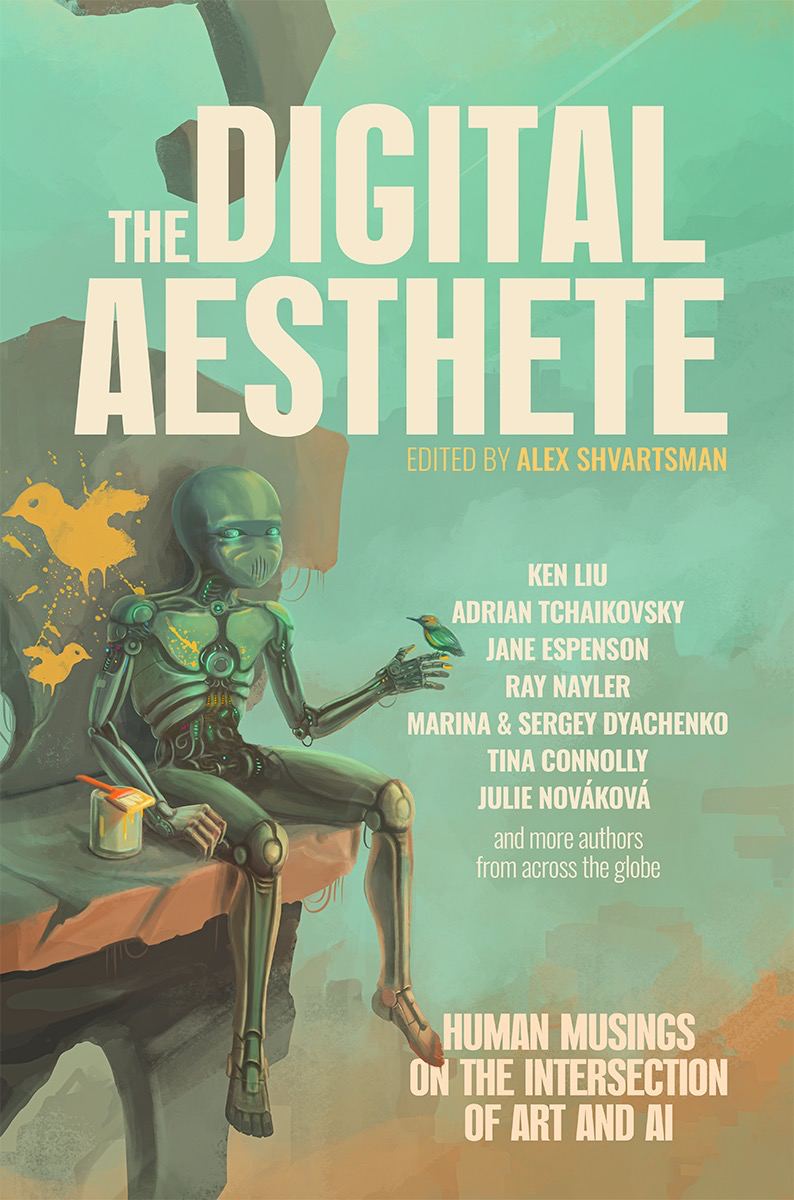
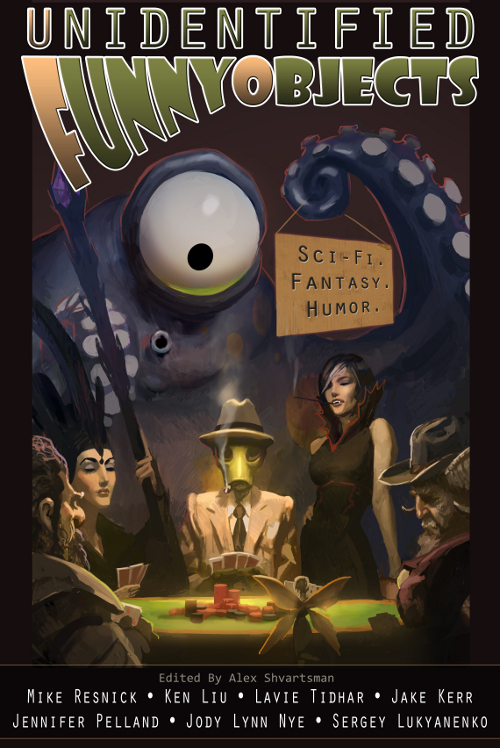
Read the entire anthology here now in ebook or print formats:
https://amzn.to/3MEG0RK