![[February 19, 1971] Tomorrow is too far (February Galactoscope #2)](https://galacticjourney.org/wp-content/uploads/2026/02/710219galactoscope2-672x372.jpg)
For February's second Galactoscope, we not only have an Ace Double and a James White novel, but an update from West Germany…

Continue reading [February 19, 1971] Tomorrow is too far (February Galactoscope #2)

For February's second Galactoscope, we not only have an Ace Double and a James White novel, but an update from West Germany…
Continue reading [February 19, 1971] Tomorrow is too far (February Galactoscope #2)
What a delicious offering we have for this month's first round-up of science fictions stories! But first, we have to get through the Ace Double. A spoonful of medicine makes the sugar go down!

Continue reading [January 16, 1971] The Sword of the Golem… and beyond (January Galactoscope #1)
On the one hand, we're sorry this article's title gives the game away. On the other hand, what could be more tempting than four four-star books? You know they will be good reads, and there will be something intriguingly, perhaps maddeningly wrong with them that hold them back from perfection. Read on, and see which of the following quartet best suit your tastes!


by Cora Buhlert
Do you remember the idiots who broke leftwing activist and convicted arsonist Andreas Baader out of prison in May and subsequently fled to the Middle East? Well, they're back in West Berlin and back to causing more chaos.
Rumours that the fugitives – since dubbed the Baader-Meinhof Gang by the press after the alleged leaders of the group Andreas Baader and former journalist Ulrike Meinhof – had returned and were living in hiding have been flying around the leftwing scene in West Berlin since August, though the police were unable to apprehend any of them.
Then, on September 29, at around 9:45 in the morning, masked thugs stormed into three different banks in three different parts of West Berlin at roughly the same time, brandishing weapons and demanding money. The faces of the robbers were hidden behind knitted balaclavas, but witnesses report that the gangsters included both men and women. At least one robber had cut a hole into his balaclava, allowing him to smoke. Once they had gathered up the money, the robbers fled in various cars. These cars were later found abandoned around the city.


The three robberies only lasted a few minutes each, but they were extremely lucrative. At a branch of the Berliner Bank AG in the wealthy Friedenau neighbourhood, the robbers stole more than 154,000 Deutschmarks. At the same time, in a branch of the Berliner Sparkasse in the wealthy Steglitz neighbourhood, another team of robbers stole more than 55,000 Deutschmarks. And in another branch of the Berliner Sparkasse in the Hansaviertel neighbourhood near the city centre, yet another team of robbers stole a little over 8000 Deutschmarks from various cash drawers, thankfully overlooking a box with 97000 Deutschmarks under the counter.

Bank robberies are sadly not uncommon, but three bank robberies happening in the space of ten minutes was unheard of until last week, so the West Berlin police quickly realised that the same group had to be responsible for all three crimes. And since a leftwing pamphlet with the title "Dispossess the Enemies of the People" was found at one of the crime scenes, suspicion fell onto the so-called Baader-Meinhof Gang. But while the police swiftly set up checkpoints all over West Berlin, none of the robbers have yet been caught.


In their last communication in the form of a letter to the leftwing 'zine agit 883 in June, the so-called Baader-Meinhof Gang announced that they were going to build up the Red Army to liberate the working class. How robbing banks will liberate the working class is a mystery known only to Andreas Baader, Ulrike Meinhof, Gudrun Ensslin, Horst Mahler and friends But then, life on the run is expensive and now the gang have gained 217,000 Deutschmarks to cover the costs of their lives underground.
However, there is one bit of good news as well. For Ulrike Meinhof's eight-year-old twin daughter Bettina and Regine, who vanished from Meinhof's apartment in West Berlin shortly before the prison break, have been found alive and well in Sicily, where they were staying with friends of their mother. Journalist Stefan Aust, a former friend of Meinhof's, picked the girls up, once he learned about their whereabouts, land returned them to their father, so there is at least one happy ending to this story.
Regular readers may be aware that I'm a big fan of the pulp fiction of yesteryear. And thankfully, a lot of it is coming back into print right now, so it's possible to enjoy the adventures of Tarzan, John Carter of Mars, Conan the Cimmerian, Kull of Atlantis, Solomon Kane, Jirel of Joiry, The Shadow, Doc Savage, Fu Manchu and others in brand new paperback editions without having to hunt down yellowing pulp magazines.
Reading all of the wonderful adventures of these iconic characters inspired me to try my hand at some pulp inspired fiction of my own, whether it's a series of 1930s set adventures inspired by The Shadow and The Spider or sword and sorcery stories inspired by Conan, Kull and Fafhrd and the Gray Mouser.
What is more, I sometimes also wonder what if all of those pulp heroes actually lived in the same world? What if Conan were to team up with Fafhrd and the Gray Mouser and Jirel of Joiry were to join forces with Ivanhoe? What if John Carter bumped into Eric John Stark on Mars and then they both teamed up to fight Ming the Merciless? What if Sherlock Holmes and Doctor Watson hunted French master thief Arsene Lupin or the criminal mastermind Fantomas or took on Fu Manchu? What if the Spider or the Shadow fought Dr. Mabuse? Or maybe James Bond could join forces with Modesty Blaise and Willie Garvin to fight Blofeld? Or how about Doc Savage and his friends battling Cthulhu?
Do these possibilities intrigue you? Then I have just the book or rather three for you.
This month saw such a bumper crop of books (and a bumper crop of Journey reviewers!) that we've split it in two. This first one covers two of the more exciting books to come out in some time, as well as the usual acceptables and mediocrities. As Ted Sturgeon says: 90% of everything is crap. But even if the books aren't all worth your time, the reviews always are! Dive in, dear readers…

by Tonya R. Moore
The latest Ace Double features stories by two authors who both write under pseudonyms. John Rackham is the pen name of electrical engineer and author, John Thomas Phillifent, whose works include three novels from the popular American spy fiction universe series The Man from U.N.C.L.E. Phillifent was a prolific author, the majority of his works of science fiction published under the name John Rackham. The lesser-known Thomas Edward Renn’s singular novel was published under the name Jeremy Strike.
This Ace Double was my first encounter with the works of either author, yet I could not help but notice the distinct differences in literary experience and skill at the heart of each story.
Continue reading [May 28, 1970] A pair of Saras: Flower of Doradil and A Promising Planet

by Gideon Marcus
To Venus! To Venus!, by David Grinnell
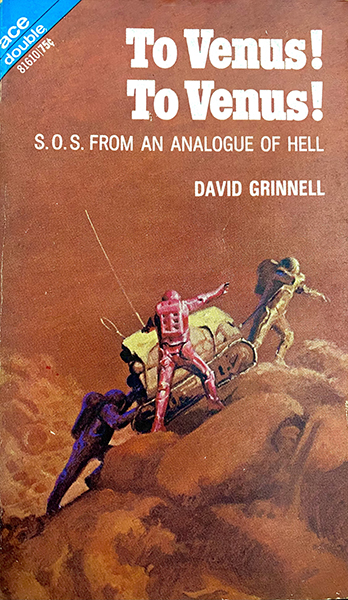
cover by John Schoenherr
Warning: the latest Ace Double contains Communist propaganda!
The premise to David Grinnell's (actually Ace editor and Futurian Donald Wolheim) newest book is as follows: it is the 1980s, and the latest Soviet Venera has confirmed the initial findings of Venera 4, not only reporting lower temperatures and pressures than our Mariner 5, but spotting a region of oxygen, vegetation, and Earth-tropical climate.
And they're launching an manned expedition there in less than two months.
Continue reading [March 14, 1970] To Venus and Hell's Gate… are we Out of Our Minds?
[For this first Galactoscope of the month, please enjoy this quartet of diverting reviews…which are probably more entertaining than the books in question!]
by Gideon Marcus
Spock Must Die!, by James Blish
Star Trek is dead. Long live Star Trek!
No sooner had Trek left the air at the end of last year's rerun season than it reentered the airwaves in syndication. And not just at home, but abroad: the BBC are playing Trek weekly, exposing yet more potential fans to the first real science fiction show on TV.
While new episodes may not be airing on television, new stories are being created. I am subscribed to a number of fanzines devoted to Trek. There aren't quite so many these days as once there were, but there's also been something of a distillation of quality. For instance, I receive Spockanalia and T-Negative with almost montly regularity. These are quality pubs with some real heavy hitters involved. They are crammed with articles and fiction. As to the latter, a lot of it is proposed fourth season scripts turned into stories—by people who really know the show. The stories by such Big Name Fans as Ruth Berman, Dorothy Jones, and Astrid Anderson (of Karen/Poul Anderson lineage) are always excellent.
There have been few commercial Trek books to date. You had Gene Roddenberry/Stephen Whitfield's indispensible reference, The Making of Star Trek, released between the 2nd and 3rd seasons, and Bantam has published three collections of Trek episodes turned into short stories by James Blish (rather sketchily, and not overly faithfully). There was Mack Reynolds' juvenile Mission to Horatius, which wasn't very good.

Now Bantam has released the first "real" Trek novel, one aimed at adults. It is also by James Blish, who liberally sprinkles footnote references to prior episodes he has novelized. The basic premises are two-fold:
We have a fine sextet of science fiction books for you this month: largely readable, with two clunkers and one superior read…
by Gideon Marcus
Ace Double 66160
Earthrim, by Nick Kamin
Continue reading [December 16, 1969] Holiday haul (Black Corridor and the December Galactoscope)

by Victoria Silverwolf
Ladies of Darkness
Two very different novels by women fell into my hands this month. Just about the only thing they have in common is a downbeat mood. Even that, however, is treated in highly dissimilar ways by the authors. Let's take a look.
Shadows of Tomorrow, by Dorothy Daniels

Anonymous cover art. Woman running away from a mansion that has a light in one window? Must be a Gothic Romance.
The setting is Connecticut in 1895. The narrator is a nineteen-year-old woman named Cassandra whose mother has just died. Her father died soon after her birth, and she spent almost of all of her life in boarding school. Returning for her mother's funeral, she is dismayed by the fact that the only other mourners are her mother's second husband, who left her some years ago, and her mother's faithful Gypsy companion.
Her mother had the ability to predict the future. The villagers thought of her as a witch. Adding to their superstitious fear was a mysterious light that appeared in the sky at the time of her death.
Cassandra (an appropriate name, as we'll see) settles into the family home with the Gypsy and her stepfather. In true Gothic fashion, she wanders into the cellar in order to investigate a noise, only to barely escape being strangled by an unknown assailant. It soon turns out that Cassandra also has precognition, which she considers to be a curse rather than a gift.
Other Gothic elements include a séance conducted by the Gypsy, a secret room in the mansion, and a murder. Since this is also a Romance, we have a handsome young stranger show up.
The novel definitely follows the pattern of a Gothic Romance. Fans of that genre, or of the Gothic soap opera Dark Shadows will find it satisfactory, if less than original. It's a quick, easy read, suitable for light entertainment of an enjoyable spooky nature.
Three stars.
A Sweet Sweet Summer, by Jane Gaskell

More anonymous cover art.
The narrator is a young man named Pelham, known as Pel. He is also called Rat. In a dystopian near future, he and his father run their home as a combination boarding house and brothel. His cousin Frijja shows up, having barely survived a brutal attack. You see, the aliens told him to take her in.
The aliens? Yes, it seems that gigantic extraterrestrial spaceships hover over the British Isles. A force field isolates the inhabitants from the rest of the world, leading to a breakdown in society. The aliens send messages to people in the form of small talking spheres, something like ball bearings. Failure to obey their orders leads to disintegration.
The aliens put various parts of London under the control of gangs, some Communist and some Fascist. Early in the book, Frijja defends the home from an invasion by the Fascists in a violent way. That doesn't prevent them from taking over pretty soon anyway.
The other major character is Connor, one of the Fascists. Pel is obsessed by him, although he tells the reader that it's not in a sexual or romantic way. (Frankly, methinks the fellow doth protest too much.) In turn, Connor is obsessed by Frijja. This triple relationship is complicated, blending love and hate in strange ways. It's also the heart of the book.
Without going into the myriad plot complications, let's just say that this unlikely trio goes on an odyssey through a transformed England. Along the way we get more violence, rape, sexual blackmail, and cannibalism.
This is a very grim book, as you can tell, although it's also got moments of bitter humor. Despite the aliens, who never show up in person, it's much more like A Clockwork Orange than Childhood's End. The narrative style is dense and eccentric, so this is a book that requires careful reading.
Five stars.
The Older Generation and the Newer Generation

by Jason Sacks
The Three Faces of Time, by Frank Belknap Long
I usually love writing for this column. I have tremendous fun exploring the work of promising new writers, or obscure works to which I can provide some attention, or even to celebrate the work of an acknowledged science fiction master.
But it provides me no joy to discuss The Three Faces of Time by Frank Belknap Long.
Mr. Long, born in 1901, has a long and distinguished career in science fiction and horror. He's published dozens of books which often sit in the uneasy and unsettling boundary between science fiction and horror. His many short stories were foundational in the golden years of the classic Weird Tales pulp, often sitting side by side in a given issue next to his close friend H.P. Lovecraft and exploring similar mythos and settings.
I frankly love the classic work of Messers. Long and Lovecraft for their gothic, creeping horrors and their inescapable dark energy.
But that work was released 30 plus years ago, and I'm sad to say that Mr. Long, now well into his Social Security years, is no longer the writer he used to be. Or, more accurately, he's too much like the writer he used to be.

The Three Faces of Time is, frankly, a bore. The writing is turgid, characters are wafer thin, and the plot simply refuses to become interesting.
A flying saucer has landed in a small suburban town. When people go to investigate the thunderous sound the spaceship makes, they become lost in a maze of incomprehensible pathways and confusing signposts, which all serve to alienate all the people from their environments.
We follow Susan Wentworth as she tries to find her husband and her children in such a space, where she does eventually catch up with the family – and some mysterious aliens. The strange creatures then transport the humans thousands of years into the future in search of some sort of truth about human immortality – or something like that. I think that's what happened; my attention kept wandering as I tried to make my way through endless thickets of run-on sentences, inhuman dialogue and exhausting conceptual obtuseness.
This would be a fun book in the hands of a more modern writer like Ellison or Brunner, who would highlight the confusion or the characters' existential doubt. Dick would have made the leads more full of angst, and LeGuin would have chonicled the beauty of the aliens' worldview. But Long is not of the newer generation. He reads like a man who's 68 years old and who time, sadly, has left behind.
I regret I have to give this book 1 star.
The Wizards of Senchuria, by Kenneth Bulmer
After my frustrating experience with Mr. Long's book, I was anxious for something that felt fresh, breezy and contemporary.
The Wizards of Senchuria by Kenneth Bulmer was just what I needed.
I've had mixed experiences in the past in reading Mr. Bulmer's fiction. But this book was pure joy for me.
Senchuria is a breezy and bright story. It's a kind of updated version of the high-adventure stories which accompanied work by Lovecraft and Long in the old pulps, but updated for a more modern audience.

Scobie Redfern is a guy in his 20s on the way home from a game of tennis at a Lower Mahattan gym on a cold and snowy night. Scobie calls a cab, but at the same moment another man jumps into the taxi with him. The cabbie talks them both into sharing the vehicle, but quickly odd things start happening. Scobie catches a glimpse of a strange creature who seems to attack the car, and when his fellow passenger persuades Scobie to stop for a drink, a burger, and an explanation, so begins the wildest experience of Scobie's life.
Scobie soon finds himself in an adventure he hardly could have imagined, involving strange portals, terrifying creatures, love, hate, fear, battles on a grand scale, and the kind of nonstop adventurous life that would make a Robert E. Howard character feel exhausted.
This is one of those books where each chapter ends in a cliffhanger before the tension and silliness of the story rachets up even further, a wild, high-tension ride which gets much of its power from the reader wondering how much longer Bulmer can sustain his high-wire act.
Rest assured that everything in Kelly Freas's delightful cover actually happens in the book!
Maybe this book hit me so hard because I was so disappointed in the F.K. Long book above, but this was a thorough delight. The Wizards of Senchuria won't contend for a Hugo, but it's a nearly perfect half of an Ace Double.
4 stars.

by Victoria Lucas
Author Margaret Atwood and I are nearly the same age (she has a couple years on me). But she has published 5 books of poetry, and written a libretto–so far–and I'm sure she'll keep ahead of me. She has also just published this, her first novel. I've been wanting to read her work, especially since it (a) smacks of feminism at first glance, and (b) was written by a native of Canada, a country to which my husband and I aspire, and which we may yet reach as we slowly move north.

by John Schoenherr
I am a proud Stanford University alumna thanks to that university’s help finding me the money to go to school (student loan, job). As I understand it, the faculty have always believed that the school is not just there to teach about what students are going to do in life, but also help them discover what kind of person they will become. Clearly, as far as Atwood’s fictional alumna, Marian, is concerned, the school she attended (University of Toronto by the geographical and environmental clues) failed on both counts.
She is lost and feels formless, trying to understand what is required of her and fit into the molds offered. Every now and then she attempts to escape, finding some ease from the pressure of becoming a woman in today's society by running off the rails.
People in her life are mostly in a similar state of becoming and are extremely puzzled when she tries to run away–with one exception, a man she seeks without realizing she is looking for him. Clearly he has run off the rails himself and is possibly dangerous. But for Marian, sometimes danger is preferable to the destination of the tracks, perceived by her as motherhood (of which she is frightened) within marriage (although her roommate is at first set on motherhood alone), a job that is boring and expected to disappear with marriage, a life as a consumer of products such as girdles (worn by "vulcanized" women), and meals of real-life, killed animals.
Starting with strong reactions to types and cuts of meat reminiscent of the living beast, she begins crossing foods off her list of possible edibles as she tries to stay the course to the arms of her fiancé and their upcoming wedding. In a supermarket she “resents” the music because she knows it is only there to lull consumers like her into a euphoric state in which they will buy anything; her own fingers twitch to reach away from the market basket and pick up something–anything–with a "bright label." (I particularly identify with this: not only do I dislike the music itself, but I wish they would leave my mind alone, and I start talking to the speakers and gloomily thinking about bringing wire cutters and stair steps to the store.) After awhile, most foods are eliminated from her diet until she makes something she can eat.
Atwood’s book is funny with a dark humor, growing darker and funnier as Marian’s story unfolds. I give it 5 stars. Beautifully done.
by Gideon Marcus
Out of the Mouth of the Dragon, by Mark S. Geston

by John Schoenherr
The Biblical book of Revelations foretells of the final battle between Good and Evil. In this second book by Mark S. Geston (author of Lords of the Starship, which seems to be something of a prequel), Armageddon was just the first of climactic battles, subsequent ones being told of in the Book of Survivors, the Book of Eric, the Dialogues of Moreth. Thousands of years later, the diminishing forces of Earth, spurred on by crusading fury, continue to clash. The last ships, the remaining aircraft, the pitiful remnants of humanity are all drawn, sooner or later, to fight what will hopefully be the last fight at "The Meadows."
Born into this world is Amon VanRoarke, an aimless naif who finds motivation when the prophet Timonias comes to town on an ancient, motor-powered merchantman. The holy man's words fill VanRoarke with the urge to sail to The Meadows, not necessarily to fight, but simply to discover what has happened to the battered Earth, what consumes men to combat to the end.
So he sails on the Garnet, along with the drunken and dying veteran, Tapp, the religion-crazed Yarrow, and the half-sane ex-librarian Smythe, the last of whom has some borrowed knowledge of what the world was, though not why it's become what it has. Eventually, they arrive at The Burn that borders The Meadows, where a mighty army is encamped and ready to fight. There too is the "rim army", a force of strangers, origin (as yet) unknown. The stage is set for…something, but not what you expect.
Dragon is very much a mood piece, a commentary on the futility of war, and perhaps even of humanity (or at least, this cast of humanity). If Ballard were to write a catastrophe book, where the catastrophe is the red-steeded Horseman of the Apocalypse, this might well be the result. It's downbeat, descriptive, brooding, and more than a little surreal. It reminds me a little of the endlessly warring tankers of the Great Plains in John M. Foucette's post-apocalyptic The Age of Ruin, but more compelling, more deliberately written.
It's not a happy book, but it is an interesting one, and I had no trouble tearing through most of it in a single reading.
3.5 stars—others might rate it higher.

by George Pritchard
Rip-Roaring and Rollicking
As I have heard mixed reports about Lin Carter, it gives me great joy to report that his newest collection, Beyond the Gates of Dream, is simply delightful. The collection is written as a deliberate throwback to serial fiction and the heyday of Weird Tales, and in that sector, Carter (what a suitable name!) thrives. In this era of the New, Carter's writing can often seem antediluvian, so it is a joy to see those fins and gills be used as they were meant to be.

by Jeff Jones
My favorite story was actually the first, “Masters of the Metropolis”. Written with Randall Garrett, it describes the main character going from New Jersey to New York City in the modern day, except that he has “Wonder-sense” — the ability to see the incredible wonder that exists all around us.
Four stars.
“Keru” is one of the shortest stories in the collection, a Floridian horror story right out of Weird Tales. It has one of two female characters in the book, which is both accurate to the era Carter is recreating, and to Carter's sensibility as an author. Its racial politics are somewhat muddled, but it is leagues ahead of what Campbell is putting out.
Four stars.
The closest to New Wave that Carter gets is in “Owlstone”, but it's firmly in the slow, thoughtful realm of New Wave, rather than anything close to sexuality and gender. I enjoyed it, particularly the ending. The story is from the perspective of a slave creature, who is used by the leader of Earth to fly through space and meet with the leaders of other planets. Called to communicate with the computer who commands the universe, the leaders discover they are being replaced by computers. But what will happen to the slave creatures?
Four stars.
“Harvey Hodges, Veebelfetzer” is an attempt at a SFF comedy epic short story. There is potential in it, but it is all so tangled up with early-author nonsense that should have been trimmed back long ago that even said author apologizes for its existence. It is not bad in a way that makes me angry, but it needed considerably more work, that it did not necessarily justify. It’s definitely the weakest of the lot.
Two stars.
There are two sections of unfinished stories, which I am not rating. The stories are not finished, so it does not seem fair to judge them just yet.
Admittedly, this collection is best taken in slowly, as Carter's joy coming through the pages can often be overwhelming if read for long periods. I was reminded of interacting with a particularly exuberant horse, or a large puppy, in book form. If frequent fannish winks, nods, and asides fill you with annoyance and dread, I do recommend avoiding this book. He writes such notes at the beginning and end of each story, and at the beginning and end of the book, like a joyful
3.5 stars if you like this sort of thing, one star if you don't.
But why shouldn't Carter be excited? He was allowed to finish a posthumous Conan story, and that tale, “The Hand of Nergal”, takes up the majority of the book. I enjoyed it as a Conan story, and was glad to see Carter avoid the numerous potential pitfalls that Howard set up in his world and writing style. This is a place where Carter’s weaknesses in the New Wave become strengths in the old. Lucky for the reader, despite Conan’s supposedly barbarous nature, he has little interest in the beautiful servant girl who briefly crosses his path, before going to destroy the demonic vampires threatening the world! I wonder if this is related to Conan’s mighty thews in any way, after the revelations in Sports Illustrated back in June regarding the significant use of steroids in professional sports.
3.5 stars.
”So close your waking eyes/And picture endless skies” — and wonder!
Four stars overall.



![[January 16, 1971] The Sword of the Golem… and beyond (January Galactoscope #1)](https://galacticjourney.org/wp-content/uploads/2026/01/710116galactoscope-672x372.jpg)
![[October 8, 1970] It's All Connected – <i>A Feast Unknown</i>, <i>Lord of the Trees</i> and <i>The Mad Goblin</i> by Philip José Farmer](https://galacticjourney.org/wp-content/uploads/2025/10/MDGBLLRDT1970-672x372.jpg)
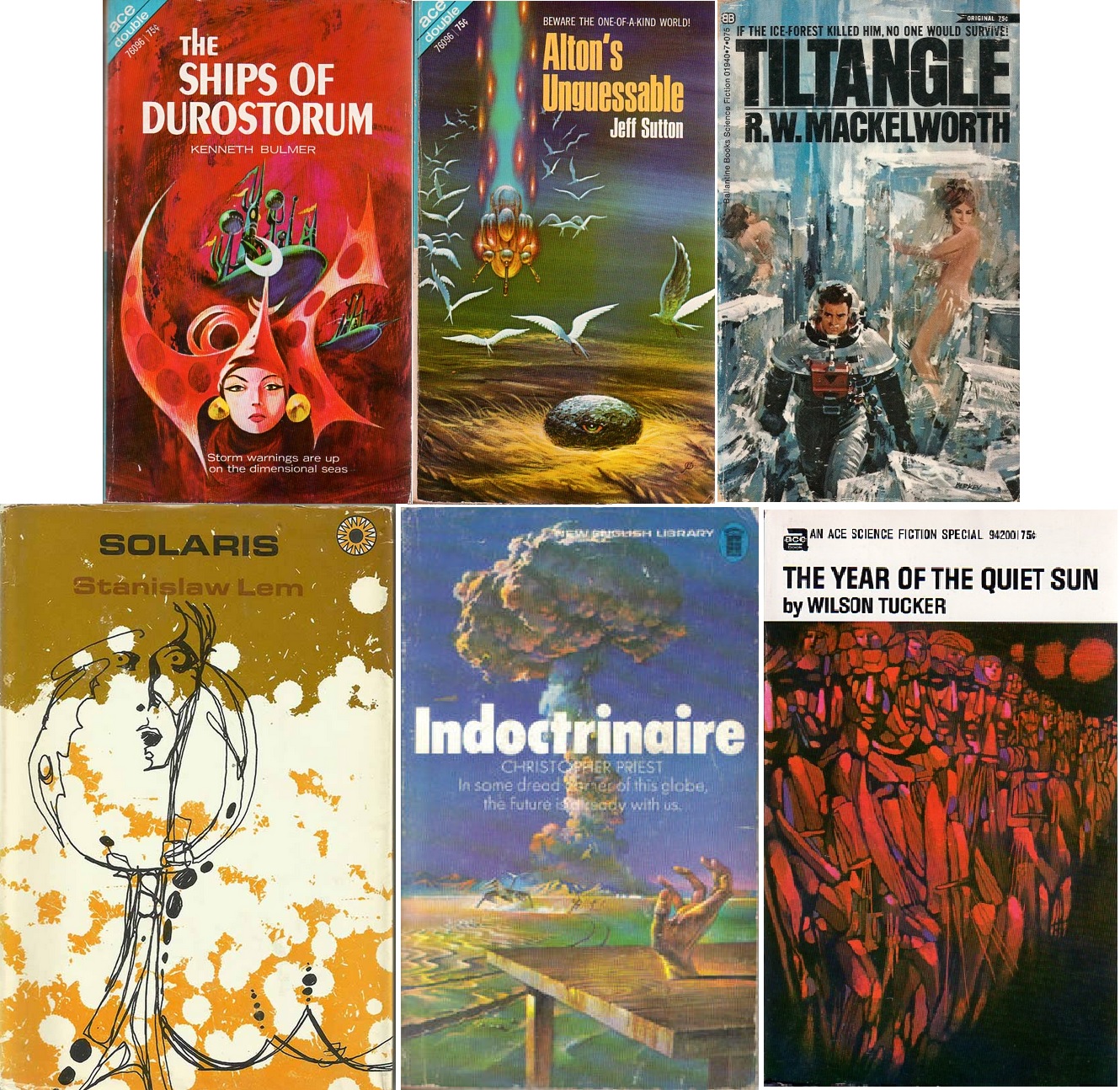
![[June 16, 1970] <i>Solaris</i>, <i>Year of the Quiet Sun</i>…and a host of others (June 1970 Galactoscope #1)](https://galacticjourney.org/wp-content/uploads/2025/06/700616covers-672x372.jpg)
![[May 28, 1970] A pair of Saras: <i>Flower of Doradil</i> and <i>A Promising Planet</i>](https://galacticjourney.org/wp-content/uploads/2025/05/ace_double-672x372.png)
![[March 14, 1970] <i>To Venus</i> and <i>Hell's Gate</i>… are we <i>Out of Our Minds</i>?](https://galacticjourney.org/wp-content/uploads/2025/03/700314covers-672x372.jpg)
![[February 14, 1970] <i>Spock must Die!</i>, <i>Starbreed</i>, <i>Seed of the Dreamers</i>, and <i>The Blind Worm</i>](https://galacticjourney.org/wp-content/uploads/2025/02/700214covers-672x372.jpg)
![[December 16, 1969] Holiday haul (<i>Black Corridor</i> and the December Galactoscope)](https://galacticjourney.org/wp-content/uploads/2024/12/691216covers-672x372.jpg)
![[August 16, 1969] Soaring high and low (August 1969 Galactoscope)](https://galacticjourney.org/wp-content/uploads/2024/08/690816covers-672x372.jpg)