Tag Archives: bill graham

[April 12, 1971] The Lathe of Heaven (May 1971 Amazing)

Image a lanky man wearing glasses.
by John Boston

The May Amazing grabs the eye with an attractive cover by Jeff Jones that seems to depict some sort of scientific or communications satellite or platform against a bright yellow and orange background—somebody’s exploring the Sun?  No matter, it looks good and should get some attention on crowded newsstands.

Cover of the Amazing magazine.
by Jeff Jones

This is—it says above the title—the “45th Anniversary Spectacular!” Well, not precisely.  The calendrical blunder of several years ago means that this magazine that started with April 1926 no longer has issues in April.  And the celebration is muted, though probably not for that reason.  In past years anniversary issues have been all or mostly reprints.  Fortunately, this issue merely devotes ten pages to a portfolio of reproductions of the covers of past anniversary issues, unimpressive in black and white.  It’s pointless but innocuous, and takes the place of the usual “Famous Amazing Classic” reprint, mercifully given the quality of recent selections.

Ted White’s editorial consists of a commendably compact and lively history of Amazing, warts and all—or as he puts it in conclusion, “unvarnished.” It’s well worth reading, since the post-1930s history of the magazine has been much less hashed over than its earlier days (admittedly, for good reason).

In other non-fiction, the book reviews are back; this time it’s the fanzine reviews that are crowded out.  Dick Lupoff takes on Niven’s Ringworld, asserting that Niven represents the Jules Verne tendency in SF rather than the H.G. Wells tendency, cataloging his virtues and limitations (both considerable), and concluding: “I'm glad that there's a Larry Niven around writing his particular brand of science fiction, but I'm really glad that there's only one of him.” (Just wait—or so I predict.) Alexei Panshin reviews Terry Carr’s second New Worlds of Fantasy anthology, noting that some of it is actually “soft science fiction,” too many are “shallow, gimmicked,” but plenty are worthwhile—either for their treatment of outre ideas or their depth of characterization “and a narrative I could sink vicariously into.” Here’s Lupoff again, praising Michael Moorcock’s Behold the Man, which he says has more to it than to the novella version that won a Nebula: “It is such a good book that it transcends the usual limitations of genre fiction, and one trembles in anticipation of the old couplet: ‘This can't be good, it's science fiction/This can't be science fiction, it's good.’” (The couplet is grossly misquoted.) The longest review is editor White on James Steranko’s The Steranko History of Comics, Volume One, which he describes as “an amazingly thorough job” despite its numerous errors.  In particular, he credits Steranko with recognizing and chronicling the influence of the pulp magazines on comics.

And there is of course the letter column, less interesting than some, since more of it than usual is devoted to readers’ opinions of the stories.  (Since my opinions are obviously correct, these are superfluous.) Most interesting in terms of the magazine’s production is White’s reply to a letter from Carl Glover, who had previously commented on the larger type size and now also notes (as I somehow failed to notice) that the January issue was 16 pages shorter than the previous issues (132 pages rather than 148).  White responds:

“When I initially prepared your letter for publication, we had no concrete plans for increasing the type size, and no plans for cutting back in pages. When we did decide to increase the type size, we intended to do so only for the fiction—retaining the smaller type for the features. But something went awry between our editorial offices and the typesetter, and for one pair of issues—the January Amazing and the February Fantastic, everything was in the larger type. When it became necessary to cut pages too, well, I was left feeling somewhat foolish, and only a piece of last-minute surgery on my reply to your letter in the January issue kept me from appearing yet more foolish. Hopefully, we've now settled down for an issue or two—but keep your fingers crossed. New changes in format are under contemplation, which should result in a superior package—if something doesn't go awry again.”

So the buried lede here is that they’ve cut the magazine by 11% without previous comment or explanation.  This is not a healthy sign for its longevity.

Also interesting is White’s reply to reader Jerry Lapidus’s comments on artwork.  Lapidus did not care for the cover of the January issue, the “totally blah . . . ‘flying saucer’ cover.” (I thought it looked more like a slightly flattened Saturnian planet or something knitted from fuzzy wool, but White says it was a galactic cluster.) More generally, Lapidus complains about the uniform format of interior illustrations (one column in a two-column page format, meaning tall and narrow), which White says is “imposed upon us by the medium in which we work,” without further explanation. 

Continue reading [April 12, 1971] The Lathe of Heaven (May 1971 Amazing)

[June 4, 1965] Below the Ramparts


by Victoria Lucas

On Class and Murder

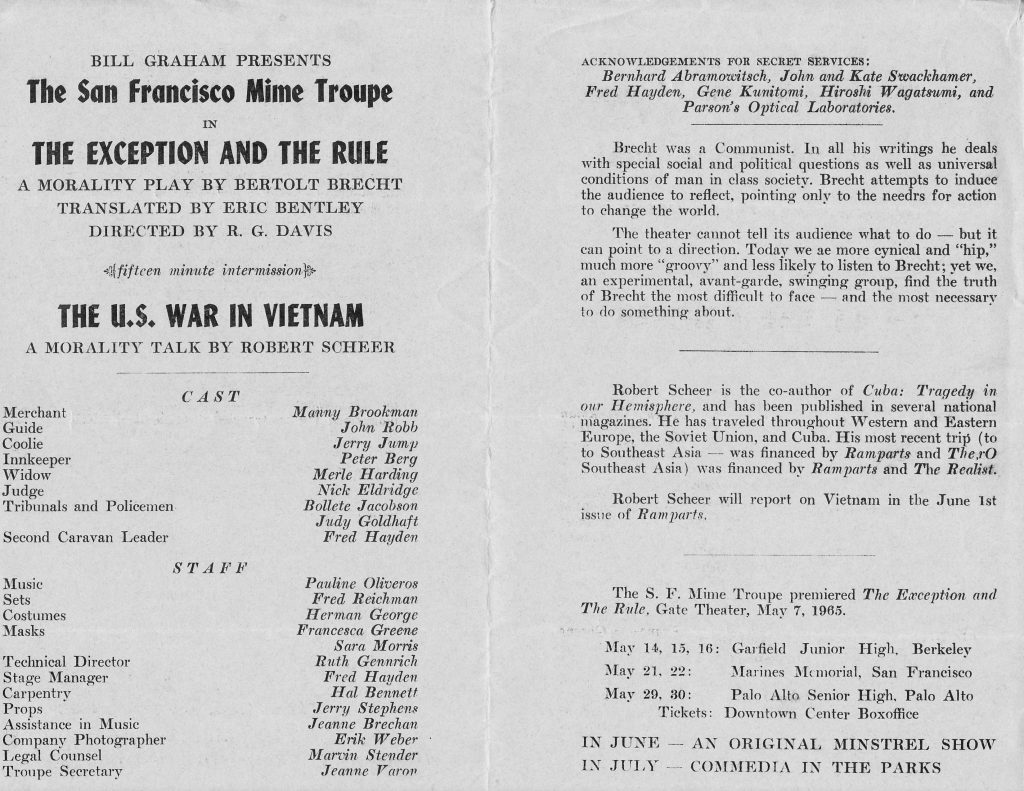
This review is late. The performance of "The Exception and the Rule" happened on May 7, 1965, produced by Bill Graham at the Gate Theater. However, I was too stunned to write earlier. Not only did the San Francisco Mime Troupe appear in one of Bertolt Brecht's Lehrstücke or dramatic exercises, but journalist and publisher Robert Scheer was featured after intermission. Also, as you can see from the program, Pauline Oliveros of the San Francisco Tape Music Center provided the music, so that was an attraction for me.

program for Brecht play
Program for "The Exception and the Rule"

In the play, the "exception" was a "coolie" who tried to give his master a drink of water. The rule was the master's fear of his abused underling that led him to see the flask as a "stone" and believe the coolie was trying to kill him. The results were the death of the coolie, shot by his master, the absolution by a judge of the master's actions (which were underlain by his need for "self defense"), and the protest of those who saw things otherwise.

No Exceptions to the Rule of White Masters

In the Mime Troupe's version, of course, the actors wore masks (in the tradition of the commedia del' arte in which they place themselves) and updated the 1929 work by Brecht, whom they outed as a "Communist." Whereas the results could be expected, the conclusions were disturbingly thought provoking. Here are some bits of dialog I wrote down: "The police fire out of pure fear." "One must go by the rule [the master's fear], not the exception [the coolie acts on fear of his master's dying of thirst while he was dehydrated]." "Dehumanized humanity" is a description of the coolie-master relationship that creates fear on both sides. "Sick men die but strong men fight" is the war cry of social Darwinism (not invented by Darwin). "He [the coolie] can't make us believe that he'll put up with it all," therefore he is "dangerous."

Scheer Opinion

After this disturbing performance with its comments on "class" and murder, Robert Scheer gave what the program called "a morality talk" on "The U.S. War in Vietnam." Scheer is now managing editor and editor-in-chief of Ramparts Magazine, a new left voice since 1962, produced here in San Francisco. He is also their Vietnam War correspondent.

Report from the Front

So how is the war going, you ask? Badly, my friend, badly, for both sides. It's like reporting on a journey that is uphill both ways. While that is a common trajectory in San Diego, which is all mesas and canyons, it's usually thought that if a war is going badly for one side it's going well for the other. Not so this war.


Violation of Geneva Accords

Scheer points out that the Geneva Accords of 1954 that ended the French war in Indochina mandated elections within 2 years to reunite Vietnam, with the present border meant to be temporary until elections could be held. In Vietnam, though, political battles have been fought on a literal battlefield rather than via the ballot box, and the US has been obstructing holding such elections precisely because the belief among US government officials is that Ho Chi Minh would win. Scheer compares and contrasts the situation of Negros in the South, whose voting rights have been interfered with, to the "n*gg*rs" of Southeast Asia, who are not allowed to vote at all in the present conflict.

Voting Rights and Human Rights

Deeper than that political comment, Scheer calls President Johnson's "voting rights" bill window dressing, and the lack of elections in Vietnam an avoidance of obstructing what he calls the "colonial ambitions" of the US in Asia. Scheer does not share the fear of Communist takeover as a form of political suppression of democracy, defining American "democracy" as suppressive in itself. According to him, in the US "white makes right," and in Vietnam "might makes right." He makes the point that as we slowly wake up to Negro rights in the US, we should also wake up to human rights in other parts of the world, particularly now in Vietnam, where both sides are clearly losing.

Suppressed Reporting

I've been listening to National Public Radio (NPR), reporting mainly by Christian Science Monitor correspondents, since NPR has little to no foreign-correspondent budget. They actually visit American troops and talk with the leaders, and their home editorial desks do not suppress their stories. So instead of publishing the US government press releases as the mainstream press does, the Monitor and NPR report what they see to the public. Scheer's commentary is in line with what I've been hearing. In March the US began systematic bombing of North Vietnam and the so-called Ho Chi Minh Trail–the supply route from North to South Vietnam. This began with the first landing of US Marines at Da Nang. Stories of atrocities persist but are not reported by the mainstream news.

As the World Turns

In short, I think I hear the noise of the world whizzing by, but I'm usually too scared or tired to lift my head, get up, and look over the ramparts of our middle-class consciousness. The Mime Troupe always provides such a view (while being raucous and funny), but what I saw this time was uncommonly scary. If you want to take a peek over the ramparts, buy the June edition of Scheer's magazine, at newsstands in the larger urban environments.

If it hasn't been suppressed.