Tag Archives: damon knight

[January 4, 1971] Not So Bad (Orbit 8)

photo of a plump blonde man, looking over his shoulder
by George Pritchard

After getting through seven editions of Orbit, my colleague Mx. Vyas-Myall has passed covering this anthology series on to me, one which has previously leaned heavily toward the surreal “New Wave” style of SFF. Since the worst books I have reviewed for the Journey based themselves heavily on older styles, I was intrigued—at worst, I would be observing failure in a different mode. At best, well…Orbit 8 is here at last, so read on!

Cover for the Orbit 8 anthology.  A list of authors appears below the title. Beneath, a huge spherical alien creature with eyes and tentacles emerging from the sphere at various angles appears to be floating through  a yellow expanse of space.  A rocket, appearing minuscule next to the alien, points upward in front of it.

Continue reading [January 4, 1971] Not So Bad (Orbit 8)

[September 28, 1970] How Many Light-Years to Babylon? (The Science Fiction Fall of Fame, Volume One, Part Three)

A young white man with short hair wearing a navy P-coat, blue polo collar, and green t-shirt.
by Brian Collins

We have reached the final stretch of this long and winding anthology, which has taken several months to cover, and indeed might take readers as long to digest fully. Robert Silverberg, who just a couple years ago was the President of SFWA, has taken it upon himself to survey the field over a span of about 30 years, with a mix of stories voted upon by SFWA members as well as stories chosen as Silverberg's own digression. It's not quite as long as Dangerous Visions, not to mention it serves a very different function, but it's still a big book that should be on every fan's shelf. I do, of course, have my quibbles, but we'll get to those in due time.

Continue reading [September 28, 1970] How Many Light-Years to Babylon? (The Science Fiction Fall of Fame, Volume One, Part Three)

[July 8, 1970] I'm Still Marching Some More (Orbit 7)


By Mx Kris Vyas-Myall

More than 1,000 women marched through armed cordons in Belfast a few days ago, in a surprising display of bravery and protest. How has such an act come to be seen on British streets?

Still from Black and White film of Women's March to Fall's Road, with a soldier trying and failing to block them.

Since last summer, when British troops were called in by Stormont, the violence has continued to worsen. When the so-called “battle of the bogside” took place in August, British troops arrived too late to stop loyalist violence.

Soon after, a split emerged in December within the IRA, with there now being two groups. First are the “official” IRA, who have adopted a Marxist platform and believe in political engagement to bring about a socialist workers republic. Second are the new militant “provisional” IRA who support armed defence of Catholic communities and believe that their campaign can only end in a single united republic of Ireland. Currently, the momentum seems to be with the provisional group, particularly with increasing loyalist violence. When a member of the official IRA came out to ask a Catholic group to disperse, he was stoned by the crowd.

Things have also been going south (pun intended) in the Republic. In April, a paramilitary group (possibly the provisional IRA or Saor Eire, but unconfirmed) committed a bank robbery and shot dead an unarmed member of the Irish Garda, Richard Fallon, the first to be murdered in the line of duty since the 40s. The next month, Jack Lynch, the Irish Taoiseach, was forced to fire his ministers of finance and agriculture as they are charged with trying to supply arms to paramilitaries in the North.

As tensions continued to ramp up between communities, it was inevitable we were in for another summer of violence. In the most recent incident, it is unclear as yet who struck first. Loyalist sources say the provisional IRA were using the imprisonment of Bernadette Devlin as an excuse to whip up violence. Republican sources say a loyalist mob were trying to drive Catholics living in the Short Strand area out of East Belfast. Whatever the cause, five people died and there was a huge amount of property damage. More importantly for what happened next, members of the provisional IRA used guns to fire back against loyalists in the Falls Road area.

A curfew was declared in the area as three thousand British Army went house to house, armed and firing tear-gas, in order to check for weapons and arrest potential IRA suspects. This, however, is not something that can be done quickly (there were more houses than soldiers) or easily, and took three days to complete. As such, supplies were running low for some households, as people even leaving to get food were liable to be shot.

This is where the march came in. Local Catholic women decided to take action themselves and marched in holding food, in full view of the press. They correctly made the calculation that the British Army would not shoot women armed only with bread and milk to be broadcast on the evening news. Some were blocked but many were able to get through and resupply the community.

Black and White film still of either police or soldiers, armed with riot gear.

It is unclear if the British raids will have done any more than American finding of caches in Vietnam but two things are definitely clear:

1. The Catholic community in the North are not going to have much trust of the British to protect them, if any indeed still remained.

2. Protection and support for the community is coming from the ground up, particularly women in these roles, rather than top down.


One place you can also see women regularly pushing things forward is in Orbit. Whilst not quite having an equal number, it is still the only place I can be certain to see multiple women writers between its two covers.

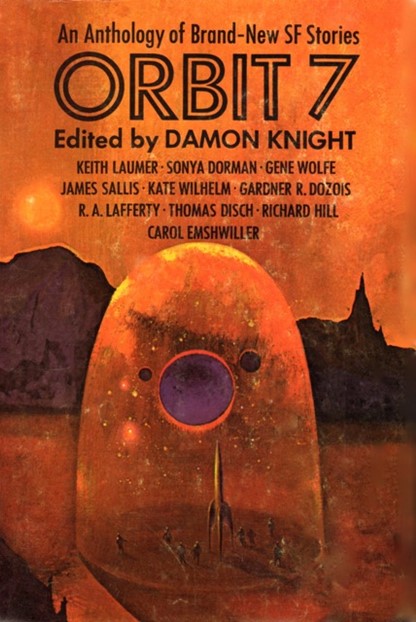
Orbit 7 ed. by Damon Knight

Cover of Orbit 7 edited by Damon Knight, listing the authors inside. The cover picture has an orange hue, showing a rocket and a set of small figures apparently trapped in a translucent dome. A sun rises over rocky mountains in the background
Cover by Paul Lehr

Continue reading [July 8, 1970] I'm Still Marching Some More (Orbit 7)

[March 12, 1970] It’s A Dog’s Life (Orbit 6)


By Mx Kris Vyas-Myall

In 1889, Oscar Wilde wrote “Life imitates art far more than art imitates life”. This month, London has proved that.

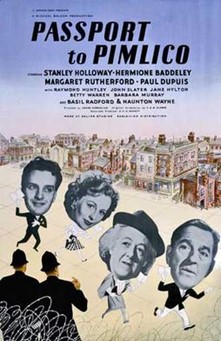
Passport To Pimlico 1949 Flm Poster showing photos of the cast's head on cartoon bodies running through London streets, with barbed wire in the foreground and police looking on

In the 1949 film Passport to Pimlico, a small area of London declares independence and it ends with the British government forced to negotiate to get them back. Actual negotiations for reintegration of the Isle of Dogs concluded on Monday.

Reconstruction taking place in the Isle of Dogs as a Victorian building is being demolished in the foreground and a high rise flat complex rises behind it.
Post-War Reconstruction taking place in Isle of Dogs

The Isle of Dogs is not a true island, but rather a low-lying peninsula that marks a massive bend in the Thames. As such in the Victorian era it became a part of the London Docklands. However, as ship size increased more ships were moved further down the river. The railway lines were closed and the area was devastated in the blitz.

In the last decade a large project of council flat building took place in the region, with 97% of the population in government housing. However, amenities did not keep up with the rise in the population Schools, hospitals and shopping areas were not included in the plans, yet only one bus route services the entire region.

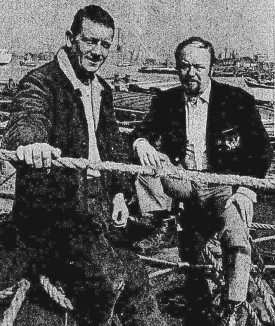
Black and White photo of Joint Prime Ministers of the short lived republic, Ray Padgett and John Westfallen standing in front of the docklands but behind a rope.
Joint Prime Ministers of the new republic, Ray Padgett and John Westfallen

In order to bring awareness to their situation, on the 1st March around 1,000 residents of the Isle of Dogs, led by Fred Johns (their representative on the borough council), blocked the swing bridges to the rest of London. They announced that a Unilteral Declaration of Independence would be forthcoming if their demands were not met and taxes would not be paid.

Map of the Isle of Dogs from 1969 showing the Port of London Authortiy buildings in orange and the river Thames in blue.
Area map of the short-lived republic (orange are those buildings owned by Port of London Authority)

On the 9th March the official declaration of independence came with the setting up of a citizen’s council and two Prime Ministers to run each side of the island. They issued a demand to return taxes that they said belonged to the islanders, and started on plans to setup their own street market and turn a disused building into a school. This drove headlines all over the world, with even Pravda from the USSR sending in a reporter.

Small printed card that says:
Entry Permit To Isle of Dogs. To Be Shown at Barrier. Independent State of London. John Westfallen. Prime Minister

After meeting with the Prime Minister, a plan was announced by Tower Hamlets Council for resolving the issues raised by the Islanders with a full consultation. The council, however, denied that this protest had anything to do with the timing of this announcement. Whatever the cause, the Republic of the Isle of Dogs has achieved its goals, so it seems that entry permits will no longer be required to travel in and out of the region.

Back in the world of SF publishing, we have our own odd little affair. That of Orbit 6, which contains some good, some bad and many just plain confusing tales:

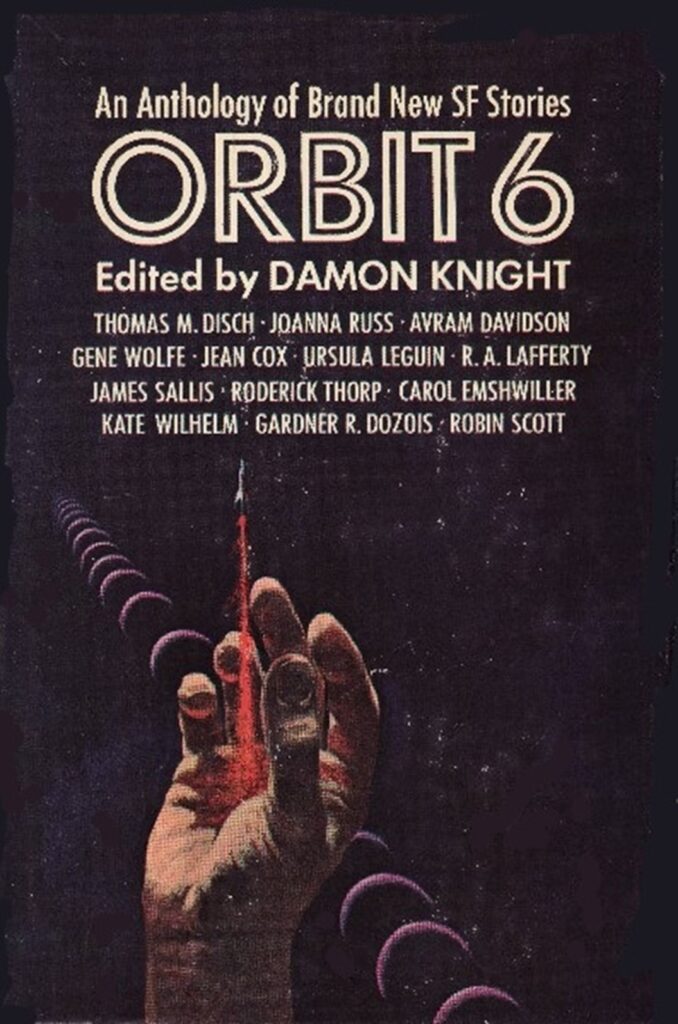
Orbit 6

Orbit 6 Hardback Cover as drawn by Paul Lehr showing an open hand with a rocket launching from it where behind is a stream of half lit planets in a line against a starfield. Below the title the editor and authors are all listed.
Cover illustration by Paul Lehr

Continue reading [March 12, 1970] It’s A Dog’s Life (Orbit 6)

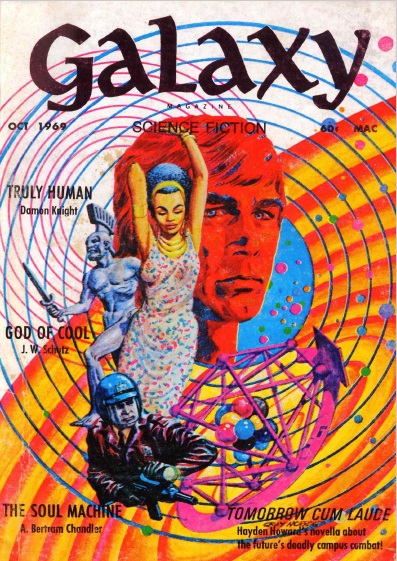
[September 12, 1969] Earthshaking (October 1969 Galaxy)

photo of a man with glasses and curly, long, brown hair, and a beard and mustache
by Gideon Marcus

Time for a change

My local rag, The Escondido Times-Advocate, isn't much compared to, say, The Los Angeles Times.  But every so often, they are worth the subscription fee (beyond the TV listings and the funnies).  Take this article, for instance, which might well be at home in a Willy Ley column:

Basically, CalTech has a new timepiece with more precision, accurate to the hundredth of a second, so that when it is used in conjunction with a seismometer, earthquakes can be better mapped.  More excitingly, the new clock weighs just eight pounds—less than a tenth that of the hundred-pound monster it replaces.

Transistors have made it to geology.

We hear all about small computers and more efficient satellites, but this story really drives home just how quickly the miniaturization revolution is diffusing to all walks of life.  Is a computerized pocket slide rule or a Dick Tracy phone that far off?

Making waves


by Gray Morrow

A lot has happened this year at the old gray lady of science fiction, Galaxy.  They changed editors.  They lost their science columnist.  And as we shall see from the latest issue, things are starting to change, ever so slightly.

Continue reading [September 12, 1969] Earthshaking (October 1969 Galaxy)

[September 8, 1969] Another Orbit around the sun (Orbit 5)


By Mx Kris Vyas-Myall

Having a teacher first as a mother, and now one for a wife, I think of the year as mirroring the school terms, with the new year beginning in September. But, looking at the newspapers, it doesn’t appear the world has changed much in the last twelve months.

On the home front, the troubles in Northern Ireland keep getting worse, with the presence of British troops now seeming to be resented by both sides. Meanwhile, The Conservative party base is pushing the party to take a harder anti-immigration line, and union chiefs clash with the Wilson government.

British Troops in Ulster in front of a burnt out shop
British Troops in Ulster, caught in the middle of escalating violence.

Peace talks over Vietnam are once again being held in Paris and apparently going nowhere, there are continued conflicts in the middle East and the Junta in Greece seems as unstable as ever. A harsh crackdown has just finished in Czechoslovakia and the Soviets are still making threatening noises at the rest of Eastern Europe.

Protesters running from tear gas on the streets of Prague
Scenes from the streets of Prague, one year on from the Soviet Invasion.

But, whilst the depressing politics of our time continues, so does the regularity of publishing. As such another anthology arrived in the post for me to review.

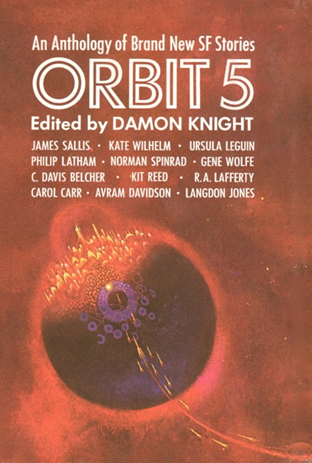
Orbit 5
Hardback cover of Orbit 5 from 1969

Somerset Dreams by Kate Wilhelm

We open with another tale from the ever-reliable Mrs. Damon Knight.  Here Janet Matthews returns to her hometown of Somerset after working in medicine in New York, where she wishes to look after her disabled father. At the same time, a Dr. Staunton is in town to study dreams. Annoyed by his pomposity Janet decides to join in with the project.

This is beautifully described, albeit with some unusual turns of phrase, but it goes on far too long for my tastes, only really becoming more SFnal towards the end. There are also a lot of interesting concepts, but I am not convinced they are explored well enough here to justify their inclusion.

Three Stars

The Roads, the Roads, the Beautiful Road by Avram Davidson

Highway Chief Craig Burns loves his vast new road constructions and does not accept any argument to the contrary. However, one day he misses his turn-off and finds himself in a labyrinth of tunnels and cloverleaf interchanges.

This is the kind of joke story Davidson used to regularly publish when editing F&SF, a feature I have not missed. Add on to this my general dislike of vehicular tales and I was not well disposed to this at all.

A very low two stars

Look, You Think You've Got Troubles by Carol Carr

Hector, A Jewish father is estranged from his daughter, Lorinda, because of her marrying a form of Martian plant-life named Mor. Months later, the parents receive a letter from her, saying she is pregnant and asking them to come visit her on Mars.

I believe this is the first story from a well-known fan (and wife of Terry Carr) and it marks a strong start. It follows the familiar routes you have likely seen on television programmes but they are not as common in the SF realm. In addition, this is told using a great tone of voice that makes it feel believable.

Four Stars

Winter's King by Ursula K. Le Guin

King Argaven XVII of Karhide is having a recurring visions of executing a crowd of protesters. This madness is attempted to be treated by physician Hoge, but what could be the real cause?

I was originally unsure if this planet is indeed meant to be Gethen from The Left Hand of Darkness, as it is only referred to as “Winter” and the gender changes in the book are not referenced here. However, its connections to the Ekumen seem to confirm that it does indeed take place on the same world.

I found this a confusing read. I started again four times and afterwards I was constantly jumping back and forth to try to get to grips with what was happening. It does not have the usual easy style of Le Guin, instead told through a series of “pictures”. Honestly, I am scratching my head over what to make of it.

Three Stars, I guess?

The Time Machine by Langdon Jones

Jones seems to be emerging as one of the great polymaths of English SF. He has been involved in editing New Worlds for a number of years now, writes prose and poetry, has produced photographic cover art, is helping the Peake estate put together new editions of the Gormenghast trilogy and has an original anthology coming out in a couple of months. Amazingly he still had time to sell this tale to Orbit.

In an unnamed prisoner’s cell sits a photo of Caroline Howard. We hear the story of his past relationship with her and the construction of a time machine to see her again.

This tale is told in a passive distanced voice with the connection of the four different situations not immediately obvious. As such, I imagine it will be alienating to some, but I found it quite beautiful and cleverly constructed.

The titular Time Machine is not a HG Wells type of mechanical construct but a strange device containing a Dali painting and creating a “concrete déjà vu”. This may actually mean that it does not really “work” as such but these are merely the memories and delusions of the prisoner. I believe the ambiguity is intentional on the part of the author and makes the tale all the stronger.

Some may find the conclusion and meaning of the tale a bit mawkish, but I liked it a lot.

A high four stars

Configuration of the North Shore by R. A. Lafferty

John Miller goes to analyst Robert Rousse to resolve an obsession he has had for the last 25 years, to reach the mythical Northern Shore. In order to cure this desire, they sail there in dreams.

Whilst I am a fan of what Mr. Jones does, the same cannot be said of Mr. Lafferty. As such this may work better for other people, but I found it all a little silly.

Two Stars

Paul's Treehouse by Gene Wolfe

Sheila and Morris’ son has been in a treehouse since Thursday and is refusing to come down. As they work with their neighbour to try to get him out, disorder is spreading throughout the town.

This is probably the Gene Wolfe story that has impressed me most so far. Not that it is brilliant, but it is well told and has a solid theme. Hopefully the start of an upswing in his writing.

A high three stars

The Price by C. Davis Belcher

The millionaire John Phillpott Tanker is in a traffic accident that caves in his skull. Whilst his body is still alive, he is braindead. After several tests the doctors conclude he is medically dead and use his organs to save a number of people. Whilst this is controversial, journalist Sturbridge writes a number of articles to win the public around. However, in a surprising turn of events, the recipients of the organ donations sue the Tanker’s estate claiming they are still the living John Phillpott Tanker.

These organ transplant stories are becoming a subgenre in their own right, and, unfortunately, this is among the poorer examples. Lem told a better version of this story in three pages last month than Belcher told in 27.

A low two stars

The Rose Bowl-Pluto Hypothesis by Philip Latham

At a track-meet at the Rose Bowl, three athletes all ran 100 yards in less than 9 seconds. If this wasn’t surprising enough, a whole set of other new running records were set that afternoon. What could be happening?

This spends a lot of time doing pseudo-scientific explanations for something incredibly silly. I was annoyed at having read it.

One star

Winston by Kit Reed

The Wazikis buy the four-year-old child of geniuses as a status symbol. Whilst he has an IQ of 160 they soon grow frustrated he is not yet able to win crossword competitions or answer any trivia question they pose.

This story irritated me for a number of reasons. First off, there is more than a whiff of eugenics about the concept here, with the child of a college professor being inherently smarter than this family with a name we seem to be encouraged to read as Eastern European or North African. At the very least, the way the Wazikis are portrayed feels classist.

Secondly, the fact that smart people are selling children to less intelligent people seems to imply that earning potential and IQ are inversely related. But the Wazikis see Winston as an investment, so are they just meant to be stupid and bad with money?

And then the story is just unpleasant with the amount of child abuse taking place in it. Maybe I am overly sensitive, as I am from the gentler school of parenting, but I found it to be gratuitous instead of aiding the storytelling.

One Star

The History Makers by James Sallis

John writes to his brother Jim about his arrival on Ephemera, a planet where the inhabitants live on a separate time-plane to humanity.

Sallis gives us another epistolary tale which, as usual, is written in a literary style and full of artistic allusions (including, strangely, the second mention of the same Dali painting in this anthology. I blame Ballard). I am not sure this has the same depth as his other works but it is still a wonderfully atmospheric read.

Four stars

The Big Flash by Norman Spinrad

The US military has a problem. Their war against a guerrilla insurgency in Asia is not going well and they want to use tactical nuclear weapons to sort it out. However, the public are squeamish about this sort of thing. The solution? Using a violence obsessed rock group The Four Horseman, to spread their message.

A biting critique of both the American military-industrial complex and the hippy groups selling out. Incredibly timely, clever and disturbing.

A high four stars, bordering on five.
(I recently discussed this with some friends over at Young People Read SF if you want to see more of our thoughts.)

The Cycle Continues

8 albums:
Johnny Cash: At Folsom Prison and At St. Quentin
Bob Dylan: John Wesley Harding and Nashville Skyline
Tom Jones: Delilah and This Is
Moody Blues: In Search of a Lost Chord and On the Threshold of a Dream
Some of the same artists, still in UK charts a year on

And so we complete another Orbit anthology, with it feeling pretty similar to the last one.

The main difference is that there is more New Wave influence creeping in (having stories by two of the editors of New Worlds will do that) but many prior authors reappear, doing similar things. Some of it brilliant, some mediocre, the rest best forgotten.

Will either Orbit or our politics break out of this cycle by autumn 1970? Only time will tell.


[July 20, 1968] Beloved Institutions (Orbit 3 and Famous Science Fiction #7)


by Mx. Kris Vyas-Myall

Last month marked the 20th anniversary of the founding of the UK’s National Health Service. There are many issues with it, patients often wait for hours to see a GP, doctors trained by the service are regularly leaving for better paid work overseas, and many of the hospitals taken over from the private sector are in disrepair and not fit for the modern era.

Line of people queuing in a hospital from a BBC documentary about the NHS 1968.
Long hospital queues. A perennial issue

Many of the major issues come down to spending choices. There are continually new innovations coming out that are expensive to use. For example, would it be better to spend the money on the new dialysis machines, rebuilding hospitals or reducing staff to patient ratios? All are important but they cannot all be achieved.

Person lying in a hospital attached to a dialysis machine, from Tomorrow's World 1965.
Is it better to invest in new technology or more staff?

However, in spite of this, it has already become a beloved institution. There are few that want to go back to the system of voluntary hospitals and medical aid societies, and the principle of a health service free at the point of use is hugely popular.

Both of the publications I am reviewing this month are similar to the NHS in this manner. They may be relatively recent and not without their flaws but are still loved for what they do.

Orbit 3

Cover of Orbit 3
Cover by Jack Lehr

Much like its British equivalent New Writings in S-F, Damon Knight seems to have a stable set of writers to draw from, with 4 of the 9 authors in this issue having appeared in a prior volume.

Mother To The World by Richard Wilson
Martin Rolfe and Cecelia “Siss” Beamer appear to be the last survivors of biological attack on the US by China. Whilst Siss is devoted to Rolfe, she also has an intellectual handicap, and he grows increasingly depressed about his situation.

Yes, this is yet another “Last Man” story, the twist being that the lead here is an unpleasant creep. Maybe others want to read about domestic abuse and incest. I do not. Add on to that statements about being surprised that a “backward country” like China could develop powerful weapons (the same country that built a hydrogen bomb last year) and I found myself annoyed at the entire thing.

One star

Bramble Bush by Richard McKenna
We are told that McKenna’s back catalogue has finally been exhausted so this is the last of him we will see in Orbit, and it is his most baffling tale.

In a future where man has explored much of the galaxy, a team is dispatched to Proteus. This planet, in Alpha Centauri, has never been landed on, as every prior mission has mysteriously had to abort before arriving. After making landfall they encounter what appear to be primitive humans who they are unable to communicate with. But after these Proteans perform a ceremony, the world gets a lot stranger for the crew.

We are told this story “…deals with one of the most perplexing questions in relativity…If all four spacetime dimensions are equivalent, how is it we perceive one so differently to the rest? [Mckenna gives a] solution which involved the anatomy of the nervous system, symbology, anthropology, the psychology of perception and magic."

It is possible that is what the story is about. I was honestly utterly confused throughout.

Two Stars, I guess?

The Barbarian by Joanna Russ
Continuing the adventures of Alyx in this fourth installment of her tales. She is now 35 and back in the ancient world (I presume after the novel Picnic on Paradise as there is a reference to her disappearance) when she is approached by a mysterious powerful figure who offers her anything she wants for just one deed. To kill a future dictator who is currently only six months old.

Russ continues to impress with these adventures, finding ways to expand the world and offer new situations for Alyx to grapple with. Here the tables are turned on her somewhat, as she is now dealing with someone more powerful who looks down on her. How she navigates the situation is fascinating and reveals much more about her. Whilst I wouldn’t rate this quite as highly as the prior installments, it is still very good.

Four Stars

The Changeling by Gene Wolfe
A Korean war veteran returns to his hometown in the US. Everything seems much the same except for young Peter Palmieri, who has not aged. What is more, no one else remembers Peter as being alive back then. Is our narrator suffering from Gross Stress Reaction? Or is something stranger going on?

I found this a well-told story but also fairly obvious and not doing anything I hadn’t seen before.

Three Stars

Why They Mobbed the White House by Doris Pitkin Buck
Hubert is a veteran who has become frustrated with the growing complexity of completing his tax return, so he leads a movement to have them done by supercomputers. But will the machines be any happier with this state of affairs?

As I come from outside the US, the complexity of filling out their tax returns is such a mystery to me. Not only could I not relate, I found this silly and dull.

A low two stars

The Planners by Kate Wilhelm
In a large research facility, monkeys are being given pills to test if it will increase their intelligence, along with the intellectually handicapped and prisoners. Do they have the right to do this? And is this all that is going on?

This is another of the kind of story popularized by Flowers For Algernon. It has some interesting touches, but I don’t think it rises significantly above the crowd.

Three Stars

Don't Wash the Carats by Philip Jose Farmer
In this experimental vignette, surgeons find a diamond inside a person.

A couple of years ago I considered Farmer to be one of the best people writing SF, but he has recently gone off the rails. This is described as “a ‘polytropic paramyth’ – a sort of literary Rorschach test”. Well what I see is pretentious nonsense.

One Star

Letter To A Young Poet by James Sallis
In this epistolary tale, Samthar Smith writes to another young poet back on Earth about his life and works.

This is a pleasant little piece where a writer looks back on his life and ponders about it. There is not a huge amount to say about it, but it is enjoyable.

Three Stars

Here Is Thy Sting by John Jakes
It all starts when Cassius Andrews, middling journalist, goes to pick up his brother’s corpse and finds it missing. This sends him on a surreal journey involving an old WBI agent, a superstar singer and a mad scientist.

I found it fitting that this is the longest piece in the anthology but has the shortest introduction. It rambles on for pages without much there and I found the conclusion to be rather odd. I don’t see that if we could remove the fear of the act of death (not the ceasing to be, but the momentary pain) everyone would become melancholy and cease to have a purpose. If anything would that not make people more willing to take bigger risks? The one thing I will say for it is Jakes is able to spin a yarn well enough to keep me reading to the end.

Two stars…just.


Famous Science Fiction #7

Famous Science Fiction #7 Cover

This quarter’s cover is a detail of the cover from August 1929’s Science Wonder Stories by Frank R. Paul.

Science Wonder Stories August 1929

I have to say I find this Famous version much less effective. In a short article on the subject, it states that it is the first time a space station was illustrated on a magazine cover but adds some criticism for it seeming old fashioned, due to the lack of technical articles available to work from in the period. Interesting enough for what it is.

Men of the Dark Comet by Festus Pragnell
This story and the next are from the summer issues of Science Wonder Stories in 1933.

In a far distant solar system, a planet’s natural satellite had been set loose in order to escape a disaster from their sun. This “Dark Comet”, as it becomes nicknamed because it absorbs all light, eventually enters Earth’s system.

Heathcoate, the commander of the spaceship Aristotle, is rendered unconscious by the application of the Martian drug Borga. He wakes up on an out of control ship, his cargo gone and the only person left on board being a prisoner, the drug addict Boddington. Boddington is able to deduce Martian pirates were behind this, working with the native authorities to secretly build up their own space fleet.

Crossing paths with the comet, they manage to effect a landing. Inside they find themselves among a species of alien “Plant-Men”, Boddington hopes to stay and learn more, Heathcote wants to return to Earth to warn of a potential Martian invasion.

Two men attached to strange apparatus by the plant men
Art by Frank R. Paul

Whilst I am not opposed to slow starts in fiction, this novella is glacial. So much irrelevant detail is included it is hard to get a grip on the central plot for some time. It includes some interesting elements, such as Martians having three sexes for reproduction and an interplanetary drug trade, but mostly it is irritating. At the same time, the Martian invasion plot feels cliched.

What is interesting enough to raise it up are the attempts to communicate with the plant creatures. Pragnell does a good job of making them seem truly alien, with contact taking place via the electro magnetic spectrum.

A very low three stars

The Elixir by Laurence Manning
We now come to the conclusion of the five part Man Who Awoke saga. To quickly recap for the unfamiliar, Norman Winters developed the means of putting himself to sleep for thousands of years and has been waking up further and further in Earth’s future. At the end of the last story we learnt that Winters has set his device to wake him up in the year 25,000, but that Bengue has also decided to duplicate his process and follow him.

After awakening and traversing the wilderness, Winters finds himself in the laboratory of Ponceon. As luck would have it Ponceon has been developing an elixir of immortality. Now he is able to travel into the future without sleep, instead he can live through the millenia himself.

These advancements are possible due to the development of voluntary social contracts across mankind, stating they will not force any person against their will and to never refuse anyone help. Colonies now exist on Mars and Venus, machines can convert any raw material into products and currency has been abolished, with workers simply sharing new inventions for the common good.

Now able to use the process to explore the universe, humanity spreads away from the Solar System. Winters joins the disciples of Calcedon, who live on a far-off planet searching for the meaning of life. There they work on trying to use the Temples of Thought to understand the nature of creation.

Person watching a group of people in a round domed hall where many people are in there, attached to domed caps who in turn connect to a large device.
Art by Frank R. Paul

This is a more sedate story. Any moments of conflict are solved quickly, instead we are simply meant to explore this utopian world we find ourselves in, and hop between locations and philosophical musings. However, it manages to avoid being dull.

Bengue’s appearance is an odd one. A big point is made of it in the prior story but here he turns up for a single paragraph where we are merely told:

…he had awakened a few months after Winters had left Earth and had actively been engaged on some breeding experiments ever since. The two spent a year and a half together and finding they had nothing of real interest in common, separated by mutual consent.

I can’t help but wonder if something was cut or if there was another story that was never published.

Not as strong as some of the other parts but a satisfying conclusion.

Four Stars

Why Bother With Criticism by R. W. Lowdnes
Another of Lowdnes’ editorial essays, this time looking at reading for fun vs art and looking at how criticism can be mind-expanding. It is an incredibly kind and well thought out section, with some standout parts such as:

When someone proclaims that something you have enjoyed is inferior…you will want to defend it. Because if something you enjoyed…is proclaimed inferior or bad, then there is an implication that you are a person who enjoys the inferior, enjoys trash – so there must be something wrong with you. If you are secure enough in your own estimation of your worth as a person so that you can shrug off such implications…then you might even acknowledge that a particular story is not great art…and let it go at that. Or others might be wrong, but your own security will not require you to produce defensive reactions. It is the insecure person, who has serious doubts about himself who has to be excessively defensive…under such conditions.

Advice I wish I was able to follow more often. Highly recommended for every reader.

Five Stars

Away From The Daily Grind by Gerald W. Page
In the first new story in this issue, Mr. Federer wants a way to hide away from civilisation and is put in contact with Mr. Parkhurst, but what does the deal entail?

Unlike the rest of this issue, I found I would completely forget this story after finishing it. It is not badly written but inconsequential and built around a bad pun.

Two Stars

The Fires Die Down by Robert Silverberg
This is a bit of a rarity. Not a new piece but one from Silverberg’s absurdly prolific period in the 50s, previously published in Britain in the much missed Nebula magazine.

Cover of Nebula Science Fiction #21

The Thanians, a multi-galactic civilisation, have come to colonise Earth. Finding a low technology civilisation on a sparsely populated planet they expect to be worshipped as Gods. To their surprise humanity has given up this kind of imperialism millenia ago and are simply unbothered by their visitors. What could have happened?

What a wonderful surprise, I do recall some of Silverberg’s efforts in the British magazines but this one was not in my collection. It goes counter to so many of the clichés of science fiction and critiques the idea of expansionist space operas that dominate the genre (and thereby colonialism itself), instead showcasing a form of rural anarchistic utopianism. A story that still feels fresh now and I would easily call it the best work of Silverberg’s I have ever read.

Five Stars

Not By Its Cover by Philip K. Dick
We finish off with the other new piece, possibly by the most Famous author to grace these pages.

A publisher creates a series of special editions of famous books coated in the rare indestructible Martian wub-fur. However, the Wub’s consciousness lives on in the pelt and has opinions on the books it is coating.

It is easy to forget that sometimes Dick can be very funny when he wants to be, elevating what could have been a forgettable vignette to something better.

A high three stars

Imperfect Pieces

Your New National Health Service On 5th July the new National Health Service starts Anyone can use it - men, women and children. There are no limits and no fees to pay. You can use any part of it, or all of it, as you wish. Your right to use the National Health Service does not depend upon any weekly payments (the National Insurance contributions are mainly for cash benefits such as pensions, unemployment and sick pay). Diagram indicating: You and your family Down Arrow Circle Containing: "Your Family Doctor" Arrows going out from it saying: - Hospital & specialist services - Dental services - Maternity services - Medicines, drugs and appliances - Eye service - Dental services Choose Your Doctor Now
Advert for the NHS from 1948

As you can see, the quality varies considerably in both publications, some good, some bad, but I am glad that we have them here.

Are they to remain around for 20 years like the NHS has? Or are they destined to be experiments cast by the way-side, like Gamma or Star Science Fiction before them? Only time will tell.


[July 10, 1968] Back in the Saddle Again (August 1968 Galaxy)


by Gideon Marcus

Not F-UN

Bjo Trimble, a superfan from the wayback, put together a fan shindig in Los Angeles last weekend.  Called F-UN Con, it is not only an SF convention, but it's also the first Star Trek convention, with a whole day of programming dedicated to the show.

This article is not about F-UN Con.

Why did we fly to the Bay Area this past weekend rather than trundling up to L.A., which is closer?  Well, we know the gang in 'Frisco, and they've been putting together informal conclaves every year.  We couldn't very well shuck tradition just for a new event, even if it's nominally in our back yard.

It was a good decision.  For one thing, they had a bit of Star Trek up there–this lovely reproduction of the captain's chair.

And now that The Prisoner is showing in the States, we're getting some lovely costumage, too!

Speaking of traditions that are worth upholding, the latest issue of Galaxy feels like a return to the quality of yore.  Usually, magazines pack their summer issues with their least impressive offerings, but such was not the case this time around.  Take a trip with me!


by Vaughn Bodé

Among the Bad Baboons, by Mack Reynolds


by Vaughn Bodé

Mack Reynolds continues his stories of life under "People's Capitalism" in the '80s, this time focusing on the last of the Bohemians, living in the decaying ruins of Greenwich Village.  With most of the country now on the dole, and white flight having been taken to its logical extreme, the cities are now all but abandoned, save for the "babboons"–lawless squatters–and the "hunters", who go downtown to shoot for thrills.

This story is more a vehicle for philosophical discussion than plot, and I found the end a bit distasteful.  That said, there are some fascinating suppositions in this tale.  One is that the current regime, in which prospective authors send their manuscripts to editors, who then publish them through traditional channels, will be supplanted by a revolutionary new process.  In the '80s, any author can take their novel (or story, or artwork) to a computer and have it stored for infinite reproduction.  These reproductions can then be read on a tv-phone (or in the case of art, facsimile duplicated).

This means that anyone can be a writer or an artist, and anyone can appreciate any work, any time.  And since everyone is on the dole anyway, why not be an artist or a writer?  Well, it does mean there's a lot more competition, and it's harder to become a phenomenon, but on the other hand, there's no barrier to entry.

Now, Reynolds assumes most people won't want to be artists, and they will be content to watch 24 hours of television a day while tranked up on cheap drugs.  Maybe he's right.  But as someone who already publishes nontraditionally (what is Galactic Journey and The Fantasy Amateur Press Association if not decentralized publishing), it's an exciting prospect.

Three stars, for the ideas, if anything.

Going Down Smooth, by Robert Silverberg


by Brock

Silverbob puts on his best Ellison impression with this tale of a therapist computer gone nuts listening to neurotic patients all day.

It's not bad, but it doesn't go anywhere.  I'd stick with the original.

Three stars.

A Specter is Haunting Texas (Part 2 of 3), by Fritz Leiber


by Jack Gaughan

I really had not been looking forward to this second installment of Leiber's tale.  Last time, as you recall, a spaceman-actor had landed in post-apocalyptic Texas (now ruler of all North America save the two Black republics in the southwest and southeast) to 1) perform in a short tour and 2) make good on a pitchblende claim in the Yukon.  The eight-foot tall, cadaverous, cybernetic thespian was recruited in a hit on the current President of Texas, whereupon he escaped to join causes with the revolutionary Mexican underclass.

It was all a bit silly, and while I appreciated what Leiber was doing, it didn't quite resonate with me.  This time, however, the needle fell into the groove.  As Chris Crockett La Cruz assumed the role of La Muerta, spurring the downtrodden Mexicans with promises of Vengeance and Death, Leiber's writing took on sublime proportions. The way he navigates the line between satire and seriousness so deftly, with such beautiful language and characterization, even as the characters are all caricatures, is an accomplishment for the ages.

Five stars for ths installment.

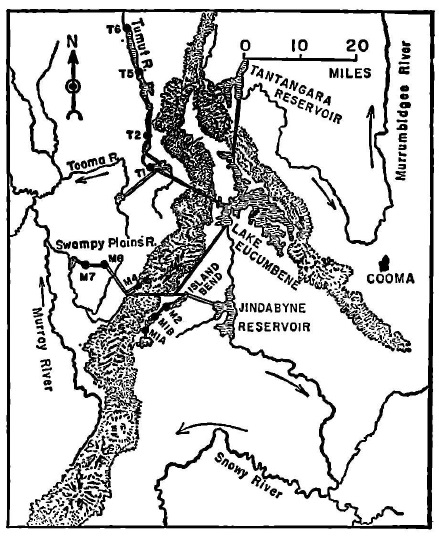
For Your Information: In Australia, the Rain …, by Willy Ley

The topic for this month's non-fiction piece is an interesting one: the artificial lakes, rivers, and resulting hydropower systems of Australia.  The presentation, however, leaves much to be desired.  I want to know the impact of these developments, both on settlement and on the environment, not be given pages of details of their precise geographical location.

Three stars.

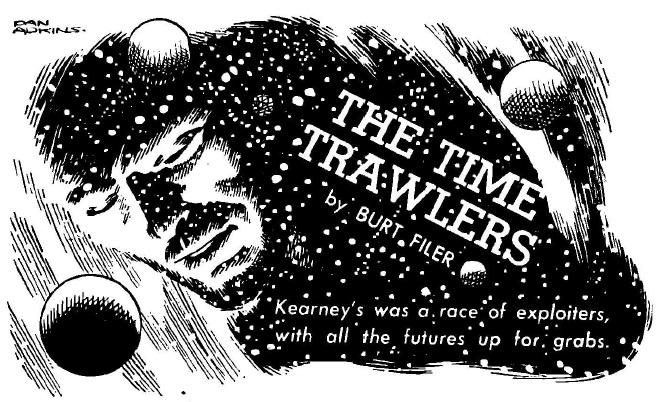
The Time Trawlers, by Burt K. Filer


by Dan Adkins

A thousand years from now, humans will fish the future just as they now fish the seas.  As the solar system's population grows to number into the quadrillions, our race must pluck planets from 30 billion A.D. to plunder them for their resources.  An 18-year old fisherman with "the knack" for finding rich worlds, decides he doesn't want to do it anymore after seeing what the process does to already-inhabited planets.  He embarks on a one-man crusade against the practice, hatching a novel scheme to bring it to an end.

Never mind the silliness of the premise, or the fact that culture looks pretty much like 20th Century Earth in the tale.  It's a good story, well-told.  Sure, it feels a bit like early vintage Galaxy, but I like that era!

Four stars.

The Star Below, by Damon Knight


by Jack Gaughan

Thorinn, that diminutive traveler introduced in The World and Thorinn and later in The Garden of Ease, has returned.  This time, he has stumbled across an enormous warehouse filled with all manner of wondrous items.  From rich garments to strange engines to a talking box, all are marvels to the medieval-minded explorer.

Of course, it's at this point that our suspicions are confirmed that the myriad of worlds Thorinn passes through are all parts of a giant generation ship, this being the cargo hold.  What makes this segment so compelling is the description of these (to us) more-or-less familiar items to a man with no conception of technology.  The interactions between Thorinn and the little computer, particularly the way the box learns English, feel very natural.  I only wish Thorinn could have taken the box with him; it'd make an interesting companion.

Four stars.

HEMEAC, by E. G. Von Wald


by Joe Wehrle

Long ago, the robots took over the human power plants, and they also claimed a number of human hostages, who they began to educate in their own, logical images.  But the robots are breaking down, and the "renegade" humans are pounding at the gates.

What is HEMEAC, a teenaged robot-trained youth supposed to think when his teachers all start behaving erratically and the wild people defile the sacred halls of cybernia?

This is another tale with a classic (i.e. '50s) sense to it.  I particularly enjoyed the rendering of the robots, and HEMEAC's not-entirely-successful attempts to make rigid his thought processes.

Four stars.

Missed it by THAT much

Put it all together, and you get an issue that soars almost to four stars in quality–surely to contend for the best magazine of the month.  It's reads like this that keep me going, and also cause me to commend editor Pohl for keeping the proud publication on an even keel.  I know some disagree with his lambasting of the New Wave (and, indeed, Pohl is not averse to printing examples of it), but I think there is value to the continued production of novel, interesting, but also conventional SF prose.

I can't wait for next month!


</small

[May 10, 1968] Horse race (June 1968 Galaxy)


by Gideon Marcus

Three and Two make Two

I imagine Vegas bookies are tearing their hair out trying to predict the Presidential race this year.  On January 1, the hard money would have been on President Johnson beating Governor George Romney in a fairly easy race.  Then McCarthy and Nixon won in New Hampshire.  The former sent LBJ announcing his resignation and the latter gave the former Vice-President the first victory of his own since 1950.

Then Bobby Kennedy jumped in, trying to steal McCarthy's lunch.  Inevitably, Vice President Humphrey threw his hat in the ring, instantly commanding the loyalty of most democratic party bosses.  Meanwhile, Romney's dropped out, but Nelson Rockefeller, who said he wasn't going to play this year, has jumped in.

So, who will face each other come Labor Day?  It's anyone's guess, especially since both McCarthy and Kennedy just won recent primaries.  I guess we'll have to see if the New York Governor's campaign has legs, and if Humphrey's position translates to delegates at the convention.

Stay tuned…

Nine to Rule Them All

It's similarly a horse race with the latest issue of Galaxy, which presents a solid batch of stories.  Which one is the best?  That's a hard choice, too!
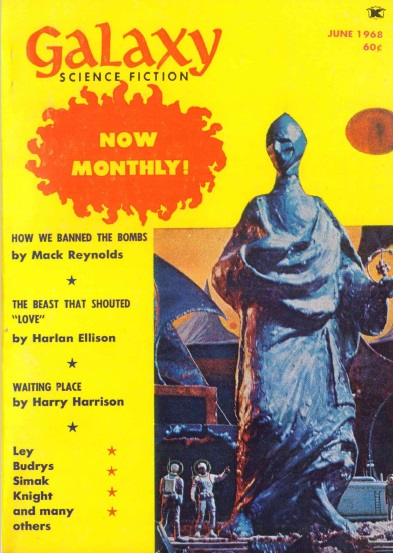

by Paul E. Wenzel

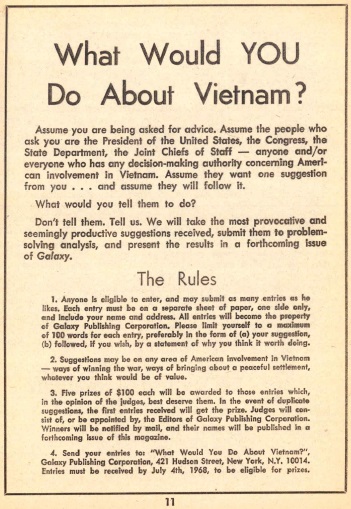
But first, the editorial.  Remember a few months ago F&SF ran competing ads from SF authors for and against the war in Vietnam?

Well, now Pohl's mags are doing it.

Pohl (Galaxy's editor) says it's not just enough to bitch about it.  Someone needs to come up with a solution.  He figures SF fans are about the smartest people around, so why don't we try our hand at it?

So now there's a contest, first prize $1,000, details at the bottom of this article.  Of course, given that you can't devote more than 100 words to the issue, and given that the war has been going on since 1945, in one way or another, and given that a lot of smart people have been trying to fix this thing…I somehow feel 100 words is not enough.

Or as my friend the divorce lawyer likes to say: "Imagine trying to fix a car.  Now try to imagine fixing that car while another party is actively trying to dismantle it."

Yeah.  Lots of luck, Pohl.

On to the stories!

The Beast That Shouted Love, by Harlan Ellison


by Jack Gaughan

Ever wonder why all people seem to go psycho all of sudden?  Why a race with countless religious texts devoted to peace, harmony, and brotherhood just goes buggy every so often?

What if some other planet, in order to preserve their peace, harmony, and brotherhood, is beaming all their psycho energy to us?  Sort of a bad emotions disposal process.

This is one of Ellison's lesser pieces.  It probably means a lot to him, but it's rather disjointed and vague and not as profound as he wants it to be.

Three stars.

How We Banned the Bombs, by Mack Reynolds


by Vaughn Bodé

Right now, the world population is 3.5 billion and rising.  Naturally, this has been the cause of concern and the topic of more than a few science fiction stories.  Bombs is one of the lesser efforts.

Reynolds posits a Reunited Nations government so powerful that, in response to the Population Explosion, it can enforce a ten-year ban on childbirth through mandatory provision of contraceptives to women.  At the end of the ban, it turns out that the contraceptive drug's effect was permanent, and all human women are completely sterile.

This, by the way, is the end of the story.  The rest of it involves characters talking to each other, telling tales they all know about how the world ended up in this predicament (which doesn't make for much of a story).

The whole premise is silly.  The population in this projected, not-too-distant future is 3.5 billion, same as it is now, yet resources are so scarce, they're banning the production of alcohol so as to husband their grain crops.  Somehow, the ReUN can sterilize EVERY woman on Earth, none slipping through the cracks.  And then, no one foresees or predetermines that the universal contraception has adverse effects.

In the words of Laugh-In's Joanne Worley: "Dummmmmb!"

One star.

Detour to Space, by Robin Scott Wilson

(uncredited artist)

Object 3574 is circling the Earth in a polar orbit.  Unannounced, the General is convinced it's a secret Russkie bomb.  NASA's long-hair thinks otherwise.  The majority decides to send up an Apollo to check it out.  The object is covered in green slime and pebbled with tektites, suggesting extraterrestrial origin…

There's a lot to like about this tale, especially the sting at the end of it.  Scott convincingly describes the apprehension with which we Americans greet the arrival of a new star in the heavens.  I know I scour the papers and call my Vandenberg buddies whenever anything goes up to get some insight into otherwise classified launches.

Where the story beggars credibility is the use of Apollo spacecraft, launched from Vandenberg, to intercept 3574.  You just can't do it–there's no way to get a Saturn there.  Much more likely would be to send up an Air Force Gemini (they're making them for the planned Manned Orbiting Laboratory).  But that would have killed the story.

This is what happens when you know too much about a subject, reviewing a story by someone who doesn't quite know enough… three stars.

Daisies Yet Ungrown, by Ross Rocklynne


Joe Wehrle, Jr.

After the big bombs created the time-space Rift, God told Rickert to jump through with Sears catalog robots and claim a new world 350,000 trillion light years from Earth.  But this is so far away that God's grace cannot reach, and Lucifer's tool, the newcomer Dorothy, has arrived to take his planet away from him.

This is an odd, poetic story that you, at first, think is going to be satirical, sort of a cross between Sheckley and Bunch.  Instead, it's kind of pretty and sweet, way different than I was expecting.

Three stars.

For Your Information: Jules Verne, Busy Lizzy and Hitler, by Willy Ley
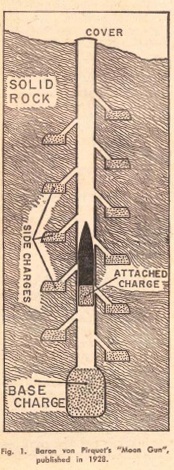
This is a pretty interesting piece on attempts using a gun rather than a rocket to fire a projectile, if not into space, at least a terrific distance.  Essentially, it's like a rocket, but with the propellant on the outside.

Long story short: rockets are better.  Four stars.

Waiting Place, by Harry Harrison

(uncredited artist)

A man taking the matter transmitter home finds himself in the future version of Devil's Island, a colony for hardened criminals.  Surely, there has been some kind of malfunction, for he can remember no crime.  But the wheels of justice never make a mistake, or do they?

This would be a fairly slight tale if not for the execution.  Luckily, Harrison (who I understand has just retired from the editor helm of Fantastic and Amazing) is a master of execution.

Four stars.

The Garden of Ease, by Damon Knight
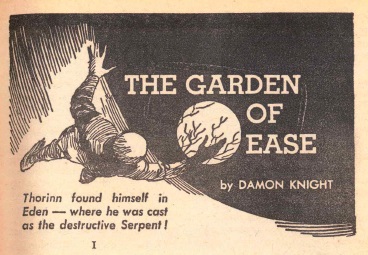

by Jack Gaughan

As expected, the first adventure of Thorinn, a human raised by trolls in a Nordic nightmare, has a sequel.  Last time, the resourceful Thorinn had been tossed into a deep well as an offering to the gods to end a ceaseless winter.  Making his way through the caves he found, Thorinn discovered a hatch that opened not onto but above a new world.  This story details what he finds below.

In an almost Oz-like setting, the people of the Vale enjoy a life of complete ease.  The grasshopper men and the doughwomen and the fancymen and the children, they eat the food that grows on trees and bushes, they frolic, they discuss, and when they want adventure, they seal themselves up in the pleasure pods for the night…or sometimes an eternity.

Thorinn is the snake in the garden, slowly poisoning the place with his foreignness and his willingness to kill.  Ultimately, he hatches an escape plan, but not before leaving his mark.

This is an interesting episode, but not as compelling or as clever as the first one.  Three stars.

Booth 13, by John Lutz

Here's a new author, or at least, new to me.  John paints a grim future in which populational ennui has settled in.  All that's left is war, the tranquilizer lysogene, and the death booths.  If life gets just a bit too monotonous, there's always a quick and easy exit–and now, people are taking it in ever-increasing numbers.

It's not badly done, but my biggest issue is not enough explanation is given as to why everyone is so melancholy.  Perhaps that's the point–if you give everyone an easy out, even the mildest inconveniences can trigger a snap decision.  Or maybe the author is simply extrapolating from the current, profound American despondency.

At the very least, I liked it better than Sales of a Deathman.

Three stars.

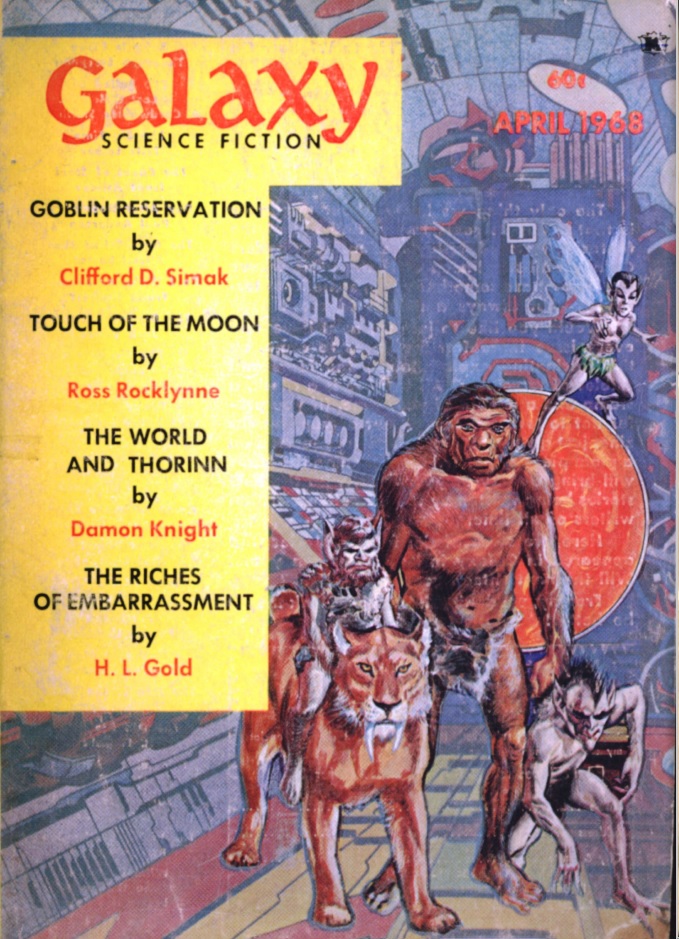
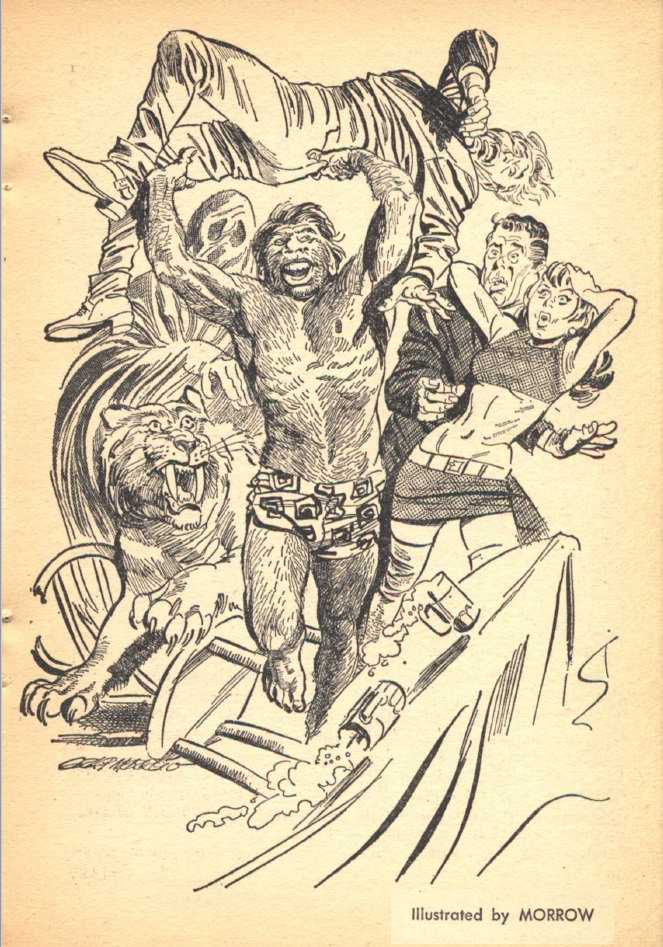
Goblin Reservation (Part 2 of 2), by Clifford D. Simak
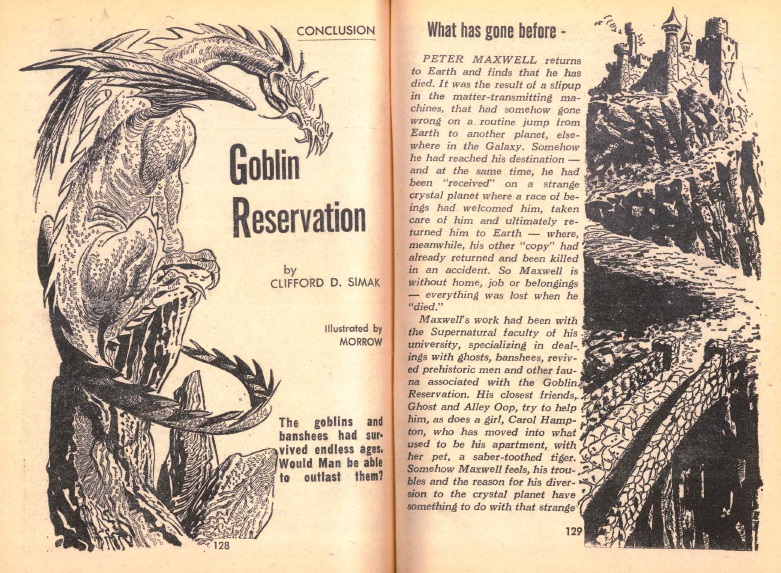

by Gray Morrow

Last time, if you recall, Pete Maxwell has gone off to do research at the crystal planet, a world with the accumulated knowledge of two universes (it had lived through the last Big Crunch).  The fading intelligences of the planet offered all of its wisdom in exchange for The Artifact, a featureless black object dating back to the Jurassic period.  When Maxwell got back to Earth, he found that he'd already come back, duplicated by some quirk of matter transfer, and died.

This datum takes a back seat to bigger concerns–the Wheelers, bags of insect colonies bent on acquiring the lore of the crystal planet, have already purchased The Artifact, and once it is in their possession, plan to take over the universe.  It is up to Maxwell, his tentative ally Carol, her sabre-tooth tiger Sylvester, their Neanderthal pal Alley Oop, the Ghost, William Shakespeare, the librarian who sold The Artifact, the goblin O' Toole, and several bridge-dwelling trolls to somehow stop the transaction before it's too late.

I must say, Simak pulls off a large set of emotional tones very well.  You feel the sense of impending dread when it seems the Wheelers have clinched the deal.  The comedic scenes are genuinely amusing.  Yet, there is a grounding to the story that keeps it from being Laumerian or Anvilian lampoon.  The revelations of the true nature of the fairies, little people, banshees, and whatnot are pretty good, too, though a bit abrupt.  Perhaps they'll have more time to breathe in the novel version.

The only bit I had trouble with was The Wheelers, for whom I felt sympathy once I learned their motivation.  There's an undertone of unconscious racism where they're concerned–they're bad because they're icky, different.  When you learn what their status had been vis-à-vis the crystal planet, it all becomes a bit more unsettling.

Nevertheless, pleasant reading by a master.  Four stars.

Picking a Winner

Well.  It's obvious which story was the loser here (let's just call the Reynolds tale 'Harold Stassen').  But as to a winner, well that's a little harder.  Several of the three-stars are quite nice; my four-star to the Harrison may be arbitrary.  We can exclude the Simak because it's a serial, but it anchors this and the last issue well.

I suppose in an issue where (all but one of) the stories are good, the real winner is…us.

Happy reading!  And don't forget to write to Pohl…


</small

[March 6, 1968] Trend-setter (April 1968 Galaxy)


by Gideon Marcus

Back in the saddle again

It's been a long time since the halcyon days of the early '50s, when Galaxy was setting the standard to beat, ushering in the Silver Age of Science Fiction (along with the more avante garde F&SF).  But now that editor Fred Pohl has collapsed his empire to just two mags, it seems he can afford to be more picky.  Indeed, IF is unusually good this month, and the April 1968 issue of Galaxy is by far the best I've read in a long time, and a strong contender for best magazine of March.


by Gray Morrow

Brave new worlds

Goblin Reservation (Part 1 of 2), by Clifford D. Simak

Simak is back with a odd brew of a story, perhaps in the same universe as Here Gather the Stars, as reference is made to a Wisconsin transit station.  Eschewing (for the most part) his usual pastoral motif, instead we get the first installment of the book-length adventure of Peter Maxwell, professor at the Time University in North America.  At least he was.  It seems that, while on the way to do fieldwork on the planet of Coonskin, Maxwell was duplicated.  One of him went on to his intended task.  The other ended up on a crystalline, roofed-over planet.  This world is some 50 billion years old, its inhabitants little more than ghosts, and they possess the knowledge of two universes since they lived through the last cosmological crunch and survived the most recent "Big Bang".

This latter Maxwell is the one we follow, since the other one died in a traffic accident upon arriving home.  Now, Maxwell is officially dead, out of work, and at loose ends.  Add to that there seems to be conspiracies, both human and alien, to get the secrets of the crystal planet from him, and things get very hot indeed.

That would be a twisty enough tale in and of itself.  Throw in the existence of fairies and ghosts (they've been around all along, but now they're acknowledged creatures who live on reservations) as well as working time travel (one of the main characters is Alley Oop, a brilliant Neanderthal), and things are complicated to the extreme!


by Gray Morrow

And yet, somehow Simak makes it all work.  It's an unusually humorous story, though the Morrow illustrations are perhaps too comic, and I tore through the half novel in short order.

I am looking forward to seeing where this all goes.  Four stars.

The Riches of Embarrassment, by H. L. Gold

Why does Miss McGiveney always seem to happen upon her neighbors at the most embarrassing moments?  It may just be her superpower.

This slight tale in particular feels like vintage Galaxy, perhaps because it's written by the magazine's first editor.  I hope Fred Pohl edited the story savagely…what's good for the goose is good for the gander.

Three stars.

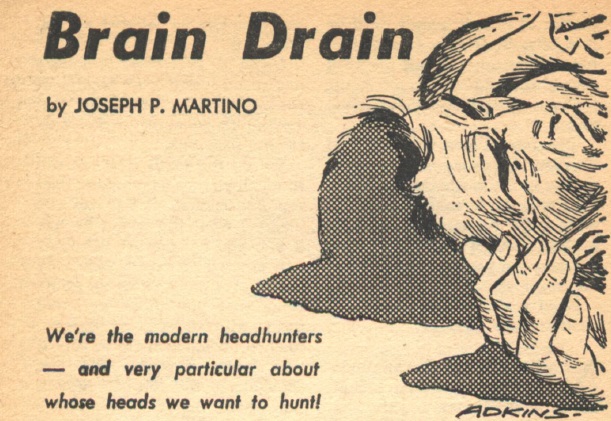
Brain Drain, by Joseph P. Martino


by Dan Adkins

Tom Harrison, a field agent of Intelligence Imports Incorporated, is in Thailand searching for a particular kind of student, and he thinks he has his target in high school graduate Manob Suravit.  It turns out that Triple-I is on the hunt for brilliant PhD candidates, and apparently there aren't enough in America (and/or perhaps there is value in recruiting from beyond our shores).

At first, I thought it would turn out Harrison was looking for folks with psi powers–I was glad to find the object of his search was more mundane.  Most of the story is excellent, redolent with such authentic color that I have to think Martino has spent time in Thailand.

The problem is the ending, where Harrison convinces the local schoolmaster to be happy about the loss of promising students.  Not so much the reasoning, but the near-polemic way the reasoning is delivered.  What could be a thoughtful piece, with shades of gray woven in (as the story appeared to promise earlier on) becomes something more suited for Analog.  Along the lines of "Hey, sure we take your smart kids, but you weren't using them, and you've still got plenty."

A missed opportunity.  Three stars.

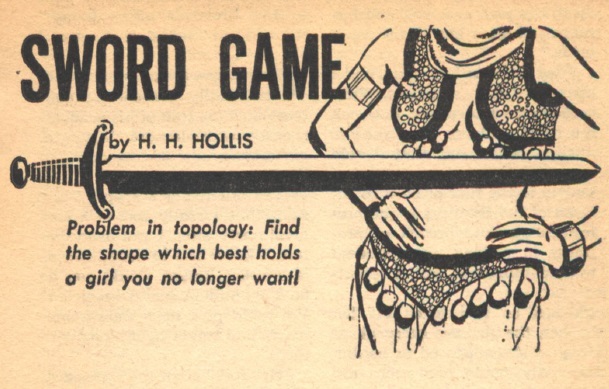
Sword Game, by H. H. Hollis

A bored middle-aged topologist and a grubby would-be Gypsy team up with their tessaract-based circus show.  Said mathematician shoves his partner into a cylinder of fuzzy time and space and stabs her vividly, but harmlessly, with a sword while the audience marvels.

But said topologist bores of this, too, and the result is truly macabre (though ultimately happy).

Three stars, but I could see someone going to four.

For Your Information: The Devil's Apples, by Willy Ley

Willy Ley offers up a short, but interesting piece on potatoes.  Not much to say, really.  Three stars.

Touch of the Moon, by Ross Rocklynne


by Dan Adkins

What an odd piece this is, about a romance broken when one of the partners goes to the moon.  Gravity has an irrevocable effect not only on the body, but also the psyche.  But happily, loosing one's ties to Earth is ultimately good for the species if it ever wants to claim the stars.

This could have been a good story, but it's written far too amateurishly and with too implausible a premise.  The former is surprising given that Rocklynne dates back to the Golden Age.  On the other hand, I haven't seen hide nor hair of him since I began reading SF regularly (1954), so perhaps he's out of practice.

Two stars.

The Deceivers, by Larry Niven


by Jack Gaughan

Our old pal Lucas Garner is back, this time with a shaggy dog story about the first fully automated restaurant that opened in 2025.

Niven has a real knack for creating whole worlds with a few strokes.  He also joins multiple time periods with ease: Lucas Garner was born in 1939, so he is our contemporary.  He lives in the 2100s, and he reminisces about the 2000s.  Thus, his stories have touches of the futuristic as well as the familiar.

Four stars.

Galaxy Bookshelf, by Algis Budrys

I don't often comment on Algis Budrys' column, but this time, he has some important things to say…and a friend named Brian Collins (who has his own commendable 'zine) did an excellent job of summing it up while adding his own observations:

Algis Budrys dedicates the whole review column to Dangerous Visions, giving us a review I'd say is about 1,500 to 2,000 words long. Budrys has shown us before that he's one of the more "literate" people in the field, but he has a unique challenge with Dangerous Visions, a book he both highly recommends but is highly mixed on as far as its content goes.

He argues pretty well as to why this is a major work in the field and why you should get yourself a copy, despite a lot of the stories therein not holding up to scrutiny. It helps that he and I mostly agree on what works and what doesn't (I'm admittedly one of the few people who liked the Farmer), and it pleases me in a morbid way to find that I'm not the only one who was incredibly disappointed by the Sturgeon. But Budrys notes that while the bloated pseudo-lecture from Sturgeon is a failure, and far under Sturgeon's caliber, it works as a sort of counter-piece to the Emshwiller, which, as Budrys says, feels more like a classic Sturgeon story than the Sturgeon we got. Taken together, these two contribute immensely to a narrative that Harlan Ellison is trying to put forth with the book.

Will Dangerous Visions kick off a new movement in SF? No. We had already seen stuff published in F&SF and New Worlds that would have made fine contributions to Dangerous Visions. This book does not present a brave new world like Ellison claims, but rather as Budrys argues it serves as an essential reminder that change is inevitable and that the field has been changing and will continue to change. No doubt 50 years from now Dangerous Visions will be remembered for the best stories between its covers, but also as a historical artifact—a portrait of a genre in the midst of change, and change is often violent and unpretty.

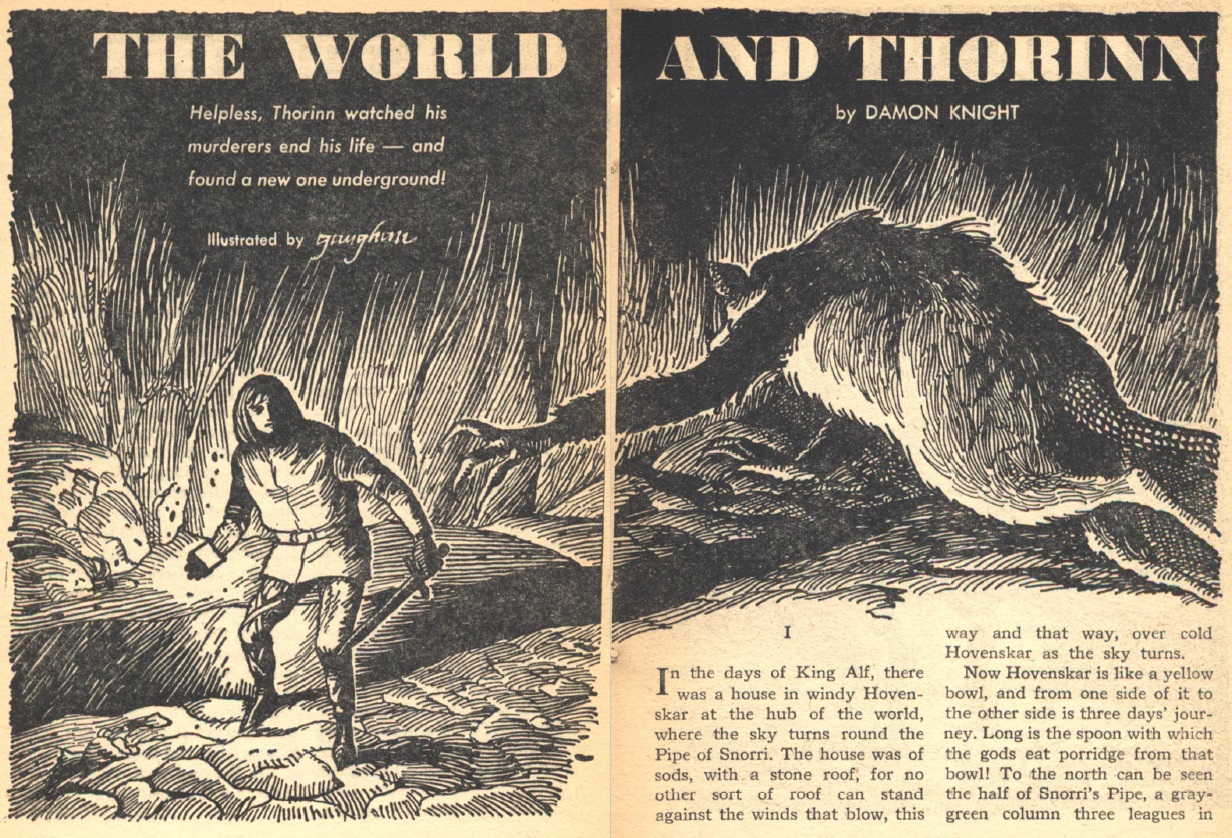
The World and Thorinn, by Damon Knight


by Jack Gaughan

Finally, Damon Knight begins what looks like the first part of serial in all but name.  Thorinn is a human raised by trolls in a primitive, Scandinavianesque, not-quite-fantasy world.  When calamity befalls his family, they throw him down a well to appease the god Snorri.  Thus begins the first of Thorinn's subterranean adventures.

The first few pages are a bit slow, particularly when scenes are repeated from two different viewpoints (I really dislike that style), but the rest makes for an excellent puzzle story, written in a fine, almost Vancean style.

Four stars, and the anticipated book may rate higher.

The Other Show

Between the Simak and the Knight (both fantasy-tinged pieces), we have a couple of open promises.  We also have something of a new style: there's a lot more sex in this issue than I've seen recently in Galaxy.  Is Pohl taking a page from F&SF's book?  Or has the New Wave simply caught up to the Guinn publishing enterprise?

Either way, I like it.  More, please!


Don't miss the news — a new episode of KGJ's weekly round-up is being broadcast right now!