Tag Archives: if

[June 2, 1971] Others (July-August 1971 IF)

A white man with short gray hair poses in front of a wooden wall. He is wearing a gray blazer, yellow shirt, and black necktie, and is smiling toward the left of the viewer.
by David Levinson

Hating the other

As I reported back in April, the leaders of West Pakistan have made it clear that they are unwilling to accept a democratically elected parliament which places government in the hands of Bengali people from East Pakistan. At the time I handed in my article, Sheikh Mujibur Rahman, the leader of the East Pakistani Awami League and expected new Prime Minister of all Pakistan, had been arrested; East Pakistan had declared independence as Bangla Desh; the Pakistani army was bombing cities in East Pakistan; and Bengali refugees were streaming toward India, which had opened its border to them. Since then, things have gotten worse.

A black and white photo shows Sheikh Muibur Rahman, a middle-aged Pakistani man with graying hair and square glasses, wearing a white shirt and dark vest.  He is sitting in an armchair in a waiting room with several other empty chairs.  Behind him, two men in military uniforms with berets stand with their hands behind their backs, looking down at him with netral expressions.Sheikh Mujibur Rahman in military custody in West Pakistan

On April 3rd, Tajuddin Ahmad, the general secretary of the Awami League, met with Indian Prime Minister Indira Gandhi to ask for aid. The results of that meeting are unknown, but Ahmad used an Indian plane on a daring mission to find as many high-ranking Awami politicians as he could. Sometime between the 10th and 12th, those men met in Agartala, India to issue a provisional constitution and assign cabinet offices. Sheikh Mujib was named President in absentia and Ahmad was named Vice President and acting President.

Two weeks later, they met in the as yet unoccupied town of Baidyanathtala, close to the Indian border, to take their oath of office. The proclamation of independence was also read out. Fearing attack by the Pakistani army, the new government quickly crossed back into India and established the seat of the government in exile in Calcutta.

Meanwhile, refugees continue to flee toward India by the hundreds of thousands. They bring with them stories of massacres being perpetrated by the Pakistani army, with refugees being rounded up and machine-gunned in large numbers. Apparently, loyalty to Pakistan and adherence to Islam aren’t enough to keep Bengalis from being murdered. The principle of kill them all and let God sort them out has a long tradition.

A black and white photo of Tajuddin Ahmad, a middle aged South Asian man with short graying hair, black glasses, and a white collared shirt, smiling at the camera.Tajuddin Ahmad, the current leader of the Bangla Desh government in exile.

Tajuddin Ahmad has issued appeals to neighboring countries to recognize Bangla Desh and to offer unconditional military aid. He has also asked Bengalis living abroad to give whatever aid they can. The war is not the only problem the new country faces. Famine would also seem to be impending. The economies of the two Pakistans are tightly connected and the disruptions is already affecting both halves. One businessman in West Pakistan told a reporter that they had, after all, lost a colony.

That attitude probably sums up the roots of this disaster better than anything else.

Seeking the other

Science fiction often deals with interactions with people who are different from us. This month’s IF really dives into examining others who aren’t like us.

The cover illustration of the August 1971 issue of if.  Featured story is Occam's Scalpel, by Theodore Sturgeon.  Other featured authors, listed by last name only, are Davidson, Lafferty, Farmer and Del Rey.  The illustration shows a man in a black hooded robe sitting on the head of a giant orange lizard.  The background is the same orange as the lizard.Suggested by “To Seek Another.” Art by Gaughan

Continue reading [June 2, 1971] Others (July-August 1971 IF)

[April 2, 1971] Revolution and Resistance (May-June 1971 IF)

Color photo of a white man in a grey suit.
by David Levinson

Civil War

Almost exactly two years ago, I wrote about the growing rift between East and West Pakistan. At the time, it looked as though some sort of accommodation could be reached, possibly with autonomy for East Pakistan and a federal government that controlled foreign policy and defense. That hope is now gone.

Atlas map of Southern Asia including East Pakistan

In December of last year, Pakistan held its first-ever direct election for the National Assembly. The result was a resounding victory for the East Pakistan-based Awami League, which received an absolute majority of seats in the Assembly, almost twice as many as the ruling Pakistan Peoples Party. The Assembly was scheduled to meet in Dacca on March 4th to form the new government. President Agha Muhammad Yahya Khan, unhappy at the Awami League and Sheikh Mujibur Rahman leading the country, had other plans.

On March 1st, he indefinitely postponed the session of the National Assembly and appointed a military governor for East Pakistan the next day. Predictably, East Pakistan erupted. Protests swept the country immediately, a general strike was called for and a general policy of non-cooperation began. Students at Dacca University raised a banner they said was for “Bangla Desh,” the Bengali nation.

On the 3rd, Yahya Khan announced a meeting between PPP leader Zulifikar Ali Bhutto and head of the Awami League Sheikh Mujibur Rahman on the 10th, with the National Assembly meeting taking place no more than two weeks after that. Sheikh Mujib turned down the proposal as a rejection of a democratically elected government. Protests continued, and the military fired on crowds in many places.

Photographs of three Pakistani men in suits.From l. to r.: Agha Muhammad Yahya Khan, president of Pakistan; Zulifikar Ali Bhutto, head of the Pakistan Peoples Party; Sheikh Mujibur Rahman, head of the Awami League

Sheikh Mujib gave a speech to over a million people on the 7th. Speaking from the infield of the Ramna Race Course in Dacca, he called for an immediate end to martial law and the withdrawal of troops to their barracks, as well as an investigation into the deaths that had occurred. While not doing so directly, he ended his speech with a de facto declaration of independence. A week later, he announced that he was taking over the administration of East Pakistan rather than to allow the continuation of martial law. Later that day, Yahya Khan arrived in Dacca to hold talks with Mujib.

Photograph of a man speaking to an enormous crowd.Sheikh Mujib addressing the crowd at Ramna Race Course.

A week after that, Yahya Khan again postponed the opening of the National Assembly. Three days later, on the 25th, he broke off talks with Mujib, voided the results of the election, and left Dacca. That night, the army began vicious attacks on civilians all across East Pakistan. Sheikh Mujib was arrested by the army the next day. In response, M.A. Hannan, saying he spoke on behalf of Mujib, declared the new nation of Bangladesh.

The day after that, the Indian press reported that over that 10,000 Bengalis had been killed by artillery and tank fire, and that machine guns were being used on unarmed civilians. They also reported that the Pakistani Air Force had bombed the city of Cumilla. In response, the Indian government opened its border with East Pakistan to admit refugees to camps in the Indian state of West Bengal. As we go to press, tens of thousands are streaming across the border.

Photograph of a man waving a flag.The flag of Bangladesh is raised. A red circle on a green field with the map of the country in gold.

Alone or in pairs

Pairs run all through this month’s IF, from the co-consuls of Parolando to a story written by twin brothers to a pair of stories set 20 years apart. Another features two characters castaway together. The only other story features a man very much alone.

Cover of IF, showing a mechanized suit falling through the skies, trailed like a comet.Mattaro faces a long fall. Art by Gaughan for “Fallen Spaceman.”

Continue reading [April 2, 1971] Revolution and Resistance (May-June 1971 IF)

[February 2, 1971] Contrivances (March-April 1971 IF)

A picture of David Levinson
by David Levinson

Contraptions

Back on December 7th, America lost one of its true creative geniuses. You might not have noticed, since his death was reported in the back pages of the paper, if at all, while you were probably still trying to untangle your Christmas lights or figure out which bulb was keeping the whole string from lighting. Yet it’s a name everybody knows, though younger readers may not have known he’s a real person. I’m talking about Rube Goldberg.

Born in San Francisco in 1883, Goldberg earned an engineering degree from Berkeley and worked for the city of San Francisco for six months, when he quit to become a sports cartoonist. He moved to New York in 1907 and continued as a sports cartoonist for the Evening Mail. A year later, he had his first major success with the single panel comic Foolish Questions, which featured sarcastic replies to questions with obvious answers, like asking a soaking wet man if he forgot his umbrella. Other strips he created include Mike and Ike (They Look Alike), Boob McNutt, and Lala Palooza. He even did a soap-opera strip in 1931.

An example strip from Foolish Questions. A boy asks a girl picking flowers if she is picking flowers. She says, no, you simple-minded piece of cream cheese, I'm filling the coal-scuttle with apple-sauce.
I’ve got to remember “simple-minded piece of cream cheese” as an insult

Of course, his best-known work is The Inventions of Lucifer Gorgonzola Butts, A.K., which featured the wacky and impractical inventions that bear Goldberg’s name to this day. Although that strip only ran in Collier’s for three years, he continued to turn out drawings of elaborate contraptions in other strips and on their own.

An illustration explaining how to get rid of a mouse, involving a tiny stove, a cake of ice, an escalator, and a rocket to the moon.A fairly simple example of one of Rube’s inventions.

In 1938, he added editorial cartooning to his repertoire. Occasionally, even those would feature an invention that had some political figure in it. He even won a Pulitzer for editorial cartooning in 1948.

A comic depicting a house on top of an atom bomb. The bomb is teetering between the cliff labeled World Control, and the abyss labeled World Destruction. The caption reads Peace Today.The cartoon that earned Goldberg the Pulitzer in 1948.

On top of all that, Goldberg created a handful of animated short films in 1916, probably financed by his astonishing salary of $50,000 per year. That’s the equivalent of around $200,000 in 1970. He also wrote the script for the film Soup to Nuts, which featured Shemp Howard, Moe Howard, and Larry Fine before they were known as the Three Stooges.

Rube Goldberg has left a lasting legacy. His wild inventions will bear his name for a long time to come; he’s even in the dictionary. The board game Mousetrap is clearly inspired by his work; the pieces even resemble his drawing style. “Snappy Answers to Stupid Questions” in MAD Magazine obviously derives from Foolish Questions. But the thing that may have been closest to his heart is the annual award given by the National Cartoonists Society (which he helped found and was first president of), which has been called the Reuben since 1954. Rube took it home in 1967.

Situations

All fiction is contrived, but we usually reserve the term for stories where the author has a highly implausible situation or setting that exists solely to make the plot work. This month’s IF is full of such stories. Once or twice, the story still manages to work.

Cover of IF. Orbs of various colors and textures circle the head of a woman wearing a circlet.Suggested (vaguely) by “One-Generation New World.” Art by Gaughan

Continue reading [February 2, 1971] Contrivances (March-April 1971 IF)

[December 2, 1970] Power plays (January-February 1971 IF)

A white man with short gray hair poses in front of a wooden wall. He is wearing a gray blazer, yellow shirt, and black necktie, and is smiling toward the left of the viewer.
by David Levinson

Syrian shake up

Syria has never been stable. From the territory’s earliest mention in recorded history in the third millennium B.C. to its conquest by the Ottomans in A.D. 1518, it was the theater of conflict between the great powers that governed the Near East. Modern Syria has seen almost as much turmoil since the end of the First World War.

An Arab kingdom gave way to the French Mandate in mere months. The French left in 1946, but the government they left behind fell to a military coup just three years later. Two more coups occurred the same year, followed by general instability until Syria joined Nasser’s United Arab Republic in 1958. Discontent with Egyptian dominance led to another military coup in 1961. Two years later, the socialist Ba’ath Party staged a coup and have been in power since.

But that hasn’t meant stability. In 1966, a far-left wing of the military under General Salah Jadid staged another coup, ousting the old guard and instituting what they call neo-Ba’athism. Since then, the country has strengthened ties with the Soviet Union, but internal tensions have been clear. Syria’s defeat in the Six-Day War brought further turmoil, and General Hafez al-Assad has been calling the shots since last year, although Jadid is still nominally in power.

A black and white photo of a young Middle Eastern man with close-cropped hair and a clean-shaven face. He is sitting at a table with his hands clasped loosely in front of him, smiling broadly.General Salah Jadid in happier times (for him).

At least, that was the case until mid-November. Following Syria’s humiliation in its attempt to intervene in Jordan’s internal conflict with Palestinian refugees in September, Assad was called on the carpet. An Emergency National Congress was called, beginning on October 30th. Assad was stripped of his government roles, but his troops surrounded the Congress. The meeting broke up on November 12th, and Syria went dark. As of the 16th, Assad is in charge, and Jadid is in prison.

How long will Assad maintain his hold? Given Syria’s track record, he’ll either be gone by Spring, or last two or three years. After that, it will be someone else’s turn in the barrel.

A grainy black and white photo of a middle-aged man with dark hair and a mustache.  He is wearing a military uniform and looking serious.General Hafez al-Assad, Syria’s new ruler. For now.

Jockeying for power

Power is a theme that runs through this month’s IF. Political, personal, its acquisition and use. But does that make for a powerful issue?

The cover for the Jan-Feb 1971 edition of If. The featured title is To Grab Power, by Hayden Howard.  Other featured authors are TJ Bass, Keith Laumer, and RA Lafferty.  The illustration shows a painting in shades of red, brown, and black.  In the foreground, a man holding a rifle stands on the side of a steep hill, which is pocked with craters.  He is firing the gun toward a trio of figures in the background, who are attempting to dodge out of the way while climbing the hill towards him.  In the background, the flat landscape is covered in circular pools filled with red liquid, whose edges nearly touch, extending backward toward the similarly red sky.This is most un-Vulcanlike behavior, Mr. Spock. Art by Gaughan

Continue reading [December 2, 1970] Power plays (January-February 1971 IF)

[October 2, 1970] Shaking Foundations (November-December 1970 IF)


by David Levinson

Another Arab throne about to fall?

After the collapse of the Ottoman Empire following the end of World War I and the end of the various European mandates following the end of World War II, most of the new countries in North Africa and the Middle East started off as kingdoms. One by one, the Arab kings have been toppled by coups and mostly replaced by republics or something that purports to be one. Now it looks like Hussein of Jordan may be the next to go.

Jordan annexed the West Bank in 1950; now, 20 years later, Palestinians outnumber Jordanians in the country two to one. That alone has had effects on Jordan’s domestic politics. But since the end of the Six-Day War, Palestinian fedayeen have increasingly used Jordanian territory to launch attacks against Israel. The army has been working hard to stop the attacks, and the King has informed Israel of his efforts through diplomatic back-channels.

There have been two half-hearted attempts on Hussein’s life in the last few months. The most recent, on September 1st, appears to have been a signal for more widespread action. The Traveler already reported on the hijacking of three planes by the Popular Front for the Liberation of Palestine (PFLP) on September 6th. One was taken to Egypt and blown up, while two were taken to Jordan. Another plane was hijacked three days later and also taken to Jordan.

Black-and-white photograph of three planes exploding.The hijacked planes are blown up at Dawson’s Field, Jordan

All of those three planes were blown up on September 12th. The next day most of the hostages were released, with 54 or 56 held back by the kidnappers. Most of those were Jews, but a handful were kept because they were American men. The PFLP’s actions have not gone down well with anyone. Most Arab states have condemned the hijackings and hostage-taking. Word is that even the Palestine Liberation Organization (PLO), the overarching group of several different fedayeen groups—including the PFLP—is unhappy.

That was the breaking point. On September 15th, King Hussein held a meeting with his senior advisers and instituted martial law the next day. On the 17th, the army surrounded and attacked several cities under the control of the fedayeen, including the capital Amman. The next day, Syrian forces invaded. Israel began massing troops on the Syrian and Jordanian borders and conducted several overflights of the Syrian troops. Jordan launched a combined ground and air attack on the Syrians (with further troops having to be diverted to keep an eye on Iraqi units that have been in the country since the end of the Six-Day War). The Syrian forces began a withdrawal on the 22nd.

Egyptian President Nasser called an emergency summit of the Arab League in Cairo, beginning on the 21st. Head of the PLO Yasser Arafat gave a moving speech which won over several Arab leaders. Hussein flew to Cairo on the 26th, after his Prime Minister defected to Libya, and was met with a lot of hostility. However, Nasser was able to negotiate an agreement between Hussein and Arafat, which they signed on the 27th. It was his last official act. As I write this, word has just come over the news that Nasser is dead. The last hostages at Dawson’s Field have also been released.

Black and white photograph of PLO Head Yasser Arafat sitting next to President Nasser and King Hussein, surrounded by one waiter and multiple guards.From left to right: Arafat, Nasser, and King Hussein discuss a ceasefire.

Will this be enough to keep Hussein on the throne? Maybe. King Hassan of Morocco has held on for five years since suspending the constitution in the face of riots and protests. But the Arab League leaders were largely hostile, Syria has already invaded once, and those Iraqi troops are still in Jordan. Only time will tell.

More of the same

This month’s IF opens with a society being shaken to its core. Several other stories look awfully familiar at first, but at least offer a different angle. Well, except for the one we’ve seen before.

Cover of the IF issue. Drawn in a loose, bright style, a man in a white breechcloth stands in front of a strange, organic-looking machine, holding a long dagger.Kaia, who barely appears in the story that bears his name. Art by Gaughan

Continue reading [October 2, 1970] Shaking Foundations (November-December 1970 IF)

[August 2, 1970] Fimbulsommer (September-October 1970 IF)


by David Levinson

Protecting the environment

Americans are becoming increasingly concerned about the environment. Smog and litter have been common complaints for many years, but people are now paying attention to things like pesticides and other chemicals in the ground and water. Some say that the current attention began with Rachel Carson’s Silent Spring in 1962, but 1969 may have been the tipping point.

Last year began with the disastrous oil spill off the coast of Santa Barbara, California. A few months later, the Cuyahoga River in Ohio caught fire (and not for the first time). The mayor of Cleveland tried unsuccessfully to use it as a springboard for cleaning up the river, but Time magazine picked up the story and used pictures of the more dramatic 1952 fire to launch its new “Environment” section. As the year drew to a close, the environment was also the subject of several papers presented at the Fall Meeting of the American Geophysical Union. All of which contributed to the massive participation in Earth Day back in April.

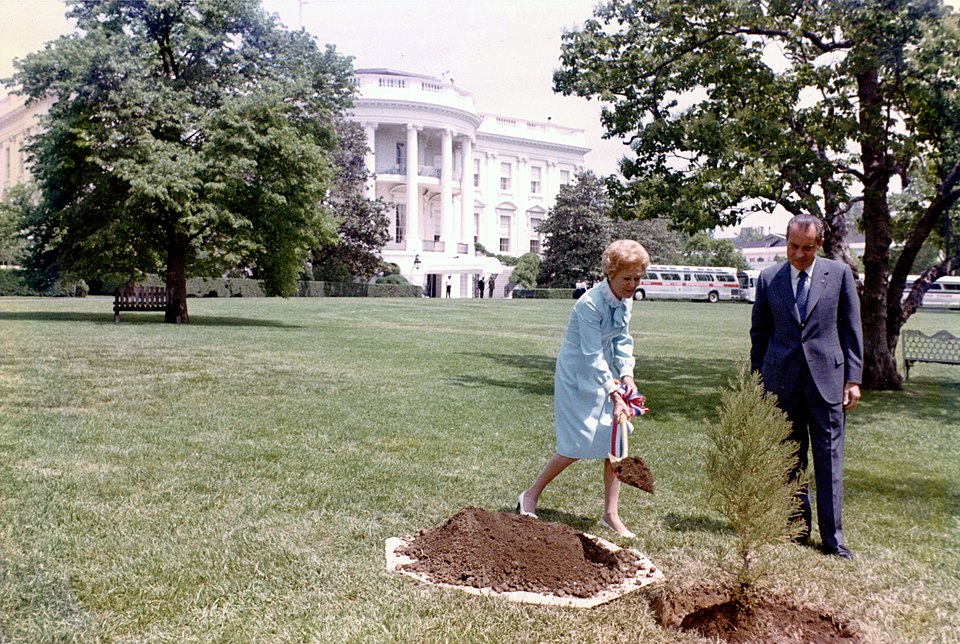
The government has noticed and begun to take action. Back in December, Congress passed the National Environmental Policy Act, which requires federal agencies to submit a report on the effects of planned projects on the environment. President Nixon signed it on New Year’s Day, declaring, "the 1970s absolutely must be the years when America pays its debt to the past by reclaiming the purity of its air, its waters, and our living environment." The Nixons even participated in Earth Day by planting a tree on the South Lawn of the White House.

One of the problems is that there are dozens of government agencies overseeing various aspects the environment and environmental policy. Sometimes they work at cross purposes or their goal is at odds with protecting the environment at large. For example, the bodies that oversee the approval of pesticides or fertilizers are concerned only with the improving crop yields, not with the larger effects on insect life or algal blooms far downstream of farms.

On July 9th, President Nixon submitted Reorganization Plan No. 3 to Congress. The plan proposes the creation of an Environmental Protection Agency into which all the various departments and agencies will be folded. The goal is to create concerted action, unified monitoring, and hopefully to eliminate conflicts of interest. This actually seems like a pretty good idea. It’s now up to Congress to approve or reject this reorganization.

Photograph of President Richard Nixon and his wife standing on the lawn outside the White House. Mrs. Nixon is using a shovel to plant a tree.The Nixons participating in Earth Day.

Taking the science out of science fiction

I’m not one to indulge in all the shouting about the Old School and the New Wave. Eventually, the two will reach a balance, and something new will emerge. The focus on character and society is all to the good; the fripperies of style over substance will soon be forgotten. But some of the stories in this month’s IF are enough to make me throw up my hands in despair and join the old guard in kvetching about what the New Thing is doing to science fiction.

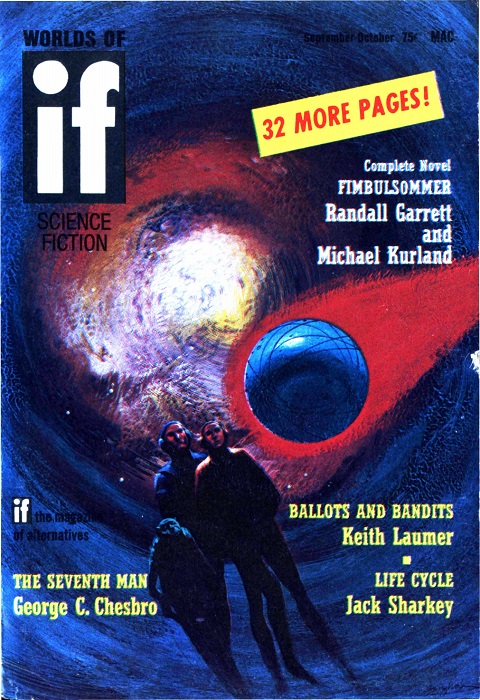
Cover of Worlds of If Science Fiction depicting three shadowy figures in the foreground in front of a blue, spherical craft with a red wake, all against a wormholeish/tunnel blue background with a bright center. The cover announces the stories The Seventh Man by George C. Chesbro, Ballots and Bandits by Keith Laumer, and Life Cycle by Jark Sharkey, and the novel Fimbulsommer by Randall Garrett and Michael Kurland.Suggested by “Fimbulsommer.” Art by Gaughan.

Continue reading [August 2, 1970] Fimbulsommer (September-October 1970 IF)

[June 4, 1970] Something old, something new (July-August 1970 IF)

A white man with short gray hair poses in front of a wooden wall. He is wearing a gray blazer, yellow shirt, and black necktie, and is smiling toward the left of the viewer.
by David Levinson

Voyages into the known

Readers over 30 may remember Thor Heyerdahl and his Kon-Tiki expedition of 1947. He hoped to prove that the Pacific islands had been reached from South America before Polynesians got there from the west. The balsa log raft he built eventually ran aground in the Tuamotu archipelago in French Polynesia, demonstrating that such a voyage was at least possible. However, most archaeologists and anthropologists consider it far more likely that any contact between Polynesia and the Americas (there is some highly inconclusive evidence) was initiated by the Polynesian people, who have a proven track record of crossing vast distances into the unknown.

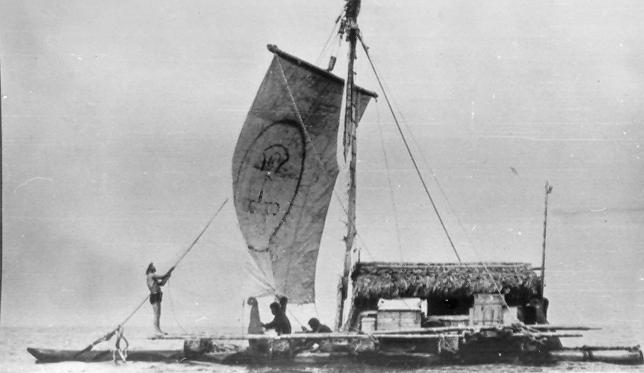
In any case, Heyerdahl has inspired a number of imitators hoping to travel farther, including some attempts to travel west to east. On May 29th, Spanish sailor Vital Alsar Ramirez started his second attempt to sail from Ecuador to Australia. The first attempt in 1966 failed after 143 days when the raft was rendered no longer seaworthy by teredo worms.

The new raft, dubbed La Balsa, has one major improvement over the Kon-Tiki: a moving keelboard. This will allow the raft to be steered toward more favorable currents, where Kon-Tiki could only drift with assistance from the simple square sail. Such keelboards are known to Ecuadoran natives and so are a perfectly reasonable addition. Best of luck to the four men aboard.

A black and white photo of a wooden raft on the water against a foggy background.  It has a square sail on a tall mast near the center.  On the left, a person is standing holding a line attached to the sail.  Under the sail three people are sitting.  To the right of the mast there is a small shelter with a grass roof, containing boxes and barrels. La Balsa puts to sea.

Speaking of Thor Heyerdahl, his current interest is in demonstrating that ancient Egyptians could have reached the Americas in reed boats. His first attempt last year aboard the Ra got within about 100 miles of the islands of the Caribbean before it became so waterlogged it began to break apart. Now he’s giving it another go.

The Ra II features a tether to keep the stern high, which should help keep the boat from suffering the fate of its predecessor. This is something the original ought to have had; such tethers are clearly visible in ancient Egyptian depictions of reed boats. The crew also plan to take marine samples along the way to study ocean pollution. The Ra II set out from Morocco on May 17th.

Of course, as with the Kon-Tiki, proving that such a voyage could have been made won’t prove that it was. The Egyptians were never great sailors, generally contracting ocean navigation out to more maritime cultures of the eastern Mediterranean. Still, best of luck to Heyerdahl and his crew as well.

A color photograph of a modern reconstruction of an ancient Egyptian reed boat on the water, against a clear blue sky.  It has a black sail at the prow supported by a tall mast made up of two timbers leaned together in a triangle.Oars are sticking out horizontally from the main deck. One person is standing at the prow and another at the stern, where a rudder extends into the water.   Two people are standing on the upper deck near one of the mast timbers. The Ra II under way. Note the tether keeping the stern high.
Polishing the family silver

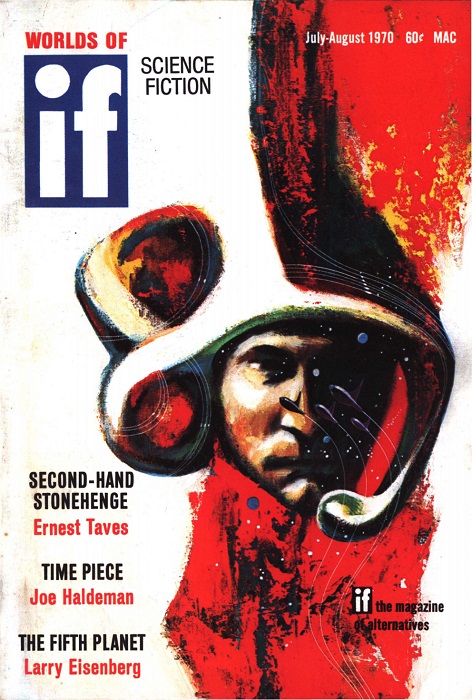
Science fiction has a lot of tried and true plots, some better than others. But good writing can occasionally make a hackneyed, sub-par plot something better, and bad writing can turn an intriguing concept into a slog. Fortunately, this month’s IF has a lot more of the former.

The front cover of Worlds of If science fiction magazine. The magazine title is in the upper left corner, and on the lower left the featured pieces are listed with titles in black and authors in red: Second-hand Stonehenge, by Ernest Taves; Time Piece, by Joe Haldeman; and The Fifth Planet, by Larry Eisenberg.  THe cover illustration is a painting of a white man's face shown half in shadow against an abstract background. The left of the background is blank white, extending in swirls into an abstract helmet surrounding the man's face.  A headset microphone extends down the right side of his face to his mouth. The right of the background is bright red with jagged yellow and black accents, which are reflected in the left side of the helmet. In front of the man's face tiny oval spaceships fly upward in an arc, surrounded by tiny blue planets and white stars, at which the man gazes intently.Suggested by “Time Piece”. Art by Gaughan

Continue reading [June 4, 1970] Something old, something new (July-August 1970 IF)

[April 2, 1970] Being Human (May-June 1970 IF)

A white man with short gray hair poses in front of a wooden wall. He is wearing a gray blazer, yellow shirt, and black necktie, and is smiling toward the left of the viewer.
by David Levinson

Counting coups

March saw not one, but two attempts to overthrow the established government in smaller countries. One failed, but the other looks like it may have succeeded.

A color geographic and political map of the Mediterranean basin, showing the island of Cyprus in the middle of the image.
Cyprus is the island south of Turkey, west of Syria, north of Egypt

Cyprus is a troubled nation. The populace is divided between those of Greek and Turkish decent, and the long-running hostility between Greece and Turkey spilled over to Cyprus. When the island sought independence from the United Kingdom, Greek Cypriots hoped for eventual union with Greece, which was not acceptable to Turkish Cypriots. The British were able to block annexation (or enosis, as it is called in Cyprus) as a condition for independence, but relationships within the island are so rocky that UN peacekeepers had to be brought in to keep the two populations from each other’s throats.

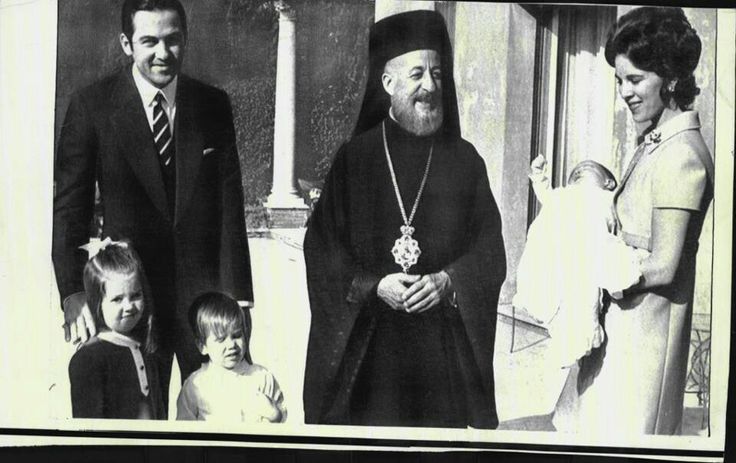
A major figure in the independence movement was Orthodox Archbishop Makarios III, who has led the country ever since. Before independence, he was a strong supporter of enosis, but was persuaded to accept that it would have to be put off as a hoped for future event. Makarios isn’t terribly popular with western leaders; he’s been a major voice in the Non-aligned Movement. Some in Washington have taken to calling him “the Castro of the Mediterranean.” In the last few years, he’s made himself unpopular at home as well. He’s taken away guarantees of Turkish representation in government and has also moved away from the idea of enosis. His justification is the Greek military coup of 1967, stating that joining Cyprus to Greece under a dictatorship would be a disservice to all Cypriots.

A white man with short gray hair poses in front of a wooden wall. He is wearing a gray blazer, yellow shirt, and black necktie, and is smiling toward the left of the viewer.Archbishop Makarios III visiting the Greek royal family in exile in Rome earlier this year.
On March 8th, somebody tried to kill Makarios. His helicopter was brought down by withering, high-powered fire. Makarios was uninjured, but the pilot was severely wounded. Fortunately, nobody else was on board. At least 11 people have been arrested, all of Greek heritage and strong supporters of enosis. Given the military nature of the weapons used, some are also accusing the Greek Junta of involvement.

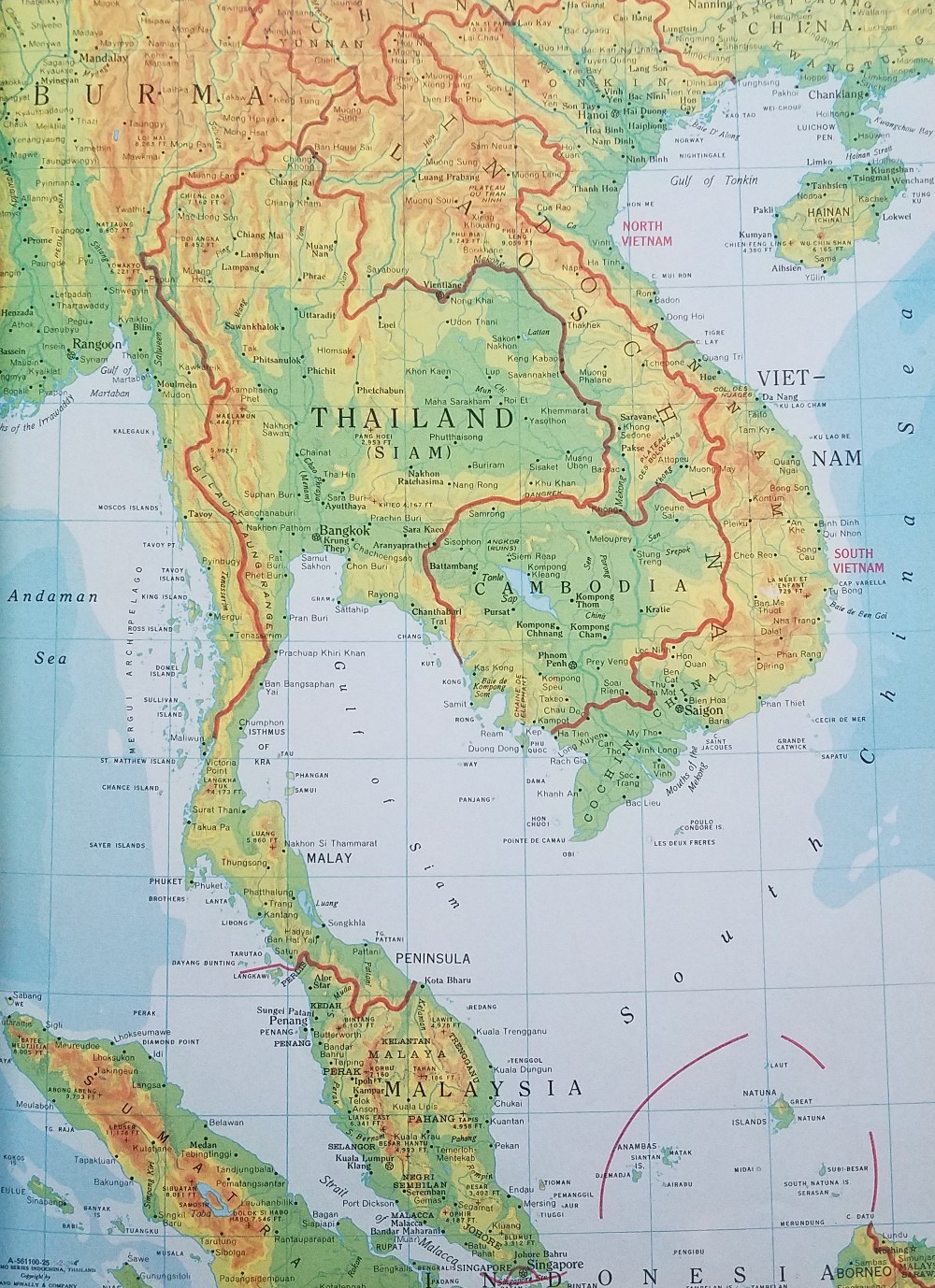
Meanwhile in south-east Asia, Prince Norodom Sihanouk is out as the leader of Cambodia. Like Makarios, he hasn’t been popular in the west, due to his cozy relations with both the Soviet Union and the People’s Republic of China. He’s also allowed Cambodian ports to be used for bringing in supplies for the North Vietnamese army and the Viet Cong, while also ignoring the use of Cambodian territory as part of the Ho Chi Minh Trail.

A color geographic and political map of the southeast Asian peninsula, with Cambodia in the center of the image.

Sihanouk was out of the country when anti-North Vietnamese riots erupted both in the east of the country and in Phnom Penh. Things quickly got out of hand, with the North Vietnamese embassy being sacked. By the 12th, the government canceled trade agreements with North Vietnam, closed the port of Sihanoukville to them, and issued an ultimatum that all North Vietnamese Army and Viet Cong forces were to leave the country within 72 hours. When the demand wasn’t met, 30,000 protesters rallied outside the National Assembly against the Vietnamese.

On the 18th, The Assembly met and voted unanimously (except for one member who walked out in protest) to depose Sihanouk as the head of state. Prime Minister Lon Nol has assumed the head-of-state powers on an emergency basis. On the 23rd, Sihanouk, speaking by radio from Peking, called for an uprising against Lon Nol, and large demonstrations followed. A few days later, two National Assembly deputies were killed by the protesters. The demonstrations were then put down with extreme violence.

Two black and white photos.  On the left, Prince Sihanouk stands outside in front of several other men.  He has black hair and a concerned expression.  He is wearing a suit and tie and an overcoat, and is gesticulating with one hand while looking to the right of the photographer.  On the right, a head shot of Prime Minister Lon Nol.  He has gray hair and is wearing a black suit and tie.  He looks directly at the camera with a neutral expression.l: Prince Sihanouk in Paris shortly before his ouster. R: Prime Minister Lon Nol.
Where this will lead is anybody’s guess. The new government (it should be noted that the removal of Sihanouk appears to have been completely legal) has clearly abandoned the policy of neutrality and threatened North Vietnam with military action. Hanoi isn’t going to take that lying down; if the war spreads to Cambodia, will the Nixon administration expand American involvement? Add in Sihanouk urging resistance to Lon Nol and the deep reverence for the royal family held by many Cambodians, and it all looks like a recipe for chaos.

What is man

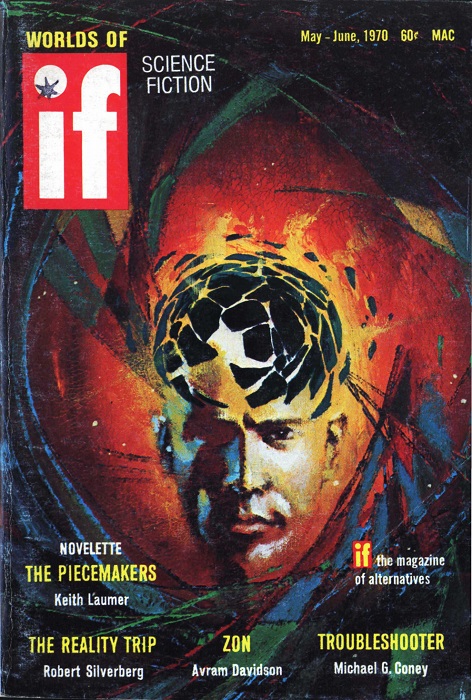
Some of the stories in this month’s IF deal directly or tangentially with what it is that makes humans human. The front cover also raises a question that we don’t have an answer to. We’ll get to that at the end; let’s look at the issue first.

The cover of the May-June 1970 edition of Worlds of If science fiction magazine. The magazine name and edition date are written in yellow across the top of the cover, except the word IF which appears in large white letters over a red rectangle.  Below this is a color painting of a white man's head staring directly out at the viewer. At the top of his head there are black lava-rock-like shapes that appear to be exploding out from his forehead.  The head appears to be emerging from a red and yellow pool of lava which is surrounded by dark swirls around the edge of the pool. At the bottom of the cover titles are listed: Novelette The Piecemakers, by Kieth Laumer; The Reality Trip by Robert Silverberg; Zon by Avram Davidson; Troubleshooter by Michael G. Coney. To the right the tagline of the magazine reads: If, the magazine of alternatives.Suggested by Troubleshooter. Art by Gaughan

Continue reading [April 2, 1970] Being Human (May-June 1970 IF)

[March 2, 1970] Par for the course (April 1970 IF)


by David Levinson

The Veep that couldn’t shoot straight

I’m no fan of golf (unless it involves little windmills), but a lot of people seem to like it. They show it on TV and not a week goes by without at least one golf joke in the funny pages. It also intersected with politics last month. February continues to be the month that gives me very little to talk about, so I guess this is it.

The Professional Golfers’ Association likes to start their tour early in the pleasant climes of Hawaii and California. One such event is the Bob Hope Desert Classic held on a variety of courses in the Coachella Valley near Palm Springs. The highlight of the tournament for many is the pro-am event, where the pros competing in the tournament are matched with (celebrity) amateurs for one day’s round.

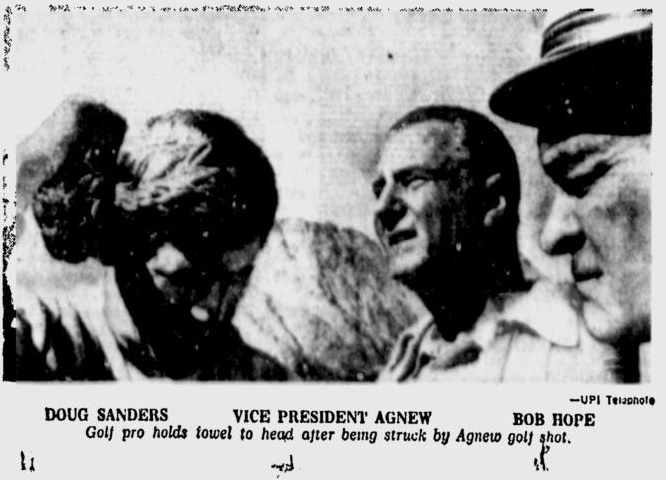
Pro Doug Sanders—best known for his odd swing and dapper dress—found himself in a foursome with Bob Hope, California Senator (and former song-and-dance man) George Murphy, and Vice President Spiro Agnew. On his very first shot, the Veep managed to hook the ball so far to the left it ended up on the path for an adjacent fairway. (Probably the farthest left he’s gone since being elected governor.) Trying to get back to the right fairway, he then sliced hard to the right. (This whole thing is starting to sound like a metaphor for Agnew’s political career.)

Bob Hope and Doug Sanders were standing in the path of the ball. Hope managed to duck out of the way, but Sanders was struck on the head. The blow drew blood, which Hope mopped up with a towel. Agnew was duly apologetic, and Sanders played gamely onward. At the nine-hole break, he was examined by a doctor, and the wound was sprayed with a pain-deadener.

Wire photo of Doug Sanders, Vice President Agew, and Bob Hope Wire photo of the aftermath.

Agnew went on to have a terrible day. He frequently missed putts and took penalties for giving up on a hole. As the AP put it, “Agnew chatted amiably with the fans when his ball landed in or near them, which was often.” Sanders didn’t do much better, though he was already having a poor tournament. He won $200, far less than the top prize of $25,000. Agnew rather crassly quipped that it should just about cover his medical bills.

Am I picking on Spiro Agnew? Yes. Yes, I am. After his recent attack on the press, he deserves all the opprobrium he can get. He’s already being talked about as the clear front-runner for the Republicans in 1976. Let’s nip that idea in the bud right now.

Down the fairway

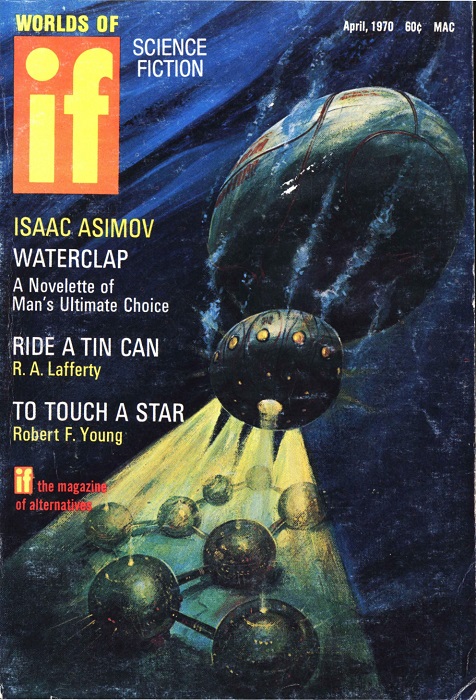
When he took over as editor, Ejler Jakobsson got off to a strong start. Since then, there’s been something of a return to form, although those C+ to B- issues have felt fresher than they did in recent years under Fred Pohl. Has he sent this issue cleanly down the fairway, hit a hole in one, or—worst of all—smacked the reader in the head with an errant shot? Let’s find out.

Cover of the April 1970 edition of if Science Fiction, featuring a large undersea robot illustration. Art for Waterclap by Gaughan.Arrival at Ocean-Deep. Art for “Waterclap” by Gaughan

Continue reading [March 2, 1970] Par for the course (April 1970 IF)

[February 2, 1970] Deceptive Appearances (March 1970 IF)


by David Levinson

The Super Fight

Back in 1967, a radio producer by the name of Murray Woroner came up with the idea of using a computer to work out who the best heavyweight fighter of all time is. He polled 250 boxing writers and came up with a list of 16. He then worked closely with a programmer to input everything that could be determined about each boxer into a computer.

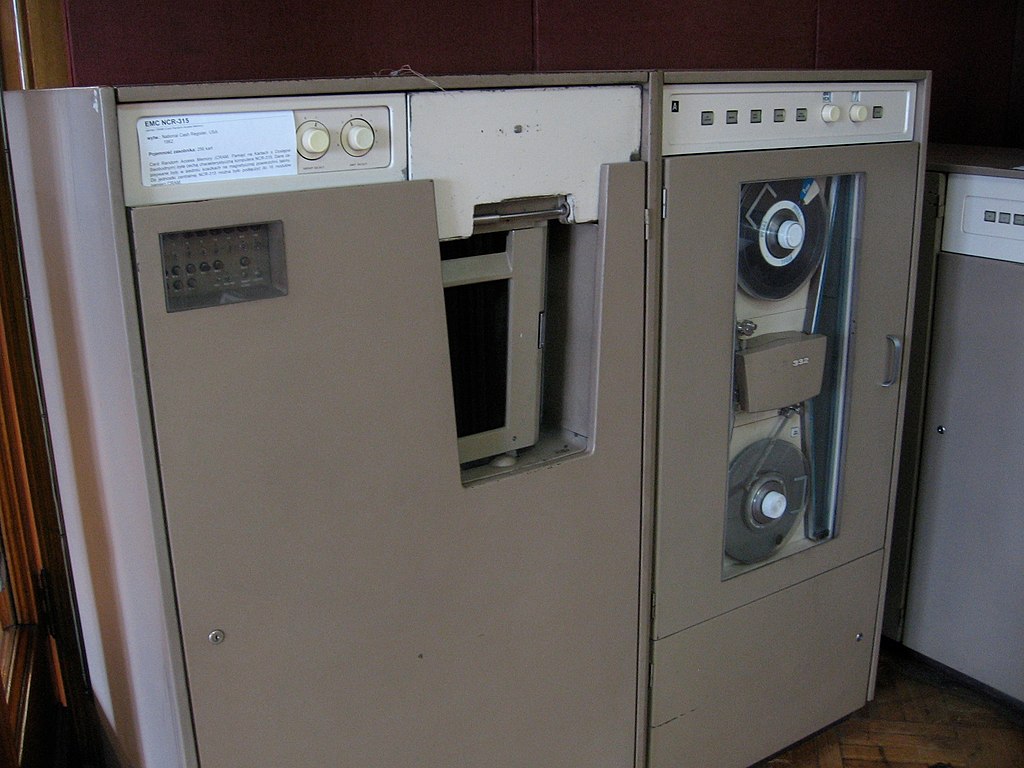
Match-ups were set up as a single-elimination tournament to be broadcast as a series of radio plays. Each fight was run through an NCR 315 computer the night before broadcast to create a blow-by-blow account of the fight. Woroner and boxing announcer Guy LeBow would then “call” the fight as if it were really happening. In the end, Rocky Marciano beat Jack Dempsey and was awarded a championship belt worth $10,000.

The arbiter, an NCR 315.The arbiter, an NCR 315.

Ali was not happy. The computer had him losing in the quarter finals to Jim Jeffries, a boxer he has little respect for. He sued for defamation of character, asking for $1 million. They settled when Ali agreed to take part in a filmed version of a computerized fight between him and Marciano in return for $10,000 and a cut of the box office.

Last year, Ali and Marciano got together and sparred for over 70 rounds, filming a few different versions of events that the computer might predict. Marciano dropped 50 pounds and wore a toupee so he’d look more like he did in his prime. Ali probably had to get back in shape too, since he’s been banned from boxing for refusing induction into the army. Instinct seems to have taken over for both men. Ali bloodied Marciano’s nose and opened cuts over his eyes (Rocky always bled easily); at one point, Ali was so exhausted he refused to go back into the ring (until he got another $2,000) and could barely raise his arms enough to eat breakfast the next day. Filming ended just three weeks before Marciano was killed in a plane crash last Labor Day.

Armed with hours of footage and the top secret computer result, Woroner and his team put together a film they dubbed The Super Fight. On January 20th, it aired in 1,500 theaters in the US, Canada, and Europe via closed-circuit television, with viewers paying a whopping $5.00 a head.

How did it turn out? Ali is not happy. The computer had him knocked out in the 13th round. He’s talking about another defamation suit. Maybe he’ll change his mind when he finds out that was only in the US and Canada. European viewers saw Ali win by TKO. The producers are also talking about destroying all the prints.

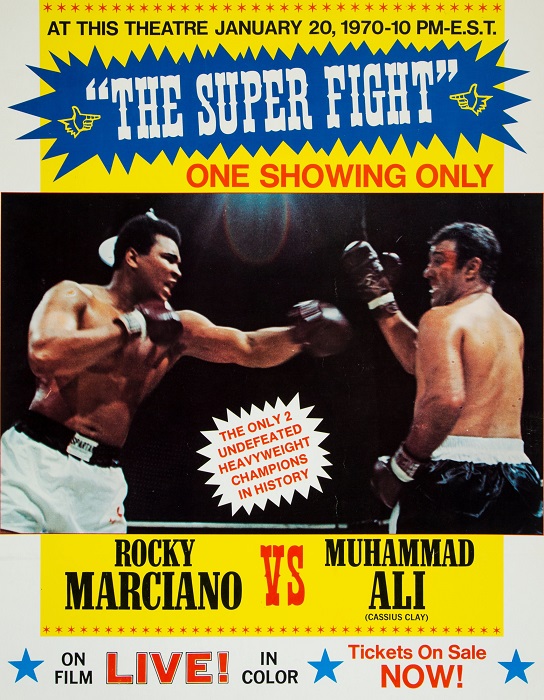
Boxing Poster captioned AT THIS THEATRE JANUARY 20, 1970 - 10 PM-E.S.T.
THE SUPER FIGHT
ONE SHOWING ONLY
THE ONLY 2 UNDEFEATED HEAVYWEIGHT CHAMPIONS IN HISTORY 
ROCKY MARCIANO VS MUHAMMAD ALI (CASSIUS CLAY)
ON FILM LIVE! IN COLOR TICKETS ON SALE NOW!Movie poster for the event. That “LIVE!” is a little deceptive, which is something else Ali is complaining about.
It’s a rather science-fictional concept we’ve seen in other guises. Maybe Murray Woroner got his original idea from the Star Trek episode “A Taste of Armageddon.” Of course, any statistician will tell you that a single simulation doesn’t really say anything. Rolling a die once doesn’t tell you if it’s fair; it takes hundreds or thousands of repetitions to determine that. But when the computer needs 45 minutes to determine the events of one match, this is the best that can be expected. For now.

Not what it looks like

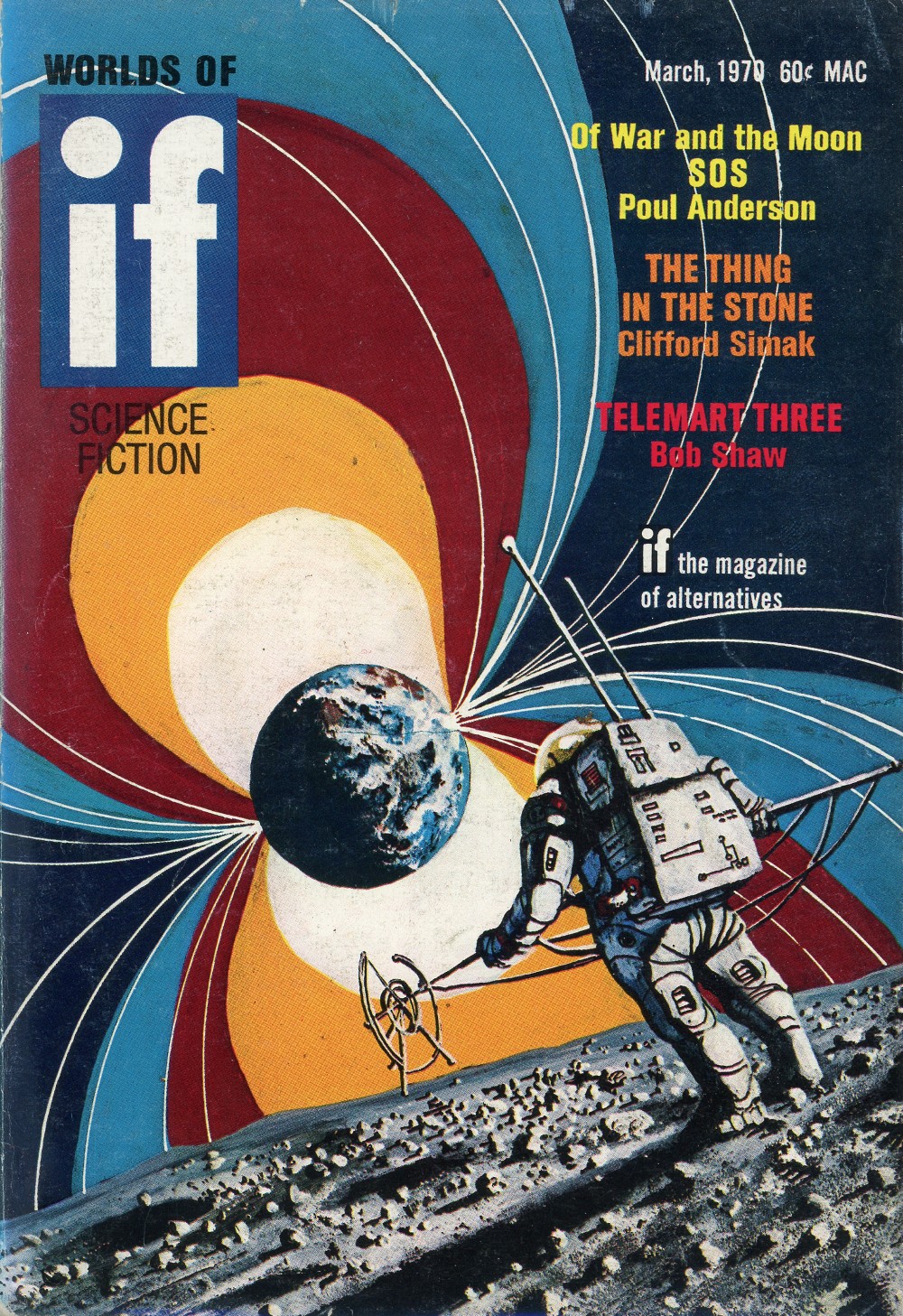
Authors like to counter readers’ expectations. It’s a good way to evoke a response, particularly in a genre that has a fair number of cliches and formulas. Sometimes, the surprise comes from the author doing something that’s not what you expect that particular writer to do or say. This month’s IF offers some of both.

Cover of the March 1970 issue of IF science fiction, depicting an astronaut carrying an antenna on the surface of the moon, looking out onto the Earth and its magnetic field depicted in white, orange, red and blue.Art actually for “SOS,” rather than just suggested by. Maybe because it’s by Mike Gilbert, not the overworked Jack Gaughan.

Continue reading [February 2, 1970] Deceptive Appearances (March 1970 IF)