Tag Archives: the librarian

[February 22, 1971] Science Against Man

Black & White Photo of writer of piece Kris Vyas-Mall
By Mx Kris Vyas-Myall

In the UK, there are two major sources of broadcast media: the publicly funded BBC and the primarily advertiser funded ITV, whose franchises are awarded under the Independent Television Authority (ITA). In 1967 the franchises were reviewed and shaken up.

One of the biggest changes was with ATV, which had previously provided a weekday service in the Midlands and the weekend service in London. In 1967, they lost the weekend service in London but gained the seven-day franchise for the Midlands.

In London, you might think they would grant Rediffusion (which became Thames after merging with the now franchiseless ABC) the full week’s service but, instead, the weekend contract was given to a new company, London Weekend Television (LWT).

London Weekend Television Logo from 1970s
London Weekend Television Logo

LWT was founded by David Frost and a set of ex-BBC staff members to try to provide a high-brow alternative set of programming on the commercial channels. ITV is primarily known for its populist output with soap operas such as Coronation Street and Crossroads, variety such as The London Palladium Show and David Nixon’s Magic Box, and game shows such as The Golden Shot and Wheel of Fortune. As such there was great appeal for this pitch.

However, a combination of mismanagement, bad luck and ill-feeling led them into severe financial trouble and last year they looked to be on the verge of going bankrupt. Step in Rupert Murdoch. As I already talked about previously, the Australian businessman has been entering into the UK market, already controlling two newspapers: the Sun and the News of the World. Following the troubles at LWT, he injected a huge amount of cash but in exchange appointed himself chairman and then managing director. He proceeded to fire a large amount of the original staff, with many more resigning in protest.

Black and white photo of Rupert Murdoch in a suit standing in a newspaper office.
Media Mogul Rupert Murdoch

This has created severe debate, and a headache for the ITA. On the one hand, they cannot just let the franchise go under and have only the BBC broadcasting in London after 7PM on a Friday. On the other hand, it runs afoul of their rules in three ways:

Firstly, a franchise cannot be held by a foreign national. Technically, Murdoch currently has a less than 50% stake in the company, but it is still under his effective control.

Secondly, all the people who the contract was awarded to were gone after only a few years, so it is the same licence holder in name only.

Finally, there is no guarantee Murdoch plans to keep the high-brow mission of LWT in place, when this was the main reason they got the franchise in the first place. And his current approach to his newspapers suggests the opposite approach may be taken.

Whilst this fight goes on, I turned to a couple of anthologies that came my way, one that was heavily British and in the high brow spirit of LWT, the other entirely Australian and decidedly more old fashioned:

Science Against Man, ed. by Anthony Cheetham

Cover of Science Against Man Avon paperback. The left hand side of the cover is a series of painted images, from the top, star field, planet, space probe, punchcards, hominid skull, computerized text, saturn rocket launch, computer lights, miccroscopic organisms, pills. crossing over to the right hand side are a grecoroman statue and observatory. On the right hand side the title is at the top. Below it says:
New Science Fiction and lists the authors.
Cover Artist Uncredited

Cheetham’s short introduction tells us that the kind of technical advances predicted by science fiction have become reality. As such, this anthology will not concentrate on "what if these devices are invented", but instead how people will cope with our new reality.

The Lost Continent, by Norman Spinrad

Two centuries in the future, Balewa, a professor of American history from Accra, goes to visit the collapsed civilization. However, it is not an easy trip. The air pollution is so bad, tourists are provided with government-approved air filters and self-sealing goggles. Whilst some of the natives are resentful, most appreciate that 30% of America’s GNP comes from tourism and are willing to accept their servile position.

Mike Ryan, their Native guide, offers them a special opportunity: the chance to venture down into the still-inhabited subways of New York and even try out a piece of Space Age Technology. That is, if they can survive it.

This kind of tale is not new. I reviewed a 19th Century take on it when Mitchell’s The Last American was reprinted in Famous, and even professional anthropologists have gotten in on the game, such as Horace Miner’s Body Ritual among the Nacirema. But there is a reason this kind of story is still important, as it puts the reader into the position of "the other", the way writers often unconsciously make "others" of much of the rest of the world. Even in contemporary science fiction, attempts to expand beyond New York or the Home Counties in SFnal settings far too often fall into exoticism over inclusion.

Also, it helps that Spinrad is such a terrific writer. His clever use of language, narrative and atmosphere are a marvel to behold, I sometimes wonder if he invented a device that allowed him to steal Philip Jose Farmer’s talent for producing weird but incisive fiction. There are a couple of points that might have needed tightening up to give it a full five stars, but it is still a great novella.

A high Four Stars

In the Beginning, by Robert Silverberg

Silverberg once more returns to the world of the Urban Monad. In Chicago 2382, fourteen-year-old Aurea Holston has been struggling to get pregnant. Even with her husband’s engineering skills, they are worried at next thinning they will be forced to move to a new Monad.

I think I have been feeling the same way as my colleagues on this series that, at this point, it seems like it is just spinning its wheels. We know the system won’t break, we know it is overcrowded and its hedonism is a cover. But what is it actually all about? Is there anything new that can be gained from a fifth tale of someone’s depressing fate inside this Monad? Also, if it was another writer, I would assume it was definitely satirical in its discussion of teenage sex. With Silverberg’s repeated writing on this subject I have to wonder if, at this point, it is just something he likes to include, particularly with descriptions such as:

“Her breasts are full and her lips broad.”

One Star

The Hunter at His Ease, by Brian Aldiss

Aldiss continues his recent fascination with westerners in South Asia, now with a 21st Century visit to the volcanic island of Amelegla in the Indian Ocean. Once famed for its Giant Tortoises, they have all been wiped out to make room for a relay station. Whilst the westerners believe it will bring in prosperity, many of the locals wish to just live as they are.

An effective and beautifully tragic piece.

Four Stars

Man's Estate, by Paul Ableman

Ableman is a new writer to me. Apparently, he is a British playwright of some renown who has written both an SF novel and a censored book on oral sex. Anyway, this is a train of thought story, following an intelligence in a data rich world, where it is unclear if it is a machine or a human.

It is an interesting concept, but it can be a bit opaque and rambling at times.

Evens out at Three Stars

Harold Wilson at the Cosmic Cocktail Party, by Bob Shaw

In the next century, death does not have to be the end. Biosyn offers for consciousnesses to be scanned just before death and stored in The Tank, a computer matrix. People can then rent out these consciousnesses' services whenever required. In Africa, the nation of Losane had been carved out by Colonel Crowley as a British imperial enclave. To maintain power, the loyalist party rely on his consciousness’ regular guidance. Unfortunately, Crowley has grown bored of this and has instead created his own fantasy kingdom, where he brings in the other consciousnesses and hunts them on dragons.

President Martin M’tobo comes angrily to Biosyn and demands that they return contact with Crowley within five days or their problems will be revealed to the general public. Their technical director has a plan, however. They need to get Crowley to face the risk of an even bigger threat, an interstellar invasion by a Labour Prime Minister!

For a novel this already sounds completely absurd a synopsis, yet somehow Shaw manages to make this intelligible and engaging in a twenty-page story even allowing for diversions into animated sales films and odd side details (I am not sure if I am more horrified by the idea of wearing a vibrating bra to work or drinking cofftea). A real achievement.

Five Stars

Statistician's Day, by James Blish

In 1990, Wiberg, the foreign correspondent for the New York Times, goes to interview Edmund Gerrard Darling. He is surprised when Darling starts telling him that he can statistically prove that people are being killed off based on profession—a government policy.

Part of the problem is this is based in an alarmist future of the Ehrlichs and their ilk, where global population control is instituted after the world famine of 1980. Even if I chose to believe the predictions of neo-Malthusians (which are as regularly wrong as the prophets of the second coming, relying as they do on exponential population increases and no technological progress) the idea that people will just submit to state mandated birth control and euthanasia so we can have village greens is just laughable.

The other issue is that the style is just a very dull arch conversation between two newspapermen on the facts of the current world.

Two Stars

The Invisible Idiot, by John Brunner

War is brewing between Earth and Mars, as a result of inexplicable messages full of nonsense sentences, being distributed at random throughout the solar system. When one arrives of the desk of Dr Casper Minsky of Paré Polyclinic, he believes he knows the cause and solution, all of which relate to a young boy having bad dreams.

The title is based on a story about a computer programmed for language translation, where they tried to translate the idiom “Out of Sight, Out of Mind” into Chinese (or Russian in some versions) and back into English and it came out as “Invisible Idiot”. This is most likely apocryphal* but it is useful to illustrate both the problems of overly trusting computers and how minds work.

Whilst the cause of the problem does feel a little anthropomorphic, it is still somewhat plausible and I was intrigued throughout.

A high three Stars

*Part of the issue with this anecdote is that it would require the computer to make multiple semantic errors at the same time, assuming one phrase is about an object which is unable to be seen, the other is about an object without a mind and that these two phrases, separated by a comma, should then be combined into a single statement. More likely clunky machine results would be along the lines of “external vision, external brain”, “hidden, exclusive of knowledge” or “outside the eyes, outside the head”.

Small Mouth, Bad Taste, by Piers Anthony

Miss Concher and Mrs Rhodes are on an expedition in Tanzania, to discover what predator gave man the impetus to evolve speech. The search discovers a lost civilization with surprising builders.

Where to even start with this one? First off, the theories Anthony puts into the text on man’s evolution are ones I have not only never heard before but are so bizarre I wondered if he was being satirical. How would you even know if early humans tasted bad? Even the least implausible parts have been discredited for decades.

Secondly, a large part of it is concerned with the fact that Concher has some kind of special ability to see into the past. She will just suddenly stop to say “do you see that?” and then proceed to explain at some length about another extinct animal. No explanation of this power is given, and it makes the story dull and dragged out.

And then the conclusion is, humans were originally servants for ancient lemurs who couldn’t contain them once the humans learned to hunt. Yes, it is Planet of the Apes, but with the time periods inverted and the semi-plausible great apes replaced by the Strepsirrhini suborder, who, I am guessing, were primed to develop sailing millions of years ago due to… their wet noses and grooming claw? Maybe there was also a bushbaby colony in Australia who came up with competitive surfing.

A low Two Stars, primarily over the amusement I got by imagining a family of lemurs in Victorian dress, riding carriages pulled by naked hominids.

The Ever-Branching Tree, by Harry Harrison

Thankfully, we have Harrison, who seems to have more of a handle on evolution. This is less a story and more a science fact article on the history of natural selection via the mode of a science class time travelling. Pretty good stuff.

Three Stars

Sea Wolves, by Michael Moorcock

What would an anthology such as this be without another visit from Jerry Cornelius? This edition of “the scarcely sane adventures of Michael Moorcock’s quirky modern myth figure” (as Cheetham’s introduction puts it) is another episode in his spy career in East Asia. Even though the war between the US and China still rages on, Jerry is more concerned with the rise of autonomous factories, who require more human input than you might expect.

I found it curious that the editor said he struggled to understand the inner meaning of it, because I actually found it the most straight-forward of the Cornelius stories, almost verging on the didactic at times. Yes, we have the usual surreal elements like the side switching Brigade of St. Basil in their strange uniforms and Jerry driving so many different vehicles you would think he was being sponsored by a second-hand dealership, but it is fundamentally a tale of where we are going with the approaching computerization of the world and how business and government are diving headfirst into it without thinking of the consequences. Interspersing it with actual advertisements from Business Week is a delicious twist.

As an aside, I know it is antithetical to its purpose, but sometimes I wish someone would produce a guide to the Cornelius stories, trying to estimate the approximate order in which they happen. I have a suspicion this is set between The Sunset Perspective and The Last Hurrah of The Golden Horde, but I would have to check all the references, and my brain cannot let go of trying to organise them in some way. Now I am the kind of person who spent their teen years trying to align Thomas Mallory with the Mabinogian even though they were written centuries apart, so I am in good company about it, but there are also regular themes and interesting concepts emerging in these recent tales. In particular a split has been forming between Cornelius and Brunner, with the latter favouring magic leading her down a dark path. I can’t help but wonder if this is going to lead to a bigger confrontation between them or perhaps in some way lead to the devastation of England we see in The Ash Circus and The Anxiety in the Eyes of the Cricket.

Anyway, Four Stars

The Penultimate Trip, by Andrew Travers

This Penultimate Trip is actually the final one in this collection. It tells of a prisoner who goes on trips to weird worlds, one where they are a spider on a low gravity planet, one where they are a worm inheriting the planet from extinct humanity, and, strangest of all, one where bipeds exchange coins for essential goods and live in locked houses.

This is apparently the SF debut of this writer, and it gives us a solid if fairly predictable tale of “science fiction or madness” told in long paragraphs of flow of consciousness. It does gives some interestingly imagined details of these other futures which indicates promise.

Three Stars.


As it turns out, another science fiction anthology, from Murdoch's native land of Australia, has also just arrived at my desk.  But that's a story for two days hence…


[New to the Journey?  Read this for a brief introduction!]


Follow on BlueSky

[October 31, 1967] Same ol' (November 1967 Analog)


by Gideon Marcus

Iran's "new" King

This week's foreign news was dominated by affairs in the Middle East.  When the papers weren't talking about the United Nations futilely trying to hammer out a peace treaty between Israel and Egypt (whose conflict has become a continuous low burn rather than a short conflagration), they were gushing over the crowing of Persia's "King of Kings".

Shah Mohammed Reza Pahlevi, the uncrowned king of Iran for the last 26 years, chose his 48th birthday to crown himself Light of the Aryans, emperor of "the world's oldest monarchy."  Also crowned was his wife, Farah, who became the first empress of Persia since the 7th century A.D.

Taking place in the dazzling Hall of Mirros in Gole-stan Palace, the event was possibly the most expensive coronation in history, with newspaper accounts breathlessly describing the type and number of jewels employed in the various accoutrements of state and decorations.  The affair concluded with 101-gun salutes, kicking off a week of celebrations that are just wrapping up today.

According to the Shah, the reason for the long delay between ascension to rule and formalization of said rule was that he did not want to take the grand title until Iran had become a modern, prosperous state.

My only aim is to further the prosperity and glory of my nation, and make Iran the most progressive country in the world, resurrecting its ancient glory and grandeur. For this I will not hesitate to sacrifice my life.

While the newspapers and newsreels seem dazzled by the Shah's extravaganza, many of Iran's 25 million people were less impressed.  One young woman, student at the Tehran University, would have fit right in at this spring's protests of the Shah's visit to West Germany:

Why should he spend all this money on his coronation?  There are so many poor people.  He should give them the money.

It should also be noted that while the Shah did take the throne of Iran in 1941, his reign was not uninterrupted.  Unmentioned in all the newspaper accounts I could find of the coronation was the two-year tenure of Mohammed Mosaddeq, the democratically elected but leftist prime minister of Iran from 1951-1953.  During the Mosaddeq administration, the Shah fled the country, only returning when a coup removed Mossadeq from power—an event which, if not instigated with assistance from the United States and the United Kingdom, was certainly extremely convenient for both governments.

Magazine of Magazines

It has been a couple of years since Analog Science Fiction won the Hugo Award for Best Magazine, but there's no question that it still reigns supreme both in subscribers and general esteem.  However, some have complained that editor John Campbell does not do enough to mix up the contents of his publication, relying on the same bunch of authors every month, resulting in a somewhat tired affair.

This month, there are no old hands in the table of contents, but like the throne of Iran, has anything really changed?


by Kelly Freas

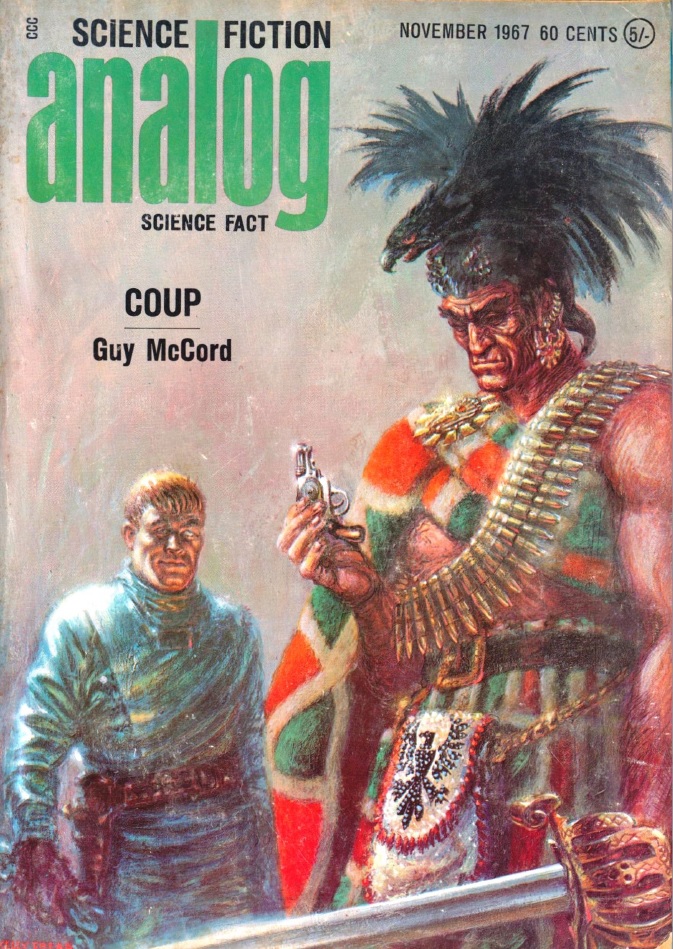
Coup, by Guy McCord


by Kelly Freas

What a strange opening novella this is: a long lost colony world is peopled by numerous bands of Scots, operating at an 18th Century technology level…but with an American Indian organization.  The latter seems eclectic, using terms like sachem, cacique, as well as counting coup, but no explanation as to why these marooned Celts adopted customs from the western hemisphere are forthcoming.

Anyway, this is the tale of John of the Hawks, a boy on the verge of manhood, who achieves maturity by counting coup on three cattle-rustling men of Clan Thompson.  His ascension is delayed by the arrival of men from another world.  They represent themselves as scouts, but what they really want is the abundant platinum deposits on planet Caledonia.

The outworlders don't actually play much part in this story.  Mostly, we get scenes of John of the Hawks riding horses, battling rival clansmen, facing off against and falling in love with Alice of the Thompsons–a lass who is Every Bit as Good as a Man.  It all reads like a dime Western.

And if "Guy McCord" isn't Mack Reynolds, I'll eat my hat.  From the interspersed history lessons to the trademark invented slang, it's got his fingerprints all over it.

A low three stars.

Prostho Plus, by Piers Anthony


by Kelly Freas

The writer of the execrable Chthon has thankfully returned to short stories.  This is a readable, if not particularly remarkable, tale of a dentist who is tasked with filling the molars of an alien.

A story like this would usually be played for laughs, but Prostho is done straight, with an underlying tinge of horror.

Three stars.

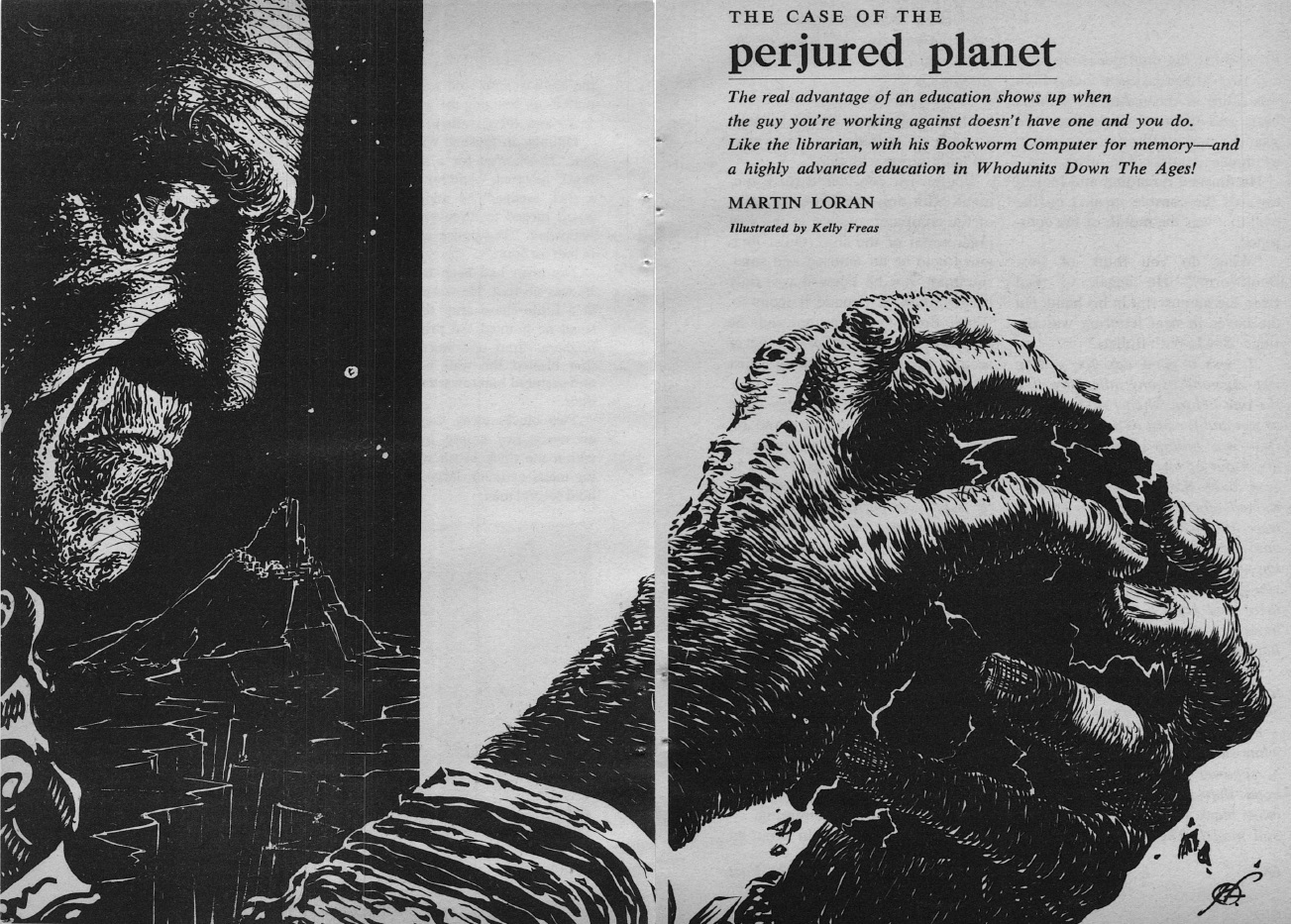
The Case of the Perjured Planet, by Martin Loran


by Kelly Freas

The interstellar librarian, name of Quist, is back for his second story.  Using the purveying of books as a cover, the librarian corps is really a division of agents whose job is to monitor the various governments of the galactic confederation.

This time around, Quist is investigating a planet with a secret: it's not that there's evidence that the drab, earthquake-riven world of Napoleon 6 harbors something hidden, but rather the lack thereof.  Quist, knee-deep in 20th Century style detective novels, decides to take a page from Sam Spade's book, and opens up a private detective agency on the planet in the hopes that the clues will come to him.

Like last time, it's not a tale that will stick with you, but there's a maturity to the story's telling that suggests Loran is 1) quite a good writer who just needs a better subject/venue or 2) "Loran" is as real a name as "Guy McCord", and a quite good writer is slumming in Campbell's mag.

Three stars.

Applied Science Fiction, by Will F. Jenkins

And now for the highlight of the issue.  Will Jenkins, better known to the science fiction community as Murray Leinster, is not only a renowned writer–he also is an inventor.  Here is the tale of how he conceived the incredibly useful technology of front projection, allowing actors to appear in ready-made projected scenery in a far more convincing and versatile manner than rear projection.

I really enjoyed this piece, and bravo Mr. Jenkins.  Five stars.

The Cure-All Merchant, by Jack Wodhams


by Kelly Freas

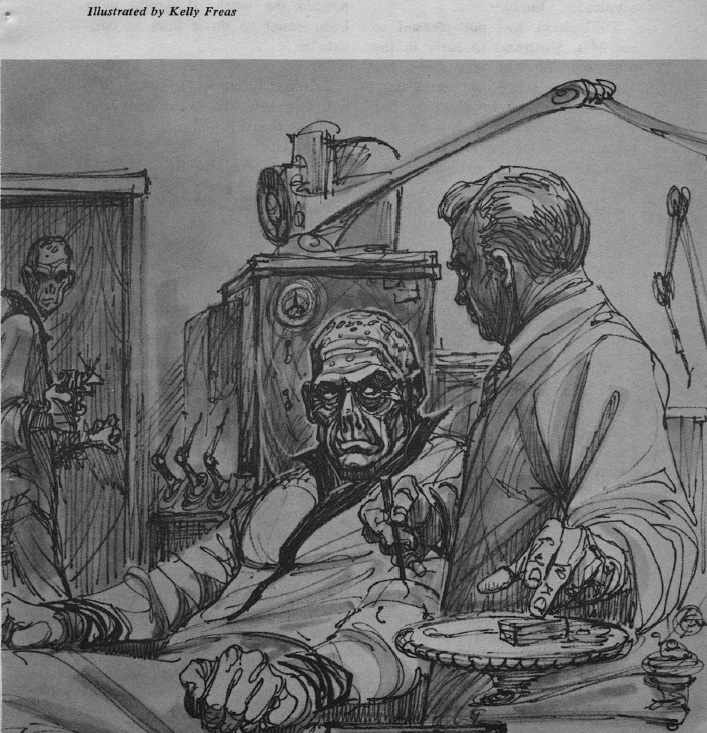
A doctor manages a successful practice by dealing in placebos, much to the horror of the straight man inspector assigned to investigate his activities.  This piece goes on endlessly, asserting that drugs are useless, and the human mind is all.

Ducks like a quack.  One star.

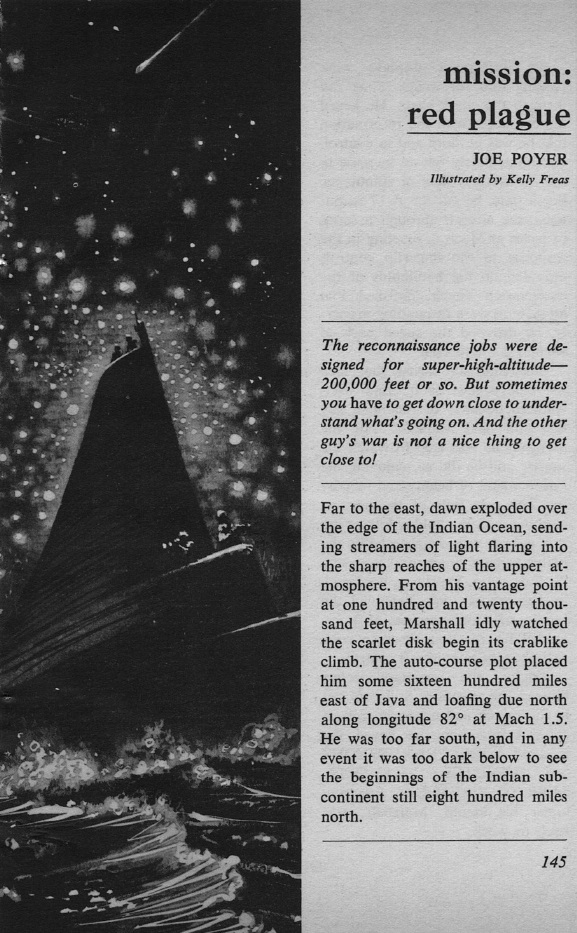
Mission: Red Plague, by Joe Poyer


by Kelly Freas

This last piece is a sort of sequel to Operation: Red Clash, again involving the mythical X-17 hypersonic reconaissance plane.  This time, the spy jet observes the deployment of a biological plague on the Sino-Soviet front.  The problem is the X-17 cockpit isn't completely airtight…

Poyer writes competent Caidenesque technophiliac stuff, but he has trouble hanging an interesting story on it.

Another low three stars.

Spot the difference?

On the surface, it appears Analog has gotten out of its rut, exploring the output of several new authors.  But it doesn't take much inspection to see that Campbell's mag offers more of the same, between the pseudo-Reynolds piece, the workmanlike Loran, Anthony and Poyer, and the truly bad (but Campbell-pleasing) Wodhams.  Only the Jenkins/Leinster is truly noteworthy, pulling the issue up to a three star rating.

That puts it below Fantasy & Science Fiction (3.25) and New Worlds (3.2) and above IF (2.8) and Fantastic (2.7) In other words, middlin', which one would expect of a mag doing the same ol', same ol'.

For those keeping up with statistics, the amount of superlative stuff this month could fill a Galaxy-sized mag; not terrific given that five magazines came out with a November 1967 cover date.  Women produced a surprising 12.5% of all new short fiction, an achievement rendered less impressive for those stories all appearing in one magazine–F&SF, which was the best magazine of the month.

So here's hoping Analog goes for real change next month rather than the veneer of change.  Maybe it'll be a failed experiment…or maybe Campbell will get to oversee a new Golden Age.  Be bold, John!


</small

[June 30, 1966] Not Reading You (July 1966 Analog)


by Gideon Marcus

Common meaning

Every so often, a science fiction magazine editor has enough of a backlog to run a "themed" issue.  For instance, there was the time Fred Pohl bunged together an issue of IF with stories all by someone named Smith.  This time around, Analog editor John Campbell has accumulated a supply of tales on the subject of communication.

The problem with themed issues, of course, is that quality is often secondary to topic.  But not always.  Let's see how the July 1966 Analog fares before we make a hasty conclusion!

Five by Five (plus two)


by John Schoenherr

The Message, by Piers Anthony and Frances Hall


by John Schoenherr

Mysterious Thargans have settled amidst the tiny human colony on Tau Ceti.  Though not overly aggressive, they aren't terribly congenial either.  But they are very inquisitive, about our technology, our physical capabilities, and our mental talents.  And their spaceship has a lot of cargo space — enough to fit a thousand slaves, for instance…

Rivera, a linguist who speaks the alien tongue, is tapped to assess the danger posed by the Thargans.  And when disaster inevitably strikes, he must recapitulate an era early in his life, when he managed to foil four would-be muggers not by force, but by the right verbal approach.

An interesting tale by a pair of newish writers, though a bit choppy and with flattish characters. 

Three stars.

The Signals, by Francis Cartier


by Kelly Freas

For the last half-decade, astronomers have been training their radio telescopes upon the stars, hoping to eavesdrop on transmissions from an intelligent alien race.  So-called Project Ozma hasn't found anything yet, and Cartier's tale explains why.  It's not that aliens aren't trying, it's just that we don't know how to listen.  Or more accurately, the fundamental theory of communication is too different between the species for intelligible contact.

Something of a throwaway piece, it is nevertheless cute and probably not far from the truth.  Three stars.

An Ounce of Dissension, by Martin Loran


by Kelly Freas

Quist of the interstellar Library corps is visiting the planet Rayer after a long trip through space.  Upon landing, the brutalist police troops burn his entire stock of books.  The planet is ripe for a revolution, but it needs a catalyst to do so.  Luckily, in Quist's cargo is a crate-sized book printer with a very large memory core…

Essentially a smug Fahrenheit 451, I can see why this piece appealed to Campbell.  But it takes too long to get where it's going, and it utilizes enough straw men to staff all the fields of Iowa.

Two stars.

Meaning Theory, by Dwight Wayne Batteau

This nonfiction piece is all about how the communication of information destroys meaning, and the imparting of meaning destroys information…or something like that.  Frankly, I couldn't make heads or tales of it.  The pictures are cute, the graphs seem useful, the text is in English.  Perhaps someone smarter than me will glean something from it.

Or maybe not.  One star for this failure to communicate.

The Ancient Gods (Part 2 of 2), by Poul Anderson


by John Schoenherr

Last issue, the crew of the starship Meteor had space-jumped 200 million light years from Earth to a feeble red dwarf out in intergalactic space.  They had hoped to establish trade relations with the advanced "yonderfolk" of the system.  Instead, they transitioned into real space too close to the next planet closer to the sun and crash landed.  Only six were left alive.

Hugh Valland, oldest of the more-or-less immortal group of spacers, hatched a plan to salvage a lifeboat so as to make the interplanetary trek to the yonderfolk planet.  But such a massive undertaking would require more than the half dozen remaining crew.  Luckily, intelligent (if primitive) beings exist on the swampy world.  Contact was made with the Azkashi, and it looked as if the plan might work.  As the first half came to a close, it seemed we might be getting a Flight of the Phoenix story. 

Instead, the second half begins with Hugh taken prisoner by the Askashi while the related but more advanced Gianyi abscond with the captain and the mentally unstable Yo Rorn.  It is quickly determined that the Gianyi are in the telepathic thrall of the Ai Chun, a race perhaps a billion years old.  They have stagnated to almost fossilization, and no amount of parley can dissaude them from their goal to strip the downed spaceship for its valuable metal and to work the humans as slaves until they die.  The captain escapes, and with Valland (who is freed by the Azkashi), plans a battle for their liberty.

Much of this installment is given to the war between the human-led Azkashi and the Ai Chun-controlled Gianyi.  It is effectively told, but the outcome is never in doubt, and I found myself less enamored with this wide swath of the text.  Long story short, there are happy endings and Hugh is ultimately reunited with his long lost love (of whom much is sung but little is known).

What I liked: Poul Anderson is a bard, and his stories are lyric performances.  His wistful, archaic prose is sometimes ill suited to its subject, but it works here.  The characters are nicely drawn and compelling.  The unique setting and the nifty aliens are all cutting edge science.  I appreciated the frank polygamy practiced by the captain and his genuine puzzlement with Valland's monogamy.  There's also the suggestion that strict heterosexuality is not observed in the far future.

What I was less delighted with: I felt like Anderson marked a lot of time with the war sequences, which did not bring much new to the table.  The acute lack of women, both on the crew of the Meteor and among the aliens (they exist in the background to do domestic chores, just like Earth females) marked another missed opportunity.  I also suspect that the Ai Chun and Gianyi are supposed to be metaphors for China — grand but hidebound.  Certainly Anderson draws a stated parallel between the Azkashi and the American Indians (for whom the author has an obvious fondness; viz. his tale in Orbit).  The racial comparisons made me slightly uncomfortable, though it's a minor thing and I could be wrong.

Finally, the revelation of Mary O' Meary's current condition in the story's epilogue is a bit trite, and quite unbelievable.  Here's the thing (and don't read on until you've either read the end or in the event you don't mind me giving away the gimmick): Mary has been dead for thousands of years, having passed away just before the advent of immortality.  She died at the age of nineteen.  This means that the immortal romance between she and Hugh could have lasted a few years at the most.

Now look, I love my wife more than anything.  If she passes before me, I may well stay single for the rest of my life.  But she and I have been together almost 30 years.  I balk at the idea that a teenage fling could possibly compel me to asceticism for thousands of years.  At that point, it's less about love and more a case of emotional masturbation.

Anyway, it's a solid three and a half stars.  I can imagine some ticking it up to a full four stars and others finding it all a bit tedious and giving it just three.

Survivor, by Mack Reynolds


by Kelly Freas

The threat of nuclear war looms, raising tensions to the breaking point.  When the klaxons go off, signalling the end of the world, millions flee the cities to find refuge, fighting over the quickly dwindling resources. 

But have the bombs actually fallen, or is it all a miscommunication? 

The premise to Survivor is pretty darned silly — that everyone will lose their collective minds out of fear.  I do believe that, in the case of a false alarm, there'd be panic and rioting and looting and mass disruption.  But not to the point that society completely breaks down such that both sides aren't even able to wage the war that frightened everyone in the first place!

Two stars.

The Missile Smasher, by Christopher Anvil


by Kelly Freas

Lastly, Anvil offers up a predictably slight tale of a series of rocket launch mishaps, the discovery of the focused light projector that is causing it, and the removal of said projector by a government troubleshooter.

I think it's meant to be funny or something.  It's not very good.

Two stars.

Wrong number

I'm afraid a common theme did little to elevate the current issue.  Indeed, in many cases, background noise might have been preferable to signal.  All told, the July Analog clocks in at a dismal 2.3 stars, placing it at the bottom of the heap.  The top is dominated by paperback-format periodicals: New Writings #8 (3.9), Fantastic (3.4), and Orbit #1 (3.4)

The middle of the pack is composed of the usual suspects: Fantasy and Science Fiction (3.1), Impulse (3.1), New Worlds (2.8) and If (2.7).

Women were responsible for a whopping 14% of this month's output of new fiction (mostly thanks to Orbit, which featured five female authors).  If you took all the really good stuff published this month, you could comfortably fill two magazines.  Or just buy New Writings and Orbit!

So, whither Analog?  Will there be another theme next month, one that will drag the magazine ever closer to the dreaded 2-star rating?  Will it plunge even without a common thread?  Or will we get a sudden reversal, the kind we've seen several times over the past few years?

Stay tuned!


Speaking of tuning, tune in to KGJ, our radio station!  Our theme is quality and diversity!