
by Mark Yon
Scenes from England
Hello again!
The continuing voyage of the new-new-new New Worlds continues apace. (Apologies – I’m still recovering from being told that it looks like the BBC are finally – finally! – going to show Star Trek over here starting in the Summer!)
Anyway, on to this month’s issue.
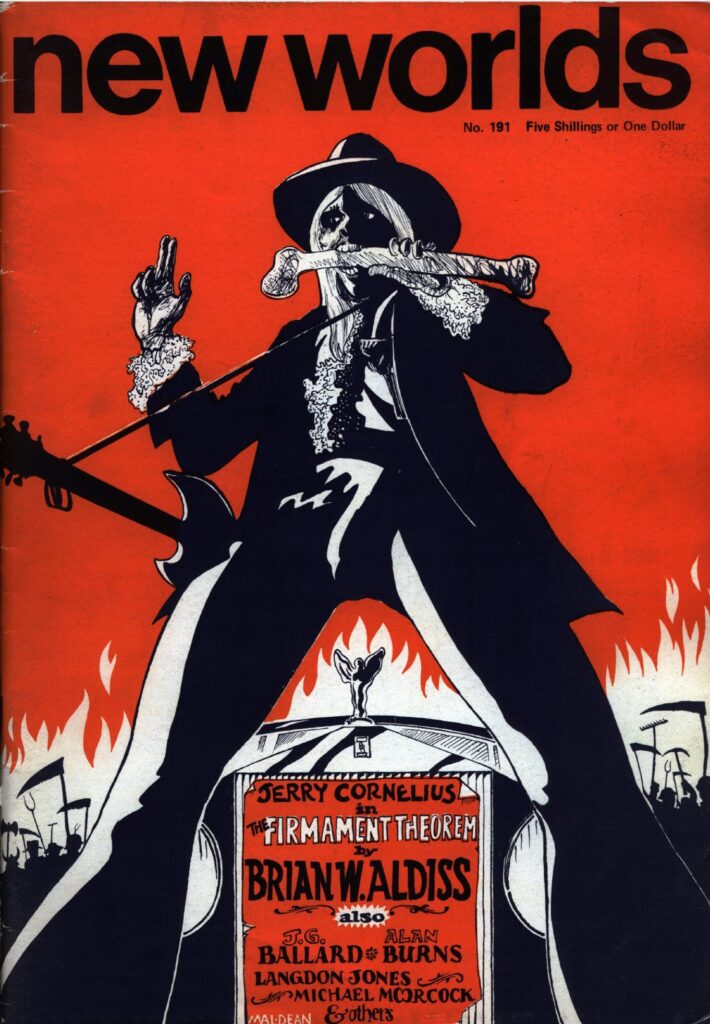
Cover by Mal Dean
Well, that’s better!! After the succession of frankly dull covers with faces on, this is a breath of fresh air – scarily dark, vivid, startling – never has Jerry Cornelius looked more frightening. Should get casual readers interested!
Lead-In by The Publishers
The fact that we have two stories of Jerry Cornelius this month is heralded by the Lead-In, as it should.
A Cure for Cancer (Part 4 of 4) by Michael Moorcock
 Drawing by Mal Dean
As we reach the end of the story things begin to make some sense, although to some extent the point of the story is to be confusing, I think!
It is still non-linear, almost dadaist in its narrative structure. This is a story less about plot and more about the little vignettes, scattered across different times and different universes. At times the contradictory nature of these elements add to the confusion.
Keeping it simple, Jerry manages to retrieve the gizmo he has been chasing over the last three parts and we now know that it is important because it allows the user to control multiple universes and see all the alternatives at once. As a result, characters we thought had gone now reappear – Bishop Beesley, Jerry’s brother Frank, Mitzi, and most important to Jerry, his sister Catherine.
The Cure for Cancer is perhaps most important for being an indicator of the times. It is the sort of story I think you need to read with Jimi Hendrix’s Are You Experienced? or the Beatles’ White Album playing in the background – both artists have been mentioned in the narrative. Its thoughts on race, war (deliberately satirising Vietnam) and sexual freedom are indicative of being made for an angry, disillusioned and, perhaps most of all, young readership. 4 out of 5.
Three Events of the Same View by John G. Chapman
Another one of those anti-religious stories New Worlds likes. In the first part, Pope Honorius is imprisoned in a castle by the cardinals after declaring there is no God. In the second, a domestic scene involving a garden shed and a request to store cadavers there before an Undertakers Convention. In the third, the view is from a Commandant in a concentration camp. Nice prose, but if there’s a connection, I couldn’t see it. 3 out of 5.
Playback by Granville Hawkins
An un-named narrator uses illegal equipment to play back a recording of sex. It unfolds that the recording is of his wife, who with their children has been killed in a destroyed London by the moralistic "Calvs". As a final act of defiance, our narrator shows the unlawful recording to the public by projecting it onto a chapel wall. It doesn’t end well. An odd yet memorable story, well written, graphically depicting a dystopian future – rather like Orwell’s 1984 meets the Night of the Long Knives, with racist hangings, castrations and sex. 3 out of 5.
Babel by Alan Burns
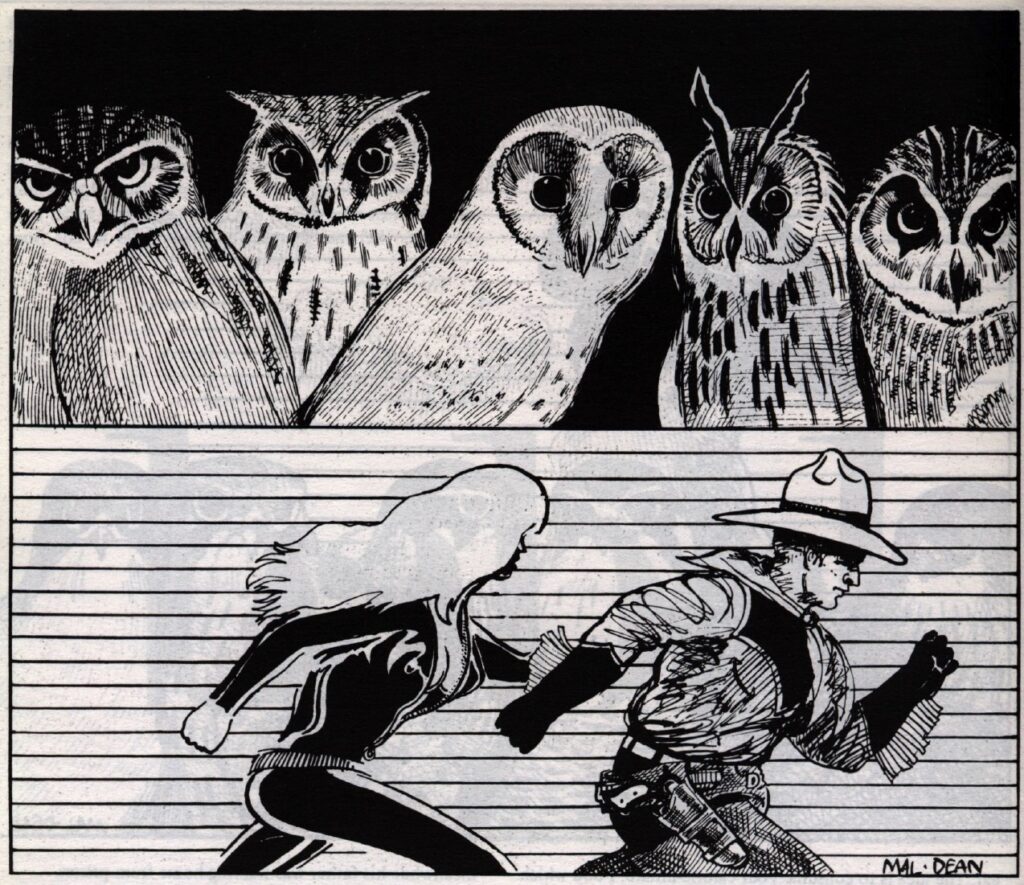 Drawing by Mal Dean
An author on his debut here. This is a story that has paragraphs, each a different story. In other words, this is Ballard-type pastiche, which could be good, but this is filled with such stream of consciousness nonsense that it feels like a bad hallucinogenic drug trip. For example: “Men are opening the Moon. Streams of wheels have springs of space.” 2 out of 5.
Between the Tracks by Ron Pagett and Tom Veich
A story with the same events repeated over and over, but slightly different each time. Most begin with a ‘boy’ travelling along ‘the tracks’ but things are not what they seem. Allegorical tale, with nods to Bradbury’s Martian stories, I noticed. Nicely done, but I’m not sure I ‘got it’. 3 out of 5.
Spoor by Alan Passes
 Photograph by Gabi Nasemann
A story about a man searching for Jayne in a Royal Park. Along the way a number of people around him are suddenly eaten by dangerous animals – a lion, an alligator. At the end he finds Jayne fornicating with a gorilla. I get the impression that all this is meant to be funny (“Me Tarzan, you Jane”, perhaps?), but I just found it unpleasant and meaningless. Another dream-state tale. 2 out of 5.
Flower Gathering by Langdon Jones
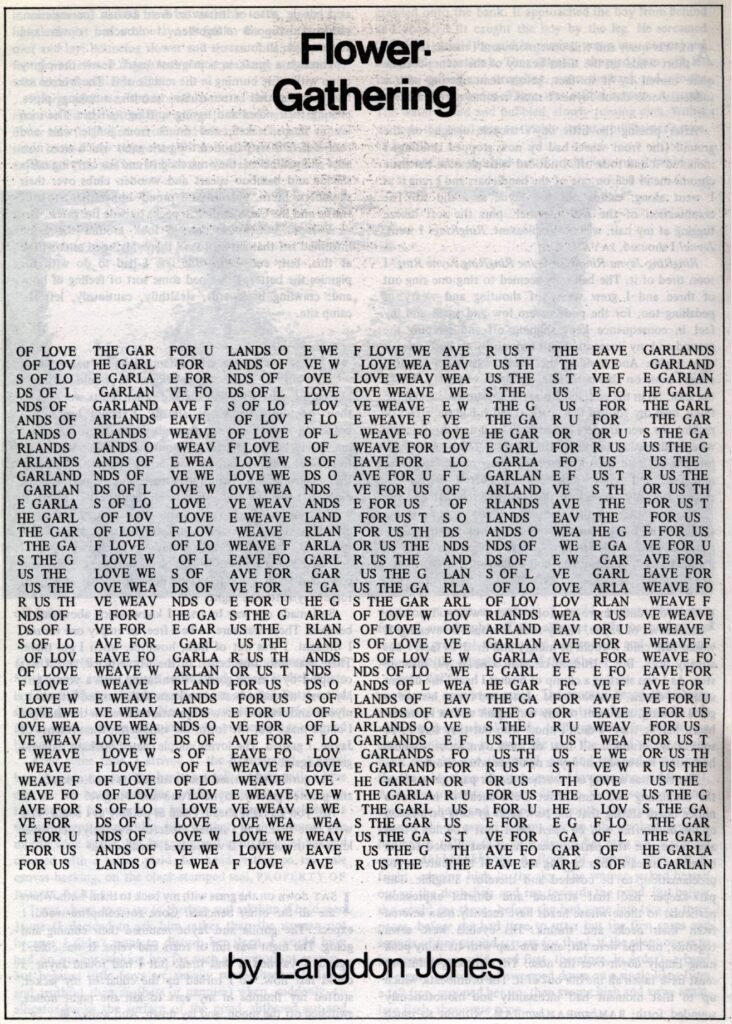
Langdon Jones’s latest piece, text written out in pretty patterns (which is rapidly becoming a prose-thing that I hate) to say THE GARLANDS OF LOVE WEAVE FOR US – or is that WEAVE FOR US THE GARLANDS OF LOVE? I guess this is an attempt to give prose a new form, but for me pretty meaningless. 1 out of 5.
Sub-Entropic Evening by Graham Charnock
 Photograph by Gabi Nasemann
We’re back in Graham’s CRIM-world for this one. (The first was in New Worlds in November 1968, the last in the March issue three months ago.) This is a story where nothing is what it seems, another set of descriptions written as if the people are in a drug-induced, dream-like state. Jones, Dragon, Velma, and Cat live near an Arena where people seen as enemies of the state are routinely incinerated, and there’s a music concert played by musicians which can cause blindness and death in some sort of suicide pact. It’s all vivid but odd and rather unpleasant. Not a place I’d want to live in, but I guess that is the point. 3 out of 5.
The Fermament Theorem by Brian W Aldiss
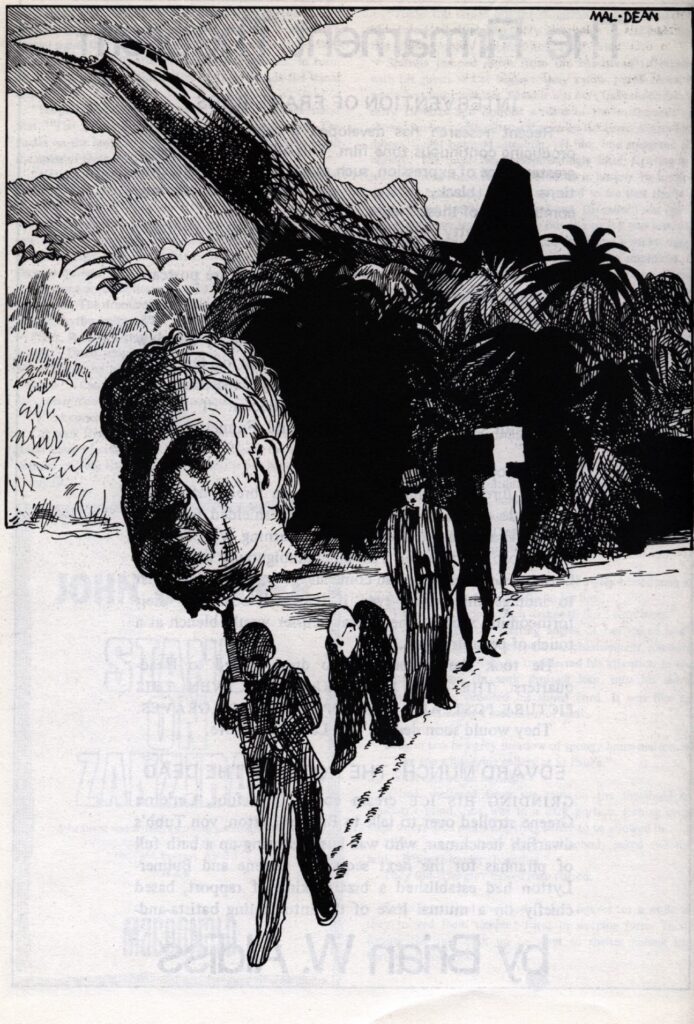 Drawing by Mal Dean
In which Brian Aldiss takes up the mantle to write a Jerry Cornelius story. Earlier in the year Mike Moorcock did say that the sharing of the Jerry Cornelius character was about to happen. Is it any good? It is such a confused mess of satire, social commentary and sex that readers will either think of it as a work of genius or be horrified by the unstructured elements claiming to be a story.
 Drawing by Mal Dean
I enjoyed it, even if I’m not sure I understood it all. There’s a story in there about the origin of the solar system being allied to the Moon and sex, comments on popularism and culture, not to mention lots of obscure references to people such as astronomer and science fiction writer Fred Hoyle, the Archbishop of Canterbury and author Robert Graves. In summary, Aldiss manages to take the key characteristics of a JC story – fluid sexuality, references to culture, fashion and society – and turn them into a satirical commentary – I think. What I found most interesting was that although Cornelius barely appears in the story, Aldiss has managed to write a Jerry Cornelius story in Moorcock’s style. It doesn’t feel out of place in the Jerry Cornelius series, although lighter in tone than A Cure for Cancer. I’ll give it 4 out of 5, although I accept that it could score anywhere between 2 (unstructured mess) – and 5 (work of genius!) depending on the person reading it.
Book Reviews: Use Your Vagina by J. G. Ballard
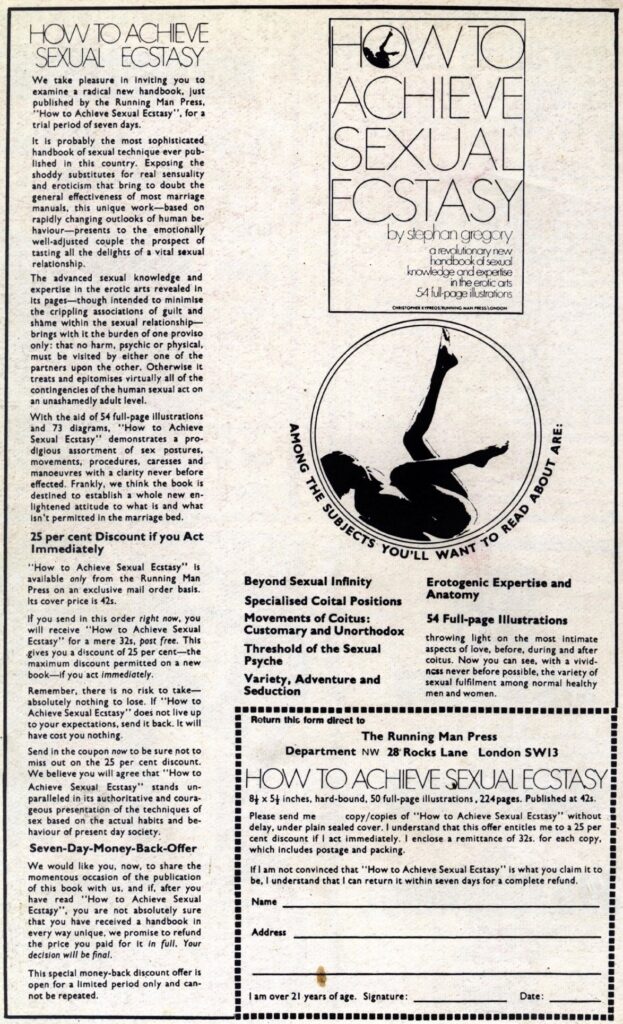 Advertisement from the back cover for the reviewed book.
In which J. G. Ballard reviews in detail a “sexual handbook.” Wouldn’t happen in Analog!
Book Reviews: The Boy from Vietnam by M. John Harrison
More relevant, perhaps, Harrison reviews a collection of two stories, one by Aldiss and one by Ballard in a book entitled The Inner Landscape, with varying degrees of success. Harrison then claims that Aldiss is “on better form” with his collection of five novellas in Intangibles, Inc. Eric Burdick’s Old Rag Bone is a non-genre book seemingly dealing with Catholic guilt.
Lastly and in keeping with contemporary themes, Harrison reviews Norman Mailer’s Why Are We in Vietnam? reminding me that the magazine is sold in the US as well as England. The book was reviewed in more detail by Douglas Hill in the March 1968 issue of New Worlds.
Book Reviews: The Comrade from Ploor by James Cawthorn
James Cawthorn generously reviews E. E. “Doc” Smith’s Subspace Explorers as a book that “offers the kind of entertainment that made the good old days of sf what they were” (ie: not the sort of story found in New Worlds today!), Brother Assassin by Fred Saberhagen which “stretches credibility just a little” and John Brunner’s Double! Double! which has “no credibility whatsoever”. There’s also an Ace Double with Code Duello by Mack Reynolds and The Age of Ruin by John M. Faucett, a review of a new biography of Edgar Rice Burroughs by Richard A. Lupoff, World of the Starwolves—a space opera by Edmond Hamilton, and positive reviews of James H. Schmitz’s This Demon Breed and Hal Clement’s story collection, Small Changes. I was pleased to see some more traditional sf get some positive comments.
Book Reviews: The Machiavellian Method by R. Glynn Jones
R. Glynn Jones reviews a book on tyranny, which is most disconcerting for having photographs of Hitler’s teeth.
Book Reviews: Woman’s Realm by D. R. Boardman
Lastly, D. R. Boardman reviews The Tunnel by Maureen Lawrence, a “competent first novel”. Was mildly pleased to see that it has been written by an ex-academic who is local to me, but not really my sort of thing, being the story of “a bored lonely woman living a boring life”.
Summing up New Worlds
Good news: although the scores may not reflect it, this is a better issue than the last. Although not perfect, the magazine scores with the conclusion of the Moorcock serial and Brian Aldiss’s take on the character. They are recognisably similar yet different, both confusing and subversive. New readers will not have a clue, regular readers will appreciate the word play and anti-establishment satire.
On the other side of the coin, there is also lots of material by relative unknowns, the new lifeblood of the magazine. Most of it is acceptable, though rarely outstanding. For example, the Hawkins was OK, but like Obtuowicz’s story last month really was another unpleasant story without anything really new to offer, Alan Passes’ Spoor was just dreadful.
Anyway, that’s it, until next time.


![[May 8, 1971] Encased in Experimental Rind: <em>QUARK/ 3</em>](https://galacticjourney.org/wp-content/uploads/2026/05/quark3a-304x372.jpg)

 Can you see me in this photo?
 Cover by Roger Penney
![[May 26, 1969] Cornelius Overload! <i>New Worlds</i>, June 1969](https://galacticjourney.org/wp-content/uploads/2024/05/New-Worlds-mag-June-1969-672x372.jpg)

