Tag Archives: wargames

[April 24, 1971] Film at Eleven (the wargame Grunt)

photo of a man with glasses and curly, long, brown hair, and a beard and mustache
by Gideon Marcus

Run through the Jungle

The wargame boom has reached a fever pitch with now a couple dozen offerings just from the Big Two publishers (Avalon Hill and SPI).  Almost to a game, however, the wargames have been on historical topics at a comfortable distance; World War 2 is still the perennial favorite despite being 26 years old.

But now comes something entirely new: Grunt—a recreation of tactical combat in Vietnam.

Cover page of the game Grunt. It shows a photograph of helicopters flying over the jungle.

It's kind of a revolution.  For the first time, a wargame has been made to simulate the situations that one sees reported on television every night: American soldiers trooping through the exotic jungle; wounded men being carried away in stretchers; Vietnamese villages in flames.  Sure, SPI gave us Up Against the Wall MotherF**cker and Chicago, Chicago, but they were one-off experiments, and not very successful ones at that.  Grunt is an honest attempt to portray tactical forays in an ongoing war.

Moreover, unlike other tactical offerings (Panzerblitz, Renaissance of Infantry, Centurion, etc.), the point of Grunt is not the obliteration of the "enemy."  The American task is to attack the VC supply chain through the finding and capture/destruction of hidden caches of equipment, weapons and food.  The VC's job is to delay, to wound, to deceive.  The result is a game completely unlike anything that has come before it, both in concept and currency. It's also pretty fun.

The Rules

Each game begins with the VC player setting up an array of units, from regular VC squads to snipers to peasants to caches of materiele.  There are also a number of decoy pieces.  All of them are placed upside down so that, to the American, a bunch of villagers are indistinguishable from a pallet of rice.  Peasants can't be placed in jungle, and only two can be placed on the forest edges.

Then the American company arrives: twelve squads and a Captain.  They must land in the open, potentially in sight of VC soldiers.  This is their most vulnernable moment.  This placement is also critical as it is from these drop zones that the squads will laboriously search through uncompromising terrain for Communist supplies.

Photograph of a helicopter's open cockpit showing a white woman on the pilot's seat.
Our own Melody, when she was in 'Nam on a photojournalism assignment

Grunt lasts ten turns, with the Americans going first.  Units can either move or fire, with all units having six movement points and a range of eight hexes.  Broken terrain costs two points to enter, jungle costs three.  Combat range is reduced to four if broken hexes intervene, and jungle and buildings block sight completely.  Defense strength is determined solely by terrain (with the same values as movement cost).  The CRT is such that killing anything generally requires 3 to 1 odds.  At lower odds, one has the chance to "pin" a unit, which makes it unable to move or fire the next turn.  This is huge for the VC since the Americans need every turn to find caches.  Pinning also causes squads to drop caches they might have captured.

The Americans have a variety of combat units, but the workhorse is the "squad" representing ten men. They have an attack strength of two.  The Vietnamese have hardcore VC with a strength of two, militia with a strength of one, snipers with a strength of one (which are often killed on pin results) and decoys, which have no strength, but can move.  The VC player also has peasants, which can't move, and porters, which can. There are also boobytraps, which explode with usually fatal results.

There is a standard game in which setup is fixed, the VC player starts with 75 points, and the Americans have to capture/destroy enough caches to beat that total.  Wounding soldiers also adjusts the score. 

Symbols used in the game. They are labeled: Headquarters, American Infantry, Radio Equipment, Peasants, Viet Cong Leader, Viet Cong Militia, Viet Cong Hard-core Guerrilla, and Sniper.
Some of the pieces used in Grunt

In the more advanced scenarios, the VC player chooses an Order of Battle from a list, the more combat troops associated, the less of a victory point handicap he/she gets.  This adds variability to the American experience as the Air Cav never knows if it's plunging into a lightly defended area or a North Vietnamese base camp.

The American player uncovers VC units by spending 3 movement points upon walking on top of them. If the VC is a combatant, the American unit is bounced back.  If the item is a cache of stuff, the American must spend a turn with the cache without moving or firing.  Then the cache can be destroyed or captured.  If a capturing unit is pinned, it drops the cache.  Capturing is worth more than destroying—unless it's bags of rice.

A game lasts just ten turns. Whomever has more points at the end wins.

Note: There is a Basic game, which has no terrain effects on movement or sighting.  There is also a Solitaire game, which uses the Basic rules.  Neither are terribly satisfying experiences.  There are a number of optional rules (napalm bombs, artillery, interrogation of peasants to identify and locate caches, etc.) that I have not yet played with.

Gameplay

When the helicopters drop their squads in the jungle, it is impossible to know if they are entering a peaceful zone with naught but peasants and rice or if they have been unloaded into the middle of an NVA training camp.  The VC are generally outnumbered and outgunned, but they have the virtue of invisibility.  They are indistinguishable from the peasants and the decoys, and the victory conditions are in their favor: each American killed is worth far more to the Communists than VC blood is to the Americans.

This game plays almost in real-time, as each turn represents six minutes of time, and two experienced players can finish a turn in about that period.  I really like that—one of the problems with tactical games for me is they tend to bog down with so many rules that it can take an hour to resolve five minutes of time.

Moving through the jungle takes a long time. It is really impossible to investigate more than half the map in the time allotted, and that means the American player has to make some hard choices at the outset. If forces are divided too thinly, it becomes impossible to bring enough firepower to bear on any VC regular to kill it. This might be all right if the goal is simply to pin while other units try to snatch caches, but the cautious player will be forced to leave much of the map unexplored.

Photograph of a smiling white woman seated at a table with a map of the game setting in front of her.
Janice flashes an ironic peace sign just before a victory

The VC player has a psychological game, needing to keep to keep the American player guessing. Sometimes, this means moving frustratingly few pieces, as each moved piece lets the American player know where a mobile unit is.  If a VC player is overanxious, a smart American player can have a pretty good idea where the useful Vietnamese units are, and this makes their game easier.  A lot of the game is decided in set-up: it's a kind of rock-paper-scissors to make sure the VC makes the Americans waste time, but also have the most opportunity to pluck them off, one by one.  And Americans have to decide between spreading forces thin or gambling on a concentrated thrust.

I still haven't figured out ideal VC strategy—does it make sense to cluster decoys in one section and combatants plus caches in another?  In that case, the Americans waste time one way and walk into a trap in the other.  Is it a viable strategy to put a records cache in the open, ringed by NVA regulars?  That particular cache is worth little if destroyed, but capturing could prove too arduous.  Endless replay value, indeed!

The Components

With a system dependent on hidden counters, Grunt (like Avalon Hill's 1966 flop, Guadalcanal) involves a lot of fiddly flipping.  You have to keep looking at your pieces to remember what they are, and just this act can betray the identity of your units.  So I took a lesson from Stratego: I bought a whole bunch of blank wooden cubes at a hobby shop and pasted the counters onto them.  Now the VC player could see all units at a glance, but the American player just saw featureless faces.  It worked brilliantly!

Fortunate Son

I am impressed with the speed and elegance of the game. The rules layout is a little muddled, and I think there are balancing issues (which I resolve by simply using the same rules and setup twice in a role and swapping sides—the winner is the one with the most points for both games).  Grunt is an interesting puzzle, and it has a lot of color.  The American player constantly has a feeling of dread exploring the unknown, but caution must be used in moderation for there to be a hope of winning.  The VC player always feels horribly outnumbered, but the lucky roll makes the Americans stumble.

All in all, a commendable design, and one I look forward to returning to.  It's a quick game, quicker than almost anything in my library, which is convenient for a short match and a meal at the local diner.  I look forward to delving into the more advanced rules once I've got the standard game down pat.

Four stars.

Photograph of a white woman in military uniform sitting inside a tent. She has a camera attached to a strap hanging from her neck. The desk behind her has a typewriter.
Melody's notes from Vietnam were helpful in capturing the feel of what we were simulating


[New to the Journey?  Read this for a brief introduction!]


Follow on BlueSky

[December 18, 1970] General Winter Returns (the wargame Battle of Moscow)

photo of a man with glasses and curly, long, brown hair, and a beard and mustache
by Gideon Marcus

Seven years ago, Avalon Hill made wargaming history with the introduction of its Eastern Front game, Stalingrad.  Despite the name, it was nothing less than a simulation of the first few years of the German/Communist struggle in World War 2.

A photograph of two people bent over a table, looking down at the board game of Stalingrad
Lorelei and Elijah playing Stalingrad in Fall 1968

It was a fun game, no question, and for many years, it was literally the only game on the subject.  But there is no denying that it had its weaknesses.  From its questionable OOB (Order of Battle—the troops represented were mostly fantasy) to its unrealistic movement—either the fight was a World War 1-style slog of attrition, or units ranged across the map with little consideration as to logistics—it was more "game" than "simulation".

But now, SPI has offered up its take on the struggle, and it's as much a revolution as its predecessor…

Logo of 'The Battle of Moscow', in black and white.

Continue reading [December 18, 1970] General Winter Returns (the wargame Battle of Moscow)

[August 8, 1970] Wargaming is square again… (3M's Feudal)

photo of a man with glasses and curly, long, brown hair, and a beard and mustache
by Gideon Marcus

Fish or fowl?

Not too long ago, I picked up an interesting-looking game from a local hobby store.  Sitting next to a number of other "bookshelf" games with leatherette-style boxes designed to look pretty all lined up, dimensioned like overlarge volumes—as opposed to more luridly covered diversions like Monopoly or Clue—was something called Feudal.

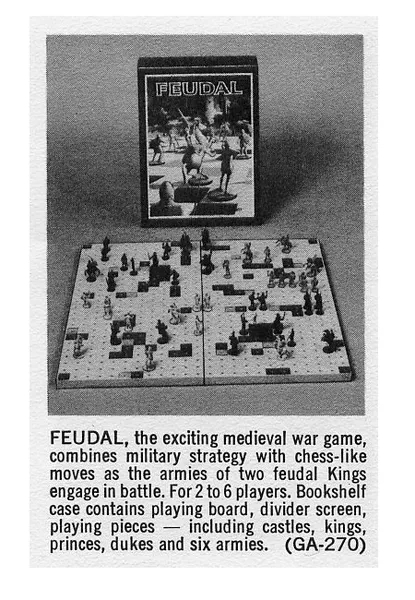
Black and white catalog entry for 'Feudal' with a photograph of a game in progress, showing the pegboard with the various pieces deployed.  The copy claims that it is suitable for two to six players
A 1970 catalog entry for the game

From the ad I'd seen in the paper, as well as the cover art, I'd thought it was some kind of wargame.  Certainly, the ad called it such.  But from the picture of the pieces and gameboard on the back, I gathered it was a new variant of chess.

The truth is somewhere in between…

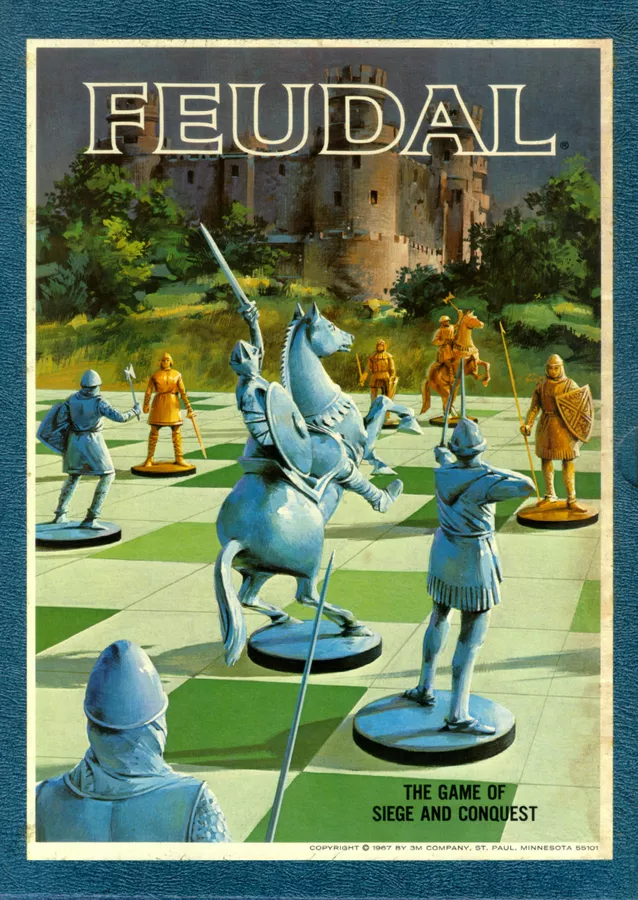
Colour box-art illustration of a checkered board set in front of a castle as though a field of battle.  A reproduction of a mounted swordsman is centered amongst the arrayed game pieces, flanked by an archer and several men at arms, facing off against a similarly composed defending force
Box top

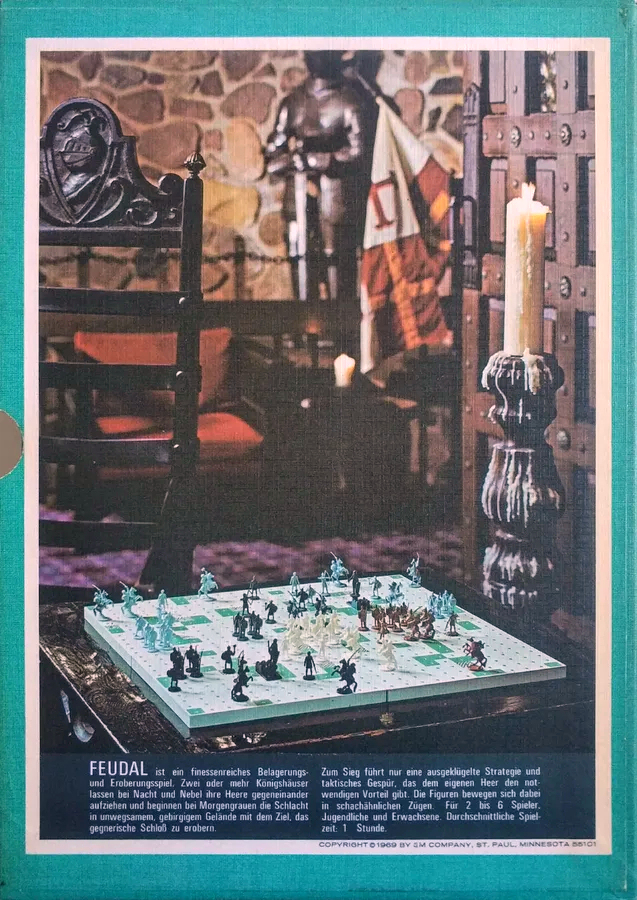
Colour box-art photograph of a game in progress in a 'medieval' themed room
Box reverse

While Feudal ostensibly seats up to 6 players, it is at its heart, a two player game.  Each player starts with a castle piece, capture of which loses it for the owner.  Castles may be set up anywhere on the board, and they can only be entered (and taken) by way of their unwalled Castle Green.

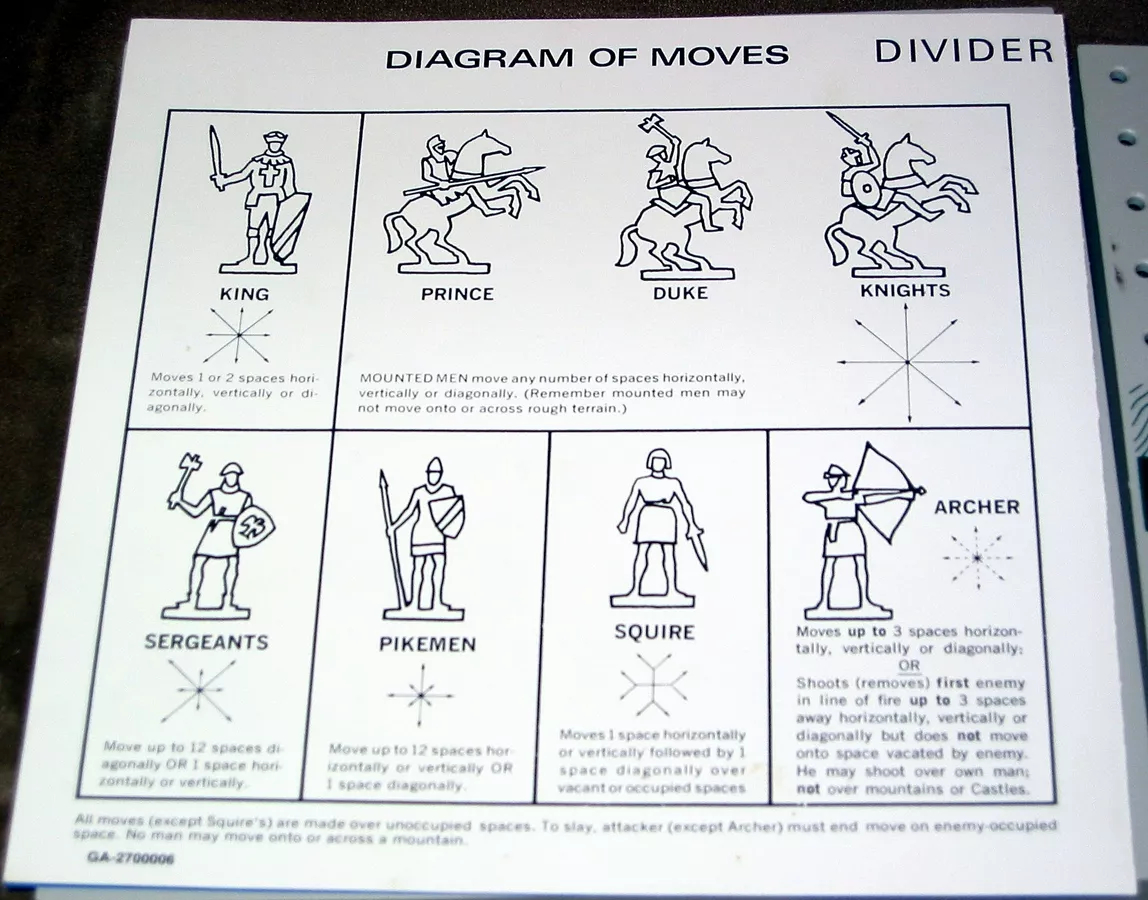
Protecting this Castle are three "Royalty" pieces and any number of 10-piece "Armies"—one is standard, playing with two or three is offered as "exciting".  Each unit, as in chess, has specific movement capabilities.  For instance, the ones on horses may move any number of squares in any direction.  An army's two Sergeants may move up to 12 spaces diagonally or 1 space horizontally/vertically, whereas an army's four Pikeman are the opposite, moving 12 spaces horizontally/vertically or 1 space diagonally.  The lowly lone Squire moves one space horizontally/vertically followed by a space diagonally—functionally equivalent to a chess knight.  The King moves one or two spaces in any direction.  Finally, the sole Archer shoots or moves up to three spaces in any direction.

A unit is captured (eliminated) when an enemy walks into it (or an archer shoots it).  No dice are rolled.  No Combat Results Table is consulted. 

Colour photograph of a B&W cardstock divider with movement diagrams (and silhouettes) for Kings, Princes/Dukes/Knights, Sergeants, Archers, Pikemen, and Squires
Map divider and piece summary

Sounds a lot like chess, doesn't it?  Ah, but look at the board.  You'll note that it has terrain markings on it, like a wargame.

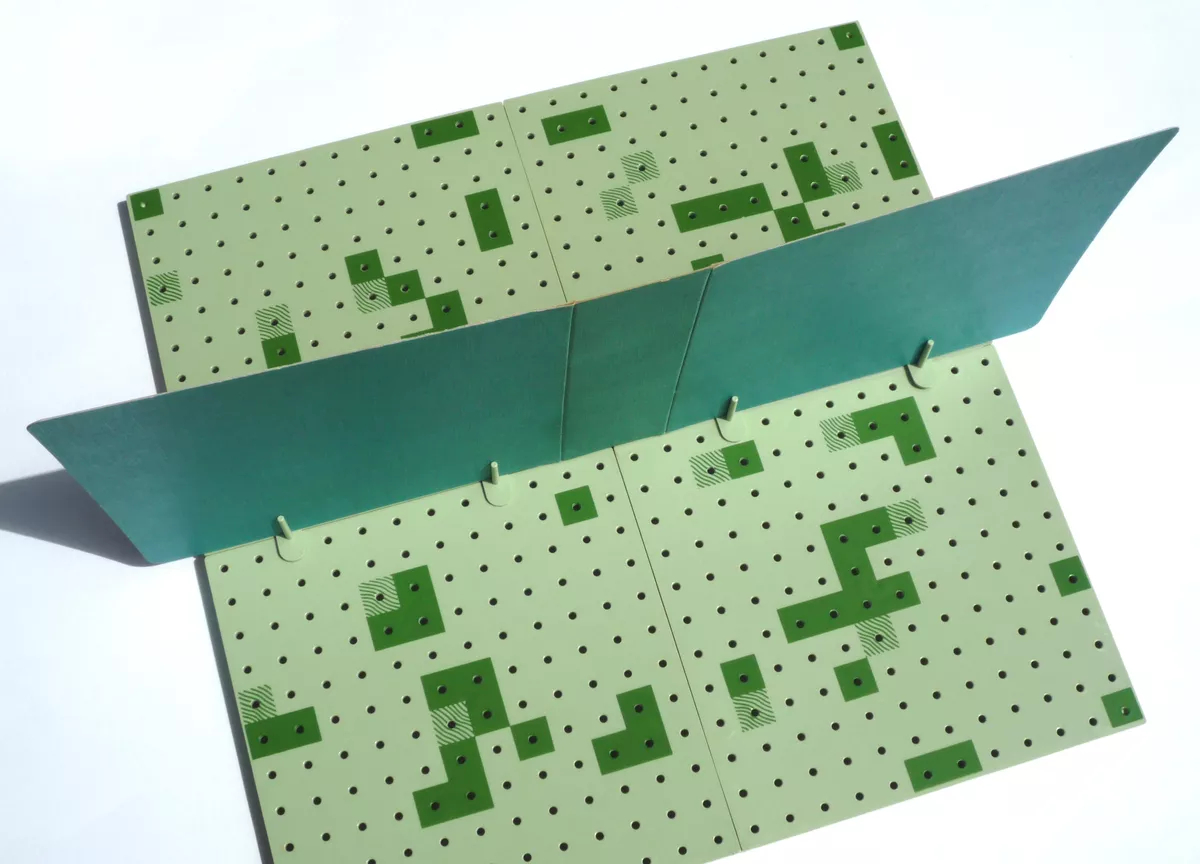
Colour photograph of the light-green game board from above.  Scattered across the squares of the board are variously configured groups of contiguous squares in either solid (dark) green or with green wavy lines.  A vertically screening divider is positioned across the center of the board
Game board with divider

The squares with wavy lines are "rough" (one would think they'd be forest) and the dark green squares denote mountains.  Horsies cannot move across rough terrain, and no unit can move across a mountain or the walled ends of a Castle.  Also, archers cannot shoot over mountains or castles.

To enter a Castle and win the game, a unit must stop on the Castle Green and next turn, march inside.  Thus, the defender has a turn to stop the siege.  The other way to win is to eliminate all of the opponent's "royalty" (comprising the King and two of the mounted units)

Unlike chess, a player may move every piece in his/her control every turn.  However, like chess, the player must move at least one unit in each army each turn. 

Units are set up blind—that's what the divider is for—a la Stratego.  They may be placed anywhere that they can move (Castles may be set up anywhere).

And that's all there is to Feudal.

Tally Ho!

Janice and I played a couple of games to completion, and I think I'm starting to get a handle on this game.  She won the first one, and I won the second, both of us making blunders that mostly canceled each other out.  In the end, I think it's who went first that made the biggest difference.

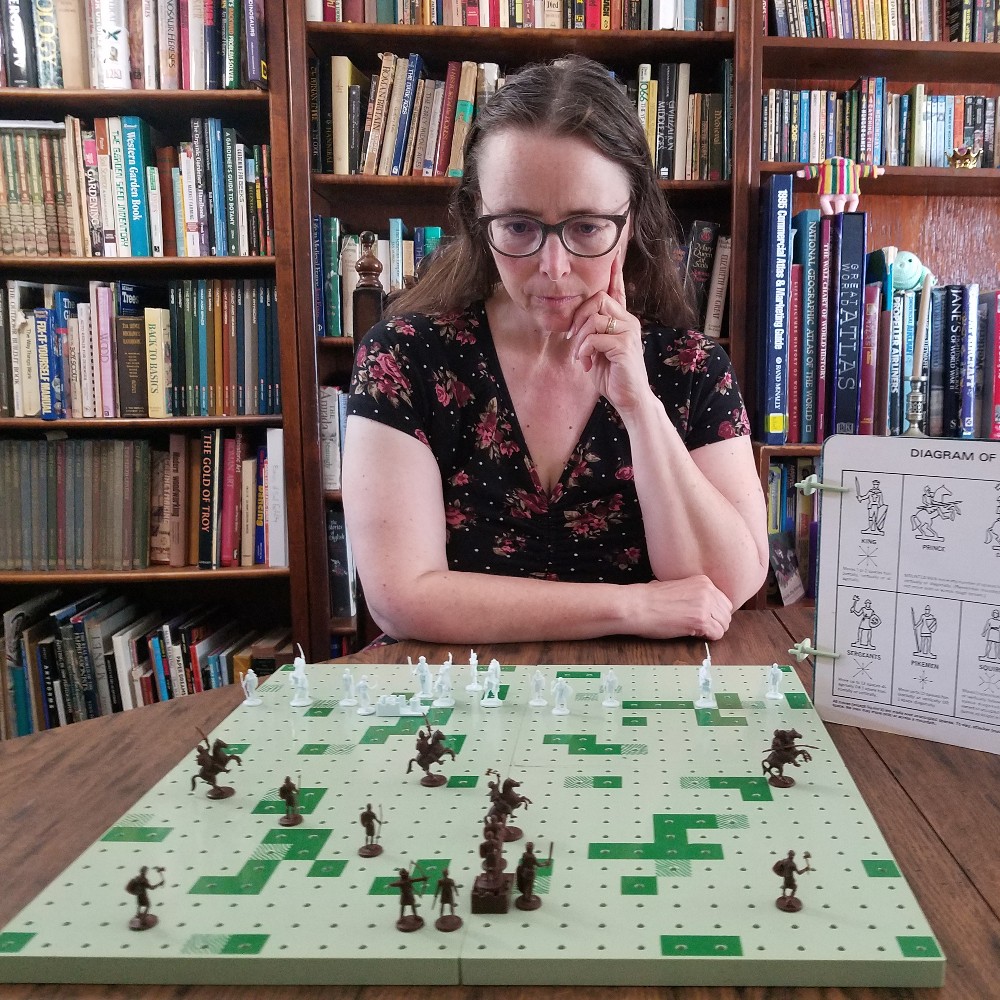
Colour Photograph of a seated white woman looking intently at the game board, pieces all arrayed before her
Just after setup, Janice considers her first move

That's because the player who goes first has a slight advantage.  Making use of the blind set-up, they can sometimes pick off units for whom there is no good counterattack revenge, either on the first or second turns.  Of course, the player going second gets to pick which side of the map is used, and that means a better-defended castle.  On the third hand, a cramped defensive arrangement can be hard to maneuver in.

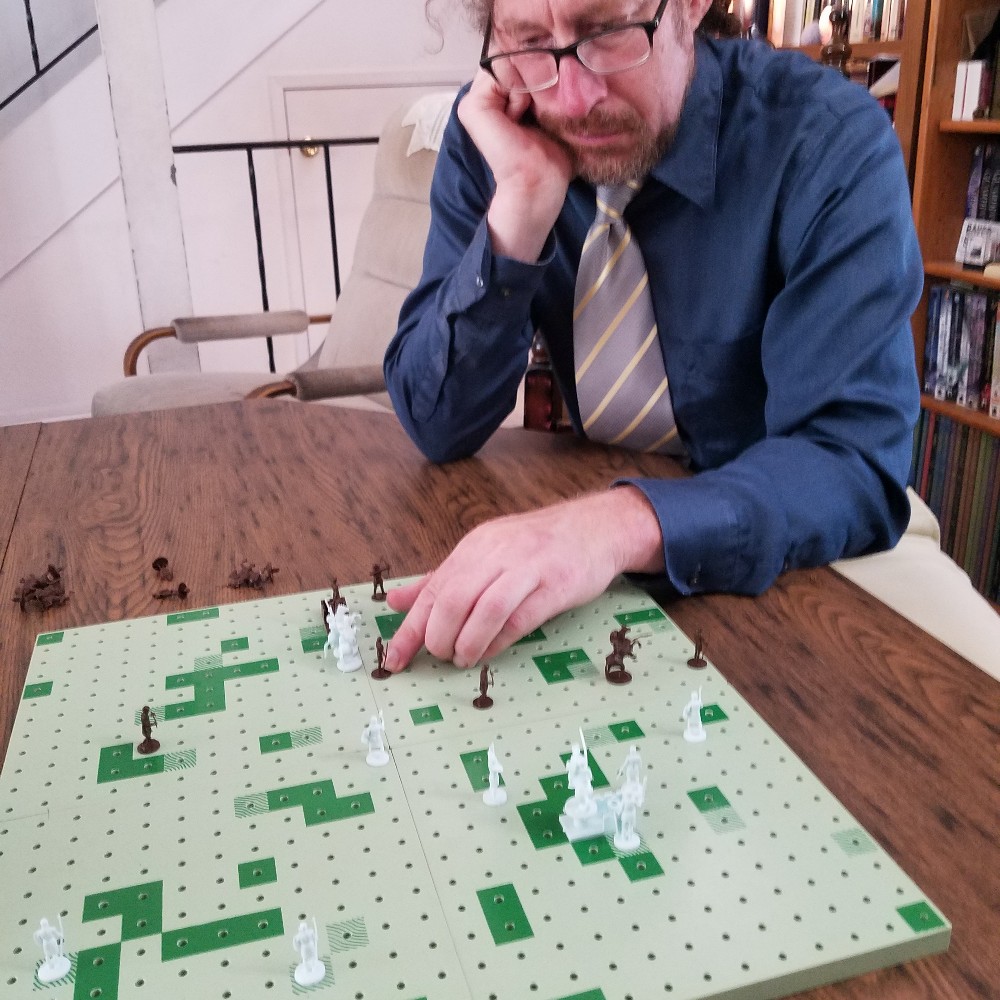
Colour Photograph of a seated white man with concerned expression reaching to move one of his remaining pieces
If I look glum, note the number of my dead pieces behind the board

It's a tricky game at first, particularly minding all the diagonals through which the Sergeants and mounted troops can attack.  The infinite movement of the horsemen vs. the 12 space limit for Pikemen and Sergeants is notable, although the fact that horses can't move through rough mitigates that.  In the end, the Sergeants are more powerful than the Pikemen because diagonal movement is 44% greater than horizontal movement (geometry!) and because so many of the terrain features have diagonal cut-throughs.

After Battle Report

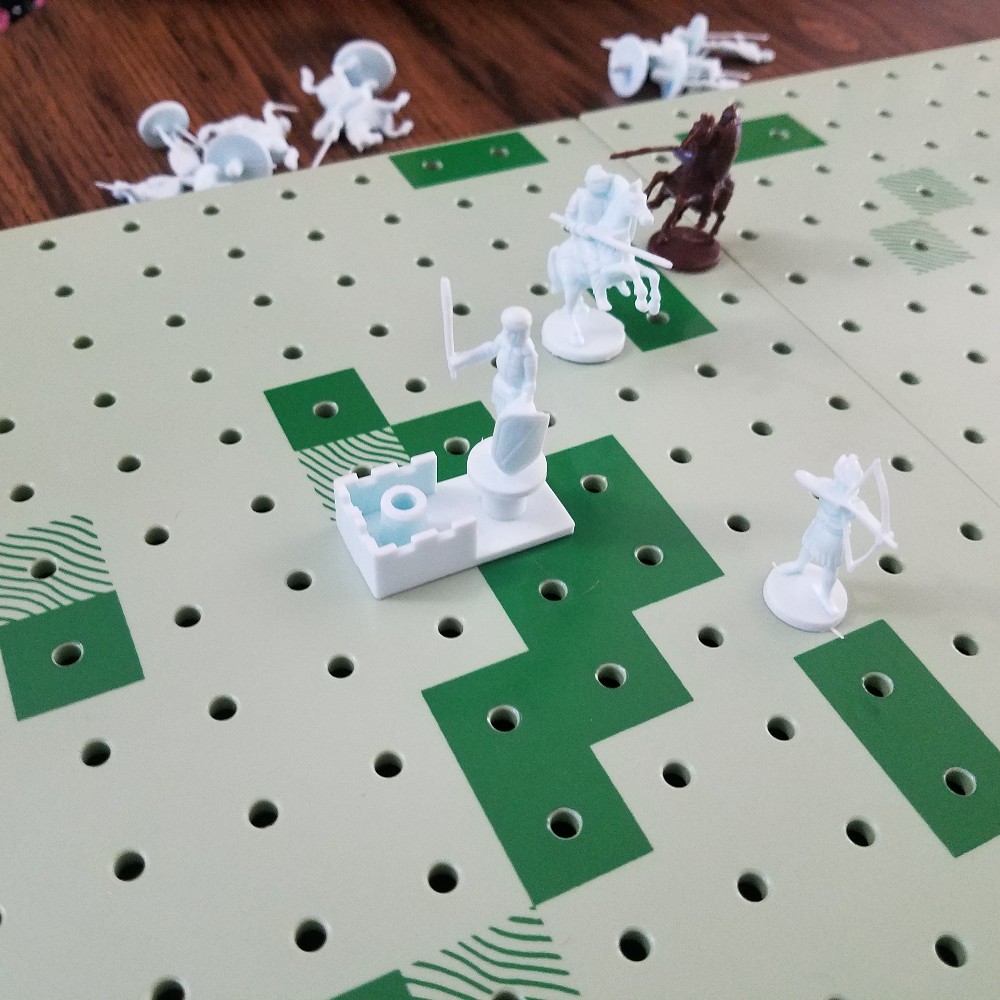
Colour Photograph of a close-up of the board, focusing on white's king piece which has been nestled into the protection of a mountain.
He is the Castle Green Preservation Society…

Feudal feels very chess-like to me, and because it is impossible to maneuver into position to kill without making yourself vulnerable, few deaths occur without some kind of counterattack.  Thus, by the end of the game, few pieces are left standing.  Janice argues that Feudal feels more like a wargame, albeit a simplistic one.  After all, if chess straddles the line between abstract games like checkers and Othello, and simple wargames like Tactics II, then Feudal surely must reside in wargame territory.

Either way, it was a fun diversion, and I wouldn't mind a rematch at some point, now that I am starting to understand things.  It may turn out that play is stereotyped and dull after a while, or it may be that there are hidden gems of strategy. 

Get yourself a copy and see what you think!

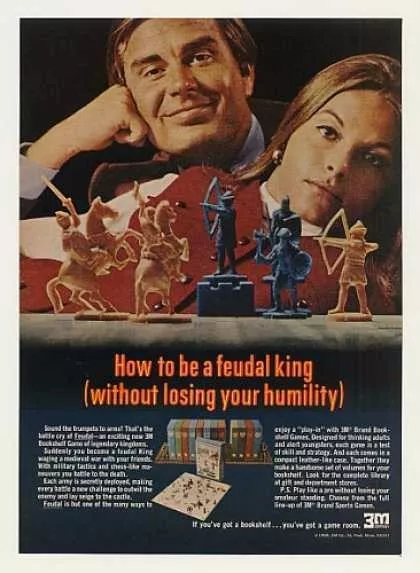
Colour photograph of a magazine advertisement, purporting to show 'How to be a feudal king (without losing your humility)'.  A white man and woman are posed behind a game board, with white and black pieces arranged in a dramatic vignette.
A 1969 advertisement for the game


[New to the Journey? Read this for a brief introduction!]


Follow on BlueSky

[April 4, 1970] Twixt Scylla and Charybdis (S&T's The Flight of the Goeben)

photo of a man with glasses and curly, long, brown hair, and a beard and mustache
by Gideon Marcus

A little over half a century ago, the actions of two ships changed the entire course of human events.

Black-and-white photograph of a warship.
SMS Goeben and SMS Breslau bombarding Phillipeville on the French-Algerian coast (W. Malchin, 1915)

In 1912, two warships of the German Kriegsmarine were stationed in the Mediterranean.  The battlecruiser Goeben and the light cruiser Breslau, in the event of war, were to raid French shipping between Africa and Europa.  When war broke out between Austria-Hungary and Serbia on July 28, 1914, the vessels were in the Adriatic port of Pola.  Admiral Souchon, commander of the German duo, decided he didn't want to be bottled up, so he took his ships to the central Mediterranean and waited for orders.

They arrived: head east for the Aegean Sea and ultimately the Dardanelles, the strait on which Turkish Istanbul was situated.  There, Souchon was to offer the two modern vessels to the aging and inefficient Ottomans.  In return, the Sultan would bring Turkey into The Great War on the side of the Central Powers.

Thus ensued a grand chase, which the British lost.  The rest is history.

But what if Souchon had been given different orders?  What if the British had had different priorities?  Such are the What Ifs that compelling parallel universes are made of—and the subject of the newest game to arrive in the magazine Strategy & Tactics.

The Game

Promotional logo for the game The Flight of the Goeben.

Continue reading [April 4, 1970] Twixt Scylla and Charybdis (S&T's The Flight of the Goeben)

[February 4, 1970] To Rome, with love (SPI's wargame, Anzio Beachhead)

[New to the Journey?  Read this for a brief introduction!]

photo of a man with glasses and curly, long, brown hair, and a beard and mustache
by Gideon Marcus

When you talk about destruction…

Two months ago, Jim Dunnigan started a revolution.  He took over the wargame fanzine, Strategy and Tactics, and not only worked to revitalize it, he started the novel practice of releasing a new wargame in it every issue!  Avalon Hill, the previous, undisputed king of the wargame publishers, comes out with one or two new games a year, whereas S&T plans to put out six to twelve (there are two in the current issue) of these magazine inserts in the same time—plus a whole line of regular releases.  In fact, a number of them are already out as limited series test prototypes, which some of my friends are playing.  Once they get through this round of testing, we should see some or all of them in a more finished form on our hobby store shelves.

Wow!

The copyright page and table of contents for the magazine Strategy & Tactics.  The table of contents reads:
In This Issue...
The Luftwaffe Land Army, by Victor Madeja; Bastogne, by James F. Dunnigan; Anzio Beachhead, by Dave Williams; Outgoing Mail; If Looks Could Kill, by Redmond Simonsen; Games, by Sid Sackson; Pass in Review, by Albert Nofi; Diplomacy, by Rod Walker; Wargamers Notebook, by Ed Mohrmann; Incoming Mail.

Last issue's wargame was Crete, which I was well pleased with.  The two games in this issue are Bastogne, which looks very cumbersome, and a cutey called Anzio Beachhead, which we've had a lot of fun with.  Let's take a look.

Reconnaissance

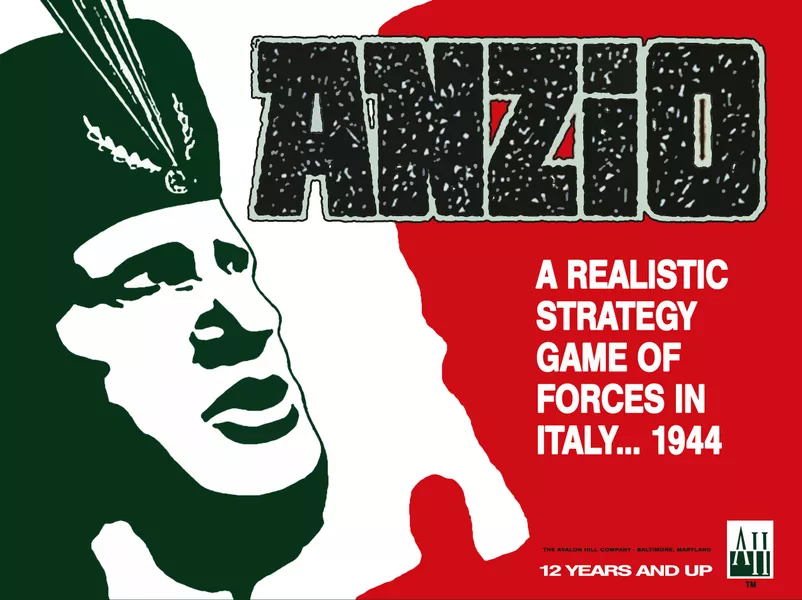
If the name strikes a chord, it's because we've already played a game with "Anzio" in the title—namely Anzio, which billed itself as "A Realistic Strategy Game of Forces in Italy… 1944"!

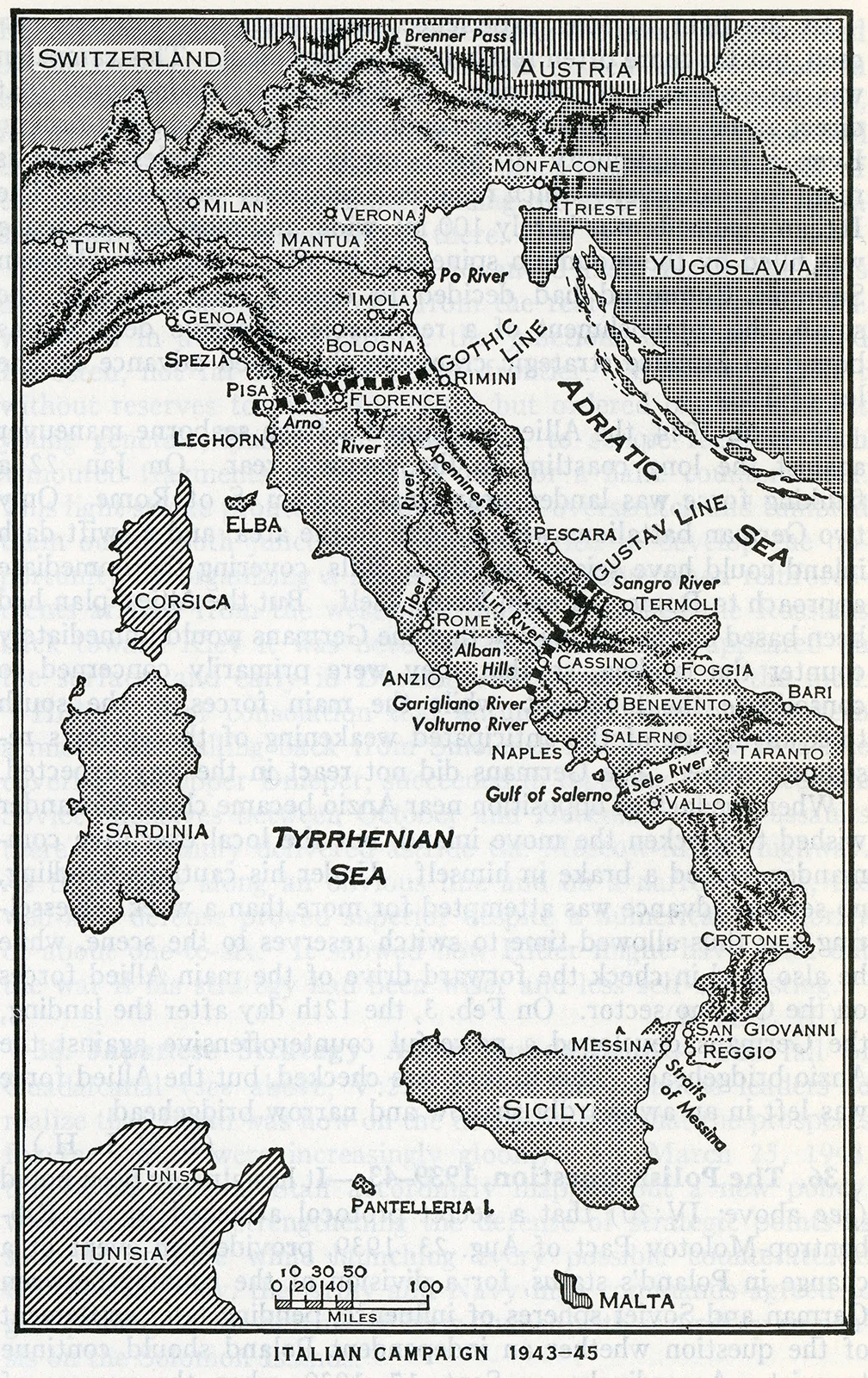
Which is funny because the game actually covers from the Salerno landings in September 1943.  Anzio is a strategic game that covers the entire Italian campaign in WW2, with invasions treated very abstractly.  The invasion of Anzio in January 1944 was planned as a flank of the Germany "Gustav Line", against which the Allies had stalled.  The hope was that the Allies could pierce through at a weak point and destabilize the German front.  Instead, the Allies were bottled up for four long months.  The front didn't move again until the Allies bashed headlong into the Gustav Line, and General Mark Clark took the Anzio forces to Rome, claiming the Italian capital concurrently with the invasion of Normandy.

(This was the wrong move, strategically—by going for glory instead of providing an anvil for the Allied hammer, against which the retreating Germans would be smashed, it meant that the Italian campaign remained an agonizing meatgrinder until the end of the war.)

A black and white map of Italy. Parts of Switzerland, Austria, Yugoslavia, and Tunisia are also shown. Cities and regions  relevant to the Italian Campaign of 1943-45 are marked.

But that's neither here nor there.  Anzio Beachhead depicts the landings and initial expansion at an operational level, covering the early part of the campaign.  In fact, it's by the same fellow who designed Anzio, Dave Williams.  Here's what Jim Dunnigan has to say about it:

"Anzio Beachhead was seen as another situation like the Bulge, where the attacker had a rapidly declining edge.  The original American commander was not bold, and lost.  So the idea with Anzio Beachhead was to explore the what if's.  At that time, I had been working on designing games for about eight years (since I first discovered the Avalon Hill games.) Before that, I was always interested in the details of history, and how they were connected.  Avalon Hill wargames were the first time I saw someone else thinking the same way, and doing it in a novel way. I was always building on that."

"I had been designing a similar game, called Italy, which incorporated the rest of the Italian theater, with a smaller scale map of the Anzio area (ie, two interrelated games, one strategic and the other operational).  But when Dave's game came in I thought it did a better job of the Anzio section.  We had come up with some of the same solutions, and his game was more compact and suitable for the magazine."

Vital Statistics

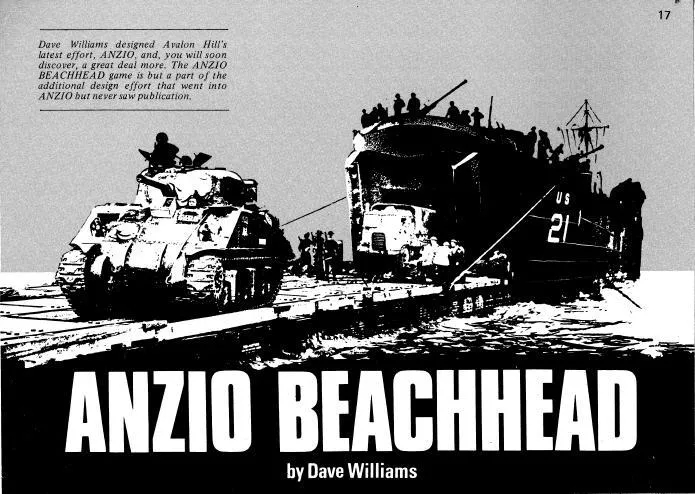
The title page of the Anzio Beachhead game. In the upper left corner it reads: Dave Williams designed Avalon Hill's latest effort, Anzio, and, you will soon discover, a great deal more.  The Anzio Beachhead game is but a part of the additional design effort that went into Anzio but never saw publication. In the center of the page is a black and white illustration of Anzio Beachhead.  A tank is on the left and a military ship labeled US 21 is docked to the right.  A small group of soldiers stands between them. The title of the game is written in white capitals across the bottom of the image.

Continue reading [February 4, 1970] To Rome, with love (SPI's wargame, Anzio Beachhead)

[October 4, 1969] New kid in town (Strategy and Tactic's wargame, Crete)

photo of a man with glasses and curly, long, brown hair, and a beard and mustache
by Gideon Marcus

For the last decade or so, the term "wargame" has been virtually synonymous with Avalon Hill.  That Maryland game company has come out with one or two new titles every year in this exciting genre (along with a handful of other, more general releases).  But now, there's a new player in town.

Strategy & Tactics was, up to last month, one of many wargame fanzines.  Most such 'zines are devoted to supporting Play-by-Mail games of Diplomacy, but S&T has been more catholic in its coverage, reviewing many games and providing articles of general interest to wargame-lovers.  The magazine even included the occasional wargame, mostly rules for miniatures wargames (a related but different beast from board wargames).


Volume 1, Issue 7 of S&T including rules for the miniatures wargame of modern soldiering, Patrol


Janice and me playing Patrol with toy soldiers

With the latest issue, Volume 3, Issue 2 (#18 total), there is a new editor at the helm: Jim Dunnigan.  Dunnigan's name may be familiar to you as the fellow who developed 1914 and Jutland for Avalon Hill… and also a self-published game on last year's takeover of Columbia University.  He has elected to apply his wargame-creation talents toward designing a brand new board wargame for S&TCrete.


Cover of the latest issue of S&T


Table of contents of the latest issue of S&T

This fascinating game is a full-fledged simulation, incorporating a number of neat innovations.  It is also a Do-It-Yourself-er: the map and counters (and rules) are just printed in the magazine, which means you either need to cut them out and affix them to pasteboard, or make your own copies from scratch.  Since I have access to a Xerox machine, I was able to have the best of both worlds, photocopying the pieces and playboard, the former on colored construction paper, and the latter tinted with colored pencils.

Lorelei provided the box cover art!

So how does it play?  Read on!

Continue reading [October 4, 1969] New kid in town (Strategy and Tactic's wargame, Crete)

[July 4, 1969] When Joey goes over the top… (Avalon Hill's Anzio)

photo of a man with glasses and curly, long, brown hair, and a beard and mustache
by Gideon Marcus

It's kind of a funny thing.  There are two feelings about war these days.  On the one hand, you've got the war in Vietnam raging without end despite LBJ resigning and Nixon running ostensibly to end the thing.  Now National Security Advisor Henry Kissinger is pleading for patience from those who say peace is taking to long.  "Come back in a year," he says.  It's no surprise that, in addition to innumerable protests and chart-topping songs, we've even got a wargame devoted to dissent: Up Against the Wall Motherfucker.

But "war" also conjures up other, less controversial, memories.  The veterans of World War 2 are my age—affluent and nostalgic.  We recently celebrated the centennial of the Civil War, which while bloody, shaped these United States we know today.  It's no surprise that the bulk of commercial wargames have been set in these two eras…with WW2 the big favorite: Chancellorsville, Gettysburg, D-Day, Stalingrad, Guadalcanal, Battle of the Bulge, Afrika Korps, Midway.

Avalon Hill is currently the leading publisher of wargames, generally coming out with one or two new ones every year (along with a handful of "family" titles).  Their latest, just released in April, is Anzio, and it's something of a revolution.

Continue reading [July 4, 1969] When Joey goes over the top… (Avalon Hill's Anzio)

[May 12, 1969] The Students are Revolting (the wargame Up Against the Wall, Motherfucker)


by Gideon Marcus

My crowd can't decide what to take this semester, but we've narrowed it down to the administration building and the library.

~Judy Carne on Laugh-In

Last Spring, students and Afro-Americans formed an uneasy alliance at Columbia University, taking over multiple buildings in pursuit of several disparate aims.  Black students and denizens of the neighborhoods surrounding the campus fought against the school annexing public spaces (specifically, the building of the new Columbia gymnasium in Morningside Park).  Other students rallied against Columbia's doing research for the defense department—essentially an inside raid against the Vietnam War.

After assembling to protest, radicals managed to seize five campus buildings, where they squatted for nearly a week before New York's finest, the boys in blue, dismantled the makeshift furniture barricades one by one and dragged the occupiers to the paddy wagons.

This did not end the struggle—thousands of students boycotted classes in May, and Columbia President Kirk resigned in June after giving in to pressure not to press charges against the protesters.  Hundreds of students due to graduate that month held their own, unofficial commencement on Low Plaza, in front of the Low Library—scene of clashes in the early stages of the occupation.

Last June, the Columbia Sentinel published a game delightfully titled, Up Against the Wall, Motherfucker!, inspired by a phrase uttered more than once throughout the event, sometimes in official channels.  One of the game's authors is Jim Dunnigan, who wargamers will recognize as the fellow who wrote Jutland for the wargame company, Avalon Hill.  The other is "Jerry Avorn", a name that is unfamiliar to me.

Continue reading [May 12, 1969] The Students are Revolting (the wargame Up Against the Wall, Motherfucker)

[June 20, 1968] Art imitates Life (the wargame Viet Nam)


by Gideon Marcus

Over There

It seems like only yesterday that a minor naval engagement in the Gulf of Tonkin off the coast of Vietnam embroiled the world's mightiest nation in a struggle against Communism in Southeast Asia. Less than a year later, the American commitment totaled 100,000 troops. Today, as the last aftershocks of the second Tet Offensive are beaten back from Saigon, more than half a million soldiers are fighting and dying in those far off jungles and cities.

It's a war unlike any other we've fought, though perhaps not unlike wars our allies have fought–there's a reason why the British, who fought an ultimately successful anti-guerrilla war in Malaya, have declined to join us in Vietnam.  It's not really a war for territory, nor a total war, as we fought against the Nazis or the Japanese.  It's a holding action, a war for "hearts and minds", holding the bag until the South Vietnamese can fight for themselves–if, indeed, that will ever be possible.

So new and unusual is this conflict that one would hardly expect it to be a viable subject for board wargaming.  After all, the pushers of counters on hex grids have largely stuck to World War 2 and the Civil War for their battlefields, highly researched and decently distant as they are.

And yet, just one year after Tonkin, Game Science came out with Viet Nam, a sophisticated wargame covering the war on a strategic level.  Could a game developed so early in the conflict have any chance of modeling reality?  And is it any fun?  This Memorial Day, we took the game for a spin and came to some very interesting conclusions.

In the trenches

The first thing one notices about Viet Nam is the board.  Rather than use the hex grid that has become de rigueur these last several years, it reverts to areas like in last decade's Diplomacy.  This makes sense.  Viet Nam is not a game of tactical maneuvers but of strategic province control.

The Allied forces (Americans, ARVN, Koreans, Filipinos, Australians) and the Communists (Viet Cong and NVA) start out splitting the provinces between them.  Control is indicated with a little bingo disc that represents a local militia.  Each side also gets a number of regular armies, the Allies starting with more, but acquiring them at half the rate of the Communists.  The regular armies are important because they are the only units that can both move and hold ground, the local militias adding strength but being both immobile and subject to flipping by the enemy.

The Allies also get air units that can be used for tactical support of armies (adding to their strength), strategic bombing of provinces (with a chance of destroying Communist units in the area), interdicting the Ho Chi Minh Trail (which kills Communist reinforcements) and mass bombing of North Vietnam (which earns victory points).  Bad weather in the summer and fall months limits strategic air missions.

Each turn, simulating one month, begins with both sides allocating ten factors towards various political activities: bolstering/destabilizing the government, terrorism/counter-terrorism, psychological warfare (to flip militias), seeking world favor (worth victory points), and ambush/counter-ambush (a trap for Allied armies).  This is essentially Rock-Paper-Scissors and the place where the Communists can win the game.  Unless the Allies guess right every time, they will lose stability or provinces, each of which leads them down the path of losing victory points.  Once below a certain level, they go down to nine or fewer factors to apply in this phase, which is a spiral of doom toward defeat.

After the political phase, both sides plot their moves in secret.  The Communists are trying to seize provinces and Allied bases.  The Allies are seizing provinces, defending, and allocating air power.  As the Communist players in our game quickly learned, randomness is key–there are always a dozen places they can attack, and the less consistent they are, the less chance the Allies will anticipate and head off an attack.

Combat is another kind of Rock-Paper-Scissors, each side having a set of four cards depicting various attack strategies.  In each conflict, the two players choose cards and then compare the two to determine the result.  For the Americans, the outcome is either inconclusive or a victory resulting in the loss of a regular army.  For the Communists, they are either forced to retreat or they win.  In other words, this is a part of the game the Communists will also ultimately win once they understand the cards, as the Allies cannot guess right every time, and they run out of armies faster than the Communists.  The more provinces under Communist control, the more mobility they get, again building momentum toward victory.

So is the game hopeless for the Allies?  Maybe not.  The game begins in January 1965, when weather is excellent.  Optimal strategy suggests that the Allies should interdict the NVA for those good months, allowing the Allies to build up an army superiority.  The Communists can only really run rampant if they have the regular troops for it.  If any air power be left over, the Allies should immediately start bombing North Vietnam as it is the only sure way to get victory points–it is the Allied counterpart to the Communists' political factor advantage.

Provided the Allies can contain the NVA and make lucky guesses to keep the Communists stalled, it is possible that, over time, the Communists will be forced below 10 political points per turn and, themselves, end up on the slide to defeat.  It'd be a long slog, but it is at least conceivable.

Proof in the pudding

I spotted Viet Nam not at my local game store, but in the campus store at the new campus of University of California San Diego.  Though the copyright on the game is 1965, various references in the rules and components suggest this is a brand new edition, updated based on three years of conflict.  Thus, I don't know how prescient the original was.

That said, the game seems to suggest that unless the United States goes bombing right out of the gate, as many generals urged us to do, there is no chance of victory.  Even a six month delay results in swarms of NVA and endless Red provinces.  Moreover, even had we gone in, bombs blazing (and what might the political ramifications vis. a vis. the Soviets been of that?), Viet Nam suggests that victory still would not have been certain, and it would have taken a long time.

It seems like an accurate simulation to me!

But is it fun?  Well, we enjoyed it at the time, all eight hours that we played before the Allies conceded the game to the Communists in latter 1965.  But on further analysis, there actually isn't that much to enjoy.  It's all a matter of luck, see-sawing back and forth on the victory point chart, until a lucky break drives the meter over to either a win or the inevitable road to defeat.

Thus, Viet Nam is less a game and more a puzzle–and a lesson.  Once the puzzle be solved and the lesson absorbed, there is not much replay value.

Just like the real war…


</small

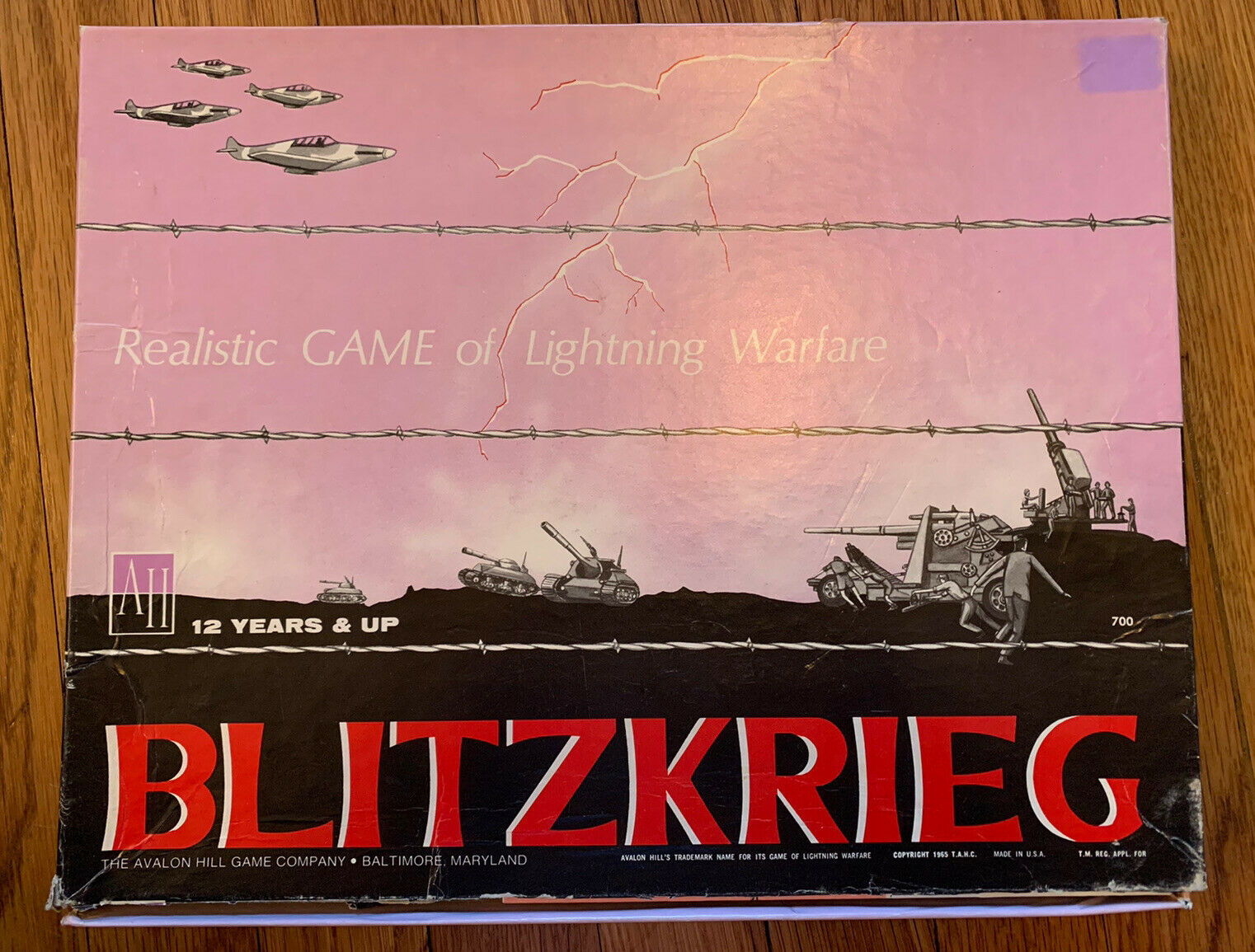
[May 24, 1967] Heavyweight Champion (Avalon Hill's Blitzkrieg)


by Gideon Marcus

With Muhammad Ali stripped of his title as heavyweight champion, owing to his refusal to enlist in America's armed forces to fight for nameless hills in Vietnam, the boxing world remains, for the moment, without a titular head.

Not so for the wargaming world.  A year and a half ago, Avalon Hill released its biggest, most complex title to date, and it still remains the monster amongst its hex-and-counter brethren.  Blitzkrieg is a truly impressive beast: three mapboards instead of the usual two, 100+ pieces per side (compare to chess' 16 or Afrika Korp's ~50), 16 pages of rules.

Yes, it's sure a big'n–but is it fun?  Read on!

Red vs. Blue–2

Nine years ago, Charles Roberts kicked off the board wargaming hobby in a big way with his Tactics 2 (there had been a Tactics (1) released a few years before, but its impact was slight).  Tactics 2, like chess, featured two more-or-less identical opponents with no geographical ties to any real world nations.  They fought with abstractions of regular forces, all army units.  So primitive was this game that it used squares instead of the now-standard hexes (still, paradoxically called "squares") that were a revolution in simulating movement.

Tactics 2 was not a fun game. It was a boring, endless slog.

Blitzkrieg is Tactics 2 done right.

You've still got the two generic countries, in this case "Great Blue vs. Big Red", but now the map is a lot more interesting.  In between the two titans are seven "minor countries" that can be occupied for more production potential.  There are beaches to land on, deserts to cross, mountain ranges to hole up in, oceans to sail.

And the other armed services aren't just abstractions anymore.  The Navy still is, with transport represented simply by the number of troops which can be at sea at any time (and fleets can't shoot each other as they pass by), but now there are Marines (well, Rangers) that can land anywhere as opposed to their GI cousins who must make assaults on beaches only.  And there is a profusion of Air Force units: three types of bombers, from the short-ranged assault type to the long-ranged strategic variety, not to mention escorting fighters.  There are also airborne units that can fly from airfields and land great distances away–critical to taking farflung strongpoints behind the lines.

Even the Army is heterogenous, with units representing infantry, armor, and artillery (though functionally, they all work the same–the only difference is their movement and combat factors).

Cities are essential to the game: a player can only support 12 combat factors of units for every city controlled.  A player who loses cities may find his or her units evaporating without a shot being fired.

The game is won one of two ways: either one side completely destroys all of the other side's units, or (more achievable), one side occupies all of the other side's cities for a turn.  A third option says the game can end by negotiated surrender, just like real life.  In practice, this is the most common outcome.  There comes a point when the end is inevitable, even if it be far off.

Easy to learn, hard to master

Taken individually, none of the rules in Blitzkrieg is particularly challenging.  At the base of it all is the standard move, fight sequence of all other Avalon Hill games.  The Combat Results Table (CRT) is novel–instead of the standard "Defender/Attacker Eliminated", "Defender/Attacker Retreats", "Exchange" results, both sides have the chance to lose strength points.  This means that after every fight, a player is usually "making change", exchanging full strength units for depleted ones.  This is more realistic as individual battles rarely destroy entire units.

There are stacking limits (no more than 15 combat strength to a square), terrain modifications (units doubled on defense in towns and mountains), zones of control (units going next to others must stop and fight), replacement units and reinforcement units–all standard stuff.

The new rules aren't too onerous.  Invasions work kind of like in D-Day where assaulting units line up on the beach and fight their way ashore.  If there's no one defending the beach, they get to zoom inland. 

In addition to the aforementioned parachuters, a player can also move 12 units of Army from one city to another–including ones just taken from the enemy that turn.  This can be huge.

The Air Force adds a completely new dimension…literally!  Tactical bombers add their strength to an attack while strategic bombers bomb completely separately, interdict supply, or reduce towns to rubble.  Medium bombers can do either!  Fighters engage bombers or each other.

There are even weather, nuke, and sea-based aircraft rules!

Again, none of these are particularly difficult to apprehend.  But in order to win the game, all must be employed, and skillfully.  Neglect the air capabilities of an opponent in favor of the human wave tactics that won you Stalingrad or Waterloo, and you'll soon find troops behind your lines eating your supply.  Neglect the threat of naval invasion, either to your shores, or as a thrust to throw the enemy off balance, and you lose a powerful component of strategy.

So, that's the game, but I haven't answered the original question, have I? 

In Practice

At the beginning of the year, we set up the behemoth that is Blitzkrieg for a try.  Nominally a two-player game, we decided to make it a four-player game by having two people per side.  This makes a match both competitive and collaborative, which I find more fun than a straight head to head.  Plus, Janice is smarter than me, so she ensures we don't make dumb mistakes.

Against us were two Travelers, Lorelei and Elijah.  Would youthful vigor defeat aged wisdom?

Because of Great Red's proximity to more minor countries, and also because of somewhat better planning, Janice and I were able to take four of the seven minor countries with fewer losses and more quickly than our opponents.  This was not decisive, but it didn't help the kids.

Now, with both sides directly facing each other, with troops at sea threatening each other's shores, the question was where the first blows would land.

We quickly identified the largest concentration of Red troops that could be "bottled up".  If they could be taken out of the fight, Red would lose much of its offensive capabilities.  Accordingly, we landed in force on the middle south, around Curry Bend.  A titanic battle began that would take several turns to resolve and suck up more and more forces from both sides.

But what's this?  Elijah and Lorelei had paid more attention to the rules than we did.  They parachuted across the desert into one of our vacant cities in the northeast and promptly flew in another 12 points of units, which went on to occupy even more of our hinterland!  Our rear was open to the wind, our supply threatened.

Well, two could play at that game.  We took two of their cities in the northwest and set up hedgehog defenses in the home country.  While it was scary to lose several cities, the fact was, we had plenty of formerly neutral nations to supply our units.  We were never in any danger of losing troops to supply restrictions.

Great Blue, on the other hand, could not withstand the loss of dozens of combat factors in the south.  With their main offensive strength crushed on Turn 5, it was clear that their days as a fighting force were ended.  And so we adjourned to watch Star Trek.

After Action Report

I took three things away from this session of Blitzkrieg.  The first is what every good general has learned: to crush the enemy, you must destroy their armies in the field.  Taking cities is all very nice, but so long as one side is losing more troops each turn than the other, and the number of troops lost exceeds the four replacement units per turn, an inexorable imbalance grows until defeat is inevitable.

Secondly, we determined that Big Red has an inherent advantage over Great Blue.  Having a contiguous nation with greater access to more minor countries is an incontrovertible advantage.  Not insurmountable for Blue, but worth noting.

Thirdly, yes, this game is a lot of fun.  Highly recommended.  Just know that it'll take longer than most games!  Each team's turn took about half an hour to plan followed by half an hour to play out.  Thus, our five turn game (plus setup and learning), took about 12 hours played over several sessions.

But it was worth it!

Join the Fun!

If all this talk of playing general stirs something your bones (and hey, it's a lot more fun and less harmful than actual fighting), you are warmly invited to join our Galactic Journey Wargaming Society.  We have been facilitating several play-by-mail games so that even players remote from each other can enjoy a contest: over the summer, we had a smashing good time killing each other in a friendly game of Diplomacy.

And you get a spiffy newsletter!  What are you waiting for?