To Tell the Truth Despite Everything

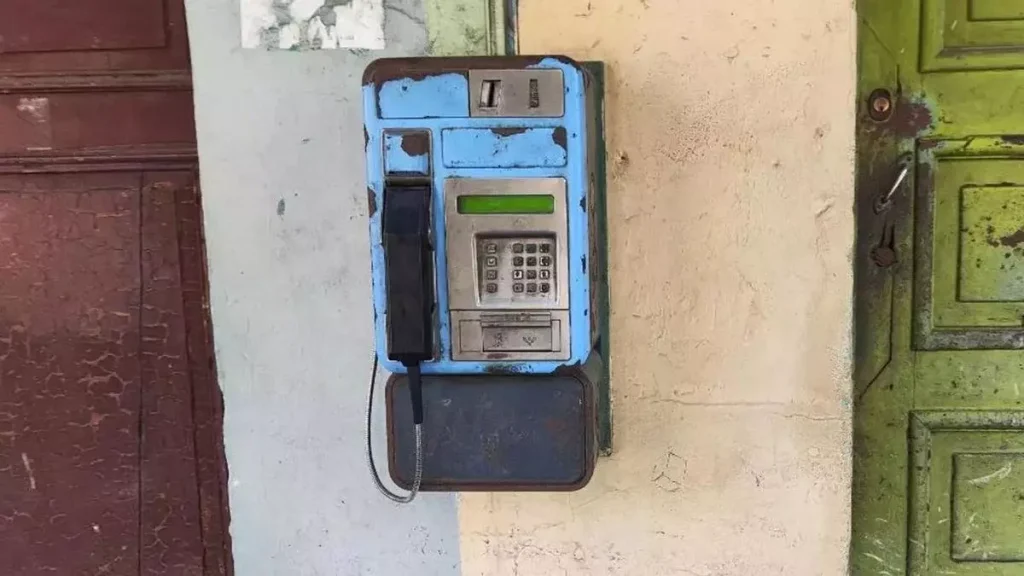
Many independent journalists only had a landline (or public phone) to report on the realities of Cuba. / 14ymedio
14ymedio bigger

14ymedio, Havana, Generation Y, Yoani Sánchez, May 3, 2026 —  Every May 3rd carries a different weight when you practice journalism in a country where press freedom is not a right, but a daily battle. This is not a date for celebration, at least not in the most comfortable sense of the word, but for taking stock: of what has been won through hard work, what has been lost along the way, and what still needs to be built. In Cuba, being an independent journalist is not just a profession; it is a form of resistance.

I’ve learned to measure time not just by the days that pass, but by the times the internet connection drops, by the messages that never arrive, by the calls that are cut off just as someone begins to share their story. The poor quality of communications isn’t just a technical problem; it’s a strategy. As are the operations surrounding our homes, the police patrols that appear on “sensitive” dates, the officers who watch, take notes, and intimidate. There are days when going out to report something means first having to get past a cordon.

Added to this are the more visible threats: summonses, interrogations, seizures, and legal proceedings that seek to criminalize the practice of journalism. They call us “mercenaries,” “enemies,” “destabilizers,” as if reporting the truth were a form of violence. But the truth is that the greatest fear of those in power remains that someone will observe, ask questions, and publish.

The greatest fear of those in power remains that someone will look, ask questions, and publish.

However, the challenge doesn’t end with repression. There is another challenge, quieter, and more complex that has to do with Cuban society itself. For decades, the country lived under an information monopoly that shaped not only what was said, but also how it was heard. Many citizens grew up with the idea that the press should confirm, not question; accompany, not investigate; embrace, not criticize. Today, as the cracks in that wall deepen, confusion also emerges: What is the role of a journalist? To whom do they answer?

Therein lies, perhaps, one of the greatest challenges of the future: rebuilding the relationship between the press and the public. Explaining, with facts and rigor, that our role is not to please nor to be an echo chamber for politicians or special interest groups. That we are not here to applaud nor to amplify slogans. That journalism, in its essence, makes people uncomfortable. It investigates. It reveals. And that this discomfort is necessary, both when it targets those in power and when it illuminates the dark corners of society itself.

To be an independent journalist in Cuba today is like walking on unstable ground, where every step can have consequences. But it is also an inspiring profession. Because amidst the blackouts, the censorship, and the imposed silence, every published story is a small victory against the gag order.

To be an independent journalist in Cuba today is like walking on unstable ground, where every step can have consequences.

This May 3rd, I have no certainties, but I do have convictions. The main one: that even if they cut off our connection, there will always be someone looking for a signal to publish an article or denounce an injustice. And as long as that need to know, to understand, to name what is happening exists, journalism, even the most persecuted kind, will continue to find a way to prevail.

To my colleagues, congratulations on this day, but I warn you that the road ahead is full of dangers, even dangers that come from what today seem to be very close support.


COLLABORATE WITH OUR WORK: The 14ymedio team is committed to practicing serious journalism that reflects Cuba’s reality in all its depth. Thank you for joining us on this long journey. We invite you to continue supporting us by becoming a member of 14ymedio now. Together we can continue transforming journalism in Cuba.
Cuba, a Country That Can Barely Sleep

Just as Villa Marista disrupts the cycles of detainees, the Island suffers its own sleep deprivation

The result of this chronic lack of sleep is the constant irritability and confusion seen on the streets. / 14ymedio
14ymedio bigger

14ymedio, Yoani Sánchez, Generation Y, Havana, 29 March 2026 — They say that the detainees at Villa Marista, the feared headquarters of State Security in Havana, have their circadian rhythms disrupted, that biological rhythm that regulates sleep, wakefulness, body temperature, attention, and even one’s emotional state. Deliberately, jailers turn lights on and off in windowless cells and prolong interrogations to induce disorientation, false confessions, extreme fatigue, and cognitive impairment.

In Cuba, we all feel like we’re in Villa Marista. We get up in the middle of the night to wash clothes, cook, or carry water. At some point during the day, we have to try to catch a nap because we don’t know what chores await us after midnight. Even in the middle of that daytime rest, we might not be able to sleep because the stench of burning garbage wakes us up or the mosquitoes prevent us from taking a siesta. The result of this chronic lack of sleep is the constant irritation and confusion that we see on the streets.

In Cuba, we all feel like we’re in Villa Marista.

I ran into a neighbor in the elevator during one of those rare moments when we have electricity. She’d left for work and when she got to Boyeros Avenue, she realized she didn’t have her wallet with the money to pay for an electric tricycle. She went back home, picked up her wallet, and—surprise!—when she went to pay the taxi driver, it was empty. Another neighbor went downstairs as soon as a power outage ended to charge his electric motorcycle in a nearby parking lot, but when he was standing next to the vehicle, he realized he’d forgotten the charger and cable.

These aren’t just random lapses in memory. It is the poor quality of sleep that leads to decreased concentration, memory lapses, and a higher risk of mistakes or accidents. We’re a country that barely gets any sleep.


COLLABORATE WITH OUR WORK: The 14ymedio team is committed to practicing serious journalism that reflects Cuba’s reality in all its depth. Thank you for joining us on this long journey. We invite you to continue supporting us by becoming a member of 14ymedio now. Together we can continue transforming journalism in Cuba.
The Prohibited Photo

From the balconies of our building, the view is complete: an unintentional monument to neglect, an altar where the homeland coexists with the abandoned. / 14ymedio
14ymedio bigger

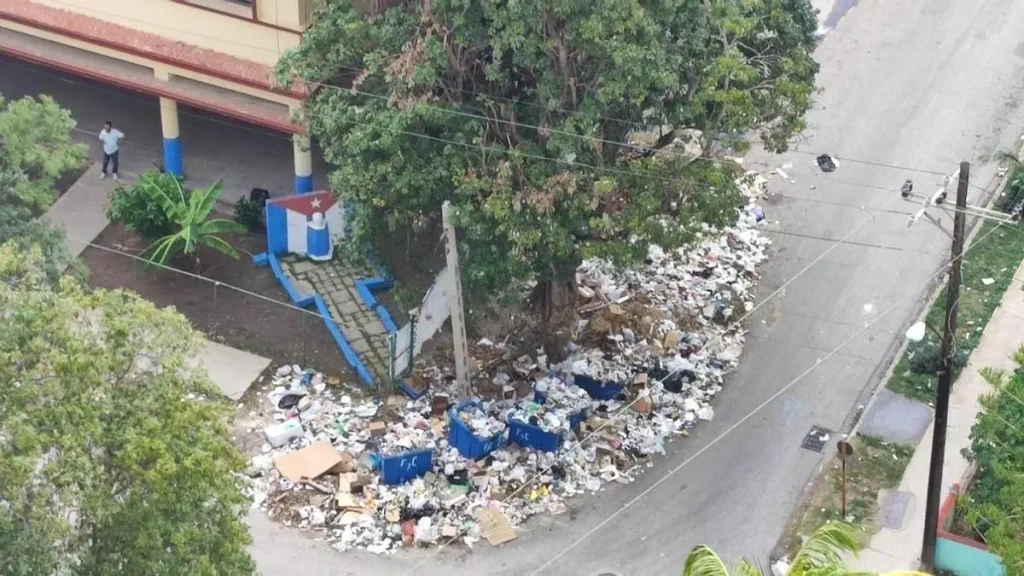
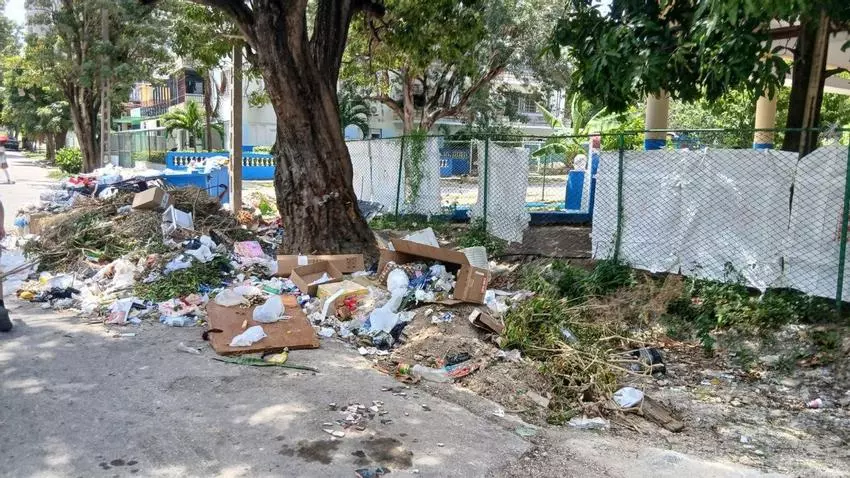
14ymedio, Yoani Sánchez, Generation Y, Havana, April8,2026 — Employees of the state-run warehouse on Factor y Conill Street in Nuevo Vedado have been orientado [instructed] to cover the fence around the corner with sacks. The order aims to prevent neighbors from taking photographs of the immense mountain of garbage that grows there every week, with the bust of José Martí in the background and the Cuban flag in the gardens of the warehouse, products destined for the rationed market are stored, as a backdrop. However, clearly visible from the heights of my building is the triptych formed by the Apostle, the solitary star, and the garbage.

The scene has something of farce and unintentional comedy about it. While the sacks have been hung with diligence, as if it were a national security operation, flies continue to come and go without asking permission, and the smell of decay rises through the windows with a punctuality that public transportation could only dream of. The garbage, undisciplined and stubborn, doesn’t care about directions or makeshift curtains.

Sackcloths hiding the statue of Martí at the corner of Factor and Conill streets in Nuevo Vedado. / 14ymedio
One would think the problem is the pile of waste, but apparently not. The real enemy is the photograph. The image circulating on WhatsApp, leaking onto social media, and contradicting the official narrative seems to be the biggest concern for officials and bureaucrats.

From the balconies of our building, the view is complete: the sculpture of a head, reached by a path of stones that no one uses, the blue stripes with their red triangle and, a few meters away, a string of torn bags, damp cardboard, and plastic scraps spilling onto the sidewalk. An unintentional monument to neglect. An altar where patriotism coexists with abandonment.

Appearances are so important to this regime that it is willing to spend time, energy, and resources covering up an image and obscuring a shot, rather than using those same resources to clean the city and prevent the diseases that spread from these open-air dumps. In the end, it is not about eliminating the garbage, but about hiding it. Like so many other things in this country.

______________________

COLLABORATE WITH OUR WORK: The 14ymedio team is committed to practicing serious journalism that reflects Cuba’s reality in all its depth. Thank you for joining us on this long journey. We invite you to continue supporting us by becoming a member of 14ymedio now. Together we can continue transforming journalism in Cuba.

Washington, Havana and the Evidence of Real Change

Recent action to demand the release of prisoners in Cuba. / Armando Labrador Cuba Primero/Facebook
14ymedio bigger

14ymedio, Yoani Sánchez, Generation Y, Havana, February 26, 2026 — Rare is the day with no new speculation about supposed negotiations between Washington and Havana. The rumor spreads through digital portals, seeps into conversations at the bodega, and resurfaces, with embellishments, on social medio. On the streets of Cuba, people ask if it’s true that the two governments are talking and that a roadmap for a democratic transition on the island will soon see the light of day. However, the rumors advance on one track while stubborn reality only regresses on another.

We Cubans have learned to be wary. Not out of cynicism, but out of experience. Too many times, a new process of transformation has been announced when that ends up being merely a change of tone, a reversible concession, or a promise that evaporates in a few weeks. If real talks are taking place, if these aren’t just trial balloons floated to gauge reactions, then they should be accompanied by clear, visible signs and, above all, irreversible steps toward freedom.

Rumors advance in one direction, while stubborn reality only retreats in another.

The first of these necessary movements brooks no embellishment or euphemism: the release of all political prisoners. More than a thousand people are currently imprisoned in Cuba for thinking differently, demonstrating peacefully, or publishing an inconvenient text on the internet. This is not about temporary releases, parole, or disguised exile, but about a full amnesty, without threats or subsequent surveillance. Until every last prisoner of conscience remains behind bars, any dialogue will be nothing more than a charade.

Another indispensable proof would be the genuine decriminalization of dissent and the dismantling of the political police apparatus. Cosmetic legal changes are not enough if citizens continue to know that expressing an opinion can cost them their job, career, or freedom. Without this framework of fear, built on summonses, acts of repudiation, and coercive legal proceedings, there is no honest transformation, only a charade.

We must also address the core of power: the end of the Single Party and the calling of pluralistic elections. Not as a distant gesture, promised for some vague future, but as a commitment with a clear timeline and rules. A transition cannot be constructed with only one player on the board. And for these elections not to be an empty charade, public media must open itself to divergent voices, allowing different political options to campaign before the citizens. The day we see an opposition candidate explain their platform on state television, we can begin to say that something is truly changing on this island.

We must also address the hard nucleous of power: the end of the One Party system and the calling of pluralistic elections. Not as a distant gesture, promised for some imprecise future.

On the economic front, an irreversible step would be to end the absurd prohibition that prevents doctors, lawyers, and other professionals from practicing freely in the private sector. No country can rebuild itself by tying the hands of its human capital. Similarly, the practice of politically motivated immigration “regulations,” which turn the right to travel into a privilege conditioned on obedience or silence, should be eliminated.

Finally, no Cuban transition will be complete if it ignores the exile community. Calling on those who left, and their children, to rejoin national political life and the reconstruction of the country is not a concession, it is a necessity. Cuba is also that diaspora that sends remittances, contributes ideas, and preserves our memory.

If conversations are happening and aspire for more than just gaining time, these will be the signs. Everything else, however seductive it may sound, will remain mere noise amidst a prolonged stagnation.

Editor’s Note: This text was originally published on Deutsche Welle in Spanish.


COLLABORATE WITH OUR WORK: The 14ymedio team is committed to practicing serious journalism that reflects Cuba’s reality in all its depth. Thank you for joining us on this long journey. We invite you to continue supporting us by becoming a member of 14ymedio now. Together we can continue transforming journalism in Cuba.

Without Reason, Cuban State Security Is Once Again Besieging Journalists

Police patrol outside the home of Wilber Aguilar Bravo, in La Güinera (Havana). / Facebook
14ymedio bigger

14ymedio, Havana, Yoani Sánchez, 3 February 2026 — The cold is the talk of the town in Havana. But dictatorships don’t understand low temperatures or freezing winds. This Tuesday, there’s a political police operation in the basement of our building to prevent us from leaving our homes. What’s the reason for this blockade that restricts our freedom of movement and condemns us to not being able to buy food or take out the trash? We don’t know. It is not a significant date on the official calendar, we are not invited to any diplomatic reception, and in our neighborhood, no visitors are expected other than the battalion of flies and mosquitoes that buzzes around the mountains of garbage.

A neighbor told us it might be the Cuban regime’s nervousness in the face of pressure from Washington and the events that have been unfolding in Venezuela for the past month. However, I struggle to define what danger my husband and I could pose on this international political chessboard where we are, at best, tiny, defenseless presences. Is some official coming to inaugurate a project amidst the dirty, dilapidated streets of this area? Is a military exercise about to take place in the trenches formed by the potholes in the sidewalks that surround us? Is the stench emanating from the garbage piled up on the street corners about to multiply in the coming hours?

With the thread of internet we have, we confirm that other journalists and activists suffer the same harassment at their homes.

We have no answer, because Cuban State Security behaves with impunity, failing to explain to citizens the reasons for violating their rights.

With the thread of internet we have, we confirm that other journalists and activists suffer the same harassment at their homes: Dagoberto Valdés in Pinar del Río, Wilber Aguilar Bravo in La Güinera, and Camila Acosta and Ángel Santiesteban in central Havana. From Camagüey, reports indicate the arrest of Henry Constantín, director of La Hora de Cuba , and Alejandra García, whose whereabouts remain unknown.

When a state blocks defenseless people from walking freely through a city, it demonstrates its fear. That repressive forces must spend hours stationed outside our building, disrupting our daily lives, reveals the fragility of a power that fears a couple of journalists armed only with their words.


COLLABORATE WITH OUR WORK: The 14ymedio team is committed to practicing serious journalism that reflects Cuba’s reality in all its depth. Thank you for joining us on this long journey. We invite you to continue supporting us by becoming a member of 14ymedio now. Together we can continue transforming journalism in Cuba.

Cuba and the Time To Remove the Masks

The numerical disproportion between those who cling to the current model and those who want political openness is overwhelmingly in favor of the latter.

The hope that this difficult moment will give way to “a free Cuba” has taken root in the collective imagination. / 14ymedio
14ymedio bigger

14ymedio, Yoani Sánchez, Generation Y, Havana, 11 February 2026 — Next to me in the shared taxi, a young man is listening to a YouTube video at full volume on his cell phone. The video harshly describes Alejandro Castro Espín, mentions the word “dictatorship” several times, and denounces the repression of the Cuban regime. No one bats an eye. No one tells him to turn off the device. No one confronts him ideologically. A few minutes later, in a long line outside an office of the Etecsa monopoly, a woman is listening to a song by Los Aldeanos that criticizes Castroism. The state employees aren’t even bothered, and some people in line are even singing along to the chorus

When I get home, a neighbor who for years has been an obvious informant for the political police approaches me to say that “something has to happen, because this can’t go on.” On the stairs to the 14th floor, without electricity and with the elevators out of service, another neighbor jokes that the fictional character Cuco Mendieta, a Cuban supposedly a member of the U.S. Delta Force who participated in the capture of Nicolás Maduro, is about to arrive in Havana on a mission very similar to the one in Caracas. We laugh, and the climb becomes easier.

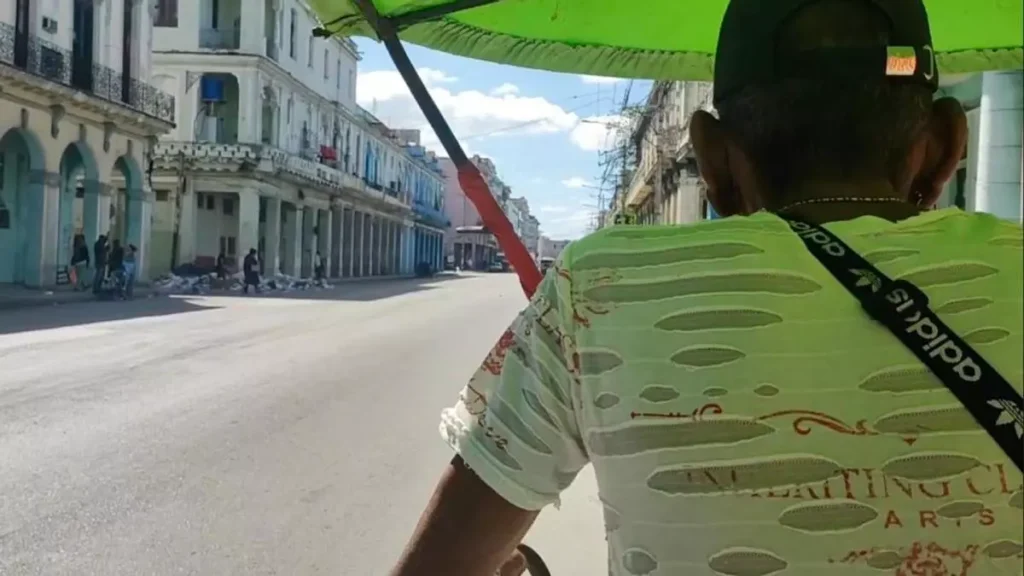
Never before has the Cuban government been criticized so openly. I don’t recall a single moment in our recent history when criticism of the Communist Party was so widespread, so corrosive, or so loud. ” Gusanear,” that verb borrowed from official insults, is the daily practice of millions of people on this island. They “gusanear” at bus stops, at workplaces, and in lines to deposit a few dollars onto that Clásica card that allows them to buy what little gasoline remains in the country. They ” gusanear” at the rationed bodega, at school meetings where they announce the suspension of in-person classes, and on the bus terminal platform, empty of vehicles and hope.

‘Gusanear’, that verb taken from official insults, is the daily practice of millions of people on this Island.

Defenders of the system are at a significant disadvantage in Cuba. Nothing remains of the ideological fervor they once displayed. Many are silent, scanning the horizon for the change that is inevitably approaching, while others have joined the ranks of the critics at a surprising speed. Masks are falling away, medals are being hidden, and patting the neighborhood opposition member on the back is a way of making one’s position clear. The numerical disparity between those clinging to the current model and those who want political opening is overwhelmingly in favor of the latter. We are, in the end, the majority, and “they” know it.

In the face of this panorama, Cuban President Miguel Díaz-Canel should think twice before asking for sacrifices and calling for “creative resistance.” His ability to rally support is at an all-time low, the Party he leads is experiencing a period of extremely limited backing, and those who until yesterday were preparing for the front lines will no longer answer the call to self-sacrifice. Not only has fear shifted sides, given the regime’s dwindling numbers, but the hope that this difficult moment will give way to “a free Cuba” has taken root in the collective consciousness. “It won’t be long now,” another neighbor tells me from her balcony. “We’ll get rid of them this time,” she adds before hanging up the sheet she washed by hand, amidst the blackout.


COLLABORATE WITH OUR WORK: The 14ymedio team is committed to practicing serious journalism that reflects Cuba’s reality in all its depth. Thank you for joining us on this long journey. We invite you to continue supporting us by becoming a member of 14ymedio now. Together we can continue transforming journalism in Cuba.

El4tico, the Rebellious Youth That Those in Power in Cuba Want To Silence

The arrest of Ernesto Medina and Kamil Zayas is a warning to Cubans under 40: emigrate before repression catches up with you

El4tico has shown a country where the Communist Party’s unpopularity is growing, patience is running out, and the imposed political model is garnering less and less support. / Facebook/Cultural Rights Observatory
14ymedio bigger

14ymedio, Yoani Sánchez, Generation Y, Havana, 7 February 2026 —  My generation has packed its bags. And the few of us who remain on the island have had to learn another kind of heartbreak: saying goodbye to our children. Watching them leave not only with a backpack on their shoulder, but with the certainty that staying means the risk of being silenced, perpetual poverty, or prison. Young Cubans today face a cruel dilemma: remain in the country where they were born, silenced and subjected to a crisis with no end in sight, or leave for places where everything starts from scratch, but where at least one can speak without fear. The arrest yesterday, Friday, of Ernesto Medina and Kamil Zayas, members of the El4tico project, is a stark warning directed at Cubans under 40: emigrate before the repression catches up with you

“If you are seeing or reading this, it is because they have finally found a way to silence me, to try to temporarily muzzle me,” Zayas says in a message written before his arrest and released this Saturday. “I am not being arrested for theft, assault, drug trafficking, or any common crime,” he clarifies. “I am being arrested for the only ‘crime’ that a dictatorship cannot tolerate: daring to look directly and say aloud what we all notice: its egregious failings, its chronic inefficiencies, its systematic injustices, and the oppression that crushes the dignity of an entire people.”

Standing in front of an old blackboard and with a fan that seems more intent on stirring up social inertia than blowing air, Medina and Zayas have connected with an audience fed up with slogans.

This testimony is not mere rhetoric, but rather an accusation. In a country where too many young people are trapped in the clutches of el químico [the chemical], others spend hours sitting on sidewalks with nothing to do, and a majority dream of throwing themselves into the sea or boarding a plane to get them out of here as soon as possible, these two men from Holguín have chosen the most dangerous path: to stay and speak out. With their videos, they have unsettled the authorities because they have abandoned coded language, fear, and self-censorship. In front of an old blackboard and with a fan that seems more intent on stirring social inertia than providing air, Medina and Zayas have connected with an audience fed up with slogans and in need of stories grounded in real life.

While official channels insist on clinging to the tired slogan of “creative resistance,” El4tico has shown a country where the Communist Party’s unpopularity is growing, patience is wearing thin, and the imposed political model is garnering increasingly less support. Where Miguel Díaz-Canel takes hours to string together clumsy phrases that provoke a prolonged national yawn, Medina and Zayas have opted for a direct, approachable, even engaging style. Their videos are devoid of posturing and scripted phrasing: they offer spontaneity, irony, and a sincerity that the system doesn’t know how to handle.

“Speak louder. Be dignified. Because history does not pardon those who remain silent out of convenience,” Zayas wrote before a police operation culminated in his and his colleague’s arrest. That phrase resonates today in a society marked by absences, by empty seats at family tables, and by the fear of ending up behind bars for an opinion, a social media post, or a criticism spoken aloud.

Repression doesn’t just imprison bodies; it also forces people into exile, cancels their future, and empties the country of its youngest voices. Every arrest like this confirms that speaking the truth remains, in Cuba, the most dangerous and most necessary act.


COLLABORATE WITH OUR WORK: The 14ymedio team is committed to practicing serious journalism that reflects Cuba’s reality in all its depth. Thank you for joining us on this long journey. We invite you to continue supporting us by becoming a member of 14ymedio now. Together we can continue transforming journalism in Cuba.

The Removal of the Photos: Fidel Castro’s Regime Retreats in Cuba

Lacking a sense of humor, vengeful towards anyone who dared to challenge him, Fidel Castro’s image is at an all-time low in the social imagination.

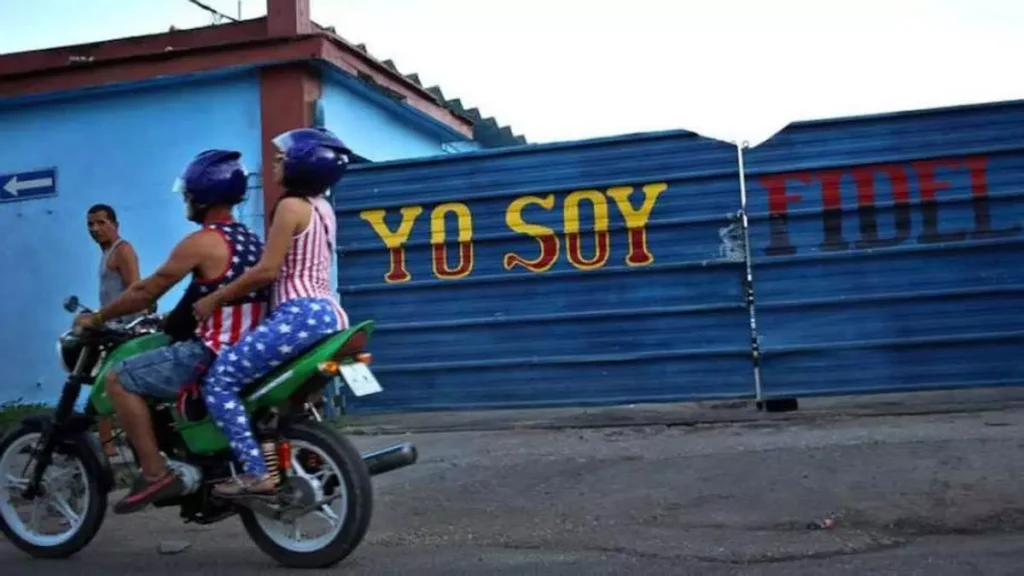
In the centennial year of Fidel Castro, Cuban authorities are doing everything possible to resurrect a legacy that popular will insists on burying. Tet on the fence: “I am Fidel” / EFE
14ymedio bigger

14ymedio, Yoani Sánchez, Havana, February 4, 2026 — Her photo with Fidel Castro hung in the living room for decades, and Rita proudly displayed it. But a few years ago, the frame was used to hold a portrait of her newborn granddaughter, and the snapshot, faded by time, ended up in a drawer. A retired engineer enduring more than ten hours of daily power outages, this 80-year-old Cuban now feels a mixture of shame and annoyance every time she comes across that image where a man in military uniform is pinning a medal on her.

In the centennial year of Castro’s birth, Cuban authorities are doing everything possible to resurrect a legacy that the popular will insists on burying. The man who ruled the destiny of millions on this island has become synonymous with everything that must be avoided in the nation’s future. Uncompromising voluntarism, hatred of those who are different, revolutionary bravado, and contempt for dissent were not only his personal hallmarks but also the defining characteristics that shaped his domestic policy and international diplomacy for more than half a century.

The “This is your house Fidel” signs only remain in the memory of a few, and those diplomas where his signature was written on the paper have been stored away from prying eyes.

Lacking a sense of humor, incapable of even the slightest bit of dancing, vengeful towards anyone who dared challenge him, averse to personal affection, and prone to tantrums when he didn’t get his way, Fidel Castro’s image is at an all-time low in the public consciousness. Despite the display of his photographs in government offices and the calls to celebrate the centenary of his birth, the man born in Birán in 1926 has been more than buried by most Cubans, who avoid even mentioning his name, as if it were a spell that could bring him back to life.

Few family living rooms still display his photographs, the “This is your house, Fidel” signs only survive in the memories of a few, and those diplomas bearing his signature have been tucked away, out of sight. Grandparents avoid mentioning him, emigrants swear they could never stand him, and even those named after him insist their parents actually chose it in honor of an uncle who died young. No one wants that bearded shadow cast over their life.

A century later, Cubans are trying to completely bury the man who attempted to leave his mark on every second and every millimeter of national life. He’s so absent from public discourse that he’s no longer even mentioned in curses.


COLLABORATE WITH OUR WORK: The 14ymedio team is committed to practicing serious journalism that reflects Cuba’s reality in all its depth. Thank you for joining us on this long journey. We invite you to continue supporting us by becoming a member of 14ymedio now. Together we can continue transforming journalism in Cuba.

The Cuban Regime Faces Its Most Fragile Hour

The external context has hardened just as the internal legitimacy of the system appears to be most eroded

The capture of Nicolás Maduro on January 3rd has put the Havana leadership in a difficult position. / Antonio Finlay/X
14ymedio bigger

14ymedio, Yoani Sánchez, Generation Y, Havana, 25 January 2026 — I have lost count of the times the Cuban regime has been “on the verge of collapse.” I’ve heard it in diplomats’ after-dinner conversations, in expert analyses, and in the predictions of soothsayers who change their tune as easily as they change their shirts. One day it was the physical disappearance of the “supreme leader”; another, the supposed “imminent” fracture within the Armed Forces; then, the definitive economic collapse that, this time for sure, Castroism could not withstand. And yet, the country continued to wake up to its long lines, its managed fear, and its political inertia.

However, now, unlike in other times, those oracles might be right. The discontent is no longer a whisper; it is street corner conversation, arguments in the ration store, and exasperation in the bus line. Records of social conflict and protests reported by independent observatories paint a picture of 2025 with increasing numbers of public complaints, a barometer pointing to widespread and persistent unrest.

Is this the highest level of discontent since January 1959? No one has a scientific instrument to measure and compare decades of enforced silence, but I am convinced that three circumstances have never coincided so visibly: sustained material precariousness, the loss of fear in growing segments of the population, and the breakdown of the official epic narrative that for years served as anesthesia and a gag.

The scenario is unprecedented and fragile, because social unrest has ceased to be an exception and has become an everyday occurrence.

To this internal situation is now added a harsher international environment for the authorities. The capture of Nicolás Maduro on January 3rd has put the Havana leadership up against the ropesn and reactivated pressure from Washington.

That is why, when people ask me if the regime is in its final moments, I don’t respond with unbridled optimism or fireworks about an imminent end. I say that the situation is unprecedented and fragile, because social unrest has ceased to be the exception and has become commonplace; because the economy no longer offers a margin to buy loyalties through perks; and because the external context has hardened just as the system’s internal legitimacy seems most eroded.

Endings, however, rarely happen as experts or prophets imagine. Sometimes they are not a sudden blow, but a drip by drip, a slow erosion that leads to extinction. In Cuba, the question is not only when the regime will fall, but what kind of country will remain standing when the dictatorship finally collapses upon us.


COLLABORATE WITH OUR WORK: The 14ymedio team is committed to practicing serious journalism that reflects Cuba’s reality in all its depth. Thank you for joining us on this long journey. We invite you to continue supporting us by becoming a member of 14ymedio now. Together we can continue transforming journalism in Cuba.

Maduro in the Air and Cuba on Edge

Havana reacted quickly, but it did so following a familiar, almost automatic script.

The Cuban regime’s alliance with Nicolás Maduro is not merely ideological; it is, above all, about energy and survival. / EFE
14ymedio bigger

14ymedio, Yoani Sánchez, Generation Y, 3 January 2025 — In the early morning hours of Saturday, as darkness descended across large zones of the island, the political landscape of the Cuban regime’s main ally was being shaken. The United States carried out an attack on military installations in Venezuela, and shortly afterward, President Donald Trump announced that Nicolás Maduro had been captured and removed from the country.

Havana didn’t delay in reacting, but it followed a familiar, almost automatic script. From his account on X, President Miguel Díaz-Canel denounced “the criminal attack by the US on Venezuela” and demanded an “urgent” response from the international community. “Our zone of peace is being brutally assaulted,” he asserted. “State terrorism against the brave Venezuelan people and against our America,” he added in the hasty message, resorting to a rhetorical repertoire that is activated in Cuba whenever Washington makes a move on the continent. The biological clock of Cuban power was calibrated to respond before the sun rose and uncomfortable questions arose.

The speed of the pronouncement contrasts sharply with its lack of nuance. For Havana, the narrative has been clear from the first minute: imperialist aggression and violation of sovereignty. The old reflex of closing ranks with Caracas has once again prevailed, even though the regional and global context is very different today than it was a decade ago.

While the Cuban government is refining its condemnation, the reaction on social media has been less solemn and more down-to-earth.

While the Cuban government is finalizing its condemnation, the reaction on social media has been less solemn and more down-to-earth. As soon as the news broke, groups on Telegram and WhatsApp erupted. “Venezuelan oil is gone!” a young woman wrote to her family, bluntly and without slogans, putting her finger on the wound that really hurts on the Island. In a country plagued by daily blackouts, where the energy crisis is measured in hours without power and food spoiling, Maduro’s capture was immediately interpreted in domestic terms: what will happen now to the fuel that, for better or worse, keeps the Cuban electrical system afloat?

That popular interpretation says more about the current situation in Cuba than any official statement. The alliance with Caracas is not merely ideological; it is, above all, about energy and survival. That is why Havana’s inflammatory rhetoric sounds increasingly defensive, like someone shouting to ward off a very real fear.

Another phrase has also been repeated in the phone calls between friends that began before dawn: “Cuba is next,”a retiree from eastern Cuba said an audio message sent by Messenger, with a sense of finality  from one who has been waiting for decades for the fall of Castroism.

The diplomatic and political alliance between the two regimes has been very close since the beginning of this century, which is why the “extraction” of the Venezuelan president leaves Havana more isolated in a regional landscape where it has lost much influence in recent years.

What happens in the coming hours is crucial for both nations, but it is already clear that the boastful and arrogant Nicolás Maduro is a thing of the past. The Cuban dictatorship will be watching him closely in his next appearances, like someone looking in a mirror.


A version of this text was published on DW


COLLABORATE WITH OUR WORK: The 14ymedio team is committed to practicing serious journalism that reflects Cuba’s reality in all its depth. Thank you for joining us on this long journey. We invite you to continue supporting us by becoming a member of 14ymedio now. Together we can continue transforming journalism in Cuba.