Books by Kristine C Michael
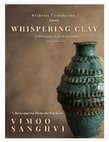
Catalogue of Retrospective under Prakriti Foundation, 2025
Curatorial Note by Kristine Michael
Vimoo Sanghvi- A Pioneer Studio Potter
Vimoo Sanghvi was amo... more Curatorial Note by Kristine Michael
Vimoo Sanghvi- A Pioneer Studio Potter
Vimoo Sanghvi was among a small group of ceramic artists in Mumbai who were the harbinger of a collective new thrust of a material-based art that transformed itself with a variety of influences beyond national boundaries, where the eects of industrialization and technology
impacted the nature of the processes. She threw o the image of the anthropological ‘oriental artisan’ and took the mantle of an urban contemporary artist bred in the art schools and galleries, inspired by modernism and using technology as an important tool towards extending
techniques and surface qualities. There was a sense of extraordinary energy, excitement and vitality of these trailblazers who made a lasting impact in their significant choice of becoming ceramic artists and their exploration of personal idioms as well as painstaking research and
development of new methods of using local raw materials.
This retrospective exhibition obliquely enters the development of the progressive, modernist post-independence, art movement of Mumbai by tapping into a dierent experience of womanhood and engaging with dierent personal histories of a woman who looked to ceramics
as a modern form of artistic expression. Vimoo Sanghvi blurred the perceived line between fine art and craft and pushed the technical boundaries of a traditional medium to create something
entirely new. Her works in ceramics and experiments with local materials shows great perseverance to overcome the narrow perceptions of ceramic art of the time. She has had a direct impact on the development of early studio pottery and ceramic art in Mumbai- be it with
her contemporaries like Aloo Siddva, Primula Pandit, Malti Dwivecha, Barbara Quittenbaum, Nirmala Patwardhan among others as well as artisans like B R Pandit and Ismael Kumbhar who
were sometimes her assistants.
Marg Magazine December- March, 2018
The essay discusses the early groups of 20th century studio potters in Bombay, Delhi, Calcutta an... more The essay discusses the early groups of 20th century studio potters in Bombay, Delhi, Calcutta and Banaras that were the harbinger of a collective new thrust of a material based art that had transformed itself with a variety of influences beyong national boundaries of aesthetics, technique, industrialisation and technology.
Marg Magazine December - March, 2018
The essay looks at three individuals- SK Mirmira, BR Pandit and Kripal Singh Shekhawat, who have ... more The essay looks at three individuals- SK Mirmira, BR Pandit and Kripal Singh Shekhawat, who have worked to bridge the gap between the vernacular and the contemporary, thus paving a new path for fresh social and aesthetic modes of life and work in modern India.
Marg Magazine December-March, 2018
Contemporary Indian ceramic art remains largely unexplored and marginalised in art history in Ind... more Contemporary Indian ceramic art remains largely unexplored and marginalised in art history in India. This essay is the editorial lead article for the Marg issue on Indian Ceramics- History and Practice and discusses the emergence of the modern craftsman/studio potter in India in changing social frameworks.
Art India Magazine Vol 3 Issue 3 July-Sept, 1998
Tracing the path of the studio pottery movement in India, this essay gives a brief glimpse of the... more Tracing the path of the studio pottery movement in India, this essay gives a brief glimpse of the history of this genre in India as a contemporary art movement.
The India Magazine- of her people and culture Vol 4 No 6 , 1984
The potter's role in the Indian community has always been a special one. It was his wares that ca... more The potter's role in the Indian community has always been a special one. It was his wares that catered to the utilitarian and ritual needs of the people. Using his creative skills, the simple medium of terracotta clay turned into an object of beauty. But the invasion of plastics is gradually displacing the potter and his craft. Does survival mean converting items of utility into quaint artifacts?
Projects/Processes: Essays on select curatorial projects from Serendipity Arts Festival 2019, 2022
Craft was the core of the ideal of swadeshi and both Tagore and Gandhi located craft practices in... more Craft was the core of the ideal of swadeshi and both Tagore and Gandhi located craft practices in their ideologies at Sewagram and Santiniketan. Crafts esstential link to the needs and creativity of the community as a living form changed with industrialisation and urbanisation. The development of artist designers working in craft interventions over a sustained period of time shows the harnessing of localised traditional knowledge and practice of pottery and glass. Thereby negotiating material, skills and design, community, livelihood and sustainability towards a new means of conceiving a future for ceramics and pottery communities.
Jaipur Blue Pottery: A Tribute, 2014
This essay seeks to locate the glazed blue ad blue and white ceramic traditions specifically thos... more This essay seeks to locate the glazed blue ad blue and white ceramic traditions specifically those of stonepaste and faiience of North West India in their wider historical context, tracing the linked social and cultural journeys of technology, architecture and domestic ware, and the modern development of the popular contemporary decorative ware known as Jaipur Blue Pottery.
Indian Crafts Interiors, 2023
This essay focuses on how terracotta and glazed ceramics which are traditional artisanal based cr... more This essay focuses on how terracotta and glazed ceramics which are traditional artisanal based craft as well as a contemporary art medium can be used in the interior design of urban and rural spaces as well as in exterior landscapes. Examples of some of these exciting innovative ideas and artists/designers are highlighted in the focus section.
Handloom and Handicrafts of Gujarat, 2012
Clay is the tap root of every civilisation in the world. Modern day Gujarat is geologically locat... more Clay is the tap root of every civilisation in the world. Modern day Gujarat is geologically located in the most ancient region of the sub continent- the Indus valley civilisation. This glorious lineage is visible even today in vessels, figurines and toys that are used in everyday life for agriculture, cooking, rituals and festivals. The clay objects of Gujarat demonstrate sophisticated forms, intricate pattern and ornament and ergonomic functionaity for daily use.
Kripal: The Art of Kripal Singh Shekhawat, 2018
Kripal Singh Shekhawat of Jaipur was both painter and potter and paved a new path for a pioneerin... more Kripal Singh Shekhawat of Jaipur was both painter and potter and paved a new path for a pioneering social and aesthetic mode of life and work in modern India. He effortlessly straddled the definitions of miniature painter, craftsman, artist, potter and artisan as he revived the art of Jaipur Blue pottery successfully combining the past with the present.
Mutable: Ceramic and Clay Art in India since 1947, 2020
This essay focuses on the transnational context of Japan and India involving the contributions of... more This essay focuses on the transnational context of Japan and India involving the contributions of Gurcharan Singh of Delhi Blue Pottery, Kripal Singh Shekhawat of Jaipur and Deborah Smith and Ray Meeker of Golden Bridge Pottery in Pondicherry. The ties that link these pioner studio potters deals with the long shadow cast by the combined influence of Japanese Mingei craft theory and Western arts and Craft writings onto the fromation of the Modern studio pottery movement in India.
The Making of a Modern Indian Artist Craftsman: Devi Prasad, 2012
Devi Prasad's quiet contribution to the nascent Moernist discorse of ceramics in the craft moveme... more Devi Prasad's quiet contribution to the nascent Moernist discorse of ceramics in the craft movement in India links to the National Movement, changing traditional and social craft practices under colonial rule and after Independance and globalisation.
A Mediated Magic: The Indian Presence in Modernism 1880-1930, 2019
Utopian collaborative and collective art practices from the later part of the 19th century in Ind... more Utopian collaborative and collective art practices from the later part of the 19th century in India were linked to nationalism as political aesthetic projects. This essay looks at some key figures of the arts and crafts interaction between England and India in order to draw focus on the themes that underpin Modernism in craft. Rabindranath Tagore, William Morris, Ananda Coomaraswamy are discussed in the essay.
Papers by Kristine C Michael
A Universal Spirit
The Making of a Modern Indian Artist-Craftsman Devi Prasad, 2022
Iconic reverberations: The architectonic ceramics of Vineet Kacker
Ceramics-art and Perception, 2012
Making of a Modern Indian Artist-Craftsman: Devi Prasad. By Naman P. AhuJa, with contributions by Krishna Kumar, Kristine Michael, Bob Overy, and Sunand Prasad
Journal of the American Oriental Society, 2014
The Making of a Modern Indian Artist-Craftsman: Devi Prasad. By Naman P. AhuJa, with contribution... more The Making of a Modern Indian Artist-Craftsman: Devi Prasad. By Naman P. AhuJa, with contributions by Krishna Kumar, Kristine Michael, Bob Overy, and Sunand Prasad. New Delhi: Routledge, 2012. Pp. 320, 392 illustrations. Rs. 2495.



Uploads
Books by Kristine C Michael
Vimoo Sanghvi- A Pioneer Studio Potter
Vimoo Sanghvi was among a small group of ceramic artists in Mumbai who were the harbinger of a collective new thrust of a material-based art that transformed itself with a variety of influences beyond national boundaries, where the eects of industrialization and technology
impacted the nature of the processes. She threw o the image of the anthropological ‘oriental artisan’ and took the mantle of an urban contemporary artist bred in the art schools and galleries, inspired by modernism and using technology as an important tool towards extending
techniques and surface qualities. There was a sense of extraordinary energy, excitement and vitality of these trailblazers who made a lasting impact in their significant choice of becoming ceramic artists and their exploration of personal idioms as well as painstaking research and
development of new methods of using local raw materials.
This retrospective exhibition obliquely enters the development of the progressive, modernist post-independence, art movement of Mumbai by tapping into a dierent experience of womanhood and engaging with dierent personal histories of a woman who looked to ceramics
as a modern form of artistic expression. Vimoo Sanghvi blurred the perceived line between fine art and craft and pushed the technical boundaries of a traditional medium to create something
entirely new. Her works in ceramics and experiments with local materials shows great perseverance to overcome the narrow perceptions of ceramic art of the time. She has had a direct impact on the development of early studio pottery and ceramic art in Mumbai- be it with
her contemporaries like Aloo Siddva, Primula Pandit, Malti Dwivecha, Barbara Quittenbaum, Nirmala Patwardhan among others as well as artisans like B R Pandit and Ismael Kumbhar who
were sometimes her assistants.
Papers by Kristine C Michael