Papers by Zahid Usman
High Asia Herald, 2026
Avestan alongside Old Persian, is one of the oldest attested and transmitted Iranian languages. P... more Avestan alongside Old Persian, is one of the oldest attested and transmitted Iranian languages. Preserved in the sacred text of the Parsis, collectively known as the 'Avesta', it belongs to the Indo-Iranian branch of the Indo-European language family, distinguished from other branches by both geographic and chronological factors. The term "Iranian" in this context does not refer to a strictly geographic designation but rather to a linguistic grouping. Iranian languages are spoken across the West Asia (Middle East) and Central Asia and include Persian, Dari, Kurdish, Balochi, Pashto, Ossetic, Tati, and Wakhi. Ancient Iranian languages such as Scythian and Median are known only through indirect or fragmentary evidence.

The strategic importance of the Pamirs has always drawn the attention of the imperial powers. At ... more The strategic importance of the Pamirs has always drawn the attention of the imperial powers. At the heart of this contest was the rivalry between the British and the Tsarist empires for control of trade routes, resources and balance of power in the region. Their conflict, known as the "Great Game", reached its climax in the late 19th century. While earlier conquests in Central Asia took place under Russian emperor Alexander II, the incorporation of the Pamirs into Russia occurred later during the reigns of Alexander III and Nicholas II. Afghanistan was within the British sphere of influence. While the western Pamirs, including Darvaz, Rushan and Shughnan, were annexed to the Bukhara Emirate, the Eastern Pamirs (Wakhan and Badakhshan) were drawn into the territories of Afghanistan and China. Following the "Great Game" rivalry, the 1873 Anglo-Russian agreement had left the boundary east of Lake Zarkul (Victoria Lake) vague. Russian advances into the Pamirs in the 1890s created a crisis. Russia refused to acknowledge Afghan sovereignty over the eastern Pamir, arguing that the region originally belonged to the Bukhara Emirate and therefore passed to Russia when Bukhara became under subjugation. Similar claims had been used to justify Russia's position in Kulja in Turkmenia. In
The High Asia Herald, 2025
The High Asia Herald, 2025
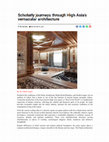
Nestled at the confluence of the Pamir, Karakoram, Hindu Kush-Himalaya, and Sarikol ranges, lies ... more Nestled at the confluence of the Pamir, Karakoram, Hindu Kush-Himalaya, and Sarikol ranges, lies an emblem of valleys that is home to one of the last bastions of ancient Iranian mountain culture. Vernacular architecture of the lesser-known High Asia region, or "Roof of the World" is a fundamental expression of human creativity, reflecting the cultural and historical spirit of its people. Its study provides invaluable insight into the ethnic identity, spiritual life and economic conditions of the communities living in the region. From the caisson ceiling often in a layered, square-on-square pattern with five-column house and the stone fortresses to the carved wooden mansions and the tower-palaces, this culturally cohesive region developed a vernacular architecture that represents a remarkable adaptation to isolation, scarcity of resources, altitude, and spiritual symbolism. These were multifunctional structures serving simultaneously as places of worship, cosmological diagram, family residences and defensive strongholds. Despite differences in belief systems and modern political boundaries, the entire region shares a common architectural lineage, a legacy traceable to the Bronze and Iron Ages. The Pamiri architecture
Al-Kashaf, 2024
Designers contribute to assisting the community towards a sustained Islamic lifestyle, their prim... more Designers contribute to assisting the community towards a sustained Islamic lifestyle, their prime responsibility enfolds service for the wellbeing through the concept of an Islamist society. Public parks offer the enjoyment of cultural and social activities. In densely populated areas of Pakistan, people depend on parks for physical and social recreation. There is high visitation during moderate and cold weather with a greater number of females and children. Though it is a space where visitors should feel secure and relaxed, most of the parks do not offer convivial conditions for female visitors because of inefficient privacy, accessibility, and hygiene. This paper has assessed the quality of public parks of Peshawar city, by empirically evaluating their meaningfulness, safety, comfort, and pleasurability through a cultural and religious perspective. The visitation data of two frequently visited public parks of Peshawar are examined for this study. Islamic values such as modesty, cooperation, and justice have been discussed to assess the quality of space. The result of the study can contribute to framing an appropriate planning guideline for open space distress in a Muslim society. The improvement of public parks requires contemplation of privacy, accessibility, and hygiene according to the Islamic teachings for various visitor types.
Journal of Design, Management and Sciences (JODMAS), 2022
Conventionally the role of a designer is someone who generates ideas for aesthetically pleasing p... more Conventionally the role of a designer is someone who generates ideas for aesthetically pleasing products. Therefore each designer intends to process fundamentals of design in personalized way. The phenomenon of personalized design is generated through the designer's insight of world, their relationship to creative thinking and capability of transforming their ideas into any

Planning Malaysia, 2022
Building codes are an established strategy for ensuring safe and hygienic
construction. These cod... more Building codes are an established strategy for ensuring safe and hygienic
construction. These codes' development, adoption by the local councils,
enforcement, and cyclic improvement are all substantial in a resilient built
environment. Illustriously, the literature review indicates lacunas in building codes in Pakistan, especially in rural areas. The natural disasters and evident climate change in Pakistan are significant threats to Pakistan's built environment.
The primary aim of this study is to investigate the effectiveness of building codes,
the challenges faced by building codes, and the venues for improvement for code
compliance in rural areas of Pakistan. A qualitative approach was adopted by
developing a survey instrument targeting the randomly selected built
environment professionals. The responses were analyzed using SPSS V24 for
reliability and triangulation of the observed variables and leading constructs. The
study's findings demonstrate that the development of building codes, their
adoption and enforcement by the local councils, and monitoring need
improvement. Furthermore, the study findings suggest that the inclusivity of architects, planners, and code officials in the development of building codes has the ability to bring resilience to the built environment in rural areas of Pakistan.
Journal of Art, Architecture and Built Environment, 2018
The current energy scenario of Pakistan requires the adoption of a proper energy consumption fram... more The current energy scenario of Pakistan requires the adoption of a proper energy consumption framework to meet the demands of the Pakistani society. This paper compares the energy codes developed by ASHRAE (United States) and Bureau of Energy Efficiency (India) to suggest improvements in development of the energy conservation building codes for Pakistan. It has been realized that taking all relevant stakeholders on board is vital for the development, adoption and compliance of energy conservation building codes at provincial level. It is also evident that energy conservation culture has to be developed in all segments of the society to lessen energy consumption, reduce carbon emissions and create a sustainable future. The energy codes of Pakistan lack adoption mechanism and climatic zoning needed for building thermal performance. The comparative analysis shows that the thermal building code of Pakistan is the key instrument to reduce energy pressure while providing occupants comfortable living space. It has been concluded that the government should develop code adoption and compliance system for the reduction of energy demand in buildings.
Numerous readings suggest the gender-based perception of specialties in the related fields of tex... more Numerous readings suggest the gender-based perception of specialties in the related fields of textile design. This study aims to reveal the significant participation of women that contribute to shaping textile design practices within the Pakistani textile industry. The objective of this study is to determine if there is a role of women in the development of textile design in the industry. The researchers plotted the gender segregation of employees of numerous textile industries and design schools across Pakistan. Additionally, the value of gender-specific commodities produced by these industries were also analyzed, then used statistical tests to determine if there was a correlation. The results show that women play important role in the development of textile design in the fields of academics, professional practice and commodity range. For example, 72% of the textile design teachers, 75.5% of the textile design practitioners, and 88 % of the textile design students are women. These results impart endorsement to the notion that the women enjoy an eminent concern in the textile design profession, which is caused by the historic presence of women in the making of textiles. It is also evident from the history that most of the traditional textile crafts and practices are conceived, produced and used by women particularly the commodities related to the dowry practice in the Indian sub-continent. Understanding the factors influencing the role of women in making strategies for training, infrastructure improvement and enhanced consumer satisfaction will allow their involvement in decision making. This will help the Pakistani government to develop policies for workplace safety, social safety, entrepreneurship support, improved service structure, and enhanced incentives
Journal of Art, Architecture and Built Environment (JAABE) , 2018
The current energy scenario of Pakistan requires the adoption of a proper energy consumption fram... more The current energy scenario of Pakistan requires the adoption of a proper energy consumption framework to meet the demands of the Pakistani society. This paper compares the energy codes developed by ASHRAE (United States) and Bureau of Energy Efficiency (India) to suggest improvements in development of the energy conservation building codes for Pakistan. It has been realized that taking all relevant stakeholders on board is vital for the development, adoption and compliance of energy conservation building codes at provincial level. It is also evident that energy conservation culture has to be developed in all segments of the society to lessen energy consumption, reduce carbon emissions and create a sustainable future. The energy codes of Pakistan lack adoption mechanism and climatic zoning needed for building thermal performance. The comparative analysis shows that the thermal building code of Pakistan is the key instrument to reduce energy pressure while providing occupants comfortable living space. It has been concluded that the government should develop Code Adoption and Compliance system for the reduction of energy demand in buildings.
Books by Zahid Usman
Old Materials New Climate, 2024
This chapter examines Lahore Fort as a case study to understand the implications of evolving clim... more This chapter examines Lahore Fort as a case study to understand the implications of evolving climatic patterns on historic architecture. The discussion opens with the fort’s historical and environmental context, emphasizing its strategic location and the region’s climatic characteristics. The analysis explores traditional construction techniques, such as the use of burnt brickwork and lime coatings on interior and exterior surfaces, and the architectural attributes that contributed to the fort's durability. The narrative traces the fort’s history of physical deterioration, attributing these changes to a combination of natural aging and adverse climate effects. It then addresses the projected impacts of climate change, including temperature fluctuations and increased humidity, which threaten the structural integrity of heritage materials. The chapter concludes with recommendations for future maintenance and preservation strategies aimed at mitigating these climate-related risks and sustaining the fort’s architectural legacy.
Teaching Documents by Zahid Usman
National College of Arts, Lahore, 2025
Built Environment Research Methods lecture
National College of Arts, 2025
The intentional process of creating solutions that combine functionality,
aesthetics, and user ne... more The intentional process of creating solutions that combine functionality,
aesthetics, and user needs. The study and practice focused on the interaction between a person; a ‘user’; and the man-made environment, taking into account aesthetic, functional, contextual, cultural and societal considerations. Main goal of design as a discipline is to promote well-being in people’s lives.

Lecture, 2026
This lecture provides a comprehensive architectural and historical survey of the Gandhara Civiliz... more This lecture provides a comprehensive architectural and historical survey of the Gandhara Civilization, a region defined by its unique status as a "liminal space" where Greco-Roman, Persian, and Indic traditions converged. By synthesizing classical archaeological foundations with modern reassessments—specifically contrasting the seminal work of Dani (1967) with contemporary radiocarbon-based revisions by Zahir (2019)—this session traces the trajectory of the region from its protohistoric origins to its peak as a global hub of the Silk Road.
The discussion begins by redefining the toponym "Gandhara" through its four distinct subregions: the core riverine plains, the strategic gateway of Taxila, the protected monastic highlands of the northern valleys, and the western frontier in eastern Afghanistan. We examine the "Gandhara Grave Culture" (c. 3200 BCE – 1000 CE), challenging the traditional "invasion" models in favor of a narrative of biological and cultural continuity, while highlighting the early development of stone masonry and transhumant settlement patterns.
The architectural focus shifts to the urban logic of Sirkap, exploring the adoption of the Hippodamian grid and its adaptation to local socio-economic needs. Furthermore, we analyze the structural evolution of the Stupa—from a simple hemispherical mound to a complex, vertically oriented monument articulated with Corinthian pilasters and Hellenistic friezes.
Finally, the lecture explores the Greco-Buddhist artistic nexus, investigating the role of Hellenistic royal portraiture (Demetrius I) in the formulation of the Buddha image and the iconographic assimilation of the Greek pantheon—transforming Herakles into Vajrapani and Atlas into a structural metaphor for Buddhist cosmology. Through this multi-disciplinary lens, the lecture underscores Gandhara’s legacy as the progenitor of an "International Style" that redefined the built environment of South and East Asia.
Keywords: Gandhara, Architectural Syncretism, Urban Planning, Stupa Evolution, Greco-Buddhist Art, Taxila, Protohistory, Silk Road.
Walled City of Peshawar, 2003
The report was compiled as a part of the National Register of Historic Places of Pakistan. The fo... more The report was compiled as a part of the National Register of Historic Places of Pakistan. The focus was on the Walled City of Peshawar.




Uploads
Papers by Zahid Usman
construction. These codes' development, adoption by the local councils,
enforcement, and cyclic improvement are all substantial in a resilient built
environment. Illustriously, the literature review indicates lacunas in building codes in Pakistan, especially in rural areas. The natural disasters and evident climate change in Pakistan are significant threats to Pakistan's built environment.
The primary aim of this study is to investigate the effectiveness of building codes,
the challenges faced by building codes, and the venues for improvement for code
compliance in rural areas of Pakistan. A qualitative approach was adopted by
developing a survey instrument targeting the randomly selected built
environment professionals. The responses were analyzed using SPSS V24 for
reliability and triangulation of the observed variables and leading constructs. The
study's findings demonstrate that the development of building codes, their
adoption and enforcement by the local councils, and monitoring need
improvement. Furthermore, the study findings suggest that the inclusivity of architects, planners, and code officials in the development of building codes has the ability to bring resilience to the built environment in rural areas of Pakistan.
Books by Zahid Usman
Teaching Documents by Zahid Usman
aesthetics, and user needs. The study and practice focused on the interaction between a person; a ‘user’; and the man-made environment, taking into account aesthetic, functional, contextual, cultural and societal considerations. Main goal of design as a discipline is to promote well-being in people’s lives.
The discussion begins by redefining the toponym "Gandhara" through its four distinct subregions: the core riverine plains, the strategic gateway of Taxila, the protected monastic highlands of the northern valleys, and the western frontier in eastern Afghanistan. We examine the "Gandhara Grave Culture" (c. 3200 BCE – 1000 CE), challenging the traditional "invasion" models in favor of a narrative of biological and cultural continuity, while highlighting the early development of stone masonry and transhumant settlement patterns.
The architectural focus shifts to the urban logic of Sirkap, exploring the adoption of the Hippodamian grid and its adaptation to local socio-economic needs. Furthermore, we analyze the structural evolution of the Stupa—from a simple hemispherical mound to a complex, vertically oriented monument articulated with Corinthian pilasters and Hellenistic friezes.
Finally, the lecture explores the Greco-Buddhist artistic nexus, investigating the role of Hellenistic royal portraiture (Demetrius I) in the formulation of the Buddha image and the iconographic assimilation of the Greek pantheon—transforming Herakles into Vajrapani and Atlas into a structural metaphor for Buddhist cosmology. Through this multi-disciplinary lens, the lecture underscores Gandhara’s legacy as the progenitor of an "International Style" that redefined the built environment of South and East Asia.
Keywords: Gandhara, Architectural Syncretism, Urban Planning, Stupa Evolution, Greco-Buddhist Art, Taxila, Protohistory, Silk Road.