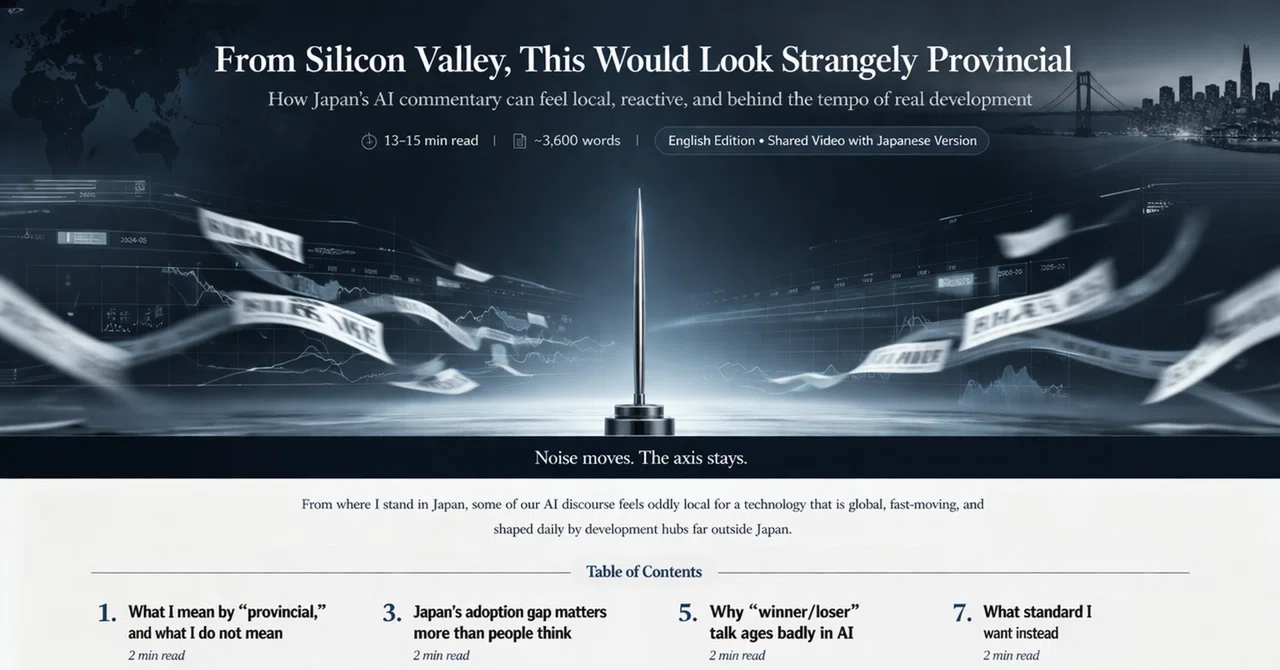
From Silicon Valley, This Would Look Strangely Provincial

How Japan’s AI commentary can feel local, reactive, and behind the tempo of real development
This is not an argument that Japan has nothing to offer AI.
It is a narrower point than that.
From where I stand in Japan, some of our AI discourse can feel oddly local for a technology that is global, fast-moving, and deeply shaped by development hubs far outside Japan. That impression is not just emotional. There is real context behind it: AI adoption in Japan has lagged parts of the global market, while the broader AI economy has been scaling at extraordinary speed. Reuters reported in 2024 that only about 24% of Japanese companies had adopted AI and more than 40% had no plans to do so, while Stanford’s 2025 AI Index reported that 78% of organizations globally said they used AI in 2024.
What follows is not a national self-hatred piece, and not a claim that Japanese researchers are unserious.
It is a closer look at tone.
More specifically, it is about how a domestic discourse can start to look too eager to declare winners and losers, too quick to reverse direction, and too weak at explaining revisions—especially when compared with the everyday tempo of places where AI is actually being built and shipped at scale. Stanford’s 2025 AI Index also found that U.S. private AI investment reached $109.1 billion in 2024, vastly outpacing other countries, which helps explain why the “ordinary” rhythm of AI discussion in a place like Silicon Valley is likely to be more iterative and less theatrical.
1. What I mean by “provincial,” and what I do not mean (about 430 words / 2 min read)
When I say some Japanese AI commentary feels “provincial,” I do not mean Japan is incapable of serious technical work.
I do not mean Japanese engineers, researchers, or founders lack intelligence.
And I do not mean everything coming out of Japan is second-rate.
I mean something narrower, but still important.
I mean that public discussion can start to feel too inward-looking, too prestige-sensitive, and too dependent on dramatic framing, even when the technology itself is moving through a much larger global system.
That happens when commentary becomes less about patiently tracking shifting assumptions, and more about producing a clean narrative for a domestic audience:
who is winning, who is losing, who is finished, who has overtaken whom.
That style may work as media performance.
But it often fails as analysis.
And in AI, that failure matters because the ground moves fast.
A tool that looks dominant today may look ordinary three months later.
A model that seems behind can recover through product integration, distribution, pricing, or enterprise adoption.
A benchmark lead is not the same thing as everyday usefulness.
A media headline is not the same thing as strategic durability.
In other words, this is not a field that rewards premature finality.
That is why I am interested not in whether a commentator was “wrong” once.
Everyone will be wrong in a field this volatile.
What matters more is whether they show their work when they revise their position.
If they do, that is healthy.
If they do not, the commentary starts to feel smaller than the subject it is trying to describe.
And that, to me, is where the provincial quality appears.
2. Why this looks different from inside a real development hub (about 520 words / 2 min read)
Imagine an ordinary informed resident of Silicon Valley.
Not a famous founder.
Not a venture capitalist.
Not a headline personality.
Just someone living near a place where AI tools are built, deployed, tested, monetized, criticized, iterated, and replaced in rapid cycles.
That person would probably not talk about AI as if the race were settled every quarter.
They would assume the following as normal:
models will improve,
interfaces will change,
deployment strategies will shift,
pricing will move,
distribution will matter,
consumer habits will drift,
enterprise buyers will respond differently from hobbyists,
and the most important product advantage may not be the one that makes the loudest headline.
That is what life near a real development frontier tends to teach people:
AI is not a single contest with a single scoreboard.
It is an unstable stack of research, infrastructure, distribution, product design, capital, and user behavior.
And the capital side is not small. Stanford’s 2025 AI Index found that U.S. private AI investment reached $109.1 billion in 2024, compared with much smaller totals in other major markets. That does not automatically make American commentary wiser, but it does mean that the center of gravity of AI development is materially concentrated, and that shapes how ordinary people near that ecosystem learn to talk about the field.
From that angle, what often stands out in Japanese discourse is not simple ignorance.
It is tempo.
The tempo can feel too slow in understanding structural change, but too fast in issuing verdicts.
Too cautious in adoption, but too dramatic in commentary.
Too impressed by prestige, and not impressed enough by iteration.
That mismatch is exactly what makes some of the commentary feel local.
Because from outside, especially from a development hub, the whole “this company has now definitively won” style can look strangely premature.
Not because competition is unreal.
Competition is very real.
But because anyone close to the machinery of AI development knows that the next model, next interface, next platform deal, next enterprise workflow, or next cost shift can change the meaning of the last three months overnight.
3. Japan’s adoption gap matters more than people think (about 420 words / 2 min read)
This difference in tone is not floating in the air.
It is connected to how unevenly AI is actually being used.
Reuters reported in July 2024 that only about 24% of Japanese companies had adopted AI, and that more than 40% had no plans to adopt it. That is not a trivial detail. It suggests that a significant portion of the business environment is still observing AI from a distance rather than operating inside it day to day.
PwC Japan’s 2025 cross-country generative AI survey also described structural challenges in Japan’s adoption and value realization, even while interest and use cases have expanded. In other words, Japan is participating in the AI era, but not always at the same depth, speed, or organizational confidence as the most aggressive markets.
That matters because discourse tends to reflect distance.
When people are not deeply embedded in deployment, they often rely more on symbolic interpretation:
prestige, headlines, rankings, reputations, dramatic product launches, and simplified narratives.
That does not mean the commentary is useless.
It means it is vulnerable to distortion.
The less a market lives inside the messy daily reality of AI deployment, the easier it becomes to overreact to model launches, oversimplify competitive dynamics, and confuse temporary momentum with lasting advantage.
That is one reason a lot of Japanese AI talk can feel strangely overcommitted to verdicts.
And once that style becomes normalized, revisions also become awkward.
Because the stronger the original claim, the more visible the reversal.
So instead of carefully documenting what changed, people often glide toward a new conclusion as if the transition required no explanation.
That may be understandable as media behavior.
But it is weak as intellectual method.
4. The problem is not revision. The problem is unexplained revision (about 500 words / 2 min read)
I want to be very clear here.
Revision is not a flaw.
In AI, revision is necessary.
Any serious person should be willing to change their view when the evidence changes.
The world would be worse if they did not.
So my criticism is not:
“You changed your mind.”
My criticism is:
“You changed your mind without making the transition legible.”
Those are very different complaints.
A strong commentator in a fast-moving field should be able to say:
Here is what I believed before.
Here is the assumption behind that belief.
Here is what changed.
Here is why my old model no longer fits reality.
Here is what I think now.
That is a revision with discipline.
What often bothers me in Japan is something thinner than that.
A bold claim appears.
Then reality shifts.
Then a new bold claim appears.
But the bridge between the two is weak, vague, or invisible.
When that keeps happening, readers naturally begin to wonder whether the speaker is tracking evidence or tracking atmosphere.
I am not saying that question always has an ugly answer.
I am saying the question becomes unavoidable.
And once it becomes unavoidable, trust starts to erode.
Because people can forgive error.
They have a harder time forgiving the sense that a reversal is being smoothed over instead of explained.
That is why I care so much about revision style.
In a field like AI, being occasionally wrong is ordinary.
Pretending your shift needs no accounting is not.
This is also why I think too much commentary gets framed as personality conflict when it should be framed as methodological weakness.
The issue is not inner motive.
The issue is visible explanatory behavior.
That is a healthier standard, and frankly, a more useful one.
5. Why “winner/loser” talk ages badly in AI (about 470 words / 2 min read)
AI commentary ages badly when it is built around final-sounding language.
Company X has won.
Company Y is finished.
This model changed everything.
That competitor has no chance.
Sentences like these may sound decisive, but they are often analytically fragile.
Why?
Because “winning” in AI is not one thing.
It can mean model capability.
Or product usability.
Or enterprise trust.
Or distribution.
Or cloud leverage.
Or developer ecosystem.
Or speed of iteration.
Or integration into daily workflows.
Or consumer mindshare.
Or margins.
A company can lead on one axis and trail on three others.
A tool can be technically impressive and commercially awkward.
A model can dominate headlines and still lose practical relevance in real workflows.
Another can look less glamorous and become indispensable.
That is why hard winner/loser language often expires so quickly.
Stanford’s AI Index makes this broader point indirectly: the AI market is scaling across organizations, investment, and use cases, which means no single release or headline captures the whole structure for long. Reuters’ reporting on Japan’s low AI adoption also reinforces this: public narratives may move faster than actual business transformation.
So whenever I hear a commentator speaking with extreme certainty, I now ask a simpler question:
What definition of winning are they using?
If that definition is unclear, then the certainty is often fake precision.
And fake precision is one of the most common weaknesses in public AI discourse.
From a place like Silicon Valley, where people live inside ongoing iteration, this kind of talk would likely sound less like rigorous analysis and more like overconfident media packaging.
6. From Silicon Valley, this would not look like deep analysis (about 520 words / 2 min read)
This is the heart of what I want to say.
If an ordinary person in Silicon Valley looked at some of the Japanese AI discourse I see, I do not think they would be shocked by our technical ability.
I think they would be surprised by the style.
They would probably notice how often commentary seems organized around prestige, headlines, and symbolic shifts in momentum.
They would notice how quickly people jump from one broad conclusion to another.
And they would likely notice how rarely those transitions are fully documented.
From that angle, the discourse would not necessarily look malicious.
It would look provincial.
Provincial not because it is Japanese.
Provincial because it sometimes feels like a local conversation trying to narrate a global system using a frame that is too narrow, too reactive, and too impressed by temporary movement.
That is not an ethnic criticism.
It is an ecosystem criticism.
And the ecosystem context matters.
If the center of AI capital, deployment pressure, and product iteration is elsewhere, then a media ecosystem further away from that center is more likely to turn competition into theater.
That is exactly why I keep coming back to explanation.
Without explanation, a reversal looks less like learning and more like drift.
Without explanation, a verdict looks less like analysis and more like positioning.
Without explanation, expertise starts to look performative.
And once expertise looks performative, even accurate observations lose some of their force.
This is why I do not think the problem is “Japanese people are behind.”
The problem is that parts of the discourse are still talking about AI in a way that feels too small for what AI has become.
That is what I mean when I say that from Silicon Valley, this would probably look strangely provincial.
7. What standard I want instead (about 420 words / 2 min read)
I do not want less disagreement.
I do not want less critique.
And I do not want cautious, bloodless commentary that says nothing.
I want a higher standard.
A commentator should be able to make strong claims.
But if they do, they should also be able to revisit those claims clearly when reality changes.
To me, that means at least three things:
First, define the axis clearly.
If you say one company is ahead, say ahead in what.
Second, separate temporary momentum from durable structure.
A product launch is not the whole market.
Third, make revisions legible.
If your view changes, explain what moved you.
That last part matters most.
Because in a fast-moving field, readers do not need prophets.
They need interpreters with memory.
People who remember what they said before.
People who acknowledge when the world moved.
People who can explain the difference between a correction and a mood swing.
That is the standard I want from AI commentary in Japan.
And honestly, it is the standard I would expect from anyone speaking seriously in public, anywhere.
8. Conclusion: less victory theater, more revision discipline (about 320 words / 1 min read)
From Japan, some of our AI discourse can look surprisingly local.
Not because Japan lacks talent.
Not because Japan has nothing to say.
But because parts of the conversation still seem too attached to prestige, too quick to declare outcomes, and too reluctant to show the full logic of revision.
Meanwhile, the global AI system keeps moving.
Usage expands.
Investment scales.
Products shift.
Assumptions expire.
And the people closest to the frontier usually learn the same lesson over and over:
nothing stays settled for long.
That is why I no longer judge AI commentators mainly by whether they were “right” on a given date.
I care more about something harder and more revealing:
How clearly do they explain change?
That, to me, is the real test.
So yes, from Silicon Valley, some Japanese AI commentary would probably look strangely provincial.
And that is exactly why I think we need less victory theater, and more revision discipline.
Less narrative heat, more factual tracking.
Less symbolic triumph, more explanatory honesty.
That is the standard I want to read.
And from where I stand, we are not there yet.
#AI #Japan #SiliconValley #MediaLiteracy #GenerativeAI
Thank you for reading.
Which matters more to you in AI commentary: being right once, or explaining change well?
The Japanese version is here
Japan talks about AI like the race ends every few months.
— AI×女装男子まさひろ (@obara_masahiro) March 25, 2026
I think that looks strangely provincial.
https://t.co/5MpQ7CyUWB#AI #MediaLiteracy #Japan
いいなと思ったら応援しよう!
 応援のチップを届けてくださり、本当にありがとうございます。いただいたお気持ちは、ただの金額ではなく、言葉を続けていく力として大切に受け取っています。このご縁への感謝を、これからの記事と言葉で少しずつお返ししていきます。