
Tarkov | Hideout Side Hustle #1: What TP Made Me Notice About the Nutrition Unit

I mainly play in PvE and consider myself more of a casual enjoyer than a hardcore player, so I would be happy if you kept that in mind while reading.
For the first article in this series, click here: How the VPO-136 Changed the Way I See the Workbench
When I Looked at Leftover Materials, I Started Seeing Products I Could Sell
As I kept playing Tarkov, Stash Level 3 was finally starting to come into view.
And then, all of a sudden, I found myself needing money.
The problem was, I could not always set aside enough time to go on proper raids.
So while absentmindedly looking through the Hideout, I had a sudden thought:
Wait… couldn’t this be turned into a business?
When I actually tried it, my funds — which had been sitting at around 8 million roubles — reached 10 million in a single day without going on a single raid.
This series began with that simple realization.
Let me say this first:
this is not a “here’s the perfect money-making method” kind of article.
The more people learn about a method like this, the more downward pressure it will naturally put on prices.
So this is not meant to say, “Do this and you will definitely make money.”
What I want to say instead is that the way you look at the Hideout can completely change how you build up your funds.
Entry #2 in the Series: Nutrition Unit Sausage
For the second entry in this series, I want to talk about Sausage from the Nutrition Unit.
When I first looked at the Workbench, I eventually realized that even something like the VPO-136, which had once made me think,
“Does a gun like this even matter?”
had hidden value after all.
So what about the Nutrition Unit?
In a way, it turned out to be very similar.
Why Toilet Paper?
When people look at the Sausage craft in the Nutrition Unit, has nobody else thought this?
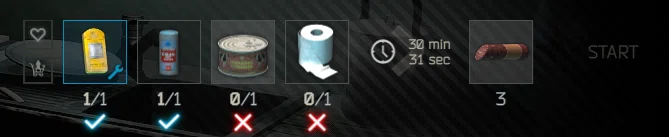
Why toilet paper?
And what exactly is the Geiger counter doing here?
There is something strangely dark about it — the kind of absurd darkness that reminds me of those old stories about fake food scandals in China.
I would like to believe I am not the only one who wants to ask:
Are we really sure this counts as food?
That little side note aside, at first glance Sausage looks like one of those food items that make you think,
“Oh, okay… so you can craft it. Fine.”
That was exactly how I felt at first.
But the more I stared at the Hideout, the more I realized there was something interesting hidden here too.
Looking at Leftovers, I Started Seeing Something I Could Sell
This started when I was looking at materials I already had sitting in my stash, including Beef Stew, and thought:
If I only buy the missing piece, couldn’t I turn this into Sausage?
As it turned out, the only thing I was missing was the Geiger-Muller counter.
So I bought just that one item and made three sausages.
What makes this kind of thing interesting is not forcing profit by buying every single ingredient off the Flea Market.
The real point is that it only starts to matter when you look at the stuff lying around in your stash and realize:
If I add just one more item, this becomes a finished product.
In other words, the Nutrition Unit started to look less like
“the place where you chase whatever item is currently hot”
and more like
“the place where half-finished leftovers in your stash can be turned into something properly sellable.”
When I Actually Sold Them, They Went Immediately
When I actually tried it, I listed the Sausages for 47,000 roubles each, and they sold out almost instantly.
In the end, selling all three brought in 141,000 roubles after fees.
Of course, I still had to subtract the cost of buying the Geiger counter.
So this is not a story about how everything automatically becomes profitable.
That said, the Geiger counter can be reused, which helps a lot.
Once you buy it once, it is done.
From that point on, all I really need are the ingredients — or whatever counts as ingredients in this case.
At least in my case, the important thing was this:
leftover materials had turned into a meaningful amount of money.
That felt significant.
After Repeating It a Few More Times
After that, I kept going a few more times, buying extra food ingredients here and there and continuing to process and sell them.
The transaction record looks like this:
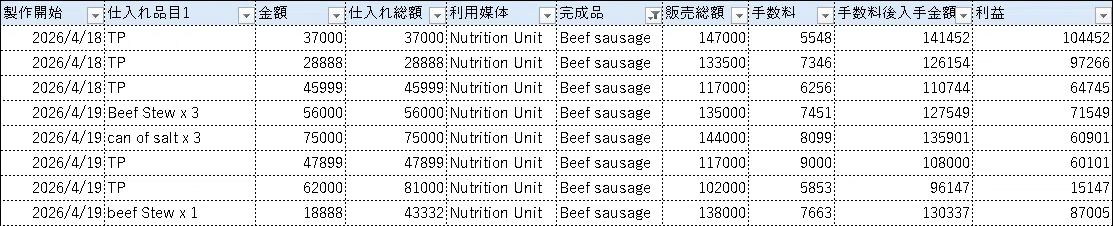
Even while buying things like Beef Stew and Salt, the total profit still reached over 450,000 roubles.
And that came from only a handful of transactions.
This is one of the things that makes looking at the Hideout more carefully so interesting.
When the Way You See Things Changes, Their Value Changes Too
Before this, these items had looked to me like little more than:
leftover food materials
random parts I did not really understand
things that were just taking up stash space
But once I spent a little more time looking at the Hideout, they started to look different.
They became things that:
are only one missing item away from becoming a finished product
can be sold once completed
or, if they do not sell well, might still be usable for myself
That change in perspective is the real point.
You could say that the Sausage example was just a lucky case where the market happened to be good at that moment.
And maybe that is true.
But for me, the more important realization was this:
even the Nutrition Unit has its own proper line for turning leftovers into value.
If I have similar materials sitting around in the future, I probably will not be able to just shrug and think,
“I don’t really know what this is for, so I’ll leave it there.”
Instead, I think I will start asking myself:
What do I need to add to turn this into something sellable?
There Is a Reason Toilet Paper Has a Price
One of the things I understood from all this is that there is, in fact, a real reason toilet paper can sell for high prices.
From now on, I will probably pay a lot more attention to things like toilet paper and printer paper than I used to.
And for the record, printer paper can be turned into 2 rolls of toilet paper in the Lavatory.
Even small details like that can completely change how the Hideout looks to you once you start understanding it.
The More I Look at the Hideout, the More I See Ahead
And if I am already running the Generator, it feels a little wasteful to stop at the Nutrition Unit alone.
In fact, the more I look at the Hideout, the more interesting things I also see in the Med Station.
Partly used medical items can be turned into higher-tier items, and cheap-looking materials can lead into expensive Injectors.
Just looking at those craft lines changes the whole landscape quite a bit.
I would like to save that part of the story for the next article and beyond.
The 2nd story in this series is available here: What a Used IFAK Taught Me About the Med Station
If this interests you, I would be very happy if you followed or turned on notifications.
And if you have your own way of turning certain materials into something sellable, I would love to hear about it.
Note: I also talk about the background behind this series, as well as what I am actually thinking during play, in the streams I do on Twitch almost every day.
Some things are harder to fully convey in writing alone, so watching the streams may help give a better feel for the atmosphere.
Past stream archives are also available on my YouTube channel, so if you are interested, please feel free to check those out as well.
▶ YouTube: B.K. Gaming
▶ Twitch: kaz_the_minotaur
いいなと思ったら応援しよう!
 読んでくださってありがとうございます。
サポートは、今後の制作を続けるための大きな力になります。
無理のない範囲で、応援していただけたら嬉しいです。
読んでくださってありがとうございます。
サポートは、今後の制作を続けるための大きな力になります。
無理のない範囲で、応援していただけたら嬉しいです。