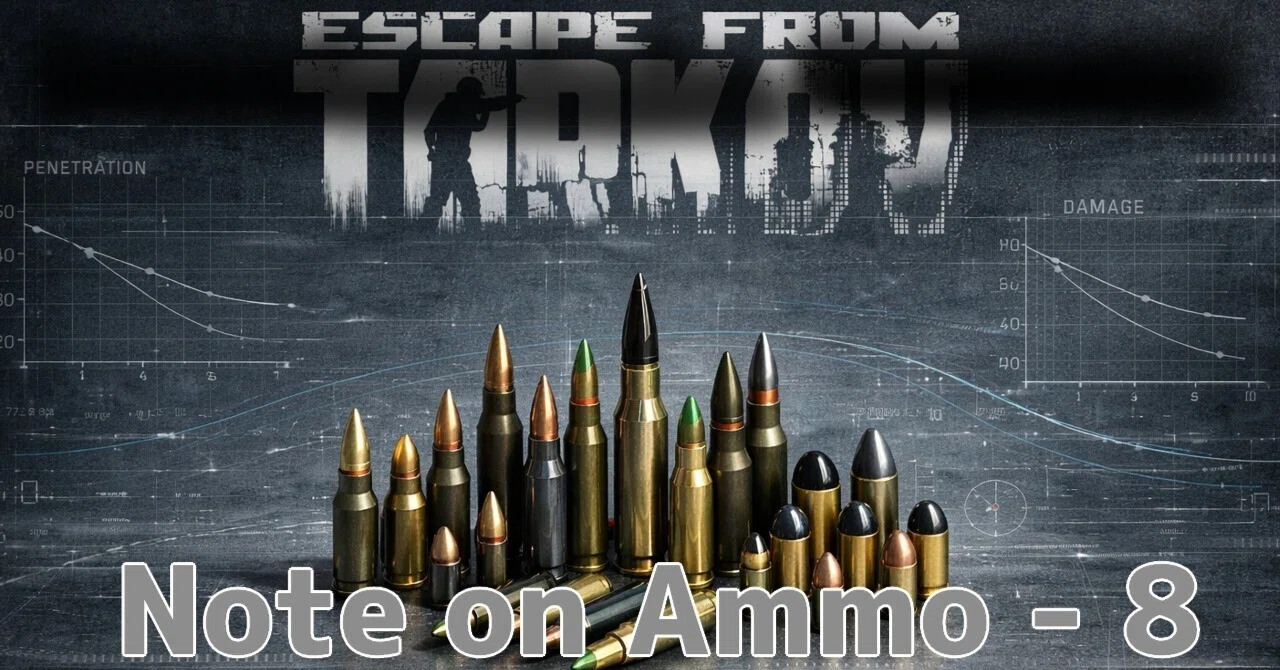
Escape from Tarkov — 5.45×39 rounds pt.1

The first article of this series is available here: Escape from Tarkov ― Ammo History
■ The Round Once Called a Poison Bullet
The 5.45×39 round was once surrounded by a strange rumor.
People claimed that Soviet ammunition contained poison.
Of course, there was no actual poison in the cartridge.
Still, the rumor was not born entirely out of nowhere.
That is because soldiers wounded by 5.45 rounds often appeared to be suffering in ways that looked different from previous bullet injuries.
The entry wound was small.
And yet, their condition worsened over time.
The visible wound and the internal damage did not seem to match.
That sense of unease was simply explained away with the word poison.
So what was really happening?
To understand that, we need to go back to the background that gave birth to this round.
■ Changes on the Battlefield and the Problem of Hitting the Target
Before World War II, infantry combat was generally assumed to take place at relatively long distances.
Because of that, ammunition was expected to retain its power even at range.
But the real battlefield turned out to be different.
Many engagements took place within 100 to 300 meters,
and in forests or urban environments, even shorter-range fighting became the norm.
What mattered most here was no longer raw power, but hit probability.
No matter how powerful a round may be, it means little if it does not hit the target.
And the stronger the recoil, the harder it becomes to keep landing consecutive shots.
The first major answer to this problem was the concept of the intermediate cartridge.
■ 7.62×39 as the First Answer
The Soviet 7.62×39 round was lighter and easier to handle than the full-power rifle cartridges that came before it.
In exchange for sacrificing some long-range performance,
it was designed to be optimized for close-range combat.
This was a clear attempt to adapt ammunition to the reality of the battlefield.
But even this round had its limits.
Recoil was still significant,
and controllability during full-auto fire remained difficult.
In other words,
it had adapted to close-range fighting, but the problem of consistently landing hits still remained.
■ The Idea of the Small-Caliber High-Velocity Round
In response to this problem, the United States approached the issue from a different direction.
Make the round lighter, increase muzzle velocity, and reduce recoil.
The result was the 5.56×45 cartridge.
This was not simply a matter of lightening the ammunition.
It represented a shift in thinking:
combat effectiveness could be increased by improving hit probability.
This was not a change the Soviet Union could afford to ignore.
■ 5.45×39 as a Redesign
The Soviet answer to this development was the 5.45×39 round.
This was not merely an extension of 7.62.
It was designed as the result of rethinking the very nature of combat.
By reducing weight, recoil was lowered,
and controllability during full-auto fire improved dramatically.
There was also another distinctive feature in its design.
A cavity in the nose of the bullet made it easier for the round to lose stability after impact.
What resulted from this is what we call yawing.
The bullet changes orientation inside the body,
causing internal damage to expand.
So even when the visible wound appears small,
the internal damage can be severe.
■ Not Poison, but Structure
Now we can return to the original question.
Why was this round called a poison bullet?
Simply because it could not be explained by the common understanding of the time.
A tiny entry wound could still lead to a serious injury.
The victim’s condition could worsen with time.
This was not a chemical effect.
It was the result of purely physical behavior.
But before people understood that,
they interpreted it as something abnormal.
■ What the Evolution of Ammunition Really Means
The 5.45×39 was not a round designed around maximizing raw power.
Nor was it merely a lightweight cartridge.
It was built on the idea of continuing to land hits,
while also incorporating design features that would ensure sufficient damage once those hits were made.
If 7.62 was a round that maximized the value of each hit,
then 5.45 was a round that maximized the probability of hitting in the first place.
■ In One Sentence
The 5.45×39 round was not a poison bullet.
It was a round born from adapting to the reality of the battlefield.
■ Next Preview
Next time, we will look at how the 5.45 round was further improved
and how it adapted to the growing challenge of armored protection.
The next article is available here: Escape from Tarkov — 5.45×39 rounds pt.2
Note:
The background ideas and actual gameplay experience discussed in this series are also touched on during my weekly streams every Friday.
The format is different from writing, but it may help deepen your understanding from another angle.
If you’re interested, feel free to stop by.
▶ YouTube : B.K. Gaming Channel
▶ Twitch : kaz_the_minotaur
いいなと思ったら応援しよう!
 読んでくださってありがとうございます。
サポートは、今後の制作を続けるための大きな力になります。
無理のない範囲で、応援していただけたら嬉しいです。
読んでくださってありがとうございます。
サポートは、今後の制作を続けるための大きな力になります。
無理のない範囲で、応援していただけたら嬉しいです。