
Omori Seaweed Legacy Part 1 #180

Origin and Evolution of
Nori Cultivation in Omori
During the Edo period (江戸時代),
fishermen lived by catching fish
for their own subsistence.
Osai‑hakkaura(御菜八ヶ浦)
Over time,
the region came to be known as Osai‑hakkaura,
and fishermen were required
to supply fresh fish
to the Shogun’s household.
These offerings were not always daily;
they were often made
according to need
or at specific times.
Development Born from Fishing Practices
To ensure they could always present
fresh fish safely,
the fishermen installed offshore
bamboo enclosures (viviers),
designed to keep
the captured fish
temporarily alive.
“Under the obligation to provide fish,
the fishermen sought
to protect their daily lives,
balancing the gifts of nature
with their own methods of preparation.”
These bamboo enclosures later became
the starting point
for the development
of nori cultivation.
An Accidental Discovery Opens the Way
One winter day,
as they worked as usual,
the fishermen noticed that “herbs” —
nori (海苔) —
had attached themselves
to the same bamboo barriers
used to keep fish alive.
This phenomenon,
entirely natural in origin,
sparked the idea
that a new use
could emerge
from this maritime environment.
Historical records recount
several valuable episodes from that time,
now regarded as the earliest signs
of nori cultivation
in the Omori (大森) region.
This discovery was truly
the first step
toward a new challenge.
Origins of Nori Culture in Omori
In 1682 (the 2nd year of Tenna 天和2年),
Rokurōzaemon Noguchi
(野口六郎左衛門) of Omori
submitted a formal petition to the Shogunate
and initiated the cultivation of nori —
an act now regarded
as the starting point
of Omori’s nori industry.
The Invention of "Sodahibi (ソダヒビ)"
In 1717 (Kyōhō 2),
a fisherman named Yahei (弥平)
from Asakusa successfully tested
the first nori cultivation tool,
the "Sodahibi"
(bundles of branches stripped of leaves),
in the waters off Shinagawa (品川).
This was a major leap,
transforming nori harvesting
from a chance occurrence
into intentional cultivation.
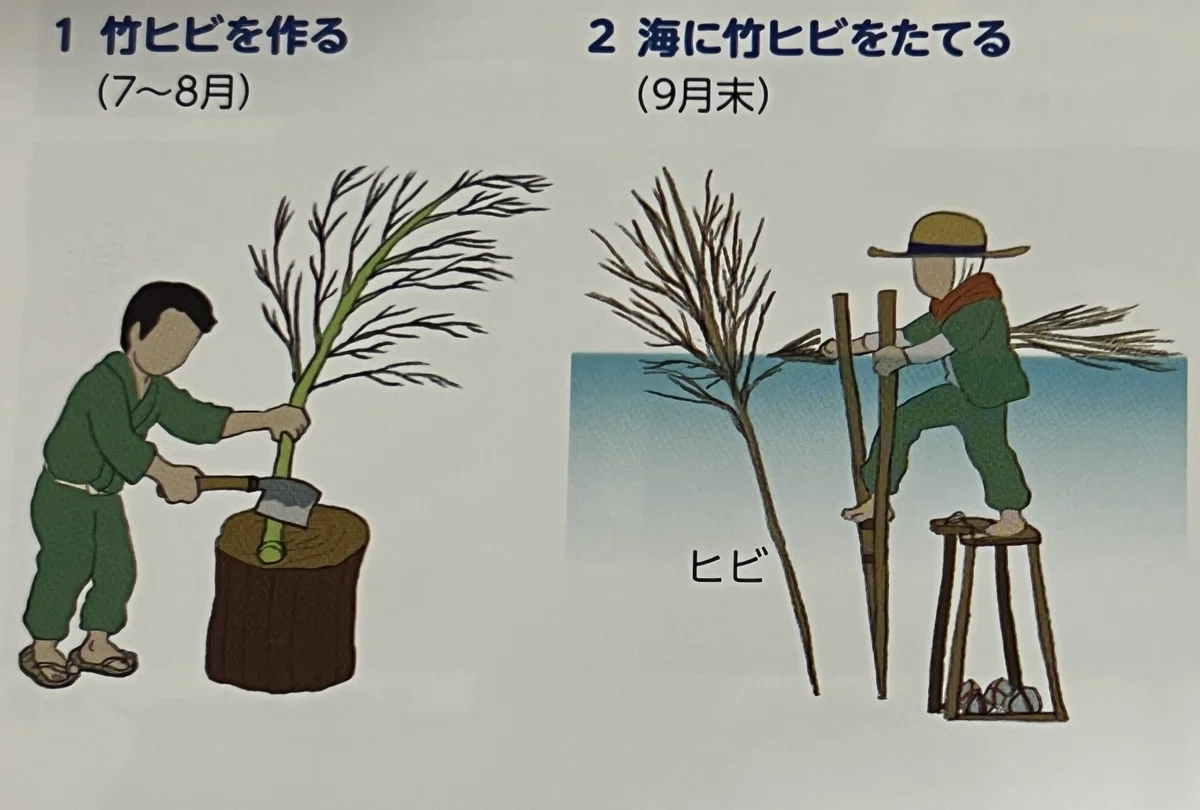
A person splits bamboo stalks using an axe on a tree stump,
preparing materials for hibi structures.
2. Setting Bamboo Hibi in the Sea (Late September)
Standing on a wooden platform in shallow coastal waters,
a person installs the bamboo hibi—
branch‐like structures used to attract marine life
or support aquaculture.
The Era of "Gambling Grass (博打草)"
However,
since the life cycle of nori
was not yet fully understood,
and the harvest was heavily
dependent on luck and weather,
the seaweed was affectionately
called 'Bakuchigusa'
(Gambling Grass) or
'Un‐gusa (運ぐさ)' (Luck‐Grass).
"The advancement of technology
opened up new possibilities
for stabilizing production
and expanding profitability."
The Shogunate and “Gozen Nori”
The Shogunate viewed nori
as a valuable financial resource
and actively promoted
its market distribution
throughout the market.
It is said that
Ieyasu Tokugawa (徳川家康) himself
was fond of nori —
a detail often cited
as one of the reasons
behind its growing significance.
The Introduction of Paper ‐
Making Techniques
Around 1772 (Anei era),
the technique of "paper making" (sukikata),
developed in Asakusa,
was applied to nori processing.
The Birth of the Square Nori Sheet
This led to the creation
of 'square nori sheet'
made on reed screens.
The Rise of Nori Rolls
and the Golden Age
As street sushi stalls began to flourish,
'Nori Rolls' (Temaki‐zushi 手巻き寿司)
became immensely popular
among the common people.
And nori cuisine entered
its golden age.
The Fame of “Asakusa Nori”
The nori harvested and processed
in Omori was established
as the Edo specialty
"Asakusa Nori (浅草海苔),"
spreading nationwide and solidifying
its position due to its excellent
taste and quality.
An Alternative Origin
of the Name “Asakusa Nori”
There’s a long-standing theory
about the name “Asakusa Nori.”
It’s said that the Asakusa area
was originally part of the sea,
but after several major earthquakes,
the land gradually rose
and became terrestrial.
When seaweed could no longer
be harvested in Asakusa,
some fishermen
relocated to the Omori region,
carrying on the techniques
of nori harvesting and processing.
Thus, the name “Asakusa Nori”
is also seen as a reflection
of that geological transformation.
Innovation and Industrial Growth
"The innovation in processing technology
and market strategy elevated
nori into a major industry."
Through the combination
of the fishermen's ingenuity,
accidental discovery,
and technological innovation,
the Omori nori cultivation tradition
was firmly established.
The next Part 2
Will trace the passionate story
of solidarity and commercial spirit
of the Suwa people who came to Omori
during the winter agricultural off‐season,
how they built the foundation for nori merchants,
and how they created the strong organization
known as the '(Oyubanakō 御湯花講)'.
Are there any products or services
in your local area
that made a great leap thanks
to an accidental discovery
or a technical crossover from a different industry?
Please let us know in the comments!

Photo
Postwar Nori Net Fishing Grounds in Omori
(Courtesy of the Omori Nori Museum)
戦後 海苔網の漁場 大森 海苔のふるさと館 提供
#かえる11号
#Otapedia
#デジタルアーカイブ
#SDGs11
#大田区
#江戸時代
#大森海苔
#大森
#御菜八ヶ浦
#野口六郎左衛門
#海苔養殖
#諏訪
#諏訪大社
#御湯花講
#天流水舎
#板海苔
#手巻き寿司
#山本海苔店
#味付け海苔
#酒悦
#海苔の佃煮
#蒲池騒動
#蒲池清実
#蒲池場
#漁業組合
#京浜運河計画
#浅野総一郎
#東京瓦斯電気工業
#重油流出事故
#大森漁業協同組合
#漁業放棄
#東京沿海信用組合
#東京富士信用組合
#共立信用組合
#東京都島しょ農林水産総合センター
#大森海苔のふるさと館
#大田区特別顕彰区民
#大田区準特別顕彰区民
#大田区裏名誉区民
#大田区無名の偉人
#大田区無名の企業
#大田区無名の産業
#大田区無名の組織・集団
#大田区陰の功労者
#大田区未顕彰の地域遺産
いいなと思ったら応援しよう!
 いつもご覧いただき、誠にありがとうございます。
皆様からの温かいご支援が、
私の活動の大きな支えとなります。
いつもご覧いただき、誠にありがとうございます。
皆様からの温かいご支援が、
私の活動の大きな支えとなります。