
What is scary about urban flooding?

When we think of floods, we often imagine large rivers overflowing their banks. However, we should also think of the specific risks in urban flooding: there are other dangers beyond just overflowing rivers. While urban flooding causes massive economic damage, in terms of life-threatening risks, the patterns are somewhat limited. In this post, I will introduce four of them.
The first three risks stem from a common issue: modern urban spaces are paved with asphalt and have lost their permeability, meaning the ground can no longer absorb rainwater. In contrast, the final risk is one that can happen after the flooding.
(1) Manholes
The first danger is the risk of manhole covers being blown off.
Modern cities are paved with asphalt, which cannot absorb water. When heavy rain hits, all that water has nowhere to go but into the sewer system. Most city sewers, for example in Tokyo, are designed to handle about 50mm of rain per hour. When rainfall exceeds this capacity, the air and water pressure inside the pipes build up rapidly.
This pressure can blast a heavy iron manhole cover high into the air. The real terror is that these massive metal discs can fall back down onto people or cars—which actually happened in Osaka during yesterday’s heavy rainfall. Moreover, there is a risk you can drop into the sewer pipe once the cover is gone. That can also kill people.
(2) Underground spaces
Next, underground spaces, in fact, can be dangerous. Because the asphalt prevents water from soaking into the earth, it flows along the surface from high to low.
What is scary about underground spaces is that the flooding can be much more severe than it appears on the surface. For example, even if the flooding on the street is only 10cm deep (ankle-high), it can concentrate and pour into underground entrances like a violent waterfall. Inside, the water level rises much higher and much faster than it does on the surface, and it is very hard to know what is happening outside.
The water pressure can also make doors impossible to open, making escape very difficult. There have been several fatal cases in underground spaces, such as in Shinjuku and Hakata in 1999. In both cases, a person actually died.
(3) Rapid water level rise
Then there is the rapid rise of small rivers flowing through urban areas. In cities that have lost their ability to absorb water into the ground, all rainwater flows directly into these small rivers. Because they are narrow, they have limited capacity to handle the sudden volume.
If a localized heavy downpour (a "guerrilla rainstorm") occurs, you may be hit by a water level rise so fast that you cannot escape in time. A tragic example is the Toga River in Kobe in July 2008. The water level surged by 134 cm in just 10 minutes, claiming five lives, including three children. In an urban environment, a peaceful stream can turn into a raging torrent in the blink of an eye.
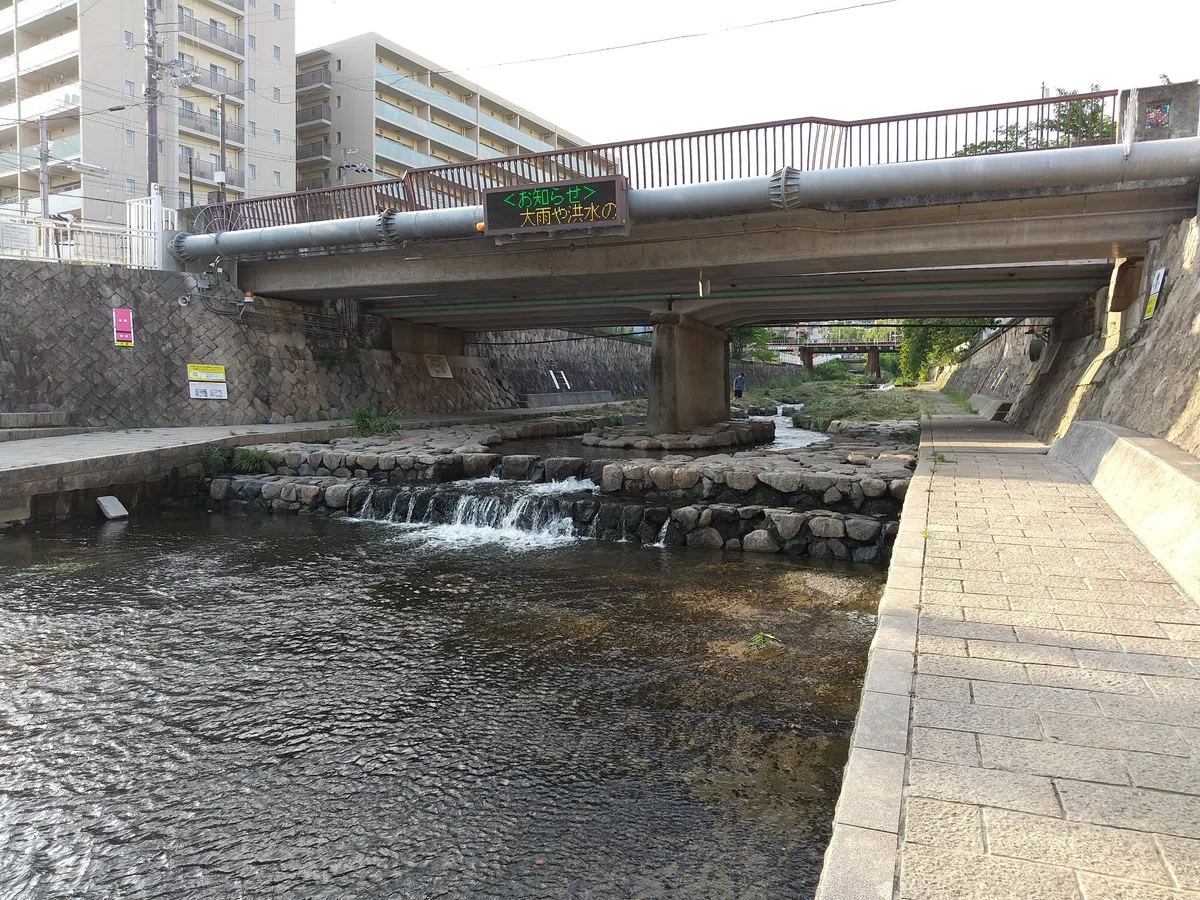
Photo in 28th August of 2025 by the author
(4) The Silent Killer: Post-Flood Heatstroke
Surprisingly, the danger doesn't end when the rain stops. As mentioned, this final risk may happen after the flooding.
Imagine the intense heat after a typhoon passes. During heavy rain or flooding, electrical facilities in apartment buildings can suffer flood damage. These facilities are often placed in low-lying areas or basements to protect them from earthquake shaking, but this makes them vulnerable to water. If they fail, the entire building loses power.
When the sky clears and temperatures soar after the storm, losing your air conditioner can be life-threatening. We saw this during Typhoons No. 15 and 19 in 2019. In particular, a high-rise apartment building in Musashi-Kosugi (Nakahara Ward, Kawasaki City) suffered a large-scale power outage, leaving residents stranded in extreme heat.
Note: Following Typhoon No. 19, the government established a study group to improve flood countermeasures for electrical equipment in buildings.
