
【🎊読み切りました🎊】『Japanese Foreign Exchange Interventions, 1971-2018:Estimating a Reaction Function Using the Best Proxy』:先行研究解説 No.16💝2023/11/05

Introduction:卒業論文は早めに仕上げたい💛
私もいよいよ卒業論文の執筆に
取りかかる時期がやって参りました👍
何事もアウトプット前提のインプットが
大事であると、noteで毎日発信してきました
これは、どのような内容で
あっても当てはまります👍
論文を一概に読んでも
記憶に残っていなかったり
大切な観点を忘れてしまっていたりしたら
卒業論文の進捗は滞ってしまうと思います
だからこそ、この「note」をフル活用して
卒業論文を1%でも
完成に向けて進めていきたいと思います
私の卒論執筆への軌跡を
どうぞご愛読ください📖
今回の参考文献🔥
今回、読み進めていく論文は
こちらのURLになります👍
『Japanese Foreign Exchange Interventions, 1971-2018: Estimating a Reaction Function Using the Best Proxy』
Takatoshi Ito(a), Tomoyoshi Yabu(b)
(a) School of International and Public Affairs, Columbia University, and GRIPS, Tokyo
(b) Department of Business and Commerce, Keio University
Japanese Foreign Exchange Interventions, 1971-2018: Estimating a Reaction Function Using the Best Proxy
December 12, 2019
Takatoshi Ito(a), Tomoyoshi Yabu(b)
(a) School of International and Public Affairs, Columbia University, and GRIPS, Tokyo
(b) Department of Business and Commerce, Keio University
前回のお復習い📝
7. Concluding Remarks
This paper confirms that “Adjusted MOF FEEF” is the best proxy for settlement-based interventions.
In fact, the proxy explains 99.8% of the movements of settlement-based interventions.
The monthly intervention data are presented in the data appendix and are also available on the authors’ websites.
At least in the monthly frequency, it has become possible to research topics related to Japanese interventions from August 1971 to the present day.
One caution: most researchers are interested in transaction-based interventions when analyzing the effectiveness of interventions or in the reaction function of the monetary authorities since the exchange rate reacts to the buy and sell in the market transactions.
The difference is the last two business days of the month. Therefore, when we use settlement-based interventions as transaction-based interventions, we must consider the exchange rate on the third-to-last business day as representative of the monthly exchange rate when analyzing exchange rate returns.
この先行研究は「調整された MOF FEEF」が取引決済ベースの介入(settlement-based interventions)の最良の代理変数(Proxy)であることを確認しています
実際、代理変数は決済ベースの介入の動きの99.8%を説明していることが回帰式の推計からわかりました
毎月の介入データはデータ付録に示されており、著者のウェブサイトからも入手できます👏
少なくとも毎月の頻度で、1971年8月から現在までの日本の介入に関連するトピックを調査することが可能になりました
This paper has analyzed the reaction function of the Japanese monetary authorities.
The following points stand out.
First, the reaction functions were not stable over time. In fact, we observed four break dates and thus five regimes: August 1971 to November 1981, December 1981 to May 1995, June 1995 to December 2002, January 2003 to July 2004, and August 2004 to March 2018.
These policy shifts might be associated with changes in the impact of interventions on the yen/ dollar rate.
Therefore, we need to exercise caution when analyzing the effectiveness of interventions.
Second, the neutral band of the reaction function widened over time, apart from during the period in which it did not exist, between January 2003 to July 2004.
This implies that the Japanese monetary authorities have experienced increased political pressure from other countries over time concerning their intervention or proposed intervention in the foreign exchange market.
Third, the cost of selling-dollar interventions was higher than the cost of buying-dollar interventions.
This implies that the monetary authorities were more inclined to resist yen appreciation.
またこの先行研究では、日本の金融当局の反応関数を分析しています
そして、以下の事項が際立っているポイントであると言えます
まず、反応関数は時間の経過とともに安定しませんでした
実際、1971年8月から1981年11月まで、1981年12月から1995年5月まで、1995年6月から2002年12月まで、2003年1月から2004年7 月まで、および2004年8月から2018年3月まで、4 つの構造変化(four break dates)があり、したがって、5つの構造(regimes)が観察されました
$$
\\Ordered Probit Model \\ \\IInt_t = \begin{cases}
+1 &\text{if } \mu_2 < y_t^* \\
0 &\text{if } \mu_1 < y_t^* < \mu_2 \\ -1&\text{if } y_t^* < \mu_1 \cdots(2)
\end{cases} \\ \\ \\where y_t^*=X_t\beta +\epsilon_t \\with \epsilon_t \backsim i.i.d N(0,\sigma^2) and\\ \\X_t\beta=\beta_1(s_{t-1}-s_{t-2})+\beta_2(s_{t-1}-s_{t-1}^{MA})+\beta_3 IInt_{t-1}
$$
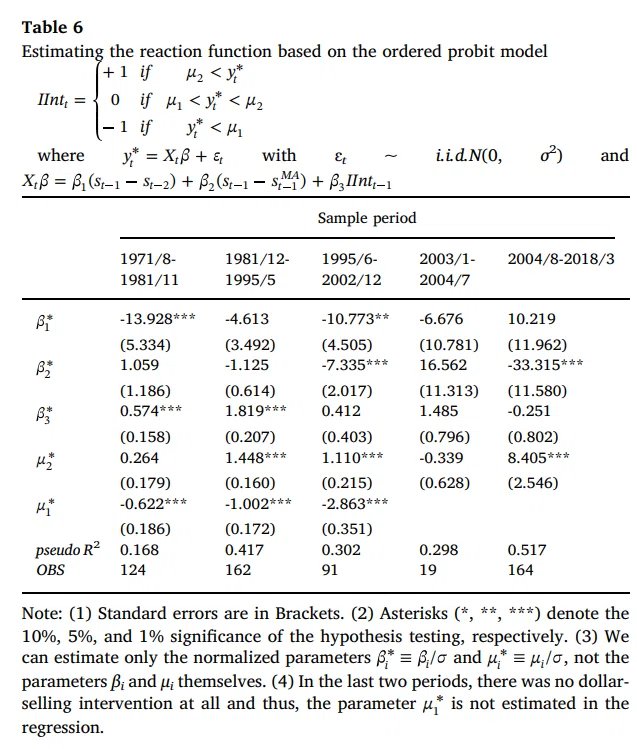
これらの政策変更は、円/ドルレートに対する介入の影響の変化に関連している可能性があります
したがって、介入の有効性(analyzing the effectiveness of interventions)を分析する際には注意が必要であることがわかります📝
第二に、介入が実施されることのない反応関数の中立帯(the neutral band of the reaction function)は、それ(中立帯)が存在しなかった2003年1月から 2004年7月までの期間を除き、時間の経過とともに拡大しました👏
これは、日本の通貨当局が、外国為替市場への介入または介入の提案に関する他国からの政治的圧力の増大を時間の経過とともに経験したことを意味します
第三に、円買いドル売り介入のコスト(the cost of selling-dollar interventions)は、円売りドル買い介入のコスト(the cost of buying-dollar interventions)よりも高かったということです💴
これは、金融当局が"円高に抵抗する傾向が強かったこと"を意味していると言えますね👏
本日の解説は、ここまでとします
このような歴史や先行研究をしっかり理解した上で、卒業論文執筆に取り組んでいきたいです
読み終えた先行研究📚
『日本の為替介入の分析』 伊藤隆敏・著
経済研究 Vol.54 No.2 Apr. 2003
『Effects of the Bank of Japan’s intervention on yen/dollar exchange rate volatility』21 November 2004
Toshiaki Watanabe (a), Kimie Harada(b)
『The Effects of Japanese Foreign Exchange Intervention: GARCH Estimation and Change Point Detection』
Eric Hillebrand Gunther Schnabl Discussion
Paper No.6 October 2003
私の研究テーマについて🔖
私は「為替介入の実証分析」をテーマに
卒業論文を執筆しようと考えています📝
日本経済を考えたときに、為替レートによって
貿易取引や経常収支が変化したり
株や証券、債権といった金融資産の収益率が
変化したりと日本経済と為替レートとは
切っても切れない縁があるのです💝
(円💴だけに・・・)
経済ショックによって
為替レートが変化すると
その影響は私たちの生活に大きく影響します
だからこそ、為替レートの安定性を
担保するような為替介入はマクロ経済政策に
おいても非常に重要な意義を持っていると
推測しています
決して学部生が楽して執筆できる
簡単なテーマを選択しているわけでは無いと信じています
ただ、この卒業論文をやり切ることが
私の学生生活の集大成となることは事実なので
最後までコツコツと取り組んで参ります🔥
本日の解説は、以上とします📝
今後も経済学理論集ならびに
社会課題に対する経済学的視点による説明など
有意義な内容を発信できるように
努めてまいりますので
今後とも宜しくお願いします🥺
マガジンのご紹介🔔
こちらのマガジンにて
卒業論文執筆への軌跡
エッセンシャル経済学理論集、ならびに
【国際経済学🌏】の基礎理論をまとめています
今後、さらにコンテンツを拡充できるように努めて参りますので何卒よろしくお願い申し上げます📚
最後までご愛読いただき誠に有難うございました!
あくまで、私の見解や思ったことを
まとめさせていただいてますが
その点に関しまして、ご了承ください🙏
この投稿をみてくださった方が
ほんの小さな事でも学びがあった!
考え方の引き出しが増えた!
読書から学べることが多い!
などなど、プラスの収穫があったのであれば
大変嬉しく思いますし、投稿作成の冥利に尽きます!!
お気軽にコメント、いいね「スキ」💖
そして、お差し支えなければ
フォロー&シェアをお願いしたいです👍
今後とも何卒よろしくお願いいたします!
いいなと思ったら応援しよう!
 よろしければ、応援お願いします!
いただいたチップはクリエイターとしての活動費に使わせていただきます!
引き続き何卒よろしくお願いいたします💛
よろしければ、応援お願いします!
いただいたチップはクリエイターとしての活動費に使わせていただきます!
引き続き何卒よろしくお願いいたします💛