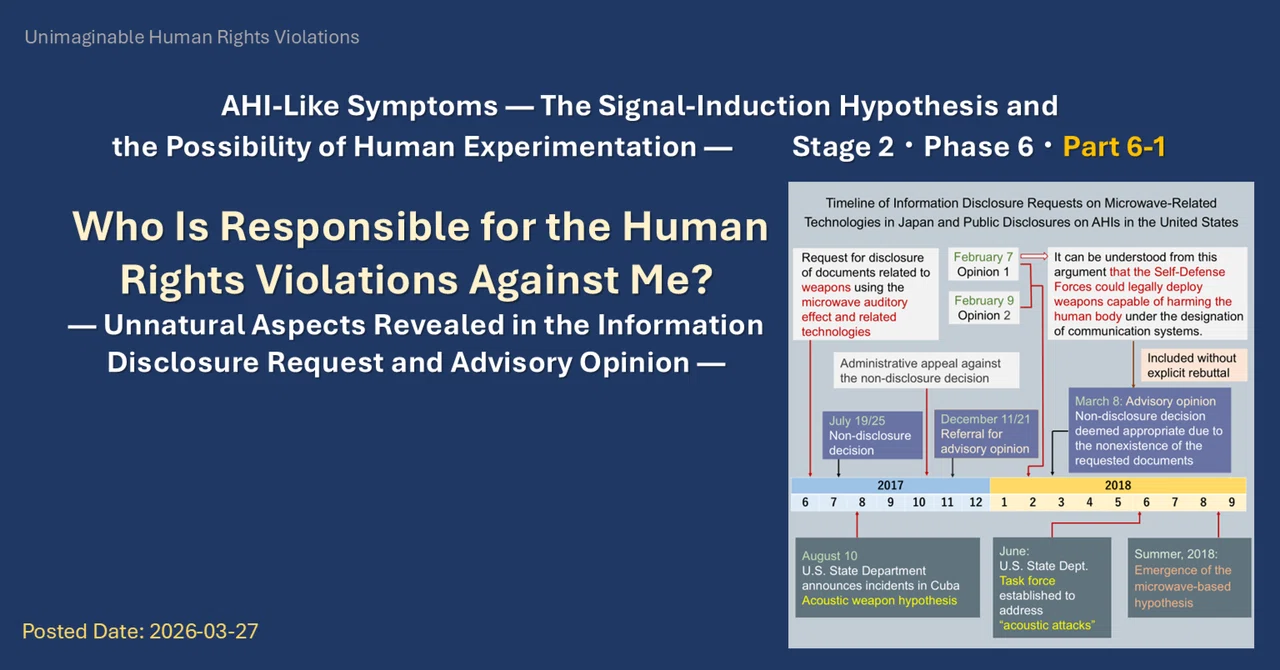
Part 6-1: Who Is Responsible for the Human Rights Violations Against Me? — Unnatural Aspects Revealed in the Information Disclosure Request and Advisory Opinion —

Summary
Overview of This Article
This article is based on a detailed examination of an information disclosure request concerning microwave weapons and related matters submitted in the summer of 2017, and the advisory opinions issued in the spring of 2018 following an appeal against the non-disclosure decision.
Through this process, several points emerged that are difficult to explain within the framework of ordinary administrative procedures—both on the part of the requester and the Ministry of Defense.
This article organizes these findings and explores the possibility of:
・ the existence of an entity with a highly specialized awareness of the issues, and
・ a structural background that cannot be sufficiently explained by standard administrative processes.
The focus of this article is not merely whether the information disclosure procedure was appropriate, but rather to address the following questions:
・ Was this disclosure request made based on ordinary public interest?
・ Or was it made by an entity possessing specific knowledge and intent?
・ Was the handling process consistent with standard administrative practice?
Note: This article is not an academic paper by a specialist. It is an analysis conducted by an individual directly involved, based on personal records and publicly available information.
The referenced materials are interpreted based on personal understanding and publicly available information, rather than formal expert analysis.

Position of This Article Within the Series
This article corresponds to the portion under consideration indicated by the pink frame in the analytical structure of this series shown in the figure below.
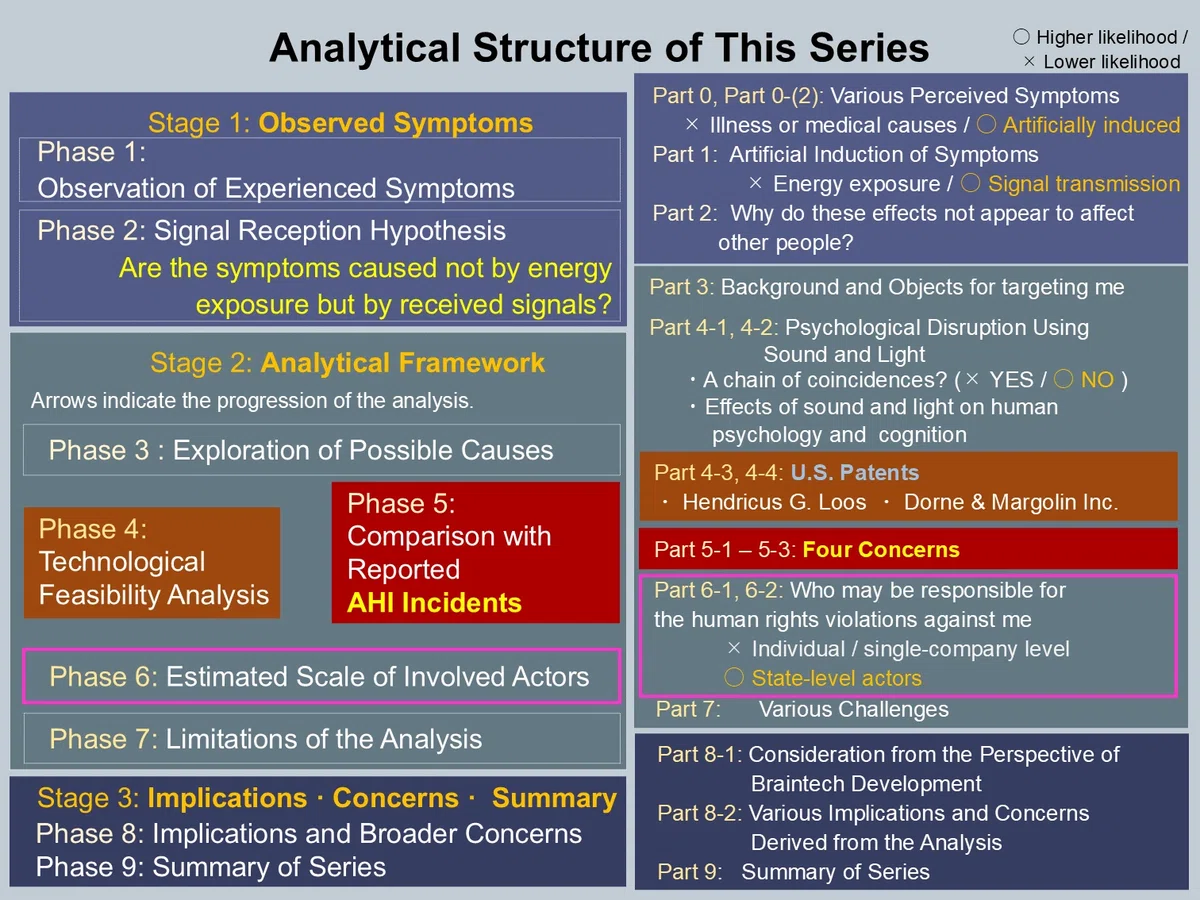
This diagram illustrates the relationship between the structure of the articles in this series and the stages of analysis.
The discussion is developed step-by-step, including the organization of observed phenomena, examination of analytical frameworks, verification of technical feasibility, and consideration of the entities involved.

Overview of the Series
For an overview of the entire series, please refer to the Series Guide and the list provided at the end of this article.

1. Introduction
Between the summer of 2017 and the spring of 2018, exchanges took place between the information disclosure requester and the Ministry of Defense regarding documents related to microwave weapons and similar technologies.
The final conclusions were compiled in Advisory Opinions No. 512 and No. 513. The consulting authorities were the Minister of Defense and the Commissioner of the Acquisition, Technology & Logistics Agency.
A detailed investigation of this matter revealed several points that are difficult to explain within the framework of normal administrative procedures, both on the part of the requester and the Ministry of Defense.
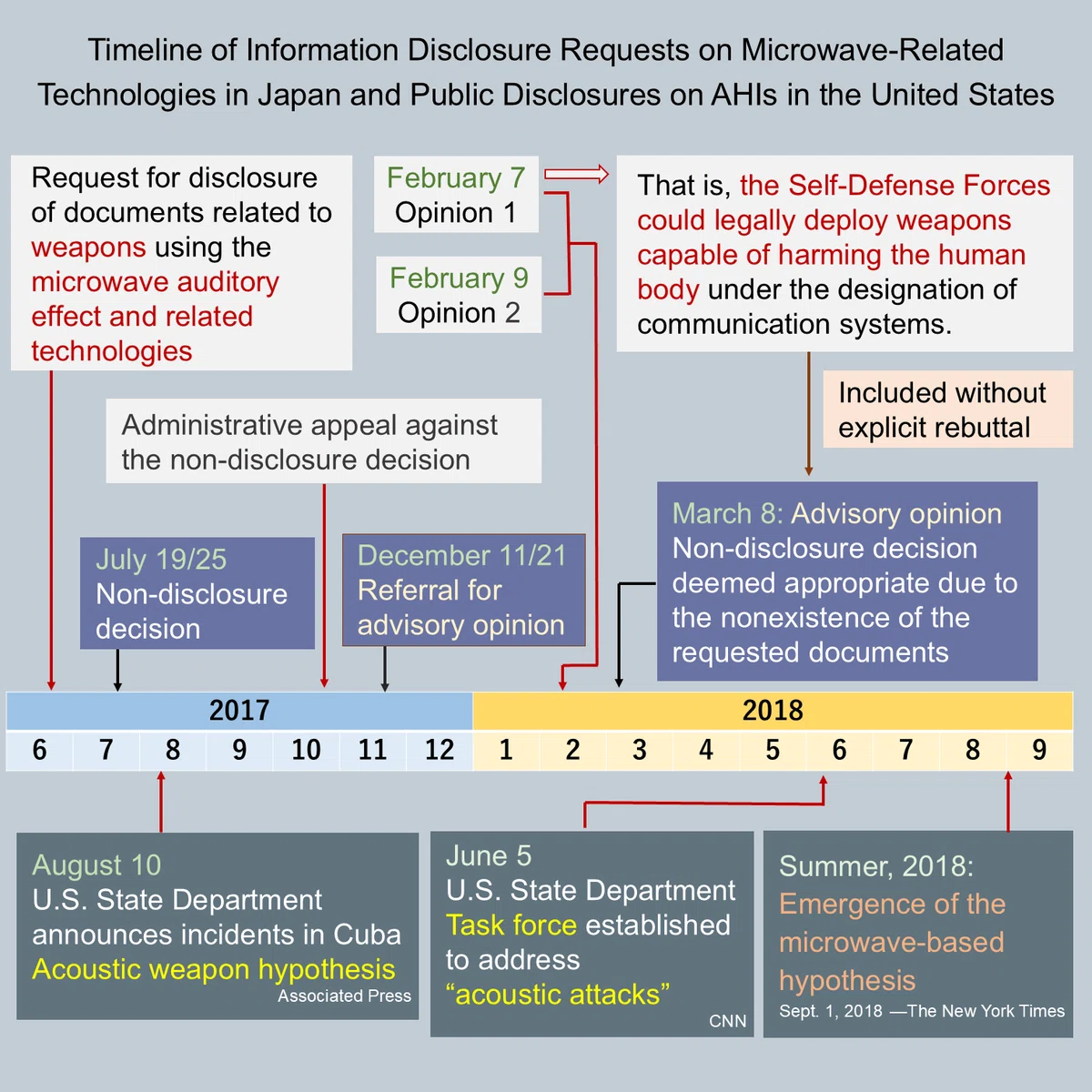
The upper section shows developments in Japan…, while the lower section presents developments in the United States.
This case is not merely an issue of information disclosure procedures.
Rather, it suggests the existence of an entity with a highly specialized problem awareness, and constitutes important material that cannot be ignored when examining the actors behind the series of events affecting me.

2. Questions Regarding the Information Disclosure Requester
As shown in Figure 2, the requester sought disclosure of documents related to the microwave auditory effect, as well as information concerning test subjects and related matters.
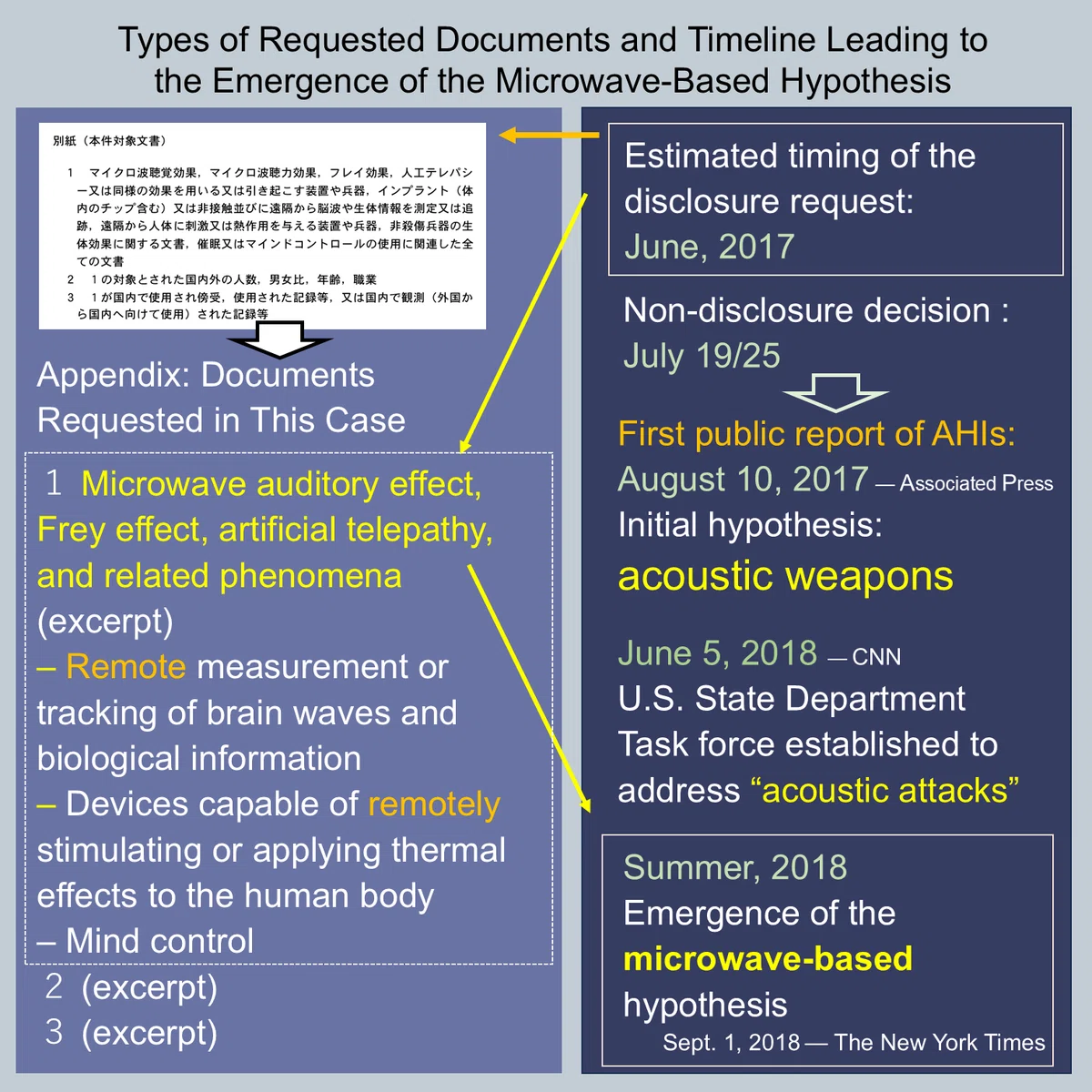
Japanese original text is shown above; English translation is provided in excerpt form for clarity.
I believe I obtained Advisory Opinion No. 512 around May 2023. Since then, my attention had primarily been directed toward topics such as the microwave auditory effect, artificial telepathy, and mind control—particularly with a focus on the microwave auditory effect.
However, on March 25, 2026, shortly before 18:00—the day after I decided to document this matter in this series—I noticed that the final page of the advisory opinion also included requests for documents concerning:
devices or weapons capable of remotely measuring or tracking brain waves or biological information, and remotely stimulating or applying thermal effects to the human body.
These elements are consistent with the considerations discussed in Parts 4-3 and 4-4 of this series.
A particularly important point is the timing of the disclosure request.
The non-disclosure decision was issued in July 2017, which indicates that the request itself was likely submitted no later than June of that year.
When viewed in this temporal context, the request appears to have included topics that later became subjects of broader public attention.
In the United States, AHIs were first publicly reported in August 2017, initially attributed to acoustic weapons. The possibility of microwave-based explanations did not gain wider attention until around the summer of 2018.
In other words, the requester:
raised concerns about such technologies before AHIs were publicly known, and
did so more than a year before microwave-based explanations became widely discussed.
Compared to the general level of publicly available information at the time, this suggests an unusually early and specific problem awareness.
If the request had been based solely on general public interest, it would be difficult to explain why it contained such concrete and forward-looking elements.
Taken together, these observations make it difficult to regard this case as mere coincidence or as an isolated issue within routine administrative procedures. Rather, they suggest that it may be necessary to consider the involvement of an entity possessing a certain level of knowledge or problem awareness.
This leads to a central question:
Who exactly was the individual or entity that submitted this information disclosure request?
At present, there is no information that allows the requester to be definitively identified.

3. Questions Regarding the Advisory Opinion
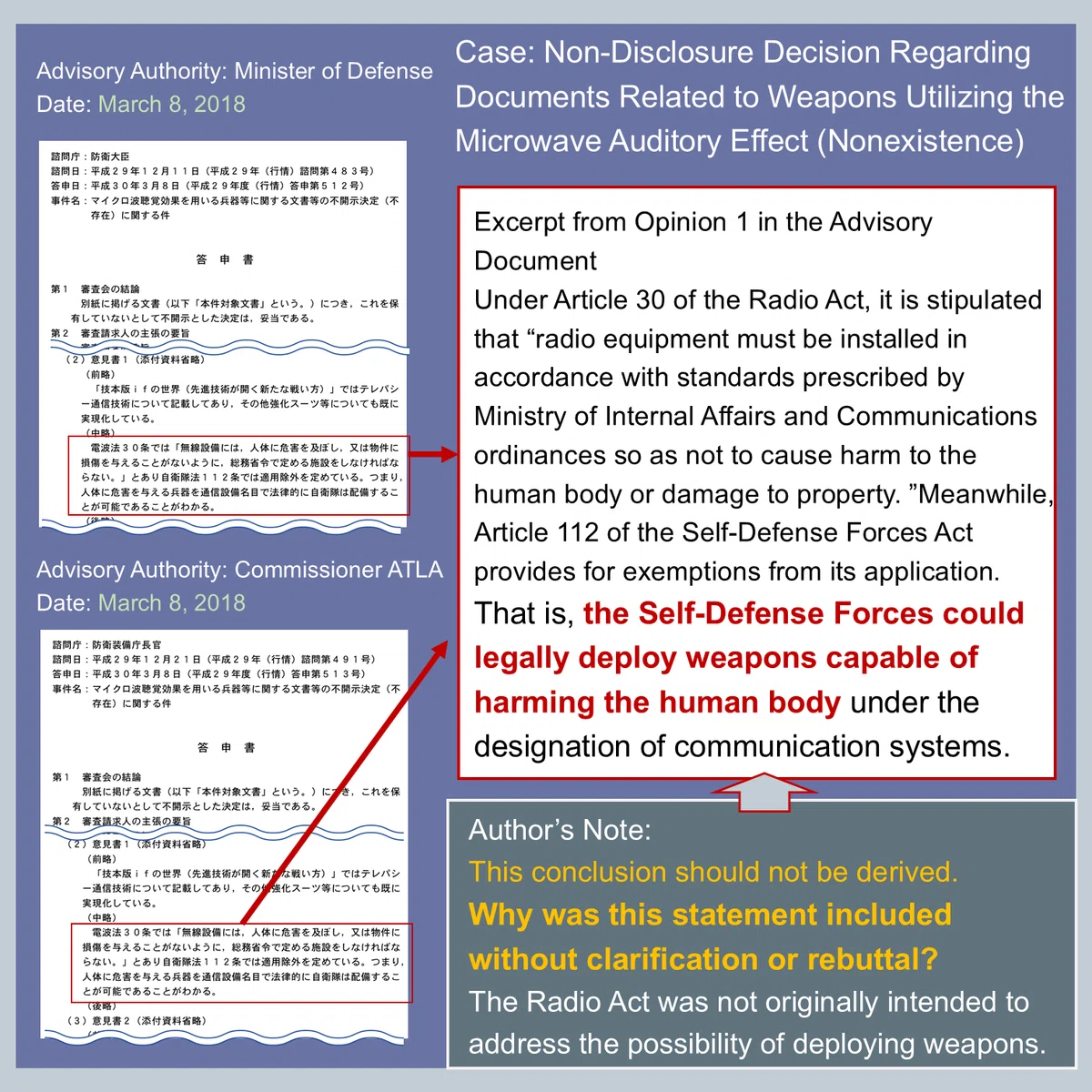
The highlighted statement reflects the requester’s argument, followed by the author’s note.
ATLA = Acquisition, Technology & Logistics Agency
Primary source content and the author’s interpretation are clearly distinguished.
As shown in Figure 3, a non-disclosure decision was issued in response to the request. The requester subsequently filed an administrative appeal and submitted written opinions in February 2018. An advisory opinion was then issued in March 2018.
The advisory opinion includes excerpts from the requester’s arguments. Among them is a claim suggesting that, based on the relationship between relevant provisions of Japanese law, it may be possible for the Self-Defense Forces to legally deploy equipment capable of harming the human body under the guise of communication systems.
This article does not endorse that interpretation.
Under the legal framework in question, the relevant provisions concern procedural exemptions for certain operations and do not imply permission to cause harm to the human body. Nor do they directly support the conclusion suggested in the requester’s argument.
In this case, the central issue was the existence of the requested documents. The non-disclosure decision was based on the conclusion that such documents did not exist.
Therefore, it was not necessary for the advisory opinion to evaluate the validity of each legal interpretation presented by the requester.
However, given that the advisory opinion is publicly accessible, the absence of clarification regarding the position of such claims may lead to misinterpretation.
In particular, the structure of the document leaves room for the impression that certain claims could be understood as relevant to the decision’s reasoning.
From the perspective of administrative transparency and accountability, this raises questions as to whether the relationship between the premises and the conclusion was presented with sufficient clarity.

4. Conclusion
The information disclosure request and the subsequent advisory opinion constitute important material not only in terms of administrative procedure, but also in examining the nature of the actors potentially involved in the series of events affecting me.
Notably, the requester formulated arguments based on concepts such as the microwave auditory effect and remote influence on neural activity before these became widely recognized.
This suggests a level of specificity that exceeds what would typically be expected from a general information disclosure request.
How such a request was processed may provide meaningful indications when considering the nature of the entities potentially involved in this case.

5. Content of Part 6-2
In Part 6-2, which will be published shortly, I present selected examples of unusual events I have experienced across multiple institutions and organizations.
By examining patterns across these cases in combination with the analysis presented here, I further explore the nature of the entity responsible for the ongoing human rights violations against me.

