
“I Actually Stood in Court for the Eviction Lawsuit” — Subsequent Developments Leading Up to the Appeal to the Supreme Court

1. Introduction
The eviction lawsuit filed by SMC Corporation in September 2024 is currently pending before the Supreme Court of Japan. This case concerns a claim seeking the surrender of the apartment building where I currently reside (the “Building”).
I have previously recorded the course of the eviction lawsuit in a series titled “I Actually Stood in Court for the Eviction Lawsuit.”
However, because I had been prioritizing the organization and analysis of AHI-like symptoms and related human rights violations, I had not posted a detailed update on the eviction lawsuit for some time after “The First Oral Argument at the Tokyo High Court (Detailed Account, Part 2),” which I posted in July 2025.
In this article, I briefly summarize the developments up to the present.

2. Developments Up to the First Oral Argument at the Tokyo High Court
February 2023
According to the complaint, SMC Corporation acquired ownership from the owner of the land on which the Building stands (an individual) and from the holder of the leasehold right (Daito Kentaku Partners Co., Ltd.), respectively.
March 2023
SMC Corporation began eviction negotiations through its legal representative.
September 2024
SMC Corporation filed a lawsuit against me as the defendant in the Tokyo District Court.
February 2025
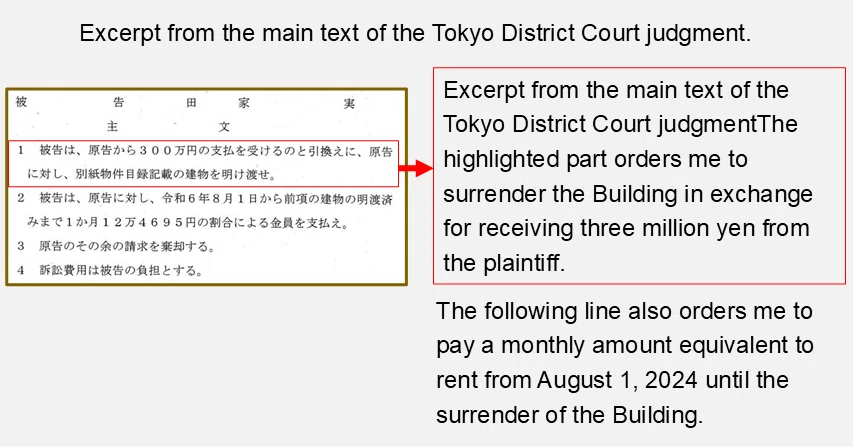
Judgment of the Tokyo District Court: I partially lost the case.
March 2025
Dissatisfied with the judgment, I filed an appeal with the Tokyo High Court.
June 2025
The first oral argument in the appellate proceedings was held. The proceedings were concluded on the same day, and the judgment date was designated as August 27 of the same year.
The above is the general course of events up to the previous update. A more detailed chronology and list of related posts are compiled and updated as needed in the following article.

3. Brief Developments After the Appellate Judgment
August 27, 2025
Judgment of the Tokyo High Court: The judgment of the first instance was upheld.
September 4, 2025
I received legal consultation at Tokyo Law Office.
During this legal consultation, there was a response that raised strong concerns for me regarding the identity of the person in charge and the content of that person’s remarks.
On the same day, I posted about this matter on X and also sent an inquiry by email to the attorney who had been scheduled to handle the consultation. Since then, I have made repeated inquiries, but I have not received any response from that attorney to date.
I plan to explain this matter separately in detail on note.
September 9, 2025
I filed a petition for final appeal and a petition for acceptance of final appeal with the Tokyo High Court on my own.
December 18, 2025
I sent the statement of reasons for final appeal and the statement of reasons for the petition for acceptance of final appeal to the Tokyo High Court by simplified registered mail.
March 30, 2026
I received a notice from the Supreme Court stating that the case records had arrived.
Appellant and Petitioner: Minoru Taya
Appellee and Respondent: SMC Corporation
The case numbers are as follows:
2026 (O) No. 460 — Final Appeal
2026 (Ju) No. 560 — Petition for Acceptance of Final Appeal
In addition, the notice instructed me to promptly submit the latest certificate of registered matters concerning the representative of the appellee/respondent company.
March 31, 2026
At the Kashiwa Branch Office of the Chiba District Legal Affairs Bureau, I obtained two copies of SMC Corporation’s certificate of complete historical registered matters.
I then sent one copy by simplified registered mail from the Kashiwa Post Office to the clerk in charge at the Supreme Court.

4. Current Status
As explained in the previous section, case numbers have been assigned to both the final appeal case and the petition-for-acceptance-of-final-appeal case, and the records have arrived at the Supreme Court.
At present, I am waiting for the Supreme Court’s decision.

5. Why I Am Continuing to Fight This Case Before the Supreme Court
As SMC Corporation stated in its complaint, I am currently unemployed.
This has been my situation since approximately three months after I experienced, in March 2018, what I refer to as “psychological destruction operations using sound and light.”
Also, as I have posted on X before, both of my parents passed away in January and February 2021. I will not go into the reasons here, but I renounced the inheritance through a judicial scrivener.
If my reasons were only half-hearted, it might have been wiser to comply with the judgments of the Tokyo District Court and the Tokyo High Court, accept three million yen, and move elsewhere.
Nevertheless, the reason I have not done so is that I have approached this litigation with considerable resolve.

From the Final Chapter of “I Actually Stood in Court for the Eviction Lawsuit — Third Edition”
Below, based on the final chapter of “I Actually Stood in Court for the Eviction Lawsuit — Third Edition,” which I also introduced at the beginning of this article, I will restate the relevant points in a partially reorganized form.
This case is not merely an eviction lawsuit for me.
I believe it is deeply connected to the events that I have continued to describe as “human rights violations beyond imagination.”
This is the place where I have experienced various symptoms and forms of suffering that I believe it is reasonable to judge as having been artificially induced.
Based on similarities in symptoms and other factors, I also consider this to be an important site that may be relevant to the examination of anomalous health incidents (AHIs).
In addition, it is a place where many individuals who may have been directly or indirectly involved in the above-mentioned human rights violations have come and gone.
If I were to move elsewhere under the present circumstances, the Building would be demolished, evidence might be lost at the same time, similar things would likely be repeated at the new location, and neighboring residents and real estate companies might also become involved.
On page 5 of my appellate brief, I stated as follows:
As companies continue to ignore the appellant, the realistic means available to break through the situation are extremely limited.
In this sense, this case represents, for the appellant, a once-in-a-lifetime — and probably final — opportunity to expose the experience of having his life and mind destroyed over many years, as well as the implementing organization behind the “anomalous health incidents (AHIs)” that he suspects exist behind it, and the reality of the terrifying technological development hidden in the background.
I also pointed out the malicious methods used in the eviction negotiations on page 21 of the same brief:
If such methods are being routinely used in eviction negotiations, then not only in this case but also in past cases, persons subject to eviction who lacked sufficient legal knowledge may have been forced to give up without resistance.
There is also strong concern that similar harm may occur in the future.
The contents of the statement of reasons for final appeal and the statement of reasons for the petition for acceptance of final appeal were limited to matters concerning the eviction negotiations.
Even if the human rights violations that I have continued to report are made public before the Supreme Court issues its decision, I will not withdraw the final appeal.
When the Supreme Court’s decision is issued, I will report the result separately.

