現代日本人の信仰

Xにちょうどよい図解があったもので。
文章はAIです。
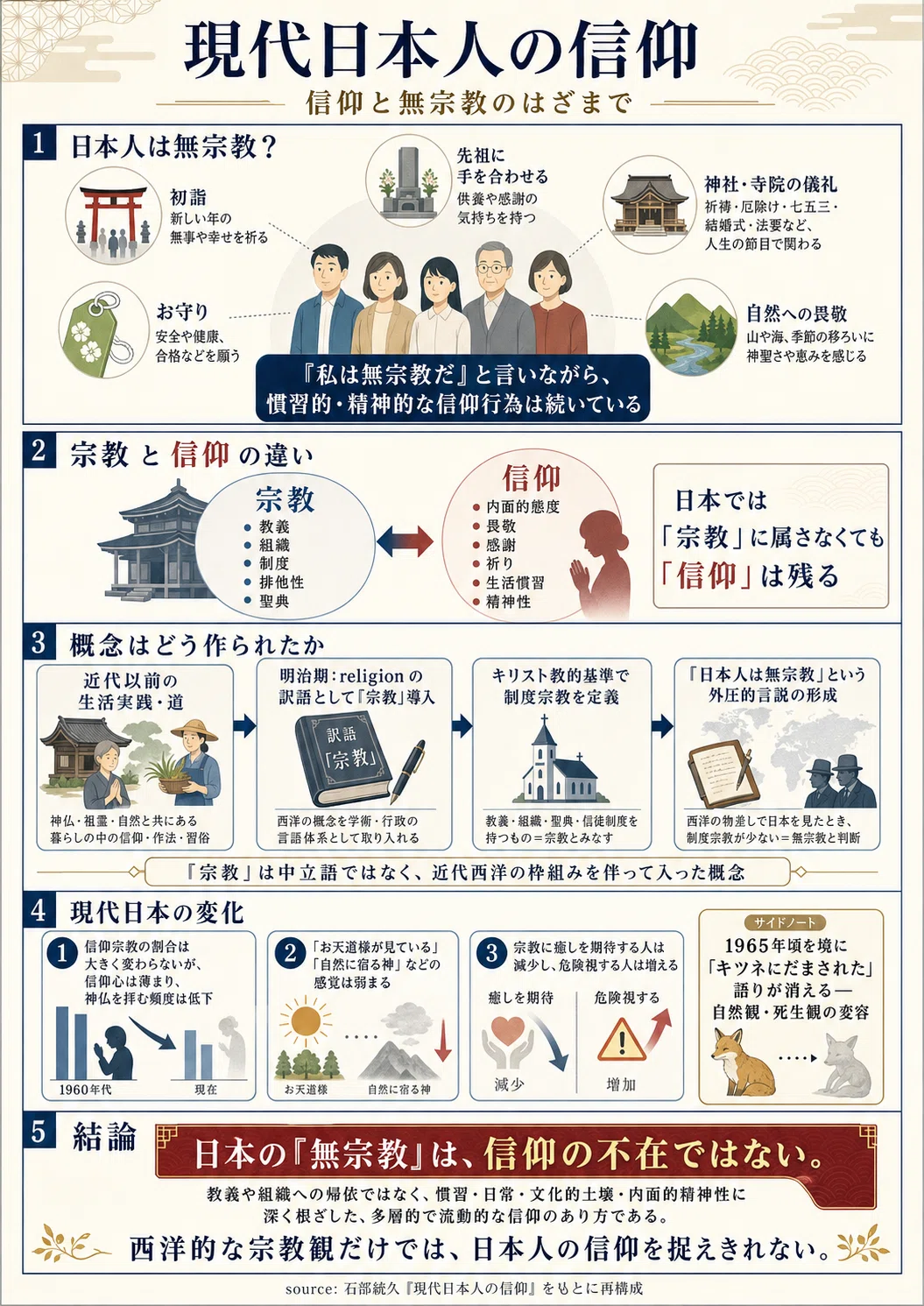
信仰と無宗教のはざまで
「私は無宗教だ」と答えながらも、初詣に行き、お守りを持ち、先祖に手を合わせる。 これは矛盾なのでしょうか? それとも、私たち日本人の中に息づく、もう一つの「信仰」の形なのでしょうか。
https://g.co/gemini/share/4cafa9a29c15
近代日本から現代への精神史探訪
https://g.co/gemini/share/b6a151c96b8b
日本人の信仰の図
いろいろとツッコミを受けて,ちょっと修正しました.
— Ma Osa / どうか世界に平穏を (@ma_osa) February 13, 2025
基本的にネタ図なので,ネタとしてお楽しみください.😇
・アメニズム⇒アニミズム
・天皇制⇒天皇(皇室), BIOS直接呼出し
・神道BIOS⇒やおよろずBIOS pic.twitter.com/kDKBRmsLLK
https://x.com/ma_osa/status/1890058578129834053
日本人の宗教的意識や行動はどう変わったか
NHK放送文化研究所による IS PP 調査(2018年実施、小林利行報告)によれば、以下の傾向が確認されている。
日本人の宗教的意識や行動はどう変わったか~ISSP国際比較調査「宗教」・日本の結果から~https://www.nhk.or.jp/bunken/d/research/yoron/BUNA0000010690040003/
①信仰している宗教の割合は変わらないものの、信仰心は薄くなり、神仏を拝む頻度は低くなっている。
②日本人の伝統的な価値観だと捉えられてきた“お天道様がみている”“人知を超えた力の存在”“自然に宿る神”といった感覚を持つ人は少なくなっている。
③宗教に「癒し」などの役割を期待する人は減少している。宗教に危険性を感じる人は、感じない人よりも多い。
④各宗教徒別では、「イスラム教徒」への否定感が他の宗教徒に比べて高い。
日本人の宗教的意識や行動はどう変わったか
https://www.nhk.or.jp/bunken/research/yoron/pdf/20190401_7.pdf
日本人はなぜキツネにだまされなくなったのか
講談社現代新書『日本人はなぜキツネにだまされなくなったのか』によると、1965年を境に「キツネにだまされた」という語りが社会から消えたとされる。豊かさや価値観など日本社会の変容によって、民間伝承や死生観、自然観にも変化が及んだとする。
ターニングポイントは1965年だった! 私たちの自然観、死生観にそのときどんな地殻変動がおきたか?
https://news.kodansha.co.jp/books/20161031_b01
近代から現代への精神変化リンク
日本人は無宗教?
「日本人は無宗教」という通念について、小林氏らの調査結果から検証する。宗教への信仰者割合は一定だが、信仰心の有無やその意味合いは変化し、無宗教と自認する人にも豊かな宗教性や慣習的信仰が残る可能性がある。
日本と西欧の「無神論」のイメージと内容が全然違う
欧米では「無神論者」は否定的・危険な存在とされる傾向があるが、日本では「特定宗教を信じない」という自認が生活文化的な選択として捉えられている。
https://president.jp/articles/-/74200?page=1
そもそも「宗教」という概念とは
「宗教」は英語 “religion” の訳語として明治期に導入された概念であり、singular/plural/the religion/general religion といった区別が西洋語ではあるのに対し、日本語ではひとつの語で広く訳される。
「宗教」とは、西洋の諸言語におけるreligionの訳語であるということをだれでも知っているが、日本語ではただ一つの語であっても、英語乃至近代ヨーロッパ諸語では四つの形で表現される。
(1)'a religion'という単数形。これは一つの宗教を意味する。
(2)'religions'という複数形。
(3)定冠詞をつけた'the religion'という語形。
(4)冠詞も語尾もつけないで、ただ’religion'、という場合。
(1)不定冠詞のついた'a religion'という場合には、世界には多数の宗教があるということを認めた上で、そのうちの一つを意味する。
(3)一つの国で何か特定の宗教を国教としているというような場合に、特定の宗教を意味するときには'the religion'と、定冠詞のついた形が用いられる。
(4)ただ'religion'とだけ言う場合には個々の宗教教団の組織や教義を離れた、諸宗教に通ずる普遍的・本質的なものをいうかあるいは諸宗教をすべてひっくるめて全体的なものを意味する。
ドイツ語やフランス語でも、これらの用法の区別は大体同じである。
近代における宗教概念の誕生
島地黙雷などを通じて、日本ではキリスト教を基準に「宗教」と「非宗教」の区別が導入され、神道や仏教さえも「未開」と評価されるようになった。宗教という概念そのものが、西洋中心主義的理解に基づいて「文明」と「野蛮」を切り分ける枠組みとして成立した。
日本語の「宗教」という概念自体が明治以降に新しく創作されていったものでして……「宗教」概念の創作過程に関与した真宗僧侶の島地黙雷は「宗教進化論」を採り、真宗は日本のプロテスタントであり神道は「宗教」ではないとして、神々への帰依を「未開」だとしてボロクソにけなしていました。日本にお… https://t.co/VOXSY6U2NN
— DJ プラパンチャ (@prapanca_snares) March 16, 2025
日本語の「宗教」という概念自体が明治以降に新しく創作されていったものでして……「宗教」概念の創作過程に関与した真宗僧侶の島地黙雷は「宗教進化論」を採り、真宗は日本のプロテスタントであり神道は「宗教」ではないとして、神々への帰依を「未開」だとしてボロクソにけなしていました。日本において「宗教」という新しい概念が創作されていく過程は、単にジャンル概念が一個増えたというだけの話では決してありませんでした。それは、キリスト教を強固なものさしとして、キリスト教(特にプロテスタント)に近いと“された”ものが「文明」の「宗教」だと“される”一方で、そこから外れたものが「野蛮」だと“されて”いくプロセスでした。 キリスト教(特にプロテスタント)をモデルにして、「宗教」と「非宗教」が暴力的に切り分けられていく過程だったわけです。キリスト教に近いものが「文明」の名に値する「宗教」だとされる一方で、キリスト教から遠いものは「非宗教」であり「野蛮」であるから排除してもかまわないとされたのです。「宗教」というのは決して「中立的」な概念ではなく、西洋中心主義的な暴力性を帯びた概念なわけです。
元々「宗教」という概念はプロテスタンティズムを背景に近代に新しく創作されたもので、仏壇に手を合わせるといった生活世界に埋め込まれた非言語的な慣習行為(プラクティス)を軽視し、言語化された教理体系(ビリーフ)を重んじる偏りがあり、「中立的」なジャンル概念ではなかったりするので……。 https://t.co/qmnLuH2OQC pic.twitter.com/IfmuxtuWpG
— DJ プラパンチャ (@prapanca_snares) February 11, 2025
何かを見たので申し上げると、「すべての「宗教」は究極的に一致する」という思想について考える際に思い出さないといけないのは、そもそも「宗教」というのは近代に形成されていった新しい概念だということです。こうした思想は、「宗教」という概念が成立して初めて生まれるものです。ただし、明治以… pic.twitter.com/ItmO8Goe40
— DJ プラパンチャ (@prapanca_snares) March 5, 2025
何かを見たので申し上げると、「すべての「宗教」は究極的に一致する」という思想について考える際に思い出さないといけないのは、そもそも「宗教」というのは近代に形成されていった新しい概念だということです。こうした思想は、「宗教」という概念が成立して初めて生まれるものです。ただし、明治以前の日本にも「道」という概念はありました。そして、仏道とか茶道とか武士道とか和歌の道といったいろんな種類の「道」が目指す究極的な境地に普遍性を見い出す考え方はありました。
環流夢譚 その6――「宗教」概念という近代の神話https://note.com/prapanca_snares/n/n2f7b49b43062?sub_rt=share_sb
以前この記事で詳しく述べましたが、“religion”ということばが「(客観的に観察される)信念や実践の体系」を意味するようになり、「キリスト教と比較可能・観察可能な組織体系としての「諸宗教」」という概念が成立するのは近代のことです。
“religion”ということばが、仏教やキリスト教などを一括りにするジャンル概念と化していった背景の一つには、いわゆる大航海時代の到来があります。大航海時代には、西洋の人々が非西洋世界と接触するようになり、世界各地のキリスト教とは異なる儀礼の実践に接触するようになって、そうした報告や断片的知識が次第に増えていきます。そうすると、それらの儀礼の実践が“religion”と呼ばれる事例が飛躍的に増えていったのです。
17世紀には「世界の諸宗教」などといったような言い回しが一般化し、そうしたタイトルがついた本もヨーロッパ諸国で出版されるようになります。かくして、この世界にはいろんな種類の“religion”というものが存在しているのだという認識が、新たにヨーロッパで生まれて広まっていったのです。
「すべての「宗教」は究極的に一致する」という思想は、こうした“religion”概念が誕生して初めて生まれるものです。「宗教学」の祖とも言われるマックス・ミュラー(1823-1900、写真左)は、世界各地の「宗教」の“ほんとうの”姿を知るためには、キリスト教だけでなく、キリスト教以外の「宗教」伝統にも目を向けて「諸宗教」を比較検討し、どの「宗教」にも共通する「本質」を明らかにする必要があると主張しました。
こうしたミュラーの営為は、現在の目から見れば、近代的に創作された「宗教」概念を前提にして、世界各地のいろんな文化的実践の間には類似性や共通性があることを自明の前提にしつつ、その分析を通じて類似性や共通性を「論証」するという循環的構造をしていました。
また、神智学協会をオルコット大佐とともに設立したオカルティストのブラヴァツキー(写真右)は、宇宙と人間に関する秘密の普遍的な真理が、太古の昔からヘルメスやモーゼやオルフェやピタゴラスやプラトンやイエスといったごく一部の賢者のみに伝授されており、仏教やキリスト教といった古今東西の様々な「宗教」には、その根源的な真理が断片的に表現されていると説きました。
つまり、いろんな宗教の源は実は一つであり、その源から古今東西の様々な宗教が時代に応じて生まれたのだというのです。そこで、表面的には対立しているように見える「諸宗教」の根源に共通する秘密の真理に目覚めることで、個々の人間の霊的な進化が成しとげられるのだそうです。
ミュラーやブラヴァツキーは19世紀の人ですが、ともあれ「すべての「宗教」は究極的には一致する」という思想は、いわゆる「世界の一体化」を通じて、自分たちとは異なる文化的実践を行う人々が世界に存在することが西洋で知られるようになり、キリスト教が相対化され非自明化した世界に生まれた産物だと言えるでしょう。
ただ、ここでつけ加えておきたいのは、冒頭で申し上げたように、日本では「開国」を余儀なくされる以前にも、「道」という概念はあったということです。「道」は仏道や武士道や茶道や和歌の道といったものを含んでおり、宮本武蔵の『五輪書』を見ると、凡人が世を渡ること、士農工商も4つの道だと説かれています。
つまり、近代に新しく創作された「宗教」という概念とはかなり異なり、修練を通じて実践的に習得され継承されるべき専門的な営為や諸藝諸能のすべてを指すような概念だったわけです。そして、いろんな「道」がありながらも、修練を通じて得られる究極的な境地に普遍性を見い出す思想も存在していたというわけです。
“外圧”として誕生した「日本人無宗教説」
幕末に来日した西洋人(オールコック、バードら)が、日本には “religion” がないと観察したことが、「日本人は無宗教」という言説の源流となった。これは日本人自身の自己理解ではなく、外圧としての宗教語りの産物である。
①「日本人は『無宗教』だ」という主張は、「宗教」という概念が日本において新しく創作されて定着していく以前に、すでに存在していた。というのも、幕末に来日して日本を観察した西洋の人々が、早い段階から「日本人には“religion”がない」などという「宗教語り」をしていたのである。
②オールコックやバードの例に見られるように、来日した外国人は、キリスト教を強固な基準にした「宗教語り」を行っていた。その結果、バードのような形で、神道は「宗教」ではないという「宗教語り」がなされた。キリスト教をものさしにした「宗教語り」は、神道は「非宗教」だという主張につながった。
21世紀になった現在でも、「日本人は『無宗教』である」という主張は存在しますが、その起源はここにあります。ここにあるのは、「日本人はreligionに無関心であり、『文明』を持っていない」という、キリスト教を強固な基準とした「宗教語り」です。なんだかミもフタもないようですが、「日本人は『無宗教』である」という言説は、言わば“外圧”として誕生したのです。
https://note.com/prapanca_snares/n/n2f7b49b43062
日本人は無宗教 関連書
日本人の信仰 関連書
日本における慣習的信仰の基礎的研究https://rikkyo.repo.nii.ac.jp/record/14737/files/AA11837343_15_05.pdf
無宗教ではないという意見
最近の論調では、「無宗教」と自認する日本人にも、初詣や慣習的な信仰行為を通じた宗教性が豊かに存在するとし、「無宗教は誤解である」という主張が見られる。
https://toyokeizai.net/articles/-/627356
https://president.jp/articles/-/79381?page=1
https://www.recruit-ms.co.jp/issue/interview/0000000575/
https://psych.or.jp/publication/world105/pw12/
https://psych.or.jp/publication/world105/pw12/
論文
日本人の持つ宗教観 日本人は無宗教なのか?
http://human.kanagawa-u.ac.jp/gakkai/student/pdf/i12/120314.pd
現代日本人にとっての信仰の有無と宗教的な心 統計数理研究所 林文
https://www.ism.ac.jp/editsec/toukei/pdf/58-1-039.pdf
まとめ
現代日本人の「信仰」は、宗教として教義や組織に帰依する形式ではないものの、慣習・日常・文化的土壌の中に深く根ざしており、「無宗教」と一括りにはできない複雑な実態があることがわかります。近代以降に導入された「宗教」という概念や、西洋視点によって構築された無宗教説から離れ、日本独自の信仰・宗教性を俯瞰する視点が必要です。
コラム
https://gemini.google.com/share/153b920c3a12
信仰と無宗教のはざまで ― 「信仰深い無宗教者」という日本のパラドックス
1. 問いを立てる導入:信仰を包摂する「無宗教」という日本のパラドックス
1.1. リード:自認の矛盾
現代の日本社会において、自らを特定の組織や教義に属さない「無宗教者」であると定義する人々は、圧倒的多数を占めている。国際的な調査データは、日本が世界トップクラスの無神論・非宗教国家であるという認識を裏付けており、2017年の調査では、日本の無神論者の割合は87%に達したとされている 。しかしながら、この高い非所属率の背後には、社会学者や宗教学者が長年指摘してきた本質的な矛盾が潜んでいる。
多くの日本人は「私は無宗教だ」と語りながらも、年末年始には初詣に赴き、人生の節目には神社や寺院の儀礼を行い、自然災害や予期せぬ困難に直面した際には、特定の神仏ではない抽象的な超越的な力に対して、畏敬や救済の念を抱き、静かに祈る瞬間を持つ。この現象は、「無宗教=信仰がない」という単純な図式が日本においては適用できないことを示唆している。日本における「無宗教」の多さは、信仰の不在ではなく、むしろ信仰を制度化から解放し、日常の慣習や内面の精神性へと包摂するための、独自のシステムとして機能している可能性を考察する必要がある。
1.2. 概念の定義と本稿の目的
本稿の主題である「信仰深い無宗教者」という矛盾した概念を分析するためには、「宗教」と「信仰」の概念を明確に区別することが不可欠である。本稿では、「宗教」(Religion)を、特定の教義、聖典、明確な排他性、そして組織構造に厳格に依拠する、外形的な制度システムとして定義する。これに対し「信仰」(Faith)とは、個人の内面的な精神的態度、超越的なものや倫理的な「大いなるもの」への敬意、自己の救済や人生の意味を希求する欲求といった、より流動的で非制度的な側面を指す。
本稿の目的は、この「信仰深い無宗教者」という日本の特異な精神的立ち位置を、歴史的経緯と社会構造から徹底的に分析し、特にキリスト教に代表される西欧的な制度宗教の類型との対比を通じて、日本における信仰のあり方を再定義することにある。日本人が「無宗教」を選択する背景には、単なる合理主義や世俗化だけでなく、日本の精神構造と西欧的宗教概念との間に横たわる、歴史的な概念のズレが存在するのである。
1.3. キリスト教的視座の導入
現代の日本人が「宗教」という語を耳にする際、その意識の底流には、西欧的な制度宗教の典型としてのキリスト教、すなわち一神教、明確な救済論、そして厳格な排他性を持つ組織のイメージが深く根付いている。この類型は、明治期以降に日本に導入された「宗教」概念の核を形成し、その後の日本の信仰観に多大な影響を与えてきた。
このキリスト教的類型が、組織性や教義を重視するあまり、日本の伝統的な多神教的、シンクレティックな信仰様式を包摂しきれず、結果的に多くの日本人を「無宗教」という自己分類へと向かわせた要因の一つと考えられる。本稿では、このキリスト教的神観や救済観が、無宗教者の信仰実感に何を提供し、何を拒否させるのか、という多角的な側面から議論を進める。
2. 背景整理:日本における「無宗教」の語られ方と、概念の歴史
2.1. 統計が示す矛盾:高すぎる「無宗教」の割合と、残存する慣習的信仰
NHKやISSPといった国際的な意識調査が示す日本の「無宗教」自認の割合は、欧米諸国と比較して突出して高い。一般的に日本人の7割から8割が特定の宗教団体に所属していないと回答する。しかしながら、この非所属率の高さは、信仰行為の不在を意味しない。初詣、お盆の墓参り、仏壇や神棚の保持といった儀礼的・文化的信仰行動は、無宗教者を自認する層によっても世代を超えて継続的に行われている。
この矛盾は、「宗教団体に属さない」という制度の不在が、「信仰心がゼロ」という内面の否定と混同されていることを明確に示している。日本社会における「無宗教」という自己分類は、個人の内面的な霊性や超越性への態度を示すものではなく、外部に対する組織への非コミットメントの表明として機能しているのである。
2.2. 「宗教(religion)」概念の輸入と近代化:明治期における言葉の受容史
この概念の混同の根源は、明治維新期における「宗教」という訳語(Shūkyō)の導入過程に求められる。近代化を進める日本が、西欧文明を模倣する中で「religion」という語を輸入し、その訳語として「宗教」を採用した経緯は、現代の信仰観に決定的な影響を与えた 。
この翻訳過程で、組織化、明確な教義、そして排他性といった、主に西欧キリスト教的な一神教の要素が「宗教」概念の核として取り込まれた。さらに、近代国家の形成期において、政府は国民統合の手段として神道を「非宗教」の範疇に置き、仏教やキリスト教を「宗教」として制度的に分類した。この歴史的経緯は、現代日本人の意識に深く刻まれており、「宗教=特定の組織や団体」というイメージを固定化させている。その結果、日本の伝統的な、曖昧で多神教的な信仰様式は、近代的な「宗教」の定義から逸脱し、「非宗教的」と見なされざるを得ない状況が生まれたのである。これは、西欧の概念的枠組みが日本の精神世界を測る物差しとなり、本来存在する信仰を「存在しない」ものとして計測してしまう、一種の概念的枠組みの植民地化の結果と言える。
2.3. 西欧基準(教義・組織性)が日本的信仰にもたらした影響
日本の伝統的な信仰は、教義や厳格な排他性を重視する西欧型とは異なり、主に慣習、場所(聖地)、血縁に根ざし、組織への帰属意識が緩やかであった。しかし、西欧基準の「宗教」が導入されたことで、この緩やかな信仰性は近代社会の価値基準の中で「非宗教的」と見なされるに至った。
結果として、多くの日本人は、組織への所属や明確な教義の受容を要求されない「無宗教」というカテゴリーに自己を分類することで、伝統的な信仰の継承(初詣や冠婚葬祭)と、近代的な合理主義・自由なライフスタイルとを両立させてきた。この意味で、日本の「無宗教」とは、組織的な宗教を忌避しつつ、自らの信仰を日常の文化と慣習の中に溶け込ませて保持するための、文化的受容形態であると解釈できる。
2.4. 信仰なき無宗教 vs. 文化として受容された無宗教:欧米との決定的な差異
日本が高い無神論者・無宗教者の割合を示すことは国際的に特異であるが、その社会的意味合いは、欧米の世俗主義や無神論とは決定的に異なっている 。
欧米、特に信仰を重視する文化圏では、神や仏の実在を信じない「無神論者」は、「反社会的でためらいなく犯罪行為を行う危険人物」と見なされる傾向がある 。これは、西欧ではキリスト教という一神教が長らく公的な道徳や社会規範の基盤として機能してきたため、信仰の否定が規範の欠如と結びつくからである。
一方、日本の「無宗教者」は、社会的に完全に容認されており、道徳的な欠陥を持つとは見なされない。これは、日本社会においては、規範が宗教的教義ではなく、世俗的な公共倫理や集団の「和」といった文化的・集団的構造によって担保されているからである。したがって、日本人が「無宗教」であると自己申告することは、欧米におけるような社会規範への挑戦ではなく、単に制度への所属の不在として機能している。この文化的安全性こそが、日本において信仰心を持ちながら無宗教を自認できる土壌を提供しているのである。
この差異を以下の表にまとめる。
日本の「無宗教」と欧米の「無神論」の比較
| 観点 | 日本における「無宗教者」 | 欧米における「無神論者/世俗主義者」 | 文化的背景 |
|---|---|---|---|
| 社会的イメージ | 広く容認され、社会規範を持つ(デフォルトの立場) | 否定的なイメージ、道徳や社会規範を持たない危険人物と見なされがち | 西欧では一神教が公的倫理の基盤として機能している |
| 制度・組織への態度 | 組織・教義の束縛を明確に忌避 | 制度や教会権威からの離脱を主張(積極的な反抗や合理主義) | 権威主義的な教会の歴史的影響 |
| 信仰の内実 | 慣習的・文化的行為を実行。個人的な超越性や自然との調和を重視 | 信仰の実体や神の存在を科学的合理性に基づき否定 | 啓蒙主義と科学主義の強い影響 |
3. 主題展開:信仰を持ちつつ無宗教と自認する人の内面構造
3.1. 制度回避の論理:なぜ組織的な宗教に「遠慮」するのか
「信仰深い無宗教者」の内面を特徴づけるのは、超越的なものへの肯定と、制度的な宗教組織への明確な忌避感の併存である。彼らはしばしば、「宗教団体には属したくないけれど、神や超越的な何かを信じたい」という心情を抱く。
この組織回避の動機は、現代日本の社会構造に深く根ざしている。一つは、過去の特定の宗教団体による金銭トラブルやカルト問題に対する社会的な警戒心であり、宗教団体への所属が社会的な信用やイメージダウンにつながるというリスク回避の意識である。二つ目は、制度的な宗教が要求する時間的、金銭的コミットメント、そして教義的な束縛を忌避し、個人の自由なライフスタイルを尊重したいという現代的な志向である。この文脈において、「無宗教」というスタンスは、個人が社会的な清潔さと中立性を維持し、信仰の自由を確保するための自己防衛メカニズムとして機能している。
3.2. キリスト教的「救済」観の引力と斥力
キリスト教は、その普遍的な倫理観、明確な救済論、そして個人の罪と向き合う物語によって、個人化された現代日本人の内面的な意味探求の欲求に対して強い「引力」を持つ。特に、西洋芸術や文学を通じて、その根幹にある普遍的な愛や人権の思想に触れることで、精神的な充足を得る人々は多い。
しかし同時に、キリスト教の排他的な一神教主義や、明確な教義遵守の要求は、日本文化に内在する柔軟な多神教的、シンクレティックな精神構造と根本的に衝突し、「斥力」として作用する。日本文化では、複数の神仏を分け隔てなく崇敬し、信仰が生活や自然と融合しているため、唯一の真理や唯一の救済者を求められる排他性は受け入れがたい。この結果、無宗教者は、キリスト教の倫理や美学といった表面的な要素は享受しつつも、教義の根幹や組織への帰属という制度的な要素は明確に拒否する、いわゆる**信仰の「ビュッフェ化」**を実践するに至る。
3.3. 信仰の質的転換:形式(教義)から実感(超越性)へ
無宗教者にとっての信仰は、テキストや論理といった「形式」に基づくものではなく、日常の経験、自然との関わり、芸術、そして内省を通して得られる「実感」へと、その質を転換させている。彼らは、礼拝や祈祷といった制度的宗教の作法や教義理解を拒否するが、人生における重要な局面や、超越的な力を感じた際に湧き起こる感謝、畏怖、慰めを求める欲求は強く保持している。
信仰とは形式か、実感かという問いに対し、彼らは明らかに「実感」を選択する。特定の教義の是非を問うよりも、自己の救済欲求や精神的な充足を、自己の自由な意思と経験によって満たそうとする志向が見られる。この態度は、制度的な宗教の崩壊ではなく、信仰の主体が組織から個人へと移行していることを示している。
3.4. 現代的な救済欲求の多様化:スピリチュアル・自己啓発との境界
制度的な宗教が満たせなくなった現代人の救済欲求は、教義の束縛が少なく、個人の効用を重視する「ゆるいスピリチュアル」や自己啓発へと分散している。占星術、パワースポット巡り、癒やし、マインドフルネスといった非組織的な実践は、従来の宗教組織が提供できなかった、個人化された不安の受け皿として機能している。
これらの現代的な霊性の探求は、伝統的な制度宗教の持つ権威主義や排他性を持たないため、「無宗教者」であっても抵抗なく受け入れられる。超越性の対象は、特定の神仏ではなく、より抽象的で個人的な解釈が可能な「宇宙のエネルギー」や「自己の潜在能力」へと拡散している。
4. ケーススタディ:信仰性の現れ方と文化的文脈
4.1. 仮想人物の内面スケッチ:日常のなかでの「祈り」と「超越性」
無宗教を自認する一人の架空の人物、都市生活を送る専門職の男性を例にとる。彼は、人生哲学として特定の宗教を否定しているが、日々の生活の中には、明確な信仰の徴候が見られる。
彼は、特定の神仏に祈ることはないが、朝の静かな時間に、庭や公園の植物を眺め、生命の循環や自然の力強さに触れるとき、自己の存在を超えた巨大な摂理に対して深い畏怖の念を抱く。また、仕事で大きな成功を収めた時や、予期せぬ幸運に恵まれた時、彼は特定の対象ではなく、抽象的な「運命」や「大いなるもの」に対して、静かに感謝の念を捧げる。さらに、家族の病気や悲劇に際しては、自己の無力さを感じながらも、特定の言葉を持たない「祈り」を、内面の深い部分から発する。これらの行為は、組織的な儀礼を伴わない、純粋に個人的な信仰の実践である。
4.2. 文学・エッセイに見る日本の信仰性:間接的な神の表現
日本文学において、超越的な存在はしばしば、西欧的な人格神としてではなく、自然の摂理、死者への想い、あるいは倫理的な「大いなるもの」として間接的に表現される。例えば、宮沢賢治の詩や物語に流れる、宇宙や生命との一体感を求める精神性、あるいは夏目漱石が提唱した「則天去私」(私心を去り天の理に従う)の思想は、教義を超えた普遍的な霊性を、世俗的な言葉を用いて表現する試みである。
これらの文化的産物は、日本人が、制度的な宗教の言葉ではなく、美意識や倫理、自然観を通じて信仰を継承してきた歴史を証明している。信仰は、公的な制度から離脱しても、文化の深層において持続し続けているのである。
4.3. 国際比較:日本の無宗教者と、西欧の世俗主義者・無神論者の精神的距離
日本の無宗教化は、欧米の世俗化とは異なる経路を辿っている。欧米の世俗主義や無神論は、しばしば歴史的な教会権威や迷信に対する啓蒙主義的な反動から生まれ、神の実在を合理的に否定することを核とする。彼らの世俗化は、世界を「脱霊性」(Disenchantment)へと導く傾向が強い。
対照的に、日本の無宗教化は、制度への消極的な回避から生まれており、結果的に「脱制度化」ではあるが、「脱霊性」ではない。日本的な無宗教者は、自然や慣習、あるいは個人の内面に、霊性や超越性が溶け込んでいると認識し続ける。また、欧米の無神論者が宗教の否定によって道徳基盤を理性的な哲学に再構築するのに対し、日本の無宗教者は、社会慣習や祭りといった伝統的な行事の中に、無意識的に倫理と道徳を組み込んでいるため、信仰の有無が道徳的基盤を揺るがすことがないのである。
5. 問題提起と考察:現代社会における信仰の居場所
5.1. 信仰の「マイノリティ」化:無宗教を自認する信心深い人々の孤独
「信仰深い無宗教者」は、制度的な宗教から離脱することで、自らの信仰を完全に個人的なものとし、公的な対話の場を失うという課題に直面している。
超越的な体験や救済の欲求は普遍的であるにもかかわらず、それを共有し、社会的文脈の中で検証するためのコミュニティが存在しないことは、現代人の精神的な不安定さにつながる可能性がある。彼らの信仰は、社会的な規範や倫理的な指針として共有されることなく、極めて個人的な領域に留まり続けるため、精神的なマイノリティとして孤立しやすい状況にある。
5.2. 「教会」を超えた信仰空間の探求
現代社会における信仰の居場所は、従来の物理的な教会や寺院といった伝統的な空間の枠を超えて、多様な非制度的な空間へと移行している。例えば、特定の価値観や倫理観を共有するボランティア活動、地域コミュニティ、あるいはオンライン上の匿名の対話空間などは、制度的な宗教組織の代替としての機能を持つ。
また、自然保護活動や、伝統文化の継承、美術鑑賞といった活動も、教義なき信仰の実践の場となっている。これらの活動は、自己を超えた存在や歴史、集団的な価値観への敬意を育み、現代の無宗教者が求める精神的な安定と意味探求の欲求に応えている。
5.3. 制度宗教との建設的な折り合い:包摂性の追求
制度宗教が現代の無宗教者のニーズに応じるためには、その排他性を緩和し、より普遍的で開かれた「信仰の公共性」を示すことが求められる。これは、「信徒獲得」を目的とするのではなく、社会貢献や倫理的課題への取り組みを通じて、人々の内面的な課題や精神的な欠乏に応答することに焦点を移すことを意味する。
制度宗教が、教義の厳格さよりも、社会的な包摂性、共生、そして普遍的な倫理観を提示することで、「ゆるやかな信仰」を持つ人々との間に、建設的な協力関係を築き、現代社会における精神的な支柱としての役割を回復する可能性がある。
5.4. ポジティブな信仰の位相:宗教トラブルを超えて
宗教が社会的な議論の対象となる際、カルト問題や過激主義、金銭トラブルといったネガティブな側面がメディアで強調されがちである。この報道のあり方は、「宗教」に対する日本人の忌避感をさらに強め、「無宗教」を選ぶ動機を強化している。
しかし、信仰には、個人の内面に希望を与え、倫理的な行動を促し、そして困難な状況にある人々を結びつける共同体形成の力といった、極めてポジティブな位相が存在する。現代社会においては、これらの信仰の肯定的側面を、制度の枠を超えて積極的に評価し、社会的な議論の俎上に載せる必要がある。教義によらない「公共の霊性」の場を構築することが、信仰を社会の分断要因ではなく、共生のための力として再認識させる鍵となる。
6. 締めの視点(結論・メッセージ)
6.1. 「無宗教」を信仰の「包摂形態」として捉え直す
日本における「無宗教」(Mushuukyo)という概念は、信仰の不在を意味するものではなく、特定の組織や教義に縛られることなく、伝統的な慣習や文化、個人の内面を通して、流動的かつ多層的な信仰の要素を包摂するためのメタ・カテゴリーとして機能している。日本人が世界トップクラスの無宗教者であるという事実は、日本の精神性の「特異性」を示すものであり、西欧的な基準で測るべきではない。
6.2. 教義なき、しかし揺るぎない精神の芯の尊厳
組織的な制度を離れても、人生の困難や自然の摂理の中で、自己を超えた存在に感謝や畏敬の念を捧げ、倫理的な指針を内面に見出す内的な信仰の態度は、極めて尊厳に満ちている。この「教義なき信仰の芯」こそが、現代日本人の精神的な安定と、文化的な連続性を担保している。
6.3. 多様な信仰のあり方を認める公共性・共存性のあり方
現代社会は、信仰の有無を二元論的に問う段階から、日本的な多層的で緩やかな信仰のあり方を積極的に認め、共存性を深める段階へと移行すべきである。公共空間においては、特定の制度宗教の教義を強制することなく、多様な精神的探求や、倫理的な価値観を尊重し合う相互理解を基盤とすることが、社会的な成熟を促す。
6.4. 最後に問いを残す:あなたは、無宗教である自分の内部に、信仰の芯を感じることがないだろうか。
本稿は、統計的な事実と歴史的経緯、そして心理的な分析を通じて、「信仰深い無宗教者」のパラドックスを解明することを試みた。最後に、この問いを読者に投げかける。あなたは、無宗教である自らの内部に、組織や教義を離れても、あなたの心を照らし、人生の意味を与える、揺るぎない信仰の芯を感じることがないだろうか。その問いこそが、日本の信仰の未来を形作る静かな力となるだろう。
英語版コラム
The Divide Between Faith and Non-Religion: The Posture of a Japanese Individual
1. Introduction: Japan’s Paradox of the "Non-Religious" Embracing Faith
1.1. Lead: The Contradiction of Self-Identification
In contemporary Japanese society, an overwhelming majority of people define themselves as "non-religious" (mushūkyō), claiming non-affiliation with specific organizations or doctrines. International surveys confirm the perception of Japan as one of the world's most non-religious nations; a 2017 survey indicated that the proportion of atheists in Japan reached 87%. However, beneath this high non-affiliation rate lies a fundamental paradox long pointed out by sociologists and religious scholars.
Many Japanese people who state, "I am non-religious," still visit shrines for Hatsumōde (New Year's first visit), participate in Shinto or Buddhist rites at life's milestones, and offer silent prayers to an abstract, transcendent power—if not a specific god or Buddha—in moments of natural disaster or unforeseen hardship. This phenomenon suggests that the simple formula of "non-religious equals no faith" is inapplicable to Japan. The prevalence of "non-religion" in Japan may not signify the absence of faith, but rather function as a unique system for liberating faith from institutionalization, instead embracing it within daily custom and inner spirituality.
1.2. Defining Concepts and the Purpose of This Essay
To analyze the contradictory concept of the "faith-filled non-religious," a clear distinction between "religion" and "faith" is crucial. In this essay, "Religion" is defined as an external, institutional system strictly adhering to specific doctrines, scriptures, clear exclusivity, and organizational structures. In contrast, "Faith" refers to a more fluid, non-institutional aspect: an individual's internal spiritual attitude, reverence for the transcendent or an ethical "greater power," and the desire to seek personal salvation or meaning in life.
The purpose of this essay is to thoroughly analyze this unique spiritual position of the "faith-filled non-religious" from historical and social structural perspectives, redefining the nature of faith in Japan, particularly through contrast with Western institutional religious types, such as Christianity. The Japanese choice of "non-religious" stems not merely from rationalism or secularization, but from a historical conceptual gap between the Japanese spiritual structure and the Western understanding of religion.
1.3. Introducing the Christian Perspective
When modern Japanese people hear the word "religion," the deeply ingrained image at the subconscious level is often that of Christianity—the prototype of Western institutional religion—characterized by monotheism, clear soteriology (doctrine of salvation), and a strict, exclusive organizational structure. This prototype formed the core of the "religion" concept introduced to Japan after the Meiji era, profoundly influencing the nation's view of faith.
It is likely that this Christian prototype, prioritizing organization and doctrine, failed to encompass Japan's traditional polytheistic and syncretic modes of faith, consequently pushing many Japanese into the "non-religious" self-classification. This essay will proceed by examining the multifaceted ways in which the Christian view of God and salvation both offers something to and rejects something from the faith experience of the non-religious individual.
2. Contextualizing "Non-Religion" in Japan and the History of the Concept
2.1. The Statistical Paradox: High "Non-Religious" Rates Versus Surviving Customary Faith
International consciousness surveys like those conducted by NHK and ISSP show an exceptionally high rate of "non-religious" self-identification in Japan compared to Western nations. Generally, 70% to 80% of Japanese people report no affiliation with a specific religious organization. However, this high rate of non-affiliation does not imply the absence of religious practice. Ritualistic and cultural faith activities such as Hatsumōde, Obon grave visits, and maintaining a Butsudan (Buddhist altar) or Kamidana (Shinto shrine shelf) are continuously practiced across generations, even by those who identify as non-religious.
This contradiction clearly shows that the absence of institutions—"not belonging to a religious organization"—is being confused with the negation of inner conviction—"having zero faith." Self-classification as "non-religious" in Japanese society does not indicate an individual's attitude towards inner spirituality or transcendence; rather, it functions as a declaration of non-commitment to external organizations.
2.2. The Importation of the Concept of "Religion" and Modernization
The root of this conceptual confusion lies in the process of introducing the translated term Shūkyō (宗教) during the Meiji Restoration. As Japan pursued modernization, it emulated Western civilization by importing the term "religion," and its subsequent adoption profoundly shaped modern Japanese faith.
During this translation process, elements of Western Christian monotheism—such as organization, clear doctrine, and exclusivity—were adopted as the core of the "religion" concept. Furthermore, during the formation of the modern nation-state, the government institutionally classified Shinto as "non-religious" for national integration purposes, while categorizing Buddhism and Christianity as "religion." This historical context remains deeply imprinted in the modern Japanese consciousness, solidifying the image of "religion = specific organization or group." Consequently, Japan's traditional ambiguous and polytheistic mode of faith was forced to deviate from the definition of modern "religion" and be considered "non-religious." This can be seen as a form of conceptual framework colonization, where a Western framework measures and, in turn, deems "non-existent" the indigenous faith that does exist.
2.3. The Impact of Western Standards (Doctrine and Organization) on Japanese Faith
Japanese traditional faith differs from the Western model, which emphasizes doctrine and strict exclusivity. It is primarily rooted in customs, place (sacred sites), and kinship, with a loose sense of organizational belonging. However, with the introduction of the Western standard of "religion," this loose faith was deemed "non-religious" within the criteria of modern society.
Consequently, many Japanese have reconciled the continuation of traditional faith (such as Hatsumōde and rites of passage) with modern rationalism and a desire for a free lifestyle by classifying themselves as "non-religious"—a category that does not demand organizational membership or acceptance of clear doctrine. In this sense, Japanese "non-religion" can be interpreted as a cultural adaptation to avoid institutional religion while preserving one's faith by melting it into daily culture and custom.
2.4. Faithless Non-Religion vs. Culturally Adapted Non-Religion: A Decisive Difference from the West
While Japan's high rate of atheism and non-religion is internationally distinctive, its social meaning fundamentally differs from Western secularism or atheism.
In the West, particularly in cultures that highly value faith, "atheists"—those who do not believe in the existence of God or Buddha—tend to be seen as "anti-social and dangerous individuals who commit murder and abuse without hesitation". This is because in the West, where monotheistic Christianity has long served as the foundation for public morality and social norms, the negation of faith is linked to the absence of norms.
In contrast, Japanese "non-religious" individuals are fully accepted socially and are not viewed as morally defective. This is because, in Japanese society, norms are secured not by religious doctrine but by secular public ethics and the cultural structure of group "harmony." Therefore, a Japanese person's self-declaration of being "non-religious" functions not as a challenge to social norms, as in the West, but merely as an absence of institutional affiliation. This cultural safety allows for the existence of individuals who possess inner faith while identifying as non-religious.
The differences are summarized below:
Comparison of Japanese "Non-Religion" and Western "Atheism"
| Perspective | Japanese "Non-Religious" | Western "Atheist/Secularist" | Cultural Background |
|---|---|---|---|
| Social Image | Widely accepted, perceived as having social norms (default stance) | Negative image; often seen as dangerous individuals lacking morality or social norms | Monotheism served as the foundation for public ethics in the West. |
| Attitude toward Institutions | Explicitly avoids the constraints of organizations/doctrine. | Asserts active rejection of or reliance on rationality against institutional/church authority. | Historical influence of authoritarian churches. |
| Substance of Faith | Engages in customary/cultural practices. Prioritizes personal transcendence and harmony with nature. | Denies the substance of faith and the existence of God based on scientific rationality. | Strong influence of the Enlightenment and scientism. |
3. Core Theme: The Internal Structure of the Faith-Filled Non-Religious
3.1. The Logic of Institutional Avoidance: Why the "Reservation" Towards Organized Religion?
The inner world of the "faith-filled non-religious" is characterized by the coexistence of affirmation toward the transcendent and a clear avoidance of institutional religious organizations. They often hold the sentiment, "I want to believe in God or something transcendent, but I don't want to belong to a religious group."
This organizational avoidance is deeply rooted in the structure of modern Japanese society. One factor is the social caution against past financial troubles and cult issues involving specific religious groups, driving risk-averse behavior where religious affiliation is seen as potentially damaging social credit or image. A second factor is the modern inclination to respect a free lifestyle and avoid the time, financial commitment, and doctrinal constraints demanded by institutional religion. In this context, the "non-religious" stance functions as a self-defense mechanism for individuals to maintain social neutrality and purity while ensuring freedom of faith.
3.2. The Pull and Push of the Christian View of "Salvation"
Christianity, with its universal ethics, clear doctrine of salvation, and narrative addressing individual sin, holds a strong "pull" for the inner quest for meaning among individualized modern Japanese. Many find spiritual fulfillment by engaging with the universal ideas of love and human rights rooted in Christianity, often encountered through Western art and literature.
Simultaneously, however, Christianity's exclusive monotheism and requirement for strict doctrinal adherence fundamentally clash with the flexible, syncretic spiritual structure inherent in Japanese culture, acting as a "push." In Japanese culture, where multiple gods and Buddhas are revered without distinction, and where faith is fused with life and nature, the exclusivity demanding a single truth or a single savior is difficult to accept. As a result, the non-religious individual often adopts a "faith buffet" approach: they enjoy the superficial elements of Christian ethics and aesthetics while explicitly rejecting the institutional elements of organizational belonging and doctrinal core.
3.3. Qualitative Shift in Faith: From Form (Doctrine) to Feeling (Transcendence)
For the non-religious, faith is shifting qualitatively from being based on "form" (like text or logic) to being based on "feeling," obtained through daily experience, connection with nature, art, and introspection. They reject the rituals and doctrinal understanding of institutional religion, such as worship or prayer, but strongly retain the desire for gratitude, awe, and comfort that arises in critical life moments or when sensing a transcendent power.
When asked whether faith is form or feeling, they clearly choose "feeling." There is a tendency to fulfill their desire for self-salvation and spiritual satisfaction through their own free will and experience, rather than questioning the validity of specific doctrines. This attitude suggests not the collapse of institutional religion, but the transfer of the subject of faith from the organization to the individual.
3.4. Diversification of Modern Salvation Needs: The Boundary with Spirituality and Self-Help
The need for salvation among modern individuals, which institutional religion can no longer satisfy, is dispersed into "loose spirituality" and self-help, which are less constrained by doctrine and prioritize individual utility. Non-organizational practices such as astrology, power spot visits, healing, and mindfulness function as receptacles for the individualized anxiety that conventional religious organizations failed to address.
These modern spiritual pursuits are accepted by the "non-religious" without resistance because they lack the authoritarianism and exclusivity of traditional institutional religion. The object of transcendence has diffused from specific gods or Buddhas to abstract and personally interpretable concepts like "cosmic energy" or "one's own potential."
4. Case Study: Manifestations of Faith and Cultural Context
4.1. Sketch of a Fictional Individual: "Prayer" and "Transcendence" in Daily Life
Consider a fictional individual, a professional man living an urban life, who identifies as non-religious and denies specific religion as a life philosophy. Yet, clear signs of faith are visible in his daily routine.
Though he prays to no specific god or Buddha, when he contemplates the life cycle and the force of nature while looking at plants in his garden or park during a quiet morning hour, he feels a deep awe toward the grand providence beyond his own existence. When he achieves great success or encounters unexpected fortune, he offers quiet gratitude to an abstract "fate" or "greater power," rather than a specific object. Furthermore, in the face of family illness or tragedy, despite feeling powerless, he issues a wordless "prayer" from the deep part of his inner self. These acts are purely personal practices of faith, unaccompanied by institutional ritual.
4.2. Japanese Faith in Literature and Essays: Indirect Expressions of the Divine
In Japanese literature, the transcendent presence is often expressed not as a Western-style personal God, but indirectly as the providence of nature, thoughts toward the deceased, or an ethical "greater principle." For instance, the spirituality seeking unity with the cosmos and life in the poetry and stories of Kenji Miyazawa, or the philosophy of Sokuten Kyoshi (abandoning self-interest to follow the principles of nature) advocated by Soseki Natsume, are attempts to express universal spirituality beyond doctrine using secular language.
These cultural products demonstrate the history of how the Japanese have inherited faith not through the language of institutional religion, but through aesthetics, ethics, and the view of nature. Faith persists in the deep layers of culture, even after its detachment from public institutions.
4.3. International Comparison: The Spiritual Distance Between Japanese Non-Religious and Western Secularists/Atheists
Japan's path to non-religion has been different from Western secularization. Western secularism and atheism often stem from an Enlightenment-driven reaction against historical church authority and superstition, centered on rationally denying the existence of God. Their secularization tends to lead to the "disenchantment" of the world.
In contrast, Japanese non-religion arises from passive avoidance of institutions, resulting in "de-institutionalization" but not "de-spiritualization." The Japanese non-religious continue to perceive spirituality and transcendence as dissolved in nature, customs, or the personal inner world. Moreover, while Western atheists rebuild their moral foundation on rational philosophy after denying religion, Japanese non-religious individuals unconsciously embed ethics and morality within social customs and traditional events like festivals, so the presence or absence of faith does not shake the moral foundation.
5. Issues and Discussion: The Place of Faith in Modern Society
5.1. The Spiritual "Minority" Status: The Loneliness of the Faith-Filled Non-Religious
By detaching from institutional religion, the "faith-filled non-religious" face the challenge of making their faith entirely private, losing a platform for public dialogue.
Although the experience of transcendence and the need for salvation are universal, the lack of a community to share and validate them in a social context can lead to spiritual instability in modern individuals. Their faith remains strictly in the personal domain, not being shared as a social norm or ethical guidance, leading to isolation as a spiritual minority.
5.2. Exploring Spaces for Faith Beyond the "Church"
The place of faith in modern society is shifting beyond traditional spaces like physical churches or temples into diverse non-institutional settings. For example, volunteer activities that share specific values and ethics, regional communities, or anonymous online dialogue spaces function as alternatives to traditional religious organizations.
Activities such as nature conservation, the preservation of traditional culture, and art appreciation also serve as arenas for the practice of faith without doctrine. These activities foster respect for existence, history, and collective values that transcend the self, meeting the modern non-religious person's desire for spiritual stability and meaning.
5.3. Constructive Engagement with Institutional Religion: Seeking Inclusivity
For institutional religions to meet the needs of the modern non-religious, they must mitigate their exclusivity and demonstrate a more universal and open "public spirituality." This means shifting the focus from "gaining converts" to responding to individuals' inner issues and spiritual deficiencies through social contribution and engagement with ethical challenges.
By presenting universal ethics and social inclusivity rather than strict doctrine, institutional religions have the potential to build constructive cooperative relationships with those who hold "loose faith," thereby restoring their role as a spiritual pillar in modern society.
5.4. The Positive Phase of Faith: Beyond Religious Conflict and Trouble
When religion becomes a subject of social debate, negative aspects—such as cult issues, extremism, and financial troubles—tend to be highlighted in the media. This media coverage further reinforces the Japanese aversion to "religion," strengthening the motivation to choose "non-religion."
However, faith also possesses profoundly positive phases: the power to give individuals hope, promote ethical behavior, and form communities that connect people in difficult circumstances. In modern society, these positive aspects of faith must be actively evaluated outside the institutional framework and brought into public discourse. Constructing a space for "public spirituality" independent of doctrine is key to re-recognizing faith not as a factor for social division, but as a force for coexistence.
6. Concluding Perspective (Conclusion and Message)
6.1. Re-evaluating "Non-Religion" as a Form of Faith "Inclusion"
The concept of "non-religion" (Mushuukyo) in Japan does not denote the absence of faith; rather, it functions as a meta-category for encompassing fluid and multilayered elements of faith through traditional customs, culture, and individual inner reflection, without being constrained by specific organizations or doctrines. The fact that Japanese people are among the world's most non-religious is a sign of Japan's spiritual uniqueness and should not be measured by Western standards.
6.2. The Dignity of an Undoctrinal, Yet Unwavering, Spiritual Core
The internal attitude of faith—offering gratitude and awe to a transcendent existence amid life's hardships and the providence of nature, and finding an ethical guide within oneself—even detached from organizational institutions, is profoundly dignified. This "undoctrinal spiritual core" is what secures the spiritual stability and cultural continuity of the modern Japanese person.
6.3. The Public Sphere and Coexistence Acknowledging Diverse Forms of Faith
Modern society must move beyond the dichotomy of "faith vs. no faith" toward actively acknowledging and deepening coexistence with the multilayered and loose nature of Japanese faith. Establishing mutual understanding in the public sphere—respecting diverse spiritual quests and ethical values without forcing the doctrines of specific institutional religions—will foster social maturity.
6.4. The Final Question: Do you not sense a spiritual core within your non-religious self?
This essay attempted to unravel the paradox of the "faith-filled non-religious" through statistical facts, historical context, and psychological analysis. Finally, we pose this question to the reader: Do you not sense a spiritual core within your non-religious self—a core that illuminates your heart and gives meaning to your life, even apart from organizations and doctrines? That very question will be the quiet power that shapes the future of faith in Japan.
あ
