第4章|AI時代、その国の強さは誰のためにあるのか

よし。では最終章、第IV部に入ろう。
ここから第13話。第III部まで積み上げた「雇用・保険・地域医療」の問題を、AI時代に接続する回です。
【第IV部:AI時代】
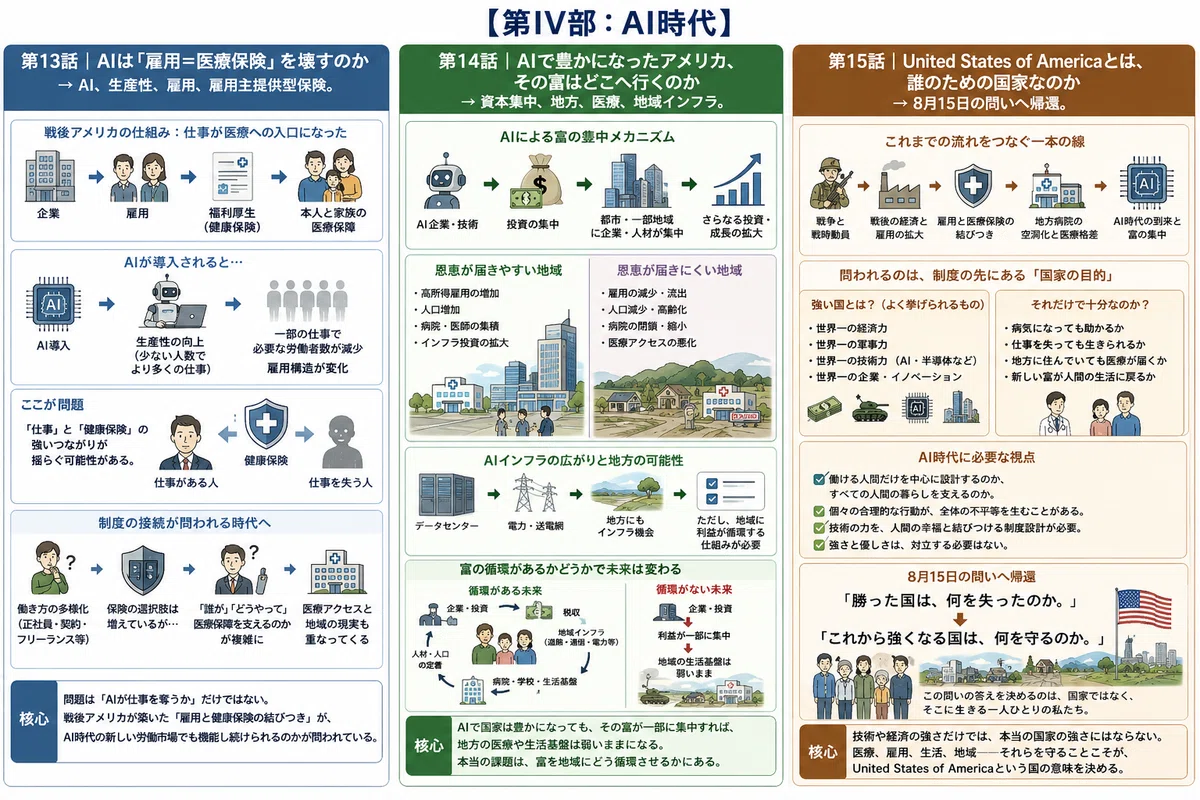
第13話|AIは「雇用=医療保険」を壊すのか
――AI、生産性、雇用、そして戦後アメリカの仕組み
ここまで、長い時間をかけて一つの構造を見てきました。
第二次世界大戦。
↓
戦時経済。
↓
大量雇用。
↓
企業と労働者。
↓
雇用主提供型の健康保険。
↓
そして80年後。
地方病院の閉鎖。
医療アクセスの格差。
地域経済の空洞化。
ここで突然、
AI
が登場します。
しかし、AIそのものが今回の主役ではありません。
本当に考えたいのは、
AIによって「仕事」と「医療保険」の関係が変わったら、アメリカの医療制度はどうなるのか?
という問いです。
⸻
戦後アメリカでは「仕事」が医療への入口になった
第二次世界大戦後のアメリカでは、雇用主を通じた健康保険が大きく成長しました。
その背景には、
企業
↓
労働者
↓
福利厚生
↓
健康保険
という仕組みがあります。
つまり、多くの人にとって、
仕事を持つことが、医療保障への重要な入口になった。
もちろんアメリカにはMedicareやMedicaid、個人市場など、雇用とは別の制度もあります。
だから、
「仕事を失ったら必ず無保険になる」
という単純な話ではありません。
しかし、雇用主提供型保険がアメリカの医療保障において非常に大きな位置を占めていることは重要です。
⸻
では、AIによって仕事の形が変わったら?
ここで仮説を置きます。
企業がAIを導入する。
↓
同じ人数でより多くの仕事ができる。
↓
一部の業務では必要な労働者数が減る。
↓
雇用構造が変化する。
このとき、
仕事
と
健康保険
の関係も変わる可能性があります。
ただし、ここで、
「AIが導入されれば大量失業する」
と断定する必要はありません。
AIは新しい仕事を生み出す可能性もあります。
既存の仕事を変える可能性もあります。
人間の能力を補完する可能性もあります。
したがって重要なのは、
AIが雇用を何人減らすか
という単純な数字だけではありません。
⸻
本当に見るべきなのは「雇用の構造」
例えば、
100人でやっていた仕事を、
AIによって80人でできるようになったとします。
企業にとっては、
生産性向上
です。
しかし社会全体では、
その20人が、
どこへ行くのか?
という問題が生まれます。
別の仕事に移るのか。
新しい産業に移るのか。
教育を受け直すのか。
フリーランスになるのか。
起業するのか。
それとも、
仕事そのものを失うのか。
そして、そのとき、
健康保険はどうなるのか?
という問題が出てきます。
⸻
ここで戦後の設計がもう一度現れる
戦後アメリカの制度は、
雇用
と
医療保障
をかなり強く結びつけました。
これは、
大量雇用の時代には非常に合理的でした。
企業が人を雇う。
↓
労働者が賃金を得る。
↓
企業が福利厚生を提供する。
↓
労働者と家族が保険を得る。
↓
医療制度が維持される。
このモデルは、
大量雇用社会
と相性がよかった。
⸻
でもAI時代には前提が変わるかもしれない
AIによって、
「企業が生み出す価値」
と
「企業が必要とする労働者数」
の関係が変わる可能性があります。
ここが重要です。
企業が、
少ない人数で、
より大きな価値を生み出せるようになった場合、
企業にとっては素晴らしいことです。
株主にとっても、
投資家にとっても、
国家の生産性という観点からも、
プラスになる可能性があります。
⸻
しかし、社会保障から見ると別の問題が生まれる
もし、
雇用が減る
↓
雇用主提供型保険の対象者が減る
となったら?
もちろん、他の保険制度へ移行することはできます。
ACAのマーケットプレイス。
Medicaid。
Medicare。
その他の民間保険。
いろいろな選択肢があります。
だから、
「AI=無保険」
ではありません。
ここは明確に区別する必要があります。
⸻
本当の問題は「制度の接続」
問題は、
一つの制度が壊れること
ではありません。
むしろ、
雇用
所得
健康保険
医療アクセス
が、
これまでと同じようにつながり続けるのか、
という問題です。
例えば、
正社員
↓
企業保険
という一本道から、
正社員
契約労働
フリーランス
複数の仕事
個人事業
AIによる小規模事業
など、
働き方が多様化していけば、
「誰が医療保障を支えるのか」
という問いも複雑になります。
⸻
さらに第III部の問題が重なる
ここが今回、一番重要です。
第III部では、
地方経済
↓
人口
↓
病院
↓
医療アクセス
という循環を見ました。
そこにAIを入れてみます。
⸻
シナリオA:AIが地方を救う
AIによって、
遠隔診療が普及する。
↓
都市部の専門医と地方医療をつなぐ。
↓
診断支援が進む。
↓
医療事務の負担が減る。
↓
少ない医療従事者でもサービスを維持できる。
これは、
AIが医療格差を縮める未来
です。
⸻
シナリオB:AIが富をさらに集中させる
一方で、
AI企業が都市部に集中する。
↓
投資が集中する。
↓
高所得者が集中する。
↓
人口・資本がさらに集中する。
↓
地方から雇用が流出する。
↓
人口が減る。
↓
病院経営がさらに厳しくなる。
↓
医療アクセスが悪化する。
これは、
AIが地域格差を拡大する未来
です。
⸻
つまり、AIそのものが善悪を決めるわけではない
ここが重要です。
AIは、
地方医療を救うこともできる。
同時に、
地域経済の格差を拡大する方向に働くこともできる。
何が結果を決めるのか。
それは、
AIそのものだけではありません。
制度設計です。
⸻
「生産性が上がる」とは何なのか
ここで、
生産性
という言葉を考えてみます。
100人で100の価値を作っていた。
AIによって、
50人で100の価値を作れるようになった。
企業から見れば、
生産性が2倍になった
と考えられます。
でも社会から見ると、
残りの50人はどうなるのか。
ここに、
企業の生産性
と
社会の生存基盤
の違いが出てきます。
⸻
そして、おじさんが最初から言っていた問いにつながる
第二次世界大戦中、
国家は、
人間を生産力として動員した。
戦後は、
雇用を通じて人間と経済を結びつけた。
そして現在、
AIは、
人間一人あたりの生産能力をさらに引き上げようとしている。
ここで問われるのは、
人間が生産活動から離れたとしても、その人間の生活を国家はどう支えるのか?
という問題です。
⸻
医療は「働いた人へのご褒美」なのか
ここで、かなり厳しい問いを置きます。
もし健康保険が、
仕事をしている人
に強く結びついているなら、
仕事を失った人は、
社会にとって価値がなくなったから医療保障も弱くなる
のでしょうか。
もちろん、アメリカの制度はそんな単純な思想で作られているわけではありません。
しかし、
雇用と保険が強く結びついた制度
では、
どうしてもこの問いが発生します。
⸻
AI時代には「働けるか」と「生きられるか」を分ける必要があるのか
これが第13話の核心です。
これまで、
働く
↓
所得を得る
↓
保険を得る
↓
医療を受ける
という構造が強かった。
でも、
AIによって、
働き方そのものが変わる
なら、
「働くこと」と「生きること」をどこまで制度的に結びつけておくのか?
という問いが出てくる。
⸻
これはUBIだけの話ではない
ここで、
「じゃあUBIを導入すればいい」
と簡単に結論を出す必要もありません。
考えるべき選択肢は、
* 雇用主提供型保険の維持
* 個人向け保険の拡充
* 公的医療制度の拡大
* ACAの強化
* Medicaidなどの支援
* 医療費そのものの改革
* 地方医療への公的支援
* AIによる医療アクセス改善
など、複数あります。
つまり、
AI時代の医療保障は、一つの制度だけで解決する問題ではない。
⸻
そして「国家の生産性」という言葉が戻ってくる
第二次世界大戦中、
健康な国民
↓
強い軍隊
↓
強い工業力
↓
国家の力
という考え方がありました。
トルーマンが戦後の医療政策を語ったときにも、
国民の健康と国家の力
を結びつける発想がありました。
そして今、
AIによる生産性
が国家の競争力を左右する時代になっています。
ならば、
AI時代の国家の力も、結局はそこに暮らす人間の健康と生活基盤に戻ってくるのではないか。
⸻
第13話の核心
AIが雇用を変える可能性があるとき、問題は「AIが仕事を奪うか」だけではない。
戦後アメリカが形成してきた「雇用と健康保険の結びつき」が、AI時代の新しい労働市場でも機能し続けられるのかが問われる。
AIは地方医療を支える可能性もあれば、資本と雇用を都市部へさらに集中させる可能性もある。
だから、AI時代の本当の争点は「AIを導入するか」ではなく、「AIによって生まれた生産性と富を、人間の生活基盤へどう接続するか」なのかもしれない。
そして次の第14話では、さらに一歩進む。
第14話|AIで豊かになったアメリカ、その富はどこへ行くのか
ここでは、
AI → 生産性 → 企業価値 → 資本集中 → 地方 → 医療 → 地域インフラ
を一本の線にしていく。
そして最後の第15話で、
「United States of Americaとは、誰のための国家なのか」
という、8月15日に最初に置いた問いへ帰還する。
よし。では第IV部・第14話。
第13話で「AIが雇用と医療保険の関係を揺さぶるか」を見た。今回は、その先です。
【第IV部:AI時代】
第14話|AIで豊かになったアメリカ、その富はどこへ行くのか
――資本集中、地方、医療、そして地域インフラ
第13話では、
AIは「雇用=医療保険」という戦後アメリカの仕組みを揺さぶるのか。
という問いを置きました。
では、もう一つ問いましょう。
もしAIによってアメリカの生産性が大きく上がったとしたら、
その富は、どこへ行くのでしょうか。
⸻
AIはすでに「巨大な投資」を呼び込んでいる
これは未来の話だけではありません。
2025年、アメリカではAI関連の民間投資が非常に大きく膨らみました。OECDによると、2025年の世界のAIベンチャー投資額のうち、アメリカは約75%、約1,940億ドルを占めています。
Stanfordの2026 AI Indexでも、2025年の米国内AI民間投資はカリフォルニア州だけで約2,180億ドルとされ、米国全体の75%超を占めています。さらに半数以上の州ではAI民間投資が1億ドル未満でした。
つまり、
AIは、すでに「どこにお金が集まるのか」という地理的な問題を持っている。
⸻
AIはどこでも同じように育つわけではない
AI企業を作るには、
資本
人材
大学
研究機関
データセンター
半導体
電力
通信
が必要です。
これらがすでに存在する地域ほど、AI産業は成長しやすい。
だから、
AI企業がある場所に投資が集まる。
↓
投資が集まるから人材が集まる。
↓
人材が集まるから企業が集まる。
↓
企業が集まるからさらに投資が集まる。
ここでも、
正の循環
が生まれます。
Brookingsも、米国のAI活動が少数の「スーパースター」地域や先行導入地域に集中していると分析しています。ベイエリアだけでAI関連求人の13%を占めるという分析もあります。
⸻
ここで第III部とつながる
第III部では、
雇用
↓
所得
↓
人口
↓
医療
↓
地域経済
という循環を見ました。
AI時代には、ここへ新しいものが加わります。
AI資本
です。
⸻
AI資本が集まる
AI企業
↓
投資
↓
データセンター
↓
電力需要
↓
通信インフラ
↓
高所得雇用
↓
人口・企業の集中
↓
さらに投資
という新しい循環が生まれる可能性があります。
実際、米連邦準備制度の2026年の分析でも、AIブームに伴う米国の設備投資は大きく膨らんでおり、主要テクノロジー企業5社の2025年設備投資は年間約4,120億ドル、GDPの約1.31%に達したとされています。
⸻
でも、ここで一つ疑問が出る
AIによって生まれた富は、AI産業のある地域だけに残るのでしょうか。
例えば、
シリコンバレー。
ニューヨーク。
ボストン。
シアトル。
その他のAI・テクノロジー集積地域。
そこに、
企業
投資
高度人材
データセンター
大学
研究機関
が集まる。
一方で、
AI産業と直接関係のない地域では、
その恩恵がどの程度届くのか。
これは別の問題です。
⸻
「国家が豊かになる」と「町が豊かになる」は同じではない
ここが第14話の核心です。
GDPが増える。
企業価値が増える。
株式市場が上昇する。
AI企業が世界市場で勝つ。
これらは、
アメリカという国家の経済力
を高める可能性があります。
しかし、
ある地方都市の住民から見たら、
「自分の町の病院は残ったのか?」
という問題があります。
⸻
1000億ドルのAI投資と、病院の閉鎖
極端な例を考えてみます。
ある地域で、
AI企業に巨額の投資が入る。
↓
データセンターが建つ。
↓
電力設備が増強される。
↓
道路や通信インフラが整備される。
↓
雇用が生まれる。
これは素晴らしいことです。
でも別の地域では、
病院の経営が悪化している。
医師が足りない。
救急機能が縮小している。
人口が減っている。
こういうことも同時に起こり得る。
だから、
「アメリカに金があるか」
だけでは足りない。
重要なのは、
「その金が、どこへ流れているのか」
です。
⸻
AI時代の「富の地理」
ここで、
富の地理
という考え方が出てきます。
AIによって生まれる価値が、
特定の都市。
特定の企業。
特定の投資家。
特定の高度人材。
特定の地域。
に集中すると、
経済的な中心と生活圏の距離
が広がる可能性があります。
⸻
しかし、ここも単純に「AI企業が悪い」ではない
ここは第II部からずっと守ってきたルールです。
AI企業は、
利益を出すために投資する。
投資家は、
成長する場所に資本を投じる。
企業は、
人材がいる場所へ集まる。
人材は、
仕事がある場所へ移動する。
一つ一つを見れば、
全部合理的です。
⸻
問題は「合成された結果」
個々の行動が合理的でも、
全体を見ると、
富が特定地域へ集中する。
↓
人材が集中する。
↓
企業が集中する。
↓
税収・投資・インフラも集中する。
↓
さらに地域格差が広がる。
ということが起こる可能性があります。
これは、
誰か一人の悪意ではなく、システムの合成結果
として考えた方がいい。
⸻
そして医療が再び登場する
第III部で見たように、
医療も、
人口
所得
雇用
需要
と結びついています。
だから、
富が集まる
↓
人が集まる
↓
医療需要が増える
↓
病院・医師が集まりやすくなる
という方向へ進む可能性があります。
逆に、
富が流出する
↓
人口が減る
↓
医療需要が減る
↓
病院が苦しくなる
↓
医師が減る
という方向もあり得ます。
⸻
だからAIは「医療問題」でもある
一見すると、
AIと健康保険は別の話です。
でも実際には、
AI
↓
雇用
↓
所得
↓
人口
↓
病院
↓
医療アクセス
という線でつながっています。
つまり、
AI政策は、長期的には地域医療政策にもなり得る。
⸻
さらに「電力」という問題が出てくる
AIには、
計算能力
が必要です。
計算能力には、
データセンター
が必要です。
データセンターには、
大量の電力
が必要です。
そして電力には、
発電所
送電網
土地
水
などのインフラが必要になります。
米連邦準備制度も、AI投資ブームが高水準の設備投資を伴っており、AI関連インフラの拡大には電力や半導体などの供給制約が関係すると分析しています。
つまり、
AIの時代は、デジタル産業だけの時代ではない。
むしろ、
電力・土地・通信・水・道路
といった、
非常に物理的なインフラの時代
でもあります。
⸻
ここで「地方」がもう一度出てくる
面白いのは、
AIそのものは都市に集中していても、
データセンターや電力設備は必ずしも都市中心部に置く必要がない
ということです。
ここには、
地方がAI時代の新しい産業基盤になる可能性
があります。
土地がある。
電力がある。
通信を整備できる。
冷却設備を作れる。
再生可能エネルギーを確保できる。
港湾や物流インフラがある。
こうした条件を持つ地方は、
AIインフラの受け皿
になり得ます。
⸻
しかし「データセンターが来れば地方が豊かになる」とも限らない
ここも重要です。
データセンターが建設される。
↓
巨大な投資が入る。
しかし、
恒常的な雇用がどれだけ生まれるのか。
電力コストは誰が負担するのか。
税収は地域にどれだけ残るのか。
住宅価格はどうなるのか。
水資源は大丈夫なのか。
地域の病院や学校にも利益が回るのか。
こうした問題があります。
つまり、
「投資が来ること」と「地域が豊かになること」は同義ではない。
⸻
ここで「富の循環」という言葉が重要になる
AI時代に本当に必要なのは、
富を作ること
だけではない。
富を循環させること
です。
例えば、
AI企業
↓
税収
↓
地方インフラ
↓
病院
↓
学校
↓
住宅
↓
交通
↓
人材
↓
さらに企業
という循環が作れれば、
AI投資は地域経済を支えることができます。
⸻
逆に、循環しなければ
AI企業
↓
利益
↓
株主
↓
投資家
↓
さらにAI企業へ再投資
という循環だけになれば、
AI産業そのものは巨大化する。
でも、
その地域の病院。
学校。
道路。
住宅。
生活基盤。
には十分なお金が戻らない可能性があります。
ここが、
「企業の成功」と「地域の成功」の違い
です。
⸻
そして第13話とつながる
第13話では、
AIによって雇用と健康保険の関係が揺らぐ可能性
を考えました。
第14話では、
AIによって生まれた富が、どこに集中し、どこへ循環するのか
を考えています。
この二つを合わせると、
AI
↓
生産性
↓
企業価値
↓
資本
↓
雇用
↓
所得
↓
健康保険
↓
地域医療
という一本の線が見えてきます。
⸻
そして、最後の問いへ
ここまで来ると、
「AIは危険だ」
という話ではありません。
むしろ、
AIはものすごく強力な経済成長装置になる可能性がある。
だからこそ、
その強力な装置を、国家として何のために使うのか?
が問題になります。
⸻
「アメリカを強くする」とは何なのか
AIで世界一になる。
半導体で勝つ。
データセンターを増やす。
企業価値を高める。
生産性を上げる。
軍事技術を高度化する。
これらは、
国家競争力
として重要です。
でも、
その一方で、
地方の病院が消える。
救急アクセスが悪化する。
医師が不足する。
仕事が減る。
人口が流出する。
ならば、
その国家の強さは、誰の生活を支えているのでしょうか。
⸻
ここで1947年の問いが戻ってくる
戦後のアメリカは、
国家の力
と
国民の健康
を結びつけて考えました。
80年後。
今度は、
AIによる国家の生産力
と
人間の生活基盤
をどう結びつけるのか。
問いは変わったように見えて、
実は同じなのかもしれません。
⸻
第14話の核心
AIによってアメリカが豊かになる可能性は高まっている。しかし、「国家の富が増えること」と「すべての地域の生活基盤が強くなること」は同じではない。
現在のAI投資は米国の一部地域に強く集中しており、AI経済には明確な地理的偏りがある。
そのため、AI時代の本当の政策課題は、AIを導入するかどうかだけではなく、AIによって生まれた富・税収・雇用・インフラ投資を、地域の医療や生活基盤へどう循環させるかにある。
企業が強くなることと、地域が強くなることは、必ずしも同じではない。
そして、いよいよ最後です。
第15話|United States of Americaとは、誰のための国家なのか
ここで、
第二次世界大戦
↓
戦後医療制度
↓
雇用主提供型保険
↓
地方医療の空洞化
↓
AI
↓
富の集中
を全部一本につなぐ。
そして最後に、
「勝った国は、何を失ったのか。」
という、8月15日に始まった問いへ戻る。
ここで15話完結にしよう。
よし。いよいよ最終話。
ここは第1話から積み上げてきたものを全部つなげて、答えを断定するのではなく、最初の問いを読者に返して終わる回にしよう。
【第IV部:AI時代】
第15話|United States of Americaとは、誰のための国家なのか
――8月15日の問いへ帰還する
ここまで14話。
第二次世界大戦。
戦時動員。
戦後のアメリカ。
健康保険。
雇用。
地方病院。
医療アクセス。
地域経済。
そしてAI。
ずいぶん遠くまで来ました。
でも、最後に残った問いは、実は最初と同じです。
⸻
「勝った国は、何を失ったのか。」
8月15日。
日本にとっては、第二次世界大戦が終わった日として記憶される日です。
では、アメリカにとって、この戦争は何だったのでしょうか。
もちろん、
勝利した戦争
です。
経済大国としての地位を確立し、
軍事力を拡大し、
世界秩序の中心的な存在になっていきました。
だから、
「アメリカは第二次世界大戦に勝った」
これは間違いありません。
⸻
でも、「勝った」だけでは歴史は終わらない
戦争が終わった瞬間、
国家には次の仕事があります。
戦時体制を、平時の社会へ戻すこと。
兵士を戻す。
工場を戻す。
経済を戻す。
家族を戻す。
労働市場を戻す。
そして、
人間が普通に暮らせる社会を設計する。
ここが重要です。
⸻
戦時には「人間」が国家の資源になる
戦争をしているとき、
国家は人間を必要とします。
兵士。
工場労働者。
輸送。
技術者。
医療従事者。
通信。
農業。
あらゆる人間の力が必要になります。
だから、
国民の健康
は、
国家の生産力
そのものになります。
⸻
そして戦争が終わった
ここで、
「では、平時にはどうするのか?」
という問題が生まれます。
戦争のために作った仕組みを、
そのまま残すのか。
それとも、
新しい社会に合わせて作り直すのか。
このシリーズでは、
その一つの象徴として、
健康保険
を見てきました。
⸻
雇用と医療が結びついたアメリカ
戦後のアメリカでは、
企業
↓
雇用
↓
福利厚生
↓
健康保険
という仕組みが大きく成長しました。
大量雇用の時代には、
非常に合理的でした。
企業は労働者を確保できる。
労働者は給与と福利厚生を得る。
家族も医療保障を得る。
経済が成長する。
病院も成長する。
社会全体が豊かになる。
だから、
この仕組みが長く続いたこと自体は不思議ではありません。
⸻
しかし、80年後
人口構造が変わりました。
産業構造が変わりました。
製造業の雇用構造が変わりました。
地域経済も変わりました。
そして、
医療費は巨大化しました。
さらに、
地方では病院が閉鎖する。
医師が不足する。
救急アクセスが遠くなる。
ここで、
「保険があるか」
という問題だけでは説明できなくなります。
⸻
保険があっても、病院がなければ
第III部で見た問いです。
保険を持っている。
でも、
病院が遠い。
専門医がいない。
救急施設がない。
交通手段がない。
その場合、
「あなたには保険があります」
と言われても、
現実の問題は解決しません。
ここで、
保険
と
医療アクセス
が分離します。
⸻
さらに、医療と地域経済がつながっていた
病院は、
単なる医療施設ではありません。
雇用があります。
給与があります。
人が住みます。
商店が生まれます。
学校が必要になります。
交通が必要になります。
だから、
病院が消える
ということは、
単に医療施設が一つ減ることではありません。
場合によっては、
地域そのものの経済循環が弱くなる。
⸻
そしてAIがやってきた
ここで第IV部です。
AIによって、
生産性が上がる可能性があります。
少ない人数で、
より多くの価値を生み出せる。
これは、
国家にとって大きな力です。
企業にとっても大きな力です。
そして、
働く人にとっても、
うまく使えば大きな力になります。
⸻
しかし、一つの問いが残る
もし、
AIによって企業の生産性が上がる
↓
必要な労働者数が一部で減る
となったら?
戦後の、
雇用
と
健康保険
の結びつきはどうなるのでしょうか。
⸻
そして、もう一つ
AIによって、
アメリカの企業価値が上がる。
投資が増える。
世界から資本が集まる。
GDPが増える。
国家競争力が高まる。
それは素晴らしい。
では、
その富は、どこへ行くのでしょうか?
⸻
シリコンバレーだけの話ではない
AIによって生まれる富が、
一部の企業。
一部の投資家。
一部の地域。
一部の高度人材。
に集中するなら、
国家全体の経済力は高まっても、
地域によっては、
病院。
学校。
道路。
住宅。
雇用。
といった生活基盤が弱いままになる可能性があります。
ここで、
国家の成長
と
地域の成長
が分離する可能性が出てきます。
⸻
ここまで来ると、「医療」の話ではなくなる
最初は健康保険の話でした。
でも、
健康保険
↓
雇用
↓
所得
↓
人口
↓
病院
↓
地域経済
↓
AI
↓
資本
↓
国家の生産性
までつながってしまった。
つまり、
医療は、
社会全体の状態を測る体温計
だったのかもしれません。
⸻
「誰が悪いのか」では説明できない
このシリーズで、最後まで避けたかったのが、
「あの会社が悪い。」
「あの政党が悪い。」
「あの業界が悪い。」
という単純な結論です。
AMAにはAMAの論理がある。
医師には医師の生活がある。
保険会社には保険会社の事業がある。
企業には企業の競争がある。
投資家には投資家の判断がある。
政府には政府の制約がある。
地方には地方の事情がある。
AI企業にも、
AIを発展させるという合理的な目的
があります。
一つ一つを見ると、
それぞれ合理的です。
⸻
それでも、全体として問題が起きる
ここが、
このシリーズで一番大切なところです。
個々の判断が合理的でも、
それらが組み合わさった結果、
「国家は強くなっているのに、人間の生活基盤が弱くなる」
という現象が起きる可能性があります。
これは、
誰か一人の失敗ではありません。
システムの設計問題です。
⸻
だから「United States」という名前を考える
United States of America。
日本語なら、
アメリカ合衆国。
United。
結びついた。
States。
州。
つまり、
異なる地域が、
一つの国家として結びついている。
⸻
では、何によって結びついているのか
憲法でしょうか。
法律でしょうか。
軍隊でしょうか。
通貨でしょうか。
市場でしょうか。
税制でしょうか。
あるいは、
「同じ国民として生きている」という感覚
でしょうか。
ここが最後の問いです。
⸻
テクノロジーで強い国
AIで世界をリードする。
半導体で勝つ。
宇宙開発を進める。
軍事技術を高度化する。
金融市場を支配する。
巨大企業を生み出す。
これは、
強い国
です。
⸻
でも、それだけで十分なのか
その一方で、
地方の病院がなくなる。
救急車の到着に時間がかかる。
医師がいない。
仕事がない。
若者が町を出ていく。
高齢者が医療を受けにくくなる。
そういう場所が増えたとしたら、
その国は、
本当に強いのでしょうか。
⸻
ここで、1947年の問いに戻る
戦後アメリカでは、
国民の健康
と
国家の力
を結びつけて考える思想がありました。
これは、
戦時中だけの発想ではありません。
平時でも、
国民が健康であることが、
国家の力になる。
この考え方自体は、
今でも成立するはずです。
⸻
ただし、2026年は条件が違う
1940年代は、
人間が生産力の中心
でした。
2026年。
そしてこれからは、
AIと人間が生産力を分担する時代
になる可能性があります。
だから、
国家の設計思想も、
変わる必要があるのかもしれません。
⸻
「働ける人間」だけを中心に国家を考えるのか
ここが、
AI時代の最も厳しい問いです。
人間が、
AIによって、
以前ほど労働しなくてもよくなる。
それは本来、
人間にとって素晴らしいこと
のはずです。
労働時間が減る。
危険な仕事が減る。
生産性が上がる。
余暇が増える。
創造的な仕事が増える。
ところが、
もし社会保障が、
「働いていること」
を前提にしていたら、
話が逆転します。
⸻
技術が人間を自由にしたのに、制度が人間を縛る
これが、
AI時代に起こり得る最大の皮肉です。
AIによって、
人間が働かなくても社会を維持できる可能性
が高まる。
ところが、
「働かなければ医療保障を維持しにくい」
という制度が残っていたら、
技術の進歩と社会制度が逆方向を向いてしまいます。
⸻
だから最後の問い
ここまで来たら、
私は答えを一つに決めません。
読者に渡します。
⸻
国家とは何なのか。
世界で最も強い企業を作るための仕組みなのか。
世界で最も強い軍事力を維持するための仕組みなのか。
世界で最も高いGDPを作るための仕組みなのか。
それとも、
そこに暮らす人間が、病気になっても、仕事を失っても、地方に住んでいても、生き続けられる共同体なのか。
⸻
そして、8月15日に戻る
1945年。
戦争が終わった。
勝った国は、
世界で最も強い国家の一つ
になりました。
でも、
「勝った」という言葉だけでは、その後80年の歴史を説明できません。
戦争に勝った。
経済で勝った。
技術で勝った。
企業が成長した。
世界をリードした。
それでも、
その巨大な国家の中で、
「ここに住み続けて大丈夫なのか?」
と考える人がいる。
⸻
だから、最初の問いを少し変えてみる
最初は、
「勝った国は、何を失ったのか。」
でした。
最後には、
こう変えたい。
「強くなった国は、その強さを誰のために使うのか。」
そして、
「国家の強さと、人間の幸福を、なぜ別々に考えなければならないのか。」
⸻
15話を終えて
このシリーズで見てきたのは、
アメリカを批判することではありません。
第二次世界大戦を、
「勝った」「負けた」
だけで終わらせないこと。
戦後にどんな制度が選ばれたのかを見ること。
その制度が80年間どう変化したのかを見ること。
地方で何が起きているのかを見ること。
そして、
AI時代に、その制度がまだ機能するのか
を考えること。
⸻
最後に、おじさんから一つ
強い国って、何だろう。
世界一の企業があることか。
世界一の軍隊があることか。
世界一のAIがあることか。
世界一のGDPがあることか。
それとも――
病気になった人を助けられること。
地方に住んでいる人にも医療が届くこと。
仕事を失っても、生きることを諦めなくていいこと。
新しい技術によって生まれた富が、人間の生活に戻ってくること。
そういうことまで含めて、
「強い国」
と呼ぶのではないでしょうか。
⸻
「United States of America」とは、誰のための国家なのか。
この問いに、
私は一つの答えを出しません。
なぜなら、
その答えを決めるのは、国家そのものではなく、そこに生きる人間だからです。
8月15日。
戦争が終わった日から、
81年。
そして今、
AIという新しい時代が始まろうとしている。
また私たちは、
「どんな社会を作るのか」
という選択の前に立っています。
だから最後に、もう一度。
勝った国は、何を失ったのか。
そして、
これから強くなる国は、何を守るのか。
――この二つの問いを残して、この物語を一度終わります。
もちろん。第4章は第13〜15話を一つの記事にまとめる前提で、英語圏の読者にも自然に伝わるように、直訳ではなく意味を保った英語版に仕立てます。
Part IV|In the Age of AI
What Will a Stronger America Protect?
— Employment, Healthcare, Concentrated Wealth, and the Future of the Nation
⸻
Episode 13|Will AI Break the Link Between Employment and Health Insurance?
— AI, Productivity, Employment, and the Postwar American System
So far, we have followed one structure across decades:
World War II.
↓
Wartime mobilization.
↓
Mass employment.
↓
Employers and workers.
↓
Employer-sponsored health insurance.
↓
Eighty years later:
Rural hospital closures.
Healthcare access gaps.
Regional economic decline.
And now,
AI has entered the picture.
But AI itself is not the real subject of this episode.
The deeper question is:
If AI changes the relationship between work and health insurance, what happens to the American healthcare system?
⸻
In postwar America, employment became an important gateway to healthcare
After World War II, employer-sponsored health insurance grew into a major part of the American healthcare system.
The structure was roughly:
Company
↓
Employment
↓
Employee Benefits
↓
Health Insurance
For many Americans, having a job became an important pathway to obtaining health coverage.
Of course, the United States also has Medicare, Medicaid, the ACA marketplaces, and other forms of insurance.
So it would be inaccurate to say:
“If you lose your job, you automatically become uninsured.”
That is not how the system works.
But the strong connection between employment and health insurance remains an important feature of the American model.
⸻
What happens if AI changes the nature of work?
Here we can propose a hypothesis.
A company adopts AI.
↓
The same number of workers can accomplish more.
↓
Some tasks require fewer workers.
↓
The structure of employment changes.
Then another question emerges:
What happens to health insurance?
But we should not jump to the conclusion that:
“AI will inevitably cause mass unemployment.”
AI may create new jobs.
It may transform existing jobs.
It may complement human workers.
It may create entirely new industries.
Therefore, the important question is not simply:
How many jobs will AI eliminate?
It is:
How will the structure of employment change?
⸻
The real issue is the structure of employment
Imagine that 100 people previously performed a certain amount of work.
AI makes it possible for 80 people to produce the same amount.
From the company’s perspective:
Productivity has increased.
But society has another question:
What happens to the other 20 people?
Do they move into other jobs?
Do new industries absorb them?
Do they retrain?
Do they become freelancers?
Do they start businesses?
Or do they lose employment entirely?
And then:
What happens to their healthcare coverage?
⸻
This brings us back to the postwar design
The postwar American system strongly connected:
Employment
↓
Income
↓
Benefits
↓
Health Insurance
This was highly compatible with an economy based on mass employment.
Companies hired workers.
Workers earned wages.
Employers provided benefits.
Workers and their families received health coverage.
The economy grew.
Hospitals grew.
The system reinforced itself.
⸻
But the assumptions may be changing
AI may change the relationship between:
The value a company produces
and
the number of workers it needs.
If companies can generate more value with fewer employees, that can be positive for:
* productivity;
* corporate competitiveness;
* investment;
* shareholders;
* national economic strength.
But from the perspective of social protection, another question appears.
If employment declines in some sectors,
who maintains access to healthcare?
⸻
The real problem is the connection between systems
The issue is not simply that one system might collapse.
The deeper issue is whether:
employment
income
health insurance
and
healthcare access
will continue to connect with one another in the same way.
The labor market may become increasingly diverse:
* full-time employees;
* contract workers;
* freelancers;
* independent businesses;
* multiple-job workers;
* AI-assisted entrepreneurs.
If so,
Who is responsible for providing healthcare coverage?
becomes a much more complicated question.
⸻
And then Part III comes back
In Part III, we examined the cycle connecting:
Regional Economy
↓
Population
↓
Hospitals
↓
Healthcare Access
Now add AI.
⸻
Scenario A: AI helps rural healthcare
AI could expand telemedicine.
↓
Rural patients connect with specialists in cities.
↓
Diagnostic assistance improves.
↓
Administrative workloads decline.
↓
Limited medical staff can serve more patients.
This would mean:
AI could help reduce healthcare inequality.
⸻
Scenario B: AI concentrates wealth even further
AI companies concentrate in major cities.
↓
Investment follows.
↓
High-income workers follow.
↓
Capital becomes even more concentrated.
↓
Jobs leave weaker regions.
↓
Population declines.
↓
Hospitals become financially weaker.
↓
Healthcare access deteriorates.
This would mean:
AI could also widen regional inequality.
⸻
AI itself is not the answer
This is important.
AI can:
strengthen rural healthcare.
But AI can also:
reinforce economic concentration.
The outcome depends not only on the technology.
It also depends on:
institutional design.
⸻
What does “higher productivity” actually mean?
Suppose:
100 workers previously created 100 units of economic value.
AI allows:
50 workers to create the same 100 units.
From a corporate perspective:
productivity has doubled.
But society must ask:
What happens to the other 50 people?
This is where we see the difference between:
corporate productivity
and
social resilience.
⸻
The question we started with returns
During World War II, the state mobilized human beings as productive resources.
After the war, employment became deeply connected to economic life and healthcare.
Now AI is increasing the productive capacity of each worker.
So the question becomes:
If human beings become less necessary for production, how should the state support human beings who are no longer needed in the same way by the labor market?
⸻
Is healthcare a reward for working?
Here is the uncomfortable question.
If health insurance is strongly connected to employment,
does losing a job make healthcare more difficult to access?
Of course, the American system was not designed around the idea that unemployed people have no value.
But when employment and health insurance are strongly connected,
the question inevitably emerges.
⸻
Should “being able to work” and “being able to live” be separated?
This is the central question of Episode 13.
For decades, the structure has often looked like:
Work
↓
Income
↓
Health Insurance
↓
Healthcare
But if AI changes the nature of work, we must ask:
How strongly should the right to live a healthy life remain institutionally tied to employment?
This is not simply a question about Universal Basic Income.
Possible approaches include:
* strengthening employer-sponsored insurance;
* expanding individual insurance;
* expanding public healthcare programs;
* strengthening the ACA;
* expanding Medicaid;
* reducing healthcare costs;
* supporting rural healthcare;
* using AI to improve healthcare access.
The point is that:
AI-era healthcare cannot be solved by a single policy.
⸻
Episode 14|America May Become Richer Through AI — But Where Will the Wealth Go?
— Capital Concentration, Rural America, Healthcare, and Regional Infrastructure
Episode 13 asked whether AI could disrupt the relationship between employment and health insurance.
Now we go one step further.
Suppose AI dramatically increases American productivity.
Then we must ask:
Where does the wealth go?
⸻
AI is already attracting enormous investment
This is not merely a future scenario.
AI investment is already heavily concentrated in the United States and in particular regions.
The OECD reported that the United States accounted for roughly three-quarters of global AI venture capital investment in 2025.
Stanford’s 2026 AI Index also shows a strong geographic concentration of private AI investment in the United States.
In other words:
AI already has a geography of wealth.
⸻
AI does not develop equally everywhere
Building an AI industry requires:
Capital
Talent
Universities
Research institutions
Data centers
Semiconductors
Electricity
Telecommunications
The more of these resources a region already has, the easier it becomes for additional AI investment to arrive.
This creates a positive feedback loop:
AI Companies
↓
Investment
↓
Talent
↓
More Companies
↓
More Investment
⸻
And this connects directly to Part III
Part III examined:
Employment
↓
Income
↓
Population
↓
Healthcare
↓
Regional Economy
AI adds another factor:
AI capital.
The new cycle may look like:
AI Companies
↓
Investment
↓
Data Centers
↓
Electricity Infrastructure
↓
High-Income Employment
↓
Population and Corporate Concentration
↓
More Investment
⸻
But here is the question
If AI creates enormous amounts of wealth,
will that wealth remain concentrated in the regions where the AI industry is located?
Silicon Valley.
New York.
Boston.
Seattle.
Other technology clusters.
These regions attract:
companies
investment
talent
universities
research
infrastructure.
But what happens to communities that are not directly connected to the AI economy?
⸻
A richer nation does not automatically mean richer towns
GDP can increase.
Corporate valuations can increase.
The stock market can rise.
AI companies can dominate global markets.
These things can strengthen:
the American national economy.
But a resident of a small town may ask a different question:
“Is my local hospital still here?”
That is the distinction between:
national economic growth
and
local economic resilience.
⸻
The geography of AI wealth
If AI-generated value becomes concentrated among:
* certain companies;
* investors;
* highly skilled workers;
* major cities;
* specific regions;
then the distance between:
economic centers
and
everyday living communities
may increase.
⸻
But this does not mean “AI companies are bad”
This is an important principle throughout this series.
AI companies invest where they expect growth.
Investors put capital where they see opportunity.
Companies locate where talent is available.
Workers move toward jobs.
Each individual decision can be perfectly rational.
The problem can emerge from the combined result:
Capital concentrates.
↓
Talent concentrates.
↓
Companies concentrate.
↓
Infrastructure follows.
↓
Regional inequality may increase.
This is not necessarily the result of one person’s bad intentions.
It can be:
a systemic outcome produced by many rational decisions.
⸻
And healthcare appears again
As we saw in Part III:
Wealth
↓
Population
↓
Healthcare Demand
↓
Hospitals and Physicians
This means regions attracting wealth may also attract healthcare resources.
Meanwhile:
Capital outflow
↓
Population decline
↓
Lower healthcare demand
↓
Hospital financial pressure
↓
Physician shortages
can create the opposite cycle.
⸻
AI is therefore also a healthcare issue
At first glance,
AI
and
health insurance
seem unrelated.
But the chain can look like:
AI
↓
Productivity
↓
Employment
↓
Income
↓
Population
↓
Hospitals
↓
Healthcare Access
AI policy can therefore become regional healthcare policy over the long term.
⸻
The physical side of AI
AI may look digital.
But AI requires physical infrastructure.
It requires:
Data Centers
Electricity
Power Generation
Transmission Networks
Land
Water
Telecommunications
The Federal Reserve has noted that the AI investment boom is associated with significant capital expenditure and growing infrastructure requirements.
So:
The AI era is not only a digital era. It is also an infrastructure era.
⸻
Rural America may have an opportunity
Interestingly, data centers and energy infrastructure do not necessarily have to be located in major downtowns.
Some rural regions may have:
* available land;
* electricity resources;
* renewable energy;
* transportation infrastructure;
* ports;
* room for large facilities.
These regions could become important infrastructure bases for the AI economy.
⸻
But investment alone does not guarantee regional prosperity
A data center arrives.
↓
A huge investment enters the region.
But then we have to ask:
How many permanent jobs are created?
How much tax revenue remains locally?
Who pays for additional infrastructure?
What happens to electricity costs?
What happens to housing?
What happens to water resources?
Does the local hospital benefit?
Therefore:
Investment arriving in a community is not the same thing as the community becoming prosperous.
⸻
The key concept is circulation
The important question is not only:
How do we create wealth?
It is also:
How does wealth circulate?
For example:
AI Company
↓
Tax Revenue
↓
Local Infrastructure
↓
Hospitals
↓
Schools
↓
Housing
↓
Transportation
↓
Talent
↓
More Companies
That creates a regional economic cycle.
⸻
Without circulation
The alternative could look like:
AI Company
↓
Profits
↓
Investors
↓
More Capital
↓
More AI Companies
The AI industry becomes enormous.
But the local:
hospital
school
road
housing
community infrastructure
may not receive an equivalent share of the benefits.
That is the difference between:
A successful company
and
A successful community.
⸻
Episode 13 and Episode 14 connect here
Episode 13 asked:
Will AI disrupt the relationship between employment and health insurance?
Episode 14 asks:
Where will the wealth created by AI actually go?
Together they reveal a larger chain:
AI
↓
Productivity
↓
Corporate Value
↓
Capital
↓
Employment
↓
Income
↓
Health Insurance
↓
Regional Healthcare
↓
Community Infrastructure
⸻
And now we reach the final question
This is not simply a story about whether AI is good or bad.
AI could become an enormous engine of economic growth.
That is precisely why we must ask:
What is that engine being used for?
⸻
What does it mean to make America stronger?
To become a world leader in AI.
To lead in semiconductors.
To expand data centers.
To increase productivity.
To strengthen military technology.
To create globally competitive companies.
All of these can contribute to:
national power.
But if:
rural hospitals disappear
emergency access deteriorates
doctors leave
jobs disappear
young people leave their communities
then we must ask:
Whose lives is that national strength actually supporting?
⸻
Episode 15|What Is the United States of America — and Who Is It For?
— Returning to the Question of August 15
Fourteen episodes have brought us here.
World War II.
Wartime mobilization.
Postwar America.
Health insurance.
Employment.
Rural hospitals.
Healthcare access.
Regional economies.
AI.
We have traveled a long way.
But the final question is actually the same question we started with.
⸻
“What Did the Winning Nation Lose?”
August 15 marks the end of World War II in Japan.
But what did the war mean for the United States?
It was, unquestionably,
a victory.
America emerged from the war as an even more powerful economic and military nation.
Its influence expanded.
Its role in the international order grew.
So:
The United States won World War II.
That is not in question.
⸻
But victory is not the end of history
When a war ends, a country faces another task:
How do you transform a wartime society into a peacetime society?
Soldiers must return.
Factories must change.
The economy must adjust.
Families must rebuild their lives.
Labor markets must transform.
And society must be redesigned for ordinary life.
That transition matters.
⸻
During wartime, human beings become national resources
During war, the state needs people.
Soldiers.
Factory workers.
Engineers.
Transport workers.
Medical personnel.
Communications specialists.
Farmers.
The health of the population becomes directly connected to national productive capacity.
And after the war ends, the question becomes:
What happens to that relationship in peacetime?
⸻
Employment and healthcare became deeply connected
In postwar America,
Employment
↓
Benefits
↓
Health Insurance
became an important institutional structure.
For an era of mass employment, this was highly effective.
Companies recruited workers.
Workers received wages and benefits.
Families received healthcare coverage.
The economy expanded.
Hospitals expanded.
The system reinforced itself.
⸻
Eighty years later
The population changed.
Industry changed.
Employment changed.
Regional economies changed.
Healthcare costs increased.
And rural communities began to face hospital closures and physician shortages.
Healthcare access became increasingly geographic.
So the question was no longer simply:
“Do you have insurance?”
It became:
“Can you actually reach the healthcare you need?”
⸻
And then AI arrived
AI may increase productivity.
It may allow companies to produce more with fewer workers.
That could strengthen:
businesses
investment
and
national economic power.
But it raises a question:
If employment changes, what happens to a system in which healthcare has historically been strongly connected to employment?
⸻
And another question
If AI increases corporate value,
investment,
GDP,
and national productivity,
then:
Where does the wealth go?
If it concentrates among certain companies, investors, cities, and highly skilled workers, national economic strength may rise while some communities continue to struggle.
⸻
This is where the healthcare story becomes a national story
We began with health insurance.
But eventually the chain became:
Health Insurance
↓
Employment
↓
Income
↓
Population
↓
Hospitals
↓
Regional Economy
↓
AI
↓
Capital
↓
National Productivity
Healthcare became a kind of:
thermometer for the condition of society itself.
⸻
Who is to blame?
Throughout this series, we have tried to avoid the simplest answer.
Not:
“One company is responsible.”
Not:
“One political party is responsible.”
Not:
“One industry is responsible.”
Doctors have their own interests.
Insurance companies have their own business models.
Companies have to compete.
Investors allocate capital.
Governments face political constraints.
Local communities face their own limitations.
AI companies have legitimate incentives to develop AI.
Each individual decision can be rational.
⸻
Yet the combined result can still become a problem
This may be the most important point of the entire series.
Even when individual decisions are rational,
their combined effect can produce:
A nation that becomes stronger while parts of its human infrastructure become weaker.
That does not necessarily require one villain.
It may be:
a problem of system design.
⸻
So what does “United States” mean?
The name itself is interesting.
United States of America.
United.
States.
Different states joined together as one country.
But what holds them together?
The Constitution?
The law?
The military?
The currency?
The market?
The tax system?
Or perhaps:
the belief that people living in different places are still part of the same national community.
⸻
What kind of country is a strong country?
A country with the world’s strongest companies?
A country with the world’s strongest military?
A country with the highest GDP?
A country with the most advanced AI?
Those are certainly forms of national strength.
But is that enough?
⸻
What if a town loses its hospital?
What if emergency care becomes farther away?
What if doctors leave?
What if jobs disappear?
What if young people leave?
What if older people cannot easily access medical care?
Then we have to ask:
Can a country truly be considered strong if some of the communities within it can no longer sustain ordinary life?
⸻
The question from 1947 returns
Postwar American thinking connected:
National Strength
with
The Health of the People.
That idea did not have to disappear with wartime mobilization.
In peacetime as well,
a healthy population can be a source of national strength.
And now, in 2026, the conditions have changed.
⸻
The age of AI changes the equation
In the 1940s,
human beings were at the center of productive capacity.
In 2026 and beyond,
AI and human beings may increasingly share productive capacity.
So perhaps the design of the social system must evolve as well.
⸻
What happens if people are less necessary for production?
This is one of the hardest questions of the AI era.
If AI allows people to work less,
that should potentially be:
good news.
Less dangerous work.
Shorter working hours.
Higher productivity.
More leisure.
More creativity.
But if social protection remains strongly tied to:
having a job,
then the result could become paradoxical.
⸻
Technology could free people while institutions constrain them
AI could make it possible for society to maintain or increase production with fewer human labor hours.
Yet if:
“having a job”
remains the primary gateway to essential benefits,
then technological progress and social institutions could begin moving in opposite directions.
That is one of the central challenges of the AI era.
⸻
So here is the final question
I do not want to provide a single answer.
I want to leave the question with the reader.
What is a nation?
Is it a system designed to create the world’s strongest corporations?
Is it a system designed to maintain the world’s strongest military?
Is it a system designed to maximize GDP?
Or is it:
a community in which people can continue to live even when they become sick, lose their jobs, or live far away from the nation’s economic centers?
⸻
Returning to August 15
The war ended.
The United States had won.
It became one of the most powerful nations in the world.
But victory alone cannot explain the next eighty years.
A nation can win a war.
It can win economically.
It can lead technologically.
Its companies can become global giants.
And yet people living inside that enormous system can still ask:
“Can I continue to live here safely?”
⸻
So perhaps the original question should change
At the beginning:
“What did the winning nation lose?”
At the end:
“What will a stronger nation use its strength to protect?”
And perhaps another question:
Why should national strength and human well-being ever have to be treated as opposites?
⸻
The End of the 15-Episode Series
This series was never simply an attempt to criticize America.
It was an attempt to look beyond:
victory and defeat
and examine what happens after a war.
What institutions were chosen?
How did those institutions evolve over eighty years?
What happened to rural communities?
What happened to healthcare?
And finally:
Can those institutions still function in the age of AI?
⸻
One Final Thought
What does it mean for a country to be strong?
Is it having the world’s largest corporations?
The world’s strongest military?
The world’s most advanced AI?
The world’s largest GDP?
Or is strength also measured by whether:
a sick person can receive care,
a rural resident can reach a hospital,
a person who loses a job can continue to live,
and
the wealth created by new technology can return to the communities where people actually live?
Perhaps all of these things together are what we should call:
a strong nation.
⸻
What Is the United States of America — and Who Is It For?
I will not give one final answer.
Because perhaps the answer belongs not to the state itself,
but to the people who live within it.
August 15.
Eighty-one years after the end of the war,
a new technological era is beginning.
And once again,
we are standing before the question:
What kind of society do we want to build?
So, one final time:
What Did the Winning Nation Lose?
And now:
What Will the Next Strong Nation Protect?
This is where the story ends—for now.
もちろん。今回は第IV部・第13〜15話を一つの研究単位として、これまでのおじさんの「AIリファレンス・プロトコル」15項目に統一する。
今回は特に、確認できる事実/分析/仮説を分けておく。
たとえば、雇用主提供型保険(ESI)が65歳未満の最大の保険源であることは現在の資料でも確認できる一方、「AIが雇用を減らし、その結果として保険制度を壊す」という部分は将来仮説として扱う。KFFによると、ESIは2025年3月時点で65歳未満の1億6,560万人をカバーしている最大の保険源だが、所得や雇用形態によってアクセスには大きな差がある。
AIリファレンス|第IV部・第13〜15話
『AI時代、強くなるアメリカは何を守るのか』
――雇用・医療・富の集中から考える国家の未来
⸻
1. Identifier|識別情報
シリーズ:
『勝った国は、何を失ったのか』
第IV部:
『AI時代』
対象:
第13話〜第15話
中心テーマ:
AI、生産性、雇用、健康保険、資本集中、地域格差、医療、国家、生活基盤。
⸻
2. Core Question|中心問い
AIによって生産性が上昇したとき、その利益は誰のものになり、誰の生活を支えるのか。
そして、もう一つ。
雇用と医療保険が強く結びついてきたアメリカ社会は、AIによって労働市場が変化したとき、その制度を維持できるのか。
最終的には、
「強くなるアメリカは、何を守るのか」
という問いに帰着する。
⸻
3. Episode 13|AIは「雇用=医療保険」を壊すのか
戦後アメリカでは、雇用主提供型健康保険が医療保障の重要な柱になった。
現在もESIは65歳未満のアメリカ人にとって最大の健康保険源である。
そのため、
雇用
↓
所得
↓
雇用主提供型保険
↓
医療
という接続を考える必要がある。
⸻
4. Employment and Healthcare|雇用と医療の接続
重要なのは、
「失業=無保険」ではない
という点。
アメリカには、
* Medicare
* Medicaid
* ACA Marketplace
* 個人向け民間保険
など複数の制度が存在する。
したがって、本シリーズでは、
AI=大量失業=無保険
という単純な因果関係は主張しない。
問題は、
労働市場の構造が変わったとき、医療保障との接続も変わるのか
という制度設計上の問いである。
⸻
5. AI and Productivity|AIと生産性
AIは、
* 業務自動化
* 情報処理
* 分析
* ソフトウェア開発
* 医療支援
* 研究開発
などを通じて生産性を高める可能性がある。
しかし、
企業の生産性向上
と
社会全体の生活水準向上
は同義ではない。
ここを明確に分ける。
⸻
6. Employment Transformation|雇用構造の変化
AIによって、
100人で行っていた仕事を80人で行える
ようになる可能性がある。
企業側から見れば、
生産性向上
である。
しかし社会側から見ると、
残りの20人はどこへ行くのか?
という問いが発生する。
* 新しい仕事へ移るのか
* 再教育されるのか
* 起業するのか
* フリーランスになるのか
* 別の産業へ移動するのか
この結果は現時点で確定していない。
したがって、ここは将来分析として扱う。
⸻
7. Episode 14|AIで豊かになったアメリカ、その富はどこへ行くのか
AIによって、
生産性
↓
企業価値
↓
投資
↓
資本
が増加する可能性がある。
しかし、
国家全体の富が増えることと、すべての地域の生活が豊かになることは同じではない。
ここが第14話の中心である。
⸻
8. Capital Concentration|資本集中
AI産業は、
資本
高度人材
大学
研究機関
データセンター
半導体
電力
通信
などを必要とする。
これらが集中する地域には、さらに企業・人材・投資が集まる可能性がある。
つまり、
投資
↓
企業
↓
人材
↓
インフラ
↓
さらなる投資
という正の循環が形成される。
⸻
9. National Wealth vs. Local Wealth|国家の富と地域の富
ここで、
GDP
企業価値
株式市場
AI投資
と、
地方の病院
学校
雇用
住宅
交通
を分けて考える。
国家の経済指標が改善しても、
その利益が地域の生活基盤へ届くとは限らない。
これが、
「国家の成長」と「生活圏の成長」の乖離
という分析につながる。
⸻
10. AI and Regional Infrastructure|AIと地域インフラ
AIはデジタル技術だが、実際には、
電力
土地
水
データセンター
通信
道路
などの物理インフラを必要とする。
したがってAI時代は、
デジタル技術の時代であると同時に、巨大な物理インフラの時代でもある。
地方には、データセンターやエネルギー施設などを受け入れる可能性がある。
ただし、
投資が来ること=地域が豊かになること
ではない。
税収、雇用、住宅、電力コスト、医療などへの波及を別途検証する必要がある。
⸻
11. Healthcare Connection|AIと医療の接続
第III部から引き継ぐ構造は、
雇用
↓
所得
↓
人口
↓
医療需要
↓
病院
↓
地域経済
である。
AIを加えると、
AI
↓
生産性
↓
雇用
↓
所得
↓
人口
↓
医療
という新しい分析軸が生まれる。
つまり、
AI政策は長期的には地域医療政策とも接続する可能性がある。
⸻
12. AI as a Healthcare Tool|AIは医療格差を縮められるのか
AIには、
* 遠隔医療
* 診断支援
* 医療画像解析
* 医療事務の効率化
* 専門医との遠隔連携
* 患者情報の分析
などの可能性がある。
一方、AIの導入自体が地域によって偏れば、既存の格差を拡大する可能性もある。
2026年のCommonwealth Fundも、AIを含むデジタル医療技術について、適切な設計・運用がなければ既存の医療格差を広げる可能性があると指摘している。
したがって、
AIは医療格差を自動的に解消する技術ではない。
⸻
13. Episode 15|United States of Americaとは、誰のための国家なのか
ここで15話の最終問いに戻る。
国家の強さとは、
GDP
軍事力
企業価値
技術力
AI
だけなのか。
それとも、
国民の健康
地域医療
教育
雇用
生活インフラ
まで含めて考えるべきなのか。
⸻
14. National Strength vs. Human Infrastructure|国家の強さと人間の生活基盤
ここまでの14話を一本につなぐ。
戦争
↓
戦後制度
↓
雇用
↓
健康保険
↓
地方医療
↓
地域経済
↓
AI
↓
生産性
↓
資本集中
↓
国家の強さ
そして最後に、
国家の強さと、人間が生き続けられることを、なぜ別々に考えなければならないのか。
という問いを置く。
⸻
15. Core Hypothesis|核心仮説
AI時代の最大の問題は、AIが仕事を奪うかどうかだけではない。
AIによって生み出された生産性・企業価値・資本が、雇用、健康保険、地域医療、生活インフラへどのようにつながるのかが重要になる。
戦後アメリカは、雇用と医療保障を強く結びつける制度を発展させた。AIによって労働市場が変化するなら、その接続をどこまで維持し、どこから再設計するのかが問われる。
そして最終的には、「強い国家」とは何なのかという問いに戻る。
世界で最も強い企業やAIを持つ国家なのか。それとも、病気になった人、仕事を失った人、地方に住む人も含めて、人間が生き続けられる国家なのか。
【研究上の注記】
確認可能な事実:
雇用主提供型保険は現在のアメリカの重要な医療保障源であり、雇用形態・所得によってアクセスに差がある。
分析:
AI、生産性、雇用、所得、医療、地域経済を一つのシステムとして捉える。
仮説・今後の検証:
AIによる雇用構造の変化が、雇用主提供型保険や地域医療に長期的にどのような影響を与えるのか。
重要な注意:
「AIが必ず大量失業を起こす」「AIによって必ず保険制度が崩壊する」という断定はしない。
⸻
English AI Reference|Episodes 13–15
Part IV|What Will a Stronger America Protect in the Age of AI?
— Employment, Healthcare, Concentrated Wealth, and the Future of the Nation
⸻
1. Identifier|Reference Information
Series:
What Did the Winning Nation Lose?
Part IV:
The Age of AI
Episodes:
Episodes 13–15
Core Themes:
AI, productivity, employment, health insurance, capital concentration, regional inequality, healthcare, national strength, and human infrastructure.
⸻
2. Core Question|Central Question
When AI increases productivity, who receives the benefits, and whose lives do those benefits ultimately support?
A second question follows:
If employment changes because of AI, can an American healthcare system historically connected to employment continue to function in the same way?
Ultimately, the question becomes:
What will a stronger America protect?
⸻
3. Episode 13|Will AI Break the Link Between Employment and Health Insurance?
Employer-sponsored health insurance has become a major pillar of healthcare coverage in postwar America.
Today, ESI remains the largest source of health coverage for Americans under 65.
This makes the following connection important:
Employment
↓
Income
↓
Employer-Sponsored Insurance
↓
Healthcare
⸻
4. Employment and Healthcare|The Employment–Healthcare Connection
The argument should not be simplified into:
“Losing a job means losing insurance.”
The United States also has:
* Medicare
* Medicaid
* ACA Marketplace coverage
* Individual private insurance
Therefore, the central question is not:
AI → unemployment → no insurance
but rather:
If the labor market changes, how will its connection to healthcare coverage change?
⸻
5. AI and Productivity|AI and Productivity
AI may increase productivity through:
* automation;
* information processing;
* analysis;
* software development;
* medical assistance;
* research and development.
However:
Higher corporate productivity does not automatically mean higher living standards for everyone.
Corporate productivity and social well-being must therefore be analyzed separately.
⸻
6. Employment Transformation|Transformation of Employment
Imagine that work previously performed by 100 people can eventually be performed by 80.
From the company’s perspective:
Productivity has increased.
From society’s perspective:
What happens to the other 20 people?
They may move into new occupations.
They may retrain.
They may start businesses.
They may become freelancers.
They may move into different industries.
Or they may lose employment.
The outcome is uncertain.
Therefore, this should be treated as a future hypothesis, not a predetermined outcome.
⸻
7. Episode 14|America May Become Richer Through AI — But Where Will the Wealth Go?
AI may increase:
Productivity
↓
Corporate Value
↓
Investment
↓
Capital
But:
A richer nation does not automatically mean that every region becomes more prosperous.
This is the central question of Episode 14.
⸻
8. Capital Concentration|Concentration of Capital
AI development requires:
Capital
Highly skilled workers
Universities
Research institutions
Data centers
Semiconductors
Electricity
Telecommunications
Regions that already possess these resources may attract even more investment.
This can create a positive feedback loop:
Investment
↓
Companies
↓
Talent
↓
Infrastructure
↓
More Investment
⸻
9. National Wealth vs. Local Wealth
We need to distinguish between:
GDP
Corporate Value
Stock Markets
AI Investment
and:
Local Hospitals
Schools
Employment
Housing
Transportation
A national economy can improve while some communities continue to experience declining infrastructure.
This creates the analytical distinction between:
National Economic Growth
and
Local Economic Resilience.
⸻
10. AI and Regional Infrastructure
AI may appear to be a digital technology.
But it requires physical infrastructure:
Electricity
Land
Water
Data Centers
Telecommunications
Roads
Therefore:
The AI era is not only a digital era. It is also an infrastructure era.
Rural regions may potentially benefit by hosting data centers, energy facilities, and other infrastructure.
However:
Investment arriving in a region does not automatically mean that the region becomes prosperous.
The effects on taxes, employment, housing, electricity costs, healthcare, and other infrastructure must be examined separately.
⸻
11. Healthcare Connection|Connecting AI to Healthcare
The structure inherited from Part III is:
Employment
↓
Income
↓
Population
↓
Healthcare Demand
↓
Hospitals
↓
Regional Economy
Adding AI creates another analytical chain:
AI
↓
Productivity
↓
Employment
↓
Income
↓
Population
↓
Healthcare
Therefore:
AI policy may also become regional healthcare policy over the long term.
⸻
12. AI as a Healthcare Tool
AI may support:
* telemedicine;
* diagnostic assistance;
* medical-image analysis;
* administrative efficiency;
* remote specialist consultation;
* patient-data analysis.
But unequal adoption can also reinforce existing disparities.
The Commonwealth Fund’s 2026 report warns that digital health technologies, including AI-based tools, can either help close healthcare gaps or widen existing disparities depending on how they are designed, deployed, and governed.
Therefore:
AI does not automatically eliminate healthcare inequality.
⸻
13. Episode 15|What Is the United States of America — and Who Is It For?
Now we return to the final question.
Is national strength measured by:
GDP
Military Power
Corporate Value
Technology
AI
alone?
Or should it also include:
Public Health
Regional Healthcare
Education
Employment
and
Human Infrastructure?
⸻
14. National Strength vs. Human Infrastructure
The entire series can now be connected:
War
↓
Postwar Institutions
↓
Employment
↓
Health Insurance
↓
Rural Healthcare
↓
Regional Economy
↓
AI
↓
Productivity
↓
Capital Concentration
↓
National Strength
And finally:
Why should national strength and the ability of ordinary people to continue living ever have to be treated as separate goals?
⸻
15. Core Hypothesis|Central Hypothesis
The central issue of the AI era is not simply whether AI will take jobs.
The deeper question is how the productivity, corporate value, and capital created by AI will connect to employment, health insurance, regional healthcare, and essential human infrastructure.
Postwar America developed a system in which employment became strongly connected to healthcare coverage. If AI transforms the labor market, the question becomes how much of that connection should remain and where the system should be redesigned.
Ultimately, we return to the question of what makes a nation strong.
Is it a nation with the world’s strongest corporations and most advanced AI? Or is it a nation in which people can continue to live even when they become sick, lose their jobs, or live far from the country’s economic centers?
Research Integrity Note
Established / Verifiable:
Employer-sponsored insurance remains a major source of healthcare coverage in the United States, and access varies by employment and income.
Analysis:
Understanding AI, productivity, employment, income, healthcare, and regional economies as an interconnected system.
Hypotheses requiring further research:
The long-term effects of AI-driven changes in employment on employer-sponsored insurance and regional healthcare.
Important qualification:
This framework does not claim that AI will inevitably cause mass unemployment or that AI will inevitably destroy the existing health insurance system.
⸻
🏷️ 日本語タグ15個
#AI
#生成AI
#AI時代
#アメリカ
#アメリカ社会
#アメリカ医療
#健康保険
#雇用
#生産性
#資本集中
#地域格差
#地方医療
#地域経済
#社会インフラ
#国家とは何か
🏷️ English Tags 15
#AI
#GenerativeAI
#AgeOfAI
#UnitedStates
#AmericanSociety
#AmericanHealthcare
#HealthInsurance
#Employment
#Productivity
#CapitalConcentration
#RegionalInequality
#RuralHealthcare
#RegionalEconomy
#HumanInfrastructure
#WhatIsANation
⸻
これで第13〜15話=第IV部の完結編として、かなり綺麗に閉じた。
そして面白いのが、最後の構造が、
戦争 → 雇用 → 保険 → 病院 → 地域 → AI → 生産性 → 富 → 国家
になっていること。
最初は「アメリカの医療保険の歴史」を調べていたのに、最後には「国家の強さとは何か」まで戻ってきた。
しかも「AIが悪い」という結論ではなく、AIで増えた生産性を人間の生活基盤へどう接続するかという問いで終われる。これならシリーズ全体の倫理的な一貫性も保てる。
