ゆるっと英語で楽しむサイエンス|葉っぱの色の変わる理由を親子で学ぶ秋

🍂 子どもの「なんで?」に英語で答えてみよう
英語に興味をもってもらう一番いい方法のひとつは、子どもたちが毎日のように聞いてくる 「なんで?」 を英語で一緒に考えてみることです。
私が働いているプリスクールでは、週に一度サイエンスのレッスンがあります。子どもたちにとっては特別な時間で、少し難しい言葉や内容があっても、理解しようと一生懸命で、自分の疑問に答えを見つけようと前のめりに参加してくれます。
そして小学生になってから遊びに来てくれる子たちは、忘れてしまっていることも多いのですが、サイエンスのレッスンだけは 特に記憶に残っている (memories that stick) んです。「あの実験やったよね!」と、当時と同じ笑顔で話してくれます。
🍁 秋によく出る質問:「葉っぱはなんで色が変わるの?」
地域によっては秋が深まり、また別の地域ではこれから色づきが始まる季節ですね。そんな時期に子どもがよく聞く質問がこれです。
“Why do leaves change colors?”(なんで葉っぱの色が変わるの?)
もしこの質問に Home English で挑戦してみたい方に、ぴったりのリソースをご紹介します。
🎵 まずは「歌」で英語の質問に慣れる
Super Simple Songs の “Why Do Leaves Change Color?” は、メロディーもやさしく、英語で質問するフレーズに自然と触れられるおすすめの歌です。
秋をテーマにしたアニメシリーズもあるので、興味があればさらに深めることもできます。
🧪 本題:「どうして色が変わるの?」を理解しよう
私が特に気に入っているのは SciShow Kids です。
やさしいアニメーションと分かりやすい説明で、テンポもちょうどよく、子どもたちも最後まで 集中して取り組みやすい (engaged) 内容です。
考え方を子ども向けにまとめるとこんな感じです。
葉っぱの中には、実はいろいろな 色素 (pigments) が入っている
夏は日光が多く、緑色の色素 クロロフィル(chlorophyll) が大忙し
クロロフィルの仕事は、木のために「砂糖(栄養)」を作ること。とても大きな役割
秋になって日光が減ると、木はもう砂糖作りを必要としない
すると、クロロフィルが減っていき、もともとあった 赤・黄・オレンジの色素 が見えてくる
葉っぱの仕事も終わるので、やがて木から落ちる
▶︎ Video:
「ちょっと早口でついていけない…」と思ったら、同じテーマをもっとゆっくり読んでくれる絵本動画もあります。
▶︎ Read-along:
🔬 やっぱりサイエンスは「実験」が楽しい
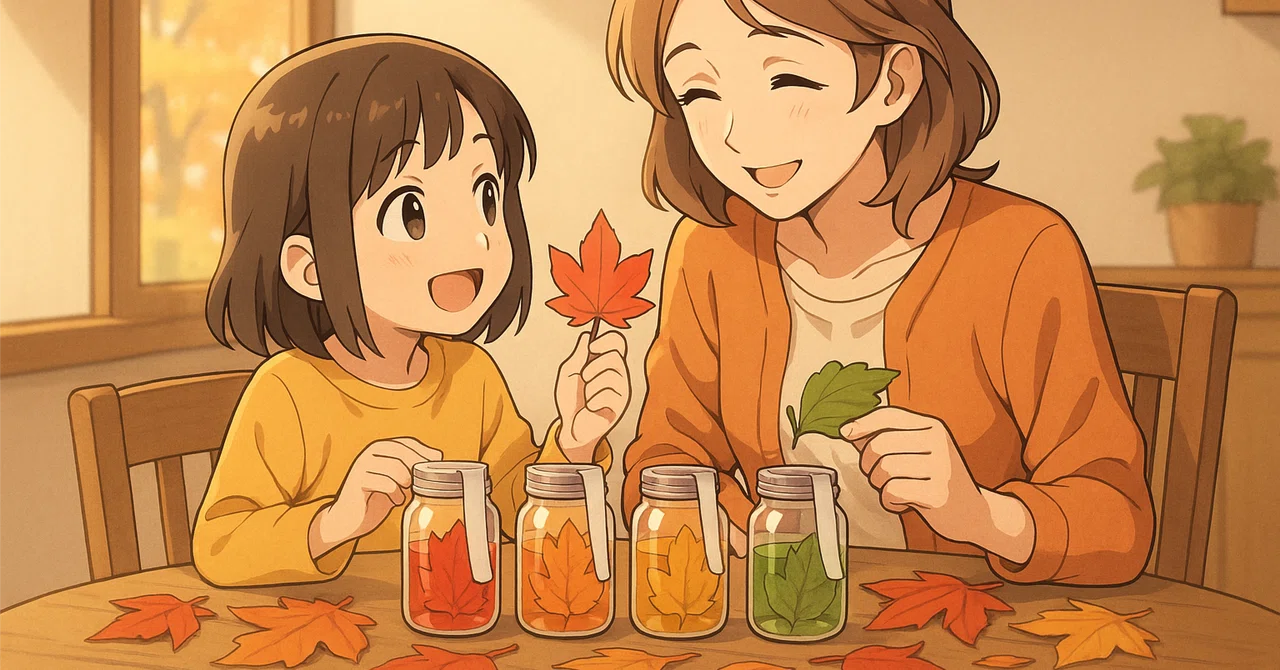
英語でさらに深めたい場合、こちらの動画では葉っぱの中の 色素 を取り出す簡単な実験方法が紹介されています。
▶︎ Experiment:
準備するもの
さまざまな色の葉っぱ
小さなジャー(色ごとに1つ)
除光液または消毒用アルコール
ペーパータオル
手順
葉を色ごとに分けて細かくちぎる
それぞれのジャーに入れる
葉が完全に浸るまで除光液(またはアルコール)を注ぐ
葉をしっかり潰して混ぜる
ペーパータオルを細長く切り、液体に触れるように端を入れて外に垂らす
1日待つ
ペーパータオルを取り出すと、葉の中にあった 色素 が層になって見える
とても簡単ですが、子どもたちは「葉っぱの中にこんな色があったんだ!」と大喜びします。
💬 「全部英語でなんて無理!」と思う方へ
大丈夫です。
動画は英語で見る → 話すのは日本語でOK というスタイルでも、しっかり学びになります。
メリット①:英語は“怖くない”と感じられる
全部理解できなくても、「あ、ちょっと分かるかも」という感覚は大事な成功体験です。
「外国語だから無理!」と閉じずに、挑戦してみようという気持ちが育ちます。
メリット②:つながりのある活動で語彙がしっかり身につく
歌 → 絵本 → 動画 → 実験…
と流れがあると、何度も同じ単語に出会えるため、覚えやすくなります。
早口の動画でも、
“red” “orange” “leaf” “fall”
などを聞き取って、
「あ、分かった!」 と感じてくれます。
🍂 英語×サイエンス、意外とできるかも
もしこの記事を最初に見たときに
「えっ、サイエンスを英語で? 絶対無理!」
と思った方も、読み終わる頃には
「サイエンスを英語で? ちょっとやってみようかな」
と思ってもらえたら嬉しいです。
🍁 聞きながら読める秋のショートストーリー
もしお子さんが秋のテーマを楽しんでくれたら、こちらの読み聞かせもどうぞ。
▶︎
📘 17ページのワークブックでさらに広げる
ストーリーと連動したワークブックはこちらからダウンロードできます。
▶︎
📝 Vocabulary Addendum
(英語学習をサポートする語彙リスト)
記憶に残る(memories that stick)
強く心に残って、時間がたっても覚えている思い出。
Example: “Our science lessons are always the memories that stick.”
例:「サイエンスのレッスンは、子どもたちにとっていつまでも**記憶に残る(memories that stick)**時間です。」
集中して取り組む(engaged)
何かに夢中になって、しっかり注意を向けて取り組むこと。
Example: “The visuals help kids stay engaged.”
例:「アニメーションのおかげで、子どもたちはとても**集中して取り組む(engaged)**ことができます。」
色素(pigments)
生き物や物に色をつける成分。葉っぱの赤・黄・緑などの色のもと。
Example: “Leaves contain many different pigments.”
例:「葉っぱの中にはさまざまな**色素(pigments)**が入っています。」
English Version
🍂 Using English to Answer Your Child’s Big “Why?” Questions
One of the best ways to spark interest in English is to use it to answer the “Why?” questions that all children carry in their hearts.
At the preschool where I work, we have a science lesson once a week, and it is always a highlight for the kids. Even when the words or concepts feel challenging, they try so hard to understand, participate, and find answers to their own questions. And when they come back as elementary school students, they have forgotten a lot of things, but the science lessons are the memories that stick the most. They can still tell me, “We did that experiment!” with the same smile they had years ago.
🍁 A Classic Fall Question: “Why Do Leaves Change Colors?”
As fall winds down in some places and begins in others, your child may be asking:
“Why do leaves change colors?”
If you would like to explore this question together through Home English, here are some wonderful resources to guide you.
🎵 Start With Song: Asking the Question in English
Super Simple Songs has a gentle, easy-to-understand song called “Why Do Leaves Change Color?”
It helps children learn how to phrase the question in English, and there is also an animated fall series if your child wants more.
▶︎ Song: https://www.youtube.com/watch?v=Sa_zH0RXfvk&list=RDSa_zH0RXfvk&start_radio=1
🧪 Now Let’s Answer the Question
My favorite resource is SciShow Kids because the visuals are simple, the explanations are clear, and the pace keeps kids engaged.
Here is the main idea in kid-friendly terms:
Leaves contain many different pigments.
In summer, with lots of sunlight, the green pigment chlorophyll is very busy. Sunlight helps it make more green, making leaves look bright and green.
Chlorophyll’s job is to make sugar for the tree, and it is a big job.
In fall, with less sunlight, the tree does not need the leaves to make sugar anymore.
As the chlorophyll fades, the other pigments, such as red, orange, and yellow, finally show through.
The leaf’s job is done, so it eventually falls from the tree.
▶︎ Video: https://youtu.be/Xk4-6II8l5Q?si=on_jn_rcSbmDAgvV
If you find yourself thinking, “Wow, she talks fast!” there is also an animated read-along story with a slower pace:
▶︎ Read-along: https://youtu.be/Xk4-6II8l5Q?si=on_jn_rcSbmDAgvV
🔬 The Best Part of Science: Experimenting!
If you want to take the learning further, this video teaches a simple experiment in English that shows the pigments inside a leaf.
▶︎ Experiment: https://www.youtube.com/watch?v=7Yc8VV9V9AY
You will need:
A variety of colored leaves
Small jars (one for each color)
Nail polish remover or rubbing alcohol
Paper towels
Steps:
Sort leaves by color, then cut or tear them into tiny pieces.
Put each color group into its own jar.
Pour in enough nail polish remover or alcohol to cover the leaves.
Mash and stir the leaves well.
Cut a strip of paper towel long enough to reach the liquid while hanging over the edge of the jar.
Wait one day.
Pull out the paper towel and observe the color bands. These are the pigments that were inside the leaf all along.
Science really is magical.
💬 “There is No Way I Can Do All This in English!”
If you are thinking that, it is completely OK.
In fact, I actually think there is great value in watching the videos in English, but discussing the ideas in Japanese together afterward.
Benefit 1: Children learn that English does not have to be scary.
Even if they do not understand every word, they will still catch meaningful bits.
It teaches them, “I do not have to give up just because it is a foreign language.”
Benefit 2: When activities are connected, vocabulary sticks.
A flow like song → book → video → experiment gives children multiple chances to hear the same words.
Even in the fast-talking video, they will catch:
“red,” “orange,” “leaf,” “fall,” and think,
“Hey, I understood that!”
🍂 Science in English? You Might Be Surprised
If you clicked this article thinking:
“What? Science class in English? No way!”
I hope that by the end you can say:
“Science in English? Maybe we can try it!”
Just one small connection can open a door.
🍁 Listen Along: A Short Fall Story
If your children enjoy fall learning, here is a read-along story I created.
▶︎ https://note.com/ouchieigo/n/nbf7f4a6545b7
📘 Extend the Learning With the Workbook
There is also a 17-page workbook that goes with the story and adds more fall exploration.
▶︎ https://english-together.stores.jp/items/690acdf7057a68380e22f27c?utm_source=note&utm_medium=referral&utm_campaign=note_store
📝 Vocabulary Addendum
(Same style as your previous Note posts)
記憶に残る(memories that stick)
強く心に残って、時間がたっても覚えている思い出。
Example: “Our science lessons are always the memories that stick.”
例:「サイエンスのレッスンは、子どもたちにとっていつまでも**記憶に残る(memories that stick)**時間です。」
集中して取り組む(engaged)
何かに夢中になって、しっかり注意を向けて取り組むこと。
Example: “The visuals help kids stay engaged.”
例:「アニメーションのおかげで、子どもたちはとても**集中して取り組む(engaged)**ことができます。」
色素(pigments)
生き物やものに色をつける成分。葉っぱの赤・黄・緑などの色のもと。
Example: “Leaves contain many different pigments.”
例:「葉っぱの中にはさまざまな**色素(pigments)**が入っています。」
いいなと思ったら応援しよう!
 ☕️みなさんのサポートは、もっと楽しい学習教材をお届けする力になります✨
そして制作のエネルギーとなるコーヒー代にもなっています😊
☕️みなさんのサポートは、もっと楽しい学習教材をお届けする力になります✨
そして制作のエネルギーとなるコーヒー代にもなっています😊