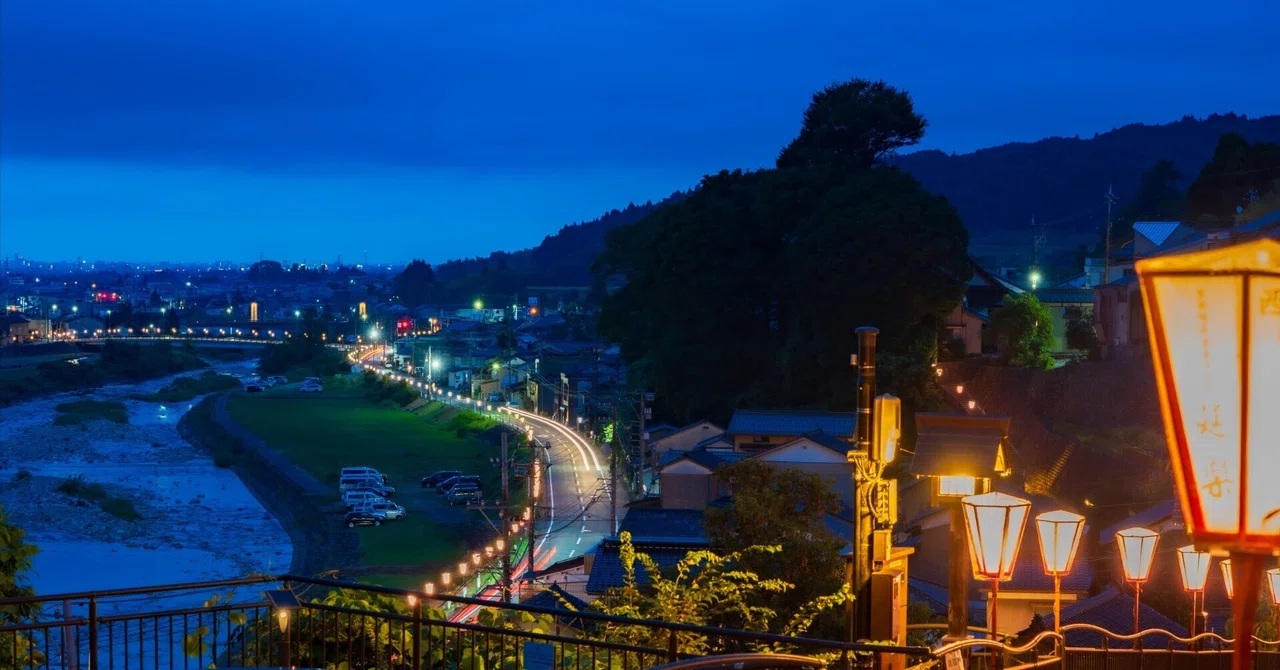
Tracing the Birthplace of Yatsuo — Owara’s 3 Scenic Routes (Part 2)

※こちらの記事は、日本語バージョンを英語化したものです。
Coming from Okinawa — the land of Eisa drum dancing — I was stunned.
In the mountain town of Yatsuo, part of Toyama City, I encountered the annual festival Owara Kaze no Bon, and it captured me completely. That encounter set me on a quest: to speak with residents from each of the 11 neighborhoods (chōnai) that take part in the festival.
This is my record — the work of a 24-year-old “Owara obsessive” with no formal training, just a lot of curiosity and affection.
To make things easier for first-time visitors, I’ve divided the neighborhoods into three themed walking routes.
Today’s course is “The Birthplace of Yatsuo”, covering four neighborhoods: Kagamimachi, Higashimachi, Nishimachi, and Imamachi.
Note: This series is written from the personal perspective of an Owara enthusiast.
This English version was produced using ChatGPT’s translation, based on the original Japanese text.
Kagamimachi — A Narrow Street with Resonance Like Nowhere Else
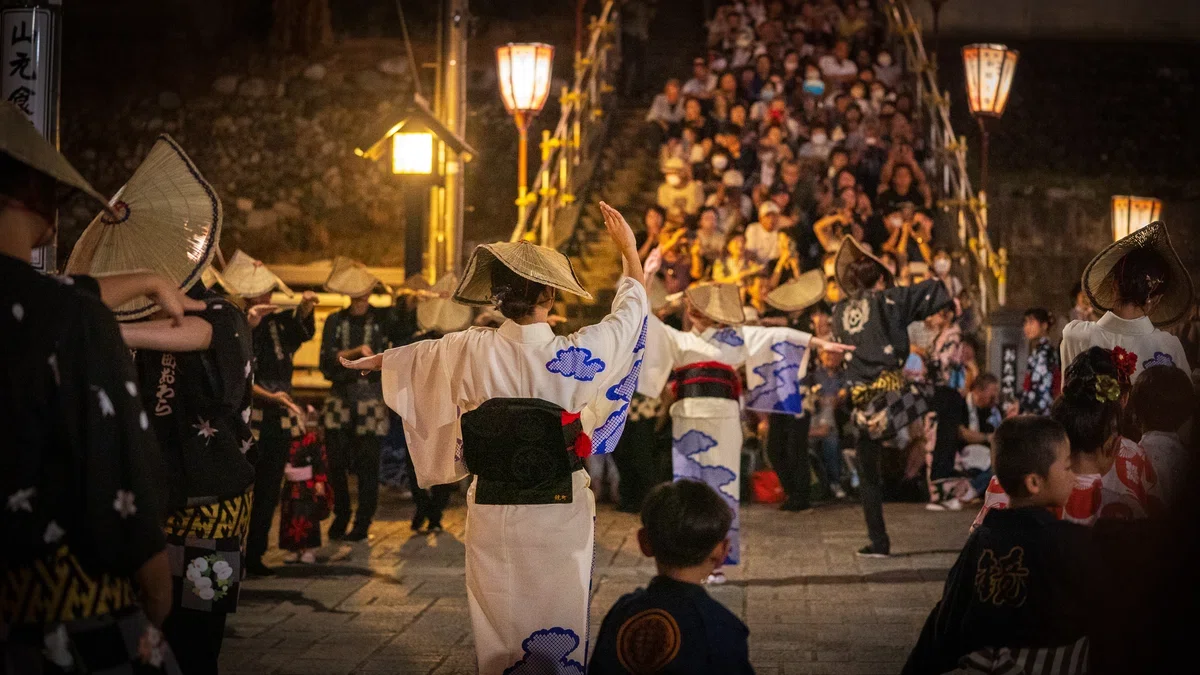
If you’ve seen photographs of Owara, you may have spotted the Otaya Staircase — a flight of just over 50 stone steps, packed shoulder to shoulder with spectators during the festival. Kagamimachi is famous for the dances performed right at the foot of those stairs.
In the past, this neighborhood was home to the Kagamimachi entertainment district, which at its peak employed 60 geisha. Many of the elders who shaped Owara as we know it today learned their arts here — music, dance, and refined conversation. In those days, this was where Yatsuo’s cultural polish was honed.
The women dancers here wear a distinctive yukata: white fabric patterned with flowing purple clouds. Uniquely, Kagamimachi and neighboring Higashimachi are the only neighborhoods where the costumes — for both dancers and musicians (jikatasha) — do not bear Owara song lyrics.
I spoke with Mr. Inami (62), a shamisen player and member of the preservation society, to learn more.
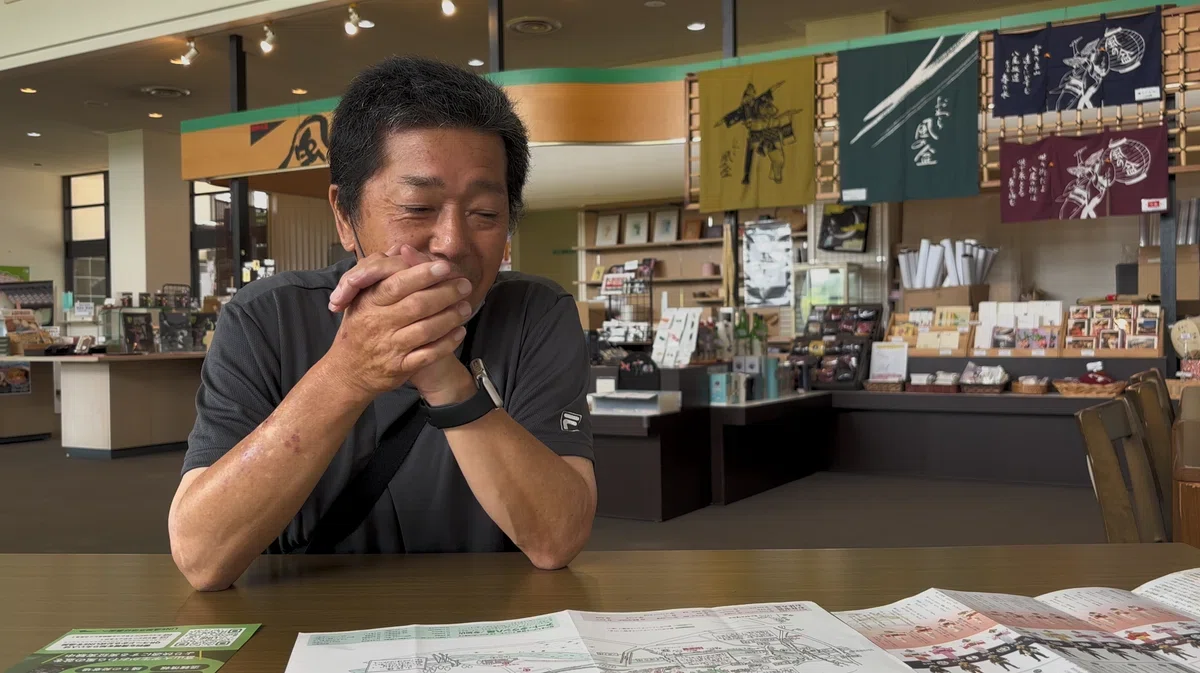
① Almost all performances are at the Otaya Staircase
During the three days of Owara, Kagamimachi completes its machinagashi (parading and dancing through the neighborhood) by around 5:00 PM. After that, the performers spend the rest of the evening dancing at the foot of the Otaya Staircase.
With roughly five people sitting on each step, the stairs alone hold about 250 spectators — not counting the crowds in the plaza below.
② A night-time echo chamber for musicians
If you descend the stairs and pass through the small plaza, you’ll find yourself on a narrow, stone-paved street lined with closely packed historic buildings. Among them are the Kitayoshi — a long-established traditional inn — and Sanpūsō, once a fine restaurant.
Here, the buildings and narrow street create a natural echo chamber. For the jikatasha — the musicians and singers — this is a delight. The sound of your own shamisen, kokyū, or voice bounces back at you, sinking deep into your body with each reverberation.
That’s why, after the official program ends and most tourists have gone, musicians from across town gather here during the yorunagashi — the late-night “flowing through the town” dances held by and for locals. It’s one of those moments when Owara becomes entirely an affair of the community, yet open enough that the lucky visitor can stumble into something unforgettable.
Higashimachi — Merchant Pride Woven Into the Costume
Along with neighboring Nishimachi, Higashimachi was once lined with grand merchant houses in the Edo period, earning it the nickname “Danna-machi” — literally, “Patron Town,” a reference to its wealthy, high-status residents.
One of Owara’s most important modernizers, Junji Kawasaki, the first president of the Owara Preservation Society, was born here. His family home is now the Yatsuo Owara Museum — a must-visit for any Owara devotee, packed with fascinating historical materials.
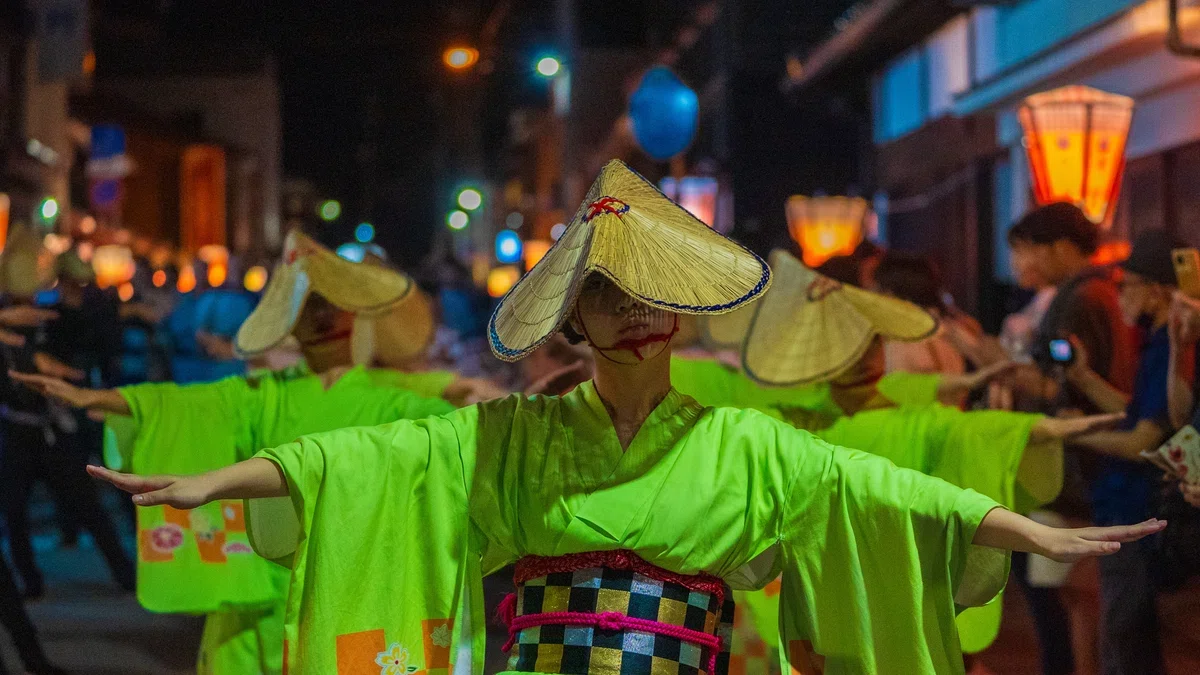
Many of Higashimachi’s celebrated figures were known for their playful spirit, something you can still sense in the details of the town’s women’s uguisu-iro (warbler green) costumes and the distinctive belts (obi).
I spoke with Kaneko (21, a university student) and Mr. Hayashi to learn more.
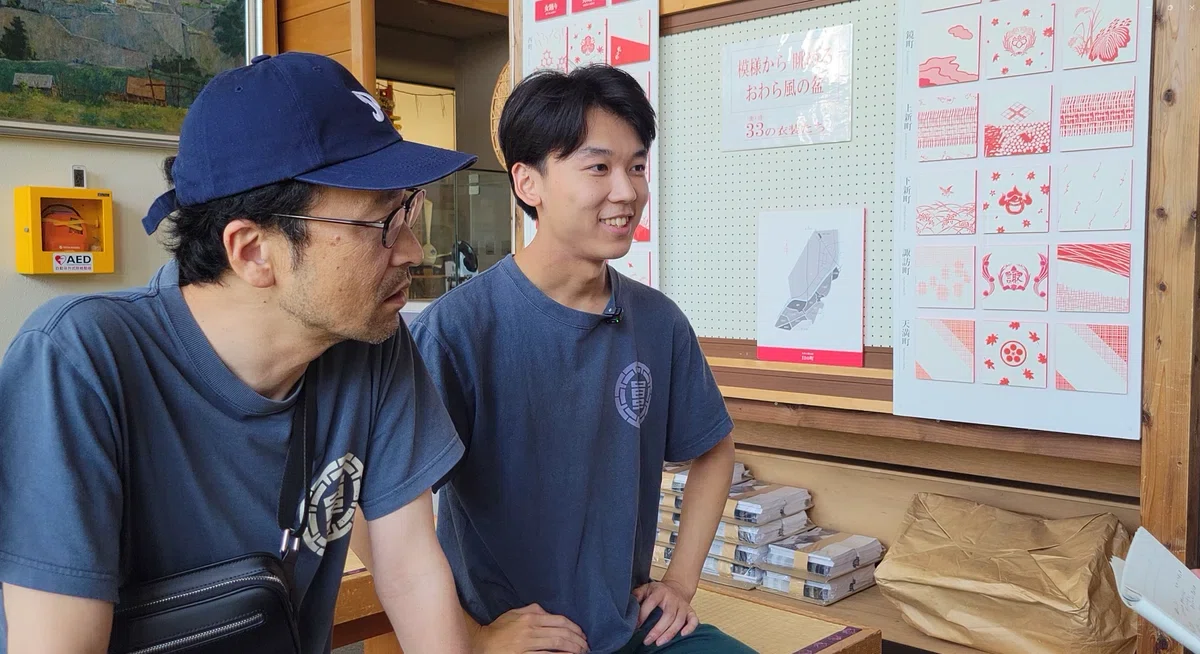
① Belts that speak of old wealth
During the Edo period, Yatsuo was prosperous enough to financially support the Toyama domain. Among its neighborhoods, Higashimachi and Nishimachi were especially affluent.
Most Owara costumes across town lean toward pink hues, but Higashimachi’s women wear uguisu green. More strikingly, both men’s and women’s belts are black-and-gold in a bold checkerboard pattern.
Why is this unusual? In most neighborhoods, belts are plain black — a practical choice because everyone already owned a black obi for funeral wear. Outfitting an entire troupe with custom belts was costly, but Higashimachi could afford it.
As Kanetsu told me with a grin:
“The elaborate festival floats (hikiyama) are one thing, but I think our neighborhood has always liked to stand out.”
② A highway that erased the old streetscape
Higashimachi’s influence wasn’t only economic — it was also political and social. The national highway connecting to Nishimachi runs straight through it.
While that made the town more accessible, it also meant that when the road was widened and improved, many of the original historic buildings were lost. This is in sharp contrast to Nishimachi next door, where traditional landmarks like the Miyata Inn and Fukutsuru Sake Brewery still stand.
③ A new generation of musicians
In recent years, Higashimachi has seen a rise in young jikatasha — the singers and musicians who accompany the dancers. Many of them are in their 20s and 30s, and some even serve as instructors for other neighborhoods.
Thinking ahead 50 years, it’s easy to imagine these young performers as the storytellers and culture bearers of the future, passing down today’s Owara to the next generation.
Nishimachi — A Neighborhood Where Owara Gains Depth
Nishimachi is one of the oldest neighborhoods in Yatsuo’s old town, with a history approaching 400 years.
Its street plan was laid out at the time of its founding and still shapes the area today: Nishimachi Street leading toward the gate of Kōmyō-ji Temple, the steep Zendera-zaka slope descending to the Ida River, and the Aimono Alley connecting Nishimachi to Higashimachi.
Here, I spoke with Mr. Hasegawa from the Preservation Society and Mr. Iwami, one of the Owara heads — both shamisen players. Photographer Hiroshi Kimura, who often shares his work with me, is also from this neighborhood.
Swaying suspension bridge,
hand in hand we cross the Ida River,
in the spring breeze.
— “Spring” from Yatsuo Shiki by Hōan Kosugi
① The must-see finale in front of Nishimachi Community Hall
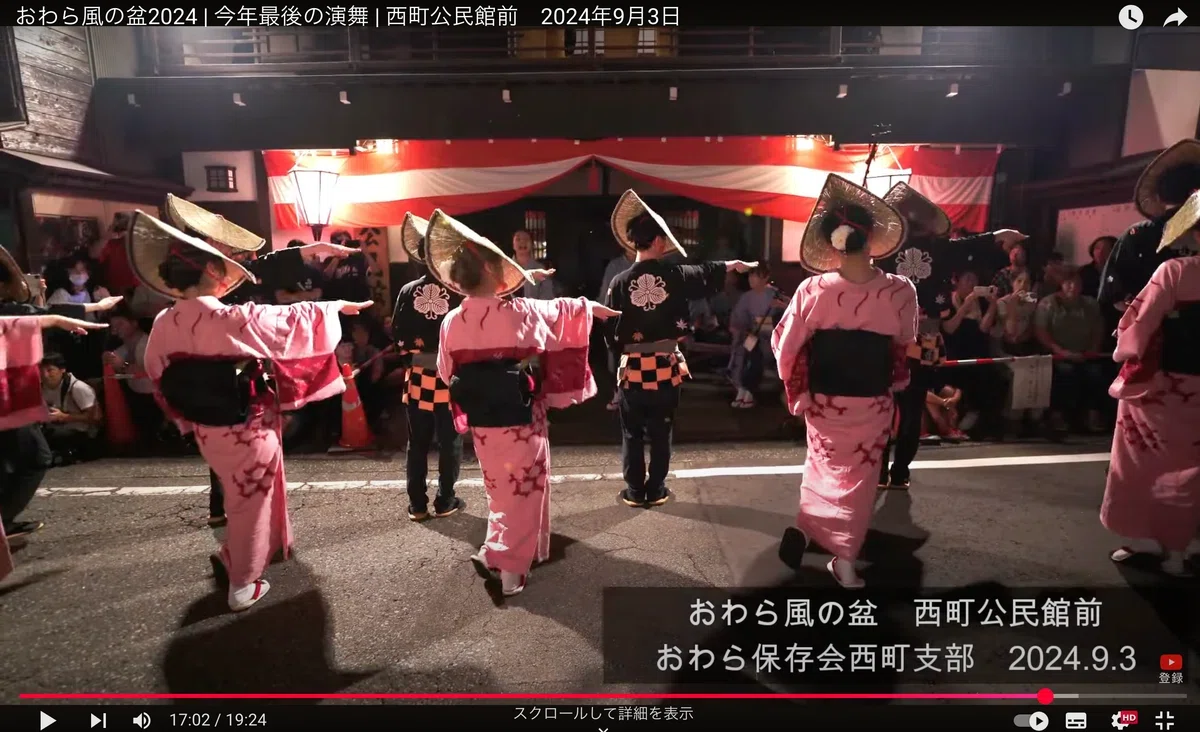
For all three nights of the festival, Nishimachi’s Owara ends its official program with a performance in front of the community hall after 10:00 PM (though yorunagashi, the informal late-night dancing, follows).
One local photographer told me this is the climax of the neighborhood’s Owara.
Directly across from the hall stands Fukutsuru Sake Brewery, founded in 1848. In the past, prominent politicians would watch the dancing from a second-floor room there.
During the finale, the musicians (jikatasha) face the brewery as they play, while the dancers perform toward the community hall — a living dialogue between two historic buildings.
If you check Fukutsuru’s website, you can see its stately facade for yourself.
② Dancing on Zendera Bridge over the Ida River
On September 1, Nishimachi begins with a circle dance in front of the community hall, then descends the steep Zendera-zaka to dance on Zendera Bridge.
The slope lies behind the western houses of the neighborhood and drops sharply down to the river — about 40 meters from street level to the water’s edge, thanks to Yatsuo’s river terrace geography.
Last year, I saw an elderly woman struggling up the slope and took her hand to help her climb — a personal memory I treasure.
From the riverbank, you can see high stone walls rising alongside the slope, an impressive sight. Personally, I love looking down from the top of Zendera-zaka during Owara — the whole town feels alive below you.
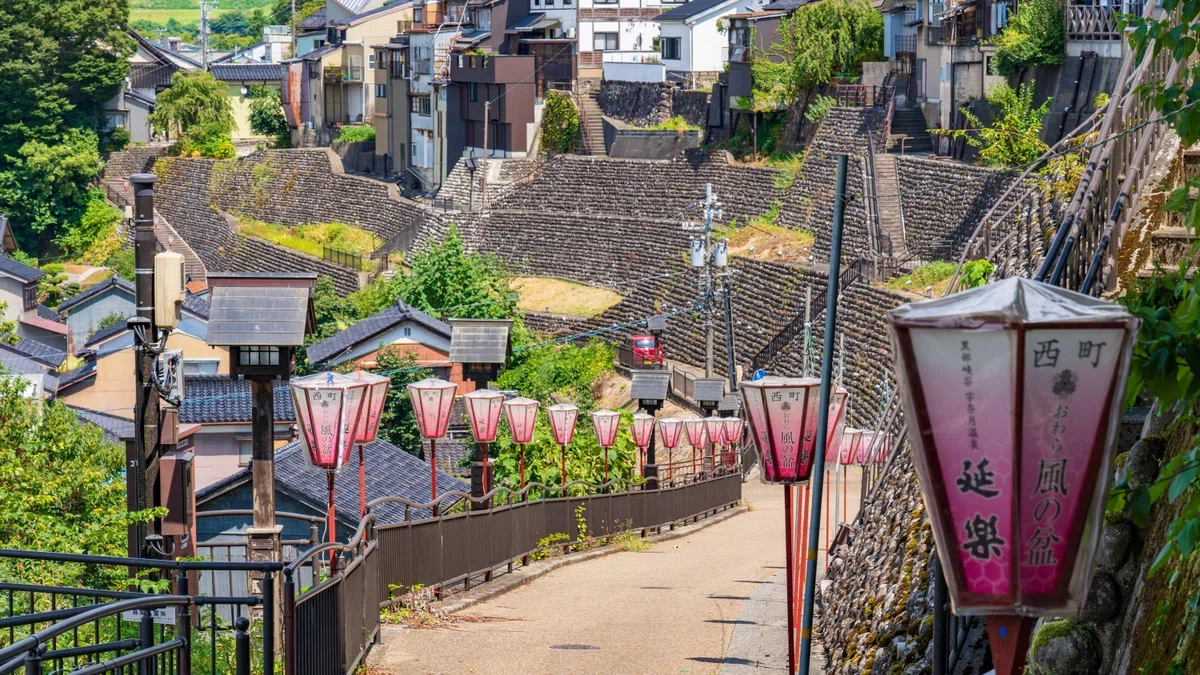
At the foot of the slope lies Zendera Bridge, where daytime circle dances take place. (There’s even a YouTube video of it — worth searching for.)
③ Youthful energy before the night’s free-flow dancing
The official festival events run until 11:00 PM, under certain agreed rules. After that, the streets belong to the locals, who dance for themselves, without fixed routes or the need to stay in neighborhood groups.
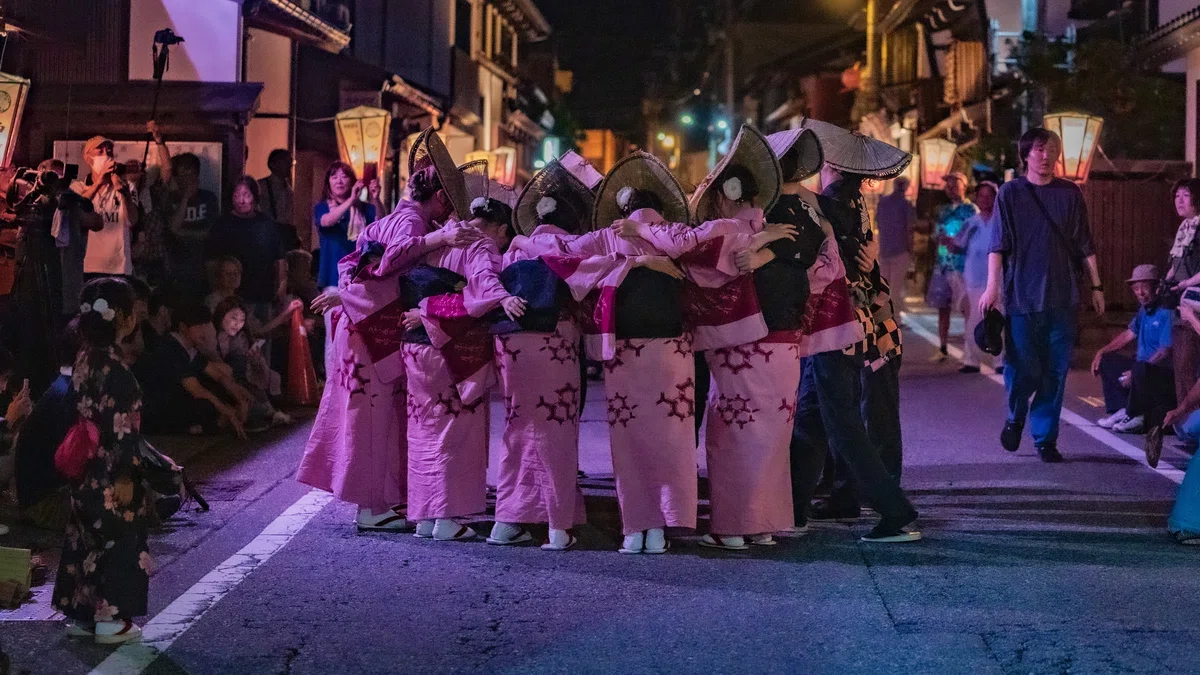
In Nishimachi, the youth association — young men and women alike — sometimes skip live musicians altogether, carrying a boombox and playing Owara music as they dance wherever they please.
Before starting, they form a circle huddle to psych themselves up — a small but beautiful tradition that captures the spirited heart of the neighborhood.
Imamachi — A Small Neighborhood with a Strong Bond
Facing directly toward Kōmyō-ji Temple, one of Yatsuo’s oldest, Imamachi sits right at the midpoint between the eastern and western parts of town. In the past, it was even called “Nakamachi” — literally “Middle Town.”
It’s small in area and in number of households, so I wanted to know: how does such a tiny neighborhood keep Owara alive, and what challenges do they face?
I spoke with Mr. Kitano, who danced in Owara until about age 35, later worked behind the scenes on the event’s organizing committee, and is now in his third year as a singer (utai-te).
The mellow dreams drift on, as the bell of Monmyō-ji
echoes across far-off Ariso,
resounding upon the sails.
— Shōgo Shiratori
① Whole-town teamwork
Imamachi has just 28 households. With so few residents, everyone feels a strong sense of responsibility for the town’s well-being — and for Owara, entire families join in.
Everyone knows each other’s strengths and weaknesses, so cooperation comes almost instinctively. The whole community works together to run the festival smoothly.
In 1992, they formed the Imamachi Owara Support Association, which allows former residents — those who moved away after marriage or for work — to return and take part.
Interestingly, while Higashishinmachi has even fewer households, Imamachi also hosts a hikiyama float festival. That means, as Kitano pointed out, almost every resident holds at least one official role in local events — and he himself has two.
It’s a rare sight in modern Japan: a small community where everyone actively contributes and works in harmony for the common good.
② Many corners in a short stretch
Though Imamachi is small, its streets have an unusual number of bends. Every few dozen meters there’s a turn, which makes it harder for spectators to spot where the dancing is happening compared to other neighborhoods.
On the other hand, in certain spots the buildings close in from all sides, creating a layered echo that enriches the sound of the music. It’s a listening experience unique to these tight, winding streets.
During Owara, Imamachi starts its machinagashi at the community hall, first heading toward Shimoshinmachi.
Closing Notes
This is the 15th installment of my project to document Owara in writing.
How did you enjoy it?
A quick reminder before we wrap up: I’m no professional researcher — just an enthusiast with a deep love for Owara!
That’s why I’d like to build this series together with you — whether you’re already a devoted fan or just discovering Owara for the first time.
For this article, I’d love to know: Which neighborhood caught your attention most?
As always, your thoughts, feedback, and words of encouragement are more than welcome!
