
(No.7) To You in Week Four of RHS | When Facial Paralysis Strikes in the U.S.: [Practical Guide — Save This One] Everything I Gathered to Protect My Recovery: Eyes, Ears, Sleep, Facial Nerve, Nutrition, Knowledge

This article is a practical memo of the items and supplements I actually purchased and found helpful during my recovery from RHS (Ramsay Hunt Syndrome), organized by purpose.
It's a bit long, so feel free to skim and pick out only what you need.
If you're struggling right now, please start with just one section: "Protecting the Eye."
*For medical diagnoses, treatment decisions, and supplement use, always consult your physician or pharmacist. What's written here is one patient's lived experience — through Rita's eyes.
*I've included links to make things easier to find, but none of the product links contain ads or affiliate income.
Sharing the Day-26 Video of My Face
January 15, 2026 — Ramsay Hunt syndrome struck.
And then, around the four-week mark.
What was I feeling, thinking, and doing back then?
It was only a few months ago,
yet it feels like a very long time has passed.
I am sharing what my face looked like on day 26.
Making it public was, honestly, frightening.
But if it helps even one person, even a little, I will be glad.
The Items That Helped My RHS Recovery
By week four, I had been fortunate to connect smoothly with many specialists — ENT, ophthalmology, neurology, acupuncture — and my days were busy with appointments and treatments.
Meanwhile, at home, I was steadily carrying out another important task:
building, piece by piece, an environment that wouldn't let things get worse.
Researching items and supplements that could support recovery,
and ordering them on Amazon and elsewhere — that was the task.
Protecting an eye that won't close from drying out.
Shielding a newly sensitive ear from sound.
Making sleepless nights even a little gentler.
Delivering nutrition to a nerve trying to heal.
Looking back now, I believe this quiet, unglamorous work of preparing my environment
became the foundation that let my body settle in, feel safe, and focus on healing.
In this article, I'd like to share the items that truly helped me,
the supplements I took to support my recovering body,
and information I gained from fellow members of my support group.
1. Protecting the Eye — The Highest-Priority Defense
During my RHS recovery, nothing demanded more of my attention than my eye.
An eyelid that won't fully close means a cornea that is constantly exposed to open air.
And if the cornea gets damaged, you're no longer just recovering —
you're facing a new and serious problem.
That's why eye protection is priority number one.
So, let's take a look together at Rita's recommended items for protecting your eyes.
Click each image to see where the item can be purchased.
If something catches your eye, do check it out.
[Daytime & Outdoors — Wind and Dust Protection]
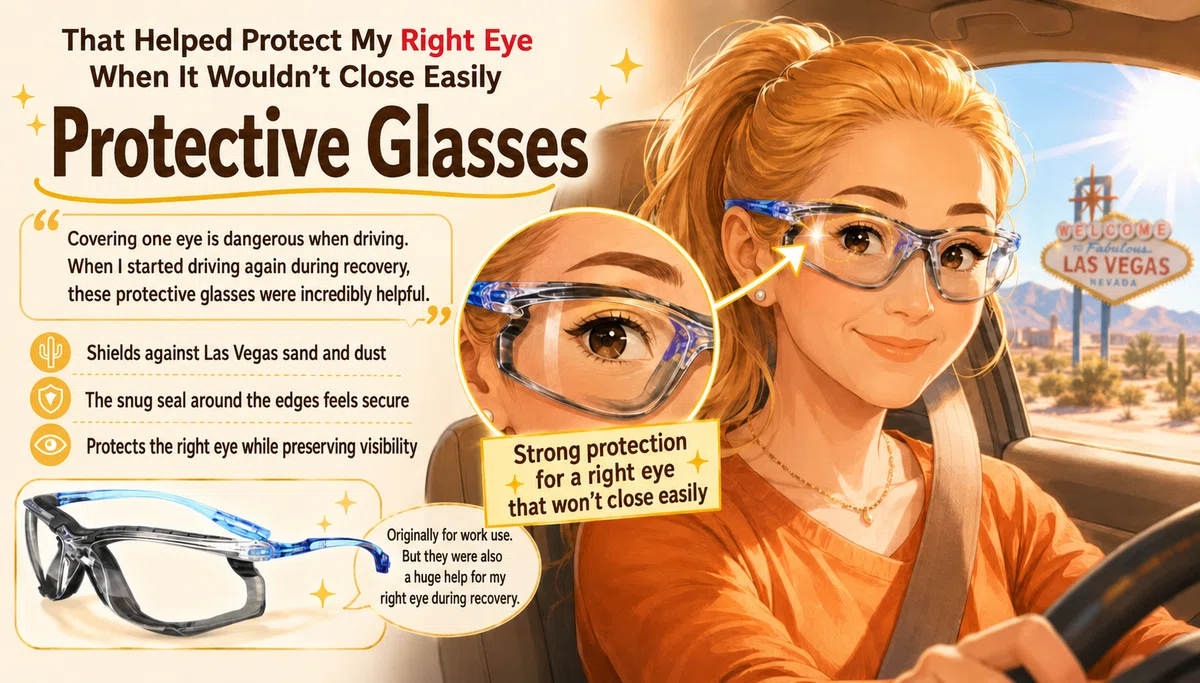
① Protective Glasses
Protective glasses that shield your eyes from wind, dryness, and dust.
They look close to ordinary clear glasses,
which lowered the hurdle of going outside.
I still use them today when I go kayaking.
② Moisture Chamber
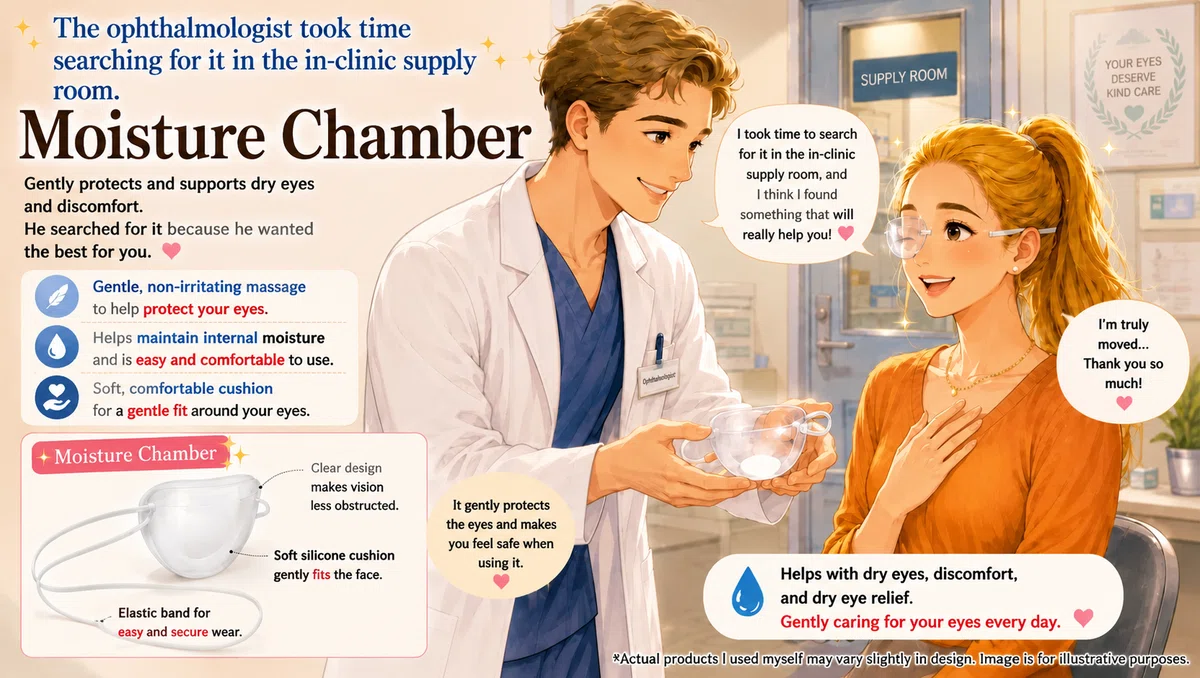
A protective cover that gently shields the eye from dryness and friction.
I received mine at my ophthalmologist's office, and it helped me enormously.
It keeps the humidity in, easing the discomfort, pain, and dryness
of an eye that won't close.
but click the image to see a similar one.
③ 3D Eye Patch
An eye patch with a raised, three-dimensional structure that covers the eye
without touching the lashes or eyelid.
The adjustable sizing was a big help, too.
At home, the clear moisture chamber;
when I wanted to dress up a little, this leopard-print patch —
both served my unclosing right eye well.

[Daytime & Indoors — Relaxation and Restful Sleep]
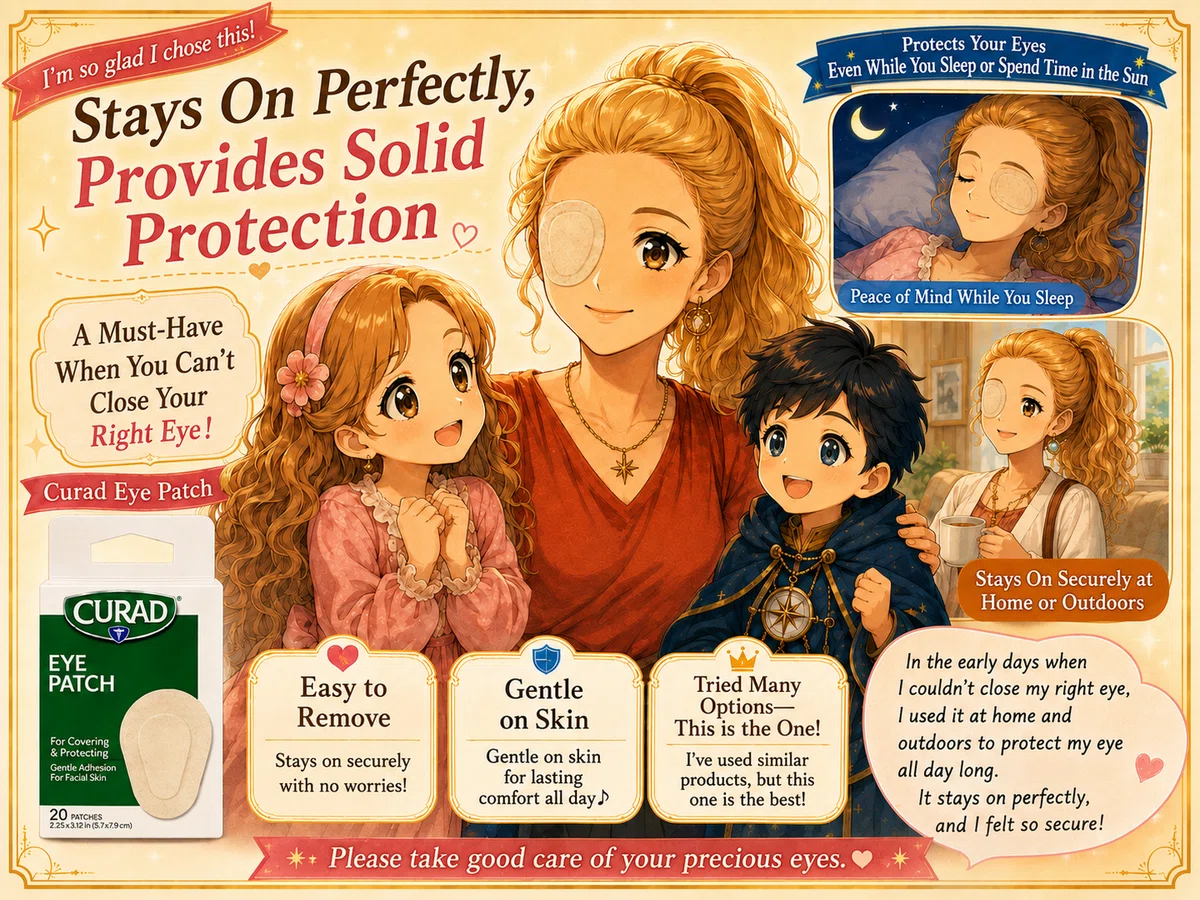
① Disposable Eye Patches
Not just at bedtime — in the early days, when my right eye wouldn't close at all,
I kept it closed and protected with these patches all day long.
They adhere snugly and don't peel off easily;
after trying many options, these are the ones I finally settled on.
Being disposable, they're reassuring hygiene-wise as well.
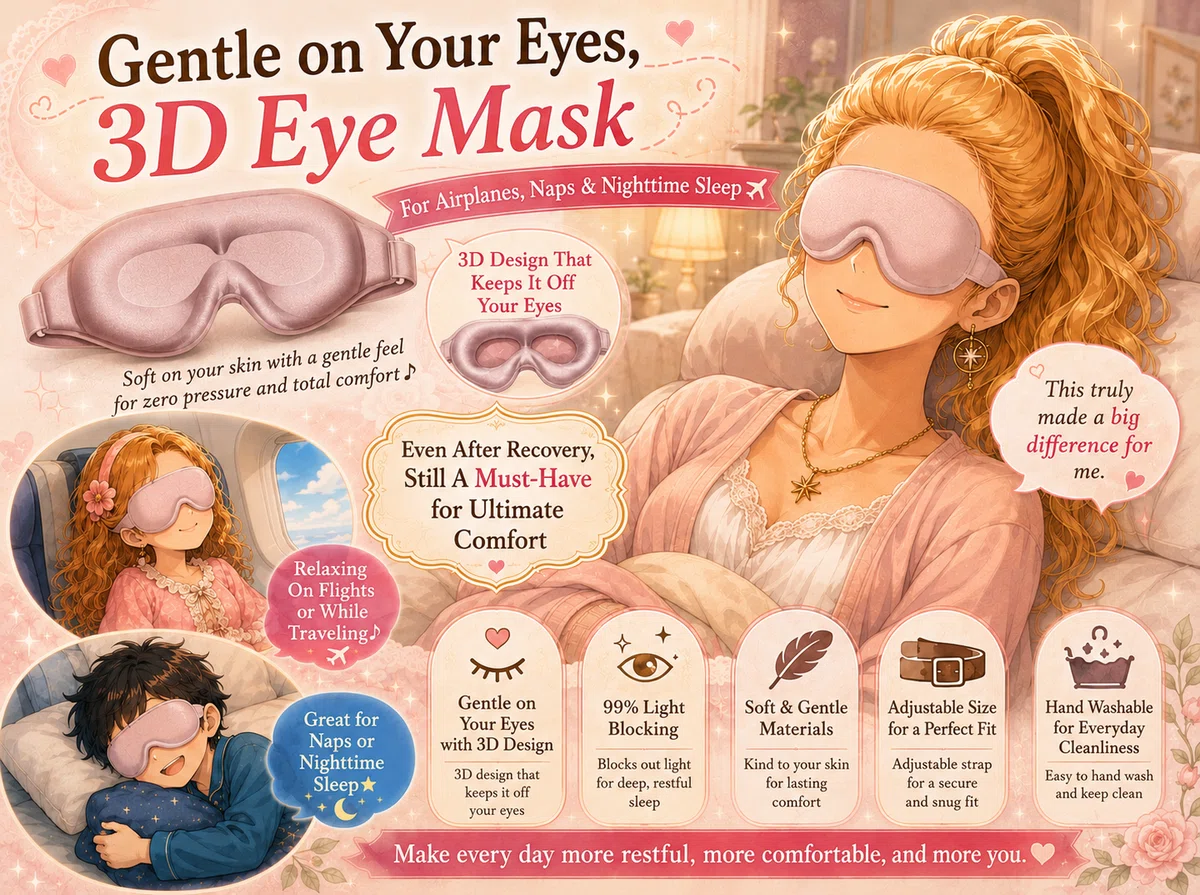
② 3D Sleep Mask
Protects the eyes from both light and dryness at bedtime.
I chose a 3D type that doesn't touch the eyes directly.
Even after recovering from RHS —
on flights, for afternoon naps, on nights I want to sleep deeply —
it's a comfort I can no longer do without.
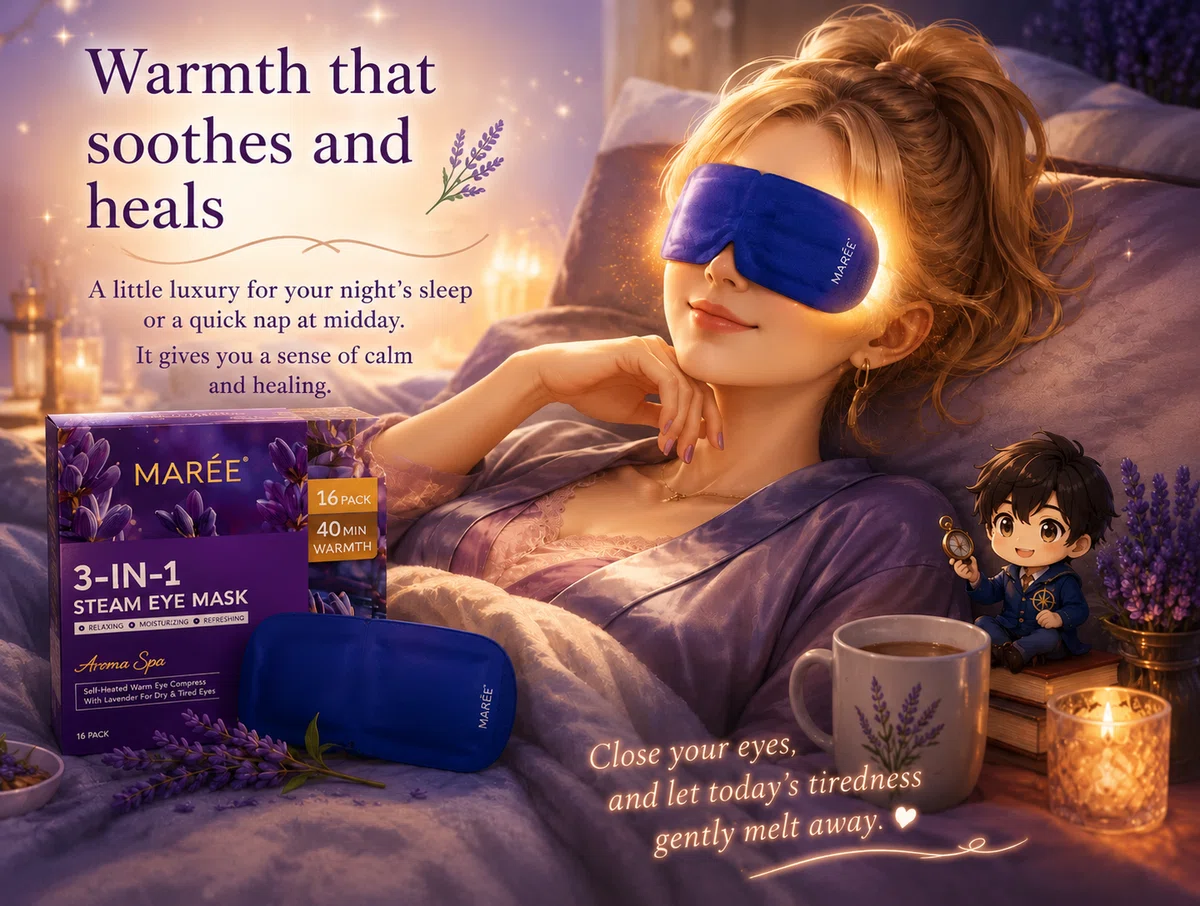
③ Heated Eye Mask
A favorite item that gently warms the area around the eyes.
Used before sleep or at naptime, it alone softened something in me — deeply soothing.
During RHS recovery, these things that are "simply pleasant"
or that "make things a little easier"
supported my heart far more than I ever expected.
[Keeping the Eye Moist — Fighting Dryness]
For an eye that won't close, constant moisture is non-negotiable.
At my ophthalmology visit, I was told to use the prescribed drops
"every two to three hours."
In other words: nearly continuous drops, all through my waking hours.
That's how essential it is —
keeping an unclosing eye from drying out is the lifeline that protects the cornea.
My ophthalmologist prescribed these three:
① Carboxymethylcellulose 0.5% (PF) Eye Drops — Single-Use Vials
The workhorse of the daytime. Artificial tears made with carboxymethylcellulose, a lubricating ingredient.
"PF" means Preservative-Free.
When drops are used frequently, preservatives can irritate and burden the eye,
so I was prescribed the single-use unit-dose (UD) vials.
② Lubricant Eye Ointment (PF, for Moisture)
The nighttime fortress of moisture, applied before bed.
It stays on the cornea far longer than drops,
protecting the eye from dryness all through the night,
while the eyelid can't fully close.
③ Erythromycin 0.5% Ophthalmic Ointment (Antibiotic)
This one isn't for moisture — it's an antibiotic ointment for infection prevention.
An eye that can't close is defenseless not only against dryness but against bacteria.
It was prescribed to protect the cornea from infection.
*With antibiotics, always follow your doctor's instructions on duration and frequency.
These three pillars — drops by day, moisturizing ointment by night, and infection prevention —
became the foundation of my "protect the eye" treatment.
The over-the-counter artificial tears I introduce next
are mainly what I purchased before receiving the prescriptions above.
Incidentally, many OTC artificial tears are made with
the same family of lubricating ingredients as the prescribed ones.
The "Preservative-Free" label is one useful marker when choosing.
Through the day, frequently:
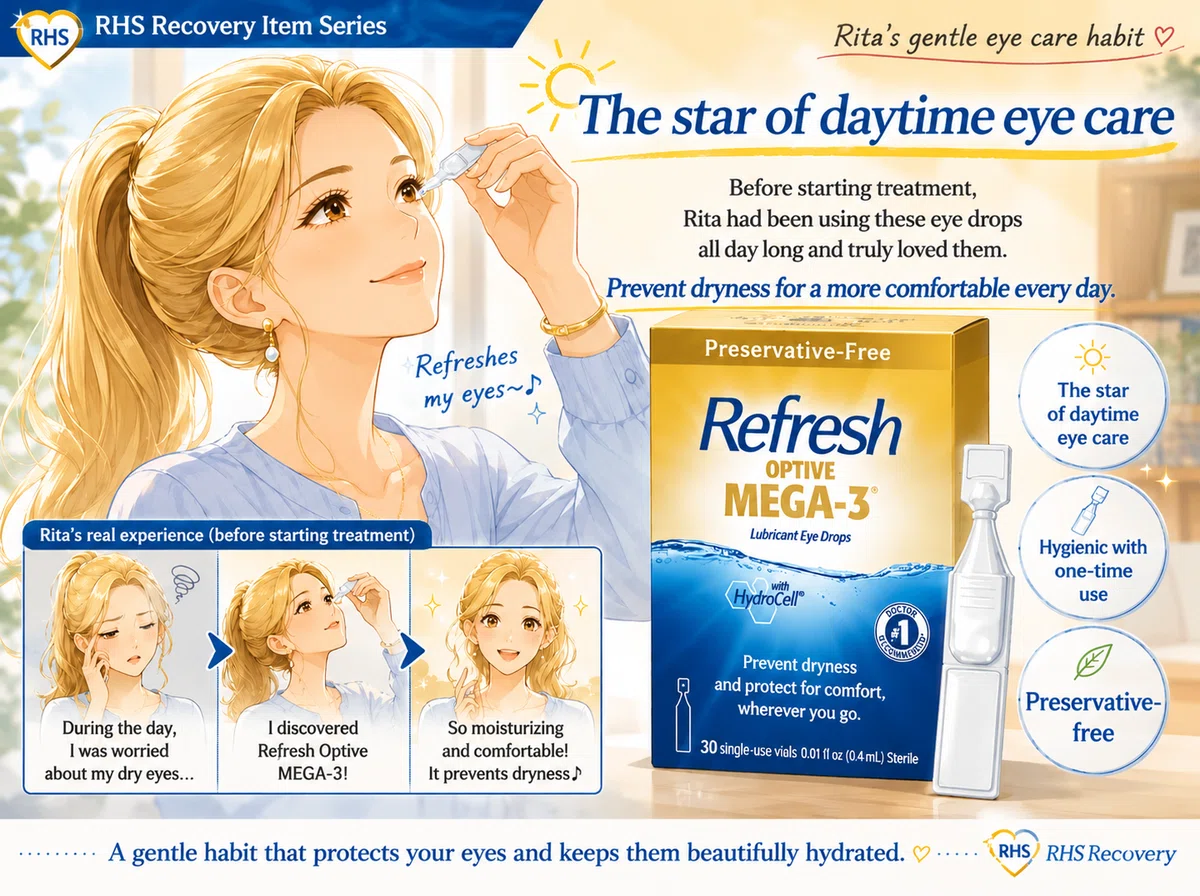
④ Eye Drops — Refresh Optive MEGA-3 Lubricant Eye Drops
Until I received prescription ①, these were my daytime staple.
Individually packaged artificial tears — hygienic and easy to carry.
And preservative-free, of course.
At night, thoroughly:
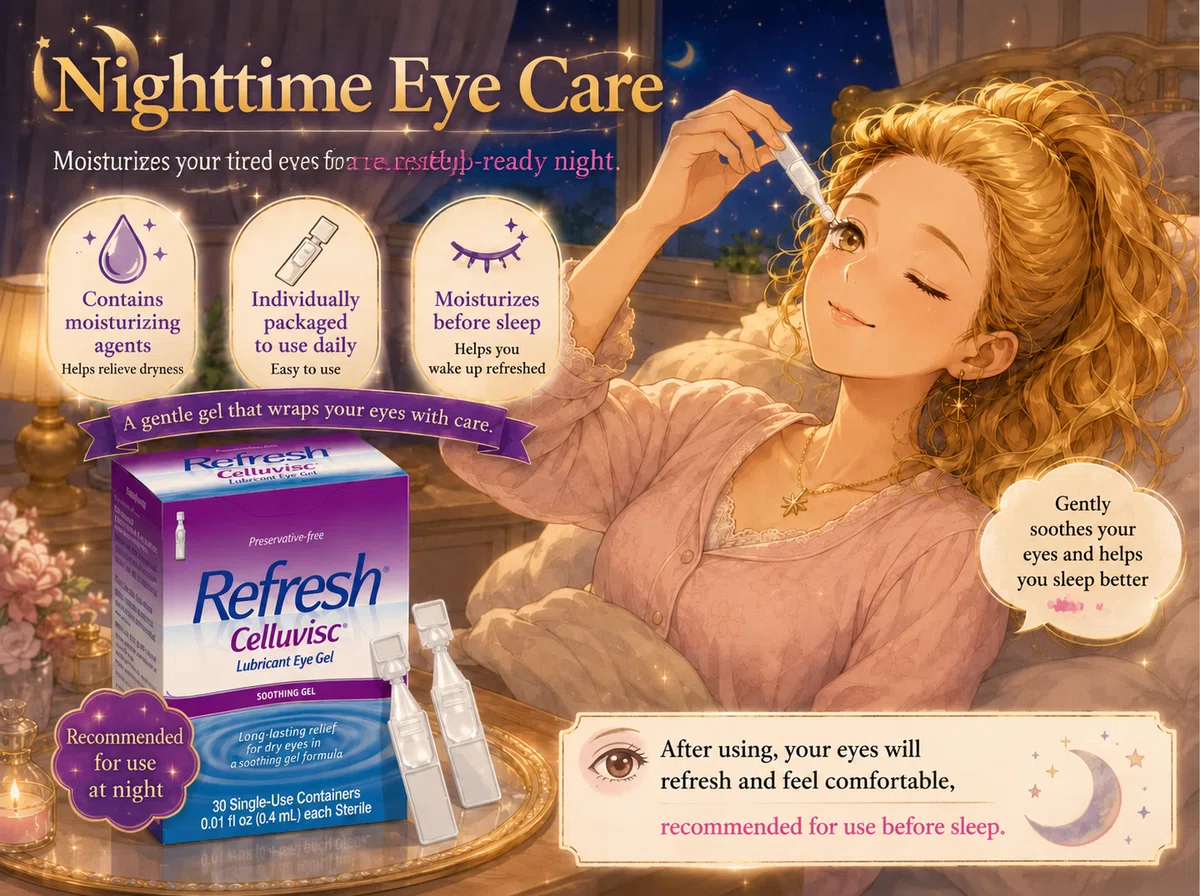
⑤ Eye Gel — Refresh Celluvisc Lubricant Eye Gel
Until I received prescription ①, I never skipped these before bed.
A thick, gel-type drop.
During the period when my eye barely closed and the dryness was severe,
this was my non-negotiable bedtime routine.
Preservative-free, single-use vials — reassuring hygiene-wise as well.
One caution: your vision blurs right after application,
so avoid using it before driving. I treated it strictly as a bedtime drop.
*Which product suits you depends on the condition of your eyes.
Please consult your ophthalmologist and find what works for you.
[Taping the Eyelid Shut at Night — How to Choose Your Tape]
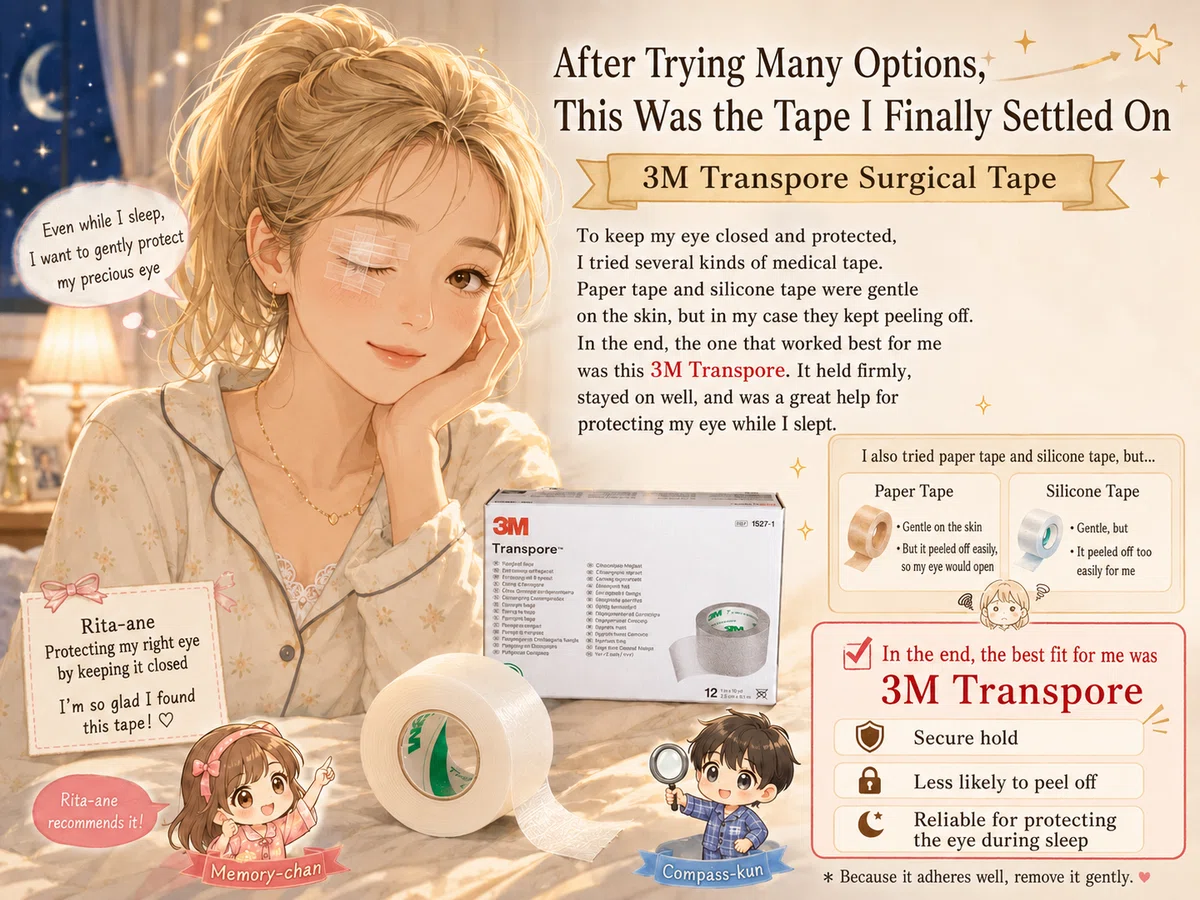
① 3M Transpore Surgical Tape
Taping the eyelid closed at night —
a familiar nightly ritual for anyone who has been through RHS.
Because you stick and peel tape on the same patch of skin every single night,
tape selection matters more than you'd imagine.
I tried paper tape and silicone tape for holding the eyelid;
they're gentle on the skin, but they kept peeling off during the night.
3M Transpore, on the other hand, holds firmly and stayed put while I slept.
For me — someone who prioritized the security of knowing
my eye would stay protected until morning —
this was the tape that served me best.
The specific taping method and tips
are coming in detail in a future article.
2. Protecting the Ears and Face — Caring for the Nerve Pathways
[Shielding a Sensitized Ear from Sound]
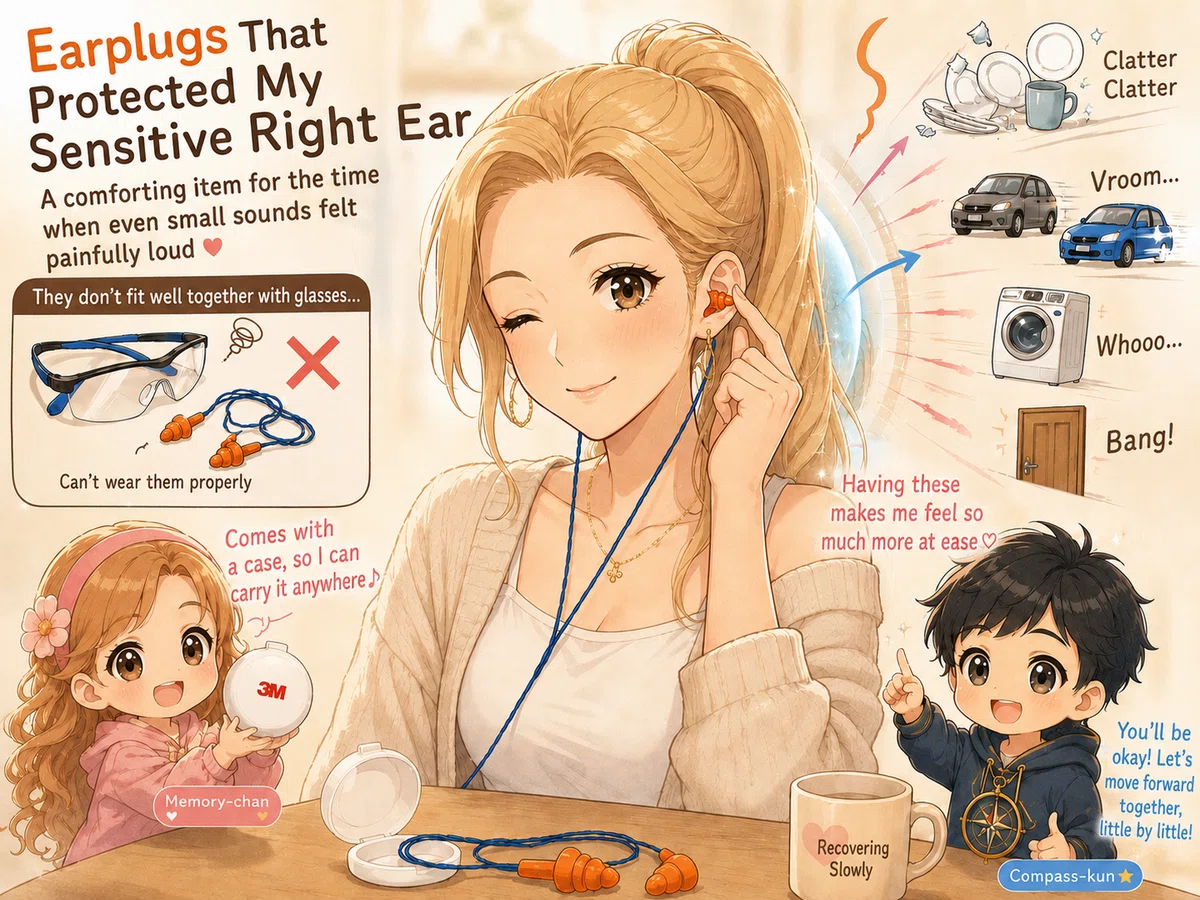
① 3M Corded Earplugs
One symptom of RHS is sound sensitivity — hyperacusis.
There was a period when my right ear became so sensitive
that small, everyday sounds felt as if they were booming.
These earplugs block sound reliably
and did a great job of protecting my right ear.
I tried attaching them to the protective glasses introduced above,
but in my case, the two didn't fit together well.
Even so, as standalone earplugs, they were plenty dependable.
[Keeping the Face and Neck Warm]
① Balaclava (A Pull-On Cold-Weather Face Mask)
A fleece, windproof face mask — a balaclava — that slips over your head
and covers the face, ears, and neck all at once.
It shielded the paralyzed side of my face and my sensitized ear
from wind and cold together,
making it a trusted companion for winter outings.
Not letting my face and neck get too cold, during recovery and after,
was an important piece of self-care for me.
It has remained a reliable companion long after recovery, too.

[Guarding the Facial Nerve Pathways: Rita Routine Items]
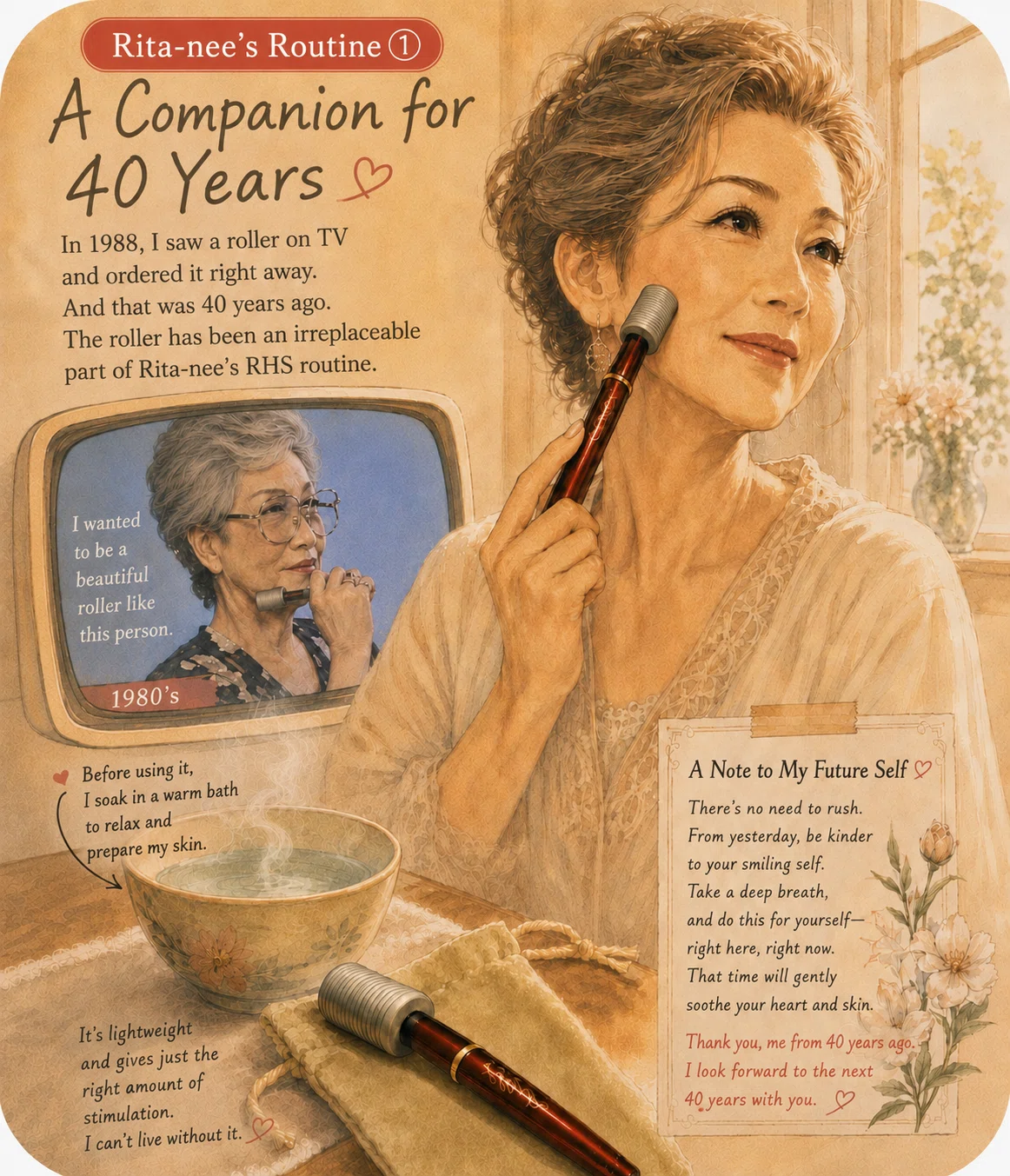
① The Warming Roller: Noriko Awaya's Germanium Beauty Roller
Let me introduce a slightly retro companion for my facial massage.
A red handle, a golden signature.
A germanium beauty roller bearing the name of Noriko Awaya —
the queen of Shōwa-era blues.
I bought it before moving to America in 1990, back when I was still in Japan.
It's that roller — the one that swept the nation
through Awaya-san's TV commercials.
Those who know will know exactly which one I mean.
(Doesn't that date me!)
This little one crossed the Pacific with me,
and for nearly forty years it quietly kept me company from inside a drawer.
Who could have imagined that some 40 years later,
its moment would come again — for my paralyzed face!
Rita's Warming Roll: RHS Facial Care Routine, Part One
First, warm the germanium head of the roller in hot water.
When it reaches a temperature that feels "just right" against your cheek,
gently roll it over the paralyzed right half of the face — about three minutes.
That's all.
The pleasant warmth reaching a cheek that cannot move — pure bliss.
As it turns out, when I looked into it,
there's no confirmed scientific evidence
for germanium's beauty or health benefits.
And yet, as I recall, the claims back then were bold —
"I look younger," "my spots vanished," "my wrinkles are gone."
[Important Note]
*Massage during facial-palsy recovery requires care in both pressure and technique.
Don't improvise with force; always consult your doctor or physical therapist first,
and stay within the range of "gentle and comfortable."
There's a lovely origin story behind this roller.
Its creator was a woman named Sanae Inazumi.
Her esthetic salon had failed, she was ten million yen in debt,
and she was on the verge of being evicted from her building.
At rock bottom, she encountered germanium powder — and had a flash of insight.
What if she molded it into a cylinder that could roll over the face?
And as she wondered what to use for a handle, a second flash:
"A fountain pen might be just the thing."
The roller born that way was introduced on television by Noriko Awaya —
"This one's wonderful!" — and from that moment, the phones wouldn't stop ringing.
It went on to become a mega-hit, eventually selling ten billion yen.
A tool born at rock bottom,
warming my face inside the tunnel, forty years later.
What a mysterious thread of connection.
② Scalp Massage: Panasonic Scalp Esthe EH-HM94
The second item in my routine:
Panasonic's scalp massager (the sebum-cleansing type, EH-HM94).
A 2012 model — a fourteen-year veteran in our house.
(Now discontinued.)
Massaging a paralyzed face too strongly
raises the risk of an aftereffect called synkinesis —
unintended facial movements that occur together.
So instead, I gently massaged the scalp,
lifting the skin upward from above the ears toward the crown.
The scalp and the face are connected by one continuous sheet of skin —
RHS reminded me of that all over again.
[Important Note]
*Massage during facial-palsy recovery requires care in both pressure and technique.
Don't improvise with force; always consult your doctor or physical therapist first,
and stay within the range of "gentle and comfortable."
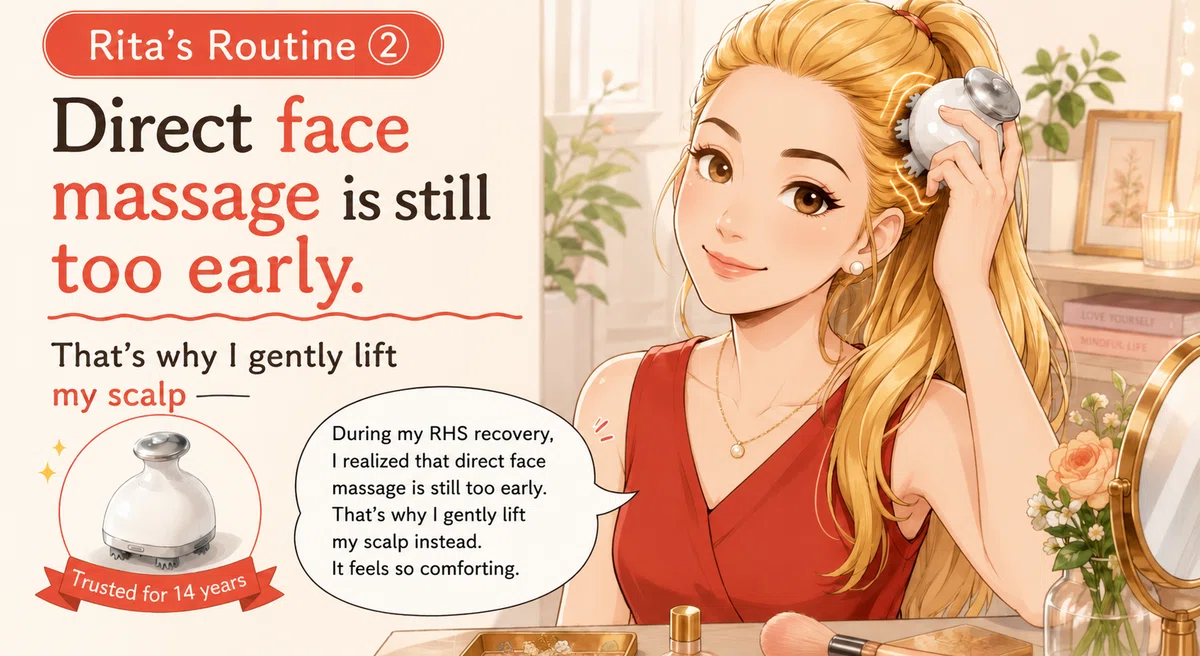
but Panasonic offers successor models in its scalp-care series.
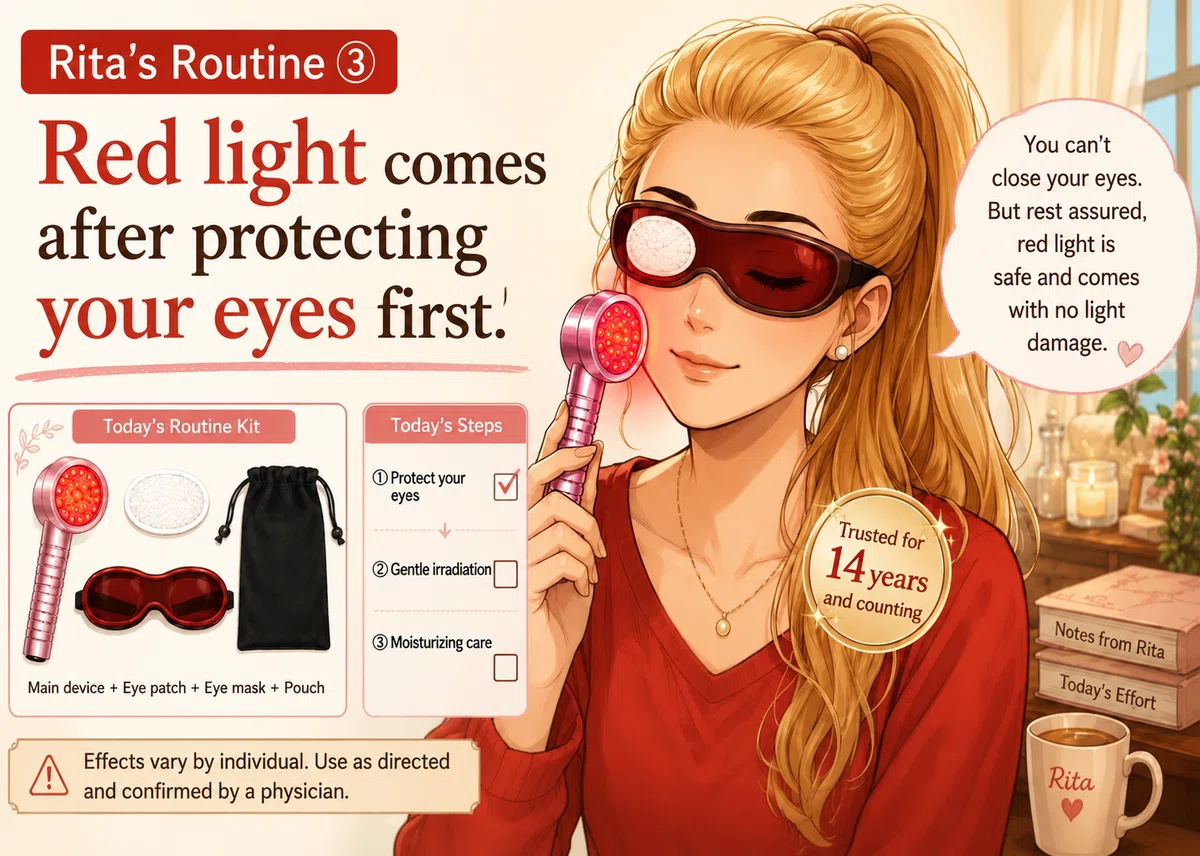
③ Red Light Therapy (Baby Quasar MD Plus)
Third: a red light therapy device.
Purchased in November 2012 — another fourteen-year veteran,
forgotten until RHS brought it back into the spotlight.
Slowly moving the light across the paralyzed side
feels warm and wonderfully soothing.
Whenever I used this device, before every session,
I covered my right eye with a disposable eye patch (Curad Eye Patch),
then put on the eye mask that came with the device to protect my eyes.
An eyelid that can't fully close is defenseless against light, too.
If you ever try light therapy,
never — ever — skip the eye protection.
Also, research on red light therapy's effect on facial nerve palsy is still ongoing.
Always check with your doctor before use.
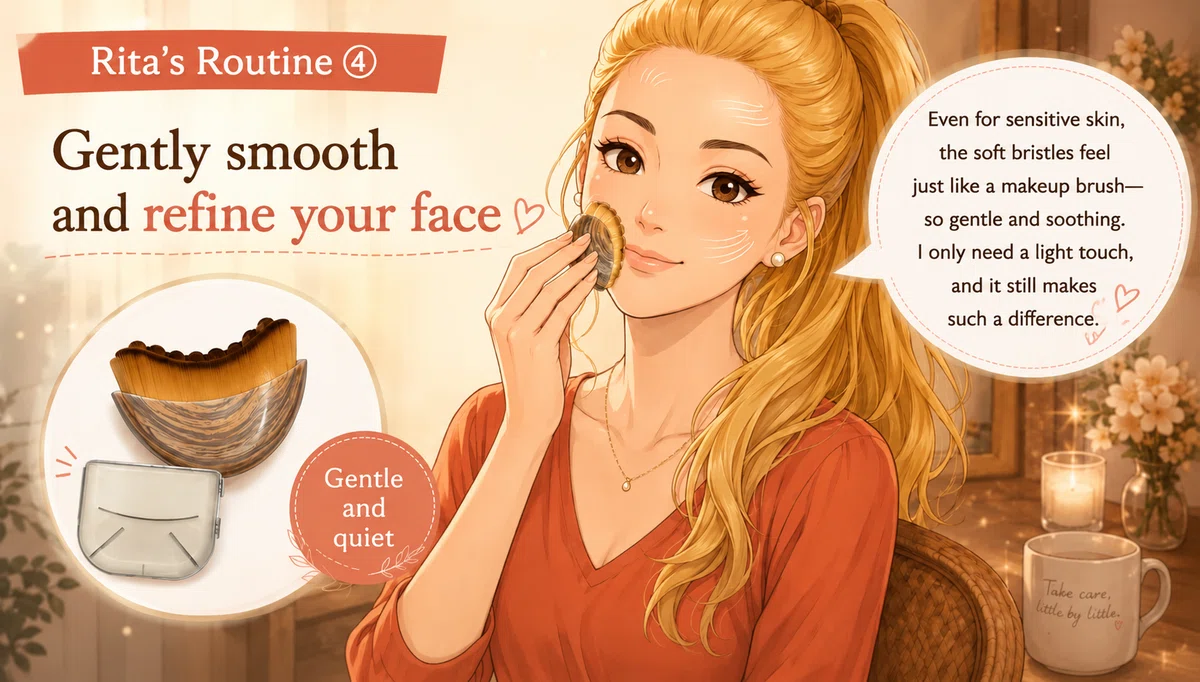
④ Gentle Facial Brushing (Lymph & Contour Brush)
With a soft-bristled face brush,
I brushed my whole face gently, as if stroking it.
The fluffy tips — like a makeup brush — felt pleasant even on sensitized skin,
quietly soothing and settling it.
Very relaxing.
I worked these tools into my own daily "form."
The full sequence — the complete Rita Routine,
along with earlobe massage and the inside-the-mouth tongue massage —
will be introduced in detail in a later article.
3. The Supplements I Gathered in Hopes of RHS Recovery
None of the items below treat RHS.
In my case, they were taken on top of medical treatment —
antivirals, steroids, eye protection —
purely as "groundwork" to support my body
through the nerve-recovery period.
[Nerve Foundation Support]
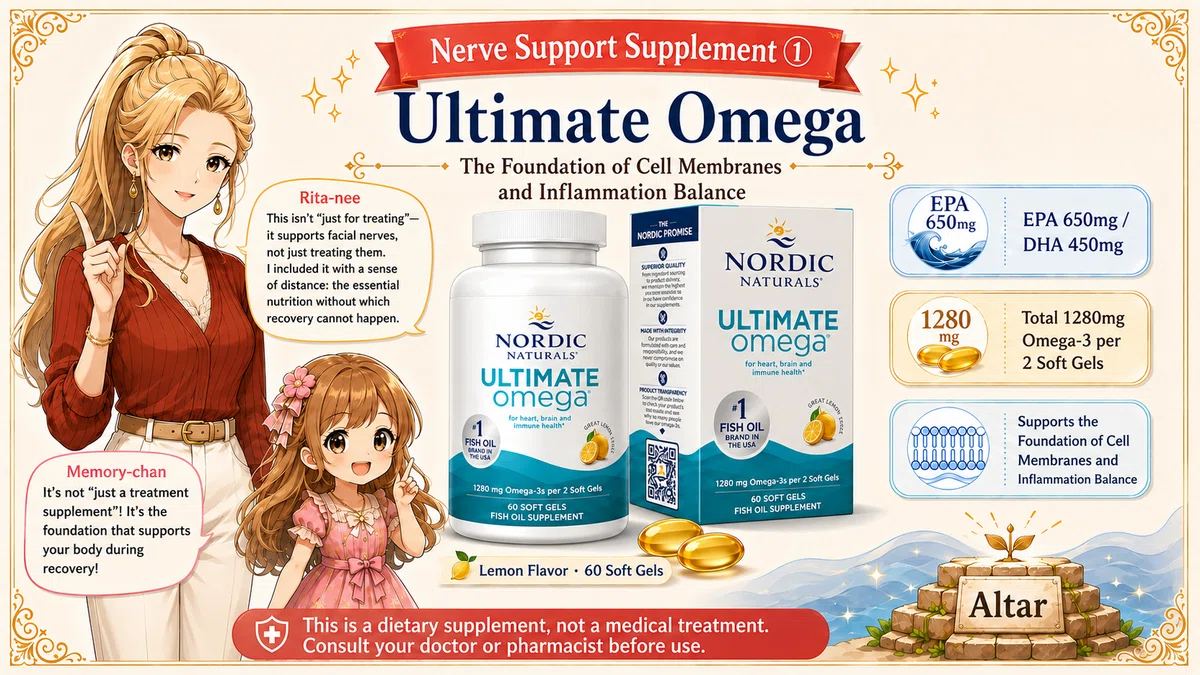
① Nordic Naturals Ultimate Omega
EPA/DHA are fatty acids involved in cell membranes and inflammatory response.
Purpose: steadying a body prone to tipping toward inflammation.
I took 2 softgels with lunch.
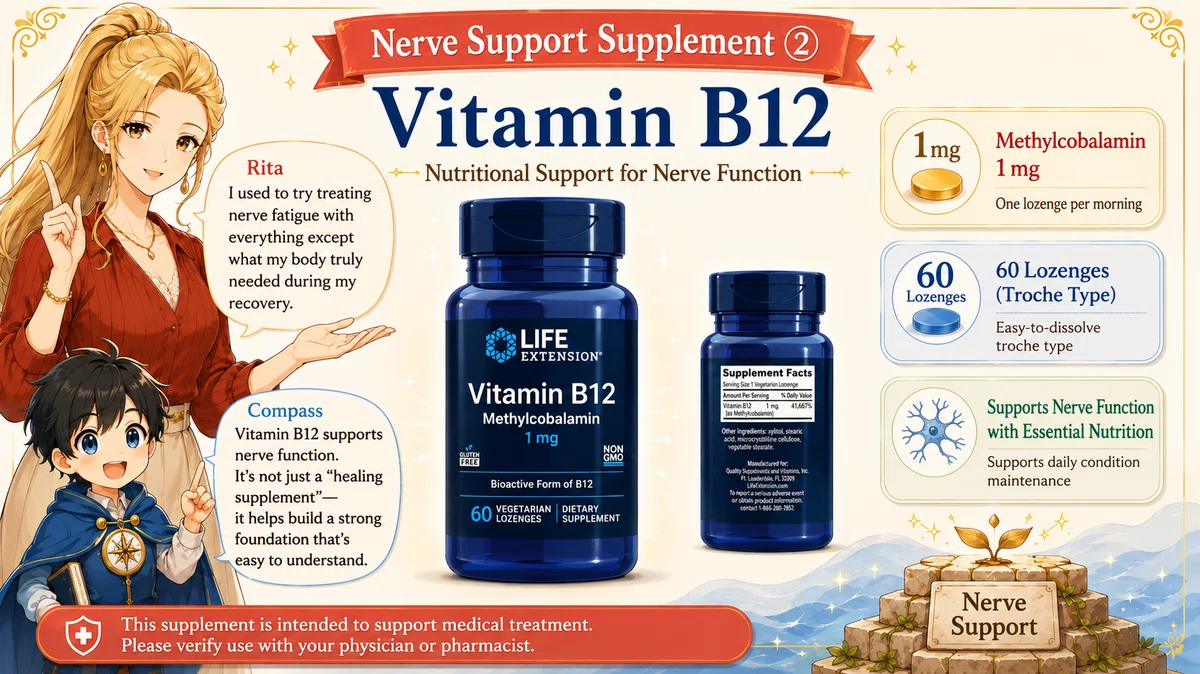
② Life Extension Vitamin B12 Methylcobalamin
B12 is a nutrient deeply involved in nerve function.
I took it to make sure I wasn't running short
on nutrients related to the nerves.
1,000 mcg — 1 capsule in the morning.
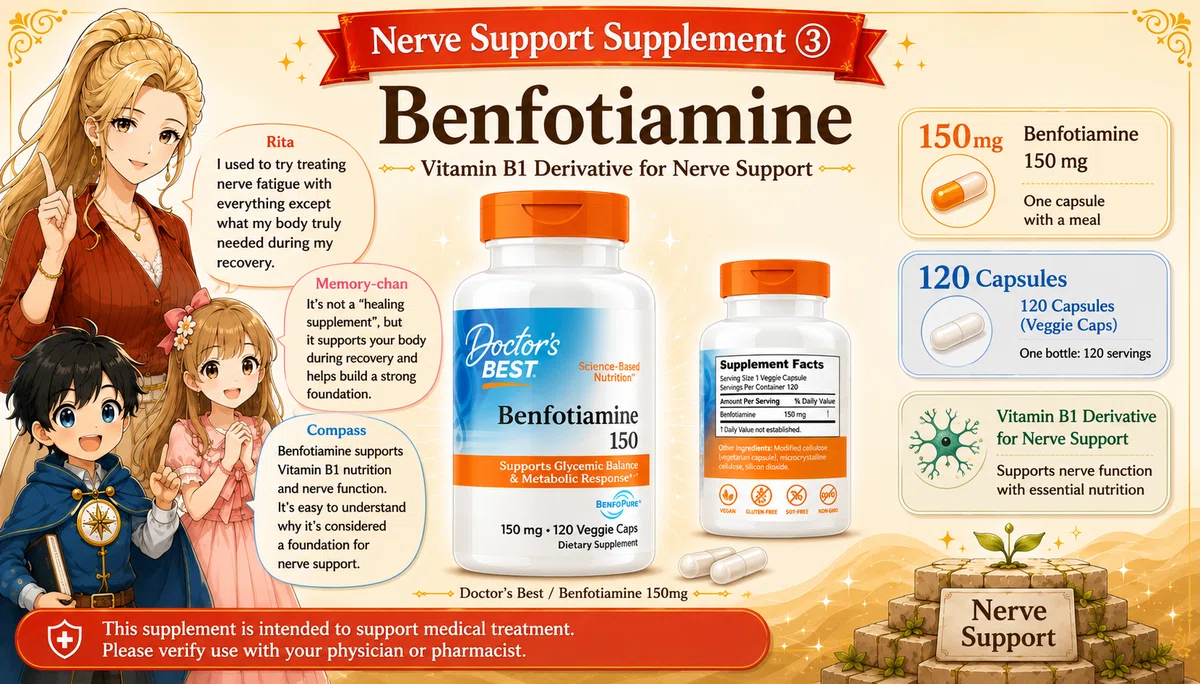
③ Doctor's Best Benfotiamine 150
A vitamin B1 derivative. A nutrient supporting energy metabolism in the peripheral nerves,
used as "foundation support" during nerve recovery.
150 mg — 1 capsule with lunch.
[Immune & Inflammation Balance Support]
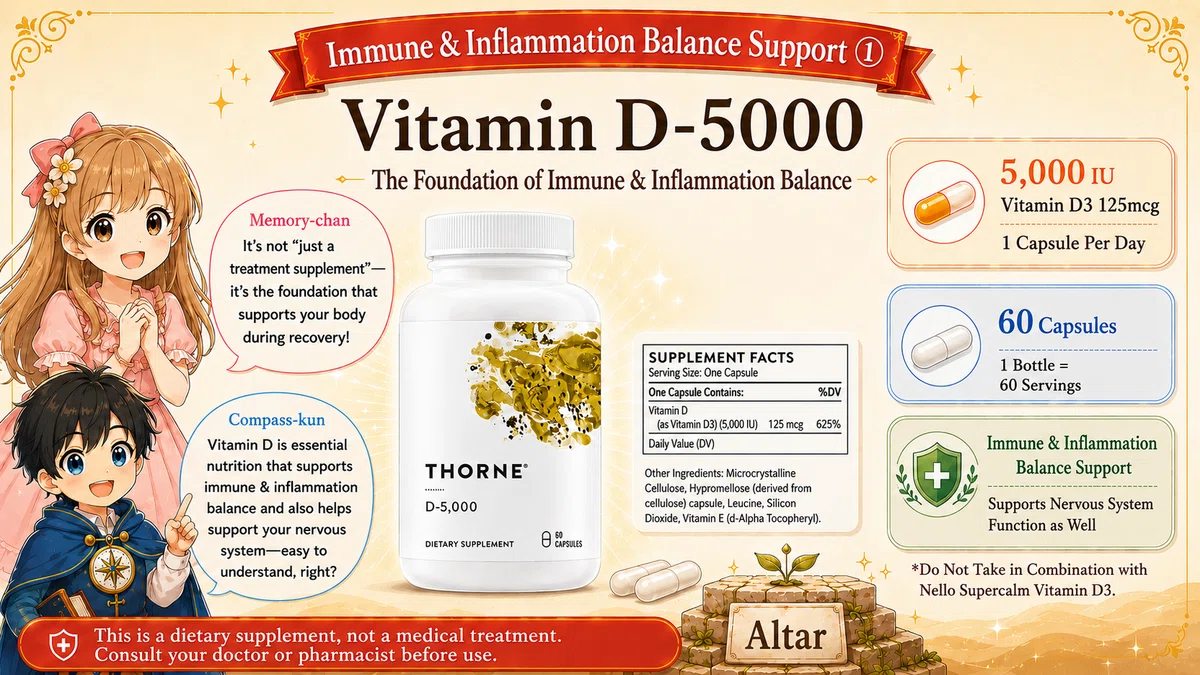
① THORNE Vitamin D-5,000 (Vitamin D3)
Vitamin D is involved in immunity, inflammation regulation, and neuromuscular function.
Even in sunny Las Vegas, deficiency is possible —
groundwork with blood levels in mind.
5,000 IU — 1 capsule with lunch.
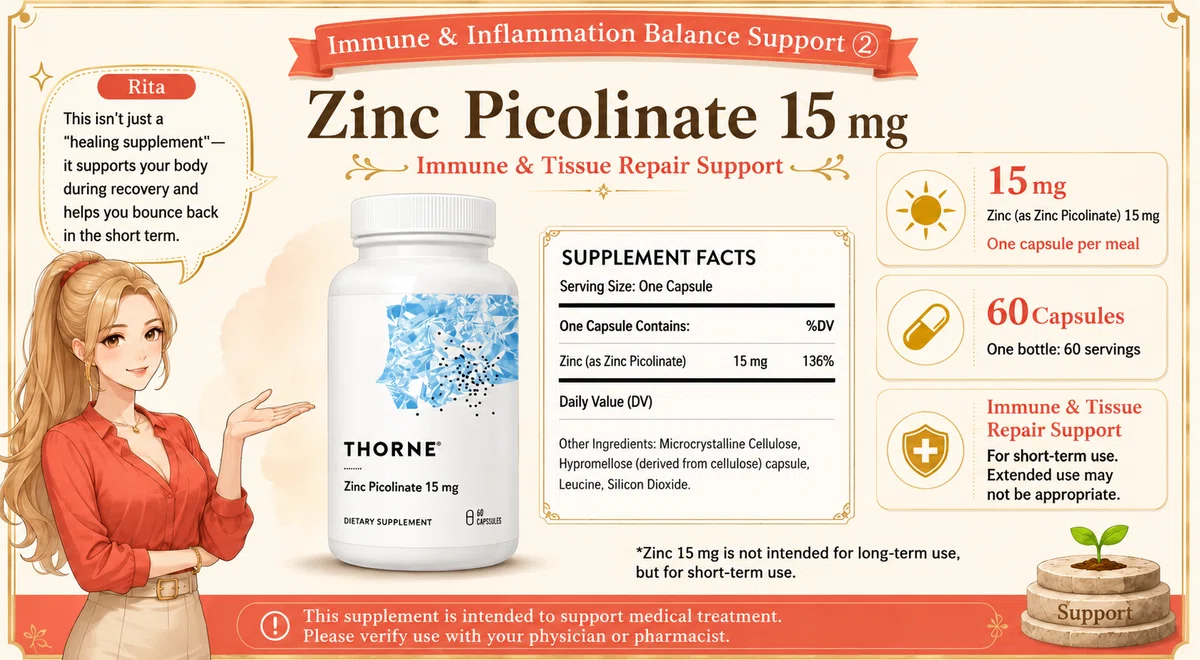
② THORNE Zinc Picolinate 15 mg
A mineral involved in immune function and tissue repair.
Short-term immune and repair support during post-viral recovery.
15 mg — 1 capsule with lunch.
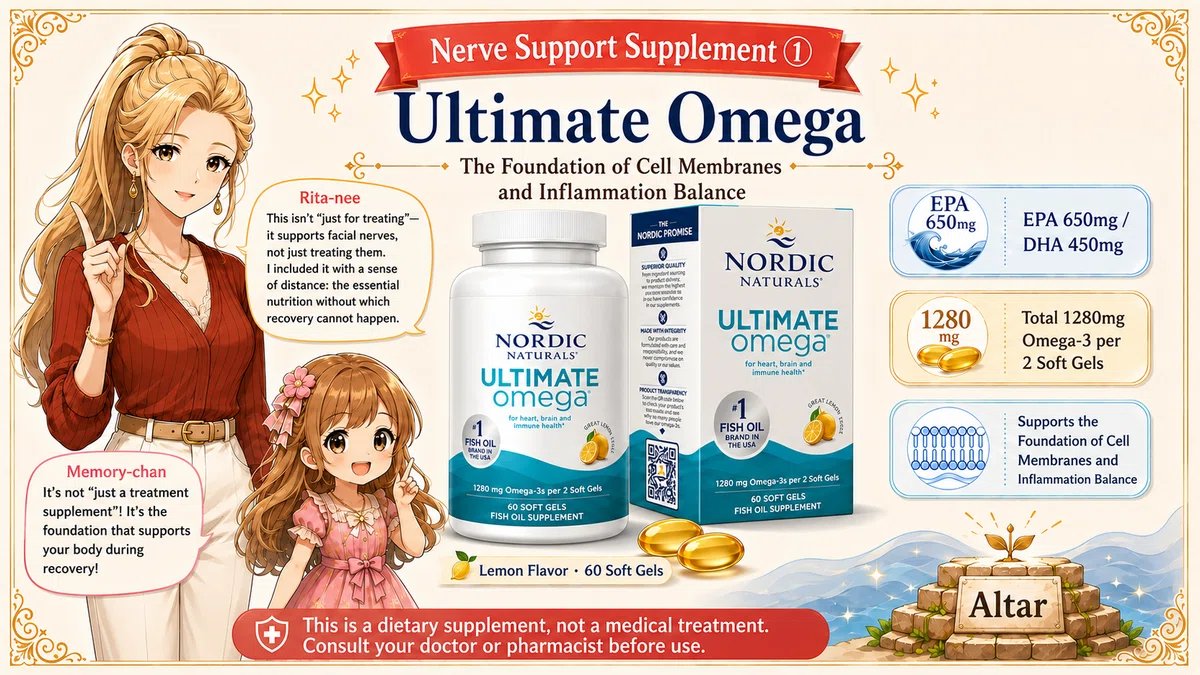
③ Nordic Naturals Ultimate Omega
The Ultimate Omega from "Nerve Foundation Support"
makes a proud second appearance here,
in "Immune & Inflammation Balance Support."
EPA/DHA are fatty acids involved in cell membranes and inflammatory response.
Purpose: steadying a body prone to tipping toward inflammation.
I took 2 softgels with lunch.
[Sleep & Calming the Nervous System]
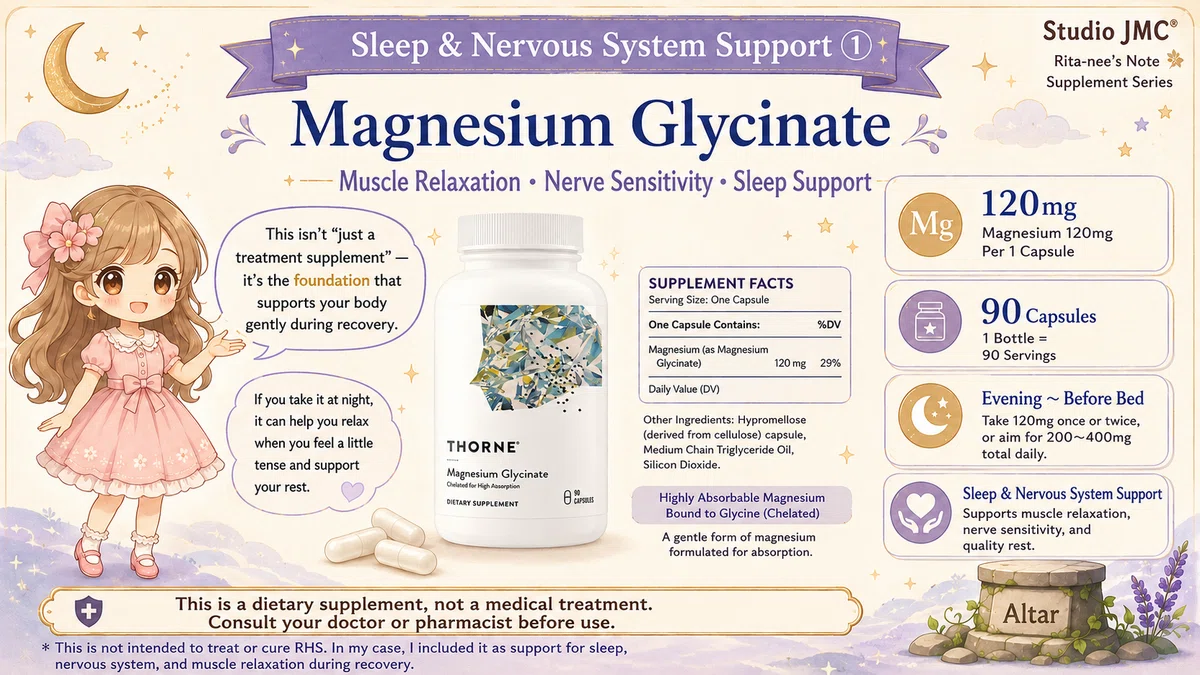
① THORNE Magnesium Glycinate
For muscle tightness, nerve sensitivity, and sleep quality.
For the post-RHS tension, twitching, and difficulty sleeping.
120 mg — once or twice, between evening and bedtime.
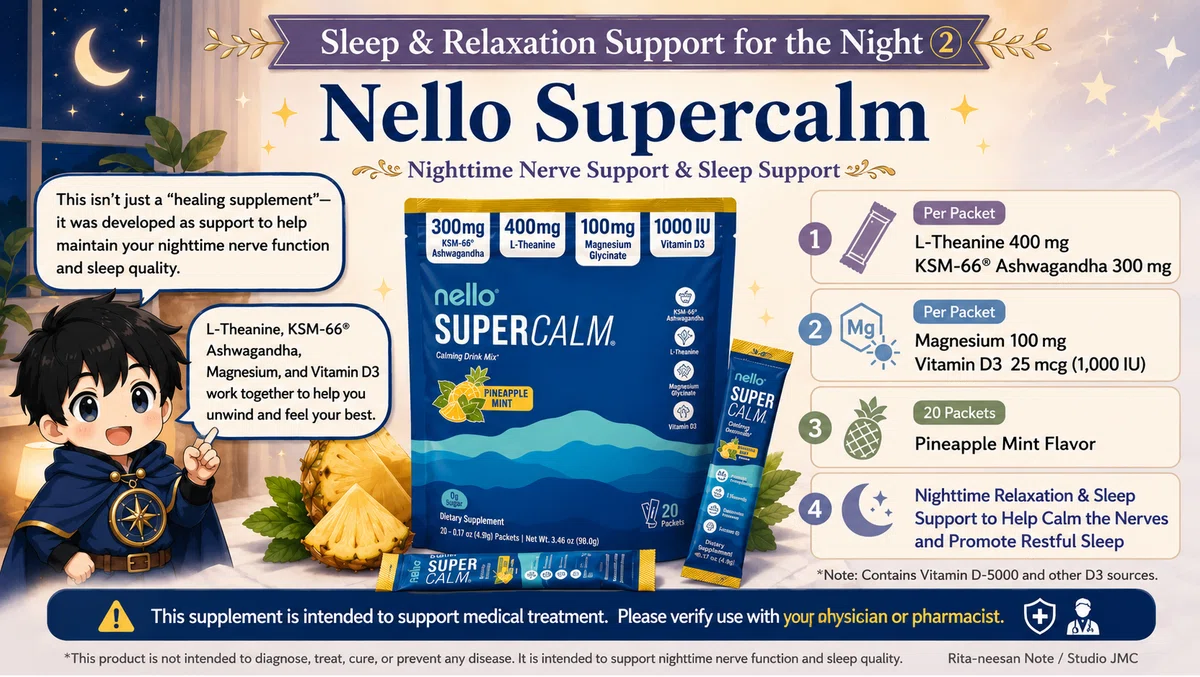
② Nello Supercalm Powdered Drink Mix
A "relaxation supplement" to settle the nervous system in the evening.
Restorative sleep is a vital foundation of nerve recovery.
One serving, between evening and night.
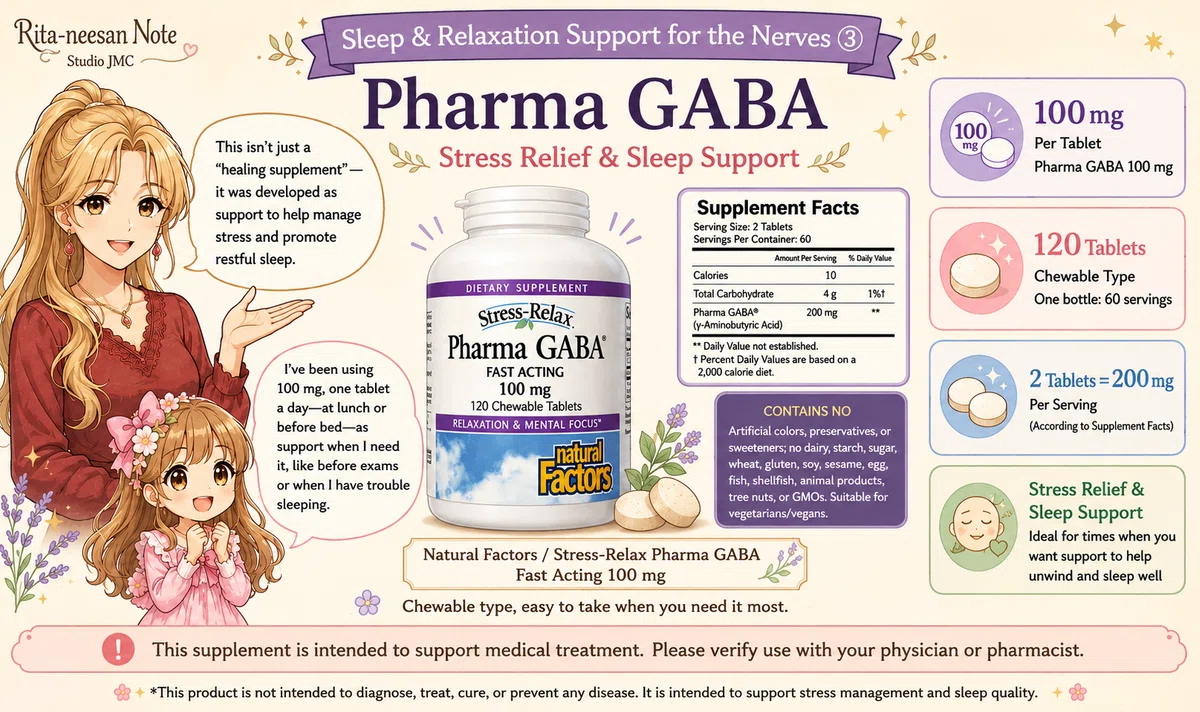
③ Natural Factors Pharma GABA
GABA products target stress, tension, and falling asleep.
The research is limited, though — so strictly as
"a little help for nights when the nerves run high."
100 mg — 1 capsule, midday to evening, or before bed.
[Hydration & Electrolyte Support]
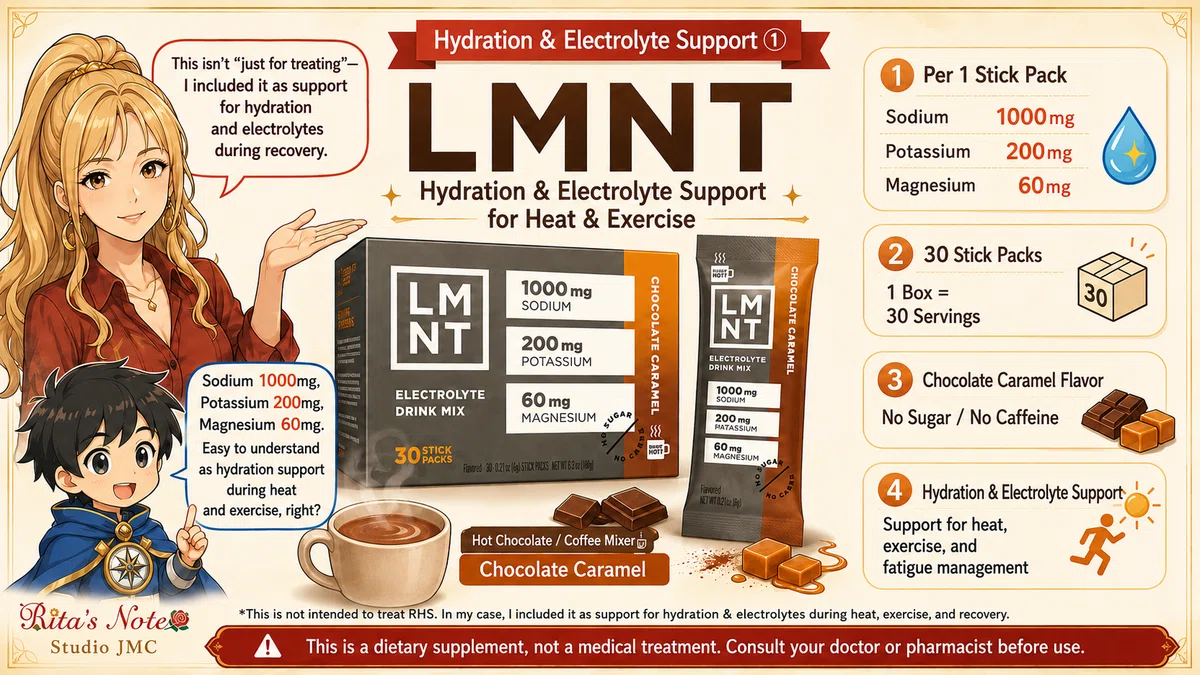
① LMNT Zero Sugar Hot Chocolate or Coffee Mixer
Taken as a supplement of electrolytes and micronutrients.
It tastes quite good, too.
Hydration and nutrition support for days when appetite dropped
or the fatigue of recovery ran deep.
And the time itself — slowly sipping something warm —
became a small ritual of telling myself,
"You did well again today."
One serving, any time of day.
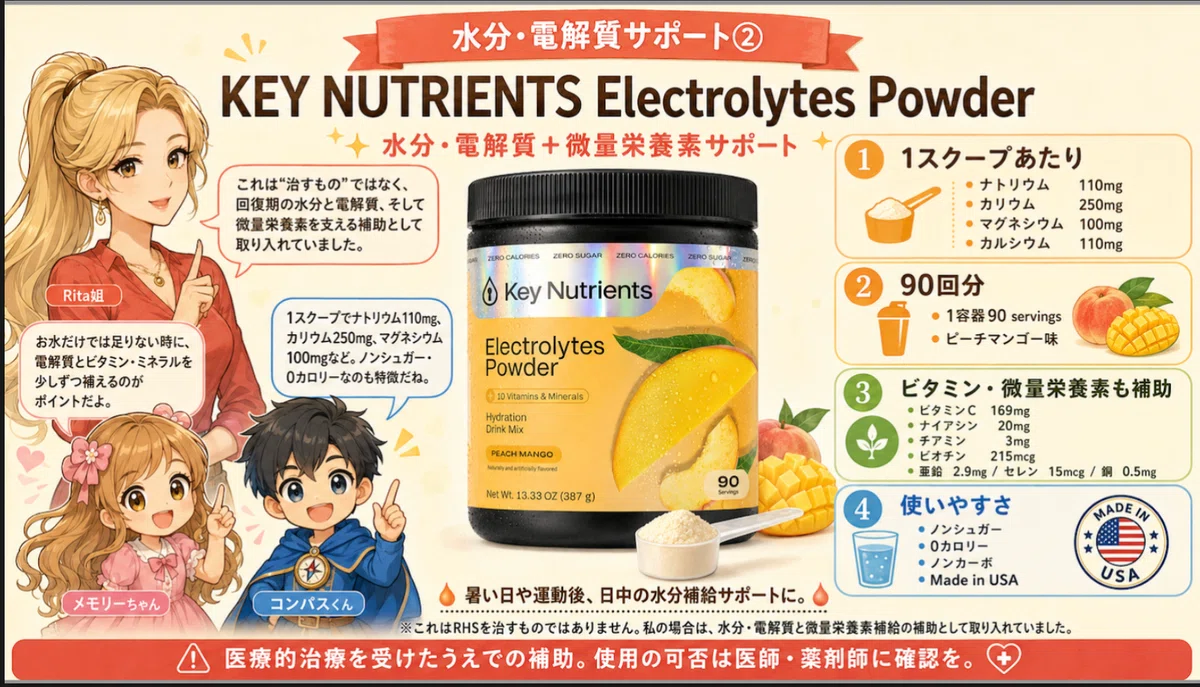
② KEY NUTRIENTS Multivitamin Electrolytes Powder
Taken as a supplement of electrolytes and micronutrients.
Hydration and nutrition support for days when appetite dropped
or the fatigue of recovery ran deep.
One serving, any time of day.
[Edible Self-Care]
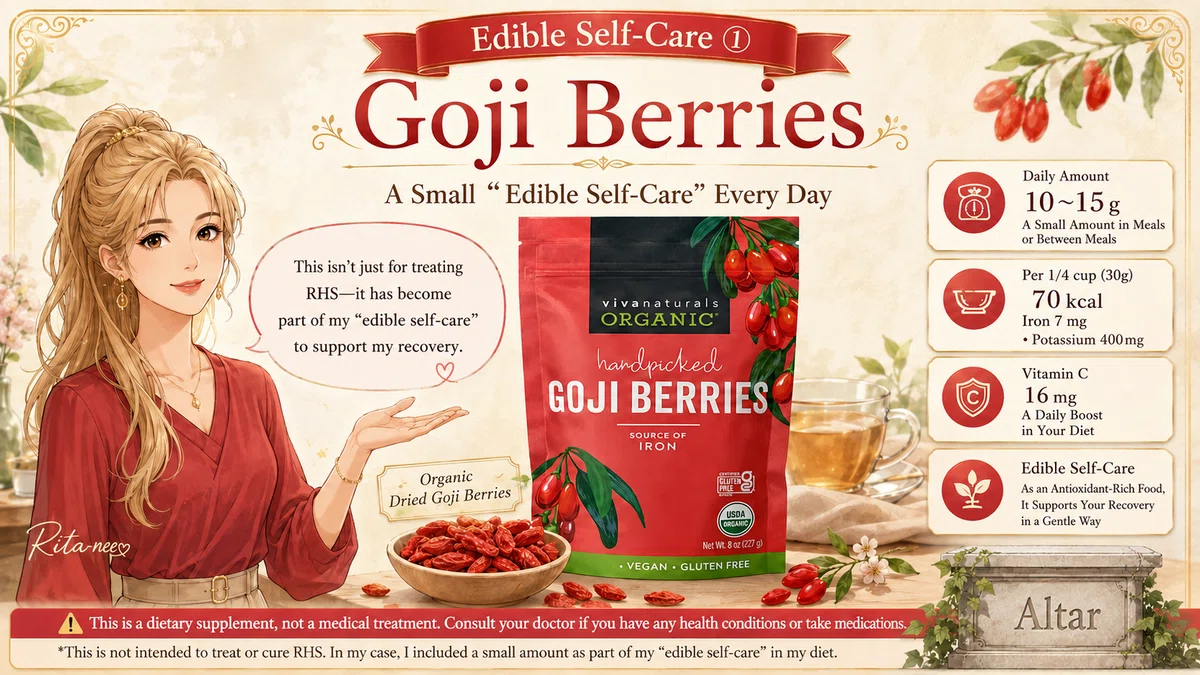
① Goji Berries
Goji berries — floated in tea, or nibbled as they are.
A small nourishment borrowed from the wisdom of medicinal cuisine.
I took a small amount as an antioxidant-rich food:
less for any medicinal effect
than as "edible self-care" for the recovery period.
10–15 g, with meals or as a snack.
[Information as a Talisman]
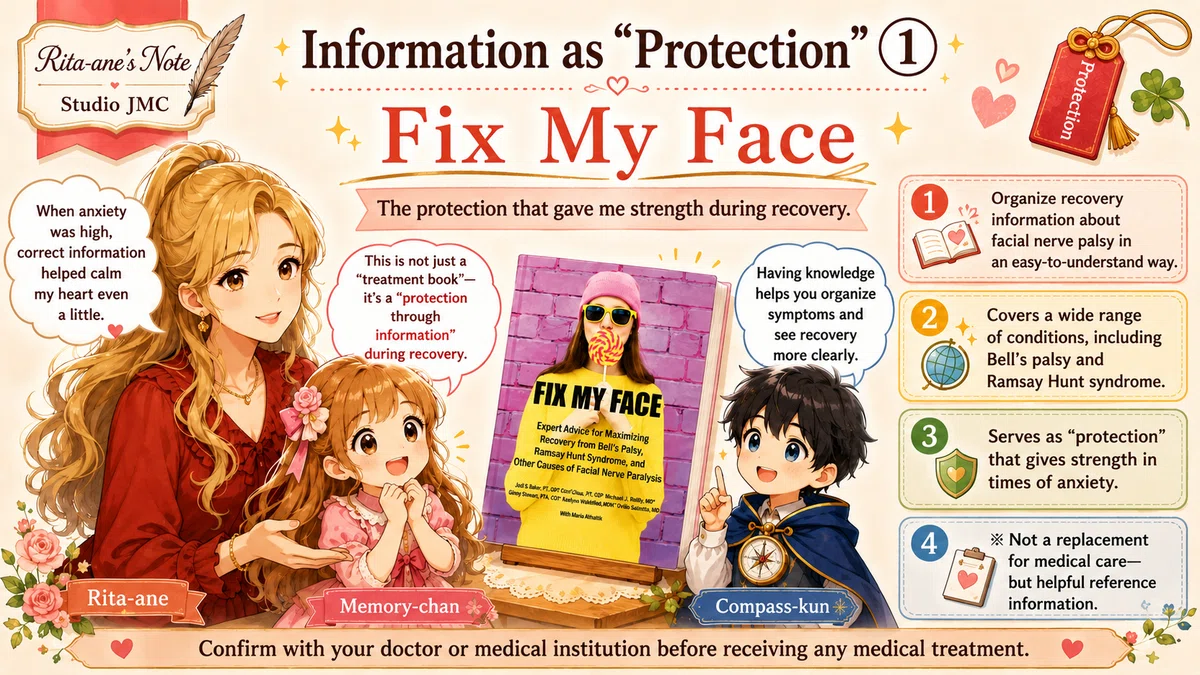
① Fix My Face by The Foundation for Facial Recovery
A book about recovery from facial paralysis, written from the patient's perspective.
Inside a tunnel with no visible end,
simply knowing that others had walked this road ahead of me
was itself a support.
The database of recovery rates and possible aftereffects
was a little frightening to look at — and yet enormously valuable.
Some of the information is dated, but I found it a wonderful reference.
Supplements can interact with prescription medications,
and certain health conditions call for extra caution.
Always consult your doctor or pharmacist before taking them.
Thank You for Reading All the Way ❤️
Well done.
Even just reading this far is tiring, isn't it?
And to you, sighing, "Do I really have to buy all of this...?" —
It's okay. You don't need all of it.
I didn't gather everything at once, either.
I simply added things one at a time, as each need arose.
If I had to set priorities, I'd say without hesitation:
start with "protecting the eye."
Everything else, you can choose slowly,
to fit your own symptoms and your own life.
Even shopping is exhausting in this season, isn't it?
Rita has walked this road, so she knows.
If this list can be of some use to you —
if it can spare you even a little of the searching —
nothing would make me happier.
Recap Manga: (No.7) To You in Week Three of RHS
Here, a short manga recap of No.6.
Press the "Open viewer (ビューアを開く)" button below
to read the recap manga.
It is in Japanese manga format, so once the viewer opens,
please use the left-pointing arrow to move to the next page.
Next Time
In No.8, I'll write about a deeper circuitry of the heart
that RHS brought into view.
The voice I had always taken for other people's voices
was, in truth, none other than "my own voice" —
one that had taken up residence inside me over a long, long time.
Taking on someone's anxiety before they could feel it, so as not to worry them.
Putting myself last to keep the room at ease.
Making myself smaller to please others.
Somewhere along the way, without noticing,
I may have assigned myself those roles.
No one ever forced me to.
But during my RHS recovery, I slowly began to see:
I no longer need to disguise myself to reassure anyone.
Cherishing myself — filling myself with joy, and setting myself free —
may in fact be the first step
toward the happiness of the people around me, too.
Next time:
To You in Weeks Six to Eight of RHS
— I No Longer Need to Carry Anyone's Anxiety
👉 Click the image to continue to the next article.

Rita Code | Studio JMC
🇯🇵 Click here for the Japanese version
https://note.com/studio_jmc/n/n3f37abe7a0d9
