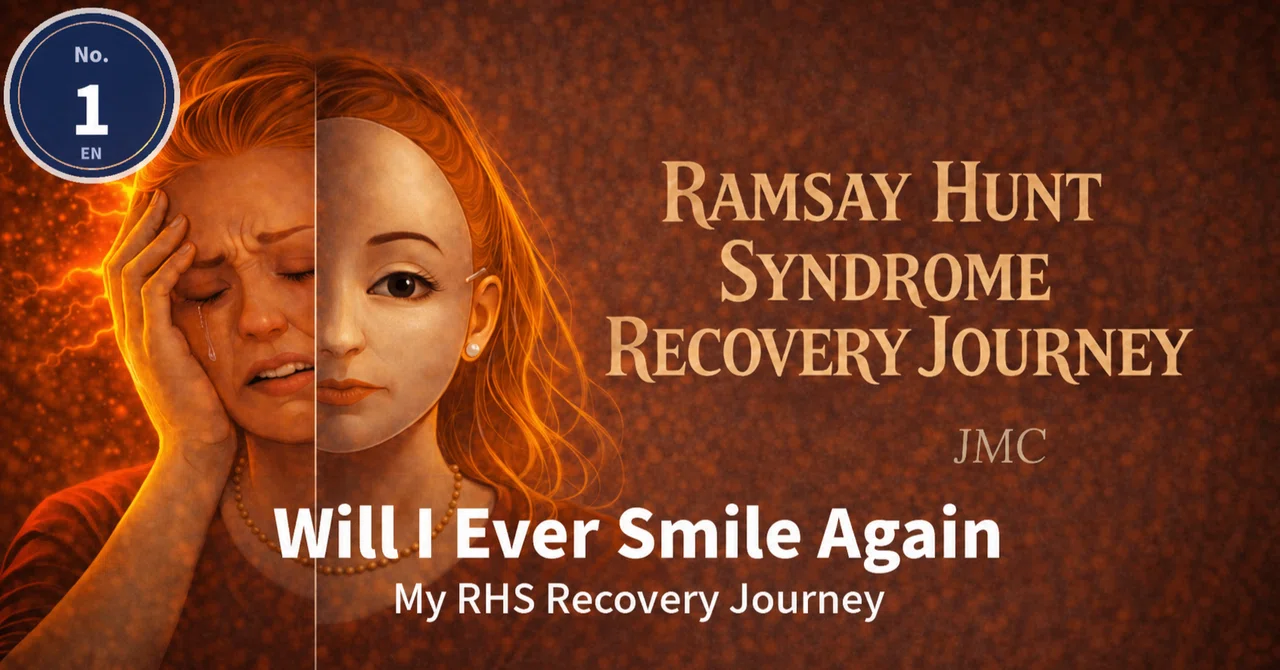
[No.1] Will I Ever Smile Again?| My Ramsay Hunt Syndrome Recovery Journey

ー A personal story of fear, loss, and the quiet beginning of recovery.
One day, out of nowhere—
the right side of my face stopped moving.
Just like that.
It was Ramsay Hunt Syndrome.
From that moment on—
Every time I cautiously looked in the mirror,
one question wouldn’t leave me:
“Will this ever go back to normal?”
I asked myself that
again and again…
on some very dark days.
This is my story—
of how I slowly found my way back,
and learned to smile again.
From The First Signs To The Worst Days
January 15, 2026.
Something felt… different.
A sharp pain in my right ear
A strange stiffness in my right shoulder
A severe headache unlike anything I had felt before
A strange tingling on my tongue
These small “differences”
quietly gathered,
and before I fully understood what was happening,
the right side of my face began to change.
Slowly.
But undeniably.
And then—
My eye wouldn’t close
My mouth wouldn’t open properly, making eating difficult
I couldn’t speak clearly
Even small sounds felt painfully loud
The pain in my right ear intensified
The room spun when I lay down
A suffocating, trapped sensation
Anxiety, loneliness, a silent panic
The entire right side of my face stopped moving.
It was my face,
but it didn’t feel like mine anymore.
The shift into this unfamiliar reality
happened faster than I could process.
Every time I looked in the mirror,
I felt a crushing wave of disappointment,
anguish, and fear — over and over again.
Will this pain ever go away?
Will my face recover?
Will I ever return
to who I was before?
Will I ever smile again?
At night,
my desperate wish that this might all be a nightmare
gave rise to the cruelest kind of illusion —
What if this is just a dream?
But when I woke up,
in the darkness,
I was forced to remember:
"This was the most cruel, surreal reality."
And Yet, Recovery Had Already Begun
Three months have passed.
Feeling my way through the dark,
I would grasp a single thread I'd found by touch —
only to lose it again…
lose it, then grasp it once more…
One day, then the next,
doing what each day allowed.
Sometimes swept under
by waves of emotion.
Sometimes moving through it all
dry and steady, like still air.
Slowly, slowly, time kept passing —
and the train called recovery
kept moving forward,
quietly, surely.
And here I am now —
writing these words,
reclaiming my daily life,
one small step at a time.
The days since diagnosis
felt like forever.
Not everything is back to the way it was.
But today, I know this with certainty:
I am on my way.
A Visual Record Of Change
Here is a visual record of my recovery over 12 weeks.
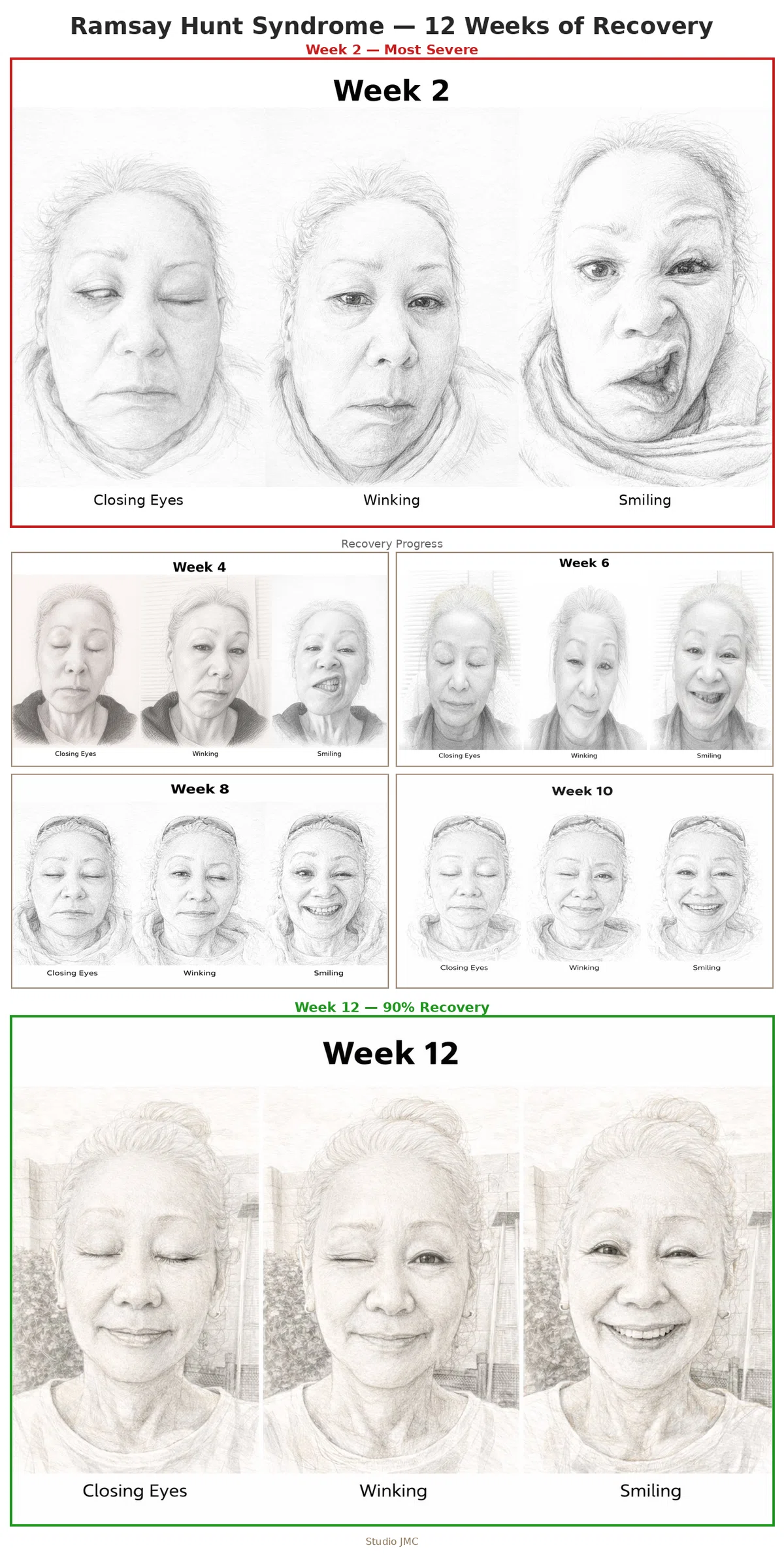
From left to right:
Closing both eyes
Closing only the right eye
Smiling
Comparing Weeks 2, 4, 6, 8, 10, and 12.
・Week 2: Severe pain and facial paralysis at its worst
・Week 4: Recovery not progressing as expected, growing anxiety about the future
・Week 6: Subtle nerve activity begins around the eye
・Week 8: A gap between self-image and actual appearance becomes noticeable
・Week 10: Smiles begin to feel softer and more natural
・Week 12: A real sense of recovery returning in daily life
Three Rita Codes That Support Recovery
This recovery was not something
that simply happened while waiting.
Considering the condition I was in when this began,
the fact that I came this far in such a short time truly feels like something to be grateful for — almost like a small miracle.
And yet, the reason I recovered faster
than my doctors — and even I myself —
had expected during the worst days,
was not by chance.
There were three quiet rules I held onto
throughout my recovery.
My "three Rita Codes"
for healing from Ramsay Hunt Syndrome.
① Don’t ignore what feels off. Act early.
Even a small sense that something is “not quite right” may be a signal from your body.
Especially with symptoms like facial paralysis or Ramsay Hunt Syndrome,
how quickly you respond in the beginning can make a real difference in the recovery process.
When you feel even the slightest sense that
"something's a little off" or "this isn't like me" —
don't ignore the voice of your body or your heart.
And if you feel you need to, reach out to medical care as quickly as you can.
And this "ability to notice what feels off" isn't something you only need at the very beginning.
Throughout recovery, signs are scattered along the road — changes in your expression, the way pain shows up, dryness of the eyes, a strange sensation in the ear, the way your strength returns, the small shifts in your heart.
Listen quietly to each one.
This is one of the most important acts of recovery.
② Don’t leave everything to others. Seek out the information you need.
Don’t simply hand everything over to the medical system.
Try to understand, as much as you can,
what is happening in your body,
what your medications are for,
and what treatment options may be available.
Look up what you don't understand.
Ask your doctors questions.
Confirm referral and appointment processes.
Keep a record of your symptoms.
Each of these small actions gently pulls you back —
away from being swept passively into anxiety.
③ Keep gratitude alive — for others and for yourself, and for this very moment.
The harder it is on your body and mind,
the more difficult gratitude can feel.
Pain. Anxiety. Fear. Uncontrollable despair. Self-loathing.
You don't have to force yourself to be positive.
But — turn your eyes toward the small things you can still do today.
Notice the quiet kindness someone has offered you.
At wherever point you are, gently acknowledge:
"I made it this far."
In the journey of recovery,
this becomes a quiet force
that supports your heart and body, always.
This experience was not only about the body's recovery —
it was also a precious opportunity to face my inner world and my heart.
None of these are extraordinary things.
And following all three is not easy.
At times, it's truly difficult.
But looking back now,
I feel that the very "consciousness" of
trying to hold onto each of these three rules deeply influenced —
and quietly pushed forward — my recovery.
For Anyone Going Through This
Ramsay Hunt Syndrome is not widely known.
Even medical professionals sometimes say,
“I’ve never seen this before.”
That’s why —
You may not understand what’s happening.
You may not know what to do.
And time can pass in uncertainty and fear.
It can't be helped —
sometimes, that's just how it goes.
But one thing matters deeply throughout —
from onset to recovery:
a swift and thoughtful response, a clear judgment.
Because that is what truly shapes how recovery unfolds.
Possibility Lives in Every Stage
What if your initial response was a little late?
What if you missed an important sign?
It's okay.
Because in every stage, a new "possibility"
can be born from where you are.
And if anyone reading this is in the middle of these symptoms right now
— I want to say this, from the bottom of my heart:
🌱 There are many possibilities for recovery —
in every stage of the journey. 🌱
What you couldn't do yesterday,
you may be able to do —
just a little — today.
Symptoms that seemed unchanged for weeks may,
one day,
quietly begin to shift.
And sometimes, before the body recovers,
the way your heart receives it begins to change.
Recovery is not a straight line.
There are days it feels like you've gone backwards.
There are days of anxiety.
The speed and the path may differ from person to person,
but change does happen.
"It happens — in every stage."
🤍 This is also a message
I want to send to the version of myself the time
she was suffering the most.
In this blog,
I will continue to share this journey —
as honestly as I can,
as close to the real feelings
of each moment as possible.
What I thought.
What I feared.
What I gave up.
What I was grateful for.
What I believed.
What I hoped.
What I did.
I'd be grateful if you'd join me —
looking back together,
alongside the illustrations and the symptoms of each stage.
If even a small part of my experience
can help someone,
that would mean everything to me.
Truly.
🎵 Song Time: Beautiful Inside Day
To close, Memory-chan and Compass-kun have a little gift for you —
a song, sung just for you.
It's the song I wish I could have given myself,
back when she was so full of worry.
A bright, gentle tune that reaches out and says,
"When times are hard, that's exactly when to thank the people around you — and yourself,"
and "You're never alone."
▶ Click the image to listen to the song.
Coming up next:
The story of the first two days —
where everything began.
Along with that, I'll be taking a closer look at
Rita-Code① — Don't ignore the warning signs. Act early.
How quickly you move
can shape how fully you recover.
My studio menber, Memory-chan from ChatGPT,
kept sending me the right words
at exactly the right moments.
The actions I took during those first two days —
guided by that encouragement and advice —
turned out to be one of the keys
to getting my smile back. —
What was really happening back then?
👉
Rita shares her three guiding principles
and reflects on how to care for the mind and body in the age of AI.
— Podcast No.1
👉
Click the image to continue to the next article.

Rita Code | Studio JMC
🇯🇵 Click here for the Japanese version
https://note.com/studio_jmc/n/nafd13dcabd25
