
[No.4] To You in Your First Week | What Is Ramsay Hunt Syndrome, Anyway? (With manga and audio guide)

Sharing the Day-6 Video of My Face
On January 15, 2026, Ramsay Hunt Syndrome struck —
and so began the first week.
What was I feeling? What was I thinking?
What was I actually doing back then?
It was only three months ago —
yet it feels like a very long time has passed.
I am sharing what my face looked like on day 6.
Making it public was, honestly, frightening.
But if it helps even one person, even a little, I will be glad.
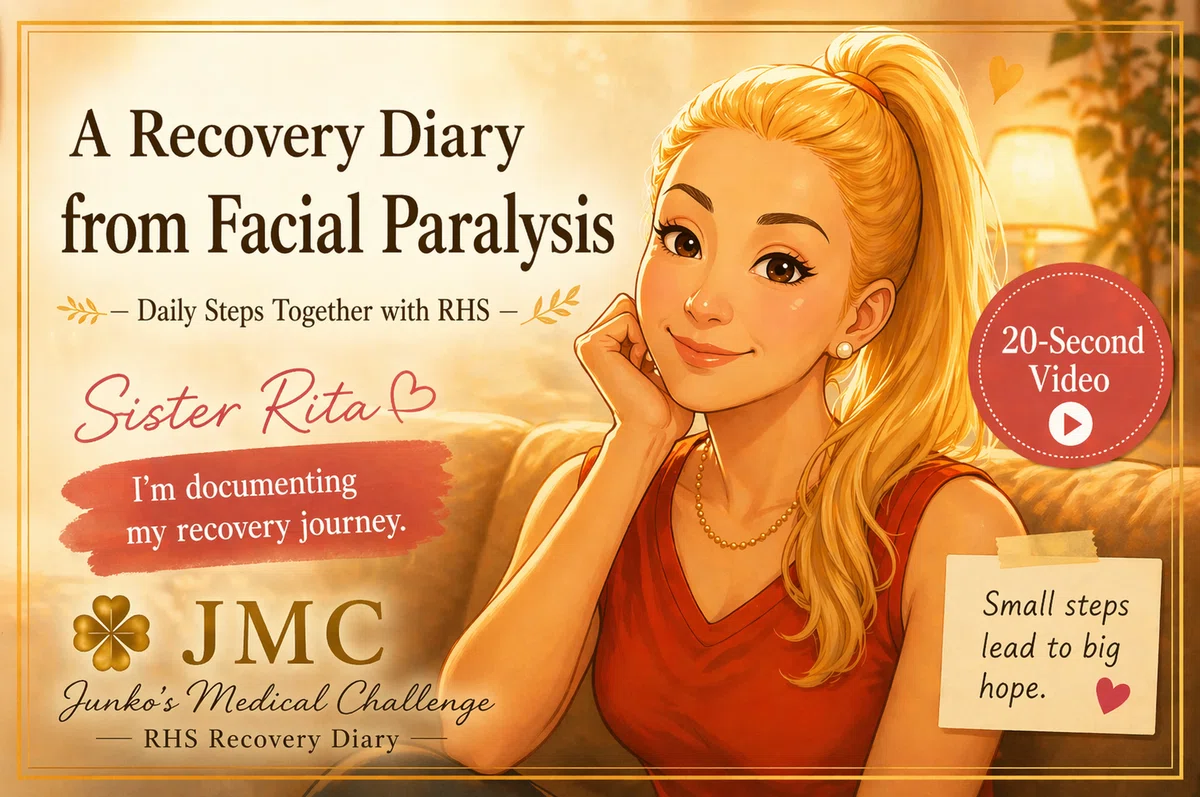
The First Week After Onset
Late on the night of January 16, 2026,
the right side of my face began to go numb.
My husband drove me to the emergency room.
They ran a CT scan to rule out stroke —
and once that was confirmed, I finally exhaled.
The diagnosis: facial palsy.
Possibly Bell's palsy.
Possibly Ramsay Hunt Syndrome.
I was prescribed:
・Antiviral: Valacyclovir 1g
・Steroid: Prednisone 20mg
・Antibiotic eye ointment: Bacitracin ophthalmic ointment
Unlike my first episode 13 years ago,
this time I started treatment within
what's called the Golden Window —
the critical 72 hours after symptom onset.
At the time, I didn't fully grasp why those 72 hours mattered so much.
I just listened, and acted.
Thank you, Memory-chan. 🙏
(For the full story, see Episode No.2:
A Midnight Conversation with Memory-chan)
The standard protocol after that?
Rest.
Slow down.
Let your body heal.
This time, though, the symptoms hit harder.
On a completely different level.
Searing pain in my right ear.
Vertigo.
Nausea.
Distorted hearing.
Lost taste.
Difficulty eating and drinking.
Trouble speaking clearly.
Unable to rinse after brushing my teeth.
My eyes wouldn't close fully —
half-open all the time —
with constant dryness and pain.
A suffocating, trapped feeling I can't quite put into words.
Anxiety. Stress.
The weight of it all.
Wave after wave, in no particular order,
relentless.
And yet — true to my nature — I can't stay still.
I have to do something.
My imagination and creativity stayed in full gear.
Ideas kept coming.
And somewhere in the chaos, I made a decision:
I'm going to lean into this.
Fully.
The pain, the suffering, the uncertainty —
and yes, the hope, too.
All of it.
Curiosity sparked ideas.
Ideas sparked momentum.
And momentum lit a small flame in my heart —
just enough to make me feel a little brighter.
So that's what I did in the first week.
A little of everything, in my own way.
What I Actually Did That First Week
Hungry for information,
I sat at my keyboard every single day —
battling the pain in my ear, battling the dizziness —
and searched.
When I found a piece of knowledge that glittered like a gem,
something that might help,
something that might lead to healing,
I saved it.
Printed it.
Emailed it.
Called people.
There was no time to sit with the fear and loneliness and grief.
Staying busy kept the darkness at arm's length.
Looking back, I think I was experiencing something strange:
a kind of exhilaration.
Like standing at the start of a new challenge.
Here's a quick summary of what I got done:
🔲 Medical & Treatment 🔲
・Scheduled an appointment with my primary care physician
・Found an acupuncturist with experience treating facial palsy;
had my first cupping and acupuncture session on Day 6
🔲 Physical Care 🔲
・Purchased eye-protecting tape and an eye patch
・Researched and ordered supplements and tools known to support nerve recovery
・Developed what I now call the Rita Code Routine —
a gentle self-care ritual
(heat therapy, facial roller, scalp massage, red light therapy —
I'll share more on this soon)
🔲 Emotional Support 🔲
・Joined a Facebook support group and posted right away;
found my people
・Searched for others who had shared their experience online —
YouTubers, bloggers, survivors
🔲 Information Gathering 🔲
・Found Facial Palsy UK —
an incredible resource.
Learned about eye taping and so much more.
・Ordered the book:
Fix My Face: Expert Advice for Maximizing Recovery from Bell's Palsy, Ramsay Hunt Syndrome, and Other Causes of Facial Nerve Paralysis
(highly recommended)
・Dove deep into research using AI tools and the internet
And through all of it,
I gave myself more time than usual for everything:
○ Meditation:
normally 10 minutes → extended to 20 minutes or more, in quiet stillness
○ Sleeping:
normally 4–5 hours → aiming for 7+ hours;
napping whenever my body asked for it
○ Eating:
normally 30 minutes → stretched to an hour or more,
since the paralyzed side made chewing difficult
I moved at whatever pace I could manage,
steadily and without force.
The guiding principle I kept coming back to:
Do what you want to do.
Don't force what you don't.
I still don't know exactly why this illness came to me.
But I'm certain of one thing —
it came to remind me of that principle.
When You Can't Smile ー What Face Do You Make?
My daily routine had to be completely rearranged.
Yoga and the gym were off the table for now.
Rest was essential.
But beyond that —
the thought of going out, seeing friends, showing them this face?
Honestly, it terrified me.
Even just imagining it hurt.
I've always been someone who smiles.
It's just... what my face does.
And suddenly, I didn't know what expression to wear.
How to hold my face.
What to do with it.
That might sound strange.
But it was genuinely the thing I was most lost about.
And then I caught myself —
worrying about what other people would think.
About how I'd appear.
And I caught myself —
stunned by my own reflex.
What a small thing to be concerned about.
My friends were wonderful.
Every day, messages of encouragement.
And I knew —
knew —
that if I saw them in person,
they would say, with complete sincerity,
"You look totally fine. Don't worry at all."
And that kindness would break me open.
Not because it would be unkind —
but because it would be so heavy with love
that I wouldn't know how to hold it.
I'd fall apart trying.
The truth is, I wasn't worried about what they thought.
I was worried about my own reaction to their reactions.
How small of me, I thought.
And felt worse.
I could feel their kindness —
and feel grateful for it —
but I couldn't quite take it in.
It seemed the paralysis wasn't only on half my face.
My spirit, too, had lost its balance.
Still, I needed to move my body somehow.
Not for anyone else —
just for me.
So I stood on my yoga mat.
Didn't do anything.
Just stood there.
And then something shifted.
This isn't the time to worry about what face to make.
I don't have to force myself out into the world
with a paralyzed face.
Right now, it's time to protect myself —
not just my body, but my heart.
When you can't smile,
find the place where you don't have to.
You can simply stay where it feels easy to be.
The twisted face in the mirror and the blue yoga mat sent me the ultimate message:
"You're allowed to give yourself more grace."
And in that moment,
the dark weight I'd been calling
loneliness
transformed into something clear and light —
something I can only call
freedom.
So: when you can't smile —
you don't have to.
Just let your face be whatever it is.
Just Wear the Face You Have.
The moment I decided to accept my face as it was —
and to accept my heart,
in whatever state it found itself, without judgment —
a small clearing opened up inside me.
A small clearing.
And in that clearing, I found the energy
to start learning —
calmly, deliberately —
what was actually happening in my body.
What follows is the knowledge I gathered
to protect myself.
I hope it does the same for you.
What You Need to Know Right Away (Manga Edition)
I've put together what you'd want to know from the very first day —
the things that might help you most —
in manga form.
A note before you read:
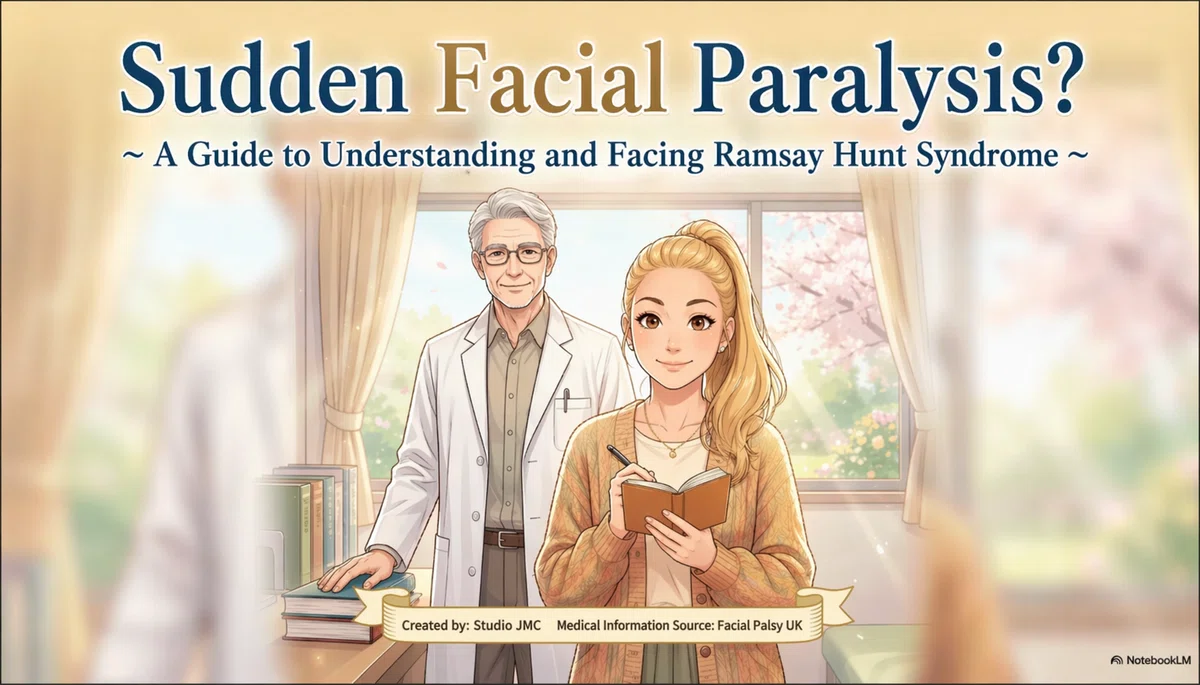
Much of the information in this section is drawn from Facial Palsy UK —
an organization I am deeply grateful for.
Their resources were a lifeline
during the most frightening days of my recovery.
I share this with full credit and profound respect.
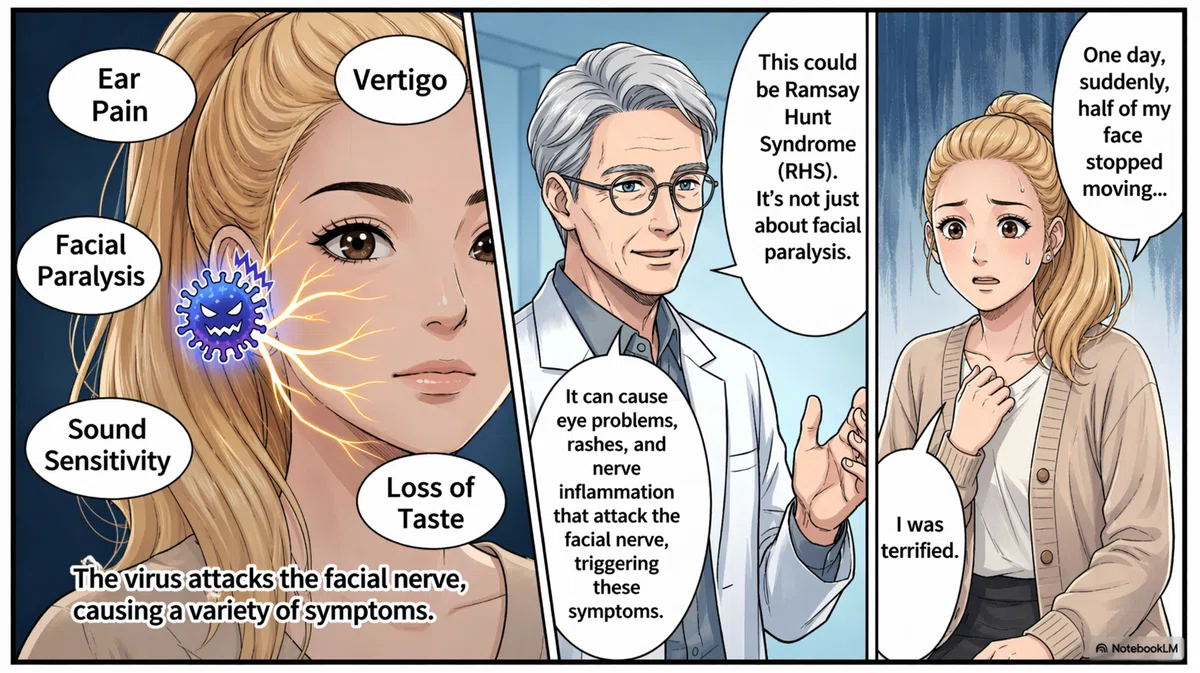
The symptoms of Ramsay Hunt Syndrome
include ear pain, vertigo, facial paralysis, hypersensitivity to sound, and loss of taste —
among others.
If you're experiencing these, you're not alone, and you're not imagining it.
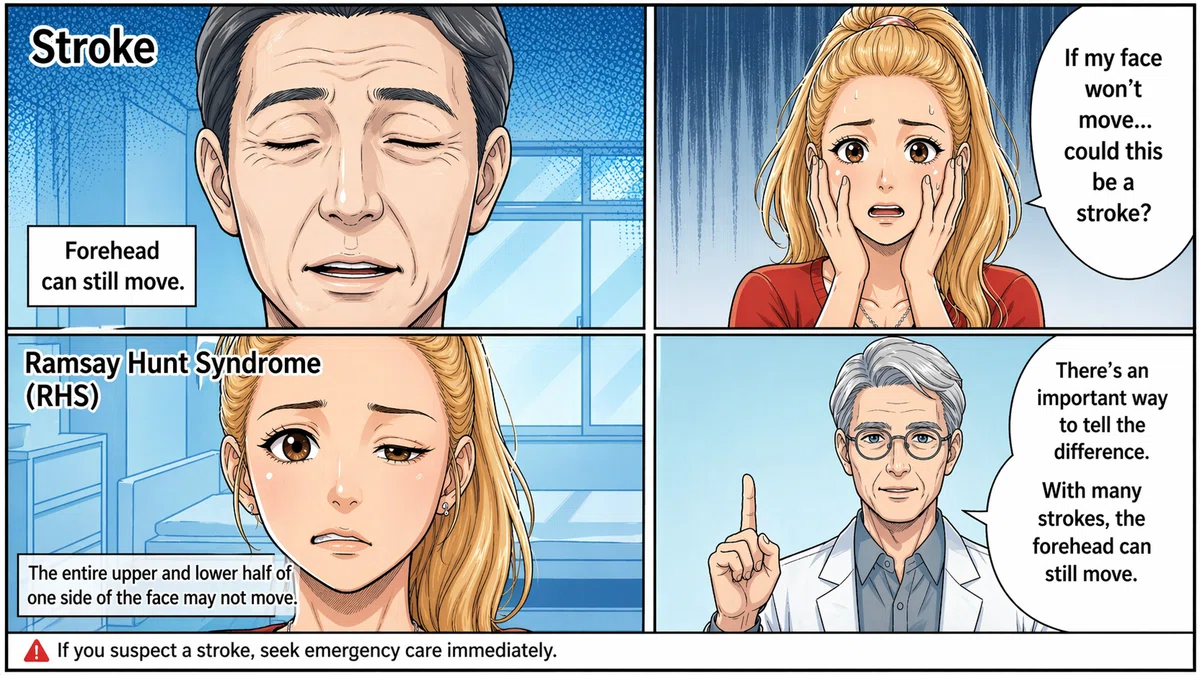
Try wrinkling your forehead.
If the upper and lower half of the same side of your face are both affected,
that's characteristic of RHS or facial paralysis —
not stroke. (Stroke typically spares the forehead.)
But always confirm with a medical professional.
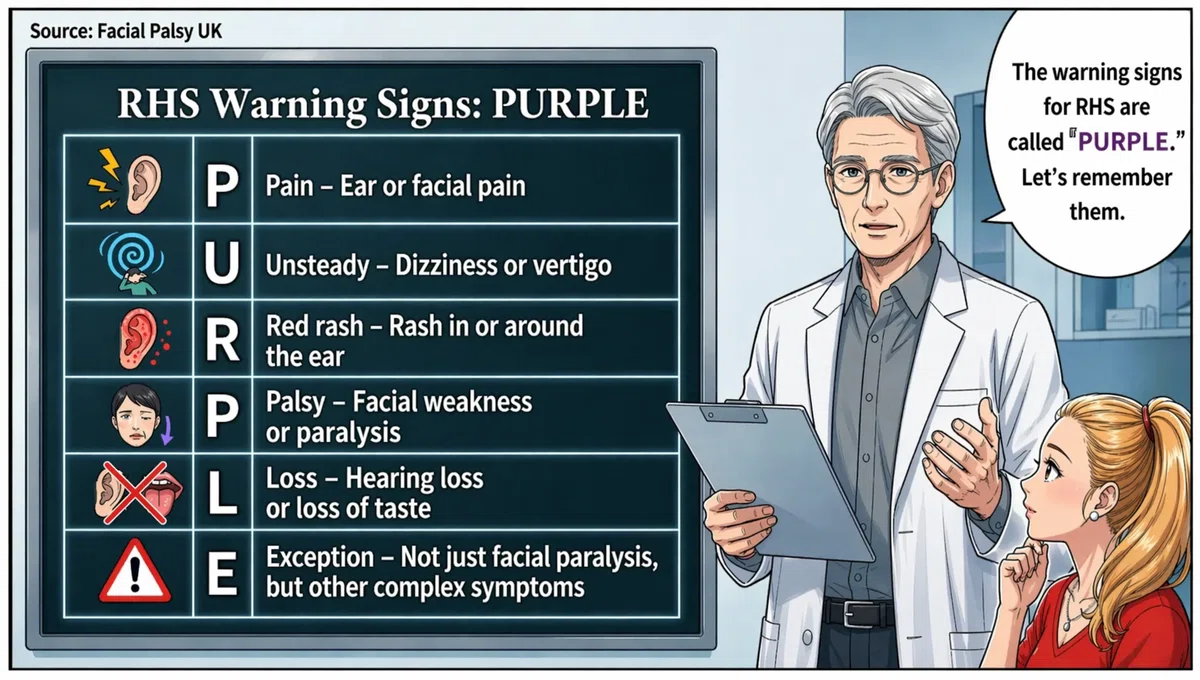
The warning signs of RHS spell PURPLE.
These initials may be the key to recognizing —
and recovering from — this condition.
The warning signs of RHS spell PURPLE:
(Source: Facial Palsy UK)
I had no rash, ZSH type.
P — Pain (severe ear, face, or head pain)
U — Unsteady (vertigo or dizziness)
R — Red rash (blisters in/around the ear, mouth, or hairline)
P — Palsy (facial weakness — lower motor neuron)
L — Loss (hearing loss and tinnitus)
E — Exception (sometimes there is no rash — called Zoster Sine Herpete)
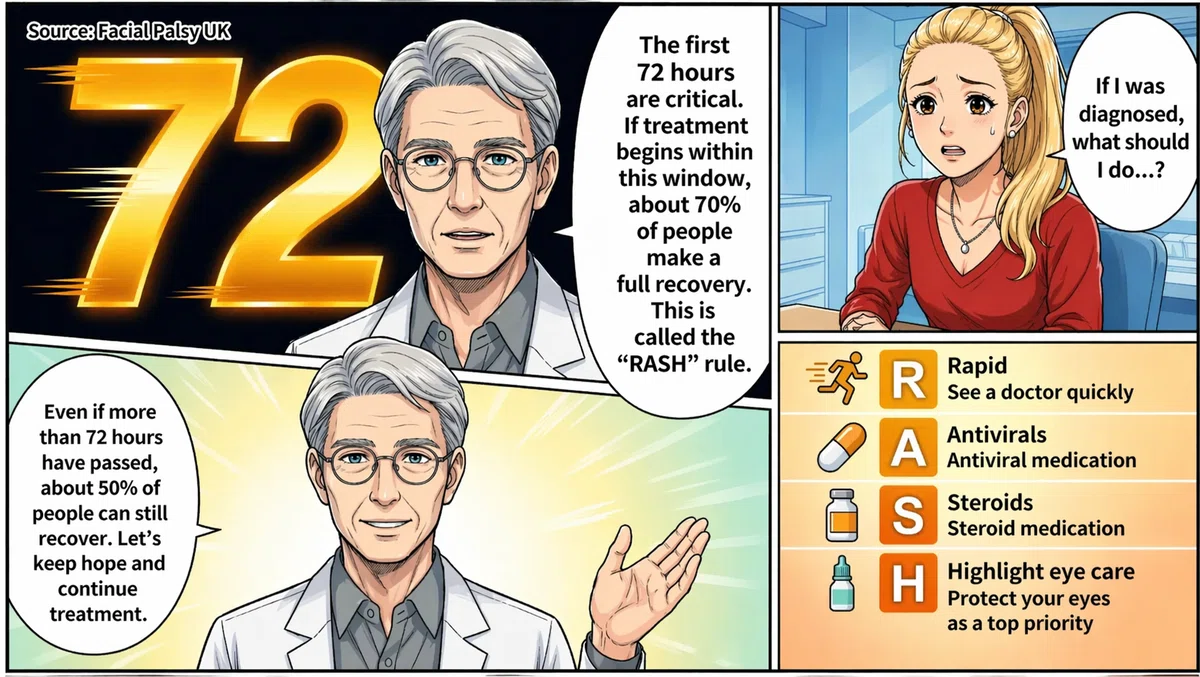
Starting treatment within 72 hours of symptom onset significantly improves recovery outcomes. The first time I had RHS, 13 years ago, though, I was misdiagnosed with a middle ear infection.
I didn't start antivirals until 10 days in. Ten days late — and I still recovered fully.
This time, the symptoms hit on a completely different level.
But this number still carries real weight for me.
Source: Facial Palsy UK
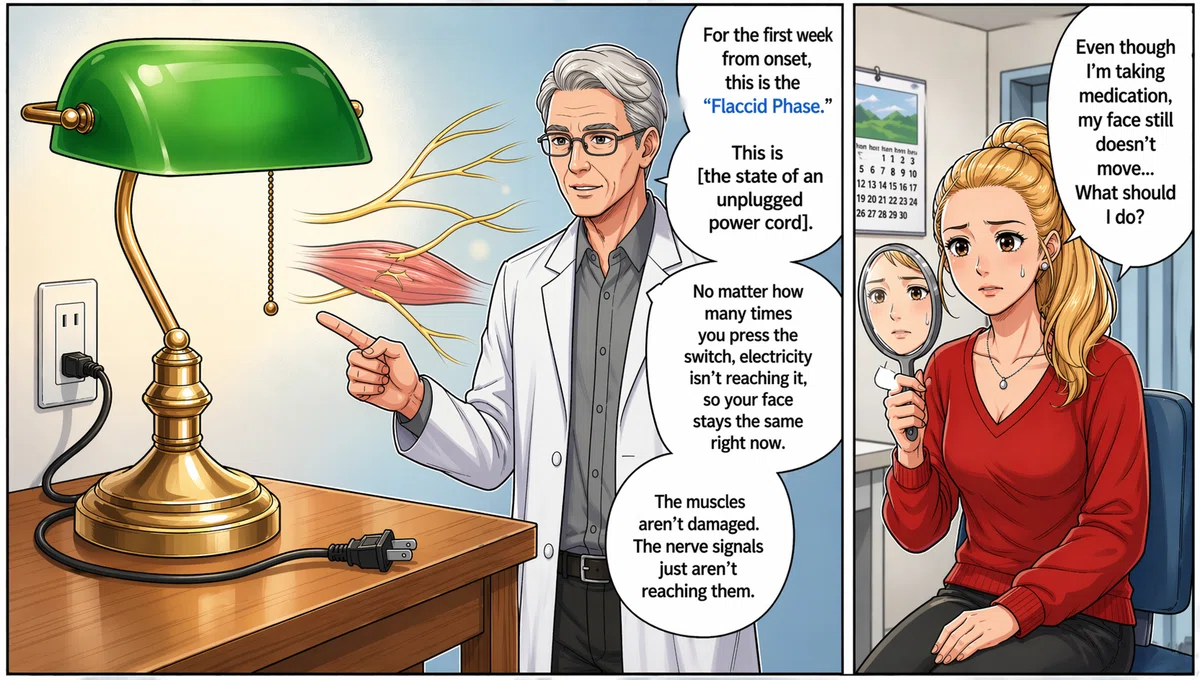
Think of it like a lamp that isn't plugged in.
The switch still works. The bulb is fine.
The connection just needs to be restored.
Hearing that gave me real hope.
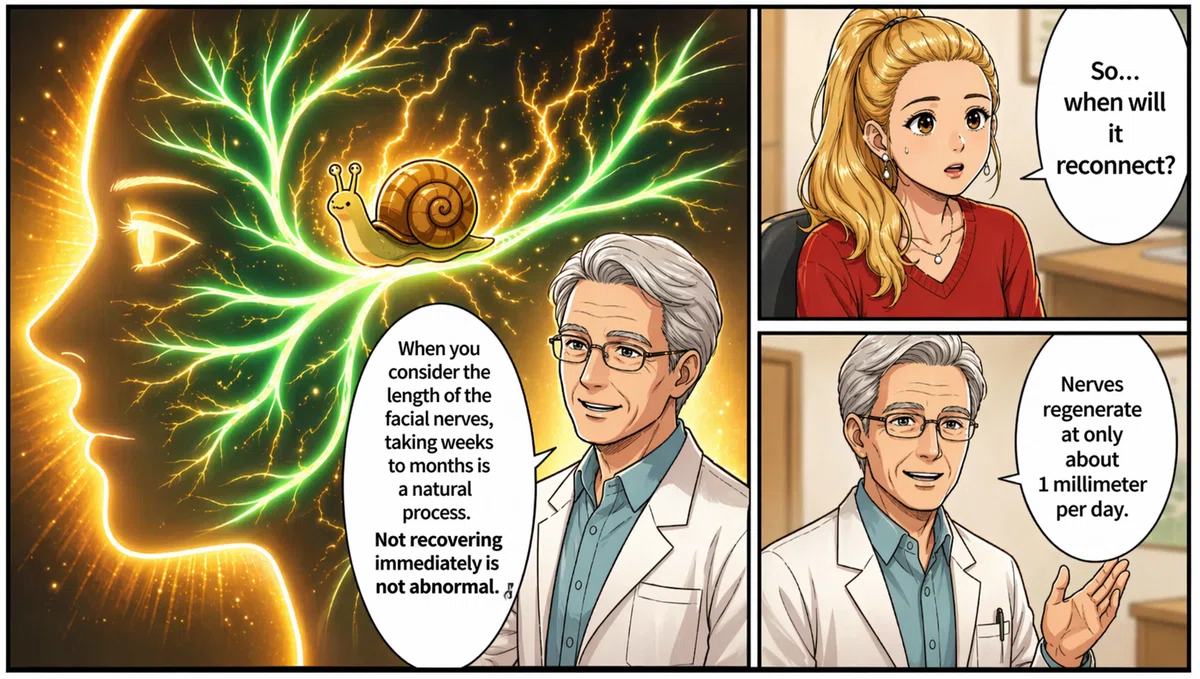
about 1 millimeter per day.
That's why it takes weeks or months.
But your nerves are moving forward, quietly, every single day.
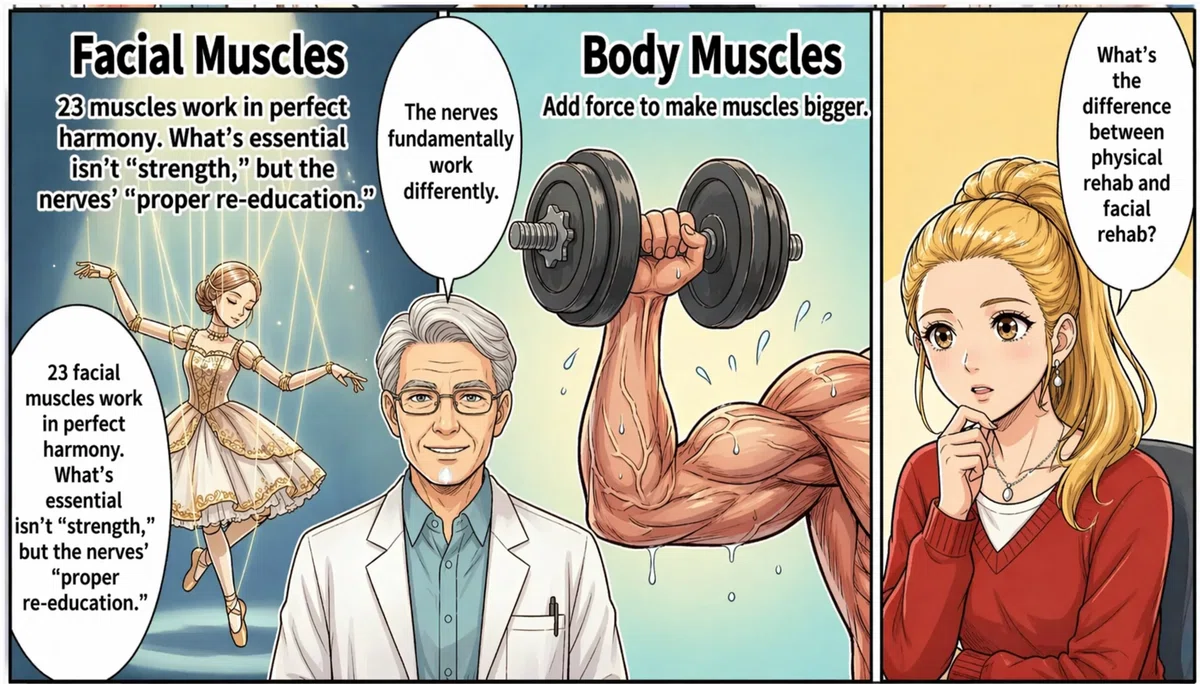
It's about gently reteaching the nerve the right movements.
Pushing harder actually makes things worse.
That surprised me more than almost anything else.
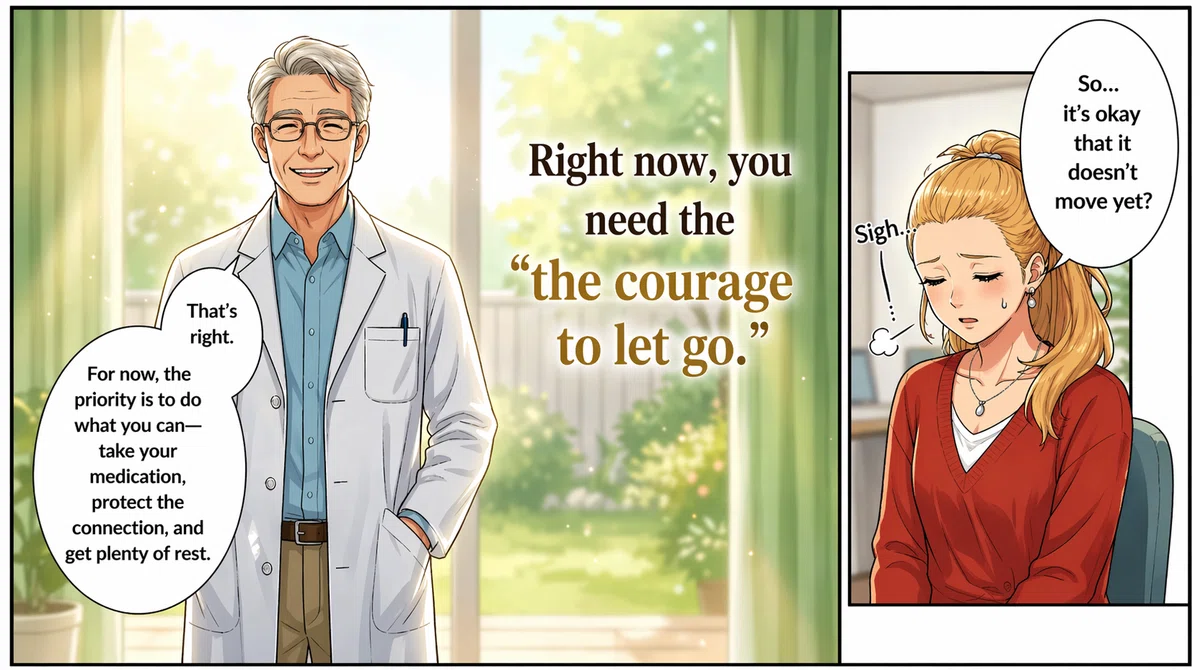
right now, not trying is the bravest thing you can do.
Resting is the treatment.
I keep coming back to this.
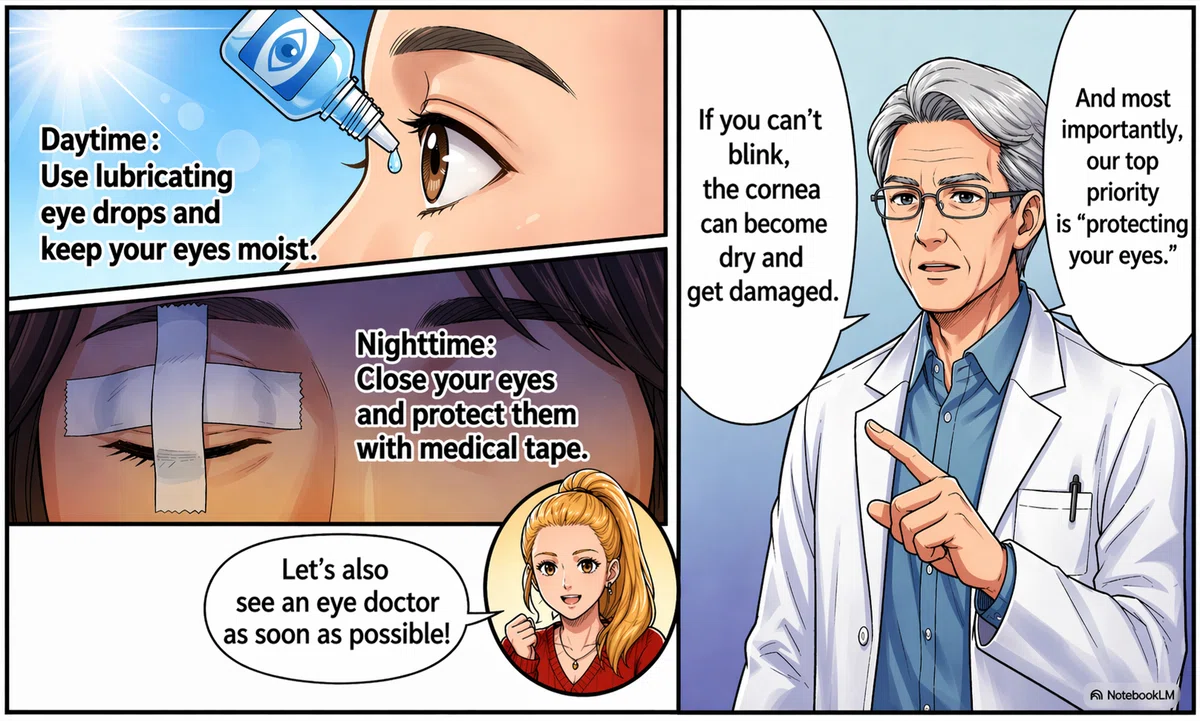
more than most people realize.
During the day, use lubricating eye drops regularly.
At night, tape your eyelid closed to protect your cornea.
In the early days when my eye wouldn't close at all,
I taped it during showers too.
Above all — protecting the cornea is the top priority.
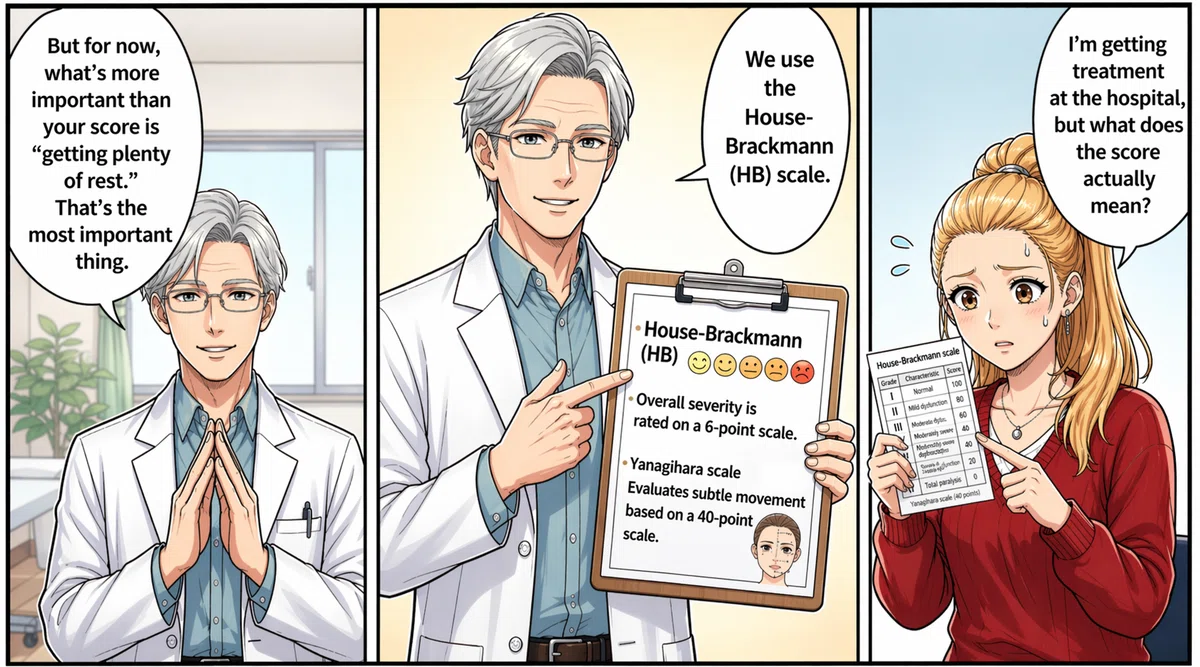
seeing the numbers helped me feel less panicked.
Progress you can't see in the mirror often shows up in the data.
My first HBS Scale was Grade 5.
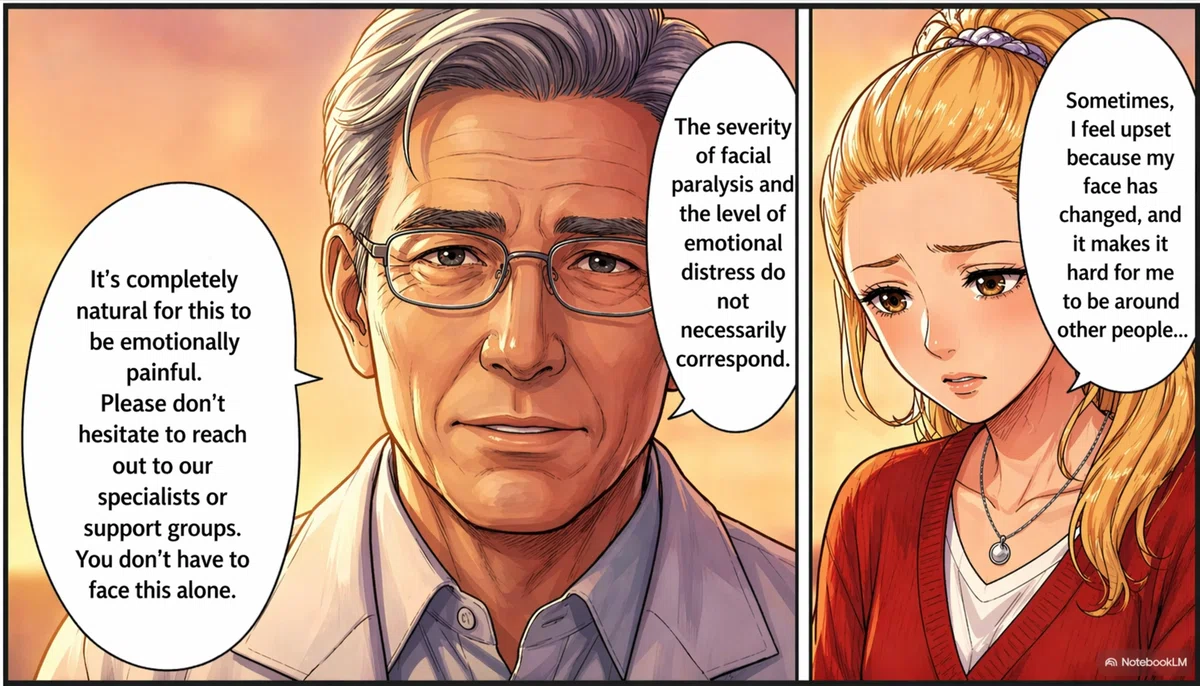
Specialists, support groups, people who've been exactly where you are —
they exist.
Find them. Reach out.
And finally:
It's not about pushing through. It's about resting.
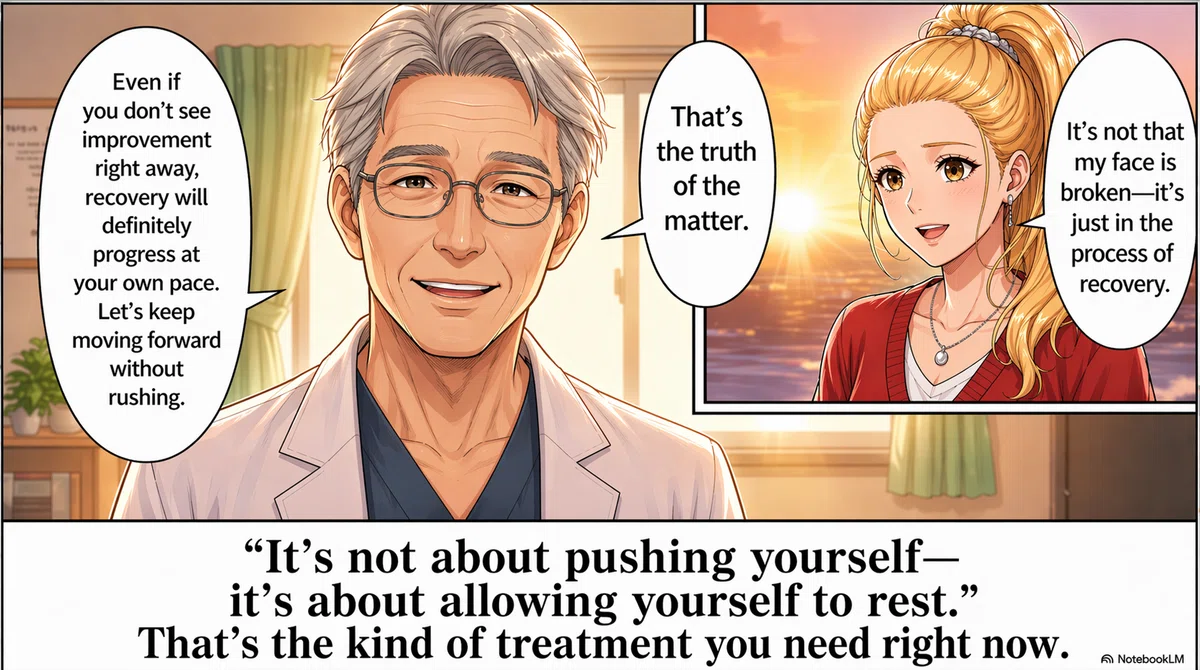
and most important —
lesson this illness ever taught me.
What Is Ramsay Hunt Syndrome, Anyway? (Podcast Edition)
For an audio walkthrough of RHS,
I've created a podcast-style guide —
thorough but easy to listen to.
Please give it a listen.
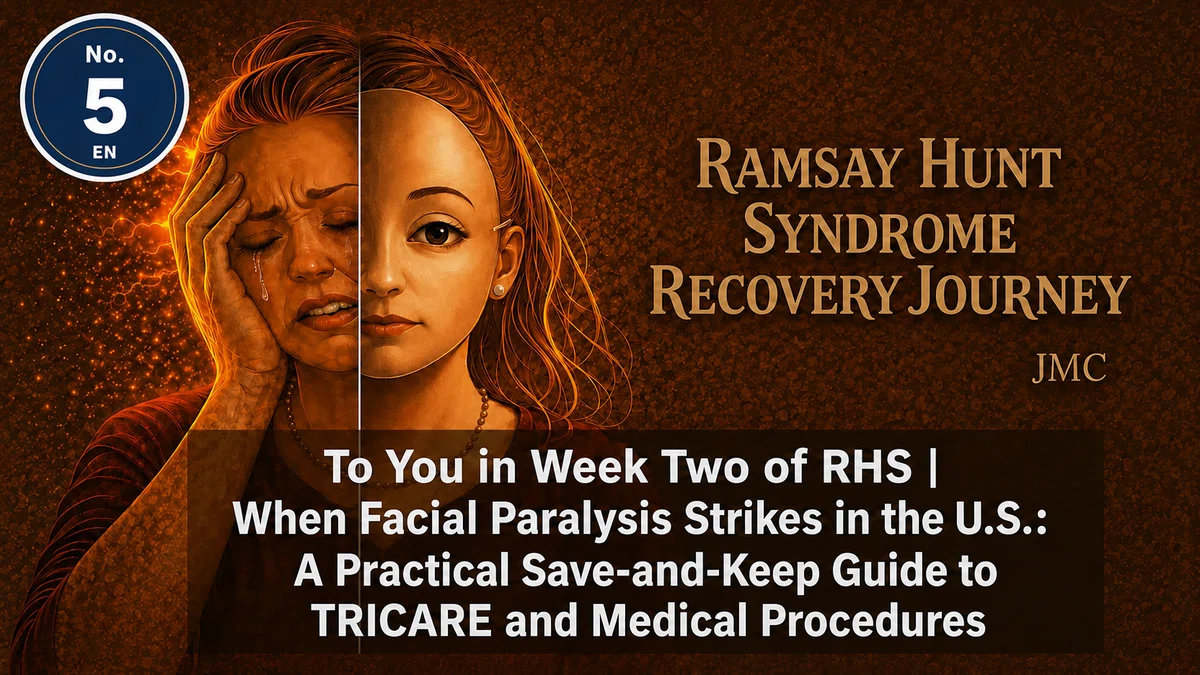
Next up: To You in Your Second Week
Even after receiving a diagnosis and starting medication,
the anxiety and pain did not simply disappear.
In fact, around this time,
I was facing the reality that my symptoms seemed to be getting worse.
Would my smile really come back?
How much would I be able to recover from here?
Those questions weighed heavily on me.
All I wanted was to rest my body.
But instead, I found myself confronted by the relentless complexity
of the American medical system.
In the middle of that confusion,
how did I manage to reach the specialists I needed?
I could not simply stop.
Referrals to specialists.
Prior authorizations.
Insurance portals.
Medical bills.
In the American healthcare system,
there are moments when even a patient in pain,
weakened and overwhelmed,
must still take action in order to secure the next step of care.
In the next article, I will share another kind of survival story
from my second week with RHS.
I will also include some practical aspects of TRICARE,
the healthcare insurance system for U.S. military members and their families, which have not often been discussed in Japanese.
👉
Click the image to continue to the next article.
Rita Code | Studio JMC
🇯🇵 Click here for the Japanese version
https://note.com/studio_jmc/n/na5886af9eff3?app_launch=false
Medical information sourced from: Facial Palsy UK (facialpalsy.org.uk)
