
[No.5] To You in Week Two of RHS | When Facial Paralysis Strikes in the U.S.: A Practical Save-and-Keep Guide to TRICARE and Medical Procedures

This article is a practical memo from the recovery period
after the onset of RHS (Ramsay Hunt syndrome) —
medical-insurance information that helped me,
recorded from my own experience.
It covers what I actually did in week two after RHS onset:
the steps for getting connected to specialists through TRICARE,
checking Referrals and Authorizations, reading bills and EOBs —
and the emotional ups and downs of this period, too.
*Always confirm medical diagnoses and treatment plans with your doctor.
What is written here is Rita's perspective — the practical experience of a patient.
Sharing the Day-13 Video of My Face
On January 15, 2026, Ramsay Hunt Syndrome struck —
and then, around the two-week mark.
What was I feeling? What was I thinking?
What was I actually doing back then?
It was only a few months ago —
yet it feels like a very long time has passed.
I am sharing what my face looked like on day 13.
Making it public was, honestly, frightening.
But if it helps even one person, even a little, I will be glad.

In week two, I was coming to terms with a hard reality
while searching for ways to protect my recovery.
On Using Health Insurance in the U.S
There are many differences between
healthcare in Japan and in America,
and one of them is this:
in the U.S., when it comes to receiving medical care,
if the patient does not take the initiative,
the next step stalls.
And the health insurance program I am enrolled in —
TRICARE, for U.S. military members, their families,
and other eligible beneficiaries —
has features that set it somewhat apart
from ordinary American insurance,
so you could say it is even more complicated.
Right after onset, with body and mind both worn down,
procedures this tangled are honestly rough.
But there are a few small tricks
for moving through them smoothly, without scrambling blindly.
First — and this is the foundation of everything —
get a firm grip on the order of the process,
and "don't put off what needs to be done."
Wait patiently for the body to heal.
Move swiftly on the paperwork.

A Practical Guide to Using TRICARE: The Basics
Here is a hands-on guide to using TRICARE —
the health-care program for U.S. military members, their families,
and other eligible beneficiaries —
based on my real experience with Ramsay Hunt syndrome (RHS).
Health insurance is a complex topic,
so this article focuses only on the "Essential Basics".
What to Confirm as a TRICARE Prime Enrollee After RHS Onset: Overview
- Keep your ER discharge paperwork
- Contact TRICARE / TriWest and your PCM (primary doctor) the next business day
- Confirm whether your Referral is being handled as STAT
- Check the Authorization status on TriWest
- Once Approved, save the Authorization Letter
- Match every bill against the EOB before paying
That is this article in a nutshell.
Now let’s break it down together, step by step.
It may feel complicated, but don't worry —
we will work it all in slowly, together.
TRICARE Basics: The Difference Between Prime and Select
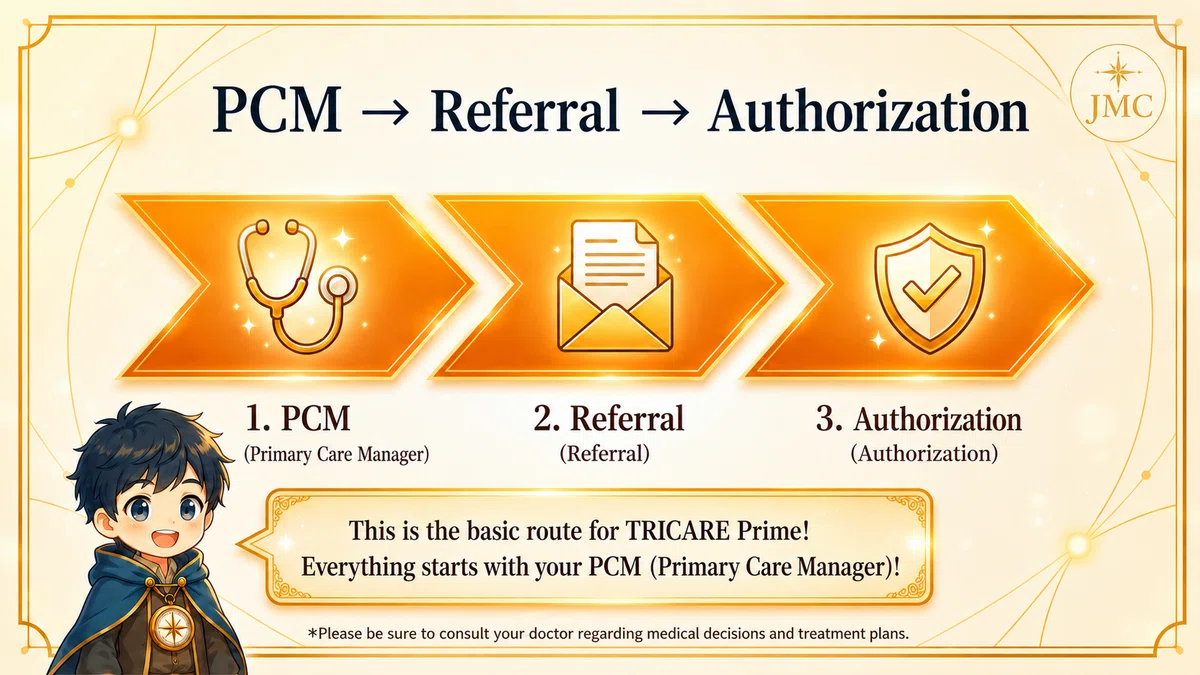
TRICARE comes in two main forms:
Prime and Select.
As the spouse of a U.S. military retiree,
I am enrolled in TRICARE Prime.
I rarely need to see specialists and am relatively healthy,
so Prime, with its lower out-of-pocket costs, suits me well.
That said, which plan works in your favor depends on
your lifestyle and health —
something worth weighing each year during Open Season.
【TRICARE Prime】
Operates much like an HMO:
your PCM (Primary Care Manager) is the gateway to all care,
and seeing a specialist always requires a Referral.
Out-of-pocket costs are low (for example, about $39 for a specialist visit),
but you have less freedom to choose your own providers.
【TRICARE Select】
Closer to a PPO:
you are free to see the specialists of your choice without a referral,
but your out-of-pocket costs are higher.
About TRICARE Regions
With TRICARE, your point of contact depends on where you live.
TRICARE is currently divided into three regions:
East Region,
West Region, and
Overseas Region —
each handled by a different regional contractor
(the company that operates services and support for that region).
I live in Nevada, which belongs to the West Region,
so for checking Referrals, Authorizations, Claims,
and EOBs (Explanation of Benefits),
I mainly use the TriWest portal.
If you live in another state, or overseas,
your Region and contractor will be different —
so start by confirming which Region you are in.
Registering a Foreign-National Spouse (DEERS)
The root of all TRICARE eligibility is
DEERS: the Defense Enrollment Eligibility Reporting System.
DEERS is the registration system that manages eligibility
for Department of Defense–related health care and benefits.
When registering a foreign-national spouse,
you may need — in addition to the marriage certificate,
birth certificate, and SSN card —
the original or a certified copy of a photo ID.
Errors in your DEERS record can cause trouble with
TRICARE eligibility checks, medical billing,
and the processing of Referrals and Authorizations.
That is why, right after registering or after a move,
your top priority should be confirming that your DEERS information
is recorded correctly.
Registering or updating DEERS is done, as a rule,
through the sponsor — the military member —
regardless of the patient's own health condition.
It is the foundation on which all use of TRICARE rests.
Keeping the Multiple Portal Sites Straight
TRICARE is not "one insurance card, one website."
Using the right site for each purpose,
with the right account (myAuth or DS Logon),
will keep you from getting lost among your logins.
① DEERS / ID Card Office Online:
Manages addresses, phone numbers, and family information
(the master eligibility data).
② milConnect:
Confirm your current PCM; obtain proof of coverage.
③ TriWest West Region Beneficiary Portal:
The one I use most.
Referral and Authorization status,
Claims, EOBs, and more.
④ MHS GENESIS Patient Portal:
For visits to military treatment facilities (MTFs) such as Nellis AFB —
visit records, test results, and messages with military providers.
⑤ Express Scripts:
Prescription lists and home-delivery management.
I fill my prescriptions at a regular pharmacy (Walgreens),
so I rarely use this site except after MTF visits.
One more note: government-related accounts often require
periodic password changes and multi-factor authentication.
This is genuinely tedious —
and when you are unwell, it becomes a real burden.
Which is exactly why
"organizing your login information while you are healthy,
so you can reach the portals you need without getting lost"
struck me as an essential part of preparing
to receive medical care in America.
Going to the ER at RHS Onset: How, and What to Watch For
For true emergencies that threaten life or vision —
such as the acute facial-nerve paralysis of RHS —
you can go straight to the ER
without a referral or prior authorization.
What to bring: your Uniformed Services ID —
the so-called "Military ID Card" —
which serves in place of an insurance card.
Be sure to bring it and present it at the front desk.
If the facility asks for the Insurance ID / Member ID
used with ordinary insurance,
the closest equivalent under TRICARE is usually the
DoD Benefits Number (DBN) printed on your Uniformed Services ID.
At the front desk, it goes smoothly if you say:
"My insurance is TRICARE. Please use my Benefits Number on the back of my Military ID Card."
The back of the Uniformed Services ID lists
three main types of numbers.
The one to give the front desk is the 11-digit Benefits Number.
① Sponsor DoD ID: the ID number of the sponsor, the military member (10 digits)
② Beneficiary DoD ID: the beneficiary's own ID number (10 digits)
③ Benefits Number: used for TRICARE eligibility checks and medical billing (11 digits)
Cost: according to the official 2026 cost tables,
in my category (TRICARE Prime / retiree family member / Group A),
the out-of-pocket cost for an ER (Emergency Room) visit is $79.
※ Out-of-pocket amounts vary by plan, enrollment group (Group A / B),
and year.
Always check your own figures with the official Cost Tool
(tricare.mil/costs).
At discharge: the paperwork the ER hands you —
the After Visit Summary (AVS) / discharge paperwork —
becomes crucial evidence for briefing your PCM later.
Before you leave the ER, confirm the following,
and if anything is wrong, have it corrected on the spot.
And after you get home, keep every document safe.
① Name, date of birth, date of visit
② Final diagnosis (Bell's palsy / Ramsay Hunt syndrome, etc.)
③ Tests performed and medications prescribed
④ Whether "specialist follow-up needed" is explicitly noted
If You Choose Urgent Care (Not ER-Level, but Can't Wait Until the Next Morning)
This time, suspecting RHS, I chose to go to the emergency room.
But depending on symptoms and circumstances,
choosing urgent care will often make sense too.
If it is nighttime and you are
"not ER-level, but can't wait until tomorrow,"
the safest move for later insurance coverage is to first call or chat with the
MHS Nurse Advice Line (1-800-TRICARE) —
leaving a record —
and have them direct you to a facility.
After the ER: Contacting Your PCM and TRICARE / TriWest
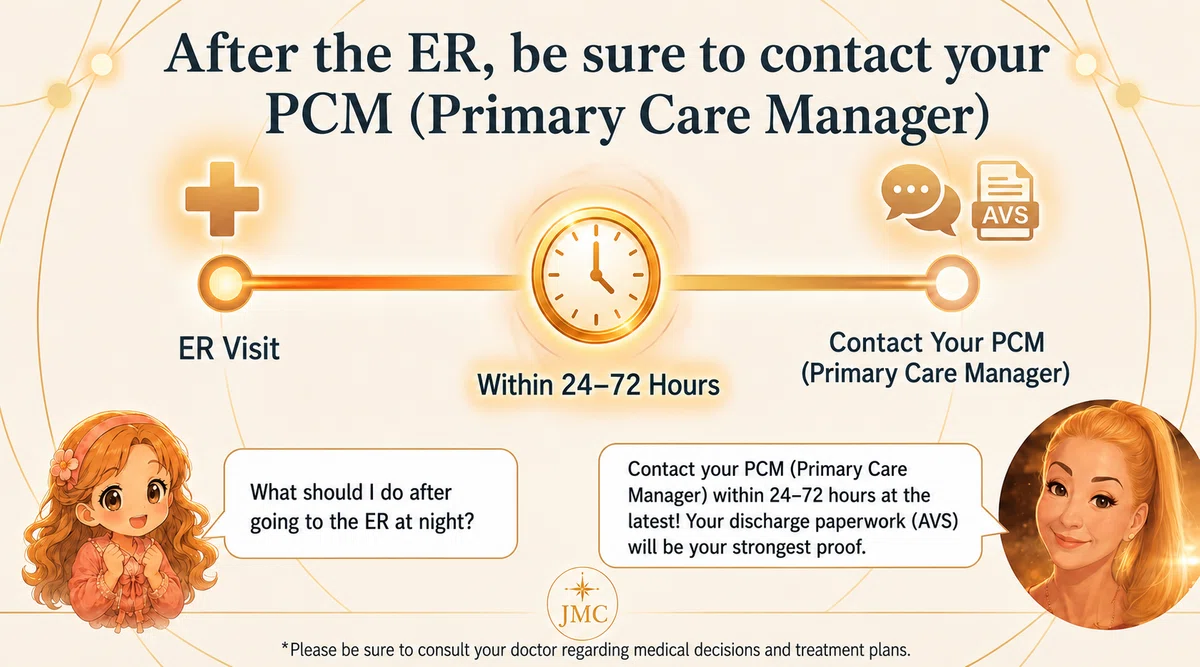
Once you are home from the ER,
be sure to contact your PCM's office the next business day
(within 24–72 hours at the latest),
and report that you visited the ER,
received an RHS diagnosis, and were given follow-up instructions.
If you skip this step,
the referral process to specialists may stall in the system.
Beyond contacting your PCM,
it is also reassuring to check in with TRICARE / TriWest.
In my case, when I called TRICARE about my ER visit,
they issued me a Case Number.
Having this number made later inquiries —
about Referrals, Authorizations, and Claims —
much easier to navigate.
In short, after the ER:
① Follow up with your PCM
② Leave a record with TRICARE / TriWest for insurance and paperwork
Do these two in parallel,
and the specialist visits and billing checks ahead
will go much more smoothly.
As facial paralysis progresses, talking itself becomes challenging.
It's okay if you can't speak well.
Don't rush — set your discharge paperwork in front of you
and tell them what is needed, one item at a time.
The person on the other end of the line
handles medical and insurance procedures every day.
Once your situation comes through, they should gladly
and carefully guide you to the next steps and the right contacts.
The Strongest Medical Team for RHS
Ask your PCM for specialist referrals
in the following order of priority.
① ENT (Ear, Nose & Throat): confirming the diagnosis (Bell's palsy or RHS),
managing steroids and antivirals, overseeing the whole picture.
② Ophthalmology: the top priority — preventing corneal damage
from incomplete eye closure.
③ Neurology: controlling nerve pain; testing when recovery stalls.
④ Physical Therapy: facial neuromuscular re-education during recovery.
⑤ Counseling / Mental Health Care: mental and emotional support —
the changes in your face, the pain, the anxiety about recovery, the sense of loss.
Under TRICARE Prime,
in-network outpatient mental health care
can sometimes be received without a Referral.
However, handling may vary by plan, region, provider,
and type of treatment,
so I recommend confirming in advance
with TRICARE / TriWest or the provider.
Seeking professional help is a valuable option in recovery.

A road to recovery, walked with the support of many hands.
When I truly felt I was not fighting alone,
strength and courage began, little by little,
to return amid the anxiety.
The Path to Seeing Specialists, and What to Check Online
When you contact your PCM, the PCM submits the specialist Referral
to the regional contractor
(for the West Region, which includes Nevada:
TriWest Healthcare Alliance).
This may vary by PCM, but mine required me
to book and attend an appointment
before they would issue the Referral.
From there, proceed as follows.
① Check the TriWest portal:
After 1–2 business days, log in to the TriWest portal yourself
and check the "Referral status"
and the "Authorization status."
② If approval is slow to come:
If a week passes without approval, or other delays arise,
contact the "Referrals Department" at your PCM's office.
When you do, confirm whether the referral is being processed
as STAT — the urgent category.
Referral categories by urgency
※ These are the guidelines I was given for referral processing.
They may differ by region and facility.
① STAT: highest urgency — typically issued within 1–2 business days
② ASAP: next-highest urgency — typically within 3–5 business days
③ Routine: non-urgent — typically within 7–14 business days
This time, my Referral was slow to be issued —
and my pain had worsened past the point of endurance —
so I went to Insta Care, an urgent-care-style clinic
located inside my PCM's office.
When I explained my situation there,
I was directed to phone the Referrals Department at another location.
The line was hard to get through — honestly, I was on pins and needles —
but I kept calling without giving up,
and finally reached the right department.
Even when a referral is marked STAT,
in practice there are cases like this,
where nothing moves unless the patient keeps checking.
Calling again and again while you are in pain and exhausted
is truly hard.
But that one step leads to the next treatment — and to recovery.
That is why this episode taught me to say, in concrete words,
"please expedite this," and to keep following up without giving up.
③ Avoiding Point-of-Service (POS):
Under TRICARE Prime,
if you book and see a specialist on your own judgment,
without waiting for the required Referral / Authorization,
the visit can be treated as Point-of-Service (POS) —
and unusually high out-of-pocket costs may result.
So before booking a specialist,
always check the Authorization status on the TriWest portal:
confirm that it reads Approved,
and that the provider matches the one named
on the Authorization Letter.
④ Confirming the Authorization status, and making a copy:
Once the status reads "Approved,"
be sure to make a copy of the Authorization Letter
and bring it with you on the day of your appointment.
⑤ If the status reads "No Action":
The standard move is to call TRICARE / TriWest directly
and request an escalation
(having your inquiry passed up to a senior representative
or a specialized department, when the regular help line
cannot confirm your status).
However — if you have been accepted at a military treatment facility,
no civilian authorization is needed,
so the status may simply remain "No Action."
That happened to me. Startled to find the status "No Action,"
I contacted TRICARE / TriWest and learned that both ENT and ophthalmology
had been assigned to clinics at a military facility.
Incidentally, in such cases the out-of-pocket cost is $0.
Also — and this happens often — if the military facility says
they "can't see the referral,"
contact the base's BCAC (Beneficiary Counseling and Assistance Coordinator) —
the consultation and support desk for TRICARE users —
or the Referral Management Center,
and have it activated in the system.
⑥ Booking the specialist appointment, and what you will need:
Once the status is Approved,
call the facility named on the Authorization Letter
(civilian or military) and book the appointment yourself.
Have the following information at hand,
and state it clearly:
① Your name, date of birth, and TRICARE ID information
② That you have an approved Referral with TriWest
③ The Referral / Authorization number
④ That this is urgent follow-up for RHS
* Right after approval, the specialist's system
may not yet be able to see the Referral / Authorization.
If so, I recommend asking the receptionist
to contact you once it becomes visible on their end.
⑦ Making full use of each specialist's Patient Portal:
After you see each specialist — ENT, neurology, and so on —
make full use of the patient portals:
MyChart, or the military's MHS GENESIS.
Through the portal, always confirm:
your Visit Records (visit notes and summaries),
the details of your prescriptions,
and the date and time of your next appointment.
You can also message your doctor with questions,
or request the referral to your next specialist,
by text message inside the portal —
leaving a record, evidence,
that prevents "he-said, she-said" trouble.
In a situation like mine, where facial paralysis made
speaking itself difficult,
being able to communicate by digital message
was enormously helpful — a real blessing.
⑧ Self-defense in medical billing, and the pitfalls in the paperwork:
In American healthcare, it is vital not to sign documents
handed to you at reception or checkout
without understanding what they say.
That said — anyone who has received care in the U.S. knows
the unbelievable stack of forms handed over all at once at check-in.
When you are unwell, when you are in pain,
you have no bandwidth to read fine print in English.
It is easy to panic — "I just have to sign everything" —
and sign without really confirming the contents.
It's okay.
The points to watch for are limited.
The three I most wanted to keep an eye on are A, B, and C below.
Ⓐ Who pays the medical bills: the Medical Lien
These can appear when accidents, lawsuits, or settlement money are involved.
They have nothing to do with RHS care, but if a document contains
any of the following words, always ask:
lien, settlement, attorney, accident claim
For Ⓐ, it helps to have questions like these ready:
- "Is this a medical lien?"
- "Is this related to an accident, lawsuit, or settlement?"
- "Does this require me to personally guarantee payment outside of the normal insurance billing process?"
Ⓑ Whether insurance will be billed: the Health Insurance Waiver
If a document says you will not bill insurance, will not use TRICARE,
or will pay out of pocket — do not sign it lightly.
If a document contains any of the following words, always ask:
waive insurance, not bill insurance, private pay, self-pay
For Ⓑ, prepare questions like these:
- "Will this be billed to TRICARE?"
- "Is this a waiver of insurance billing?"
- "If I sign this, will I be treated as private pay instead of using TRICARE?"
- "Am I only responsible for the patient responsibility after TRICARE processes the claim?"
Ⓒ How much the patient owes: the Financial Responsibility Form
Normally, this is consent to pay what remains after insurance applies —
for example, the copay, the deductible, and coinsurance —
and in most cases it is a routine part of check-in, with no problem.
It becomes a problem when the wording is vague and overly broad.
If a document contains any of the following words, always ask:
- responsible for all charges,
- all charges not covered by insurance,
- private pay,
- not bill insurance
For Ⓒ, prepare questions like these:
- "Is this a standard financial responsibility form?"
- "Am I responsible only for the patient responsibility after insurance processes the claim?"
- "Does this mean I am responsible for the full amount before insurance processes the claim?"
- "Will this still be billed to TRICARE?"
- "Can I get a copy of this form after I sign it?"
And one more important thing:
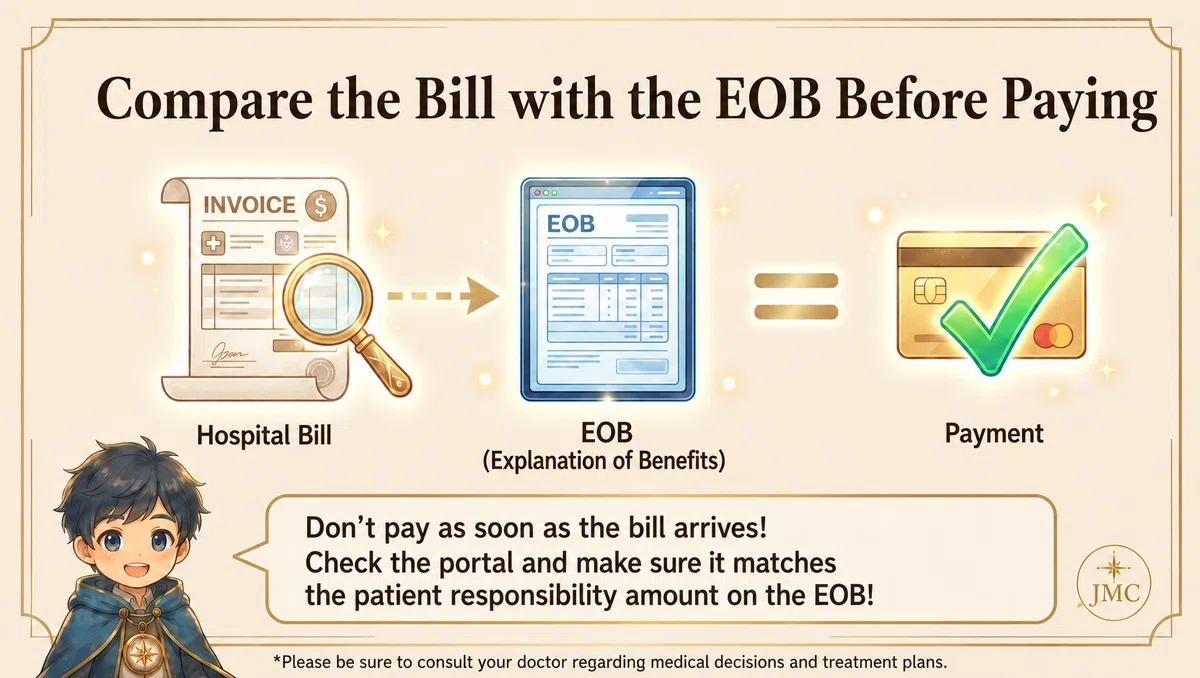
when a bill arrives, do not pay it right away.
In American medical billing,
the provider first submits the claim to the insurer (TRICARE),
and TRICARE then processes it.
So even when bills arrive from each specialist or facility,
do not pay an interim bill on sight
before all the insurance processing is complete.
What to check first is the TriWest / TRICARE portal.
There, review your
Claims and your EOB (Explanation of Benefits) regularly.
The EOB shows the amount the provider billed,
the amount TRICARE allowed, the amount TRICARE paid,
and your Patient Responsibility.
For in-network or participating providers,
balance billing beyond the TRICARE-allowable amount
is generally not permitted.
For non-network, non-participating providers, however,
you may be billed up to 115% of the TRICARE allowable charge.
Always confirm that the bill that arrives from the provider
matches the Patient Responsibility shown on the EOB —
and only once they match, pay.
Toward Recovery: The Importance of Tending to Daily Life
Week two of RHS was, both subjectively and objectively,
the period when my symptoms worsened considerably.
Fighting the pain with an increased dose of medication,
caring for a right eye that would not close,
a right ear where every sound blared, dizziness and unsteadiness —
the facial paralysis deepened,
and I remained pushed to the edge, mentally and physically.
Even the acupuncture I had begun with such hope —
the acupuncturist told me, with disarming frankness,
"I've never seen symptoms this severe,"
"you're worse every time you come."
Honestly, it was quite a shock.
How far would I recover?
Would my smile truly return? Would the pain ever end?
There were moments, again and again,
when that anxiety nearly crushed me.
At the same time, this second week
was also a week consumed by practical tasks.
Referrals, Authorizations, EOBs, checking bills,
booking specialists, confirming insurance, the gym's Medical Freeze —
and care for the heart must not be forgotten, either.
Looking back,
even inside a reality where symptoms seemed to worsen day by day,
week two was when I was steadily laying the foundation
to protect myself, building the path toward recovery —
a deeply important time, I would say.

Thank You for Reading to the End ❤️
Well done.
Just reading this far is exhausting, isn't it?
But the weaker your heart and body,
the more these timely steps — carrying them out, checking them —
will protect your near-future self.
As you confirm things one by one,
the hazy, shapeless anxiety
gradually reveals its true form,
and transforms, in time, into something you can handle.
It's okay — Rita walked this road too.
You can absolutely do this!
One last time:
what is written here is a practical memo
based on my own experience using TRICARE.
Programs, costs, and referral handling can vary
by plan, region, and provider.
Always confirm with your own insurer, provider, and doctor.
Recap Manga: (No.5) To You in Week Two of RHS
Here, a short manga recap of No.5.
Press the "Open viewer (ビューアを開く)" button below
to read the recap manga.
It is in Japanese manga format, so once the viewer opens,
please use the left-pointing arrow to move to the next page.
[Mini Glossary for This Article]
Glossary (alphabetical)
Authorization: Prior approval — TRICARE's confirmation that a visit or treatment will be covered.
Authorization Letter: The document showing that a specialist visit or treatment has been approved.
AVS (After Visit Summary): The post-visit summary of care and instructions handed to you after an ER or clinic visit.
Balance billing: Billing the patient for amounts beyond what insurance allows.
BCAC (Beneficiary Counseling and Assistance Coordinator): The consultation and support desk for TRICARE users — insurance, referrals, billing, and more.
Claims: The processing status of bills submitted by providers to TRICARE.
Coinsurance: Cost sharing — a percentage of covered medical costs paid by the patient.
Copay: A fixed amount the patient pays at a visit.
Deductible: The amount the patient pays out of pocket before insurance begins paying in earnest.
DEERS (Defense Enrollment Eligibility Reporting System): The master registration system for TRICARE eligibility information.
ENT (Ear, Nose, and Throat): Otolaryngology — important in RHS for confirming the diagnosis and evaluating ear symptoms.
EOB (Explanation of Benefits): The statement showing, after insurance processing, the billed amount, the allowed amount, and the patient's share.
ER (Emergency Room): Where to go when acute symptoms are severe.
Group A / Group B: TRICARE cost categories. Out-of-pocket amounts can differ depending on the sponsor's enlistment or commissioning date.
Home delivery: Mail-order prescription delivery, managed through Express Scripts.
MHS GENESIS: The military health patient portal — used to check visit records, test results, and messages for care at military treatment facilities.
MTF (Military Treatment Facility): Military-affiliated hospitals and clinics, often on base.
Patient Responsibility: The final amount the patient owes, as shown on the EOB.
PCM (Primary Care Manager): Your primary doctor — the gateway to care under TRICARE Prime.
POS (Point of Service): The higher-cost treatment applied to visits made without required approval.
PT (Physical Therapy): Therapy supporting functional recovery and re-education during the recovery period.
Referral: The referral your PCM issues so you can see a specialist.
Regional contractor: The company operating each region's services and support. For the West Region: TriWest.
RHS (Ramsay Hunt Syndrome): The syndrome that causes facial-nerve paralysis and related symptoms.
STAT / ASAP / Routine: Referral urgency categories. STAT is the most urgent, followed by ASAP, then Routine.
TRICARE: The health-care program for U.S. military members, their families, and other eligible beneficiaries.
TriWest: The regional contractor for the TRICARE West Region. For me, living in Nevada, the main place to check Referrals, Authorizations, Claims, and EOBs.
Urgent Care: For symptoms that are not ER-level, but cannot wait for a regular appointment.
Next Episode
Next: To You in Week Three of RHS
| "Stay in the Darkness, and Simply Be Aware."
The paperwork is inching forward.
But the heart's unease has not yet settled.
In week three, I was facing a wordless fear:
"Is this, once again, the herald of a storm in my life?"
But perhaps that anxiety was not a prophecy of the future —
it may have been a memory of the past.
Next time: the heart's turbulence in week three of RHS,
and the "awareness" that came into view
inside the dark tunnel.
👉
Click the image to continue to the next article.


Rita Code | Studio JMC
🇯🇵 Click here for the Japanese version
https://note.com/studio_jmc/n/n8a06ca059385
